





Policy significance statement
Results from this study will advance both the theory and practice of environmental MRV. The voluntary reporting requirements installed by the Paris Agreement have created a high demand for knowledge on monitoring and reporting, and evidence-based policymaking globally. This commentary explicates the technical and institutional nature of environmental MRV and the implications for the success of command-and-control, market-based, and voluntary environmental policy measures. To enhance environmental MRV for achieving carbon neutrality and sustainability transitions, it is necessary to equip talents with soft skills such as deliberation, professionalism, and translating technical knowledge for easy understanding by laymen.
1. Information asymmetry, one of the key challenges in forming collective actions for combating climate change
Events associated with climate change, such as global warming, sea-level rise, and extreme weather episodes, could damage the natural and built environment and harm human beings and societies beyond carbon emitters. On the other hand, actions and efforts of climate mitigation and adaptation could reduce carbon emissions, restore ecosystems, and/or increase resilience when facing adverse situations, benefiting even future generations. Those damages and benefits are featured by spillover effects. People balance costs and benefits between short-term and long-term, private and public, local and regional even global. Those tradeoffs determine whether and how much positive spillover effects can be generated or adverse spillover effects can be reduced or avoided and how those costs and benefits are distributed in society. Positive spillover effects are highly desirable for achieving sustainability transitions.
To step up national/international action on climate mitigation and adaptation, the Bali Action Plan adopted at the United Nations Climate Change Conference in Bali in December 2007 (COP 13) put forward for consideration measurable, reportable and verifiable (MRV) nationally appropriate mitigation actions by developing countries, and international assistance in a form of technology, financing, and capacity-building (UNDP Environment and Energy Group, 2008). Adopted on December 12, 2015 at the COP 21, the Paris Agreement encourages nationally determined contributions (NDCs) (Article 4) and adaptation actions (Article 7) from each Party. Furthermore, the Paris Agreement sets up an enhanced transparency framework that requires regular reporting of the national inventory of anthropogenic emissions by sources and removals by sinks of greenhouse gases (GHGs), information necessary to track progress made in implementing and achieving the NDCs, and climate change impacts and adaptation (Article 13) (UNFCCC, 2015).
With an increased sense of urgency and ambition for climate actions, more than 70 countries, including China, Indonesia, Japan, South Korea, and Thailand, have made net-zero pledges (United Nations, 2023). However, the Secretary General of the United Nations, Mr. António Guterres pointed out at COP 27 in November 2022, “the problem is that the criteria and benchmarks for these net-zero commitments have varying levels of rigor and loopholes wide enough to drive a diesel truck through” (Guterres, Reference Guterres2022).
At a domestic level, there has also been a growing focus on the MRV of GHG emissions in the design and implementation of carbon trading schemes. The MRV systems can be assessed by their level of completeness in monitoring (boundaries, source streams, emission sources, activities), consistency in methodologies and reporting requirements, and quality control measures for assuring accuracy and credibility of reported emission data. Experiences from the European Union and other countries have revealed the difficulties in making each ton of reported carbon emissions traceable, reliable, and comparable across different sectors and regions (Hinostroza et al., Reference Hinostroza, Lütken, Aalders, Pretlove, Peters and Holm2012; Bellassen et al., Reference Bellassen, Stephan, Afriat, Alberola, Barker, Chang, Chiquet, Cochran, Deheza, Dimopoulos, Foucherot, Jacquier, Morel, Robinson and Shishlov2015; Tang et al., Reference Tang, Guo, Oudenes, Li, Wang, Tang, Wang and Wang2018).
Information asymmetry presents one of the key challenges in forming effective collective actions for combating climate change. The voluntary reporting requirements installed by the Paris Agreement have created a high demand for knowledge on environmental MRV. Seemingly, a technology-based engineering task, environmental MRV is also heavily impacted by institutional design and professionalism. This commentary articulates the principal–agent relationship and the associated contractual hazards embedded in the institutional design of environmental MRV, and illustrates the need for institution and capacity building, using China as a case study.
2. Contractual hazards in environmental MRV
Climate finance in various forms such as environmental, social and governance (ESG) investing and carbon emissions trading, has become main streamed globally for internalizing the spillover effects. The market mechanisms do not reduce carbon emissions themselves but can potentially incentivize the invention and deployment of technologies and practices and achieve economic efficiency in climate mitigation and adaptation. Claiming to be green could save costs that would be needed for emitters to actually become green. Environmental MRV is intended to correct information asymmetry and catch green washing. However, contractual hazards associated with the principal–agent relationships in the MRV tend to compromise the evidence base and the effectiveness of climate actions.
Given the information asymmetry, the regulatory agencies require publicly listed companies to inform the public and investors of their ESG performance. In carbon emissions trading, carbon emitters need to go through the MRV to have their carbon reduction certified by the third parties, before they can sell those carbon credits in the market. Commercially operated third parties are contracted to provide carbon emissions data for green investors and the public (can be represented by regulators), who are the principals financing climate actions and bearing the consequences of climate change (Loh and Li, Reference Loh and Li2022).
According to transaction cost economics, when engaging in a contractual relationship with the agent, the principal bears contractual hazards (Williamson, Reference Williamson1985). If resources necessary for performing the task cannot be used for other purposes (asset specificity), the agent may hold up the principal and extract extra benefits (Williamson, Reference Williamson1985). Furthermore, if it is difficult for the principal to gauge the quality of output (a lack of observability), the agent may shirk their duties (Mayer and Salomon, Reference Mayer and Salomon2006). Finally, if unsatisfactory performance cannot be penalized or good performance rewarded (a lack of enforceability), the agent may disregard all the objectives of the principal (Williamson, Reference Williamson1996). Contractual hazards, asset specificity, observability, and enforceability, are contingent upon the ex ante screening, contract design and execution, and ex post evaluation. Thus, the integrity of the information and data supporting system of the market mechanisms depends on how the principal–agent problem has been dealt with, which is context specific.
Professionalism is deemed an effective solution to the principal–agent problem when the agent possesses specialized knowledge, or it is difficult for the principal to monitor the agent’s performance and/or to enforce rewards or penalties. It has been mainly studied in medicine and health care, for both ensuring professional autonomy of physicians and safe guarding patients’ interests (Hodges et al., Reference Hodges, Paul and Ginsburg2019). Professionalism can be cultivated by well-designed institutions and enforceable contracts. In environmental MRV, the technicians and/or administrators of the service providers work closely with the emitters and could still be bought to manipulate monitoring data. Besides external influence, self-conscious about it or not, those environmental engineers pursue multiple goals (professional, organizational, and personal) that may not be in congruence with each other, which may also lead to professional dilemmas (Persson et al., Reference Persson, Rothstein and Teorell2013; Guttman, Reference Guttman2017).
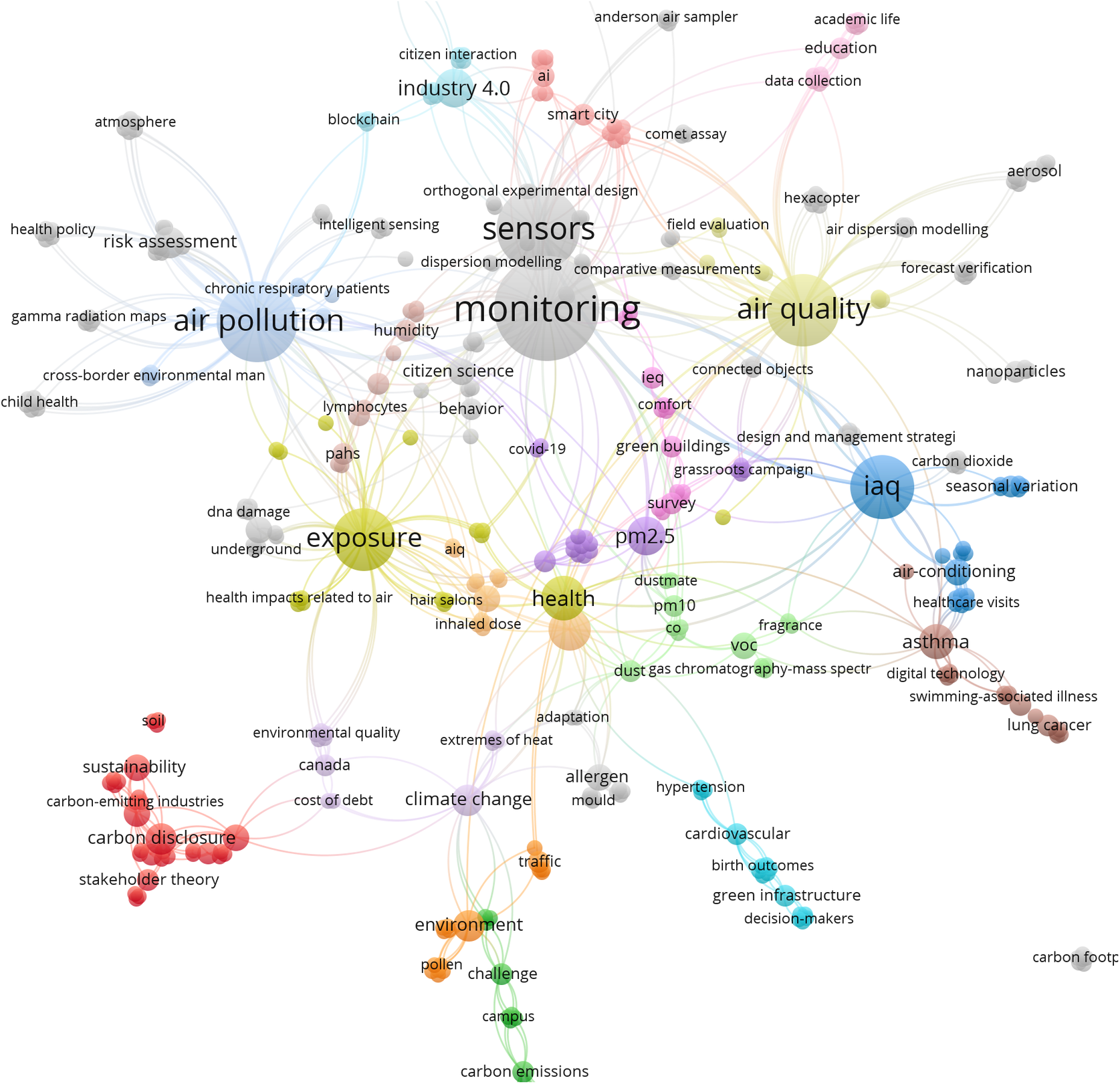
Despite the high importance of professionalism in environmental MRV, only scarce attention has been paid to this issue in the academic literature. The Web of Science Core Collection contained only 214 articles that relate to environmental MRV, air pollution or carbon emissions, and professionalism, based on the searchFootnote 1 performed on 15 January 2023. Figure 1 illustrates the keywords that have been paid the most attention to by scholars and their linkages, based on co-word analysis using VOSviewer. The five most frequently occurred keywords are monitoring (41), sensors (26), air pollution (25), air quality (20), and indoor air quality (16), with a frequency of occurrences in parentheses (Table 1). If reading closely the full texts of the search results, there is only one article that concerns about professionalism in auditing air pollution control outcomes. To ensure data quality, the authors proposed to use e-contracts and blockchain to trace economic activities that emit air pollution (Dai et al., Reference Dai, He and Yu2019). The rest of the articles mainly discuss low-cost sensors and compare them with professional devices (Jiang et al., Reference Jiang, Bregt and Kooistra2018), and a few examine how health (Cromar et al., Reference Cromar, Duncan, Bartonova, Benedict, Brauer, Habre, Gayle, Haynes, Khan, Kilaru, Liu, Pawson, Peden, Quint, Rice, Sasser, Seto, Stone, Thurston and Volckens2019) and financial professionals utilize monitoring data (Kim and Park, Reference Kim and Park2022). It is clear that a technical view dominants and the lack of attention to professionalism is a global phenomenon.
Keyword clusters reported by VOSviewer.
Frequency of occurrences of author keywords in the academic literature
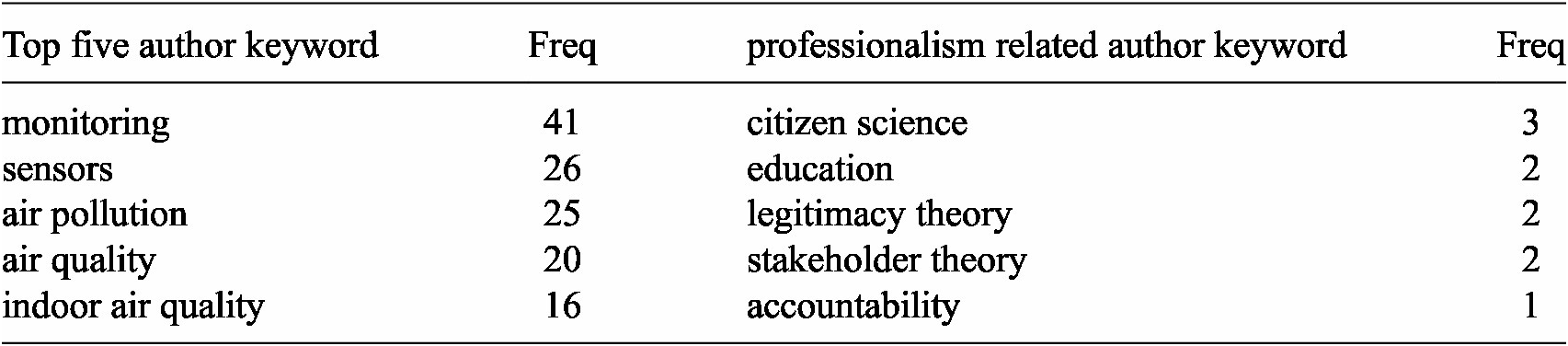
Keywords co-occurred with professionalism are citizen science education legitimacy theory stakeholder theory, and accountability, all with a frequency of occurrences of less than 5. The results echo mechanisms for enhancing accountability of police officers, such as engaging local communities in surveillance and reporting (Ali and Nicholson-Crotty, Reference Ali and Nicholson-Crotty2021; Blair et al., Reference Blair, Weinstein, Christia, Arias, Badran, Blair, Cheema, Farooqui, Fetzer, Grossman, Haim, Hameed, Hanson, Hasanain, Kronick, Morse, Muggah, Nadeem, Tsai, Nanes, Slough, Ravanilla, Shapiro, Silva, Pedro and Wilke2021; Tobón, Reference Tobón2021). Although efforts made to facilitate crime reporting by the public (Nanes et al., Reference Nanes, Ravanilla and Haim2023), community policing has not been effective in building citizen trust or reducing crime in the Global South (Blair et al., Reference Blair, Weinstein, Christia, Arias, Badran, Blair, Cheema, Farooqui, Fetzer, Grossman, Haim, Hameed, Hanson, Hasanain, Kronick, Morse, Muggah, Nadeem, Tsai, Nanes, Slough, Ravanilla, Shapiro, Silva, Pedro and Wilke2021). Similarly, the availability of low-cost sensors could enable the social enforcement of environmental regulations and policies and possibly reduce agency shirking and slack of MRV service providers. It remains a big challenge to build public trust in the environmental MRV systems and enhancing professionalism of the workforce
3. MRV of air quality and carbon emission in China
The organization of the MRV work can take various forms, such as internal provision within the government hierarchy and/or outsourcing to the third parties in the market. The choices of institutional design shape principal–agent relationships, which in turn affect the quality of the MRV work (Li and Huang, Reference Li and Huang2020). As both carbon and air pollutant emissions arise from the burning of fossil fuels, carefully analyzing air quality monitoring can inform the design of effective MRV for carbon emissions reduction.
The Chinese National Environmental Monitoring Center (CNEMC) under the Ministry of Ecology and Environment (MEE) is responsible for building national environmental monitoring networks. Before 2013, EPBs at a local level (provincial, prefectural and county) were responsible for maintaining and operating the monitoring stations in the national network and transmitted the data upward to the CNEMC. The transboundary reality of air pollution creates externality and also free riding among government officials who desire to meet the environmental performance targets with minimum efforts or least disruption to local economic growth. Scholars found evidence of data manipulation because cities tended to adjust the downward air pollution index (API) to just below 100 for qualifying a clean air dayFootnote 2 if it was actually above the threshold (Chen et al., Reference Chen, Jin, Kumar and Shi2012; Ghanem and Zhang, Reference Ghanem and Zhang2014). The former minister of the environment, Jining Chen, also publicly acknowledged the inaccuracy of air quality monitoring data (Xinhua Net, 2016).
To increase data accuracy, starting in 2013, the MEE centralized to the CNEMC and contracted out to third parties in the market the responsibility of operating and maintaining air quality monitoring stations in the national network (General Office of the Central Committee of the Communist Party of China and General Office of the State Council, 2016). Similarly, provincial EPBs also contracted to environmental MRV service providers the operation and maintenance of their provincial air quality monitoring networks (Li and Huang, Reference Li and Huang2020).
The equipment and technicians responsible for operating and maintaining the equipment have to be stationed somewhere near the monitoring stations and dedicate their time to the monitoring work. Both the capital and human investment in air quality and carbon emissions monitoring has a high degree of asset specificity (Li and Huang, Reference Li and Huang2020).
Instead of output, the MEE regulates the inputs and working procedures necessary for producing air quality and carbon emissions data (State Environmental Protection Administration, 2007). However, given the limited manpower and distance, it is difficult for the CNEMC and the provincial EPBs to closely check the input by their agents and to monitor whether the operational guidelines have been strictly followed by the technicians (Li and Huang, Reference Li and Huang2020).
Criminalization of environmental data fraud can create a sufficient deterrent effect on the third parties and the regulated emitters if there is a high chance of being caught, which depends on whether data quality can be discerned and whether the penalties are sufficiently heavy. However, with a total of 43,000 enforcement officers and 1.3 million polluting firms in China (Ministry of Ecology and Environment, 2021), assuming an enforcement visit to a polluting firm once a month (12 times a year), a pair of enforcement officers would need to make 725.58 enforcement visits per year. The limited enforcement capacity coupled with a lack of culture of compliance of the regulated polluters, it is doubtful whether the Chinese government would be able to detect and penalize possible wrongdoings effectively.
Unsurprisingly, falsification of carbon emission data was also discovered in 2021. Between October and December 2021, the MEE sent a working group to each of the 31 regions in China for supervising the MRV work to ensure data quality for the national carbon market. Four of the largest consulting firms eligible for verifying carbon emissions data for the regulated power generators had colluded with their clients. They faked coal samples, falsified or faked testing reports, and included unchecked information in the conclusions. The MEE published those cases on its website on March 14, 2022, providing evidence on the challenge of holding the environmental professionals accountable (Ministry of Ecology and Environment, 2022).
The effectiveness of climate finance has been compromised by a lack of integrity in the MRV of carbon emissions embedded in business operations. China and other countries alike, face the following challenges in MRV overall. The transaction costs associated with operating and managing MRV are high, especially when ensuring consistency and accuracy of measurement of carbon emissions from highly diverse facilities with different technical specifications. At the same time, it is difficult to motivate and oversee the agents in their work and ensure data accuracy. However, there is no one-size-fits-all approach in setting up the MRV systems, and their effectiveness depends on the legal, administrative, and cultural factors in the broader contexts. For example, in the United States and European Union, a first-party compliance and verification system can be adopted, while a third-party system may be more suitable for China (Hinostroza et al., Reference Hinostroza, Lütken, Aalders, Pretlove, Peters and Holm2012; Bellassen et al., Reference Bellassen, Stephan, Afriat, Alberola, Barker, Chang, Chiquet, Cochran, Deheza, Dimopoulos, Foucherot, Jacquier, Morel, Robinson and Shishlov2015).
4. Ways forward
Collective actions for tackling climate change depend on the delineation of property rights, boundaries of authorities and responsibilities, and costs and benefits distributed among different stakeholders. Credible data sets are the foundation for designing the above institutions, but we can never take for granted the generation of and access to such information, especially in the complex multi-level and multi-stakeholder settings. The intricate principal–agent relationships call for attention to and research on the nontechnical institutional design of MRV systems.
Decisions and actions taken by the business community have significant implications for the world’s sustainability. Green finance rewards a firm’s nonfinancial performance, such as ESG or carbon emissions reduction, in the capital market. In this way, becoming environmentally and socially responsible aligns well with the profit-making objective of a firm. At the global level, there is no single standard for what ESG information should be reported. Based on self-reported ESG data, rating agencies produce ESG scores to make it convenient for investors to build their portfolios, such as the Dow Jones Sustainability Index, MCSI ESG Indexes, Domini400, Bloomberg SASB ESG Indices, S&P ESG Index, and FTSE4Good, to name a few (Widyawati, Reference Widyawati2020). The inconsistency in the evaluation criteria set by rating agencies has caused confusion for investors (Berg et al., Reference Berg, Kölbel and Rigobon2022). Worst of all, none of those indices validate the link with firms’ performance on the E, S, or G dimensions (Hawley and Shen, Reference Hawley and Shen2022). Enhancing the integrity of the MRV of ESG, carbon emissions, air quality, and other environmental data not only increases the credibility of the regulators but also incentivizes the invention and deployment of technologies and practices for climate mitigation and adaptation.
Beyond compliance and enforcement, the transition to sustainable lifestyles and consumption and production patterns are necessary for addressing climate change (UNFCCC, 2022). To induce voluntary practices of sustainable lifestyles, nudging has been advocated and tested for promoting actions with positive spillover effects, such as energy conservation, water consumption reduction, recycling, vaccination, and organ donation. Instead of forcing or paying people to behave in a certain way, nudging provides cues for people to make socially desirable decisions, softer than mandatory or economic incentive measures. Studies have demonstrated that people become more environmentally friendly if given the correct information. For example, electricity reduction can be achieved by including additional information in electricity bills, such as the average consumption of similar-sized homes in the neighborhood, and methods to change energy use (Carlsson et al., Reference Carlsson, Gravert, Johansson-Stenman and Kurz2021). Smart, low-cost, and affordable technologies offer possibilities of green nudges.
Thus, carbon neutrality and sustainability transitions demand not only accurate data but also the government that is capable of taking a holistic view, asking the right questions, and operating a repository that is accessible for all (van Maanen, Reference van Maanen2023). That could potentially empower citizens to share responsibilities in overseeing and reporting MRV violations. We expect to see heightened attention and efforts to capacity building. Talent education and training will be expanded to soft skills, such as deliberation, professionalism, and translating technical knowledge for easy understanding by laymen. The innovation system can then promote social learning across the four sectors, science, government, market, and civil society. Facilitated by the accurate information provided by the professionals, climate mitigation and adaptation can be better integrated into daily routines of businesses and families, to achieve carbon neutrality and a more sustainable future.
Data availability statement
The data that support the findings of this study are openly available in the Web of Science Core Collection.
Acknowledgments
The authors thank Professor Masaru Yarime for the helpful comments offered at the Data for Policy 2022 Conference. The authors would also like to thank the reviewers for their constructive comments and directions.
Author contribution
W.L. performed the following tasks that led to the publication of this article: conceptualization, funding acquisition, methodology, supervision, and writing the original draft. C.L. reviewed and edited the original draft. H.C.C. performed the following tasks that led to the publication of this article: data curation, formal analysis, methodology, project administration, and visualization.
Funding statement
This project is supported by the Public Policy Research Funding Scheme from the Public Policy Research Funding Scheme from the Chief Executive’s Policy Unit of The Government of the HKSAR under research grant PPR 2021.A1.121.21D. The funders had no role in study design, data collection and analysis, decision to publish, or preparation of the manuscript.
Competing interest
The authors declare none.


 Open access


Comments
No Comments have been published for this article.