




Introduction
Why do some cities and settlements last longer than others? Although archaeologists have studied thousands of early sites—particularly through regional surveys—the question of settlement persistence has rarely been addressed. Studies of the duration of individual settlements, for example, tend to focus on the sites’ historical particularities, while analyses of survey data either emphasise synchronic reconstructions of individual periods (e.g. settlement patterns, demography, land use), or track variables across time (e.g. political centralisation, trade). Consequently, sites are typically viewed as static sources of data rather than dynamic entities with social, cultural and physical attributes that may endure through time. In this article, we highlight persistence, or the length of time a site is occupied, as a key attribute in the study of human settlement. We seek to address the question of whether there are influences that operate on settlement persistence in a similar way across different regions. In particular, we explore whether there are aspects of archaeological data that support or limit the ways in which archaeologists can answer such questions.
The issue of settlement persistence is often overshadowed by a fascination with the process of collapse. Societal collapse catches the attention of scholars and the public alike. Writers have long wondered what led societies to collapse, such as, for example, the Classic Maya in the ninth century AD (Diamond Reference Diamond2005). Yet we know that most Maya cities were occupied for a millennium or more and endured as political capitals for many centuries. Should we not be as equally concerned with the centuries of success during which Maya cities persisted as we are with the century of decline? Furthermore, some settlements and cities persist even through periods of wider societal collapse. What accounts for the persistence of these individual sites despite the disappearance of their original settlement system?
A few archaeological studies have explicitly considered settlement persistence, although none has done so in detail. Fletcher (Reference Fletcher and Bintliff2004: fig. 7.7), for example, graphs settlement persistence against city size for large, ancient political capitals, finding equivocal results. Wilkinson (Reference Wilkinson, Chase and Scarborough2014: fig. 13.7), presenting a similar graph but including sites of all sizes, finds an inverse relationship (i.e. larger sites are less persistent than smaller sites). Other studies focus on settlements of specific periods or regions. Fernández-Götz and Ralston (Reference Fernández-Götz and Ralston2017) graph the persistence of a selection of European Iron Age settlements, demonstrating that these centres have diverse population histories. Meanwhile, Feinman and Carballo (Reference Feinman and Carballo2018) plot the lifespans of major Mesoamerican capitals, reporting a weak association between persistence and degree of collectivity of polity governance and a lack of association between persistence and maximal city size. We build on these studies using larger, more rigorous cross-cultural samples and quantitative analysis, introducing an archaeological method that can address the topic of settlement persistence.
Settlement persistence has recently been argued to be a relevant topic in relation to urban sustainability (Smith et al. Reference Smith2021b). The many fields that study cities and urbanisation, including the emerging transdisciplinary field of ‘urban science’, have identified social processes and interactions common to population agglomerations and urbanisation across time (Lobo et al. Reference Lobo, Bettencourt, Smith and Ortman2020). It is thus plausible to ask whether some of these common processes explain why some settlements and settlement systems lasted longer than others. Here, we describe several archaeological measures that can address this topic. We use high-quality archaeological data from seven diverse regions of the world (Figure 1) to examine the average length of occupation, or settlement persistence, within each region, and question whether the resulting distribution patterns can illuminate the nature of the forces that generated this variation. To further understand what processes contributed to these distribution patterns, we then explore the relationship between average persistence patterns and environmental productivity. Finally, for select regions, we ask whether the persistence of individual settlements is related to the size of their populations. Our findings suggest that, with some exceptions, larger settlements in more productive regions tend to persist longer.
Map of case study locations (figure by N. Gauthier).

What is settlement persistence?
Settlement persistence (or persistence of occupation) is a measure of the length of continuous use of a well-defined place of human occupation (Smith et al. Reference Smith2021b). While archaeologists have excavated and recorded many thousands of ancient settlements and assigned dates to their occupations, settlement persistence itself is rarely considered. Yet archaeology makes a unique contribution to the study of sustainability because, in the words of Robert Costanza and Bernard Patten, “[t]he basic idea of sustainability is quite straightforward: a sustainable system is one which survives or persists” (Costanza & Patten Reference Costanza and Patten1995: 193). In the study of climate-change responses, adaptation is a key concept (Sobel Reference Sobel2021), and persistence is a measure of the success (or failure) of past settlements in adapting to stresses and shocks.
Data and methods
Archaeological data for studying the continuity of site occupation come from three sources: relatively full-coverage regional surveys; inventories of regional sites, such as those maintained by government agencies; and special-purpose compilations, such as those created for individual research projects. Assembling data appropriate for measuring persistence within a broader region, however, presents numerous challenges: large regional survey datasets may offer little specificity about any single site, while inventories of sites may incorporate data with widely varying resolution and accuracy, and special-purpose compilations may be limited to or biased towards particular classes of sites with certain characteristics.
We selected seven case studies for this study (Table 1; Figure 1), which include examples of all three types of the above source data. These case studies were identified on the basis of accessibility, use of explicit and reliable survey methods, and archaeologically visible variation in settlement duration. Each case study dataset includes foundation and abandonment dates for each settlement, inclusion of sites with continuous occupation across multiple archaeological phases and sites with phases of abandonment and re-occupation. For analytical purposes, each uninterrupted occupation of a single location was treated as one data point, referred to as an OccLocation.
Overview of case studies.

Despite access to clean and well-documented datasets, substantial effort was needed to reformat the data in order to undertake comparative analysis. Differences in data collection and survey methods—which influence site identification, chronological designation and size estimations—complicate comparative evaluation (see Green & Petrie Reference Green and Petrie2018). Our analysis required us to standardise terminology, identify sites with multiple phases of occupation when original datasets were organized by phase, identify the continuity or discontinuity of multi-phase occupations, and reconcile differences in the identification of occupations. We also had to account for differences in the calendar dates used to define chronological periods. Details of the methods can be found in the online supplementary material (OSM), along with information about the seven case studies.
While persistence is a term that can be applied to any type of human aggregations from hunter-gatherer camps to modern cities, the determinants of persistence vary for different degrees of sedentism. We seek to identify common patterns for permanent settlements in the analytical expectation that, as with other salient features of permanent settlements (such as scale, density, and spatial form), there were common generative mechanisms.
Occupation lengths and period designations
Within an archaeological survey, sites are often assigned to specific chronological periods based on changes within the material record (e.g. types of pottery). Many sites, however, would not have been occupied for the entire chronological span of a period. Across all the case studies, we had to determine how systematically to assign occupation lengths to sites with period-based chronologies. In this respect, we used the methods in Dewar (Reference Dewar1991) and Kintigh (Reference Kintigh1994), which employ the frequencies of single versus multiphase sites to provide an estimate of the number of contemporaneous settlements during a period and to estimate the average occupation span of sites for each period (see the OSM). In datasets where site-specific dates were available (US Southwest and Fertile Crescent), these were used instead. In the US Southwest, for example, material culture data from the cyberSW database were gathered and dates were assessed using an empirical Bayesian approach (Ortman Reference Ortman2016; Mills et al. Reference Mills2018) to determine settlement occupation based on the frequencies and overlapping date ranges of ceramic types present at each settlement. After determining the specific chronological period spans for each dataset, we calculated individual time spans for all discrete chronological phases for the combined datasets as a whole.
Given the variability in the data available for each case study, it is also prudent to consider how differences in regional recording traditions of variables such as site size or the precision of chronological phases may influence the patterns documented. In the case of site size, where possible, we selected large survey datasets in which site size was estimated using the same methods by the same researchers across the entire sample. In some cases, however, this was not possible, such as in the central Italy and US Southeast datasets, which combine data recorded by many researchers over many years. Thus, in the analysis below we do not use these particular datasets for comparisons involving settlement size. The US Southwest dataset also represents a compilation of data from many different sources, but we are confident that the site size estimates (based on surface room counts) are consistent, as these data have been compiled and cleaned by a single team of researchers and only are included for settlements where systematic room counts are available (Wilcox et al. Reference Wilcox, Gregory, Hill, Gregory and Wilcox2007; Mills et al. Reference Mills2013). Of course, there may still be differences in size estimates between projects; therefore, we only make comparisons across datasets based on general patterns and features of distributions rather than in terms of absolute settlement sizes.
The issue of chronological resolution and its influence on the measurement of settlement persistence is complex where phase-based data are used. This is because phases may differ in length between datasets, as well as within individual datasets. In many archaeological sequences chronological resolution is coarser in earlier phases and more fine grained in later periods. Thus, it is important to consider what impact such chronological divisions may have on persistence data. In order to explore such patterns, Figure 2 shows a scatter plot for the four datasets, using phase-based persistence estimates. In this plot, the x-axis represents the mean estimated occupation length of sites that intersect with each phase and the y-axis represents the length of that phase. As this plot illustrates, the relationship between phase length and mean occupation length is variable.
Plot showing mean estimated occupation lengths against phase length (figure by M.A. Peeples).

There is a tendency for sites in the Santa Valley that are occupied in longer and earlier periods to have higher persistence values, while in the other three datasets the relationship is much weaker and inconsistent between phases. In the OSM, we explore this pattern further and note that, for the Santa Valley, many of the longest-lived settlements were occupied in the earliest phases (with the longest date ranges), whereas we do not see such an association for the other datasets, in which the longest-lived settlements tend to be multi-phase sites occupied across several shorter phases. Based on these results, we might expect some of the longest-lived settlements in the Santa Valley to have over-estimated occupation lengths due to the coarse chronological resolution. As we discuss below, the Santa Valley sample also has the lowest median occupation length of all the datasets considered, suggesting that the number of sites impacted is relatively small in relation to the regional sample. The Santa Valley sample also has a low proportion of multi-phase sites (approximately 12.5 per cent), which probably further drives down the median value. Overall, this initial exploration suggests that we should be concerned with the potential impact of chronological resolution; however, the datasets considered here highlight that we can be reasonably confident that this factor is not the primary driver of inter-regional patterning, at least in terms of multi-phase sites.
Another potential lingering issue with the use of phase-based data is our inability to identify breaks in occupation at a settlement within a particular phase. This potential issue is less severe when phases are shorter, but even relatively short archaeological phases can span generations. There is likely no one-size-fits-all solution to this problem. It would be prudent, however, to investigate well-excavated sites where possible and assess the degree to which such serial occupation did or did not occur. Excavations at Formative period sites in highland central Mexico, for example, demonstrate that these settlements often caused sufficient environmental degradation that they were not reoccupied on archaeological-phase timescales (Lesure et al. Reference Lesure2013). In the absence of specific evidence to evaluate this issue, we suggest that archaeological estimates of persistence—for single-phase sites in particular—might tend toward overestimates.
Results
Settlement persistence by region
As with most variables of interest to social scientists, settlement persistence is stochastic: it can assume more than one value due to chance, but there are typical values. Even if underlying processes (e.g. cultural, political, environmental) interacted—strongly or weakly—to determine the longevity of a settlement, these processes exhibit variability, which, in turn, leads persistence to exhibit variability. With enough data, it is possible to discern spatial and temporal patterns in the behaviour of a stochastic variable, despite the effects of ‘noise’. The study of settlement persistence should therefore strive to identify the probability distribution governing the behaviour of persistence (Forbes et al. Reference Forbes, Evans, Hastings and Peacock2011). The stochasticity of settlement persistence presents complications for empirical investigation. Issues that must be considered before drawing conclusions include sample size, biased sampling (e.g. are data only available for large-sized settlements?), truncated distributions and the well-known difficulties of robustly identifying the data-generating distribution (e.g. the ability to identify a true underlying distribution in noisy datasets, even in cases where the distribution is known a priori).
To gain initial insight into possible stochastic processes contributing to persistence, we first consider the distribution of settlement persistence for each regional case study. Figure 3 shows histograms of site occupation lengths for each dataset and reveals differences in the median settlement occupation lengths. All but one (northern Fertile Crescent) of the distribution patterns are heavy tailed, meaning that they have numerous outliers far from the mass of settlements clustered around the mean values. An empirical heavy-tailed distribution can be tested for its fit using various models, such as lognormal, Pareto, Exponential and Lévy distributions and power law distributions (Clauset et al. Reference Clauset, Shalizi and Newman2009).
Histograms of settlement persistence by region. The dotted line represents the median occupation length for each study area (figure by M.A. Peeples).

Heavy-tailed distributions are noteworthy for two reasons. When a distribution is light tailed (such as the familiar Normal Distribution), extreme-valued observations are rare and most observed values tend not to deviate significantly from the mean; with heavy-tailed distributions, observations significantly different than the mean can occur more frequently. Heavy-tailed distributions are a source of concern in statistical analysis, since the most commonly utilised methods of statistical analysis regression techniques assume that the data and noise are well-described by symmetric distribution and non-heavy-tailed distributions (Resnick Reference Resnick2007).
Our results suggest that the resolution of chronological phases is a major factor that affects whether we can attribute heavy-tailed distributions to a specific distribution form. These results suggest that in portions of the US Southwest, where the chronological resolution is in the order of 25–50-year intervals for most of the sequence, both lognormal and power-law distributions present viable descriptions for the observed empirical pattern; however, differentiating between these models (which imply different underlying behavioural processes) requires careful contextualisation. This difference matters because it may suggest that we need fine-grained chronological resolution in order to argue confidently for particular generative processes using the most robust statistical approaches (e.g. Clauset et al. Reference Clauset, Shalizi and Newman2009).
Regional environmental potential
Every aspect of social life requires the use and distribution of energy (Smil Reference Smil2018). The underlying processes responsible for settlement persistence—from social dynamics to the construction and use of physical infrastructure—all make demands on societies’ ability to access and use energy. For societies in the past, the quality and quantity of available energy were largely determined by the natural environment in which they were embedded. We thus need to consider the macro-regional environments that would have directly affected settlement persistence. To assess relative differences in baseline potential to sustain human populations for each study area, we compared settlement persistence to modern environmental productivity. For this, we use net primary productivity (NPP), a measure of the amount of energy stored in plant biomass available to humans for food, fuel and fibre consumption (see Tallavaara et al. Reference Tallavaara, Eronen and Luoto2018; Freeman et al. Reference Freeman2020).
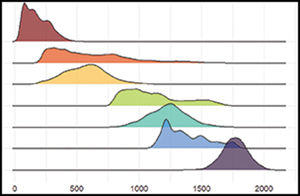
Although realised NPP (i.e. actual biomass production) depends on a host of environmental factors (e.g. Zaks et al. Reference Zaks, Ramankutty, Barford and Foley2007), we focus on climatic potential productivity, a simple yet effective measure of large-scale climatic constraints on biomass production. Specifically, we used the Miami model of Lieth (Reference Lieth1973), which estimates climatic potential NPP as a function of two limiting factors: mean annual temperature and total annual precipitation. It uses globally calibrated empirical functions to relate each climate variable to potential NPP, the lowest of which (i.e. the ‘limiting factor’) is taken as the final NPP estimate. These data are shown in Figure 4.
Kernel density estimates of potential net primary productivity (NPP) under average 1979–2013 temperature and precipitation in each regional case study, arranged in order of increasing median NPP (figure by N. Gauthier).

Both mean annual temperature and total annual precipitation have varied significantly throughout the Holocene, as have the technologies and land-use practices that determined how efficiently past societies could extract energy from plant biomass. Nonetheless, present-day climatic NPP is a reasonable upper-bound estimate of relative differences in environmental potential that can be consistently applied across the various study areas. Future work might incorporate more detailed reconstructions of past climate, technology and land use, and their change over time (e.g. Turchin et al. Reference Turchin2021).
NPP tells us about overall productivity, but settlement persistence is related both to the stability of production and total production. Here, we assume that higher overall production results in greater buffering against unstable production conditions. We might expect settlements in environments with higher potential NPP to have persisted for longer timespans, all else being equal, as food producing communities in such areas would be able to provision their populations more consistently. To explore this possibility directly, Figure 5 plots the median NPP against the median settlement persistence. For both axes, the error bars around each point are defined as the interquartile range of each variable.
Plot showing the median potential net primary productivity against the median settlement persistence in years. The error bars for each point show the interquartile range of values for the corresponding axis (figure by M.A. Peeples).

As Figure 5 shows, there is no clear relationship between NPP and persistence among the case studies. In particular, the northern Fertile Crescent sample is variable in terms of both NPP and persistence, with overall longer median persistence than the other study areas but relatively low NPP. On the other end of the spectrum, the US Southeast shows the least variability in terms of both NPP and persistence, and generally shows relatively low persistence, despite displaying the highest NPP values. The remaining five datasets show a linear trend, with greater NPP associated with greater longevity (r2 = 0.82, F = 13.53, df = 3, p = 0.03479). We are cautious in drawing strong conclusions from this pattern due to the small sample size. Unsurprisingly, the two outliers from the linear pattern described here (northern Fertile Crescent and US Southeast) are the datasets where only large settlements are included in the sample. This is a relationship worth exploring in greater detail in the future. Our data show that settlements in more productive regions will often last longer. The variation within the results, however, indicates that environmental potential is not the sole factor that determines a settlement's longevity.
Settlement size and persistence
There is a rich research tradition in archaeology and anthropology regarding the importance of scale and how it affects social dynamics (Carneiro Reference Carneiro2000). Population size and density have proven to be important determinants of many salient socio-economic characteristics of settlements. Previous studies, both of ancient and contemporary settlements, have demonstrated super-linear scaling (increasing returns to scale) with greater settlement size (Lobo et al. Reference Lobo, Bettencourt, Smith and Ortman2020). Following that line of research, we might expect larger settlements to have longer occupation spans due to the efficiency of infrastructure and the concentration of resources. To evaluate this possibility, we explore the relationship between settlement size and duration for the four study areas with internally consistent population size or area estimates (Santa Valley, the Basin of Mexico, Yautepec Valley and the US Southwest). For each of these datasets, we divide settlements into five population size classes. These bins represent arbitrary divisions of a continuous range of variation, and other breakpoints are possible. Figure 6 shows the distribution of settlement longevity for each population size class within each of the four study areas. Except for the Yautepec Valley, which shows a trend toward increased longevity with increased population, there is no clear relationship between settlement population and duration.
Box plots comparing maximum site population size and persistence measure for the four regions with well-defined population estimates (figure by M.A. Peeples).

The relationship between settlement population size and persistence therefore appears to be mediated by a variety of other factors. The fine-grained settlement data from the US Southwest allow us to explore this issue in more detail. Previous research has shown that settlement size increased through time during a number of periods of punctuated settlement growth (Adler Reference Adler1996; Adams & Duff Reference Adams and Duff2004). As Figure 7 shows, settlements larger than 1000 people were rare in the earliest centuries of the timeframe considered here, and settlements larger than 1000 rooms in our database include only those with foundation dates of AD 1200 or later. Thus, the largest settlements only relate to the later centuries of the timeframe considered here and cannot, by definition, be among the longest-lived settlements. One way to address this is to consider the proportion of the total period of interest that a particular settlement's occupation covers. This provides a measure of the possible length of duration that a site fills within the period in question, given the date of its foundation.
Settlement peak population by start date for the US Southwest case study (figure by M.A. Peeples).

Figure 8 shows that, when we take foundation date into account in the US Southwest, larger settlements clearly persist longer than the smallest settlements. Another factor that can influence the relationship between settlement size and longevity is temporal edge effects—that is, the increased potential of distorted results at the temporal starting and ending boundaries of a dataset. In the Basin of Mexico, for example, the most common site type is a single-phase occupation dating to the Aztec period. Because this is the final period in the dataset, the possible duration of these sites is artificially truncated. As Figure 9 shows, excluding those single-phase settlements results in a general upward trend in the median value of settlement longevity by size, although there is still considerable overlap between size categories.
Settlement persistence as proportion of the potential persistence (period from beginning of site occupation to AD 1500) for settlements in the US Southwest by size class (figure by M.A. Peeples).

The Basin of Mexico, excluding single-phased sites founded during the final period included in the dataset, by size class (figure by M.A. Peeples).

Conclusion: the analytical usefulness of settlement persistence
In this article, we have introduced a formal method of examining settlement persistence that specifically addresses persistence of occupation across diverse archaeological datasets. We find that settlement occupation lengths tend to be heavy tailed, meaning that a few long-lasting sites have an outsized influence on regional distributions. We also find that larger settlements tend to last longer than smaller ones when temporal edge effects are accounted for, and that there is a weak positive correlation between regions with greater environmental productivity and greater settlement longevity. These findings suggest that there are specific measures that can be applied systematically to questions of settlement persistence.
Our results reveal some of the potential biases of working with archaeological settlement data, including sampling bias and edge effects. The histogram results from the analysis of occupation duration raise the issue of skewness, requiring us to question whether the results are an artefact of data collection or a reflection of the past generating processes of the data itself. Understanding the origins of skewness matters, because in some cases the mean is not an informative reflection of what is typical (Wilcox Reference Wilcox2003). Within the northern Fertile Crescent, for example, the distribution is, in part, a result of the dataset, which comprises selected urban centres within a specified focal period that inherently affect the distribution outcome, but also reflects a period of unprecedented urban boom and bust (Lawrence et al. Reference Lawrence, Palmisano and de Gruchy2021). Temporal edge effects are equally problematic and accurately accounting for their inherent bias is crucial, as illustrated by excluding the single-period Aztec sites in the Basin of Mexico dataset. Overcoming these issues will require more comparative analysis that incorporates further standardised case studies, in order to associate the patterns identified more firmly with the larger process of settlement persistence.
Can studying ancient settlement systems help us better understand the contemporary, and urgent, challenges of urban sustainability and urban adaptation to climate change? Settlement persistence is sustainability and resilience made manifest. It is the result of social interactions and decisions otherwise hard to ‘see’ in the material record. We contend that there is variation in settlement persistence that is not simply a result of environmental conditions or settlement size. Human agency and creativity—culture, institutional diversity and identity—influence observed settlement patterns. For a settlement or settlement system to endure, its inhabitants and institutions must adapt to changing environments and learn to solve new collective action problems (e.g. situations where individuals’ choices have interdependent outcomes, such as the case with the provisioning of public goods). For settlements and settlement systems to persist, societies must find ways to live within ecological balance. Long-term settlement persistence probably requires both resilience and sustainability, as we can assume regular exogenous shocks of different magnitudes, as well as baseline continuity in the capacity to reproduce the system. Which types of resilience can be inferred from persistence? A recent article argues that cities can more easily recover from natural disasters (e.g. earthquakes), physical destruction (e.g. aerial bombing) and epidemics (e.g. bubonic plague) than economic or political dislocations (Glaeser Reference Glaeser2022). The historical depth and cultural scope of urban resilience needs to be greatly expanded in order to make such conclusions more robust. We contend that investigating settlement persistence can strengthen our understanding of contemporary sustainable urban development and urban adaptation by expanding the temporal depth and diversity of human agglomeration experiences.
A quarter of a century ago, Costanza and Patten (Reference Costanza and Patten1995: 193–94) observed that “the basic idea of sustainability is quite straightforward: a sustainable system is one which survives or persists. Sustainability, at its base, always concerns temporality, and in particular, longevity.” Despite this observation, much of the field of urban sustainability science today fails to take account of past urban processes and dynamics. A 2018 National Science Foundation report on urban sustainability science, for example, does not include a single reference to cities in the past (Ramaswami et al. Reference Ramaswami2018).
The analyses presented in this article thus provide a means to incorporate past settlement dynamics into research on contemporary urban sustainability. Further identification of general processes affecting settlement persistence can propel the development of a theoretical and explanatory framework that encompasses collapse, resilience and robustness, illuminating the relationship between these three salient features of any socio-ecological system (Smith et al. Reference Smith2021b). Such a framework can, in turn, help develop the empirical narratives needed to demonstrate how knowledge about past settlements is fundamental to understanding the development of cities today and of their ability to adapt, and therefore persist, in the future.
Acknowledgements
Given the comparative nature of this research, we wish to thank all those researchers who contributed to generating and making accessible the datasets that we used. We would also like to thank the reviewers for their constructive feedback.
Funding statement
Funding for this research was provided by a seed grant from the School of Human Evolution and Social Change. The US Southwest data were gathered as part of the NSF supported cyberSW project (1738181, 1738245, 1738258, 1738062). The compilation of the northern Fertile Crescent dataset was supported by the European Research Council under the European Union's Horizon 2020 research and innovation programme for the project CLaSS: Climate, Landscape, Settlement and Society: Exploring Human Environment Interaction in the Ancient Near East (grant no. 802424, award holder: Dan Lawrence).
Supplementary materials
To view supplementary material for this article, please visit https://doi.org/10.15184/aqy.2022.175.


 Open access

