

Introduction
Violence against women (VAW) is a serious global problem, with almost one-third of women aged 15 years and older worldwide estimated to have experienced physical and/or sexual violence by an intimate partner or non-partner or both at least once in their lifetime (World Health Organization [WHO] 2021, 33). In response, international normative frameworks have been implemented with the intention to prevent and eliminate VAW, recognizing it as a gender-based violence and human rights violation. Conventions such as the 1979 United Nations (UN) Convention on the Elimination of All Forms of Discrimination Against Women (CEDAW), the 1993 UN Declaration on the Elimination of Violence against Women (DEVAW), and the 1995 Beijing Declaration and Platform for Action provide the “organizing principles or standardized procedures that resonate across many states” (Krook and True Reference Krook and True2012, 104). An increasing number of countries have subsequently ratified international frameworks to address and protect against VAW, adopting these into various national measures, such as legal reforms, educational efforts, and services for survivors. Yet, the implementation of these policies largely relies on the actions of subnational governments where most VAW cases are reported and responded to. Why do some but not all subnational governments adopt policies to implement VAW response services? Surprisingly, few studies have addressed this critical question and limited knowledge exists on whether and how national measures are diffused to the subnational level.
This paper responds to this knowledge gap in the Indonesian context, exploring why some subnational governments adopt policies to implement VAW response services and others do not despite the Indonesian government’s national policy commitment to eliminate VAW. To answer this question, we consider existing theories based on previous studies on the diffusion of policies to advance gender equality (True and Mintrom Reference True and Mintrom2001) and eliminate VAW across countries (Htun and Weldon Reference Htun and Weldon2012), as well as contextual gender policy reform theories emerging from studies of Southeast and South Asian states (Cagna and Rao Reference Cagna and Rao2016; Mollica et al. Reference Mollica, Davies, True, Eddyono, Fonseka and Johnston2022). This scholarship helps identify the factors that might explain the adoption and non-adoption of policies to implement VAW prevention and response services at the subnational level.
Both norm diffusion and public policy scholarship highlight implementation issues, in particular the gap between national government commitments and local-level institutional practices (Betts and Orchard Reference Betts, Orchard, Betts and Orchard2014, 12; Hill and Hupe Reference Hill and Hupe2002, 7–8). From a norm diffusion perspective, the process of introducing international norms’ precepts into formal policy mechanisms within a state is understood as norm implementation (Betts and Orchard Reference Betts, Orchard, Betts and Orchard2014, 2). In this study, we consider the adoption of policies to prevent and respond to VAW at the subnational level as a process to implement national policy frameworks at the local level. Although policy adoption in itself does not end VAW, local government action that institutionalizes VAW policies is a vital implementation process that enables street-level service delivery for protection, prosecution, and prevention. It is at the local level where survivors first access the services to report violence experience and receive medical and/or psychosocial treatment as well as legal assistance. Local policy is an important implementing instrument of the state’s institutional approach to address VAW, informing the scope of services to support survivors, funding allocation, and the roles of local government and non-governmental organizations (NGOs) in implementing the services at the local level. Accordingly, we sought to understand how international and national legal frameworks are diffused to subnational governments to enable local-level implementation of VAW prevention and response services.
To study the subnational diffusion of policy to implement VAW response services, we focus on the case of Indonesia, the world’s largest Muslim-majority democracy with decentralized governance and legal pluralism. This paper tests the relevance of existing theories within a non-Western subnational setting and extends gender policy diffusion theories to consider other salient factors, such as the role of religion. VAW policies adopted by city/regency governments are important because they translate national laws into the local context where contending norms exist. They provide legal clarity for public service delivery to assist survivors and prevent violence. In Indonesia, local authorities at the city/regency level have broad legislative autonomy due to decentralization, which was introduced in 1999 during the early democratic reform period. This autonomy affects how national laws and policies are translated and implemented at the local level. Additionally, Indonesia’s pluralistic legal system is crucial to consider in the analysis of policy diffusion since it recognizes Indigenous or customary (adat) laws and Islamic laws alongside national or civil laws (Lukito Reference Lukito2013, 6). Studies found that discrepancies between local customary rules and national laws on VAW can hinder survivors from accessing justice and perpetuate impunity for VAW (Lestarini, Pranoto, and Tirtawening Reference Lestarini, Pranoto and Tirtawening2021, 160–2; Mollica et al. Reference Mollica, Davies, True, Eddyono, Fonseka and Johnston2022, 621). For these reasons, understanding the key factors that influence local policy adoption to implement VAW response services is vital knowledge for VAW policymakers and advocates, as well as contributing to theory-building in the gender and politics field.
In the next section, we explain the context of VAW policy action at the national and subnational levels in Indonesia. The second section then focuses on the relevant theories explaining the subnational diffusion of policies to implement VAW response and prevention services. The third section outlines the strategy to analyze data from 509 cities/regencies from 2004 to 2022 using an event history model. We explain the model results on the most significant factors associated with the adoption of local policies to prevent and respond to VAW and interpret them in light of the politics of VAW policymaking in the Indonesian case. Our findings show that the presence of local NGOs connected with national and transnational VAW advocacy networks, and women’s local legislative representation are significant factors. This finding provides further evidence for the critical role of advocacy networks in institutional change and gender policy reform. However, province-level morality regulations that codify contending conservative norms constrain the progressive effects of advocacy networks and women’s political presence. Through this study, we demonstrate a research approach to examining subnational policy diffusion and identifying the factors that influence policy change to implement VAW response services at the local level.
VAW Problem and Policy Action in Indonesia
VAW remains a critical problem in Indonesia. According to the 2021 Indonesian National Women’s Life Experience Survey, 26% of women aged 15–64 have experienced physical and/or sexual violence by a partner or non-partner (Ministry of Women’s Empowerment and Child Protection [MOWECP] 2022, vii). Based on the National Commission on Violence Against Women’s (NCVAW) annual reports, the number of reported VAW cases, capturing physical, psychological, and sexual violence in both private and public spaces, increased 100-fold from 3,169 reports in 2001 to 339,782 reports in 2022 (NCVAW 2001, 1; 2023, 15). This sharp increase reflects both improved reporting systems and the pervasiveness of VAW across the country. However, these figures are likely to underestimate the true scale of the problem, as many cases remain unreported due to institutional and sociocultural barriers (Noer, Chadijah, and Rudiatin Reference Noer, Chadijah and Rudiatin2021, 2; Palermo, Bleck, and Peterman Reference Palermo, Bleck and Peterman2014, 609–10).
At the national level, the Indonesian government has shown compliance with international frameworks and adopted several laws to criminalize and eliminate VAW. Indonesia ratified CEDAW in 1984 and committed to international frameworks to eliminate VAW, including the Beijing Declaration and Platform for Action and the UN DEVAW. Since the democratic transition in 1998, the government has made incremental institutional and policy changes to address VAW. The first milestone was the establishment of the NCVAW or Komnas Perempuan as a quasi-autonomous policy agency to address and prevent VAW in the country (Blackburn Reference Blackburn1999, 439). This marked formal state recognition of VAW as gender-based violence and a human rights violation, aligning with UN DEVAW and departing from the earlier legal framing under the Criminal Code, which treated extramarital sexual violence as an offense against public morality (Blackburn Reference Blackburn2004, 196–7). Following this, the government issued the Zero-Tolerance Policy on VAW in 1999 and launched the National Action Plan on the Elimination of VAW in 2000 (Munir Reference Munir2005, 3–4).
The subsequent adoption of Law No. 23/2004 on the Elimination of Domestic Violence marked a substantial legal change. It criminalizes domestic violence as a human rights violation, particularly affecting women, and includes physical, sexual, psychological, and economic violence within households, covering spouses, children, other family members, and domestic workers. These were not recognized in the national Criminal Code, which excluded gender-based violence in the domestic sphere (Katjasungkana Reference Katjasungkana and Lindsey2008, 485). The law also mandates government services for survivor protection and violence prevention. To support implementation, the national government adopted regulations such as Government Regulation No. 4/2006 on recovery services for domestic violence survivors and MOWECP Regulation No. 2/2008, which provides guidelines for provincial and city/regency governments to implement comprehensive institutional measures for VAW response. In 2022, the Indonesian government adopted Law No. 12/2022 on Sexual Violence Crimes, which expands the criminalization of VAW, incorporating nine types of sexual violence, including physical and psychological abuse, sexual exploitation, and technology-facilitated sexual violence, in private and public spheres. These national laws and regulations signify Indonesia’s compliance with the international frameworks to end VAW and formalize a normative shift from VAW as a moral and private issue to a human rights violation requiring state action (Katjasungkana Reference Katjasungkana and Lindsey2008, 485; Yentriyani Reference Yentriyani, Bexley, Dong and Setyonaluri2023, 191).
Subnational Policy Diffusion Gap to Implement National VAW Laws
International progress in the diffusion of laws and policies to address VAW at the national level in Indonesia is disconnected from the local level diffusion and implementation. Local-level policy efforts to eliminate VAW in Indonesia can potentially be more consequential than the national level due to decentralization reform. Decentralization in Indonesia established regional autonomy (otonomi daerah) that devolves extensive executive and legislative authorities to cities (kota) and regencies (kabupaten), or district level at the sub-provincial level (Nasution Reference Nasution2016, 4). Cities and regencies hold the most substantial executive and legislative autonomy to deliver most public services, including health, education, public safety, and social welfare. Provinces have limited consultative and supervisory functions for cross-city and regency coordination. The heads of governments and members of the regional parliament (DPRD) at the provincial and city/regency levels are democratically elected, shifting political accountability closer to local communities (Aspinall and Fealy Reference Aspinall, Fealy, Aspinall and Fealy2003, 4). Within this system, local governments issue legislations and policies to exercise regional autonomy and translate the national laws and regulations to deliver programs and public services at the local level (Butt and Lindsey Reference Butt and Lindsey2018, 62).
Despite its significance for local service implementation, the institutionalization of local policies to prevent and respond to VAW at the city/regency level remains uneven. The anti-domestic violence law and MOWECP Regulation (no. 2/2008) specify that local governments are responsible for administering local policies and programs, establishing facilities, and allocating budgets to implement services for survivors. However, by 2022, only 159 (31%) of 509 cities and regencies in Indonesia had adopted local regulations (peraturan daerah) on women’s protection from violence.Footnote 1 Given the decentralization structure, these regulations are critical to inform local governments’ program planning and delivery in providing the primary services to prevent and respond to VAW. The diffusion of city/regency regulations on women’s protection from violence across one-third of cities and regencies indicates a positive development in policy norm implementation to eliminate VAW at the subnational level, but remains a theoretical and empirical puzzle with approximately 70% of the cities and regencies not adopting local regulations by 2022, almost two decades after the Law on the Elimination of Domestic Violence was enacted. How can we explain the subnational gap in policy adoption to implement VAW response services?
Explaining Subnational VAW Policy Diffusion
Scholarship on gender reforms and policy diffusion suggests four main factors that influence the adoption of policies that advance women’s rights and reduce VAW. First, advocacy networks involving women’s NGOs as well as other actors such as social movements, religious organizations, parts of regional and intergovernmental organizations, and parts of executive and legislative branches of government, ranging across international and domestic levels, are critical in introducing and advocating policies to advance gender equality. Second, women parliamentarians are important policy actors who, in their own right, can facilitate the adoption of policies that are informed by women’s gendered experiences. Third, governmental institutional mechanisms can support the socialization of new policy norms by facilitating policy networks across jurisdictions. Fourth, the perceived compatibility between new policy norms and preexisting normative frameworks also influences the likelihood of policy diffusion.
In regards to the first factor, norm and policy diffusion literature highlight the significant role of transnational advocacy networks in facilitating the diffusion of gender equality and women’s rights policies internationally across countries (Keck and Sikkink Reference Keck and Sikkink1998, 180–1; True and Mintrom Reference True and Mintrom2001), and domestically across subnational jurisdictions (O’Brien Reference O’Brien2015). Transnational advocacy networks connect government and non-governmental policy actors across international and domestic levels, including international organizations, civil societies, and government officials, who are bound by shared principled ideas or norms in their efforts to influence policy outcomes (Keck and Sikkink Reference Keck and Sikkink1998, 2, 9; True Reference True2016b, 311; True and Mintrom Reference True and Mintrom2001, 38). In contrast to feminist political scientists who differentiate between autonomous and state-oriented forms of women’s organizing and transnational feminism, emphasizing the types of actors involved (Htun and Weldon Reference Htun and Weldon2018; Kelly-Thompson et al. Reference Kelly-Thompson, Lusvardi, Forester and Weldon2024), international relations (IR) scholars underscore that advocacy networks are defined by shared principles or values among diverse actors operating across jurisdictions to influence policy outcomes (Keck and Sikkink Reference Keck and Sikkink1998; True and Mintrom Reference True and Mintrom2001). IR scholars conceptualized networks not only as norm-promoting actors but also as political structures where differently situated non-state and state actors negotiate and validate the social, cultural, and political meanings of the shared norms (Keck and Sikkink Reference Keck and Sikkink1998, 3; True Reference True, Orchard and Wiener2024, 203). Studies show that these networks facilitate multiple pathways to accessing information, resources, and services among NGOs, state policy agencies, and international organizations in advocating for and implementing policies to eliminate VAW (Medie and Walsh Reference Medie and Walsh2021; Montoya Reference Montoya2013; O’Brien Reference O’Brien2015).
The second factor highlighted in the comparative gender and politics literature is women’s participation in government, particularly as legislators. Moving beyond the critical mass theory that simplifies the relationships between the number of women’s descriptive representation and substantive policy outcomes for women, scholars have explained how substantive representation of women occurs and identified critical actors promoting policy change to advance women’s rights (Childs and Krook Reference Childs and Krook2009). Critical actors can be men or women legislators or leaders, but studies often focus on women. Childs (Reference Childs2006) and Kalra and Joshi (Reference Kalra and Joshi2020), for example, found that women parliamentarians do not simply act for women because of their sex, but the intersection of their gender, social, educational, and party identities influences their understanding of gender differences and support for gender-responsive policies. Other factors that influence women parliamentarians’ actions and impact include formal rules and informal political norms in the legislative institutions (Francheschet Reference Francheschet, Krook and Mackay2011, 68–73), and connections with other advocacy actors such as experts, international organizations, and civil society groups (Sawer Reference Sawer2012, 327–8). The contingent effect of women’s presence in legislative and executive positions in influencing substantial policy outcomes for women’s rights continues to be a debate in gender and politics scholarship. Some studies found that the number of women in parliament is not a significant factor influencing the adoption of policies to advance women’s rights at the national level (Htun and Weldon Reference Htun and Weldon2018, 79; True and Mintrom Reference True and Mintrom2001, 49) and the findings at the subnational level remain mixed (Bochel and Bochel Reference Bochel and Bochel2008; Bratton and Ray Reference Bratton and Ray2002). Testing the influence of women’s legislative representation in different contexts can contribute to further understanding the substantial effect of women’s presence in political offices.
Third, norms and policy diffusion research suggest that institutional mechanisms can facilitate the socialization and emulation of new policy norms. Demonstration effect theory predicts that policy diffusion occurs when governments emulate a model policy that had been previously adopted by another government based on the information about the policy’s success and normative influence (Kubicek Reference Kubicek and Kubicek2002, 5; Starr Reference Starr2021, 126–7). Information sharing, learning, and socialization about policy norms and practices are more likely when institutional mechanisms promote and sustain connections or networks between governments (Checkel Reference Checkel and Checkel2007, 9–14; Mintrom and Vergari Reference Mintrom and Vergari1998, 128–9). Norms and policy diffusion literature show that institutional mechanisms such as intergovernmental organizations and international conferences can facilitate policy networks and socialization (True and Mintrom Reference True and Mintrom2001, 38; Wotipka and Ramirez Reference Wotipka, Ramirez, Simmons, Dobbin and Garrett2008, 332–3). Studies on subnational policy diffusion of policies to advance women’s rights in federal or decentralized countries suggest that domestic institutional mechanisms such as higher-level policy references and intergovernmental policy coordination or coalition can foster vertical and horizontal policy learning and emulation across subnational governments (Fay and Polischuk Reference Fay and Polischuk2021, 429; Kim Reference Kim2013, 595).
Fourth, preexisting normative frameworks also influence policy diffusion. Norm diffusion literature suggests that the advocacy process for new policy norms is more straightforward if there is compatibility or congruence between these policy norms and preexisting local normative frameworks (Acharya Reference Acharya2004, 241; Checkel Reference Checkel1999, 87). Htun and Weldon (Reference Htun and Weldon2018) also suggest that policy ideas to advance women’s rights are more likely to be resisted if they are perceived to be doctrinal policy issues that challenge the local religious or customary doctrine. Studies in several Asian and Latin American countries show that advocacy of policies to prevent and respond to VAW often faced resistance because the contents are considered to contradict the dominant local patriarchal customary or religious doctrine on gender relations, which privilege men in gender relations and construct sexual matters as private and taboo (Cagna and Rao Reference Cagna and Rao2016, 282–3; O’Brien and Walsh Reference O’Brien and Walsh2020, 128–9). The challenge of VAW policy resistance is more complex when there are institutional mechanisms that strengthen the influence of contending conservative norms and their supporting groups in policymaking, such as the legal pluralism system that legitimizes policies based on conservative customary and religious norms on gender relations, family, and morality (Hajjar Reference Hajjar2004, 19–20; Mollica et al. Reference Mollica, Davies, True, Eddyono, Fonseka and Johnston2022, 616–7). Resistance to women’s rights policies due to contending conservative norms should not be understood simply as a regressive reaction to international human rights frameworks, rather they reflect a complex transnational political dynamic of policymaking and implementation shaped by colonialism, globalization, and domestic politics (Hajjar Reference Hajjar2004, 15; Mir-Hosseini Reference Mir-Hosseini2011, 19–20).
Other factors that also affect policy diffusion are economic factors and time. Following modernization theory, higher levels of economic development are positively associated with policy change to advance women’s rights. Improved economic status expands the social, political, and economic opportunities for women and shifts social and political conditions to be more supportive of gender equality (Inglehart and Norris Reference Inglehart and Norris2003, 34–5). Additionally, policy and norm diffusion literature suggest that the passage of time and momentum can influence policy diffusion. Increased socialization and mobilization on a policy issue over time, which is driven by policy actors, networks, and institutional mechanisms, will lead to a tipping point of higher policy adoption and diffusion (Finnemore and Sikkink Reference Finnemore and Sikkink1998, 902; True and Mintrom Reference True and Mintrom2001, 43).
Considering these gender reform and policy diffusion theories, in this study, we explore the empirical influence of advocacy networks, women parliamentarians, and institutional factors on the subnational diffusion of policies to implement VAW response services in Indonesia. With statistical inference, we can ascertain which factors are most significant in facilitating the adoption of regulations on women’s protection from violence across 509 cities/regencies in Indonesia between 2004 and 2022.
Analytical Strategy
To identify the factors associated with the adoption of city/regency regulations on women’s protection from violence in Indonesia, we employ event history analysis. This method is used in political studies to assess the “hazard rate” or the probability that a unit will experience an event during a particular period, given that the unit is at risk or has not experienced the event at that time (Allison Reference Allison2011, 3–5; True and Mintrom Reference True and Mintrom2001, 36–7). The aim is to examine whether a set of independent variables affects the probability of event occurrence. Coefficients on variables of interest are estimated using the standard logit or probit models (Berry and Berry Reference Berry and Berry1990, 398–9; True and Mintrom Reference True and Mintrom2001, 36–7).
The dataset constructed for this study contains year-by-year information on 509 cities/regencies in Indonesia during the 19 years from 2004 to 2022. The first observation year is 2004, which is when the Indonesian Law on the Elimination of Domestic Violence was adopted and this law sets the legal foundation for the implementing regulations at national and subnational levels. The observation ends in 2022, which is the most recent year for which data were available during the study period. To explore the relationships between the dependent variable and the independent variables and estimate the variable coefficients, we employed logit models. The sub-sections below describe the dependent and independent variables for analysis.
Defining Policies to Implement VAW Response Services at the Subnational Level
This study examines the adoption of city/regency regulations (peraturan daerah kota/kabupaten) to implement VAW prevention and response services in Indonesia. These local regulations are enacted by the head of the city/regency government (a mayor or regent), and the city/regency parliament. They constitute the lowest tier of legislation within Indonesia’s legal hierarchy system and function to exercise regional autonomy, operationalize national laws and regulations, and guide the delivery of public services (Butt and Lindsey Reference Butt and Lindsey2018, 62). City/regency regulations inform the roles and responsibilities of local agencies and outline technical aspects of program planning and service delivery at the subordinate administrative level.
This paper examines the adoption of city/regency regulations on women’s protection from violence. These regulations are titled either as “the regulation on the protection of women” or “the protection of women and children,” or “the protection of women survivors of violence.” In the Indonesian context, the use of “women’s protection” in the policy title emphasizes the focus on the provision of programs and services to protect women and/or girls from gender-based violence. We included all city/regency regulations that contain three key provisions on the implementation of services to prevent and respond to VAW that comply with the international frameworks and national laws, particularly the 2004 national domestic violence law. First, these regulations reiterate that VAW is a violation of human rights and prohibit gender-based discrimination and violence, including physical, psychological, sexual, and economic violence in the private or domestic spheres. Second, they outline the scope of response services to protect survivors of VAW, including reporting or hotline services, coordination with the police, legal assistance, medical and psychosocial services, and safe house or shelter. They also include prevention programs, such as awareness-raising activities and educational campaigns. Lastly, the regulations provide guidance on the institutional mechanisms to implement these services, including budget sources and coordination among local stakeholders, such as local government agencies, NGOs, and communities. In this study, we focus on the adoption of city/regency regulations on women’s protection from violence that meet the three criteria above and do not examine the quality or variety of policy contents or the adoption of revisions or additional policies with similar objectives.
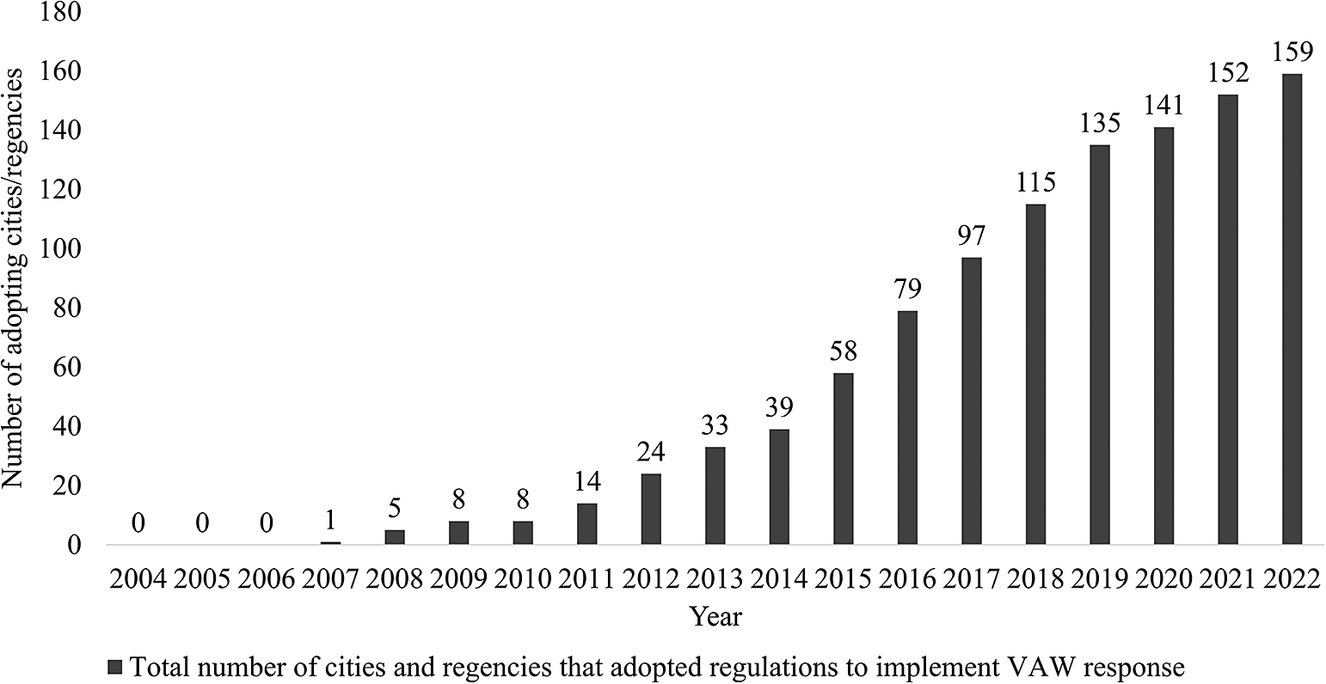
The constructed dependent variable for this study is the adoption of city/regency regulations on women’s protection from violence from 2004 to 2022. The data was sourced from the Indonesian government’s official online databases of laws and regulations (Indonesian National Audit Office 2023; Ministry of Law and Human Rights n.d.), cross-checked with other reliable online sources such as local governments’ websites and news media reports. The limitation of this approach is that there might be some omissions. For example, due to irregular updates, and local governments may not share their regulations on public platforms for technical or political reasons. Despite these potential limitations, we have included all the available city/regency regulations on women’s protection from violence adopted up until 2022 using credible online sources. The dependent variable is coded as a dichotomous variable (0,1), with “1” indicating the adoption of the regulation, and “0” for every year before adoption. In event history analysis, when a unit experienced the event during the observation period, in this case when a city or regency adopted the regulation on women’s protection from violence between 2004 and 2022, then their observation ended at the year of the event because they are considered to be no longer “at risk” of experiencing the event (True and Mintrom Reference True and Mintrom2001, 37). By 2022, 159 cities/regencies (31%) of 509 cities/regencies in Indonesia had adopted regulations on women’s protection from violence. The first adoption was in 2007 by Lumajang Regency in East Java Province. Since then, the number of cities and regencies adopting the regulations on women’s protection from violence increased steadily over the study period (see Figure 1).
The number of cities and regencies in Indonesia that adopted women’s protection regulations per year between 2004 and 2022.
Source: Authors’ calculation, based on government-sourced data.

Figure 1. Long description
The vertical Y axis is labeled Number of adopting cities forward slash regencies and ranges from 0 to 180 in increments of 20. The horizontal X axis is labeled Year and ranges from 2004 to 2022.
Data points are represented by dark vertical bars with the specific value printed above each bar. The trend shows zero adoption from 2004 to 2006. A slow increase begins in 2007 with 1 city, reaching 8 by 2010. From 2011 onward, there is a significant upward trajectory.
Key data values include
* 2011: 14
* 2013: 33
* 2015: 58
* 2017: 97
* 2019: 135
* 2021: 152
* 2022: 159
A legend at the bottom indicates that the bars represent the Total number of cities and regencies that adopted regulations to implement V A W response.
To analyze the factors affecting the likelihood of city/regency regulations on women’s protection from violence adoption, we employed event history analysis with a logit model.Footnote 2 The model helps to understand which factors (independent variables) are associated with the adoption of city/regency regulations on women’s protection from violence. Next, we discuss the independent variables that gender policy reform theories suggest can explain why local governments adopt policies to implement VAW prevention and response services in Indonesia.
Advocacy Networks (Transnational and National)
Politics and gender scholars have found that multilevel advocacy network involving women’s organizations at transnational and national levels is a major factor facilitating the diffusion of policy to advance women’s rights, including the elimination of VAW. To test the hypothesis that the multilevel advocacy network involving local NGOs, women’s organizations, religious organizations, customary-based organizations, universities, international organizations, and state officials increases the likelihood of VAW policy adoption, we include a variable on VAW advocacy networks. This variable indicates whether local NGOs are connected with transnational, national, or both types of advocacy networks in promoting shared principles and policy norms aimed at preventing and ending VAW that are aligned with international and national legal frameworks. Each city/regency is scored based on the presence of transnational and/or national advocacy networks. The score is “0” if there is no network, “1” if there is a presence of either transnational networks or national networks, and “2” if there is a presence of both transnational and national networks. The data for this variable is based on two transnational networks and two national networks that indicate their public advocacy to eliminate VAW. Based on these networks’ objectives, activities, and outputs, we consider participation in these selected networks as an indication of local NGOs’ activism in advocating and implementing policies and programs to reduce VAW that are aligned with the international and national legal frameworks.
Transnational Networks
The presence of transnational networks is indicated by the presence of local NGOs that participated in at least one of two internationally connected networks, which are the UN CEDAW meetings and period reporting mechanisms for Indonesia and the MAMPU program (Australia-Indonesia Partnership for Gender Equality and Women’s Empowerment).Footnote 3 Scholars argue that CEDAW and the subsequent UN declarations on VAW such as the UN DEVAW and the 1995 Beijing Declaration not only provide the normative frameworks to legitimize the prohibition and elimination of VAW, but also facilitate networking and mobilization of advocacy actors through meetings, reporting, and supporting programs (Merry Reference Merry2005, 93–5; True and Mintrom Reference True and Mintrom2001, 38; Zwingel Reference Zwingel2005, 411–5). Studies found that transnational advocacy networks facilitated by the UN CEDAW mechanisms have successfully promoted the institutionalization and diffusion of governments’ actions to address VAW in many countries (Keck and Sikkink Reference Keck and Sikkink1998, 192–4; True Reference True2016a, 5–7; Weldon and Htun Reference Weldon and Htun2013, 244–5).
The MAMPU program also forged a significant transnational network since it was a partnership program between the Indonesian and Australian governments implemented from 2013 to 2020 to support programs on women’s empowerment, including VAW reduction, in Indonesia (MAMPU 2020a, 8). The program supported the work of the NCVAW and various national networks of local NGOs to advocate for local regulations on women’s protection from violence and implement VAW prevention and response services (Supraptini and Lockley Reference Supraptini and Lockley2020, 1). Based on this reasoning, the presence of local NGOs that participated in either the UN CEDAW reporting mechanism or the MAMPU program networks indicates active engagements between local NGOs with international advocacy actors supporting policies and programs to eliminate VAW.
To construct the VAW advocacy networks variable, a list of local NGOs that participated in these two transnational networks was created. In total, 156 local NGOs were identified as participants in five UN CEDAW meetings and contributors to the NGO reports for the periodic reporting mechanisms between 2004 and 2022.Footnote 4 In addition, 80 local NGOs were identified to be part of the network supported by the MAMPU program.Footnote 5 These NGOs were then input into the dataset, matching their verified location and the year of the meeting, report, or engagement with the networks. Transnational networks are considered to be present in a city/regency in a given year if local NGOs based in the jurisdiction participated in the UN CEDAW meetings or reporting mechanisms, and/or were part of the MAMPU program networks.
National Networks
To indicate the presence of national advocacy networks on VAW, we use the list of local NGOs that contributed to the NCVAW’s annual reports on VAW in Indonesia (Catatan Tahunan) and the list of local NGOs involved in the advocacy network supporting the adoption of the Law No. 12/2022 on Sexual Violence Crimes. The NCVAW publishes annual reports on trends in VAW cases in Indonesia based on the aggregated data of VAW reports collected by the Commission and various service units, including local government service units for women and children’s protection, police offices, district courts, and NGOs. Data and information presented in these annual reports have been instrumental in supporting the advocacy of VAW programs and laws, including the Sexual Violence Crimes Law (Yentriyani Reference Yentriyani, Bexley, Dong and Setyonaluri2023, 190). The NCVAW’s reports include a list of contributing local NGOs that shared data on reported VAW cases. This source is used because each NGO’s year of contribution to the NCVAW annual report is identifiable, indicating both their local presence and active engagement in VAW response and national advocacy efforts.
The second national network is the advocacy network for the Sexual Violence Crimes Law. This advocacy was formally initiated in 2014 by the NCVAW in collaboration with networks of local NGOs, experts, and communities to develop the proposed bill (RUU TPKS) and its academic paper (NCVAW and FPL 2017, xiv). Until the law’s adoption in 2022, the advocacy network collected data, lobbied the parliament and government, organized public awareness campaigns, and addressed criticisms and oppositions, mainly from conservative religious groups (Yentriyani Reference Yentriyani, Bexley, Dong and Setyonaluri2023, 190–2). This network is a strong indication of an active national advocacy network working to eliminate VAW, connecting government organizations, women’s policy agencies, activists, religious organizations, universities, and NGOs across Indonesia.
In total, 281 local NGOs were identified as contributors to the NCVAW Annual Reports between 2004 and 2022, and 219 local NGOs were part of the Sexual Violence Crimes Law advocacy network active from 2014 to 2022.Footnote 6 Each NGO was input into the dataset, matching their verified location and the years of their participation in the networks. National networks are considered to be present in a city/regency in a given year if there are local NGOs that participated in at least one of the two national networks.
The advocacy network score for each city/regency is based on the presence or absence of local NGOs connected with the national and/or transnational networks. A city/regency’s score varies from year to year depending on local NGOs’ engagement with the transnational and national networks. Informed by existing gender policy diffusion theory (O’Brien Reference O’Brien2015; True and Mintrom Reference True and Mintrom2001), a higher score for this variable is associated with a higher likelihood of women’s protection from violence regulation adoption by the city/regency governments.
This variable should be seen as indicative of complex interactions among various policy actors across the transnational, national, and local levels. One limitation of the networks’ score is that some local NGOs may refuse to be identified in the UN CEDAW reports or other sources due to the sensitivity of the issues. As such, potentially numerous other local NGOs that have participated in the transnational and national networks related to CEDAW implementation and VAW advocacy may not have been identified by this study method. Nonetheless, the variable on advocacy networks was constructed using credible information from official documents and websites, providing a sound estimation of local NGOs’ connection with transnational and national VAW advocacy networks in Indonesia.
Policy Actors: Women’s Legislative Representation in Local Parliament
Within the government, female parliament members as policy actors are considered one of the important actors in advancing gender-responsive policy adoption. To test the hypothesis that a higher proportion of women in the local parliament will increase the likelihood of women’s protection from violence regulation adoption by city/regency governments, this study includes a variable on the percentage of seats held by women at the city/regency level parliament (DPRD kabupaten/kota). This variable is measured every five years, following the term of the government and the election cycle (i.e., 2004–8, 2009–13, 2014–8, and 2019–22).Footnote 7
Supporting Institutional Mechanism: Provincial Regulation on Women’s Protection from Violence
Theories suggest that institutional mechanisms can support policy diffusion, especially when they promote congruent norms and support policy networks on women’s rights protection. This study focuses on provincial-level regulations (peraturan daerah provinsi) on women’s protection from violence as a regional institutional mechanism that reinforces policy norms and networks to reduce VAW. Provincial regulations are legislations issued by provincial governments as the regional representatives of the national government to provide the normative frameworks and technical guidance on services implementation and coordination across cities and regencies within the province (Nasution Reference Nasution2016, 4). Although provincial governments do not have direct hierarchical authority over the subordinate jurisdictions and function more as coordinators, the legal compliance system sets the “hierarchy of laws” based on the vertical territorial order so that regulations issued by city/regency governments must follow the policy norms in the higher provincial regulations (Butt and Lindsey Reference Butt and Lindsey2018, 36). In addition, provinces in Indonesia are important in defining the regional normative frameworks, especially those with “special autonomy status” in governing religious affairs, local customary institutions, and development policies such as in Aceh, Papua, and West Papua provinces (Nasution Reference Nasution2016, 2). Accordingly, provincial regulations provide important regional frameworks for city/regency governments.
Moreover, provincial regulations also mandate coordination mechanisms to support the implementation of VAW prevention and response services, involving local government organizations, NGOs, and local community leaders. These coordination mechanisms can facilitate and strengthen VAW advocacy networks across the cities and regencies, thereby increasing policy socialization and learning on VAW elimination. Network building and communications within the province may be easier due to geographical proximity and sociocultural similarities.
We hypothesize that provincial-level regulations on women’s protection from violence will increase the likelihood of the diffusion of policy to implement VAW response services across the cities and regencies within the province. To test this, we included a variable on the availability of provincial-level regulation on women’s protection from violence. This study includes all the available provincial regulations on women’s protection from violence based on the same criteria and sources as the dependent variable. By 2022, 23 of 34 provinces (68%) had adopted the regulations on women’s protection from violence, with the first adoption occurring in 2005, one year after the anti-domestic violence law was enacted. Each city/regency is scored “0” if they do not have a provincial regulation on women’s protection from violence, and the score changes to “1” from the year the provincial regulation is adopted.
Constraining Norms: Provincial Morality Regulations
Contending normative frameworks can constrain policy advocacy to advance women’s rights, particularly those that reinforce conservative religious and social morality norms. This study considers provincial regulations (peraturan daerah provinsi) that regulate conservative morality norms as the constraining normative frameworks that can hinder the advocacy for women’s protection from violence regulations. Provincial morality regulations represent the institutionalization of local patriarchal customary and religious norms that reinforce male privilege and restrict women’s rights (Noerdin Reference Noerdin, Robinson and Bessell2002, 185; Robinson Reference Robinson and Hefner2018, 318).
Legal pluralism and decentralization affect the relative influence of local customary and religious institutions in policymaking in Indonesia. Scholars observed that since decentralization was implemented, there has been a revival of religious and customary identities in local politics, and policymakers at the subnational levels often adopt local conservative customary and religious norms as formal regulations for political competition, claiming that these norms are more appropriate and representative of the local society and identity (Mietzner Reference Mietzner and Hill2014, 52–3; Noerdin Reference Noerdin, Robinson and Bessell2002, 182). These morality regulations are framed as a means to preserve moral values by imposing strict rules and restrictions on activities or behaviors that are considered to affect public morality based on conservative interpretations of Islam, which is the majority religion (NCVAW 2010, 1; Robinson Reference Robinson and Hefner2018, 318). For example, some of the local morality regulations control sexual morality (e.g., pornography and indecent acts), restrict women’s dress code, impose religious activities as administrative requirements for public services, and regulate criminal punishment.
Compared with informal norms that are practiced socially and culturally, local morality regulations formally codify contending patriarchal norms, thus reinforcing their influence in policymaking and implementation. Studies found that these morality regulations are not only discriminatory toward women and minority groups, but they also obscure legal clarity for women’s access to justice and contravene national laws on human rights and VAW (Eddyono et al. Reference Eddyono, Fanani, Sabaniah, Maurice, Ghazali, Warlif, Velayati and Ciciek2016, 24–5; NCVAW 2010, 27–57; Noerdin Reference Noerdin, Robinson and Bessell2002, 185). In addition, the policymaking process for these morality regulations often privileges conservative religious groups and excludes NGOs that support the advancement of minority groups and women’s rights (NCVAW 2010, 60–3). This indicates that the relationships between governments and groups supporting conservative norms are stronger in jurisdictions with morality regulations, thus may hinder the progressive advocacy aimed at challenging women’s subordinate status and addressing their vulnerability to VAW.
We consider provincial morality regulations as a constraining normative framework and hypothesize that the adoption of women’s protection regulations is less likely in cities and regencies with higher numbers of provincial morality regulations. We focus on provincial regulations that are included in the NCVAW’s list of “discriminatory local regulations” which contain norms, codes, rules, and practices that discriminate and disadvantage women and minority groups (NCVAW 2010). The variable to test the hypothesis is the number of provincial morality regulations based on the NCVAW’s discriminatory local regulations list (NCVAW 2010). We included 27 provincial regulations recorded in 10 provinces (out of 34 provinces).Footnote 8 Each city/regency is coded with the number of morality regulations that have been adopted by its provincial government. The number increased with each addition of morality regulation adopted between 2004–22.
Control Variables: Economic Factors and Time Effects
This study includes a variable on the gross regional product (GRP) per capita (PDRB Per Kapita) at the city/regency level to test the hypothesis that a higher economic development level increases the likelihood of progressive women’s rights protection policy adoption. The number is calculated by dividing the city/regency’s total GRP by its population. It represents the amount of wealth available in a local jurisdiction, accounting for the size of its population. This study uses the amount of city/regency GRP per capita in constant (real) prices for each year in local currency (Rp).Footnote 9 The variable is expressed as the natural logarithm of the local GRP per capita quantity, considering a few high differences between cities/regencies with very high and low local GRP per capita, and the diminishing marginal effects of every addition of wealth.Footnote 10
To test the influence of policy diffusion momentum, this study included variables for period effects. In event history analysis, time control variables are included to capture the likelihood of the event occurrence in each period and test if the probability of an event varies over time (Allison Reference Allison2011, 20–1; Singer and Willet Reference Singer and Willett1993, 176).
To capture period effects, this study included four dichotomous (0,1) variables. Each variable refers to a five-year period of the government and parliament terms in Indonesia. These variables also test whether changes in governments influenced the political environment affecting the likelihood of women’s protection from violence regulation adoption at the sub-national level.
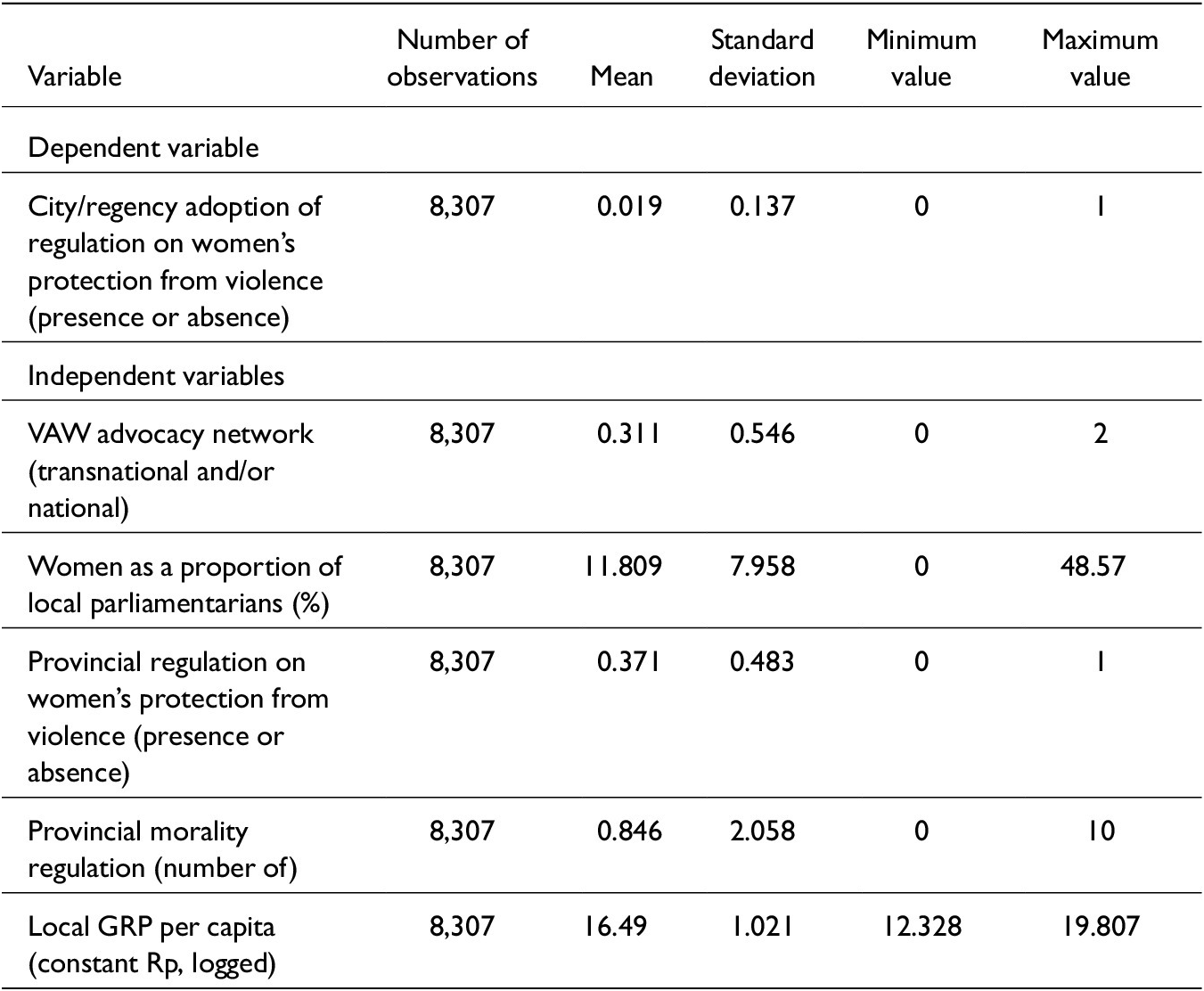
The summary statistics of the key variables are shown in Table 1. In total, there are 8,307 observations, representing the year-by-year information on 509 cities and regencies in Indonesia from 2004 until they adopted the regulation on women’s protection from violence or until 2022 for non-adoption. The value of the dependent variable and the variables on VAW advocacy network and provincial regulation on women’s protection from violence represent the nominal code described in the previous sections. The average percentage of seats held by women in local parliament is 11.81%, ranging from 0%, which is common in many cities/regencies, to 48.57% (Minahasa Regency, North Sulawesi Province in 2019–22). The variable on provincial morality regulations shows that out of 34 provinces, the majority of provinces do not have morality regulations (0), but Aceh Province has the highest number (10). On GRP per capita, before the numbers were transformed to the natural logarithm value, the average was Rp25.27 million (about 1,600 USD), ranging from the lowest Rp230,000 or about 15 USD (Yahukimo Regency, Papua Province in 2004) to the highest Rp400 million or about 26,600 USD (Morowali Regency, Central Sulawesi Province in 2022).
Descriptive statistics of the key variables

Table 1. Long description
The table consists of six columns: Variable, Number of observations, Mean, Standard deviation, Minimum value, and Maximum value. All variables have 8,307 observations.
* City or regency adoption of regulation on women's protection from violence (presence or absence): Mean 0.019, Standard deviation 0.137, Minimum 0, Maximum 1.
* V A W advocacy network (transnational and or national): Mean 0.311, Standard deviation 0.546, Minimum 0, Maximum 2.
* Women as a proportion of local parliamentarians (%): Mean 11.809, Standard deviation 7.958, Minimum 0, Maximum 48.57.
* Provincial regulation on women's protection from violence (presence or absence): Mean 0.371, Standard deviation 0.483, Minimum 0, Maximum 1.
* Provincial morality regulation (number of): Mean 0.846, Standard deviation 2.058, Minimum 0, Maximum 10.
* Local G R P per capita (constant R p, logged): Mean 16.49, Standard deviation 1.021, Minimum 12.328, Maximum 19.807.
Model and Analysis
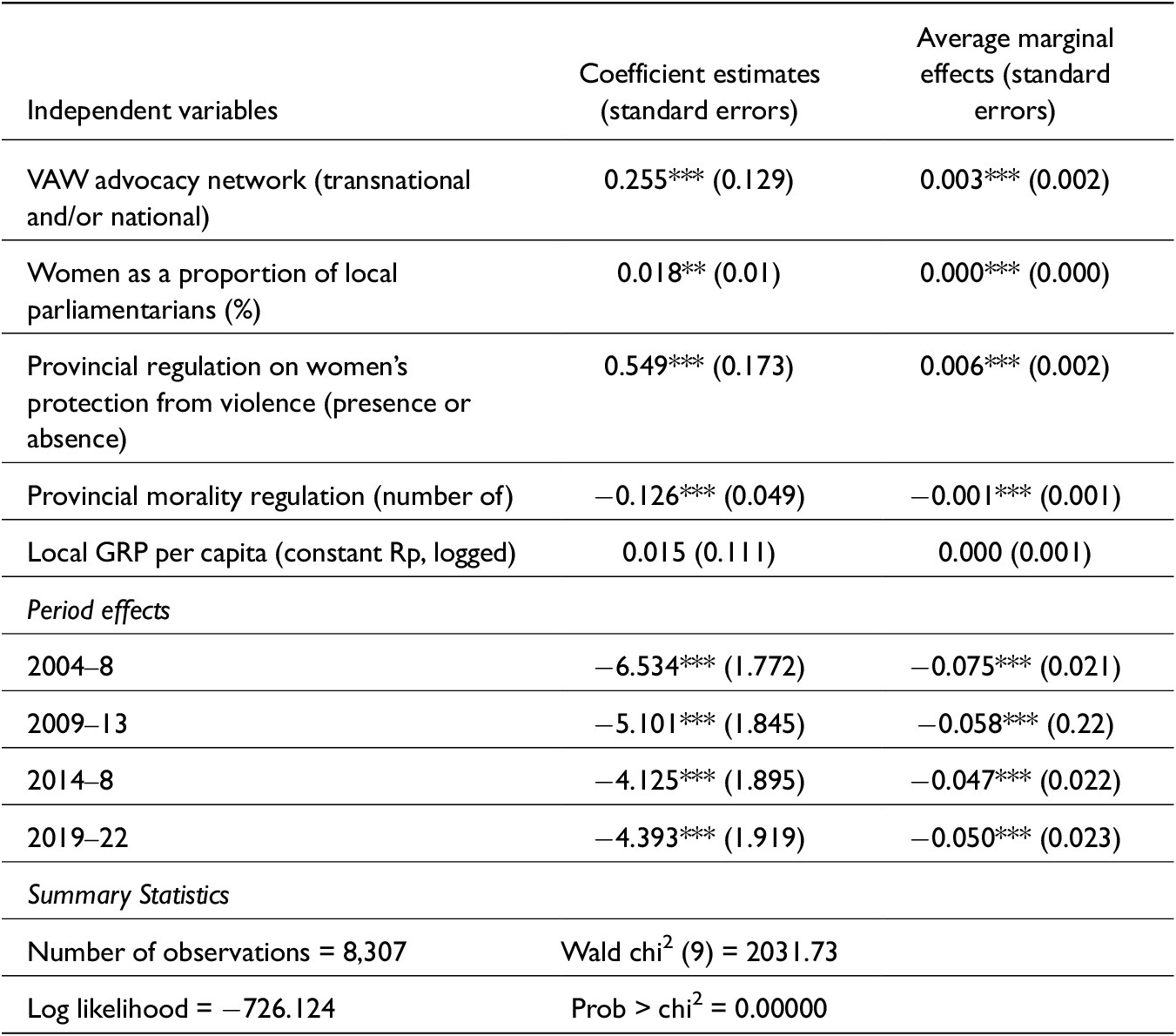
The results for the event history analysis model are presented in Table 2. The model generated highly significant results and supports our theoretical expectation that advocacy networks, women in local parliaments, and provincial-level institutional mechanisms to support women’s protection from violence are major factors in facilitating the diffusion of policy to implement VAW response services at the city/regency level in Indonesia. Importantly, we also find that the existence of provincial morality regulations that codify contending conservative norms constrain the progressive effects of advocacy networks and women’s political presence. These findings extend norm diffusion studies by showing how international policy diffusion, promoted by transnational advocacy networks, spawns localized advocacy networks that in turn drive subnational policy adoption for implementation purposes. It also extends the status and doctrinal politics theory in explaining subnational policy change to implement VAW response services (Htun and Weldon Reference Htun and Weldon2018, 17–9). Evidence from Indonesia demonstrates that mobilization and networking involving both governmental and non-governmental actors can facilitate the adoption of policies to contest women’s subordinate status and vulnerability to VAW. Moreover, the findings highlight the influence of doctrinal politics, showing that VAW policy advocacy is hindered by institutionalized conservative religious doctrine, which indicates the strong influence of groups that promote these norms within subnational policymaking processes.
Factors influencing the adoption of regulation on women’s protection from violence at the city/regency level in Indonesia
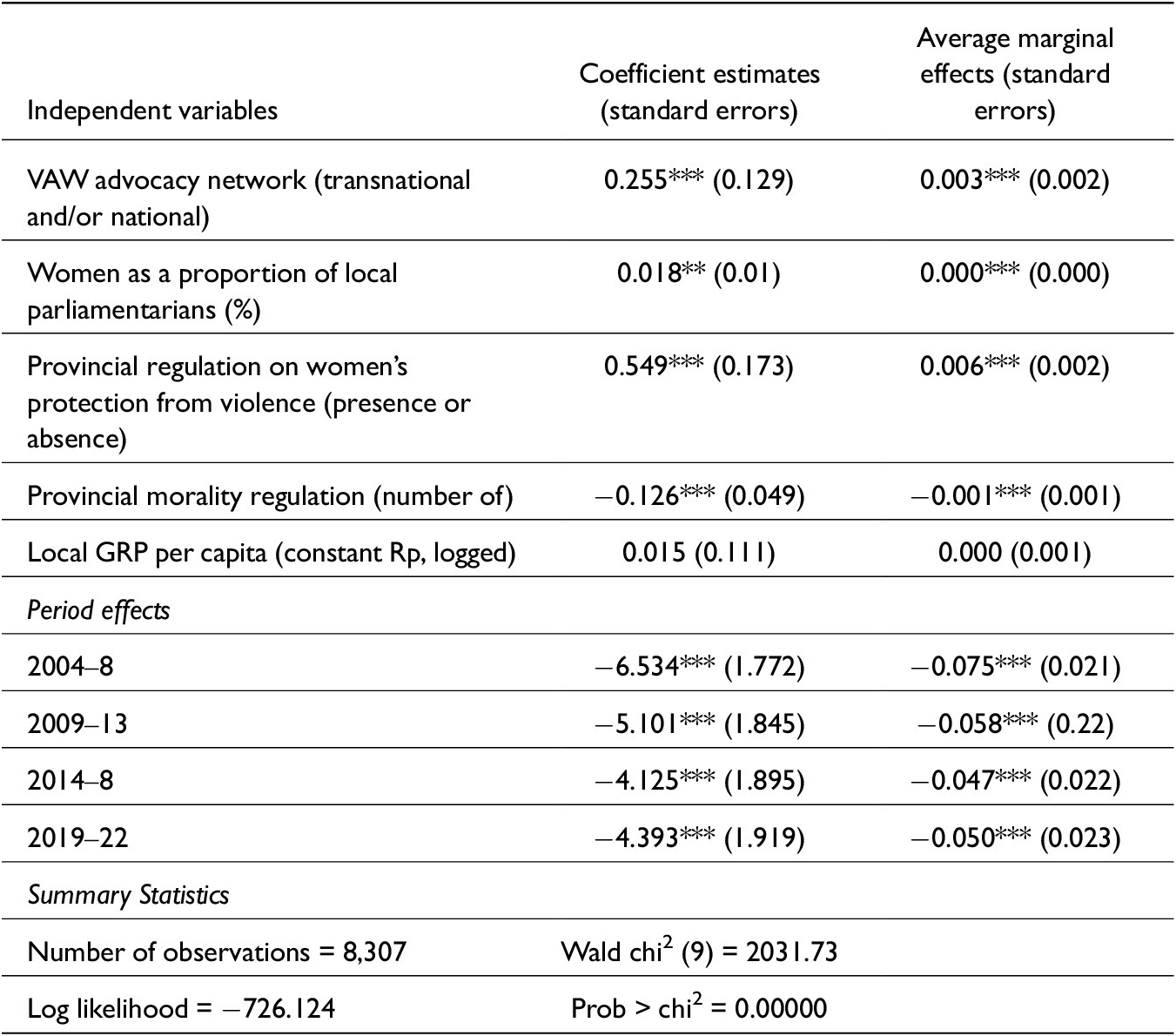
Table 2. Long description
A table with three columns: Independent variables, Coefficient estimates (standard errors), and Average marginal effects (standard errors).
Key findings include:
* V A W advocacy network: 0.255*** (0.129) coefficient; 0.003*** (0.002) marginal effect.
* Women as a proportion of local parliamentarians (%): 0.018** (0.01) coefficient; 0.000*** (0.000) marginal effect.
* Provincial regulation on women protection from violence: 0.549*** (0.173) coefficient; 0.006*** (0.002) marginal effect.
* Provincial morality regulation: -0.126*** (0.049) coefficient; -0.001*** (0.001) marginal effect.
* Local G R P per capita (logged): 0.015 (0.111) coefficient; 0.000 (0.001) marginal effect.
Period effects from 2004 to 2022 show negative coefficients ranging from -6.534 to -4.125, all significant at the 0.05 level.
Summary Statistics:
* Number of observations = 8,307.
* Wald chi super 2 (9) = 2031.73.
* Log likelihood = -726.124.
* Prob > chi super 2 = 0.00000.
Note: *** indicates significance at 0.05 level (two-tailed); ** indicates significance at 0.05 level (one-tailed).
Note: ***Significant at 0.05 level, two-tailed test; ** significant at 0.05 level, one-tailed test.
The presence of advocacy networks is a significant factor increasing the likelihood of city/regency regulation on women’s protection from violence adoption. The result indicates that the higher the advocacy network score, which means both transnational and national networks are present, the more likely it is that the city/regency governments will adopt regulations on women’s protection from violence. This supports the argument that multilevel networking among local NGOs, activists, experts, government officials, and international organizations has a significant effect on the subnational diffusion of policies to implement VAW response and prevention services (Keck and Sikkink Reference Keck and Sikkink1998; True and Mintrom Reference True and Mintrom2001). Overlapping memberships in domestic and international networks open up multiple channels to access information, funds, and expertise, which are especially important at the local level where the state capacity is weak and advocacy actors may have limited resources and access to participate in the transnational process (O’Brien Reference O’Brien2015, 288). Our data shows that many local NGOs were involved in multiple transnational and domestic networks, indicating an advocacy strategy that is based on network building across diverse actors and multiple levels to address gender injustice issues (Keck and Sikkink Reference Keck and Sikkink1998, 167–71; Moghadam Reference Moghadam2005, 13–4). Moving beyond the conceptual distinction between autonomous and state-oriented forms of feminist organizing, the findings suggest that networking and coalition building between governmental and non-governmental organizations can serve as a vital strategy for advancing policy change to eliminate VAW, particularly in the contexts with authoritarian legacies and strong cultural norms promoting consensus-style policymaking, such as in Southeast Asian (ASEAN) countries, and specifically Indonesia.Footnote 11
The significance of the advocacy networks variable also suggests that the NCVAW, as a quasi-autonomous women’s policy agency, plays an important role in bridging the state and non-state organizations. The NCVAW’s participation in the two national networks included in our advocacy networks indicates its key role in supporting the subnational diffusion of policies to implement VAW response services. Further qualitative research can provide more insights into how quasi-autonomous policy agencies like the NCVAW influence gender policy reform and implementation.
Our results also show that the adoption of regulations on women’s protection from violence is more likely when there is a greater presence of women parliamentarians in local parliaments. This finding indicates the contingent effect of women’s political representation in facilitating substantial policy reform to advance women’s rights, in contrast with other studies which show that the number of women parliamentarians is not a significant factor in influencing gender-responsive policy adoption (Htun and Weldon Reference Htun and Weldon2018, 80; True and Mintrom Reference True and Mintrom2001, 49). In the context of Indonesia, this finding is notable given the low average percentage of women in city/regency parliaments (11.81%). Despite their small numbers, women parliamentarians might have contributed to supporting substantive policy change to advance women’s rights. Research from Indonesia shows that women parliamentarians at the subnational level played a central role in formulating gender-responsive policies and lobbying fellow legislators for support (Jovani, Subono, and Suyanto Reference Jovani, Subono and Suyanto2020, 1052).
Certainly, the scholarship on critical mass theory has been more critical of the direct link between a specific percentage of women in parliament and substantial policy outcomes to advance women’s rights (Beckwith and Cowell-Meyers Reference Beckwith and Cowell-Meyers2007; Childs and Krook Reference Childs and Krook2009). It is not just women’s numerical representation that matters, but also the capability and identity of the female leaders, their political party ideology, and other institutional and social factors that influence their policy action (Childs Reference Childs2006; Francheschet Reference Francheschet, Krook and Mackay2011). How women legislators at the city/regency parliament in Indonesia catalyze policy adoption to implement VAW response services can be further investigated by qualitative research.
Institutional factors also play an important role. The results indicate that provincial-level regulation on women’s protection from violence is a significant factor that increases the likelihood of the adoption of city/regency regulations on the same issue. This is not surprising given Indonesia’s hierarchical decentralization governance and legal system where provincial regulations operate as higher-level policy references for cities and regencies. This finding indicates that promoting legal coherence across the national and subnational governments is important to provide legal clarity and increase the salience of policy norms to eliminate VAW at the local level, especially where local contending norms exist. Moreover, provincial regulations on women’s protection from violence can strengthen advocacy networks and policy actors who support women’s status improvements and resilience against VAW. By mandating coordination mechanisms for VAW prevention and response services, these regulations can facilitate network formation and regular interactions between women’s NGOs and local government organizations across the cities and regencies within the province.
The model suggests that provincial morality regulation is a constraining factor. The higher the number of provincial morality regulations that are discriminatory toward women and minority groups, the adoption of regulations on women’s protection from violence at the city/regency level will be less likely. Taking all other variables at their mean values, the probability of the women’s protection from violence regulation adoption at the city/regency level is 0% if provincial morality regulation is at the highest value (10). This finding resonates with research that found advocacy for policy to improve women’s rights and gender equality tends to be resisted in the context where conservative patriarchal norms have a strong influence in policymaking (Htun and Weldon Reference Htun and Weldon2018, 18–9; O’Brien and Walsh Reference O’Brien and Walsh2020). The provincial morality regulations formalize contending conservative customary norms as local regulations, resulting in conflicting legal codes on gender roles and women’s rights protection across jurisdictions. Disharmony between institutions and legal frameworks across jurisdictions not only obscures the legal norms to implement VAW response and prevention services but also complicates and hinders women’s movements and advocacy efforts (Adamson, Menjívar, and Walsh Reference Adamson, Menjívar and Walsh2020; Mollica et al. Reference Mollica, Davies, True, Eddyono, Fonseka and Johnston2022). In addition, the provincial morality regulations can strengthen the influence of groups and policy actors who support these conservative norms in local policymaking, increasing the resistance to the progressive influence of VAW advocacy networks and women’s political presence.
The constraining effect of discriminatory morality regulations on the adoption of city/regency regulations on women’s protection from violence, however, is not always straightforward. Our finding suggests that VAW advocacy networks were present and engaged in driving successful policy adoption to implement VAW response services in some of the cities and regencies with a high number of provincial morality regulations, such as Bireuen Regency in Aceh Province (10 morality regulations) and Pesisir Selatan Regency in West Sumatera Province (five morality regulations). Research shows that transnational advocacy networks can overcome the opposition of conservative local groups to VAW policy adoption by bringing in issue-specific expertise and transnational knowledge (O’Brien Reference O’Brien2015, 288). Further qualitative research can examine how different policy actors interact in local contexts to influence VAW policy adoption and implementation.
The period effects also emerged as significant variables, indicating that the likelihood of women’s protection from violence regulations adoption at the city/regency level increased over time. The significance of these variables indicates that socialization and advocacy of policy on women’s protection from violence heightened between 2004 and 2022. The heightened momentum might have been influenced by the Sexual Violence Crimes Law advocacy at the national level. This advocacy was officially launched in 2014 by the NCVAW and a coalition of NGOs (NCVAW and FPL 2017, xiv). As previously explained, this advocacy effort activated multilevel network-building among NGOs, experts, and state actors who delivered various activities such as public campaigns and stakeholders’ socialization until the Sexual Violence Crimes Law was adopted in 2022 (NCVAW and FPL 2017, xii–v; Yentriyani Reference Yentriyani, Bexley, Dong and Setyonaluri2023, 190–2). The continuous policy socialization and advocacy efforts by the networks might have increased public and political attention toward VAW problems and policy action, thus increasing the likelihood of women’s protection from violence regulation adoption at the city/regency level over time. In addition, the general elections at the national and subnational levels held every five years might have added to the political momentum and window of opportunity for VAW policy advocacy.
Finally, our results show that the measure of economic development, represented by local GRP per capita, is not significant. This result is consistent with gender policy reform theories and our theoretical expectations that economic wealth is less significant compared to VAW advocacy networks and women’s political presence as well as institutional factors in influencing the adoption of local regulations on women’s protection from violence (Htun and Weldon Reference Htun and Weldon2018, 80; True and Mintrom Reference True and Mintrom2001, 49).
We further analyzed how the probability of women’s protection from violence regulations adoption changes with the changes in the most theoretically and statistically significant variables in our dataset. Taking all other variables at their mean values, we found that there is zero chance of women’s protection from violence regulations adoption by city/regency governments when a city or regency does not have VAW advocacy networks, women’s legislative representation, and provincial regulation on women’s protection from violence. By contrast, when a city/regency has transnational and national VAW advocacy networks, the maximum percentage value of women in local parliaments (48.57%), a provincial regulation on women’s protection from violence, and zero provincial morality regulation, its probability to adopt women’s protection from violence regulation increased to 5%. The modest probability can explain the slow diffusion of regulations on women’s protection from violence at the city/regency level in Indonesia and indicate a complex dynamic of policy advocacy to implement VAW response services at the local level that cannot be captured by our dataset. Qualitative research can further investigate these findings. Nonetheless, our findings suggest that supporting VAW advocacy networks and women’s political presence, as well as improving harmony between institutions across jurisdictions, are critical to increase the prospect of subnational diffusion and implementation of policies to eliminate VAW at the local level in Indonesia.
Conclusion
Transnational networks and international conventions have promoted the global diffusion of state policies to eliminate VAW as gender-based violence, but domestic policy change and implementation are understudied. Considering the decentralized nature of public administration and that most VAW cases are reported and responded to at the subnational level, examining subnational policy adoption is essential to inform better service implementation for survivors and VAW prevention. Our study finds that subnational diffusion of policies to implement VAW response services in Indonesia is affected by status and doctrinal politics. It is significantly influenced by advocacy networks that include state and non-state actors, and domestic normative frameworks.
Event history modeling suggests that the adoption of city/regency regulations on women’s protection from violence is more likely when there is a presence of local NGOs connected to transnational and national advocacy networks promoting VAW policies and programs. The adoption of these local regulations is also more assured when a higher number of women participate in local parliaments. These findings highlight the importance of civil society mobilization and presence in formal political institutions in driving the adoption of policies to implement VAW response and prevention services. Qualitative case study research on advocacy networks and women’s participation in local governments is needed to further develop the findings of this study, especially in cases of non-adoption.
Interestingly, our model finds that provincial-level institutions are also significant, but their effect depends on the policies’ normative content and implementation. It suggests that the likelihood of city/regency governments adopting regulations on women’s protection from violence is higher when similar policy norms are present at the provincial level, facilitating network building between policy actors who support women’s rights advancement and VAW elimination. By contrast, the increase in the number of provincial morality regulations that are discriminatory toward women and minority groups, and favorable to conservative groups and policy actors, undermines the chances of women’s protection from violence regulation adoption at the local level.
In addition, our analysis indicates that the momentum for the spread of women’s protection from violence regulations increases over time, which is likely influenced by the efforts of VAW advocacy networks. Despite the heightened momentum, approximately 70% of cities and regencies in Indonesia have yet to adopt women’s protection from violence regulations. The findings from this study can guide further qualitative research on the factors affecting non-adoption in these subnational jurisdictions to inform advocacy efforts to reduce VAW in those settings.
While our study has focused on the adoption of subnational policies to implement VAW response and prevention services, it is also relevant to examine the practices of policy and service implementation. Qualitative research into specific local jurisdictions to understand the institutional practices and social conditions affecting efforts to address VAW can enable a more detailed contextual understanding of the causal mechanisms. A qualitative case study approach can also unpack the relationships and dynamics among advocacy and policy actors in promoting and/or resisting policy adoption and implementation to eliminate VAW in a given city/regency.
Overall, our findings underscore that the politics of policy change to advance women’s freedom from violence vary across different policy areas and contexts. However, there are some consistent patterns, most notably, the importance of advocacy networks and women’s subnational political presence. In our case study of Indonesia, a large, emerging democratic country, it is crucial for policymakers and advocates to consider the presence of discriminatory morality regulations and the relative influence of the groups supporting conservative norms in the subnational contexts when mobilizing to promote policy implementation to address VAW. Above all, supporting advocacy networks across government and civil society groups and women’s subnational political representation are vital strategies for further embedding and implementing VAW norms and policies to support survivors of VAW.
Data Availability Statement
The data that support the findings of this study are available in Hanifah, Hana, Jacqui True, Astghik Mavisakalyan, and Asher Flynn. 2025. “Diffusion of Policy to Address Violence Against Women: Implementation Evidence from Indonesia”. [Dataset]. Monash Bridges. https://doi.org/10.26180/29500343.v1
Acknowledgments
This research was supported by the Australia Awards Scholarship, funded by the Australian Government (partially) and the Australian Research Council (ARC) Centre of Excellence for the Elimination of Violence against Women (Project number CE230100004), funded by the Australian Government (partially). The views and opinions expressed in the article are those of the authors and do not represent the views of the Australian Government. We want to thank three anonymous reviewers for their insightful and constructive feedback.
Competing interests
The authors declare that there are no conflicts of interest.

 Open access

