

Introduction
In welfare states worldwide, there is increasing interest for universal basic income (UBI), basic income (BI), and guaranteed income (GI) experiments in pursuit of more effective approaches for alleviating poverty, reducing health disparities, and enhancing social integration (Costello et al., Reference Costello, Compton, Keeler and Angold2003; Costello et al., Reference Costello, Erkanli, Copeland and Angold2010; Kangas et al., Reference Kangas, Jauhiainen, Simanainen and Ylikännö2019; Allas et al., Reference Allas, Maksimainen, Manyika and Singh2020; Ferdosi et al., Reference Ferdosi, McDowell, Lewchuk and Ross2020; Gibson et al., Reference Gibson, Hearty and Craig2020; Verlaat et al., Reference Verlaat, de Kruijk, Rosenkranz, Groot and Sanders2020). UBI, BI, and GI refer to periodic income paid by a political community to all or certain members on an individual or household basis, without means test or work requirement (Van Parijs, Reference Van Parijs2004). UBI concerns unconditional payment to all citizens of a country or region. BI and GI are used interchangeably and concern conditional or unconditional payments to a selected subpopulation. In this article, we use the term GI for consistency. A shared characteristic of GI experiments is the relative unconditionality of support, which entails few or no behavioural or compliance conditions are attached. This contrasts with conditional cash transfers (CCTs), which have long been used in development contexts and face criticism for being paternalistic, stigmatising, and have been shown to negatively influence the dignity, autonomy, and freedom of recipients (Ladhani and Sitter, Reference Ladhani and Sitter2020). The emphasis on unconditionality in GI also contrasts sharply with the prevailing conditional nature of many current welfare policies (Reeves and Loopstra, Reference Reeves and Loopstra2017; McGann et al., Reference McGann, Nguyen and Considine2020; Hermans and Roets, Reference Hermans and Roets2023), often characterised by policing, control, and monitoring of welfare beneficiaries (Segal, Reference Segal2016; de Wispelaere et al., Reference De Wispelaere, Halmetoja and Pulkka2018; Verlaat et al., Reference Verlaat, de Kruijk, Rosenkranz, Groot and Sanders2020). Social assistance is increasingly contingent not only upon citizenship, but also upon employment status, work history, or the demand to perform ‘forced’ volunteer work (Segall, Reference Segall2005; Veldboer et al., Reference Veldboer, Kleinhans and van Ham2015; Kampen et al., Reference Kampen, Veldboer and Kleinhans2019). The aim is to facilitate a transition from government support to paid employment, thereby enhancing individuals’ circumstances (Rizvi et al., Reference Rizvi, Kearns, Dignam, Coates, Sharp, Magwood, Labelle, Elmestekawy, Rossiter, Al-Zubaidi, Dewidar, Idzerda, Aguilera, Seal, Little, Antequera Martín, Petkovic, Jull, Gergyek, Tanjong Ghogomu, Shea, Atance, Ellingwood, Pollard, Mbuagbaw, Wells, Welch and Kristjansson2024). However, many welfare states have been scrutinised after revelations of social security scandals due to rigid implementation of these policies (Rouwhorst, Reference Rouwhorst2022) and due to increasing levels of stigmatisation, surveillance, and inadequate benefit levels (e.g. Ruijer et al., Reference Ruijer, Porumbescu, Porter and Piotrowski2023). Against this background, GI proposals have been presented as promising policies to achieve a fairer distribution of resources and opportunities (Büchs, Reference Büchs2021). Consequently, there has been a noticeable surge of GI policy experiments in high-income counties such as the USA, Canada, Finland, Spain, and the Netherlands.
Evidence suggests that various societal problems decrease when through GI, people’s ability to meet basic needs and to achieve socially valued goals increases, mitigating the (mental) health repercussions associated with life in chronic (financial) scarcity (West and Castro, Reference West and Castro2023). Consistent with these findings, numerous studies on GI field experiments report reductions in depression and psychosis symptoms, improved mental health, diminished stress, a renewed sense of hope for the future, as well as increasing social participation, autonomy, and self-respect (Wilson and McDaid, Reference Wilson and McDaid2021).
However, a puzzling discrepancy persists, as not all studies find such positive results or come to similar conclusions, particularly concerning the causal relationship between GI and (mental) health. For instance, Miller et al.’s randomised controlled trial (Reference Miller, Rhodes, Bartik, Broockman, Krause and Vivalt2024) did not demonstrate any such causal link. Additionally, even within systematic literature reviews that predominantly examine the same experiments, authors occasionally draw partially conflicting conclusions (Wilson and MacDaid, Reference Wilson and McDaid2021; Rizvi et al., Reference Rizvi, Kearns, Dignam, Coates, Sharp, Magwood, Labelle, Elmestekawy, Rossiter, Al-Zubaidi, Dewidar, Idzerda, Aguilera, Seal, Little, Antequera Martín, Petkovic, Jull, Gergyek, Tanjong Ghogomu, Shea, Atance, Ellingwood, Pollard, Mbuagbaw, Wells, Welch and Kristjansson2024), with findings ranging from significant effects of GI on health and well-being to an absence of causal evidence, presumably due to a focus on different outcome measures or subgroups. There is consensus, however, that GI and similar welfare policies tend to have a more pronounced effect for the most socioeconomically disadvantaged (Thomson et al., Reference Thomson, Igelström, Purba, Shimonovich, Thomson, McCartney and Katikireddi2022; Miller et al., Reference Miller, Rhodes, Bartik, Broockman, Krause and Vivalt2024). Consequently, Miller et al. (Reference Miller, Rhodes, Bartik, Broockman, Krause and Vivalt2024: 36) contend that for guaranteed income interventions to achieve greater effectiveness, it may be essential to focus on particularly vulnerable subgroups, considering their unique needs and circumstances. The authors further advocate for additional research into how guaranteed income interacts with the actual lives of specifically marginalised populations (ibid.), directing attention to the underlying mechanisms through which (GI) interventions work and the contextual conditions that influence this (Greenhalgh and Manzano, Reference Greenhalgh and Manzano2021). Such insights regarding the allocation of resources to address social needs may help improve the effectiveness of care for vulnerable populations (Fleming, Reference Fleming2023), as has been previously evidenced for people experiencing psychosis (Tsai et al., Reference Tsai, McCleery, Wynn and Green2023) and/or homelessness (Hough and Rice, Reference Hough and Rice2010; Evans et al., Reference Evans, Sullivan and Wallskog2016; Locks and Thuilliez, Reference Locks and Thuilliez2023; van Steenbergen et al., Reference Van Steenbergen, Lemmers and Buchel2023).
This paper takes up this call by describing the outcomes of a Dutch GI experiment for patients in forensic psychiatry, based on a mixed method study following the principles of realist evaluation (Pawson and Tilly, Reference Pawson and Tilley1997). This case is especially relevant because for this particularly vulnerable patient population, several outcome measures related to GI are interconnected, as poverty is known to predicate both mental illness and crime (Draine et al., Reference Draine, Salzer, Culhane and Hadley2002; Anakwenze and Zuberi, Reference Anakwenze and Zuberi2013; Silva et al., Reference Silva, Loureiro and Cardoso2016). Although research on the impact of GI on crime is inconclusive, there is general agreement that regular unconditional payments tend to reduce property and violent crimes (Foley, Reference Foley2011; Palmer et al., Reference Palmer, Phillips and Sullivan2019; Watson et al., Reference Watson, Guettabi and Reimer2020; Calnitsky and Gonalons-Pons, Reference Calnitsky and Gonalons-Pons2021; Somers et al., Reference Somers, Muffels and Künn-Nelen2021; Stam, Reference Stam2022), albeit with a potential increase in substance abuse-related incidents and offenses (Foley, Reference Foley2005; Bruckner et al., Reference Bruckner, Brown and Margerison-Zilko2011; Evans and Moore, Reference Evans and Moore2011; Kodish et al., Reference Kodish, Gittelsohn, Oddo and Jones-Smith2016; Watson et al., Reference Watson, Guettabi and Reimer2020). Therefore, a policy experiment providing a GI to patients in forensic psychiatry could go either way. If their crimes are predicated by poverty or mental illness induced by poverty, GI may help to break vicious cycles of poverty, mental illness, and crime (Goodman et al., Reference Goodman, Smyth, Borges and Singer2009; Cornaglia et al., Reference Cornaglia, Feldman and Leigh2014; Ridley et al., Reference Ridley, Rao, Schilbach and Patel2020). Conversely, given many participants’ histories of substance abuse, GI could also increase consumption of ‘temptation goods’ undermining their mental health and increasing crime (Evans and Moore, Reference Evans and Moore2011; Watson et al., Reference Watson, Guettabi and Reimer2020), which was feared by more sceptical stakeholders. The initiators of the experiment, drawing on scarcity theory (Mullainathan and Shafir, Reference Mullainathan and Shafir2013), anticipated that it would initiate a positive chain reaction: reducing (financial) stress and enhancing the well-being of participants, enabling them to make better decisions, thereby decreasing future troubles. Ultimately, it was hoped that this process would help participants to structurally improve their lives by fostering social integration and creating opportunities for some to generate additional income through employment.
The existing literature extensively explores the connections between GI and health outcomes from the perspectives of behavioural psychology and public health (Gibson et al., Reference Gibson, Hearty and Craig2020; Wilson and McDaid, Reference Wilson and McDaid2021; Sayre, Reference Sayre2023). Additionally, economics and criminology offer a wealth of theoretical discourse on the relationship between income security, labour, and crime (e.g., Thornberry, Reference Thornberry1987; Agnew, Reference Agnew1992; Akers, Reference Akers2017). However, these theoretical frameworks have remained largely disconnected in GI literature, leaving a notable gap in understanding the dynamic interplay among guaranteed income, mental illness, and crime, as well as the underlying mechanisms that interlink these elements (Calnitsky and Gonalons-Pons, Reference Calnitsky and Gonalons-Pons2021). This paper addresses this gap by elucidating the underlying mechanisms through which a Dutch GI experiment affected participants’ mental health and involvement in criminal or deviant behaviours, as well as examining pertinent contextual conditions.
Theory
In analysing the underlying mechanisms observed in our study, we drew upon a combination of GI literature and broader criminological theories, delineated into three distinct perspectives on criminogenic conditions as outlined below.
Firstly, crime is approached in the literature as a form of economic behaviour based on rational choice theory or general strain theory (Agnew, Reference Agnew1992; Agnew et al., Reference Agnew, Matthews, Bucher, Welcher and Keyes2008; Watson et al., Reference Watson, Guettabi and Reimer2020; Stam, Reference Stam2022). Seen this way, it has been repeatedly hypothesised that additional economic resources provided through GI diminish the necessity or allure of financially motived crime such as burglary, robbery, theft, and drug dealing (Akee et al., Reference Akee, Copeland, Keeler, Angold and Costello2010; Watson et al., Reference Watson, Guettabi and Reimer2020; Calnitsky and Gonalons-Pons, Reference Calnitsky and Gonalons-Pons2021). Secondly, (violent) crime and deviant behaviour are approached in the literature as behavioural responses to psychological distress and associated inhibitions to self-regulate impulses, based on stress theory (Lucero et al., Reference Lucero, Lim and Santiago2016) and scarcity theory (Mullainathan and Shafir, Reference Mullainathan and Shafir2013). Accordingly, income support may alleviate financial and psychological stressors known to act as precursors to financial and violent crime (Calnitsky and Gonalons-Pons, Reference Calnitsky and Gonalons-Pons2021; Stam, Reference Stam2022, also see: Lucero et al., Reference Lucero, Lim and Santiago2016; Friedline et al., Reference Friedline, Chen and Morrow2021).
These two mechanisms, most commonly referenced in the GI literature, clarify the connection between GI and criminal behaviour. However, relying exclusively on these mechanisms may prove insufficient, as they tend to psychologise and economise human beings while overlooking their inherently social nature (Bunge, Reference Bunge, Wikström and Sampson2006). Consequently, the current discourse within GI literature concerning crime lacks comprehensive analyses of social mechanisms. This viewpoint can, however, be illuminated through criminological and systemic theory (Garland, Reference Garland1997). Drawing upon Hirschi’s foundational social bonds theory (Reference Hirschi1969), crime can be interpreted as a result of inadequate integration within social and societal ties that facilitate social control (Laub and Sampson, Reference Laub and Sampson2006; Noland et al., Reference Noland, Klötz Logan, Sjöström and Strandh2023). From this perspective, a GI may decrease recipients’ tendency for crime and deviant behaviour by strengthening intimate attachments (family/community), by enhancing commitment to conventional long-term goals (such as career aspirations), by enabling involvement in conventional activities, and by fostering belief in the fairness of societal arrangements (Kempf, Reference Kempf2023).
These theories are not mutually exclusive. Rather, as indicated in interactional theory, the conditions contributing to delinquency may be numerous, multidirectional, and subject to change over time for any individual (Thornberry, Reference Thornberry1987). Therefore, to further our understanding of the effects of GI on crime and deviant behaviour, it is imperative to theorise these variances as part of the life course which unfolds within context (Laub and Sampson, Reference Laub and Sampson2006). In other words, the question should not be ‘Does GI work to reduce crime?’, but rather: ‘What works for whom in what circumstances and in what respects, and how?’ (Pawson and Tilly, Reference Pawson and Tilley1997).
A key controversy surrounding GI is whether it discourages labour market participation (LMP), which is often viewed as the best way for people to escape poverty in the long term (Spencer, Reference Spencer2018). Several GI studies have noted a decrease in hours worked (Feinberg and Kuehn, Reference Feinberg and Kuehn2018), although it is reported that this decrease mainly accounts for people who are sick, old, or disabled, women with young children to look after, and young people who continue studying (Bibler et al., Reference Bibler, Guettabi and Reimer2019, De Paz-Báñez et al., Reference De Paz-Báñez, Asensio-Coto, Sánchez-López and Aceytuno2020). Although LMP of (former) patients in forensic psychiatry is generally very low (Norland et al., Reference Noland, Klötz Logan, Sjöström and Strandh2023), it is also seen as one of the factors associated with lower reconviction rates, alongside family and access to formal support and permanent welfare benefits (Noland et al., Reference Noland, Klötz Logan, Sjöström and Strandh2023). Consequently, if GI for patients in forensic psychiatry would decrease LMP it may inadvertently increase recidivism. No research has been done to investigate this potential mechanism. This is unfortunate because it speaks to both the workings and the sustainability of GI interventions and is therefore explored further in this article.
The experiment
In 2017, two caretakers from the forensic department of a Dutch mental healthcare institution observed that a considerable portion of their time was dedicated to addressing clients’ financial hardships and the subsequent impact on their mental well-being, maladaptive behaviours, and criminal activities, obstructing effective care. In response, they formulated and instigated a policy experiment to mitigate financial scarcity among their clients by providing a guaranteed income. They also acted as project leaders for the entire experiment. The project leaders then consulted with the researchers and with the government officials of the city in which the experiment took place (and that paid the GI), to determine the experiment’s design. This included protocols and ethical considerations regarding the duration of the experiment, the amount of the GI, the selection, recruitment and care of participants, and the compliance conditions, which are described below.
Rate and duration of payment
In the Netherlands, residents unable to support themselves financially receive social welfare benefits to ensure a minimum standard of living. In 2019, the so-called ‘bijstandsuitkering’ was €1025 per month, while the minimum wage was €1636. This social allowance is intentionally low to encourage recipients to seek paid work. Based on what the municipality was willing and able to pay, it was decided to supplement the income of participants to €1350 per month. Since the Dutch poverty line at the time was considered to be €1063 per month (Schut et al., Reference Schut, Goderis and Hoff2016), it was expected that this amount would be sufficient to alleviate participants’ poverty and elevate their financial capability to a more socially acceptable standard within the Dutch context. Participants received an average monthly income supplement of €344 to spend as they pleased, with amounts ranging from €89 to €414. The income supplement for each participant was set by assessing their income in the month before the programme began and supplementing it to reach the target amount. This fixed amount remained unchanged throughout the programme, regardless of any additional income earned by participants.
Most participants were under administrative guardianship, which means that their finances are managed by a third party, generally a professional who is responsible for budgeting, paying bills, repaying depts, and transfer of a small living allowance. Consequently, most participants subsisted on weekly allowances between €40 and €70. This meant that the GI often more than doubled their disposable income. The income supplement was disbursed as ‘special assistance’ (bijzondere bijstand), ensuring creditors could not seize the money and that the supplement would not affect other benefits. Based on Hough and Rice’s study on personalised support to rough sleepers in the UK (Reference Hough and Rice2010), it was expected that effects of income security would occur within a year. Assuming that participants would be better able to pursue structural improvements in their lives afterward, the experiment was set to last three years, from January 2019 to January 2022.
Selection and recruitment
At the outset of the experiment, the psychiatric facility provided ambulant forensic care to fourteen patients in total. All of them were asked by the project leaders if they wanted to join or not, so no selection was made. The compliance conditions and withdrawal protocols were explained to patients by the project leaders in person. Additionally, patients received an information letter in plain language and a frequently-asked-questions form, outlining all conditions and procedures (see supplementary materials). It was made clear that patients would continue to receive outpatient treatment from a Forensic Assertive Community Treatment Team, regardless of their choice to join the experiment. Similarly, the decision to participate would not affect regular welfare benefits, which provided protection against undue pressure to join the experiment. Informed consent (IC) was obtained through conversations between the project coordinators and participants, followed by signing of IC forms. It was agreed that conversations with the researchers were confidential, and personal information was not shared unless a client posed an imminent danger to themselves or others.
Compliance conditions and withdrawal protocol
Compliance conditions for participants were minimised as much as possible. However, to justify public expenditure for the experiment, the municipality needed to impose some conditions. We acknowledge that this imposed some behavioural restrictions, which may have harmed the autonomy of participants and may have been experienced as paternalistic or stigmatising (Howard Reference Howard2022), which causes some moral tension.
Participants would only receive the money as long as they: (1) were not in jailFootnote 1, (2) remained registered citizens in the city area, and (3) would partake in research activities (interviews). Participants could not be incarcerated, register themselves in a different city, or withdraw from interviews or surveys while retaining guaranteed income. In principle, participants could use the money without restriction and efforts were made to make sure they were actually free to do so. However, in case of clear indications that the additional funding would lead to nuisance or criminal behaviour, the municipality reserved the right to terminate the payment prematurely. Such an action would only be taken after issuing a warning and engaging in discussion with participants, which did not occur. During the interviews, participants were asked how they generally used their income supplement, but they were not required to keep any records or provide further accountability regarding their spending.
Participants could withdraw from the study at any time without explanation, and this would not affect their access to (psychiatric) care or their regular welfare benefits. However, withdrawal would terminate the monthly income supplement provided in the experiment. Without this condition some participants would have preferred not to talk to the researchers.
Post-study care
In accordance with Howards’ ethical good practices for cash transfer trials (Reference Howard2022), steps were taken to mitigate post-study impacts. The project leaders approached all remaining participants six months before the pilots’ ending, to remind them that the pilot would be ending and to ask if they wanted help to prepare for the end of their income supplement. After the pilot ended, the project leaders again visited the participants to ask if help was wanted. Six months later, the researchers called up the participants to check how they were doing and if any help was needed. If help was wanted, the researchers contacted the project leaders who subsequently contacted a relevant caretaker.
Stakeholders involved
The caretakers who initiated the pilot also functioned as project coordinators. In this role they managed relations between the municipality (which paid for the extra income and organised the payments), the researchers (first and fourth author), the participants, and participants’ ambulatory care takers (who provide outpatient care to patients living independently). The project leaders also spoke in advance with participants’ financial guardians to explain that the participants could decide for themselves how to spend the money.
Ethical clearance
The research procedure was approved by the scientific council of the local mental health services (GGZ-NHN) and by the ethical committee of the Erasmus School of Health Policy and Management: ETH2122-0053.
Research methods
To guide our research, we formulated the following question: How, why, for whom, and under what circumstances does receiving a monthly income supplement influence the lives of forensic psychiatric outpatients? We were particularly interested in examining mechanisms related to scarcity, and in outcomes affecting physical and psychosocial health, social relationships, community participation, housing stability, interactions with the justice system, and substance use. These variables were selected based on a preliminary examination of previous GI studies (Costello et al., 2003; Akee et al., Reference Akee, Copeland, Keeler, Angold and Costello2010; Hough and Rice, Reference Hough and Rice2010; Haushofer and Shapiro, Reference Haushofer and Shapiro2016; Blattman et al., Reference Blattman, Fiala and Martinez2014). We focused on specific domains where prior research had reported significant effects.
Study design
This study focuses on understanding the underlying mechanisms and pathways that connect guaranteed income interventions to their impacts on crime and mental health outcomes, using a realistic evaluation framework. Pawson’s Realistic Evaluation is a theory-driven approach that explores how and why interventions work (or don’t), for whom, and in what contexts. It centres on the context-mechanism-outcome (CMO) configuration, which explains that outcomes result from mechanisms triggered in specific contexts. Mechanisms are the underlying processes or responses activated by an intervention, while context shapes whether and how they operate. Adopting Pawson’s Realistic Evaluation framework, we focused specifically on the processes that govern the functioning of these interventions, highlighting the interplay of context, mechanisms, and (intended and unintended) outcomes (Pawson and Tilley, Reference Pawson and Tilley1997; Greenhalgh and Manzano, Reference Greenhalgh and Manzano2021). Our research aims to reveal the ‘how’ and ‘why’ behind the effects of guaranteed income, concentrating on the mechanisms that either promote or obstruct favourable results, acknowledging the dynamic complexities inherent in social life (Sturmberg and Martin, Reference Sturmberg and Martin2009), particularly at society’s margins.
The research was designed as a 3.5-year longitudinal study, employing the case history method to gather rich temporal narratives (Thomson, Reference Thomson2007, Reference Thomson and Thomson2009), which fitted our main goal to reveal how change processes (pathways) unfolded over time for whom and under what circumstances. In addition to the qualitative framework, we integrated quantitative elements to bolster the research in several ways. Firstly, the use of validated surveys allowed us to measure outcomes for conceptually complex phenomena, such as scarcity effects, risk of recidivism, and mental health indicators, in a standardised manner. This standardisation also enhances the comparability of our findings across different contexts. Secondly, the quantitative data provided a means to identify overall trends and shifts over time within the population, addressing the challenge of comparing the diverse life experiences of individual participants. Lastly, the combination of qualitative and quantitative methods enabled triangulation by cross-verifying results which enhanced the credibility of the findings. This mixed-methods approach contributed to a more comprehensive understanding of the effects of guaranteed income on crime and mental health outcomes.
Data collection
Since the experiment’s population consisted of only fourteen people, all participants were included in the research. Information about sex, age, respondents’ backgrounds, and whether they had children was obtained by researchers during the initial interview. Details regarding debts, afflictions, prior crimes, and substance use were provided by caretakers in the first survey. The research sample included eleven men and three women, predominantly aged 30–40 years. Over half had experienced traumatic childhood events (n = 8) and most of them had debts (n = 10). Additionally, most had children (n = 9), though not all were in contact with them. Respondents suffered from a range of mental health disorders including: antisocial and/or borderline personality disorder (n = 6), mild intellectual disability (n = 6), post-traumatic stress disorder (n = 5), addictions (n = 3), depressive disorder (n = 1), autism (n = 1), schizophrenia (n = 1), attention deficit hyperactivity disorder (n = 1), and bipolar disorder (n = 1). All had criminal convictions, including violent crimes (n = 9), drug-related crimes (n = 5), harassment (n = 3), robbery (n = 3), theft (n = 3), illegal possession of a weapon (n = 3), attempted manslaughter (n = 2), libel and slander (n = 1), stalking (n = 1), abduction (n = 1), and destruction of property (n = 1). At the start of the experiment, caretakers noted that six participants displayed problematic substance use, including polydrug use, alcohol, and cannabis. In contrast, five participants had unproblematic use of substances, specifically alcohol and cannabis, while three participants did not use any substances.
Data collection began two months before the first payments and occurred at set intervals to ensure that data (from various sources) could be synchronised. Measurement moments M1–M4 took place every four months and M5–M8 every six months. At each moment, data were concurrently collected using all data collection methods outlined in Table 1. If a participant was not doing well, there were sporadic instances where we could not do (part of) the interview or administer the survey, as doing so would place additional burdens on the participant, which we aimed to avoid. In five instances, we refrained from interviewing a participant, and in eight instances we refrained from administering the subsequent survey. Additionally, there were fourteen instances where caretaker surveys were missing, for example due to a change in personnel. This had a limited impact on the validity of our analysis, as we were able to use other data sources to address any gaps.
Data collection methods used, and the total amount conducted during the research

*A total of five care providers worked with participants in different compositions, due to changing patient preferences and staff changes.
With participants, qualitative interviews and a Likert scale survey were conducted in Dutch (quotes were translated to English). We visited participants at their homes or a location of their choosing to lower the threshold for participation. During the qualitative interviews, developments in participants’ lives (and wishes) were discussed regarding the biographical domains of (mental) health, societal participation, domestic life, drug use, and social network. Additional questions covered public nuisance, offending behaviour and contacts with the police. The survey combined a validated financial scarcity and stress survey (Werf et al., Reference Werf, Dijk and Dillen2018) with relevant questions from the health monitor (GGD Amsterdam, 2016), both consisting of structured questions to be answered on a Likert scale. The survey data primarily functioned to identify overarching trends within the research sample and variations among individual participants, while the interview material served to pinpoint possible underlying mechanisms and contextual conditions. Additionally, the project leaders (who also worked as care coordinators) shared the results of the Forensic Ambulant Risk Evaluation (FARE) at set intervals. This tool was already used as part of the regular care trajectories of participants for treatment evaluation and risk assessment (van Horn et al., Reference Van Horn, Eisenberg, Bouman, Van den Hanenberg, Van der Put and Bogaerts2016). The FARE outcomes were used to analyse overall developments in risk of recidivism.
With ambulatory care givers, online surveys were conducted, consisting of closed and open-ended questions. Online surveys were also conducted with coordinators of the municipal councils for public order and safety (‘Veiligheidshuis’ and ‘Ketenhuis’Footnote 2), concerning public nuisance and the attention participants received of local safety services. The primary reason for collecting data from these stakeholders was for validation purposes and to support our data analyses. While we were confident that our respondents would provide valuable insights into their experiences and developments, there was a degree of scepticism from stakeholders regarding the reliability of the information gathered from patients alone. To address this, we aimed for data triangulation, which allowed us to validate our findings through multiple perspectives. Furthermore, we anticipated that these stakeholders would possess unique insights and information that patients might not be able to provide. In our surveys, we specifically asked caregivers to share their observations and interpretations regarding the mechanisms at play. Their input was valuable in helping us interpret and contextualise the mechanisms identified through patient interviews.
Of the original research group, ten participants were part the experiment for three full years. Four participants exited earlier. An overview of all data collection moments, including an overview of sample attrition, is provided in Table 2. Half a year after the experiment stopped, we contacted the former respondents to check how they were doing. We managed to reach nine of the ten remaining participants, who all appreciated the follow-up.
Moments of concurrent data collection and overview of sample attrition
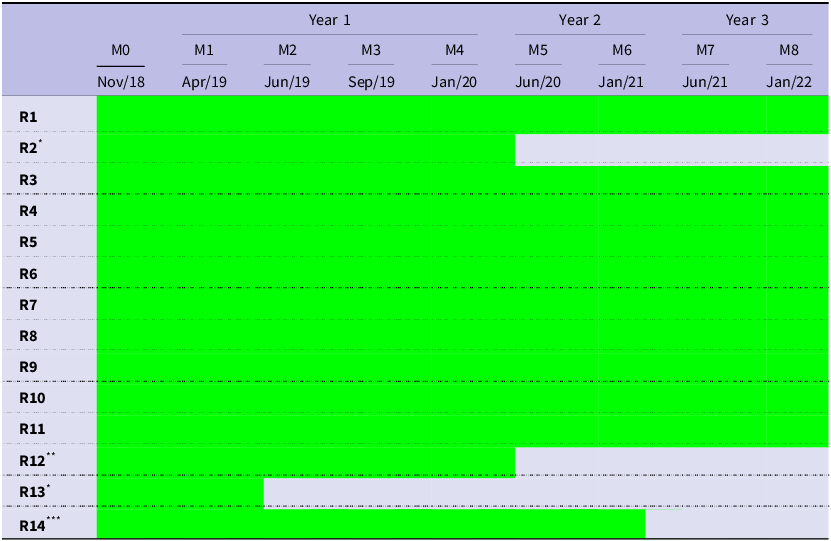
Reasons for early exit:
*Incarcerated with no perspective on short term return
**Chose to move and live in a different municipality
***Moved to an in-patient care facility in a different municipality
Analysis
To find mechanisms explaining observed general developments and fluctuations, we used the analytical steps of the case history method (Thomson, Reference Thomson2007, Reference Thomson and Thomson2009). Descriptive statistics from the surveys and FARE were analysed and visualised in figures to track developments over time, both at the individual participant level and across the research sample, for use throughout the analysis.
Firstly, developments in the lives of participants were recorded per measurement moment and categorised per biographical domain, combining interview data with quantifiable survey data in structured tables, thus accumulating in a participant file. Secondly, participant files were used to re-construct ‘development paths’ per participant per biographical domain. During this step, quantitative data was plotted in figures, which helped to identify specific trends per participant over time and fluctuations therein. Thirdly, following Thomson, we used Saldaña’s (Reference Saldaña2003) notion of ‘through lines’ to (re)create participants’ biographical narratives of change and continuity over time, transforming data to narrative (Thomson, Reference Thomson and Thomson2009). Lastly, development paths and biographical narratives of different participants were compared to identify overarching ‘social patterns’ and the mechanisms and conditions described in the results chapter. During this last step, the survey and FARE data was especially helpful by enabling comparison between the developments between participants in a relatively objective way, independent of the ways in which participants themselves attributed meaning to the variables we wanted to investigate. For example, participants attached widely different meanings to what was considered wellbeing, health, and abnormal or criminal behaviour. Therefore, the use of validated quantitative survey data provided a standardised framework for assessing these complex concepts, which helped to draw meaningful comparisons of the impact of GI across diverse participants who lived vastly different lives.
Results
Experiences of financial scarcity and mental health
During the experiment, participants generally reported fewer difficulties in making ends meet and felt less burdened by financial scarcity (Figure 1). This trend was also visible in survey data on self-noted psychological wellbeing (Figure 1), although individual psychological wellbeing proved to be highly volatile due to (mental) health issues and life events. Throughout the pilot programme, both participants and caregivers attributed beneficial developments in psychological well-being to enhanced resilience and a reduction in stress resulting from the guaranteed income:
It felt freeing, you know? No stress about living on 50 bucks a week. How do I put it… It was like stepping into another world; I was just being myself. – Jayden
I can just go buy groceries and afford presents for Christmas and birthdays. I don’t have to rule out everything because I don’t have any money. For the first time in my life, I have some savings, a buffer, a bit of a basis. – Floris
Average development of financial scarcity and psychological wellbeing on a 0–5 scale. (M0: n = 13, M1: n = 14, M2–M3: n = 13, M4–M5: n = 12, M6: n = 11, M7-M8: n = 10).

Decrease in deviant behaviour and crime
Throughout the experiment, most participants reported a general decrease in deviant and/or offending behaviours. At several moments, participants reported a decreased need to engage in criminal activities for sustenance or found themselves better able to cope with stressful situations that would have previously incited violent behaviours. For instance, Deborah could increasingly abstain from illegal side jobs, having found adequate fulfilment through her enhanced income. Similarly, Jan, who prior to the experiment had often taken justice into his own hands when feeling wronged, felt more able to restraint his impulses as he could better assess the consequences. Such observations were further corroborated by the FARE data analysis. Participants’ initial risk of recidivism compared to the final month of their participation showed an average decrease of 24 per cent (see Table 3). In the first two months after the experiment ended, the FARE was again administered to eight participants. Results show that after the payments ended, the average risk of recidivism rose by 19 per cent. Clinical assessors from the health services also noted a steady decrease in participants’ risk of recidivism during the experiment, and an increase afterwards, as did several participants themselves.
Outcomes of the Forensic Ambulant Risk Evaluations prior to and after participation of the experiment

1 Number of participants with lower risk factor score.
2 Number of participants with higher risk factor score.
3 Risk on a scale from 0 (low risk) to 5 (high risk).
4 Percentage increase/decrease of the average final measurement relative to the average pre-start measurement.
5 We aimed to understand the surprising increase in the instability of participants’ living situations by exploring explanations within their narratives and consulting project leaders. Based on these sources, we believe this outcome should be viewed in light of broader societal factors rather than as a direct result of our intervention. Three concurrent developments contributed to this situation. First, the ongoing housing crisis in the Netherlands limited participants’ ability to relocate from unsuitable housing or difficult neighbour relationships. Second, the social safety net in the Netherlands has deteriorated, leading to rising poverty in the impoverished neighbourhoods where participants typically resided. Lastly, the Covid-19 pandemic and subsequent lockdowns forced participants to remain at home.
Mechanisms
Based on our analysis of participants’ development paths, we will now describe three central mechanisms and pathways which may explain the above reductions in deviant and/or delinquent behaviours among participants (see Figure 2). It is essential to note that numerous conditions could obstruct these mechanisms, which materialised only under favourable conditions, as we will discuss in the subsequent section.
Mechanisms that explain the general decrease found in deviant and/or deviant behaviours.

Mechanism 1: Guaranteed income provides means to fulfil basic needs
In the baseline interviews prior to the experiment, several participants mentioned experiencing a combination of poverty and limited ways to legitimately acquire sufficient income. Consequently, some relied on theft, illicit activities, or black-market work to fulfil their basic needs. Some reported that their dependence on criminal activities came with great costs, mostly due to the excessive violence and stress associated with their involvement in the local underground economies. As a result, several respondents wanted to distance themselves from their criminal networks and activities. These participants mentioned repeatedly that the GI reduced their incentive to engage in illegal activities by helping them meet basic needs and cope with setbacks. For instance, participants like Deborah, Levi, Floris, and Thomas said that the GI enabled them to stop ‘hustling’, and helped them to refuse illegitimate business offers, however tempting offers of quick money may still be.
You know, every time I get a letter saying I need to pay, it used to really stress me out. Back then [before the pilot], whenever those letters arrived, I’d freak out and end up doing all the wrong things just to scrape together the money. And in the end, I’d get caught, which just made everything twice as bad. – Levi
Benjamin, who due to financial needs after his release from prison in the period before the pilot, was involved in plans for drug smuggling, chose to abandon those plans upon learning about the GI pilot. He subsequently declined several further invitations ‘to go on a trip’ during the pilot, demonstrating his increased ability to desist.
I no longer engage in crime. I have been approached a few times, but no, I will not do that. I am keeping my distance from everything at this moment. I wish to maintain this stance. I do not want to risk losing what I have now. – Benjamin
Mechanism 2: Guaranteed income decreases the experience of financial scarcity and its associated psychological effects, enhancing personal agency and self-control
Throughout the experiment, participants and their care takers noted that chronic poverty and financial stress led to a cognitive and behavioural focus on short term survival, irritability, and violent incidents. The accounts provided by participants suggest that the GI mitigated these issues by lowering baseline stress levels and improving participants’ ability to cope with stressors. On various occasions, participants reported exercising restraint in situations where they would previously have exhibited aggressive or disruptive behaviour, attributing this change to their increased income.
Several respondents noted that reduced financial stress enhanced their ability to reflect on the consequences of different courses of action and behaviours when faced with challenges. Initially, most approached life ‘one day at a time’ and lacked the ability to think about the future, but as the experiment progressed, they increasingly reported that their financial capacity and generally calmer states of mind enabled them to think about and foster hopes for the future. This was evident for Jeremy.
The money reduced my stress and helped with quite a few things. It brought me a bit of peace. I’ve changed in some ways too. I thought things through and felt calmness, you know? (…) I’ve started thinking differently than before, more wisely. (…) I can perceive better and know how to go on with my life. – Jeremy
This enhanced ability to think about the future, as indicated by Jeremy and others, inherently involved considering the impact of one’s actions on that future. As such, the GI facilitated a transition from a reactive everyday approach to life (survival) to a more proactive stance focused on hopes and dreams for the future.
The increased income did not seem to increase problematic consumption of temptation goods. Respondents offered two main explanations for this. Some respondents attributed it to the GI providing access to more interesting and useful activities. Such as Jim, who saved up his income supplement to buy a small boat to fix up and sell later. Others noted that while the GI enabled the use of alcohol or drugs as coping mechanisms for stress and psychological suffering, it simultaneously reduced the need to do so.
You know, when you have fewer [financial] worries, it opens up more time for fun stuff in life. And look, we’re not alcoholics or anything, but it does mean you’re less likely to reach for a beer to cope with sadness or whatever else is going on. – Romano and and his girlfriend
Lastly, the GI allowed participants to disengage or distance themselves from stressful situations, such as work or interactions within previously relied-upon criminal networks. In some cases, it enabled individuals to opt for self-isolation to avoid feelings of being overwhelmed or to be triggered into destructive behaviours.
Mechanism 3: Guaranteed income strengthens social and societal ties and obligations, which enhance rule adherence
Several participants mentioned at separate occasions that preceding the experiment, they felt that they had been pushed ‘outside of society’. Resultingly, some viewed themselves as unbound by societal norms and regulations, in part since they had little left to lose. The GI changed this dynamic. By providing participants with the financial means needed to improve their quality of life and to strengthen their social and societal ties, they were more inclined to adhere to and embrace social norms and socially desirable behaviours.
In part, the GI helped participants to strengthen their social and societal tiesFootnote 3 by enabling their participation in social activities. Participants repeatedly mentioned that the GI helped them to afford transportation and gifts, which strengthened relationships with acquaintances, friends, and loved ones. Simultaneously, the GI increased participants’ ability to perform certain role-identities they expressed a desire for, such as “being a good parent” or “partner”, which subsequently strengthened their relationships and encouraged them to embrace the values and behavioural norms associated with those roles. For example, by enabling them to contribute to the household budget, to buy clothing for their children, or to undertake family activities outdoors. These processes of increasing social connectivity and identity transformation facilitated desistance from antisocial behaviours and crime. This was particularly evident for Benjamin, Jeremy, and Jayden, for whom the GI facilitated their self-notion and role of husband and or/ father and increasingly embedded them in the nurturing relationships, social routines, and informal control provided by family life.
You can’t just take advantage of a woman. A man is supposed to take care of a woman, and I’m a MAN. I’m getting ready because I need to support my family. – Jayden
I’m tired of looking over my shoulder or having to tell my child, ‘Yeah, dad’s not around because he made some dumb choices’. I want to be able to walk the street with my child without anyone saying, ‘Look, there’s a drug dealer’. My kid is my number one priority. – Kees
Both participants and their social workers noted that the GI greatly improved participant’s quality of life, or at least reduced their suffering. Participants were keenly aware that incarceration would result in (temporary) loss of the GI and its affordances. Consequently, several participants mentioned exhibiting greater self-control when faced with situations that might have otherwise escalated and may have led to legal repercussions. This incentive for rule-abiding behaviour was embraced by some not because they embraced the morals of behavioural rules, but because of the potential negative consequences, as explained by Jan.
You have things to lose, and once you have something at stake, it really curbs your recidivism. (…) When you’re at rock bottom and have nothing left, what’s stopping you from pushing back? If I were to do that NOW, I risk losing my benefits, which would come with some serious downsides. That keeps me stable. – Jan
Others, like Kees, Jayden, and Jeremy, repeatedly mentioned feeling a moral obligation to use the GI to better themselves, to behave in a socially accepted manner, and to spend their money ‘for its intended purpose’, and ‘not on foolish things’. As such, they indicated that for them the GI came with the implicit or explicit expectations that when society gives you something, you must give something in return.
Mechanism 4: Guaranteed income enables social retreat
Among the participants, there were individuals who had been so profoundly affected by their harsh life that they considered meaningful social integration not (wholly) feasible. For them, the GI allowed them to withdraw from certain or all forms of societal engagement and/or social interactions that they perceived as unsafe. These participants indicated that the GI, by enabling social retreat, helped them to avoid situations that could potentially lead to (violent) confrontations.
For instance, some participants expressed appreciation for the GI as it reduced their need to engage in the labour market. This was the case for Jayden, who suffered from aggression regulation issues and felt pressured into a job reintegration programme where he felt out of place:
I went there to have a look(…). I don’t belong there. It’s not possible because then I’ll get into a fight right away, and we shouldn’t have that. – Jayden
Other participants, due to psychiatric conditions and negative experiences considered conventional notions of ‘the good life’ as entirely unattainable. This was the case for Kees and Jan, who ultimately used the GI to distance themselves from social situations. And also for Deborah, who coupled her social retreat with a ‘worldly’ retreat, spending her days in a daze of self-medication.Footnote 4 Both Deborah and Jan repeatedly presented this as the only viable alternative to ending their otherwise intolerable lives by suicide.
Although it is depressing to be home all day, at least it’s safe. This project [GI] has allowed me to stay away from people. The need to go out and work has been kept at bay a bit more. (…) My plan is to keep withdrawing and just grow old. – Jan
I’ve been through so much and felt so much pain, and I still feel it. I just want some peace and to spend my days at home. I can’t stand being around people, and I don’t want to see anyone. I’d prefer to live in a haze where it feels like all those other people aren’t even there. – Deborah
Contextual conditions
While the mechanisms previously outlined may explain the general reduction found in recidivism risk, it is essential to acknowledge the considerable variability in their functioning among participants and across time. The various ways in which participants engaged with the GI indicate that how the GI worked out, and its effectiveness on the individual level was intricately linked to personal histories, preferences, and social circumstances, as well as their realistic opportunities for social and societal participation. A closer examination of participants’ developmental trajectories reveals various contextual conditions that influence the occurrence, timing, and applicability of these mechanisms to specific individuals.
Crime as part of lifestyle and identity
For some participants, such as Deborah, Jim, and Lieke, crime was not only a means to survive, but also a lifestyle. Embedded and socialised in peer groups where violence and crime were considered normal, they did not always perceive criminality as a violation of normative rules. Rather, they approached crime more from the perspective of risk assessment, and described crime as part of their identity, as an inclination that was engrained deep within:
That is the old world, and it is baked within me. To that extent, it will never change. – Jim
For participants whose criminal behaviour primarily arose from the interaction between identity and opportunity, as opposed to necessity or psychological strain, the occurrence of the previously described mechanisms was limited. Furthermore, as exemplified in Table 4, for some, a life of (petty) crime offered a better quality of life than what mainstream society could provide, making it hard to stay on a path of desistance.
Fragment from Lieke’s development path

Various sources of distress affect the life course
Studying participants’ lives reveals that financial difficulties were just one component in a web of various complex issues that were potentially inducive to deviant behaviours. Due to the vulnerability of the participants, various stressors, including health conditions, living circumstances, and negative social influences, could lead to setbacks. For participants whose deviant behaviour stemmed from root causes unrelated to financial stress, the GI’s effect was limited.
For some participants, antisocial or violent behaviour was primarily triggered by severe mental health problems and everyday experiences, with no apparent connection to financial issues. This was particularly evident in Menno’s case, whose life was profoundly driven by recurrent collisions of past traumas and present experiences. And also for Thomas, who could no longer see a future and ‘got stuck’ in the present due to constant disturbances by drug users in his apartment building.
Most participants wanted to distance themselves from deviant peers but found it challenging due to deep embedment in marginalised or criminal networks and a lack of alternative social contacts. Some participants also experienced a dual (self)stigma, of being both a criminal and mentally ill, further limited their access to social settings and ability to form new supportive ties. Consequently, several participants remained connected to and dependent on networks in which violence and crime were part of life, perpetuating stimuli for deviant behaviour through social pressures from peers or induced by the psychological strain that accompanies a life in violent circumstances.
Extraordinary life events
Throughout the experiment, it became clear that participants faced exceptional challenges that hindered their ability to make meaningful and lasting life changes. Impactful life events often caused severe fluctuations in participants’ well-being, disrupting the previously described mechanisms. For instance, sudden financial shortages caused by (traffic) fines, by illness of pets, or unexpected loss of income could induce stress and create the temptation to resort to criminal activities for generating income. It was also repeatedly observed that emotional experiences could temporarily overshadow positive psychological effects of the GI. On several occasions, the researchers encountered respondents visibly bruised and wounded, such as when Deborah got her windows broken and was beaten up with a leaden pipe by a neighbouring drug user or when Eva had become victim of domestic violence. More frequently, participants were overwhelmed by experiences like the loss of loved ones, housing issues, or by health problem and an inability to find help. Such life events often triggered fears, delusions, apathy, and even self-destructive behaviour, increasing psychological strain and undermining the basic securities that support mechanisms reducing deviant behaviours.
Discussion
This paper presents our analysis of a three-year GI experiment involving fourteen forensic psychiatric patients in the Netherlands. It was found that the GI provided participants with temporary basic livelihood security, which subsequently reduced their experiences of financial scarcity and improved their psychological well-being. Overall, these conditions promoted socially desirable behaviours amongst participants and led to a decrease in public nuisance and risk of recidivism. These findings strengthen previous studies showing that guaranteed income interventions decrease delinquency, property crime, and violent crime (Groeneveld et al., Reference Groeneveld, Short and Thoits1979; Watson et al., Reference Watson, Guettabi and Reimer2020; Calnitsky and Gonalons-Pons, Reference Calnitsky and Gonalons-Pons2021).
Contrary to previous findings (Dobkin and Puller, Reference Dobkin and Puller2007; Kodish et al., Reference Kodish, Gittelsohn, Oddo and Jones-Smith2016; Evans and Moore, Reference Evans and Moore2011; Watson et al., Reference Watson, Guettabi and Reimer2020), we found no significant increase in substance abuse or drug-related crimes, despite anticipations of decreased impulse control due to ‘full wallet’ or ‘party effects’ (ibid). This finding may seem surprising given the participants’ historical backgrounds. We identified several plausible explanations, which are noteworthy in light of Foley’s (Reference Foley2005) call to explain variance in (indulgent) spending behaviours among GI participants. Firstly, funds were disbursed monthly, with some participants opting for weekly payments. Since each payment was relatively modest, most participants allocated it towards immediate necessities. This supports the significance of staggered payments in GI experiments, as supported by broader studies on income support and crime (Foley, Reference Foley2011; Carr and Packham, Reference Carr and Packham2019). Secondly, several participants wanted to spend the money ‘as intended’, indicating that a labelling effect (Kooreman, Reference Kooreman2000; Evans and Popova, Reference Evans and Popova2017) occurred even though no explicit expectations were voiced on how to spend the GI. Thirdly, respondents found more productive uses for the money, indicating a substitution effect (Fiszbein and Schady, Reference Fiszbein and Schady2009).
To explain the overall reduction in recidivism risk, we identified four mechanisms. Three of these empirically validated previously hypothesised mechanisms in GI and criminological studies (Calnitsky and Gonalons-Pons, Reference Calnitsky and Gonalons-Pons2021; Stam, Reference Stam2022). We contribute to these studies a detailed description of the pathways associated with each mechanism for our population of Dutch patients in forensic psychiatry, but also by identifying the contextual conditions under which these mechanisms are triggered or not. Furthermore, we revealed a novel fourth mechanism.
Firstly, our study substantiates the hypothesis that increased economic resources reduce the need to engage in financially motivated crimes and the allure of property crimes (Watson et al., Reference Watson, Guettabi and Reimer2020; Calnitsky and Gonalons-Pons, Reference Calnitsky and Gonalons-Pons2021). Secondly, our study corroborates previous studies that note a reduction of financial stress due to GI (e.g. Verlaat et al., Reference Verlaat, de Kruijk, Rosenkranz, Groot and Sanders2020), as well as the hypothesis regarding a consequential reduction in violent incidents (Calnitsky and Gonalons-Pons, Reference Calnitsky and Gonalons-Pons2021). Following earlier studies, we found that GI enhanced participants’ capacity for future-oriented thinking, planning, and aspirations (Kangas et al., Reference Kangas, Jauhiainen, Simanainen and Ylikännö2019; Ferdosi et al., Reference Ferdosi, McDowell, Lewchuk and Ross2020; Hill-Dixon et al., Reference Hill-Dixon, Davis, Patel and Boelman2020; Wilson and McDaid, Reference Wilson and McDaid2021). We contend that these developments are a crucial element in the mechanism linking mental health to crime reduction, as they increased participants’ awareness of and aversion to the negative consequences associated with deviant behaviours and crime.
Thirdly, we contribute a novel mechanism to the UBI/GI literature on crime by incorporating a social perspective grounded in social bonds theory (Hirschi, Reference Hirschi1969; Laub and Sampson, Reference Laub and Sampson2006). Consistent with GI literature, we noted an enhanced capability among participants to spend time improving relationships with family and friends (Akee et al., Reference Akee, Copeland, Keeler, Angold and Costello2010; Costello et al., Reference Costello, Erkanli, Copeland and Angold2010; Kirchner et al., Reference Kirchner, Sabes, Todeschini, Blanco, Fernández, Yanes and Julia2019; Hamilton and Mulvale, Reference Hamilton and Mulvale2019; Ferdosi et al., Reference Ferdosi, McDowell, Lewchuk and Ross2020; Wilson and McDaid, Reference Wilson and McDaid2021). Additionally, we discovered that GI further solidified participants’ social embeddedness by enabling certain lifestyle choices and the performance of role identities. These processes of increasing social connectivity and identity transformation promoted an increase of socially desirable behaviours amongst participants and desistance from antisocial conduct and crime, as has also been demonstrated in criminological literature (Laub and Samson, Reference Laub and Sampson2006; Gålnander, Reference Gålnander2020).
Lastly, we identified a fourth mechanism new to the literature. For some participants the GI facilitated a retreat from interactions with others in stressful situations, which could potentially lead to (violent) conflicts. This aligns with the criminological concept of ‘knifing off’, wherein individuals sever ties with their past or criminal networks as a pivotal step towards desistance (Maruna and Roy, Reference Maruna and Roy2007). Our findings suggest that GI indeed enabled some participants to disengage from criminal peers upon whom they previously relied for sustenance. However, we also found that the GI facilitated a broader retreat from social or societal engagement such as from work or interactions with peers, as a means to prevent (violent) conflicts and crime. This indicates that a decrease in labour market participation is not necessarily detrimental for individuals who, due to various circumstances (whether temporary or not), may be better off not working, or for those who lack access to suitable employment because the labour market is not structured to accommodate them or because they lack the necessary skills. This underscores the importance of long-term GI experiments, which relieve participants of financial stress while simultaneously allowing for the development of structural solutions.
These mechanisms aided in diminishing deviant behaviour and crime; however, due to the messiness and interplay of complex conditions in the lives of participants, the outcomes of the GI intervention remained somewhat unpredictable. The GI interacted with participants’ psychological and social contexts, and as long as they remained dependent on criminal networks or perceived crime as part of their identity mechanisms to reduce crime were diminished, consistent with social learning theory (Akers, Reference Akers2017). Furthermore, for participants, financial difficulties were part of a complex system of interacting problems. Challenges in other areas of life, such as mental and/or physical illness, stressful living conditions, and social exclusion, could severely impact well-being and cause setbacks. Also, the experiments’ proceedings were highly influenced by individual disruptive life events and an unpredictability that seems inherent to life on the fringes of society (Berg et al., Reference Berg, Harting and Stronks2021), which hindered their ability to make (lasting) changes in their life course.
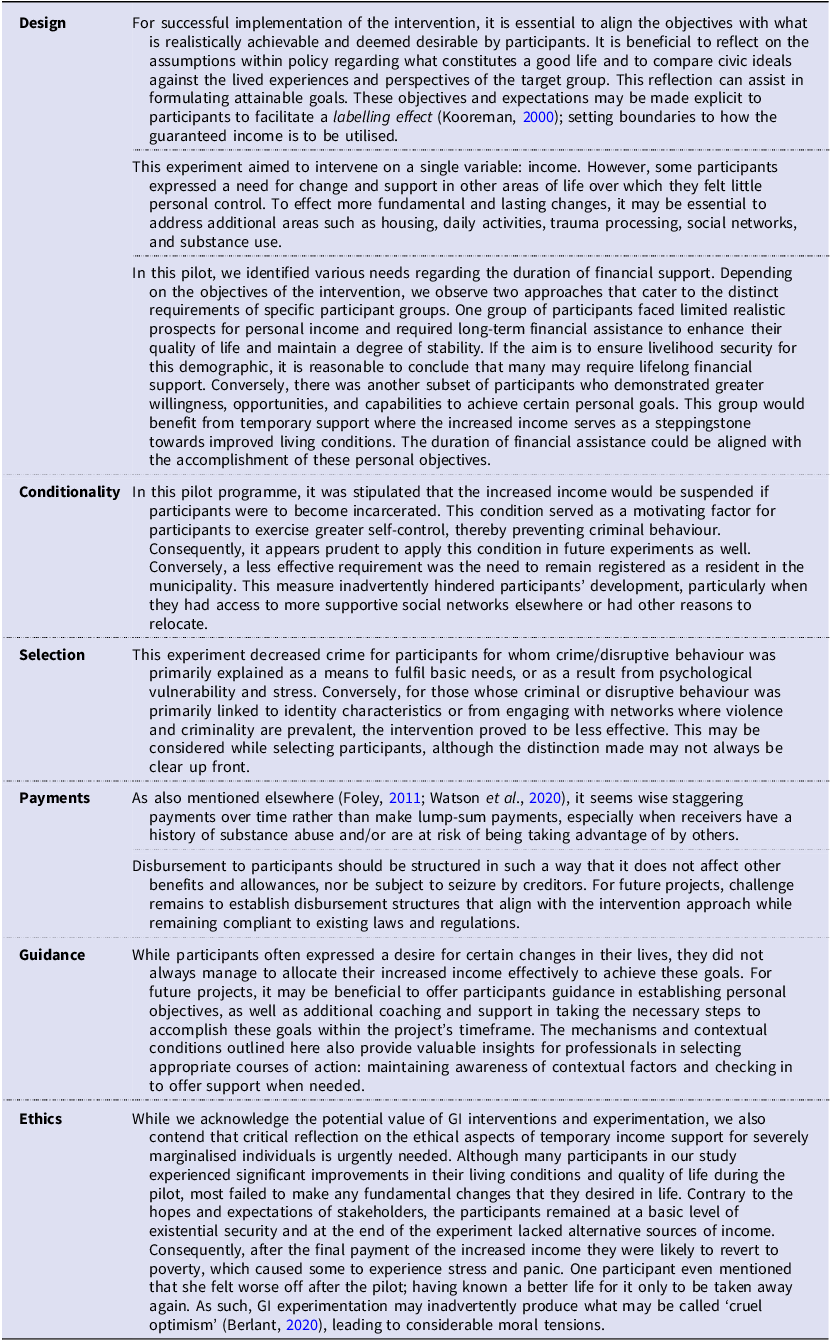
Nevertheless, in line with Flemings’ contention (Reference Fleming2023), our analysis indicates that GI as a form of targeted welfare has the potential to reduce the (mental) health impact of poverty and enhance the effectiveness of care for marginalised populations. As such, GI policies might serve as a double-edged sword to alleviate scarcities that burden both clients and healthcare professionals. This paper highlights some practical lessons and considerations for designing future GI experiments for similar target groups, as displayed in Table 5.
Considerations for future experiments

Limitations
While our study’s depth is a strength, it also presents limitations. Obviously, the small sample size limits generalisability. Furthermore, in our data collection and analysis we primarily focused on context at the individual level; however, it is plausible that environmental conditions also influenced the outcomes of the intervention, undermining the reliability of our findings. Various background elements, including the influence of Covid-19, local media attention, municipal characteristics, and local policing policy, were at play. Further research is needed to establish if our findings hold true, or how they may differ for similar populations in different contexts, similar populations with a differently designed intervention, and for other especially marginalised populations.
Acknowledgements
This research would not have been possible without the invaluable support and cooperation of many. We extend our heartfelt gratitude to the initiators and project coordinators of the pilot, Irene Veldhuis & Wouter Boekweit; to the ambulant social workers, Ronald Buckert in particular; and of course to the participants: Deborah, Eva, Floris, Jan, Jayden, Jeremy, Jim, Kees, Levi, Lieke, Menno, Romano, Thomas, and Benjamin. We also wish to acknowledge our contacts from the municipality and safety councils for their contributions. Furthermore, we are grateful to the members of the academic committee who provided valuable guidance during the early stages of this research: Prof. Dr. Karien Stronks, Dr. Sjoukje Botman, Dr. Christian Broër, Dr. Roeland van Geuns, en Dr. Annet Nugter.
Funding statement
The research was funded by the Dutch Ministry of Social Affairs and Employment, the Ministry of Justice and Security, and the Ministry of the Interior and Kingdom Relations.
Competing interests
The authors declare none.




 Open access

