

A large body of research on women’s underrepresentation in politics attributes this gap to both supply- and demand-side factors.Footnote 1 On the supply side, gendered socialization is shown to depress women’s political ambition and reduce their likelihood of pursuing office (Fox and Lawless Reference Fox and Lawless2011; Reference Fox and Lawless2014; Fulton et al. Reference Fulton, Maestas, Maisel and Stone2006; Schneider et al. Reference Schneider, Holman, Diekman and McAndrew2016). Women also face institutional barriers in party recruitment and nomination processes (Kang et al. Reference Kang, Sheppard, Snagovsky and Biddle2021; Kitchens and Swers Reference Kitchens and Swers2016; Lawless and Pearson Reference Lawless and Pearson2008). On the demand side, voters often rely on gender stereotypes, perceiving women as less suited for political leadership, which can lead to harsher scrutiny and different expectations for female candidates (Bauer Reference Bauer2020a; Reference Bauer2020b; Bos Reference Bos2011; Ditonto, Hamilton, and Redlawsk Reference Ditonto, Hamilton and Redlawsk2014; Huddy and Terkildsen Reference Huddy and Terkildsen1993).
Recent studies employing experimental methods offer a more nuanced view of voter attitudes. Some find that women candidates face electoral disadvantages (Clayton et al. Reference Clayton, Robinson, Johnson and Muriaas2020; Ono and Yamada Reference Ono and Yamada2020; Teele, Kalla, and Rosenbluth Reference Teele, Kalla and Rosenbluth2018), while others report a modest female advantage or no systematic bias. A meta-analysis of 67 studies by Schwarz and Coppock (Reference Schwarz and Coppock2022), for instance, finds that voters on average tend to favor female over male candidates. These findings suggest that voter bias may not be the primary explanation for women’s underrepresentation in office.
However, this general absence of average voter bias does not mean that gender no longer matters in elections. Gendered voting patterns may still emerge in ways that are contingent on voters’ attitudes and the information environment. Rather than asking whether female candidates are penalized on average, we examine how and under what conditions candidate gender influences vote choice, sometimes subtly, sometimes powerfully. Specifically, we theorize that candidate gender can serve two distinct heuristic functions for voters.
In this study, we investigate the mechanisms by which candidate gender influences voter evaluations and choices. Specifically, this study begins with the understanding that candidate gender plays two different roles in voters’ evaluations of candidates. First, candidate gender can act as a positive heuristic, particularly for women voters who expect greater policy responsiveness from female representatives. Prior research shows that some voters, especially women, engage in co-gender voting in anticipation of substantive representation on gender-related issues (Dolan Reference Dolan2003; Herrnson, Lay, and Stokes Reference Herrnson, Lay and Stokes2003; Huddy and Terkildsen Reference Huddy and Terkildsen1993). Second, candidate gender can also function as a negative heuristic, activating hostile sexist attitudes that diminish support for female candidates. Importantly, sexism is not confined to male voters; both men and women can hold hostile sexist beliefs (Cassese and Barnes Reference Cassese and Barnes2019; Glick and Fiske Reference Glick and Fiske2001), but these beliefs may operate differently across groups.
This study investigates how these two mechanisms — substantive representation and hostile sexism — interact with the information environment to shape voter evaluations. We fielded a conjoint experiment in South Korea, a context characterized by the politicization of gender issues and gender divides in politics. Our design includes both low- and high-information conditions. In the low information condition, we examine whether candidate gender serves as a heuristic for substantive representation, expecting co-gender voting to emerge, particularly among women anticipating greater advocacy from female candidates. We also assess whether hostile sexism moderates this effect. Among male voters, stronger sexist attitudes are expected to reinforce support for male candidates. Among women, however, sexism may weaken co-gender preferences, leading to more neutral patterns. In the high-information condition, where candidates’ policy positions are clear, we expect voters to rely less on gender cues. Instead, gender bias is expressed not through voter support for a specific candidate gender, but through their preference for certain policy positions.
The findings of this study highlight two distinct ways candidate gender influences voting: as a heuristic for co-gender voting and as a trigger for hostile sexism. These mechanisms can weaken one another, helping to explain why the average effect of candidate gender often appears minimal (see also Hansen and Dolan Reference Hansen and Dolan2023). As shown in the Results section, hostile sexism affects both men and women, but in different ways — dampening male support for female candidates while neutralizing female voters’ preference for women. Therefore, when considering the effect of candidate gender, a more nuanced understanding and interpretation of the results is necessary.
Our results also show that the impact of sexism depends on the information environment. In low-information settings, voters rely more on gender cues, and sexist attitudes more directly shape candidate evaluations. In high-information settings, however, gender bias shifts from penalizing female candidates to opposing candidates who support gender equality policies. In this sense, sexism is not activated by candidate gender per se but is instead channeled through opposition to gender equity policies. These findings highlight that even if voters do not explicitly discriminate against female candidates as some studies suggest (Dolan Reference Dolan2014; Schwarz and Coppock Reference Schwarz and Coppock2022; Teele, Kalla, and Rosenbluth Reference Teele, Kalla and Rosenbluth2018), gender bias persists in shaping electoral outcomes by influencing voter preferences on policy.
Finally, by focusing on South Korea, a country marked by persistent underrepresentation of women in politics, this study contributes to the broader literature by examining gendered voting dynamics in a non-Western context. In doing so, it enhances the external validity of theories that have been developed primarily in US and European settings, and provides a critical test of how candidate gender influences voter behavior in societies characterized by entrenched sexism and sharp gender polarization.
Disentangling the Effect of Candidate Gender
Candidate gender can influence voter decision-making in two key ways. First, it can serve as a heuristic for substantive representation, a shortcut that helps voters infer what kinds of policies a candidate may prioritize. Second, it can act as a trigger for sexist attitudes, especially among voters who hold hostile views toward women in positions of power. While both mechanisms are well established in existing literature, they are often treated in isolation. We integrate these perspectives to offer a more complete account of how candidate gender shapes voter behavior, and then theorize how information environments condition the relative weight of each mechanism.
In low-information environments where voters lack detailed knowledge about candidates, demographic traits like gender become especially salient. A rich body of research shows that male and female politicians often prioritize different issues: women are more associated with policies related to welfare, education, and public health, while men are seen as more concerned with economic and security issues (Gidengil Reference Gidengil1995; Seltzer and Heller Reference Seltzer and Heller1997; Yildrim Reference Yildrim2022). These patterns are commonly traced to differing socialization experiences (Beutel and Marini Reference Beutel and Marini1995; Huddy, Cassese, and Lizotte Reference Huddy, Cassese, Lizotte, Wolbrecht, Beckwith and Baldez2008). In the absence of issue-specific information, gender serves as an important political heuristic cue that voters can use to infer candidates’ ideology and issue priorities (Dolan Reference Dolan2003; Gay Reference Gay2002; McDermott Reference McDermott1998). This dynamic fosters co-sex voting: women prefer female candidates who are assumed to support women’s issues, and men may prefer male candidates aligned with traditionally masculine priorities. In the South Korean context, previous studies have found that women are more supportive of female candidates and of policies such as legislative gender quotas (Kim et al. Reference Kim, Kim, Lee and Kim2003; Lee Reference Lee2013), suggesting that gendered heuristics matter in candidate evaluation. Conversely, women’s representation is likely to produce opposing reactions among male voters, as more policies in favor of women can be interpreted by men as a threat to their status. The election of female candidates may heighten status anxiety among men (Kim and Kweon Reference Kim and Kweon2022) and an increase in women’s social and economic status could be regarded as a challenge to men’s masculinity and self-worth (Edwards Reference Edwards2006; Green and Shorrocks Reference Green and Shorrocks2023; Kehn and Ruthig Reference Kehn and Ruthig2013).Footnote 2
Hypothesis 1 Women (men) are more likely than men (women) to vote for female (male) candidates.
Candidate gender can also activate sexist biases, especially among voters with strong hostile sexist attitudes (Bracic, Israel-Trummel, and Shortle Reference Bracic, Israel-Trummel and Shortle2019; Cassese and Barnes Reference Cassese and Barnes2019; Schaffner, Macwilliams, and Ntena Reference Schaffner, Macwilliams and Ntena2018). These voters perceive female political leadership as a threat to traditional gender hierarchies and often question women’s competence and legitimacy as leaders (Cassese and Barnes Reference Cassese and Barnes2019; Winter Reference Winter2023). Consequently, sexists have low levels of support for women’s representation (Dahlerup Reference Dahlerup2006; Murray Reference Murray2014). In the 2016 US presidential election, for instance, research showed that sexists with strong hostility toward women showed higher support for Trump in response to Trump’s attack on Clinton for playing the so-called “women’s card” (Cassese and Holman Reference Cassese and Holman2019). Importantly, hostile sexism is not exclusive to men. Some women also endorse sexist beliefs, often due to internalized norms or alignment with dominant group benefits (Cassese and Barnes Reference Cassese and Barnes2019; Glick and Fiske Reference Glick and Fiske2001). Thus, while the heuristic perspective predicts co-sex voting based on shared identity and inferred policy alignment, the bias activation perspective suggests that sexism can shape candidate evaluations negatively across both male and female voters, regardless of shared gender.
The literature identifies several forms of sexism — hostile, benevolent, and modern — that may influence political behavior in distinct ways (Archer and Kam Reference Archer and Kam2020; Beauregard and Sheppard Reference Beauregard and Sheppard2021; Glick and Fiske Reference Glick and Fiske1996; Reference Glick and Fiske2001; Swim et al. Reference Swim, Aikin, Hall and Hunter1995). This study focuses on hostile sexism, as it most directly captures overt hostility toward women in leadership. Indeed, Schaffner (Reference Schaffner2022) finds that hostile sexism is the strongest and most valid predictor of candidate evaluations.Footnote 3
Hypothesis 2 Voters, both men and women, who hold stronger sexist attitudes are less likely to support female candidates than those who hold weaker sexist attitudes.
In real world settings, candidate gender acts both as a heuristic cue and as a trigger for bias. These two mechanisms may operate in competing directions depending on the voter’s own gender and level of sexism. For example, male voters high in sexism may exhibit reinforced in-group bias, while female voters high in sexism may experience cross-pressures between shared identity with a female candidate and negative attitudes toward women in leadership. Conversely, male voters low in sexism may be less inclined to favor male candidates. These dynamics can result in muted or inconsistent effects for certain subgroups.
Hypothesis 3 Strong sexist attitudes are likely to reinforce co-sex voting among male voters, while weakening co-sex voting for female voters.
Candidate Gender in High- and Low-Information Environments
Information environments vary across electoral contexts and significantly shape how candidate gender influences voter behavior. In South Korea, for example, local elections or the entry of unfamiliar candidates often create low-information settings, whereas national contests or media saturated campaigns typically represent high-information environments where candidate platforms are more widely known. In these high-information contexts, voters use a range of cues other than candidate gender when evaluating candidates in elections. McDermott (Reference McDermott1997) shows that gender cues affect voters with minimal information the most and its heuristic effect may be limited by the presence of other heuristic information. Therefore, an information environment is important for understanding the effect of candidate gender on voting choices. Information rich contexts offer voters more opportunities to learn about candidates’ qualifications for political leadership positions. de la Cuesta, Egami, and Imai (Reference de la Cuesta, Egami and Imai2022), for instance, show that partisan cues are less powerful in shaping voter choice in high-information environments. Similarly, we argue that the effect of candidate gender, both as a heuristic for substantive representation and as a stimulus for sexism, weakens when individuating information about candidates’ policy positions on gender issues is available.
First, the effect of candidate gender as a cue for substantive representation is strongest when voters lack explicit information about where candidates stand on gender-related issues. In the absence of such information, voters infer candidates’ policy positions from their demographic characteristics, including gender. However, in high-information environments, voters are better equipped to assess candidates’ policy preferences directly. As a result, they are less likely to rely on gender-based heuristics to infer substantive representation (see also Andersen and Ditonto Reference Andersen and Ditonto2018; Dolan Reference Dolan2014; Jones and Brewer Reference Jones and Brewer2019; Sanbonmatsu Reference Sanbonmatsu2002). In this context, co-sex voting is unlikely to occur (Erickson and Black Reference Black and Erickson2001; Frederick and Streb Reference Frederick and Streb2008; Matson and Fine Reference Matson and Fine2006; McDermott Reference McDermott1998). Importantly, the diminished effect of candidate gender does not mean that voters disregard gender entirely. Rather, gendered voting is more likely to be shaped by candidates’ policy positions. Female voters tend to support candidates who advocate for gender equality, while male voters are more likely to oppose such candidates and policies.
Similarly, the effects of sexism vary across information environments. In low-information settings, where only demographic traits are visible, sexists are likely to respond negatively to female candidates, interpreting their gender as a threat to traditional gender hierarchies. Thus, strong sexist attitudes can lead to backlash against female leadership in these environments. Like other voters, sexists rely on ascriptive cues when individuating information is unavailable. However, when candidate-specific policy information is provided, even strong sexist voters may shift their focus from candidate gender to ideological alignment. Ditonto (Reference Ditonto2019) shows that sexists tend to seek less information about female candidates and evaluate them more negatively, even when policy preferences are aligned. Yet when such information is explicitly provided, it still has the potential to shape voting decisions. For example, Utych (Reference Utych2021) finds that while sexism predicts lower ratings for women candidates, it also depresses evaluations of Democratic candidates of either gender. When partisan information is present, the effect of sexism on support for male candidates is comparable to its effect on support for female candidates. This logic can be extended to gender-related policy information. We argue that in high-information contexts, policy content, not candidate gender, drives the preferences of sexist voters. Those high in hostile sexism, regardless of gender, are more likely to support candidates who oppose gender equality initiatives. Nonetheless, one could argue that entrenched gender stereotypes may continue to shape candidate evaluations, such that even when policy stances align, sexist voters still penalize female candidates due to perceptions of incompetence or weak leadership (Alexander and Andersen Reference Alexander and Andersen1993; Huddy and Terkildsen Reference Huddy and Terkildsen1993). If this is the case, then providing information about a candidate’s position on gender equality policies may not be sufficient to fully counteract the influence of candidate gender.
Hypothesis 4 For both female and male voters, co-sex voting will not appear when information about candidate policy positions on gender issues is provided. Instead, female voters are more likely to support candidates who are supportive of gender equality policies while male voters are more likely to support those who oppose them.
Hypothesis 5 The effect of candidate gender will not differ among individuals by the strength of their sexism when information about candidate policy positions on gender issues is provided. Instead, sexists are more likely than non-sexists to prefer those who oppose gender equality policies than those who support them.
Case Selection: South Korea
We focus on South Korea to empirically examine our hypotheses. In recent years, gender issues have become central to sociopolitical conflicts (Kim and Kweon Reference Kim and Kweon2022), shaping electoral outcomes, particularly among younger voters (Kim Reference Kim2022). While younger men and women share views on some issues, they diverge sharply on gender equality (Park Reference Park2020). Contrary to the common expectation that younger generations hold more egalitarian views than their older cohorts, recent studies suggesting that hostility toward women is not significantly weaker among individuals in their 20s and 30s compared to those in their 40s and 50s. In contrast, clear gender differences persist, with men displaying higher levels of hostile sexism than women (Jeong and Lee Reference Jeong and Lee2019; Kim and Kweon Reference Kim and Kweon2022).
The politicization of gender issues has important implications for understanding political behavior in South Korea. Although the mean levels of hostile sexism in most groups appear to be moderate, in the political context that is highly politicized around gender issues, the activation of these attitudes can exert a strong influence on vote choice and partisanship. For example, Koo (Reference Koo2021) finds that individuals with high levels of hostile sexism were more likely to support a conservative candidate who had been criticized for sexist remarks. Similarly, strong sexist attitudes increase opposition to gender equality policies such as legislative gender quotas (Kwon and Yoon Reference Kwon and Yoon2022).
Given these dynamics, South Korea offers a unique and important case for studying gender bias in politics. On one hand, the strong politicization of gender divides may give rise to gendered voting patterns, with women favoring female candidates (co-sex voting) and men supporting male candidates. On the other hand, the heightened salience of gender equality issues suggests that dispositional biases against women, particularly among those with strong sexist attitudes, regardless of gender, may override gender-based affinity in vote choice. These competing forces make South Korea an ideal context for examining the dual nature of gendered candidate evaluations: one shaped by co-sex voting, and the other driven by entrenched sexist attitudes, across both low- and high-information electoral environments.
Research Design
For empirical testing, we conducted original conjoint experiments with 1,645 South Korean adults using Qualtrics.Footnote 4 The survey is an online convenience survey, so the sample is not nationally representative of South Korean population. However, we used a quota sampling method based on gender, age, and region to ensure balanced representation across these attributes.
To ensure the quality of the responses, we excluded respondents who failed to pass an attention check at the beginning of the survey. We used two different conjoint experimental designs to test our hypotheses. Specifically, the respondents were randomly divided into one of two groups: low-information (N = 807) and high-information groups (N = 838). As shown in Table 1, subjects in the low-information group were presented with profiles of two hypothetical candidates who ran in a legislative election that only have candidates’ demographic information.Footnote 5 Candidate profiles in the high-information group also included information about the candidates’ policy positions and partisanship. For the latter group, we focused on three policy areas to provide information on policy positions: taxation, gender quotas, and regional quotas. Each of these policy areas taps into the salient political issues in South Korea encompassing the economy, gender conflict, and regionalism.Footnote 6 In the survey, each respondent was presented with 10 pairs of profiles. To ensure that the specific order of attributes did not affect participants’ responses, we randomized the order of attributes in the profiles. Additionally, to examine potential concerns about profile distribution and potential interactions affecting the gender effect (de la Cuesta, Egami, and Imai Reference de la Cuesta, Egami and Imai2022), we tested for possible two-way and three-way interactions among candidate gender, party affiliations, and their positions on the gender quota. As shown in the appendix, the estimated interaction terms were all statistically insignificant, suggesting that the effect of candidate gender is relatively consistent across party lines and candidates’ policy positions.
Conjoint table samples

Table 1. Long description
The table consists of three columns: Attributes, Low-info group profile example, and High-info group profile example.
Rows 1 through 7 contain identical data for both groups:
- Gender: Female or Male.
- Age: 27, 36, 45, 54, 63, or 72.
- Education: High school, Community college, University, or Post-graduate.
- Wealth: Less than 100m, 100 to 300m, 300 to 500m, 0.5 to 1b, or Over 1b.
- Occupation: Laborer, Civil movement, Business entrepreneur, Party official, or Professionals such as Doctors, lawyers, and professors.
- Region: Seoul, Youngnam, Honam, Gyeonggi, Gangwon, Chungcheong, or Jeju.
- Experience: Previously elected, Experienced an election but not elected, Current incumbent, or First-time candidate.
Rows 8 through 11 show differences between the groups. For the Low-info group, these attributes are marked as not presented. For the High-info group, the values are:
- Party: Minju or People's Power.
- Taxation: Reduced taxation or E P R system.
- Gender quota: Expended mandated quota or Reduced or removal of quota.
- Regional quota: Expansion, Status quo, or Removal.
Notes: Respondents in each treatment group were provided with a pair of two profiles in 10 times. All attributes in each profile were randomly ordered and attribute levels were randomly generated.
In this study, we were interested in how sexist attitudes shape candidate evaluations. Following previous studies (Barnes, Beall, and Holman Reference Barnes, Beall and Holman2021; Beauregard and Sheppard Reference Beauregard and Sheppard2021; Cassese and Holman Reference Cassese and Holman2019), we employed three widely used items to measure hostile sexism (Glick and Fiske Reference Glick and Fiske2001). These items included the following three statements: 1) most women fail to appreciate all that men do for them; 2) women seek to gain power by gaining control over men; and 3) most women interpret innocent remarks or acts as sexist. We asked the subjects about the extent of their agreement or disagreement with these statements on a five-point scale.Footnote 7
For the purpose of analysis, we performed a factor analysis on the three items to construct an index measuring hostile sexism. To achieve this, a principal component analysis with varimax rotation was employed. The result shows that all three items strongly loaded onto a single factor, indicating that they represent a unidimensional construct. For the details of the factor analysis, see Appendix B.Footnote 8 In subsequent analyses, hostile sexism was recorded as a binary variable. We divided all respondents into high (1) and low (0) hostile sexism groups based on whether their average scores on the three hostile sexism items were above or below the median and then compared differences between these groups in both low- and high-information conditions.Footnote 9
For our dependent variable, we were interested in candidate evaluations by respondents, particularly their voting support. After each pair of profiles, all respondents were asked to choose which one of the two candidates they wanted to vote for.
Analysis Results
In presenting the analysis results, we first demonstrated that voters rely on candidate gender when specific information about a substantive representation is unavailable. In such circumstances, both male and female voters would prefer candidates of the same gender, expecting descriptive representation to lead to substantive representation. Following this, we examine how individual levels of sexism influence preferences based on candidate gender, and finally, how these dynamics shift across different information environments.
Low-Information Environments
We begin by examining whether voters engage in co-sex voting when they lack detailed policy information about candidates. Following Leeper, Hobolt, and Tilley (Reference Leeper, Hobolt and Tilley2020), we estimated the marginal means for each candidate attribute using a regression-based estimator. As shown in Figure 1, individuals tend to maintain more favorable attitudes toward candidates of the same gender, confirming our first hypothesis (H1). Among female respondents, the marginal mean for female candidates was 0.52 and that for male candidates was 0.48. Among male voters, the marginal mean for female candidates was 0.47 and that for male candidates was 0.53. This gendered preference for candidate gender is noteworthy given that female and male respondents did not show different preferences for other candidate attributes. In other words, while female and male respondents largely shared preferences regarding candidate age, occupation, wealth, education, and region, they diverged significantly in their preferences for candidate gender, each prioritizing co-sex candidates.
Marginal means by respondents’ gender.

Figure 1. Long description
A coefficient plot with a vertical dashed baseline at 0.50 on the X-axis, which is labeled Marginal Means ranging from 0.40 to 0.60. The Y-axis lists categorical variables grouped into sections. Data points are represented by pink circles for Female respondents and teal triangles for Male respondents, each with horizontal error bars indicating confidence intervals.
* Sex: For Male Candidate, both genders are above 0.50. For Female Candidate, both are below 0.50.
* Age: Preferences fluctuate, with the lowest mean at age 72 (approx. 0.38) and higher means for ages 36 to 54.
* Expertise: Current legislators and Former legislators show means above 0.50, while First time candidates are below.
* Wealth: Most categories cluster near the 0.50 baseline, with Over 1 billion showing a slight positive mean for both genders.
* Education: Post graduate and University graduate show means above 0.50, while High school graduate is below 0.50.
* Occupation: Professionals show the highest positive mean (approx. 0.55 to 0.58), while Business entrepreneurs and Political party officials are near or below the baseline.
* Region: Most regions like Seoul and Gyeonggi are above 0.50, while Honam is below.
* Same Region: Respondents who share the same region as the candidate (Yes) show a significantly higher mean (approx. 0.54 to 0.56) compared to those who do not (No).
Next, we examined whether male or female respondents with high sexism exhibited different preferences than those with low sexism, particularly concerning male or female candidates. In particular, we partitioned our dataset by respondents’ gender and levels of hostile sexism and subsequently estimated the marginal means for candidate attributes. “High HS” signifies respondents whose average score across the three hostile sexism items exceeded the median value among all respondents, while “Low HS” denotes those scoring below the median.
Figure 2 summarizes the findings. Panel (a) represents the marginal means of preferences of respondents with high hostile sexism toward male and female candidates, broken down by respondent gender. Panel (b) shows the same information for respondents with low hostile sexism. Panel (c) displays the difference in marginal means depending on the level of sexism.
The effects of hostile sexism — low-information context.

Figure 2. Long description
A multi-panel figure with three dot plots labeled a, b, and c.
Panel a, titled High H S, has a horizontal x-axis for Marginal Means ranging from 0.40 to 0.60 and a vertical y-axis with two categories: Male Candidate and Female Candidate. A vertical dashed line is at 0.50. For Male Candidate, the male respondent mean is approximately 0.54 and the female respondent mean is 0.50. For Female Candidate, the male respondent mean is approximately 0.46 and the female respondent mean is 0.50.
Panel b, titled Low H S, uses the same axes. For Male Candidate, the male respondent mean is approximately 0.51 and the female respondent mean is 0.46. For Female Candidate, the male respondent mean is approximately 0.49 and the female respondent mean is 0.54.
Panel c, titled High H S minus Low H S, has a horizontal x-axis for Differences in Marginal Means ranging from -0.10 to 0.10 with a vertical dashed line at 0.00. For Male Candidate, both male and female respondent differences are positive, centered around 0.03. For Female Candidate, both male and female respondent differences are negative, centered around -0.03.
In all panels, male respondents are represented by teal triangles and female respondents by red circles, both with horizontal error bars.
Panel (c) shows that the direction of the sexism effect was similar among male and female respondents: those with high hostile sexism preferred male candidates over female candidates, confirming our second hypothesis (H2). However, Panels (a) and (b) reveal that the effects of hostile sexism on male and female respondents differed in important but nuanced ways. In Panel (a), male respondents with high hostile sexism showed approximately 0.08 greater preference for male candidates compared to female candidates. For male respondents with low hostile sexism (Panel b), the effect of candidate gender appears insignificant as weak sexism counterbalances the effect of gender-based preferences. This suggests that for male respondents with high hostile sexism, concerns about substantive gender representation and hostility toward female candidates influenced their candidate preferences in the same direction, resulting in strong co-sex voting.
For female respondents, the patterns were reversed. Female respondents with low hostile sexism (Panel b) demonstrated clear co-sex voting, preferring female candidates over male candidates by approximately 0.08. This indicates that low sexism and concerns about substantive representation reinforced their preference for female candidates. In contrast, female respondents with high hostile sexism (Panel a) showed no significant gender preference, as their sexist attitudes significantly weakened their baseline preference for female candidates.
These findings highlight how the two mechanisms — concern about substantive representation and sexism — can simultaneously drive respondents’ preferences, sometimes reinforcing and sometimes counteracting each other. This explains why what appears to be statistically insignificant effects should be interpreted carefully. For instance, what appears to be the insignificant effect of hostile sexism on female candidates does not mean that women cannot be sexist, or that hostile sexism does not affect women. Compared to women with weak hostile sexism, those with strong sexism had higher levels of hostility toward female candidates. However, the effect of sexism was moderated by their baseline preference for substantive representation, leading to a statistically insignificant result.
High-Information Environments
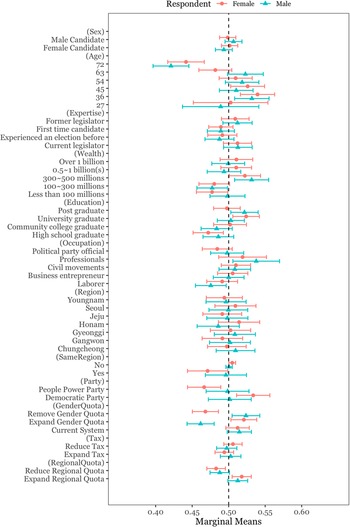
Next, we examined how these dynamics change when candidate profiles included information about candidates’ partisanship and their stances on three policies. Figure 3 presents the marginal means for each candidate attribute among male and female respondents. We expected respondents to use candidate gender as a heuristic to understand substantive gender representation in the absence of substantive information. However, when more accurate information was available, the respondents relied less on candidate gender cues. The results presented in Figure 3 corroborate these expectations.
Marginal means by respondents’ gender — high-information.

Figure 3. Long description
A coefficient plot with a vertical axis listing demographic and policy categories and a horizontal axis measuring Marginal Means from 0.40 to 0.60. A dashed vertical line marks the 0.50 baseline. Data points are split by respondent gender: pink circles for Female and teal triangles for Male, each with horizontal error bars representing confidence intervals.
* Sex: Male candidates are preferred slightly more by male respondents, while female candidates show near-neutral preference.
* Age: Significant divergence at age 72, where both genders show low marginal means (approx. 0.42 to 0.44). Preference peaks around age 36 and 45 for both genders.
* Expertise: Former legislators and those with election experience hover near the 0.50 baseline.
* Wealth: Higher wealth categories (300 to 500 millions and over 1 billion) show higher marginal means compared to the ‘Less than 100 millions’ category.
* Education: University and post-graduate levels show higher means than high school graduates.
* Occupation: Professionals and civil movement members show higher means, particularly among male respondents for professionals.
* Region: Most regions (Seoul, Jeju, Honam, etc.) cluster around the 0.50 line with overlapping confidence intervals.
* Party: Democratic Party candidates show higher marginal means (approx. 0.53) compared to People Power Party candidates (approx. 0.47).
* Gender Quota: Strong preference for ‘Expand Gender Quota’ (approx. 0.52) compared to ‘Remove Gender Quota’ (approx. 0.47).
* Tax and Regional Quota: ‘Expand Tax’ and ‘Expand Regional Quota’ show higher marginal means than their ‘Reduce’ counterparts.
In Figure 3, in contrast to the low-information environment, the marginal means for male and female candidates did not differ significantly from 0.5 among both male and female respondents, indicating that candidate gender ceased to affect respondents’ voting choices when policy positions and partisanship information were available. Moreover, confidence intervals generally overlapped across respondent genders.
Instead, the candidates’ stances on the gender quota produced a significant difference in marginal means between male and female respondents. Among the male respondents, the marginal means for candidates who preferred expanding the gender quota were approximately 0.46 among male respondents but 0.52 among female respondents. This was the opposite of that for candidates who preferred to remove gender quotas. The marginal means for such candidates were 0.52 among male respondents and 0.47 among female respondents. For the candidates who preferred to maintain the current system, the marginal means are not different from 0.5 both among male and female respondents. In other words, both the male and female respondents preferred candidates whose positions were consistent with their gender interests. Note that we did not observe a significant gender gap in the marginal means of candidates’ stances on the estate tax and regional quota. A gender gap was observed only when the issue was relevant to gender issues. These findings support our fourth hypothesis (H4).
Next, we examined the effect of individual sexism in a high-information context, as shown in Figure 4. In Panel (c), the differences in marginal means for male and female candidates were not significantly different from zero for both male and female respondents. In Panels (a) and (b), the marginal means for male and female candidates were not statistically different from zero among respondents. These results are in clear contrast with those shown in Figure 2. In a high-information context, candidate gender became ineffective as a cue, regardless of the strength of individual hostile sexism.
The effects of hostile sexism — high-information context.

Figure 4. Long description
A multi-panel figure with three coefficient plots labeled a, b, and c. All plots share a common y-axis with categories grouped by (Sex) including Male Candidate and Female Candidate, and (Gender Quota) including Expand, Current, and Reduce. A vertical dashed line represents the null effect or baseline.
Panel a, titled High H S, shows marginal means on an x-axis from 0.40 to 0.60. For Male Candidate, both male (teal triangle) and female (red circle) respondents are slightly above 0.50. For Expand, male respondents show a significant negative shift toward 0.43, while females are near 0.48.
Panel b, titled Low H S, shows marginal means on the same scale. For Expand, female respondents show a positive shift toward 0.54, while males are near 0.51. For Reduce, female respondents show a negative shift toward 0.45.
Panel c, titled High H S minus Low H S, shows the differences in marginal means on an x-axis from negative 0.15 to 0.15. The Expand category shows a positive difference for both genders, with males at approximately 0.08 and females at 0.06. The Reduce category shows a negative difference for both, with males at approximately negative 0.08 and females at negative 0.06. Error bars representing confidence intervals are shown for all data points.
However, this does not mean that the influence of sexism disappears in candidate choice. Rather, sexism manifested itself in evaluating candidates’ policy stances on gender quotas. In Panel (a), male respondents with strong hostile sexism preferred candidates who promised to reduce the quota (mm = 0.56) over those who promised to expand it (mm = 0.43). In contrast, female respondents with strong hostile sexism did not show distinctive preferences toward candidates based on their positions on the gender quota. This might be because sexist women’s opposition to gender quota policies, motivated by their sexist attitudes, weakens their baseline preference for substantive representation based on their gender identity. In Panel (b), where respondents exhibited weak sexism, the candidates’ positions on the gender quota did not affect male respondents’ choices. This seemingly insignificant effect of candidate gender might have occurred because men’s weak sexism eroded their baseline preference for substantive representation. In contrast, female respondents with weak sexism preferred candidates who promised to expand the quota (mm = 0.54) over those who promised to remove it (mm = 0.45). Overall, male respondents with high hostile sexism showed approximately 0.08 greater preference for candidates who proposed removing gender quotas compared to those with low hostile sexism. Similarly, female respondents with high hostile sexism demonstrated about 0.05 greater preference for candidates advocating quota removal than female respondents with low hostile sexism. These findings demonstrate that the effects of hostile sexism operate in the same direction for both male and female respondents, with sexist attitudes consistently predicting support for candidates who oppose gender quotas.
These findings support our prediction in the fifth hypothesis (H5). The findings suggest that candidate gender serves more as a signal of policy positions on gender issues than as a valence trait. Consequently, when voters are provided with information about candidates’ policy positions, the influence of candidate gender diminishes.
Discussion and Conclusion
The impact of candidate gender on voter preferences has been extensively studied using conjoint experiments, leading to a growing body of research. While the findings from these studies are mixed, the general conclusion is that candidate gender has no effect on voting choice, or that voters generally prefer female candidates. In their meta-analysis study, Schwarz and Coppock (Reference Schwarz and Coppock2022) concluded that voter bias against women candidates cannot be the main source of the underrepresentation of women in real world politics. However, these arguments and experimental results do not align well with the observed biases and antipathy toward female politicians that are still prevalent in the real world. This raises the question of the origin of this discrepancy. To address this puzzle, we posit that the discrepancy stems from a lack of understanding of what candidate gender represents to voters in their candidate evaluations.
This study argues that candidate gender can influence voters’ choices in two ways. First, when voters aim to elect a candidate who can represent their gendered interests in an election, candidate gender serves as a heuristic for determining whether a candidate can effectively represent them. In this case, co-sex voting is likely to occur: male voters prefer male candidates, and female voters prefer female candidates. Second, candidate gender can influence a voters’ choices by activating their sexist attitudes. When candidate gender is mobilized as a trigger for sexism, voters with strong sexism, regardless of gender, prefer male candidates to female candidates.
Previous studies have often interpreted the significance of candidate gender as evidence of sexism. However, because candidate gender can also serve as a cue for substantive representation, assessing bias based solely on the coefficient’s significance can be misleading. Therefore, we analyzed the impact of sexism on candidate choice by directly measuring respondents’ degrees of sexism and comparing those with higher and lower levels of sexism. Our results reveal a more nuanced relationship between sexism and the effect of candidate gender than suggested by previous research. Specifically, we found no effect of candidate gender among men with low hostile sexism and women with high hostile sexism. This can be attributed to the insignificant effect arising from co-gender preferences and the influence of sexism on candidate choice within these groups. These results imply that interpreting the absence of a candidate gender effect as an absence of sexism may be misleading. For instance, if female voters have incentives to support female candidates due to considerations of substantive representation, the lack of a candidate gender effect among female voters with strong sexism may not indicate that their sexism is not influencing their voting choices against women, but rather that the effect of sexism is counterbalanced by their preference for representation.
Additionally, we further demonstrate that the effects of candidate gender as a heuristic for substantive representation and the triggers of sexism vary according to the information environment. First, voters rely less on candidate gender when information about candidates’ positions on gender issues, such as attitudes toward gender quotas, is available. These results suggest that the mixed evidence for candidate gender effects observed in previous studies may be attributed to the design of candidate profiles in conjoint experiments. If the profile fails to provide individuating information about a candidate’s stance on gender-related policies, participants may infer this from the candidate’s gender. When the candidate profile includes additional substantive information that helps voters infer the candidate’s political leaning, as in Ono and Burden (Reference Ono and Burden2019), the effect of candidate gender is likely to diminish.
This study has further shown that when presented with information about candidates’ policy positions that have significant gender implications, individuals with high and low sexism scores do not significantly differ in their responses to a candidate’s gender. However, notable differences emerge in issues such as gender quotas, with those with strong sexism supporting the reduction of gender quotas, and those with weak sexism supporting their expansion. Hence, understanding whether sexism influences voting choices requires a broader perspective beyond mere attitudes toward candidate gender alone. Notably, as female legislators and candidates champion women’s empowerment policies, opposition to these policies may contribute to the challenges faced by female candidates in winning elections. Nevertheless, it is important to differentiate between the effects of candidate gender and policy positions. Beyond descriptive representation, low public support for policies that aim to enhance women’s status means that the substantive representation of women may be challenged when sexism is manifested through preferences for candidates who oppose gender equality policies, even when voters do not appear to discriminate against female candidates.
In summary, our study calls for a more nuanced interpretation of the candidate gender effect on voters’ electoral choices. This is because the effects of candidate gender as a heuristic for substantive representation and a trigger for sexism are entangled in the results. As discussed previously, in some cases, the two mechanisms of candidate gender effects counterbalance each other. Therefore, what appears to be the statistically insignificant effect of candidate gender should not be readily interpreted as the absence of voter bias against female candidates. Rather, a more nuanced understanding of the role of candidate gender in voters’ candidate evaluations is necessary. Additionally, we demonstrated that the influence of candidate gender, both as a heuristic and a trigger for sexism, is most pronounced when voters lack substantial information about policy positions. However, the waning effect of candidate gender in the presence of policy information does not indicate the eradication of gender bias. In this case, gender bias is manifested through voters’ electoral choices based on policy positions rather than solely on candidate gender. Therefore, it is crucial to understand the impact of sexism on the choices of female politicians or those advocating for gender equality. Focusing solely on supply-side factors without addressing this issue presents inherent limitations in advancing the descriptive or substantive representation of women.
Supplementary material
The supplementary material for this article can be found at http://doi.org/10.1017/S1743923X25100251.
Competing interest
The authors declare no conflict of interest.
Acknowledgments
Kang and You acknowledge that this work was supported by the Laboratory Program for Korean Studies through the Ministry of Education of the Republic of Korea and the Korean Studies Promotion Service of the Academy of Korean Studies (AKS-2018- LAB-1250002).




 Open access

