We partner with a secure submission system to handle manuscript submissions.
Please note:
You will need an account for the submission system, which is separate to your Cambridge Core account. For login and submission support, please visit the
submission and support pages.
Please review this journal's author instructions, particularly the
preparing your materials
page, before submitting your manuscript.
Click Proceed to submission system to continue to our partner's website.
To save this undefined to your undefined account, please select one or more formats and confirm that you agree to abide by our usage policies. If this is the first time you used this feature, you will be asked to authorise Cambridge Core to connect with your undefined account.
Find out more about saving content to .
To send this article to your Kindle, first ensure no-reply@cambridge.org is added to your Approved Personal Document E-mail List under your Personal Document Settings on the Manage Your Content and Devices page of your Amazon account. Then enter the ‘name’ part of your Kindle email address below. Find out more about sending to your Kindle.
Find out more about saving to your Kindle.
Note you can select to save to either the @free.kindle.com or @kindle.com variations. ‘@free.kindle.com’ emails are free but can only be saved to your device when it is connected to wi-fi. ‘@kindle.com’ emails can be delivered even when you are not connected to wi-fi, but note that service fees apply.
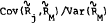
In the linear market-index model of the return-generating process, return on security j is given by

where αj and βj are constants characteristic of company j, is return on a market index, and is the company-specific component of return such that and . The coefficient βj is given by . It is known as market responsiveness, volatility, systematic risk, and, more commonly, simply as “beta.” It has been widely accepted as a measure of nondiversifiable risk and incorporated in popular performance measures. Many stock information services now provide estimates of beta.
Bernell Stone's paper extends the single-factor market model to a two-factor model to “better” explain the stochastic process that generates security returns. The inductive search for new models (of which his paper is one) presumably is predicated upon some unsatisfactory results of joint tests of the single-index market model and the capital asset pricing model. It is well known that there are other components of systematic or covariance risk that are not explained by the single-market factor. In the most general sense then, one would conclude that the truth of the return generating process is a multiple factor model, given that the process is indeed linear in the factors. Professor Stone chooses a two-factor (or index) model, in which the known factors are: (1) the return on an equity index, and (2) the return on a bond index. To this extent his interesting work is a special case of the more general work of others.
The study had two objectives: 1) an evaluation of third-market operational efficiency vis-a-vis the New York Stock Exchange and 2) an evaluation of any impact resulting from inclusion of third-market issues in the NASDAQ quotation system on preexisting third market versus NYSE efficiency.
Capital adequacy is an important and controversial issue in banking. Bank regulators consider the evaluation of capital adequacy one of their major responsibilities and place special attention on the role of capital in preventing bank failures.
The purpose of this paper is to examine various measures of the structure of banking markets and to relate these measures to selected indices of bank prices. To this point most studies in the field (and court rulings as well) have relied almost exclusively on concentration ratios and the number of banks as measures of market structure. However, these simple measures have important deficiencies which may lead to erroneous conclusions.
The purpose of this paper is to survey monetary policy as it unfolded from the beginning of 1973 to the spring of 1974. This is, on the whole, a relatively uncomplicated period to discuss since there was, I would judge, rather less controversy about the aims and appropriateness of monetary policy over most of this period than is often the case. In brief, monetary policy focused primarily on producing a moderate degree of restraint, one that would relieve the excess demand pressures clearly evident during at least the first part of the period. The aim in doing so was to create a climate in which inflation could gradually be brought under control. This objective suffered serious competition only briefly, when, during the early stages of the oil boycott, the potential of that situation for creating economic weakness was still very unclear.
This paper seeks to document some simple and not-so-simple facts. My thesis is that, to an unprecedented degree, Federal Reserve (F.R.) Board Chairman Arthur Burns has engaged himself and the System in political action. Burns' leadership has contributed to politicizing the monetary control process, the dialogue concerning the nature and effects of that process, and perhaps even F.R. decisions themselves. These tactics have reduced the Federal Reserve's power to resist external political influence, a power that Chairman McCabe “bled” for in 1951 and that over the next two decades Chairman Martin labored assiduously to consolidate. On the other hand, this behavior at least maintained and probably increased Burns' standing with President Nixon.
The current operating procedure of the Federal Reserve, as described by Richard Davis and interpreted by me, entails picking long-term growth rates (meaning six months and longer) for monetary aggregates, while simultaneously specifying short-run conditions for the federal funds rates and monetary aggregates which are felt to be consistent with long-term goals. But, he also states, because of “shorter term developments,” that the specified shorter term growth rates for monetary aggregates might not be equivalent to the desired long-term growth rate. This operating procedure disturbs me for two reasons. First, there is evidence demonstrating that different growth rates in the money stock which last as long as six months result in different levels of economic activity; thus six months should be the maximum control period not the minimum. Secondly, I don't see what meaning a long-term growth path for monetary aggregates can have if the Federal Reserve lets “shorter term” development define the short-term growth paths for money in a way which is inconsistent with the longer term goals.
Edward Kane alleges that the Federal Reserve System recently has taken a turn for the worse, with respect to monetary policy, in that Chairman Burns has re-politicized the System beyond prudent bounds. It is interesting to note that Kane changed the title of his paper from “The Politicization of the Fed” in his first draft (and before he had heard my comments at the meeting) to “The Re-Politicization of the Fed” in his second draft (after he had heard my comments). In my view, Kane's latest title is closer to the truth–though still somewhat misleading–in that, over time, the Fed has necessarily factored political and social considerations into the formulation of economic and monetary policy. But so what, and what else is new? The examples cited by Kane to “document” his case can best be characterized as allegations that illustrate a certain behavioral pattern over time, but these examples fail to support his case that–because of the repoliticization of the Fed–recent monetary policy has been at times counterproductive to the public interest. Perhaps a more legitimate conclusion that Kane could have reached from his observations of public policy in recent years is that the appointment of Dr. Burns as Chairman of the Committee on Interest and Dividends tended to formalize the quasipolitical nature of the position of the Chairman of the Federal Reserve Board.
This paper examines the problem of including intertemporally dependent cash flows in capital budgeting models under uncertainty, including review of previous efforts to resolve this problem. The difficulty involved in estimating autocorrelation coefficients and the magnitude of the error introduced by assuming independence are discussed.
This paper presents a descriptive theory of risk that may be applied to capital budgeting decisions. The proposed theory is actually much more general than a theory of financial risk and is consistent with reported laboratory experiments. The essential feature of this theory is the role that risk descriptively plays as a constraint in the decision-making process. Specifically, risk is modeled as a chance constraint such that projects are rejected if the probability of “failure” is larger than some prescribed level. This has the effect of making all investment decisions chance-constrained programming problems, although some classes of problems have trivial solution procedures. In this context, risk serves to “strike out” or eliminate alternatives from consideration.
The research report abstracted here addresses the question: do firms of low risk before financial leverage introduce relatively more financial leverage than firms of relatively high risk before leverage? Most of the received theory of corporation finance suggests an affirmative response. Our empirical work encourages us to be far more cautious.
The purpose of this paper is to obtain some quantitative evidence of whether what has been said of the capital markets of Central Europe is also true for the West-German capital market: that they lack depth, breadth, and resiliency; that they react strongly or even excessively to changes in demand and supply; and that they are vulnerable to adjustments in bank liquidity.
This study examines the historic security market performance of REIT shares during the six-year period 1968–1973. Performance measures suggested by Sharpe, Treynor, and Jensen were calculated for a sample of 30 larger and older REITs on both a pre- and post-tax basis. Principal conclusions are: 1) The average mortgage trust sampled had “outperformed” the S&P 500 while equity and hybrid trusts have fared poorer than the S&P 500. 2) The differences in performance levels are due principally to return levels and not risk differentials. 3) A substantial portion of the risk inherent in an REIT is diversifiable risk. This together with other evidence suggests that most REITs have not diversified risk exposure to the extent they indicated they would and were able to. 4) Performance rankings using before- and after-tax returns were identical, suggesting that certain espoused tax advantages unique to REITs have been virtually meaningless on a practical level.
Several titles reflecting different approaches to our subject matter were considered for the paper. An historical but somewhat pedantic approach to the teaching of investments might have been titled “Pedagogical Developments in Investments: Past, Present, and Future.” Another possibility was “Sex and the Single Investor,” a title which probably would have attracted a larger audience. “Beat the Dealer Versus Beat the Market” might well have been an appropriate title in view of our presence here in Las Vegas and also because of recent experience in the securities markets. We finally decided on simply “A Portfolio Analysis of the Teaching of Investments,” because this seems to better capture the essence of our viewpoint.
The problem of what to teach in investments courses can hardly have any one answerbecause teachers, students, levels, and purposes are too diverse. Even subject matter is debatable these days when one must make up his mind whether gold and antiques should be covered along with stocks and bonds, bills, and deposits. Thus what I offer here is one man's viewpoint, what seems most plausible to me out of 20 years' experience in brokerage and teaching: an opinion–no more, no less.
Among the topics that have been subjected to intensive research by businessschool scholars over the past two decades, few have received more attention than those which collectively comprise the field of investments. What is more important, even fewer have witnessed the plethora of important research findings that has been forthcoming in the investments field. Indeed, it seems reasonable to argue that in recent years no other business field's research accomplishments have been either as impressive or as generally reinforcing.
Reform of Financial Institutions and Markets: A Progress Evaluation
Regulatory reform relating to commercial banks and other deposit financial institutions has been frequently observed to be “crisis-bred.” The National Banking Act, along with fundamental but complementary legislation of 1863 and 1864, was in large measure stimulated by problems of the Civil War. The Federal Reserve Act was an outgrowth of the Panic of 1907 which vividly demonstrated the need for a central bank. The McFadden Act of 1927, the Glass-Steagall Act of 1932, the Reconstruction Finance Act of 1932, the Federal Home Loan Bank Act of 1932, the Home Owners' Loan Act of 1933, the Emergency Banking Act and the Banking Act of 1933, the Securities Exchange Act of 1934 and the Banking Act of 1935 all reflected reactions to crises of various dimensions.
Recently, there has been no shortage of proposals for reforming the U.S. financial system. Proposals have been offered by the Hunt Commission, the Administration, and several other groups. All these proposals contain many common elements, attesting to the difficulty of obtaining comprehensive financial reform. The analysis here focuses primarily upon the Administration's 1973 recommendations.