

Despite important advances in women’s descriptive representation, women remain a minority of elected representatives and party officials in countries around the world (UN Women 2024). A key explanation for this is that pipelines to power are gendered (Mariani Reference Mariani2008; Thomsen and King Reference Thomsen and King2020). However, while scholars have examined professional sectors such as law and business (e.g. Fox and Lawless Reference Fox and Lawless2005), a vital pipeline which has been overlooked is party youth wings. These are sub-organizations that socialize young people into politics and constitute key recruitment pools of future legislators and officials (Martínez-Cantó and Verge Reference Martínez-Cantó and Verge2023; Ohmura et al. Reference Ohmura, Bailer, Meiβner and Selb2018). Surprisingly, given youth wings’ valuable role in socializing and training tomorrow’s political elites, we know very little about women’s involvement in them. This shortcoming is noteworthy since, when people are young, gendered patterns of inequalities related to family responsibilities and career paths are less established (Ohmura and Bailer Reference Ohmura and Bailer2022; Pfanzelt and Spies Reference Pfanzelt and Spies2019). In other words, the experience of being in a youth wing in that phase of their lives has the potential to positively shape young women’s political attitudes and aspirations, with consequences for their future representation. In this article we investigate whether this is indeed the case. Drawing on YOUMEM data — the largest cross-national survey of youth wing members to date (McDonnell et al. Reference McDonnell, Ammassari, Valbruzzi, Bolin, Werner, Heinisch, Jungar and Wegscheider2025a) — we ask: Do women and men in party youth wings differ in their acquisition of personal efficacy and electoral ambition?
Our theoretical framework assumes that, due to long-standing gender differences in political socialization (Fox and Lawless Reference Fox and Lawless2024; Oser et al. Reference Oser, Feitosa and Dassonneville2023), women should be less likely than men to join youth wings in order to influence party policy (personal efficacy) and to stand as candidates (electoral ambition). In particular, the gender gap in electoral ambition has been well established, with (young) women both among the general public (Devroe et al. Reference Devroe, Coffé, Vandeleene and Wauters2023; Fox and Lawless Reference Fox and Lawless2014) and party memberships (Ammassari et al. Reference Ammassari, McDonnell and Valbruzzi2023; Kjaer and Kosiara-Pedersen Reference Kjaer and Kosiara-Pedersen2019) being less ambitious than men.Footnote 1 Assuming this initial disparity, we theorize that youth wings may perform two distinct, competing roles in the political socialization of young women. On the one hand, given how younger generations are more supportive than older ones of women’s participation in politics (Dolan and Sanbonmatsu Reference Dolan and Sanbonmatsu2009; Fernández and Valiente Reference Fernández and Valiente2021), youth wings may act as forces of renovation within political parties, providing inclusive environments for women to grow politically. On the other hand, since youth wings are party sub-organizations, it is possible they will reproduce the discrimination against women that their senior parties perpetrate in their structures, rules, and norms (Daddow and Hertner Reference Daddow and Hertner2021; Kenny and Verge Reference Kenny and Verge2016). In the former scenario, we would expect young women to indicate they have acquired more efficacy and ambition during their membership, relative to men; while, in the latter, we would expect the opposite. At the same time, we contend that youth wings of left-wing parties will be more likely to positively affect women’s political attitudes. Finally, we examine whether exposure to the youth wing, and in particular levels of activism and length of membership, matter more for women’s acquisition of personal efficacy and electoral ambition than men’s.
We test our theory using cross-sectional survey data from the YOUMEM project, drawing on a sample of over 3,100 youth wing members from the main center-left and center-right parties in Australia, Austria, Germany, Italy, Spain, and Sweden.Footnote 2 Specifically, we compare the extent to which the desire to influence party policy and to stand as a candidate features among the reasons why members have joined, and among the reasons why they remain. Our results show that women are more likely than men to perceive they have acquired both personal efficacy and electoral ambition during their membership, with the gender gap being especially marked for efficacy. While both center-left and center-right youth wings foster women’s personal efficacy, it is primarily women members of center-right youth wings who witness an increase in their levels of electoral ambition. Lastly, we find that the degree of exposure to the youth wing has a positive impact on women’s political socialization. The longer women have been in the youth wing and the more active they are, the greater their desire to influence party policy and stand as candidates, relative to men. Overall, our findings indicate that the experience of being in a youth wing can facilitate the development of key political attitudes among young women. Moreover, it is especially beneficial for women who get involved in grassroots activities and who remain in the youth wing over time.
The article proceeds as follows. In the next two sections, we set out our theoretical framework. Drawing on the literature on gender and politics, party membership, and youth in politics, we argue that — in terms of the socialization they offer their women members — youth wings may act either as forces of renovation or as reproducers of inequality within their parties. We then develop a series of hypotheses reflecting these two perspectives, focusing on gendered trends in youth wing members’ acquisition of efficacy and ambition, the role of party ideology, and how exposure to the youth wing may shape these political attitudes. In the fourth section, we introduce our six country cases, and describe our youth wing membership surveys and the variables utilized in the analysis. In the fifth, we present our findings, starting with descriptive results on gender differences in the acquisition of efficacy and ambition, before moving on to the results of our regression analyses. Our findings provide support for the idea that youth wings can be forces of renovation, fostering women’s efficacy and ambition to a greater extent than men’s. Finally, we conclude the article by discussing the implications of our research and highlighting promising paths for future work. Our study suggests that, in addition to the political socialization and recruitment of young people, youth wings’ democratic functions may include facilitating more inclusive and representative party institutions.
Women’s Political Socialization and Party Youth Wings
Due to long-standing trends of gendered socialization associating women with the private realm and men with the public one (Krook Reference Krook2010; Norris and Lovenduski Reference Norris and Lovenduski1995), women tend to display less political efficacy and ambition than men (Allen and Cutts Reference Allen and Cutts2018; Devroe et al. Reference Devroe, Coffé, Vandeleene and Wauters2023; Fox and Lawless Reference Fox and Lawless2004; Reference Fox and Lawless2024; Oser et al. Reference Oser, Feitosa and Dassonneville2023). These gender differences in attitudes are in turn exacerbated by parties which, with their informal and formal structures, rules, and norms, reinforce the impression that “the individual fulfilling the ‘ideal’ party member […] is by definition a man” (Verge Reference Verge2015, 758; see also Bjarnegård Reference Bjarnegård2013; Kenny Reference Kenny2013; Verge and de la Fuente Reference Verge and de la Fuente2014; Daddow and Hertner Reference Daddow and Hertner2021). As a result of these dynamics, the pipelines to power — the venues where candidates and officials are typically recruited from — are gendered. Not only are women in these pipelines scarce, but the few women present in them are substantially different from their men counterparts, resulting in their lower likelihood to pursue a career in politics (Carroll and Sanbonmatsu Reference Carroll and Sanbonmatsu2013; Mariani Reference Mariani2008; Thomsen and King Reference Thomsen and King2020).
One pipeline which gender and politics scholars (and most party organization scholars) have overlooked is youth wings. These are party sub-organizations for young people which are very common in parliamentary democracies.Footnote 3 According to Allern and Verge (Reference Allern, Verge, Scarrow, Webb and Poguntke2017, 119), 78% of parties in Global North countries have youth wings, well ahead of the next most frequent sub-organization, which is women’s wings (41%). In addition to providing parties with campaign volunteers and being a source of linkage between young people and political elites, youth wings fulfill two vital and interconnected democratic functions. The first is political recruitment: youth wings represent key pools of future elected representatives and officials in parliamentary democracies (Binderkrantz et al. Reference Binderkrantz, Nielsen, Pedersen and Tromborg2020; Hooghe et al. Reference Hooghe, Stolle and Stouthuysen2004; Martínez-Cantó and Verge Reference Martínez-Cantó and Verge2023; Ohmura et al. Reference Ohmura, Bailer, Meiβner and Selb2018). For instance, in their study of German MPs’ career paths between 1998 and 2014, Ohmura et al. (Reference Ohmura, Bailer, Meiβner and Selb2018, 178) find that over a quarter of parliamentarians had held positions in their party youth wings. Similarly, as regards officials, Martínez-Cantó and Verge (Reference Martínez-Cantó and Verge2023, 141) report that 24% of party national executive committee (NEC) members in Spain between 1975 and 2020 were previously in their party’s youth wing. It is therefore no surprise that, as observed by Bolin and Jungar (Reference Bolin and Jungar2024, 503) in their qualitative study of Swedish youth wings, youth wing members consider “the possibility of pursuing a political career as something they particularly value in their organization” (see also Fjellman and Rosén Sundström Reference Fjellman and Sundström2021).
The second function is the socialization of young people into politics. Youth wings offer a space where they can interact with like-minded peers, party officials, and elected representatives, learn about the party, and engage in related political and social activities (Mycock and Tonge Reference Mycock and Tonge2012; Rainsford Reference Rainsford2018; de Roon Reference de Roon2022). In addition, according to Bolin and Jungar (Reference Bolin and Jungar2024, 499) “youth wings empower their members with a sense of influence over their own youth wings and the mother party, as well as politics and society at large.” This is also because these organizations offer members the chance to contribute to policymaking: about 70% of youth wings in the Global North have representation rights in the party congress and/or the party executive (Allern and Verge Reference Allern, Verge, Scarrow, Webb and Poguntke2017, 121). Hence, youth wings can serve as critical incubators for political engagement, equipping young people with the resources, skills, and networks necessary to influence not only their parties but also the broader political landscape.
An important aspect, however, that is largely absent from the literature on youth wings is whether there are gendered trends in the political socialization experienced by members. In fact, we know very little in general about women’s involvement in these party sub-organizations. The scattered evidence so far shows that, first, youth wings can be conceived of as “boys’ clubs” since men considerably outnumber women in their memberships (Ammassari et al. Reference Ammassari, McDonnell and Valbruzzi2023; Ohmura and Bailer Reference Ohmura and Bailer2022); second, women in youth wings are less interested than men in pursuing political careers which involve standing for elections, although they are similarly interested in intra-party careers which are less in the spotlight (Ammassari et al. Reference Ammassari, McDonnell and Valbruzzi2023; Kolltveit Reference Kolltveit2022); and third, they tend to have preferences regarding the purpose of party work, networking, and election rules which hinder their ability to rise up through the youth wing/party ranks (Ohmura and Bailer Reference Ohmura and Bailer2022). None of these studies, though, addresses the question of whether the experience of being in a youth wing can foster women’s political attitudes, including efficacy and ambition.
This question is especially relevant, given that youth wings are party sub-organizations specifically for young people. Young people tend to be less affected by gendered patterns of inequalities which emerge in later life stages, for instance in terms of childcare, domestic responsibilities, type of employment, and income (Ohmura and Bailer Reference Ohmura and Bailer2022; Pfanzelt and Spies Reference Pfanzelt and Spies2019; see also Hooghe et al. Reference Hooghe, Stolle and Stouthuysen2004). All these aspects have been shown to hinder women’s political careers to a greater extent than men’s (Bernhard et al. Reference Bernhard, Shames and Teele2021; Fulton et al. Reference Fulton, Maestas, Sandy Maisel and Stone2006; Mariani Reference Mariani2008; Martínez-Cantó and Verge Reference Martínez-Cantó and Verge2023). Accordingly, youth wings have the potential to socialize politically engaged young women and prepare them for office before these gender disparities materialize — especially in an era when younger generations are ever more supportive of women’s involvement in politics (Dolan and Sanbonmatsu Reference Dolan and Sanbonmatsu2009; Fernández and Valiente Reference Fernández and Valiente2021). If youth wings indeed fulfill this function, it could have a positive impact on women’s future representation in political parties.
Gender, Efficacy, and Ambition in Party Youth Wings
To study whether youth wings are beneficial to young women’s political socialization, we focus on two attitudes: personal efficacy, defined as grassroots members’ belief that they can influence party policy (Whiteley and Seyd Reference Whiteley and Seyd2002, 54–55), and (nascent) electoral ambition, defined as “the embryonic or potential interest in office seeking” (Fox and Lawless Reference Fox and Lawless2005, 643). While the literature on political ambition, and especially the gender gap in that ambition, is abundant (see Davidson-Schmich Reference Davidson-Schmich, Kenny and Bjarnegård2025 for a review), efficacy has received far less scholarly attention. We focus on both efficacy and ambition for a number of reasons. First, the development of policy and competing in elections are two of the most important functions of political parties. They are also two of the main reasons why people join parties (van Haute and Gauja Reference van Haute and Gauja2015) and their youth wings (McDonnell et al. Reference McDonnell, Ammassari, Valbruzzi, Bolin, Werner, Heinisch, Jungar and Wegscheider2025a). Second, both attitudes are strong predictors of high-intensity party activism, including standing as candidates and holding intra-party positions (Bale et al. Reference Bale, Webb and Poletti2020; Heidar and Kosiara-Pedersen Reference Heidar, Kosiara-Pedersen, Demker, Heidar and Kosiara-Pedersen2020; Whiteley and Seyd Reference Whiteley and Seyd2002). Studying the personal efficacy and electoral ambition of youth wing members thus gives us insights into which young people are likely to pursue a political career. Finally, our choice responds to calls to look beyond electoral ambition and pay more attention to alternative ways in which women can achieve power within political parties (Ammassari et al. Reference Ammassari, McDonnell and Valbruzzi2023). In particular, as mentioned above, recent research has noted how women tend to prefer political careers which are more removed from the public eye, but nonetheless allow them “to influence party policies, choices and strategies” (ibid, 1071; see also Bauer and Darkwah Reference Bauer and Darkwah2020; Kolltveit Reference Kolltveit2022).
Both efficacy and ambition can be affected by gender. Notably, as discussed earlier, processes of gendered socialization and parties’ practices favoring men have negatively impacted women’s political attitudes (Krook Reference Krook2010; Verge Reference Verge2015). Based on this evidence, our theoretical framework assumes that, when they join the youth wing, women will have lower levels of personal efficacy and electoral ambition than men. In other words, they should be less likely to have signed up because they want to influence party policy, and because they want to stand as candidates in the future. We argue that whether women acquire more or less efficacy and ambition relative to men during their membership depends on the type of experience they have as youth wing members. We therefore theorize two competing “ideal type” roles that youth wings can fulfil in this regard: “forces of renovation” or “reproducers of inequality.”
We start by looking at youth wings as forces of renovation. There is plenty of empirical evidence that recent younger generations have more positive attitudes toward women in politics than previous ones. For instance, young people are more likely to be in favor of having more women as political decision-makers (Dolan and Sanbonmatsu Reference Dolan and Sanbonmatsu2009; Fernández and Valiente Reference Fernández and Valiente2021), think that women are equal political leaders to men (Neundorf and Shorrocks Reference Neundorf and Shorrocks2022), believe in women’s ability to govern (Alexander Reference Alexander2012), and trust women as political representatives (Toshkov and Cretti Reference Toshkov and Cretti2023). Contemporary youth wing members may therefore be more open to, and encouraging of, women’s involvement at the grassroots and in leadership positions. After all, although gender parity in political institutions in most regions of the world remains a distant goal, today’s young people have been socialized in an era where there are more women in politics than ever, and measures of positive discrimination such as gender quotas have been increasingly normalized (Krook Reference Krook2006). Women politicians may not only act as role models for young women, but also signal to all youths, both women and men, that women “belong” in politics (Ladam et al. Reference Ladam, Harden and Windett2018; Ponce et al. Reference Ponce, Scarrow and Achury2020; Wolbrecht and Campbell Reference Wolbrecht and Campbell2007). If youth wings reflect these generational shifts and socio-political developments, rather than being mere mirrors of their senior parties, we would expect them to treat their women members better than has been the case among their predecessors. In this scenario, the experience of being involved in a youth wing should be especially empowering for women, and their political socialization should benefit more than men’s, given the lower levels of personal efficacy and electoral ambition that women start out with. Accordingly, we hypothesize that:
H1a: Women will report a greater increase in personal efficacy and electoral ambition during their youth wing membership, relative to men.
The second “ideal type” takes the opposite view and envisages youth wings as reproducers of inequality. Regardless of the degree of autonomy youth wings may enjoy, they remain party sub-organizations whose structures and rules resemble those of their senior parties — not to mention the significant overlap in personnel between the two organizations, with youth wing leaders often being active in senior parties as staffers and running local branches (Mycock and Tonge Reference Mycock and Tonge2012; McDonnell et al. Reference McDonnell, Sofia, Ann-Cathrine, Anders Ravik and Cas2026). Accordingly, youth wings may well uphold the same organizational culture which is institutionalized in their parties. Rarely is this a culture which favors women. Political parties are gendered organizations whose day-to-day practices put women at disadvantage. For instance, during party meetings men tend to dominate conversations and women’s points are dismissed as irrelevant; if women members hold leadership positions, their legitimacy is questioned and challenged; and they may be sanctioned if they show overt ambition and assertiveness (Kantola and Lombardo Reference Kantola and Lombardo2019; Kenny Reference Kenny2013; Verge and de la Fuente Reference Verge and de la Fuente2014). In addition, men members tend to network primarily with other men, leading to the creation of what Bjarnegård (Reference Bjarnegård2013) defines as “homosocial capital.” These men-dominated networks, which are often cultivated outside party settings in less convenient locations and times of the day for women (Kantola and Lombardo Reference Kantola and Lombardo2019; Verge and de la Fuente Reference Verge and de la Fuente2014), ensure that the latter “remain outsiders from the inside” (Verge and Claveria Reference Verge and Claveria2018, 545). It is therefore no surprise that women in political parties, including in youth wings, tend to display less interest in running for office than men (Ammassari et al. Reference Ammassari, McDonnell and Valbruzzi2023; Kjaer and Kosiara-Pedersen Reference Kjaer and Kosiara-Pedersen2019; cf. van Dijk Reference van Dijk2025). If women in youth wings are subject to the same discriminatory practices as their counterparts in senior parties, their political socialization will likely be damaged. In particular, the awareness that they can never “fully belong” to the organization they are members of may depress their sense of efficacy and career aspirations, while young men, by contrast, should receive a boost. Based on these considerations, the second of our two competing hypotheses states that:
H1b: Men will report a greater increase in personal efficacy and electoral ambition during their youth wing membership, relative to women.
The above contrasting roles which we ascribe to youth wings are ideal types best understood as extremes on a spectrum, with youth wings primarily acting as forces of renovation or as reproducers of inequality. Furthermore, it may also be the case that the political socialization youth wings offer their women members differs depending on youth wing-level characteristics, most notably party ideology. Parties of the left, by virtue of their belief that inequalities are socially constructed and should be removed (Bobbio Reference Bobbio1994), have historically had stronger connections with women’s movements and feminist organizations (Kittilson Reference Kittilson, Waylen, Celis, Kantola and Laurel Weldon2013). Accordingly, they are more likely than right-wing parties to have candidate and intra-party quotas for women, to adopt gender action plans, and to elect and employ women as representatives and officials (Childs and Kittilson Reference Childs and Kittilson2016; Kittilson Reference Kittilson2006; Yong and Hazell Reference Yong and Hazell2014; Verge Reference Verge2020). Similarly, although all party memberships are numerically dominated by men, parties of the left tend to have larger proportions of women among their grassroots than those of the right (van Haute and Gauja Reference van Haute and Gauja2015; Heidar and Wauters Reference Heidar and Wauters2019). All these aspects should not only encourage the recruitment of women youth wing members, but also enhance their levels of activism and foster their political career aspirations (Ladam et al. Reference Ladam, Harden and Windett2018; Piscopo Reference Piscopo2019; Ponce et al. Reference Ponce, Scarrow and Achury2020). In addition, if the extent to which youth wings can act as forces of renovation depends on how autonomous they are from their senior parties, it is noteworthy that center-left youth wings tend to be more independent than youth wings of the center-right in terms of their membership rules, organization, and leadership selection (McDonnell et al. Reference McDonnell, Ammassari, Werner, Bolin, Valbruzzi, Lopes, Heinisch, Jungar and Wegscheider2025b). In sum, it seems plausible that women will be more likely to acquire personal efficacy and electoral ambition as members of center-left youth wings, than as members of center-right ones. Our next hypothesis thus posits that:
H2: Women in center-left youth wings will report a greater increase in personal efficacy and electoral ambition, relative to women in center-right youth wings.
Finally, we are interested in whether the acquisition of personal efficacy and electoral ambition is encouraged by different factors for women and men. In this regard, scholars have emphasized the role that material resources like education, and attitudes like political interest, play in promoting political socialization (Coffé and Bolzendahl Reference Coffé and Bolzendahl2010; Fox and Lawless Reference Fox and Lawless2005; Morales Reference Morales2009; Verba et al. Reference Verba, Schlozman and Brady1995). Given that our focus is on the political socialization young people experience while they are in youth wings, rather than before enrolling in them, in this study we concentrate instead on what we term “youth wing exposure,” which we understand in terms of length of membership and activity levels. By renewing their annual membership and by taking part in the activities organized by the youth wing, members can show loyalty to the organization, learn useful political skills, and network with the senior party leadership (Bolin and Jungar Reference Bolin and Jungar2024; Fjellman and Rosén Sundström Reference Fjellman and Sundström2021; Malafaia et al. Reference Malafaia, Menezes and Neves2018; Mycock and Tonge Reference Mycock and Tonge2012). At the same time, however, exposure is likely to have distinct gendered effects depending on the role youth wings fulfill in women’s political socialization. If youth wings act more as reproducers of inequalities (H1b), we would expect men to benefit more than women from factors like length of membership and party activism. This would be in line with what we know about senior parties. For example, in their study of candidates and ministers in the Global North, Verge and Claveria (Reference Verge and Claveria2018) find that holding party office facilitates men’s political careers more than women’s. Similarly, Martínez-Canto and Verge (Reference Martínez-Cantó and Verge2023) observe that intra-party resources such as embeddedness in party networks help men gain positions of power and extend their tenure in office, but do not benefit women in the same way. By contrast, if youth wings act more as forces of renovations within parties (H1a), we would expect the opposite interaction effect between gender and youth wing exposure. Given how women join youth wings with a political socialization “disadvantage” (see also Fox and Lawless Reference Fox and Lawless2014), staying in the youth wing and getting involved in grassroots activities should be particularly beneficial for their sense of efficacy and ambition. Based on the above, we propose the following competing hypotheses — the first of which would apply if H1a proves to be true, and the second if H1b is supported:
H3a: Youth wing exposure will have a stronger positive effect on women’s reported acquisition of personal efficacy and electoral ambition than men’s.
H3b: Youth wing exposure will have a stronger positive effect on men’s reported acquisition of personal efficacy and electoral ambition than women’s.
Research Design
To investigate gendered trends in the acquisition of efficacy and ambition among youth wing members, we draw on original cross-sectional survey data collected as part of the YOUMEM project (McDonnell et al. Reference McDonnell, Ammassari, Valbruzzi, Bolin, Werner, Heinisch, Jungar and Wegscheider2025a) from 3,120 members (955 women and 2,165 men) of the 12 main center-left and center-right party youth wings in Australia, Austria, Germany, Italy, Spain, and Sweden. The youth wings and their respective senior parties are listed in Table 1 below. Our six country cases are all parliamentary democracies with traditions of strong center-left and center-right parties alternating as the major parties in government and opposition. In addition to providing an environment in which future grassroots members are politically socialized, party youth wings are often the training grounds for future political careers in all countries. Indeed, at the time of writing in December 2025, the prime ministers in four of our six country cases — Australia, Germany, Italy, and Sweden — and the main opposition leaders in three of them – Australia, Italy, and Sweden — had begun their political careers in youth wings.
Youth wings surveyed

Table 1. Long description
Content flagged by safety filters.
At the same time, the six democracies encompass four regions of the Global North — the Anglosphere, Northern Europe, Southern Europe, and Western Europe — which are characterized by distinct political cultures (Morales Reference Morales2009; see also Dekker and van der Broek Reference Dekker and van den Broek1998) and gender regimes (Sainsbury Reference Sainsbury1999). Accordingly, the extent to which women’s presence in politics is normalized across the six countries is quite different. To give an illustration, our case selection comprises Sweden, whose “public gender regime” incentivizes women to pursue a career, since the state is the main source of social support; but also Italy, whose “domestic gender regime” expects women to be primarily responsible for the care of children and the elderly (Sainsbury Reference Sainsbury1999; see also Esping-Andersen Reference Esping-Andersen1990; Sundström Reference Sundström2003). Relatedly, the six countries differ considerably in the extent to which women participate in political parties. For example, if we look at women’s descriptive representation in the Lower House of Parliament in each country, as of October 2025 Australia and Sweden had the highest proportions of women MPs (46% and 45%, respectively) and Italy the lowest (32%), with Spain (44%), Austria (36%), and Germany (33%) in between (Inter-Parliamentary Union 2025).Footnote 4 As for women party leaders, Italy had not had a single woman as leader of a prominent party until 2022, while Australia and Austria had only had one.Footnote 5 By contrast, parties represented in parliament in Germany, Spain, and Sweden have regularly had women leaders. In sum, these countries provide very different environments for (young) women who wish to get involved in politics and pursue a political career. Our “diverse” case selection (Gerring Reference Gerring2006) is thus well suited to account for these disparate contexts, and provides a strong basis for the generalizability of our findings among center-left and center-right youth wings in the Global North.
Our YOUMEM surveys were fielded online between 2018 and 2022.Footnote 6 The Australian survey was launched in March 2018 and concluded in November that year; the Spanish and Italian ones took place between March 2020 and April 2021, the Swedish survey was fielded in September-October 2020, while the Austrian and German surveys were conducted in the second half of 2021 and first half of 2022.Footnote 7 The long timeframe for most of the surveys was due to the difficulties of securing distribution among the youth wing memberships in all countries except Sweden. In Australia, Italy, and Spain, going through the national level organization was either not feasible or produced few results, so we asked youth wing leaders in all states and territories (Australia), regions (Italy), and autonomous communities (Spain) to distribute the link to their local members. In Austria and Germany we had better cooperation from national youth wing leaders, but it still took a long time to achieve good distribution among the state-level branches. For the Swedish survey, the youth wing’s national leaderships distributed a link to the survey via e-mail to all members who had provided them with an e-mail address.
While ours is the first cross-national survey of youth wing members, it is worth acknowledging a few limitations. As is the norm in party membership research (Gauja and van Haute Reference Gauja, van Haute, van Haute and Gauja2015, 194), our study is based on a non-random sample of youth wing members, meaning that we cannot exclude that there are systematic differences between those who participated and those who did not. Relatedly, since some of the youth wings were unwilling to share precise information about how many members they have (or how many received the survey link), we do not know the proportions of members from all twelve youth wings that responded to our survey.Footnote 8 That said, according to what we know about youth wing and party members more generally, our sample is representative of these populations since our respondents tend to be men (especially in center-right youth wings), well-educated, with higher-than-normal levels of political family backgrounds, political interest, and electoral ambition (Bruter and Harrison Reference Bruter and Harrison2009; van Haute and Gauja Reference van Haute and Gauja2015; Heidar and Wauters Reference Heidar and Wauters2019).Footnote 9 In addition, we were able to secure good geographical coverage, with at least three quarters of all regions and states in each country being represented. These considerations reassure us about the quality of the sample.
Our two outcomes of interest are the reported acquisition of personal efficacy and electoral ambition. To investigate these, we compare the reasons why young people first decided to enroll in the youth wing and the reasons why they continue to renew their membership, using four-level agreement Likert scales. By mapping differences in members’ reasons for joining and staying, we can learn about the kind of political socialization that youth wings offer them, even though our data is not longitudinal. Since the “joining” and “staying” statements have very similar wordings and were relatively close to one another in the survey questionnaire, a respondent who chooses a different agreement option between the two is signaling that they think there has been a change during their membership.Footnote 10
To measure the acquisition of personal efficacy, we asked respondents to indicate the extent to which they agreed on a four-level scale with two statements — one belonging to a battery of questions on why they joined the party, and one belonging to a battery gauging why they stayed in it. The first statement is “I joined the youth wing because I wanted to influence [name of the party] policy”; and the second is “Being a member of the youth wing allows me to influence policies I care about.” The scale for each item ran from strongly disagree (coded as 0) to strongly agree (coded as 3). We then subtracted the value of the “staying” statement from that of the “joining” statement, and recoded the resulting values to obtain an ordinal variable with three levels: 1) “negative variation” if the result of the subtraction was higher than 0 (i.e. if the “joining” statement was assigned a higher value than the “staying” statement); 2) “no variation” if the result was equal to 0 (i.e. if the two statements were assigned the same value; and 3) “positive variation” if the result was lower than 0 (i.e. if the “joining” statement was assigned a lower value than the “staying” statement.Footnote 11 To measure the acquisition of electoral ambition, we followed the same procedure with the statements “I joined the youth wing because I wanted to stand as a candidate one day” and “In the future, I would like to stand as a candidate for the senior party.” This again resulted in a three-level ordinal variable.Footnote 12
The main independent variable of the analysis is the gender of youth wing members, coded as 1 for women and 0 for men. To test our hypothesis on differences across party ideology (H2), we use a variable measuring the ideology of the youth wing (coded as 1 for center-right, 0 for center-left). To test H3a and H3b on youth wing exposure, we created two variables. The first is a continuous one which measures respondents’ length of membership in years. The second, youth wing activism, is a four-level ordinal variable which gauges how many hours respondents devote to party activities in an average week outside election campaigns (from “0 hours,” coded as 0, to “More than 10 hours,” coded as 3). In addition, we included controls for age, tertiary education, political family background, political interest, ideological congruence, and the country of respondents.Footnote 13
Gendered Trends in Youth Wing Members’ Acquisition of Efficacy and Ambition
In this section, we use YOUMEM survey data to test our hypotheses. The starting point of our theoretical framework was that due to a series of supply- and demand-side gendered dynamics, women would be less likely than men to join youth wings in order to influence party policy and stand as candidates. To assess this, we examine gender differences in respondents’ agreement with the two statements measuring personal efficacy and electoral ambition as reasons for joining. Table 2 below reports the differences in means between women and men, together with the p-value obtained from a Welch Two Sample t-test. The table shows that, when they enroll, women display lower personal efficacy and electoral ambition, with the gender gap being especially marked for the latter attitude.
Gender differences in reasons for joining the youth wing

Table 2. Long description
The table has two rows for reasons: personal efficacy and electoral ambition, each with columns for minimum, maximum, women, men, and p-value. For personal efficacy, minimum is 0, maximum is 3, women score 2.18, men score 2.31, p-value is less than 0.001 with three asterisks. For electoral ambition, minimum is 0, maximum is 3, women score 1.31, men score 1.78, p-value is less than 0.001 with three asterisks. Both reasons show statistically significant gender differences, with men scoring higher than women.
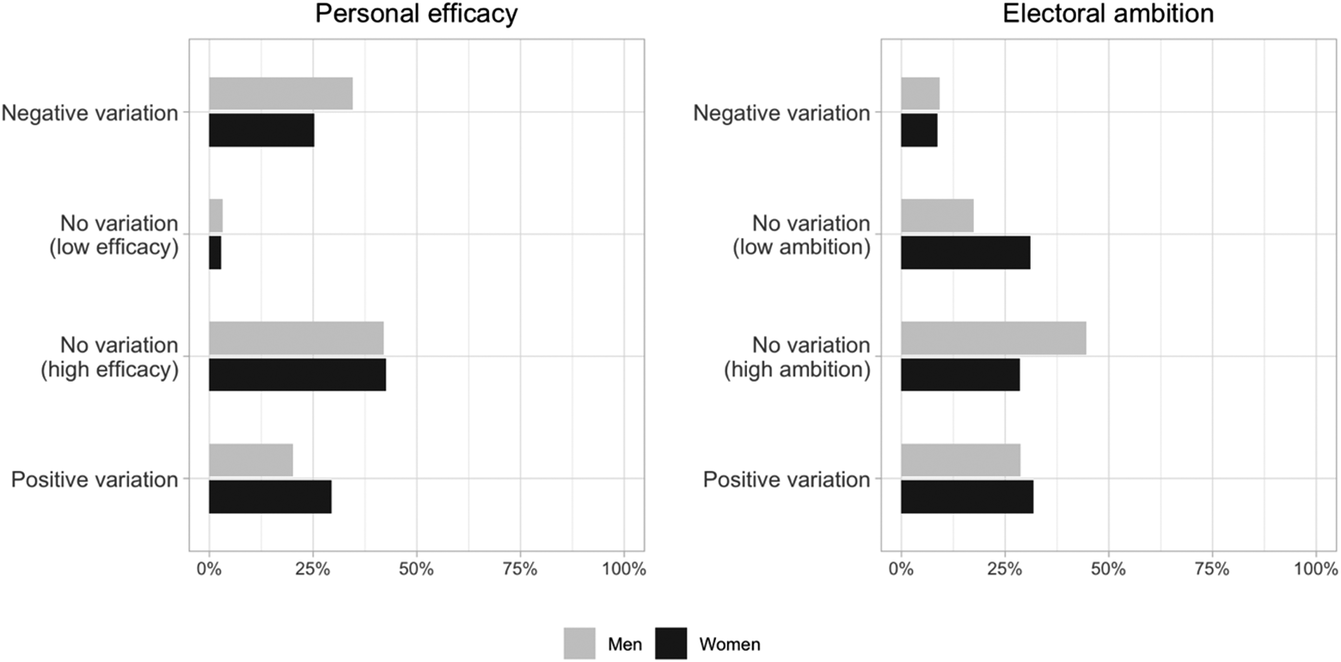
To investigate whether gender gaps in efficacy and ambition narrow over the course of membership (H1a) or if they become even larger (H1b), Figure 1 below displays the distribution of our two dependent variables among women and men. To get a more fine-grained understanding of members’ development of political attitudes, we distinguish two types of “no variation” outcomes: one in which there is no variation because respondents displayed little to no efficacy/ambition as reasons for joining the youth wing and staying in it; and one in which there is no variation because respondents said that efficacy/ambition were reasons for both joining and staying. Starting from personal efficacy in the left-hand panel, the figure shows that the mode for both women and men is “No variation (high efficacy)”: about 42%–43% of women and men agree that they joined because they wanted to influence party policy, and that being a youth wing member allows them to do so. Conversely, the proportion of respondents who think throughout their membership that they have no influence over party policy is very small (around 3% for both women and men). When we look at the acquisition and loss of personal efficacy, however, the picture becomes more interesting. Women are more likely than men to indicate they have acquired personal efficacy over the course of their membership: about 29% of women report an increase in their belief that they can influence party policy, as opposed to 20% of men. By the same token, while only one in five women witnesses a decline in their personal efficacy, over one in three men do likewise.
Variation in personal efficacy and electoral ambition of youth wing members, by gender.
Source: Table E2, Appendix E.

Figure 1. Long description
Starting with the left panel labeled ‘Personal efficacy’, four horizontal categories are listed from top to bottom: Negative variation, No variation (low efficacy), No variation (high efficacy), and Positive variation. For Negative variation, men (grey) have a longer bar than women (black). For No variation (low efficacy), both genders have very short bars, with women slightly shorter. For No variation (high efficacy), men and women have similar bar lengths, with men slightly longer. For Positive variation, women have a longer bar than men. Moving to the right panel labeled ‘Electoral ambition’, the same four categories are listed from top to bottom: Negative variation, No variation (low ambition), No variation (high ambition), and Positive variation. For Negative variation, both genders have short bars, with women slightly shorter. For No variation (low ambition), women have a longer bar than men. For No variation (high ambition), men have a longer bar than women. For Positive variation, women have a longer bar than men. The legend at the bottom indicates men are represented by grey bars and women by black bars.
When we move on to the right-hand panel of Figure 1, we observe very different trends. The largest gender differences regarding electoral ambition, in fact, concern the two “no variation” outcomes. About 45% of men joined because they wanted to stand as candidates and were still interested in pursuing a candidature when they took our survey; the same proportion among women is 16 percentage points lower (29%). In addition, while about one-third of women reported having no candidate aspirations either before enrolling or as regards the future, the same is true of only 18% of men. At the same time, when we look at variation in members’ levels of electoral ambition, women seem to benefit slightly more than men. About one in three women signal that they have acquired electoral ambition during their membership, as opposed to 29% of men. Conversely, more men than women, proportionally, witness a decline in their aspiration to stand as candidates (9.3% vs 8.6%, respectively). These results, which hold for both center-left and center-right youth wings (see Tables E3–E4, Appendix E), provide preliminary evidence in favor of H1a: namely, women appear more likely than men to acquire efficacy and ambition during their membership.
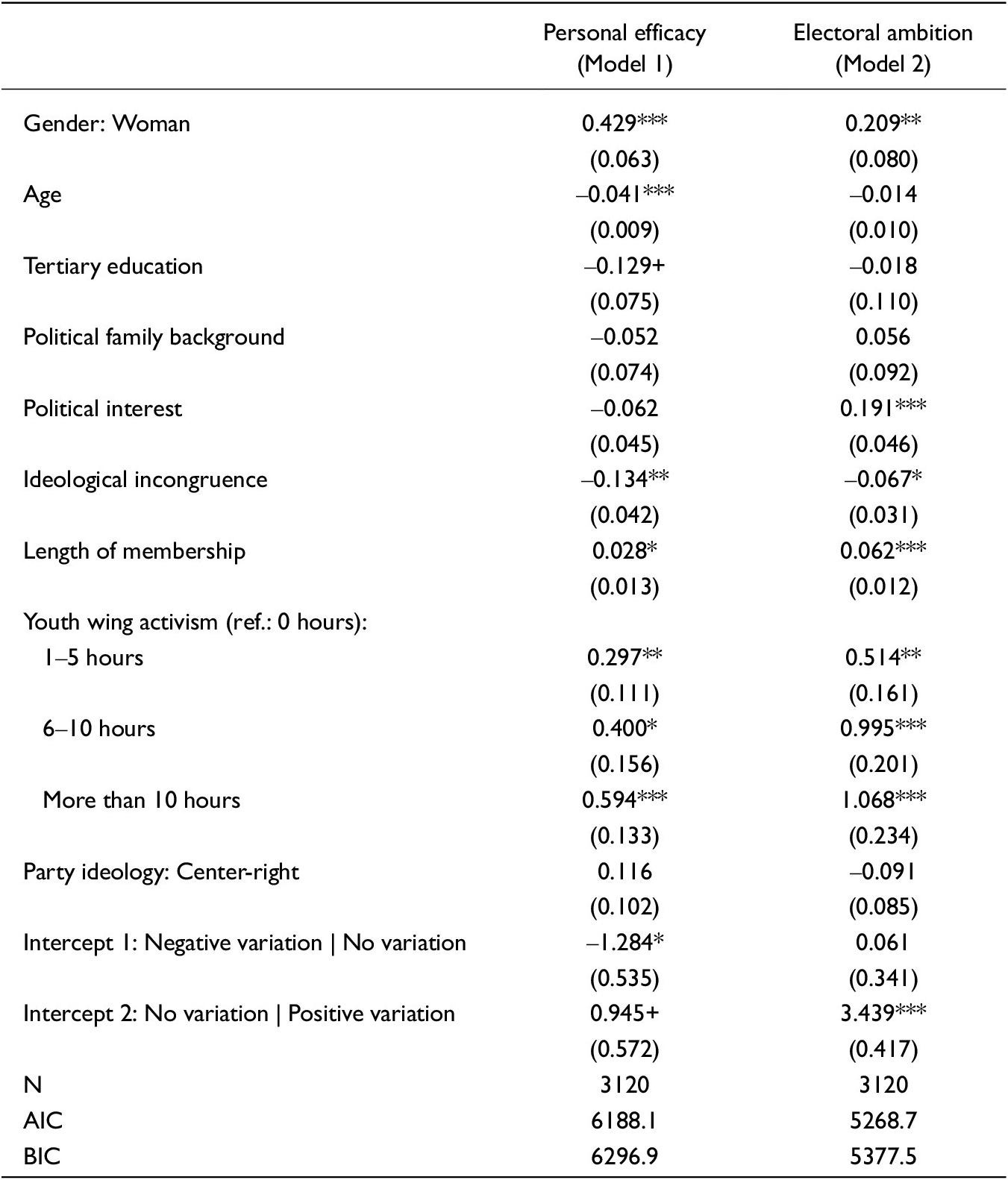
As these results are descriptive, we need a more robust statistical analysis to test our hypotheses. Since our dependent variables are two ordinal variables of three levels each, we run two generalized ordinal logistic regressions — one for personal efficacy, and one for electoral ambition — with “negative variation” as the base category, robust standard errors clustered at the youth wing level, and country-fixed effects.Footnote 14 These are displayed in Table 3 below. As the first model shows, women are significantly more likely than men to acquire personal efficacy during their membership, even after controlling for a range of socio-demographic factors and youth wing exposure. In addition, we find similar gendered trends for electoral ambition, as illustrated in the second model. While the relationship between gender and the acquisition of electoral ambition is not as strong as we find for personal efficacy, the coefficient for gender remains significant at the 99% confidence interval even after accounting for all the relevant controls, indicating that women tend to experience a positive variation in their levels of electoral ambition more than men. Overall, this evidence provides further support for H1a and suggests that the experience of being in a youth wing can be empowering for women.
Generalized ordinal logistic regressions predicting variation in personal efficacy and electoral ambition

Table 3. Long description
The table has two main columns: personal efficacy (Model 1) and electoral ambition (Model 2). For each predictor, the coefficient is listed, with standard error in parentheses below. Significant results are marked with plus or asterisks. Gender: Woman has coefficients 0.429 triple asterisk for efficacy and 0.209 double asterisk for ambition, with standard errors 0.063 and 0.080. Age has negative coefficients: minus 0.041 triple asterisk for efficacy, minus 0.014 for ambition, standard errors 0.009 and 0.010. Tertiary education: minus 0.129 plus for efficacy, minus 0.018 for ambition, standard errors 0.075 and 0.110. Political family background: minus 0.052 for efficacy, 0.056 for ambition, standard errors 0.074 and 0.092. Political interest: minus 0.062 for efficacy, 0.191 triple asterisk for ambition, standard errors 0.045 and 0.046. Ideological incongruence: minus 0.134 double asterisk for efficacy, minus 0.067 single asterisk for ambition, standard errors 0.042 and 0.031. Length of membership: 0.028 single asterisk for efficacy, 0.062 triple asterisk for ambition, standard errors 0.013 and 0.012. Youth wing activism (reference: 0 hours): 1–5 hours, 0.297 double asterisk for efficacy, 0.514 double asterisk for ambition, standard errors 0.111 and 0.161; 6–10 hours, 0.400 single asterisk for efficacy, 0.995 triple asterisk for ambition, standard errors 0.156 and 0.201; more than 10 hours, 0.594 triple asterisk for efficacy, 1.068 triple asterisk for ambition, standard errors 0.133 and 0.234. Party ideology: center-right, 0.116 for efficacy, minus 0.091 for ambition, standard errors 0.102 and 0.085. Intercept 1: minus 1.284 single asterisk for efficacy, 0.061 for ambition, standard errors 0.535 and 0.341. Intercept 2: 0.945 plus for efficacy, 3.439 triple asterisk for ambition, standard errors 0.572 and 0.417. N equals 3120 for both models. A I C is 6188.1 for efficacy, 5268.7 for ambition. B I C is 6296.9 for efficacy, 5377.5 for ambition. Notes indicate robust standard errors clustered by youth wing, significance levels, and that models include country-fixed effects. The dependent variable is ordinal with three levels: negative variation (base), no variation, and positive variation.
Notes: Robust standard errors clustered by youth wing in parentheses.
+ p < 0.1, * p < 0.05, ** p < 0.01, *** p < 0.001.
The models include country-fixed effects.
For each model, the dependent variable is an ordinal variable with three levels: “negative variation” (base category), “no variation,” and “positive variation.”
To corroborate the robustness of our findings, we performed several checks for distinct sample subsets and under different variable and model specifications (see Appendix F). First, to ensure that our results are not driven by a specific country or youth wing, we carried out sensitivity tests by excluding each country (Tables F1–F2) and youth wing (Tables F3–F4) one at a time from the sample. We also re-ran the main models by clustering the standard errors by country, rather than by youth wing (Table F5). Second, to check that our findings do not depend on the operationalization of the dependent variables, we adopted a more conservative approach in our measures of variation in efficacy and ambition. We created two ordinal dependent variables which take the value “negative variation” when a respondent goes from (strongly) agreeing that they had efficacy/ambition when joining, to (strongly) disagreeing that they had efficacy/ambition when they took the survey; and the value “positive variation” for the opposite trend (Table F6).Footnote 15 Third, to make sure that our results are robust to different model specifications, we computed two multinomial logistic regressions, one per dependent variable (Table F7), and two OLS regressions by keeping the dependent variables continuous rather than ordinal (Table F8). Finally, we re-ran our main models by adding a variable controlling for the age at which respondents joined the youth wing, since respondents who enrolled when younger might be more likely to report acquiring efficacy and ambition (Table F9). Our results are further corroborated by these tests: women are significantly more likely than men to indicate they have acquired personal efficacy and electoral ambition over the course of their membership, with gender differences being especially marked for efficacy.
One could argue that the mechanism behind this latter finding is that women and men in youth wings differ systematically in terms of the policy issues they consider salient and wish to influence. For example, if women were interested in policy issues that are more short-term in nature, or “easier” to tackle, it might explain why they report acquiring efficacy to a greater extent than men. To investigate this, we looked at what youth wings members say are the three most important policy issues to them. These are displayed in Figures E1–E2 (Appendix E). The figures show that, within each party family, women and men are very similar when it comes to the policy areas they consider most salient. Although the ranking does change slightly across genders, we see that education, unemployment, the environment, and health care feature consistently among the top-three policy issues of center-left youth wing members, while the economy, unemployment, education, and health care do so for center-right ones — regardless of their gender. In other words, our results on personal efficacy are not driven by gender differences in policy priorities.
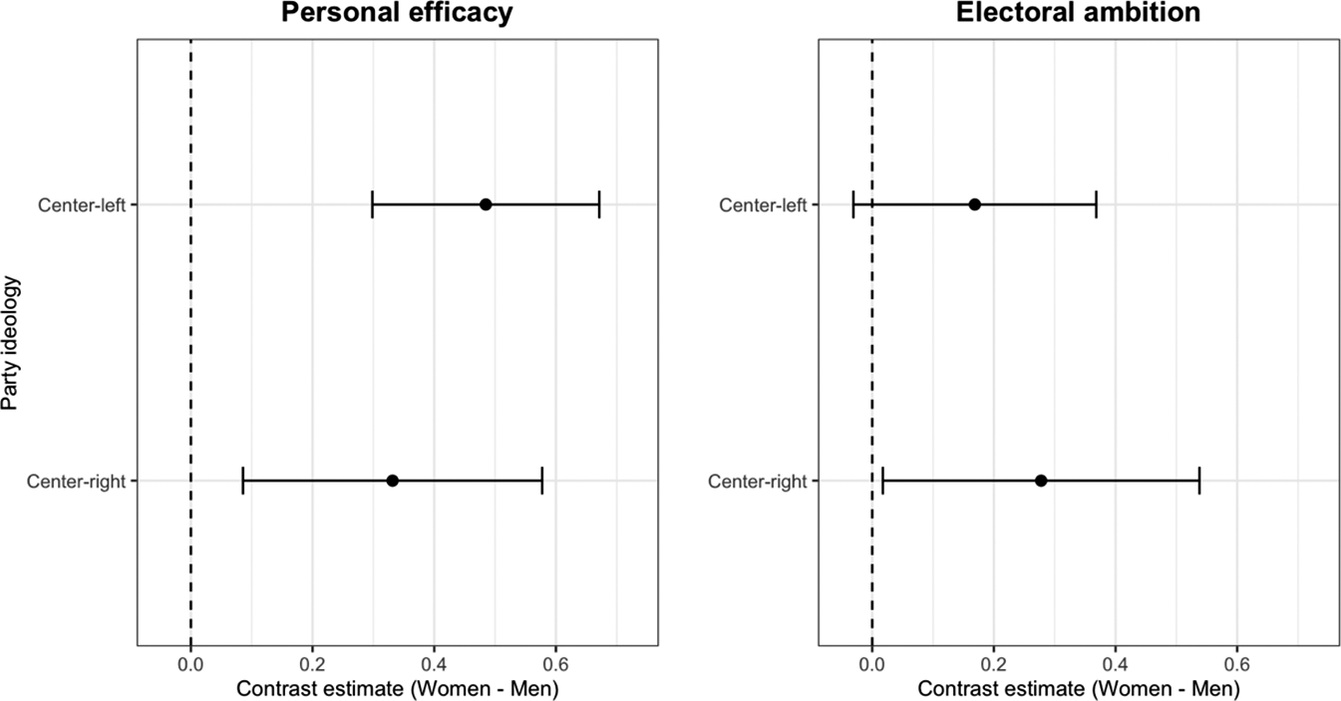
Our next step is to examine whether the trends we uncovered apply equally to youth wings of both the center-left and the center-right (H2). To do so, we re-estimate the two main models by adding an interaction term between gender and party ideology (see Model 3 in Tables E5–E6, Appendix E). For personal efficacy the term’s coefficient is negative and significant at the 90% confidence interval, while for electoral ambition it is positive but insignificant. This suggests that, while women appear more likely to acquire efficacy in center-left youth wings and ambition in center-right ones, ultimately there is no systematic variation in the relationship between gender and party ideology across all three levels of the outcome variables. Nevertheless, given that we are specifically interested in the acquisition of personal efficacy and electoral ambition, we explore this relationship further by plotting the differences in estimated marginal means between men and women from the interaction models (Mize Reference Mize2019). The plots, which are displayed in Figure 2 below, provide a more nuanced understanding of the interaction between the two variables. As the left-hand panel of the figure shows, women are significantly more likely than men to gain personal efficacy over the course of their membership in both center-left and center-right youth wings, with the effect being stronger in the former. The right-hand panel of Figure 2, however, reveals heterogeneous trends between the two party families. Contrary to what we posited in H2, while women in both ideological types of youth wings acquire electoral ambition to a greater extent than men, this effect is significant only in youth wings of the center-right. These results, which are in line with the signs of the interaction terms’ coefficients (Models 3 in Tables E5–E6, Appendix E), lead us to reject H2: the experience of being a youth wing member fosters women’s belief that they can influence party policy, regardless of youth wing ideology; however, it is especially in center-right youth wings that young women report a growth in their candidate aspirations, relative to men.
Contrast plots of estimated marginal means, by gender and party ideology.
Source: Models 3 in Tables E5–E6, Appendix E.
Note: The contrast estimate shows the difference between women and men in the estimated values from the regression model. Values above zero indicate that women have higher estimated marginal means than men (i.e. women are more likely than men to report positive variation in efficacy/ambition), whereas values below zero mean that men have higher estimated marginal means.

Figure 2. Long description
The left panel is titled Personal efficacy and the right panel is titled Electoral ambition. Both panels share the y axis labeled Party ideology, with center-left at the top and center-right at the bottom. The x axis in both panels is labeled Contrast estimate (Women minus Men), ranging from zero at the left to approximately 0.7 at the right. Each panel displays two horizontal error bars with central points: one for center-left and one for center-right. In both panels, the center-left group shows a higher contrast estimate than the center-right group. All estimates are above zero, indicating women have higher estimated marginal means than men for both personal efficacy and electoral ambition, regardless of party ideology. The dashed vertical line marks zero contrast.
To better unpack the role of the party-level context, as a further test we re-ran the above analysis by looking at the youth wing’s level of autonomy from its senior party. This is because autonomous youth wings may be less likely to perpetuate their senior party’s organizational culture and practices. We take membership rules as a measure of autonomy: specifically, we consider “autonomous” youth wings to be those which young people can join without having to be members of the senior party, while we consider “non-autonomous” youth wings as those whose affiliation requires membership of the senior party. Among our cases, the two Austrian and two German youth wings, as well as the Spanish center-left JSE and the Swedish center-left SSU, are autonomous according to this distinction. As Figure E3 in Appendix E shows, however, there are no systematic differences between these two groups of youth wings when it comes to gendered trends in members’ acquisition of personal efficacy and electoral ambition. In both autonomous and non-autonomous youth wings, women report an increase in their levels of efficacy to a greater extent than men, while there are no significant gender differences when it comes to variation in members’ levels of electoral ambition.
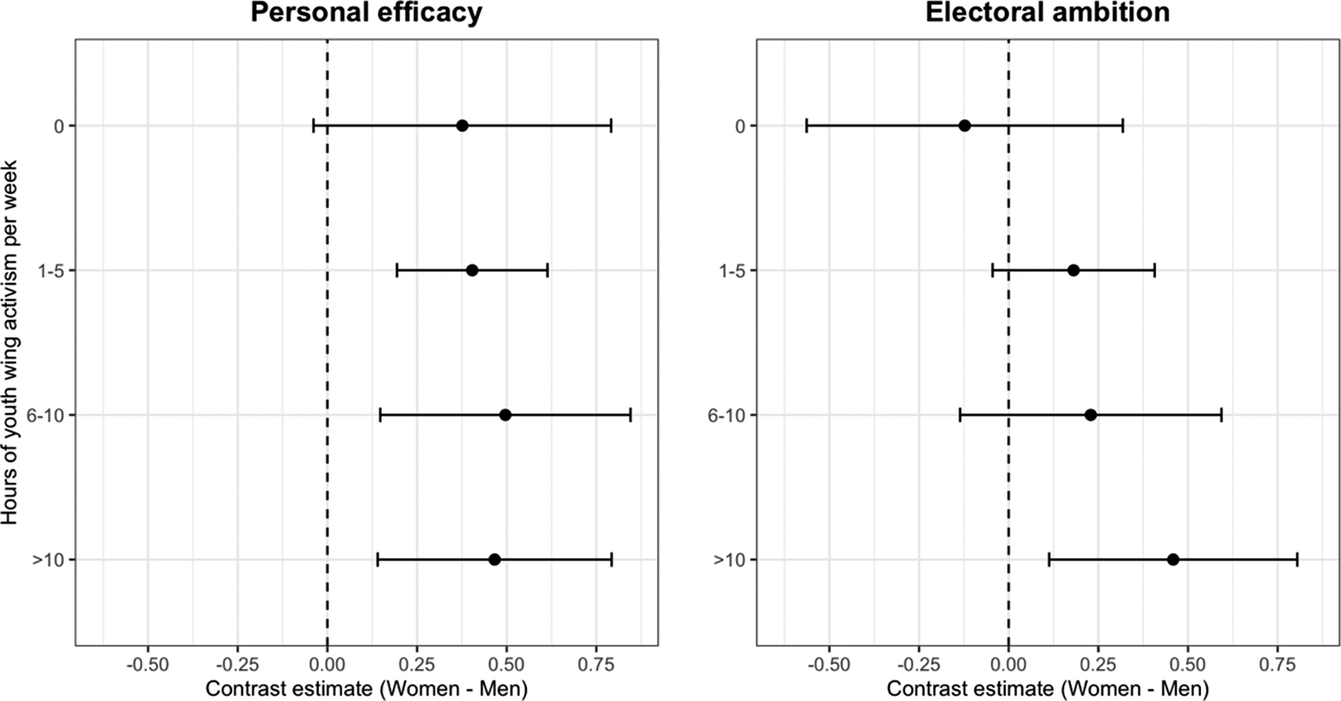
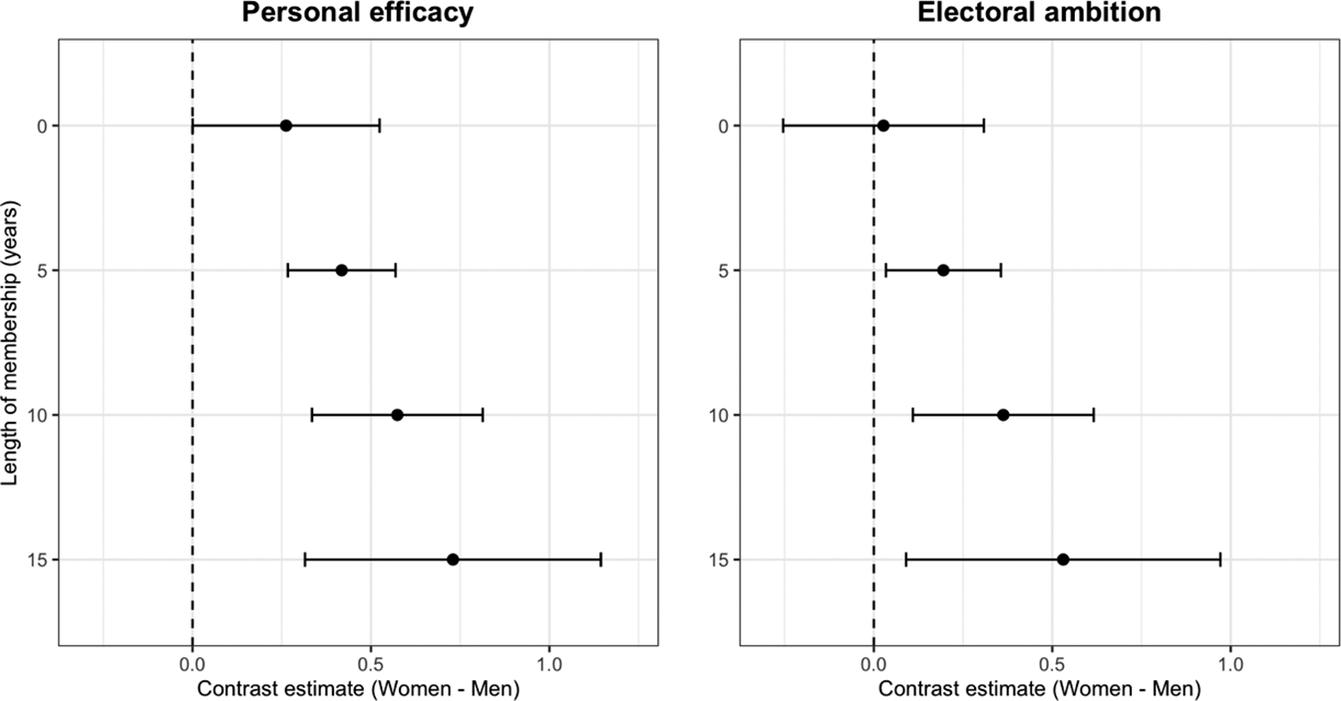
The evidence observed suggests that youth wings can act as forces of renovation within their parties, nurturing young women’s political attitudes, particularly efficacy. As discussed regarding H3a and H3b, an observable implication of this argument is that youth wing exposure should benefit women’s political socialization more than men’s. We investigate this by interacting gender with our two measures of exposure, activism and length of membership (see Models 1 and 2 in Tables E5–E6, Appendix E). While all the coefficients of the interaction terms are positive, in line with the above argument, they are not all statistically significant, similar to what we observed regarding party ideology. As discussed, however, this does not necessarily mean that there are no significant gender differences in members’ acquisition of efficacy and ambition. Following the procedure adopted earlier (see Mize Reference Mize2019), we thus plot the differences in estimated marginal means by gender and youth wing activism (Figure 3) and gender and length of membership (Figure 4).
Contrast plots of estimated marginal means, by gender and youth wing activism.
Source: Models 2 in Tables E5-E6, Appendix E.

Figure 3. Long description
The left panel is titled Personal efficacy. The y axis lists hours of youth wing activism per week as 0, 1-5, 6-10, and greater than 10. The x axis shows contrast estimate (Women minus Men) from negative 0.50 to positive 0.75. Each category has a horizontal line with a central dot and error bars. All dots are positioned to the right of zero, indicating higher estimates for women. The right panel is titled Electoral ambition. The y axis categories and x axis scale are identical. Each category again shows a horizontal line with a central dot and error bars. All dots are to the right of zero, but the 1-5 hours category is closer to zero than the others. Both panels feature a dashed vertical line at zero for reference.
Contrast plots of estimated marginal means, by gender and length of membership.
Source: Models 1 in Tables E5–E6, Appendix E.
Note: To improve the readability of the graph, we plotted a specific set of values for length of membership (0, 5, 10, 15 years). Please note, however, that “length of membership” is a continuous variable.

Figure 4. Long description
The left panel is titled Personal efficacy. The x-axis is labeled Contrast estimate (Women minus Men) ranging from negative to positive values, with a dashed vertical line at zero. The y-axis is Length of membership (years) with points at 0, 5, 10, and 15. Each point represents the estimated contrast between women and men, with horizontal error bars indicating confidence intervals. All points are to the right of zero, indicating higher estimates for women, but the confidence intervals overlap zero. The right panel is titled Electoral ambition, with the same axis structure. Points at each membership length also show positive contrast estimates for women minus men, with overlapping confidence intervals. The structure and trends are consistent across both panels, with no statistically significant differences indicated.
Starting from our first measure of exposure, youth wing activism, the left-hand panel of Figure 3 shows that for all levels of activism (except “0 hours,” which implies being inactive), the likelihood that members acquire personal efficacy is significantly greater among women, with the gaps being especially large for higher levels of activism (over 6 hours). In addition, the right-hand panel, which looks at the acquisition of electoral ambition, shows a very similar trend, although gender differences are significant only among members who are active more than 10 hours per week (see also Model 2 in Table E6). Overall, the more hours women spend on youth wing activities, the more likely they are to signal an increase in their levels of personal efficacy and electoral ambition, while the contrary is true for men. Although our data cannot establish the precise causal direction between activism and political attitudes, these results nonetheless provide preliminary support for H3a: youth wing activism benefits women’s political socialization more than men’s.
These gendered patterns are even more evident if we look at our second measure of youth wing exposure, length of membership. Figure 4 shows that the longer members stay in the youth wing, the more likely it is that women, relative to men, will report an increase in personal efficacy and electoral ambition. These gender gaps are significant in all instances except for members who have been in the youth wing for less than 1 year. Like youth wing activism, therefore, length of membership fosters women’s aspirations to influence party policy and to stand as candidates to a greater extent than men’s. Notably, when we regress personal efficacy and electoral ambition on length of membership, we find that the two political attitudes do not significantly predict the amount of time people remain in youth wings (see Table E8 in Appendix E). This suggests that our results are not driven by self-selection of highly motivated members participating in our study. Our findings thus provide further support for H3a and indicate that youth wing exposure has a greater positive impact on the political socialization of women members. Furthermore, they also lend additional evidence to the argument of H1a, namely that youth wings can act as forces of renovation within their parties. If women get involved in youth wings, they can benefit from this experience and develop key attitudes which may encourage them to pursue a career in politics.
Finally, that youth wings are not necessarily perpetrators of inequality can also be gauged by other measures in our survey (see Appendix E, pp. 17–18). For example, women are as likely as men to socialize with other youth wing members beyond formal party activities; to agree that being in the youth wing allows them to spend time with people they like; and to want to be a member of the senior party once their time in the youth wing is over. We also find no differences in the importance attributed by women and men to youth wing activities such as policy discussions and election campaigns, while women consider social events like barbeques and dinners to be more important than men do. If youth wings really resembled the “reproducers of inequality” ideal type more than the “forces of renovation” one, we would expect women members to feel more excluded from intra-party networks, and to evaluate youth wing activities more negatively than men. Overall, these findings provide further evidence against H1b, and in favor of H1a.
Discussion and Conclusion
In this study we investigated whether the experience of being a party youth wing member can foster young women’s political socialization, focusing on their perceived acquisition of personal efficacy and electoral ambition. Drawing on original survey data from over 3,100 youth wing members in six countries, we found that after joining youth wings, greater proportions of young women, relative to men, cultivate aspirations to influence party policy and to stand as candidates. Moreover, these gender gaps become more pronounced among those who have been members for a long time and are very engaged in youth wing activities. Our findings have important implications for the study of gender and politics which we discuss below.
First, our study has shed light on a pipeline to power which has been overlooked by gender and politics scholars. The results, ultimately, are good news: while we know that the youth wing pipeline is gendered in the sense that men heavily outnumber women (Ammassari et al. Reference Ammassari, McDonnell and Valbruzzi2023; Ohmura and Bailer Reference Ohmura and Bailer2022), we have found that it is also gendered in ways which favor women. Specifically, the more time young women spend participating in youth wings and being socialized into that environment, the more they are empowered compared to men. In other words, youth wings function as positive socialization agents for young women in ways that are the exact opposite of their senior parties, where activism and other intra-party resources matter more for men’s career advancement than women’s (Martínez-Cantó and Verge Reference Martínez-Cantó and Verge2023; Verge and Claveria Reference Verge and Claveria2018). According to our findings, in light of the recruitment, training, and socializing functions they perform, youth wings can indeed be intra-party actors which bring about renewal and stimulate positive changes. Although numerically they remain boys’ clubs, they are doing a good job in signaling to their women members that they “belong” in these organizations and can have a future in politics.
Future research is needed to investigate the dynamics underpinning our findings. We suggested earlier that it could be a matter of younger generations being more supportive of women in politics. This seems plausible, given that some youth wings (including among our cases) have been around for decades, and yet gender gaps in descriptive representation have not been closed. In this sense, our results may point to a generational effect — one that specifically concerns the youth wings of today. Interviews and focus groups with youth wing members and leaders could dig into the role that contemporary youth wings play in fostering women’s efficacy and ambition, for instance in terms of their functioning, the activities they organize, and their day-to-day informal practices (see Bjarnegård and Kenny Reference Bjarnegård and Kenny2015). In particular, aspects which might be worth investigating include whether young women are recruited by the party or the youth wing more often than men are; if they get more encouragement for taking on intra-party positions or running as candidates; and if they are offered bespoke training and educational activities. This type of work could reveal “best practices” that other youth wings and even senior parties can adopt in order to provide a more inclusive environment for women — one in which they are confident in expressing their desire to influence policy and stand for election. Moreover, a limitation of our study is that we could not use longitudinal data to investigate trends in the acquisition of efficacy and ambition. While the way our survey questionnaire was designed sought to redress this, future studies could employ longitudinal surveys to map the development of key political attitudes over the course of youth wing and party membership, along with exploring how efficacy and ambition may be affected by important life events such as starting a degree, a permanent job, or having children.
Second, our study highlighted differences between the two political attitudes we investigated. While women are more likely than men to acquire both personal efficacy and electoral ambition, the trend is stronger for efficacy. This finding reiterates the need to explore other ways in which women can achieve political power — especially ones which do not entail elections (see Ammassari et al. Reference Ammassari, McDonnell and Valbruzzi2023). The young women we surveyed aspire to having a say in policy and influencing the programmatic direction of their parties, without necessarily having to stand as candidates. Relatedly, while our article focused on generic electoral ambition, recent work has pointed to the importance of considering this alongside non-electoral ambition (Ammassari et al. Reference Ammassari, McDonnell and Valbruzzi2023) as well as the different levels of policy-making to which ambition may be addressed, from local to supranational (Devroe et al. Reference Devroe, Coffé, Vandeleene and Wauters2023). We therefore invite scholars to consider these dimensions in future work on the topic. In addition, we found that the experience of being in a youth wing, regardless of its ideology, can foster women’s aspirations to influence party policy; but it is young women in the center-right who witness a greater increase in their candidate aspirations relative to men. Whether this is more related to the kind of women who join youth wings (and parties) of the right, the party culture that youth wings on that side of the political spectrum promote, or a “survivor bias” by which women on the right post-hoc rationalize their youth wing experiences despite the challenges they face, is an open question. Nonetheless, it is an important one to address, since it would help scholars better understand the role that party ideology plays in women’s political participation and representation.
Finally, our research underlines the importance of studying young women’s political engagement. While it is true that, already at an early age, children and adolescents are subject to processes of gendered political socialization (Bos et al. Reference Bos, Greenlee, Holman, Oxley and Lay2022; see also Fox and Lawless Reference Fox and Lawless2014), it is also the case that younger generations do not experience the same patterns of domestic and professional gender inequalities which occur as they grow older. For this same reason, gender and politics scholars should pay more attention both to youth wings and other “early” pipelines to power, such as party student wings (Lundin et al. Reference Lundin, Nordström-Skans and Zetterberg2016) and youth councils (Harada Reference Harada2021). If these organizations can challenge entrenched gender norms and establish structures which support the political development of young women, the benefits for women’s representation in tomorrow’s political parties could be substantial.
Supplementary material
The supplementary material for this article can be found at http://doi.org/10.1017/S1743923X26100774.
Acknowledgments
We would like to thank Katrine Beauregard and Ferran Martinez i Coma for their extensive feedback on a previous draft of the article. We are also grateful to the participants of the 2025 AusPSA Political Organisations and Participation workshop in Canberra for their helpful comments, questions, and suggestions.
Funding information
We did not receive any financial support for this study.
Competing interests
There are no competing interests to declare.
Compliance with ethical standards
This study was approved by the Griffith University Human Research Ethics Committee (Ref. No. 2016/160) and was performed in accordance with the ethical standards as laid down in the APSA guidelines on ethical standards. All participants ticked a box on the survey indicating their informed consent prior to participating.




 Open access

