





1 Introduction
Let $\widehat {\mathbb C}$
denote the Riemann sphere and let
$\widehat {\mathbb C}$
denote the Riemann sphere and let $f:\widehat {\mathbb C}\to \widehat {\mathbb C}$
be a rational map of degree
$f:\widehat {\mathbb C}\to \widehat {\mathbb C}$
be a rational map of degree $d\geq 2$
. By the Riemann–Hurwitz formula, f has
$d\geq 2$
. By the Riemann–Hurwitz formula, f has $2d-2$
critical points, counted with multiplicity; the critical set of f is denoted
$2d-2$
critical points, counted with multiplicity; the critical set of f is denoted $C_f$
. The postcritical set of f, denoted
$C_f$
. The postcritical set of f, denoted $P_f$
, is the smallest forward invariant subset of the Riemann sphere that contains the critical values of f. If the postcritical set is finite, the rational map is said to be postcritically finite. Associated to a postcritically finite rational map is a ramification portrait; that is, a finite directed graph
$P_f$
, is the smallest forward invariant subset of the Riemann sphere that contains the critical values of f. If the postcritical set is finite, the rational map is said to be postcritically finite. Associated to a postcritically finite rational map is a ramification portrait; that is, a finite directed graph $\Gamma _f$
that encodes the action of f restricted to
$\Gamma _f$
that encodes the action of f restricted to $C_f\cup P_f$
. As an example, consider the polynomial
$C_f\cup P_f$
. As an example, consider the polynomial $f:z\mapsto z^2-2$
. The critical set is
$f:z\mapsto z^2-2$
. The critical set is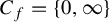 $C_f=\{0,\infty \}$
, the postcritical set is
$C_f=\{0,\infty \}$
, the postcritical set is $P_f=\{-2,2,\infty \}$
, and the ramification portrait is
$P_f=\{-2,2,\infty \}$
, and the ramification portrait is

In the ramification portrait above, there is an edge from vertex x to vertex y if and only if $y=f(x)$
. This edge is weighted with the positive integer
$y=f(x)$
. This edge is weighted with the positive integer $\mathrm {deg}_f(x)$
, the local degree of f at x. To lighten notation, we record the weight of the edge from x to
$\mathrm {deg}_f(x)$
, the local degree of f at x. To lighten notation, we record the weight of the edge from x to $f(x)$
if and only if
$f(x)$
if and only if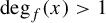 $\mathrm {deg}_f(x)>1$
; that is, if and only if
$\mathrm {deg}_f(x)>1$
; that is, if and only if $x\in C_f$
. The ramification portrait above is a polynomial ramification portrait; that is, there is a fixed vertex mapping to itself with full degree (the vertex
$x\in C_f$
. The ramification portrait above is a polynomial ramification portrait; that is, there is a fixed vertex mapping to itself with full degree (the vertex $\infty $
).
$\infty $
).
In this article, we study which graphs are isomorphic to ramification portraits from postcritically finite polynomials. There are immediate necessary conditions that arise from local degree restrictions and from Riemann–Hurwitz restrictions (see §2). We prove that in the polynomial setting, these conditions are also sufficient. A weighted finite directed graph as above which satisfies these conditions is called an abstract polynomial portrait.
Theorem 1.1. Let $\Gamma $
be an abstract polynomial portrait. Then, there exists a polynomial
$\Gamma $
be an abstract polynomial portrait. Then, there exists a polynomial $f:\widehat {\mathbb C}\to \widehat {\mathbb C}$
so that
$f:\widehat {\mathbb C}\to \widehat {\mathbb C}$
so that $\Gamma _f\simeq \Gamma $
.
$\Gamma _f\simeq \Gamma $
.
To prove Theorem 1.1, we construct an explicit topological polynomial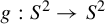 $g:S^2 \to S^2$
so that
$g:S^2 \to S^2$
so that $\Gamma _g\simeq \Gamma $
. We build g so that it has no obstructing multicurves. It then follows from Thurston’s topological characterization of rational maps that g is combinatorially equivalent to a polynomial f, so
$\Gamma _g\simeq \Gamma $
. We build g so that it has no obstructing multicurves. It then follows from Thurston’s topological characterization of rational maps that g is combinatorially equivalent to a polynomial f, so $\Gamma _f\simeq \Gamma _g$
.
$\Gamma _f\simeq \Gamma _g$
.
We cannot strengthen Theorem 1.1 by removing the hypothesis that $\Gamma $
is a polynomial ramification portrait because of the following two phenomena. The first is dynamical and related to Thurston’s theorem. The second is non-dynamical and related to the Hurwitz problem.
$\Gamma $
is a polynomial ramification portrait because of the following two phenomena. The first is dynamical and related to Thurston’s theorem. The second is non-dynamical and related to the Hurwitz problem.
1.1 Ramification portraits that can only be realized topologically
Consider the following abstract ramification portrait $\Gamma $
:
$\Gamma $
:

Suppose there is a rational map $f:\widehat {\mathbb C}\to \widehat {\mathbb C}$
so that
$f:\widehat {\mathbb C}\to \widehat {\mathbb C}$
so that $\Gamma \simeq \Gamma _f$
. Then, f is a quadratic rational map with two periodic cycles of period 2. However, a quick computation reveals that a quadratic rational map can have at most one periodic cycle of period
$\Gamma \simeq \Gamma _f$
. Then, f is a quadratic rational map with two periodic cycles of period 2. However, a quick computation reveals that a quadratic rational map can have at most one periodic cycle of period $2$
, so no such f exists.
$2$
, so no such f exists.
Even though no rational map f exists so that $\Gamma _f\simeq \Gamma $
, it is possible to construct a topological branched cover
$\Gamma _f\simeq \Gamma $
, it is possible to construct a topological branched cover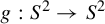 $g:S^2\to S^2$
so that
$g:S^2\to S^2$
so that $\Gamma _g\simeq \Gamma $
. For example, after identifying
$\Gamma _g\simeq \Gamma $
. For example, after identifying $S^2$
with
$S^2$
with $\widehat {\mathbb C}$
, we could take the squaring map
$\widehat {\mathbb C}$
, we could take the squaring map $s: z\mapsto z^2$
and postcompose with an orientation-preserving homeomorphism
$s: z\mapsto z^2$
and postcompose with an orientation-preserving homeomorphism $h:S^2\to S^2$
so that
$h:S^2\to S^2$
so that $h(\infty )=1, h(1)=\infty ,$ $h(0)=2$
, and
$h(0)=2$
, and $h(4)=0$
. Then,
$h(4)=0$
. Then, $g:=h\circ s$
is a branched cover with
$g:=h\circ s$
is a branched cover with $\Gamma _g\simeq \Gamma $
. By Thurston’s theorem, the map g will necessarily admit an obstructing multicurve (see §2).
$\Gamma _g\simeq \Gamma $
. By Thurston’s theorem, the map g will necessarily admit an obstructing multicurve (see §2).
We are aware of a few methods to construct ramification portraits that can only be realized topologically and that are similar in spirit to the example above. It would be interesting to put these examples into a more general context.
Question 1.2. Which abstract ramification portraits $\Gamma $
can only be realized topologically?
$\Gamma $
can only be realized topologically?
1.2 Ramification portraits that cannot even be realized topologically
The Hurwitz problem is to characterize which branch data arise from branched covering maps $S^2\to S^2$
. See [Reference Barański1, Reference Edmonds, Kulkarni and Stong5, Reference Khovanskii and Zdravkovska8, Reference Thom10]. For example, it is known that there is no branched cover with the branch data
$S^2\to S^2$
. See [Reference Barański1, Reference Edmonds, Kulkarni and Stong5, Reference Khovanskii and Zdravkovska8, Reference Thom10]. For example, it is known that there is no branched cover with the branch data $(2,2),(2,2),(3,1)$
. That is, there is no branched cover
$(2,2),(2,2),(3,1)$
. That is, there is no branched cover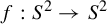 $f:S^2\to S^2$
of degree
$f:S^2\to S^2$
of degree $4$
with exactly three critical values
$4$
with exactly three critical values $\{v_1,v_2,v_3\}\subseteq S^2$
, so that:
$\{v_1,v_2,v_3\}\subseteq S^2$
, so that:
-
• $f^{-1}(\{v_1\})$
contains exactly two points, each mapping forward with local degree two;
$f^{-1}(\{v_1\})$
contains exactly two points, each mapping forward with local degree two; -
•
$f^{-1}(\{v_2\})$
contains exactly two points, each mapping forward with local degree two; and -
•
$f^{-1}(\{v_3\})$
contains exactly two points, one mapping forward with local degree 3 and the other mapping forward with local degree 1.


This fact has dynamical consequences. Indeed, any abstract ramification portrait $\Gamma $
with this branch data cannot be the ramification portrait of a branched covering map
$\Gamma $
with this branch data cannot be the ramification portrait of a branched covering map $S^2\to S^2$
and, therefore,
$S^2\to S^2$
and, therefore, $\Gamma $
cannot be the ramification portrait of a rational map
$\Gamma $
cannot be the ramification portrait of a rational map $\widehat {\mathbb C}\to \widehat {\mathbb C}$
. For example, the following ramification portrait has branch data
$\widehat {\mathbb C}\to \widehat {\mathbb C}$
. For example, the following ramification portrait has branch data $(2,2),(2,2),(3,1)$
.
$(2,2),(2,2),(3,1)$
.

While the general Hurwitz problem is unsolved, we note that all polynomial branch data are realizable (see [Reference Edmonds, Kulkarni and Stong5, Preposition 5.2]). We will not use this fact to construct the branched cover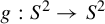 $g:S^2\to S^2$
in the proof of Theorem 1.1.
$g:S^2\to S^2$
in the proof of Theorem 1.1.
1.3 Thurston’s theorem
Let $S^2$
denote an oriented topological 2-sphere and let
$S^2$
denote an oriented topological 2-sphere and let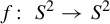 $f\colon \, S^2 \to S^2$
be an orientation-preserving branched cover of degree
$f\colon \, S^2 \to S^2$
be an orientation-preserving branched cover of degree $d\ge 2$
so that the postcritical set
$d\ge 2$
so that the postcritical set $P_f$
is finite. We call such a map f a Thurston map. For convenience in stating the theorem, we assume that the orbifold of f is hyperbolic. (This condition essentially excludes power maps
$P_f$
is finite. We call such a map f a Thurston map. For convenience in stating the theorem, we assume that the orbifold of f is hyperbolic. (This condition essentially excludes power maps $z\mapsto z^n$
, Chebyshev maps, and Lattès maps; see [Reference Douady and Hubbard3].) Two Thurston maps
$z\mapsto z^n$
, Chebyshev maps, and Lattès maps; see [Reference Douady and Hubbard3].) Two Thurston maps $f:(S^2,P_f)\to (S^2,P_f)$
and
$f:(S^2,P_f)\to (S^2,P_f)$
and $g:(S^2,P_g)\to (S^2,P_g)$
are combinatorially equivalent provided that there are orientation-preserving homeomorphisms
$g:(S^2,P_g)\to (S^2,P_g)$
are combinatorially equivalent provided that there are orientation-preserving homeomorphisms $\phi _0:(S^2,P_f)\to (S^2,P_g)$
and
$\phi _0:(S^2,P_f)\to (S^2,P_g)$
and $\phi _1:(S^2,P_f)\to (S^2,P_g)$
so that:
$\phi _1:(S^2,P_f)\to (S^2,P_g)$
so that:
-
•
$\phi _0\circ f = g\circ \phi _1$
; and -
• the homeomorphisms
$\phi _0$
and
$\phi _1$
are isotopic relative to
$P_f$
.



In the 1980s, Thurston proved that every Thurston map f is combinatorially equivalent to a rational map or it is obstructed. In the latter case, f admits an invariant curve system called an obstructing multicurve.
A multicurve $\Delta $
is a finite collection of simple disjoint curves in
$\Delta $
is a finite collection of simple disjoint curves in $S^2\setminus P_f$
, no two of which are homotopic. All components
$S^2\setminus P_f$
, no two of which are homotopic. All components $\delta \in \Delta $
are also required to be essential (
$\delta \in \Delta $
are also required to be essential ( $\delta $
does not bound a disk) and non-peripheral (
$\delta $
does not bound a disk) and non-peripheral ( $\delta $
does not bound a disk with exactly one puncture). The multicurve
$\delta $
does not bound a disk with exactly one puncture). The multicurve $\Delta $
is said to be invariant for f provided that for all
$\Delta $
is said to be invariant for f provided that for all $\delta \in \Delta $
, every component of
$\delta \in \Delta $
, every component of $f^{-1}(\{\delta \})$
is either:
$f^{-1}(\{\delta \})$
is either:
-
• homotopic to some
$\delta '\in \Delta $
in
$S^2\setminus P_f$
; or -
• ‘erased’, that is, it is peripheral or inessential.


Given an invariant multicurve $\Delta $
for f, Thurston defined an associated linear transformation
$\Delta $
for f, Thurston defined an associated linear transformation ${\mathbb R}^\Delta \to {\mathbb R}^\Delta $
that encodes how different components of
${\mathbb R}^\Delta \to {\mathbb R}^\Delta $
that encodes how different components of $f^{-1}(\Delta )$
map to
$f^{-1}(\Delta )$
map to $\Delta $
. The matrix for this transformation has non-negative real entries, so there is a leading eigenvalue
$\Delta $
. The matrix for this transformation has non-negative real entries, so there is a leading eigenvalue $\unicode{x3bb} $
which is real and non-negative. The multicurve
$\unicode{x3bb} $
which is real and non-negative. The multicurve $\Delta $
is an obstruction provided that
$\Delta $
is an obstruction provided that $\unicode{x3bb} \geq 1$
. If the Thurston map f admits an obstruction, f is said to be obstructed. If not, f is said to be unobstructed.
$\unicode{x3bb} \geq 1$
. If the Thurston map f admits an obstruction, f is said to be obstructed. If not, f is said to be unobstructed.
Theorem 1.3. (Thurston’s topological characterization of rational maps [Reference Douady and Hubbard3])
Let ${f:(S^2,P_f)\to (S^2,P_f)}$
be a Thurston map and suppose that f has a hyperbolic orbifold. Then, f is combinatorially equivalent to a rational map F if and only if f is unobstructed. In this case, F is unique up to conjugation by Möbius transformations.
${f:(S^2,P_f)\to (S^2,P_f)}$
be a Thurston map and suppose that f has a hyperbolic orbifold. Then, f is combinatorially equivalent to a rational map F if and only if f is unobstructed. In this case, F is unique up to conjugation by Möbius transformations.
1.4 Levy cycles
For a given Thurston map $f:(S^2,P_f)\to (S^2,P_f)$
, verifying the criterion in Thurston’s theorem is difficult as it involves an infinite search in general. In this article, we will work with Thurston maps that are topological polynomials; that is, there is some
$f:(S^2,P_f)\to (S^2,P_f)$
, verifying the criterion in Thurston’s theorem is difficult as it involves an infinite search in general. In this article, we will work with Thurston maps that are topological polynomials; that is, there is some $\omega \in S^2$
that is a fully ramified fixed point of f. More is known about Thurston’s criterion in the case of topological polynomials.
$\omega \in S^2$
that is a fully ramified fixed point of f. More is known about Thurston’s criterion in the case of topological polynomials.
A Levy cycle for the Thurston map $f:(S^2,P_f)\to (S^2,P_f)$
is a circularly ordered collection of simple closed curves
$f:(S^2,P_f)\to (S^2,P_f)$
is a circularly ordered collection of simple closed curves $\{\delta _0,\ldots , \delta _{n-1},\delta _{n}=\delta _0\}$
on
$\{\delta _0,\ldots , \delta _{n-1},\delta _{n}=\delta _0\}$
on $S^2\setminus P_f$
such that:
$S^2\setminus P_f$
such that:
-
• no two curves are homotopic relative to
$P_f$
; -
• the curves are pairwise disjoint;
-
• each curve is essential and non-peripheral; and
-
• for all
$1\leq i\leq n$
, at least one component of
$f^{-1}(\delta _i)$
is homotopic to
$\delta _{i-1}$
and maps to
$\delta _i$
by degree
$1$
.


Levy proved the following results in his thesis [Reference Levy9].
Theorem 1.4. (Levy)
Let $f:(S^2,P_f)\to (S^2,P_f)$
be a Thurston map that is a topological polynomial. Then, f is obstructed if and only if f admits a Levy cycle.
$f:(S^2,P_f)\to (S^2,P_f)$
be a Thurston map that is a topological polynomial. Then, f is obstructed if and only if f admits a Levy cycle.
Theorem 1.5. (Levy)
Let $\Gamma $
be an abstract polynomial ramification portrait such that every critical vertex is periodic. Then, every Thurston map realizing
$\Gamma $
be an abstract polynomial ramification portrait such that every critical vertex is periodic. Then, every Thurston map realizing $\Gamma $
is unobstructed.
$\Gamma $
is unobstructed.
The proof of the latter can be strengthened to give the following result. See, for example, Hubbard [Reference Hubbard6, Theorem 10.3.9].
Theorem 1.6. (Levy–Berstein)
Suppose $\Gamma $
is an abstract polynomial ramification portrait such that each cycle contains a critical vertex. Then, every Thurston map realizing
$\Gamma $
is an abstract polynomial ramification portrait such that each cycle contains a critical vertex. Then, every Thurston map realizing $\Gamma $
is unobstructed.
$\Gamma $
is unobstructed.
We will use Levy’s first theorem in an essential way in our proof of Theorem 1.1. Indeed, given an abstract ramification portrait $\Gamma $
, we will construct a topological polynomial
$\Gamma $
, we will construct a topological polynomial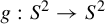 $g:S^2\to S^2$
so that
$g:S^2\to S^2$
so that $\Gamma _g\simeq \Gamma $
and so that g cannot possibly admit a Levy cycle. Theorem 1.1 immediately follows.
$\Gamma _g\simeq \Gamma $
and so that g cannot possibly admit a Levy cycle. Theorem 1.1 immediately follows.
In [Reference Kelsey7, Theorem 1.1], Kelsey uses self-similar groups to give a partial converse to the Levy–Berstein theorem. In the discussion that follows, an attractor of an abstract ramification portrait is a cycle that contains a critical vertex and a non-attractor is a cycle that does not contain a critical vertex.
Theorem 1.7. (Kelsey)
Suppose $\Gamma $
is an abstract polynomial ramification portrait and that
$\Gamma $
is an abstract polynomial ramification portrait and that $\Gamma $
satisfies at least one of the following properties:
$\Gamma $
satisfies at least one of the following properties:
-
(1)
$\Gamma $
contains a cycle (which is necessarily a non-attractor) of length at least two that does not contain any critical values; -
(2)
$\Gamma $
contains at least two cycles (which are necessarily non-attractors) that do not contain any critical values; -
(3)
$\Gamma $
contains at least two non-attractor cycles that have length at least two; -
(4)
$\Gamma $
contains at least four non-attractor cycles.


Then, there is an obstructed Thurston map that realizes $\Gamma $
.
$\Gamma $
.
In Theorem 1.8, we show that certain abstract polynomial ramification portraits have only unobstructed representatives and, in Theorem 1.9, we show that certain abstract polynomial ramification portraits have obstructed representatives. We need a definition to state Theorems 1.8 and 1.9. Let $\Gamma $
be an abstract polynomial ramification portrait and let v be a vertex of
$\Gamma $
be an abstract polynomial ramification portrait and let v be a vertex of $\Gamma $
. Then, v is the source vertex of exactly one edge of
$\Gamma $
. Then, v is the source vertex of exactly one edge of $\Gamma $
. We let
$\Gamma $
. We let $\tau (v)$
denote the target vertex of this edge.
$\tau (v)$
denote the target vertex of this edge.
Theorem 1.8. Suppose $\Gamma $
is an abstract polynomial ramification portrait that has at least four postcritical vertices and satisfies one of the following properties:
$\Gamma $
is an abstract polynomial ramification portrait that has at least four postcritical vertices and satisfies one of the following properties:
-
(i)
$\Gamma $
has a single non-attractor cycle and it has length one; -
(ii) every finite postcritical vertex of
$\Gamma $
is in a single non-attractor cycle, this cycle has length
$p^k$
for some prime number p and some positive integer k, and the finite postcritical vertices can be enumerated as
$\{v_i: 0\leq i < p^k\}$
such that
$\tau (v_i) = v_{i+1}$
(mod
$p^k$
) for every
$i\in \{0,\dots ,p^k -1\}$
and if
$v_j$
is a critical value, then j is a multiple of
$p^{k-1}$
.








Then, every Thurston map with ramification portrait isomorphic to $\Gamma $
is unobstructed.
$\Gamma $
is unobstructed.
The hypothesis that there are at least four postcritical vertices is not restrictive, since by Thurston’s characterization theorem, a Thurston map with fewer than four postcritical points is unobstructed. The proof is along the lines of the argument for the Levy–Berstein theorem. If the abstract ramification portrait can be realized by an obstructed Thurston map, then by Levy [Reference Levy9], there must be a Levy cycle. This implies that, in the teminology of Hubbard [Reference Hubbard6], there must be a degenerate Levy cycle. One then shows that this is impossible if the ramification portrait satisfies property (i) or (ii). The proof is given in §4. Part (if not all) of case (i) of Theorem 1.8 was previously known. The case of a single non-attractor cycle of length one and no other finite cycles was observed by Kelsey [Reference Kelsey7, p. 52].
Theorem 1.9. Suppose $\Gamma $
is an abstract polynomial ramification portrait that has at least four postcritical vertices and satisfies one of the following properties:
$\Gamma $
is an abstract polynomial ramification portrait that has at least four postcritical vertices and satisfies one of the following properties:
-
(i) every finite postcritical vertex of
$\Gamma $
is in a single non-attractor cycle, this cycle has length
$p^k$
for some prime number p and some positive integer k, the finite vertices can be enumerated as
$\{v_i: 0\le i < p^k\}$
such that
$v_0$
is a critical value,
$\tau (v_i) = v_{i+1}$
mod
$p^k$
for every
$i\in \{0,\dots ,p^k -1\}$
, and there is a critical value
$v_j$
such that j is not a multiple of
$p^{k-1}$
; -
(ii) every finite postcritical vertex of
$\Gamma $
is in a single non-attractor cycle of length at least two and this cycle does not have prime-power length; -
(iii)
$ \Gamma $
contains a non-attractor cycle of length at least two that does not contain all of the finite critical values; -
(iv)
$\Gamma $
has at least two non-attractor cycles of length one.









Then, there exists an obstructed Thurston map whose ramification portrait is isomorphic to $\Gamma $
.
$\Gamma $
.
The proof of Theorem 1.9 is constructive and relies on a combinatorial lemma, Lemma 5.1. Given an abstract polynomial ramification portrait $\Gamma $
that satisfies any of conditions (i)–(iv) of the theorem, we describe a construction of an obstructed Thurston map with ramification portrait isomorphic to
$\Gamma $
that satisfies any of conditions (i)–(iv) of the theorem, we describe a construction of an obstructed Thurston map with ramification portrait isomorphic to $\Gamma $
. We introduce rose maps and prove the lemma in §5. We then prove the theorem in §6.
$\Gamma $
. We introduce rose maps and prove the lemma in §5. We then prove the theorem in §6.
Combining Theorems 1.8, 1.9, and the Levy–Berstein theorem, we classify the abstract polynomial ramification portraits that are completely unobstructed. We summarize this result in the following theorem, which we prove in §7.
Theorem 1.10. Suppose $\Gamma $
is an abstract polynomial ramification portrait. Then, every Thurston map with ramification portrait isomorphic to
$\Gamma $
is an abstract polynomial ramification portrait. Then, every Thurston map with ramification portrait isomorphic to $\Gamma $
is unobstructed if and only if
$\Gamma $
is unobstructed if and only if $\Gamma $
satisfies at least one of the following conditions:
$\Gamma $
satisfies at least one of the following conditions:
-
(i)
$\Gamma $
has at most three postcritical vertices; -
(ii) every cycle of
$\Gamma $
is an attractor; -
(iii)
$\Gamma $
has a single non-attractor cycle and it has length one; -
(iv) every finite postcritical vertex of
$\Gamma $
is in a single non-attractor cycle, this cycle has length
$p^k$
for some prime number p and some positive integer k, the finite postcritical vertices can be enumerated as and if
$$ \begin{align*} \{v_i: 0\le i < p^k\} \text{ such that }\tau(v_i) = v_{i+1}\;\mathrm{mod}\; p^k \text{ for every }i\in \{0,\dots,p^k -1\}, \end{align*} $$
$v_j$
is a critical value, then j is a multiple of
$p^{k-1}$
.


1.5 Notes and references
In addition to the references we have already highlighted, we would like to mention two somewhat related works: in [Reference DeMarco, Koch and McMullen2], the authors prove that given a finite set X with $|X|\geq 2$
, a map
$|X|\geq 2$
, a map $F:X\to X$
, and prescribed multiplicities at points of X, there is some rational map
$F:X\to X$
, and prescribed multiplicities at points of X, there is some rational map $f:\widehat {\mathbb C}\to \widehat {\mathbb C}$
so that the restriction of f to its postcritical set coincides with the map F in such a way that the multiplicity of each point
$f:\widehat {\mathbb C}\to \widehat {\mathbb C}$
so that the restriction of f to its postcritical set coincides with the map F in such a way that the multiplicity of each point $x\in X$
agrees with the local degree of f at the corresponding postcritical point. We note that the map
$x\in X$
agrees with the local degree of f at the corresponding postcritical point. We note that the map $F:X\to X$
, together with the multiplicities at points of X, is analogous to our abstract ramification portrait
$F:X\to X$
, together with the multiplicities at points of X, is analogous to our abstract ramification portrait $\Gamma $
; however, our abstract ramification portraits satisfy a Riemann–Hurwitz condition, so they have a natural degree,
$\Gamma $
; however, our abstract ramification portraits satisfy a Riemann–Hurwitz condition, so they have a natural degree, $d\geq 2$
. In our article, we are interested in the question of whether there is a rational map of degree d that realizes a given abstract ramification portrait. In [Reference DeMarco, Koch and McMullen2], the degree of the rational maps constructed can be arbitrarily large.
$d\geq 2$
. In our article, we are interested in the question of whether there is a rational map of degree d that realizes a given abstract ramification portrait. In [Reference DeMarco, Koch and McMullen2], the degree of the rational maps constructed can be arbitrarily large.
In [Reference Doyle and Silverman4], the authors begin with a similar sort of abstract combinatorial object called a portrait and they construct a moduli space of endomorphisms $\mathbb P^N\to \mathbb P^N$
(using GIT) that consists of points realizing the given combinatorial data. While we prove the existence of maps with a given abstract ramification portrait, in [Reference Doyle and Silverman4], it is not proven that the moduli spaces are non-empty.
$\mathbb P^N\to \mathbb P^N$
(using GIT) that consists of points realizing the given combinatorial data. While we prove the existence of maps with a given abstract ramification portrait, in [Reference Doyle and Silverman4], it is not proven that the moduli spaces are non-empty.
2 Preliminaries
2.1 Ramification portraits associated to Thurston maps
Let $f:(S^2,P_f)\to (S^2,P_f)$
be a Thurston map of degree d. The ramification portrait of f is the weighted directed graph
$f:(S^2,P_f)\to (S^2,P_f)$
be a Thurston map of degree d. The ramification portrait of f is the weighted directed graph $\Gamma $
such that the vertex set
$\Gamma $
such that the vertex set $V(\Gamma )$
is the union of the set
$V(\Gamma )$
is the union of the set $C_f$
of critical points and the set
$C_f$
of critical points and the set $P_f$
of postcritical points, and for each vertex v, there is an edge from v to
$P_f$
of postcritical points, and for each vertex v, there is an edge from v to $f(v)$
with weight the local degree
$f(v)$
with weight the local degree $\deg _f(v)$
of f at v. By the Riemann–Hurwitz formula,
$\deg _f(v)$
of f at v. By the Riemann–Hurwitz formula,
 $$ \begin{align*} \sum_{v\in C_f} (\deg_f(v)-1) = 2d-2. \end{align*} $$
Since f has degree d, at each vertex v, the sum of the weights of the incoming edges is at most d. Note that f is a topological polynomial if and only if there is a vertex v such that $f(v) = v$
and
$f(v) = v$
and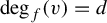 $\deg _f(v)=d$
.
$\deg _f(v)=d$
.
2.2 Abstract ramification portraits
Suppose $\Gamma $
is a finite weighted directed graph (with the weights positive integers) such that each vertex of
$\Gamma $
is a finite weighted directed graph (with the weights positive integers) such that each vertex of $\Gamma $
is the source of exactly one edge. Let
$\Gamma $
is the source of exactly one edge. Let $\tau \colon \, V(\Gamma )\to V(\Gamma )$
be the function which takes a vertex v to the target of the edge with source v. We call the weight of the edge from v to
$\tau \colon \, V(\Gamma )\to V(\Gamma )$
be the function which takes a vertex v to the target of the edge with source v. We call the weight of the edge from v to $\tau (v)$
the degree of
$\tau (v)$
the degree of $\tau $
at v and denote it by
$\tau $
at v and denote it by $\deg (v)$
. A vertex v is critical if
$\deg (v)$
. A vertex v is critical if $\deg (v)> 1$
, and is postcritical if there are a critical vertex w and a positive integer k such that
$\deg (v)> 1$
, and is postcritical if there are a critical vertex w and a positive integer k such that $\tau ^{\circ k}(w) = v$
. If v is a critical vertex, then
$\tau ^{\circ k}(w) = v$
. If v is a critical vertex, then $\tau (v)$
is called a critical value. We denote the set of critical vertices by
$\tau (v)$
is called a critical value. We denote the set of critical vertices by $C_{\Gamma }$
and we denote the set of postcritical vertices by
$C_{\Gamma }$
and we denote the set of postcritical vertices by $P_{\Gamma }$
. We say that
$P_{\Gamma }$
. We say that $\Gamma $
is an abstract ramification portrait if it satisfies the following:
$\Gamma $
is an abstract ramification portrait if it satisfies the following:
-
• every vertex of
$\Gamma $
is either critical or postcritical; -
• there is an integer
$d\ge 2$
such that
$\sum _{v\in C_{\Gamma }} (\deg (v)-1) = 2d-2$
; and -
• for each vertex v, the sum of the weights of the edges with target v is at most d.



We call d the degree of the abstract ramification portrait. We say that an abstract ramification portrait $\Gamma $
is realized by a Thurston map f if
$\Gamma $
is realized by a Thurston map f if $\Gamma $
is isomorphic to the ramification portrait of f (as weighted directed graphs). An abstract ramification portrait
$\Gamma $
is isomorphic to the ramification portrait of f (as weighted directed graphs). An abstract ramification portrait $\Gamma $
is realizable if it is realized by some Thurston map.
$\Gamma $
is realizable if it is realized by some Thurston map.
An abstract ramification portrait of degree d is an abstract polynomial ramification portrait if there is a vertex v such that $\tau (v)=v$
and
$\tau (v)=v$
and $\deg (v)=d$
. In this case, we choose such a vertex and call it
$\deg (v)=d$
. In this case, we choose such a vertex and call it $\infty $
; the other vertices are called finite. We call a cycle (of the action of
$\infty $
; the other vertices are called finite. We call a cycle (of the action of $\tau $
on
$\tau $
on $V(\Gamma )$
) finite if all of its vertices are finite; that is, a cycle is finite if it does not consist of the singleton
$V(\Gamma )$
) finite if all of its vertices are finite; that is, a cycle is finite if it does not consist of the singleton $\infty $
.
$\infty $
.
2.3 Finite subdivision rules
We define finite subdivision rules in the present context of Thurston maps. A finite subdivision rule $\mathcal {R}$
consists of the structure of a finite CW complex
$\mathcal {R}$
consists of the structure of a finite CW complex $S_{\mathcal {R}}$
on the 2-sphere (called the model subdivision complex), a subdivision
$S_{\mathcal {R}}$
on the 2-sphere (called the model subdivision complex), a subdivision $\mathcal {R}(S_{\mathcal {R}})$
of
$\mathcal {R}(S_{\mathcal {R}})$
of $S_{\mathcal {R}}$
, and an orientation-preserving, continuous cellular map
$S_{\mathcal {R}}$
, and an orientation-preserving, continuous cellular map $\sigma _{\mathcal {R}}\colon \, \mathcal {R}(S_{\mathcal {R}})\to S_{\mathcal {R}}$
(called the subdivision map) whose restriction to each open cell is a homeomorphism onto an open cell. Furthermore, for each closed 2-cell
$\sigma _{\mathcal {R}}\colon \, \mathcal {R}(S_{\mathcal {R}})\to S_{\mathcal {R}}$
(called the subdivision map) whose restriction to each open cell is a homeomorphism onto an open cell. Furthermore, for each closed 2-cell $\widetilde {t}$
of
$\widetilde {t}$
of $S_{\mathcal {R}}$
, there are: (i) a cell structure t (called the tile type of
$S_{\mathcal {R}}$
, there are: (i) a cell structure t (called the tile type of $\widetilde {t}$
) on the 2-disk
$\widetilde {t}$
) on the 2-disk $D^2$
such that the 1-skeleton of t is
$D^2$
such that the 1-skeleton of t is $\partial D^2$
and (ii) a continuous surjection
$\partial D^2$
and (ii) a continuous surjection $\psi _t\colon \, t\to \widetilde {t}$
(called the characteristic map of
$\psi _t\colon \, t\to \widetilde {t}$
(called the characteristic map of $\widetilde {t}$
) whose restriction to each open cell is a homeomorphism onto an open cell.
$\widetilde {t}$
) whose restriction to each open cell is a homeomorphism onto an open cell.
Since, by definition, a homeomorphism cannot be a Thurston map, a subdivision map $\sigma _{\mathcal {R}}$
is not a Thurston map if it has degree one. Since the critical values of
$\sigma _{\mathcal {R}}$
is not a Thurston map if it has degree one. Since the critical values of $\sigma _{\mathcal {R}}$
are vertices of
$\sigma _{\mathcal {R}}$
are vertices of $S_{\mathcal {R}}$
and
$S_{\mathcal {R}}$
and $\sigma _{\mathcal {R}}$
takes vertices of
$\sigma _{\mathcal {R}}$
takes vertices of $S_{\mathcal {R}}$
to vertices of
$S_{\mathcal {R}}$
to vertices of $S_{\mathcal {R}}$
, a subdivision map
$S_{\mathcal {R}}$
, a subdivision map $\sigma _{\mathcal {R}}$
is a Thurston map if it has degree at least 2. Conversely, a Thurston map f is the subdivision map of a finite subdivision rule if and only if there exists a connected finite f-invariant graph G that contains the postcritical set of f. Such a graph G serves as the 1-skeleton of a model subdivision complex.
$\sigma _{\mathcal {R}}$
is a Thurston map if it has degree at least 2. Conversely, a Thurston map f is the subdivision map of a finite subdivision rule if and only if there exists a connected finite f-invariant graph G that contains the postcritical set of f. Such a graph G serves as the 1-skeleton of a model subdivision complex.
3 Realizing a ramification portrait by an unobstructed map
In this section, we prove Theorem 1.1. We begin with an example to illustrate the construction. Consider the abstract ramification portrait $\Gamma $
that is shown as follows.
$\Gamma $
that is shown as follows.

The proof defines an ordering of the finite postcritical vertices of $\Gamma $
. In this case, we use the ordering given by
$\Gamma $
. In this case, we use the ordering given by $a_1 < a_2 < a_3 < a_4 < a_5 < a_6$
. Following the terminology that will be defined in the proof, the ordered sets
$a_1 < a_2 < a_3 < a_4 < a_5 < a_6$
. Following the terminology that will be defined in the proof, the ordered sets $(a_1,a_2,a_3)$
and
$(a_1,a_2,a_3)$
and $(a_4)$
are called type-
$(a_4)$
are called type- $1$
chains and the ordered set
$1$
chains and the ordered set $(a_5,a_6)$
is called a type-
$(a_5,a_6)$
is called a type- $2$
chain. (The first element of a type-
$2$
chain. (The first element of a type- $1$
chain is the image of a critical vertex that is not postcritical, and the first element of a type-
$1$
chain is the image of a critical vertex that is not postcritical, and the first element of a type- $2$
chain is a periodic critical vertex.) The model subdivision complex
$2$
chain is a periodic critical vertex.) The model subdivision complex $S_{\mathcal {R}}$
is shown in Figure 1 as a stereographic projection of
$S_{\mathcal {R}}$
is shown in Figure 1 as a stereographic projection of $S^2$
to the plane. The 1-skeleton will always be a star graph with central vertex
$S^2$
to the plane. The 1-skeleton will always be a star graph with central vertex $\infty $
. The vertices of
$\infty $
. The vertices of $\Gamma $
are identified with the vertices of
$\Gamma $
are identified with the vertices of $S_{\mathcal {R}}$
. The ordering of the finite postcritical vertices chosen above determines the counterclockwise ordering of the labels of the vertices in Figure 1. The tile type t is shown in Figure 2;
$S_{\mathcal {R}}$
. The ordering of the finite postcritical vertices chosen above determines the counterclockwise ordering of the labels of the vertices in Figure 1. The tile type t is shown in Figure 2; $S_{\mathcal {R}}$
is the image of t under the characteristic map
$S_{\mathcal {R}}$
is the image of t under the characteristic map $\psi \colon \, t\to S_{\mathcal {R}}$
. The label of a vertex v of t is
$\psi \colon \, t\to S_{\mathcal {R}}$
. The label of a vertex v of t is $\psi (v)$
; if
$\psi (v)$
; if $\psi (v)\ne \infty $
, then v is called a finite vertex.
$\psi (v)\ne \infty $
, then v is called a finite vertex.
The model subdivision complex $S_{\mathcal {R}}$
.
$S_{\mathcal {R}}$
.

The tile type t, which $\psi $
maps to
$\psi $
maps to $S_{\mathcal {R}}$
by identifying edges in pairwise fashion.
$S_{\mathcal {R}}$
by identifying edges in pairwise fashion.

The following is an outline of the construction of the subdivision $\mathcal {R}(S_{\mathcal {R}})$
of
$\mathcal {R}(S_{\mathcal {R}})$
of $S_{\mathcal {R}}$
. We add edges to
$S_{\mathcal {R}}$
. We add edges to $S_{\mathcal {R}}$
in three stages.
$S_{\mathcal {R}}$
in three stages.
In stage $1$
, we add edges to
$1$
, we add edges to $S_{\mathcal {R}}$
that will ensure that the subdivision map cannot have any Levy cycles. Figure 3 shows the construction after the first stage for our example from the point of view of the tile type t. The tile t is a 12-gon. The label of every vertex v of t appears adjacent to v and outside of t. Every other vertex is labeled
$S_{\mathcal {R}}$
that will ensure that the subdivision map cannot have any Levy cycles. Figure 3 shows the construction after the first stage for our example from the point of view of the tile type t. The tile t is a 12-gon. The label of every vertex v of t appears adjacent to v and outside of t. Every other vertex is labeled $\infty $
and the labels of the finite vertices are in the proper cyclic order. Every finite vertex v has an image label, which is
$\infty $
and the labels of the finite vertices are in the proper cyclic order. Every finite vertex v has an image label, which is $\sigma _{\mathcal {R}}(\psi (v))$
. It is drawn inside t. (Of course, this is abuse of notation, since we have not finished the construction yet and, hence, have not defined the subdivision map
$\sigma _{\mathcal {R}}(\psi (v))$
. It is drawn inside t. (Of course, this is abuse of notation, since we have not finished the construction yet and, hence, have not defined the subdivision map $\sigma _{\mathcal {R}}$
yet.)
$\sigma _{\mathcal {R}}$
yet.)
The construction after stage $1$
.
$1$
.

In stage $2$
, we add edges to ensure that
$2$
, we add edges to ensure that $\mathcal {R}(S_{\mathcal {R}})$
will have the correct number of subtiles and, hence,
$\mathcal {R}(S_{\mathcal {R}})$
will have the correct number of subtiles and, hence, $\sigma _{\mathcal {R}}$
will have the correct degree. This is done in a way that ensures that the ramification portrait of
$\sigma _{\mathcal {R}}$
will have the correct degree. This is done in a way that ensures that the ramification portrait of $\sigma _{\mathcal {R}}$
will be isomorphic to
$\sigma _{\mathcal {R}}$
will be isomorphic to $\Gamma $
. No further changes are made in the second stage for our example since there is already the correct number of subtiles.
$\Gamma $
. No further changes are made in the second stage for our example since there is already the correct number of subtiles.
In stage $3$
, we simply add stickers as needed in each subtile so that each subtile has the proper number of vertices and edges. (A sticker is an edge with a vertex of valence one, resembling a stick pin with a spherical head.) Figure 4 shows the result for our example.
$3$
, we simply add stickers as needed in each subtile so that each subtile has the proper number of vertices and edges. (A sticker is an edge with a vertex of valence one, resembling a stick pin with a spherical head.) Figure 4 shows the result for our example.
The subdivision of the tile type after stage $3$
.
$3$
.

Figure 4 Long description
Starting at the top vertex, labeled a1 and infinity, the hexagon proceeds clockwise with vertices labeled a2, a3, a4, a5, and a6, each also paired with infinity at the corners. At each vertex, smaller points labeled a1 through a6 cluster near the main vertex. From the top left vertex, arcs radiate inward from a6 to a2, each connecting to its respective labeled point. At the bottom left, arcs from a6 and a5 extend inward to a5 and a4. At the bottom vertex, arcs from a5, a4, a3, a2, and a1 radiate from the main vertex a4. At the bottom right, arcs from a5, a6, a1, a2, and a3 cluster near a3. At the top right, arcs from a5, a6, a1, a2, and a3 cluster near a2. All arcs are gray, and the main hexagon outline is black and bold. The structure emphasizes the subdivision of each vertex into labeled subpoints and their interconnections.
All of this is done while ensuring that in every subtile, every other vertex is a vertex of t with label $\infty $
and that the image labels are in the proper cyclic order.
$\infty $
and that the image labels are in the proper cyclic order.
It is now straightforward to define the subdivision map $\sigma _{\mathcal {R}}$
so that its restriction to each open cell is a homeomorphism to an open cell and it takes each finite vertex to its image label. Figure 5 shows the subdivision
$\sigma _{\mathcal {R}}$
so that its restriction to each open cell is a homeomorphism to an open cell and it takes each finite vertex to its image label. Figure 5 shows the subdivision $\mathcal {R}(S_{\mathcal {R}})$
.
$\mathcal {R}(S_{\mathcal {R}})$
.
The subdivision of the model subdivision complex.

Figure 5 Long description
Starting at the central node labeled infinity, six main branches radiate outward. Each branch is labeled at its endpoint: a sub 1, a sub 2, a sub 3, a sub 4, a sub 5, and a sub 6. Along each branch, intermediate nodes are labeled sequentially, such as a sub 2, a sub 3, a sub 4, a sub 5, and a sub 6, with each label corresponding to its position along the branch. Gray arcs connect nodes across branches, forming loops that link nodes with matching labels, such as a sub 1 to a sub 6, a sub 2 to a sub 5, and so forth. The structure illustrates the subdivision of the model subdivision complex, with spatial relationships defined by the arrangement and connectivity of labeled nodes.
The five new edges in Figure 3 ensure that if we extend the subtiling so that it combinatorially describes a finite subdivision rule, then the subdivision map cannot have a Levy cycle. This can be proven by contradiction as follows. Let $\gamma $
be an element of a Levy cycle. In the model subdivision complex, the new arc whose barycenter has label
$\gamma $
be an element of a Levy cycle. In the model subdivision complex, the new arc whose barycenter has label $a_4$
bounds an open disk D such that
$a_4$
bounds an open disk D such that $D \cap P_f = \{a_3\}$
and its boundary contains
$D \cap P_f = \{a_3\}$
and its boundary contains $\infty $
. Lemma 3.1 implies, for every positive integer n, that
$\infty $
. Lemma 3.1 implies, for every positive integer n, that $\gamma $
can be isotoped rel the postcritical set to be disjoint from all new edges of the nth subdivision
$\gamma $
can be isotoped rel the postcritical set to be disjoint from all new edges of the nth subdivision $\mathcal {R}^{n}(S_{\mathcal {R}})$
. Since the disk D contains the single postcritical point
$\mathcal {R}^{n}(S_{\mathcal {R}})$
. Since the disk D contains the single postcritical point $a_3$
and its boundary contains
$a_3$
and its boundary contains $\infty $
, the vertex
$\infty $
, the vertex $a_3$
cannot be in the connected component
$a_3$
cannot be in the connected component $D_{\gamma }$
of
$D_{\gamma }$
of $S_{\mathcal {R}}\setminus \gamma $
which does not contain
$S_{\mathcal {R}}\setminus \gamma $
which does not contain $\infty $
. In the next two subdivisions, there will be new edges enclosing the postcritical points
$\infty $
. In the next two subdivisions, there will be new edges enclosing the postcritical points $a_4$
,
$a_4$
, $a_2$
, and
$a_2$
, and $a_1$
, so none of them can be in
$a_1$
, so none of them can be in $D_{\gamma }$
. There is a new edge joining the vertex
$D_{\gamma }$
. There is a new edge joining the vertex $a_5$
to
$a_5$
to $\infty $
, so
$\infty $
, so $a_5$
cannot be in
$a_5$
cannot be in $D_{\gamma }$
. In the next subdivision, there will be a new edge joining
$D_{\gamma }$
. In the next subdivision, there will be a new edge joining $a_6$
to an
$a_6$
to an $\infty $
, so
$\infty $
, so $a_6$
cannot be in
$a_6$
cannot be in $D_{\gamma }$
. Hence, no finite postcritical point can be in
$D_{\gamma }$
. Hence, no finite postcritical point can be in $D_\gamma $
, so there are no Levy cycles and, hence, the subdivision map is equivalent to a rational map. This concludes our example.
$D_\gamma $
, so there are no Levy cycles and, hence, the subdivision map is equivalent to a rational map. This concludes our example.
We call an edge of a subdivision $\mathcal {R}^n(S_{\mathcal {R}})$
(of a finite subdivision rule
$\mathcal {R}^n(S_{\mathcal {R}})$
(of a finite subdivision rule $\mathcal {R}$
) a new edge if it is not contained in an edge of
$\mathcal {R}$
) a new edge if it is not contained in an edge of $S_{\mathcal {R}}$
. The following lemma plays a crucial role in the proof of Theorem 1.1.
$S_{\mathcal {R}}$
. The following lemma plays a crucial role in the proof of Theorem 1.1.
Lemma 3.1. Suppose f is a Thurston map which is also the subdivision map $\sigma _{\mathcal {R}}$
of a finite subdivision rule
$\sigma _{\mathcal {R}}$
of a finite subdivision rule $\mathcal {R}$
. Suppose
$\mathcal {R}$
. Suppose $\{\delta _0,\dots ,\delta _{k-1}, \delta _{k}=\delta _0\}$
is a Levy cycle for f and let n be a positive integer. Then, for each
$\{\delta _0,\dots ,\delta _{k-1}, \delta _{k}=\delta _0\}$
is a Levy cycle for f and let n be a positive integer. Then, for each $i\in \{1,\dots ,k\}$
,
$i\in \{1,\dots ,k\}$
, $\delta _i$
can be isotoped rel
$\delta _i$
can be isotoped rel $P_f$
so that it is disjoint from each new edge of the subdivision
$P_f$
so that it is disjoint from each new edge of the subdivision $\mathcal {R}^n(S_{\mathcal {R}})$
.
$\mathcal {R}^n(S_{\mathcal {R}})$
.
Proof. We first assume $n=1$
. Let E be the
$n=1$
. Let E be the $1$
-skeleton of
$1$
-skeleton of $S_{\mathcal {R}}$
and let
$S_{\mathcal {R}}$
and let $E_1$
be the
$E_1$
be the $1$
-skeleton of
$1$
-skeleton of $\mathcal {R}(S_{\mathcal {R}})$
. Each
$\mathcal {R}(S_{\mathcal {R}})$
. Each $\delta _i$
can be isotoped so that
$\delta _i$
can be isotoped so that $\delta _i\cap E_1$
is finite. For each
$\delta _i\cap E_1$
is finite. For each $i\in \{0,\dots ,k\}$
, let
$i\in \{0,\dots ,k\}$
, let $a_i$
be the minimum of
$a_i$
be the minimum of $\#(\delta \cap E)$
, where
$\#(\delta \cap E)$
, where $\delta $
is a curve that is isotopic rel
$\delta $
is a curve that is isotopic rel $P_f$
to
$P_f$
to $\delta _i$
, and let
$\delta _i$
, and let $b_i$
be the minimum of
$b_i$
be the minimum of $\#(\delta \cap E_1)$
, where
$\#(\delta \cap E_1)$
, where $\delta $
is a curve that is isotopic rel
$\delta $
is a curve that is isotopic rel $P_f$
to
$P_f$
to $\delta _i$
. Let
$\delta _i$
. Let $i\in \{1,\dots ,k\}$
and let
$i\in \{1,\dots ,k\}$
and let $\delta $
be a curve that is isotopic rel
$\delta $
be a curve that is isotopic rel $P_f$
to
$P_f$
to $\delta _i$
such that
$\delta _i$
such that $a_i = \#(\delta \cap E)$
. Let
$a_i = \#(\delta \cap E)$
. Let $\gamma $
be a component of
$\gamma $
be a component of $f^{-1}(\delta )$
which maps to
$f^{-1}(\delta )$
which maps to $\delta $
by degree
$\delta $
by degree $1$
and is isotopic rel
$1$
and is isotopic rel $P_f$
to
$P_f$
to $\delta _{i-1}$
. Then,
$\delta _{i-1}$
. Then, $a_{i-1} \le b_{i-1} \le \#(\gamma \cap E_1) = a_i$
. Since this is true for every i and i varies cyclically, each of these inequalities is an equality. So,
$a_{i-1} \le b_{i-1} \le \#(\gamma \cap E_1) = a_i$
. Since this is true for every i and i varies cyclically, each of these inequalities is an equality. So, $a_{i-1} = a_i$
and
$a_{i-1} = a_i$
and $a_{i-1} = b_{i-1}$
. This implies that
$a_{i-1} = b_{i-1}$
. This implies that $\gamma $
does not intersect
$\gamma $
does not intersect $E_1 \setminus E$
. This establishes the result for
$E_1 \setminus E$
. This establishes the result for $n=1$
.
$n=1$
.
Now, suppose that $n>1$
. Let p be a positive integer with
$n>1$
. Let p be a positive integer with $p\ge n$
and
$p\ge n$
and $p\equiv 1 \mod k$
. Then,
$p\equiv 1 \mod k$
. Then, $\{\delta _0,\dots ,\delta _{k-1}, \delta _{k}=\delta _0\}$
is a Levy cycle for
$\{\delta _0,\dots ,\delta _{k-1}, \delta _{k}=\delta _0\}$
is a Levy cycle for $f^{\circ p}$
. By the previous paragraph applied to
$f^{\circ p}$
. By the previous paragraph applied to $f^{\circ p}$
, each
$f^{\circ p}$
, each $\delta _i$
can be isotoped so that it does not intersect any new edge of
$\delta _i$
can be isotoped so that it does not intersect any new edge of $\mathcal {R}^p(S_{\mathcal {R}})$
. Since each new edge of
$\mathcal {R}^p(S_{\mathcal {R}})$
. Since each new edge of $\mathcal {R}^n(S_{\mathcal {R}})$
is a union of new edges of
$\mathcal {R}^n(S_{\mathcal {R}})$
is a union of new edges of $\mathcal {R}^p(S_{\mathcal {R}})$
, then each
$\mathcal {R}^p(S_{\mathcal {R}})$
, then each $\delta _i$
can be isotoped so that it is disjoint from each new edge of
$\delta _i$
can be isotoped so that it is disjoint from each new edge of $\mathcal {R}^n(S_{\mathcal {R}})$
.
$\mathcal {R}^n(S_{\mathcal {R}})$
.
Proof of Theorem 1.1
Let $\Gamma $
be an abstract polynomial ramification portrait. Let
$\Gamma $
be an abstract polynomial ramification portrait. Let ${C' = C_{\Gamma }\setminus \{\infty \}}$
(the set of finite critical vertices) and let
${C' = C_{\Gamma }\setminus \{\infty \}}$
(the set of finite critical vertices) and let $P' = P_{\Gamma } \setminus \{\infty \}$
(the set of finite postcritical vertices). Let
$P' = P_{\Gamma } \setminus \{\infty \}$
(the set of finite postcritical vertices). Let $V_{\Gamma } = \{\tau (x): x\in C_{\Gamma }\}$
(the set of critical values) and let
$V_{\Gamma } = \{\tau (x): x\in C_{\Gamma }\}$
(the set of critical values) and let ${V' = V_{\Gamma } \setminus \{\infty \}}$
(the set of finite critical values). Let
${V' = V_{\Gamma } \setminus \{\infty \}}$
(the set of finite critical values). Let $A = \{v\in V': v = \tau (c)\ \textrm {for some} c\in C_{\Gamma }\setminus P_{\Gamma }\}$
. For each
$A = \{v\in V': v = \tau (c)\ \textrm {for some} c\in C_{\Gamma }\setminus P_{\Gamma }\}$
. For each $v\in A$
, we choose an element
$v\in A$
, we choose an element $c_v \in C_{\Gamma }\setminus P_{\Gamma }$
with
$c_v \in C_{\Gamma }\setminus P_{\Gamma }$
with $\tau (c_v) = v$
.
$\tau (c_v) = v$
.
Let n be the cardinality of $P'$
. A key step is to appropriately order the elements of
$P'$
. A key step is to appropriately order the elements of $P'$
by naming them
$P'$
by naming them $a_1,\dots ,a_n$
. To do this, we partition
$a_1,\dots ,a_n$
. To do this, we partition $P'$
into chains. We define the chains recursively. We will put postcritical vertices that have already been placed in chains in a set
$P'$
into chains. We define the chains recursively. We will put postcritical vertices that have already been placed in chains in a set $\widetilde {A}$
such that
$\widetilde {A}$
such that $\tau (\widetilde {A})\subseteq \widetilde {A}$
. To begin the construction, let
$\tau (\widetilde {A})\subseteq \widetilde {A}$
. To begin the construction, let $\widetilde {A} = \emptyset $
and let
$\widetilde {A} = \emptyset $
and let $i=1$
.
$i=1$
.
The ordering. Suppose for the recursive step that $A\not \subset \widetilde {A}$
,
$A\not \subset \widetilde {A}$
, $i\in \{1,\dots ,n\}$
, and that we have already defined
$i\in \{1,\dots ,n\}$
, and that we have already defined $a_j$
for
$a_j$
for $j\in \{1,\dots ,i-1\}$
. Suppose that there is a vertex in
$j\in \{1,\dots ,i-1\}$
. Suppose that there is a vertex in $P'\setminus \widetilde {A}$
that is not periodic under
$P'\setminus \widetilde {A}$
that is not periodic under $\tau $
. Because
$\tau $
. Because $\tau (\widetilde {A})\subseteq \widetilde {A}$
, we can choose an element
$\tau (\widetilde {A})\subseteq \widetilde {A}$
, we can choose an element $v\in A\setminus \widetilde {A}$
such that v is not the image under
$v\in A\setminus \widetilde {A}$
such that v is not the image under $\tau $
of a postcritical vertex. Let
$\tau $
of a postcritical vertex. Let $a_i = v$
and add v to
$a_i = v$
and add v to $\widetilde {A}$
. If
$\widetilde {A}$
. If $\tau (v) \notin \widetilde {A}$
, we let
$\tau (v) \notin \widetilde {A}$
, we let $a_{i+1} = \tau (v)$
and add
$a_{i+1} = \tau (v)$
and add $\tau (v)$
to
$\tau (v)$
to $\widetilde {A}$
. We continue until we reach an index j such that
$\widetilde {A}$
. We continue until we reach an index j such that $\tau (a_j)$
is in
$\tau (a_j)$
is in $\widetilde {A}$
. At this point, we stop this iteration of the recursion. We define the ordered set
$\widetilde {A}$
. At this point, we stop this iteration of the recursion. We define the ordered set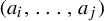 $(a_i,\dots ,a_{j})$
to be the chain of each of its elements. We call it a type-1 chain. It begins with an element of A. The first element of the chain is
$(a_i,\dots ,a_{j})$
to be the chain of each of its elements. We call it a type-1 chain. It begins with an element of A. The first element of the chain is $a_i$
and the last element of the chain is
$a_i$
and the last element of the chain is $a_{j}$
. The length of the chain is
$a_{j}$
. The length of the chain is $j+1-i$
. After redefining i to be
$j+1-i$
. After redefining i to be $j+1$
, we continue this recursive step as long as possible.
$j+1$
, we continue this recursive step as long as possible.
Once we can no longer continue this recursion, the elements of $P'$
which remain are exactly the elements of finite (attractor) cycles which are connected components of
$P'$
which remain are exactly the elements of finite (attractor) cycles which are connected components of $\Gamma $
. To start the next recursion, we choose a critical vertex v in a remaining attractor cycle and let
$\Gamma $
. To start the next recursion, we choose a critical vertex v in a remaining attractor cycle and let $a_i = v$
. Let k be the number of elements in the attractor cycle. For
$a_i = v$
. Let k be the number of elements in the attractor cycle. For $1\le j < k$
, let
$1\le j < k$
, let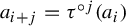 $a_{i+j} = \tau ^{\circ j}(a_i)$
. As before,
$a_{i+j} = \tau ^{\circ j}(a_i)$
. As before, $a_i$
is the first element of the chain,
$a_i$
is the first element of the chain, $a_{i+k-1}$
is the last element of the chain, and the length of the chain is k. We call it a type-2 chain. We continue recursively to choose all of the points in the other attractor cycles. After doing this, the elements of
$a_{i+k-1}$
is the last element of the chain, and the length of the chain is k. We call it a type-2 chain. We continue recursively to choose all of the points in the other attractor cycles. After doing this, the elements of $P'$
are
$P'$
are $a_1,\dots ,a_n$
in order.
$a_1,\dots ,a_n$
in order.
One or two chains of type $1$
.
$1$
.

Construction of $S_{\mathcal {R}}$
. We next construct the associated finite subdivision rule
$S_{\mathcal {R}}$
. We next construct the associated finite subdivision rule $\mathcal {R}$
. The
$\mathcal {R}$
. The $1$
-skeleton of the model subdivision complex
$1$
-skeleton of the model subdivision complex $S_{\mathcal {R}}$
is a tree as in Figure 1. There is one central vertex. We identify
$S_{\mathcal {R}}$
is a tree as in Figure 1. There is one central vertex. We identify $\infty \in \Gamma $
with this central vertex. There are n ‘stickers’ (a sticker is an edge of the graph with a vertex of valence one, like a stick pin with a spherical head) from
$\infty \in \Gamma $
with this central vertex. There are n ‘stickers’ (a sticker is an edge of the graph with a vertex of valence one, like a stick pin with a spherical head) from $\infty $
to valence
$\infty $
to valence $1$
vertices
$1$
vertices $a_1,\dots ,a_n$
, in counterclockwise order. We identify
$a_1,\dots ,a_n$
, in counterclockwise order. We identify $a_1,\dots ,a_n\in \Gamma $
with these valence
$a_1,\dots ,a_n\in \Gamma $
with these valence $1$
vertices. The tile type t is a
$1$
vertices. The tile type t is a $(2n)$
-gon, which we think of as an n-gon with each edge bisected. The characteristic map
$(2n)$
-gon, which we think of as an n-gon with each edge bisected. The characteristic map $\psi :t\to S_{\mathcal {R}}$
maps the edge barycenters to the sticker heads and the other vertices to
$\psi :t\to S_{\mathcal {R}}$
maps the edge barycenters to the sticker heads and the other vertices to $\infty $
. The edge barycenters are called finite vertices and the others are called
$\infty $
. The edge barycenters are called finite vertices and the others are called $\infty $
-vertices. More generally, a vertex of some subdivision of t which is not a vertex of t is called a finite vertex. Every vertex v of t is labeled by
$\infty $
-vertices. More generally, a vertex of some subdivision of t which is not a vertex of t is called a finite vertex. Every vertex v of t is labeled by $\psi (v)$
. These vertex labels are placed outside t in Figures 6–10. We use clockwise order on
$\psi (v)$
. These vertex labels are placed outside t in Figures 6–10. We use clockwise order on $\partial t$
.
$\partial t$
.
If k is an integer with $k\ge 2$
, a k-doodle is a graph with three vertices and k edges (none of them loops) such that one vertex (the central vertex) has valence k, one vertex (the head) has valence
$k\ge 2$
, a k-doodle is a graph with three vertices and k edges (none of them loops) such that one vertex (the central vertex) has valence k, one vertex (the head) has valence $1$
, and the third vertex (the foot) has valence
$1$
, and the third vertex (the foot) has valence $k-1$
. Note that a
$k-1$
. Note that a $2$
-doodle is a bisected arc.
$2$
-doodle is a bisected arc.
We define a subdivision $\mathcal {R}(t)$
of t. We do this in three stages. We first define a subtiling of t into subtiles such that the finite vertices in each subtile are in the proper cyclic order. This means that there might be fewer than n of them, but they will have image labels, which are distinct elements of
$\mathcal {R}(t)$
of t. We do this in three stages. We first define a subtiling of t into subtiles such that the finite vertices in each subtile are in the proper cyclic order. This means that there might be fewer than n of them, but they will have image labels, which are distinct elements of $\{a_1,\ldots ,a_n\}$
, and, when taken in clockwise order, their image labels have the same cyclic order as in
$\{a_1,\ldots ,a_n\}$
, and, when taken in clockwise order, their image labels have the same cyclic order as in $(a_1,\ldots ,a_n)$
. We then add arcs and k-doodles as determined by the critical vertices of
$(a_1,\ldots ,a_n)$
. We then add arcs and k-doodles as determined by the critical vertices of $\Gamma $
so that we have d subtiles. Finally, we add stickers as necessary to get the subdivision
$\Gamma $
so that we have d subtiles. Finally, we add stickers as necessary to get the subdivision $\mathcal {R}(t)$
. The tiles of the first stage will be defined so that the resulting subdivision map does not have Levy cycles. We do this by ensuring that there is an iterated subdivison
$\mathcal {R}(t)$
. The tiles of the first stage will be defined so that the resulting subdivision map does not have Levy cycles. We do this by ensuring that there is an iterated subdivison $\mathcal {R}^n(t)$
of t such that for each finite vertex v of t except possibly one, either there is a new edge from v to an
$\mathcal {R}^n(t)$
of t such that for each finite vertex v of t except possibly one, either there is a new edge from v to an $\infty $
-vertex or there is an arc (made out of two or four new edges) from the
$\infty $
-vertex or there is an arc (made out of two or four new edges) from the $\infty $
-vertex before v to the
$\infty $
-vertex before v to the $\infty $
-vertex after v.
$\infty $
-vertex after v.
As we construct $\mathcal {R}(t)$
, we will give image labels to its vertices. The image label of a vertex is the vertex it will map to under the analog of
$\mathcal {R}(t)$
, we will give image labels to its vertices. The image label of a vertex is the vertex it will map to under the analog of $\psi $
from
$\psi $
from $\mathcal {R}(t)$
to
$\mathcal {R}(t)$
to $S_{\mathcal {R}}$
. So, for a vertex v in t, the image label of v is defined to be
$S_{\mathcal {R}}$
. So, for a vertex v in t, the image label of v is defined to be $\tau (\psi (v))$
. We will keep track of the critical vertices that have already been accounted for during the construction of
$\tau (\psi (v))$
. We will keep track of the critical vertices that have already been accounted for during the construction of $\mathcal {R}(t)$
in a set
$\mathcal {R}(t)$
in a set $\widetilde {C}$
. For the beginning of the construction, we define
$\widetilde {C}$
. For the beginning of the construction, we define $\widetilde {C} = \emptyset $
.
$\widetilde {C} = \emptyset $
.
A chain of type $1$
followed by a chain of type
$1$
followed by a chain of type $2$
.
$2$
.

A chain of type $2$
followed by a chain of type
$2$
followed by a chain of type $1$
. Here,
$1$
. Here, $i=n$
.
$i=n$
.

Figure 8 Long description
There are two panels. In both, a V-shaped chain has a central top vertex. The left branch is labeled a sub n, the right branch a sub 1. On the left panel, a sub n is repeated below the left branch, and tau of a sub 1 appears in gray below the right branch. The right panel repeats the main structure but adds a gray arrow from a sub n to a sub 1, labeled tau of a sub n, and a gray arrow from the top vertex to the right branch, labeled tau of a sub 1. All gray elements indicate mappings or transformations between nodes.
Two chains of type $2$
.
$2$
.

A single chain and it has type $1$
.
$1$
.

Figure 10 Long description
The left panel shows a V-shaped chain with three labeled points: a sub r minus 1 at the left vertex, a sub r at the right, and a gray arc from a sub r to tau of open parenthesis a sub r close parenthesis. The right panel shows a similar V-shaped chain with points a sub n at the left, a sub 1 at the right, and a sub r and a sub 1 below. Two gray arcs connect a sub 1 to tau of open parenthesis a sub 1 close parenthesis and a sub r to a sub 1.
Stage 1. Suppose $a_i$
is the last element of a chain and
$a_i$
is the last element of a chain and $a_j$
is the first element of the next chain (in cyclic order). So, either
$a_j$
is the first element of the next chain (in cyclic order). So, either $1\le i < n$
and
$1\le i < n$
and $j=i+1$
or
$j=i+1$
or $i=n$
and
$i=n$
and $j=1$
. The construction in stage 1 depends on the types of the chains which contain
$j=1$
. The construction in stage 1 depends on the types of the chains which contain $a_i$
and
$a_i$
and $a_j$
. We consider various cases.
$a_j$
. We consider various cases.
If $a_i$
and
$a_i$
and $a_{j}$
are in distinct chains of type
$a_{j}$
are in distinct chains of type $1$
or if they are in the same chain of type
$1$
or if they are in the same chain of type $1$
(there is only one chain) and
$1$
(there is only one chain) and $\tau (a_i)\ne a_j$
, then we add a k-doodle, with k being the degree of the critical vertex
$\tau (a_i)\ne a_j$
, then we add a k-doodle, with k being the degree of the critical vertex $c_{a_{j}}$
, with head the
$c_{a_{j}}$
, with head the $\infty $
-vertex after
$\infty $
-vertex after $a_i$
and with foot the
$a_i$
and with foot the $\infty $
-vertex before
$\infty $
-vertex before $a_i$
. We give the central vertex of the k-doodle image label
$a_i$
. We give the central vertex of the k-doodle image label $a_{j}$
and add
$a_{j}$
and add $c_{a_{j}}$
to
$c_{a_{j}}$
to $\widetilde {C}$
. See Figure 6, which, like Figures 7–10, is drawn with
$\widetilde {C}$
. See Figure 6, which, like Figures 7–10, is drawn with $k=2$
.
$k=2$
.
If $a_i$
is in a chain of type
$a_i$
is in a chain of type $1$
and
$1$
and $a_{j}$
is in a chain of type
$a_{j}$
is in a chain of type $2$
, then we add
$2$
, then we add $k-1$
edges joining
$k-1$
edges joining $a_j$
to the
$a_j$
to the $\infty $
-vertex before
$\infty $
-vertex before $a_i$
(where
$a_i$
(where $k = \deg (a_j)$
) and add
$k = \deg (a_j)$
) and add $a_{j}$
to
$a_{j}$
to $\widetilde {C}$
. See Figure 7.
$\widetilde {C}$
. See Figure 7.
Suppose $a_i$
is in a chain of type
$a_i$
is in a chain of type $2$
and
$2$
and $a_j$
is in a chain of type
$a_j$
is in a chain of type $1$
(this can only occur if
$1$
(this can only occur if $i=n$
and
$i=n$
and $j=1$
). If
$j=1$
). If $a_i$
is in a chain of length
$a_i$
is in a chain of length $1$
, then we do not do anything at this stage. If
$1$
, then we do not do anything at this stage. If $a_i$
is in a chain of length greater than
$a_i$
is in a chain of length greater than $1$
, then we add a k-doodle (with
$1$
, then we add a k-doodle (with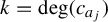 $k = \deg (c_{a_{j}})$
) with head the
$k = \deg (c_{a_{j}})$
) with head the $\infty $
-vertex after
$\infty $
-vertex after $a_i$
and with foot the
$a_i$
and with foot the $\infty $
-vertex before
$\infty $
-vertex before $a_i$
. We give the central vertex of the k-doodle image label
$a_i$
. We give the central vertex of the k-doodle image label $a_{j}$
and add
$a_{j}$
and add $c_{a_{j}}$
to
$c_{a_{j}}$
to $\widetilde {C}$
. Figure 8 shows both possibilities.
$\widetilde {C}$
. Figure 8 shows both possibilities.
If $a_i$
and
$a_i$
and $a_{j}$
are both in chains of type
$a_{j}$
are both in chains of type $2$
, and
$2$
, and $a_i$
is in a chain of length
$a_i$
is in a chain of length $1$
, then to
$1$
, then to $a_{j}$
we add
$a_{j}$
we add $k-1$
edges joining it to the
$k-1$
edges joining it to the $\infty $
-vertex before
$\infty $
-vertex before $a_{j}$
(where
$a_{j}$
(where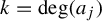 $k= \deg (a_j)$
) and add
$k= \deg (a_j)$
) and add $a_{j}$
to
$a_{j}$
to $\widetilde {C}$
. If
$\widetilde {C}$
. If $a_i$
and
$a_i$
and $a_{j}$
are both in chains of type
$a_{j}$
are both in chains of type $2$
, and
$2$
, and $a_i$
is in a chain of length greater than
$a_i$
is in a chain of length greater than $1$
, then to
$1$
, then to $a_{j}$
we add
$a_{j}$
we add $k-1$
edges joining it to the
$k-1$
edges joining it to the $\infty $
-vertex before
$\infty $
-vertex before $a_{i}$
(where
$a_{i}$
(where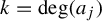 $k=\deg (a_j)$
) and add
$k=\deg (a_j)$
) and add $a_{j}$
to
$a_{j}$
to $\widetilde {C}$
. The two possibilities are shown in Figure 9.
$\widetilde {C}$
. The two possibilities are shown in Figure 9.
Now, suppose that there is a single chain, it has type $1$
, and
$1$
, and $\tau (a_n) = a_1$
. This is the only remaining case. The Riemann–Hurwitz condition implies that if there is just one finite critical value, then
$\tau (a_n) = a_1$
. This is the only remaining case. The Riemann–Hurwitz condition implies that if there is just one finite critical value, then $\Gamma $
has only two critical vertices and their degrees both equal the degree of
$\Gamma $
has only two critical vertices and their degrees both equal the degree of $\Gamma $
. Hence, the finite critical vertex is the only vertex of
$\Gamma $
. Hence, the finite critical vertex is the only vertex of $\Gamma $
which
$\Gamma $
which $\tau $
maps to the finite critical value. This is impossible in the present case because
$\tau $
maps to the finite critical value. This is impossible in the present case because $a_1\in A$
and
$a_1\in A$
and $\tau (a_n)=a_1$
. So, either one of the
$\tau (a_n)=a_1$
. So, either one of the $a_i$
elements is a critical vertex or one of the
$a_i$
elements is a critical vertex or one of the $a_i$
elements with
$a_i$
elements with $i>1$
is a critical value.
$i>1$
is a critical value.
First, suppose that $r\in \{1,\dots ,n\}$
and
$r\in \{1,\dots ,n\}$
and $a_r$
is a critical vertex with degree k. We add
$a_r$
is a critical vertex with degree k. We add $k-1$
arcs in t from
$k-1$
arcs in t from $a_r$
to the
$a_r$
to the $\infty $
-vertex before
$\infty $
-vertex before $a_r$
, and we add
$a_r$
, and we add $a_r$
to
$a_r$
to $\widetilde {C}$
. See the left side of Figure 10.
$\widetilde {C}$
. See the left side of Figure 10.
If none of the $a_i$
elements is a critical vertex, then some
$a_i$
elements is a critical vertex, then some $a_i$
with
$a_i$
with $i>1$
is a critical value. In this case, suppose
$i>1$
is a critical value. In this case, suppose $r\in \{2,\dots ,n\}$
such that
$r\in \{2,\dots ,n\}$
such that $a_r$
is a critical value. Let
$a_r$
is a critical value. Let $k_1 = \deg (c_{a_1})$
and let
$k_1 = \deg (c_{a_1})$
and let $k_r = \deg (c_{a_r})$
. We add a
$k_r = \deg (c_{a_r})$
. We add a $k_r$
-doodle with head the
$k_r$
-doodle with head the $\infty $
-vertex after
$\infty $
-vertex after $a_n$
and with foot the
$a_n$
and with foot the $\infty $
-vertex before
$\infty $
-vertex before $a_n$
. We give its central vertex image label
$a_n$
. We give its central vertex image label $a_r$
and we add
$a_r$
and we add $c_{a_r}$
to
$c_{a_r}$
to $\widetilde {C}$
. We then add a
$\widetilde {C}$
. We then add a $k_1$
-doodle with head the
$k_1$
-doodle with head the $\infty $
-vertex after
$\infty $
-vertex after $a_n$
and with foot the
$a_n$
and with foot the $\infty $
-vertex before
$\infty $
-vertex before $a_n$
as indicated in Figure 10. We give its central vertex image label
$a_n$
as indicated in Figure 10. We give its central vertex image label $a_1$
and we add
$a_1$
and we add $c_{a_1}$
to
$c_{a_1}$
to $\widetilde {C}$
. See the right side of Figure 10. This completes stage
$\widetilde {C}$
. See the right side of Figure 10. This completes stage $1$
of the construction.
$1$
of the construction.
Verification of stage 1 consistency. We first verify that the stage 1 edge constructions can be made so that interiors of distinct edges are disjoint. This is clear unless one of the edges is as in Figure 7 or the right side of Figure 9. In both cases, the second chain $(a_j,\ldots )$
has type 2. Figures 7–9 show that a stage 1 edge can join the
$(a_j,\ldots )$
has type 2. Figures 7–9 show that a stage 1 edge can join the $\infty $
-vertex immediately preceding vertex
$\infty $
-vertex immediately preceding vertex $v_j$
to a vertex with image label in the chain
$v_j$
to a vertex with image label in the chain $(a_j,\ldots )$
or an adjacent
$(a_j,\ldots )$
or an adjacent $\infty $
-vertex only in the situation of the left side of Figure 9. So, edges as in Figure 7 or the right side of Figure 9 can be constructed to meet other edges only in endpoints. Thus, the stage 1 edges can be constructed so that their interiors are disjoint.
$\infty $
-vertex only in the situation of the left side of Figure 9. So, edges as in Figure 7 or the right side of Figure 9 can be constructed to meet other edges only in endpoints. Thus, the stage 1 edges can be constructed so that their interiors are disjoint.
We now look at what we have after stage $1$
. Every subtile except for the central one is either a
$1$
. Every subtile except for the central one is either a $2$
-gon or a
$2$
-gon or a $4$
-gon, and so there are only one or two finite vertices. For a
$4$
-gon, and so there are only one or two finite vertices. For a $2$
-gon, there is only one finite vertex and so its image label is in proper cyclic order.
$2$
-gon, there is only one finite vertex and so its image label is in proper cyclic order.
For a $4$
-gon, there are two finite vertices, so their image labels are in proper cyclic order if they are distinct. Chains of type 2 consist of the vertices of connected components of
$4$
-gon, there are two finite vertices, so their image labels are in proper cyclic order if they are distinct. Chains of type 2 consist of the vertices of connected components of $\Gamma $
which are cycles. Using this and the facts that elements of chains are distinct and distinct chains are disjoint, one verifies that the image labels of the 4-gons in Figures 7–10 are distinct. The only potential problem is if, in the notation of Figure 6,
$\Gamma $
which are cycles. Using this and the facts that elements of chains are distinct and distinct chains are disjoint, one verifies that the image labels of the 4-gons in Figures 7–10 are distinct. The only potential problem is if, in the notation of Figure 6, $\tau (a_i) = a_j$
. Suppose that this happens. Then,
$\tau (a_i) = a_j$
. Suppose that this happens. Then, $a_i$
and
$a_i$
and $a_j$
are in different chains. Because
$a_j$
are in different chains. Because $\tau (a_i) = a_j$
, and
$\tau (a_i) = a_j$
, and $a_i$
and
$a_i$
and $a_j$
are in different chains,
$a_j$
are in different chains, $a_j$
is not periodic under
$a_j$
is not periodic under $\tau $
. However, if there exists such a vertex when a chain is defined, then the first vertex of that chain must not be the image of a postcritical vertex. So, it is not possible that
$\tau $
. However, if there exists such a vertex when a chain is defined, then the first vertex of that chain must not be the image of a postcritical vertex. So, it is not possible that $\tau (a_i) = a_j$
. Hence, the two finite vertices of every 4-gon have different image labels.
$\tau (a_i) = a_j$
. Hence, the two finite vertices of every 4-gon have different image labels.
Now, we verify that the same is true for the central subtile s. We first observe that the vertices of s alternate between finite postcritical vertices and $\infty $
-vertices, as required.
$\infty $
-vertices, as required.
Note that if x is a vertex of t with label a, then the image label of x is $\tau (a)$
. So, considering only the vertices of s which are vertices of t, if they do not have image labels in the proper cyclic order, then the label of one of them is the last member of a chain. In this case, the left side of either Figures 8, 9, or 10 occurs. However, in these cases, it is not hard to see that our image labels are in proper cyclic order. So, the image labels of the vertices of s which are vertices of t are in the proper cyclic order.
$\tau (a)$
. So, considering only the vertices of s which are vertices of t, if they do not have image labels in the proper cyclic order, then the label of one of them is the last member of a chain. In this case, the left side of either Figures 8, 9, or 10 occurs. However, in these cases, it is not hard to see that our image labels are in proper cyclic order. So, the image labels of the vertices of s which are vertices of t are in the proper cyclic order.
It remains to interpolate the vertices of s which are not vertices of t. These occur in Figure 6, and the right sides of Figures 8 and 10. In the first two cases, the image label of the vertex in question is $a_j$
, and in the last case, this image label is
$a_j$
, and in the last case, this image label is $a_1$
. A short case analysis shows that proper cyclic order also occurs in these cases. We conclude that the image labels of the vertices of s are in proper cyclic order after stage 1.
$a_1$
. A short case analysis shows that proper cyclic order also occurs in these cases. We conclude that the image labels of the vertices of s are in proper cyclic order after stage 1.
Stage 2. For the second stage, we add subtiles (much as in stage 1) corresponding to the critical vertices in $C'$
that are not in
$C'$
that are not in $\widetilde {C}$
. We do this recursively. Each time we add subtiles because of an element c of
$\widetilde {C}$
. We do this recursively. Each time we add subtiles because of an element c of $C' \setminus \widetilde {C}$
, we add this element to
$C' \setminus \widetilde {C}$
, we add this element to $\widetilde {C}$
. This guarantees that we visit every element of
$\widetilde {C}$
. This guarantees that we visit every element of $C'$
exactly once, including the visits made in stage 1. Since
$C'$
exactly once, including the visits made in stage 1. Since $C'$
is finite, this process will terminate.
$C'$
is finite, this process will terminate.
Suppose $c\in C' \setminus \widetilde {C}$
. Let
$c\in C' \setminus \widetilde {C}$
. Let $k = \deg (c)$
.
$k = \deg (c)$
.
If $c\in P'$
, then we add
$c\in P'$
, then we add $k-1$
edges from c to the
$k-1$
edges from c to the $\infty $
-vertex of t before c and we add c to
$\infty $
-vertex of t before c and we add c to $\widetilde {C}$
. Image labels of finite vertices of all tiles remain in proper cyclic order.
$\widetilde {C}$
. Image labels of finite vertices of all tiles remain in proper cyclic order.
Now, suppose $c\not \in P'$
, but that there is another element
$c\not \in P'$
, but that there is another element $c'\in C' \setminus \widetilde {C}$
with
$c'\in C' \setminus \widetilde {C}$
with $c'\not \in P'$
and
$c'\not \in P'$
and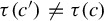 $\tau (c')\ne \tau (c)$
. Let
$\tau (c')\ne \tau (c)$
. Let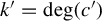 $k' = \deg (c')$
. Let
$k' = \deg (c')$
. Let $i,j\in \{1,\dots ,n\}$
such that
$i,j\in \{1,\dots ,n\}$
such that $\tau (c) = a_i$
and
$\tau (c) = a_i$
and $\tau (c') = a_j$
. Choose a subtile s of t. If s does not contain a vertex with image label
$\tau (c') = a_j$
. Choose a subtile s of t. If s does not contain a vertex with image label $a_i$
, then there is a unique
$a_i$
, then there is a unique $\infty $
-vertex in s such that we can add a k-doodle with head and foot this
$\infty $
-vertex in s such that we can add a k-doodle with head and foot this $\infty $
-vertex, and with image label
$\infty $
-vertex, and with image label $a_i$
, and still have the image labels be in cyclic order. We do this and we add c to
$a_i$
, and still have the image labels be in cyclic order. We do this and we add c to $\widetilde {C}$
. Image labels of finite vertices of all tiles remain in proper cyclic order. Suppose s does contain a vertex v with image label
$\widetilde {C}$
. Image labels of finite vertices of all tiles remain in proper cyclic order. Suppose s does contain a vertex v with image label $a_i$
. Then, we add a
$a_i$
. Then, we add a $k'$
-doodle to s with head the
$k'$
-doodle to s with head the $\infty $
-vertex after v, with central vertex with image label
$\infty $
-vertex after v, with central vertex with image label $a_j$
, and with foot the
$a_j$
, and with foot the $\infty $
-vertex before v. We then add a k-doodle to s with head the
$\infty $
-vertex before v. We then add a k-doodle to s with head the $\infty $
-vertex after v, with central vertex with image label
$\infty $
-vertex after v, with central vertex with image label $a_i$
, and with foot the
$a_i$
, and with foot the $\infty $
-vertex before v. There are a new subtile in s with the same image labels (and in the same cyclic order) as for s, some
$\infty $
-vertex before v. There are a new subtile in s with the same image labels (and in the same cyclic order) as for s, some $2$
-gons if
$2$
-gons if $k>2$
or
$k>2$
or $k'> 2$
, and two
$k'> 2$
, and two $4$
-gons with a vertex labeled
$4$
-gons with a vertex labeled $a_i$
and a vertex labeled
$a_i$
and a vertex labeled $a_j$
. So, we still have the image labels of the finite vertices of all of the subtiles in cyclic order. Finally, we add c and
$a_j$
. So, we still have the image labels of the finite vertices of all of the subtiles in cyclic order. Finally, we add c and $c'$
to
$c'$
to $\widetilde {C}$
.
$\widetilde {C}$
.
To complete stage $2$
, we need to consider the case that all elements of
$2$
, we need to consider the case that all elements of $C' \setminus \widetilde {C}$
have the same image
$C' \setminus \widetilde {C}$
have the same image $a_i$
under
$a_i$
under $\tau $
. Let
$\tau $
. Let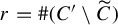 $r = \#( C' \setminus \widetilde {C} )$
and let m be the sum of the degrees of the elements of
$r = \#( C' \setminus \widetilde {C} )$
and let m be the sum of the degrees of the elements of $C' \setminus \widetilde {C}$
. At every step of the construction thus far, the number of subtiles of t increases by
$C' \setminus \widetilde {C}$
. At every step of the construction thus far, the number of subtiles of t increases by $\deg (v)-1$
, where v is the vertex added to
$\deg (v)-1$
, where v is the vertex added to $\widetilde {C}$
. So, the number of subtiles of t created thus far is
$\widetilde {C}$
. So, the number of subtiles of t created thus far is
 $$ \begin{align*} 1+\Sigma_{v\in\widetilde{C}}(\mathrm{deg}(v)-1) & = 1+\Sigma_{v\in C'}(\mathrm{deg}(v)-1)-m+r\\ & = 1+d-1-m+r\\ & = (d-m)+r. \end{align*} $$
Because there remain m tiles to add with a vertex labeled $a_i$
and the total number of tiles at the end of this stage with a vertex labeled
$a_i$
and the total number of tiles at the end of this stage with a vertex labeled $a_i$
is at most d (the sum of the weights of the edges of
$a_i$
is at most d (the sum of the weights of the edges of $\Gamma $
with target vertex
$\Gamma $
with target vertex $a_i$
is at most d), there is currently a subtile that does not have a vertex with image label
$a_i$
is at most d), there is currently a subtile that does not have a vertex with image label $a_i$
. There is a unique
$a_i$
. There is a unique $\infty $
-vertex in this subtile such that we can add a k-doodle with head and foot this
$\infty $
-vertex in this subtile such that we can add a k-doodle with head and foot this $\infty $
-vertex, and with image label
$\infty $
-vertex, and with image label $a_i$
, and still have the image labels be in cyclic order. We do this and we add c to
$a_i$
, and still have the image labels be in cyclic order. We do this and we add c to $\widetilde {C}$
. This completes the recursive step, so we can continue the recursion until
$\widetilde {C}$
. This completes the recursive step, so we can continue the recursion until $C' = \widetilde {C}$
. This completes the second stage. At this point, there are d subtiles of t and in each subtile, the image labels of the finite vertices are in proper cyclic order.
$C' = \widetilde {C}$
. This completes the second stage. At this point, there are d subtiles of t and in each subtile, the image labels of the finite vertices are in proper cyclic order.
Stage 3. Suppose s is a subtile of the construction after stage two and ${i\in \{1,\dots ,n\}}$
. If s does not have a vertex with image label
${i\in \{1,\dots ,n\}}$
. If s does not have a vertex with image label $a_i$
, then there is a unique
$a_i$
, then there is a unique $\infty $
-vertex of s to which we can add a sticker whose other vertex has image label
$\infty $
-vertex of s to which we can add a sticker whose other vertex has image label $a_i$
and still have the image labels of the finite vertices in cyclic order. We do this for every such s and i. This completes stage
$a_i$
and still have the image labels of the finite vertices in cyclic order. We do this for every such s and i. This completes stage $3$
.
$3$
.
Completion of the construction of $S_{\mathcal {R}}$
. At this point, every subtile has n finite vertices and their image labels are in proper cyclic order. We define this to be the subdivision
$S_{\mathcal {R}}$
. At this point, every subtile has n finite vertices and their image labels are in proper cyclic order. We define this to be the subdivision $\mathcal {R}(t)$
and we define its image under the characteristic map
$\mathcal {R}(t)$
and we define its image under the characteristic map $t\to S_{\mathcal {R}}$
to be
$t\to S_{\mathcal {R}}$
to be $\mathcal {R}(S_{\mathcal {R}})$
. It is straightforward to define a subdivision map that takes
$\mathcal {R}(S_{\mathcal {R}})$
. It is straightforward to define a subdivision map that takes $\mathcal {R}(S_{\mathcal {R}})$
to
$\mathcal {R}(S_{\mathcal {R}})$
to $S_{\mathcal {R}}$
, which takes each open cell homeomorphically to an open cell, takes each
$S_{\mathcal {R}}$
, which takes each open cell homeomorphically to an open cell, takes each $\infty $
-vertex to
$\infty $
-vertex to $\infty $
, and takes a vertex with image label
$\infty $
, and takes a vertex with image label $a_i$
to the vertex
$a_i$
to the vertex $a_i$
. This completes the definition of the finite subdivision rule
$a_i$
. This completes the definition of the finite subdivision rule $\mathcal {R}$
. It is clear from this construction that the ramification portrait of the subdivision map
$\mathcal {R}$
. It is clear from this construction that the ramification portrait of the subdivision map $\sigma _{\mathcal {R}}$
is isomorphic to
$\sigma _{\mathcal {R}}$
is isomorphic to $\Gamma $
.
$\Gamma $
.
Verification that $\sigma _{\mathcal {R}}$
has no Levy cycle. We prove by contradiction that
$\sigma _{\mathcal {R}}$
has no Levy cycle. We prove by contradiction that $\sigma _{\mathcal {R}}$
cannot have a Levy cycle. Suppose
$\sigma _{\mathcal {R}}$
cannot have a Levy cycle. Suppose $\{\delta _0,\dots ,\delta _{k-1},\delta _k=\delta _0\}$
is a Levy cycle for
$\{\delta _0,\dots ,\delta _{k-1},\delta _k=\delta _0\}$
is a Levy cycle for $\sigma _{\mathcal {R}}$
. Choose any
$\sigma _{\mathcal {R}}$
. Choose any $i\in \{1,\dots ,k\}$
and consider the component
$i\in \{1,\dots ,k\}$
and consider the component $D_i$
of
$D_i$
of $S^2 \setminus \delta _i$
that does not contain
$S^2 \setminus \delta _i$
that does not contain $\infty $
. Since
$\infty $
. Since $\delta _i$
is essential and is not peripheral,
$\delta _i$
is essential and is not peripheral, $D_i$
must contain at least two points of P. We will obtain a contradiction by showing that
$D_i$
must contain at least two points of P. We will obtain a contradiction by showing that $D_i$
can contain at most one point of P. For this, consider a finite postcritical point
$D_i$
can contain at most one point of P. For this, consider a finite postcritical point $a_j$
of
$a_j$
of $\sigma _{\mathcal {R}}$
in
$\sigma _{\mathcal {R}}$
in $S_{\mathcal {R}}$
.
$S_{\mathcal {R}}$
.
Suppose that there exists a positive integer m such that $\tau ^{\circ m}(a_j)$
is a critical vertex. Then,
$\tau ^{\circ m}(a_j)$
is a critical vertex. Then, $a_j$
and
$a_j$
and $\infty $
are joined by a new edge in
$\infty $
are joined by a new edge in $\mathcal {R}^{m+1}(S_{\mathcal {R}})$
. By Lemma 3.1, we can isotope
$\mathcal {R}^{m+1}(S_{\mathcal {R}})$
. By Lemma 3.1, we can isotope $\delta _i$
in
$\delta _i$
in $S^2\setminus P_f$
to be disjoint from this new edge, so
$S^2\setminus P_f$
to be disjoint from this new edge, so $a_j$
and
$a_j$
and $\infty $
are in the same component of
$\infty $
are in the same component of $S^2 \setminus \delta _i$
. Hence,
$S^2 \setminus \delta _i$
. Hence, $a_j\notin D_i$
. So,
$a_j\notin D_i$
. So, $a_j\notin D_i$
if either
$a_j\notin D_i$
if either $a_j$
is in a type-
$a_j$
is in a type- $2$
chain or we are in the situation of the left half of Figure 10.
$2$
chain or we are in the situation of the left half of Figure 10.
Now, suppose that $a_j$
is in a type-
$a_j$
is in a type- $1$
chain that is not followed by a type-
$1$
chain that is not followed by a type- $2$
chain. Let
$2$
chain. Let $a_r$
be the last element of the type-
$a_r$
be the last element of the type- $1$
chain that contains
$1$
chain that contains $a_j$
. We are in the situation of either Figure 6 or the right half of Figure 10. So, there is a pair of new edges of
$a_j$
. We are in the situation of either Figure 6 or the right half of Figure 10. So, there is a pair of new edges of $\mathcal {R}(S_{\mathcal {R}})$
that bounds an open disk D that contains
$\mathcal {R}(S_{\mathcal {R}})$
that bounds an open disk D that contains $a_r$
and no other postcritical points. Hence,
$a_r$
and no other postcritical points. Hence, $a_r$
cannot be in the open disk
$a_r$
cannot be in the open disk $D_i$
since if so, Lemma 3.1 implies that we can isotope
$D_i$
since if so, Lemma 3.1 implies that we can isotope $D_i$
rel
$D_i$
rel $P_f$
into D. Similarly, in
$P_f$
into D. Similarly, in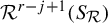 $\mathcal {R}^{r-j+1}(S_{\mathcal {R}})$
, there is a pair of new edges that bounds an open disk that contains
$\mathcal {R}^{r-j+1}(S_{\mathcal {R}})$
, there is a pair of new edges that bounds an open disk that contains $a_j$
and no other postcritical points.
$a_j$
and no other postcritical points.
Finally, suppose $a_j$
is in a type-
$a_j$
is in a type- $1$
chain which is followed by a type-
$1$
chain which is followed by a type- $2$
chain. This is the only remaining possibility. Let
$2$
chain. This is the only remaining possibility. Let $a_r$
be the last element of the type-
$a_r$
be the last element of the type- $1$
chain containing
$1$
chain containing $a_j$
. Suppose that
$a_j$
. Suppose that $j\ne r$
. Let u be the vertex of t with label
$j\ne r$
. Let u be the vertex of t with label $a_j$
. Let
$a_j$
. Let $t'$
be the tile of
$t'$
be the tile of $\mathcal {R}^{r-j}(t)$
which contains u. Then, the label of u relative to
$\mathcal {R}^{r-j}(t)$
which contains u. Then, the label of u relative to $t'$
is
$t'$
is $a_r$
, that is, the structure map of
$a_r$
, that is, the structure map of $t'$
from
$t'$
from $t'$
to
$t'$
to $S_{\mathcal {R}}$
maps u to
$S_{\mathcal {R}}$
maps u to $a_r$
. Let v be the finite vertex of
$a_r$
. Let v be the finite vertex of $t'$
following u. The label of v relative to
$t'$
following u. The label of v relative to $t'$
is
$t'$
is $a_{r+1}$
. Because (i)
$a_{r+1}$
. Because (i) $j\ne r$
, (ii)
$j\ne r$
, (ii) $a_r$
is in a type-1 chain, and (iii)
$a_r$
is in a type-1 chain, and (iii) $a_{r+1}$
is in a type-2 chain, the definition of chains implies that v is not the finite vertex of t following u. So, the edge
$a_{r+1}$
is in a type-2 chain, the definition of chains implies that v is not the finite vertex of t following u. So, the edge $e_1$
of
$e_1$
of $t'$
joining v and the
$t'$
joining v and the $\infty $
-vertex of
$\infty $
-vertex of $t'$
following u must be a new edge. However, as in Figure 7, there is a new edge
$t'$
following u must be a new edge. However, as in Figure 7, there is a new edge $e_2$
in
$e_2$
in $\mathcal {R}(t')$
joining v and the
$\mathcal {R}(t')$
joining v and the $\infty $
-vertex of
$\infty $
-vertex of $t'$
preceding u. As before, the two new edges in
$t'$
preceding u. As before, the two new edges in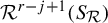 $\mathcal {R}^{r-j+1}(S_{\mathcal {R}})$
corresponding to
$\mathcal {R}^{r-j+1}(S_{\mathcal {R}})$
corresponding to $e_1$
and
$e_1$
and $e_2$
bound an open disk which contains
$e_2$
bound an open disk which contains $a_j$
and no other postcritical point. We have reduced to the case in which
$a_j$
and no other postcritical point. We have reduced to the case in which $j=r$
. Chains are defined so that at most one postcritical point has this property. So, the open disk
$j=r$
. Chains are defined so that at most one postcritical point has this property. So, the open disk $D_i$
can contain at most one postcritical point, which contradicts the assumption that
$D_i$
can contain at most one postcritical point, which contradicts the assumption that $\delta _i$
is an element of a Levy cycle.
$\delta _i$
is an element of a Levy cycle.
Since $\sigma _{\mathcal {R}}$
is a Thurston map whose ramification portrait is isomorphic to
$\sigma _{\mathcal {R}}$
is a Thurston map whose ramification portrait is isomorphic to $\Gamma $
and
$\Gamma $
and $\sigma _{\mathcal {R}}$
has no Levy cycle, the proof of Theorem 1.1 is complete.
$\sigma _{\mathcal {R}}$
has no Levy cycle, the proof of Theorem 1.1 is complete.
4 Completely unobstructed ramification portraits
Proof of Theorem 1.8
Suppose $\Gamma $
is an abstract polynomial ramification portrait of degree d that has at least four vertices and satisfies condition (i) or (ii) of the statement of the theorem. Suppose f is a Thurston map with ramification portrait isomorphic to
$\Gamma $
is an abstract polynomial ramification portrait of degree d that has at least four vertices and satisfies condition (i) or (ii) of the statement of the theorem. Suppose f is a Thurston map with ramification portrait isomorphic to $\Gamma $
and with
$\Gamma $
and with $\infty $
a fixed critical point such that
$\infty $
a fixed critical point such that $\deg _f(\infty ) = d$
. We prove by contradiction that f is unobstructed.
$\deg _f(\infty ) = d$
. We prove by contradiction that f is unobstructed.
Suppose f is obstructed. Then, f has a Levy cycle and (in the terminology of [Reference Hubbard6, §10.3]) f has a degenerate Levy cycle $\{\delta _0,\dots ,\delta _{n-1},\delta _n = \delta _0\}$
. This means the following. For each
$\{\delta _0,\dots ,\delta _{n-1},\delta _n = \delta _0\}$
. This means the following. For each $i\in \{0,\dots ,n\}$
, let
$i\in \{0,\dots ,n\}$
, let $D_i$
be the disk bounded by
$D_i$
be the disk bounded by $\delta _i$
in the 2-sphere such that
$\delta _i$
in the 2-sphere such that $\infty \not \in D_i$
. For each
$\infty \not \in D_i$
. For each $i\in \{1,\dots ,n\}$
, one component of
$i\in \{1,\dots ,n\}$
, one component of $f^{-1}(D_i)$
is a disk
$f^{-1}(D_i)$
is a disk $D_{i-1}'$
such that:
$D_{i-1}'$
such that:
-
(a)
$D_i\cap D_j=\emptyset $
if
$i\ne j\in \{1,\dotsc ,n\}$
; -
(b) the boundary of
$D_{i-1}'$
is isotopic to
$\delta _{i-1}$
rel
$P_f$
; -
(c)
$D_{i-1}' \cap P_f = D_{i-1}\cap P_f$
; and -
(d)
$f|\colon \, D_{i-1}' \to D_i$
is a homeomorphism.






A key point for the Levy–Berstein theorem is that a postcritical point in one of the $D_i$
disks cannot be a critical point, because that would violate part (d). However, it also cannot have an iterate that is a critical point, because that would imply that some
$D_i$
disks cannot be a critical point, because that would violate part (d). However, it also cannot have an iterate that is a critical point, because that would imply that some $D_j$
contains a critical point. Since each
$D_j$
contains a critical point. Since each $D_i$
must contain at least two postcritical points, there must be at least two postcritical points in non-attractor cycles. This gives the contradiction for case (i).
$D_i$
must contain at least two postcritical points, there must be at least two postcritical points in non-attractor cycles. This gives the contradiction for case (i).
Now, suppose condition (ii) holds. Then, for some prime number p and positive integer k, we can enumerate the finite postcritical points of f as $\{v_i: 0\leq i < p^k\}$
such that
$\{v_i: 0\leq i < p^k\}$
such that $f(v_i) = v_{i+1}$
(mod
$f(v_i) = v_{i+1}$
(mod $p^k$
) for every
$p^k$
) for every $i\in \{0,\dots ,p^k -1\}$
, and if
$i\in \{0,\dots ,p^k -1\}$
, and if $v_j$
is a critical value, then j is a multiple of
$v_j$
is a critical value, then j is a multiple of $p^{k-1}$
. Since the sets
$p^{k-1}$
. Since the sets $P_f\cap D_i$
partition the set of finite postcritical points and they all have the same cardinality, there is a positive integer m such that
$P_f\cap D_i$
partition the set of finite postcritical points and they all have the same cardinality, there is a positive integer m such that $\#(P_f \cap D_i) = p^m$
for all i. Then,
$\#(P_f \cap D_i) = p^m$
for all i. Then, $np^m = p^k$
and
$np^m = p^k$
and $n = p^r$
, where
$n = p^r$
, where $r = k-m$
. For some
$r = k-m$
. For some $i\in \{1,\dots ,n\}$
,
$i\in \{1,\dots ,n\}$
, $v_0\in D_i$
. Then,
$v_0\in D_i$
. Then, $\{v_{jp^r}\colon \, 0\le j < p^m\} \subset D_i$
and so
$\{v_{jp^r}\colon \, 0\le j < p^m\} \subset D_i$
and so $\{v_{jp^{k-1}}\colon \, 0\le j < p\} \subset D_i$
. Thus,
$\{v_{jp^{k-1}}\colon \, 0\le j < p\} \subset D_i$
. Thus, $D_i$
contains every finite critical value of f.
$D_i$
contains every finite critical value of f.
Let D be the disk bounded by $\delta _i$
that contains
$\delta _i$
that contains $\infty $
and let
$\infty $
and let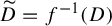 $\widetilde {D} = f^{-1}(D)$
. Then, D does not contain any finite critical values of f. It follows that the restriction of f to
$\widetilde {D} = f^{-1}(D)$
. Then, D does not contain any finite critical values of f. It follows that the restriction of f to $\widetilde {D}\setminus \{\infty \}$
is a covering map onto
$\widetilde {D}\setminus \{\infty \}$
is a covering map onto $D\setminus \{\infty \}$
. However, every connected covering space of a once-punctured disk is a once-punctured disk. Since f is d-to-1 near
$D\setminus \{\infty \}$
. However, every connected covering space of a once-punctured disk is a once-punctured disk. Since f is d-to-1 near $\infty $
, the space
$\infty $
, the space $\widetilde {D}\setminus \{\infty \}$
is a once-punctured disk which maps by f to
$\widetilde {D}\setminus \{\infty \}$
is a once-punctured disk which maps by f to $D\setminus \{\infty \}$
with degree d. Hence,
$D\setminus \{\infty \}$
with degree d. Hence, $\partial \widetilde {D}=f^{-1}(\partial D)=f^{-1}(\delta _i)$
. This contradicts the assumption that
$\partial \widetilde {D}=f^{-1}(\partial D)=f^{-1}(\delta _i)$
. This contradicts the assumption that $f^{-1}(\delta _i)$
has a connected component which maps to
$f^{-1}(\delta _i)$
has a connected component which maps to $\delta _i$
with degree 1. Thus, f is unobstructed.
$\delta _i$
with degree 1. Thus, f is unobstructed.
5 Rose maps
To prove Theorem 1.9, we need a topological description for topological polynomials which may not be subdivision maps. We begin this section by discussing our approach to this. We define a rose to be the boundary of the union of finitely many closed topological disks in the 2-sphere which are disjoint except for having exactly one point in common. We view a rose as a graph with exactly one vertex. Its edges are called petals.
Let $S_1^2$
and
$S_1^2$
and $S_2^2$
be two copies of
$S_2^2$
be two copies of $S^2$
, and suppose that we have a finite branched covering map
$S^2$
, and suppose that we have a finite branched covering map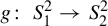 $g\colon \, S_1^2\to S_2^2$
whose critical values lie in a finite set
$g\colon \, S_1^2\to S_2^2$
whose critical values lie in a finite set $P\subseteq S_2^2$
. The restriction of g to
$P\subseteq S_2^2$
. The restriction of g to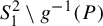 $S_1^2\setminus g^{-1}(P)$
is a covering map from
$S_1^2\setminus g^{-1}(P)$
is a covering map from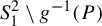 $S_1^2\setminus g^{-1}(P)$
onto
$S_1^2\setminus g^{-1}(P)$
onto $S_2^2\setminus P$
. In the context of covering maps, a straightforward thing to do in this situation is to use the fact that
$S_2^2\setminus P$
. In the context of covering maps, a straightforward thing to do in this situation is to use the fact that $S_2^2\setminus P$
is homotopic to a rose with
$S_2^2\setminus P$
is homotopic to a rose with $\#(P)-1$
petals—the fundamental group of
$\#(P)-1$
petals—the fundamental group of $S_2^2\setminus P$
is a free group on
$S_2^2\setminus P$
is a free group on $\#(P)-1$
generators. Let
$\#(P)-1$
generators. Let $R_2$
be a rose in
$R_2$
be a rose in $S_2^2\setminus P$
which is a spine and let
$S_2^2\setminus P$
which is a spine and let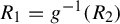 $R_1=g^{-1}(R_2)$
. Because every connected component of
$R_1=g^{-1}(R_2)$
. Because every connected component of $S_2^2\setminus R_2$
contains at most one branch value of g, every connected component of
$S_2^2\setminus R_2$
contains at most one branch value of g, every connected component of $S_1^2\setminus R_1$
is a disk, equivalently,
$S_1^2\setminus R_1$
is a disk, equivalently, $R_1$
is connected. The restriction of g to
$R_1$
is connected. The restriction of g to $R_1$
is a covering map onto
$R_1$
is a covering map onto $R_2$
and this restriction determines g up to homotopy.
$R_2$
and this restriction determines g up to homotopy.
With this in mind, we construct finite branched covering maps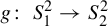 $g\colon \, S_1^2\to S_2^2$
as follows. Let
$g\colon \, S_1^2\to S_2^2$
as follows. Let $R_2\subseteq S_2^2$
be a rose with
$R_2\subseteq S_2^2$
be a rose with $n\ge 1$
petals. We orient
$n\ge 1$
petals. We orient $S_2^2$
and label n connected components of
$S_2^2$
and label n connected components of $S_2^2\setminus R_2$
each bounded by one petal with
$S_2^2\setminus R_2$
each bounded by one petal with $1,\dotsc ,n$
in counterclockwise order. We label the remaining connected component of
$1,\dotsc ,n$
in counterclockwise order. We label the remaining connected component of $S_2^2\setminus R_2$
with
$S_2^2\setminus R_2$
with $\infty $
. Suppose that we have a finite connected graph
$\infty $
. Suppose that we have a finite connected graph $R_1\subseteq S_1^2$
whose vertices have small neighborhoods which look like small neighborhoods of the vertex of
$R_1\subseteq S_1^2$
whose vertices have small neighborhoods which look like small neighborhoods of the vertex of $R_2$
. Here is what this means. The connected components of
$R_2$
. Here is what this means. The connected components of $S_1^2\setminus R_1$
are labeled with
$S_1^2\setminus R_1$
are labeled with $1,\dotsc ,n$
(duplications allowed) and
$1,\dotsc ,n$
(duplications allowed) and $\infty $
. We choose a barycenter for every edge of
$\infty $
. We choose a barycenter for every edge of $R_1$
and call the resulting edges half edges. These barycenters are not vertices of
$R_1$
and call the resulting edges half edges. These barycenters are not vertices of $R_1$
. Let v be a vertex of
$R_1$
. Let v be a vertex of $R_1$
. Then,
$R_1$
. Then, $2n$
half edges contain v. After orienting
$2n$
half edges contain v. After orienting $S_1^2$
, they can be written as
$S_1^2$
, they can be written as $\epsilon _1,\dotsc ,\epsilon _{2n}$
in counterclockwise order around v so that
$\epsilon _1,\dotsc ,\epsilon _{2n}$
in counterclockwise order around v so that $\epsilon _{2i-1}$
and
$\epsilon _{2i-1}$
and $\epsilon _{2i}$
are in the boundary of a connected component of
$\epsilon _{2i}$
are in the boundary of a connected component of $S^2_1\setminus R_1$
with label i for every
$S^2_1\setminus R_1$
with label i for every $i\in \{1,\ldots ,n\}$
. Furthermore,
$i\in \{1,\ldots ,n\}$
. Furthermore, $\epsilon _{2i}$
and
$\epsilon _{2i}$
and $\epsilon _{2i+1}$
are in the boundary of a connected component of
$\epsilon _{2i+1}$
are in the boundary of a connected component of $S_1^2\setminus R_1$
with label
$S_1^2\setminus R_1$
with label $\infty $
for every
$\infty $
for every $i\in \{1,\ldots ,n\}$
, where
$i\in \{1,\ldots ,n\}$
, where $\epsilon _{2n+1}=\epsilon _1$
. It is a straightforward matter, by mapping vertices, then half edges, and then disks, to construct a finite branched covering map
$\epsilon _{2n+1}=\epsilon _1$
. It is a straightforward matter, by mapping vertices, then half edges, and then disks, to construct a finite branched covering map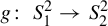 $g\colon \, S_1^2\to S_2^2$
such that
$g\colon \, S_1^2\to S_2^2$
such that $g|_{R_1}$
is a covering map onto
$g|_{R_1}$
is a covering map onto $R_2$
which maps vertices to vertices and edges to edges. This can be done so that g has at most one critical point in every connected component of
$R_2$
which maps vertices to vertices and edges to edges. This can be done so that g has at most one critical point in every connected component of $S_1^2\setminus R_1$
.
$S_1^2\setminus R_1$
.
We define a rose map to be a map of pairs $g\colon \, (S_1^2,R_1)\to (S_2^2,R_2)$
, where
$g\colon \, (S_1^2,R_1)\to (S_2^2,R_2)$
, where $S_1^2$
and
$S_1^2$
and $S_2^2$
are two oriented copies of
$S_2^2$
are two oriented copies of $S^2$
,
$S^2$
, $g\colon \, S_1^2\to S_2^2$
is an orientation-preserving finite branched covering map,
$g\colon \, S_1^2\to S_2^2$
is an orientation-preserving finite branched covering map, $R_2\subseteq S_2^2$
is a rose,
$R_2\subseteq S_2^2$
is a rose, $R_1= g^{-1}(R_2)$
is a graph with pullback graph structure, and every connected component of
$R_1= g^{-1}(R_2)$
is a graph with pullback graph structure, and every connected component of $S_2^2\setminus R_2$
contains at most one critical value of g. The next lemma guarantees the existence of the rose maps that we will use for the proof of Theorem 1.9. We will precompose a rose map
$S_2^2\setminus R_2$
contains at most one critical value of g. The next lemma guarantees the existence of the rose maps that we will use for the proof of Theorem 1.9. We will precompose a rose map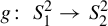 $g\colon \, S_1^2\to S_2^2$
with a homeomorphism
$g\colon \, S_1^2\to S_2^2$
with a homeomorphism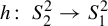 $h\colon \, S_2^2\to S_1^2$
to obtain a desired topological polynomial
$h\colon \, S_2^2\to S_1^2$
to obtain a desired topological polynomial $f=g\circ h$
. In the lemma, the connected components of
$f=g\circ h$
. In the lemma, the connected components of $S_2^2\setminus R_2$
are labeled, which induces a labeling of the connected components of
$S_2^2\setminus R_2$
are labeled, which induces a labeling of the connected components of $S_1^2\setminus R_1$
, which induces a labeling of the vertices of the graph dual to
$S_1^2\setminus R_1$
, which induces a labeling of the vertices of the graph dual to $R_1$
.
$R_1$
.
Lemma 5.1. Suppose that $\Gamma $
is an abstract polynomial ramification portrait whose finite postcritical vertices are
$\Gamma $
is an abstract polynomial ramification portrait whose finite postcritical vertices are $v_1,\dots ,v_n$
. Let u be a finite critical value of
$v_1,\dots ,v_n$
. Let u be a finite critical value of $\Gamma $
with the maximum number of incoming edges from critical vertices. Let v be any finite critical value of
$\Gamma $
with the maximum number of incoming edges from critical vertices. Let v be any finite critical value of $\Gamma $
. Then, there exists a rose map
$\Gamma $
. Then, there exists a rose map $g\colon \, (S_1^2,R_1)\to (S_2^2,R_2)$
realizing the branch data of
$g\colon \, (S_1^2,R_1)\to (S_2^2,R_2)$
realizing the branch data of $\Gamma $
such that n connected components of
$\Gamma $
such that n connected components of $S_2^2\setminus R_2$
each bounded by a petal of
$S_2^2\setminus R_2$
each bounded by a petal of $R_2$
are labeled
$R_2$
are labeled $v_1,\dots ,v_n$
in counterclockwise order, the remaining connected component is labeled
$v_1,\dots ,v_n$
in counterclockwise order, the remaining connected component is labeled $\infty $
, and
$\infty $
, and $R_1$
has a dual graph
$R_1$
has a dual graph $R_1^*$
for which the following statements hold.
$R_1^*$
for which the following statements hold.
-
(1) The boundary of one connected component of
$S_1^2\setminus R_1^*$
contains exactly two critical points: one vertex with label u and one vertex with label
$\infty $
. -
(2) If u has an incoming edge from a non-critical vertex, then the boundary of one connected component of
$S_1^2\setminus R_1^*$
contains exactly two critical points: one vertex with label v and one vertex with label
$\infty $
.


Proof. We will construct $R_1$
rather explicitly.
$R_1$
rather explicitly.
To prepare for the construction of $R_1$
, let U be the set of critical vertices which
$R_1$
, let U be the set of critical vertices which $\tau $
maps to u and let W be the set of remaining finite critical vertices. So,
$\tau $
maps to u and let W be the set of remaining finite critical vertices. So, $C_\Gamma =U\amalg W\amalg \{\infty \}$
. The Riemann–Hurwitz condition gives that
$C_\Gamma =U\amalg W\amalg \{\infty \}$
. The Riemann–Hurwitz condition gives that
 $$ \begin{align*} \sum_{w\in U}^{}(\deg_\tau(w)-1)+\sum_{w\in W}^{}(\deg_\tau(w)-1)=d-1, \end{align*} $$
where d is the degree of $\Gamma $
. So,
$\Gamma $
. So,
 $$ \begin{align} \sum_{w\in W}^{}(\deg_\tau(w)-1)=d-1+\#(U)-\sum_{w\in U}^{}\deg_\tau(w)\ge \#(U)-1. \end{align} $$
In particular, if W is empty, then $\#(U)=1$
. In this case, there is exactly one choice for
$\#(U)=1$
. In this case, there is exactly one choice for $R_1$
up to isomorphism. Only two connected components of
$R_1$
up to isomorphism. Only two connected components of $S_1^2\setminus R_1$
are not monogons and one of these has label
$S_1^2\setminus R_1$
are not monogons and one of these has label $\infty $
. Statement (1) is true in this case and statement (2) is true since
$\infty $
. Statement (1) is true in this case and statement (2) is true since $u=v$
. So, we henceforth assume that W is non-empty.
$u=v$
. So, we henceforth assume that W is non-empty.
Let m be the maximum number of incoming edges from critical vertices at the critical values other than u. Then, it is possible to partition W into disjoint non-empty subsets $W_1,\dotsc ,W_m$
so that if
$W_1,\dotsc ,W_m$
so that if $w,w'\in W_i$
for some i with
$w,w'\in W_i$
for some i with $w\ne w'$
, then
$w\ne w'$
, then $\tau (w)\ne \tau (w')$
. We do this so that if
$\tau (w)\ne \tau (w')$
. We do this so that if $u\ne v$
, then there exists
$u\ne v$
, then there exists $w\in W_m$
such that
$w\in W_m$
such that $\tau (w)=v$
.
$\tau (w)=v$
.
Now, we begin to construct $R_1$
. We enumerate the elements of
$R_1$
. We enumerate the elements of $W_1$
and for every
$W_1$
and for every ${w\in W_1}$
, we construct a closed (two-dimensional) polygon
${w\in W_1}$
, we construct a closed (two-dimensional) polygon $P_w\subseteq S_1^2$
with
$P_w\subseteq S_1^2$
with $\deg _\tau (w)$
sides whose interior has label
$\deg _\tau (w)$
sides whose interior has label $\tau (w)$
. These polygons are disjoint from each other, except that each has exactly one vertex in common with the next. We obtain a chain (not to be confused with the chains in §3)
$\tau (w)$
. These polygons are disjoint from each other, except that each has exactly one vertex in common with the next. We obtain a chain (not to be confused with the chains in §3) $C_1$
of polygons. We also construct such chains
$C_1$
of polygons. We also construct such chains $C_2,\dotsc ,C_m$
for
$C_2,\dotsc ,C_m$
for $W_2,\dotsc ,W_m$
so that the chains
$W_2,\dotsc ,W_m$
so that the chains $C_1,\dotsc ,C_m$
are disjoint from each other and if
$C_1,\dotsc ,C_m$
are disjoint from each other and if $u\ne v$
, then the polygon with label v in
$u\ne v$
, then the polygon with label v in $C_m$
is last.
$C_m$
is last.
The choices of u and m imply that U contains at least m elements. We choose $m-1$
distinct elements
$m-1$
distinct elements $u_1,\dotsc ,u_{m-1}\in U$
. For every
$u_1,\dotsc ,u_{m-1}\in U$
. For every $i\in \{1,\ldots ,m-1\}$
, we construct a polygon
$i\in \{1,\ldots ,m-1\}$
, we construct a polygon $P_{u_i}$
as before which is disjoint from the polygons already constructed and from the other
$P_{u_i}$
as before which is disjoint from the polygons already constructed and from the other $P_{u_j}$
polygons, except that one vertex of
$P_{u_j}$
polygons, except that one vertex of $P_{u_i}$
is a vertex of
$P_{u_i}$
is a vertex of $C_i$
that is only in the last polygon of
$C_i$
that is only in the last polygon of $C_i$
, and a different vertex of
$C_i$
, and a different vertex of $P_{u_i}$
is a vertex of
$P_{u_i}$
is a vertex of $C_{i+1}$
that is only in the first tile of
$C_{i+1}$
that is only in the first tile of $C_{i+1}$
. The polygons
$C_{i+1}$
. The polygons $P_{u_1},\dotsc ,P_{u_{m-1}}$
join the chains
$P_{u_1},\dotsc ,P_{u_{m-1}}$
join the chains $C_1,\dotsc ,C_m$
to form a single chain C.
$C_1,\dotsc ,C_m$
to form a single chain C.
We intend to also construct similar polygons $P_v$
for the remaining elements v of U. We intend to construct each of them in one of two ways. One way to construct
$P_v$
for the remaining elements v of U. We intend to construct each of them in one of two ways. One way to construct $P_v$
is to choose a vertex of C contained in only one polygon and to construct
$P_v$
is to choose a vertex of C contained in only one polygon and to construct $P_v$
so that it meets the polygons already constructed exactly in this vertex. Here is another way to construct
$P_v$
so that it meets the polygons already constructed exactly in this vertex. Here is another way to construct $P_v$
. Choose
$P_v$
. Choose $i\in \{1,\ldots ,m\}$
, and two consecutive polygons P and
$i\in \{1,\ldots ,m\}$
, and two consecutive polygons P and $P'$
in
$P'$
in $C_i$
. Let x be the vertex common to P and
$C_i$
. Let x be the vertex common to P and $P'$
. We modify P and
$P'$
. We modify P and $P'$
slightly near x, pulling them apart so that they become disjoint. We then construct
$P'$
slightly near x, pulling them apart so that they become disjoint. We then construct $P_v$
so that it contains both of the new vertices in P and
$P_v$
so that it contains both of the new vertices in P and $P'$
while being otherwise disjoint from the polygons already constructed.
$P'$
while being otherwise disjoint from the polygons already constructed.
The only obstacle to performing the constructions described in the previous paragraph is that C might not contain enough vertices to accommodate all the elements of U. However, it is not difficult to see that the number of elements of U that can be accommodated, including $u_1,\dotsc ,u_{m-1}$
, is
$u_1,\dotsc ,u_{m-1}$
, is
 $$ \begin{align*} 1+\sum_{w\in W}(\deg_\tau(w)-1). \end{align*} $$
Thus, line equation (5.1) shows that C does indeed have enough vertices to accommodate all the elements of U. So, we construct a polygon $P_v$
as described in the previous paragraph for every
$P_v$
as described in the previous paragraph for every $v\in U\setminus \{u_1,\dotsc ,u_{m-1}\}$
.
$v\in U\setminus \{u_1,\dotsc ,u_{m-1}\}$
.
Because U contains at least m elements, this can be done so that
 $$ \begin{align} \text{the first of these polygons meets exactly one polygon in } C, \text{the first polygon in } C_1.\quad \end{align} $$
Furthermore, if u has an incoming edge from a non-critical vertex, then the inequality in line equation (5.1) is strict, so we may also construct these polygons so that
 $$ \begin{align} &\text{if } u \text{ has an incoming edge from a non-critical vertex, then the last polygon in }\nonumber\\ & C_m \text{ contains a vertex not in any of these polygons.} \end{align} $$
Every vertex in the complex constructed thus far is contained in either one or two polygons. If there are two, then their labels are different. Hence, it is possible to add monogons with labeled interiors at each of these vertices so that the cyclic order of labels about each vertex agrees with the cyclic order of the labels of $R_2$
. We have
$R_2$
. We have $R_1$
. The discussion preceding the lemma describes how to construct a rose map
$R_1$
. The discussion preceding the lemma describes how to construct a rose map $g\colon \, (S_1^2,R_1) \to (S_2^2,R_2)$
from this information. Line equation (5.2) implies statement (1) of the lemma and line equation (5.3) implies statement (2).
$g\colon \, (S_1^2,R_1) \to (S_2^2,R_2)$
from this information. Line equation (5.2) implies statement (1) of the lemma and line equation (5.3) implies statement (2).
6 Obstructed ramification portraits
Proof of Theorem 1.9
We first prove the theorem in cases (i) and (ii). Assume that $\Gamma $
satisfies either condition (i) or (ii). We will use the following example to illustrate various constructions in the proof. Consider the abstract polynomial ramification portrait that is shown as follows.
$\Gamma $
satisfies either condition (i) or (ii). We will use the following example to illustrate various constructions in the proof. Consider the abstract polynomial ramification portrait that is shown as follows.

It satisfies the conditions of case (i).
We prepare to apply Lemma 5.1. Suppose that $\Gamma $
has n finite postcritical vertices
$\Gamma $
has n finite postcritical vertices $v_0,\dotsc ,v_n$
with
$v_0,\dotsc ,v_n$
with $v_n=v_0$
such that
$v_n=v_0$
such that $\tau (v_i)=v_{i+1}$
for every
$\tau (v_i)=v_{i+1}$
for every $i\in \{0,\ldots ,n-1\}$
. Of course, if
$i\in \{0,\ldots ,n-1\}$
. Of course, if $\Gamma $
satisfies condition (i), then
$\Gamma $
satisfies condition (i), then $n=p^k$
. Choose a finite critical value u of
$n=p^k$
. Choose a finite critical value u of $\Gamma $
with the maximum number of incoming edges from critical vertices. We redefine
$\Gamma $
with the maximum number of incoming edges from critical vertices. We redefine $v_0,\dotsc ,v_n$
if necessary so that
$v_0,\dotsc ,v_n$
if necessary so that $v_0=u$
without changing the assumptions.
$v_0=u$
without changing the assumptions.
In particular, if $\Gamma $
satisfies condition (i), then there exists a critical value
$\Gamma $
satisfies condition (i), then there exists a critical value ${v_i\in \{v_0,\dotsc ,v_{p^k-1}\}}$
such that i is not a multiple of
${v_i\in \{v_0,\dotsc ,v_{p^k-1}\}}$
such that i is not a multiple of $p^{k-1}$
. We set
$p^{k-1}$
. We set $v=v_i$
. In our example, we take
$v=v_i$
. In our example, we take $u=v_0$
and
$u=v_0$
and $v=v_2$
.
$v=v_2$
.
To define v in the case of condition (ii), suppose that $\Gamma $
satisfies condition (ii). Because u is in a non-attractor cycle,
$\Gamma $
satisfies condition (ii). Because u is in a non-attractor cycle, $\tau $
maps some vertex which is not critical to u. It follows that the inequality in line equation (5.1) is strict and so
$\tau $
maps some vertex which is not critical to u. It follows that the inequality in line equation (5.1) is strict and so $\Gamma $
has more than one finite critical value. Let v be any finite critical value other than u.
$\Gamma $
has more than one finite critical value. Let v be any finite critical value other than u.
We next define a positive integer m. If $\Gamma $
satisfies condition (i), then we set
$\Gamma $
satisfies condition (i), then we set $m=p^{k-1}$
. Suppose that
$m=p^{k-1}$
. Suppose that $\Gamma $
satisfies condition (ii). Let i be the index such that
$\Gamma $
satisfies condition (ii). Let i be the index such that $v=v_i$
. Because n is not a prime power, it is the product of two relatively prime proper divisors. Because they are relatively prime, if both of these two proper divisors divide i, then n divides i, which is not true. Hence, some positive proper divisor of n does not divide i. Let m be such a positive proper divisor of n.
$v=v_i$
. Because n is not a prime power, it is the product of two relatively prime proper divisors. Because they are relatively prime, if both of these two proper divisors divide i, then n divides i, which is not true. Hence, some positive proper divisor of n does not divide i. Let m be such a positive proper divisor of n.
So, in either case (i) or (ii), m is a positive proper divisor of n such that $v=v_i$
and m does not divide i.
$v=v_i$
and m does not divide i.
Lemma 5.1 implies that there exists a rose map $g\colon \, (S_1^2,R_1)\to (S_2^2,R_2)$
realizing the branch data of
$g\colon \, (S_1^2,R_1)\to (S_2^2,R_2)$
realizing the branch data of $\Gamma $
such that n connected components of
$\Gamma $
such that n connected components of $S_2^2\setminus R_2$
each bounded by a petal of
$S_2^2\setminus R_2$
each bounded by a petal of $R_2$
are labeled
$R_2$
are labeled $v_0,\dotsc ,v_{n-1}$
in counterclockwise order, the remaining connected component is labeled
$v_0,\dotsc ,v_{n-1}$
in counterclockwise order, the remaining connected component is labeled $\infty $
, and
$\infty $
, and $R_1$
has a dual graph
$R_1$
has a dual graph $R_1^*$
for which:
$R_1^*$
for which:
-
(1) the boundary of one connected component
$C_u$
of
$S_1^2\setminus R_1^*$
contains exactly two critical points: one vertex with label u and one vertex with label
$\infty $
; -
(2) the boundary of one connected component
$C_v$
of
$S_1^2\setminus R_1^*$
contains exactly two critical points: one vertex with label v and one vertex with label
$\infty $
.


By modifying $R_1^*$
if necessary, we may assume that the restriction of g to both
$R_1^*$
if necessary, we may assume that the restriction of g to both $C_u$
and
$C_u$
and $C_v$
is injective. We identify every postcritical vertex w of
$C_v$
is injective. We identify every postcritical vertex w of $\Gamma $
with a point in the connected component of
$\Gamma $
with a point in the connected component of $S_2^2\setminus R_2$
with label w. These serve as the vertices of a graph
$S_2^2\setminus R_2$
with label w. These serve as the vertices of a graph $R_2^*$
dual to
$R_2^*$
dual to $R_2$
. Their g-pullbacks serve as the vertices of
$R_2$
. Their g-pullbacks serve as the vertices of $R_1^*$
. Figure 11 depicts important features of the rose map g for our example.
$R_1^*$
. Figure 11 depicts important features of the rose map g for our example.
Rose map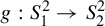 $g:S_{1}^2\to S_{2}^2$
.
$g:S_{1}^2\to S_{2}^2$
.

Figure 11 Long description
At the center is a node labeled infinity, marked with a red dot. Two large petal-shaped clusters, S squared sub 1 and S squared sub 2, are positioned to the left and right, each containing nine petals labeled v sub 0 through v sub 8. Each petal has a black dot at its tip. The left cluster, S squared sub 1, is labeled at the bottom left, and the right cluster, S squared sub 2, is labeled at the bottom right. Both clusters are connected to the central infinity node by curved lines. Above the central node, a third cluster is shown, also with nine petals labeled v sub 0 through v sub 8, and is labeled S squared sub 2 at the lower right. Dotted lines and ellipsis indicate continuation or repetition between the two main clusters. The spatial arrangement emphasizes the central infinity node as a hub connecting multiple petal graphs.
Now, we choose m disjoint closed topological disks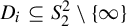 $D_i\subseteq S_2^2\setminus \{\infty \}$
such that: (i)
$D_i\subseteq S_2^2\setminus \{\infty \}$
such that: (i) $v_j$
is in the interior of
$v_j$
is in the interior of $D_i$
if
$D_i$
if $j\equiv i\text { (mod }m)$
for
$j\equiv i\text { (mod }m)$
for $i\in \{0,\dotsc ,m-1\}$
and
$i\in \{0,\dotsc ,m-1\}$
and $j\in \{0,\dotsc ,n-1\}$
; (ii)
$j\in \{0,\dotsc ,n-1\}$
; (ii) $D_0$
is in the open disk
$D_0$
is in the open disk $g(C_v)$
; and (iii) for
$g(C_v)$
; and (iii) for $i\in \{1,\dotsc ,m-1\}$
,
$i\in \{1,\dotsc ,m-1\}$
, $D_i$
is in the open disk
$D_i$
is in the open disk $g(C_u)$
. The restriction of g to
$g(C_u)$
. The restriction of g to $C_v$
is a homeomorphism, so there exists a unique lift
$C_v$
is a homeomorphism, so there exists a unique lift $\widetilde {D}_0$
of
$\widetilde {D}_0$
of $D_0$
to
$D_0$
to $C_v$
. We denote the lift of
$C_v$
. We denote the lift of $v_j$
to
$v_j$
to $C_v$
by
$C_v$
by $\widetilde {v}_j$
for every index
$\widetilde {v}_j$
for every index $j\equiv 0\text { (mod } m)$
. There likewise exist unique lifts
$j\equiv 0\text { (mod } m)$
. There likewise exist unique lifts $\widetilde {D}_i$
of
$\widetilde {D}_i$
of $D_i$
to
$D_i$
to $C_u$
for every
$C_u$
for every $i\in \{1,\dotsc ,m-1\}$
. We denote the lift of
$i\in \{1,\dotsc ,m-1\}$
. We denote the lift of $v_j$
to
$v_j$
to $C_u$
by
$C_u$
by $\widetilde {v}_j$
for every index
$\widetilde {v}_j$
for every index $j\not \equiv 0\text { (mod }m)$
. Figure 12 shows all of these points and disks for our example.
$j\not \equiv 0\text { (mod }m)$
. Figure 12 shows all of these points and disks for our example.
Rose map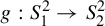 $g:S_{1}^2\to S_{2}^2$
.
$g:S_{1}^2\to S_{2}^2$
.

Figure 12 Long description
Starting at the left, the first petal-shaped graph is centered at a black dot with eight radiating edges labeled v sub 1 through v sub 8, each ending in a black dot. Gray paths loop around subsets of these vertices, forming nested contours. The region is labeled S super 2 sub 1 and C sub u. A thin curve connects this cluster to a central infinity symbol, then continues to a mirrored petal-shaped graph on the right, labeled S super 2 sub 2 and C sub v, with vertices v sub 0 through v sub 8. Gray paths again highlight connections among vertices. At the lower right, a smaller petal-shaped graph repeats the structure with vertices v sub 1 through v sub 6, gray paths, and a central black dot. All graphs are drawn with bold black lines for petals and dots for vertices, with gray shading indicating specific paths or cycles.
We next construct an orientation-preserving homeomorphism $h\colon \, S_2^2\to S_1^2$
such that: (i)
$h\colon \, S_2^2\to S_1^2$
such that: (i)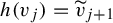 $h(v_j)=\widetilde {v}_{j+1}$
for
$h(v_j)=\widetilde {v}_{j+1}$
for $j\in \{0,\dotsc ,n-1\}$
; (ii)
$j\in \{0,\dotsc ,n-1\}$
; (ii) $h(\infty )=g^{-1}(\infty )$
; and (iii)
$h(\infty )=g^{-1}(\infty )$
; and (iii)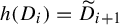 $h(D_i)=\widetilde {D}_{i+1}$
for
$h(D_i)=\widetilde {D}_{i+1}$
for $i\in \{0,\dotsc ,m-1\}$
, where
$i\in \{0,\dotsc ,m-1\}$
, where $D_m=D_0$
. See Figure 13.
$D_m=D_0$
. See Figure 13.
Finally, define $f:=g\circ h$
. The map f is a Thurston map whose ramification portrait is isomorphic to
$f:=g\circ h$
. The map f is a Thurston map whose ramification portrait is isomorphic to $\Gamma $
and the boundaries of the disks
$\Gamma $
and the boundaries of the disks $D_i$
form a degenerate Levy cycle. This proves Theorem 1.9 in cases (i) and (ii).
$D_i$
form a degenerate Levy cycle. This proves Theorem 1.9 in cases (i) and (ii).
Now, suppose that $\Gamma $
satisfies condition (iii). Let C be a non-attractor cycle of length
$\Gamma $
satisfies condition (iii). Let C be a non-attractor cycle of length $\ell \ge 2$
that does not contain all of the finite critical values of
$\ell \ge 2$
that does not contain all of the finite critical values of $\Gamma $
. Let
$\Gamma $
. Let $v_1,\dotsc ,v_n$
be the finite postcritical vertices of
$v_1,\dotsc ,v_n$
be the finite postcritical vertices of $\Gamma $
indexed so that
$\Gamma $
indexed so that $v_1,\dotsc ,v_\ell $
are the vertices of C,
$v_1,\dotsc ,v_\ell $
are the vertices of C, $\tau (v_\ell )=v_1$
, and
$\tau (v_\ell )=v_1$
, and $\tau (v_i)=v_{i+1}$
for
$\tau (v_i)=v_{i+1}$
for $i\in \{1,\ldots ,\ell -1\}$
. By Lemma 5.1, there exists a critical value
$i\in \{1,\ldots ,\ell -1\}$
. By Lemma 5.1, there exists a critical value $v\notin C$
and a rose map
$v\notin C$
and a rose map $g\colon \, (S_1^2, R_1)\to (S_2^2,R_2)$
realizing the branch data of
$g\colon \, (S_1^2, R_1)\to (S_2^2,R_2)$
realizing the branch data of $\Gamma $
such that n connected components of
$\Gamma $
such that n connected components of $S_2^2\setminus R_2$
each bounded by a petal of
$S_2^2\setminus R_2$
each bounded by a petal of $R_2$
are labeled
$R_2$
are labeled $v_1,\dotsc ,v_n$
in counterclockwise order, the remaining connected component is labeled
$v_1,\dotsc ,v_n$
in counterclockwise order, the remaining connected component is labeled $\infty $
, and the boundary of one connected component
$\infty $
, and the boundary of one connected component $C_v$
of
$C_v$
of $S_1\setminus R_1^*$
contains exactly two critical points: one vertex with label v and one vertex with label
$S_1\setminus R_1^*$
contains exactly two critical points: one vertex with label v and one vertex with label $\infty $
. We may assume that the restriction of g to
$\infty $
. We may assume that the restriction of g to $C_v$
is injective. As in cases (i) and (ii), we identify every postcritical vertex w of
$C_v$
is injective. As in cases (i) and (ii), we identify every postcritical vertex w of $\Gamma $
with a point in the connected component of
$\Gamma $
with a point in the connected component of $S_2^2\setminus R_2$
with label w.
$S_2^2\setminus R_2$
with label w.
Let D be a closed topological disk in the open disk $g(C_v)$
whose interior contains
$g(C_v)$
whose interior contains $v_1,\dotsc ,v_\ell $
, but such that D contains no other postcritical vertex of
$v_1,\dotsc ,v_\ell $
, but such that D contains no other postcritical vertex of $\Gamma $
. Let
$\Gamma $
. Let $\widetilde {D}$
be the lift of D to
$\widetilde {D}$
be the lift of D to $C_v$
. Let
$C_v$
. Let $\widetilde {v}_i$
be the lift of
$\widetilde {v}_i$
be the lift of $v_i$
to
$v_i$
to $C_v$
for
$C_v$
for $i\in \{1,\ldots ,\ell \}$
. Now, construct an orientation-preserving homeomorphism
$i\in \{1,\ldots ,\ell \}$
. Now, construct an orientation-preserving homeomorphism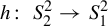 $h\colon \, S_2^2\to S_1^2$
such that: (i)
$h\colon \, S_2^2\to S_1^2$
such that: (i) $h(v_i)=\widetilde {v}_{i+1}$
for
$h(v_i)=\widetilde {v}_{i+1}$
for $i\in \{1,\ldots ,\ell -1\}$
; (ii)
$i\in \{1,\ldots ,\ell -1\}$
; (ii) $h(v_\ell )=v_1$
; (iii)
$h(v_\ell )=v_1$
; (iii) $h(\infty )=g^{-1}(\infty )$
; (iv)
$h(\infty )=g^{-1}(\infty )$
; (iv) $h(D)=\widetilde {D}$
; and (v) the ramification portrait of
$h(D)=\widetilde {D}$
; and (v) the ramification portrait of $f:=g\circ h$
is isomorphic to
$f:=g\circ h$
is isomorphic to $\Gamma $
. Since
$\Gamma $
. Since $\partial D$
is by itself a degenerate Levy cycle for f, this proves Theorem 1.9 in case (iii).
$\partial D$
is by itself a degenerate Levy cycle for f, this proves Theorem 1.9 in case (iii).
Finally, we consider case (iv), where $\Gamma $
has at least two non-attractor cycles of length one. Let a and b denote the vertices of two non-attractor cycles of
$\Gamma $
has at least two non-attractor cycles of length one. Let a and b denote the vertices of two non-attractor cycles of $\Gamma $
of length
$\Gamma $
of length $1$
. Define the abstract ramification portrait
$1$
. Define the abstract ramification portrait $\Gamma '$
as follows:
$\Gamma '$
as follows: $V(\Gamma ')=V(\Gamma )$
,
$V(\Gamma ')=V(\Gamma )$
, $\tau '(a)=b$
,
$\tau '(a)=b$
, $\tau '(b)=a$
, and
$\tau '(b)=a$
, and $\tau '(x)=\tau (x)$
for all
$\tau '(x)=\tau (x)$
for all $x\in V(\Gamma ')\setminus \{a,b\}$
. So,
$x\in V(\Gamma ')\setminus \{a,b\}$
. So, $\Gamma '$
satisfies condition (iii). The proof for case (iii) shows that there is a Thurston map f realizing
$\Gamma '$
satisfies condition (iii). The proof for case (iii) shows that there is a Thurston map f realizing $\Gamma '$
that has a degenerate Levy cycle consisting of a single curve which bounds a disk D such that
$\Gamma '$
that has a degenerate Levy cycle consisting of a single curve which bounds a disk D such that $D\cap P_f = \{a,b\}$
. Postcompose f with an orientation-preserving homeomorphism
$D\cap P_f = \{a,b\}$
. Postcompose f with an orientation-preserving homeomorphism $h:S^{2}\to S^{2}$
such that h is the identity in the complement of D,
$h:S^{2}\to S^{2}$
such that h is the identity in the complement of D, $h(b)=a$
, and
$h(b)=a$
, and $h(a)=b$
. Then,
$h(a)=b$
. Then, $h\circ f$
is an obstructed Thurston map whose ramification portrait is isomorphic to
$h\circ f$
is an obstructed Thurston map whose ramification portrait is isomorphic to $\Gamma $
.
$\Gamma $
.
The obstructed Thurston map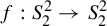 $f:S^{2}_{2}\to S^{2}_{2}$
.
$f:S^{2}_{2}\to S^{2}_{2}$
.

Figure 13 Long description
Starting at the top left, the first panel shows a graph with five labeled vertices v tilde 4, v tilde 2, v tilde 1, v tilde 5, v tilde 7, and v tilde 8 connected by curved edges, labeled S super 2 sub 1. The top right panel shows a three-pronged structure with vertices v tilde 0, v tilde 3, and v tilde 6. An arrow labeled h points from the top left to the bottom left panel. The bottom left panel, labeled S super 2 sub 2, displays a more complex graph with vertices v 0 through v 8, each connected by multiple curved and straight edges. The bottom right panel, also labeled S super 2 sub 2, shows a similar structure but with different edge arrangements. An arrow labeled g points from the top right to the bottom right panel, and an arrow labeled f points from the bottom left to the bottom right panel. All vertices and edges are clearly labeled, and the mappings illustrate the transformation of the graph structures between surfaces.
7 Classification of completely unobstructed ramification portraits
Proof of Theorem 1.10
For the forward direction, we will prove the contrapositive. Suppose that $\Gamma $
is an abstract polynomial ramification portrait that does not satisfy any of the conditions (i)–(iv). Since
$\Gamma $
is an abstract polynomial ramification portrait that does not satisfy any of the conditions (i)–(iv). Since $\Gamma $
does not satisfy conditions (i) and (ii),
$\Gamma $
does not satisfy conditions (i) and (ii), $\Gamma $
has at least four postcritical vertices and there is a non-attractor cycle. Since
$\Gamma $
has at least four postcritical vertices and there is a non-attractor cycle. Since $\Gamma $
does not satisfy condition (iii), either
$\Gamma $
does not satisfy condition (iii), either $\Gamma $
has at least two non-attractor cycles or there is a non-attractor cycle of length at least two. If
$\Gamma $
has at least two non-attractor cycles or there is a non-attractor cycle of length at least two. If $\Gamma $
has at least two non-attractor cycles, then it satisfies conditions (iii) or (iv) of Theorem 1.9 and so
$\Gamma $
has at least two non-attractor cycles, then it satisfies conditions (iii) or (iv) of Theorem 1.9 and so $\Gamma $
can be realized by an obstructed Thurston map. Now, suppose that
$\Gamma $
can be realized by an obstructed Thurston map. Now, suppose that $\Gamma $
has a single non-attractor cycle and it has length at least two. If this cycle does not contain all of the finite postcritical vertices, then
$\Gamma $
has a single non-attractor cycle and it has length at least two. If this cycle does not contain all of the finite postcritical vertices, then $\Gamma $
can be realized by an obstructed map by condition (iii) of Theorem 1.9. So, we may suppose that all of the finite postcritical vertices are in a single non-attractor cycle. If its length is not a prime power, then
$\Gamma $
can be realized by an obstructed map by condition (iii) of Theorem 1.9. So, we may suppose that all of the finite postcritical vertices are in a single non-attractor cycle. If its length is not a prime power, then $\Gamma $
can be realized by an obstructed map by condition (ii) of Theorem 1.9. If its length is a prime power, then since
$\Gamma $
can be realized by an obstructed map by condition (ii) of Theorem 1.9. If its length is a prime power, then since $\Gamma $
does not satisfy condition (iv), it satisfies condition (i) of Theorem 1.9 and
$\Gamma $
does not satisfy condition (iv), it satisfies condition (i) of Theorem 1.9 and $\Gamma $
can be realized by an obstructed map.
$\Gamma $
can be realized by an obstructed map.
For the reverse direction, suppose $\Gamma $
is an abstract polynomial ramification portrait and f is a Thurston map whose ramification portrait is isomorphic to
$\Gamma $
is an abstract polynomial ramification portrait and f is a Thurston map whose ramification portrait is isomorphic to $\Gamma $
. If
$\Gamma $
. If $\Gamma $
satisfies condition (i), then f is unobstructed by Thurston’s characterization theorem since there are not enough postcritical points to have an obstruction. If
$\Gamma $
satisfies condition (i), then f is unobstructed by Thurston’s characterization theorem since there are not enough postcritical points to have an obstruction. If $\Gamma $
satisfies condition (ii), then f is unobstructed by the Levy–Berstein theorem. If
$\Gamma $
satisfies condition (ii), then f is unobstructed by the Levy–Berstein theorem. If $\Gamma $
satisfies condition (iii) or (iv), then f is unobstructed by Theorem 1.8.
$\Gamma $
satisfies condition (iii) or (iv), then f is unobstructed by Theorem 1.8.
Acknowledgements
The research of S. Koch was supported in part by the NSF. We would like to thank the anonymous referee for their comments and suggestions.

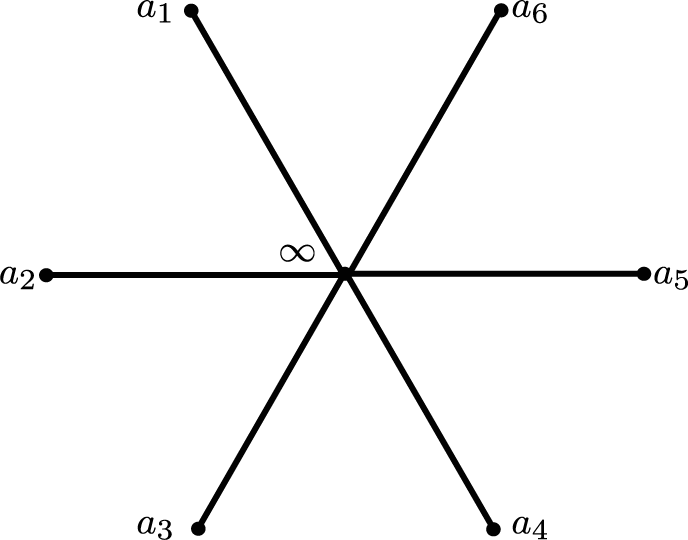

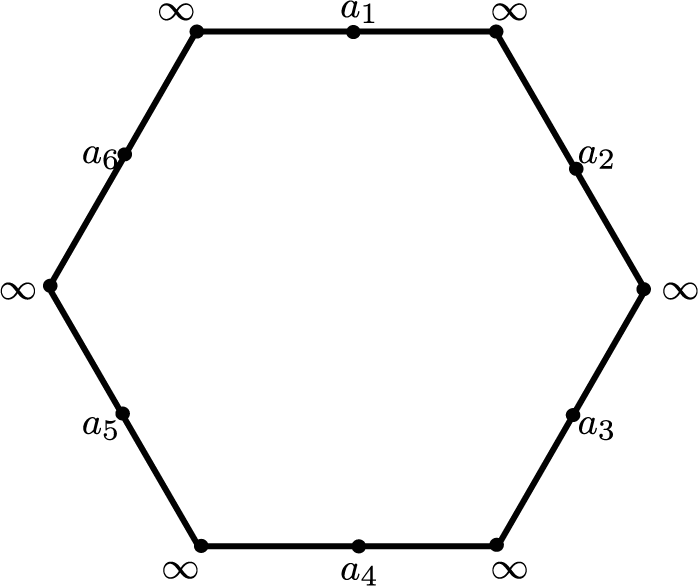


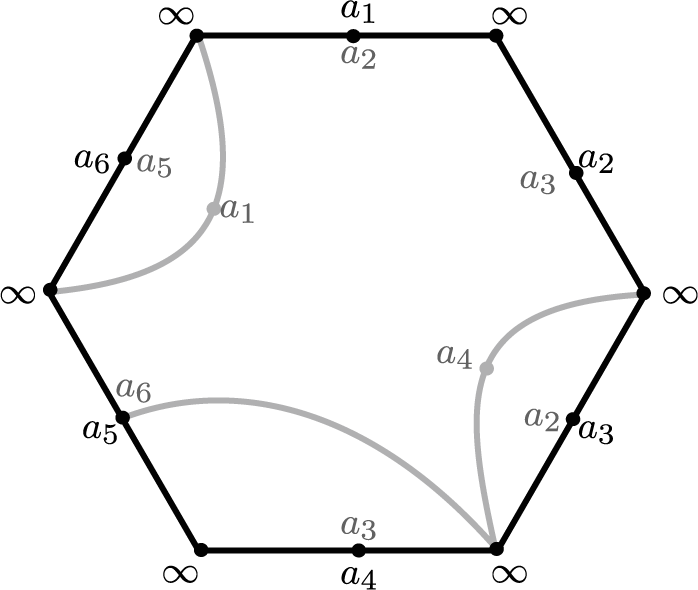

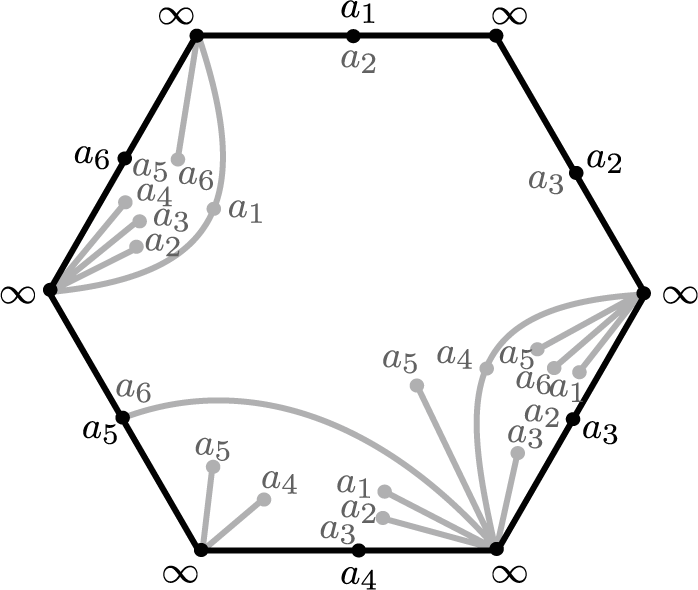

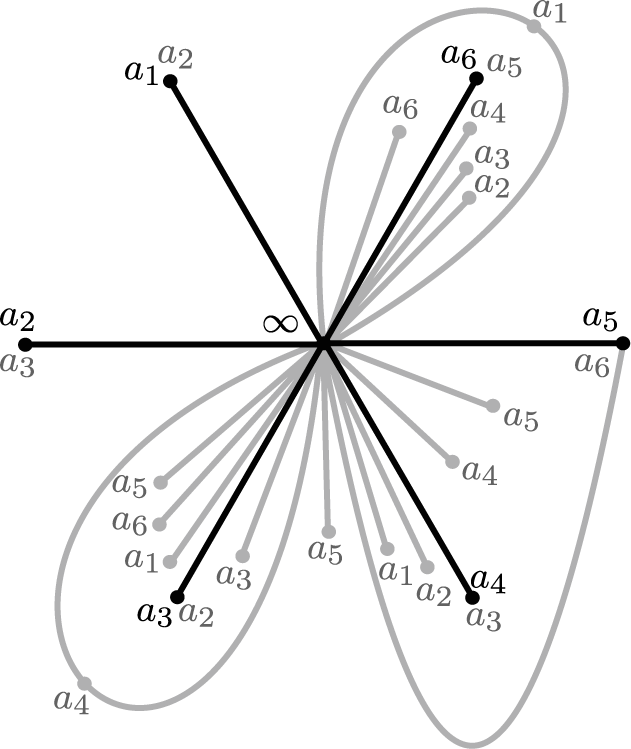
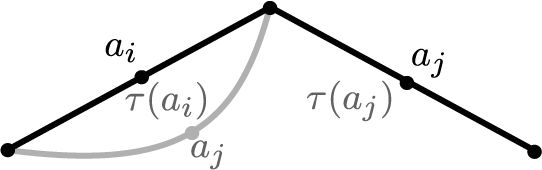

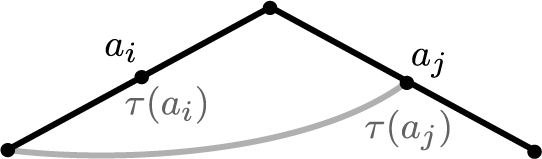









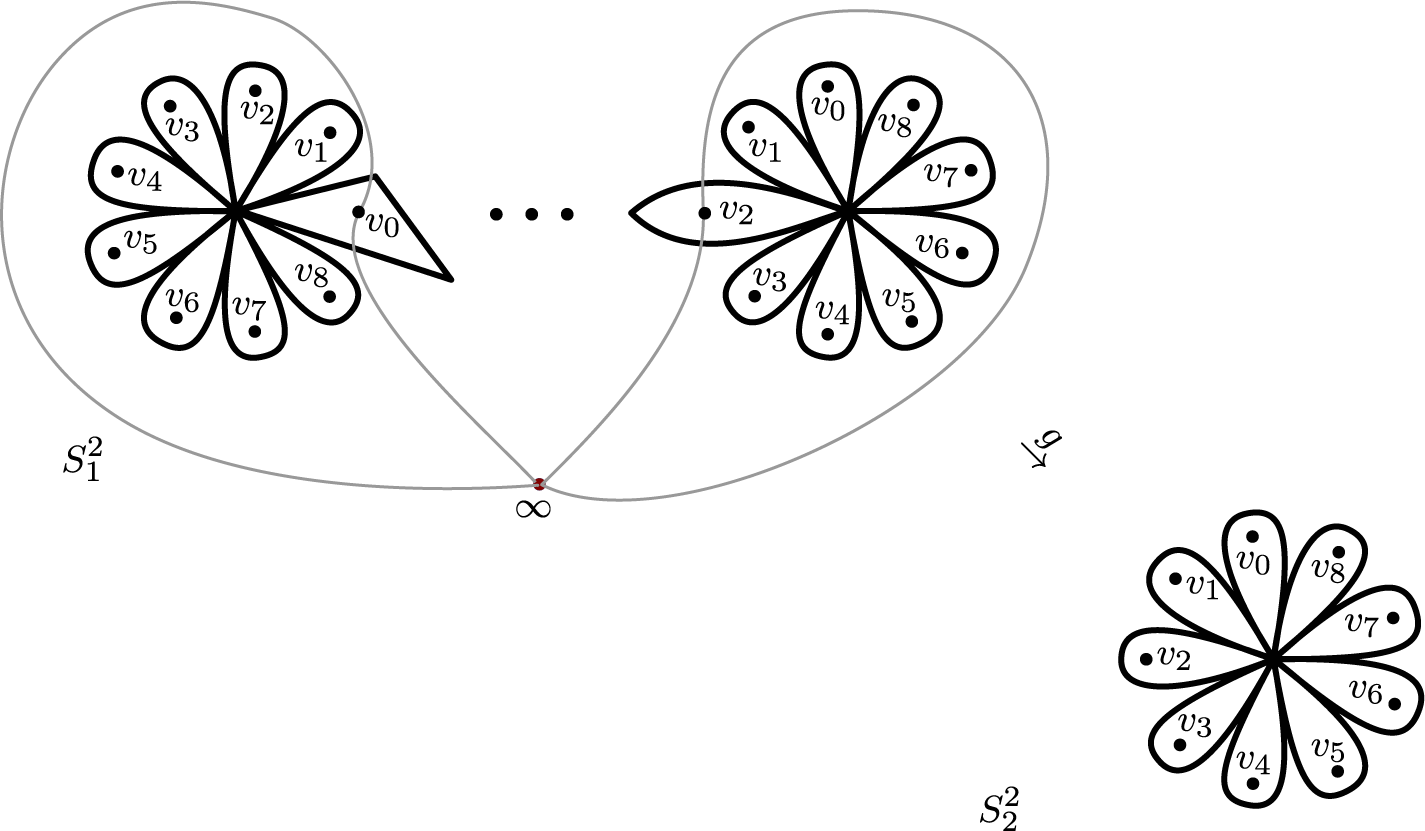

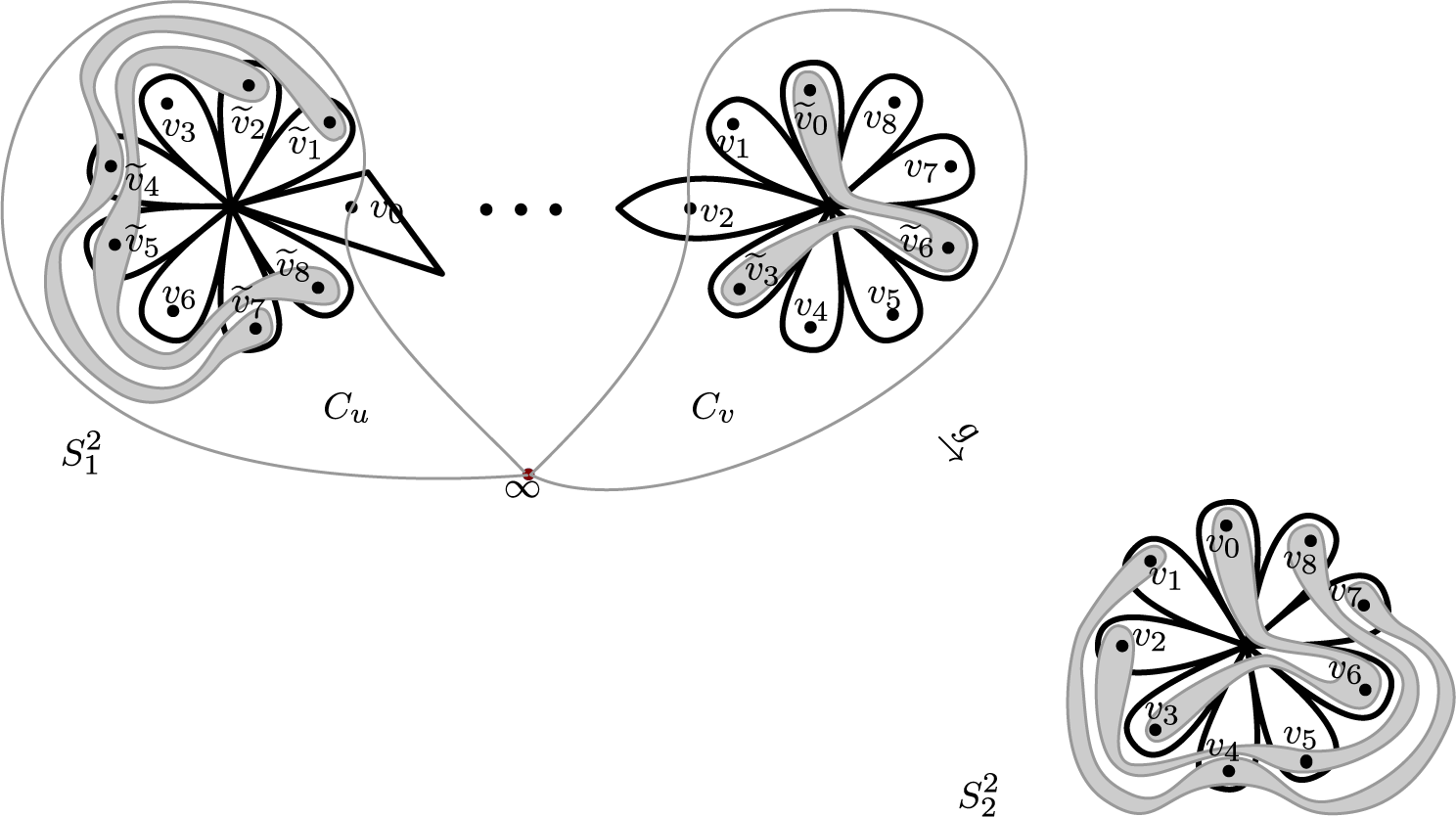

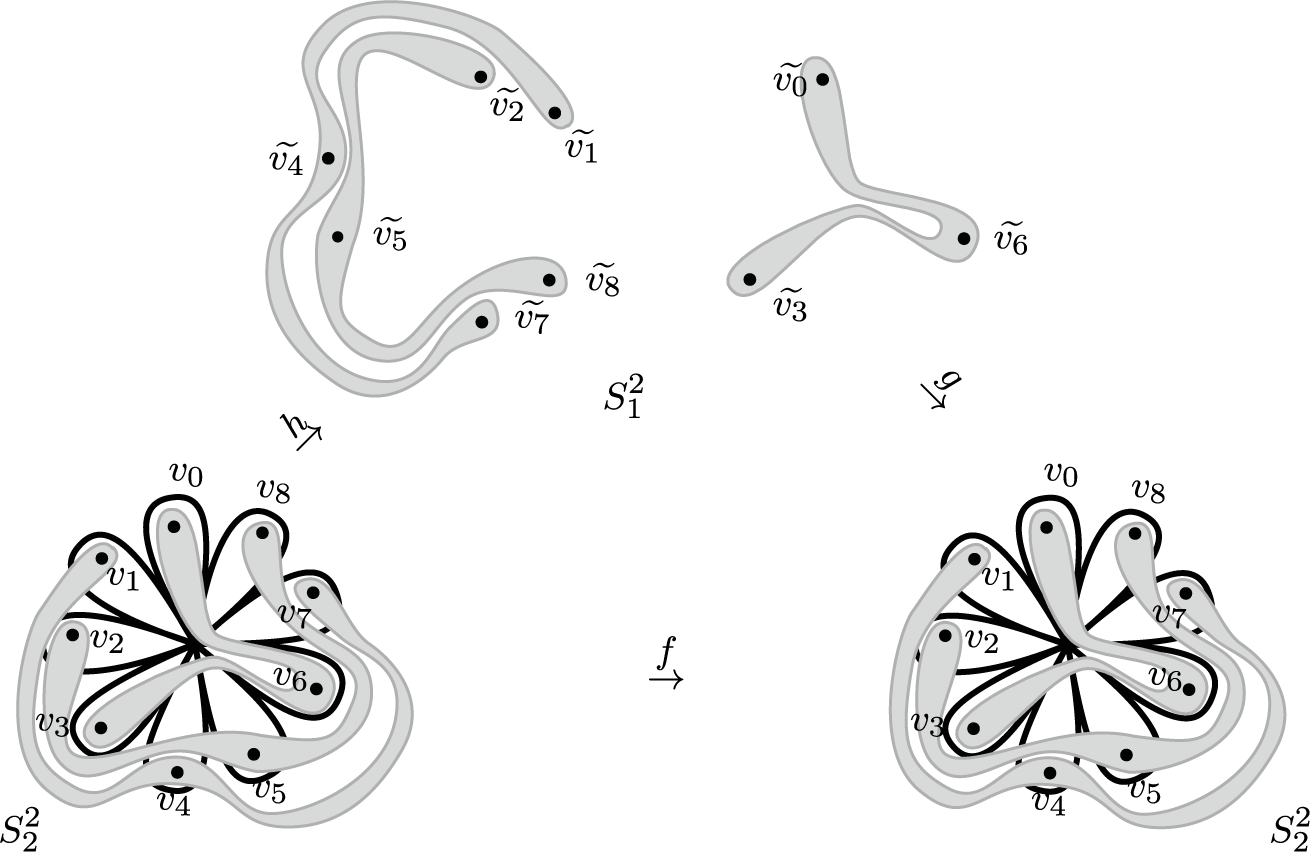


 Open access

