




1. Introduction
Although Informal Second Language Learning (ISLL) is a relatively recent field of research, substantial empirical evidence has shown a correlation between engagement in extramural English (EE) activities, such as watching films, listening to music, and playing games, and various aspects of language proficiency. These include the knowledge and development of vocabulary (Bollansée et al., Reference Bollansée, Puimège, Peters, Werner and Tegge2020; Peters, Reference Peters2018; Peters et al., Reference Peters, Noreillie, Heylen, Bulté and Desmet2019; Schwarz, Reference Schwarz2020; Sundqvist, Reference Sundqvist2009; De Wilde et al., Reference De Wilde, Brysbaert and Eyckmans2020), listening and reading comprehension (Muñoz, Reference Muñoz2020; Verspoor et al., Reference Verspoor, De Bot and Lowie2011; De Wilde et al., Reference De Wilde, Brysbaert and Eyckmans2021), as well as speaking (Sundqvist, Reference Sundqvist2009; De Wilde et al., Reference De Wilde, Brysbaert and Eyckmans2021) and writing skills (Kaatari et al., Reference Kaatari, Larsson, Wang, Acikara-Eichoff and Sundqvist2023; Olsson & Sylvén, Reference Olsson and Sylvén2015; Sundqvist & Wikström, Reference Sundqvist and Wikström2015). These studies focus on measurable learning outcomes associated with informal language engagement.
In addition, there is a body of research that explores how learners perceive and experience informal language learning. Studies addressing students’ perspectives, such as Chik (Reference Chik, Dressman and Sadler2020) on gaming, Trinder (Reference Trinder2017) on perceptions of the usefulness of various digital resources, and Zadorozhnyy and Yu (Reference Zadorozhnyy and Yu2021) on the development of L2 digital literacies, all indicate that learners tend to regard informal activities as valuable opportunities for language development. Such work complements outcome-oriented studies by emphasizing learners’ motivations, attitudes, and personal interpretations of their informal learning experiences.
A number of terms have been used to refer to informal learning, including “Learning Beyond the Classroom” (Benson, Reference Benson, Benson and Reinders2011a, Reference Benson2011b), “Online Informal Learning of English” (OILE) (Sockett, Reference Sockett2014), “Extramural English” (EE) (Sundqvist, Reference Sundqvist2009), “Informal Digital Learning of English” (IDLE) (Lee, Reference Lee2017; Lee & Dressman, Reference Lee and Dressman2017), and “Informal Second Language Learning” (ISLL) (Arndt, Reference Arndt2019). However, there are certain differences in the precise meaning of these. “Language Beyond the Classroom,” for example, explores language learning and teaching occurring outside formal educational settings, whereas OILE investigates whether online interactions with English influence language proficiency. In turn, while OILE shares similarities with IDLE, the two differ in scope: OILE focuses exclusively on online activities, whereas IDLE includes both extracurricular and extramural contexts. Moreover, Lee (Reference Lee2019) distinguishes between extracurricular IDLE, which is essentially other-directed and associated with a formal program of teaching, and extramural IDLE, which is self-directed. However, Sockett does not regard OILE as other-initiated (Sockett, Reference Sockett2014). In contrast to extracurricular IDLE, EE is learner-initiated (Sundqvist & Sylvén, Reference Sundqvist and Sylvén2016), is restricted to English, and encompasses both digital and analogue activities. EE includes both incidental and intentional learning, although incidental learning is more common. Therefore, the focus of EE is on exposure rather than on intentional learning outcomes, in recognition of the fact that such experiences may or may not result in measurable language development. Such a distinction makes EE the most appropriate term for describing the informal, incidental nature of English use to be explored in the present study.
Despite the growing body of literature in this area, few studies have focused on the perspectives of teachers from a cross-national point of view (Schurz et al., Reference Schurz, Coumel and Hüttner2022; Schurz & Sundqvist, Reference Schurz and Sundqvist2022) or indeed from a national perspective (Casale & Olsson, Reference Casale and Olsson2025; Hannibal Jensen & Lauridsen, Reference Hannibal Jensen and Lauridsen2023). Schurz and Sundqvist (Reference Schurz and Sundqvist2022) are currently the only quantitative examination of teachers’ perspectives on EE and English Language Teaching (ELT), and they consider four European contexts (Austria, Finland, France, and Sweden). As the authors claim, teachers of English as a Foreign Language in countries with longer traditions of EE are likely to have greater experience and to address this reality in their teaching practices compared to their counterparts in dubbing countries.
Schurz and Sundqvist examined EE across four countries with native languages from different language families: Germanic (Sweden and Austria), Romance (France), and Finno-Ugric (Finland). In the present study, by contrast, we analyze EE in two countries that belong to the same language family: Romance (Portugal and Spain). Portuguese and Spanish, the dominant languages in their respective countries, thus share a similar linguistic distance from English, and as a consequence, the comparable language backgrounds of learners are likely to exert a similar influence on their engagement with English.
However, the two countries differ in terms of dubbing traditions. Portugal is largely a non-dubbing country, whereas Spain uses dubbing extensively for audiovisual content. Indeed, dubbing in Spain became mandatory on April 20, 1941, and is currently governed by the Protection and Promotion of Cinematography Act 17/1994, enacted on June 8, 1994 (BOE-A-1994-13139). Indeed, the long history of the dubbing tradition in Spain has led to it being one of the leading countries in the sector (cf. Gil Ariza, Reference Gil Ariza2004). Meanwhile, subtitling is the norm in Portugal and is regulated by Decree-Law 350/93, issued on October 7, 1993.
Portuguese language teachers are expected to have greater experience with EE than in the case of Spain, in that Portugal has a longer tradition of engaging with English outside the classroom. As Schurz and Sundqvist (Reference Schurz and Sundqvist2025) note, there is a long tradition of using EE in countries where subtitling is prevalent (Media Consulting Group, 2009). The present study explores teacher reports across three key areas: (1) their awareness of the frequency with which their students engage in extramural practices, (2) their reporting of the influence of EE practices on their students’ English, and (3) their views on the relationship between EE and ELT and on the influence of their students’ EE activities on their teaching practices.
2. EE across Portugal and Spain
The most recent Eurobarometer survey (European Commission, 2024) noted differences between Portugal and Spain in terms of both English proficiency and exposure to the language. Respondents from Portugal reported higher conversational English ability than in the case of Spain. For extramural engagement with English, the two countries showed similar patterns of activity, with browsing online and audiovisual media being the most common forms of engagement. However, Portuguese participants showed a stronger preference for subtitled content and a slightly higher use of English in online browsing and media consumption, indicating greater informal exposure. In Spain, whereas fewer respondents preferred subtitled media, a greater proportion of them viewed language learning as advantageous for internet use and preferred self-directed learning through TV, films, or radio. These findings suggest that English exposure is more deeply embedded in students’ normal media habits in Portugal than in Spain, in which respondents expressed greater interest in language learning through media, even if their real engagement was in fact lower.
According to the Eurobarometer survey, Portuguese speakers demonstrated a stronger preference for watching films and programs with subtitles than average preferences across the European Union (EU). They also used English for internet browsing nearly as frequently as the average EU citizen and perceived learning languages for online activities as relatively advantageous. However, Portuguese speakers were also more likely than the EU average to engage in self-directed language learning through activities such as watching films, television, or listening to the radio. In contrast, Spanish speakers demonstrated a stronger-than-average preference for consuming news in English and for reading books, journals, and newspapers in English when compared to mean levels across the continent.
Despite both Portuguese and Spanish speakers frequently reporting that they used English for internet browsing, there has been only limited research into the potential impact of EE on the proficiency of English language learners in these two countries. In Portugal, few studies have been conducted. In one of these, Tonoian (Reference Tonoian2014) analyzed the way in which 115 university students in Portugal learned English and found that they learned more English outside the classroom than within it. More specifically, 54% of students reported using English every day outside the classroom, 25% reported using it twice a week, and the remainder used it only rarely. English was most commonly used online with friends (35%) or in face-to-face exchanges (28%). Half of participating students reported playing computer games regularly, with 98% doing so in English. Additionally, 83% watched movies or TV programs in English on an almost daily basis, and 80% knew the words to more than 20 English-language songs. Social networks were also widely used, with 32% spending more than 2 hours per day on such platforms. In contrast to Tonoian’s study, Pereira et al. (Reference Pereira, Fillol and Moura2019) analyzed the use of media in general and did not focus on English. However, one finding in their study revealed that students reported learning English through video games. Finally, a recent report by the Organisation for Economic Co-operation and Development (OECD, 2024) on how 15-year-olds learn English found that adolescents in Portugal tend to have frequent exposure to English outside school. The report included a case study of three Portuguese schools. Findings based on interviews with a total of 16 teenagers across these schools showed that participants engaged with English through activities such as gaming, watching videos, listening to music, and communicating with friends.
In the Spanish context, a small number of studies have looked at engagement in EE activities and their possible impact on English learning. Thus, Muñoz et al. (Reference Muñoz, Cadierno and Casas2018) conducted a comparative study of English grammar skills in two groups of 7- and 9-year-old Danish and Spanish learners. The study focused on receptive vocabulary skills and cognate linguistic distance plus two context-related factors: the amount of formal instruction received and the frequency of exposure to English outside the classroom. At the onset of instruction, Danish learners exhibited a level of receptive knowledge in English comparable to that of Spanish/Catalan learners after several years of formal teaching. This was seen to have been conditioned by factors such as greater receptive vocabulary, cognate recognition, and more informal exposure to English, especially through audiovisual materials. Formal instruction was seen to have given little advantage to Spanish learners, whereas frequent contact with English outside the classroom by Danish children appeared to improve their receptive knowledge. These findings support usage-based models of learning, which underline the importance of input frequency and informal exposure in language learning, while also revealing an age-related advantage among the older Danish learners in the study. Further research by Muñoz and Cadierno (Reference Muñoz and Cadierno2021) expanded the scope of this line of investigation, comparing 14- and 15-year-old students in Denmark and Spain by means of tests of listening comprehension, metalinguistic knowledge, and grammaticality judgment. The Danish students outperformed the Spanish ones on all measures except metalinguistic knowledge and reported greater engagement in EE activities. The study concluded that the effects of out-of-school language activities were influenced by both the learning context and the proficiency levels of the learners. Muñoz (Reference Muñoz2020) conducted a large-scale study of 3,048 Spanish learners of English aged between 12 and 39. Listening to music was identified as the preferred activity of learners, followed by watching videos and reading online content. Gender differences were also observed: female subjects, particularly adolescents, listened to music most frequently, whereas male participants of all ages tended to prefer video games. The study also found that reading correlated most strongly with higher classroom grades, followed by watching audiovisual content with L2 subtitles and, for female learners, conversing with friends.
Alonso (Reference Alonso2023) examined the impact of extramural activities on language proficiency across four groups of Spanish learners: 38 secondary education students, 25 baccalaureate students, 32 state language school students, and 18 university students. Significant differences were observed in the frequency of exposure to extramural activities such as watching films, playing games, reading, writing, and speaking. State language school and university students watched films most frequently, while university students also engaged more extensively in listening to music, reading, writing, and speaking. Furthermore, activities such as watching films, listening to music, reading, and speaking were positively associated with academic achievement, a finding which was also reported in Muñoz (Reference Muñoz2020) for reading. In a similar vein, Amengual-Pizarro (Reference Amengual-Pizarro2023) examined the practices of 91 prospective primary teachers, finding that their preferred out-of-class activity was listening to music, followed by watching films or TV series in English, which again is in line with the findings of Alonso (Reference Alonso2023) and Muñoz (Reference Muñoz2020). A significant association was also identified by Amengual-Pizarro between the frequency of exposure to watching films or TV series in English and grades achieved for both reading and writing, as well as final grades. In a recent paper, Alonso and Fernández-Dobao (Reference Alonso and Fernández-Dobao2025) analyzed the effects of the informal exposure to English on vocabulary, grammar, and writing in a group of 178 Galician adolescent learners of English. Findings showed that the performance of learners in language tasks correlated positively with the activities of watching films, both with and without subtitles, reading, writing, and, to a lesser extent, listening to music, gaming, and speaking online. Gender-related differences were also observed, both in the frequency of some out-of-school activities and in correlation with the performance of learners in the three language tasks used. Both genders listened to music most frequently, but females did so more often, while gaming was more common among males. Gender differences also appeared in the patterns of correlation: for females, watching media with captions, reading, and writing showed a stronger positive correlation with language test scores, whereas for males, listening to music was more strongly associated with progress in the acquisition of vocabulary. These results suggest that out-of-school English activities can be related to positive language outcomes, but that there are differences here across genders.
In conclusion, while ISLL through activities such as listening to music, watching audiovisual content, and reading has been shown to have a positive impact on language proficiency and academic achievement among Spanish learners, research on this phenomenon remains limited in Portugal. Further research, then, is needed to explore ISLL across diverse cultural and linguistic settings, including Portuguese learners, to better understand how informal exposure to a second language can contribute to overall language development, as well as to explore teachers’ views on the issue in greater depth.
3. Teachers’ perspectives on EE
As noted in Section 1, ISLL has emerged recently as a distinct area of research. However, most work has focused on students’ exposure to EE activities and the effect of these on English learning, with relatively few studies exploring the perspective of teachers. To the best of our knowledge, only two studies have examined teachers’ views on EE in the European context: Schurz et al. (Reference Schurz, Coumel and Hüttner2022) and Schurz and Sundqvist (Reference Schurz and Sundqvist2022). Both studies explored teachers’ perceptions of EE and the relationship of these to classroom practices, but the two studies differed in scope, methodology, and focus. Schurz et al. (Reference Schurz, Coumel and Hüttner2022) took a qualitative approach, interviewing 20 lower-secondary teachers from Austria, France, and Sweden to explore how EE engagement influences pedagogical approaches to accuracy, fluency, and grammar. Their findings highlighted cross-country differences, with Swedish teachers demonstrating a more nuanced and positive understanding of the role of EE than their Austrian and French counterparts, especially in terms of grammar learning. The authors suggested that Sweden’s strong culture of implicit language learning may extend to classroom practices, where explicit grammar instruction plays a less prominent role. In contrast, Schurz and Sundqvist (Reference Schurz and Sundqvist2022) conducted a larger-scale quantitative survey of 534 upper-secondary teachers from Austria, Finland, France, and Sweden, comparing contexts in which English media are typically dubbed (Austria, France) or subtitled (Finland, Sweden). Their findings indicated that EE engagement and its perceived impact are lower in countries that favor dubbing, and that teachers in subtitling countries are more open to adapting their teaching practices to extramural learning. These two studies, then, provided complementary evidence. A qualitative approach allowed for an in-depth view of how teachers conceptualize and respond to EE in the classroom, while a survey study gave broader quantitative support for the idea that national media traditions influence teachers’ EE perceptions and pedagogical adaptation strategies.
In a follow-up study, Schurz and Sundqvist (Reference Schurz and Sundqvist2025) examined the instructional activities adopted by teachers in those four countries where students engaged extensively in EE. A total of 239 teachers participated in this survey. The findings revealed that Austrian and French teachers tend to use activities based on authentic materials, whereas Finnish and Swedish teachers rely more on activities focusing on register differences. These results revealed cross-contextual variation in the instructional use of EE, which the authors attributed to political and sociocultural factors.
Two further studies explored the views of primary teachers in relation to EE (Casale & Olsson, Reference Casale and Olsson2025; Hannibal Jensen & Lauridsen, Reference Hannibal Jensen and Lauridsen2023), although neither took a cross-national approach, and they differed in focus and scope. Hannibal Jensen and Lauridsen (Reference Hannibal Jensen and Lauridsen2023) found that teachers had positive views regarding the benefits, challenges, and learning opportunities offered by EE to children aged 7–11, underlining how teachers value EE as a means to boost vocabulary and motivation, but they saw fewer advantages in gaming than in the use of YouTube. This study also raises issues relating to student demotivation due to boredom and high self-expectation. In contrast, Casale and Olsson (Reference Casale and Olsson2025) looked at Swedish primary teachers, exploring their perceptions of students’ EE practices and the implications of these for classroom teaching. They identified three themes here: teachers’ interest in EE, its effects on teaching and learning, and strategies for classroom integration. The findings suggested that frequent out-of-school English exposure can enrich teaching but can also exacerbate learner disparities, highlighting the need for pedagogical support and differentiated instruction, an issue that was not emphasized so greatly in Hannibal Jensen and Lauridsen (Reference Hannibal Jensen and Lauridsen2023). All these studies point to the growing recognition of EE as a valuable yet unevenly exploited facet of English learning and, as such, illustrate the need for more teacher awareness and pedagogical integration of the extramural activities of students.
Earlier studies examined teachers’ perspectives on EE, but their scope has generally been narrower than that of Schurz and Sundqvist (Reference Schurz and Sundqvist2022). For instance, Ranta (Reference Ranta2010) investigated the views of 108 students and 34 teachers in Finland regarding English use inside and outside the classroom. Using both questionnaires and qualitative data, the study found that students and teachers recognized the notable role of English in real-world contexts.
Toffoli and Sockett (Reference Toffoli and Sockett2015) focused on 30 university teachers’ knowledge of the out-of-school English practices of their students. Ten of these teachers believed that such activities involved only a minority of students, while most reported that these practices were increasing, with 25 considering them beneficial for English skills. Over half of the teachers stated that students’ out-of-school practices influenced their teaching, but only around one-third were open to integrating these into their classroom practices. Teachers also identified illegal downloads as a major issue and highlighted the need to adapt educational frameworks to support the use of online resources.
In a recent study conducted in Kazakhstan, Zadorozhnyy and Yu (Reference Zadorozhnyy and Yu2021) explored informal digital learning among undergraduate English teachers in training through 32 semi-structured interviews. Participants reported a positive relationship between EE engagement and improvements in listening and noted that the use of social media contributed to greater communicative competence. Most interviewees engaged primarily in receptive rather than productive activities and generally believed that EE could enhance the language skills of students. They also noted the need to update teaching strategies to reflect contemporary digital practices, aligning in this sense with Toffoli and Sockett’s findings, although the participants in Kazakhstan appeared to be better informed in this respect, perhaps because they were digital natives. However, some of the interviewees did express skepticism about the widespread impact of informal learning, which illustrates that views were not uniform.
These findings are consistent with Schurz and Sundqvist’s results in Austria and France. Teachers in those two countries tended to view EE engagement as less beneficial, or even potentially harmful, compared to teachers in Finland and Sweden. Although differences between teachers in France and Sweden were non-significant when French middle school teachers were excluded, the findings still showed the most positive evaluations of EE in Finland and Sweden, with Austria and France ranking lower. Despite this, Zadorozhnyy and Yu found that most participants supported bridging formal and informal learning and were open to pedagogical change, although they also reported students having limited attention to informal digital activities in schools and universities. In conclusion, research on EE learning underlines its significant role in shaping the perceptions of language learning for both students and teachers. While much of the existing literature focuses on the effects of EE on student learning, studies such as Schurz and Sundqvist (Reference Schurz and Sundqvist2022) and Casale and Olsson (Reference Casale and Olsson2025) provide valuable insights into the perspectives of teachers across diverse educational and cultural contexts. These findings illustrate the influence of subtitling and dubbing practices on EE engagement and their perceived impact on teaching strategies. Further studies, such as those by Ranta (Reference Ranta2010), Toffoli and Sockett (Reference Toffoli and Sockett2015), and Zadorozhnyy and Yu (Reference Zadorozhnyy and Yu2021), reveal positive attitudes among educators regarding the integration of informal learning practices into formal instruction. However, one remaining challenge involves recognizing the need to bridge informal and formal learning while accounting for the L2 digital literacy of students (Zadorozhnyy & Yu, Reference Zadorozhnyy and Yu2021), and ensuring that teacher education and in-service training programs are updated in order to prepare teachers for the diversity of today’s English language classrooms (Casale & Olsson, Reference Casale and Olsson2025). This evolving landscape calls for a further exploration of teachers’ roles in using EE to enhance language education.
4. Method
4.1. Research questions and hypotheses
In order to analyze the perspectives of secondary teachers on informal learning in the Portuguese and Spanish context, the following research questions and hypotheses are proposed.
1. How frequently do secondary education teachers consider EE activities to be among their students in Portugal and Spain?
It is hypothesized that listening to music, watching films, and playing games will be the most common. We also hypothesize that engaging in EE activities in Portugal will be more frequent than in Spain, in that Portugal is a non-dubbing country, with English enjoying a higher degree of social penetration than in Spain.
2. How do secondary school teachers perceive the impact of their students’ EE activities on listening and speaking skills, grammar, vocabulary, reading, the use of formal and informal language, as well as on students’ confidence and motivation?
It is hypothesized that teachers will perceive EE as having a more positive impact on listening, speaking, vocabulary, informal language use, confidence, and motivation than on grammar, reading, and formal language use, in that the latter are typically associated with explicit, classroom-based instruction, whereas EE activities predominantly provide exposure to authentic, informal, and meaning-focused language input.
3. What are teachers’ beliefs and practices regarding the relationship between EE and ELT?
It is hypothesized that teachers in Portugal will attribute greater significance to this, since English has a higher degree of social penetration in that territory.
4.2. Participants
A total of 244 participants took part in the study, 124 teachers from Portugal (116 females and 8 males, mean age 54.4) and 120 from Spain (90 females and 29 males; mean age 46.4). The majority of participants, in both countries, held at least a master’s degree and worked in public schools. Most of them taught English as their main subject although a substantial proportion of Portuguese teachers also taught other subjects. Most participants reported the national language as their L1, with a small number of non-native L1 speakers in both groups. Detailed demographic and professional characteristics are presented in Table 1.
Demographic and professional characteristics of Portuguese and Spanish teachers

Table 1 Long description
The table compares demographic and professional characteristics of Portuguese and Spanish teachers. Portuguese teachers are mostly female (93.5%), older with a mean age of 54.4 years, and more likely to hold a Master's degree (74.2%) than Spanish teachers, who are 75% female with a mean age of 46.4 years. Spanish teachers have a higher percentage with a Ph.D. (15.0%) compared to Portuguese teachers (4.8%). Both groups predominantly work in public schools, but a higher percentage of Spanish teachers (95.8%) do so compared to Portuguese teachers (87.1%). Portuguese teachers focus more on English for specific purposes (41.1%) than Spanish teachers (18.0%). Most teachers in both groups speak their native language, with Portuguese teachers at 97.6% and Spanish teachers at 93.3%. Percentages may not total 100 due to rounding.
Note: Percentages may not total 100 due to rounding.
As can be observed, the two groups are broadly comparable. Both have a higher number of female than male teachers. The teachers in each group are predominantly middle-aged, with the Portuguese group being an average of 8 years older. The two groups share similar qualifications, with some holding both a bachelor’s and a master’s degree. Finally, most work in public schools.
4.3. Research instrument
The present study implemented the online survey originally developed by Schurz and Sundqvist (Reference Schurz and Sundqvist2022). This survey consists of three main sections: Section 1 gathers background information about teachers and schools; Section 2 focuses on student and teacher practices and the perceived effects of EE on various areas of language learning; and Section 3 examines the relationship between EE and ELT. Since the original instrument was designed for use in Austria, Finland, France, and Sweden, several adaptations were made to tailor it to the Portuguese and Spanish contexts. In Section 1, which collects demographic and institutional data, the scope was narrowed to include only respondents from Portugal and Spain. While the primary focus of the study is on secondary education, data were also collected from other educational levels, which will be analyzed in a future publication. Additionally, the original item about the specific region of Finland in which respondents were taught was replaced with a question about school type (public, private, or independent). Section 2 concentrates on EE practices and their potential effects on various aspects and areas of learning. The only adjustment in this section involved omitting the question about the grade level at which English was taught. Section 3, which explores the relationship between EE and ELT, remained unchanged. The survey is included in the supplementary materials.
The internal reliability of the survey was assessed using Cronbach’s alpha. All scales showed medium to high reliability: Frequency of extramural activities: global α = .83, Portugal α = .75, Spain α = .82; perceptions of students’ EE: global α = .75, Portugal α = .68, Spain α = .78; perceived influence of EE on students’ English proficiency: global α = .92, Portugal α = .90, Spain α = .93; beliefs about English use in and out of school: global α = .76, Portugal α = .78, Spain α = .74.
An exploratory factor analysis was conducted using R, version 4.5.0 (R Core Team, 2025) and the psych library (Revelle, Reference Revelle2025). Principal component analysis (PCA) with Promax rotation suggested a four-factor solution, based on the criterion of Eigenvalues > 1 (Kaiser, Reference Kaiser1960) and Horn’s parallel analysis (Hayton et al., Reference Hayton, Allen and Scarpello2004; Horn, Reference Horn1965). Sampling adequacy was confirmed with a Kaiser–Meyer–Olkin (KMO) value above 0.70 (Kaiser, Reference Kaiser1974), and Bartlett’s test of sphericity was significant (p < .001) (Bartlett, Reference Bartlett1954), indicating that the data were suitable for factor analysis. In the Portuguese dataset, the four extracted factors explained the following percentages of variance: factor 1: 20.9%, factor 2: 20.1%, factor 3: 17.3%, factor 4: 17.0%. In the Spanish dataset, the variance was as follows: factor 1: 22.9%, factor 2: 22.0%, factor 3: 17.4%, factor 4: 15.6%. The four identified factors were defined as: (F1) connecting EE and ELT, (F2) compensating for the English that is not acquired outside the classroom, (F3) interacting with students in English outside the classroom, and (F4) integrating EE into the classroom.
Cronbach’s alpha for each factor ranged between .61 and .83 in the Portuguese sample and .71 and .84 in the Spanish one. Due to the high penalization imposed by Cronbach’s alpha on scales with low item count, the inter-item correlation was calculated and ranged between .45 and .71 for Portugal and between .55 and .67 for Spain.
4.4. Data analysis
To address RQ1 (the frequency of EE practices) and RQ2 (the effect of EE on various language domains), a mixed ANOVA with Huynh–Feldt correction (Mauchly’s test yielded p < .001) was employed. Normality was assessed using the Shapiro–Wilk test. Although some violations were observed, these were not considered problematic due to the robustness of ANOVA with sample sizes exceeding 30 (Field, Reference Field2018). Homogeneity of variances was calculated using Levene’s test, which revealed inconsistencies. As a result, post hoc Welch’s t tests and Bonferroni corrections were applied. Outliers were examined using the interquartile range. The significance threshold was set at p < .05. Following Cohen’s (Reference Cohen1988) guidelines, effect sizes were interpreted using Cohen’s d: small (0.2), medium (0.5), and large (0.8).
To address RQ3, a factor analysis was conducted. A ceiling effect was identified in one item (endorsed by 62.3% of participants, M = 4.48, SD = 0.77), which was subsequently removed. An iterative item-trimming procedure was implemented. In each cycle, one item was eliminated, and PCA with Promax rotation was recalculated for the dataset of each country. During this process, data from Portugal and Spain were examined concurrently using four criteria: cross-loadings, low primary factor loadings, low communalities (h2), and high item complexity. In each iteration, the item with the weakest performance across the evaluated metrics in both countries was removed. Following each removal, PCA was recalculated, and several indicators were reviewed: model fit indices (root mean square error of approximation and root mean square residual); factorability measures (KMO and Bartlett’s test of sphericity); internal consistency (Cronbach’s alpha and mean inter-item correlation); and construct validity (factor loadings and communalities [h2]). In the final iteration, model fit indices indicated a good fit: for Portugal, Root Mean Square Residual (RMSR) = 0.7158 and Fit = .9470; for Spain, RMSR = 0.6588 and Fit = .9536. The number of factors was determined using Horn’s parallel analysis and confirmed with the Eigenvalue > 1 rule. This iterative process was repeated 11 times. The eleventh iteration produced a clean factor solution, with loadings ranging from .61 to .92, satisfactory communalities, interpretable factors in both countries, and item complexities below 2. One item (Q14.4) showed a complexity of 1.9 in Portugal with slight cross-loading. This final configuration was retained to answer RQ3.
5. Results
5.1. Research question 1: how frequently do secondary education teachers consider EE activities to be among their students in Portugal and Spain?
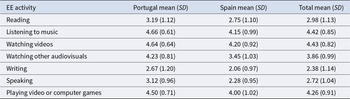
Findings revealed that the most commonly reported EE activities among students, according to teachers, were watching videos, listening to music, and playing video games. In Portugal, listening to music ranked highest, followed by watching videos, whereas in Spain this order was reversed. The remaining activities followed the same order in both countries: in descending order of frequency, watching other types of content, reading, speaking, and writing, as shown in Table 2.
Descriptive statistics for frequency of EE activities

Table 2 Long description
The table presents descriptive statistics for the frequency of various entertainment and educational (EE) activities in Portugal and Spain, based on a 5-point Likert scale. Listening to music is the most frequent activity in both countries, with a mean of 4.66 in Portugal and 4.15 in Spain, resulting in a total mean of 4.42. Watching videos follows closely, with means of 4.64 in Portugal and 4.20 in Spain. In contrast, writing is the least frequent activity, with means of 2.67 in Portugal and 2.06 in Spain. The data suggests that audiovisual activities are more popular than reading and writing. The sample sizes differ between countries, with 100 participants from Spain and 111 from Portugal, which may affect the comparability of the results.
Notes: N = 100 for Spain, N = 111 for Portugal. Responses were based on a 5-point Likert scale. The sample is smaller in that only those participants who answered all items were included.
The results of the mixed ANOVA with the Huynh–Feldt correction revealed a significant difference between Portugal and Spain, F(1.21, 209.00) = 45.00, p < .001, generalized η2 = .09, partial η2 = .18. The differences between activities were also significant, F(4.91, 1026.07) = 277.13, p < .001, generalized η2 = .42, partial η2 = .57. The greatest effects were observed for the EE activities of watching other audiovisual materials and speaking. Post hoc Welch’s t tests with Holm–Bonferroni corrections indicated significant differences for all activities: reading (p = .003, d = 0.40), listening to music (p < .001, d = 0.63), watching videos (p < .001, d = 0.55), watching other materials (p < .001, d = 0.82), writing (p < .001, d = 0.54), speaking (p < .001, d = 0.83), and playing video games (p < .001, d = 0.52). Overall, EE engagement in Portugal was significantly higher than in Spain (see Fig. 1).
Estimated means of EE frequency on teachers’ reports of frequency of exposure to EE activities with 95% error bars.

Figure 1 Long description
A line graph comparing the estimated means of EE frequency between Portugal and Spain across various activities. The x-axis lists activities: Reading, Music, Videos, Other audiovisuals, Writing, Speaking and Gaming. The y-axis represents the estimated means of EE frequency. Portugal's line shows higher values across most activities, peaking at Videos and Gaming. Spain's line follows a similar pattern but with generally lower values. Error bars are present for each data point.
5.2. Research question 2: how do secondary school teachers perceive the impact of their students’ EE activities on listening and speaking skills, grammar, vocabulary, reading, the use of formal and informal language, as well as on students’ confidence and motivation?
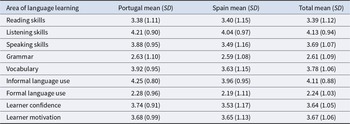
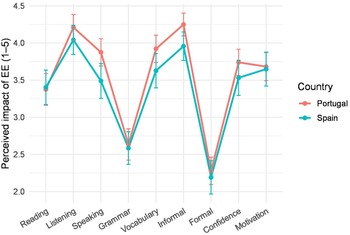
The analysis of the teachers’ reporting of the influence of EE activities on different language areas showed that similar results were found in both cases. Portuguese teachers ranked the influence of the different activities in the following order: informal language use, listening skills, vocabulary, speaking skills, confidence, motivation, reading skills, grammar, and formal language use; Spanish teachers ranked them as follows: listening skills, informal language use, vocabulary, motivation, learner confidence, speaking skills, reading skills, grammar, and formal language use. The total means for learner confidence (3.64) and motivation (3.67) were higher than grammar (2.61) and formal language use (2.24) but lower than listening (4.13) and informal language use (4.11). This suggests that EE activities are perceived as more effective at boosting affective factors (confidence, motivation) and practical skills (listening, informal use) than grammar and formal language use, as Table 3 illustrates.
Descriptive statistics of teachers’ reported influence of extramural English (EE) activities on areas of language learningFootnote 1

Table 3 Long description
The table measures the influence of extramural English activities on various areas of language learning, based on teachers' reports from Portugal and Spain. Listening skills show the highest influence, with Portugal at 4.21 and Spain at 4.04, indicating a strong impact. In contrast, formal language use has the lowest influence, with Portugal at 2.28 and Spain at 2.19. Vocabulary and informal language use also show high influence, particularly in Portugal. Overall, Portugal tends to report slightly higher influence across most areas compared to Spain. The data is based on a 5-point Likert scale, and only participants who answered all items were included in the analysis.
Notes: N = 94 for Spain, N = 104 for Portugal. Responses were based on a 5-point Likert scale (1 = very low influence, 5 = very high influence). Only participants who answered all items were included in the analysis.
A mixed ANOVA using the Huynh–Feldt correction did not reveal significant differences across countries, F(1, 196.00) = 2.12, p = .147, generalized η2 = .01, partial η2 = .01. A significant main effect was found for area of language learning, F(7.02, 1376.42) = 170.74, p < .001, generalized η2 = .47, partial η2 = .47; however, when analyzing the differences between countries for each area, the significance observed in post hoc Welch’s t tests was not maintained after Holm–Bonferroni adjustments. Although there were no overall differences between countries, nor any specific differences to each area, teachers’ perceptions of the influence of EE on their students’ skills varied across areas, and the area pattern differed between countries, F(7.02, 1376.42) = 2.00, p = .047, generalized η2 = .00, partial η2 = .01 (see Fig. 2).
Estimated means of teacher reports on the influence of EE activities on different language areas with 95% error bars.

Figure 2 Long description
The x-axis lists nine language areas: Reading, Listening, Speaking, Grammar, Vocabulary, Informal, Formal, Confidence and Motivation. The y-axis represents the perceived impact of EE, ranging from 1 to 5. Two lines are plotted: one for Portugal and one for Spain. Both lines show similar trends with peaks at Listening and Vocabulary and troughs at Grammar and Formal. Error bars are present for each data point, indicating variability. The legend identifies the lines for Portugal and Spain.
5.3. Research question 3: what are teachers’ beliefs and practices regarding the relationship between EE and ELT?
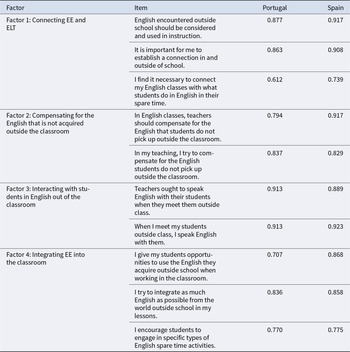
RQ3 explores the importance that teachers place on the relationship between EE and ELT, as well as the extent to which EE is reported to influence ELT. In essence, both these aspects examine the relationship between EE and ELT and have been analyzed using factor analysis. Table 4 sets out the results of the four factors obtained, along with their loadings. Factors 1, 2, and the first item in Factor 3 are related to teachers’ beliefs in the relationship between English in- and out-of-school. Factors 3 and 4 involve the practices of teachers regarding the link between English in- and out-of-school.
Four obtained factors and their items per country

Table 4 Long description
The table measures the agreement levels of teachers in Portugal and Spain on four factors related to integrating English encountered outside school into classroom instruction. Factor 1 shows high agreement in both countries, with Spain scoring slightly higher (0.917) than Portugal (0.877). Factor 2 reveals similar trends, with Spain again scoring higher (0.917) compared to Portugal (0.794). Factor 3 shows nearly identical high scores for both countries, with Portugal and Spain scoring 0.913 and 0.923, respectively. Factor 4 indicates a stronger emphasis in Spain (0.868) than in Portugal (0.707) on integrating external English into classroom activities. Overall, Spain consistently scores higher across all factors, suggesting a stronger inclination towards these educational practices.
Note: N is reduced because only participants who answered all items were included.
As the results indicate, the loading of the factors is high in both countries. The descriptive statistics are provided in Table 5. A notable issue that arose during the iterative trimming process was that items related to the connection between EE and ELT loaded fairly well on Factor 1 (F1) in the Portuguese sample, but not in the Spanish one. To ensure a comparable factor structure across both sub-samples, these items were discarded. Nevertheless, this discrepancy may indicate a difference in how effectively teachers from each country are able to integrate EE content into their teaching.
Descriptive statistics of the four factors across Portugal and Spain

Table 5 Long description
The table presents descriptive statistics for four factors across Portugal and Spain, focusing on participant numbers and mean scores with standard deviations. Factor F2 has the highest mean score in Portugal at 4.06, compared to 3.91 in Spain, indicating a notable difference. Conversely, Factor F3 shows the largest mean difference, with Portugal scoring 3.38 and Spain 3.06. Factor F1 has similar mean scores in both countries, with Portugal at 3.97 and Spain at 4.07. Factor F4 shows almost identical means, with Portugal at 3.42 and Spain at 3.44. The data suggests that while some factors have consistent scores across countries, others vary significantly, highlighting potential cultural or contextual influences.
Note: N is reduced since only those participants who answered all the items were included.
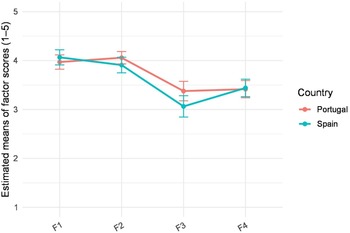
The mixed ANOVA did not reveal any significant differences between countries for Factors 1, 2, or 4. A significant difference was found for Factor 3, p = .039, d = 0.28; however, this effect did not remain significant after Holm–Bonferroni adjustments. These results indicate that Portuguese and Spanish teachers showed similar levels of agreement across all four factors (see Fig. 3).
Estimated means of agreement with factors 1–4, with 95% error bars.

Figure 3 Long description
A line graph comparing estimated means of factor scores (1 to 5) for Portugal and Spain across four factors (F1 to F4). The x-axis represents the factors and the y-axis represents the estimated means of factor scores. Two lines are shown: one for Portugal and one for Spain. Both lines start at a similar level for F1, slightly decrease at F2, drop at F3 and rise again at F4. Error bars are present for each data point.
6. Discussion
6.1. Teachers’ reports of the frequency of students’ EE
Both Portuguese and Spanish teachers reported that the most common EE activities among students were watching videos, listening to music, and playing video games. This aligns with previous research on the practices of students in various contexts, such as Spain (Alonso & Fernández-Dobao, Reference Alonso and Fernández-Dobao2025; Muñoz, Reference Muñoz2020), Sweden (Sundqvist, Reference Sundqvist2009), Flanders (Peters, Reference Peters2018), and Japan (Barbee, Reference Barbee2013).
As hypothesized, results also revealed that all EE activities were reported to be more frequent in the Portuguese context. This may be explained by sociolinguistic and media factors. Portugal, as a non-dubbing country, provides greater exposure to authentic English input through subtitled media, fostering incidental language learning. In contrast, Spain’s dubbing tradition and lower degree of English social presence probably constrain opportunities for such exposure. These findings resonate with Schurz and Sundqvist’s (Reference Schurz and Sundqvist2022) cross-national study, which found higher EE engagement in subtitling countries (Finland and Sweden) than in dubbing ones (Austria and France). Our results extend these findings by showing that, in Portugal and Spain, differences are not limited to certain activities; rather, they show the pervasive effect of the media environment on language exposure. Since both groups share a similar linguistic background, the differences cannot be attributed to language distance but to contextual factors influencing access to English input. This shows the importance of sociocultural and media environments in shaping the opportunities of learners for incidental language learning beyond the classroom.
Interpreted through the lens of second language acquisition (SLA), teachers’ reports of higher levels of EE activity in Portugal point to a richer input environment that may afford increased opportunities for incidental second language learning. Although the present study does not directly measure learners’ actual exposure or learning outcomes, teachers’ perceptions are consistent with input-based and usage-based perspectives (Ellis, Reference Ellis2019; Sundqvist & Sylvén, Reference Sundqvist and Sylvén2016), which highlight the role of frequent and meaningful language encounters in supporting implicit development. From this perspective, the more extensive use of English-language media in Portugal can be understood as a facilitating condition for informal language contact and potential acquisition.
6.2. Teachers’ reports of the influence of EE on listening, speaking, grammar, vocabulary, informal and formal language, confidence, and motivation
No significant differences between the two groups were found regarding the influence of EE on different areas of language learning (i.e., listening, speaking, grammar, informal and formal language, confidence, and motivation). This contrasts with the findings by Schurz and Sundqvist (Reference Schurz and Sundqvist2022), who reported variations across all language areas except listening skills and learning motivation. Although in our study engagement in EE was reported to be higher in Portugal than in Spain, teachers in both countries agreed that all these activities were beneficial for language learning. A possible explanation for this is that teachers recognize the pedagogical value of authentic, real-world English exposure, especially in relation to informal language use, listening skills, and vocabulary. However, this alignment may also indicate that the perceptions of teachers reflect general beliefs about the pedagogical value of EE rather than detailed knowledge of the actual practices of students outside school, as Schurz and Sundqvist (Reference Schurz and Sundqvist2022) also point out.
As hypothesized, descriptive statistics revealed that both Portuguese and Spanish teachers ranked the activities most positively influenced by EE in a similar order. This may be due to the nature of EE activities, which typically focus on real-life, informal language use, providing learners with enjoyable opportunities to practice aspects such as listening and informal communication. These perceptions are coherent with the nature of the most frequently reported activities: watching videos, listening to music, and gaming, all of which provide abundant auditory and interactive input. Moreover, EE activities such as watching videos, listening to music, and playing digital games typically provide exposure to informal and naturally occurring language, including colloquial expressions and everyday speech. As Leonard et al. (Reference Leonard, Pintado Gutiérrez and Martyn2025) argue, these language features are less systematically addressed in second language curricula.
Teachers’ emphasis on the influence of EE on informal language use, listening skills, and vocabulary resonates with findings from earlier research linking EE exposure to vocabulary growth (Peters, Reference Peters2018; Schwarz, Reference Schwarz2020), proficiency (De Wilde et al., Reference De Wilde, Brysbaert and Eyckmans2021), motivation (Sundqvist & Sylvén, Reference Sundqvist and Sylvén2014), and confidence (Hannibal Jensen, Reference Hannibal Jensen2019). In addition, our results echo Schurz and Sundqvist’s (Reference Schurz and Sundqvist2022) findings, in which informal language, listening, and vocabulary were seen as the domains most impacted by EE.
As noted above, both Portuguese and Spanish teachers reported viewing EE as having a limited impact on grammar and formal language use. Similar findings were reported by Schurz and Sundqvist (Reference Schurz and Sundqvist2022) and by Schurz et al. (Reference Schurz, Coumel and Hüttner2022). In the former study, teachers across the four countries generally did not perceive writing, formal language, or grammar as being positively influenced by EE, while in the latter, only the Swedish teachers recognized the benefits of EE in grammar. Our results mirror the emphasis on form-focused learning described by Norris and Ortega (Reference Norris and Ortega2002) and suggest that teachers may underestimate the incidental learning potential of EE in these areas. Teachers may also observe improvements in communicative and affective outcomes more readily than in grammar, which are subtler and often considered to require deliberate study (e.g., Rivera et al., Reference Rivera, Paolieri, Iniesta, Pérez and Bajo2023). However, evidence shows that EE can indeed support gains in grammar, writing, and reading (Alonso & Fernández-Dobao, Reference Alonso and Fernández-Dobao2025; Lefever, Reference Lefever2010; Meyer et al., Reference Meyer, Fleckenstein, Keller and Hübner2024; Pattermore & Muñoz, Reference Pattermore and Muñoz2020). In addition to these learning benefits, reading has also been identified as a common EE activity across a variety of settings, such as Hong Kong (Hyland, Reference Hyland2004) and Germany (Meyer et al., Reference Meyer, Fleckenstein, Keller and Hübner2024). This suggests a mismatch between the perceptions of teachers and emerging empirical findings. Our own findings indicate the need to raise teachers’ awareness of how different EE activities can also provide valuable input and opportunities for output in grammar and reading, complementing formal instruction rather than competing with it.
6.3. Teachers’ reports of their beliefs and practices regarding the connection of EE and ELT
Findings revealed consistent perceptions among Portuguese and Spanish teachers across four factors: the relationship between EE and ELT, compensating for what is not learned outside the classroom, interacting with students in English, and integrating EE into instruction.
The highest-loading factors (Factor 1: relationship of EE and ELT; Factor 2: compensating for the English that is not acquired outside the classroom) indicate that teachers in both contexts prioritize linking formal instruction with students’ EE experiences and addressing perceived learning gaps. This highlights teachers’ awareness of the pedagogical value of bridging classroom instruction and real-world language use (Reinders & Benson, Reference Reinders and Benson2017; Sylvén & Sundqvist, Reference Sylvén and Sundqvist2012; Thorne & Reinhardt, Reference Thorne and Reinhardt2008). However, it must be noted that this finding does not clarify the depth or nature of the association that teachers actually make between EE and ELT. The convergence of findings in the current study reinforces the idea of a broader international pattern: teachers reported perceiving EE as beneficial, which is consistent with previous research in other contexts (Casale & Olsson, Reference Casale and Olsson2025; Hannibal Jensen & Lauridsen, Reference Hannibal Jensen and Lauridsen2023; Schurz & Sundqvist, Reference Schurz and Sundqvist2022). Our study extends these findings to contexts not previously analyzed in a cross-national context, Spain and Portugal, where teachers similarly recognize the advantages of EE for language learning.
Echoing the results reported by Schurz and Sundqvist (Reference Schurz and Sundqvist2022), teachers in Portugal and Spain also recognized EE as an important complement to formal instruction, one that enhances both engagement and authenticity. Studies conducted in other contexts (e.g., Toffoli & Sockett, Reference Toffoli and Sockett2015 in France; Zadorozhnyy & Yu, Reference Zadorozhnyy and Yu2021 in Kazakhstan) have likewise shown that although teachers acknowledge the benefits of integrating informal learning, they also express caution about practical, ethical, and legal challenges, such as the quality of resources and privacy concerns. Factor 2 illustrates teachers’ interest in addressing the gap between informal and formal learning, compensating for real-world English use with explicit instruction. This suggests that efforts to promote balanced language development by targeting skills are less likely to emerge through EE alone.
Factors 3 and 4 (interaction of students with English out of the classroom and integrating EE into the classroom) show that teachers reported their approval of the interaction of students with English and actively integrating EE into classroom practice.
They encourage students to communicate in English beyond the classroom, to apply the language learned outside school, and to engage with English-related activities during their free time. This awareness of the benefits of meaningful, authentic exposure aligns with the notion that frequent engagement with authentic language supports learning (Muñoz & Cadierno, Reference Muñoz and Cadierno2021) and that promoting opportunities for naturalistic input and interaction constitutes a key condition for language development, as reflected in communicative and sociocultural models of SLA. Factor 4 further highlights teachers’ support for using English in classroom activities, providing students with authentic communicative opportunities that promote fluency and confidence. These practices mirror the suggestions of input- and usage-based perspectives on SLA (Ellis, Reference Ellis2019; Sundqvist & Sylvén, Reference Sundqvist and Sylvén2016), which emphasize the importance of comprehensible input and opportunities for spontaneous language use.
The absence of significant differences between Portugal and Spain contrasts with the findings by Schurz and Sundqvist (Reference Schurz and Sundqvist2022) across countries with different levels of exposure to EE. This may reflect the increasing digitalization of English input, which has blurred traditional boundaries between dubbing and non-dubbing contexts. The internet now provides widespread access to English media, creating more comparable conditions across European settings. An important observation during the iterative trimming process was that items related to the links between EE and ELT loaded well on Factor 1 in the Portuguese sample but not in the Spanish sample. To maintain a comparable factor structure across both sub-samples, these items were removed. However, this discrepancy may reflect differences in how effectively teachers from each country integrate EE content into their language teaching. The stronger item loading for “connecting EE and ELT” among Portuguese teachers might indicate more established institutional or cultural support for integrating EE practices into teaching. According to Eurydice (European Commission, 2025), the Technological Education Plan (Plano Tecnológico de Educação – PTE), launched in Portugal in 2010, included training programs that reached a significant number of teachers, focusing on enhancing their digital literacy and pedagogical skills. Furthermore, in a study by Pinho and Moreira (Reference Pinho and Moreira2012), Portuguese primary education teachers expressed a desire to align their teaching practices with the real-world use of English, indicating an openness to incorporating EE into their instruction. In contrast, although Spain has implemented the Bilingual Education Program, which integrates English into the curriculum of public schools, the focus has primarily been on formal instruction rather than on the integration of EE (Ministerio de Educación y Formación Profesional, 2025).
Overall, teachers in both contexts share a pedagogical orientation that values authentic, out-of-school English use while maintaining the classroom as a structured environment for explicit language support. This convergence aligns with current SLA perspectives and indicates a move toward pedagogies that integrate incidental and intentional learning, bridging informal and formal domains of English use.
7. Conclusion
This study has sought to contribute to a deeper understanding of how Portuguese and Spanish secondary school teachers perceive and integrate EE into ELT. The most frequent EE activities identified across both countries were watching videos, listening to music, and gaming. The two countries differed in the frequency of reported engagement with all EE activities, with Portugal reporting higher levels in all activities. Despite differences in national media practices, given that Portugal is a subtitling country and Spain a dubbing one, teachers in both contexts reported remarkably similar perceptions regarding the influence of EE on various language areas, such as vocabulary. Listening skills, informal language use, and vocabulary were considered to be the areas most positively influenced by EE, whereas grammar, reading, and formal language use were seen as less positively impacted. Finally, teachers in both Portugal and Spain responded positively to linking EE with ELT, compensating for the English not learned outside the classroom, interacting with students in English, and incorporating EE into ELT.
This study contributes to the existing literature in several novel ways. Unlike previous research, it compares two closely related contexts rather than countries with markedly different language backgrounds. It also extends EE research to Southern Europe and shows that all EE activities are reported to be more frequent in Portugal, indicating the broad effect of the media in that country. Although teachers in both countries view EE as beneficial, Portuguese teachers report higher levels of student engagement, suggesting that similar beliefs coexist with differing perceptions of use.
A number of pedagogical implications can be drawn from this study. The generally positive perceptions of EE illustrate the value of integrating students’ EE engagement into classroom practices. Teachers can encourage learners to reflect on their EE experiences by keeping language diaries or by engaging in creative classroom projects inspired by EE materials. Second, the limited recognition of the potential of EE to positively impact grammar and formal language use indicates the need for professional development. Teacher education programs can support practitioners in understanding how EE contributes to these skills, for example, through the use of subtitled media, fan fiction, online forums, or reading-based digital engagement. Finally, schools and educational policymakers should promote these practices by ensuring access to high-quality English-language media, promoting digital literacy, and encouraging the safe and ethical use of online resources. This aligns with Schurz and Sundqvist’s (Reference Schurz and Sundqvist2025) observation that, as EE becomes increasingly pervasive across contexts, EE-sensitive practices should be institutionally supported through curricular guidelines, teacher education, and pedagogical materials that acknowledge learners’ everyday encounters with English outside school.
Finally, this study is not without limitations. Due to a technical issue during the data collection, it was not possible to analyze the potential effects of different EE practices on writing skills. Additionally, the data were not triangulated with other research instruments, such as interviews, which might have provided a deeper understanding of the perspectives of teachers. Moreover, although the sample size is relatively large, it should not be considered as fully representative of the teaching population in each country.
Supplementary material
The supplementary material for this article can be found at https://doi.org/10.1017/S026144482610130X.
Acknowledgements
I would like to thank the teachers who participated in the study, as well as those who assisted in distributing the questionnaire online. I am also grateful to the statistician and the general coordinator of the project “English and social media: Theoretical and applied perspectives (ENSOME).”
I would like to thank the Interuniversity Consortium of Galicia and the University of VIgo for covering the article processing charges.
Funding statement
This project was funded by the Spanish Ministry of Science, Innovation and Universities (PID 2021-122267NB-100).
Rosa Alonso is an Assistant Professor in the Department of English, French and German at the University of Vigo. Her research interests focus on the interplay between language and cognition, and on motion events. She is also interested in the acquisition and use of English beyond the classroom.





 Open access

