We partner with a secure submission system to handle manuscript submissions.
Please note:
You will need an account for the submission system, which is separate to your Cambridge Core account. For login and submission support, please visit the
submission and support pages.
Please review this journal's author instructions, particularly the
preparing your materials
page, before submitting your manuscript.
Click Proceed to submission system to continue to our partner's website.
To save this undefined to your undefined account, please select one or more formats and confirm that you agree to abide by our usage policies. If this is the first time you used this feature, you will be asked to authorise Cambridge Core to connect with your undefined account.
Find out more about saving content to .
To send this article to your Kindle, first ensure no-reply@cambridge.org is added to your Approved Personal Document E-mail List under your Personal Document Settings on the Manage Your Content and Devices page of your Amazon account. Then enter the ‘name’ part of your Kindle email address below. Find out more about sending to your Kindle.
Find out more about saving to your Kindle.
Note you can select to save to either the @free.kindle.com or @kindle.com variations. ‘@free.kindle.com’ emails are free but can only be saved to your device when it is connected to wi-fi. ‘@kindle.com’ emails can be delivered even when you are not connected to wi-fi, but note that service fees apply.
The following paper is a study of abstract algebras qua abstract algebras. As no vocabulary suitable for this purpose is current, I have been forced to use a number of new terms, and extend the meaning of some accepted ones.
The group of order 168 discovered by Klein, which it is now known can be generated by two operations E, of order 7, and ϑ, of order 2, which satisfy the relations E7 = 1, ϑ2 = 1, (Eϑ)3 = 1, (E4ϑ)4 = 1, has a vast literature. But for the most part each author pursues the matter from his own point of view; and it seems it may be useful to present a simplified approach to the theory which takes account of various possible aspects, in particular the geometrical. This is the object of the present note; for most of its contents I have found it necessary to do fresh work, so that the paper is by no means a transcript of what is already available.
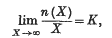
1. Let ξ, η denote the rectangular Cartesian coordinates of a point in a plane. Let J (ξ, η) denote a harmonic function which is positive in the half-plane η > 0. In this paper, we first show (Theorem I) that every such function J determines a non-negative number d, and a bounded non-diminishing function G(x), such that

In a paper which is to be published shortly formulae have been obtained for the virtual characters of the system of surfaces cut out on a primal of S4, having ordinary singularities, by adjoint primals of any order; an account of the principal results has been given elsewhere. As a first application of these formulae we propose in the present paper to investigate the canonical systems belonging to various threefolds and thence to construct the canonical models which correspond to them.
Let us consider a discontinuous bivariate distribution. That is, let us consider N × Q non-negative values pνq (ν = 1, 2, …, N; q = 1, 2, …, Q), being the theoretical probabilities of the νth value of a variate Xμ (μ = 1, 2, …, N) concurring with the qth value of a second variate Ys (s = 1, 2, …, Q).
The successful development in recent years of the topology of general closed sets is largely due to the application of combinatory methods, which have led to an elaborate theory of approximation of closed sets by infinite cycles, to the generalization of duality theorems for closed sets, and to a geometrical theory of dimensions. Corresponding to the combinatory invariants involved the main results of these theories concern for the most part properties of the set as a whole, which cannot possibly express fully its internal and in particular its local structure. Still less is our knowledge of the eventual relations between the local structure of a set and its properties in the large.
The theoretical method for computing the grade of a curve on an algebraic surface is well known. In practice difficulties arise which are not considered in the theory; so that it seems worth while to describe a practical method. This is done in § 1 of this paper. The method is then applied to some examples with the object of discovering whether Noether exceptional curves are necessarily exceptional curves†. In particular, a certain quintic surface with three tacnodes is studied, and our examination leads us to results which differ from those which have been accepted up till now. Another example illustrates the limitations of a practical method for computing grades, because of the possible presence of infinitesimal curves, and leads to the transformation of the quintic surface with two tacnodes into a double plane of order ten of a certain type, which has the singularity known as a (5, 5) point on its branch curve. Light is thrown on the Noether composition of this singularity by the transformation, which also shows the relation between two well-known types of surface for which the Noether relation p(2) = p(1) − 1 does not hold.
The probability relations which can occur between two separated physical systems are discussed, on the assumption that their state is known by a representative in common. The two families of observables, relating to the first and to the second system respectively, are linked by at least one match between two definite members, one of either family. The word match is short for stating that the values of the two observables in question determine each other uniquely and therefore (since the actual labelling is irrelevant) can be taken to be equal. In general there is but one match, but there can be more. If, in addition to the first match, there is a second one between canonical conjugates of the first mates, then there are infinitely many matches, every function of the first canonical pair matching with the same function of the second canonical pair. Thus there is a complete one-to-one correspondence between those two branches (of the two families of observables) which relate to the two degrees of freedom in question. If there are no others, the one-to-one correspondence persists as time advances, but the observables of the first system (say) change their mates in the way that the latter, i.e. the observables of the second system, undergo a certain continuous contact-transformation.
This problem, in the particular case of the hydrogen molecular ion, is so well known that a detailed reference to the large number of papers dealing with it is unnecessary. The investigations to which chief reference is made will be found at the end of this paper.
In a previous paper the present writer gave a solution of the problem of determining the circulation around a thin elliptic cylinder in a steady stream of slightly viscous fluid when the major axis of the cylinder is inclined at a small angle to the direction of the flow at infinity. The present note gives a largely qualitative analysis of the manner in which this circulation is built up when the motion of the fluid or cylinder is started instantaneously from rest with a given velocity.
Buri's method of solution of the equations of turbulent motion in a boundary layer has been used extensively in a previous paper. Since the results of that investigation have not been compared with experiment, nor has any other application of Buri's method been checked experimentally, it seems advisable to apply this method to a problem for which the experimental results are known.
We have examined the two-dimensional gliding of a semi-infinite plate on the surface of a stream of finite depth. We have calculated the lift L in terms of the ratio D/H, where H is the depth of the stream at infinity up-stream, and D is the height of the trailing edge of the plate above the surface of the stream.
In particular we have found that the trailing edge cannot be at a height of more than 0·07H approximately, above the up-stream fluid surface.
In conclusion, the writer would like to thank Prof. G. I. Taylor, F.R.S., for suggesting this problem and for his continued interest in it.
The probability of excitation of helium by electron impact to the more important doubly excited levels is calculated, and comparison made with the experimental results of Priestley and Whiddington who have observed two lines due to double excitation. The calculated relative intensities and angular distributions are found to be in qualitative agreement with experiment, and reasons are given for the lack of quantitative agreement.
Taylor and Fisk have discussed the internal conversion of magnetic multipole radiation by K electrons and have found internal conversion coefficients which are much larger than those for electric multipoles, and which increase with the order of the multipole. The object of the present note is to determine whether this state of affairs holds also for pair production by internal conversion of magnetic multipole radiation.
All the light elements up to aluminium and some heavier ones have been examined for disintegration by slow neutrons. Large effects have been found in lithium and boron and a small effect in nitrogen, the reactions being
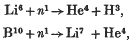
and probably

The charged particles emitted in the disintegration of lithium and boron afford a convenient and sensitive indicator for slow neutrons.
One of us (M. G.) desires to acknowledge the financial assistance received from the International Student Service, London, and from Magdalene College, Cambridge.
Experiments are described comparing the effects of neutrons slowed down in paraffin wax at the temperatures of liquid nitrogen and liquid hydrogen with those obtained at ordinary temperatures. It is found that the absorption produced by certain substances increases as the temperature is lowered. The transformations produced in these substances also increase, but generally to a smaller extent, probably owing to more neutrons being absorbed in the paraffin: the exact figure depends on the thickness of the layer of cooled paraffin.
A few experiments were also made substituting liquid hydrogen for paraffin wax (without change of temperature). The effect of this also appears to depend on the thickness of the layer, but it is not yet possible to draw definite conclusions.
1. The purpose of this note is to prove the uniqueness of the solutions of two closely related differential equations, under suitable boundary conditions. The first is the equation satisfied by the potential in the electrostatics of the new field theory proposed by Born, namely,