Contents
Research Article
On Homogeneous Ideals
-
- Published online by Cambridge University Press:
- 18 May 2009, pp. 105-111
-
- Article
-
- You have access
- Export citation
Note on Three-Dimensional Lie Groups
-
- Published online by Cambridge University Press:
- 18 May 2009, pp. 112-115
-
- Article
-
- You have access
- Export citation
General Products of Two Finite Cyclic Groups
-
- Published online by Cambridge University Press:
- 18 May 2009, pp. 116-123
-
- Article
-
- You have access
- Export citation
A Product of two E-Functions Expressed as a Sum of Two E-Functions
-
- Published online by Cambridge University Press:
- 18 May 2009, pp. 124-126
-
- Article
-
- You have access
- Export citation
-
The formula to be proved is

In proving (1) the following formulae are required:
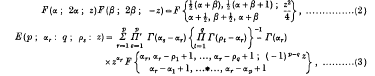
where p≥q + 1, (1).
Integrals Involving E-Functions and Associated Legendre Functions
-
- Published online by Cambridge University Press:
- 18 May 2009, pp. 127-128
-
- Article
-
- You have access
- Export citation
-
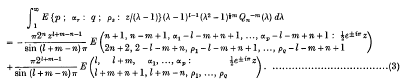
The formulae to be proved are as follows.
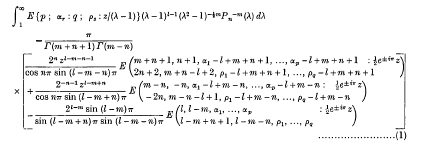
If p ≧ q + 1, R(l + m) > 0, R(αr − l − m + n)> −1, R(αr − l − m − n)> 0, r = 1,2,…p,
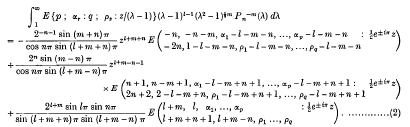
If p ≧ q + 1, R(l >0, R(l+m >0, R(αr − l − m + n)> −1,
Integrals Involving Products of Modified Bessel Functions of the Second Kind
-
- Published online by Cambridge University Press:
- 18 May 2009, pp. 129-131
-
- Article
-
- You have access
- Export citation
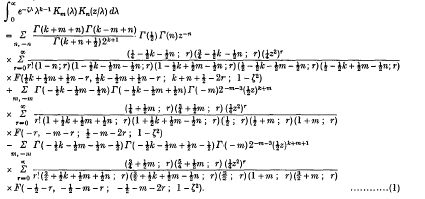
-
The formula to be proved is
Some Results involving Hypergeometric and E-Functions
-
- Published online by Cambridge University Press:
- 18 May 2009, pp. 132-138
-
- Article
-
- You have access
- Export citation
-
Recently R. S. Varma [11] gave the generalisation

for the Laplace transform

Since

(1) gives (2) when k = − m + ½.
We shall represent (1) by

and as usual, (2) will be denoted by


The Closest Packing of Spherical Caps in n Dimensions
-
- Published online by Cambridge University Press:
- 18 May 2009, pp. 139-144
-
- Article
-
- You have access
- Export citation
-
Let Sn denote the “surface” of an n-dimensional unit sphere in Euclidean space of n dimensions. We may suppose that the sphere is centred at the origin of coordinates O, so that the points P(x1, x2, …, xn) of Sn satisfy

We suppose that n≥2.
On Packings of Spheres in Hilbert Space
-
- Published online by Cambridge University Press:
- 18 May 2009, pp. 145-146
-
- Article
-
- You have access
- Export citation
-
A point x in real Hilbert space is represented by an infinite sequence (x1, x2, x3, …) of real numbers such that

is convergent. The unit “sphere“ S consists of all points × for which ‖x‖ ≤ 1. The sphere of radius a and centre y is denoted by Sa(y) and consists of all points × for which ‖x−y‖ ≤ a.

Two Integrals involving Modified Bessel Functions of the Second Kind
-
- Published online by Cambridge University Press:
- 18 May 2009, pp. 147-148
-
- Article
-
- You have access
- Export citation
Front matter
GMJ volume 2 issue 3 Cover and Front matter
-
- Published online by Cambridge University Press:
- 18 May 2009, pp. f1-f2
-
- Article
-
- You have access
- Export citation
Back matter
GMJ volume 2 issue 3 Cover and Back matter
-
- Published online by Cambridge University Press:
- 18 May 2009, pp. b1-b2
-
- Article
-
- You have access
- Export citation