

Introduction
In 2022, the populist radical right in Western Europe garnered substantial electoral success. While such parties have previously enjoyed stints in government, what distinguishes their recent success is the prominence of female party leaders who competed to be their countries’ national leaders. Emblematic of this trend are the cases of Fratelli d’Italia’s (FdI) Giorgia Meloni, who became Italy’s first female prime minister in October 2022 with 24% of votes (La Repubblica 2022), and Rassemblement National’s (RN) Marine Le Pen, who came close to becoming the first female President of the French Republic in April 2022, after scoring her best results to date in a presidential election (Franceinfo 2022).Footnote 1 Yet populist radical right leaders are often “strongmen,” men with authoritarian inclinations who are harsh and assertive (Ben Ghiat, Reference Ben Ghiat2020). The masculine nature of this stereotype raises the question: are the women who lead these parties also strongmen?
We build on the work of Geva (Reference Geva2023) on Le Pen as a “strong woman,” who portrayed herself as a tough advocate of border control—but also as a maternal protector of the nation. In this article, we theorize how populist radical right women leaders perform gender, navigating and integrating aspects of both hegemonic masculinity and hegemonic femininity. We define strongwomen as women characterized by three main traits: assertiveness and aggressiveness (ideals of hegemonic masculinity); strong beliefs about gendered and racial hierarchies (in line with hegemonic gender roles); and compassion, maternalism, and support for women’s rights (associated with hegemonic femininity).
The applicability of this notion to female leaders at the helm of populist radical right parties is still under-explored, despite being worth examining due to two compelling reasons. First, the growing electoral success of populist radical right parties and their leaders urgently requires an in-depth understanding of these political actors. Second, figures like Le Pen and Meloni arising as prominent leaders signal a noteworthy shift in the populist radical right, moving away from their traditional identities as Männerparteien, or parties for and by men (Mudde Reference Mudde2007).
Examining whether the more well-known concept of strongmen can be meaningfully transposed to female leadership, this article compares how Meloni and Le Pen perform gender as populist radical right female leaders.
After taking stock of the existing literature on framings of gender in populist radical right parties, we discuss the pivotal theoretical concepts of strongmen, hegemonic masculinity, and hegemonic femininity, incorporating the concept of femonationalism to foreground the interlinkages between gender and race hierarchies. We then dissect Le Pen’s and Meloni’s framing of gender and identify four themes: (1) the promotion of natality and motherhood in the context of the (heterosexual) family; (2) prescriptive maternity and opposition to abortion; (3) limitation of LGBTQ+ rights; (4) support for women’s rights, which, in the case of France, morphs into femonationalism. Taken together, our findings lead us to advance the notion of strongwomen as a conceptual tool enriching the scholarly understanding of the complex relationship between women’s political leadership and their stance on gender-related matters.
Gender and “The People” According to the Populist Radical Right
Populism is “an ideology which pits a virtuous and homogenous people against a set of elites and dangerous ‘others’” (Albertazzi and McDonnell, Reference Albertazzi and McDonnell2008, 3). Literature on gender in the populist radical right (see, for instance, Chueri and Damerow Reference Chueri and Damerow2023; Donà Reference Donà2020; de Lange and Mügge Reference deLange and Mügge2015; Giorgi and Loner Reference Giorgi and Loner2023) shows how prominent gender is in the construction of these parties’ ideology and policy. Yet it also highlights the growing political participation of women in the radical right, who have redefined the boundaries between “traditional and non-traditional femininity,” by simultaneously emphasizing their roles as wives and mothers, while also engaging in politics as “fierce racial warriors” (Blee Reference Blee2020, 420). The success of populist radical right female leaders like Meloni and Le Pen further suggests a renegotiation of idealized gendered models of leadership, privileging hegemonic masculine traits over stereotypically feminine ones (Chaudhury Reference Chaudhury2022, 943).
In the case of France, for example, an increasing number of women voted for the Front National (the former name of the RN), headed by Le Pen, in the 2012 presidential elections (Mayer Reference Mayer2015). Chueri and Damerow (Reference Chueri and Damerow2023) suggest that the decreasing gender gap among both populist radical right representatives and voters is due to the populist radical right’s conscious appointment of female leaders, who are perceived as being more responsive to women’s concerns over the alleged threat to gender equality posed by “illiberal” non-Western cultures. Puleo and Piccolino (Reference Puleo and Piccolino2022, 87) add, further, that women in populist radical right leadership have helped make their parties more “acceptable” to voters by counteracting the traditionally masculine self-presentation of populist radical right leaders with a softer and more feminine style of leadership. However, Giorgi and Loner (Reference Giorgi and Loner2023) note that while gender-related issues and female leaders are becoming more prominent, populist actors tend to give limited attention to feminist concerns, particularly after their electoral campaigns.
Gender is a social construct, performed by individuals according to the masculine or feminine traits attributed to their sexed bodies (Butler Reference Butler1998). In the case of populist radical right ideology, attention to gender equality has merged with nativist calls for the defense of women’s and gay and lesbian rights as “core civilizational values of the West” (de Lange and Mügge Reference deLange and Mügge2015, 62). Nativism, which combines nationalism and xenophobia, holds that the nation should be inhabited by the native group but is threatened by the presence of non-natives (Mudde Reference Mudde2019). In both the Italian and French cases, nativism paves the way to Islamophobia, i.e., unfounded hostility and fear toward Muslims (Kallis Reference Kallis and Rydgren2018), advancing the view that Muslims are not assimilable into Western societies (Mudde Reference Mudde2019). Through the phenomenon of femonationalism (Farris Reference Farris2017), populist radical right parties often intertwine the protection of the nation from Muslims with the safeguarding of women’s rights, using feminist ideas to make their parties appear more “mainstream” (Spierings Reference Spierings, Dietze and Roth2020), as well as to legitimize their Islamophobia (Farris Reference Farris2017). Femonationalism is apparent, for example, in accusations by populist radical right actors that Muslim men impose Islamic traditions, such as the hijab, onto Muslim women for misogynistic reasons (Havertz Reference Havertz2021). Such portrayals crystallize racial and gender hierarchies, portraying Muslim women as in need of salvation by Western men from Muslim men.
Strongmen and Hegemonic Femininity?
Strongmen are authoritarian and charismatic male leaders, characterized by aggressiveness and assertiveness. They are often found at the helm of radical right parties, as well as in contexts of growing authoritarian attacks on democracy. According to Ben Ghiat (Reference Ben Ghiat2020), strong female leaders such as Margaret Thatcher and Indira Gandhi cannot be categorized as strongmen because they were not authoritarian, nor did they seek to challenge democracy to the degree seen among leaders like Mussolini, Hitler, Trump, and Putin. However, she does not exclude the possibility of “strongmen” among female leaders of Western populist radical right parties. Yet she does not elaborate on how the concept of strongman could be applied to women, especially in democratic contexts like France and Italy.
Meloni and Le Pen emanate strength and firmness but are not outright authoritarian. Their parties, the FdI and RN, have certainly distanced themselves from the authoritarianism of their predecessors, the Alleanza Nazionale and Front National, respectively. They have done so by undertaking a moderation trajectory to enlarge their electorate and increase their respectability and legitimacy (Dézé Reference Dézé2012; Scrinzi Reference Scrinzi2017). Yet the FdI and FN still have a fraught relationship with democracy. On the one hand, they abide by a liberal democratic system of free and fair elections, rule of law, and accountability. On the other hand, they limit rights and liberties for immigrants and other minority groups, which infringes the liberal democratic protection of individual rights and liberties (Finchelstein and Urbinati Reference Finchelstein and Urbinati2018).
The concept of strongmen is predicated upon the notion of hegemonic masculinity, which is the practice of legitimizing the subordination of women and other (gendered) groups, such as gay men, to heterosexual men (Connell and Messerschmidt Reference Connell and Messerschmidt2005; Hamilton et al. Reference Hamilton, Armstrong, Seeley and Armstrong2019). Hegemonic masculinity invests such men with the mission “to protect weak and vulnerable women” (Rommelspacher Reference Rommelspacher and Birsl2011, 54), with the goal of ensuring the reproduction of heterosexual families and the nation (Sauer Reference Sauer, Dietze and Roth2020). The concept of hegemonic femininity is similarly predicated upon gender hierarchies, adding an “emphasized femininity” as well as beliefs about racial hierarchies (Connell and Messerschmidt Reference Connell and Messerschmidt2005). Hegemonic femininity thus adds a further layer of complexity to the concept of hegemonic masculinity: it inscribes gender in racialized dynamics where women are subordinated to men, but non-Western women are subordinated even further (Hamilton et al. Reference Hamilton, Armstrong, Seeley and Armstrong2019, 321). This intertwining of gender and racial hierarchies shows how hegemonic femininity is married to femonationalismFootnote 2 (Farris Reference Farris2017).
Building on these existing notions, we define strongwomen as women characterized by: (1) assertiveness and aggressiveness (characteristic of strongmen and rooted in hegemonic masculinity); (2) strong beliefs in gendered and racial hierarchies (associated with hegemonic femininity); (3) conventionally feminine traits (Winter Reference Winter2010) such as being compassionate, motherly, and supportive of women’s rights. The deployment of these conventionally feminine traits legitimizes women’s leadership in a traditionally male-dominated space, without meaningfully challenging gender hierarchies. Strongwomen thus both embody and reshape traditional notions of gendered political authority.
Methodology
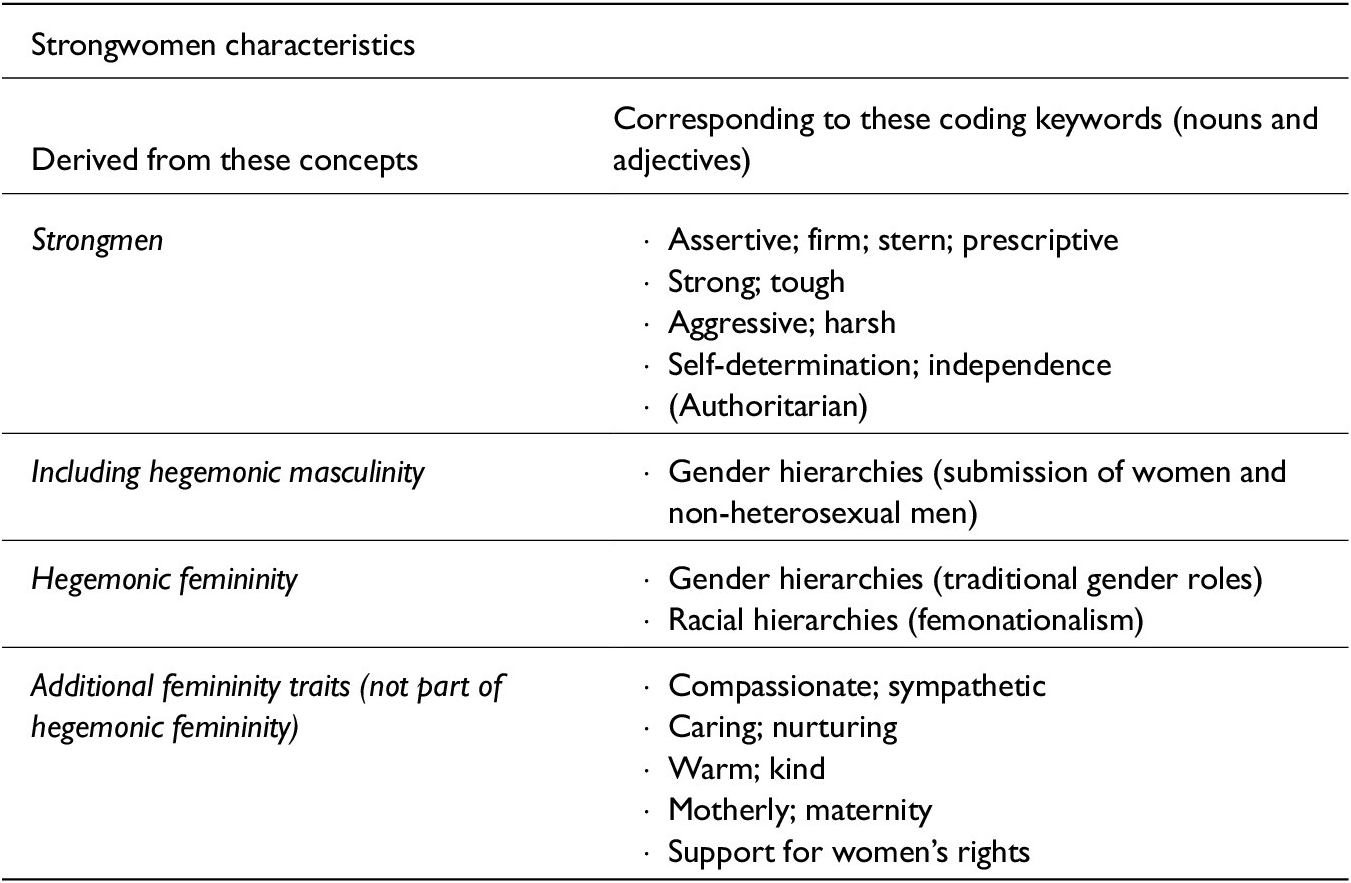
Table 1 operationalizes the concept of strongwomen, showing how it combines elements of hegemonic masculinity and hegemonic femininity, as well as other conventionally feminine traits. To explore this concept, we compare the cases of Le Pen and Meloni in their capacity as female populist radical right leaders. We acknowledge, of course, that other populist radical right parties have also been led by women, for example, Alice Weidel of the Alternative für Deutschland in Germany, Inger Støjberg of the Denmark Democrats, and Pia Kjærsgaard of the Danish People’s Party. However, we focus on Le Pen and Meloni because they are currently the two most prominent female figures in the current populist radical right political scene. The fact that they both contested elections in 2022 also enables us to collect and analyze data from roughly the same period in both cases.
Operationalization of the concept of strongwomen

Table 1. Long description
From the top row downward, the left column lists conceptual sources: Strongmen, Including hegemonic masculinity, Hegemonic femininity, and Additional femininity traits not part of hegemonic femininity. The right column provides coding keywords for each. For Strongmen: assertive, firm, stern, prescriptive, strong, tough, aggressive, harsh, self-determination, independence, and authoritarian. Including hegemonic masculinity: gender hierarchies, specifically submission of women and non-heterosexual men. Hegemonic femininity: gender hierarchies with traditional gender roles and racial hierarchies (femonationalism). Additional femininity traits: compassionate, sympathetic, caring, nurturing, warm, kind, motherly, maternity, and support for women’s rights. The table note clarifies that authoritarian traits are characteristic of strongmen, but populist radical right parties operate within democratic systems.
Note: As previously mentioned, “authoritarian” traits are characteristic of strongmen. However, populist radical right parties continue to operate within democratic systems.
We gathered various sources of data. First, we collected social media data from Twitter and TikTok, focusing on around 100 posts from Le Pen and Meloni’s personal accounts. We selected these rather than party accounts for two reasons. First, we are interested in their personal gender performances and ideologies. Moreover, as De Giorgi et al. (Reference De Giorgi, Cavalieri and Feo2023) suggest, Meloni and Le Pen run a vertical and personalized leadership; hence, their social media accounts provide a privileged perspective for the analysis of party platforms. Second, the reach of the personal accounts of these two leaders is much greater. As of March 2025, Meloni had 2.8 million followers on Twitter, while Le Pen had 3 million, compared to their respective party accounts with 353,180 and 388,000 followers. Similarly, on TikTok, Meloni had 2.3 million followers, compared to 230,300 for the FdI, while Le Pen had 1.2 million followers, compared to 490,500 for the RN.
Second, we gathered and analyzed textual data from party platforms and important speeches. This included the FdI and RN party manifestos for the 2022 elections. For Le Pen, we analyzed her speech after the RN made electoral gains in the June 2022 parliamentary elections (Europe 1 2022). For Meloni, we focused on her victory speech on election day (Meloni Reference Meloni2022e), as well as her maiden speech (first speech) in parliament after becoming prime minister (Meloni Reference Meloni2022d).
Together, this data allows us to explore gender performances from different vantage points, ranging from party leaders’ personal discourse on social media to official party discourse in manifestos and speeches. The timeframe for data collection ran from three months before the elections (broadly coinciding with the electoral campaign) to three months after the elections. We focus on the period after the elections, given that it is an important moment in agenda-setting for the Italian government led by Meloni. We replicated this approach for the French case for the sake of consistency across the two case studies. The resulting timeframe is January to July 2022 for France and June to December 2022 for Italy.
We use qualitative discourse analysis to study these materials. Table 1 shows how we operationalized our concepts of strongmen, hegemonic masculinity, hegemonic femininity, and femininity more broadly. To limit the risk of inconsistent analysis and to ensure intercoder reliability, both authors separately coded the data deductively. The analysis yielded two broad themes in the gender performances of Le Pen and Meloni. The first concerns ideas related to family and motherhood, assertively reinforcing traditional gender roles and hierarchies. The second theme revolves around women’s rights, evoking notions of both compassion and patriarchal protection.
Theme 1: The Family and Motherhood
Both Meloni and Le Pen assertively reinforce traditional gender roles and hierarchies, blending toughness with nurturing attitudes associated with motherhood. Their focus on family and motherhood fits well with the populist radical right’s championing of the (heterosexual) family as the cornerstone of society, while promoting women’s primary role as mothers. By way of illustration, the FdI opened its 2022 manifesto by foregrounding the family as “the foundational element of society,” quoting Pope John Paul II’s remarks about the family being a “Nation truly sovereign and spiritually strong” (FdI 2022, 5). Analogously, the RN’s manifesto depicts the family as the root of the French social and civilizational model and the first link in the chain of the national community (RN 2022). Despite their shared emphasis on the family and motherhood, the two parties diverge on abortion rights and rights for same-sex parents.
The (Heterosexual) Family: Natality, Motherhood, and the “Mother Card”
In populist radical right parties’ manifestos, it is common to find policies that pledge support for traditional gender roles within the family (Akkerman Reference Akkerman2015). Family policies are embedded in the social conservative view of the family as the core unit of the nation (Vampa Reference Vampa2023). For example, in her maiden speech in parliament in 2022, Meloni assertively defined the family as “the primary nucleus of our societies, the crib of affections, and the place where everyone’s identity is forged.” (Meloni Reference Meloni2022d). Nevertheless, Meloni’s and Le Pen’s personal circumstances do not fit with the model of the traditional family, diverging from the value placed by their parties on the (heterosexual) family composed of a mother, a father, and children (Heinisch and Werner Reference Heinisch and Werner2019, 484).
A pivot point of the traditional family is natality. The 2022 RN manifesto advocates demographic growth through financial aid for families with more than one child. However, in line with Le Pen’s nativist policy agenda, the 2022 RN manifesto restricts National Solidarity Benefits—including natality and family allowances, as well as social housing—to French families, thus excluding non-native ones. Moreover, in July 2022, Le Pen explicitly referred to “French families” in relation to the urgent need for “natality politics” as a solution to declining birth rates and to the perceived threats posed by immigration (Le Pen Reference Le Pen2022e). These concerns for natality reflect the nativist emphasis on demographic preservation as a means of countering population decline and replenishing the ranks of the native in-group (Rasmussen Reference Rasmussen2023). Similarly, the 2022 FdI manifesto heavily champions natality and proposes the creation of nurseries in workplaces, modeled after Germany’s Tagesmutter system. The natality policy proposals in FdI’s manifesto suggest a formal revision of traditional gender roles, aiming at promoting birth rates by relieving women from their care responsibilities. Along similar lines, Meloni’s maiden speech, given in 2022, simultaneously promoted natality and women’s employment (Meloni Reference Meloni2022d), thus hinting at the support of women’s rights.
While Le Pen and Meloni reconfigure traditional gender roles by formally encouraging women to pursue their professional careers and supporting them in balancing work and motherhood, they simultaneously reinforce women’s traditional gender role as mothers. Motherhood is framed not only as a private responsibility but also as a national duty, instrumental in addressing declining birth rates and in furthering the nativist agenda. The two leaders, though, differ in their approach. Le Pen explicitly ties natality to nativism, underpinned by racial hierarchies, whereas Meloni places greater emphasis on state support for working mothers, highlighting her support for women’s rights. Nevertheless, both leaders can be considered strongwomen. Le Pen’s more pronounced nativist approach to natality reinforces gender and racial hierarchies that are characteristic of hegemonic femininity. Similarly, Meloni’s emphasis on both motherhood and a professional career sustains traditional gender hierarchies typical of hegemonic femininity while also incorporating support for women’s rights.
Motherhood and womanhood become fused in what we call the “mother card,” or the strategic deployment of the status as a mother (and a woman) for political purposes. Through the mother card, Meloni foregrounds her political persona crystallized in both womanhood and motherhood. As Vampa observes (Reference Vampa2023, 28), the “woman-mother figure is a constant in the social policy model proposed by the Italian right.” Tellingly, the Ministry for Equal Opportunities has now become, under FdI, the Ministry for Family, Natality, and Equal Opportunities, highlighting the party’s focus on the traditional family and traditional gender roles equating women with motherhood (Vampa Reference Vampa2023). A striking example of Meloni’s mother card strategy is her use of motherhood to perform compassion in response to criticism over her handling of the 26 February 2023 Cutro shipwreck, which killed over 91 migrants, including 35 children (ANSA Redazione 27 March 2023).
Another instance of Meloni’s using the mother card is her recurrent self-presentation as: “I am Giorgia, I am a woman, I am a mother, I am Christian” (Meloni Reference Meloni2019). Through this statement, Meloni continually reaffirms her identity as a woman and as a mother, while also emphasizing the Christian roots that are integral to her party (Vampa Reference Vampa2023). The nexus between Christian values and motherhood is widespread in the populist radical right (Norocel and Giorgi Reference Norocel and Giorgi2022). The FdI’s appeal to Christianity, identifiable in its manifestos since 2014, is inextricably entangled with its traditional views on the family and gender roles (Vampa Reference Vampa2023). Beyond the religious element, the trinity “Giorgia-woman-mother” has now become emblematic of Meloni’s identity (Vampa Reference Vampa2023) and is evident in her TikTok video where she maternally receives flowers from two little girls before a public speech (Meloni Reference Meloni2022f). Although flowers are not per se feminine, they have been associated with feminine attributes in the literature and arts since at least the Middle Ages (Stott Reference Stott1992). Moreover, the color pink, often used as a marker of gender and sexuality (Koller Reference Koller2008), appears in Meloni’s tweeted selfie with her daughter next to a pink-decorated Christmas tree (Meloni Reference Meloni2022b).
Likewise, Le Pen’s stereotypically feminine caring attitude is evident in her TikTok videos. Using the hashtag #MomentsdeCampagne, she performs the role of a beloved maternal leader (specifically, the mother of the nation) surrounded by enthusiastic supporters and children giving her flowers and hugs (Le Pen Reference Le Pen2022h). As Geva remarks (Reference Geva2020), the use of flowers was also predominant in Le Pen’s 2017 presidential campaign, where she deployed the symbolic blue rose as a sign of both femininity and conservatism. Despite sharing feminine traits and pro-natality policy pledges, Le Pen stands apart from Meloni in the significance she gives to family, motherhood, and the mother card (Snipes and Mudde Reference Snipes and Mudde2019). Notably, the concept of the “traditional family” was a prominent theme in Le Pen’s early career, aligning with the FN’s promotion of traditional values, specifically its opposition to same-sex partnerships and abortion (Scrinzi Reference Scrinzi2023). In the 2022 RN manifesto, however, Le Pen does not prioritize the issue of motherhood.
A rare reference to Le Pen’s identity as a mother and a subtle use of the mother card only surfaced when she declared, “I am French, a patriot, a mother of three children whom I raised alone, I am a fighter” (Le Pen Reference Le Pen2021). Through this statement underscoring Le Pen’s role as an independent single mother, Le Pen emphasizes her credentials as a mother of the nation (Campus Reference Campus2013), who is tough, assertive, and motherly in the mission of protecting her country. A similar assertive and protective attitude can be identified in Le Pen’s promising legislative results, when she firmly and confidently claimed that her party represents the French nation and “the interests of the French people” (Europe 1 2022).
In the context of the role as a mother of the nation, another key difference between Le Pen and Meloni becomes clear. Le Pen frames her arguments in secular terms to avoid invoking religion, focusing instead on preserving the French cultural and national identity. As argued by Scrinzi (Reference Scrinzi2023), Le Pen emphasizes the principle of French laïcité —the strict separation of religion and state—as a cornerstone of her discourse and as a means to bolster the RN’s anti-Islam and nativist positions.
Prescriptive Maternity: Anti-Abortion
A consequence of the different approach to and weight placed on the family and motherhood is Meloni’s and Le Pen’s positions on abortion. Despite attempts to moderate the FdI ideology after coming into power, Meloni’s radicalism in terms of conservative values emerges clearly in her anti-abortion discourse, which diverges from Le Pen’s more moderate approach to the matter. In Meloni’s posts and FdI’s 2022 manifesto, the “prevention of abortion” is accorded foremost importance. Despite being nebulously formulated, the FdI’s recipe to prevent abortion is to offer financial help to single women and those facing financial hardships, encouraging them to carry their pregnancies to term (FdI 2022). Several of Meloni’s TikTok posts (Meloni Reference Meloni2022c; Meloni Reference Meloni2022h) are dedicated to the issue. Notably, Meloni has stated that the FdI does not plan to abolish Law No.194, which guarantees women’s right to abortion in the first 90 days of pregnancy for health, economic, social, or family-related reasons (Meloni Reference Meloni2022h). The FdI’s manifesto (2022, 5) also clarifies that the party has no intention of preventing the “full application of the 1978 Law No. 194 on the voluntary interruption of pregnancy.” According to Meloni, prevention is a way to defend women’s personal autonomy (Meloni Reference Meloni2022h), even if a closer scrutiny of Law No. 194 reveals that it does not infringe women’s self-determination and their choice not to undergo an abortion. Importantly, preventing abortion is consistent with Meloni’s pledge to “protect human life since its beginning,” which is an expression of the party’s solid Christian foundations (FdI 2022, 5).
As a result of the emphasis on natality, motherhood, and the prevention of abortion, maternity becomes implicitly prescriptive for women. Meloni’s maternity mantra, which is both assertive and aggressive, reflects the “normative cult of motherhood” (Pető Reference Pető, Kahlert and Ernst2010), whereby being childless is envisaged as an evisceration of women’s role (Mudde Reference Mudde2007, 92). The indissoluble linkage between women and mothers springs from the conservative gendered family roles and from the gendering of the nation: women are entrusted with the mission of ensuring the continuity of the nation through natural procreation and the nurturing of the offspring (Yuval-Davis Reference Yuval-Davis1997).
Le Pen’s silence on abortion speaks volumes to her difference from Meloni. In Le Pen’s “republicanized” and secular RN (Scrinzi Reference Scrinzi2023), there are no mentions of any measures for or against abortion in manifestos, public speeches, and social media accounts, apart from making a comment on the US anti-abortion laws, stating that in France no significant party wants to limit this right (Le Pen Reference Le Pen2022g). Instead, according to Le Pen, what is imperiling women’s rights in France is Islamism (Le Pen Reference Le Pen2022g). It is worth noting, further, that in March 2024, the RN even voted in favor of the law that made abortion a constitutional right in France (Abboud Reference Abboud2024). Unlike Meloni, therefore, Le Pen’s stance on abortion does not center on prescriptive maternity, but rather on a strategic defense of women’s rights framed within a nativist and anti-Islamist discourse.
Anti-LGBTQ+ Attitudes
The assertive and harsh traits distinctive of strongwomen are present in Italy in discussions over LGBTQ+ rights that are inextricable from the populist radical right’s views on the traditional family. In contrast, in France, sympathy toward LGBTQ+ rights predominates. Meloni has always championed the traditional heterosexual family, while maintaining ambivalence on LGBTQ+ rights. An emblematic example is when, in a public speech, Meloni was interrupted by a young man who stormed onto the stage waving an LGBTQ+ flag and calling for the rights to same-sex marriage and adoption (Meloni Reference Meloni2022a). Meloni’s composed reaction belied her lack of support for adoption by same-sex parents. Her firm response to the protester revealed that she considered civil unions as a sufficient concession to LGBTQ+ individuals: “You can have civil unions, so you can do whatever you want” (Meloni Reference Meloni2022a). Feo and Lavizzari (Reference Feo and Lavizzari2021) label the populist radical right’s obsession with the traditional heterosexual family as a form of familialism, which evokes a biopolitical view of the heterosexual family as the foundation of the nation, whereby the reproduction of the nation takes priority over individuals’ gender self-determination (Grzebalska and Pető Reference Grzebalska and Pető2018, 167). In this context, non-heterosexual families are feared to tear apart the social fabric of the nation.
Strategic ambivalence repeatedly infuses Meloni’s anti-LGBTQ+ stances. The FdI’s 2022 manifesto stresses that the party does not want to revoke the existing law allowing civil unions, even as it shows hostility toward same-sex parents’ adoptions. The manifesto declares its mission of “maintaining the law on civil unions, reiterating at the same time the prohibition of same-sex parents’ adoptions, [as being] in the utmost interest of minors” (FdI 2022, 21). This affirmation reflects the growing trend whereby populist radical right parties do not alter the core of their heteronormativity, while attempting to pass as tolerant. Meloni’s highlighting of a gay man’s vow to support FdI (Meloni Reference Meloni2022j) is another instance of the strategic ambivalence that subtly covers Meloni’s anti-LGBTQ+ sentiments in political rhetoric intended to pass as tolerant and attract some marginalized groups, i.e., lesbian, gay, and bisexual, to the detriment of other gender and race-defined groups, i.e., non-binary, transgender, and queer people, as well as Muslims (Foster and Kirke Reference Foster and Kirke2022).
When it comes to so-called “gender ideology,” the FdI’s antagonistic stance is patent, despite their unclear understanding of what this term actually means. According to Kantola and Lombardo (Reference Kantola and Lombardo2020, 566), “gender ideology” is a term used by the populist radical right as a shorthand for the view that gender equality is dangerous, because it “challenges traditional family values based on heteronormative relations and education; the sexual division of labour that assigns women the main role in the domestic and private sphere and men the main role in the public sphere; and sexual and reproductive rights.” It is no surprise, therefore, that the FdI has traditionally opposed adoptions by same-sex parents (Griffini Reference Griffini2023) and same-sex marriages (Feo and Lavizzari Reference Feo and Lavizzari2021).
French law, in contrast, has allowed same-sex marriages and adoptions since 2013. Le Pen has not vocally opposed these laws (Akkerman Reference Akkerman2015). Interestingly, at the time when the law was passed, Le Pen was against same-sex marriages and adoptions, claiming that a family could be only composed of a mother and a father, but she supported civil same-sex partnerships (FN 2012). However, after 2013, matters concerning the LGBTQ+ community disappeared from Le Pen’s discourses and manifestos. In fact, Judis (Reference Judis2016, 203) describes Le Pen as “twice-divorced, pro-choice, and comfortable around gays,” which tallies with Le Pen’s avoidance of discussions on abortion and LGBTQ+ rights. This is to be understood against the backdrop of the dédiabolisation (de-demonization) undergone by the RN to partially cleanse its radical image (Dézé Reference Dézé2012; Wievorka Reference Wievorka2013).
Theme 2: Protecting Women’s Rights
In keeping with their self-projection as strongwomen, both Meloni and Le Pen act as compassionate but tough protectors of women (Saccà and Selva Reference Saccà and Selva2021). This allows them to herald both strongmen and feminine traits. Yet Le Pen’s and Meloni’s pro-women’s rights stances have often been ambivalent from a feminist perspective. This pattern aligns with conservative women more generally, who may claim to speak for women, while harming women’s very own interests (Celis and Childs Reference Celis and Childs2018, 6). Strongwomen, we theorize, display strong advocacy also in support of women’s rights. In their worldview, however, women’s rights, such as self-affirmation and gender equality, are predominantly for Western women. When it comes to non-Western women, the promotion of women’s rights becomes a smokescreen for harshness against immigrants, reinscribing racial hierarchies.
Rights for (Western) Women
Meloni advocates for women’s rights by proposing supportive measures for working mothers (FdI 2022). However, even in this instance, Meloni does not escape traditional gender roles through her emphasis on women as reproducers within heterosexual families. Additionally, the 2022 FdI’s manifesto and Meloni’s maiden speech call for the breaking of the glass ceiling that prevents women’s participation in the workplace, while also fighting against the gender pay gap, every form of discrimination, violence against women, and gender stereotypes. In fact, Meloni is a prime example of a woman seeking to juggle work with motherhood (Meloni Reference Meloni2022d).
Similarly, on Twitter, Le Pen assertively reclaims her independence as a “free woman” who owes nothing to “political parties, bankers, or big companies” (Le Pen Reference Le Pen2022d). On International Women’s Day in 2022, Le Pen affirmed that “the election of a woman as President is an occasion to take women’s rights to the center of the State” (Le Pen Reference Le Pen2022f). In a later Tweet, she proclaimed that, as France’s female leader, she would be determined to close the gender gap in salaries, as well as respond harshly to threats to women’s safety (Le Pen Reference Le Pen2022i). On the International Day for the Elimination of Violence against Women, she tweeted: “I think of every woman victim of sexual or physical violence. We have one duty: to protect [women] and sanction those who are guilty” (Le Pen Reference Le Pen2022b). Similarly, on International Women’s Day, Le Pen asserted that “at the time when women face all sorts of violence […], we have to constantly fight to guarantee their protection and dignity” (Le Pen Reference Le Pen2023).
On 2023 International Women’s Day, Meloni also expressed tough condemnation of violence against women. Indeed, she warmly but firmly expressed gratitude to the courageous women throughout history and commemorated women victims of femicides (Reference Meloni2023). To a greater degree than Le Pen, she spoke out vehemently against violence against women (Reinhardt et al. Reference Reinhardt, Heft and Pavan2023, 9). On the International Day for the Elimination of Violence against Women in 2022, Meloni wrote that the government takes primary responsibility for preventing and punishing violence against women, including femicides (Meloni Reference Meloni2022g). Interestingly, in the year before the elections, Meloni dedicated several posts to violence against women perpetrated by immigrant men (see, for instance, Meloni Reference Meloni2021). Nonetheless, this topic disappeared once the 2022 electoral campaign started.
Femonationalism for Non-Western Women
Tough advocacy for women’s rights exposes its fault lines when it comes to non-Western women. The latter are treated with cosmetic compassion, as a sheen to cover beliefs in race hierarchies embedded in hegemonic femininity. Through a femonationalist frame, women’s rights are twisted into antagonism against Islam, portrayed as “barbaric, repressive, misogynistic […] hostile to the West” (Kallis Reference Kallis and Rydgren2018, 84). Consequently, women’s rights become the linchpin of anti-immigration agendas (Akkerman Reference Akkerman2015, 40) and of Islamophobia. The consequences are that, first, Western women are envisaged as in need of protection against Muslim immigrant men. Second, Muslim (immigrant) women are perceived as “oppressed Orientalist objects” (Farris Reference Farris2017, 184) who must be safeguarded (Pettersson Reference Pettersson2017, 13). Using pro-women’s rights ideals for anti-immigrant and anti-Islam campaigns precisely uncovers the performative contradictions of populist radical right parties’ discourse (Farris Reference Farris2017).
Femonationalism is considerably more conspicuous in the case of Le Pen compared to Meloni. During the 2022 presidential campaign, Le Pen’s aggressive, war-like words, such as “eradicate” and “being at war” against Islamism, were rooted in the fear of the loss of native cultural values such as women’s equality (see, for instance, Le Pen Reference Le Pen2022e). Notably, the RN’s predecessor, the FN, was among the pioneers in shaping anti-Muslim discourse in Europe (Dézé Reference Dézé2012; Wievorka Reference Wievorka2013). Its leader, Marine Le Pen, has persevered in using the term “Islamism,” adopted first by her father, to identify a “pervasive totalitarian ideology that must be fought” (Le Pen Reference Le Pen2022c).
Le Pen’s femonationalism is particularly evident when she aggressively denounces “Islamism” for forcing women to wear the veil and describes hijab-wearing women as facing isolation (Le Pen Reference Le Pen2022g). Le Pen also denounces the burkini, a swimsuit worn by Muslim women, as a costume of “Islamist” propaganda, which she proposes to ban in her mission to protect women’s rights (Le Pen Reference Le Pen2022a). The veil, for its part, has been a longstanding proxy for the populist radical right’s conflict against the supposedly regressive gender values embraced by Muslim immigrants (Choi et al. Reference Choi, Poertner and Sambanis2023). As Akkerman (Reference Akkerman2015) notes, the populist radical right defines gender equality and religious freedom as a bulwark against the coercion allegedly exercised against Muslim women by Muslim family members and religious authorities.
Meloni, in contrast, is less vocal on the issue of protecting Muslim women from Muslim men. Despite the absence of femonationalist overtones in her discourse, in September 2022, Meloni sternly confirmed her support for Iranian women’s revolt against their oppression by Islamic fundamentalism. On that occasion, she tweeted: “Iranian women today are in revolt, challenging fundamentalist regimes by ripping off their veils and cutting their hair in the square and, in turn, risking arrest and death. I am close to them for the courage they show, fighting head-on against Islamist obscurantism.” (Meloni Reference Meloni2022i)
Additionally, Meloni took to Twitter to assertively denounce violence against all women and praise the Muslim women fighting against violence perpetrated by Muslim men (Meloni Reference Meloni2022i). Mild femonationalist undertones are laid bare only when Meloni warns against excessive tolerance of “other cultures and religions,” which may overshadow violence against women and, thus, clash with women’s rights (Twitter Meloni Reference Meloni2022i).
Conclusion
Populist radical right parties in some countries have promoted women to top-level political roles. Le Pen came close to winning the French presidency in 2022. Meloni, for her part, became Italy’s first female prime minister. While there is copious literature on how the populist radical right frames gender, comparative analysis of female leadership in the populist radical right has been missing. This article thus seeks to contribute to the growing academic attention to Le Pen and Meloni, which is particularly significant given their political clout at the national and EU levels.
Driven by the research question over how Meloni and Le Pen perform and frame gender-related matters, this article breaks new ground in its comparative and systematic exploration of the concept of strongwomen. These findings may be extended beyond Italy and France, since globally female leadership in the populist radical right is not a rare occurrence. However, our findings do not lay claim to causal connections between gender and leadership. We also do not claim that male leaders in the populist radical right would perform gender and frame gender-related matters differently.
We build on Ben Ghiat’s (Reference Ben Ghiat2020) ground-breaking concept of strongmen, understood as tough and aggressive leaders like Mussolini and Trump, by adding a focus on hegemonic femininity (with its related beliefs in gender and race hierarchies), together with an emphasis on stereotypical feminine traits. With this in mind, we conceptualize strongwomen as a related but distinct phenomenon to strongmen, through the fusion of toughness and aggressiveness (typical of strongmen) with gender and race hierarchies (underpinning hegemonic femininity), complemented with caring and nurturing traits (stereotypical of femininity).
Corroborated by the qualitative discourse analysis of a host of social media posts from Twitter and TikTok, public speeches, and manifestos collected in the three months before and after the 2022 elections, our findings clearly suggest that Le Pen and Meloni can be categorized as strongwomen, despite displaying a slightly different combination of strongwomen traits. We show how Meloni combines typically feminine nurturing attitudes toward motherhood and women’s rights with a strongman’s harshness against LGBTQ+ rights and abortion, and in favor of the traditional family and prescriptive maternity. The consolidation of the gender and racial hierarchies inscribed in hegemonic femininity constitutes a strongwomen element common to both Meloni and Le Pen. However, compared with Meloni, Le Pen’s femonationalism presents a more aggressive push for racial hierarchies, masked as the protection of (non-Western) women’s rights. In addition, Le Pen lacks aggressiveness against LGBTQ+ rights and abortion, but, like Meloni, she champions the centrality of the family and (nativist) natality policies.
While this study constructs an original conceptual approach useful to the understanding of how populist radical right female leaders view and perform gender, further research is needed to explore how the concept of strongwomen manifests itself across different geographical contexts. The extension of our study is ever more needed in the current global political landscape, where the populist radical right is expanding its influence, and gender plays a growing role in their platform and leadership. A focus on women leaders in the populist radical right provides a more nuanced view of how norms about masculinity and femininity combine to challenge traditional patterns of political authority, while also reinforcing traditional gender roles.
Acknowledgments
We are grateful for the invaluable comments from the editor and three anonymous reviewers. We also wish to tank Dr Margherita de Candia for her precious suggestions on previous drafts.
Funding declaration
Support for this study was provided by the NUlab (Northeastern University) conference travel grants, Spring 2025.
Competing interests
The authors declare no conflict of interest.

 Open access

