


The residential neighbourhood in which people live has the potential to influence diet intake by providing environments that can support either healthy or unhealthy dietary behaviours(Reference Glanz, Sallis and Saelens1). There is some evidence to suggest exposure to unhealthy food outlets selling mostly processed, energy-dense foods such as fast food outlets, takeaways, café restaurants and convenience stores may promote unhealthy dietary behaviours(Reference Gustafson, Sharkey and Samuel-Hodge2–Reference Bernsdorf, Lau and Andreasen4), whilst exposure to healthy food outlets selling fresh produce, fruit and vegetables (i.e. supermarkets and greengrocers) may support healthy dietary behaviours(Reference Moayyed, Kelly and Feng5). Therefore, creating neighbourhoods that provide opportunities to purchase healthy food and limit exposure to unhealthy food represents a potential strategy for addressing the current obesity epidemic(Reference Sallis and Glanz6).
Understanding how individuals interact with their environment is crucial for informing public health strategies aimed at improving dietary intakes and reducing obesity. The current ecological approach to understanding dietary intakes recognises that what people eat is the result of complex interactions between multiple factors including a range of social, individual and environmental determinants(Reference Glanz, Sallis and Saelens1). As outlined in their model, Glanz et al.(Reference Glanz, Sallis and Saelens1) propose that the relationship between the local food environment (i.e. location, type and mix of food outlets around the home) and dietary patterns can be moderated or mediated by a range of individual variables including demographic, psychosocial or perceived environment variables.
To date, reviews show a lack of clear evidence for a link between the local food environment and diet, with most research being cross-sectional with mixed findings(Reference Black, Moon and Baird7,Reference Caspi, Sorensen and Subramanian8) . Stronger evidence linking changes in the local food environment with changes in dietary behaviours is needed to inform urban design policies and planning regulations. The few natural experiments investigating the ‘before-and-after’ effects of changes to the local food environment show little influence on diet(Reference Cummins, Findlay and Higgins9–Reference Thornton, Ball and Lamb13). However, these studies focused mainly on how opening a new supermarket influences fruit and vegetable intake of people from predominantly low socio-economic areas within the UK and US. Furthermore, research examining the impact of residential relocation on health and behaviour has been limited to physical activity(Reference Hirsch, Moore and Clarke14,Reference Giles-Corti, Bull and Knuiman15) and body weight outcomes(Reference Hirsch, Moore and Barrientos-Gutierrez16,Reference Braun, Rodriguez and Song17) . Longitudinal studies linking changes in the local food environment to changes in diet provide high-quality evidence but remain limited(Reference Richardson, Meyer and Howard18–Reference Boone-Heinonen, Gordon-Larsen and Kiefe21). Indeed, these studies show some evidence that increased numbers of fast food outlets and convenience stores around the home may contribute to a lower diet quality and increased unhealthy food intake(Reference Richardson, Meyer and Howard18–Reference Boone-Heinonen, Gordon-Larsen and Kiefe21). Yet, none of these studies simultaneously examined the role of individual and environmental factors on dietary intake. Therefore, studies examining how changes in the local food environment are related to changes in dietary intake, and what mediates these relationships, are needed to improve our conceptual understanding of the role environmental factors play in influencing dietary intake.
In Perth, Western Australia, the RESIDential Environments (RESIDE) Project provided a unique opportunity to study the effect of residential relocation on dietary intake. RESIDE was a longitudinal natural experiment from 2003 to 2012 of people relocating from their home within an established neighbourhood into one of the seventy-three new residential developments(Reference Giles-Corti, Knuiman and Timperio22). New developments were typically located in outer suburban, greenfield areas and infill locations (i.e. brownfield sites), further from the Perth Central Business District. Compared with established neighbourhoods, the local food environments within new developments were characterised by a lower percentage of healthy food outlets (including supermarkets and greengrocers) and greater distances from home to the nearest supermarket/greengrocer(Reference Bivoltsis, Trapp and Knuiman23). These findings suggest that people relocating from an established neighbourhood to a new development may experience a change in their local food environment with fewer opportunities to purchase healthy food and greater exposure to unhealthy food, and this change may impact their dietary behaviours.
This study uses data from two points of the RESIDE project to examine the influence of changes in individual behaviours, perceptions and spatial exposure to the local food environment on changes in dietary intake following relocation (i.e. relocating from an established neighbourhood to a new residential development). It is hypothesised that (1) after controlling for socio-demographics and self-selection, people relocating to new developments with increased proximity and density of unhealthy food outlets and a lower percentage of healthy food outlets will have poorer diets, and (2) these relationships will be mediated by changes in individual behaviours and perceptions of the local food environment.
Methods
Sample and data collection
The RESIDE project is a longitudinal natural experiment from 2003 to 2012 of people who relocated from their home within an established neighbourhood into one of the seventy-three new residential developments across Perth, Western Australia. Full details of the sample procedures are provided elsewhere(Reference Giles-Corti, Knuiman and Timperio22). In brief, people identified as building homes within new developments were invited to participate (response rate 33·4 %). In total, 1811 adults were recruited into the study at baseline. Participants completed a self-reported questionnaire on physical activity, health, lifestyle behaviours, perceptions, usual food intake and socio-demographic variables at four time points: T1 prior to relocating (baseline: 2003–2005), T2 (1–2-years post move: 2004–2006), T3 (2–3 years post move: 2006–2008) and T4 (6–9 years post move: 2011–2012).
The current study draws on data from 1811 participants who completed T1 and 1464 participants who completed T2 and was restricted to those who moved from their house located in an established neighbourhood at T1 into a new development at T2 (n 1225; 68 %). The remaining 239 participants, who were excluded, did not move house between T1 and T2, or moved elsewhere (i.e. outside the study area or into an established area). A further twenty-five participants were omitted because they did not provide complete dietary data (n 18) or participant characteristics (n 7), resulting in a final sample of 1200. The date of T1 questionnaire completion ranged from September 2003 to September 2005, and the date of T2 questionnaire completion was July 2004–February 2007. Overall, 91·4 % of participants completed their T2 questionnaire within 6–18 months after moving into their new house.
Measures
Dietary outcomes
The RESIDE project collected dietary data across the four time points (T1, T2, T3 and T4) in varying detail. The most comprehensive dietary data were obtained at the fourth time point (T4). At T1 and T2, a subset of six dietary questionnaire items were collected: (1) How many serves of vegetables do you usually eat each day (including fresh, frozen and tinned)?; (2) How many serves of fruit do you usually eat each day (including fresh, dried, frozen and tinned fruit)?; (3) How often do you eat red meat (beef, lamb and kidney but not pork or ham) including all minimally processed forms of red meat such as chops, steaks, roasts, rissoles, mince, stir-fries and casseroles?; (4) How often do you eat chips, French fries, wedges, fried potatoes or crisps?; (5) How often do you eat meat products such as sausages, frankfurters, polony, meat pies, bacon or ham? and (6) What type of milk do you usually consume? Fruit and vegetable intakes were rated on a scale from 0 to 5 (0 = do not eat to 5 = 6 serves or more). The frequency of intake for items 3, 4 and 5 was rated from 0 to 6 (0 = never to 6 = most days, i.e. 6–7 d/week). Item 6, milk type, was coded 0 = whole (full cream), 1 = other (soya, lactose free, low or reduced fat, do not drink milk) and 2 = skim.
Using the above six dietary questionnaire items, and a previously described approach(Reference Bivoltsis, Trapp and Knuiman24), an a priori diet quality score (the simple RESIDE dietary guideline index or S-RDGI1) was calculated to assess diet quality in this study at T1 and T2. In brief, at T4, a diet quality index (RDGI) was derived using the most comprehensive dietary data available. A multiple linear regression model was then fitted using the RDGI scores (dependent variable) and the scores of the subset of six dietary questionnaire items (independent variables), from which the estimated regression equation was used to predict the dependent variables (S-RDGI1) at T1 and T2 when only the independent variables (six subset of scores) were known.
Diet quality scores ranged from 0 to 100 with higher scores reflecting a better diet quality. Diet quality indices combine the healthy and unhealthy aspects of diet within a single construct, and there may be many ways to achieve a middle score. Therefore, in addition to the overall diet quality score, the raw frequencies of those foods recommended by the Australian Dietary Guidelines(25) to increase in the diet (items 1, 2 and 6) were summed to create a ‘healthy’ component score (range = 0–12) with higher numbers reflecting a healthier diet and the raw frequencies of those foods recommended to limit in the diet (items 3, 4 and 5) were summed to create an ‘unhealthy’ component score (range = 0–18) with higher numbers reflecting an unhealthier diet. The raw frequency categories for fruit and vegetable intake were also summed to create a single measure for comparability with previous studies (range = 0–10).
Spatial exposure to the local food environment
The locations of food outlets were sourced from a commercial database (SENSIS Pty. Ltd.) at temporally matched time points of 2004 (baseline) and 2006 (follow-up). Validation studies indicated moderate to good agreement between commercial listings and in situ locations of food outlets(Reference Hooper, Middleton and Knuiman26). All food outlets present were classified into twenty-one types based on information relating to the types of food items sold and methods of service and distribution (online Supplementary file 1). Using geographic information systems, the following spatial exposure measures were generated for the geocoded residential addresses of the 1200 participants at T1 and T2: (1) Count within a 1·6-km road network buffer around the home of the four most frequently highlighted food outlet categories within the literature including takeaway/fast food (i.e. sum of all takeaway and fast food outlets), convenience stores, café restaurants and supermarket/greengrocers (i.e. sum of all supermarket discount, supermarket small, supermarket large and greengrocers). A 1·6-km road network buffer was chosen to reflect the way ‘neighbourhood’ was conceptualised within the RESIDE study and represents a 15-min walk (30-min round trip)(Reference Giles-Corti, Timperio and Cutt27) known to capture 95 % of usual walking destinations(Reference Smith, Gidlow and Davey28). Furthermore, road network buffers may capture outlets accessible by walking more effectively than Euclidean buffers(Reference Oliver, Schuurman and Hall29); (2) Proximity to supermarket/greengrocers, convenience stores, café restaurants and takeaway/fast food outlets was represented by calculating the shortest road network distance (km) from home to the nearest food outlet type from each category; and (3) A relative measure of the percentage of healthy food outlets was calculated within each 1·6-km road network buffer to account for mounting evidence, suggesting that relative measures may be more appropriate than absolute measures for conceptualising exposure(Reference Clary, Ramos and Shareck30,Reference Mason, Bentley and Kavanagh31) . Firstly, all twenty-one food outlet types were assigned an individual score based on the average of those applied in existing Australian studies(Reference Thornton and Kavanagh32,Reference Moayyed, Kelly and Feng33) (see online Supplementary file 1 for a list of assigned scores). Negative scores were considered ‘unhealthy’ food outlets (UN) and positive scores ‘healthy’ food outlets (H). A modified version of the retail food environment index (MRFEI)(Reference Spence, Cutumisu and Edwards34) was then derived using the count of all ‘healthy’ outlets divided by the total count of all twenty-one outlets multiplied by 100(Reference Mason, Bentley and Kavanagh31). A higher MRFEI represents a greater relative percentage of ‘healthy’ food outlets and therefore a ‘healthier’ food environment.
Since previous RESIDE findings demonstrated that having a supermarket within 0·8 km of home by road was associated with a healthy eating score at T4(Reference Trapp, Hickling and Christian35), sensitivity analyses were run with 0·8-km road network buffers to investigate the possibility of scale effects. Given that over 90 % of participants had access to a motor vehicle, and food purchase is likely to occur at distances >1·6 km(Reference Thornton, Crawford and Lamb36), additional buffers of 5 km were examined. All spatial analyses were undertaken using ArcGIS Desktop version 10.5.1 (Environmental Systems Research Institute).
Individual behaviours
Participants were asked two questions on a seven-point scale (0 = never to 6 = 6–7 times/week) ‘How often do you eat meals that are bought from a canteen or takeaway food shop’ and ‘How often do you eat meals that are bought from a restaurant or café’. Reliability of these items was high with test–retest reliability determined via intraclass correlations of 0·82 and 0·83, respectively(Reference Marks, Webb and Rutishauser37,38) . An additional binary (yes, no) variable indicating if participants walked for either transport or recreation within their neighbourhood to or from a café or restaurant was captured by asking whether ‘You might walk to or from a café or restaurant as a means of transport/recreation in your neighbourhood or local area in a usual week’.
Perceptions of the local food environment
Information describing the way participants perceived their surrounding local food environment was obtained from responses to survey items based on the Neighbourhood Environment and Walking Scale questionnaire(Reference Cerin, Saelens and Sallis39). Questions included: ‘About how long would it take to get from your home to the nearest café or restaurant/greengrocer/supermarket/if you walked to them?’ Responses were converted into two binary variables (yes, no) for perception of a café/restaurant or supermarket/greengrocer within a 15 min walk of home.
Adjustment variables
Analyses were adjusted for age, gender (male v. female), education level (secondary or less/other; trade/apprenticeship/certificate; bachelor or higher), marital status (married/de facto v. separated/divorced/widowed/single/no response), hours of work per week (not in workforce/no response; ≤19; 20–38; 39–59; ≥60), household income (<$50 000/no response; $50 000–69 999; $70 000–$89 999; >$90 000), children <18 years at home (yes v. no children <18 years at home), access to a motor vehicle (yes always v. no/don’t drive/yes sometimes), total hours per week of physical activity (i.e. participants reported the number of times and minutes per week of walking/cycling for recreation/transport(Reference Giles-Corti, Timperio and Cutt27), and vigorous intensity that makes you breathe harder and puff/pant or moderate intensity that does not make you breathe harder and puff/pant leisure time activities) and BMI (continuous variable in kg/m2). When participant data on height were not provided within T1 or T2 questionnaires, it was sourced from the T3 or T4 questionnaires. A measure of area-level socio-economic status was assigned to each participant using the Australian Bureau of Statistics 2006 Census Collection District Index of Relative Socioeconomic Advantage and Disadvantage (IRSAD). The IRSAD is derived from twenty-one Census variables related to income, education, employment, occupation and housing and represents a continuum of advantage (high values) to disadvantage (low values)(40). The Australian Bureau of Statistics-applied deciles are an ordered scale from 1 (lowest 10 %) to 10 (highest 10 %). An individual’s area-level socio-economic status was the IRSAD decile value of the Census Collection District that fell under their residential address at T1 and T2. Self-selection variables were measured at baseline by asking participants the importance (five-point Likert scale) of twenty-one reasons that may have influenced their choice to move into a new development. Previous work(Reference Giles-Corti, Bull and Knuiman15) identified five factors that accounted for 42 % of the variables and these were used to adjust for self-selection. A final adjustment variable was included for time (in months) between T1 and T2 questionnaire completion.
Statistical analysis
For all measures (except participant characteristic and self-selection variables), change variables were calculated (i.e. follow-up minus baseline values). Descriptive statistics were calculated for participant characteristics at baseline (T1). Associations of participant characteristics at baseline with changes in dietary outcomes were determined using mixed linear regression that accounted for clustering within new developments. Following this, separate mixed models examined each change variable (i.e. spatial exposures, individual behaviours and perceptions) for associations with change in each dietary outcome variable (healthy diet, unhealthy diet, fruit/vegetable intake and diet quality), adjusting for all baseline participant characteristics, baseline diet, time between T1 and T2 questionnaire completion, self-selection factors and clustering within new developments. Mediation analysis was then conducted for significant change variables (P ≤ 0·05), for which there was a conceptual relationship, to determine whether change in spatial exposure to the local food environment and change in diet was mediated by either individual behaviours or perceptions. Figure 1 shows the hypothesised conceptual model of the relationships between individual behaviours, perceptions and spatial exposure and the local food environment with dietary outcomes. The methods outlined in Baron and Kenny (1986)(Reference Baron and Kenny41) were undertaken to test for mediation. All statistical analyses were conducted using IBM SPSS Statistics for Windows, version 23.0 (IBM Corp.).
Hypothesised conceptual model of the relationships between individual behaviours, perceptions of the local food environment and spatial exposure to the local food environment with dietary outcomes

Results
Participant characteristics at baseline (T1) and their association with changes in dietary outcomes following relocation are shown in Table 1. At baseline, participants had a mean age of 40·5 years and 38·3 % were male. A total of 61·6 % had more than secondary level education, 67·4 % worked ≥20 h/week, 46·5 % had an income ≥$70 000 and 49·1 % had children aged under 18 years at home. Most participants were married/de facto (82·2 %) and reported always having access to a motor vehicle (93·3 %). On average, participants undertook 4·7 h/week of physical activity and had a BMI of 25·9 kg/m2. The average area-level socio-economic status of participant’s homes at baseline was 6·2 deciles.
Participant characteristics at baseline (T1) and their association with changes in dietary outcomes from T1 to T2 (n 1200)

SES, socio-economic status.
† Education level, hours of work per week and household income treated as ordinal variables (categorical); age, physical activity, BMI and area-level SES treated as continuous variables; remaining characteristics treated as binary variables. Reference levels = female; single, separated/divorced/widowed/no response; no children <18 years at home; don’t drive/no access to motor vehicle/sometimes access to motor vehicle.
‡ Based on single factor mixed model accounting for clustering in the seventy-three new developments. Significant results in bold. *P ≤ 0·05, **P ≤ 0·01.
§ Total hours per week of walking/cycling for recreation/transport and moderate to vigorous leisure time physical activity.
Increasing hours of work per week at baseline was significantly associated with a decrease in unhealthy diet scores (P ≤ 0·05) after moving house. Participants with children aged under 18 years at home before moving had a significant (P ≤ 0·01) increase in unhealthy diet scores following relocation. Always having access to a motor vehicle at baseline was significantly (P ≤ 0·05) associated with an increase in healthy diet scores and fruit/vegetable intake following relocation. Always having access to a motor vehicle did not change from T1 (93·4 %) to T2 (92·5 %). Increasing physical activity at baseline was significantly (P ≤ 0·05) associated with a decrease in diet quality after relocation.
Between T1 and T2, healthy diet scores, unhealthy diet scores and fruit/vegetable intake on average decreased only slightly by 0·11 ± 1·3, 0·24 ± 2·1 and 0·08 ± 1·2, respectively, whilst overall diet quality increased by 0·07 ± 5·8 (Table 2). There was also little difference in the percentage of participants with an increase, decrease or no change in dietary variables between time points (Table 2). Individual behaviours on average decreased slightly between T1 and T2, as indicated by a greater percentage of participants reporting a decrease (compared with an increase) in the frequency of eating meals bought from a canteen or takeaway food shop, restaurant or café. Similarly, 40·1 % of participants reported a decrease in the presence of a supermarket/greengrocer within 15-min walk of home following relocation (Table 2). The count of all food outlets declined, with 72·0 % of participants having a decline in the number of supermarket/greengrocers around the home. The percentage of healthy food outlets around the home (MRFEI) declined (–10·2 ± 32·1) for most (64·0 %) participants. The majority of participants (74·9–80·6 %) also experienced an increase in the distance from home to the nearest food outlet for all outlet types (between 0·7 and 1·1 km) (Table 2).
Study variables at baseline (T1), follow-up (T2), change from T1 to T2 (T2 minus T1) and the percentage of participants with an increase, decrease or no change between time points (n 1200)
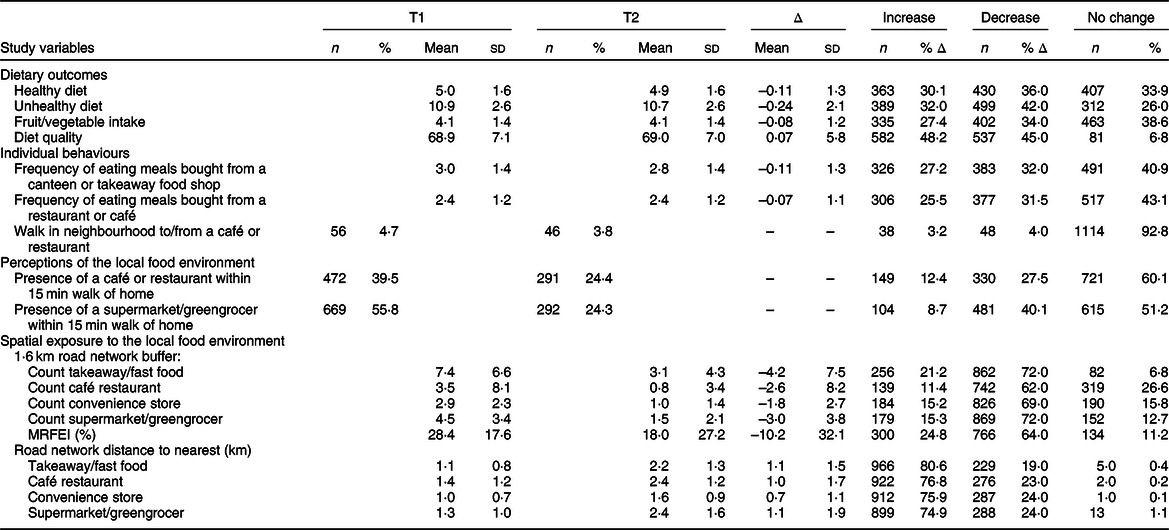
MRFEI, modified retail food environment index (higher numbers mean a greater percentage of healthy food outlets).
Table 3 shows results for the single factor associations between changes in individual behaviours, perceptions and spatial exposure and the local food environment with changes in dietary outcomes from T1 to T2. A one unit increase in the frequency of eating meals bought from a canteen or takeaway food shop was significantly associated with an increase in unhealthy diet (β = 0·290, 95 % CI 0·212, 0·368) and a decrease in healthy diet (β = –0·088, 95 % CI –0·139, –0·038), fruit/vegetable intake (β = –0·068, 95 % CI –0·114, –0·022) and diet quality (β = –0·515, 95 % CI –0·731, –0·299). A one unit increase in the frequency of eating meals bought from a restaurant or café was significantly associated with an increase in unhealthy diet (β = 0·168, 95 % CI 0·078, 0·259). Compared with participants with no change in their perception of a café or restaurant present within 15 min walk of home, those with an increase (change from no to yes) had a significant increase in unhealthy diet (β = 0·406, 95 % CI 0·078, 0·733). Conversely, compared with participants with no change in their perception of a supermarket/greengrocer present within 15 min walk of home, those with an increase (change from no to yes) had a significant increase in unhealthy diet (β = 0·402, 95 % CI 0·015, 0·788). An increase in the number of café restaurants and convenience stores around the home was significantly associated with an increase in unhealthy diet (β = 0·020/café restaurant, 95 % CI 0·007, 0·033; β = 0·049/convenience store, 95 % CI 0·010, 0·089). An increase in the percentage of healthy food outlets around the home (MRFEI) was significantly associated with an increase in healthy diet (β = 0·003/%, 95 % CI 0·001, 0·005) and fruit/vegetable intake (β = 0·002/%, 95 % CI 0·001, 0·004).
Single factor associations between changes in individual behaviours, perceptions and spatial exposure to the local food environment with changes in dietary outcomes from T1 to T2
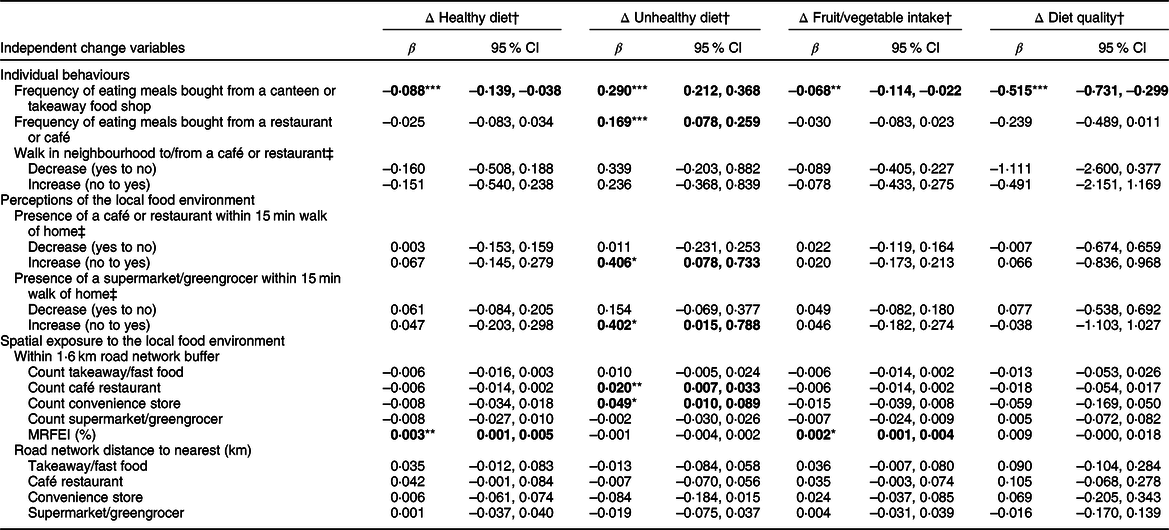
MRFEI, modified retail food environment index (higher numbers mean a greater percentage of healthy food outlets).
† Adjusted for all baseline participant characteristics, baseline diet, time between T1 and T2 questionnaire completion, self-selection variables and accounting for clustering in the seventy-three new developments. Significant results in bold. *P ≤ 0·05, **P ≤ 0·01, ***P ≤ 0·001.
‡ Reference level = no change.
Sensitivity analyses
There were no significant associations with change in dietary outcomes for analyses involving measures of spatial exposure to the local food environment computed using road network buffers of 0·8 km and 5 km (results not shown).
Mediation analyses
Table 4 presents the results of multivariable associations using the significant (P ≤ 0·05) change variables from Table 3, to test for conceptually relevant mediation relationships. The relationship between the percentage of healthy food outlets around the home (MRFEI) and healthy diet or fruit/vegetable intake was not mediated by the frequency of eating meals bought from a canteen or takeaway food shop (i.e. no change in regression coefficients after adjustment). All remaining dietary outcomes were only slightly mediated (i.e. a small decline in regression coefficients after adjustment) by the individual behaviours and perceptions.
Multivariable associations between changes in study variables and changes in dietary outcomes from T1 to T2 for conceptually relevant mediation relationships

MRFEI, modified retail food environment index (higher numbers mean a greater percentage of healthy food outlets).
† Mediation analyses conducted using the significant (P ≤ 0·05) change variables from single factor associations.
‡ Adjusted for all baseline participant characteristics, baseline diet, time between T1 and T2 questionnaire completion, self-selection variables and accounting for clustering in the seventy-three new developments. Significant results in bold. *P ≤ 0·05, **P ≤ 0·01, ***P ≤ 0·001.
§ Reference level = no change.
Discussion
To date, there has been little research on the relationship between changes in the local food environment and changes in diet. Planning neighbourhoods that promote healthy choices relies upon strong evidence to guide specific policy. This study found longitudinal evidence to suggest that moving to a neighbourhood with more convenience stores and café restaurants around the home was associated with an increase in unhealthy food intake. Whilst moving to a neighbourhood with a greater percentage of healthy food outlets was associated with an increase in healthy food and fruit/vegetable intake. Furthermore, findings from this study indicate that factors such as vehicle access, individual behaviours and perceptions of the local food environment may also play a role in shaping dietary intakes.
The local food environment around the home changed significantly following residential relocation. There was an overall decline in the number of all food outlet types around the home, and the distance from home to the nearest food outlet increased for all outlet types. Although some participants (24·8 %) experienced an increase in the percentage of healthy food outlets around the home, most (64·0 %) experienced a decline in the percentage of healthy food outlets around the home following residential relocation to a new development. These findings are consistent with previous RESIDE research which identified an overall lack of food outlets in new developments at T2, T3 and T4, and 2·3 times more takeaway/fast food outlets than supermarket/greengrocers in new developments at T4 compared with 1·7 in established neighbourhoods(Reference Bivoltsis, Trapp and Knuiman23).
Both positive and negative changes were observed in dietary intakes after relocating, and these changes were likely associated with specific individual factors modifying the way participants respond to a changing environment. For example, having children <18 years of age at home at baseline was associated with an increase in unhealthy food intake after relocating. Similarly, increasing hours of work per week at baseline was associated with a decrease in unhealthy food intake after relocating. Thus, families and people living on low incomes may be especially vulnerable to purchasing less healthy convenience foods from locally accessible food outlets around the home. Other research also suggests that low-income residents may be more susceptible to unhealthy food intake in environments where there are more unhealthy food outlets(Reference Rummo, Meyer and Boone-Heinonen19,Reference Boone-Heinonen, Gordon-Larsen and Kiefe21) . Alternatively, people working longer hours may spend less time within their local neighbourhood and be less influenced by their local food environment. This study also found that access to a vehicle at baseline was associated with an increase in diet quality and fruit/vegetable intake following relocation. This suggests that people may be willing to travel beyond their immediate neighbourhood to obtain healthy food, increasing their potential food environment. Indeed, the way people make healthy food choices is closely influenced by dietary determinants such as individual level socio-demographic, psychosocial, social and biological factors(Reference Crawford, Ball and Mishra42). Car access and/or supportive public transport links may therefore be key enablers of a healthy diet that contribute to inequities in dietary outcomes among sub-groups.
An increase in the count of convenience stores and café restaurants around the home was associated with an increase in unhealthy food intake. Other studies, involving 15–20 years of follow-up, have shown similar results. For example, in the US, having a higher number of convenience stores within 3 km(Reference Rummo, Meyer and Boone-Heinonen19,Reference Boone-Heinonen, Gordon-Larsen and Kiefe21) and fast food restaurants within 1 km around the home(Reference Rummo, Guilkey and Ng20) was associated with lower diet quality. Higher numbers of fast food restaurants within 3 km of the home were also associated with higher consumption of a fast food-type diet(Reference Richardson, Meyer and Howard18). Although the present study found no significant relationships between changes in the local food environment and changes in overall diet quality, this may be due to the measurement error from using predicted diet quality scores rather than raw data(Reference Bivoltsis, Trapp and Knuiman24). All self-reported dietary intake is prone to miss-reporting and measurement error, which can obscure diet-exposure relationships(Reference Shim, Oh and Kim43). However, using only six simple questions on usual dietary intake, we observed statistically significant changes in individual markers of diet quality (e.g. healthy and unhealthy food intake) after residential relocation. Although these dietary changes were of small magnitude, they were evident in 6–18 months after relocating.
Moving to a neighbourhood with a greater percentage of healthy food outlets around the home was associated with an increase in healthy food and fruit/vegetable intake. Yet, there were no significant associations between spatial exposure to supermarket/greengrocers and diet in this study. Within new developments, neighbourhood centres may be the main location of supermarkets and other unhealthy food stores resulting in spatial co-occurrence(Reference Lamichhane, Warren and Puett44), contributing to unhealthy food intake. This is highlighted by the fact that participants who perceived an increase in the presence of a supermarket/greengrocer within 15 min walk of home had an increase in unhealthy food intake. This suggests the ratio of healthy to unhealthy food outlets influences people’s healthy dietary choices more than the absolute presence of healthy food outlets such as supermarkets/greengrocers, a finding consistent with the previous cross-sectional research exploring the effects of relative and absolute measures of exposure(Reference Clary, Ramos and Shareck30,Reference Mason, Bentley and Kavanagh31) . In Australia, people living in a neighbourhood with a greater percentage of healthy food outlets (i.e. supermarkets, greengrocers and fruit and vegetable markets) relative to unhealthy food outlets (i.e. takeaway or fast food stores) were more likely to purchase fruit and vegetables, with little evidence for an association between absolute exposure(Reference Mason, Bentley and Kavanagh31). Similarly, in Canada, the percentage of healthy outlets (i.e. summed density of healthy stores divided by the sum of densities of all considered outlets) was a better correlate of fruit and vegetable intake than absolute densities(Reference Clary, Ramos and Shareck30). However, contrasting findings were reported from a European study(Reference Pinho, Mackenbach and Oppert45). Variability in the way the food environment and diet were measured along with contextual differences may be a contributing factor.
Moving to a new development had some influence on participant behaviour and perceptions. For example, a greater percentage of participants reported a decrease (compared with an increase) in their perception of a supermarket/greengrocer and café or restaurant within 15 min walk of home, along with a decrease in the frequency of eating meals bought from a canteen, takeaway food shop, restaurant or café. These findings may reflect how participant behaviour and perceptions are influenced in response to moving to a new development with fewer amenities around the home. However, this study found limited evidence to suggest that the above individual behaviours and perceptions were mediators between spatial exposure to the local food environment and dietary intake (as demonstrated by only a slight decline in coefficients after adjustment). These variables may play a small role in determining dietary intake by influencing where people purchase food from or how convenient people perceive certain food outlets as resulting in changes to shopping preferences and utilisation. Thus, individual behaviours and perceptions are more proximal determinants of changes to dietary intake, but they are not the only mechanisms through which the surrounding environment drives changes in food choices.
There were no significant associations between changes in the proximity of food outlets and diet. This may reflect how density and variety of food outlets around the home have a greater influence on diet than proximity, a finding highlighted in previous reviews(Reference Black, Moon and Baird7,Reference Bivoltsis, Cervigni and Trapp46) , particularly for unhealthy food intake. Greater diversity and density of unhealthy food close to the home likely mean people will be more inclined to utilise these outlets due to convenience and easy access. Furthermore, changes in eating habits for unhealthy food may be influenced in the short term by a person’s immediate surroundings. This was made more apparent by the sensitivity analyses finding no significant associations for change in dietary outcomes and food outlet counts within 5 km buffers. No significant associations were also found for the smaller buffers of 0·8 km. It may be that these smaller buffers did not capture enough change to detect significant associations.
Implications for policy and planning
Policies that increase healthy food outlets to create a more favourable mix of food choices may be more effective at increasing healthy food and fruit/vegetable intake than focusing on individual outlet types. As such, considering the combined effect of all food outlets present (healthy and unhealthy) within a composite index may be a suitable indicator of the healthiness of the local food environment for use in policy development. In particular, the design and development of new residential areas should focus on the early installation of a variety of food outlets. Planning regulations must also take into consideration the effect of transport links such that healthy food choices are accessible to the whole population, protecting population subgroups at greater risk. Lastly, this study provides some evidence that increasing numbers of unhealthy food outlets (i.e. convenience stores and café restaurants) close to the home can translate into poorer food choices for residents. Thus, novel policies that impose restrictions on the densities of these outlets may improve dietary intakes.
Strengths and limitations
Limitations include the aforementioned self-reported dietary intakes and commercially sourced food outlet locations. Further, spatial exposure was place-based and conceptualised relative to the home and may not represent the full spectrum of exposure. Although this study controlled for a range of covariates and self-selection factors, residual confounding by other time-varying factors could not be ruled out. Lastly, this study did not capture what foods were sold in each outlet type or where food purchasing occurred, which may have led to the misclassification of some food outlet types. These limitations aside, this study is unique because it is the first to demonstrate how changes in the local food environment following residential relocation influences dietary intake. Strengths include the use of individual residential addresses as opposed to administrative units, considering both healthy and unhealthy food outlets and a range of spatial metrics, examining multiple dietary outcomes, controlling for self-selection factors and exploring the mediating effects of behaviours and perceptions. The inclusion of sensitivity analyses was also a strength, as the findings allowed for the consideration of scale effects on the relationship between spatial exposure to food outlets and dietary outcomes.
Conclusions
This study provides longitudinal evidence that increased spatial exposure to convenience stores and café restaurants can increase unhealthy food intake, whilst an increased percentage of healthy food outlets around the home can increase healthy food intake. Improving the mix of food outlets around the home by increasing those selling fresh produce and reducing takeaway, fast food and convenience stores may have a positive influence on the diets of residents. Furthermore, low-income households and those with children at home are particularly susceptible to the local food environment, and healthy food intakes may be dependent on having access to a vehicle. Urban planning regulations and policies should consider these factors to enable healthier dietary choices for all.
Acknowledgements
Acknowledgements: The authors thank Manita Narongsirikul for assistance in the development of the geographic information systems measures used in this study. The Western Australian Land Information Authority, Western Australian Department of Planning provided the spatial data. Financial support: This research was funded by grants from the Western Australian Health Promotion Foundation (Healthway) (nos. 11828, 18922); Australian Research Council (ARC) (no. LP0455453); and Australian National Health and Medical Research Council Capacity Building (no. 458688). A.B. was supported by an Australian Government Research Training Program (RTP) Scholarship and University of Western Australia Safety-Net Top-Up Scholarship. G.T. was supported by a National Health and Medical Research Council (NHMRC) Early Career Research Fellowship (no. 1073233). Funding sources had no involvement in the design, collection, analysis, writing and interpretation of data or the decision to submit this article for publication. Conflict of interest: The authors declare that they have no competing interests. Authorship: G.L.A., G.T. and M.K. contributed towards conceptualisation of the study. A.B. performed all data analysis, with guidance from M.K. on appropriate statistical methods. A.B. led the study and wrote the manuscript. G.L.A., G.T., M.K. and P.H. critically revised the manuscript for important intellectual content. All authors read and approved the final manuscript. Ethics of human subject participation: This study was conducted according to the guidelines laid down in the Declaration of Helsinki, and all procedures involving human subjects were approved by the University of Western Australia’s Human Research Ethics Committee (no. RA/4/1/479). Written informed consent was obtained from all subjects/patients.
Supplementary material
For supplementary material accompanying this paper visit https://doi.org/10.1017/S1368980019005111



