

In 1635, the Scots-born Jesuit Hugh Sempill published a twelve-book text on the mathematical disciplines.Footnote 1 Sempill devoted book seven of this work to the subject of cosmography; subsequent books consider what he described as the constituent elemental and celestial parts of that discipline, namely geography (book eight), hydrography and meteorology (book nine), astronomy (book ten), and astrology and calendrics (books eleven and twelve). Chapter eleven of book ten is entitled ‘Of Sundials and Other Cosmographical Instruments’.Footnote 2
This one chapter, easily overlooked amid the wealth of material regarding the mathematical disciplines in the early modern period, is of considerable interest to historians of science and curators of scientific instruments. At first sight, it constitutes an extraordinary vindication of the claim, advanced by former Whipple Museum Curator Jim Bennett, that sundials were cosmographical devices in the long sixteenth century.Footnote 3 Bennett presents the Renaissance discipline of cosmography as a key to unlocking the true meaning of these objects, all too frequently understood merely as time-telling devices. By associating sundials with cosmography, he seeks to demonstrate how they were not only part of a strong mathematical tradition that was intellectually stimulating for its many enthusiastic participants, but also intimately connected to broader cultural changes such as the European overseas expansion and the competitive pursuit of power, territory, and commercial advantage entailed by that enterprise. Bennett’s arguments challenge scholars to produce much richer histories of sundials and dialling than have so far been generated. They also imply that curators at institutions with rich collections of dials – institutions like the Whipple Museum – might profitably rethink how best to display and interpret them for a visiting public.Footnote 4
This chapter will revisit Bennett’s arguments regarding sundials not only in the light of Sempill’s text and the burgeoning literature on cosmography, but also by drawing on the collections of the Whipple Museum and the Whipple Library and the scholarship they have inspired. Like Bennett’s inquiries into the connection between dialling and cosmography, my own studies of this subject have their origin in our ongoing attempts to make sense of the mathematical culture of the early modern period.Footnote 5 That culture was generative not only of instruments and texts, but also of texts about instruments, instruments reproduced from texts and their accompanying images, images that functioned as instruments, and instrument–book hybrids.Footnote 6 Efforts to understand it, therefore, typically cross backwards and forwards across the adjacent realms of text, image, and instrument, and are frequently drawn to the points of closest overlap. This approach is hardly unique to graduates of the Whipple school of instrument studies, but it is one that the environment of the Whipple Museum and Library – like other institutions whose collections encompass both instruments and books – is especially conducive to developing. Our common past association with the Whipple can help to explain why Jim Bennett and I are exercised by similar issues in the history of Renaissance mathematics and mathematical instruments, and employ a similar technique, attentive to multiple kinds of sources, in attempting to resolve them.
But while our preoccupations and our methods our similar, our conclusions sometimes differ. Here, by retracing Bennett’s steps through the cosmographical literature of sixteenth-century Europe, I shall suggest some problems with his argument that sundials, in particular, can be associated with cosmography. I shall then use Sempill’s account to explore, more generally, the advantages and disadvantages of labelling certain objects as ‘cosmographical instruments’, suggesting that such designations, when used at all in the period, were idiosyncratically applied. In addition, I shall re-examine the question of cosmography’s supposed decline after 1600. For Bennett, the disappearance of cosmography is another way in which cosmography and dialling might be associated. He suggests that as cosmography faded its astronomical component found a new home in the vibrant dialling tradition of subsequent centuries.Footnote 7 Because, I shall argue, it actually persisted as a category of knowledge and a set of activities even into the twentieth century, attempts to employ ‘cosmographical’ as a term of the historian’s art risk confusing, rather than clarifying, our accounts of past scientific practice. We need to be particularly attentive to the variety of ways in which such categories were deployed at different times and places, and avoid overwriting them with our own, even – perhaps especially – when we seek to recruit our terms from those used in the past.
Sundials and Cosmography
That sundials should have been considered cosmographical instruments during the sixteenth and seventeenth centuries is entirely plausible on prima facie grounds. Renaissance cosmography’s foundational text was Ptolemy’s Geography – a guide to mapping the Earth by longitude and latitude, with an accompanying gazetteer of places, from which both world and regional maps could be drawn. On completing the first translation of the text from Greek into Latin in the early fifteenth century, the Florentine humanist Jacopo Angeli elected to rename this work the Cosmography, after the word cosmos, arguing that the text concerned both the heavens and the Earth.Footnote 8 As depicted in one of the best-known and most frequently republished cosmographic works of the sixteenth century, Peter Apian’s Cosmographicus liber (1524), the truth of Angeli’s claim rested on the fact that coordinate mapping depends upon the projection onto the surface of the Earth of fundamental divisions of the celestial sphere (Figure 3.1).Footnote 9 These lines define the equator and the tropics, and allow meridians passing through the poles to be drawn. Texts like Apian’s were also concerned with the apparent annual motion of the Sun along the sphere, known as the ecliptic, and with the sphere’s daily rotation. They related these phenomena to the surface of the Earth by, for example, discussing the ancient division of the globe into klimata – latitudinal bands defined by the maximum length of the day. Thus cosmography was fundamentally concerned with using projective geometry to connect the heavens and the Earth and, frequently, to relate solar motion, terrestrial location, and time. Sundials are devices constructed using projective geometry to relate solar position and time for one or more terrestrial locations.Footnote 10 It is therefore easy to see cosmography and dialling as closely related, both conceptually and technically.

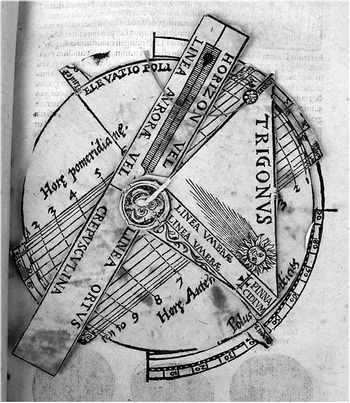
Bennett strengthens this prima facie case for considering sundials cosmographical devices by adducing various other kinds of historical evidence. He notes, for example, that Apian’s Cosmographicus liber includes a sundial among the several paper instruments that it contains: a universal rectilinear altitude dial, which he identifies as belonging to a class of instruments sometimes referred to by the name ‘organum Ptolomei’, or ‘instrument of Ptolemy’ (Figure 3.2).Footnote 11 Within the pages of the book, this device clearly served a didactic rather than an immediate time-telling function. Apian instructed his reader how to use it to perform a range of operations connecting time, solar motion, and terrestrial location.Footnote 12 It was, therefore, an application rather than an explication of the art of dialling, employed to demonstrate some of the fundamental relationships at the heart of cosmography. Nevertheless, Bennett suggests, its presence in Apian’s influential text connected that work with the subject’s ancient authority, Claudius Ptolemy, via a sundial. Indeed, Bennett posits that the name ‘organum Ptolomei’ was rooted in Ptolemy’s contemporary status as a cosmographical author, rather than a writer on astronomy.Footnote 13 Dialling, on this evidence, was fundamentally intertwined with cosmography.

Bennett strengthens the case for considering sundials cosmographical by demonstrating that a large number of individuals he identifies as cosmographers also wrote on dials, or were involved in their production. Besides Apian, the examples include Gemma Frisius, who revised and augmented Apian’s work, Egnazio Danti, Sebastian Münster, Oronce Finé, and Gerard Mercator.Footnote 14 The full list of cosmographers Bennett provides does indeed seem too extensive for the overlap between cosmography and dialling to be attributed merely to coincidence. Once again, therefore, a strong connection between sundials and cosmography seems to have been established.
Arguments such as these are cumulatively powerful, but the evidence deployed in them is somewhat circumstantial. And, even though the claim that sundials were cosmographical instruments can now be supported by reference to Sempill’s text, analyses are not necessarily justified by the conclusion to which they lead. Closer scrutiny reveals problems with both sets of evidence. While it is clearly true that Ptolemy was the ghost at Apian’s cosmographic feast, several elements of the Cosmographicus liber would have suggested his presence to a contemporary reader more clearly than Apian’s inclusion of a paper dial in the book. Notably, the opening chapter of his text, ‘What Is Cosmography, and How Does It Differ from Geography and Chorography’, was an adaptation of the first chapter of book one of the Geography, ‘How Geography Differs from Chorography’.Footnote 15 And while that discussion did not identify Ptolemy by name, it did refer to a work by Johannes Werner, the Paraphrases, which was a summary of book one of the Geography and had been printed alongside Werner’s translation of that book in 1514.Footnote 16 A later chapter of the Cosmographicus liber explicitly discussed the use and the form of Ptolemy’s maps, while the gazetteer of places which appeared in the second part of the book strongly echoed the style of the Geography, listing the coordinates of the principal places of the world by region, as if to facilitate their use in the production of maps, rather than organising them alphabetically.Footnote 17
To some extent, these elements worked to distance the Cosmographicus liber from Ptolemy’s legacy, rather than to evoke it. Partly, no doubt, this was because of the shortcomings in the geographical knowledge of the ancients exposed by the New World discoveries; these ‘new’ parts of the world were briefly discussed in the text and incorporated into its coordinate lists.Footnote 18 But it may also have been because, by this point in time, ‘cosmography’ had already fallen out of fashion as the preferred title for Ptolemy’s geographical work. From 1490 onwards, editors had begun to reinstate the title that Jacopo Angeli had changed, renaming Ptolemy’s text the Geography.Footnote 19 Thus, as Apian’s first chapter suggested, the subject of cosmography could no longer simply be considered co-extensive with the material covered by Ptolemy. Nevertheless, the references and allusions in the Cosmographicus liber were clear enough to hint at Ptolemy’s continuing importance to cosmographical theory and practice.
In contrast, it would have taken a particularly astute reader, already familiar with the geometry and nomenclature of dials, to infer a strong connection between the paper dial in Apian’s book and this ancient authority, especially since the text itself did not refer to the instrument as an organum ptolomei. An expert reader might have recognised the underlying relationship between the instrument in Apian’s book, the ship-shaped dials known as navicula (Figure 3.3), the so-called Regiomontanus dial, and the instruments explicitly named as organa ptolomei in late-medieval manuscripts. As Catherine Eagleton has noted, the identity of the latter category of instruments is somewhat confused in the manuscript tradition: the description was applied in certain texts to a range of instruments with varying physical forms and omitted entirely from other manuscripts describing devices with identical geometry.Footnote 20 The origins of the name are also not clear, although some manuscripts suggest that the designation ‘organum’ derives from the resemblance of the device, in some forms or at some stage of its production, to a musical instrument.Footnote 21 But the underlying geometry of these dials, as well as that of naviculae and the Regiomontanus dial, was treated in Ptolemy’s work On the Analemma, known in the Latin West since the middle of the thirteenth century.Footnote 22 It is not impossible, therefore, that the organum ptolomei was named in recognition of Ptolemy’s authority in dialling, rather than astronomy or cosmography. Apian himself might have understood as much; even before his appointment to the University of Ingolstadt in 1526, his studies at Vienna had introduced him to the remnants, and hence the legacy, of the cluster of mathematicians associated with these two institutions that had formed around the humanist scholar Conrad Celtis in the late fifteenth century.Footnote 23 Among them was Andreas Stiborius, whose writings included Canons for the use of the organum ptolomei – a text sometimes transmitted, naturally enough, alongside one describing the instrument.Footnote 24 Apian would have been well placed therefore, to conceive of a relationship between the devices that were described as organa ptolomei in Viennese manuscripts and the paper instrument with which he supplied his Cosmographicus liber, as well as to recognise the multiple associations with the ancient author of the Geography that this relationship suggested. But this connection was surely not perceptible, without explicit commentary, to the neophyte mathematician and geographer at whom Apian’s cosmographical text appears to have been aimed. As we shall see, there are other grounds for supposing that the Cosmographicus liber strengthened the association of cosmography with dialling. But those reasons emerge most clearly when the status of instruments in the work is considered more generally.
A navicula dial, 1620. The geometry underlying these ship-shaped dials is similar to that of Apian’s dial, as shown in Figure 3.2, the Regiomontanus dial, and the organa ptolomei.

The argument that a great many sixteenth-century cosmographers were active in the manufacture of sundials and/or the production of associated texts also seems problematic when inspected more closely. This argument holds most force precisely if we elect to employ the category of ‘cosmographer’ to describe these individuals active in dialling. But a more parsimonious explanation is suggested by the fact that both cosmography and gnomonics were mathematical pursuits. If these ‘cosmographers’ are instead identified as mathematical authors, professors of mathematics, mathematical instrument-makers, practical mathematicians – or, if we wish to employ the term, mathematical practitioners – then it hardly seems surprising that their interest in mathematics should have led them to undertake work in both of these fields. Indeed, the fact that many authors of cosmographic texts also wrote texts on sundials itself seems to suggest that cosmography and dialling were considered separate (or at least separable) forms of mathematical expertise. Oronce Finé’s De solaribus horologiis et quadrantibus first appeared in his Protomathesis of 1532 alongside, not within, his treatment of cosmography.Footnote 25 And the dialling texts of the polymathic Sebastian Münster, including Erklerung des newen Instruments der Sunnen (1528) and Compositio horologiorum (1531), were likewise published separately from his encyclopaedic Cosmographia of 1544.Footnote 26 The genres were distinct.
That is not to say, however, that the category of ‘cosmographer’ is anachronistic or redundant. On the contrary, some individuals were indeed identified as ‘cosmographers’ in the long sixteenth century, and some of them either consciously embraced that label as a professional identity or had it thrust upon them. However, the role of the cosmographer, and the tasks that it entailed, varied from place to place in the period.Footnote 27 One such individual known to have constructed dials, Egnazio Danti, illustrates one form of cosmographical practice. Danti served first as ‘ducal cosmographer’ to Cosimo I de’ Medici and later as ‘papal cosmographer’ to Gregory XIII – although whether these designations represent descriptions of his service to these princes, or offices that he occupied, is not entirely clear. In either case, whilst occupying these roles Danti was principally engaged in the design and production of lavishly painted maps and globes, created to adorn spaces within the Palazzo Vecchio in Florence and in the Vatican.Footnote 28 He also designed and constructed other instruments, including astrolabes, sundials, and the anemoscope in the Vatican’s Tower of the Winds.Footnote 29 For this reason, the production of such non-cartographic devices has sometimes been characterised as part of the task of the Renaissance cosmographer.Footnote 30 Yet given the opportunity to define cosmography in his Le scienze matematiche ridotte in tavole of 1577, produced when he was a professor of mathematics at Bologna, Danti did so quite narrowly: in Table XXIII, on the science of geography, he indicated that cosmography was the description of the Earth made with reference to the heavens (which is to say, using longitude and latitude), and of the heavens as well.Footnote 31 A different table entirely was devoted to ‘Gnomonic Science’, while the very first table in the text, ‘Of the Division of the Mathematical Sciences’ showed both gnomonics and geography as subjects subalternated to geometry.Footnote 32 In Danti’s analysis, therefore, cosmography-geography and the theoretical understanding of sundials were related to one another as branches of mathematics, but were nevertheless distinct. Moreover, the practical activity of making dials, astronomical instruments, and other kinds of device was classified separately again, as a mechanical art, rather than a science.Footnote 33 Overall, the text strongly suggests that Danti himself did not consider everything that he did whilst a cosmographer as cosmographical, in the proper sense of that term, including the construction of dials.
Other Cosmographical Instruments
If cosmography was not always identified with dialling, how then should we understand Sempill’s claim that dials were cosmographical devices? It is helpful to recall that the text with which we began referred to ‘Sundials and other cosmographical instruments’, and to consider what that category meant to Sempill more generally. Sempill’s chapter on the topic first identified waterclocks, sandglasses, and clocks driven by weights and cogs as mechanical devices, outside the realm of his discussion.Footnote 34 Amongst the ‘scioteric’ or ‘gnomonic’ devices which he considered cosmographical, however, and which told the time by shadows of sunlight or moonlight, or the observation of a star, he included astrolabes, pillar dials, astronomical rings, and quadrants. He abbreviated his discussion of other instruments ‘by cosmographers, geographers, hydrographers, and astronomers’, in recognition of the fact that there were too many to discuss.Footnote 35 But he identified amongst the principal ones celestial globes, armillary spheres, planispheres, and terrestrial globes.Footnote 36 Finally, having named a number of scholars who had ‘left such devices to posterity’, he listed ‘various kinds of quadrants, radii, annula, cosmolabes, trigons, torqueta, mesolabes, mariners’ compasses, azimuthal semicircles, parallactic rulers, armillaries, bipartite arcs, and sextants’ as also belonging to this category.Footnote 37 He ended the chapter by promising to write of these instruments more fully in a forthcoming Mathematical Dictionary that he never actually produced.Footnote 38
Just as with sundials, a prima facie case can be established for considering most of the instruments listed by Sempill as cosmographical devices. Nevertheless, it is conceivable that Sempill’s understanding of the different sub-disciplines of mathematics, the relationship between them, and the status of their instruments, was idiosyncratic. In other words, Sempill’s classification of sundials and other instruments as cosmographical may well have reflected his own understanding of this category, developed from first principles, rather than a view that was generally held. However, as a Scottish Jesuit, based in Madrid, and publishing in Antwerp, the print capital of the Spanish Netherlands, Sempill had access to multiple forms of cosmographical tradition. And that he did indeed draw on a wide range of cosmographical texts and works by cosmographers is revealed by the indices of authors, ancient and modern, with which he furnished his book.Footnote 39 Consideration of just a few of his sources suggests why it would have been easy for him to identify such a wide range of instruments as cosmographical in kind.
Peter Apian was one of those cited by Sempill; and, of course, his Cosmographicus liber was frequently published in Antwerp from 1529 onwards, in multiple languages.Footnote 40 Even before it was augmented by Frisius, this work referenced numerous instruments, in both images and text. Two of these devices were explicitly labelled cosmographical: the ‘cosmographical globe’ (Figure 3.4) and the speculum cosmographicum, or ‘cosmographical mirror’ (Figure 3.5).Footnote 41 The former was the name given by Apian to the terrestrial globe divided by longitude and latitude; in most editions of the work, it was depicted on the title page, as well as in the chapter in which it was named and discussed. The speculum cosmographicum was a paper volvelle, pre-assembled in the book. Taking the form of a terrestrial planisphere surmounted with a rotatable ecliptic ring, hour circle, and latitude index, it was superficially very like a standard planispheric astrolabe, but furnished with a geographical rather than a celestial latitude plate. Any reader of the Cosmographicus liber attentive to these names might conclude that the text referenced precisely two kinds of cosmographical instrument, the globe and the speculum. These were indeed instruments particularly distinguished by the celestial and terrestrial divisions that they physically embodied, in quite a straightforward way.
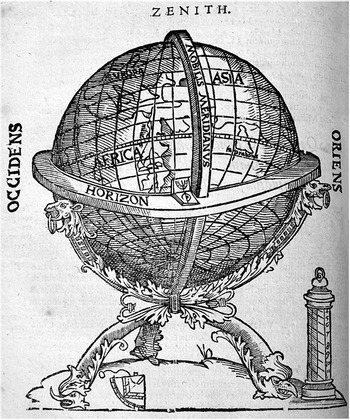

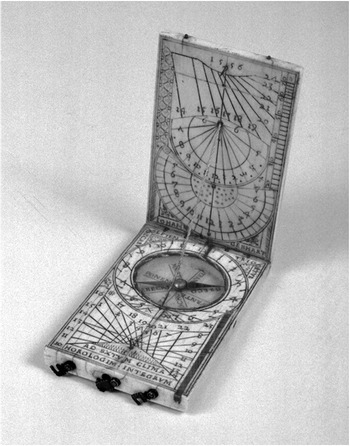
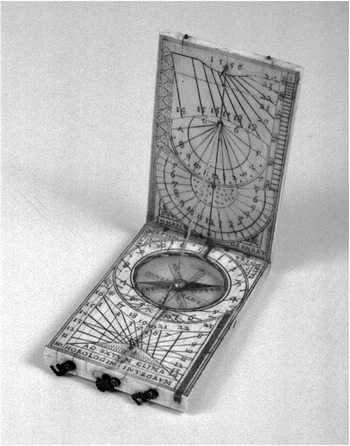
Equally, however, the presence in Apian’s text of a wider range of devices might lead a reader to suppose that other instruments could also be considered cosmographical in certain contexts of use. The work also contained an illustration of an armillary sphere, with a terrestrial globe divided by lines of longitude and latitude clearly visible at its centre.Footnote 42 It presented to the reader other paper devices, including the instrumentum theoricae solis – essentially a printed rendering of the reverse of a planispheric astrolabe, with eccentric calendar scales that could, in theory, be used to locate the place of the sun in the zodiac on any day of the year.Footnote 43 It discussed the use of the astronomical staff.Footnote 44 And it depicted a magnetic compass, and discussed its use, in more than one place in the text. Importantly, for the supposition that the work encouraged the association between cosmography and sundials, the cosmographical globe was typically depicted with three other devices: a pillar dial, an horary quadrant, and – resting on the horizon ring of the globe – a diptych compass dial of the type for which Nuremberg was particularly well-known (Figure 3.6).Footnote 45 The compass dial was explicitly discussed in connection with the globe, as Apian explained how to use it to establish the meridian line and set the globe for a particular location.Footnote 46 Further devices were discussed in appendices and additions to the text; these varied as the book went through its numerous editions, but among them were the nocturnal and the ring-dial, or annulus astronomicus.Footnote 47 Any of these instruments could, surely, have been considered cosmographical by a reader of this text.
In the wake of Apian, and in the context of the increasing dissociation of cosmography from Ptolemy’s Geography, variant forms of cosmographical authorship emerged. A textbook tradition developed that increasingly identified cosmography with the mathematical intersection of astronomy and geography. Since that intersection was largely co-extensive with the contents of treatises on the celestial sphere, these textbooks were commonly titled in such a way as to identify themselves as works in cosmography or spherical astronomy. Thus Finé’s 1532 work was the De cosmographia sive mundi sphaera; Antoine Mizauld published De mundi sphaera sive cosmographia in 1552, also in Paris; Thomas Blundeville’s Exercises of 1594 included A Plaine Treatise of the First Principles of Cosmographie, and Specially of the Spheare; and Rudolf Goclenius produced Cosmographiae seu sphaera mundi descriptionis, hoc est astronomiae et geographiae rudimenta in Marburg in 1599. All four of these authors were cited by Sempill.Footnote 48 Naturally their texts, and others like them, gave warrant to the idea that armillary spheres were cosmographical instruments; like their medieval exemplar, Sacrobosco’s De sphaera, they commonly invoked the physical instrument (or an image of the instrument) as a pedagogical tool.Footnote 49
More ambitious mathematical authors were able to enlarge their cosmographical textbooks by extending their coverage to include planetary astronomy as well. Several authors of such works, including Francesco Maurolico, Francesco Barozzi, and the Jesuit Giuseppe Biancani (Blancanus), were likewise cited by Sempill.Footnote 50 Of course, many of the textbook cosmographies included geographical as well as astronomical material. But rather different in kind were the encyclopaedic cosmographies prepared by Sebastian Münster and his French imitator, André Thevet, who also featured in Sempill’s lists.Footnote 51 Their texts were descriptive geographies, incorporating both human and natural history, in the style of Strabo and Pliny the Elder, rather than Ptolemy.Footnote 52 The mathematics of the sphere that underpinned coordinate-based geography was present in these texts, but served as the very shallow foundation to a much more elaborate superstructure that prioritised detailed accounts of places, peoples, events, and resources. A third kind of cosmographical work was the Atlas, a genre inaugurated in 1595 by Gerard Mercator, another author acknowledged by Sempill.Footnote 53 Mercator’s posthumously published text was only a partial realisation of his vision of cosmography, which encompassed a causal understanding of Creation, as well as mathematically founded descriptions of heaven and earth, and accounts of human history.Footnote 54 Beginning with a natural philosophy based on an exegesis of Genesis, this work suggested that cosmography was much more than the intersection of astronomy and geography required to produce the coordinate maps with which it was lavishly endowed. Indeed, this was the common characteristic of the extended textbooks, encyclopaedic cosmographies, and the Atlas: they pushed the boundaries of cosmography towards something more akin to the sum of astronomy and geography, although the precise dimensions of those components varied from case to case. Presumably, in the process, they could have authorised readers such as Sempill to consider astronomical and cartographic and surveying instruments as, in some sense, cosmographical.
A handful of authors cited by the Scottish Jesuit published works that explicitly referenced cosmographical instruments in their titles. Johannes Stoeffler’s posthumous Cosmographicae aliquot descriptiones of 1537 referred to a sphaera cosmographica, meaning the terrestrial globe.Footnote 55 And Giovanni Paolo Gallucci published his Della fabrica et uso di diverso stromenti di Astronomia et Cosmografia in 1597 and 1598. This quarto text of 293 pages was itself a work of compilation, one that discussed the construction and use of twenty-seven distinct devices, including the planispheric astrolabe, the Rojas universal astrolabe, the astronomical staff of Peter Apian, the specchio geografico of Apian (i.e., his speculum cosmographicum), the horary quadrant of Johannes Stoeffler, the annulus astronomicus or ring-dial of Gemma Frisius, and several of the observing instruments described by Ptolemy in the Almagest.Footnote 56 This work too, therefore, offered contemporary readers considerable latitude in the identification of cosmographical instruments.
As important as any of these sources to Sempill, however, was surely the cosmographical tradition native to his adopted homeland of Spain. In the sixteenth century cosmographers and professors of cosmography, identified and salaried as such, were appointed by Philip II to serve at the Casa de Contratación in Seville, its governing body, the Council of the Indies, and the Royal Mathematical Academy in Madrid.Footnote 57 The Jesuits of the Imperial College of Madrid, where Sempill taught, were quite literally the heirs to the cosmographic practice of the latter institution, which had been established in the 1570s to provide instruction in the mathematical sciences. After the death in 1625 of its last professor of cosmography, Juan Cedillo Díaz, responsibility for delivering its lectures, and subsequently the classes themselves, were transferred to the Jesuits’ Collegio.Footnote 58 Sempill acknowledged the relationship in the dedication of his work to Philip IV, writing that the twelve books had been conceived in the sand of the Royal Academy, ‘amidst the sphere and cylinder of Archimedes’.Footnote 59
Cosmography in Iberia in the long sixteenth century was closely concerned not only with coordinate-based mapping, but also with mathematical techniques of navigation. Thus, cosmographers at the Casa de Contratación (or House of Trade) in Seville were charged with maintaining and improving the padrón real, the master map used to produce navigational charts for ships bound for the Indies. They were also responsible for producing and checking those derivative charts, constructing and certifying navigational instruments, and training ships’ captains and pilots in navigational techniques. And they played a part, alongside the Casa’s chief pilot, in examining those who aspired to occupy these crucial shipboard roles.Footnote 60 Cosmography was in this way institutionalised in Spain as a cluster of activities, dependent upon mathematical expertise, that were intimately associated with the practical problems of travelling to, and managing, overseas territories. The subject was similarly construed in Portugal, Spain’s principal rival in the early years of the European expansion, but also a source of cosmographic expertise for the Spanish court, especially during the Iberian Union from 1580 to 1640.Footnote 61 It is hardly surprising, therefore, that Sempill, writing not only as a Jesuit mathematician but also as a scholar embedded in the mathematical culture of Iberia, should have associated hydrography and instruments such as the mariner’s compass with the practice of cosmography.
Because individuals could be and were appointed to cosmographical offices in Iberia in the long sixteenth century, a wider range of texts and instruments that they produced could perhaps be identified as cosmographical, both then and now, than is the case for some mathematicians working in other parts of Europe. Many Iberian cosmographers identified themselves as such in their writings as well as on their maps, although given the Spanish Crown’s proprietary attitudes to knowledge that might be of use to its European rivals, these texts and charts were not printed as frequently as similar items created elsewhere.Footnote 62 Cosmographers in the service of the monarch produced translations of works by mathematical authorities, such as Euclid, treatises on the sphere, works on the art of navigation, sailing instructions (rutters), and repertorios de los tiempos – texts that treated calendrics and meteorology in forms intended to be particularly useful to mariners.Footnote 63 And they also wrote on particular instruments, including globes, cross-staves, mariner’s astrolabes and compasses. Naturally, Sempill referenced many Spanish and Portuguese cosmographers in his indices of authors, including Pedro Nuñez, Alonso de Chaves, and Rodrigo Zamorano.Footnote 64
Iberian cosmographers cited by Sempill even included references to dials in their works. Alonso de Chaves, for example, devoted a chapter of the second book of his manuscript Quatri partitu en cosmografía práctica to discussion of the universal dial of Regiomontanus, a close cousin to the dial incorporated by Apian into the pages of the Cosmographicus liber.Footnote 65 Sempill’s inclusion of ‘sundials’ alongside ‘other cosmographical instruments’ is, therefore, not so difficult to comprehend given his access to the Iberian tradition and his manifest eclecticism. Yet the fact remains that his particular construal of the category of ‘cosmographical instrument’ is unusual. The point that Sempill’s text appears to support, therefore, is not that sundials were cosmographical instruments in the long sixteenth century, but that they could be considered so – and the same applies to many of the other devices that historians have generally come to refer to as mathematical. Some of these objects were considered cosmographical by some makers, and by some authors and (we must assume) consumers of instrument literature, but the Renaissance category of cosmography was sufficiently protean to admit of many variant usages. Cosmography was not one thing, but many, and one and the same practice or instrument could be considered ‘cosmographical’ or not by different scholars, depending upon their personal preferences, the context in which they were operating, and the tradition or traditions with which they were familiar.
The Decline of Cosmography Revisited
The claim that cosmography disappeared shortly after 1600 has become established in the scholarly literature treating cosmography in the long sixteenth century. But this claim has also been advanced, and then repeated, without sufficient attention being paid to the full variety of cosmography’s forms. Perhaps the clearest articulation of the thesis of cosmography’s demise has been offered by Frank Lestringant.Footnote 66 He, however, was thinking particularly of the encyclopaedic form of the subject, as represented by the cosmographies of Münster, François de Belleforest, and André Thevet. While his account acknowledges the existence of one other genre of cosmographic authorship, the atlas, it neglects the mathematical textbook tradition and at the same time characterises the practical application of cosmographical learning to navigation and chartmaking, as witnessed particularly in Iberia, as somehow so technically difficult as to have rendered it incoherent and therefore unstable.Footnote 67 Encyclopaedic universal cosmographies do seem to have fallen out of fashion after 1600, but perhaps not so abruptly as Lestringant supposes or for the reasons he supplies. In his analysis, the expiry of descriptive cosmography was especially associated with the hubris of his particular subject, the French royal cosmographer André Thevet, in whose Cosmographie universelle of 1575 eye-witness claims both clashed with received religious truths and stretched to breaking point his readers’ credulity.Footnote 68 Despite this ‘crisis’, the last early modern edition of Münster’s vast Cosmographia was published as late as 1628, while Peter Heylyn’s eminently encyclopaedic Cosmographie in Four Bookes was published in London in 1652 and again in 1657.Footnote 69 Encyclopaedic cosmography persisted, therefore, at least until the middle of the seventeenth century.
Other forms of cosmography lasted even longer. Mercator’s Atlas of 1595 was just the first of a series of cosmographic atlases published late into the seventeenth century in the Low Countries, by Jodocus Hondius, Johannes Janssonius, Willem Janszoon Blaeu, and their heirs and successors.Footnote 70 Vincenzo Maria Coronelli embraced the identity of ‘cosmographer’, and published works including the Atlante Veneto under the auspices of an Accademia cosmografica degli Argonauti – not so much a learned society as a way of publishing by subscription – in the 1690s.Footnote 71 A Kosmographische Gesellschaft was set up in Nuremberg in the late 1740s, again with the objective of facilitating the publication of various cartographical products.Footnote 72 A similarly named Cosmografiska Sällskapet, or Cosmographical Society, was established in Uppsala in 1758 and prioritised the production of geographical textbooks. Immanual Kant drew upon a German translation of one of these, Tobern Bergman’s Physik beskrifsning öfver jordlokot (1766), in the lectures on physical geography that he gave at the University of Königsberg.Footnote 73 Globes, as well as texts, can be associated with these Enlightenment forms of cosmography: Coronelli, of course, was the pre-eminent globemaker of his day; the Nuremberg Gesellschaft produced globes, including a lunar globe designed by Tobias Mayer; and, from 1762 onwards, Anders Åkerman published globe pairs as part of the Uppsala cosmographical enterprise.Footnote 74
Both the textbook and the Iberian traditions in cosmography also persisted long after the subject’s supposed demise. Cosmographers continued to be appointed at the Casa de Contratación until the early eighteenth century, and Juan Baptista Mayor was appointed cosmografo mayor of the Indies as late as 1770.Footnote 75 More surprisingly, textbook treatments of cosmography continued to be produced in the nineteenth and even the twentieth centuries, particularly in France, Portugal, Spain, and former Spanish colonies. Mostly aimed at schoolchildren or recipients of a technical education, rather than those in higher education, the common starting point of these works was the celestial sphere and its projection onto the surface of the Earth in order to generate the terrestrial divisions of longitude and latitude. Examples include Auguste Tissot’s Précis de cosmographie (1869), Manuel Burillo Stolle’s Elementos de cosmografía y nociones de física del globo (1903), and António Barbosa’s Elementos de cosmografia (1926).Footnote 76 The latter, a Portuguese-language text addressed to secondary-school educators, is especially noteworthy, partly because its author recommended the construction and use of instruments as the best way to teach cosmography to pupils in the seventh grade.Footnote 77 Amongst the devices he discussed were the cross-staff, the mariner’s astrolabe, and, indeed, the sundial. Barbosa explicitly invoked Portugal’s long history of cosmographic excellence and the Renaissance textbook tradition in his work, citing both the Tratado da sphera (1537) of the Portuguese cosmógrafo-mor Pedro Nuñez, and a Spanish-language edition of Apian and Frisius’s Cosmographia from 1575.Footnote 78 Twentieth-century school texts in some languages and cultures, therefore, not only presented cosmography in ways that seem remarkably similar to some sixteenth-century treatments of the subject, but might even have done so consciously.
Historians have not been entirely wrong to claim that cosmography declined after 1600, or to suggest that the category was increasingly displaced by those of astronomy and geography.Footnote 79 But the decline was not absolute, and it proceeded at different rates with respect not only to the various genres of cosmographic work, but also to different languages. In English, it seems clear, the terms ‘cosmography’, ‘cosmographer’, and ‘cosmographic’ were much less frequently employed after 1700 than cognate terms such as ‘astronomy’ and ‘geography’, and were rarely used post-1800 except by historians.Footnote 80 But in French, Spanish, and Portuguese, the category retained some currency well past this threshold. The eighteenth century was something of a transitional period, in which groups that sought to identify themselves with a cartographic tradition uniting astronomical and geographical techniques and products continued to do so under the aegis of ‘cosmography’ in Italian, German, and Swedish. Yet this was probably a deliberate decision, authorised by and alluding to the practices of the past, rather than merely a reflection of enduring preferences within those language communities. Cosmography remained, as it had been in parts of Europe in the long sixteenth century, indeed, a discipline and practice that individuals might choose to identify with if their allegiance to it was not already determined by their context.
This characteristic of ‘cosmography’ helps to explain why prima facie analysis of the qualities of particular classes of instrument can be such an unreliable predictor of their categorisation by our historical subjects. Globe-pairs, and devices like the ‘English’ or Castlemaine globe devised in 1679 (Figure 3.7), which set a terrestrial globe over a celestial planisphere, might seem quintessentially cosmographical, combining as they do representations of the Earth, divided by longitude and latitude, and depictions of the heavens. And indeed, paired celestial and terrestrial globes were sometimes produced by makers who identified as cosmographers, such as Mercator and Coronelli, and were described in avowedly cosmographical texts. At least as frequently, however, globe-pairs were identified as celestial and terrestrial, or astronomical and geographical, without invoking cosmography explicitly as a category.Footnote 81 One and the same instrument might therefore be understood as cosmographical or not, depending on the context on which it was produced and discussed. The Earl of Castlemaine, for example, introduced the globe he devised with Joseph Moxon without reference to cosmography; but Coronelli considered this globo inglese in his Epitome cosmografica of 1693.Footnote 82 Like sundials, therefore – and authors of globe manuals often emphasised the capacity of globes to solve problems in dialling – such devices could be considered cosmographical instruments, but weren’t necessarily labelled as such, and this situation persisted for many years after the long sixteenth century.Footnote 83

Conclusions
The historical usage of words cannot always be sharply distinguished from either historians’ uses or the recoinages of present-day practitioners. In the nineteenth century, Alexander von Humboldt, who had published on the history of the New World discoveries and nautical astronomy, asserted in the French edition of his Kosmos that ‘cosmography’ was the proper title for this work.Footnote 84 Evidently, this was a use of the term informed by Humboldt’s knowledge of the category’s deep history. But the more-or-less transparent etymology of ‘cosmography’, readily understood to mean the description or depiction of the universe as a whole, has also allowed it to be periodically reintroduced without apparent reference to the past.Footnote 85 Such fresh uses might themselves be considered part of a complete history of cosmography.
Problems arise, however, when scholars choose to convert historical categories into terms of their art, not in order to capture past usages but so as to overwrite them as a matter of analytic convenience. Such was the case when, for example, some historians chose to treat ‘cosmography’ simply as a synonym for ‘geography’ – overlooking, thereby, the substantial component of Renaissance cosmography that was, in fact, astronomical or navigational in kind. ‘Geography’ could then displace ‘cosmography’ as the object of study of such historians, contributing to the myth of the latter category’s demise.Footnote 86 Such too would be the difficulty with Matthew Edney’s attempt to rehabilitate ‘mathematical cosmography’ to capture the relations between astronomy, geography, and surveying in British cartography of the late eighteenth and early nineteenth centuries.Footnote 87 The category may have been virtually defunct in British scholarly discourse of this era but, as we have seen, it retained its currency elsewhere. Students of European cartography would, if this proposal were adopted, struggle unnecessarily to distinguish between the usages of their historical subjects and those of historians.
Of course, the writing of history involves translation of past concepts and terms into ones that can be comprehended by modern-day audiences. It would therefore be counterproductive, even were it possible, to insist that historians only ever used actors’ categories as the actors did themselves.Footnote 88 But if we wish to understand the full range of meanings that past individuals associated with the subject and practice of cosmography, we must be sufficiently respectful of our subjects’ uses of ‘cosmographer’, ‘cosmography’, and ‘cosmographical’ to notice that their application of these terms varied individually, by context, by tradition, by genre, and by language. At every point in its post-1400 history, the category of ‘cosmography’ was used alongside, sometimes as an umbrella term for, and sometimes in competition with, the alternative categories of ‘astronomy’ and ‘geography’. Histories of all of these disciplines need to acknowledge the overlap in content of these categories and in the texts and the instruments that their practitioners used, discussed, and produced. But, if we elide them in the process we lose all sight of the different traditions in which our subjects worked, and the conscious choices they made about the disciplinary classifications they employed.
Jim Bennett’s suggestion that sundials were ‘cosmographical instruments’ in the long sixteenth century was motivated, in part, by a desire to demonstrate that our understanding of dials’ cultural significance is impoverished, and needs to be enhanced. By speculating that dialling was heir to the rich and interesting tradition of Renaissance cosmography, he offered a motivation for paying closer attention to the theory and use of these instruments. As we have seen, cosmography itself persisted long enough to be its own post-Renaissance heir. Nevertheless, Bennett’s thesis retains much to commend it. Sundials could be considered ‘cosmographical’ in the long sixteenth century – and it may yet transpire that the treatment of sundials and dialling within cosmographical texts is even better documented in literature produced after 1650 than it is in that of the Renaissance.Footnote 89 Dialling may not be what the astronomical component of cosmography became. But histories of cosmography need to acknowledge the presence of sundials in some accounts of the subject. And the richer history of dialling that Bennett has envisaged will also need to accommodate cosmographical writings as one forum for the treatment of sundials, even after 1600. Dialling and cosmography are disciplines with intertwined histories, in other words, and there is much to be gained by studying them as such, provided that the distinctions between them are not lost in the process. Sundials were indeed sometimes considered cosmographical devices. But so too were many other species of mathematical instrument. Appreciating that fact will help historians to better understand the rich mathematical culture of the early modern period and, in turn, help curators to display and interpret their collections in ways that better communicate the significance of such objects to museum visitors.





 Open access