Contents
Research Article
Conical shock waves for an isentropic Euler system
-
- Published online by Cambridge University Press:
- 12 July 2007, pp. 1109-1127
-
- Article
- Export citation
Compact hypersurfaces in a unit sphere
-
- Published online by Cambridge University Press:
- 12 July 2007, pp. 1129-1137
-
- Article
- Export citation
-
We study curvature structures of compact hypersurfaces in the unit sphere Sn+1(1) with two distinct principal curvatures. First of all, we prove that the Riemannian product
is the only compact hypersurface in Sn+1(1) with two distinct principal curvatures, one of which is simple and satisfies
 where n(n − 1)r is the scalar curvature of hypersurfaces and c2 = (n − 2)/nr. This generalized the result of Cheng, where the scalar curvature is constant is assumed. Secondly, we prove that the Riemannian product
  This gives a partial answer for the problem proposed by Cheng.
Existence, uniqueness and non-uniqueness of weak solutions of parabolic initial-value problems with discontinuous nonlinearities
-
- Published online by Cambridge University Press:
- 12 July 2007, pp. 1139-1167
-
- Article
- Export citation
On a simple model of reacting compressible flows arising in astrophysics
-
- Published online by Cambridge University Press:
- 12 July 2007, pp. 1169-1194
-
- Article
- Export citation
Self-similar boundary blow-up for higher-order quasilinear parabolic equations
-
- Published online by Cambridge University Press:
- 12 July 2007, pp. 1195-1227
-
- Article
- Export citation
Composition operators on Bloch-type spaces
-
- Published online by Cambridge University Press:
- 12 July 2007, pp. 1229-1239
-
- Article
- Export citation
-
We characterize those holomorphic symbols ϕ: D → D for which the induced composition operator Cϕ: Bω → Bμ (respectively, Bω,0 → Bμ,0) is bounded or compact, where D is the unit disc in the complex plane C, ω is a normal function on [0, 1) and μ is a non-negative function on [0, 1) with μ(tn) > 0 for some sequence
Landau–Ginzburg-type equations on the half-line in the critical case
-
- Published online by Cambridge University Press:
- 12 July 2007, pp. 1241-1262
-
- Article
- Export citation
-
We study nonlinear Landau–Ginzburg-type equations on the half-line in the critical case
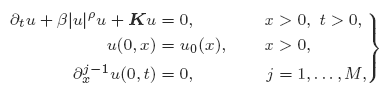 where β ∈ C, ρ > 2. The linear operator K is a pseudodifferential operator defined by the inverse Laplace transform with dissipative symbol K(p) = αpρ, M = [1/2ρ]. The aim of this paper is to prove the global existence of solutions to the initial–boundary-value problem and to find the main term of the asymptotic representation of solutions in the critical case, when the time decay of the nonlinearity has the same rate as that of the linear part of the equation.
A note on the monotonicity of the Maslov-type index of linear Hamiltonian systems with applications
-
- Published online by Cambridge University Press:
- 12 July 2007, pp. 1263-1277
-
- Article
- Export citation
Boundedness of pseudodifferential operators of a C*-algebra-valued symbol
-
- Published online by Cambridge University Press:
- 12 July 2007, pp. 1279-1286
-
- Article
- Export citation
Weighted inequalities for Cesàro maximal operators in Orlicz spaces
-
- Published online by Cambridge University Press:
- 12 July 2007, pp. 1287-1308
-
- Article
- Export citation
-
Let 0 < α ≤ 1 and let M+α be the Cesàro maximal operator of order α defined by
 In this work we characterize the pairs of measurable, positive and locally integrable functions (u, v) for which there exists a constant C > 0 such that the inequality
 holds for all λ > 0 and every f in the Orlicz space LΦ(v).We also characterize the measurable, positive and locally integrable functions w such that the integral inequality
 holds for every f ∈ LΦ(w).The discrete versions of this results allow us, by techniques of transference, to prove weighted inequalities for the Cesàro maximal ergodic operator
 associated with an invertible measurable transformation, T, which preserves the measure.
Finally, we give sufficient conditions on w for the convergence of the sequence of Cesàro-α ergodic averages for all functions in the weighted Orlicz space LΦ(w).
Rikitake system: analytic and Darbouxian integrals
-
- Published online by Cambridge University Press:
- 12 July 2007, pp. 1309-1326
-
- Article
- Export citation