

Introduction
Service user participation in social care regulation is an evolving approach and part of a broader movement within social care that recognises the importance of involving those directly impacted by policies and decisions (Barnes, Reference Barnes1999; Beresford, Reference Beresford, Eide, Josephsson and Vik2017). This approach emphasises the need to actively incorporate the voices of service users in shaping the systems that affect them. In the regulatory context, participation plays a crucial role in integrating the perspectives and lived experiences of service users into the key regulatory functions, including standard setting, standard monitoring, and enforcement (Levi-Faur, Reference Levi-Faur2014). By engaging service users in these processes, regulators aim to improve the effectiveness of regulation and, ultimately, enhance care outcomes.
In recent years, regulatory bodies have increasingly integrated service user participation into their strategies and practices, marking a shift toward more inclusive and responsive forms of social care governance (Haber and Heims, Reference Haber and Heims2020; Dolev and Benish, Reference Dolev and Benish2025). Correspondingly, scholarly interest in this area has grown, with research focusing on various methods employed by regulators, such as complaint systems (e.g., Bouwman et al., Reference Bouwman, Bomhoff, Robben and Friele2016), participation in inspection teams through ‘experts by experience’ (e.g., De Graaff et al., Reference De Graaff, Rutz, Stoopendaal and van de Bovenkamp2024), and mystery guest (e.g., Adams et al., Reference Adams, van de Bovenkamp and Robben2015).
One of the most commonly used participatory methods is on-site interviews with service users, which inspectors widely practice as part of their broader monitoring tasks (Furness, Reference Furness2009; Pålsson, Reference Pålsson2017). Despite the prevalence of this method, there has been limited exploration of how these interviews are conducted, particularly from a participatory perspective and a lack of understanding regarding how the information gathered during these interviews is integrated into the inspection process.
This study seeks to address this gap by examining two key research questions: How do inspectors perceive service user participation? And how do they apply the information obtained from service users? To explore these questions, this article presents a case study of onsite interviews conducted by inspectors with children in residential care in Israel. This case study provides a deeper understanding of how participation is implemented in social care regulation.
Theoretical framework: Participatory regulation in social care
Regulation has always been an essential part of the welfare state (Levi-Faur, Reference Levi-Faur2014), but its importance increased with the rise of privatisation and outsourcing. Services once provided directly by the state are now provided by non-governmental actors, redefining the government’s role from a ‘provider state’ to a ‘regulatory welfare state’. In this model, the state relies on regulatory tools to ensure that private providers meet essential standards, particularly to protect vulnerable service recipients (Benish et al., Reference Benish, Haber and Eliahou2017).
Within this regulatory welfare state, a notable trend has evolved over the past 30 years, in which an increasing number of regulatory bodies integrate service user participation into their strategies and practices (De Graaff et al., Reference De Graaff, Rutz, Stoopendaal and van de Bovenkamp2024). The rise of service user participation represents a major shift in the governance of care services, placing the voices and experiences of those receiving care at the centre of regulatory processes. This development is driven by two main forces. It reflects the broader expansion of service user participation in social care, seen both as a way to strengthen democracy and as part of the New Public Governance approach to public administration (Osborne, Reference Osborne2009). It also responds to public demand for better regulation, fueled by repeated care failures and criticism that regulators neglect service users’ complaints and feedback (Bouwman et al., Reference Bouwman, Bomhoff, Robben and Friele2016).
Participation in regulation is distinct from participation in service delivery, as it is implemented through pathways that connect users’ voices to the specific regulatory actions of standard-setting, monitoring, and enforcement (Levi-Faur, Reference Levi-Faur2014). In a standard-setting pathway, service users influence what ‘quality’ should mean and which standards matter. In a monitoring pathway, they provide evidence that tests whether standards are enacted in practice. In an enforcement pathway, their input contributes to judgments about appropriate responses, ranging from soft guidance to formal requirements (Dolev and Benish, Reference Dolev and Benish2024).
Within monitoring and enforcement, inspectors carry the legislative responsibility to uncover service conditions and detect any illegal or unjustified practices targeting service users. The legislative framework both grants inspectors a mandate to inspect the services and defines the aspects to be supervised (Repo, Reference Repo2024). By collecting information against legal frameworks or established standards, inspectors ensure the inspection process is ‘forensic’ (Smith, Reference Smith2000), identifying deficiencies or highlighting exemplary practices (Hall et al., Reference Hall, Lindgren, Sowada, Van de Walle and Raaphorst2019).
Onsite interviews are a key mechanism for incorporating service users’ perspectives as regulatory intelligence (Furness, Reference Furness2009; Adams et al., Reference Adams, van de Bovenkamp and Robben2015), providing first-hand inputs that may confirm or contradict official records. In these encounters, inspectors act as participation facilitators, framing questions, assessing credibility, and deciding how to use the information. This discretion explains why the same method can yield different regulatory outcomes across inspectors and contexts (Van de Walle and Raaphorst, Reference Van de Walle and Raaphorst2019). Yet despite their centrality, onsite interviews have rarely been examined in detail, and even fewer studies approach them from a participatory perspective. Hall et al. (Reference Hall, Lindgren, Sowada, Van de Walle and Raaphorst2019) conceptualise inspectors as information-seekers within the street-level bureaucracy tradition, and Repo (Reference Repo2024) describes inspection as knowledge work concerned with processing and triangulating diverse information sources. While these perspectives illuminate the informational basis of inspections, they do not explore onsite interviews through a participatory lens. Addressing this gap, Pålsson’s (Reference Pålsson2017) study of Swedish residential care inspections stands out as a notable inspection-specific theorisation. He identifies three rationales: regulatory, supportive, and protective, for how inspectors interpret and use children’s accounts during onsite interviews, directly linking participatory practices to regulatory consequences (see Table 1). This makes his work a key starting point for the present study.
Analytical inspectorial rationales used in interviews with children during inspection (Pålsson, Reference Pålsson2017, p. 38)

These three rationales illustrate different ways inspectors engage with children’s inputs from a participatory perspective. Under the regulatory rationale, children’s voices are treated primarily as evidence of compliance with standards, giving them only conditional influence on the inspection. The supportive rationale values children’s own concerns, affording them stronger agency but sometimes raising expectations beyond inspectors’ authority. The protective rationale prioritises safeguarding, leading inspectors to filter out sensitive information and thereby limiting children’s role in shaping regulatory judgements.
Building on this framework, the present study examines onsite interviews in the Israeli context to explore how inspectors shape participatory practices and perceive children’s roles. Israel offers a revealing case as most residential care services are delivered by non-governmental providers under state contracts, while inspectors remain the primary regulatory actors. This arrangement highlights the dilemmas of participatory regulation in a highly outsourced welfare system.
Background: Social care regulation in Israel
In Israel, as in many other countries, the regulatory framework for social care has undergone significant evolution, particularly in response to the increasing outsourcing of services to non-governmental organisations (NGOs). As reliance on non-governmental agencies for social care has grown, the regulatory role of the Ministry of Welfare has expanded. The ministry now bears the responsibility of ensuring that these agencies meet required standards of care (Lahat and Talit, Reference Lahat and Talit2015).
The regulatory systems within the Ministry were established long before the widespread adoption of contracting-out. Historically, the role of inspectors, many of whom were trained social workers, was shaped by the principles of supervision inherent in the social work profession (Hovav, Reference Hovav1998), emphasising professional standards and ethical considerations.
Today, designing appropriate regulatory systems for social welfare services remains a pressing challenge for the Israeli government. As the landscape of service provision continues to evolve, adaptable regulatory frameworks are essential to ensure that vulnerable populations receive high-quality care. Policymakers and regulators face the ongoing task of balancing strict oversight with the flexibility needed to foster innovation in the sector (Benish et al., Reference Benish, Halevy and Spiro2018).
Residential care in Israel and the role of inspections
The fundamental rights of the child are outlined in the International Convention on the Rights of the Child (United Nations, 1989), which Israel ratified in 1991. Among these rights, Articles 19 and 32 emphasise the state’s responsibility to protect children from all forms of physical or mental harm, exploitation, and neglect. This obligates the state to intervene in situations of abuse or danger and to provide necessary services to ensure children’s safety.
Children at risk live in environments that compromise their ability to exercise these rights. Since a child’s natural place is within the family, Israel’s welfare services focus on community-based solutions like daycare centres, foster homes, and after-school programmes to help families function normally. However, in severe cases of risk or neglect, the state may remove children from their families and place them in out-of-home care, including foster families or residential facilities. When reintegration isn’t possible, adoption may be considered.
Israel has a disproportionately high rate of residential care placements: about 73 per cent of children removed from their homes are placed in residential facilities and only 27 per cent in foster care (Office of the State Comptroller of Israel, 2023). In contrast, foster care averages 57 per cent in Europe, the USA, and Australia, while residential placements average 39 per cent (Eurochild and UNICEF, 2021). This pattern reflects a shortage of foster families, parental objections, and low compensation for relatives providing care (Silman, Reference Silman2014).
Residential facilities in Israel are commonly divided into three categories according to the severity of children’s needs: educational-rehabilitative facilities for children with learning gaps or emotional difficulties but potential for normative development; therapeutic facilities for children with behavioral or mental disorders requiring special education; and post-hospital facilities for children discharged from psychiatric hospitals or in need of an alternative to hospitalisation (Dolev et al., Reference Dolev, Ben-Rabi, Zemach-Marom, Courtney and Iwaniec2009).
The placement of children in residential facilities operated by the Ministry of Welfare and Social Affairs is governed by the Supervision of Residential Care Law (1965) and the Youth Law (1960). These facilities provide education, care, and guidance within a safe environment for children primarily aged eight to eighteen, with some exceptions up to twenty-one.
Admissions are based on Youth Protection Committee recommendations, with parental consent or a court order, often in response to emotional challenges, neglect, or abuse.
Inspectors of residential care operate within the Division of Residential Services of the Ministry of Welfare and Social Affairs. There are twenty-five inspectors distributed across four districts, overseeing a total of 130 facilities. While the Supervision and Control Administration of the Ministry sets supervision policy for all divisions, each division retains flexibility to adapt the policy to its specific needs.
Method
The study employed an abductive thematic analysis approach (Timmermans and Tavory, Reference Timmermans and Tavory2012; Thompson, Reference Thompson2022), which combines inductive and deductive reasoning to iteratively explore and interpret data. Abductive analysis seeks to generate explanations for observed phenomena by aligning empirical findings with existing theoretical frameworks. This approach allowed for the testing of Pålsson’s (Reference Pålsson2017) analytical framework, while remaining open to the discovery of new qualitative insights. By integrating the structured framework with the flexibility to explore emergent themes, the study aimed to provide a more nuanced and comprehensive understanding of how information gathered from children during onsite interviews is applied.
Case selection
This study focuses on a single case: onsite interviews conducted by inspectors from the Personal and Social Services Administration in Israel’s Ministry of Welfare and Social Affairs. This administration provides key welfare services to individuals, families, special populations, and immigrant communities. The case was selected for its broad scope and strategic importance within the Israeli welfare system. Additionally, the choice was one of convenience, as access to inspectors in this administration was readily available.
Data collection
In-depth, semi-structured interviews were employed as the primary method for gathering data. A total of twelve interviews were conducted with inspectors from the Division of Residential Services at the Personal and Social Services Administration, Ministry of Welfare and Social Affairs in Israel, and three interviews were conducted with headquarters staff, resulting in fifteen interviews overall. Of the twenty five inspectors in the division, seven had less than six months of experience, two were on maternity leave, and four declined to participate. The interviewed inspectors represented all four districts within the ministry’s jurisdiction and had at least six months of experience in residential care inspections. All interviewed inspectors were trained social workers, including three men and nine women, with experience in inspection ranging from six months to seven years (median: two years). Each inspector was responsible for supervising five to ten residential facilities, all operated by non-governmental organisations, typically encompassing a mix of educational-rehabilitative, therapeutic, and in some cases post-hospital settings (Dolev et al., Reference Dolev, Ben-Rabi, Zemach-Marom, Courtney and Iwaniec2009).
The interviews were guided by a pre-established framework based on existing literature on participation and onsite interviews. Inspectors were asked to describe interviews they had conducted with children, from the initial meeting to the conclusion of the interview, and to explain how they used the information gathered. Further questions explored how inspectors perceive the value of these interviews, how the insights contribute to their work, and the challenges they face. Additionally, three interviews were conducted with the division’s headquarters to gather organisational and policy-related insights.
The study was approved by the Ethics Committee of the Social Work and Social Welfare Department at the Hebrew University of Jerusalem. All interviews were conducted between May and September 2023 and lasted between one and one-and-a-half hours. Interviewees provided informed consent before participating in the study, and all interviews were recorded and transcribed for analysis.
Context of the inspection procedures and inspector responsibilities
Information on inspection procedures and inspector responsibilities was collected from interviews with the Residential Services division’s headquarters. Inspectors play a key role in implementing policies and addressing the needs of residential care facilities. Each inspector must visit facilities under their supervision at least once every three weeks, with a minimum of two unannounced visits per year. They are tasked with verifying compliance with ministry policies and ensuring children receive proper emotional, medical, educational, and administrative support. When a new child is admitted, inspectors must confirm that the intake process follows established protocols.
According to the headquarters, inspectors maintain ongoing communication with facilities to address emerging challenges. They relay information upward to inform policy-making and downward to guide staff, playing a crucial role in linking policy with practice. They also help improve the quality of care by offering direct guidance. Each inspector follows a structured work plan that organises tasks by topic and timeline.
According to the headquarters, inspectors are required to interview children during inspections, using a structured tool to ensure confidentiality while capturing children’s experiences. This procedural framework highlights their dual role in enforcing policy compliance and offering practical support to enhance care quality.
Inspectors prepare reports that summarise key decisions. Deficiencies, when identified, are documented, along with guidance for the facility manager. The manager’s response is requested, and the report is used as a reference during the next inspection. A copy is also sent to the supervisor and headquarters.
Data analysis
The analysis was based on an abductive approach (Timmermans and Tavory, Reference Timmermans and Tavory2012; Thompson, Reference Thompson2022) in conjunction with Braun and Clarke’s reflexive thematic analysis (Braun and Clarke, Reference Braun and Clarke2019, Reference Braun and Clarke2023). This facilitated a flexible and iterative process, moving between theory and data. Pålsson’s three rationales informed the initial coding and served as a guide for identifying how inspectors described their work. Whereas Pålsson focused on how children’s views were incorporated into inspection reports, this study also examined the informal ways inspectors acted on the information they gathered. When material revealed categories that did not align with Pålsson’s rationales, new codes were developed inductively. This abductive process anchored the analysis in an established framework while remaining open to new insights.
The analysis had six phases: (1) Familiarising with the dataset: reading the transcribed interviews and the documents several times, noting down ideas; (2) Coding: systematically creating initial codes across the dataset; (3) Generating initial themes: reviewing and combining some of these codes into potential themes while discarding others as irrelevant to the research; (4) Developing and reviewing themes; (5) Refining, defining, and naming themes; and (6) Writing the analysis. This process uncovered the underlying perceptions that guide inspectors when applying information gathered from interviews with children in residential care.
Atlas.ti software was used to manage and analyse the data, facilitating a systematic examination of the transcripts. The insights from the thematic analysis and Palsson’s framework were synthesised into four themes.
Findings
The data analysis revealed four ways inspectors apply information gathered from children during onsite interviews in residential services: (1) assessing quality of care against established standards; (2) advocating for children as a group; (3) advocating for children individually; and (4) empowering the children to address their concerns. Each reflects a different perspective on service user’s role in inspections and on the inspectors’ role. The findings are presented below according to these four themes and their associated perspectives.
Assessing quality of care against established standards
One theme that emerged from the interviews is the use of children’s inputs to assess whether a facility meets regulatory requirements. This approach aligns with the fundamental objective of monitoring and reflects the institutional duty of inspectors to evaluate service quality from the perspective of children. The underlying assumption is that children provide crucial evidence for evaluating the quality of care and that other sources of information within the facility, such as staff or documents, may be incomplete or unreliable. As one inspector explained:
If you only speak with the staff and the manager, you’ll get about a quarter of the picture, they may present an idealised account, or only partial information. If you conduct interviews with the children, you can cross-check the information. That’s oversight, that’s control. You just can’t do it without speaking to the children. It doesn’t give you the full picture, especially regarding their feelings, which aren’t reflected in the documents (inspector six).
Inspectors employing this approach direct conversations with children in the residential service toward topics relevant to care quality. For this purpose, the Ministry has developed a structured tool with standard-related questions. Inspectors may use the tool to pose direct questions or conduct open conversations that draw out relevant themes. By guiding the conversation in this manner, inspectors ensure that the focus remains on critical areas of care, as one explained:
I need to examine the facility organisationally, through the eyes of the child, to understand what is happening. For this, there are structured, consistent questions, such as whether there are established procedures, whether there is a structured personal programme in place. There are also questions on issues such as children’s safety, their relationship with the caregiver, extracurricular activities, the food, various programmes, and summer plans (inspector twelve).
When inspectors identify relevant information, their first step is to determine whether it indicates deficiency. If so, they assess whether the issue reflects a broader, recurring problem or a one-time incident. This distinction guides the appropriate response and ensures systemic issues are addressed:
In one of the services I supervised, there were recurring complaints from children about the food. To address this, I brought in nutritionists and cross-checked the feedback to get a clearer picture. Since the issue seemed consistent, we required the chef to resolve it. It’s always more complex than simply asking ‘what is tasty and what isn’t’ so we deepened the investigation to see what was really going on (inspector three).
What I often take from these interviews is a trend, things that are systemic. For example, I found that a certain residential care doesn’t provide clothing regularly to its children and doesn’t fulfill that right (inspector six).
Advocating for children as a group
A second theme that emerged from the interviews is the use of children’s inputs with an emphasis on what matters most to them. This theme reflects the assumption that quality of care extends beyond established standards and that children themselves are best positioned to indicate what it should include:
I listen to the children and try to understand what is truly important to them. For example, they may tell me that the current group activities offered to them are not suitable for them and may suggest other activities more tailored to their unique interests and hobbies. This is something I follow up on, even though it’s not explicitly included in the standards (inspector two).
Inspectors noted that they do not strictly adhere to standards but conduct interviews flexibly and broadly to gather input about the overall quality of care, including aspects not explicitly regulated but essential to the children’s well-being. Similar to the previous theme, when inspectors identify concerns during interviews, they investigate further to determine whether the issue is systemic. If so, they act to advocate for the children. Because these issues often fall outside formal standards, this approach requires a collaborative stance with providers, as illustrated by the inspector who referenced after-school activities above:
I will discuss this with the manager and see how he responds. He might say, ‘Next year we’re planning a different programme tailored to their needs,’ or, ‘Right now, we don’t have the budget for it’. It really depends on what he says, and based on that, I know how to respond. I might inquire why there’s no budget for this activity, given the available funding per child. This opens up various considerations and creates an opportunity for further dialogue (inspector two).
Advocating for individual children
This theme highlights a distinct approach inspectors use when gathering inputs from children. Here, inspectors apply the information obtained in interviews to address and help resolve personal challenges the children face. This approach acknowledges children’s vulnerability and frames inspectors as advocates for their individual wellbeing. It appears to stem from inspectors’ perception of themselves as representatives of the state, bearing responsibility for decisions regarding children’s removal from their homes. Consequently, this perspective strengthens their sense of duty to care for the children individually. By focusing on the children’s specific needs and circumstances, inspectors aim to provide more personalised support:
I think we have a responsibility. The children are placed there, but it’s not as if the Ministry just puts them there and abandons them, without checking from a distance if they have what they need. We need to make sure the children understand that we placed them there with responsibility. I want them to see that I see them, and to make sure they are getting everything they need within the service (inspector one).
During interviews, personal issues may arise, whether deliberately prompted by inspectors or not. When this occurs, inspectors seek to determine if the child is experiencing difficulties that are not being adequately addressed. They assess the credibility of the information and its potential impact on the child’s wellbeing, and if it appears to affect the child negatively, they intervene. This may involve requiring action from relevant staff or management, or in some cases, referring the matter to external agencies, such as child protection services:
A girl once came to me and told me that she wanted another pair of shoes because at her school, the status of the population is very high, and she was embarrassed that she only had one pair of shoes. So I immediately went out and said to the staff, ‘You are buying her shoes, and you will also take a picture of it to show me that you bought them (inspector two)’.
I met a girl, and she told me, ‘My brother is in such and such a programme, and I haven’t seen him in a month.’ So that same day, I called the manager and told her, ‘This week, you will arrange a meeting between the siblings.’ She explained to me that they hadn’t met because of the holidays, but now she’ll make sure it happens (inspector eleven).
However, inspectors noted that addressing children’s personal issues can be tricky, as some overlap with more complex matters best suited for therapeutic intervention. They also acknowledged that such involvement is not formally part of their regulatory role but often stems from their professional identity as social workers. This blurring of boundaries may leave both inspectors and children feeling frustrated: inspectors lack the resources to resolve all issues and children may feel their concerns remain unaddressed, as one explained:
There are things we can help with, but there are also things we’re limited in. A girl asked me at the end of the interview, ‘Can you help me find my mom?’ Now, there are things I simply can’t do, of course, and that’s the really hard part. There are quite a few stories with kids in care facilities where you just feel helpless about what can you actually do, and what is the facility really responsible for? (inspector nine).
Empowering children to address their concerns
This theme highlights inspectors’ efforts to encourage children to manage their concerns within the service setting. It emphasises strengthening the relationship between children and staff. Inspectors recognise that the residential care facility has become the child’s home, and they see it as their duty to reinforce the authority of the service while navigating the sensitive dynamics between children and staff. Consequently, this strategy avoids direct intervention that could disrupt the balance of the care environment. By promoting dialogue and understanding, inspectors support children in voicing their concerns and finding solutions, as one inspector explains:
I don’t want to be seen as someone who comes in, criticises the service, tells them what to do, and then leaves. My goal is always to return the power to the residential service itself. Rather than saying to the children, ‘I will handle this,’ I ask, ‘What can we do together? Would it help if we arranged a meeting, would that work for you?’ (inspector two).
In practice, when inspectors identify an unresolved problem, concern or dissatisfaction with care, they avoid immediate intervention. Instead, they encourage the children to propose their own solutions or guide them to communicate directly with staff. For instance, one inspector described how she handles food-related issues:
Many times, children come with complaints but are unsure of what they want or need. In these situations, I often encourage them to pause and think about solutions. For example, I might ask whether they would like to share their ideas for a recipe or approach the chef directly to express their expectations. Staff members, such as the chef, often have good intentions, and initiating this type of conversation can open up a dialogue (inspector two).
Another inspector explained how he encourages children to communicate directly with staff when issues relate to the facility’s internal culture, illustrating how he manages concerns while respecting the facility’s protocols:
A boy complained that his phone had been taken away, and when I asked him about it, he said, ‘Yes, because I did this, this, and this.’ I connected him with the staff and avoided taking actions that contradicted the facility’s approach and procedures, as it is important to respect these. In the end, I come and go, but the children remain there (inspector six).
As part of this approach inspectors may also help the children reframe the situation from a different perspective, thereby promoting constructive dialogue and collaborative resolution within the service:
When children come and complain, it’s important to leave them with the feeling that they are in a good place. Even if, as an inspector, I believe that the facility needs improvement in various areas, it’s not right to simply say that things are wrong. We need to avoid leaving them with the impression that they are in a facility that is not good enough for them (inspector seven).
Discussion and conclusion
This study presents four approaches to how inspectors apply inputs gathered from service users during onsite inspections. While these themes align with those outlined by Pålsson (Reference Pålsson2017), the study offers two key contributions. First, while Pålsson identified three rationales – regulatory, protective, and supportive –this study adds a fourth: the ‘empowerment rationale’. This rationale, further described below, highlights distinct roles for both inspectors and service users that are not included in Pålsson’s framework. Second, the study offers a more nuanced interpretation of Pålsson’s framework. Whereas his analysis centred on formal procedures – how inspectors incorporate children’s feedback into decision-making and reporting, this study expands the scope to include informal practices, providing a fuller view of how information is used. It also uncovers the underlying assumptions inspectors hold, which shape each approach.
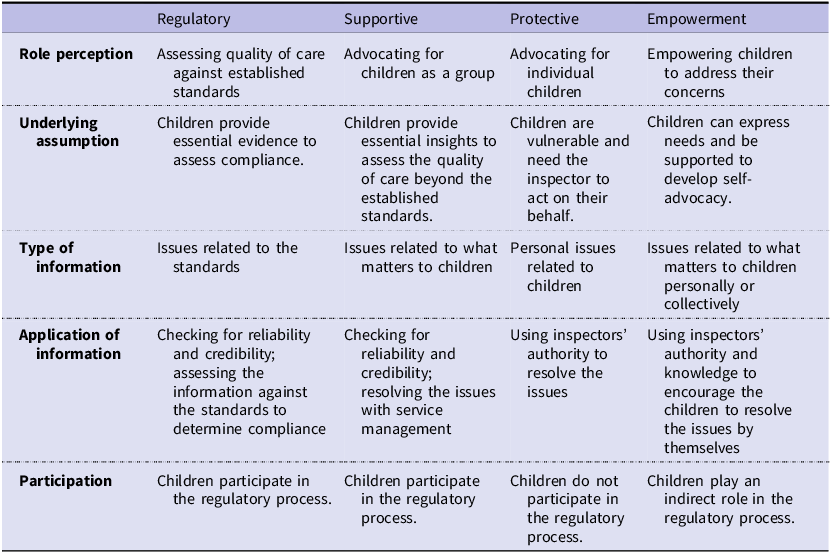
Although all four rationales were identified, inspectors did not adhere to a single, fixed rationale. Most described drawing on more than one, suggesting that these approaches may coexist and shift with context. Table 2 summarises the four approaches and their underlying assumptions.
Approaches for applying information collected in onsite interviews

The first approach, assessing quality of care against established standards, reflects the inspectors’ duty to monitor compliance and aligns with Pålsson’s regulatory rationale. In this process, inspectors direct interviews with children toward topics linked to formal standards, using either a structured tool or an open conversation. Two nuances emerged: inspectors emphasised that children’s perspectives are essential for a reliable picture of service quality, but they also stressed the need to verify credibility and determine whether problems are systemic rather than isolated. Once validated, inspectors discuss the issues with management and staff and document their findings in the report. This approach incorporates children into the regulatory process but limits their role to standards compliance. It tends to emerge when inspectors are motivated by institutional accountability and a strong adherence to formal criteria.
The second approach, advocating for children as a group, focuses on applying the information gathered from children to advocate for their collective well-being based on what matters to them. This aligns with Pålsson’s supportive rationale. In this process, inspectors conduct interviews with children to seek their perspectives and expectations, including aspects of care that may not be explicitly covered by regulations. This theme can be seen as an extension of the regulatory rationale, positioning children not only as informants but as central contributors in defining and improving the standards of care. This orientation tends to emerge when inspectors are motivated by a commitment to children’s collective voice and see participation as a way to improve services through dialogue and user experience.
The third approach, advocating for individual children, reflects inspectors’ protective orientation. When they identify unresolved personal issues during interviews, they intervene to address them. While Pålsson found that protective assumptions often led inspectors to hesitate in using children’s inputs – either to protect them or due to concerns about reliability – inspectors here described the opposite: vulnerability prompted them to intervene on children’s behalf. This proactive stance appears tied to their identity as social workers and state representatives, with responsibility for decisions about children’s removal from their homes. Notably, inspectors did not express concern that such intervention might harm or compromise the children, reflecting a strong professional drive to help that may at times outweigh caution about privacy. Although this orientation provides direct protection, it sidelines participation by resolving issues for children rather than with them. It is not formally defined, and it tends to emerge when inspectors lean more heavily on their social work identity than on their regulatory role, emphasising advocacy and protection.
Finally, the fourth approach, empowering children to address their concerns, highlights inspectors’ efforts to encourage children to voice concerns and seek solutions within the care setting. This approach acknowledges the complexity of the care environment and aims to maintain stability while still responding to concerns raised by children. It also reflects inspectors’ awareness of the long-term impact of their actions: encouraging children to participate in resolving issues not only addresses immediate concerns but also fosters resilience and self-advocacy skills that may benefit them during their time in care. This rationale adds to Pålsson’s framework by explicitly recognising children’s agency. From a participatory perspective, it enables children to play an indirect but substantial role in the regulatory process, as they are supported to manage aspects of their care experience.
There is, however, a tension within empowerment approaches that is important to consider. Scholars have noted that empowerment may, in some contexts, encourage individuals to adjust to existing arrangements rather than challenge them (e.g., Cruickshank Reference Cruickshank1999). In this study, inspectors aimed to support children to raise concerns while preserving the ‘family-like’ stability of the residence and working within regulatory boundaries. Similar to the advocating approach, it is not formally defined, and it tends to emerge when inspectors draw on their social work identity while implicitly conveying regulatory expectations to children, who thereby play an indirect role in the regulatory process. This dynamic is important to consider and may warrant further exploration in future research. Together, these four approaches show how inspectors perceive and act on children’s inputs, navigating three overlapping identities: the regulatory agent, the facilitator of participation, and the professional social worker. Each rationale privileges a different configuration of these roles: in the regulatory rationale, the compliance role dominates and participation is narrowly instrumental; in the supportive rationale, inspectors extend regulation by incorporating children’s collective voice; in the protective rationale, inspectors act from their social work identity by intervening directly on behalf of vulnerable children; and in the empowerment rationale, inspectors draw on both regulatory authority and professional background to foster children’s agency. Taken together, these approaches show that participatory regulation is not a uniform process but one that varies depending on how inspectors combine regulatory authority, participatory aims, and professional values.
While grounded in Israel’s residential care system, the findings point to a broader feature of the regulatory welfare state: in outsourced systems, inspectors become the state’s primary representatives within services. This position heightens their ambivalence, as they are simultaneously tasked with enforcing compliance and facilitating children’s participation. Service-user interviews, widely used as a participatory method in welfare monitoring, thus illustrate how regulatory authority and participatory ideals are negotiated in practice. The study highlights inspectors as a crucial site where these logics intersect, underscoring the need for comparative research on how different regimes balance accountability, participation, and professional discretion.
Limitations
This study has several limitations. It relies on inspectors’ self-reported accounts, which may not fully capture their actual practices. Future research could incorporate observations, interviews with children and staff, and inspection report analysis for a fuller picture. The study also focuses on a single case, limiting transferability. Comparative studies across care types and countries could enhance external validity. Moreover, rationales for participation may vary with inspectors’ backgrounds, facility characteristics, or child populations, warranting further study. Finally, this research examined one participatory method and future work could explore others, such as complaints or advocacy group engagement, to broaden understanding.
Acknowledgements
ChatGPT (OpenAI, GPT-4o, and GPT-5.1 models, accessed during 2024–2025) was used for language editing and improving clarity. All substantive content, research design, analysis, data interpretation, and conclusions are entirely my own.


 Open access

