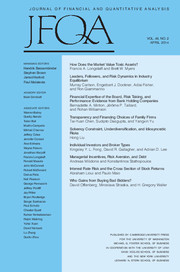
Contents
Research Articles
How Does the Market Value Toxic Assets?
- Part of:
-
- Published online by Cambridge University Press:
- 23 April 2014, pp. 297-319
-
- Article
-
- You have access
- Export citation
Leaders, Followers, and Risk Dynamics in Industry Equilibrium
-
- Published online by Cambridge University Press:
- 04 June 2014, pp. 321-349
-
- Article
- Export citation
Financial Expertise of the Board, Risk Taking, and Performance: Evidence from Bank Holding Companies
-
- Published online by Cambridge University Press:
- 13 May 2014, pp. 351-380
-
- Article
- Export citation
Transparency and Financing Choices of Family Firms
-
- Published online by Cambridge University Press:
- 27 May 2014, pp. 381-408
-
- Article
- Export citation
Solvency Constraint, Underdiversification, and Idiosyncratic Risks
-
- Published online by Cambridge University Press:
- 13 May 2014, pp. 409-430
-
- Article
- Export citation
Individual Investors and Broker Types
-
- Published online by Cambridge University Press:
- 09 June 2014, pp. 431-451
-
- Article
- Export citation
Managerial Incentives, Risk Aversion, and Debt
-
- Published online by Cambridge University Press:
- 23 May 2014, pp. 453-481
-
- Article
- Export citation
Interest Rate Risk and the Cross Section of Stock Returns
-
- Published online by Cambridge University Press:
- 10 March 2014, pp. 483-511
-
- Article
- Export citation
Who Gains from Buying Bad Bidders?
-
- Published online by Cambridge University Press:
- 31 March 2014, pp. 513-540
-
- Article
- Export citation
Front Cover (OFC, IFC) and matter
JFQ volume 49 issue 2 Cover and Front matter
-
- Published online by Cambridge University Press:
- 10 October 2014, pp. f1-f5
-
- Article
-
- You have access
- Export citation
Back Cover (OBC, IBC) and matter
JFQ volume 49 issue 2 Cover and Back matter
-
- Published online by Cambridge University Press:
- 10 October 2014, pp. b1-b8
-
- Article
-
- You have access
- Export citation