


The historical range of the jaguar Panthera onca has contracted and many populations are now threatened (De la Torre et al., Reference De la Torre, González-Maya, Zarza and Ceballos2017), including the subpopulations in the Atlantic Forest (Morato et al., Reference Morato, Beisiegel, Ramalho and Boulhosa2013). The last c. 300 individuals in this forest occur in seven subpopulations, and the survival of the species in this biome will depend on reducing jaguar mortality and reconnecting the subpopulations (Paviolo et al., Reference Paviolo, De Angelo, Ferraz, Morato and Pardo2016). However, some of these are isolated and the cost of establishment of suitable corridors may be prohibitive (Paviolo et al., Reference Paviolo, De Angelo, Ferraz, Morato and Pardo2016), and alternative strategies, such as supplementation and reintroduction, may be required (Galetti et al., Reference Galetti, Eizirik, Beisiegel, Ferraz, Cavalcanti and Srbek-Araujo2013).
Reintroductions of apex predators, including the few attempts to reintroduce jaguars, have generally been poorly documented and measurement of failure or success has been hampered by the lack of prior definition of expected outcomes (Breitenmoser et al., Reference Breitenmoser, Breitenmoser-Wursten, Carbyn, Funk, Gittleman, Funk, MacDonald and Wayne2001). To evaluate reintroduction as a tool for conservation of the jaguar, we adapted the IUCN (2013) soft release protocol to reintroduce two rescued jaguars in the southern Pantanal, Brazil (Fig. 1). We chose this area based on five criteria: (1) rescued animals were from the same region, (2) knowledge of the species' biology in the Pantanal was available, including for the release site (Cavalcanti & Gese, Reference Cavalcanti and Gese2010), (3) availability of suitable habitat (de Paula et al., Reference de Paula, Cavalcanti and Morato2012), (4) prey availability (Perilli et al., Reference Perilli, Lima, Rodrigues and Cavalcanti2016), and (5) acceptance by the local community.
The estimated home range (with 95% CI bands) of jaguars Panthera onca 1 and 2 in the southern Pantanal, Brazil. Note the high overlap in their home ranges.

Our expected outcomes were that the two jaguars would: (1) prey on wild species (to evaluate this, we compared the species preyed upon with the reported feeding habits of jaguars in the same area; Perilli et al., Reference Perilli, Lima, Rodrigues and Cavalcanti2016), (2) establish residence (establishment of residence may be an indicator of acclimation, and jaguars have resident ranges; Rabinowitz & Nottingham, Reference Rabinowitz and Nottingham1986), (3) have similar home ranges and movement to those reported for jaguars in the Pantanal (Morato et al., Reference Morato, Stabach, Fleming, Calabrese and de Paula2016), (4) have daily activity patterns comparable to that of resident jaguars, (5) exhibit social interactions (Kanda et al., Reference Kanda, Oliveira-Santos, Morato, de Paula, Rampim and Sartorello2019), and (6) reproduce.
In June 2014, during the flood season, a female jaguar and her two 3-month old female cubs were forced to seek refuge in an urban area of Corumbá, in the state of Mato Grosso do Sul, in the southern Brazilian Pantanal, climbing a tree c. 2 m from a house. An attempt to capture the jaguars resulted in the accidental death of the mother. The two orphans were moved to a wildlife rescue centre in Campo Grande, where they spent 9 months. We then moved them to a new facility in São Paulo state, with better infrastructure and minimum contact with people, where they stayed for 4 months.
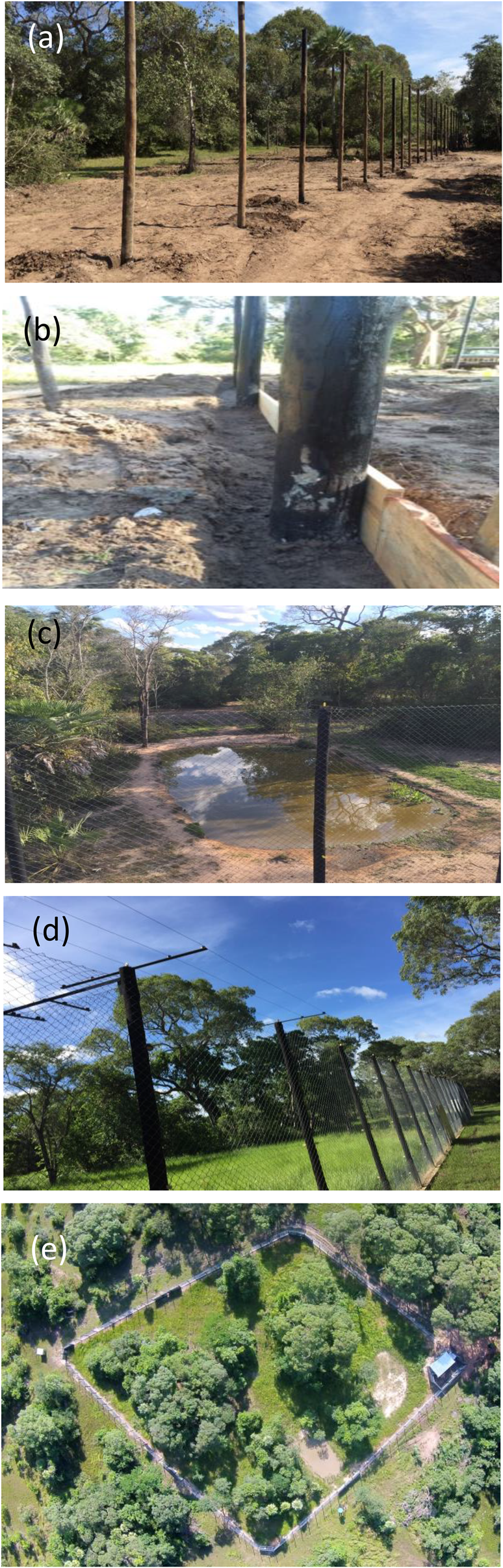
Pre-release, the two jaguars were tested for all relevant infectious and parasitic diseases. At c. 16 months old, having been confirmed healthy, they were moved on 27 July 2015 to a 1 ha enclosure with native vegetation (Plate 1) in the Caiman Ecological Refuge, a 53,000 ha private ranch in Miranda, Mato Grosso do Sul (Fig. 1). The ranch is a mixed enterprise, with cattle ranching and ecotourism. It follows jaguar-friendly best practices (Rampim et al., Reference Rampim, Sartorello, Fragoso, Haberfeld and Devlin2020), and hunting is not allowed on the property. As a result, potential prey is abundant and the estimated density of jaguars is c. 7 per 100 km2 (Soisalo & Cavalcanti, Reference Soisalo and Cavalcanti2006). In the first 2 months in the enclosure the jaguars were fed meat and dead animals (roadkill), to facilitate acclimation. After this, live wild prey was captured and presented, one animal at a time. Prey was released into the enclosure through one of six guillotine gates. These gates were covered with wooden plates to prevent the jaguars associating the arrival of food with people. We observed that hunting was better after 7 days without food. After 11 months the two jaguars were able to chase, surprise and kill all the animals offered. On a few occasions we offered two prey, of the same species, simultaneously, to evaluate hunting behaviour. In total, the jaguars captured and consumed 46 prey, including white-lipped peccaries Tayassu pecari, capybaras Hydrochoerus hydrochaeris, caimans Caiman yacare and feral pigs Sus scrofa scrofa (Table 1). After fitting collars equipped with GPS/VHF, recording one location per hour, and accelerometers, the jaguars were monitored for 30 days inside the enclosure, to provide baseline data on activity patterns and social behaviour.
The 1 ha enclosure in the Caiman Ecological Refuge (Fig. 1): (a) 4.5 m high eucalyptus posts, 3 m apart; (b) 40 cm deep trench excavated around the perimeter of the enclosure and filled with cement, to prevent any animal digging into or out of the enclosure; (c) c. 2 m deep, 60 m2 pond; (d) galvanized wire perimeter fence of 2.2 mm gauge and 6 × 6 cm mesh, with electric wires at 40, 100 and 200 cm, both inside and outside and on the top of the fence; (e) aerial view.
Total amount of meat consumed and dead and live prey offered to the two female jaguars Panthera onca during 238 days in an enclosure in the Caiman Ecological Refuge, in Miranda, Mato Grosso do Sul, Brazil.

The two jaguars were released at c. 27 months old, on 9 June 2016. To evaluate movement behaviour and estimate home range and spatial overlap, we used 16 months of telemetry data (June 2016–September 2017). We also performed visual appraisals using images captured by a c. 200 km2 grid of 60 camera traps. We observed that jaguar no. 2 suffered initial loss of weight but recovered 20 days after release. The enclosure door remained open for 3 months and both jaguars returned several times. We fitted a continuous-time stochastic movement model (ctmm; Calabrese et al., Reference Calabrese, Fleming and Gurarie2016) in R 3.5.1 (R Core Team, 2018) to evaluate movement behaviour and estimate home range. This method accounts for the inherent serial autocorrelation of our data and could handle irregularities in the sample schedule (Fleming et al., Reference Fleming, Fagan, Mueller, Olson, Leimgruber and Calabrese2015). Range residence behaviour was checked by visual inspection of a semi-variogram (function variogram in R). Movement models were fit with maximum likelihood (function ctmm.fit) and ranked based on the Aikake information criteria (function ctmm.select). We estimated home range conditional on the fitted model for both individuals using the akde function (autocorrelated kernel density estimator). We estimated spatial overlap using the overlap function. Daily activity patterns were evaluated using Activity Pattern Software (Lotek, Newmarket, Canada) after recovering the accelerometer data from the GPS collars.
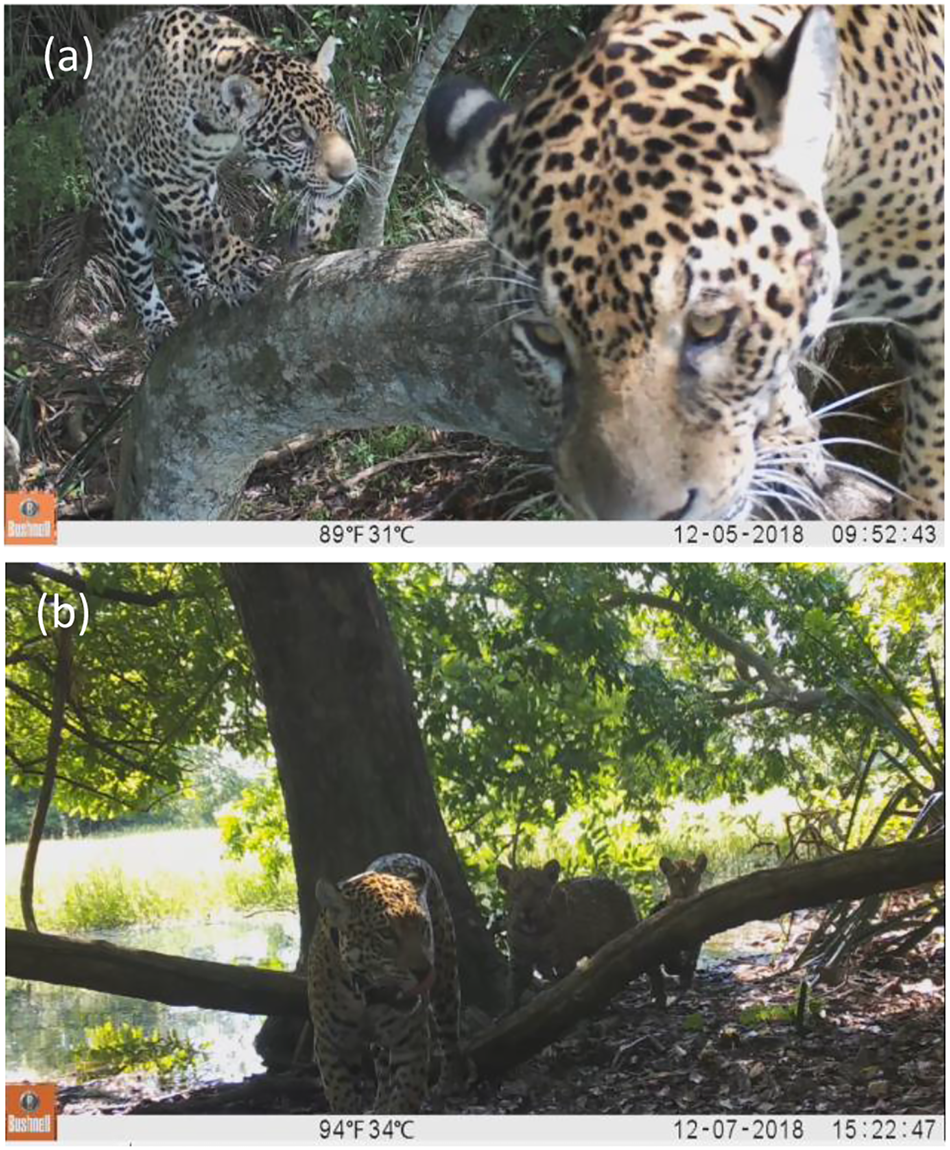
We adapted the method described by Cavalcanti & Gese (Reference Cavalcanti and Gese2010) to identify prey consumed. When > 4 consecutive locations were found < 100 m from each other this was classified as a kill site, where we then searched for prey remains to identify the species. Social behaviour, interactions and reproduction were investigated by observation and camera-trap images. Range residence was confirmed after visual inspection of a semi-variogram, 2 months post release (Morato et al., Reference Morato, Stabach, Fleming, Calabrese and de Paula2016). Home range estimates were 97.6 km2 (95% CI 79.1–118.1) for jaguar 1, and 64.2 km2 (95% CI 55.5–73.7) for jaguar 2 (Fig. 1). Both individuals anchored their home range around the enclosure and showed high spatial overlap with each other (85%, 95% CI 74–94%; Fig. 1). The home ranges included areas with ecotourism and cattle ranching activities, areas with wild prey, and well-preserved natural vegetation. Directionality in movement paths, represented by the velocity autocorrelation timescale (h), were 0.45 (95% CI 0.42–0.46) and 0.45 (95% CI 0.42–0.48) for jaguar 1 and 2, respectively. Mean distances travelled per day were 9.6 and 10.3 km for jaguar 1 and 2, respectively. Daily activity was similar to that previously reported for jaguars, with both individuals moving (hunting and transiting) during the night and resting during the day (Kanda et al., Reference Kanda, Oliveira-Santos, Morato, de Paula, Rampim and Sartorello2019). We identified 10 species preyed upon by the two jaguars (Table 2). Social interactions were observed between the two jaguars and nine other individual jaguars), including mating, fighting and paired movement. Jaguar 1 gave birth to a cub in c. June 2018 and jaguar 2 gave birth to two cubs in c. August 2018 (Plate 2).
Details of the 52 and 32 prey killed by female jaguars 1 and 2, respectively, after release (January 2017–December 2017) and, for comparison, the mean per cent of total prey killed by jaguars in an earlier study in the southern Pantanal.

1 From Cavalcanti & Gese (Reference Cavalcanti and Gese2010).
(a) Jaguar 1 with her 6–7 month old cub, photo-trapped in December 2018, and (b) Jaguar 2 and her two 4–5 month old cubs, photo-trapped in December 2018.
The two jaguars established residence near the enclosure, with home ranges, and movement and activity patterns similar to those reported for free living individuals (Morato et al., Reference Morato, Stabach, Fleming, Calabrese and de Paula2016), and prey consumption similar to that recorded in a previous study in the same area (Cavalcanti & Gese, Reference Cavalcanti and Gese2010), including a high consumption of caimans. The exhibition of social interactions, and reproduction, indicate that the reintroduction was successful.
The main objective of a reintroduction is usually to re-establish or supplement an extinct or declining population (Cheyne, Reference Cheyne2006). We released two individuals in an area where jaguars are not facing a high risk of extinction (Morato et al., Reference Morato, Beisiegel, Ramalho and Boulhosa2013) and threats are low. Our intention was to evaluate a protocol that could be applied to other subpopulations across the species’ range, and specifically for the Critically Endangered subpopulation of the Atlantic Forest (Morato et al., Reference Morato, Beisiegel, Ramalho and Boulhosa2013). Despite the success of this reintroduction in the Pantanal we need to be cautious in using this tool for the species' long-term survival.
As a pre-condition for reintroduction, the highest priority must be to address the threats that are causing jaguar population declines. Firstly, some jaguar subpopulations are proximal to areas where people are active, potentially resulting in negative interactions. Jaguars involved in such interactions are often killed by members of the affected community (Inskip et al., Reference Inskip, Ridout, Fahad, Tully, Barlow and Barlow2013). In such areas, law enforcement to prevent killing of jaguars, and alleviation of negative interactions with ranchers, are required and should play a central role in planning any reintroduction (Caruso & Pérez, Reference Caruso and Pérez2013). Secondly, in areas that have undergone deforestation (Ribeiro et al., Reference Ribeiro, Metzger, Martensen, Ponzoni and Hirota2009) or defaunation (Jorge et al., Reference Jorge, Galetti, Ribeiro and Ferraz2013), it is important to evaluate habitat quality and prey availability before establishing a reintroduction programme. Thirdly, social interaction is a key component. The absence of intersexual territoriality (Crawshaw & Quigley, Reference Crawshaw and Quigley1991) suggests that reintroducing female jaguars is likely to increase the success of reintroductions in areas where male jaguars are present. Fourthly, jaguars tend to move in areas with which they are familiar, evidence of cognitive capacity and spatial memory (Kanda et al., Reference Kanda, Oliveira-Santos, Morato, de Paula, Rampim and Sartorello2019), and therefore building enclosures in the release area and keeping individuals there prior to release may facilitate acclimation. Fifthly, the cost of reintroduction needs to be compared to alternative strategies. The total cost for reintroducing the two female jaguars was c. USD 111,490, without considering the costs of previous studies of the species’ behaviour in the same area. This reintroduction was in an area where spatial ecology, habitat and prey preferences were known (Cavalcanti & Gese, Reference Cavalcanti and Gese2009, Reference Cavalcanti and Gese2010; Morato et al., Reference Morato, Stabach, Fleming, Calabrese and de Paula2016). In the Atlantic Forest on the Argentina–Brazil border the main strategy for the southernmost jaguar subpopulation was to reduce persecution and poaching by means of education and law enforcement. The annual cost of the programme was c. USD 97,000 and after 10 years the jaguar population increased from an estimated 50 to 90 individuals (Paviolo et al., Reference Paviolo, De Angelo, Ferraz, Morato and Pardo2016).
In conclusion, reintroduction can be an important tool in areas where the jaguar population is in severe decline. It is the only option where the species has been extirpated and the management goal is reintroduction, residency and recovery. This study defines some of the practices and parameters that led to a successful outcome in the Pantanal.
Acknowledgements
We thank Centro de Reabilitação de Animais Silvestres de Campo Grande and Instituto de Meio Ambiente de Mato Grosso do Sul for rescuing the jaguars; Mantenedor Santa Rosa for hosting and caring for them; Caiman Ecological Refuge for allowing us to build the training facility and release the jaguars on their property; Alexandre Bossi, Camila Martins, Écio Silva, Fernando Von Zuben, Márcia Reed, Pedro Lacerda Camargo, Raphael Klabin, Robert Kozmann Jr, and Roberto Klabin and Instituto SOS Pantanal for their support; Log Materials and Bushnell Corporation for donating camera traps; and Tetrapak for donating materials to build the enclosure.
Author contributions
Study design: RLG-M, LS, LR, PT, MH, RCdP, RGM; fieldwork: LS, LR, CEF, JAMJ, MH, RCdP; data analysis, writing: RLG-M, LS, RGM; revision: LS, LR, CEF, JAMJ, PT, MH, RCdP.
Conflicts of interest
The authors have no relationship with Log Materials, Bushnell Corporation or Tetrapak, who donated equipment for research purposes only.
Ethical standards
All research protocols were approved by Instituto Chico Mendes de Conservação da Biodiversidade and Sistema de Autorização e Informação em Biodiversidade (licenses 46508, 47979, 52734), and the research followed guidelines approved by the American Society of Mammalogists, and otherwise abided by the Oryx guidelines on ethical standards.


 Open access

