





1. Introduction
Over the past decade, the sociocultural turn in the field of second language acquisition (SLA) has sparked growing interest in the emotions experienced by language learners (Gregersen & Mercer, Reference Gregersen and Mercer2021). Socio-emotional variables in second language (L2) learning refer to learners’ affective experiences that influence language learning processes and resulting learning outcomes (Shao et al., Reference Shao, Pekrun and Nicholson2019), such as foreign language anxiety, enjoyment, self-efficacy, and motivation. These emotions play a central role in influencing learners’ intended effort, cognitive processing, attention allocation, and readiness to participate in communicative tasks, thereby directly affecting learning outcomes. For example, anxiety has been shown to have a debilitating effect on L2 learning and achievement by constraining cognitive processing as well as reducing motivation and willingness to communicate in an L2 (Teimouri et al., Reference Teimouri, Goetze and Plonsky2019). In contrast, enjoyment has been found to facilitate language learning by enhancing learners’ attention and capacity to process the target language (Dewaele & MacIntyre, Reference Dewaele, MacIntyre, MacIntyre, Gregersen and Mercer2016).
Recognizing the importance of emotions in L2 learning, researchers in the field of computer-assisted language learning (CALL) have been interested in exploring how contemporary technologies may be used to enhance L2 learners’ socio-emotional experiences (Dhimolea et al., Reference Dhimolea, Kaplan-Rakowski and Lin2022). One technology that has gained popularity due to its potential to facilitate both linguistic and affective development of L2 learners is high-immersion virtual reality (HiVR). HiVR has been defined as “a computer-generated 360º virtual space that can be perceived as being spatially realistic, due to the high immersion afforded by a head-mounted device,” or HMD (Kaplan-Rakowski & Gruber, Reference Kaplan-Rakowski and Gruber2019, p. 552). This technology affords a fully immersive experience because the HMD entirely envelopes users’ vision and therefore disconnects them from the real world. In contrast, low-immersion virtual reality (LiVR) offers a less integrative experience via a flat two-dimensional (2D) computer screen, through which the user can still see the outside world.
Previous research suggests that HiVR-based instruction has the potential to better facilitate the development of L2 learners’ linguistic knowledge compared to less immersive teaching approaches (Dhimolea et al., Reference Dhimolea, Kaplan-Rakowski and Lin2022). Specifically, some studies have found that HiVR can improve L2 learners’ reading comprehension of real-time captions (e.g., Kaplan-Rakowski & Gruber, Reference Kaplan-Rakowski and Gruber2023a; Wang et al., Reference Wang, Guo, Wang, Tu and Liu2021), as well as listening (e.g., Ye & Kaplan-Rakowski, Reference Ye and Kaplan-Rakowski2024), writing (e.g., Wang et al., Reference Wang, Luo, Liu, Tu and Wang2022), speaking (e.g., Wu & Hung, Reference Wu and Hung2022), and vocabulary skills (e.g., Tai et al., Reference Tai, Chen and Todd2022) more effectively than in non-immersive modalities (face-to-face and tech-mediated). Several studies have also indicated a facilitative effect of HiVR-based instruction on the development of L2 learners’ pragmatic skills (e.g., Taguchi & Hanks, Reference Taguchi and Hanks2025) and intercultural competencies (e.g., DeWitt et al., Reference DeWitt, Chan and Loban2022). However, learning in HiVR has also been associated with greater physical and mental discomforts such as increased cognitive load, motion sickness, and eye strain compared to LiVR (Makransky et al., Reference Makransky, Terkildsen and Mayer2019; Weech et al., Reference Weech, Kenny, Lenizky and Barnett-Cowan2020).
While emerging evidence suggests that HiVR may facilitate the development of L2 learners’ language skills, its influence on socio-emotional outcomes remains less conclusive. Some studies have explored the effectiveness of HiVR on L2 learners’ socio-emotional responses, including anxiety (Thrasher, Reference Thrasher2022), motivation (Wang et al., Reference Wang, Guo, Wang, Tu and Liu2021), engagement (Li et al., Reference Li, Ying, Chen and Guan2022), enjoyment (Ye & Kaplan-Rakowski, Reference Ye and Kaplan-Rakowski2024), and self-efficacy (Wang et al., Reference Wang, Luo, Liu, Tu and Wang2022). However, this research has yielded conflicting results. For example, some have found no effect of HiVR on L2 learners’ motivation (Chen & Liao, Reference Chen and Liao2022), whereas others have revealed a large positive effect of HiVR for the same variable (Wang et al., Reference Wang, Guo, Wang, Tu and Liu2021; Zhao & Yang, Reference Zhao and Yang2023). Such contradictory findings limit our understanding of the potential impact of HiVR-based instruction on L2 learners’ socio-emotional responses.
Additionally, previous meta-analytic studies have examined L2 learners’ socio-emotional outcomes in both LiVR and HiVR without recognizing differences between these two types of computer-generated environments (e.g., Chen et al., Reference Chen, Wang and Wang2022). Given that HiVR is likely to provide learners with a higher level of immersion than LiVR (Makransky et al., Reference Makransky, Terkildsen and Mayer2019), there is a need to focus on the influence of HiVR-based instruction on L2 learners’ socio-emotional responses.
To address these gaps in the literature, this meta-analysis evaluated the overall impact of HiVR-assisted instruction on 11 socio-emotional variablesFootnote 1 : affect, anxiety, attitude, engagement, enjoyment, learning autonomy, motivation, satisfaction, self-efficacy, sense of presence, and willingness to communicate. In addition, this study examined whether the effect of HiVR on L2 learners’ socio-emotional responses varies as a function of various moderator variables. The results inform CALL researchers, language instructors, and HiVR materials designers on how to develop and use HiVR-based materials to support L2 learners’ socio-emotional reactions in language learning.
2. Literature review
2.1 Virtual reality and L2 learners’ socio-emotional responses
Previous literature has identified several psychological affordances of learning in HiVR, including sense of presence, sense of agency, and the perception of a safe space (Makransky & Petersen, Reference Makransky and Petersen2021; Shin, Reference Shin2017). Sense of presence refers to the feeling of “being there” in a virtual environment while being physically in another (Slater et al., Reference Slater, Banakou, Beacco, Gallego, Macia-Varela and Oliva2022). HiVR has been shown to foster a higher sense of presence compared to LiVR by enabling learners to experience virtual space from a first-person perspective and without distractions from the outside world (Makransky et al., Reference Makransky, Terkildsen and Mayer2019). According to the cognitive affective model of immersive learning (CAMIL; Makransky & Petersen, Reference Makransky and Petersen2021), a heightened sense of presence in HiVR may activate intense socio-emotional reactions in users (e.g., intrinsic motivation, situational interest, self-efficacy) that have been linked to improved learning. This theoretical claim has been supported by previous research, which found that the high sense of presence induced by HiVR promoted strong emotional responses, such as engagement and motivation, in young and adult learners, which enhanced their memory performance and resulted in improved learning (Mancuso et al., Reference Mancuso, Bruni, Stramba-Badiale, Riva, Cipresso and Pedroli2023; Petersen et al., Reference Petersen, Petkakis and Makransky2022). Additionally, HiVR has been found to enhance a sense of agency, which refers to learners’ feelings of generating and controlling actions in a virtual space (Kong et al., Reference Kong, He and Wei2017). Heightened learner agency has been shown to increase motivation, enjoyment, and positive attitudes toward language learning (Taguchi, Reference Taguchi2022). Finally, HiVR provides learners with a safe, risk-free space where they can freely experiment with language, engage in meaningful practice, and receive immediate corrective feedback (Kaplan-Rakowski, Reference Kaplan-Rakowski, Chapelle, Taguchi and Kadar2023). The increased feeling of safety in HiVR may promote L2 learners’ willingness to communicate (Fathi et al., Reference Fathi, Zou and Zhaleh2025) and reduce their foreign language anxiety (Thrasher, Reference Thrasher2022), which, in turn, can lead to positive learning outcomes.
Given these psychological affordances of HiVR environments, a growing body of research in recent years has examined how the use of HiVR may impact L2 learners’ socio-affective responses. However, findings across these studies have been mixed or at times inconclusive. For example, some studies have shown that HiVR can benefit L2 learners by reducing foreign language anxiety (e.g., Thrasher, Reference Thrasher2022; Wang et al., Reference Wang, Luo, Liu, Tu and Wang2022) and enhancing motivation (e.g., Chen et al., Reference Chen, Hung and Yeh2021; Kaplan-Rakowski & Gruber, Reference Kaplan-Rakowski and Gruber2023a), self-efficacy (e.g., Wang et al., Reference Wang, Luo, Liu, Tu and Wang2022; Zhao & Yang, Reference Zhao and Yang2023), engagement (e.g., Kaplan-Rakowski & Gruber, Reference Kaplan-Rakowski and Gruber2023a; Li et al., Reference Li, Ying, Chen and Guan2022), and enjoyment (e.g., Ye & Kaplan-Rakowski, Reference Ye and Kaplan-Rakowski2024). In contrast, other studies have found no significant effect of HiVR on learners’ anxiety (e.g., Chen, Reference Chen2022), motivation (e.g., Hung et al., Reference Hung, Lin, Yu and Sun2023), willingness to communicate (e.g., Wu & Hung, Reference Wu and Hung2022), engagement (e.g., Nicolaidou et al., Reference Nicolaidou, Pissas and Boglou2023), and enjoyment (e.g., Johnson et al., Reference Johnson, Giroux, Merritt, Vitanova and Sousa2020). The varying treatment- (e.g., VR treatment duration) and learner-related characteristics (e.g., L2 proficiency) in these primary studies may have led to these inconsistencies. Conducting a rigorous analysis of the various conditions that can moderate the effect of HiVR on language learners’ socio-affective variables provides a promising path forward for explaining and resolving incongruences in the existing body of research.
2.2 Moderating variables in HiVR research
There are three groups of moderating factors that potentially influence the effect of HiVR on L2 learners’ socio-affective responses: type of a socio-emotional variable, learner characteristics, and treatment-related factors. These categories are thus directly addressed in this meta-analysis and described below.
2.2.1 Type of a socio-emotional variable
L2 learning is understood to be governed by an interplay between positive and negative emotions, each playing a distinct role in the language learning process. Positive emotions (e.g., motivation, self-efficacy, enjoyment, engagement) have been shown to have a facilitative effect on language learners’ intended effort, attention, and achievement (Gregersen & Mercer, Reference Gregersen and Mercer2021). In contrast, anxiety has been found to significantly hinder L2 learners’ performance and cognitive processing (e.g., Teimouri et al., Reference Teimouri, Goetze and Plonsky2019). Previous research has shown that emotional experiences in VR environments can vary depending on the type of a socio-emotional variable. For example, meta-analyses by Qiu et al. (Reference Qiu, Shan, Yao and Fu2024) and Yu and Duan (Reference Yu and Duan2024) indicated that VR was more effective in enhancing language learners’ motivation than in reducing their anxiety. Thus, examining the impact of HiVR on specific types of socio-emotional responses may provide insights into whether and to what extent L2 learners’ different emotional reactions can be supported and enhanced by HiVR.
2.2.2 Learner characteristics
The effect of VR on L2 learners’ emotions has also been found to vary as a function of learner-related variables such as educational level and L2 proficiency. For example, Qiu et al. (Reference Qiu, Shan, Yao and Fu2024) found that primary and middle school students benefited more from VR-based instruction than college students. In contrast, the results of Chen et al.’s (Reference Chen, Wang and Wang2022) meta-analysis revealed that VR treatment had a stronger effect on the emotions of college students compared to younger learners. These mixed results blur our understanding of how VR influences emotions across different learner groups, highlighting the need for further research on its effects across various educational levels, L2 proficiencies, and target languages.
2.2.3 Treatment variables
Previous primary research as well as meta-analyses (e.g., Chen et al., Reference Chen, Wang and Wang2022; Qiu et al., Reference Qiu, Shan, Yao and Fu2024; Wu et al., Reference Wu, Yu and Gu2020) have reported that various treatment-related variables (e.g., HiVR content type, type of HiVR software, type of control treatment) moderate the effect of HiVR instruction on L2 learners’ emotions. However, no study has controlled for all these variables, underscoring the need for further meta-analytic research in this area.
2.3 Previous meta-analyses and motivation for the present study
To the best of our knowledge, four meta-analyses have examined the impact of VR on L2 learners’ socio-emotional outcomes (see Appendix S1 for a summary of these studies; note that all appendices appear in the supplementary material). These meta-analyses found that VR had an overall positive effect on socio-emotional reactions in L2 learning. Two of them focused on LiVR. Wang et al. (Reference Wang, Lan, Tseng, Lin and Gupta2019) meta-analyzed four primary studies that examined the effect of three-dimensional virtual worlds (3DVWs; a type of LiVR that does not use HMDs) on L2 learners’ attitudes and self-efficacy. 3DVWs were found to improve language learners’ attitudes and self-efficacy, with medium effect sizes. More recently, Yu and Duan (Reference Yu and Duan2024) meta-analyzed 37 studies on the effects of VR technologies on L2 learners’ anxiety, motivation, satisfaction, and self-efficacy, as compared to less immersive teaching methods. This study predominantly included studies with LiVR (n = 33), with only a few focused on HiVR (n = 4). The authors reported small positive effects of VR on learners’ anxiety and self-efficacy and medium positive effects for motivation and satisfaction. Although the meta-analyses by Wang et al. and Yu and Duan underscore the potential of VR to influence L2 learners’ socio-emotional variables, they also highlight the need for further targeted meta-analytic research on HiVR to better understand the affordances of this technology, especially given that HiVR has been shown to induce a stronger sense of presence than LiVR (Makransky et al., Reference Makransky, Terkildsen and Mayer2019).
The other two meta-analytic studies had a greater focus on HiVR. Chen et al. (Reference Chen, Wang and Wang2022) synthesized findings from 21 primary studies – nine HiVR and 12 LiVR – to examine the impact of VR-assisted instruction on L2 learners’ linguistic and emotional outcomes. Results showed an overall positive (medium) effect of VR on language learners’ socio-affective variables. While these affective gains included learning attitudes, motivation, self-efficacy, and willingness to communicate, they were not meta-analyzed at the level of these individual affective variables but rather combined into the larger category of “affective gains.” Finally, Qiu et al. (Reference Qiu, Shan, Yao and Fu2024) conducted a meta-analysis of 14 journal articles that focused on both HiVR (n = 20) and LiVR (n = 3). The results indicated that VR-assisted instruction significantly increased L2 learners’ motivation and reduced anxiety. However, these findings are in contrast with those of Qiu et al. (Reference Qiu, Shan, Yao and Fu2024), who found no statistically significant effect of VR on anxiety. Although in general these findings advance our understanding of the impact of VR on L2 learners’ socio-emotional responses, conflicting results highlight the need for further investigations to better understand the role of VR in shaping learners’ socio-affective outcomes.
Although previous meta-analyses have examined the effect of VR on L2 learners’ socio-emotional variables, several issues remain underexplored. First, previous meta-analyses included studies published no later than 2021. With HiVR rapidly advancing in the past five years in terms of technological innovation, availability, accessibility, and an increase in peer-reviewed publications on its use in language learning (Dhimolea et al., Reference Dhimolea, Kaplan-Rakowski and Lin2022), there is a need to meta-analyze the results of more recent publications. Second, previous meta-analytic studies focused on the effects of either LiVR only or both LiVR and HiVR without distinguishing between these technologies. Given that HiVR can provide learners with a higher level of immersion than LiVR, thus potentially having a more marked effect on learners’ socio-affective factors, it is necessary to conduct a meta-analysis that focuses exclusively on HiVR to improve our knowledge of HiVR’s affordances. Third, more nuanced research into individual socio-emotional variables is needed. With the exception of Yu and Duan (Reference Yu and Duan2024), previous meta-analytic studies have either focused on a modest number of socio-emotional variables or did not examine the impact of VR on individual socio-emotional responses. Given that affective variables have been found to play distinct and critical roles in language learning (Gregersen & Mercer, Reference Gregersen and Mercer2021), further meta-analytic research is needed to explore whether and to what extent HiVR can serve as a tool for enhancing L2 learners’ socio-emotional reactions. Finally, more expansive meta-analytic research in this area could also be informative for variables for which findings have been less conclusive, such as anxiety (Qiu et al., Reference Qiu, Shan, Yao and Fu2024; Yu & Duan, Reference Yu and Duan2024). This meta-analysis sought to fill these gaps by including studies that (a) were published in the past five years (2019 to 2024), (b) focused exclusively on HiVR, and (c) examined the effect of HiVR on individual socio-emotional variables.
This study is guided by the following two research questions (RQs):
RQ1 What is the impact of HiVR-based language instruction on L2 learners’ socio-emotional variables as compared to low-immersion (2D) language instruction?
RQ2 To what extent do specific moderators influence the effect of HiVR-based language instruction on L2 learners’ socio-emotional variables?
To address RQ2, the following three groups of moderator variables were considered: (a) type of a socio-emotional variable (e.g., anxiety, motivation, self-efficacy); (b) learner variables (e.g., age, L2 proficiency), and (c) treatment variables (e.g., HMD type, HiVR treatment length).
3. Methodology
3.1 Literature search
The literature search included three main steps. First, we searched the following 10 databases to retrieve relevant studies to include in the meta-analysis: EBSCO, ACM Digital Library, ERIC, JSTOR, LLBA, PsycINFO, Scopus, Springer Link, Taylor & Francis, and Web of Science. In addition, ProQuest Dissertations and Theses Global database was searched to identify potentially eligible unpublished research reports. Following this step, a manual search for articles was conducted in six applied linguistics journals, seven journals on technology-enhanced language learning, and 10 journals on educational technology (see Appendix S2 for the list of journals). Three sets of keywords were used to locate potentially relevant studies: (a) keywords related to virtual reality: “virtual reality” and “VR”; (b) keywords related to the type of target language: “second,” “foreign,” and “L2”; and (c) keywords related to language learning: “language learning” and “language acquisition.” The following search string with Boolean operators was used to identify relevant research reports: (“virtual reality” OR “VR”) AND (“second” OR “foreign” OR “L2”) AND (“language learning” OR “language acquisition”). Finally, manual forward citation searches were performed on the identified primary and meta-analytic studies. A PRISMA flow diagram (Page et al., Reference Page, McKenzie, Bossuyt, Boutron, Hoffmann, Mulrow, Shamseer, Tetzlaff and Moher2021) outlining study identification and screening process can be found in Appendix S3.
3.2 Inclusion and exclusion criteria
A total of 2,871 studies were identified through the retrieval process and reviewed using the following inclusion and exclusion criteria:
-
1. Publication in a peer-reviewed journal or dissertation completed between 2019 and 2024.
-
2. Either an experimental or quasi-experimental design.
-
3. Participants in an experimental condition were exposed to a virtual environment through an HMD.
-
4. Examination of the effect of HiVR on L2 learners’ affective variables using a comparative design, in which HiVR-based instruction was contrasted with low-immersion conditions. Studies that focused solely on HiVR without a comparison condition were excluded.
-
5. Participants in a control condition were exposed to similar instructional content through less immersive technologies (e.g., computer screen, mobile screen) or paper-based materials (e.g., printed handouts).
-
6. Between-group designs (studies that adopted a within-group design were excluded due to the small number available, with n = 8).
-
7. At least one socio-emotional variable as a dependent variable.
-
8. Focus on second or foreign language learning.
-
9. Sufficient information to calculate an effect size (i.e., sample size, mean, and standard deviation for both experimental and control groups).
-
10. Publication in English.
Eighteen studies met all 10 criteria and were included in the analysis (see Appendix S4). The descriptive overview of the learner and methodological characteristics of the included studies can be found in Appendix S5.
3.3 Coding
The coding scheme for identifying and cataloging study characteristics was informed by previous meta-analyses on the effects of VR-based instruction on L2 language learning (e.g., Qiu et al., Reference Qiu, Shan, Yao and Fu2024). The first version of the coding scheme was piloted on a subsample of five studies. Following necessary adjustments, the rest of the studies were coded by the first author. Forty-three coded features were divided into six main categories, including bibliographic information, study design, learner variables, treatment variables, learning outcomes, and statistical reporting (see Appendix S6 for the coding scheme, Appendix S7 for the description of moderator variables, and Appendix S8 for the definitions of socio-emotional variables included in the moderator analysis). The entire sample was coded by the first author. The second and third authors independently coded nine (50%) and 10 (55%) randomly selected studies, respectively, from the total of 18. The mean percent agreement among the three coders was 91%. All cases of disagreement were then discussed and resolved.
3.4 Sensitivity and publication bias analyses
Before aggregating effect sizes, we detected outliers that might lead to a biased estimate of the mean effect size and explored the possibility of publication bias in the dataset. Following previous meta-analyses (e.g., Dalman & Plonsky, Reference Dalman and Plonsky2022), effect sizes were converted into z scores. Any z score greater than 2 was considered an outlier and excluded to ensure the robustness of the results (Lipsey & Wilson, Reference Lipsey and Wilson2000). One such effect size (z = 3.24) in Chen and Liao (Reference Chen and Liao2022) was identified and removed from further analyses. The impact of publication bias was found to be minimal (see Appendix S9 for full results).
3.5 Calculation of effect size
Hedges’s g was used as the effect size for each study in the sample because it can correct for small sample bias (Borenstein et al., Reference Borenstein, Hedges, Higgins and Rothstein2009). The following procedures were used to calculate effect sizes of the primary studies based on sample size, mean, and standard deviationFootnote 2 : (a) if multiple independent socio-emotional variables were measured in a study, an effect size for each variable was computed (e.g., motivation and self-efficacy in Zhao and Yang, Reference Zhao and Yang2023); (b) if two or more constructs associated with the same socio-emotional variable were measured in a primary study (e.g., four dimensions of engagement – emotional, cognitive, social, and behavioral – in Li et al., Reference Li, Ying, Chen and Guan2022), a combined effect size and the variance of their sum were calculated (see Appendix S10); (c) if there was more than one experimental or control group in a primary study, one effect size was calculated for each independent comparison between VR-based group and non-VR-based group as long as there was no overlap in participant population (e.g., comparison between two HiVR-based and two paper-based conditions in Ding, Reference Ding2024); and (d) if a study employed a pretest–posttest design, effect size was computed on pre- and postintervention data (e.g., Chen et al., Reference Chen, Wang and Wang2022; Chen & Liao, Reference Chen and Liao2022). In cases where pre/posttest correlations were not reported or available, we used a correlation of r = 0.60, as suggested by Norouzian and Bui (Reference Norouzian and Bui2024), which is a more conservative coefficient estimate than the r = 0.70 commonly adopted in other meta-analytic studies (Rosenthal, Reference Rosenthal1991). For studies that did not have pre- and postintervention data, the effect size was calculated using postintervention descriptives.
3.6 Analysis procedure
All statistical analyses were conducted using the Comprehensive Meta-Analysis software (Version 4; Borenstein et al., Reference Borenstein, Hedges, Higgins and Rothstein2022). To address RQ1, a random-effects model was adopted because there were differences between the primary studies. For example, different socio-emotional variables were examined, VR treatment length varied across studies, and participants were at different educational and proficiency levels.
Once the overall effect size was calculated, the Q test (Hedges & Olkin, Reference Hedges and Olkin1985) was used to evaluate heterogeneity across individual effect sizes. Additionally, heterogeneity was assessed using I 2 . I 2 evaluates the proportion of variation in the effect sizes due to the differences between studies rather than sampling error, where I 2 values of 0.25, 0.50, and 0.75 indicate low, moderate, and high heterogeneity, respectively (Higgins et al., Reference Higgins, Thompson, Deeks and Altman2003). The alpha level was set at 0.05. Effect size values were interpreted following Plonsky and Oswald’s (Reference Plonsky and Oswald2014) benchmarks for L2 research: small = 0.40, medium = 0.70, and large = 1.00.
To answer RQ2, a moderator analysis was conducted to examine the extent to which the effect of HiVR-assisted instruction varied as a type of socio-emotional outcome, learner characteristics, and treatment variables. Between-study Q statistics (Q b ) were calculated to determine which categorical moderators had a significant effect on the overall effect size. Additionally, meta-regression analyses were performed for four continuous moderators (age, number of VR sessions, length of each VR session, and total VR treatment length).
4. Results
4.1 Overall effect size
As shown in Table 1, HiVR-based instruction was found to have a small but significant positive effect (g = 0.50) on language learners’ socio-emotional variables (see Figure 1). This finding suggests that HiVR had an overall stronger effect on language learners’ socio-emotional responses compared to low-immersion (2D) language instruction. Further analyses revealed a significant degree of heterogeneity among effect sizes (Q = 169.21, df = 30, p < 0.01), indicating systematic variation across observed effect sizes. In addition, I 2 , which represents the percentage of variability between studies due to real differences rather than sampling error, was 82.27%, suggesting considerable heterogeneity. These results, therefore, supported the use of a random-effects model, which allows for variation attributable to real differences between studies.
Overall effect size of HiVR on language learners’ socio-emotional variables

Note. HiVR = high-immersion virtual reality; N = number of participants in primary studies; n = number of primary studies; k = number of effect sizes; g = Hedges’s g effect size estimate; σ2 = sampling variance; z = z value; p = p value; CI = confidence interval.
Forest plot.

4.2 Moderator analyses
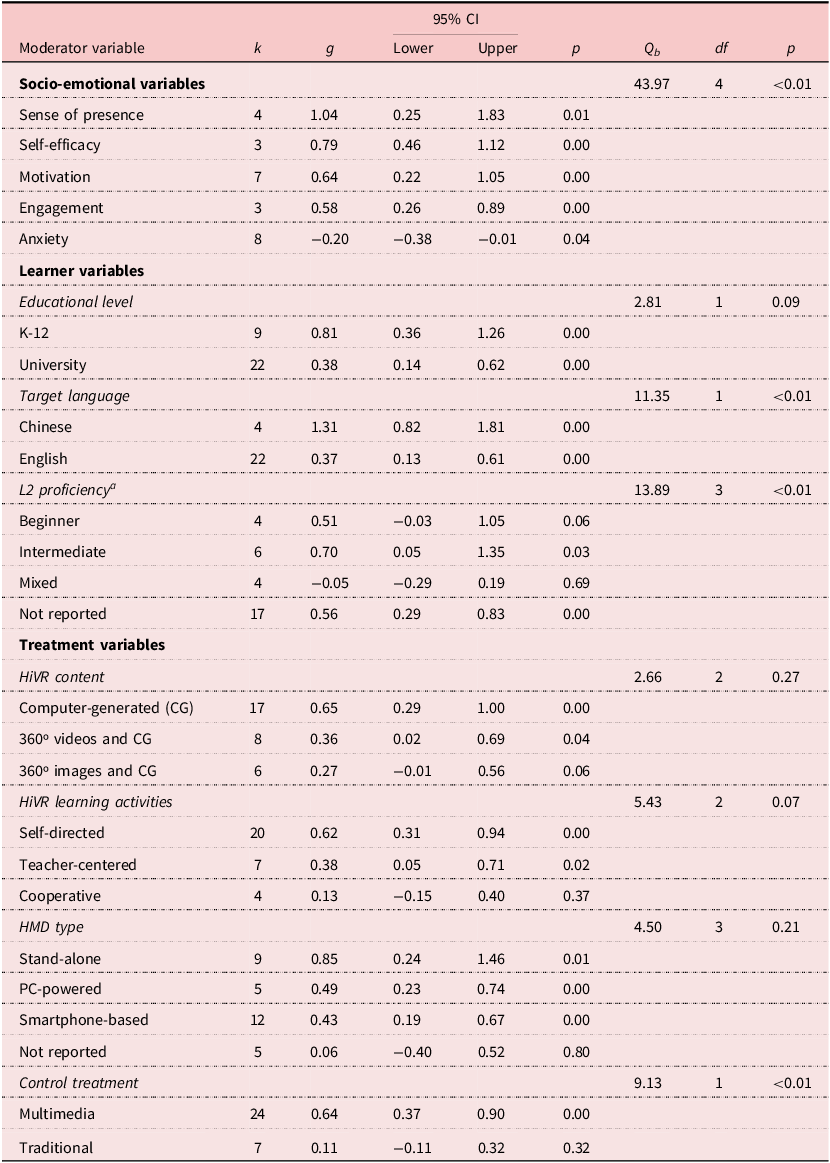
The modulating effect of eight categorical variables is summarized in Table 2. Four categorical moderators (i.e., type of a socio-emotional response, target language, L2 proficiency, and control treatment) were found to modulate the effect of HiVR treatment on L2 learners’ socio-emotional variables.
Summary of moderator analyses with categorical variables
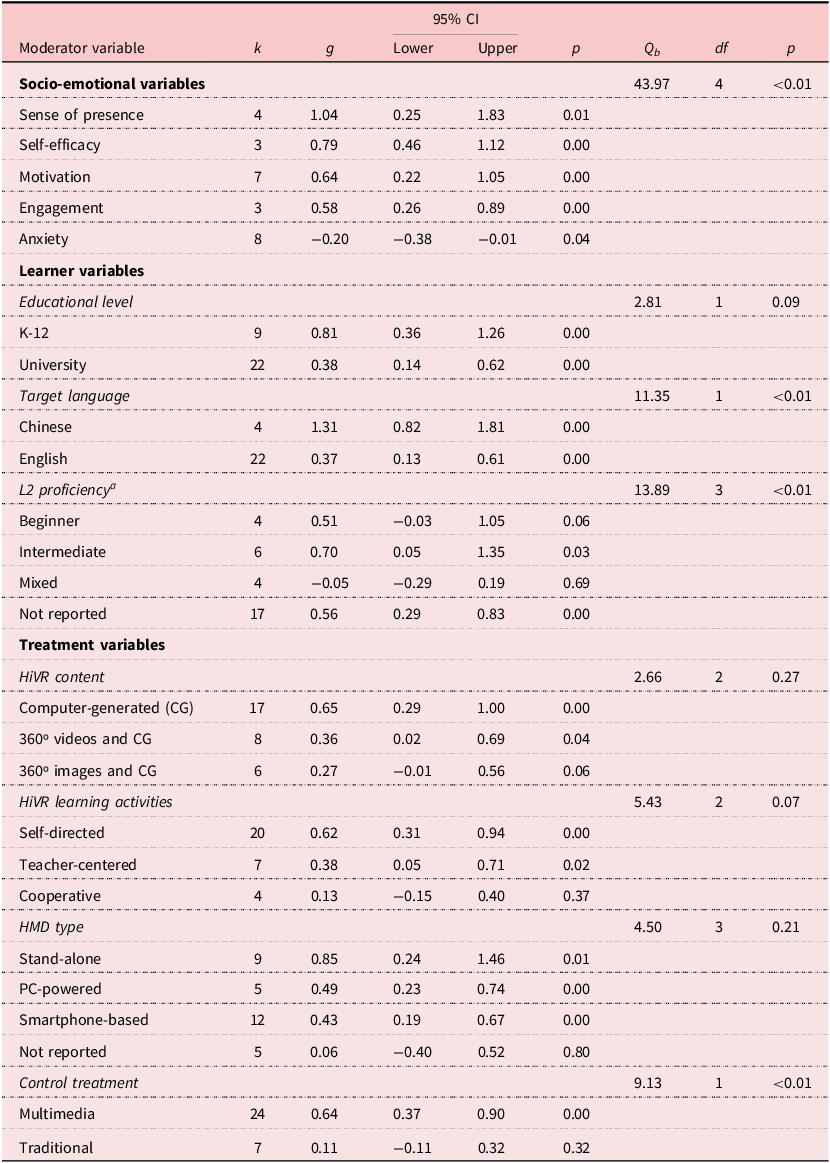
Table 2. Long description
The table presents the modulating effect of eight categorical variables on HiVR treatment for L2 learners. It includes columns for the moderator variable, k, g, 95% CI (Lower and Upper), p, Qb, df, and p. The table is divided into sections for socio-emotional variables, learner variables, and treatment variables. Each section lists specific categories and their corresponding values. For example, under socio-emotional variables, categories include sense of presence, self-efficacy, motivation, engagement, and anxiety. Under learner variables, categories include educational level (K-12 and University) and target language (Chinese and English). Treatment variables include HiVR content, HiVR learning activities, HMD type, and control treatment. Each row provides specific values for k, g, 95% CI (Lower and Upper), p, Qb, df, and p.
Note. k = number of effect sizes; g = Hedges’s g effect size; CI = confidence interval; Q b = between-group homogeneity; HiVR = high-immersion virtual reality; HMD = head-mounted device.
a Note that the studies used different proficiency measures to determine participants’ L2 proficiency levels.
4.2.1 Type of a socio-emotional variable
The effect of HiVR-assisted instruction was large for sense of presence (g = 1.04), medium for self-efficacy (g = 0.79), and small for motivation (g = 0.64), engagement (g = 0.58), and anxiety (g = −0.20). Q b was significant, suggesting that the effect of HiVR treatment differed significantly between the examined socio-emotional variables. However, it must be noted that there was a small number of individual effect sizes for sense of presence (k = 4), self-efficacy (k = 3), and engagement (k = 3), which highlights the need to interpret these results with caution.
Additionally, several socio-emotional variables appeared in very few studies and were therefore excluded from the moderator analysis due to potential power issues. These included learning autonomy (k = 1), enjoyment (k = 2), attitude to L2 (k = 1), affect (k = 1), and willingness to communicate (k = 1).
4.2.2 Educational level
Given the small number of studies focusing on elementary (n = 2) and high school (n = 4) students, these studies were combined as “K-12” in the moderator analysis. A medium effect was found for K-12 students (g = 0.81), while a small effect was reported for university-level learners (g = 0.38). However, the Q b value indicated that the difference in effect sizes across these learner groups was not statistically significant.
4.2.3 Target language
Effect sizes were calculated only for the studies on English and Chinese learners, as the number of studies that focused on Portuguese (n = 1), Italian (n = 1), and French (n = 1) learners was not sufficient for the analysis. HiVR was found to have a large effect on the socio-affective responses of L2 Chinese learners (g = 1.31) and a small effect on L2 English learners (g = 0.37). The Q b value indicated a significant difference in the magnitude of the effect of HiVR on L2 socio-emotional variables across target languages.
4.2.4 L2 proficiency
A medium effect of HiVR treatment was found on socio-emotional variables of intermediate-level learners (g = 0.70). However, the effect of HiVR intervention on socio-emotional variables for beginner-level (g = 0.51) and mixed-level learners (g = −0.05) was smaller. The Q b value showed a differential impact based on proficiency level. However, this result should be taken as tentative, as more than half of the primary studies in the sample (n = 10, 56%) did not report the proficiency level of their participants.
4.2.5 HiVR content
The effect size produced by the studies that used computer-generated HiVR environments was larger (g = 0.65) than that produced by the studies that employed HiVR environments created from 360º videos combined with computer-generated content (g = 0.36), with both effects being statistically significant. The effect size produced by the studies that combined 360º images with computer-generated content (g = 0.27) did not reach significance. However, the Q tests revealed no significant differences between the three types of HiVR content under the random-effects model.
4.2.6 HiVR learning activities
More than half of the primary studies (n = 12, 67%) included in this meta-analysis adopted self-directed learning activities, with a small-to-medium effect size reported (g = 0.62). However, effects did not reach significance for teacher-centered (g = 0.38) or cooperative (g = 0.12) learning activities. According to the Q b statistics, no significant difference existed between effect sizes of different HiVR learning activities.
4.2.7 HMD type
Among the different types of VR headsets used in the studies, the largest effect size was observed for stand-alone (wireless) VR headsets (g = 0.85), followed by a small effect size for PC-powered headsets (g = 0.49) and smartphone-based HMDs (g = 0.43). However, the Q b value indicated that there was no statistically significant difference between the impact of different types of VR headsets on L2 learners’ socio-emotional responses.
4.2.8 Control treatment
Effect sizes differed significantly between the studies that employed different teaching materials in the control group. The effect of HiVR-based instruction compared to multimedia materials (g = 0.64) was larger than the effect of HiVR compared to paper-based materials (g = 0.11).
4.2.9 HiVR software
Following the general recommendation for meta-analytic research in applied linguistics to include at least three effect sizes per moderator subgroup (Li, Reference Li2016; Vuogan & Li, Reference Vuogan and Li2024), we excluded the moderators of “HiVR software” from our primary analysis, as one of its subgroups contained only two effect sizes. The results of the exploratory analyses for this moderator are presented in Appendix S11.
4.2.10 Continuous moderators
The results of random-effects meta-regression analysis showed that mean age, number of HiVR sessions, the length of each HiVR session, and the total length of HiVR treatment did not moderate the effect of HiVR on L2 learners’ socio-emotional variables (see Table 3).
Summary of meta-regression analyses with continuous variables

Note. k = number of effect sizes; β = regression coefficient; SE = standard error; CI = confidence interval; z = z value; p = p value; Q = Cochran’s heterogeneity statistic; HiVR = high-immersion virtual reality.
5. Discussion
5.1 Discussion of overall effectiveness
The results revealed that exposure to HiVR had a small but positive impact on L2 learners’ socio-emotional responses: g = 0.50, 95% CI [0.29, 0.71]. This finding suggests that HiVR-assisted instruction had a greater impact on L2 learners’ socio-emotional outcomes compared to low-immersion (2D) learning approaches. The differential impact of HiVR may be due to the fact that HMDs quite literally “block out” the outside world, fostering a heightened sense of presence (Makransky et al., Reference Makransky, Terkildsen and Mayer2019). This was underscored by the large effect size shown for sense of presence (g = 1.04) in this meta-analysis. The stronger sense of presence afforded by HiVR may intensify other socio-emotional responses to an immersion experience, as was seen here for motivation, self-efficacy, and engagement.
It is noteworthy that the overall effect of HiVR observed in this study (g = 0.50) is slightly lower than the effects reported in previous meta-analyses. This variation may be attributed to differences in the type of VR technology examined across studies: Wang et al. (Reference Wang, Lan, Tseng, Lin and Gupta2019) focused exclusively on LiVR (d = 0.58), while Chen et al. (Reference Chen, Wang and Wang2022) focused on both LiVR and HiVR (g = 0.57). Given that learners may experience negative side effects more commonly in HiVR compared to LiVR (e.g., Weech et al., Reference Weech, Kenny, Lenizky and Barnett-Cowan2020), the smaller effect of HiVR in this study may be explained by physical discomfort (e.g., motion sickness) and higher cognitive load that L2 learners in some primary studies included in this meta-analysis experienced when exposed to HiVR (e.g., Wu & Hung, Reference Wu and Hung2022; Zhao & Yang, Reference Zhao and Yang2023).
5.2 Discussion of moderating factors
First, regarding the type of a socio-emotional variable, results indicate that the effect of HiVR treatment varied across L2 learners’ socio-emotional variables, with a large effect on sense of presence (g = 1.04), a medium effect on self-efficacy (g = 0.79), and a small effect on motivation (g = 0.64), engagement (g = 0.58), and anxiety (g = −0.20). These findings are consistent with previous meta-analyses in the domain of SLA that found that VR experiences can promote a higher sense of presence, enhance learners’ self-efficacy, increase motivation, and reduce anxiety compared to less immersive teaching methods (Qiu et al., Reference Qiu, Shan, Yao and Fu2024; Wang et al., Reference Wang, Lan, Tseng, Lin and Gupta2019; Yu & Duan, Reference Yu and Duan2024). For instance, Wang et al. (Reference Wang, Lan, Tseng, Lin and Gupta2019) reported a medium effect of VR on L2 learners’ self-efficacy (d = 0.60), Yu and Duan (Reference Yu and Duan2024) and Qiu et al. (Reference Qiu, Shan, Yao and Fu2024) revealed a moderate effect of VR on L2 learners’ motivation (g = 0.46 and g = 0.62, respectively), and Yu and Duan (Reference Yu and Duan2024) found a small but positive effect of VR on L2 learners’ anxiety (g = −0.24). The small effect of VR on anxiety may be explained by the fact that the primary studies included in this meta-analysis based their findings on the subjective, self-reported data collected through questionnaires, which introduce some degree of bias. Therefore, experimental studies using more objective (physiological) measures (e.g., salivary cortisol levels, heart rate, electrodermal activity) are needed to better understand how HiVR may influence anxiety in language learners.
Overall, the findings align with the CAMIL theory, which posits that HiVR’s unique affordances of high sense of presence and increased learner agency can facilitate self-efficacy, motivation, and interest, subsequently leading to improved learning outcomes (Makransky & Petersen, Reference Makransky and Petersen2021). In line with this claim, the present results indicate that exposure to HiVR can significantly enhance learners’ sense of presence, which can be accompanied by improved self-efficacy, motivation, and engagement, as well as some reduction in anxiety. These findings suggest that affective variables function as mediating mechanisms through which immersive environments can facilitate learning.
Second, in terms of the target language, the large effect of HiVR on L2 Chinese learners (g = 1.31) and small effect on L2 English learners (g = 0.37) suggests that HiVR technologies can be used to enhance socio-emotional responses of both groups, though the magnitude of the effect is smaller for English learners. However, effect sizes could not be calculated for other target languages due to an insufficient number of studies. Given this limitation, further research is needed to explore the impact of HiVR on learners of other L2s.
Third, with respect to L2 proficiency, results showed a stronger effect of HiVR on socio-emotional outcomes of more proficient (i.e., intermediate-level) than less proficient (i.e., beginner-level) learners. One possible reason for this could be that HiVR, with its rich and immersive stimuli, may place higher cognitive demands on less proficient learners, who may have fewer cognitive resources available for processing an L2 in real time (Zhang & Yang, Reference Zhang and Yang2023). These results, nevertheless, should be interpreted with caution because less than half of the studies in the sample reported participants’ proficiency levels.
Finally, for the moderator of control treatment, results revealed that the HiVR-based instruction had a larger effect on L2 learners’ socio-emotional variables when compared with multimedia materials (g = 0.64) than when compared with paper-based materials (g = 0.11). This finding provides further evidence that the heightened sense of presence afforded by HiVR technologies may elicit stronger emotional reactions than those observed in less immersive environments, as was seen here for self-efficacy and, to a lesser extent, for motivation, engagement, and anxiety.
6. Limitations
The present study has several limitations that would be useful to address in future research. First, the number of individual effect sizes (k = 31) included in this meta-analysis is relatively small, due to the application of rigorous eligibility criteria. Although similar sample sizes have been reported in other meta-analyses in CALL (e.g., Li, Reference Li2024, k = 20; Şimşek & Şimşek, Reference Şimşek and Şimşek2025, k = 29), the reliability of the findings would be enhanced with a larger sample size. A larger sample size could also better promote generalizability across a more diverse set of contexts (e.g., ages, L2s, etc.). Second, limiting the sample to studies using between-group designs resulted in the exclusion of some relevant research in the field. Future work may consider expanding the inclusion criteria to focus on a wider range of study designs. Third, the effect of HiVR on some socio-emotional variables (e.g., learning autonomy, enjoyment) could not be analyzed in this meta-analysis because of an insufficient number of studies addressing these outcomes. As more research on the impact of HiVR on L2 learners’ affective outcomes becomes available, future meta-analytic research should examine the effects of this technology on a broader set of socio-emotional variables.
Regarding reporting practices, the results of this meta-analysis highlight the need for improved reporting in the primary research. Several moderator variables, such as proficiency and the length of each HiVR session, were not reported in a majority of the studies, thus limiting the analyses. This finding adds further support to previous research in SLA (e.g., Plonsky & Gass, Reference Plonsky and Gass2011) and CALL (e.g., Ziegler, Reference Ziegler2016), highlighting the continued need for more transparent reporting practices to facilitate future synthetic and meta-analytic work.
7. Conclusion
This meta-analysis addressed a critical gap in the research by examining the impact of HiVR on language learners’ socio-emotional outcomes. The findings revealed an overall positive effect of HiVR (g = 0.50), which is in line with contemporary meta-analytic studies that have demonstrated similar positive effects on socio-emotional outcomes in both LiVR and mixed study groups (HiVR and LiVR). In addition, HiVR was found to significantly (positively) modulate all socio-emotional outcomes that had sufficient data to be included in this meta-analysis. Notably, sense of presence showed a large effect size, self-efficacy yielded a medium effect size, whereas motivation, engagement, and anxiety showed small effect sizes. Furthermore, the effect of HiVR has been found to be moderated by proficiency and the type of control treatment used.
These findings suggest that HiVR has potential as a pedagogical tool for enhancing learners’ socio-emotional experiences. Given the crucial role of emotions in the language learning process and their association with learning performance (Gregersen & Mercer, Reference Gregersen and Mercer2021), incorporating HiVR-based materials into language learning curricula and offering learners regular opportunities to engage with HiVR content may foster positive attitudes toward language learning and lead to improved learning outcomes. We therefore encourage language educators to incorporate HiVR-based activities in the classroom or language lab settings to enhance students’ affective experiences.
On a macro level, this research complements prior meta-analytic and systematic reviews that have shown HiVR’s effectiveness in supporting the development of L2 learners’ linguistic skills (e.g., Dhimolea et al., Reference Dhimolea, Kaplan-Rakowski and Lin2022). The heightened sense of presence afforded by HiVR technologies is likely to promote the use of attentional resources and enhance emotional reactions, which in turn may lead to deeper processing of linguistic and cultural experiences within fully immersive virtual environments. This study, therefore, underscores HiVR’s transformative potential to enhance L2 learners’ socio-emotional experiences and facilitate their language development.
Supplementary material
The supplementary material for this article can be found at https://doi.org/10.1017/S0958344026100548
Data availability statement
All data, code, and output used in this meta-analysis are available at https://osf.io/8b3ax/overview?view_only=af00d808be8542f6872e9485bb9cdbda
Authorship contribution statement
Yulia Khoruzhaya: Conceptualization, Data curation, Formal analysis, Investigation, Methodology, Project administration, Software, Visualization, Writing – original draft, Writing – reviewing & editing. Kara Moranski: Conceptualization, Data curation, Funding acquisition, Investigation, Methodology, Project administration, Resources, Software, Supervision, Writing – review & editing. Alexandra Neuenschwander: Data curation, Formal analysis. Nicole Ziegler: Formal analysis, Methodology, Resources, Writing – review & editing.
Funding disclosure statement
This research was supported by the U.S. Department of Education Title VI International Research and Studies Program Grant [P017A230042].
Competing interests statement
The authors declare no competing interests.
Ethical statement
This study does not involve intervention or interaction with human participants. Ethical approval was not required.
GenAI use disclosure statement
The authors declare no use of generative AI.
About the authors
Yulia Khoruzhaya is a postdoctoral fellow in the Department of Romance and Arabic Languages and Literatures at the University of Cincinnati. Her research interests include technology-enhanced language learning, usage-based approaches to second language acquisition, corpus linguistics, and research methods.
Kara Moranski is an associate professor of Spanish linguistics at the University of Cincinnati. She uses her training in both applied linguistics and educational statistics to identify and enhance instructional methods that promote language development, primarily but not limited to Spanish language education.
Alexandra Neuenschwander is a current medical student at Ohio State University. She obtained her Bachelor of Science from the University of Cincinnati, where she also minored in Spanish and Integrative Health and Wellness.
Nicole Ziegler is an associate professor in the Department of Second Language Studies at the University of Hawai‘i at Mānoa. Her research agenda focuses on instructed second language acquisition (ISLA), including mixed-method and interdisciplinary research in L2 interaction, task-based language teaching (TBLT), computer-assisted language learning (CALL), and task-based approaches for Maritime English.





 Open access

