


Introduction
Tropical forests provide a large number of products such as fruit, seed, resin, medicine, wildlife meat and by-products defined as non-timber forest products (NTFPs). It has been proposed that NTFP extraction can contribute positively to sustainable forestry management because it provides tangible economic benefits to poor rural communities whilst simultaneously conserving biodiversity (Peters, Reference Peters1989; Shahabuddin & Prasad, Reference Shahabuddin and Prasad2004; Kaushal & Melkani, Reference Kaushal and Melkani2005; Mahapatra et al., Reference Mahapatra, Albers and Robinson2005). In India for example, sustainable harvesting and management of NTFP extraction, together with improved market structures, have been promoted as a strategy to aid poverty alleviation and wildlife conservation simultaneously (Mahapatra & Mitchell, Reference Mahapatra and Mitchell1997; Shaanker et al., Reference Shaanker, Ganeshaiah, Krishnan, Ramya, Meera and Aravind2004a, 2004b; Hiremath, Reference Hiremath2004; Mahapatra et al., Reference Mahapatra, Albers and Robinson2005; Shanker et al., Reference Shanker, Hiremath and Bawa2005).
However, there is evidence that such positive benefits from NTFP extraction may be more elusive than first thought. Examples from India have demonstrated that excessive commercial harvesting of NTFPs can denude forest ecosystems by destructive collection practices for valued target species such as Garcinia gummi-gutta, Phyllanthus indofischeri, Emblica officinalis, Boswellia serrata and Sterculia urens (Tiwari, Reference Tiwari1995; Bhattacharya et al., Reference Bhattacharya, Joshi, Bhagat and Hayat2002; Ganesan, Reference Ganesan2003; Rai & Uhl, Reference Rai and Uhl2004; Shaanker et al., Reference Shaanker, Ganeshaiah, Krishnan, Ramya, Meera and Aravind2004a). There is also a link between NTFP collection and illegal activities, including bushmeat hunting and poaching, although the nature of this relationship is poorly understood and documented (Kaul et al., Reference Kaul, Hilaluddin and McGowan2004). With legislation in India (The Scheduled Tribes and Other Traditional Forest Dwellers (Recognition of Forest Rights) Act 2006) giving the right, from 31 December 2007, of NTFP collection to communities living within forests, even in protected areas (Kothari, Reference Kothari2005; Prabhu, Reference Prabhu2005), there is an urgent need to investigate the role of NTFPs in rural development.
Although various studies in India have highlighted the contribution of NTFPs to household income we still lack understanding of how socio-cultural status can determine income from NTFPs (Shahabuddin & Prasad, Reference Shahabuddin and Prasad2004). This is especially important in India where access to NTFPs is controlled by the Government (Gadgil & Guha, Reference Gadgil and Guha1992; Rangarajan, Reference Rangarajan2001) but actual forest use is often determined by various cultural, political and economic background factors (Kumar, Reference Kumar2002; Rai & Uhl, Reference Rai and Uhl2004, Shahabuddin & Prasad, Reference Shahabuddin and Prasad2004). Here we focus on which factors determine the financial returns from NTFP collection using a case study in the Periyar Tiger Reserve, in the state of Kerala in southern India. In particular we explore the relationship between financial returns from NTFPs and the social, economic and cultural background of collectors, to understand the potential contribution of NTFP collection to solving livelihood problems.
Study area
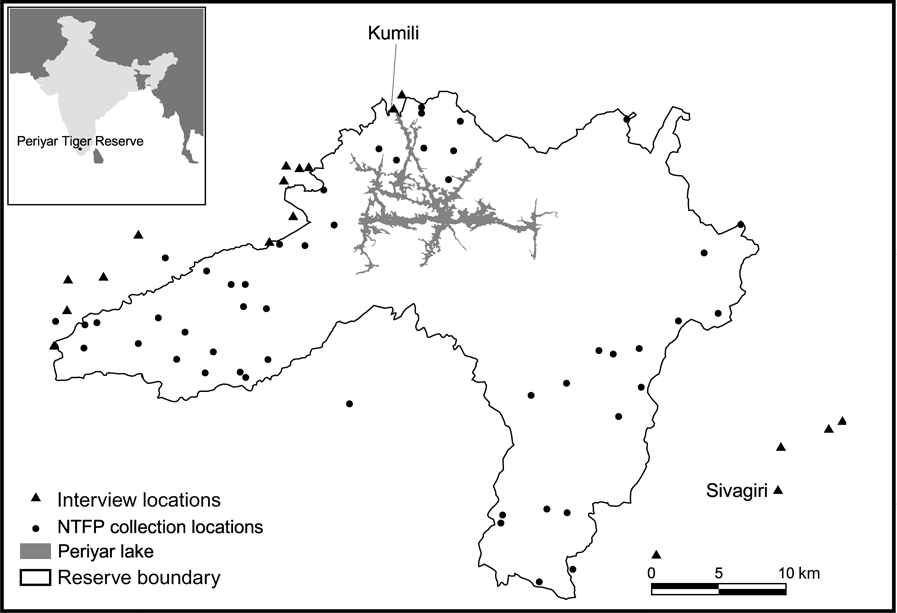
The study was carried out in and around the 777 km2 Periyar Tiger Reserve in the state of Kerala, southern India (Fig. 1). The area forms part of the Western Ghats, which is recognized for its exceptionally rich biodiversity (Myers et al., Reference Myers, Mittermeier, Mittermeier, de Fonseca and Kent2000) and is important for threatened flagship species such as the tiger Panthera tigris tigris (Dinerstein et al., Reference Dinerstein, Loucks, Heydlauff, Wikramanayake, Bryja and Forrest2006) and elephant Elephas maximus. The Reserve has an altitudinal range of 750–1,500 m, average total annual rainfall of c. 2,500 mm, humidity and temperature ranges of 60-85% and 15-31°C, respectively, and forest types are tropical evergreen and semi-evergreen (74.6%) and moist deciduous (12.7%; KFD, 2001, 2003). The plant species of these forests offer a number of opportunities for NTFP collection.
Locations where NTFPs were harvested in Periyar Tiger Reserve, as reported by the collectors, and where we interviewed collectors. Inset shows location of the Reserve in southern India.
Approximately 225,000 people live within 2 km of the Reserve boundary (KFD, 2001), and to varying extents these communities depend, directly and indirectly, on the natural resources of the Reserve through NTFP harvesting, timber smuggling, livestock grazing, tourism and pilgrimage, and narcotic cultivation (World Bank, 1996). The land surrounding the Reserve is intensively farmed, mostly as cash crop plantations for tea, rubber, cardamom Elettaria cardamomum and coffee, providing employment to many people.
Methods
Survey data were collected between May and July 2006 through questionnaires that included a mixture of open and closed response questions. Sampling was conducted at the household level, as this constitutes the basic unit of shared economic production and resource utilization within the study area. For communities inside and outside Periyar Tiger Reserve only those people perceived to have some dependency on NTFP income were selected from village lists.
All interviews (n = 73) were conducted with the full willingness of the respondents, who were assured of anonymity to increase the chances that they would provide genuine answers (Henerson et al., Reference Henerson, Morris and Fitz-Gibbon1987). Questionnaires were conducted in Malayalam and in Tamil with the help of two interpreters who were aware of conservation issues. Interviews took 20–40 minutes. The data collected included information on NTFPs harvested and their quantities, together with demographic information of the collector (age, gender, origin, highest level of formal education, land holding and community background). Respondents who did not reside within the state of Kerala or whose first language was not Malayalam or who had migrated from other states, were categorized as migrants.
NTFP species, quantity collected, locations of harvests, and the final sale price for recent collection trips were elicited from respondents. Location of harvest was established by triangulating information from respondents, Forest Department sources and our field observations. The location of respondents' residences were recorded using a global positioning system, and distance of the house to the collection location was extracted using the geographical information system MapInfo (MapInfo Corporation, Troy, USA) and Survey of India 1:50,000 maps.
The total revenue generated by each collecting trip was calculated from the quantity of NTFP collected and the price achieved by the collector. To compare the financial returns from NTFP collection with other alternative local economic activities on a per unit effort basis (e.g. the daily wage for labouring in a tea plantation), the average revenue per day of a trip was estimated by dividing total revenue by the number of days spent on the trip. Revenue earned from NTFP was recorded in Indian rupees (INR) and converted to USD using USD 1 = INR 44, the prevailing rate at the time. In addition, respondents were asked about their willingness to continue NTFP collection as a profession for themselves and for their children. If they were unwilling to continue NTFP collection as a profession they were asked what alternative profession they would prefer.
General linear regression analysis was performed to determine which independent variables (gender, age, local or migrant, level of formal education, possession of agricultural land or not, NTFP collection for livelihood or additional income, forest-dwelling community or not), individually or in combination, best explained average daily revenue obtained by the respondents. SPSS v. 14.0 (SPSS, Chicago, USA) was used for all statistical analyses.
Results
Of the 73 respondents 13% were female and 88% male, most (71%) were non-forest dwelling communities as opposed to forest-dwellers (29%), and 52% were migrants and the rest (48%) local. The mean age of respondents was 42 ± SD 9.88 years (range 23–60), and while many (58%) had attained some level of formal education, relatively few (19%) had attained secondary education. Mean household size was 4.5 ± SD 1.56 people (range 1-9). Only a quarter of respondents owned agricultural land and the average landholding was only 0.32 ± SD 0.24 ha (range 0.04–0.80 ha). For 61% of respondents NTFPs were the main source of livelihood, and 39% collected NTFPs on a part-time basis to supplement their income.
Collectors spent an average of 6.2 ± SD 4.84 days per trip in the Reserve (range 1-20). On average, they travelled 11 ± SD 8.6 km per trip (range 0.48-38.11 km). Length of a trip depended, in part, on the location of residence, and NTFP collectors from the neighbouring state of Tamilnadu covered the greatest distances and expended the most time (an average of 38 km and 20 days per trip).
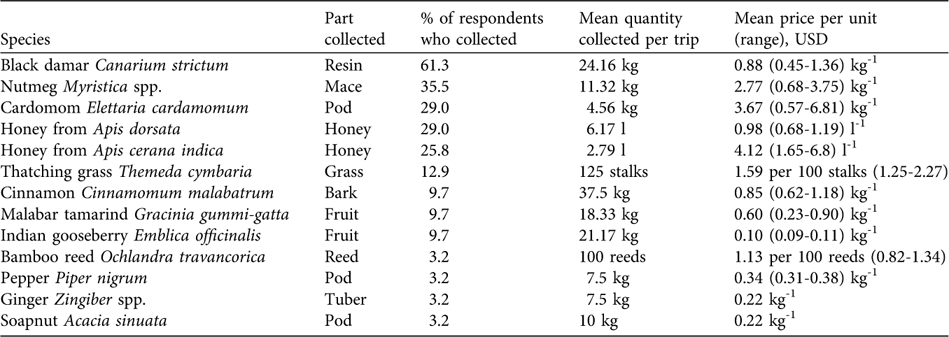
In total, respondents collected 33 NTFP species. Table 1 provides the percentage of respondents collecting the 13 most economically important species, the average quantity collected, and the average and range of prices obtained. Commercial harvesting of the resin black damar, for use in varnish and the perfume industry, from the tree Canarium strictum was the most commonly collected NTFP, followed by mace from Myristica spp., which is used in the aromatic industry or as a natural dye. The most valuable NTFP was the honey of Apis cerana indica, followed by cardamom, and mace from Myristica spp.. There was considerable range in price obtained for some products. For example, cardamom was sold for as little as USD 0.57 kg-1 and as high as USD 6.81 kg-1.
Percentage of respondents who collected 13 NTFPs (ranked from highest to lowest percentage), with mean quantity collected per trip, and mean price received per unit collected.
Average revenue was USD 3.15 ± SD 4.19 day-1, varying widely (USD 0.27–23.63 day-1). Collectors whose livelihood was largely dependent on NTFPs earned more, averaging USD 3.88 day-1, whereas part-time collectors earned on average USD 1.99 day-1. Daily returns were directly determined by distance travelled, quantity collected, and price obtained but we considered that other socio-economic and cultural factors may have been influencing revenues. Therefore, we examined the influence on average daily revenue of seven variables, using general linear regression analyses. The independent variables were (1) gender; (2) origin of the respondent (local or migrant); (3) age of the respondent (categorized into age groups); (4) level of formal education (categorized as none, primary, secondary); (5) whether or not they possessed agricultural land; (6) purpose of collection (livelihood or part-time income supplement); and (7) community of origin (forest-dwelling or not).
When considered in combination, the variables that best explain average daily revenue are origin, community, agricultural land holding, and purpose of collection (adjusted R 2 = 0.470, F-test P = 0.001; Table 2). Respondents with a lower average daily revenue tend to be part-timers with lower socio-economic status such as migrants, forest-dwellers or those without access to agricultural land. Hence, collectors from low income households with less economic opportunities achieve lower returns from NTFP collection than others.
Results of regression of average daily revenue from NTFP collection against four independent variables describing the socio-economic characteristics of individual collectors.

1 Whether NTFPs were collected for livelihood or as an income supplement
2 Origin, i.e. local or migrant from neighbouring states
3 Whether from a forest-dwelling or other community
4 Whether possessed agricultural land
The majority (82%) of the respondents would prefer not to continue the profession of NTFP collection, with many respondents preferring agricultural land (41%) or livestock (11%) as an alternative livelihood source. A smaller number (12%) would accept any job, and 11% would prefer to have small businesses. A few (7%) were willing to work as forest guards and the remainder (18%) were not sure about the kind of job they wanted. None of the respondents wanted their children to take up NTFP collection as a profession.
Discussion
The mean daily revenue from NTFP collection was higher than the average agricultural wage labour, which is c. USD 2.09 day-1 in the state of Kerala (DES, 2003) and USD 1.38 day-1 in the neighbouring state of Tamilnadu (DES, 2005). However, economic returns from NTFP collection were variable and highly influenced by socio-economic status. For example, many migrants and forest-dwellers earn <USD 1 day-1 from NTFP collection. This is partly because they are not well equipped in terms of social status and education to deal with middlemen, and hence can be exploited, but also because they are less able to add value to their collection because of their poorly developed skills and restricted access to the resources required to invest in storage, processing, and marketing (Bhattacharya et al., Reference Bhattacharya, Joshi, Bhagat and Hayat2002; Mahapatra et al., Reference Mahapatra, Albers and Robinson2005).
Another factor is political patronage. NTFP harvesting is illegal and, with little local political influence, migrants face a much higher risk of capture and prosecution by the Forest Department, especially when they harvest high value NTFPs such as Cinnamomum malabatrum. In contrast, better placed local people enjoy a degree of protection from local political leaders and can afford to take the risk of being caught and prosecuted for illegally harvesting commercially higher value NTFPs, which is considered a more serious offence than harvesting lower value NTFPs (Bawa & Gadgil, Reference Bawa, Gadgil and Daily1997). These findings are consistent with other studies showing that wealthier households from higher classes in society tend to reap greater benefits from NTFP collection than poorer households (Kumar, Reference Kumar2002; Rai & Uhl, Reference Rai and Uhl2004; Mahapatra et al., Reference Mahapatra, Albers and Robinson2005). Other studies also highlight the importance of land tenure security, local institutions, and social dynamics to NTFP incomes and unsustainable extraction practices (Momberg et al., Reference Momberg, Puri, Jessup and Zerner2000; Rai & Uhl, Reference Rai and Uhl2004; Rai, Reference Rai, Shahabuddin and Rangarajan2007).
Overall, we believe that NTFP collection, far from being a potential solution in a development context (Mahapatra & Mitchell, Reference Mahapatra and Mitchell1997; Reddy & Chakravarty, Reference Reddy and Chakravarty1999; Arnold & Pérez, Reference Arnold and Perez2001; Bhattacharya & Hayat, Reference Bhattacharya and Hayat2004; Hiremath, Reference Hiremath2004; Pandit & Thapa, Reference Pandit and Thapa2007) may threaten biodiversity and help enforce economic and social disparities, especially in India, where protected areas are surrounded by land with human densities >300 km-2 (Rodgers et al., Reference Rodgers, Hartley, Bashir, Saberwal and Rangarajan2003).
NTFP collection in protected areas could have significant negative ecological impacts. Although impacts have been little studied in India (Shaanker et al., Reference Shaanker, Ganeshaiah, Krishnan, Ramya, Meera and Aravind2004a; Shahabuddin & Prasad, Reference Shahabuddin and Prasad2004), studies in some areas have reported the damaging impacts of harvesting on ecosystem functions that could negatively affect biodiversity (Sinha, Reference Sinha2000; Sinha & Bawa, Reference Sinha and Bawa2002; Pant, Reference Pant2003; Rai & Uhl, Reference Rai and Uhl2004; Shaanker et al., Reference Shaanker, Ganeshaiah, Rao and Aravind2004b). Ved et al. (Reference Ved, Prathima, Mortan, Shankar, Shaanker, Ganeshaiah and Bawa2001), for example, documented 154 species of medicinal plants that have become rare and threatened by extraction pressures in southern India. These impacts could intensify with the introduction of new technology, access to new markets, and the possible breakdown of social and religious restrictions (Bawa & Gadgil, Reference Bawa, Gadgil and Daily1997; Sinha & Bawa, Reference Sinha and Bawa2002; Kala et al., Reference Kala, Farooquee and Dhar2005).
Encouragement and support of NTFP collection from protected areas could also have significant negative impacts on tiger and other threatened species. Although the overall link between NTFP exploitation and animal communities is poorly explored (Shahabuddin & Prasad, Reference Shahabuddin and Prasad2004), commercialization of forest products as a conservation strategy in protected areas could increase the negative impacts of more intensive harvesting (Green & Minkowski, Reference Green, Minkowski, Rainer and Bourne1977; Prasad, Reference Prasad2001; Muddappa, 2001), and reliance on more destructive practices such as burning and timber-cutting (Madhusudhan & Karanth, Reference Madhusudan, Karanth, Robinson and Bennet2000; Saha, Reference Saha2002; Shahbuddin & Prasad, 2004). NTFP collection in a protected area may also be directly connected to illegal collateral activities such as poaching, as it provides a legitimate excuse for human presence (Madhusudhan & Karanth, Reference Madhusudan, Karanth, Robinson and Bennet2000; Peres & Lake, Reference Peres and Lake2003).
Our study suggests that NTFP as a development mechanism for poor communities may have disadvantages. Firstly, those collectors most in need of income support from NTFPs are least able to benefit from an NTFP-based development strategy as they have the poorest developed skills, lack resources to store, process and market their produce, and face prejudice and unfair treatment because of their social status. Secondly, it can expose collectors and their dependents to widely fluctuating incomes because of price variations in local and global markets (Arnold & Pérez, Reference Arnold and Perez2001; Rai & Uhl, Reference Rai and Uhl2004; Gopalakrishnan et al., Reference Gopalakrishnan, Wickramasinghe, Gunatilake and Illukpitiya2005) and extremes in seasonal and biological production (Mahapatra et al., Reference Mahapatra, Albers and Robinson2005). Thirdly, in the long-term there is also the risk that the price for some NTFPs will decline as factory-made alternatives such as plastic containers for bamboo and reed baskets, and plastic for rattan furniture, become more widely available. Fourthly, the institutions and practices for monitoring harvesting rates and capacity building for commercial NTFP production require more time and resources than other development options (Barrett & Arcese, Reference Barrett and Arcese1998; Ballabh et al., Reference Ballabh, Balooni and Dave2002; Gubbi, Reference Gubbi2006).
Finally, there would appear to be little desire among the collectors interviewed in this study to continue with NTFP collection as a profession. This is hardly surprising as the work is hard and collectors risk danger from tiger, elephant, sloth bear and other wildlife, and from the steep and rough terrain they must traverse. Furthermore, all respondents, including forest-dwellers, stated they did not want their children to continue with NTFP collection as it is a hard life, and expressed the desire that their children receive education and find alternative employment.
As nearly half of the respondents were willing to shift to agriculture-based professions, direct measures to encourage this, such as the provision of agricultural land by the Government or civil society, would be a more sustainable alternative to NTFP in both ecological and human terms. There are a number of successful agriculture-based projects, although small in number, implemented in India, by both government and civil society, in which local communities have benefited (Gubbi, Reference Gubbi2003; Karanth et al., Reference Karanth, Curran and Reuning-Scherer2005; Karanth & Karanth, Reference Karanth, Karanth, Redford and Fearn2007) whilst also reducing their dependence on NTFPs (Shanker et al., Reference Shanker, Hiremath and Bawa2005). Formal and non-formal education among collectors could also improve chances of alternative employment and lead to reduced dependency on forests (Gunatilake, Reference Gunatilake1998; Hegde & Enters, Reference Hegde and Enters2000; Tessema, Reference Tessema2003; Xu et al., Reference Xu, Chen, Lu and Fu2006).
It may be possible that NTFP collection can find a niche role in development through ecotourism, in which collection activities are regulated and income is largely generated by providing services to tourists rather than from ecologically damaging extraction. Tourism activities, such as spice plantation visits are now underway in the northern part of Periyar Tiger Reserve, and similar opportunities such as rubber plantation visits involving NTFP collectors from the western part of the Reserve could be explored for other areas. However, it is important that the most socially disadvantaged groups are actively targeted in any development initiative. This has proved difficult in India for socio-cultural reasons. For example, in a development programme for cinnamon bark collectors carried out under an Integrated Conservation and Development Project in the Periyar Tiger Reserve, only one out of 21 participants in a high value tourism venture, which brought good tips, were from a disadvantaged group. In contrast, an ecotourism enterprise run entirely by poorer forest-dwelling communities under the same Programme brought less revenue to the eco-development committee that runs the enterprise and the guides received lower tips (S. Gubbi, pers. obs.).
In conclusion, our research suggests that NTFP collection is unlikely to generate positive outcomes for biodiversity conservation or poverty alleviation. The new laws giving rights of land and resource use, including NTFP collection, to communities living within forests and protected areas (Kothari, Reference Kothari2005; Prabhu, Reference Prabhu2005), are therefore probably misguided in terms of livelihoods and harmful to conservation in protected areas (Karanth & Bhargav, Reference Karanth and Bhargav2005; Dang, Reference Dang2005). We suggest that the Indian government considers provision of alternative farm-based livelihoods and investment in improved access to education for collectors and their families. Further research is, however, required to compare NTFP revenues within other protected areas to understand further the social, economic and legal factors affecting incomes from NTFPs. Results of such studies will further strengthen the case for or against NTFP collection as a mechanism for alleviating poverty and supporting wildlife conservation.
Acknowledgements
We thank the respondents who took part in the survey, K.U. Karanth, S. Kumar, A. Kumar, S. Srinivas and B. Hegde of the Wildlife Conservation Society-India Program, N. Leader-Williams and M. Linkie of of Durrell Institute of Conservation and Ecology (DICE), UK, V. Gopinath, B. Thomas, P. Mahanti, M.L. Thomas, J. Zacharias and S. Francis of Kerala Forest Department, and R. Pillai, M. Balasubramaniam, A. Veeramani, A. Bashir, Sebastain, M.B. Anil, Sasikala and Jaya of the Periyar Foundation. M.D. Madhusudhan and K. Karanth provided useful inputs. Funding was provided through a WCS Graduate Fellowship and C.V. Starr Graduate Fellowship in Tiger Conservation, the Wildlife Conservation Society-India Program, and the Centre for Wildlife Studies, 21st Century Tiger and DICE. Kerala State Forest Department provided the necessary permission and support. We thank two anonymous referees whose comments improved the manuscript.
Biographical sketches
Sanjay Gubbi's research interests are in conservation policies and human impacts on wildlife conservation. He has a keen interest in evidence-based conservation and his current work is focused on conservation of tigers and other wildlife in the Western Ghats of India. Douglas MacMillan is interested in the economics of conservation and development and has a special interest in the design and implementation of economic incentives for sustainable resource use.



