

On 25 April 1832, Charles Darwin (1809–82) was four months into his five-year passage on board the Royal Navy vessel HMS Beagle, on course to chart the coastal regions of the southern tip of South America. With the ship anchored in the blue waters of Botofogo Bay, Darwin was en route to a temporary residence on the Brazilian mainland when a series of waves overwhelmed his small boat. Writing in his diary that same day, Darwin described his deep dismay as his most precious possessions were almost swallowed by the sea:
Whilst landing on the beach I suffered on a small scale, sufficient however to paint some of the horrors of shipwreck. – Two or three heavy seas swamped the boat, & before my affrighted eyes were floating books, instruments & gun cases & everything which was most useful to me. – Nothing was lost & nothing completely spoiled, but most of them injured.Footnote 1
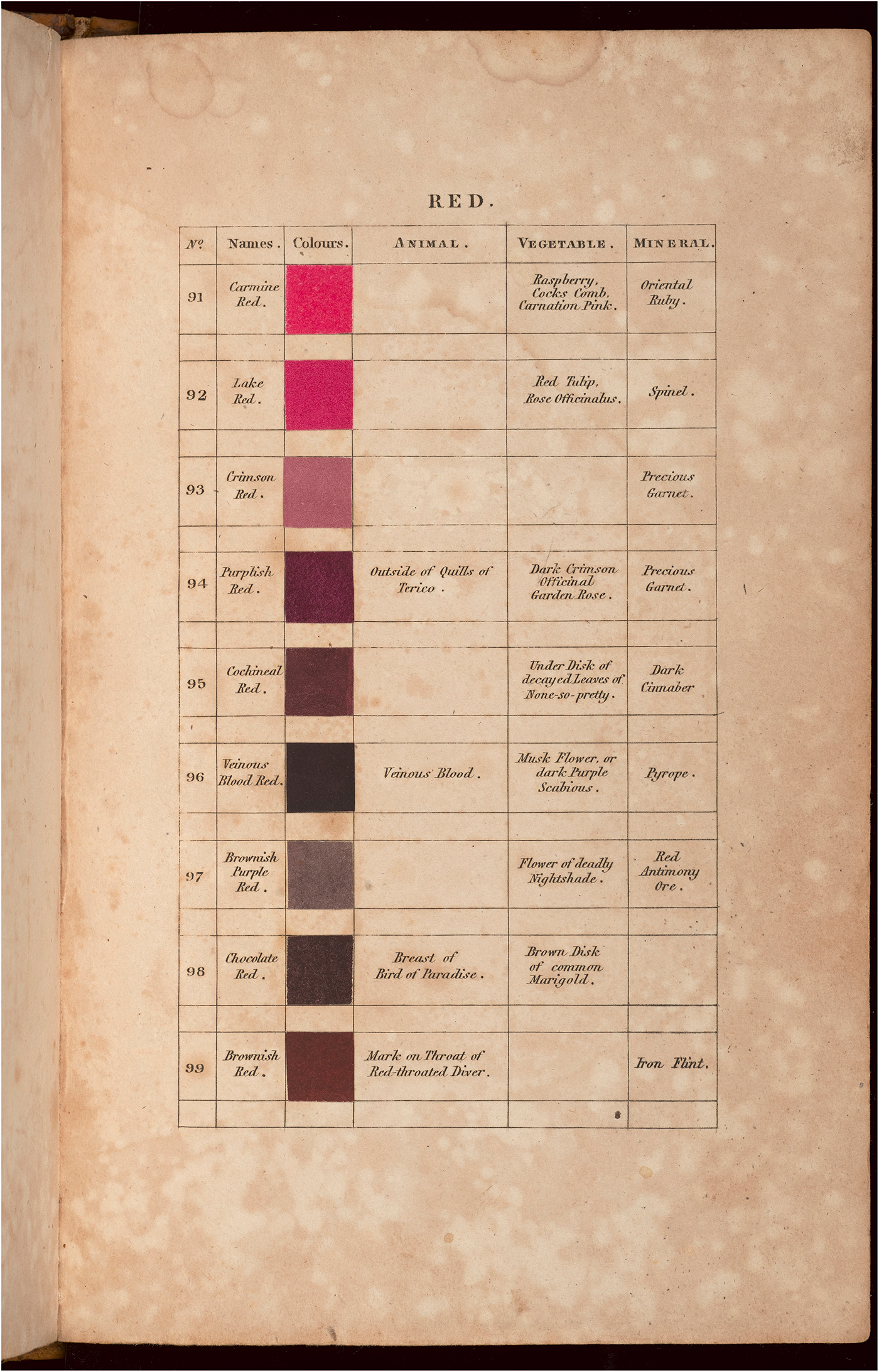
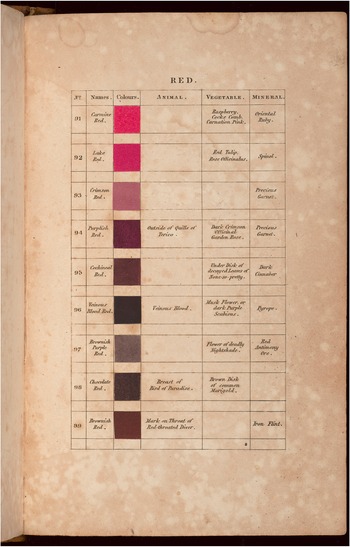
Evidently among this flotilla of items was Darwin’s copy of an illustrated work on colour, published a decade previously: Werner’s Nomenclature of Colours (1821), by Patrick Syme.Footnote 2 Water-damaged, sun-darkened and exhibiting pencil annotations in Darwin’s hand, the Beagle copy of Syme’s colour manual is now held in Cambridge University Library (DAR LIB T.620) (Figure 1). Its charts contain 110 painted samples of colour, each elucidated by written examples from the ‘animal’, ‘vegetable’ and ‘mineral’ kingdoms. First published in 1814, Syme’s charts were based on the mineralogical colour system developed by Abraham Gottlob Werner (1749–1817). Expanded in number and scope, and published in compact octavo – a pocket-sized approximately ten by twenty centimetres – Syme’s book served to extend the observatory skill set of the nineteenth-century naturalist.
Charles Darwin’s copy of Werner’s Nomenclature of Colours (1821) by Patrick Syme (Cambridge University Library, DAR LIB T.620). The tideline ringing the outer edge of its pages suggests submersion in water, possibly during the swamping of Darwin’s boat in Botofogo Bay in April 1832. Reproduced by kind permission of the Syndics of Cambridge University Library.
A few weeks into the voyage of 1831–6 Darwin adopted Syme’s distinct binomial nomenclature as a standard for his scientific note taking, routinely consulting its pages for the identification and articulation of natural hues. Syme’s terms feature regularly among Darwin’s written contribution to the documentary output of the Beagle voyage. This included eighteen field notebooks, a 779-page commonplace journal (his Beagle Diary), botanical notes, specimen catalogues, and the extensive scientific observations recorded in his Geological Diary and Zoology Notes (CUL, GBR/0012/MS DAR 30-31).Footnote 3 The last of these contains 368 pages of detailed observatory notes, compiled assiduously throughout the voyage and including over two hundred references to Syme’s terms.Footnote 4 While the Syme–Werner vocabulary appears throughout this corpus of manuscript materials, the Zoology Notes represent the most extensive repository, and will therefore operate as the locus of the following discussion, which seeks to enrich understanding of the observatory mechanisms available to nineteenth-century naturalists as they traversed imperial passages. Focusing on colour as a particularly subjective and transient aspect of sensory experience, I explore the various methods by which visual data could be captured on a voyage such as the Beagle’s.
While Darwin’s collecting practices have been the subject of numerous important studies, there has so far been minimal analysis of Darwin’s attention to colour as representative of the particular sensory difficulties encountered by the travelling naturalist.Footnote 5 This is a notable omission, given the significance of colour for the development of Darwin’s subsequent contributions to evolutionary theory: as Diane Donald and Jan Eric Olsen have noted, Darwin’s view of nature as a dynamic and highly variable entity held colouration as a characteristic aspect of its processes.Footnote 6 Similarly, while historians of discovery and exploration are accustomed to considering field notes and travel diaries as generative sources of primary information, such studies rarely direct their analysis towards the specific nuances of colour language and nomenclature.Footnote 7 In re-examining Darwin’s Beagle materials through this chromatic lens, I unpick the importance of colour as a crucial and uniquely problematic aspect of exploratory natural history. Colour is here considered in relation to collecting practices and descriptive mechanisms, and in the context of early nineteenth-century discourse on the instrumental capacity of the human body. In order to understand the efficacy of Syme’s book as a device for sensory translation, I analyse the precise nature of Darwin’s practical use of Werner’s Nomenclature for the description of natural objects and phenomena. In so doing, I redefine the significance of the Beagle copy and its colours among the wider corpus of paper documents – as well as publications, instruments and specimens – that constitute the Beagle archive.
Werner’s Nomenclature and the sensing body
The cover of DAR LIB T.620 is scarred and ruptured, its leather softened from frequent handling and persistent use; while its gilt border has worn away in places, the spine retains the abbreviated title, ‘Werner on Colours, 1821’. Inside, the book’s pages are mottled and darkened, encrypted with the repeat physicality of close consultation, and with the environmental influences of oceanic passage and exploratory fieldwork. While its presence on the Beagle has long been noted – referred to in the 1908 Cambridge University Library catalogue as a ‘record’ of the voyage – the historical significance of this item remains largely unexplored.Footnote 8 Syme’s book is notably absent from Richard Keynes’s 1979 survey of the manuscript materials pertaining to the voyage, The Beagle Record, and while the copy is analysed in Mario Gregorio’s 1990 work Charles Darwin’s Marginalia, its connection to the Beagle goes unremarked.Footnote 9 Where more recent scholarship has afforded some limited discussion of the value of this item for the development of nineteenth-century natural-historical enquiry, this has tended to neglect the artefactual nature of DAR LIB T.620.Footnote 10 As a result, the historical and scientific significance of the book’s passage alongside Darwin – as a habitual inhabitant of his pocket, his writing table and his open palm – has yet to be properly investigated. In order to understand the nature and impact of Darwin’s reliance on Syme’s colour manual, in this section I explore the relevance of Werner’s Nomenclature for chromatic discourse more broadly, situating Syme’s publication within the epistemological context of early nineteenth-century scientific thought.
For Darwin’s contemporaries, the value of Werner’s Nomenclature lay in its capacity to provide a fixed means of encoding the nuances of natural hues, representing one of a number of early nineteenth-century attempts to resolve the difficulties of standardizing colour expression.Footnote 11 Syme articulates the importance of such an item in his introduction, writing that a ‘nomenclature of colours, with proper coloured examples of the different tints, as a general standard to refer to in the description of any object, has been long wanted in arts and sciences’.Footnote 12 As Brian Dolan has discussed, colour represented a particular challenge for naturalists in this period of escalating imperial expansion, and most especially for those investigating areas of natural history (such as mineralogy) where the correct identification of coloured materials could yield significant economic benefits.Footnote 13
The origins of Syme’s book can be similarly located in the eighteenth-century exertions of descriptive mineralogists, representing one of many attempts to adapt and elucidate the colour system proposed by Saxon mineralogist Abraham Werner.Footnote 14 Originally appearing in Von den äußerlichen Kennzeichen der Foßilien (On the External Characters of Fossils [Minerals]) (1774), Werner’s tabular list of fifty-four hues embodied an instructive emphasis on the primacy of colour as a key ‘external characteristic’ of mineralogical matter: ‘Among the common generic characters of Fossils’, wrote Werner, ‘the Colour is the first which strikes the senses’.Footnote 15 This Baconian emphasis to knowledge making has been discussed by Barbara Stafford in her seminal work Voyage into Substance (1984), characterized by the appreciation of a ‘sensuous knowledge’ of natural things.Footnote 16 A reliance on sense-led enquiry was central to Werner’s pedagogical ethos, which operated within an Enlightenment framework that situated bodily experience at the heart of scientific knowledge. Such ideas hinged on the supposition that humans possess the cognitive capacity to accurately interpret ‘sense data’: as Stephanie O’Rourke has argued, eighteenth-century empiricist values rested on the assumption that the body is naturally endowed with sensory faculties that operate in mechanistic and reliable ways.Footnote 17
Reflecting the epistemological importance of the sensing body in late eighteenth-century Europe, Werner’s list of colours can be read as a means to fine-tune the visual capabilities of the self-as-observer. Werner’s syllabus of empirical self-enhancement was circulated across Europe by his former students from the Freiberg Mining Academy. Among them was Robert Jameson (1774–1854), who studied under Werner from 1800 to 1802 before returning to Edinburgh to take up the professorship in natural history in 1804.Footnote 18 Jameson was an enthusiastic ‘Wernerian’, championing both Werner’s observatory methods and his divisive ‘Neptunian’ theories of Earth formation.Footnote 19 As president of the Wernerian Natural History Society (est. 1808), Jameson worked closely with the society’s ‘painter of objects’, Patrick Syme, and was responsible for prompting Syme’s authoring of Werner’s Nomenclature of Colours.Footnote 20 Syme was a locally renowned still-life painter, scientific illustrator and teacher. He ran seasonal classes in botanical illustration for the ‘young Ladies’ of Edinburgh, and his still-life groupings of mostly botanical subjects were celebrated for their ‘great delicacy’ and the ‘truth’ of their colouring.Footnote 21
Syme applied his general knowledge of natural history and broad skill set for delineating natural objects to expanding Werner’s suite of colours, adding botanical and zoological examples for each tint, illustrated by pasted-in colour swatches. Enlarging both the disciplinary scope and the number of Werner’s colours, Syme produced a slim and portable compendium containing over a hundred binomial hues, with renewed applicability for ‘Zoology, Botany, Chemistry, Mineralogy, and Morbid Anatomy’. As Dolan notes, Syme’s publication opened new dimensions in the pursuit of natural history, as the concise visual nature of its charts extended the disciplinary prerequisite of skilled observation – what Sam Smiles calls ‘the discipline of hard looking’ – that underpinned scientific practice in the first half of the nineteenth century, and which transformed accurate observation into a form of knowledge in and of itself.Footnote 22 While others had attempted to publish paper devices for the discernment of natural chromatics, Syme’s book proved to be a uniquely practical apparatus for looking at nature.Footnote 23
Having replaced Werner’s external mineralogical referents with integrated swatches of painted colour, Syme synthesized the Wernerian system into a single paper object, refining its capacity to render ‘the eye, by practice … correct’.Footnote 24 Syme thus produced a particular kind of object that straddled Enlightenment and post-Enlightenment paradigms of scientific knowledge making. While promising to hone the sensory capacities of the human body, Werner’s Nomenclature also provided an external instrument to mediate the interpretive action of the eye. This secondary function speaks to a shift in consensus regarding the authoritative capacity of the expert-as-instrument – which Simon Schaffer has called ‘the crisis of authority over the experimental body’ – resulting to some extent in the deliberate disembodiment of scientific endeavour.Footnote 25 As O’Rourke has similarly argued, scientific activity became progressively codified as the eighteenth century gave way to the nineteenth, displaying an ascendant preference for quantitative over qualitative data.Footnote 26 Direct bodily observation waned in authority, subordinated to new material technologies for quantifying the data of the senses.
As one such technology, Werner’s Nomenclature was designed to mediate the potential vagaries of chromatic experience. Its effectiveness for this purpose is evidenced by its popularity in the nineteenth-century anglophone world. In the decades following the publication of the first edition of Werner’s Nomenclature the charts’ distinctive terms appeared in numerous printed works of natural history, including William Barton’s A Flora of North America (1821–3) and the series Illustrations of Ornithology (1827–43) by Prideaux John Selby and Sir William Jardine.Footnote 27 Syme’s nomenclature was particularly prevalent in the professional vocabularies of Edinburgh-educated surgeons and naturalists. For example, Scottish surgeon William Prout referred to its charts in identifying the hue of a urinary calculus (‘corresponding nearly exactly to the wax-yellow of Werner’), while John Gordon selected Syme’s ‘Wood-Brown’ as the closest match to the ‘Grey Substance’ of the human brain.Footnote 28
The work’s utility for naturalists was emphasized by Wernerian Natural History Society founding member John Fleming in The Philosophy of Zoology (1822). Lamenting the previous absence of a ‘uniform nomenclature for colours’, Fleming praised the recently published second edition of Syme’s book:
executed by Mr Syme of Edinburgh, an accomplished painter of objects in natural history, and an accurate judge of colours. It is a work which every naturalist should possess; and it would be of very great advantage to science, were it generally adopted as a standard of colours.Footnote 29
Syme’s book was less popular outside the Edinburgh milieu, with many naturalists subscribing instead to an ambiguous or Latinate vocabulary of colours. Even after becoming familiar with Werner’s Nomenclature, Darwin’s mentor at Cambridge, Leonard Jenyns, continued to apply a comparatively vague system for chromatic description, pairing basic colour terms with modifiers, as in ‘light’, ‘dark’, ‘dusky’ and ‘pale’ blue.Footnote 30 While a number of Syme’s specific terms can be found in Jenyns’s publication A Manual of British Vertebrate Animals (1835), these are transcribed from an earlier ornithological work by Prideaux John Selby, who was an associate of Syme’s.Footnote 31
The pervasiveness of the book’s locally originating usership was likely a result of its continued endorsement by Professor Jameson, whose lectures Darwin had attended whilst studying medicine in Edinburgh from 1825 to 1827. Although Darwin famously disliked the professor, Jameson’s emphasis on practical methods of natural-historical enquiry led to the recommendation of his course by the British Army Board, and as a result the transient diaspora of Jameson’s former students was broad in its geographical reach.Footnote 32 In fact, the practical application of Syme’s book for exploratory natural history was first tested by Scottish naval surgeon John Richardson (1787–1865), who studied at Edinburgh from 1801 to 1804. Richardson carried a copy of the 1814 edition of Werner’s Nomenclature during two Arctic expeditions in the 1820s, quoting its terms in his field notes.Footnote 33
Richardson’s subsequent publication, Fauna Boreali-Americana (1829–37), comprises an illustrated survey of the zoological inhabitants of the North American ‘fur countries’, furnished with colours matched to ‘Mr. Syme’s useful little work’.Footnote 34 This publication may have prompted Darwin’s own consultation of Werner’s Nomenclature: he was certainly familiar with Richardson’s Fauna, as copies of The Quadrupeds (Volume 1, 1829) and The Birds (Volume 2, 1831) were among the Beagle’s bibliographical inhabitants.Footnote 35 However, while Richardson set the precedent for the use of Syme’s book in overseas exploration, the Beagle archive presents a far more richly documented record of its practical application.
Colour in the field
Darwin’s reliance on Werner’s Nomenclature began soon after the Beagle set sail from Plymouth in December 1831, with the book quickly acquiring significance for Darwin in his activities as private naturalist. These activities – as first proposed to him by John Stevens Henslow (1796–1861), professor of botany at Cambridge University – were to collect, observe and note ‘any thing worthy to be noted in Natural History’.Footnote 36 While Henslow’s initial brief was pithy, the twenty-two-year-old naturalist appreciated the magnitude of the work awaiting him during the voyage, as he wrote on his departure from England: ‘principal objects are 1st, collecting observing & reading in all branches of Natural history that I possibly can manage’.Footnote 37 Bankrolled by his father, Darwin’s passage on the Beagle afforded the ideal opportunity to pursue natural history in the Enlightenment tradition, immersing himself in what Stafford calls the ‘data of nature’.Footnote 38
In order to process the wealth of scientific and sensory information available to its passengers, the Beagle was equipped with an extensive library and a multitude of apparatus for scientific measurement. Having visited the anchored ship prior to departure in September 1831, Darwin wrote to Henslow of its provisions: ‘[Captain] Fitzroy has an immense stock of instruments & books. – viz takes out 5 Simpisometers, 3 M Barometers. – in books all travels, & many natural history books’.Footnote 39 Having evidently already acquired his copy of Werner’s Nomenclature, Darwin concluded the letter with the words ‘Keep Syme on colours in your mind’. Darwin thus announced his intention to refer to Werner’s Nomenclature during the voyage, taking steps to ensure that his correspondents were familiar with its particular chromatic vocabulary. As Marie‐Noëlle Bourguet has noted, travellers’ inscriptions were worthless without the means to decode their meaning.Footnote 40
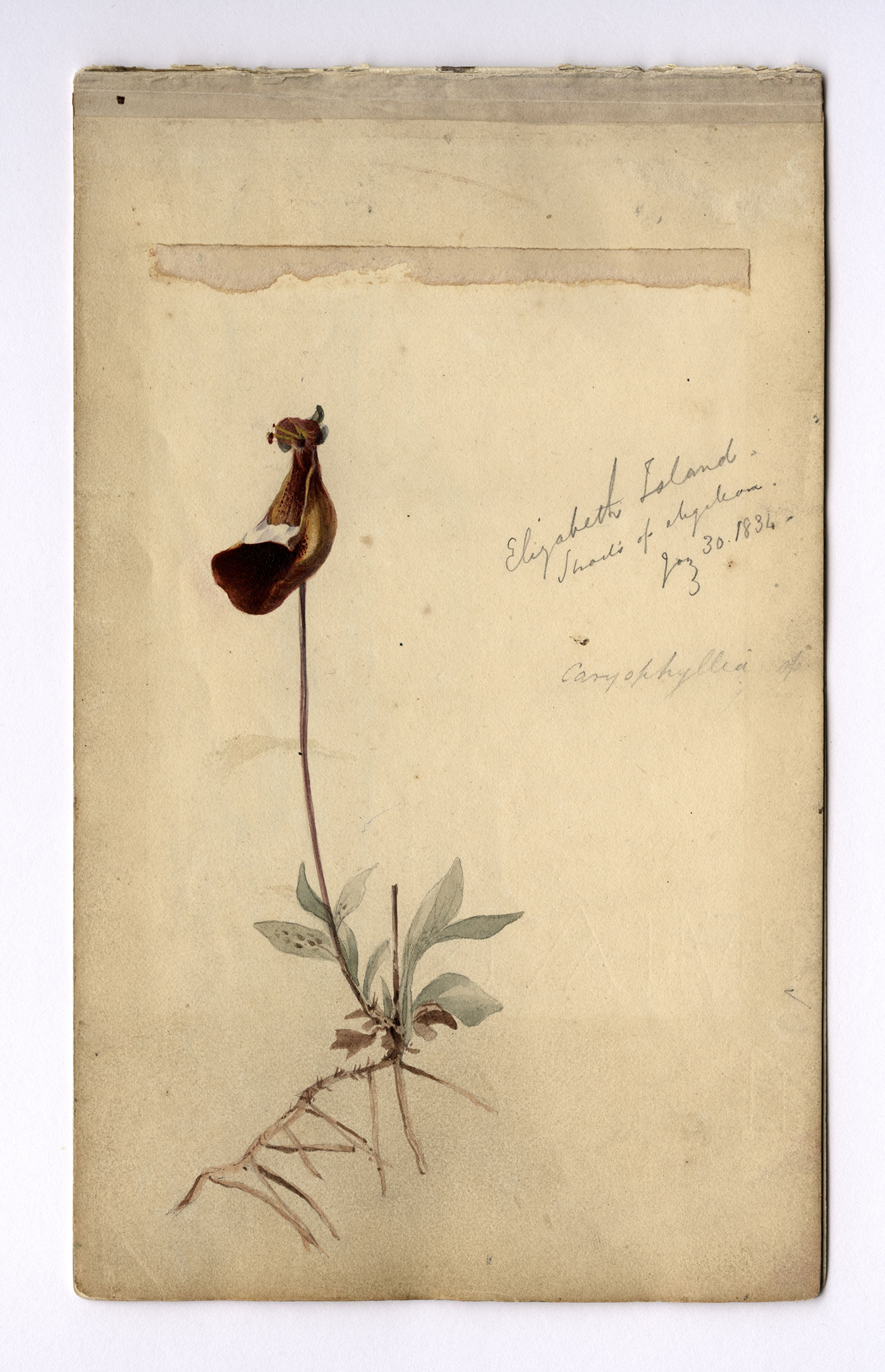
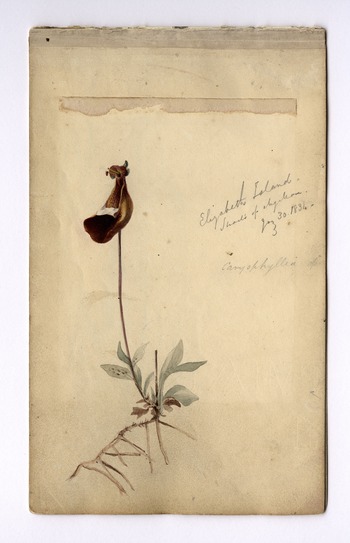
Provisions were also made for the pictorial documentation of exploratory data, with the onboard presence, at varying intervals, of the artists Augustus Earle (1793–1838) and Conrad Martens (1801–78).Footnote 41 While both men captured the topography of their respective portions of the voyage, Martens was more prolific in his image making, filling four sketchbooks with pencil and watercolour studies of the land and seascapes slipping by.Footnote 42 The subjects of Martens’s pictorial attention were varied and often precisely coloured, as in the delicate rendering of a Chilean orchid (Figure 2), its velvety tones carefully delineated in watercolour.Footnote 43 Elsewhere, Martens’s colour notations – scrawled hastily in the field – reflect the tradition of en plein air, documenting momentary visual experiences (a Santa Cruz sky, ‘purplish but light’) and referring to pigments from the paintbox (the leaves of a plant, ‘light burnt Sienna’).Footnote 44 Epitomizing the notational practices of landscape artists, Martens’s markings functioned as self-guiding prompts to aid subsequent visual reconstruction. The addition to sketches of descriptive notes or small areas of indicative colour were among the methods developed to mitigate the practical challenges of painting during long-distance voyaging.Footnote 45 Some of these challenges were unique to tropical environments, as when the artist Sydney Parkinson’s efforts aboard Captain Cook’s Endeavour were hampered by insects that ‘eat the painters [sic] colours off the paper as fast as they can be laid on’.Footnote 46
A botanical drawing of ‘Caryophyllia sp.’ by Conrad Martens (Sketchbook I). Cambridge University Library (Add 7984). Reproduced by kind permission of the Syndics of Cambridge University Library.
At the end of the eighteenth century and the beginning of the nineteenth, botanical draughtsmen developed ingenious techniques to overcome the practical difficulties of working in the field, as in the case of Ferdinand Bauer (1760–1826), whose process for recording colour relied on a complex numerical system contained in coded charts.Footnote 47 The Bohemian naturalist–illustrator Thaddeus Haenke (1761–1816) also compiled a similar graphical reference system – comprising sixteen pages and close to 2,500 colours – to facilitate the rapid recording of natural hues, in line with the unaccommodating pace of exploratory travel.Footnote 48 The activities of these individuals reflected the increased presence of specialist draughtsman on European voyages, whose detailed depictions of natural productions advanced scientific, commercial and colonial agendas; as Adriana Craciun and Mary Terrall have noted, visual knowledge was one of the most highly prized commodities of long-distance travel.Footnote 49 As no such dedicated illustrator of natural history was present on the Beagle, the documentation of animals and their colours was skewed towards the textual and fell largely within Darwin’s purview. Writing in Endless Forms, art historian Jane Munro connects Darwin’s own ‘inability to draw’, which she considers unusual among naturalists of the period, with his reliance on the technical colour vocabulary provided in Syme’s publication.Footnote 50
As demonstrated by the superfluity of his written output, Darwin readily subscribed to the late Enlightenment emphasis on rigorous note taking, endorsed by travellers such as Horace-Benédict de Saussure and Alexander von Humboldt and intended to guard against the unreliability of memory and the unruliness of observation.Footnote 51 As Darwin later wrote in his Journal of Researches, ‘Let the collector’s motto be, “Trust nothing to the memory;” for the memory becomes a fickle guardian when one interesting object is succeeded by another still more interesting.’Footnote 52 In order to deploy the scientific mechanism of descriptive observation – which Stafford calls the ‘lexical gaze of the natural historian’ – Darwin relied on a selection of material items for collecting and processing the raw data of natural-historical discovery.Footnote 53
Darwin’s initial collecting activities took place during excursions on land and on the deck of the Beagle, and required the use of specialist field equipment such as the gun cases listed among his ‘most useful’ possessions almost lost in Botofogo Bay. The contemporary naturalist’s portable paraphernalia included items for catching, measuring and weighing, and for close visual inspection: Fleming’s The Philosophy of Zoology (1822) recommends the ‘pocket-glass or Hand Megaloscope’ as ‘a necessary part of the travelling apparatus (or rather daily dress) of the zoologist’.Footnote 54 Such portable objects formed an essential and intimate part of what historian of material culture Viccy Coltman refers to as the ‘repertoire of things’ amassed by the contemporary traveller and stashed about their person.Footnote 55 For field collecting, the most appropriate items were easily operational with a single hand and could fit snugly in the pocket – pockets which, according to the entomologists Kirby and Spence, must themselves be ‘sufficiently ample’ to accommodate the numerous trappings of the naturalist in the field.Footnote 56
On one occasion Darwin described in his Beagle Diary the great astonishment of native Bahians at seeing his ‘Fly net, small pistol & compass’ pulled one after another from the depths of his ‘most capacious pockets’.Footnote 57 These pockets were noted on other occasions to contain ‘a silver pencil case’, ‘many contrivances for catching animals’ and ‘promethians’ – matches – which, he wrote, ‘I ignited by biting … between my teeth’.Footnote 58 Multiple uses were found for these items where possible: ‘Big rat weighs flask with water’, he wrote in one of his notebooks, fine-tuning his ad hoc scales with the addition of bullets, pellets and ‘big scizzors [sic]’.Footnote 59
Darwin’s personal repertoire also included paper objects, whose utility was equally contingent on considerations of size and convenience. His field notebooks, in their compact usefulness, were perhaps the most essential for his collecting activities. No bigger than six and a half by four inches, these have been described by Darwin scholar Nora Barlow as ‘real books for the pocket’; their leather-bound pages received Darwin’s immediate observations and speculations, written in situ – ‘on mule or horseback or on the deck of the Beagle’, notes Keynes.Footnote 60 In her discussion of European travellers’ inscriptions, Bourguet locates such notebooks at the core of the traveller’s endeavour, providing ready-made receptacles designed to render manageable and mobile an overabundance of sensory data and insuring its availability ‘through time and space’.Footnote 61
As crucial objects for his fieldwork, Darwin’s notebooks preserve a cascade of sensory information, containing frequent and richly expressed descriptions of coloured phenomena, often captured using Syme’s specific terms. During his first days in Cape Verde, in January 1832, Darwin noted the ‘tile red’ body and ‘scarlet red’ prickles of a starfish, encountered beneath a sky of ‘pale ultramarine’ and ‘Berlin blue’.Footnote 62 The markings of a snake were ‘primrose yellow’ and ‘scarlet red’, while a long-legged plover near Buenos Aires nurtured ‘very pointed oval eggs. olive brown’.Footnote 63 The iris of a condor shot in Santa Cruz glowed ‘scarlet red’; peering into the eyes of a hawk in the Falklands he saw instead a ‘honey yellow’.Footnote 64 To articulate each of these fresh and fleeting hues Darwin must have retrieved Syme’s book from one of his ‘capacious’ pockets, employing it as a mnemonic tool to capture the recently living colours of these animals. Functioning in a similar manner to Bauer’s and Haenke’s colour charts for sketching, Syme’s pocketable publication expedited the documentation of colour in the field. At the same time, it facilitated a particular kind of ‘optical performance’, or way of seeing, with regard to colour.Footnote 65
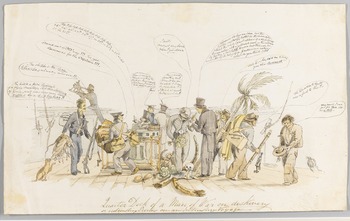
The extent to which Darwin’s meticulous attention to colour permeated his observatory practices is represented pictorially in the Beagle archive, in a watercolour sketch titled ‘Quarter Deck of a Man of War on Diskivery [sic] or Interesting Scenes on an Interesting Voyage’ (Figure 3). Recently attributed to the Beagle’s first onboard artist, Augustus Earle, the work has been dated to September 1832.Footnote 66 Earle’s cartoon offers a caricatured evocation of day-to-day activity on deck, including the only extant portrait of Darwin on the Beagle. A motley cohort of sailors mills to and fro, carrying jumbled assortments of geological, botanical and zoological specimens; nautical instruments; and collecting equipment. While no books feature in this muddle of objects and bodies, Earle’s image does include a near-explicit reference to Werner’s Nomenclature of Colours.
‘Quarter Deck of a Man of War on Diskivery [sic] or interesting Scenes on an Interesting Voyage’, presumed to be the work of August Earle, dated to c.24 September 1832. Image courtesy of Sotheby’s.
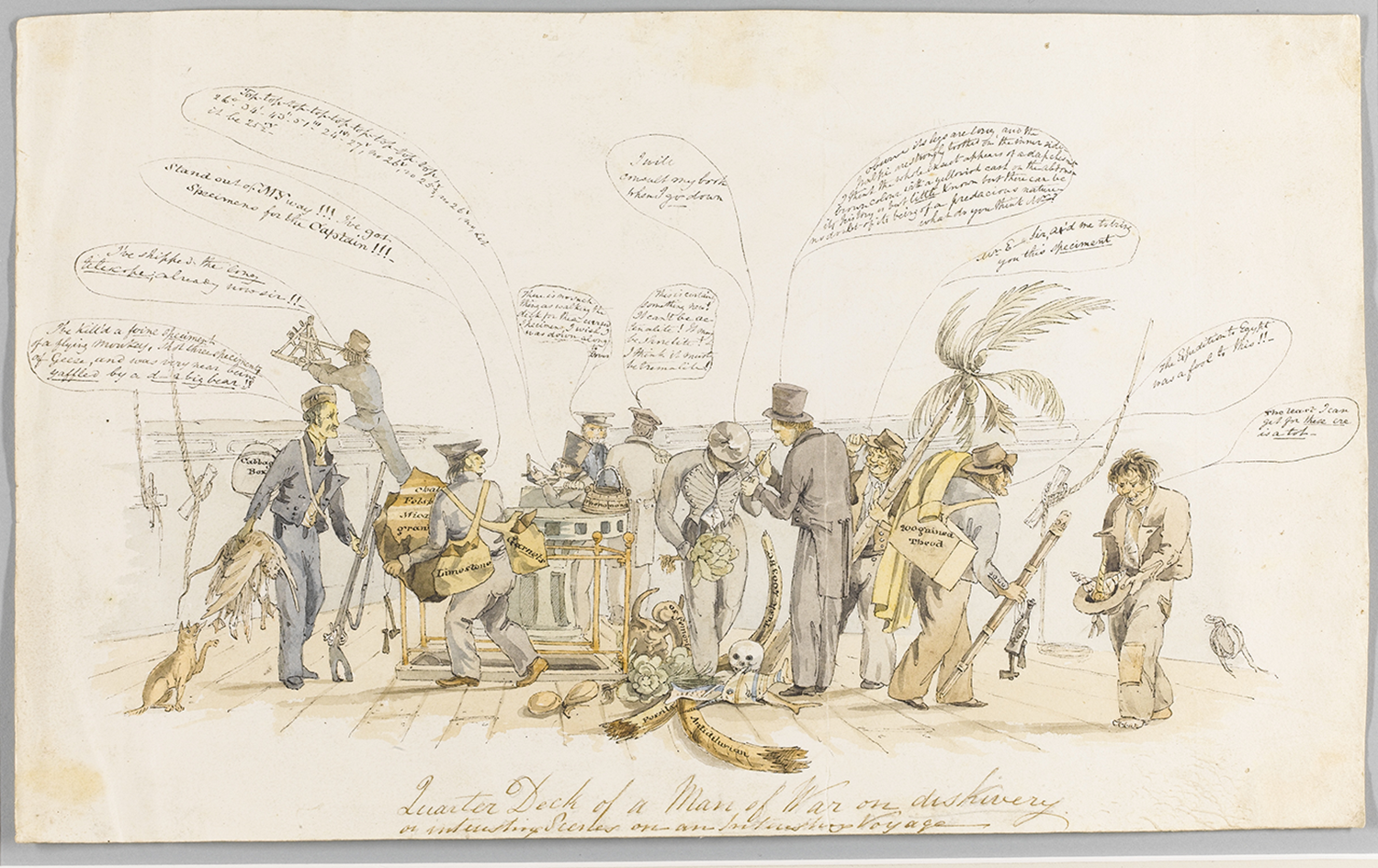
Darwin – recognizable in the unlikely attire of gentlemanly top hat and tails – is deep in conversation with an unnamed officer. Both peer intently at an insect clasped in Darwin’s hand, with the naturalist’s observations regarding the tiny animal appearing in a speech bubble above his head:
Observe its legs are long, and the palpi are strongly toothed on the inner side. I think the whole insect appears of a dark chesnut [sic] brown colour with a yellowish cast on the abdomen. Its history is but little known but there can be no doubt of its being of a predacious nature. What do you think Mr –?
Matching Syme’s uncommon spelling of ‘chesnut’, this detail from Earle implies the artist’s familiarity with Werner’s Nomenclature, cementing its significance for the Beagle’s scientific agenda – a frenzied agenda of seemingly indiscriminate collecting, which Earle gently mocks.
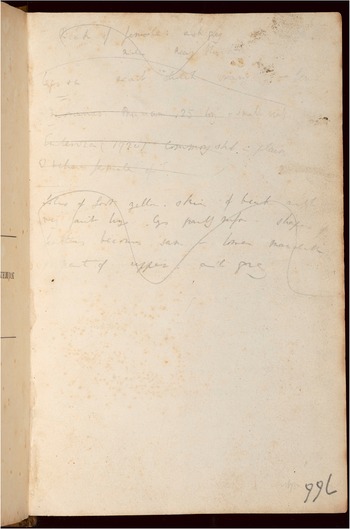
Werner’s Nomenclature also contributed materially to the scientific activity of the voyage. Aside from his notebooks, DAR LIB T.620 was one of only two paper items taken by Darwin into the field – the other being his copy of Milton’s Paradise Lost.Footnote 67 On these occasions Werner’s Nomenclature supplemented Darwin’s selection of multifunctional items, operating to both enhance and replicate the notebooks’ ability to house immediate observatory experiences. Scrawled in pencil on the book’s half-title verso is the following inscription (Figure 4):
Beak of female: ash grey
male nearly black
legs &c. exact dutch orange
Inscriptions by Darwin on the half-title verso page of Werner’s Nomenclature of Colours (1821). Cambridge University Library (DAR LIB T.620). Reproduced by kind permission of the Syndics of Cambridge University Library.
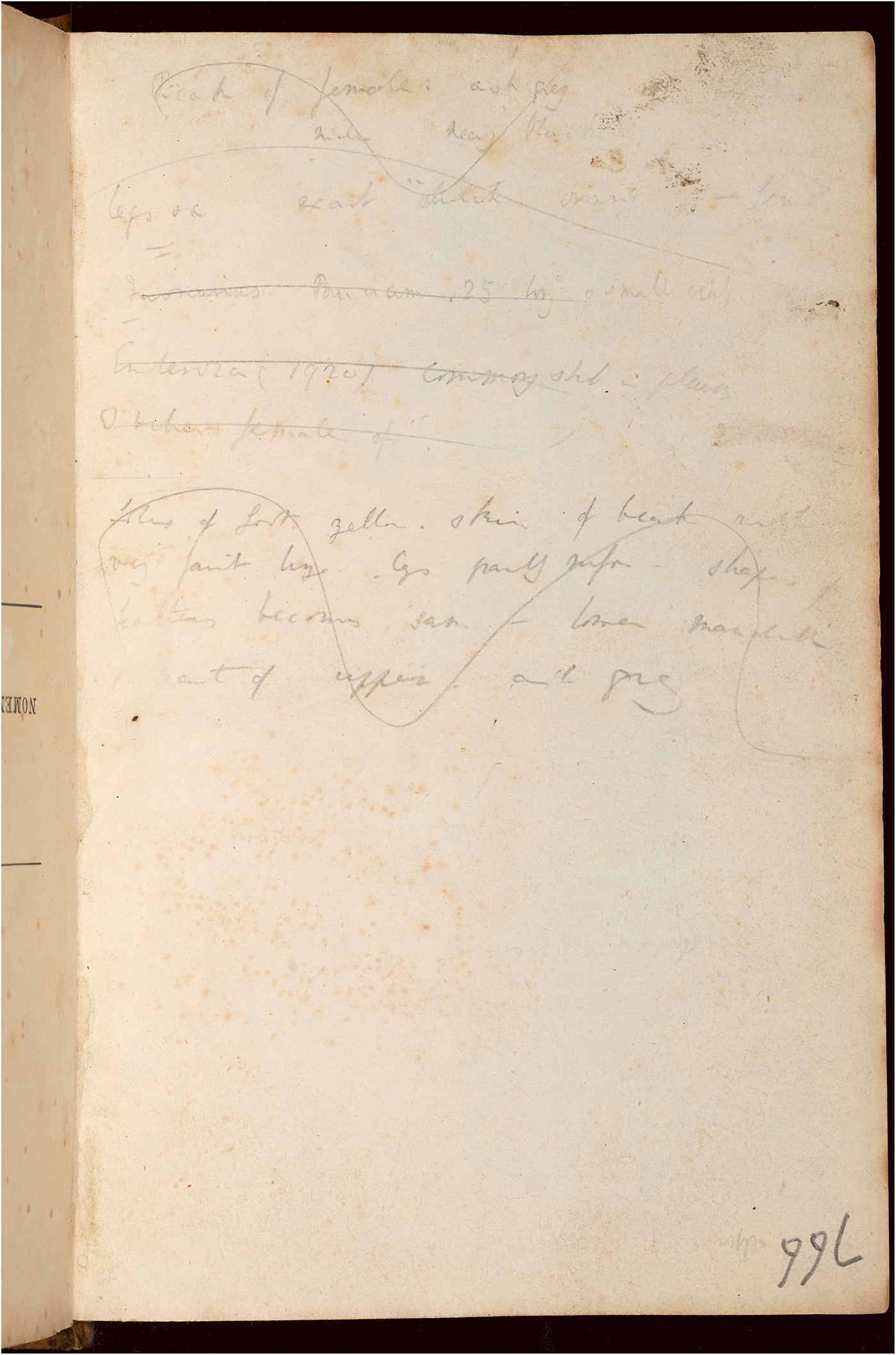
Darwin’s script describes the striated caracara (Phalcoboenus australis), an orange-legged, fierce-natured hawk encountered by Darwin in the Falkland Islands in April 1834. Other erased pencil markings, now illegible, suggest the habitual use of Syme’s book to collect descriptive notes in the field.Footnote 68
While occasionally functioning as a repository of immediate observations, the principal value of Syme’s book lay not in its ability to store information but to process it, facilitating a reading of visual similarity through comparative consultation of its charts. In this way DAR LIB T.620 enabled the synchronized acts of ‘taking note’ (observing) and ‘note taking’ (inscribing), which Bourguet calls ‘the seeing-and-writing operation’.Footnote 69 As I explore in the following section, much of this operation occurred on board the Beagle, in the aftermath of collecting, and was captured in a further corpus of manuscript documents that included Darwin’s Zoological Diary.
Transcribing nature’s hues
In the relative tranquillity of the Beagle’s chart room, or ‘poop-cabin’, Darwin undertook both the authoring of his daily journal and the preparation of his specimens – or, as Darwin put it, ‘arranging and writing notes about all of my treasures’.Footnote 70 The cabin, a snug ten feet by eleven, with five feet of headspace, accommodated the daily activities of Darwin and the ship’s chart maker, John Stokes (1811–85), both seated around the large table that dominated the room.Footnote 71 Darwin’s hammock was strung up overhead, the cabin’s skylight providing occasional views of the moon and stars, ‘performing their small revolutions in their new apparent orbits’.Footnote 72 Along with Darwin’s own books and belongings, this compact work–sleep space also housed the ship’s onboard library, which, according to FitzRoy, represented ‘a complete library in miniature, upwards of 400 volumes!’Footnote 73
Swollen by Darwin’s own natural-history books, this repository of printed knowledge was of daily benefit in the processing of the Beagle’s biological ‘treasures’. One item of potential practical import was William Swainson’s 1822 publication The Naturalist’s Guide – itself a pocket-sized octavo volume designed for use in the field.Footnote 74 Swainson’s guide lists the methods to be followed and the apparatus to be acquired for the successful preservation of natural specimens. It also emphasizes the importance of precise, rigorous note taking, particularly in relation to colour. Any animals to be bottled in spirits, whether reptilian, amphibian or aquatic, should be accompanied by a full chromatic description; for fish especially, noting their ‘beautiful but evanescent colours’ counteracts ‘the unsightly appearance they generally present in spirits’, as the process of preservation causes their colours to leach away.Footnote 75
In the case of bird specimens, Swainson gives the most essential elements for description: ‘the colours of the legs, eyes, and bill, the skin round the nostrils, and that which often encircles the eye’.Footnote 76 Unlike some structural colours in the plumage, these fleshy parts contain pigments that are lost or altered in the prepared skins. This convention for ornithological description is reflected in Darwin’s observational notes: when confronted by the living or freshly killed Falkland Island hawk, Darwin recorded only the colours of its legs and beak on the open half-title page of DAR LIB T.620. He later transcribed the original description into his Zoology Notes:
Specimen (1932, unfortunately injured by fire) was a female with eggs as large as goose-shot; it generally agrees with the specific description of C. novæ-zelandæ: – legs & skin about beak bright ‘dutch orange’, beak ‘ash-grey’, in the male it is nearly black …Footnote 77
Elsewhere, an Argentinian gull is described only in terms of the deep ‘reddish orange’ of the soles of its feet, and the ‘arterial blood red’ of its legs and bill.Footnote 78 The colours of the feathered parts of a cormorant are likewise omitted:
skin round eyes ‘Campanula blue’ cockles at base of upper mandible ‘saffron & gamboge yellow’. – Mark between eyes & corner of mouth ‘orpiment orange’. I saw this bird in the Falkland Islands catch a fish, let it go & catch it again 8 times successively as an otter does a fish or Cat a mouse.Footnote 79
In their calculated economy, Darwin’s zoological notes include only information he expects to be lost through the transformative and deleterious effects of death and preservation. Encountered together, and in lieu of any visual record, the preserved animal and Darwin’s written description form a kind of object–text, amalgamating into a total approximation of the form, colours and behaviours of the original living creature.Footnote 80
While chromatic material might be adequately preserved in the birds’ plumage, the aquatic lifeforms, pickled in spirits, retained none of their animate colours, and were therefore described in full by Darwin. Arriving in the tropics he penned a chromatic portrait of two corals, ‘differing chiefly in colour’: ‘The stony part in both is of an “Aurora red”, but in the one the back & part [sic] of animal is of an [sic] brilliant “orpiment orange”, in the other of a bright “Gamboge yellow”.’Footnote 81 Making a similar study of a mercurial cephalopod submerged in a tank on the Beagle’s deck, Darwin described its living colours as they undulated from yellow-spotted ‘French grey’ (no. 11) to clouds of ‘hyacinth red’ (no. 83) and ‘Chesnut [sic] brown’ (no. 103).Footnote 82
The above observations were transcribed shortly after the Beagle made landfall in the Cape Verde archipelago in January 1832, where the rugged landscape of St Jago awaited the eager young naturalist. Recorded in the parallel manuscript of his Beagle Diary, Darwin recollected the affective novelty of the scenery and its living inhabitants:
Before returning to our boat, we walked across the town & came to a deep valley. Here I first saw the glory of tropical vegetation. Tamarinds, Bananas & Palms were flourishing at my feet. – I expected a good deal, for I had read Humboldts [sic] descriptions & I was afraid of disappointments: how utterly vain such fear is, none can tell but those who have experienced what I to day have. – It is not only the gracefulness of their forms or the novel richness of their colours, it is the numberless & confusing associations that rush together on the mind, & produce the effect. – I returned to the shore, treading on Volcanic rocks, hearing the notes of unknown birds, & seeing new insects fluttering about still newer flowers. – It has been for me a glorious day, like giving to a blind man eyes. – he is overwhelmed with what he sees & cannot justly comprehend it. – Such are my feelings, & such may they remain.Footnote 83
In this equivalent account of Cape Verdean scenery and wildlife Darwin seeks to measure not individual hues and tints but the strength of his own reaction to their collective ‘richness’ and novelty. As this passage suggests, Darwin was heavily inspired by Alexander von Humboldt’s earlier descriptions of tropical scenery, published in his Personal Narrative of a Journey to the Equinoctial Regions of the New Continent (1819–29), whose Romantic style Daniela Bleichmar has termed the ‘imperial picturesque’.Footnote 84
In the following passage from the Zoology Notes, recorded near Rio, Darwin merged this Humboldtian picturesque register with his precise application of Syme’s terms:
For some hours the air, seen through for a short distance, had a prodigious transparency: but all colours at a greater [distance] were blended into a most beautiful tint. – giving to the landscape an serene appearance. – I have never observed this in England. – the colour was ‘French grey’ with a very little prussian blue. – the sky in the Zenith was ‘Ultra marine’ & ‘flax flower blue’.Footnote 85
Such instances represent a synthesis between what art historian Charlotte Klonk refers to as ‘subjectivity-claims’ and ‘objectivity-claims’, which, Klonk suggests, were briefly permitted to coincide in the phenomenalist writings of early nineteenth-century observers of nature.Footnote 86 While retaining empiricist aspirations towards scientific generality, phenomenalism rested on the value of individual observations, attempting to capture nature faithfully, ‘not as it is in itself or in its underlying essence (if it has one) but as it appears’.Footnote 87 The tranquil view of a gradated sky is thus captured as it appeared to Darwin’s sensory and emotional faculties, mediated by Syme’s terms. In this way the experience yields both scientific knowledge and aesthetic affect.
The melding of subjective and objective registers in the description of colour can also be encountered in Captain FitzRoy’s parallel account of the voyage, in which the colours of sea and sky inspire both spiritual enchantment and topographical speculation. In Tahiti, FitzRoy describes a ‘most enchanting view’ of ‘dazzling white’ breakers foaming over coral reefs, contrasted by the ‘deep blue’ of the surrounding ocean.Footnote 88 Elsewhere his chromatic gaze is purposefully analytical, considering the ‘milky white tint’ of the sea as indicative of ‘one of those great, though slow-moving currents, which sweep past the Falkland Islands, and thence northwards: but to what cause its unusual whiteness is to be attributed, I know not.’Footnote 89 As Katharine Anderson notes, hydrography – the charting of straits, coastlines and currents – was one of the most significant practices undertaken on sea voyages.Footnote 90 The discerning gaze of the exploratory observer was a crucial element, a well-trained eye for chromatic difference being equal in value to the miscellany of barometers, thermometers and chronometers necessary for nautical measurements.
The significance of sea colour variation had been established in the writings of earlier travellers, including Humboldt, whose Personal Narrative was a formative text for the development of Darwin’s scientific appetite.Footnote 91 During his own five-year expedition in Latin America (1799–1804) Humboldt had also carried with him a device for colour measurement: a version of Horace-Bénédict de Saussure’s circular ‘cyanometer’.Footnote 92 This paper instrument furnished travellers with a visual measurement of the fifty-three degrees of blue observable in the sky; as when, standing at the summit of the Peak of Tenerife, Humboldt observed ‘the azure vault of the sky’, its ‘intensity at the zenith’ corresponding to ‘41° of the cyanometer’.Footnote 93 Humboldt also frequently directed his blue disk downwards to measure the hues of the sea:
Though this color is commonly green, we have no need of a chlorometer to estimate the intensity of its tint. In this experiment there is no question but of the strength of the color, of the lighter or deeper shade, and not of the individual nature or quality of the tint.Footnote 94
Humboldt attempted to improve the accuracy of the cyanometer’s measurement by viewing the ocean through ‘a narrow aperture’, revealing ‘a beautiful ultramarine color’; an experience replicated three decades later by Darwin, who documented in his Zoology Notes ‘the beautiful colour of the sea when seen through the chinks of a straw hat … it was according to Werner nomenclature [sic] “Indigo with a little Azure blue”’.Footnote 95 Having ‘read and reread’ Humboldt’s Personal Narrative, Darwin adopted Werner’s Nomenclature as a colour measurement device, similar in nature to Humboldt’s cyanometer, which could distinguish not only the ‘strength of a colour’ but also the ‘quality of the tint’.Footnote 96 Darwin’s adoption of Syme’s vocabulary injected his Beagle manuscripts with a vivid and precise record of the colours of natural objects and phenomena, which proved crucial to the dissemination of the Beagle’s findings in print.
The Darwin–Syme nomenclature in print and paint
The relative scarcity of opportunity for long-distance voyaging in the first half of the nineteenth century amplified the cultural value of the collected facts of exploration, and secured an eager audience for their translation into print. As Innes Keighren, Charles Withers and Bill Bell have argued, the hazardous nature of foreign travel assured the worth of knowledge secured through hardship, having been ‘hard won from nature’s grasp’.Footnote 97 Arriving on European shores, the data of exploration were subsequently transposed into a mobile and circulatory form through the publication of popular narratives, or travel accounts, appended to or accompanied by works of descriptive natural history.Footnote 98 In this tradition, the published outcomes of the Beagle voyage were divided between FitzRoy’s edited Narrative of the Surveying Voyages of His Majesty’s Ships Adventure and Beagle (1839), the third volume of which contained Darwin’s account of the voyage, and the illustrated series The Zoology of the Voyage of H.M.S. Beagle (1838–43).Footnote 99
Though under Darwin’s editorship, the five volumes of The Zoology of the Voyage were authored by the more established naturalists Richard Owen, George Waterhouse, John Gould, Leonard Jenyns and Thomas Bell, who enacted various transformations, interpolations and augmentations to prepare Darwin’s manuscript for print. The authors supplemented Darwin’s immediate observations with their own visual inspection of preserved specimens, working up detailed descriptions of the Beagle’s collected fauna. Of these, only the parts on Mammalia by George Robert Waterhouse (1810–88) (Volume 2) and Birds by John Gould (1804–81) (Volume 3) contain coloured plates. The illustrations in the latter were designed by Gould’s wife Elizabeth (née Coxen, 1804–41).Footnote 100 The scientific and aesthetic value that these coloured images added to the ornithological portion of the publication is reflected in its cost: Part 3 was available for sixty shillings, a third more expensive than Jenyns’s ichthyological volume, and three times the cost of the part on reptiles by Bell.Footnote 101
In her 2002 article ‘Botany on a plate’, historian Anne Secord discusses the power of pictures for the dissemination of early nineteenth-century botanical knowledge.Footnote 102 Her observations might be equally applied to zoology, as both strands of natural history came to rely intensively on pictures, which supplied the viewer with both sensory enjoyment and ‘rational pleasure’, appealing in equal measure to the eye and the mind. As I have discussed elsewhere, by the middle decades of the century the sensory appreciation of zoological images had become particularly contingent not only on the accuracy of the image (its likeness), but also on its capacity to pictorially reanimate the depicted animal (its lifelikeness).Footnote 103 The currency of what Thomas Balfe and Joanna Woodall call the ‘vital, lively or lifelike image’ increased in conjunction with expanding frontiers and developments in image-making technologies.Footnote 104 This proliferation of images of nature presented new challenges when it came to the interaction between image and word: as Dolan has noted, attempts to combine the languages of text and image encountered a range of technological and philosophical challenges, especially where colour was concerned.Footnote 105
Verbal–visual depictions of preserved specimens presented a particular challenge, as the fading of biological colour threatened to undermine the accuracy of any attempt at re-presentation. For the Beagle’s birds, lifelikeness was attempted through the agglomeration of Darwin’s notes, John Gould’s subsequent observations and Elizabeth Gould’s visual renderings. These hand-coloured lithographs illustrate Gould’s letterpress, which combines Darwin’s original citations of Syme’s terms (identifiable by their quotation marks) with single-term or Latinate colour designations, as in the case of Milvago leucurus:
back and breast black, with the feathers of the neck having a white central mark following the shaft, – tectrices, with a broad white band at extremity; thighs and part of the belly rufous-red; beak ‘ash gray,’ with cere and tarsi ‘Dutch orange.’Footnote 106
The vagueness of Gould’s colour terms is mitigated by the addition of painted colour, as in Elizabeth’s regal rendering of Milvago albogularis (Figure 5), which exhibits Syme’s ‘pitch black’, ‘liver brown’ and ‘yellowish brown’.
Plate I of Part 3 of The Zoology of the Voyage of H.M.S. Beagle (1841), showing Milvago albogularis. The accompanying letterpress describes the colours of its ‘Head, back, upper wing coverts pitch black, passing into liver brown; feathers on back of neck and shoulders terminating in a yellowish-brown tip’. Image provided by the John Rylands Research Institute and Library, University of Manchester.

The inclusion of hand-coloured images of the Beagle’s birds was enabled by the relative chromatic stability of avian plumage, as the Goulds were able to consult the preserved skins in conjunction with Darwin’s notes to reconstitute their colouration. In comparison, the dried and bottled fish, reptile and amphibian specimens contained little of their original colour. The representational potential of the Darwin–Syme colour vocabulary therefore proved more crucial for the parts on ichthyological (Volume 4) and herpetological (Volume 5) species described and depicted in The Zoology of the Voyage. Darwin particularly encouraged his collaborators and readers of these sections to familiarize themselves with Syme’s book. Embarking on Volume 4, Darwin outlined in a letter to its author, Leonard Jenyns, the most essential information for the volume’s preface, including ‘that colours when given were compared with Pat. Syme’s nomenclature book in hand’.Footnote 107 The haptic utility of Werner’s Nomenclature is duly emphasized in Jenyns’s introduction: ‘a comparison was always made with the book in hand, previous to the exact colour in any case being noted’.Footnote 108 Jenyns’s statement adds currency to Darwin’s chromatic data, gathered on the spot and processed through the ostensibly objective measure of Syme’s charts.
Darwin offered, where possible, a full description of the fresh colouration of these animals, as was the case with this Argentinian toad:
Mouth pointed: but the colours are the most extraordinary I have ever seen. – Body ‘ink black’. under surface of feet, & base of abdomen & scattered patches of an intense ‘vermilion red’ (the animal looked as if it had crawled over a newly painted surface). – back with scattered spots of ‘buff orange’.Footnote 109
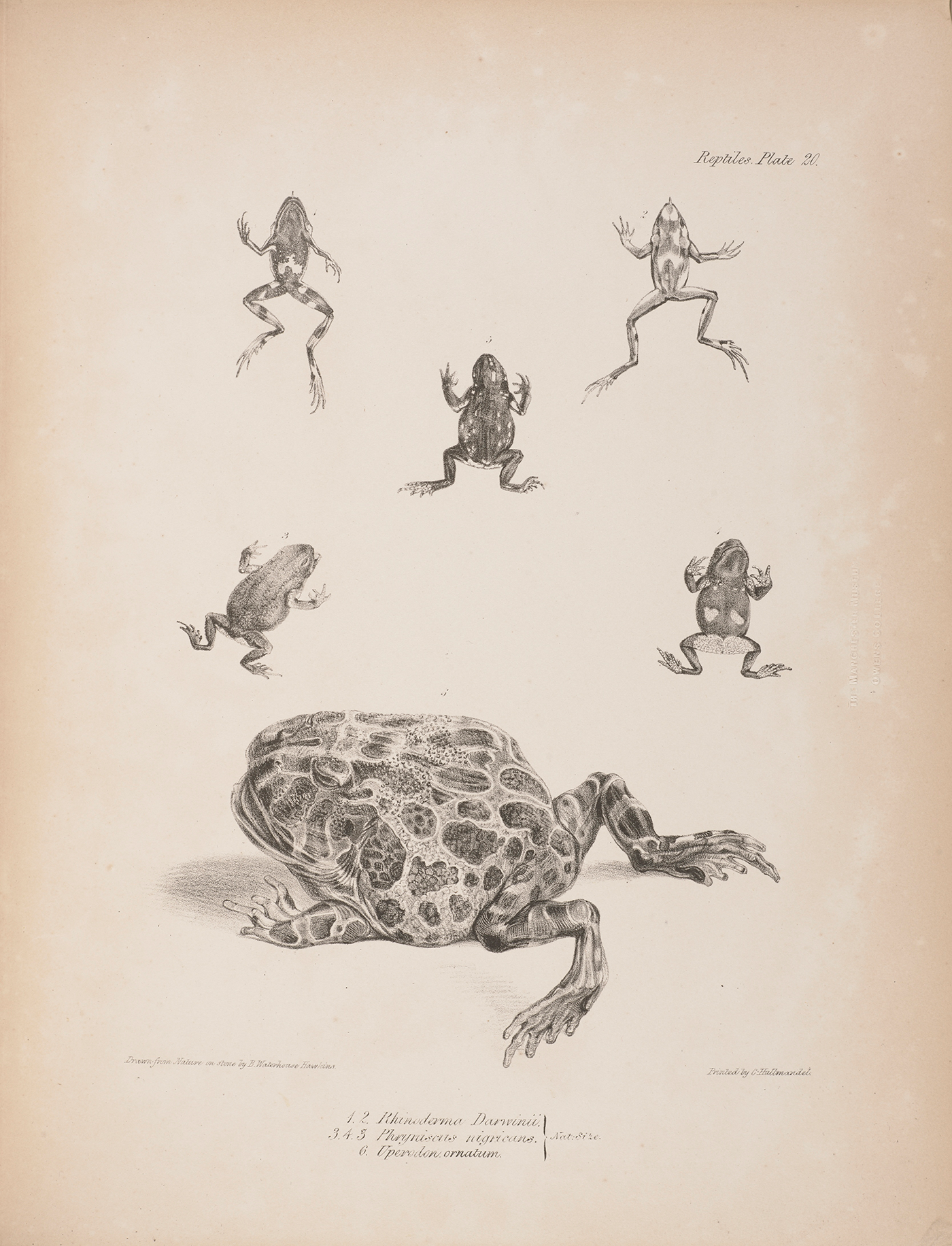
Processing Darwin’s notes for Volume 5, Thomas Bell (1792–1880), zoology professor at King’s College, identified the toad as Phryniscus nigricans, first described by Arend Friedrich August Wiegmann in 1834.Footnote 110 According to Bell, however, the toad’s colours had previously been misstated, ‘in consequence of the action of the spirit in which the specimen had been preserved’. Quoting almost word for word the description given in Darwin’s Zoology Notes – illustrated by an uncoloured, triple-aspect lithograph by Benjamin Waterhouse-Hawkins (Figure 6) – Bell’s image-text is an emendation of previous representations of the species, superseding them to become the most accurate published representation of the animal itself.
Plate 20 of Volume 5 of The Zoology of the Voyage of H.M.S. Beagle (1843), showing Rhinoderma darwinii (Figures 1–2), Phryniscus nigricans (Figures 3–5) and Uperon ornatum (Figure 6). Image provided by the John Rylands Research Institute and Library, University of Manchester.
The viscous hues of Phryniscus nigricans struck a particular chord with Darwin. He mentioned the animal in a letter to Henslow in October 1832, referencing both Werner’s Nomenclature and its companion on the Beagle, John Milton’s Paradise Lost:
As for one little toad; I hope it may be new, that it may be Christened ‘diabolicus’. – Milton must allude to this very individual, when he talks of ‘squat like [a] toad’, its colours are by Werner, ink black, Vermilion red & buff orange.Footnote 111
The animal makes a repeat appearance in the published version of his Beagle Diary, in which Darwin amalgamates the entry from his Zoology Notes with his evangelical musings to Henslow:
If we imagine, first, that it had been steeped in the blackest ink, and then, when dry, allowed to crawl over a board, freshly painted with the brightest vermilion, so as to colour the soles of its feet and parts of its stomach, a good idea of its appearance will be gained. If it had been an unnamed species, surely it ought to have been called Diabolicus, for it is a fit toad to preach in the ear of Eve.Footnote 112
Notably, the precisely quoted colour terms have been omitted from this alternative description. For the popular audience of his Journal of Researches, Darwin opts instead for the literary effect of the chromatic absolutes ‘blackest ink’ and ‘brightest vermilion’.Footnote 113
The nuanced distinction in Darwin’s expression of colour might be understood as a result of the diverging purposes and intended audiences of his Beagle writings. In a letter to his sister Caroline from April 1832 – on the day of his accident in Botofogo Bay – Darwin wrote of his Beagle Diary: ‘to me it will [be] of considerable future interest as it [is] an exact record of all my first impressions, & such a set of vivid ones they have been’.Footnote 114 The precise ‘future interest’ of this document was to supply the manuscript material for the Journal of Researches. This work, as stated in Darwin’s preface to the second edition (1845), was intended largely for ‘popular reading’.Footnote 115 Naturalists in search of scientific detail (and exact chromatics) must, he suggests, refer to ‘the larger publications, which comprise the scientific results of the Expedition’, and which were drawn largely from his Zoology Notes. Syme’s terms thus operate as a specialist coda for colour, reserved in the most part for a knowing body of naturalists for whom the standardization of chromatic language was a persistent preoccupation.
Conclusion
As cultural historian John Gage notes, Darwin’s dedicated use of Werner’s Nomenclature was almost entirely restricted to his travels on the Beagle: Syme’s ‘nuanced, and hence rather precise’ terminology, Gage suggests, ‘was probably far too cumbersome for regular use’.Footnote 116 As I have demonstrated, Syme’s chromatic vocabulary was in fact anything but ‘cumbersome’ – its concise binomial terms, bound and illustrated in a pocketable field guide, furnished Darwin with a highly mobile and versatile technology for processing exploratory data. Rather than signalling its impracticality, Darwin’s decision to largely abandon Syme’s chromo-vocabulary after his time on the Beagle might instead reflect the reluctance of those among his fellow naturalists – including Jenyns and Henslow – to incorporate the terminology into their own descriptive practices. Darwin may also have favoured a more accessible mode of chromatic expression for the articulation and circulation of his theoretical oeuvre: by the publication of On the Origin of Species (1859), Darwin’s chromatic lexis comprised mostly imprecise and indefinite terms such as ‘blue’, ‘bluish’ and ‘slaty-blue’.Footnote 117
Despite its transitory relevance for Darwin’s observational practices, Syme’s book facilitated the accurate transcription of the mercurial and transient hues of nature, while its contemporaneous popularity among British naturalists ensured the wider perspicuity of its ‘rather precise’ terms. Emerging from an epistemological environment in which the scientific objectivity of the human body came under particular scrutiny – redefined through the introduction of novel techniques and apparatus – Werner’s Nomenclature provided a uniquely effective apparatus for mediating the sensory dilemma posed by colour, representing a short-lived but immensely useful addition to the nineteenth-century naturalist’s repertoire of scientific instrumentation.
Acknowledgements
This research is the result of a doctoral training partnership studentship at the University of Edinburgh, funded by the Arts and Humanities Research Council (UKRI funding reference AH/L503915/1). Imaging and permissions have been generously funded by the Society for the History of Natural History. For the purpose of open access, the author has applied a creative commons attribution (CC BY) licence to any author-accepted manuscript version arising.


 Open access

