




Introduction
Contemporary archaeology can be used as a tool to assess both past and present inequalities. Urban development can lead to unequal treatment of citizens, such as gentrification that tends to push poverty out of sight and mind (Mullins Reference Mullins2006; Baram Reference Baram2019). The Nordic countries—though often presented in public as utopian models of socialist success—are no exception and there are troubled legacies connected to government policies both in the past and in the present. The outside perception of what might be referred to as ‘bad’ neighbourhoods can be markedly different from the ways the communities see themselves, and archaeology can offer a tool to investigate the realities of life in such places. In recent decades, economic and social differentiation has increased in the Nordic countries, as in other regions, and racism and interlinked extreme ideologies have gained ground. We consider these issues through a contemporary archaeological case study of Oulu Vaakunakylä, a Second World War German military camp turned into a working-class community in northern Finland (Matila et al. Reference Matila, Hyttinen and Ylimaunu2021; Seitsonen & Matila Reference Seitsonen, Matila, Halinen, Heyd and Mannermaa2022) (Figure 1). This contributes to global studies on the archaeologies of analogous issues, such as marginalisation, urbanisation and urban redevelopment (e.g. González Ruibal Reference González Ruibal2008).
A) Location of Vaakunakylä and the Finnish and German troops during the war (map O. Seitsonen, background map Esri); B) wartime map of Vaakunakylä (Oulu City Archives); C) Vaakunakylä today (figure by authors).

Vaakunakylä: from a Nazi Camp into a working-class neighbourhood
The Vaakunakylä (‘Coat of Arms Village’) camp was established on Hietasaari Island, near the city of Oulu in west-central Finland, in 1942 by German troops stationed in northern Finland (Figures 1 & 2). In the later part of the Second World War, 1941–1944, Finland joined Nazi Germany in the fight against the Soviet Union but ended the war with the Finno-German Lapland War 1944–1945. During their retreat from Finland in 1944–1945, the German troops used scorched-earth tactics and destroyed most of the property within their reach. This ‘Burning of Lapland’ and the Finns' close wartime relations with the Nazis are still politically loaded and difficult issues in the country (Seitsonen Reference Seitsonen2021; Matila Reference Matila2022). However, the Germans left Oulu before their use of scorched-earth tactics and, therefore, the Vaakunakylä barracks were preserved. In the late 1940s, Finns who were left homeless by the war moved into the barracks (Figure 2).
A) German soldier standing guard in Vaakunakylä during the war (anonymous photographer/CC-BY-4.0); B) Vaakunakylä in the early 1980s (photograph by U. Pohjamo & P. Kingelin/University of Oulu); C) field-school participants excavating the wartime horse-stable foundations at Vaakunakylä (photograph by authors).

The area became a working-class neighbourhood that existed largely outside the emerging Finnish society—that is, without municipal infrastructure. This was in fact the fate of the entire island of Hietasaari, but locals did not seem to mind living in rural seclusion near the city. The Vaakunakylä neighbourhood existed until the late 1980s when the city of Oulu decided to get rid of it, evicted the inhabitants despite their petitions and bulldozed the area (Pohjamo Reference Pohjamo2011).
The removal of the Vaakunakylä community coincides with the rise of a neoliberal understanding of nature in Finland. There was no place for low-income neighbourhoods in this philosophy, where nature became viewed as a commodity for public consumption (Matila et al. Reference Matila, Hyttinen and Ylimaunu2021). Also, the stigma attributed to Vaakunakylä of co-operating with the Nazis did not help. The City of Oulu had already taken measures to conceal the last reminders of Nazi past from the local landscape (Ylimaunu et al. Reference Ylimaunu, Mullins, Symonds, Kallio-Seppä, Heikkilä, Kuorilehto and Tolonen2013).
Since 1987, the area has been parkland. However, in 2025 a premier housing expo will take place there, after which it will become Oulu's most expensive residential area. This prompted our archaeological intervention because some former residents did not want their past to be wiped out by the new housing. In co-operation with the city authorities, we have collected memories from the former inhabitants of Vaakunakylä and excavated the area in 2020–2022. Now we are processing these materials within a wider archaeology-art framework (https://vaakunakyla.wordpress.com/).
Marginalised yet ‘good enough’ lives
From the 1950s to the 1980s, city officials labelled the Vaakunakylä community as criminal and restless and marginalised the populace with this reputation. However, the archaeological findings and collected oral histories highlight a more nuanced story of working-class families. Vaakunakylä residents were for instance actively making their living spaces more inhabitable and homelike. This is illustrated, for example, by building remains that were restructured to enhance the living standards, such as a wartime laundry barrack redesigned as a sauna (Figure 3), a nearby German latrine turned into a septic tank, and barracks refurbished as family housing (Figure 4).
Foundations of a German laundry barrack turned into a sauna (photograph by authors).

A) Vesa-Pekka Herva digging a German latrine; B) restructured wartime barrack foundations reinforced with German chimney elements, in the background is a flowerbed lined with German bricks (photographs by authors).

Numerous rubbish pits located in the area helped in reconstructing day-to-day family life. Only a few wartime finds were made, which is understandable as the Germans were in the area only for a couple of years and Finns lived there for four decades (Figure 5A–C). Pits contained mostly household waste, as there was no municipal garbage management in Vaakunakylä, which indicated variation between households in terms of possessions. For instance, sherds of high-end porcelain sets (Figure 5D & E) suggest that at least some Vaakunakylä residents could afford non-essential commodities to improve their living standards. Based on finds and recollections, locals took pride in their living spaces and were comfortable enough to entertain guests, which contrasts clearly with outsiders’ low opinions of poorer areas.
Finds from Vaakunakylä. A) German military button; B) Soviet military button; C) cartridges; D) Arabia Myrna cup fragments; E) fragments of a Sudlow's teapot; F–H) toys (photographs by authors).

Toys, infants’ medication, diapers and dummies excavated from the rubbish pits allow interesting glimpses into the often silent and neglected lives of children in the past (Figure 5F–H). For instance, they suggest that children were loved, looked after and had all the necessities to live a good and safe life. In the light of archaeological evidence and local memories, the Vaakunakylä community appears as anything but criminal and marginal and instead as a rather normal low-income working-class district.
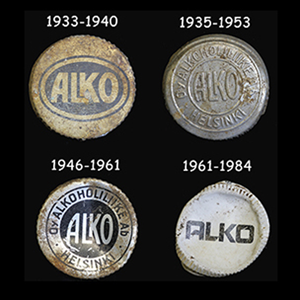
Bottle tops from the Finnish state-owned alcohol monopoly Alko are common finds from Vaakunakylä. This is in line with outsiders’ (mis)perceptions of lower-class neighbourhoods but, based on our contemporary archaeological explorations, alcohol bottle tops are among the most common finds in all twentieth-century contexts in Finland. We can trace what was consumed in different households based on the bottle tops and they also serve as horizon markers. We have established in our research a ‘bottle-top chronology’ based on the finds from Vaakunakylä that works as a tool for dating twentieth-century sites across Finland (Kelloniemi Reference Kelloniemi2023) (Figure 6).
The ‘bottle-top chronology’ with finds from Vaakunakylä (photographs by authors).

Former residents visiting our excavations were delighted with the studies of their community. However, several of them expressed bitterness about losing their homes when the city levelled the area, so our excavations turned into an unexpected outlet for these long-suppressed feelings. All visitors emphasised that despite the derogatory stamps placed on them, life in Vaakunakylä was ‘good enough’. This is a very Finnish approach to life and explains, to a degree, the country's ranking as the ‘happiest nation in the world’.
Public heritage
In addition to the archaeological work, the project commemorates the past of the Vaakunakylä neighbourhood in the city through community engagement and public art. These activities will create a renewed collective memoryscape, bringing back a fragment of the past where locals can share their memories and finally get their voices heard. We hope that this will have a healing aspect when the pent-up feelings are brought to the surface and discussed. Ultimately, we will produce a multi-vocal archaeology-art-based reminder that critically examines life in Vaakunakylä and other such communities left on the outskirts of, and marginalised by, the Finnish state.
Acknowledgements
We thank the former residents of Vaakunakylä for their contributions and positive attitude towards us digging up their old rubbish and thanks to City of Oulu for assistance and co-operation.
Funding statement
Funded by the Kone Foundation and the University of Oulu.


 Open access

