




1 Introduction
The field of combinatorial dynamics has its roots in the striking Sharkovskii theorem [Reference Sharkovskii30], in the sense that the theory grew up as a succession of progressive refinements and generalizations of the ideas contained in the original proof of that result. The core of the theory is the notion of combinatorial type or pattern.
Consider a class $\mathcal {X}$
of topological spaces (closed intervals of the real line, trees, graphs and compact surfaces are classic examples) and the family
$\mathcal {X}$
of topological spaces (closed intervals of the real line, trees, graphs and compact surfaces are classic examples) and the family $\mathcal {F}_{\mathcal {X}}$
of all maps
$\mathcal {F}_{\mathcal {X}}$
of all maps  satisfying a given property (continuous maps, homeomorphisms, etc). Any of such maps gives rise, by iteration, to a discrete dynamical system. Assume now that we have a map
  in
in $\mathcal {F}_{\mathcal {X}}$
which is known to have a periodic orbit P. The pattern of P is the equivalence class
$\mathcal {F}_{\mathcal {X}}$
which is known to have a periodic orbit P. The pattern of P is the equivalence class $\mathcal {P}$
of all maps
$\mathcal {P}$
of all maps  in
in $\mathcal {F}_{\mathcal {X}}$
having an invariant set
$\mathcal {F}_{\mathcal {X}}$
having an invariant set $Q\subset Y$
that, at a combinatorial level, behaves like P. In this case, we say that every map g in the class exhibits the pattern
$Q\subset Y$
that, at a combinatorial level, behaves like P. In this case, we say that every map g in the class exhibits the pattern $\mathcal {P}$
. Of course, we have to precise in which sense a periodic orbit behaves as P. So, we have to decide which feature of P has to be preserved inside the equivalence class
$\mathcal {P}$
. Of course, we have to precise in which sense a periodic orbit behaves as P. So, we have to decide which feature of P has to be preserved inside the equivalence class $\mathcal {P}$
. The period of P, just a natural number, is a first possibility (Sharkovskii’s theorem), but a richer option arises from imposing that:
$\mathcal {P}$
. The period of P, just a natural number, is a first possibility (Sharkovskii’s theorem), but a richer option arises from imposing that:
-
(a) the relative positions of the points of Q inside Y are the same as the relative positions of P inside X;
-
(b) the way these positions are permuted under the action of g coincides with the way f acts on the points of P.
An example is given by the family $\mathcal {F}_{\mathcal {M}}$
of surface homeomorphisms. The pattern (or braid type) of a cycle P of a map
$\mathcal {F}_{\mathcal {M}}$
of surface homeomorphisms. The pattern (or braid type) of a cycle P of a map  from
from $\mathcal {F}_{\mathcal {M}}$
, where M is a surface, is defined by the isotopy class, up to conjugacy, of
$\mathcal {F}_{\mathcal {M}}$
, where M is a surface, is defined by the isotopy class, up to conjugacy, of $f\big \rvert _{M\setminus P}$
[Reference Bowen18, Reference Matsuoka26].
$f\big \rvert _{M\setminus P}$
[Reference Bowen18, Reference Matsuoka26].
When $\mathcal {F}_{\mathcal {X}}$
is the family of continuous maps of closed intervals, the points of an orbit P of a map in
$\mathcal {F}_{\mathcal {X}}$
is the family of continuous maps of closed intervals, the points of an orbit P of a map in $\mathcal {F}_{\mathcal {X}}$
are totally ordered and the pattern of P can be simply identified with a cyclic permutation in a natural way. The notion of pattern for interval maps was formalized and developed in the early 1990s [Reference Baldwin12, Reference Misiurewicz and Nitecki29].
$\mathcal {F}_{\mathcal {X}}$
are totally ordered and the pattern of P can be simply identified with a cyclic permutation in a natural way. The notion of pattern for interval maps was formalized and developed in the early 1990s [Reference Baldwin12, Reference Misiurewicz and Nitecki29].
Set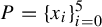 $P=\{x_i\}_{i=0}^5$
and
$P=\{x_i\}_{i=0}^5$
and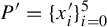 $P'=\{x^{\prime }_i\}_{i=0}^5$
. If
$P'=\{x^{\prime }_i\}_{i=0}^5$
. If  and
and  are continuous maps such that $f(x_i)=x_{i+1}$
and
$f(x_i)=x_{i+1}$
and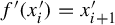 $f'(x^{\prime }_i)=x^{\prime }_{i+1}$
for
$f'(x^{\prime }_i)=x^{\prime }_{i+1}$
for $0\leq i\leq 5$
,
$0\leq i\leq 5$
, $f(x_5)=x_0$
and
$f(x_5)=x_0$
and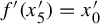 $f'(x^{\prime }_5)=x^{\prime }_0$
, then the models
$f'(x^{\prime }_5)=x^{\prime }_0$
, then the models $(T,P,f)$
and
$(T,P,f)$
and $(T',P',f')$
are equivalent and belong to the same pattern
$(T',P',f')$
are equivalent and belong to the same pattern $[T,P,f] = [T',P',f']$
.
$[T,P,f] = [T',P',f']$
.

In the last decades, a growing interest has arisen in extending the notion of pattern from the interval case to more general one-dimensional spaces such as graphs [Reference Alsedà, Gautero, Guaschi, Los, Mañosas and Mumbrú2, Reference Alsedà, Mañosas and Mumbrú10] or trees [Reference Alsedà, Guaschi, Los, Mañosas and Mumbrú3, Reference Baldwin13, Reference Bernhardt14]. Precisely, in this paper, we deal with patterns of periodic orbits of continuous maps defined on trees (simply connected graphs).
Let us precise the conditions (a) and (b) above in our context. If  is a continuous map of a tree and $P\subset T$
is a periodic orbit of f, the triplet
$P\subset T$
is a periodic orbit of f, the triplet $(T,P,f)$
will be called a model. Two points
$(T,P,f)$
will be called a model. Two points $x,y$
of P will be said to be consecutive if the unique closed interval of T having
$x,y$
of P will be said to be consecutive if the unique closed interval of T having $x,y$
as endpoints contains no other points of P. Any maximal subset of P consisting only of pairwise consecutive points will be called a discrete component. We will say that two models
$x,y$
as endpoints contains no other points of P. Any maximal subset of P consisting only of pairwise consecutive points will be called a discrete component. We will say that two models $(T,P,f)$
and
$(T,P,f)$
and $(T',P',f')$
are equivalent if there is a bijection
$(T',P',f')$
are equivalent if there is a bijection $\phi $
from P to
$\phi $
from P to $P'$
, which sends discrete components to discrete components and conjugates the action of f on P and the action of
$P'$
, which sends discrete components to discrete components and conjugates the action of f on P and the action of $f'$
on
$f'$
on $P'$
, that is,
$P'$
, that is, $f' \circ \phi \big \rvert _{P} = \phi \circ f\big \rvert _{P}$
. In Figure 1, we show two equivalent 6-periodic models with two discrete components. Note that two points
$f' \circ \phi \big \rvert _{P} = \phi \circ f\big \rvert _{P}$
. In Figure 1, we show two equivalent 6-periodic models with two discrete components. Note that two points $x_i,x_j$
of P are consecutive in T when the corresponding points
$x_i,x_j$
of P are consecutive in T when the corresponding points $x^{\prime }_i,x^{\prime }_j$
of
$x^{\prime }_i,x^{\prime }_j$
of $P'$
are consecutive in
$P'$
are consecutive in $T'$
.
$T'$
.
A pattern is an equivalence class of models by the above equivalence relation. A map  is said to exhibit a pattern $\mathcal {P}$
if f has an invariant set P such that
$\mathcal {P}$
if f has an invariant set P such that $(T,P,f) \in ~\mathcal {P}.$
A usual way of measuring the dynamical complexity of a map  of a compact metric space is in terms of its topological entropy, a notion first introduced in 1965 [Reference Adler, Konheim and McAndrew1]. It is a non-negative real number (or infinity) that measures how the iterates of the map mix the points of X. It will be denoted by $h(f)$
. An interval map with positive entropy is chaotic in the sense of Li and Yorke [Reference Li and Yorke25]. The same is true for more general compact metric spaces [Reference Blanchard, Glasner, Kolyada and Maas15]. However, the dynamics of a map with zero topological entropy is much simpler.
$h(f)$
. An interval map with positive entropy is chaotic in the sense of Li and Yorke [Reference Li and Yorke25]. The same is true for more general compact metric spaces [Reference Blanchard, Glasner, Kolyada and Maas15]. However, the dynamics of a map with zero topological entropy is much simpler.
Given a pattern $\mathcal {P}$
in
$\mathcal {P}$
in $\mathcal {F}_{\mathcal {X}}$
, we would like to establish, only in terms of the combinatorial data encoded by
$\mathcal {F}_{\mathcal {X}}$
, we would like to establish, only in terms of the combinatorial data encoded by $\mathcal {P}$
, a lower bound for the dynamical complexity that will be present in any map in
$\mathcal {P}$
, a lower bound for the dynamical complexity that will be present in any map in $\mathcal {F}_{\mathcal {X}}$
exhibiting
$\mathcal {F}_{\mathcal {X}}$
exhibiting $\mathcal {P}$
. In view of what has been said in the previous paragraph, it is natural to define the topological entropy of the pattern
$\mathcal {P}$
. In view of what has been said in the previous paragraph, it is natural to define the topological entropy of the pattern $\mathcal {P}$
, denoted from now on by
$\mathcal {P}$
, denoted from now on by $h(\mathcal {P})$
, as the infimum of the topological entropies of all maps in
$h(\mathcal {P})$
, as the infimum of the topological entropies of all maps in $\mathcal {F}_{\mathcal {X}}$
exhibiting
$\mathcal {F}_{\mathcal {X}}$
exhibiting $\mathcal {P}$
.
$\mathcal {P}$
.
Although computing the entropy of a continuous map is difficult in general, in some cases, the computation of the entropy of a pattern $\mathcal {P}$
in
$\mathcal {P}$
in $\mathcal {F}_{\mathcal {X}}$
can be easily performed thanks to the existence of the so called canonical models. A canonical model of a pattern
$\mathcal {F}_{\mathcal {X}}$
can be easily performed thanks to the existence of the so called canonical models. A canonical model of a pattern $\mathcal {P}$
in
$\mathcal {P}$
in $\mathcal {F}_{\mathcal {X}}$
is a map
$\mathcal {F}_{\mathcal {X}}$
is a map $f\in \mathcal {F}_{\mathcal {X}}$
that exhibits
$f\in \mathcal {F}_{\mathcal {X}}$
that exhibits $\mathcal {P}$
and satisfies at least the following properties:
$\mathcal {P}$
and satisfies at least the following properties:
-
(1) f is essentially unique and can be constructed from the combinatorial data enclosed in $\mathcal {P}$
;
$\mathcal {P}$
; -
(2) f has minimum entropy in the set of all maps exhibiting
$\mathcal {P}$
; -
(3) the dynamics of f can be completely described using algebraic tools that, in particular, allow us to compute
$h(f)$
.


From properties (1)–(3), it follows that $h(\mathcal {P})$
, defined as the infimum of entropies of maps, is in fact a minimum and can be easily computed as the entropy of the canonical model of
$h(\mathcal {P})$
, defined as the infimum of entropies of maps, is in fact a minimum and can be easily computed as the entropy of the canonical model of $\mathcal {P}$
. The existence of canonical models for patterns has been proved for continuous maps of closed intervals (see [Reference Alsedà, Llibre and Misiurewicz9] for a list of references), homeomorphisms of compact surfaces [Reference Fathi, Laudenbach and Poenaru19, Reference Thurston32] and continuous maps on trees [Reference Alsedà, Guaschi, Los, Mañosas and Mumbrú3].
$\mathcal {P}$
. The existence of canonical models for patterns has been proved for continuous maps of closed intervals (see [Reference Alsedà, Llibre and Misiurewicz9] for a list of references), homeomorphisms of compact surfaces [Reference Fathi, Laudenbach and Poenaru19, Reference Thurston32] and continuous maps on trees [Reference Alsedà, Guaschi, Los, Mañosas and Mumbrú3].
Now, we are ready to explain the aim of this paper. Several natural questions concerning patterns and entropy arise. Fix $n\in \mathbb {N}$
and consider the (finite) set of all n-periodic tree patterns. An important classification in this set is given by the zero/positive entropy character of its elements. On the one hand, the zero entropy tree patterns are well understood and several equivalent characterizations can be found in the literature [Reference Alsedà, Guaschi, Los, Mañosas and Mumbrú3, Reference Alsedà, Juher and Mañosas6, Reference Blokh17]. On the other hand, let
$n\in \mathbb {N}$
and consider the (finite) set of all n-periodic tree patterns. An important classification in this set is given by the zero/positive entropy character of its elements. On the one hand, the zero entropy tree patterns are well understood and several equivalent characterizations can be found in the literature [Reference Alsedà, Guaschi, Los, Mañosas and Mumbrú3, Reference Alsedà, Juher and Mañosas6, Reference Blokh17]. On the other hand, let $\operatorname {\mathrm {Pos}}_n$
be the subset of all n-periodic tree patterns with positive entropy. One would like to describe the patterns with maximal/minimal entropy in
$\operatorname {\mathrm {Pos}}_n$
be the subset of all n-periodic tree patterns with positive entropy. One would like to describe the patterns with maximal/minimal entropy in $\operatorname {\mathrm {Pos}}_n$
.
$\operatorname {\mathrm {Pos}}_n$
.
Several advances in the description of the entropy-maximal tree patterns have been reported [Reference Alsedà, Juher, King and Mañosas5], but the problem is still open. In fact, the maximality problem is unsolved even in the particular case of interval patterns [Reference Geller and Tolosa21–Reference King and Strantzen23]. Indeed, the maximal-entropy cyclic permutations of order n, when n has the form $4k+2$
, are still unknown, although [Reference Alsedà, Juher and King4] tackles this case from a computational point of view and proposes a conjecture.
$4k+2$
, are still unknown, although [Reference Alsedà, Juher and King4] tackles this case from a computational point of view and proposes a conjecture.
In this paper, we face the opposite problem: the characterization of the patterns of minimal entropy in $\operatorname {\mathrm {Pos}}_n$
. For interval maps, the description of the minimum entropy cycles is known when n is not a power of two (see [Reference Alsedà, Llibre and Misiurewicz9] for a review). In the setting of tree maps and for any
$\operatorname {\mathrm {Pos}}_n$
. For interval maps, the description of the minimum entropy cycles is known when n is not a power of two (see [Reference Alsedà, Llibre and Misiurewicz9] for a review). In the setting of tree maps and for any $n\ge 3$
, an n-periodic tree pattern
$n\ge 3$
, an n-periodic tree pattern $\mathcal {Q}_n$
was defined in [Reference Alsedà, Juher and Mañosas7] that conjecturally has minimal entropy in the set
$\mathcal {Q}_n$
was defined in [Reference Alsedà, Juher and Mañosas7] that conjecturally has minimal entropy in the set $\operatorname {\mathrm {Pos}}_n$
(the problem makes no sense when
$\operatorname {\mathrm {Pos}}_n$
(the problem makes no sense when $n=1,2$
, since every periodic pattern of period 1 or 2 has entropy zero), and the conjecture was proved to be true when n is a power of a prime. See the canonical model of
$n=1,2$
, since every periodic pattern of period 1 or 2 has entropy zero), and the conjecture was proved to be true when n is a power of a prime. See the canonical model of $\mathcal {Q}_n$
in Figure 2. The entropy of
$\mathcal {Q}_n$
in Figure 2. The entropy of $\mathcal {Q}_n$
turns out to be
$\mathcal {Q}_n$
turns out to be $\log (\unicode{x3bb} _n)$
, where
$\log (\unicode{x3bb} _n)$
, where $\unicode{x3bb} _n$
is the unique real root of the polynomial
$\unicode{x3bb} _n$
is the unique real root of the polynomial $x^n-2x-1$
in
$x^n-2x-1$
in $(1,+\infty )$
.
$(1,+\infty )$
.
The canonical model $(T,P,f)$
of
$(T,P,f)$
of $\mathcal {Q}_n$
, for which
$\mathcal {Q}_n$
, for which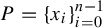 $P=\{x_i\}_{i=0}^{n-1}$
is time labelled and
$P=\{x_i\}_{i=0}^{n-1}$
is time labelled and $f(y)=y$
.
$f(y)=y$
.

The first main result of this paper states that the conjecture is in fact true for every $n\ge 3$
.
$n\ge 3$
.
Theorem A. Let $n\ge 3$
be a positive integer. Then,
$n\ge 3$
be a positive integer. Then, $\mathcal {Q}_n$
has minimum entropy in the set
$\mathcal {Q}_n$
has minimum entropy in the set $\operatorname {\mathrm {Pos}}_n$
of all n-periodic patterns with positive entropy. Moreover,
$\operatorname {\mathrm {Pos}}_n$
of all n-periodic patterns with positive entropy. Moreover, $h(\mathcal {P})> h(\mathcal {Q}_n)=\log (\unicode{x3bb} _n)$
for any
$h(\mathcal {P})> h(\mathcal {Q}_n)=\log (\unicode{x3bb} _n)$
for any $\mathcal {P}\in \operatorname {\mathrm {Pos}}_n$
such that
$\mathcal {P}\in \operatorname {\mathrm {Pos}}_n$
such that $\mathcal {P}\ne \mathcal {Q}_n$
, where
$\mathcal {P}\ne \mathcal {Q}_n$
, where $\unicode{x3bb} _n$
is the unique real root of the polynomial
$\unicode{x3bb} _n$
is the unique real root of the polynomial $x^n-2x-1$
in
$x^n-2x-1$
in $(1,+\infty )$
.
$(1,+\infty )$
.
Traditionally, reducibility/irreducibility has been another important classification for tree patterns. A pattern is reducible when it has a block structure (see §3). Roughly speaking, this means that the points of the orbit can be partitioned into disjoint subtrees that are permuted under the action of the map. The notion of reducibility arose early in the study of interval maps and has been recently extended to the setting of tree patterns [Reference Alsedà, Juher and Mañosas6]. The irreducible tree patterns are closely related to pseudo-Anosov braid types of periodic orbits of orientation preserving disk homeomorphisms [Reference Franks and Misiurewicz20]. As we will see, every irreducible tree pattern has positive entropy. The dynamic relevance of the patterns from $\operatorname {\mathrm {Irr}}_n$
motivates the study of the minimality of the entropy in this subclass of
$\operatorname {\mathrm {Irr}}_n$
motivates the study of the minimality of the entropy in this subclass of $\operatorname {\mathrm {Pos}}_n$
. For interval maps, the problem was solved in [Reference Misiurewicz28]. Since the minimum entropy pattern
$\operatorname {\mathrm {Pos}}_n$
. For interval maps, the problem was solved in [Reference Misiurewicz28]. Since the minimum entropy pattern $\mathcal {Q}_n$
turns out to be irreducible, Theorem A incidentally proves that
$\mathcal {Q}_n$
turns out to be irreducible, Theorem A incidentally proves that $\mathcal {Q}_n$
also minimizes the topological entropy in the subclass
$\mathcal {Q}_n$
also minimizes the topological entropy in the subclass $\operatorname {\mathrm {Irr}}_n$
.
$\operatorname {\mathrm {Irr}}_n$
.
Corollary B. Let $n\ge 3$
be a positive integer. Then,
$n\ge 3$
be a positive integer. Then, $\mathcal {Q}_n$
has minimum entropy in the set
$\mathcal {Q}_n$
has minimum entropy in the set $\operatorname {\mathrm {Irr}}_n$
of all n-periodic irreducible patterns. Moreover,
$\operatorname {\mathrm {Irr}}_n$
of all n-periodic irreducible patterns. Moreover, $h(\mathcal {P})> h(\mathcal {Q}_n)=\log (\unicode{x3bb} _n)$
for any
$h(\mathcal {P})> h(\mathcal {Q}_n)=\log (\unicode{x3bb} _n)$
for any $\mathcal {P}\in \operatorname {\mathrm {Irr}}_n$
such that
$\mathcal {P}\in \operatorname {\mathrm {Irr}}_n$
such that $\mathcal {P}\ne \mathcal {Q}_n$
.
$\mathcal {P}\ne \mathcal {Q}_n$
.
Now, the problem of determining the minimum (positive) entropy in the family of all reducible patterns arises. It is not difficult to see that $\operatorname {\mathrm {Pos}}_n\setminus \operatorname {\mathrm {Irr}}_n\ne \emptyset $
if and only if n is not a prime and
$\operatorname {\mathrm {Pos}}_n\setminus \operatorname {\mathrm {Irr}}_n\ne \emptyset $
if and only if n is not a prime and $n\ge 6$
. By Theorem A, the minimum positive entropy for any reducible pattern is strictly larger than
$n\ge 6$
. By Theorem A, the minimum positive entropy for any reducible pattern is strictly larger than $\log (\unicode{x3bb} _n)$
. The second main result of this paper gives the minimum entropy in
$\log (\unicode{x3bb} _n)$
. The second main result of this paper gives the minimum entropy in $\operatorname {\mathrm {Pos}}_n\setminus \operatorname {\mathrm {Irr}}_n$
. In this case, however, the minimum entropy pattern is not unique.
$\operatorname {\mathrm {Pos}}_n\setminus \operatorname {\mathrm {Irr}}_n$
. In this case, however, the minimum entropy pattern is not unique.
Theorem C. Let $n\ge 6$
be a composite number. Then, the minimum positive entropy in the set of all reducible n-periodic patterns is
$n\ge 6$
be a composite number. Then, the minimum positive entropy in the set of all reducible n-periodic patterns is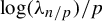 $\log (\unicode{x3bb} _{n/p})/p$
, where p is the smallest prime factor of n.
$\log (\unicode{x3bb} _{n/p})/p$
, where p is the smallest prime factor of n.
This paper is organized as follows. In §2, we introduce formally the basic notions of pattern, canonical model and path transition matrix, and recall how to compute the topological entropy of a pattern. In §3, we review some classic notions and results about block structures and reducibility for tree patterns, which we use in §6 to recall the characterization of zero entropy periodic patterns. A deeper study of the structure of zero entropy patterns is carried out in §7. In §4, we briefly recall a mechanism, first introduced in [Reference Alsedà, Juher and Mañosas7], that allows us to compare the entropies of two patterns $\mathcal {P}$
and
$\mathcal {P}$
and $\mathcal {O}$
when
$\mathcal {O}$
when $\mathcal {O}$
has been obtained by joining together several discrete components of
$\mathcal {O}$
has been obtained by joining together several discrete components of $\mathcal {P}$
. Section 5 is devoted to the task of explaining the strategy of the proof of Theorem A. As we will see, the proof is by induction on the period n and relies on a core result, Theorem D, that is stated in the same section and proved in §8 using the results of §7. The use of this result allows us to prove Theorem A for almost all patterns, with two particular exceptions: the k-flowers (patterns with k discrete components attached at a unique central point) and the triple chain, a pattern with three consecutive discrete components. We deal with these two cases in §§9 and 10, respectively. Putting all together, we prove Theorem A in §11. Finally, §12 is devoted to the proof of Corollary B and Theorem C.
$\mathcal {P}$
. Section 5 is devoted to the task of explaining the strategy of the proof of Theorem A. As we will see, the proof is by induction on the period n and relies on a core result, Theorem D, that is stated in the same section and proved in §8 using the results of §7. The use of this result allows us to prove Theorem A for almost all patterns, with two particular exceptions: the k-flowers (patterns with k discrete components attached at a unique central point) and the triple chain, a pattern with three consecutive discrete components. We deal with these two cases in §§9 and 10, respectively. Putting all together, we prove Theorem A in §11. Finally, §12 is devoted to the proof of Corollary B and Theorem C.
2 Patterns and canonical models
In this section, we formalize the definitions outlined in §1. We also recall how to compute the topological entropy of a pattern by using purely combinatorial tools. Finally, we define the pattern that will be proved to have minimum positive entropy.
A tree is a compact uniquely arcwise connected space which is a point or a union of a finite number of intervals (by an interval, we mean any space homeomorphic to $[0,1]$
). Any continuous map
$[0,1]$
). Any continuous map  from a tree T into itself will be called a tree map. A set $X\subset T$
is said to be f-invariant if
$X\subset T$
is said to be f-invariant if $f(X)\subset X$
. For each
$f(X)\subset X$
. For each $x\in T$
, we define the valence of x to be the number of connected components of
$x\in T$
, we define the valence of x to be the number of connected components of $T\setminus \{x\}$
. A point of valence different from 2 will be called a vertex of T and the set of vertices of T will be denoted by
$T\setminus \{x\}$
. A point of valence different from 2 will be called a vertex of T and the set of vertices of T will be denoted by $V(T)$
. Each point of valence 1 will be called an endpoint of T. The set of such points will be denoted by
$V(T)$
. Each point of valence 1 will be called an endpoint of T. The set of such points will be denoted by $\operatorname {\mathrm {En}}(T)$
. Also, the closure of a connected component of
$\operatorname {\mathrm {En}}(T)$
. Also, the closure of a connected component of $T \setminus V(T)$
will be called an edge of T.
$T \setminus V(T)$
will be called an edge of T.
Given any subset X of a topological space, we will denote by $\operatorname {\mathrm {Int}}(X)$
and
$\operatorname {\mathrm {Int}}(X)$
and $\operatorname {\mathrm {Cl}}(X)$
the interior and the closure of X, respectively. For a finite set P, we will denote its cardinality by
$\operatorname {\mathrm {Cl}}(X)$
the interior and the closure of X, respectively. For a finite set P, we will denote its cardinality by $|P|$
.
$|P|$
.
A triplet $(T,P,f)$
will be called a model if
$(T,P,f)$
will be called a model if  is a tree map and P is a finite f-invariant set such that $\operatorname {\mathrm {En}}(T)\subset P$
. In particular, if P is a periodic orbit of f and
$\operatorname {\mathrm {En}}(T)\subset P$
. In particular, if P is a periodic orbit of f and $|P|=n$
, then
$|P|=n$
, then $(T,P,f)$
will be called an n-periodic model. Given
$(T,P,f)$
will be called an n-periodic model. Given $X\subset T$
, we will define the connected hull of X, denoted by
$X\subset T$
, we will define the connected hull of X, denoted by  or simply by
  , as the smallest closed connected subset of T containing X. When $X=\{x,y\}$
, we will write
$X=\{x,y\}$
, we will write $[x,y]$
to denote
$[x,y]$
to denote  . The notation $(x,y)$
,
$(x,y)$
, $(x,y]$
and
$(x,y]$
and $[x,y)$
will be understood in the natural way.
$[x,y)$
will be understood in the natural way.
An n-periodic orbit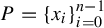 $P=\{x_i\}_{i=0}^{n-1}$
of a map
$P=\{x_i\}_{i=0}^{n-1}$
of a map $\theta $
will be said to be time labelled if
$\theta $
will be said to be time labelled if $\theta (x_i)=x_{i+1}$
for
$\theta (x_i)=x_{i+1}$
for $0\le i<n-1$
and
$0\le i<n-1$
and $\theta (x_{n-1})=x_0$
.
$\theta (x_{n-1})=x_0$
.
Let T be a tree and let $P\subset T$
be a finite subset of T. The pair
$P\subset T$
be a finite subset of T. The pair $(T,P)$
will be called a pointed tree. Two points
$(T,P)$
will be called a pointed tree. Two points $x,y$
of P will be said to be consecutive if
$x,y$
of P will be said to be consecutive if $(x,y)\cap P=\emptyset $
. Any maximal subset of P consisting only of pairwise consecutive points will be called a discrete component of
$(x,y)\cap P=\emptyset $
. Any maximal subset of P consisting only of pairwise consecutive points will be called a discrete component of $(T,P)$
. We say that two pointed trees
$(T,P)$
. We say that two pointed trees $(T,P)$
and
$(T,P)$
and $(T',P')$
are equivalent if there exists a bijection
$(T',P')$
are equivalent if there exists a bijection  which preserves discrete components. The equivalence class of a pointed tree $(T,P)$
will be denoted by
$(T,P)$
will be denoted by $[T,P]$
.
$[T,P]$
.
Let $(T,P)$
and
$(T,P)$
and $(T',P')$
be equivalent pointed trees, and let
$(T',P')$
be equivalent pointed trees, and let  and
and  be maps. We will say that $\theta $
and
$\theta $
and $\theta '$
are equivalent if
$\theta '$
are equivalent if $\theta '= \phi \circ \theta \circ \phi ^{-1}$
for a bijection
$\theta '= \phi \circ \theta \circ \phi ^{-1}$
for a bijection  that preserves discrete components. The equivalence class of $\theta $
by this relation will be denoted by
$\theta $
by this relation will be denoted by $[\theta ]$
. If
$[\theta ]$
. If $[T,P]$
is an equivalence class of pointed trees and
$[T,P]$
is an equivalence class of pointed trees and $[\theta ]$
is an equivalence class of maps, then the pair
$[\theta ]$
is an equivalence class of maps, then the pair $([T,P],[\theta ])$
will be called a pattern. We will say that a model
$([T,P],[\theta ])$
will be called a pattern. We will say that a model $(T,P,f)$
exhibits a pattern
$(T,P,f)$
exhibits a pattern $(\mathcal {T},\Theta )$
if
$(\mathcal {T},\Theta )$
if  and
and $\Theta =[f\big \rvert _{_{P}}]$
.
$\Theta =[f\big \rvert _{_{P}}]$
.
Despite the fact that the notion of a discrete component is defined for pointed trees, by abuse of language, we will use the expression discrete component of a pattern, which will be understood in the natural way since the number of discrete components and their relative positions are the same for all models of the pattern.
Recall that the topological entropy of a continuous tree map f is denoted by $h(f)$
. Given a pattern
$h(f)$
. Given a pattern $\mathcal {P}$
, the topological entropy of
$\mathcal {P}$
, the topological entropy of $\mathcal {P}$
is defined to be
$\mathcal {P}$
is defined to be
 $$ \begin{align*} h(\mathcal{P}) := \inf \{h(f) \,\colon (T,P,f)\ \mathrm{is a model exhibiting}\ \mathcal{P} \}. \end{align*} $$
The simplest models exhibiting a given pattern are the monotone ones, defined as follows. Let  be a tree map map. Given $a,b\in T$
, we say that
$a,b\in T$
, we say that $f\big \rvert _{[a,b]}$
is monotone if
$f\big \rvert _{[a,b]}$
is monotone if $f([a,b])$
is either an interval or a point and
$f([a,b])$
is either an interval or a point and $f\big \rvert _{[a,b]}$
is monotone as an interval map. Let
$f\big \rvert _{[a,b]}$
is monotone as an interval map. Let $(T,P,f)$
be a model. A pair
$(T,P,f)$
be a model. A pair $\{a,b\}\subset P$
will be called a basic path of
$\{a,b\}\subset P$
will be called a basic path of $(T,P)$
if it is contained in a single discrete component of
$(T,P)$
if it is contained in a single discrete component of $(T,P)$
. We will say that f is P-monotone if
$(T,P)$
. We will say that f is P-monotone if $f\big \rvert _{[a,b]}$
is monotone for any basic path
$f\big \rvert _{[a,b]}$
is monotone for any basic path $\{a,b\}$
. The model
$\{a,b\}$
. The model $(T,P,f)$
will then be said to be monotone. In such a case, [Reference Alsedà, Guaschi, Los, Mañosas and Mumbrú3, Proposition 4.2] states that the set
$(T,P,f)$
will then be said to be monotone. In such a case, [Reference Alsedà, Guaschi, Los, Mañosas and Mumbrú3, Proposition 4.2] states that the set $P\cup V(T)$
is f-invariant (recall that
$P\cup V(T)$
is f-invariant (recall that $V(T)$
stands for the set of vertices of T). Hence, the map f is also
$V(T)$
stands for the set of vertices of T). Hence, the map f is also $(P\cup V(T))$
-monotone. Observe that the notion of P-monotonicity is much more restrictive than the usual topological notion of a monotone map (full preimages of continua are continua).
$(P\cup V(T))$
-monotone. Observe that the notion of P-monotonicity is much more restrictive than the usual topological notion of a monotone map (full preimages of continua are continua).
First, [Reference Alsedà, Guaschi, Los, Mañosas and Mumbrú3, Theorem A] states that every pattern $\mathcal {P}$
has monotone models, and that for every monotone model
$\mathcal {P}$
has monotone models, and that for every monotone model $(T,P,f)$
of
$(T,P,f)$
of $\mathcal {P}$
,
$\mathcal {P}$
, $h(f)=h(\mathcal {P})$
. Moreover, there exists a special class of monotone models, satisfying several extra properties that we omit here, called canonical models. Additionally, [Reference Alsedà, Guaschi, Los, Mañosas and Mumbrú3, Theorem B] states that every pattern has a canonical model. Moreover, given two canonical models
$h(f)=h(\mathcal {P})$
. Moreover, there exists a special class of monotone models, satisfying several extra properties that we omit here, called canonical models. Additionally, [Reference Alsedà, Guaschi, Los, Mañosas and Mumbrú3, Theorem B] states that every pattern has a canonical model. Moreover, given two canonical models $(T,P,f)$
and
$(T,P,f)$
and $(T',P',f')$
of the same pattern, there exists a homeomorphism
$(T',P',f')$
of the same pattern, there exists a homeomorphism  such that $\phi (P) = P'$
and
$\phi (P) = P'$
and $f' \circ \phi \big \rvert _{P} = \phi \circ f\big \rvert _{P}$
. Hence, the canonical model of a pattern is essentially unique. Summarizing, we have the following result.
$f' \circ \phi \big \rvert _{P} = \phi \circ f\big \rvert _{P}$
. Hence, the canonical model of a pattern is essentially unique. Summarizing, we have the following result.
Theorem 2.1. Let $\mathcal {P}$
be a pattern. Then, the following statements hold.
$\mathcal {P}$
be a pattern. Then, the following statements hold.
-
(a) There exists a canonical model of
$\mathcal {P}$
. -
(b) The canonical model
$(T,P,f)$
of
$\mathcal {P}$
satisfies
$h(f)=h(\mathcal {P})$
.



It is worth noticing that the proof of Theorem 2.1 gives a finite algorithm to construct the canonical model of any pattern. For instance, the model $(T,P,f)$
in the right picture of Figure 1 is the canonical model of the corresponding pattern. The P-monotonicity of f determines that
$(T,P,f)$
in the right picture of Figure 1 is the canonical model of the corresponding pattern. The P-monotonicity of f determines that $f(a) = b$
,
$f(a) = b$
, $f(b) = c$
and
$f(b) = c$
and $f(c) = c.$
Observe also that the left model
$f(c) = c.$
Observe also that the left model $(T',P',f')$
of Figure 1, a representative of the same pattern, cannot be
$(T',P',f')$
of Figure 1, a representative of the same pattern, cannot be $P'$
-monotone, since in this case, we would have
$P'$
-monotone, since in this case, we would have $f'(v) \in f'([x^{\prime }_2,x^{\prime }_6]) \cap f'([x^{\prime }_4,x^{\prime }_5]) = [x^{\prime }_3,x^{\prime }_1] \cap [x^{\prime }_5,x^{\prime }_6] = \emptyset .$
There is a combinatorial procedure to compute the entropy of a pattern $\mathcal {P}$
that does not require the construction of its canonical model. Indeed,
$\mathcal {P}$
that does not require the construction of its canonical model. Indeed, $h(\mathcal {P})$
can be obtained from the transition matrix of a combinatorial directed graph that can be derived independently of the images of the vertices in any particular monotone model of the pattern. Let us recall this procedure.
$h(\mathcal {P})$
can be obtained from the transition matrix of a combinatorial directed graph that can be derived independently of the images of the vertices in any particular monotone model of the pattern. Let us recall this procedure.
A combinatorial directed graph is a pair $\mathcal {G}=(V,U)$
, where
$\mathcal {G}=(V,U)$
, where $V = \{v_1,v_2,\ldots ,v_k\}$
is a finite set and
$V = \{v_1,v_2,\ldots ,v_k\}$
is a finite set and $U\subset V\times V$
. The elements of V are called the vertices of
$U\subset V\times V$
. The elements of V are called the vertices of $\mathcal {G}$
and each element
$\mathcal {G}$
and each element $(v_i,v_j)$
in U is called an arrow (from
$(v_i,v_j)$
in U is called an arrow (from $v_i$
to
$v_i$
to $v_j$
) in
$v_j$
) in $\mathcal {G}$
. Such an arrow is usually denoted by
$\mathcal {G}$
. Such an arrow is usually denoted by $v_i\rightarrow v_j$
. The notions of path and loop in
$v_i\rightarrow v_j$
. The notions of path and loop in $\mathcal {G}$
are defined as usual. The length of a path is defined as the number of arrows in the path. The transition matrix of
$\mathcal {G}$
are defined as usual. The length of a path is defined as the number of arrows in the path. The transition matrix of $\mathcal {G}$
is a
$\mathcal {G}$
is a $k\times k$
binary matrix
$k\times k$
binary matrix $(m_{ij})_{i,j=1}^k$
such that
$(m_{ij})_{i,j=1}^k$
such that $m_{ij}=1$
if and only if there is an arrow from
$m_{ij}=1$
if and only if there is an arrow from $v_i$
to
$v_i$
to $v_j$
, and
$v_j$
, and $m_{ij}=0$
otherwise.
$m_{ij}=0$
otherwise.
Let $\{\pi _1,\pi _2,\ldots ,\pi _k\}$
be the set of basic paths of the pointed tree
$\{\pi _1,\pi _2,\ldots ,\pi _k\}$
be the set of basic paths of the pointed tree $(T,P)$
. We will say that
$(T,P)$
. We will say that $\pi _i$
f-covers
$\pi _i$
f-covers $\pi _j$
, denoted by
$\pi _j$
, denoted by $\pi _i\rightarrow \pi _j$
, whenever
$\pi _i\rightarrow \pi _j$
, whenever  . The
. The $\mathcal {P}$
-path graph is the combinatorial directed graph whose vertices are in one-to-one correspondence with the basic paths of
$\mathcal {P}$
-path graph is the combinatorial directed graph whose vertices are in one-to-one correspondence with the basic paths of $(T,P)$
, and there is an arrow from the vertex i to the vertex j if and only if
$(T,P)$
, and there is an arrow from the vertex i to the vertex j if and only if $\pi _i$
f-covers
$\pi _i$
f-covers $\pi _j$
. The associated transition matrix, denoted by
$\pi _j$
. The associated transition matrix, denoted by $M_{\mathcal {P}}$
, will be called the path transition matrix of
$M_{\mathcal {P}}$
, will be called the path transition matrix of $\mathcal {P}$
. It can be seen that the definitions of the
$\mathcal {P}$
. It can be seen that the definitions of the $\mathcal {P}$
-path graph and the matrix
$\mathcal {P}$
-path graph and the matrix $M_{\mathcal {P}}$
are independent of the particular choice of the model
$M_{\mathcal {P}}$
are independent of the particular choice of the model $(T,P,f)$
. Thus, they are well-defined pattern invariants.
$(T,P,f)$
. Thus, they are well-defined pattern invariants.
For any square matrix M, we will denote its spectral radius by $\rho (M)$
. We recall that it is defined as the maximum of the moduli of the eigenvalues of M.
$\rho (M)$
. We recall that it is defined as the maximum of the moduli of the eigenvalues of M.
Remark 2.2. Let $M_{\mathcal {P}}$
be the path transition matrix of a pattern
$M_{\mathcal {P}}$
be the path transition matrix of a pattern $\mathcal {P}$
. Then (see [Reference Alsedà, Guaschi, Los, Mañosas and Mumbrú3]), the topological entropy of
$\mathcal {P}$
. Then (see [Reference Alsedà, Guaschi, Los, Mañosas and Mumbrú3]), the topological entropy of $\mathcal {P}$
can be computed as
$\mathcal {P}$
can be computed as $h(\mathcal {P})=\log \max \{\rho (M_{\mathcal {P}}),1\}$
.
$h(\mathcal {P})=\log \max \{\rho (M_{\mathcal {P}}),1\}$
.
To end this section, we define the patterns that will be shown to have minimum positive entropy. Let $n\in \mathbb {N}$
with
$n\in \mathbb {N}$
with $n\ge 3$
. Let
$n\ge 3$
. Let $\mathcal {Q}_n$
be the n-periodic pattern
$\mathcal {Q}_n$
be the n-periodic pattern $([T,P],[\theta ])$
such that
$([T,P],[\theta ])$
such that $P=\{x_0,x_1,\ldots ,x_{n-1}\}$
is time labelled and
$P=\{x_0,x_1,\ldots ,x_{n-1}\}$
is time labelled and $(T,P)$
has two discrete components,
$(T,P)$
has two discrete components, $\{x_{n-1},x_0\}$
and
$\{x_{n-1},x_0\}$
and $\{x_0,x_1,\ldots ,x_{n-2}\}$
. In Figure 2, we show the canonical model of
$\{x_0,x_1,\ldots ,x_{n-2}\}$
. In Figure 2, we show the canonical model of $\mathcal {Q}_n$
. Observe that
$\mathcal {Q}_n$
. Observe that $\mathcal {Q}_3$
is nothing but the 3-periodic Štefan cycle of the interval [Reference Štefan31]. In [Reference Alsedà, Juher and Mañosas7], the authors prove that
$\mathcal {Q}_3$
is nothing but the 3-periodic Štefan cycle of the interval [Reference Štefan31]. In [Reference Alsedà, Juher and Mañosas7], the authors prove that $h(\mathcal {Q}_n)=\log (\unicode{x3bb} _n)$
, where
$h(\mathcal {Q}_n)=\log (\unicode{x3bb} _n)$
, where $\unicode{x3bb} _n$
is the unique real root of the polynomial
$\unicode{x3bb} _n$
is the unique real root of the polynomial $x^n-2x-1$
in
$x^n-2x-1$
in $(1,+\infty )$
. We will use the following properties of the numbers
$(1,+\infty )$
. We will use the following properties of the numbers $\unicode{x3bb} _n$
. Statement (a) is proved in [Reference Alsedà, Juher and Mañosas7, Proposition 3.1], while statement (b) is an easy exercise.
$\unicode{x3bb} _n$
. Statement (a) is proved in [Reference Alsedà, Juher and Mañosas7, Proposition 3.1], while statement (b) is an easy exercise.
Proposition 2.3. Let n be any positive integer with $n\ge 3$
. Then:
$n\ge 3$
. Then:
-
(a)
$\unicode{x3bb} _{n+1}<\unicode{x3bb} _n$
; -
(b)
$\sqrt [n]{4}>\unicode{x3bb} _n$
.


3 Block structures, skeletons and
$\pi $
-reducibility

The zero entropy tree patterns will play a central role in this paper. The characterization of such patterns was first given in [Reference Alsedà, Guaschi, Los, Mañosas and Mumbrú3], and another description was proven to be equivalent in [Reference Alsedà, Juher and Mañosas6]. We will use this second approach, and this section is devoted to recall the necessary notions and results. The characterization of zero entropy periodic patterns relies on the notion of block structure, which is classic in the field of combinatorial dynamics. In the literature, one can find several kinds of block structures and related notions for periodic orbits. In the interval case, the Sharkovskii square root construction [Reference Sharkovskii30] is an early example of a block structure. The notion of extension, first appearing in [Reference Block16], gives rise to some particular cases of block structures. Also, the notion of division, introduced in [Reference Li, Misiurewicz, Pianigiani and Yorke24] for interval periodic orbits and generalized in [Reference Alsedà and Ye11] to study the entropy and the set of periods for tree maps, is a particular case of a block structure.
Remark 3.1. All patterns considered in this paper will be periodic. Given an n-periodic pattern $\mathcal {P}$
, by abuse of language, we will speak about the points of
$\mathcal {P}$
, by abuse of language, we will speak about the points of $\mathcal {P}$
and, by default, we will consider that such points are time labelled with the integers
$\mathcal {P}$
and, by default, we will consider that such points are time labelled with the integers $\{0,1,\ldots ,n-1\}$
. Often, we will identify a point in
$\{0,1,\ldots ,n-1\}$
. Often, we will identify a point in $\mathcal {P}$
with its time label. In agreement with such conventions, the points of the patterns shown in the pictures will be simply integers in the range
$\mathcal {P}$
with its time label. In agreement with such conventions, the points of the patterns shown in the pictures will be simply integers in the range $[0,n-1]$
. See for instance Figure 3.
$[0,n-1]$
. See for instance Figure 3.
(left) An 8-periodic pattern $\mathcal {P}$
admitting two block structures with trivial blocks. (right) The canonical model
$\mathcal {P}$
admitting two block structures with trivial blocks. (right) The canonical model $(T,P,f)$
of
$(T,P,f)$
of $\mathcal {P}$
, for which the images of the vertices are
$\mathcal {P}$
, for which the images of the vertices are $f(a)=c$
,
$f(a)=c$
, $f(b)=0$
and
$f(b)=0$
and $f(c)=a$
.
$f(c)=a$
.

A pattern will be said to be trivial if it has only one discrete component. It is easy to see that the entropy of any trivial pattern is zero.
Let $\mathcal {P}=([T,P],[f])$
be a non-trivial n-periodic pattern with
$\mathcal {P}=([T,P],[f])$
be a non-trivial n-periodic pattern with $n\ge 3$
. For
$n\ge 3$
. For $n>p\ge 2$
, we will say that
$n>p\ge 2$
, we will say that $\mathcal {P}$
has a p-block structure if there exists a partition
$\mathcal {P}$
has a p-block structure if there exists a partition $P=P_0\cup P_1\cup \cdots \cup P_{p-1}$
such that
$P=P_0\cup P_1\cup \cdots \cup P_{p-1}$
such that $f(P_i)=P_{i+1\bmod p}$
for
$f(P_i)=P_{i+1\bmod p}$
for $i\ge 0$
, and
$i\ge 0$
, and  for
for $i\ne j$
. In this case, p is a strict divisor of n and
$i\ne j$
. In this case, p is a strict divisor of n and $|P_i|=n/p$
for
$|P_i|=n/p$
for $0\le i<p$
. The sets
$0\le i<p$
. The sets $P_i$
will be called blocks, and the blocks will be said to be trivial if each
$P_i$
will be called blocks, and the blocks will be said to be trivial if each $P_i$
is contained in a single discrete component of
$P_i$
is contained in a single discrete component of $\mathcal {P}$
(equivalently, each pattern
$\mathcal {P}$
(equivalently, each pattern  is trivial). Note that $\mathcal {P}$
can have several block structures, but only one p-block structure for any given divisor p of n. If
$\mathcal {P}$
can have several block structures, but only one p-block structure for any given divisor p of n. If $\mathcal {P}$
has structures of trivial blocks, the one with blocks with maximum cardinality will be called a maximal structure.
$\mathcal {P}$
has structures of trivial blocks, the one with blocks with maximum cardinality will be called a maximal structure.
From the equivalence relation which defines the class of models belonging to the pattern $\mathcal {P}$
, it easily follows that the notions defined in the previous paragraph do not depend on the particular model
$\mathcal {P}$
, it easily follows that the notions defined in the previous paragraph do not depend on the particular model $(T,P,f)$
representing
$(T,P,f)$
representing $\mathcal {P}$
.
$\mathcal {P}$
.
Remark 3.2. (Standing convention)
Let $\mathcal {P}$
be an n-periodic pattern whose points are time labelled as
$\mathcal {P}$
be an n-periodic pattern whose points are time labelled as $\{0,1,\ldots ,n-1\}$
. When
$\{0,1,\ldots ,n-1\}$
. When $\mathcal {P}$
has a block structure of p blocks
$\mathcal {P}$
has a block structure of p blocks $P_0\cup P_1\cup \cdots \cup P_{p-1}$
, by convention, we will always assume that the time labels of the blocks have been chosen in such a way that
$P_0\cup P_1\cup \cdots \cup P_{p-1}$
, by convention, we will always assume that the time labels of the blocks have been chosen in such a way that $0\in P_0$
.
$0\in P_0$
.
Let $(T,P,f)$
be the canonical model of
$(T,P,f)$
be the canonical model of $\mathcal {P}$
. A p-block structure
$\mathcal {P}$
. A p-block structure $P_0\cup P_1\cup \cdots \cup P_{p-1}$
for
$P_0\cup P_1\cup \cdots \cup P_{p-1}$
for $\mathcal {P}$
will be said to be separated if
$\mathcal {P}$
will be said to be separated if  for
for $i\ne j$
. Note that the separability of a block structure for a pattern depends on the particular topology of its canonical model and, as a consequence, cannot be determined directly from the combinatorial data of
$i\ne j$
. Note that the separability of a block structure for a pattern depends on the particular topology of its canonical model and, as a consequence, cannot be determined directly from the combinatorial data of $\mathcal {P}$
a priori. However, recall that the canonical model of a pattern
$\mathcal {P}$
a priori. However, recall that the canonical model of a pattern $\mathcal {P}$
is unique and can be algorithmically computed from
$\mathcal {P}$
is unique and can be algorithmically computed from $\mathcal {P}$
. So, this is an intrinsic notion.
$\mathcal {P}$
. So, this is an intrinsic notion.
In Figure 3, we show an example of an 8-periodic pattern $\mathcal {P}$
admitting both a 4-block structure given by
$\mathcal {P}$
admitting both a 4-block structure given by $P_0=\{0,4\}$
,
$P_0=\{0,4\}$
, $P_1=\{1,5\}$
,
$P_1=\{1,5\}$
, $P_2=\{2,6\}$
,
$P_2=\{2,6\}$
, $P_3=\{3,7\}$
and a 2-structure given by
$P_3=\{3,7\}$
and a 2-structure given by $Q_0=\{0,2,4,6\}$
,
$Q_0=\{0,2,4,6\}$
, $Q_1=\{1,3,5,7\}$
. Note that in both cases, the blocks are trivial and
$Q_1=\{1,3,5,7\}$
. Note that in both cases, the blocks are trivial and $Q_0\cup Q_1$
is a maximal structure by definition. As it has been said, one can determine these block structures directly in the combinatorial representation of
$Q_0\cup Q_1$
is a maximal structure by definition. As it has been said, one can determine these block structures directly in the combinatorial representation of $\mathcal {P}$
, without checking any particular topology. See Figure 3 (left). In contrast, to determine the separability of a block structure, one has to construct the canonical model of
$\mathcal {P}$
, without checking any particular topology. See Figure 3 (left). In contrast, to determine the separability of a block structure, one has to construct the canonical model of $\mathcal {P}$
, which is shown in the same figure (right). Here, we see that
$\mathcal {P}$
, which is shown in the same figure (right). Here, we see that $Q_0\cup Q_1$
is separated, while
$Q_0\cup Q_1$
is separated, while $P_0\cup P_1\cup P_2\cup P_3$
is not (the convex hulls of the blocks
$P_0\cup P_1\cup P_2\cup P_3$
is not (the convex hulls of the blocks $P_0$
and
$P_0$
and $P_2$
, which are respectively the intervals
$P_2$
, which are respectively the intervals $[0,4]$
and
$[0,4]$
and $[2,6]$
, intersect at the vertex a).
$[2,6]$
, intersect at the vertex a).
Let $\mathcal {P}$
be an n-periodic pattern and let
$\mathcal {P}$
be an n-periodic pattern and let $(T,P,f)$
be the canonical model of
$(T,P,f)$
be the canonical model of $\mathcal {P}$
. Let
$\mathcal {P}$
. Let $P=P_0\cup P_1\cup \cdots \cup P_{p-1}$
be a separated p-block structure for
$P=P_0\cup P_1\cup \cdots \cup P_{p-1}$
be a separated p-block structure for $\mathcal {P}$
. Then,
$\mathcal {P}$
. Then,  . The skeleton of $\mathcal {P}$
(associated to this block structure) is a p-periodic pattern
$\mathcal {P}$
(associated to this block structure) is a p-periodic pattern $\mathcal {S}$
defined as follows. Consider the tree S obtained from T by collapsing each tree
$\mathcal {S}$
defined as follows. Consider the tree S obtained from T by collapsing each tree  to a point $x_i$
. Let
$x_i$
. Let  be the standard projection, which is bijective on
  and satisfies
  . Set
. Set $Q=\kappa (P)=\{x_0,x_1,\ldots ,x_{p-1}\}$
and define
$Q=\kappa (P)=\{x_0,x_1,\ldots ,x_{p-1}\}$
and define  by
by $\theta (x_i)=x_{i+1\bmod p}$
. Then, the skeleton
$\theta (x_i)=x_{i+1\bmod p}$
. Then, the skeleton $\mathcal {S}$
of
$\mathcal {S}$
of $\mathcal {P}$
is defined to be the p-periodic pattern
$\mathcal {P}$
is defined to be the p-periodic pattern $([S,Q],[\theta ])$
.
$([S,Q],[\theta ])$
.
Remark 3.3. (Standing convention)
Let $\mathcal {P}$
be an n-periodic pattern whose points are time labelled as
$\mathcal {P}$
be an n-periodic pattern whose points are time labelled as $\{0,1,\ldots ,n-1\}$
. Assume that
$\{0,1,\ldots ,n-1\}$
. Assume that $\mathcal {P}$
has a separated p-block structure. From the convention established in Remark 3.2, each point of
$\mathcal {P}$
has a separated p-block structure. From the convention established in Remark 3.2, each point of $\mathcal {P}$
labelled as i belongs to the block
$\mathcal {P}$
labelled as i belongs to the block $P_{i\bmod {p}}$
. From now on, we adopt the convention that the p points of the skeleton have time labels
$P_{i\bmod {p}}$
. From now on, we adopt the convention that the p points of the skeleton have time labels $\{0,1,\ldots ,p-1\}$
such that the point i of the skeleton corresponds to the collapse of the block
$\{0,1,\ldots ,p-1\}$
such that the point i of the skeleton corresponds to the collapse of the block $P_i$
.
$P_i$
.
Example 3.4. Let us see an example of construction of the skeleton. Consider the 8-periodic pattern $\mathcal {P}$
consisting of two discrete components
$\mathcal {P}$
consisting of two discrete components $\{0,2,6\}$
,
$\{0,2,6\}$
, $\{0,1,3,4,5,7\}$
(Figure 4, left). Then,
$\{0,1,3,4,5,7\}$
(Figure 4, left). Then, $P_0=\{0,4\}$
,
$P_0=\{0,4\}$
, $P_1=\{1,5\}$
,
$P_1=\{1,5\}$
, $P_2=\{2,6\}$
,
$P_2=\{2,6\}$
, $P_3=\{3,7\}$
defines a structure of four trivial blocks. By checking the canonical model
$P_3=\{3,7\}$
defines a structure of four trivial blocks. By checking the canonical model $(T,P,f)$
, which is shown in Figure 4 (centre), we see that
$(T,P,f)$
, which is shown in Figure 4 (centre), we see that  when
when $i\ne j$
. Thus, the structure is separated. The corresponding skeleton is obtained by collapsing the convex hull of each block to a point, giving the 4-periodic pattern
$i\ne j$
. Thus, the structure is separated. The corresponding skeleton is obtained by collapsing the convex hull of each block to a point, giving the 4-periodic pattern $\mathcal {S}$
shown in Figure 4 (right).
$\mathcal {S}$
shown in Figure 4 (right).
(left) An 8-periodic pattern $\mathcal {P}$
with a separated structure of 4 trivial blocks. (centre) The canonical model
$\mathcal {P}$
with a separated structure of 4 trivial blocks. (centre) The canonical model $(T,P,f)$
of
$(T,P,f)$
of $\mathcal {P}$
, the convex hulls of the blocks marked with thick lines. (right) The corresponding skeleton.
$\mathcal {P}$
, the convex hulls of the blocks marked with thick lines. (right) The corresponding skeleton.

The entropies of a pattern $\mathcal {P}$
with a separated structure of trivial blocks and its associated skeleton coincide, as the following result (a reformulation of [Reference Alsedà, Guaschi, Los, Mañosas and Mumbrú3, Proposition 8.1]) states.
$\mathcal {P}$
with a separated structure of trivial blocks and its associated skeleton coincide, as the following result (a reformulation of [Reference Alsedà, Guaschi, Los, Mañosas and Mumbrú3, Proposition 8.1]) states.
Proposition 3.5. Let $\mathcal {P}$
be a pattern with a separated structure of trivial blocks. Let
$\mathcal {P}$
be a pattern with a separated structure of trivial blocks. Let $\mathcal {S}$
be the corresponding skeleton. Then,
$\mathcal {S}$
be the corresponding skeleton. Then, $h(\mathcal {S})=h(\mathcal {P})$
.
$h(\mathcal {S})=h(\mathcal {P})$
.
Going back to Example 3.4, note that the obtained skeleton $\mathcal {S}$
is a zero entropy interval pattern. Then,
$\mathcal {S}$
is a zero entropy interval pattern. Then, $h(\mathcal {P})=0$
by Proposition 3.5.
$h(\mathcal {P})=0$
by Proposition 3.5.
As a consequence of Proposition 3.5, we have the following result that will be used in the proof of the main theorem of this paper.
Corollary 3.6. Let $\mathcal {P}$
an n-periodic pattern with a separated structure of p trivial blocks. Let
$\mathcal {P}$
an n-periodic pattern with a separated structure of p trivial blocks. Let $\mathcal {S}$
be the corresponding skeleton. If
$\mathcal {S}$
be the corresponding skeleton. If $h(\mathcal {S})\ge \log (\unicode{x3bb} _p)$
, then
$h(\mathcal {S})\ge \log (\unicode{x3bb} _p)$
, then $h(\mathcal {P})>\log (\unicode{x3bb} _n)$
.
$h(\mathcal {P})>\log (\unicode{x3bb} _n)$
.
The existence of a separated structure of trivial blocks for a pattern $\mathcal {P}$
has a strong connection with the path transition matrix of
$\mathcal {P}$
has a strong connection with the path transition matrix of $\mathcal {P}$
, via the iterative behaviour of some particular basic paths of
$\mathcal {P}$
, via the iterative behaviour of some particular basic paths of $\mathcal {P}$
. Let us explain it. Let
$\mathcal {P}$
. Let us explain it. Let $\mathcal {P}$
be a periodic pattern and let
$\mathcal {P}$
be a periodic pattern and let $\pi $
be a basic path of
$\pi $
be a basic path of $\mathcal {P}$
. Consider any model
$\mathcal {P}$
. Consider any model $(T,P,f)$
of
$(T,P,f)$
of $\mathcal {P}$
. For
$\mathcal {P}$
. For $k\ge 1$
, we will say that
$k\ge 1$
, we will say that $\pi $
splits in k iterates if
$\pi $
splits in k iterates if $f^i(\pi )$
is a basic path of
$f^i(\pi )$
is a basic path of $\mathcal {P}$
for
$\mathcal {P}$
for $0\le i<k$
and
$0\le i<k$
and $f^k(\pi )$
is not a basic path of
$f^k(\pi )$
is not a basic path of $\mathcal {P}$
. Equivalently,
$\mathcal {P}$
. Equivalently, $f^i(\pi )$
only f-covers
$f^i(\pi )$
only f-covers $f^{i+1}(\pi )$
for
$f^{i+1}(\pi )$
for $0\le i<k$
and
$0\le i<k$
and $f^{k-1}(\pi )$
f-covers at least two different basic paths. We say that a basic path
$f^{k-1}(\pi )$
f-covers at least two different basic paths. We say that a basic path $\pi $
never splits if
$\pi $
never splits if $f^i(\pi )$
is a basic path for every
$f^i(\pi )$
is a basic path for every $i\ge 0$
. In this case, we will say that
$i\ge 0$
. In this case, we will say that $\mathcal {P}$
is
$\mathcal {P}$
is $\pi $
-reducible. As an example, the path
$\pi $
-reducible. As an example, the path $\pi =\{0,4\}$
for the pattern
$\pi =\{0,4\}$
for the pattern $\mathcal {P}$
in Figure 4 never splits, so
$\mathcal {P}$
in Figure 4 never splits, so $\mathcal {P}$
is
$\mathcal {P}$
is $\pi $
-reducible. However, let
$\pi $
-reducible. However, let $\sigma $
be the path
$\sigma $
be the path $\{4,7\}$
on the same pattern. Note that
$\{4,7\}$
on the same pattern. Note that $f(\sigma )=\{5,0\}$
is a basic path, while
$f(\sigma )=\{5,0\}$
is a basic path, while $f^2(\sigma )=\{6,1\}$
is not. Then,
$f^2(\sigma )=\{6,1\}$
is not. Then, $\sigma $
splits in two iterates and
$\sigma $
splits in two iterates and $f^2$
-covers the two basic paths
$f^2$
-covers the two basic paths $\{6,0\}$
and
$\{6,0\}$
and $\{0,1\}$
.
$\{0,1\}$
.
The $\pi $
-reducibility of a pattern with respect to a basic path
$\pi $
-reducibility of a pattern with respect to a basic path $\pi $
is equivalent to the existence of a separated structure of trivial blocks, as the following result states.
$\pi $
is equivalent to the existence of a separated structure of trivial blocks, as the following result states.
Proposition 3.7. Let $\mathcal {P}$
be a periodic pattern. Then,
$\mathcal {P}$
be a periodic pattern. Then, $\mathcal {P}$
is
$\mathcal {P}$
is $\pi $
-reducible for a basic path
$\pi $
-reducible for a basic path $\pi $
if and only if
$\pi $
if and only if $\mathcal {P}$
has a maximal and separated structure of trivial blocks. In this case,
$\mathcal {P}$
has a maximal and separated structure of trivial blocks. In this case, $\mathcal {P}$
is
$\mathcal {P}$
is $\sigma $
-reducible for any basic path
$\sigma $
-reducible for any basic path $\sigma $
contained in a block.
$\sigma $
contained in a block.
Proof. The ‘only if’ part of the first statement is [Reference Alsedà, Juher and Mañosas7, Proposition 9.5], while its ‘if’ part and the second claim easily follow from the definition of a trivial block structure.
4 A mechanism to compare entropies
Another key ingredient to prove Theorem A is a tool, first introduced in [Reference Alsedà, Juher and Mañosas7], that allows us to compare the entropies of two patterns $\mathcal {P}$
and
$\mathcal {P}$
and $\mathcal {O}$
when
$\mathcal {O}$
when $\mathcal {O}$
has been obtained by joining together several discrete components of
$\mathcal {O}$
has been obtained by joining together several discrete components of $\mathcal {P}$
. For the sake of brevity, here we will give a somewhat informal (though completely clear) version of this procedure.
$\mathcal {P}$
. For the sake of brevity, here we will give a somewhat informal (though completely clear) version of this procedure.
Let $(T,P,f)$
be a model of a pattern
$(T,P,f)$
be a model of a pattern $\mathcal {P}$
. We recall that two discrete components of
$\mathcal {P}$
. We recall that two discrete components of $(T,P)$
are either disjoint or intersect at a single point of P. Two discrete components
$(T,P)$
are either disjoint or intersect at a single point of P. Two discrete components $A,B$
of
$A,B$
of $(T,P)$
will be said to be adjacent at
$(T,P)$
will be said to be adjacent at $x\in P$
(or simply adjacent) if
$x\in P$
(or simply adjacent) if $A\cap B=\{x\}$
. A point
$A\cap B=\{x\}$
. A point $z\in P$
will be said to be inner if z belongs to
$z\in P$
will be said to be inner if z belongs to $k\ge 2$
discrete components of
$k\ge 2$
discrete components of $(T,P)$
, all being pairwise adjacent at z.
$(T,P)$
, all being pairwise adjacent at z.
Now, let $x\in P$
be an inner point and let
$x\in P$
be an inner point and let $A,B$
be two discrete components adjacent at x. If we join together A and B to get a new discrete component
$A,B$
be two discrete components adjacent at x. If we join together A and B to get a new discrete component $A\cup B$
and keep intact the remaining components, we get a new pattern
$A\cup B$
and keep intact the remaining components, we get a new pattern $\mathcal {O}$
. We will say that
$\mathcal {O}$
. We will say that $\mathcal {O}$
is an opening of
$\mathcal {O}$
is an opening of $\mathcal {P}$
(with respect to the inner point x and the discrete components A and B). As an example, see Figure 5, where
$\mathcal {P}$
(with respect to the inner point x and the discrete components A and B). As an example, see Figure 5, where $\mathcal {O}$
is an opening of
$\mathcal {O}$
is an opening of $\mathcal {P}$
with respect to the inner point 5 and the discrete components
$\mathcal {P}$
with respect to the inner point 5 and the discrete components $A=\{2,5,6\}$
and
$A=\{2,5,6\}$
and $B=\{0,5\}$
, while
$B=\{0,5\}$
, while $\mathcal {R}$
is an opening of
$\mathcal {R}$
is an opening of $\mathcal {P}$
with respect to the inner point 5 and the discrete components B and
$\mathcal {P}$
with respect to the inner point 5 and the discrete components B and $C=\{1,3,5\}$
.
$C=\{1,3,5\}$
.
Two different openings of $\mathcal {P}$
.
$\mathcal {P}$
.

Remark 4.1. (Standing convention)
As it is clear from the examples shown in Figure 5, we are implicitly assuming that the labelling of the points of an n-periodic pattern $\mathcal {P}$
fixes the labelling of the points of any opening of
$\mathcal {P}$
fixes the labelling of the points of any opening of $\mathcal {P}$
.
$\mathcal {P}$
.
As one may expect from intuition, the entropy of a model decreases when performing an opening, as the following result ([Reference Alsedà, Juher and Mañosas7, Theorem 5.3]) states.
Theorem 4.2. Let $\mathcal {P}$
and
$\mathcal {P}$
and $\mathcal {O}$
be n-periodic patterns. If
$\mathcal {O}$
be n-periodic patterns. If $\mathcal {O}$
is an opening of
$\mathcal {O}$
is an opening of $\mathcal {P}$
, then
$\mathcal {P}$
, then $h(\mathcal {P})\ge h(\mathcal {O})$
.
$h(\mathcal {P})\ge h(\mathcal {O})$
.
We finish this section stating that the property for a pattern of having a block structure is preserved by openings. The result is a direct consequence of the definition of a block structure and the fact that no new inner points are created after performing an opening.
Lemma 4.3. Let $\mathcal {P}$
be a periodic pattern with a block structure and let
$\mathcal {P}$
be a periodic pattern with a block structure and let $\mathcal {O}$
be an opening of
$\mathcal {O}$
be an opening of $\mathcal {P}$
. Then,
$\mathcal {P}$
. Then, $\mathcal {O}$
has a block structure.
$\mathcal {O}$
has a block structure.
5 Strategy of the proof of Theorem A
In this section, we give a general overview of the proof of Theorem A to justify the need for the several techniques and results deployed in the subsequent sections.
We will prove Theorem A by induction on the period n. So, assume that we have an n-periodic pattern $\mathcal {P}$
and that the result is true for every pattern with period less than n.
$\mathcal {P}$
and that the result is true for every pattern with period less than n.
The first step is a simplification process based on the opening mechanism. Recall (Theorem 4.2) that after performing an opening on $\mathcal {P}$
, the entropy h of the obtained pattern is less than or equal to
$\mathcal {P}$
, the entropy h of the obtained pattern is less than or equal to $h(\mathcal {P})$
. If h is still positive, we can perform again an opening and so on, until we get a pattern with positive entropy such that every new opening leads to entropy zero. In other words, we can assume that
$h(\mathcal {P})$
. If h is still positive, we can perform again an opening and so on, until we get a pattern with positive entropy such that every new opening leads to entropy zero. In other words, we can assume that $\mathcal {P}$
satisfies the following property.
$\mathcal {P}$
satisfies the following property.
 $$ \begin{align} \mbox{Every opening of } \mathcal{P} \mbox{ is a zero entropy pattern}. \end{align} $$
Property (⋆) is very restrictive and has a strong consequence: a pattern satisfying property (⋆) is, generically, $\pi $
-reducible. More precisely, we have the following result, that will be proved in §8.
$\pi $
-reducible. More precisely, we have the following result, that will be proved in §8.
Theorem D. Let $\mathcal {P}$
be an n-periodic pattern with positive entropy such that any opening of
$\mathcal {P}$
be an n-periodic pattern with positive entropy such that any opening of $\mathcal {P}$
has entropy zero. Assume that
$\mathcal {P}$
has entropy zero. Assume that $\mathcal {P}$
has at least two inner points and at least three openings. Then,
$\mathcal {P}$
has at least two inner points and at least three openings. Then, $\mathcal {P}$
is
$\mathcal {P}$
is $\pi $
-reducible for some basic path
$\pi $
-reducible for some basic path $\pi $
.
$\pi $
.
If $\mathcal {P}$
satisfies the hypothesis of Theorem D, then it is
$\mathcal {P}$
satisfies the hypothesis of Theorem D, then it is $\pi $
-reducible. So, we can consider its skeleton
$\pi $
-reducible. So, we can consider its skeleton $\mathcal {S}$
, with the same entropy but with a period that strictly divides n, and use the induction hypothesis.
$\mathcal {S}$
, with the same entropy but with a period that strictly divides n, and use the induction hypothesis.
The above argument is the core idea of the proof of Theorem A, but we are left with two special cases for which we cannot assure that property (⋆) implies $\pi $
-reducibility: the k-flowers and the triple chain. A k-flower is a pattern consisting on
$\pi $
-reducibility: the k-flowers and the triple chain. A k-flower is a pattern consisting on $k\ge 2$
discrete components (the petals) attached at a unique inner point. A pattern having three discrete components and two inner points will be called a triple chain. See Figure 6. The reader will be easily convinced that the flowers and the triple chain are the two sorts of patterns that do not satisfy the property of having at least two inner points and at least three openings. Here, we have, precisely, the step of the proof where we find our candidate
$k\ge 2$
discrete components (the petals) attached at a unique inner point. A pattern having three discrete components and two inner points will be called a triple chain. See Figure 6. The reader will be easily convinced that the flowers and the triple chain are the two sorts of patterns that do not satisfy the property of having at least two inner points and at least three openings. Here, we have, precisely, the step of the proof where we find our candidate $\mathcal {Q}_n$
for minimum entropy, since it has two discrete components attached at a single inner point (a
$\mathcal {Q}_n$
for minimum entropy, since it has two discrete components attached at a single inner point (a $2$
-flower).
$2$
-flower).
(left) A k-flower and (right) a triple chain.

The cases of the k-flowers and the triple chain will be tackled in §§9 and 10, respectively. Concerning the k-flowers, the case $k=2$
is especially simple since Theorem A follows directly from a previous result in [Reference Alsedà, Juher and Mañosas8]. However, for
$k=2$
is especially simple since Theorem A follows directly from a previous result in [Reference Alsedà, Juher and Mañosas8]. However, for $k\ge 3$
, we construct an
$k\ge 3$
, we construct an $n'$
-periodic pattern, where
$n'$
-periodic pattern, where $n'$
is a strict divisor of n, whose entropy can be put in relation with that of
$n'$
is a strict divisor of n, whose entropy can be put in relation with that of $\mathcal {P}$
, and then we use the induction hypothesis. Finally, in the case of the triple chain, we compute directly lower bounds of the entropy by counting coverings in the
$\mathcal {P}$
, and then we use the induction hypothesis. Finally, in the case of the triple chain, we compute directly lower bounds of the entropy by counting coverings in the $\mathcal {P}$
-path graph (equivalently, entries in the path transition matrix).
$\mathcal {P}$
-path graph (equivalently, entries in the path transition matrix).
6 Structure of zero entropy patterns
Although a point is an element of a topological space and a pattern is a combinatorial object defined as an equivalence class of pointed trees, recall that by abuse of language, we talk about the points of a pattern. The same translation from topology to combinatorics can be applied to the terms valence, inner point and endpoint. The (combinatorial) valence of a point x of a pattern $\mathcal {P}$
is defined as the number of discrete components of
$\mathcal {P}$
is defined as the number of discrete components of $\mathcal {P}$
containing x. Recall that an inner point of
$\mathcal {P}$
containing x. Recall that an inner point of $\mathcal {P}$
has been defined as a point of combinatorial valence larger than 1. Otherwise, the point will be called an endpoint of
$\mathcal {P}$
has been defined as a point of combinatorial valence larger than 1. Otherwise, the point will be called an endpoint of $\mathcal {P}$
. Let x be a point of
$\mathcal {P}$
. Let x be a point of $\mathcal {P}$
of combinatorial valence
$\mathcal {P}$
of combinatorial valence $\nu $
. Obviously, for any model
$\nu $
. Obviously, for any model $(T,P,f)$
of
$(T,P,f)$
of $\mathcal {P}$
, the (topological) valence of the point of T corresponding to x is the same and equals
$\mathcal {P}$
, the (topological) valence of the point of T corresponding to x is the same and equals $\nu $
. As a consequence, x is an endpoint (respectively, an inner point) of
$\nu $
. As a consequence, x is an endpoint (respectively, an inner point) of $\mathcal {P}$
if and only if the point corresponding to x in any model
$\mathcal {P}$
if and only if the point corresponding to x in any model $(T,P,f)$
is an endpoint (respectively, a point of valence larger than 1) of the tree T. So, in what follows, we will drop the words combinatorial and topological, and will use these terms indistinctly in both senses.
$(T,P,f)$
is an endpoint (respectively, a point of valence larger than 1) of the tree T. So, in what follows, we will drop the words combinatorial and topological, and will use these terms indistinctly in both senses.
The strategy outlined in §5 relies strongly in using property (⋆) that depends on the notion of zero entropy pattern. So, we start this section with the following recursive characterization of zero entropy patterns that uses the notions of block structure and skeleton presented in §3. It is [Reference Alsedà, Juher and Mañosas6, Proposition 5.6].
Proposition 6.1. Let $\mathcal {P}$
be an n-periodic pattern. Then,
$\mathcal {P}$
be an n-periodic pattern. Then, $h(\mathcal {P})=0$
if and only if either
$h(\mathcal {P})=0$
if and only if either $\mathcal {P}$
is trivial or has a maximal separated structure of trivial blocks such that the associated skeleton has entropy
$\mathcal {P}$
is trivial or has a maximal separated structure of trivial blocks such that the associated skeleton has entropy $0$
.
$0$
.
Obviously, we can use Proposition 6.1 recursively, in the sense that the skeleton $\mathcal {S}$
, with entropy zero and a period that strictly divides that of
$\mathcal {S}$
, with entropy zero and a period that strictly divides that of $\mathcal {P}$
, has also a maximal separated structure of trivial blocks with an associated skeleton
$\mathcal {P}$
, has also a maximal separated structure of trivial blocks with an associated skeleton $\mathcal {S}'$
of entropy zero. We can thus iterate the process as many times as necessary to finally obtain a trivial pattern. Consider, for instance, the zero entropy pattern
$\mathcal {S}'$
of entropy zero. We can thus iterate the process as many times as necessary to finally obtain a trivial pattern. Consider, for instance, the zero entropy pattern $\mathcal {P}$
of Example 3.4, whose skeleton
$\mathcal {P}$
of Example 3.4, whose skeleton $\mathcal {S}$
was shown in Figure 4. This skeleton has a maximal separated structure of two trivial blocks, with the associated skeleton
$\mathcal {S}$
was shown in Figure 4. This skeleton has a maximal separated structure of two trivial blocks, with the associated skeleton $\mathcal {S}'$
being a trivial pattern of two points. See the complete sequence of skeletons in Figure 7(top). Note that the previous simplification process cannot be carried out without checking the particular topology of the involved canonical models. Indeed, if we ignore the topology of the tree T in the canonical model
$\mathcal {S}'$
being a trivial pattern of two points. See the complete sequence of skeletons in Figure 7(top). Note that the previous simplification process cannot be carried out without checking the particular topology of the involved canonical models. Indeed, if we ignore the topology of the tree T in the canonical model $(T,P,f)$
of
$(T,P,f)$
of $\mathcal {P}$
(that is shown in Figure 4), for the skeleton, it is not possible to decide, only from the combinatorics of
$\mathcal {P}$
(that is shown in Figure 4), for the skeleton, it is not possible to decide, only from the combinatorics of $\mathcal {P}$
, between the patterns
$\mathcal {P}$
, between the patterns $\mathcal {S}$
and
$\mathcal {S}$
and $\mathcal {C}$
depicted in Figure 7. To overcome this dependence on the topology, next we propose a similar but purely combinatorial simplification mechanism over zero entropy patterns.
$\mathcal {C}$
depicted in Figure 7. To overcome this dependence on the topology, next we propose a similar but purely combinatorial simplification mechanism over zero entropy patterns.
(top) A sequence of skeletons. (bottom) The sequence of combinatorial collapses according to Definition 6.4.

Definition 6.2. Let $\mathcal {P}=([T,P],[f])$
be a zero entropy n-periodic pattern. Let
$\mathcal {P}=([T,P],[f])$
be a zero entropy n-periodic pattern. Let $P_0\cup P_1\cup \cdots \cup P_{p-1}$
be the maximal and separated structure of trivial blocks given by Proposition 6.1. A p-periodic pattern
$P_0\cup P_1\cup \cdots \cup P_{p-1}$
be the maximal and separated structure of trivial blocks given by Proposition 6.1. A p-periodic pattern $\mathcal {C}=([S,Q],[g])$
will be called the combinatorial collapse of
$\mathcal {C}=([S,Q],[g])$
will be called the combinatorial collapse of $\mathcal {P}$
if the following properties are satisfied:
$\mathcal {P}$
if the following properties are satisfied:
-
(a)
$g(i)=j$
if and only if
$f(P_i)=P_j$
; -
(b) for any
$0\le i<j\le p-1$
, there is a discrete component of
$\mathcal {P}$
intersecting the blocks
$P_i,P_j$
if and only if there is a discrete component of
$\mathcal {C}$
containing the points
$i,j$
.





We will say that the point i of $\mathcal {C}$
is the collapse of the block
$\mathcal {C}$
is the collapse of the block $P_i$
of
$P_i$
of $\mathcal {P}$
. Property (a) above implies that the standing convention established in Remark 3.3 about the labelling of the points of a skeleton translates verbatim to the labelling of the points of a combinatorial collapse.
$\mathcal {P}$
. Property (a) above implies that the standing convention established in Remark 3.3 about the labelling of the points of a skeleton translates verbatim to the labelling of the points of a combinatorial collapse.
Note that, by definition, the combinatorial collapse is unique, since it is always carried out over the maximal structure of trivial blocks.
As an example, the pattern $\mathcal {C}$
shown in Figure 7(bottom) is the combinatorial collapse of
$\mathcal {C}$
shown in Figure 7(bottom) is the combinatorial collapse of $\mathcal {P}$
. Note that the skeleton
$\mathcal {P}$
. Note that the skeleton $\mathcal {S}$
does not satisfy property (b) of Definition 6.2: the blocks
$\mathcal {S}$
does not satisfy property (b) of Definition 6.2: the blocks $P_0=\{0,4\}$
and
$P_0=\{0,4\}$
and $P_1=\{1,5\}$
intersect a single discrete component in
$P_1=\{1,5\}$
intersect a single discrete component in $\mathcal {P}$
, while the corresponding points
$\mathcal {P}$
, while the corresponding points $0,1$
of
$0,1$
of $\mathcal {S}$
are contained in different discrete components.
$\mathcal {S}$
are contained in different discrete components.
Notice that, if $\mathcal {P}$
is a zero entropy pattern, then the combinatorial collapse
$\mathcal {P}$
is a zero entropy pattern, then the combinatorial collapse $\mathcal {C}$
of
$\mathcal {C}$
of $\mathcal {P}$
can be obtained from the skeleton
$\mathcal {P}$
can be obtained from the skeleton $\mathcal {S}$
of
$\mathcal {S}$
of $\mathcal {P}$
simply by performing openings. Then, Theorem 4.2 assures us that
$\mathcal {P}$
simply by performing openings. Then, Theorem 4.2 assures us that $h(\mathcal {C})=h(\mathcal {S})=0$
. Therefore, we get the following translation of Proposition 6.1 to the context of combinatorial collapses.
$h(\mathcal {C})=h(\mathcal {S})=0$
. Therefore, we get the following translation of Proposition 6.1 to the context of combinatorial collapses.
Proposition 6.3. Let $\mathcal {P}$
be a non-trivial periodic pattern with entropy zero. Then, the combinatorial collapse of
$\mathcal {P}$
be a non-trivial periodic pattern with entropy zero. Then, the combinatorial collapse of $\mathcal {P}$
has entropy zero.
$\mathcal {P}$
has entropy zero.
Definition 6.4. As an immediate consequence of Proposition 6.3, a zero entropy n-periodic pattern $\mathcal {P}$
has associated a sequence of patterns
$\mathcal {P}$
has associated a sequence of patterns $\{\mathcal {P}_i\}_{i=0}^r$
and a sequence of integers
$\{\mathcal {P}_i\}_{i=0}^r$
and a sequence of integers $\{p_i\}_{i=0}^r$
for some
$\{p_i\}_{i=0}^r$
for some $r\ge 0$
such that:
$r\ge 0$
such that:
-
(a)
$\mathcal {P}_r=\mathcal {P}$
; -
(b)
$\mathcal {P}_0$
is a trivial
$p_0$
-periodic pattern; -
(c) for
$1\le i\le r$
,
$\mathcal {P}_{i}$
has a maximal separated structure of
$\prod _{j=0}^{i-1} p_{j}$
trivial blocks of cardinality
$p_i$
and
$\mathcal {P}_{i-1}$
is the corresponding combinatorial collapse.


The sequence $\{\mathcal {P}_i\}_{i=0}^r$
will be called the sequence of collapses of
$\{\mathcal {P}_i\}_{i=0}^r$
will be called the sequence of collapses of $\mathcal {P}$
. Notice that
$\mathcal {P}$
. Notice that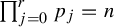 $\prod _{j=0}^{r}p_j=n$
. See Figure 8 for an example with
$\prod _{j=0}^{r}p_j=n$
. See Figure 8 for an example with $p_0=3$
,
$p_0=3$
, $p_1=2$
,
$p_1=2$
, $p_2=3$
.
$p_2=3$
.
An example of a zero entropy 18-periodic pattern $\mathcal {P}_2$
and the corresponding sequence of collapses.
$\mathcal {P}_2$
and the corresponding sequence of collapses.

Remark 6.5. Let $\mathcal {P}$
be a zero entropy n-periodic pattern and let
$\mathcal {P}$
be a zero entropy n-periodic pattern and let $\{\mathcal {P}_i\}_{i=0}^r$
be the corresponding sequence of collapses. Consider any particular time labelling
$\{\mathcal {P}_i\}_{i=0}^r$
be the corresponding sequence of collapses. Consider any particular time labelling $\{0,1,\ldots ,n-1\}$
of the points of
$\{0,1,\ldots ,n-1\}$
of the points of $\mathcal {P}$
. By Remark 3.3, this choice fixes the time labels of all points in all patterns of the sequence of collapses. Note also that, for any
$\mathcal {P}$
. By Remark 3.3, this choice fixes the time labels of all points in all patterns of the sequence of collapses. Note also that, for any $0\le i<r$
, the integers labelling the points of
$0\le i<r$
, the integers labelling the points of $\mathcal {P}_i$
persist as labels of points in
$\mathcal {P}_i$
persist as labels of points in $\mathcal {P}_{i+1}$
. In particular, if
$\mathcal {P}_{i+1}$
. In particular, if $p_0$
is the period of the trivial pattern
$p_0$
is the period of the trivial pattern $\mathcal {P}_0$
, then
$\mathcal {P}_0$
, then $\{0,1,\ldots ,p_0-1\}$
are the only integers in the rank
$\{0,1,\ldots ,p_0-1\}$
are the only integers in the rank $\{0,1,\ldots ,n-1\}$
that persist as labels of points in any pattern of the sequence of collapses. See Figure 8 for an example with
$\{0,1,\ldots ,n-1\}$
that persist as labels of points in any pattern of the sequence of collapses. See Figure 8 for an example with $p_0=3$
.
$p_0=3$
.
7 Branching sequences
In this section, we dive deeper into the very particular combinatorial structure of zero entropy patterns. The obtained results will be used in §8 to prove Theorem D.
Let $\mathcal {P}$
be an n-periodic pattern and let x be a point of
$\mathcal {P}$
be an n-periodic pattern and let x be a point of $\mathcal {P}$
of valence
$\mathcal {P}$
of valence $\nu \ge 1$
. Consider any model
$\nu \ge 1$
. Consider any model $(T,P,f)$
of
$(T,P,f)$
of $\mathcal {P}$
. Then,
$\mathcal {P}$
. Then, $T\setminus \{x\}$
has
$T\setminus \{x\}$
has $\nu $
connected components
$\nu $
connected components $K_1,K_2,\ldots ,K_\nu $
. We want to register how the forward iterates of the point x are distributed among the connected components of
$K_1,K_2,\ldots ,K_\nu $
. We want to register how the forward iterates of the point x are distributed among the connected components of $T\setminus \{x\}$
. To this end, consider the integer time labelling of the points of
$T\setminus \{x\}$
. To this end, consider the integer time labelling of the points of $\mathcal {P}$
such that
$\mathcal {P}$
such that $x=0$
. Now,
$x=0$
. Now,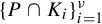 $\{P\cap K_i\}_{i=1}^\nu $
can be viewed as a partition of
$\{P\cap K_i\}_{i=1}^\nu $
can be viewed as a partition of $\{1,2,\ldots ,n-1\}$
. The set
$\{1,2,\ldots ,n-1\}$
. The set $(P\cap K_i)\cup \{0\}$
of points of
$(P\cap K_i)\cup \{0\}$
of points of $\mathcal {P}$
will be called an x-branch. Note that this notion is independent of the chosen model
$\mathcal {P}$
will be called an x-branch. Note that this notion is independent of the chosen model $(T,P,f)$
representing
$(T,P,f)$
representing $\mathcal {P}$
. As an example, consider the 7-periodic pattern
$\mathcal {P}$
. As an example, consider the 7-periodic pattern $\mathcal {P}$
shown in Figure 5. Let x be the point of valence 3 labelled as 5 in that figure. Shift all labels by
$\mathcal {P}$
shown in Figure 5. Let x be the point of valence 3 labelled as 5 in that figure. Shift all labels by $-5$
(mod 7). The discrete components of
$-5$
(mod 7). The discrete components of $\mathcal {P}$
read now as
$\mathcal {P}$
read now as $\{0,3,5\}$
,
$\{0,3,5\}$
, $\{3,6\}$
,
$\{3,6\}$
, $\{0,2\}$
and
$\{0,2\}$
and $\{0,1,4\}$
. The x-branches of
$\{0,1,4\}$
. The x-branches of $\mathcal {P}$
are then
$\mathcal {P}$
are then $\{0,3,5,6\}$
,
$\{0,3,5,6\}$
, $\{0,2\}$
and
$\{0,2\}$
and $\{0,1,4\}$
.
$\{0,1,4\}$
.
Remark 7.1. Let $\mathcal {P}$
be a periodic pattern and let x be any point of
$\mathcal {P}$
be a periodic pattern and let x be any point of $\mathcal {P}$
. Observe that any discrete component of
$\mathcal {P}$
. Observe that any discrete component of $\mathcal {P}$
is contained in a single x-branch. As a direct consequence of this fact, if in addition
$\mathcal {P}$
is contained in a single x-branch. As a direct consequence of this fact, if in addition $\mathcal {P}$
has entropy zero, then any block of the maximal structure of trivial blocks is contained in a single x-branch.
$\mathcal {P}$
has entropy zero, then any block of the maximal structure of trivial blocks is contained in a single x-branch.
To understand the following result, it is crucial to keep in mind Remarks 3.3 and 6.5 concerning the labelling conventions of points and blocks in zero entropy patterns. In particular, the labels of all points in the combinatorial collapse of a pattern $\mathcal {P}$
persist as labels of points in
$\mathcal {P}$
persist as labels of points in $\mathcal {P}$
.
$\mathcal {P}$
.
Lemma 7.2. Let $\mathcal {P}$
be a zero entropy periodic pattern with a maximal separated structure
$\mathcal {P}$
be a zero entropy periodic pattern with a maximal separated structure $P_0\cup P_1\cup \cdots \cup P_{p-1}$
of trivial blocks. Let
$P_0\cup P_1\cup \cdots \cup P_{p-1}$
of trivial blocks. Let $\mathcal {C}$
be the combinatorial collapse of
$\mathcal {C}$
be the combinatorial collapse of $\mathcal {P}$
. If
$\mathcal {P}$
. If $\kern1pt 0\le i,j,k<p$
are three points of
$\kern1pt 0\le i,j,k<p$
are three points of $\mathcal {C}$
such that
$\mathcal {C}$
such that $\{j,k\}$
is contained in a single i-branch of
$\{j,k\}$
is contained in a single i-branch of $\mathcal {C}$
, then
$\mathcal {C}$
, then $P_j\cup P_k$
is contained in a single i-branch of
$P_j\cup P_k$
is contained in a single i-branch of $\mathcal {P}$
.
$\mathcal {P}$
.
Proof. Assume by way of contradiction that $P_j$
and
$P_j$
and $P_k$
are respectively contained in two different i-branches of
$P_k$
are respectively contained in two different i-branches of $\mathcal {P}$
. Then, for some
$\mathcal {P}$
. Then, for some $N\ge 2$
, there exist
$N\ge 2$
, there exist $N+1$
different points of
$N+1$
different points of $\mathcal {P}$
,
$\mathcal {P}$
, $x_0,x_1,\ldots ,x_N$
, such that:
$x_0,x_1,\ldots ,x_N$
, such that:
-
(a)
$x_0=j$
and
$x_N=k$
; -
(b)
$x_n$
is inner for all
$0<n<N$
; -
(c)
$\{x_n,x_{n+1}\}$
is contained in a discrete component of
$\mathcal {P}$
for
$0\le n<N$
; -
(d)
$x_m=i$
for some
$1\le m<N$
.


Intuitively, the above ordered sequence of points accounts for all points of $\mathcal {P}$
successively met in the shortest path going from j to k. The assumption that i separates j from k is imposed by property (d).
$\mathcal {P}$
successively met in the shortest path going from j to k. The assumption that i separates j from k is imposed by property (d).
Consider now, for any point $x_n$
of the above sequence, the collapse of the trivial block of
$x_n$
of the above sequence, the collapse of the trivial block of $\mathcal {P}$
containing
$\mathcal {P}$
containing $x_n$
. It is a point of
$x_n$
. It is a point of $\mathcal {C}$
that we denote by
$\mathcal {C}$
that we denote by $y_n$
. Note that
$y_n$
. Note that $y_0=j$
,
$y_0=j$
, $y_m=i$
and
$y_m=i$
and $y_N=k$
. Observe also that, for a pair of consecutive points
$y_N=k$
. Observe also that, for a pair of consecutive points $x_n,x_{n+1}$
, it may happen that
$x_n,x_{n+1}$
, it may happen that $\{x_n,x_{n+1}\}$
is contained in a block. In this case, since the blocks are trivial,
$\{x_n,x_{n+1}\}$
is contained in a block. In this case, since the blocks are trivial, $\{x_n,x_{n+1},x_{n+2}\}$
is not contained in a block. Therefore,
$\{x_n,x_{n+1},x_{n+2}\}$
is not contained in a block. Therefore, $y_n=y_{n+1}\ne y_{n+2}$
. However, if
$y_n=y_{n+1}\ne y_{n+2}$
. However, if $\{x_n,x_{n+1}\}$
is not contained in a block, by the definition of the combinatorial collapse,
$\{x_n,x_{n+1}\}$
is not contained in a block, by the definition of the combinatorial collapse, $\{y_n,y_{n+1}\}$
is a binary set contained in a discrete component of
$\{y_n,y_{n+1}\}$
is a binary set contained in a discrete component of $\mathcal {C}$
. These observations lead to the existence of a sequence
$\mathcal {C}$
. These observations lead to the existence of a sequence $z_0,z_1,\ldots ,z_{M}$
of
$z_0,z_1,\ldots ,z_{M}$
of $M+1\le N+1$
points of
$M+1\le N+1$
points of $\mathcal {C}$
such that:
$\mathcal {C}$
such that:
-
(a’)
$z_0=j$
and
$z_M=k$
; -
(b’)
$z_n$
is inner for all
$0<n<M$
; -
(c’)
$\{z_n,z_{n+1}\}$
is contained in a discrete component of
$\mathcal {C}$
for
$0\le n<M$
; -
(d’)
$x_{m'}=i$
for some
$1\le m'<M$
.



By property (d’), j and k belong to different i-branches in $\mathcal {C}$
, in contradiction with the hypothesis of the lemma.
$\mathcal {C}$
, in contradiction with the hypothesis of the lemma.
Let $\mathcal {P}$
be a zero entropy periodic pattern and let
$\mathcal {P}$
be a zero entropy periodic pattern and let $\mathcal {C}$
be its combinatorial collapse. Let us call
$\mathcal {C}$
be its combinatorial collapse. Let us call $\{P_i\}$
and
$\{P_i\}$
and $\{Q_i\}$
the blocks of the respective maximal structures of trivial blocks. Let x be a point of
$\{Q_i\}$
the blocks of the respective maximal structures of trivial blocks. Let x be a point of $\mathcal {P}$
and let
$\mathcal {P}$
and let $P_i$
be the block of
$P_i$
be the block of $\mathcal {P}$
containing x. Let us call y the point of
$\mathcal {P}$
containing x. Let us call y the point of $\mathcal {C}$
corresponding to the collapse of
$\mathcal {C}$
corresponding to the collapse of $P_i$
and let
$P_i$
and let $Q_j$
be the block of
$Q_j$
be the block of $\mathcal {C}$
containing y. By Remark 7.1, there exists a unique x-branch Z containing
$\mathcal {C}$
containing y. By Remark 7.1, there exists a unique x-branch Z containing $P_i$
. However, Remark 7.1 yields also that
$P_i$
. However, Remark 7.1 yields also that $Q_j$
is contained in a single y-branch of
$Q_j$
is contained in a single y-branch of $\mathcal {C}$
. Recall now that the labels of the points in
$\mathcal {C}$
. Recall now that the labels of the points in $\mathcal {C}$
persist as labels of points in
$\mathcal {C}$
persist as labels of points in $\mathcal {P}$
. So, we can view
$\mathcal {P}$
. So, we can view $Q_j$
also as a subset of points of
$Q_j$
also as a subset of points of $\mathcal {P}$
. Then, by Lemma 7.2, there exists a unique x-branch
$\mathcal {P}$
. Then, by Lemma 7.2, there exists a unique x-branch $Z'$
containing
$Z'$
containing $Q_j$
. The point x will be called bidirectional if
$Q_j$
. The point x will be called bidirectional if $Z\ne Z'$
.
$Z\ne Z'$
.
Lemma 7.3. Any periodic pattern with entropy zero has bidirectional inner points.
Proof. Let $\mathcal {P}=([T,P],[f])$
be a zero entropy pattern and let
$\mathcal {P}=([T,P],[f])$
be a zero entropy pattern and let $\mathcal {C}$
be the combinatorial collapse of
$\mathcal {C}$
be the combinatorial collapse of $\mathcal {P}$
. Let
$\mathcal {P}$
. Let $P_0\cup P_1\cup \cdots \cup P_{p-1}$
and
$P_0\cup P_1\cup \cdots \cup P_{p-1}$
and $Q_0\cup Q_1\cup \cdots \cup Q_{q-1}$
be the maximal separated block structures of
$Q_0\cup Q_1\cup \cdots \cup Q_{q-1}$
be the maximal separated block structures of $\mathcal {P}$
and
$\mathcal {P}$
and $\mathcal {C}$
, respectively.
$\mathcal {C}$
, respectively.
Let x be any inner point of $\mathcal {P}$
. Assume that x is not bidirectional. To not overload the notation, assume without loss of generality that
$\mathcal {P}$
. Assume that x is not bidirectional. To not overload the notation, assume without loss of generality that $x=0$
. By the standing labelling conventions,
$x=0$
. By the standing labelling conventions, $0\in P_0$
and the collapse of
$0\in P_0$
and the collapse of $P_0$
is the point of
$P_0$
is the point of $\mathcal {C}$
labelled as 0 that belongs to the block
$\mathcal {C}$
labelled as 0 that belongs to the block $Q_0=\{0,q,2q,\ldots ,(p/q-1)q\}$
. Since
$Q_0=\{0,q,2q,\ldots ,(p/q-1)q\}$
. Since $P_0$
is a trivial block,
$P_0$
is a trivial block, $P_0\subset C$
for a discrete component C of
$P_0\subset C$
for a discrete component C of $\mathcal {P}$
. Set
$\mathcal {P}$
. Set
 $$ \begin{align*} X:=\bigcup_{1\le k<p/q} P_{kq}. \end{align*} $$
The set X is the expansion of all points in $Q_0\setminus \{0\}$
to the corresponding blocks in
$Q_0\setminus \{0\}$
to the corresponding blocks in $\mathcal {P}$
. Since we are assuming that 0 is not bidirectional, Remark 7.1 and Lemma 7.2 imply that
$\mathcal {P}$
. Since we are assuming that 0 is not bidirectional, Remark 7.1 and Lemma 7.2 imply that
 $$ \begin{align} P_0\cup X\mbox{ is contained in a single 0-branch } Z \mbox{ of } \mathcal{P}. \end{align} $$
We start by distinguishing two cases.
Case 1. $X\cap C=\emptyset $
. We claim that in this case,
$X\cap C=\emptyset $
. We claim that in this case, $C=P_0$
. Indeed,
$C=P_0$
. Indeed, $Q_0$
is contained in a discrete component of
$Q_0$
is contained in a discrete component of $\mathcal {C}$
. By definition of the combinatorial collapse, all blocks
$\mathcal {C}$
. By definition of the combinatorial collapse, all blocks $P_{iq}$
for
$P_{iq}$
for $0\le i<p/q$
must intersect a single discrete component D of
$0\le i<p/q$
must intersect a single discrete component D of $\mathcal {P}$
. Since
$\mathcal {P}$
. Since $X\cap C=\emptyset $
, by property (7.1), this is only possible if
$X\cap C=\emptyset $
, by property (7.1), this is only possible if $C=P_0$
(as claimed), D is contained in the 0-branch Z and D is adjacent to C. See Figure 9(centre). Let
$C=P_0$
(as claimed), D is contained in the 0-branch Z and D is adjacent to C. See Figure 9(centre). Let $x'$
be the only point in
$x'$
be the only point in $C\cap D=P_0\cap D$
, whose collapse is the point 0 in
$C\cap D=P_0\cap D$
, whose collapse is the point 0 in $\mathcal {C}$
. Then, the
$\mathcal {C}$
. Then, the $x'$
-branch containing
$x'$
-branch containing $P_0$
and the
$P_0$
and the $x'$
-branch containing
$x'$
-branch containing $Q_0$
are different. Therefore,
$Q_0$
are different. Therefore, $x'$
is bidirectional and we are done.
$x'$
is bidirectional and we are done.
The two cases in the proof of Lemma 7.3. The arrows mark the two different $x'$
-branches implying that
$x'$
-branches implying that $x'$
is bidirectional.
$x'$
is bidirectional.

Case 2. $X\cap C\ne \emptyset \mbox { and }X\not \subset C$
. In this case, all blocks
$X\cap C\ne \emptyset \mbox { and }X\not \subset C$
. In this case, all blocks $P_{iq}$
intersect C and at least one block, say
$P_{iq}$
intersect C and at least one block, say $P_{jq}$
, has an inner point
$P_{jq}$
, has an inner point $x'$
in common with C, whose collapse is the point
$x'$
in common with C, whose collapse is the point $jq$
in
$jq$
in $\mathcal {C}$
. See Figure 9(right). Then, the
$\mathcal {C}$
. See Figure 9(right). Then, the $x'$
-branch containing
$x'$
-branch containing $P_{jq}$
and the
$P_{jq}$
and the $x'$
-branch containing
$x'$
-branch containing $Q_0$
are different. Therefore,
$Q_0$
are different. Therefore, $x'$
is bidirectional and we are done.
$x'$
is bidirectional and we are done.
Note that if $\mathcal {P}$
has no bidirectional inner points, then from above, we are not in the hypotheses of cases 1 and 2 and, as a consequence,
$\mathcal {P}$
has no bidirectional inner points, then from above, we are not in the hypotheses of cases 1 and 2 and, as a consequence, $X\subset C$
. Since
$X\subset C$
. Since $P_0\subset C$
, we get that
$P_0\subset C$
, we get that
 $$ \begin{align*} \tilde{P}_0:=P_0\cup X=\bigcup_{0\le k<p/q} P_{kq}\subset D. \end{align*} $$
Set $\tilde {P}_i:=\bigcup _{k=0}^{(p/q)-1} P_{i+kq}$
for
$\tilde {P}_i:=\bigcup _{k=0}^{(p/q)-1} P_{i+kq}$
for $0\le i<q$
. From above, if
$0\le i<q$
. From above, if $\mathcal {P}$
has no bidirectional inner points, then
$\mathcal {P}$
has no bidirectional inner points, then $\tilde {P}_i$
is contained in a single discrete component of
$\tilde {P}_i$
is contained in a single discrete component of $\mathcal {P}$
. Moreover, since
$\mathcal {P}$
. Moreover, since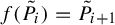 $f(\tilde {P}_i)=\tilde {P}_{i+1}$
, it follows that
$f(\tilde {P}_i)=\tilde {P}_{i+1}$
, it follows that $\tilde {P}_0\cup \tilde {P}_1\cup \cdots \cup \tilde {P}_{q-1}$
is a trivial block structure for
$\tilde {P}_0\cup \tilde {P}_1\cup \cdots \cup \tilde {P}_{q-1}$
is a trivial block structure for $\mathcal {P}$
, in contradiction with the maximality of the structure
$\mathcal {P}$
, in contradiction with the maximality of the structure $P_0\cup P_1\cup \cdots \cup P_{p-1}$
.
$P_0\cup P_1\cup \cdots \cup P_{p-1}$
.
Let x be a point of an n-periodic pattern $\mathcal {P}$
and let
$\mathcal {P}$
and let $\nu \ge 1$
be the valence of x. It is convenient to fix an indexing of the set of x-branches. Next, we define a natural indexing method that will be used by default from now on. Recall that, arithmetically, an x-branch is nothing but a subset of
$\nu \ge 1$
be the valence of x. It is convenient to fix an indexing of the set of x-branches. Next, we define a natural indexing method that will be used by default from now on. Recall that, arithmetically, an x-branch is nothing but a subset of $\{0,1,\ldots ,n-1\}$
. Moreover, each x-branch contains 0 by definition and the intersection of two different x-branches is
$\{0,1,\ldots ,n-1\}$
. Moreover, each x-branch contains 0 by definition and the intersection of two different x-branches is $\{0\}$
. We will index the set of x-branches according to the minimum (positive) time distance from x to a point in the branch. More precisely, for any x-branch Z, let
$\{0\}$
. We will index the set of x-branches according to the minimum (positive) time distance from x to a point in the branch. More precisely, for any x-branch Z, let $d_Z$
be the minimum positive integer in Z. From now on, we will assume that the set
$d_Z$
be the minimum positive integer in Z. From now on, we will assume that the set $\{Z_i\}_{i=1}^\nu $
of x-branches is indexed in such a way that
$\{Z_i\}_{i=1}^\nu $
of x-branches is indexed in such a way that $d_{Z_i}<d_{Z_j}$
if and only if
$d_{Z_i}<d_{Z_j}$
if and only if $i<j$
. As an example, consider the 7-periodic pattern
$i<j$
. As an example, consider the 7-periodic pattern $\mathcal {P}$
shown in Figure 5. Let x be the point of valence 3 labelled as 5 in that figure. The x-branches of
$\mathcal {P}$
shown in Figure 5. Let x be the point of valence 3 labelled as 5 in that figure. The x-branches of $\mathcal {P}$
are then
$\mathcal {P}$
are then $X=\{0,3,5,6\}$
,
$X=\{0,3,5,6\}$
, $Y=\{0,2\}$
and
$Y=\{0,2\}$
and $W=\{0,1,4\}$
, with
$W=\{0,1,4\}$
, with $d_X=3$
,
$d_X=3$
, $d_Y=2$
and
$d_Y=2$
and $d_W=1$
. So, for this example, we would denote the set of x-branches as
$d_W=1$
. So, for this example, we would denote the set of x-branches as $\{Z_1,Z_2,Z_3\}$
, with
$\{Z_1,Z_2,Z_3\}$
, with $Z_1=W$
,
$Z_1=W$
, $Z_2=Y$
and
$Z_2=Y$
and $Z_3=X$
.
$Z_3=X$
.
Let $\mathcal {P}$
be an n-periodic pattern and let x be an inner point of
$\mathcal {P}$
be an n-periodic pattern and let x be an inner point of $\mathcal {P}$
, of valence
$\mathcal {P}$
, of valence $\nu>1$
. There exists a unique n-periodic
$\nu>1$
. There exists a unique n-periodic $\nu $
-flower (a pattern with a unique inner point y and
$\nu $
-flower (a pattern with a unique inner point y and $\nu $
discrete components) whose set of y-branches, which coincides with its set of discrete components (petals) when y is labelled as 0, coincides with the set of x-branches of
$\nu $
discrete components) whose set of y-branches, which coincides with its set of discrete components (petals) when y is labelled as 0, coincides with the set of x-branches of $\mathcal {P}$
. Such a pattern will be denoted by
$\mathcal {P}$
. Such a pattern will be denoted by $\mathcal {F}_{x}(\mathcal {P})$
. Note that
$\mathcal {F}_{x}(\mathcal {P})$
. Note that $\mathcal {F}_{x}(\mathcal {P})$
is in some sense the simplest pattern having the set of x-branches of
$\mathcal {F}_{x}(\mathcal {P})$
is in some sense the simplest pattern having the set of x-branches of $\mathcal {P}$
, and is obtained from
$\mathcal {P}$
, and is obtained from $\mathcal {P}$
by performing iteratively all possible openings that do not consist of joining two discrete components adjacent at x. For an example, consider the 7-periodic pattern
$\mathcal {P}$
by performing iteratively all possible openings that do not consist of joining two discrete components adjacent at x. For an example, consider the 7-periodic pattern $\mathcal {P}$
shown in Figure 5. Let x be the point of valence 3 labelled as 5 in that figure. In this case,
$\mathcal {P}$
shown in Figure 5. Let x be the point of valence 3 labelled as 5 in that figure. In this case, $\mathcal {F}_{x}(\mathcal {P})$
is the 3-flower whose petals are
$\mathcal {F}_{x}(\mathcal {P})$
is the 3-flower whose petals are $\{5,1,3,4\}$
,
$\{5,1,3,4\}$
, $\{5,0\}$
and
$\{5,0\}$
and $\{5,2,6\}$
. After shifting the labels by
$\{5,2,6\}$
. After shifting the labels by $-5$
(mod 7) so that the central point of the flower reads as 0, the petals are written as
$-5$
(mod 7) so that the central point of the flower reads as 0, the petals are written as $\{0,3,5,6\}$
,
$\{0,3,5,6\}$
, $\{0,2\}$
and
$\{0,2\}$
and $\{0,4,1\}$
, which are precisely the x-branches of
$\{0,4,1\}$
, which are precisely the x-branches of $\mathcal {P}$
.
$\mathcal {P}$
.
Remark 7.4. Let $\mathcal {P},\mathcal {Q}$
be n-periodic patterns. For any
$\mathcal {P},\mathcal {Q}$
be n-periodic patterns. For any $x,y\in \{0,1,\ldots ,n-1\}$
, the set of x-branches of
$x,y\in \{0,1,\ldots ,n-1\}$
, the set of x-branches of $\mathcal {P}$
and the set of y-branches of
$\mathcal {P}$
and the set of y-branches of $\mathcal {Q}$
coincide if and only if
$\mathcal {Q}$
coincide if and only if $\mathcal {F}_{x}(\mathcal {P})=\mathcal {F}_{y}(\mathcal {Q})$
.
$\mathcal {F}_{x}(\mathcal {P})=\mathcal {F}_{y}(\mathcal {Q})$
.
The previous remark says that in fact the notation $\mathcal {F}_{x}(\mathcal {P})$
, which denotes a pattern, could have been reserved to denote simply the (arithmetic) set of x-branches of
$\mathcal {F}_{x}(\mathcal {P})$
, which denotes a pattern, could have been reserved to denote simply the (arithmetic) set of x-branches of $\mathcal {P}$
. We have used the construction of the flower just as a trick that hopefully supports the geometric visualization.
$\mathcal {P}$
. We have used the construction of the flower just as a trick that hopefully supports the geometric visualization.
The following result is true for any point of a periodic pattern but, in pursuit of simplicity, is stated without loss of generality for a point labelled as 0.
Lemma 7.5. Let $\mathcal {P}$
be a zero entropy periodic pattern and let
$\mathcal {P}$
be a zero entropy periodic pattern and let $\{\mathcal {P}_i\}_{i=0}^r$
be the associated sequence of collapses. For any
$\{\mathcal {P}_i\}_{i=0}^r$
be the associated sequence of collapses. For any $0\le i\le r$
, let
$0\le i\le r$
, let $P_0^i$
be the block of the maximal structure of
$P_0^i$
be the block of the maximal structure of $\mathcal {P}_i$
containing the point
$\mathcal {P}_i$
containing the point $0\in \mathcal {P}_i$
. Then,
$0\in \mathcal {P}_i$
. Then, $P_0^i$
is contained in a single 0-branch of
$P_0^i$
is contained in a single 0-branch of $\mathcal {P}$
.
$\mathcal {P}$
.
Proof. By Proposition 6.3, $h(\mathcal {P}_i)=0$
. Then, by Remark 7.1,
$h(\mathcal {P}_i)=0$
. Then, by Remark 7.1, $P_0^i$
is contained in a single 0-branch of
$P_0^i$
is contained in a single 0-branch of $\mathcal {P}_i$
. The result follows then immediately by using iteratively Lemma 7.2.
$\mathcal {P}_i$
. The result follows then immediately by using iteratively Lemma 7.2.
A sequence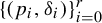 $\{(p_i,\delta _i)\}_{i=0}^r$
of pairs of integers will be called a branching sequence if the following conditions hold:
$\{(p_i,\delta _i)\}_{i=0}^r$
of pairs of integers will be called a branching sequence if the following conditions hold:
-
(bs1)
$p_i\ge 2$
for
$0\le i\le r$
; -
(bs2)
$\delta _1=1$
; -
(bs3) for any
$1\le i\le r$
, if
$\delta _i\notin \{\delta _j\}_{j=0}^{i-1}$
, then
$\delta _i=1+\max \{\delta _j\}_{j=0}^{i-1}$
.


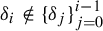

Let $\mathcal {P}$
be a zero entropy n-periodic pattern and let
$\mathcal {P}$
be a zero entropy n-periodic pattern and let $\{\mathcal {P}_i\}_{i=0}^r$
be the associated sequence of collapses. Let x be any point of
$\{\mathcal {P}_i\}_{i=0}^r$
be the associated sequence of collapses. Let x be any point of $\mathcal {P}$
, with valence
$\mathcal {P}$
, with valence $\nu \ge 1$
. Relabel the points of
$\nu \ge 1$
. Relabel the points of $\mathcal {P}$
in such a way that
$\mathcal {P}$
in such a way that $x=0$
. Now, for any pattern
$x=0$
. Now, for any pattern $\mathcal {P}_i$
in the sequence of collapses, Lemma 7.5 tells us that the block of the maximal structure of
$\mathcal {P}_i$
in the sequence of collapses, Lemma 7.5 tells us that the block of the maximal structure of $\mathcal {P}_i$
containing
$\mathcal {P}_i$
containing $0$
is contained in a single 0-branch
$0$
is contained in a single 0-branch $\delta _i$
of
$\delta _i$
of $\mathcal {P}$
. It is easy to check that the sequence
$\mathcal {P}$
. It is easy to check that the sequence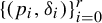 $\{(p_i,\delta _i)\}_{i=0}^r$
, where
$\{(p_i,\delta _i)\}_{i=0}^r$
, where $p_0$
is the period of
$p_0$
is the period of $\mathcal {P}_0$
and
$\mathcal {P}_0$
and $p_i$
is the cardinality of the blocks of the maximal structure in
$p_i$
is the cardinality of the blocks of the maximal structure in $\mathcal {P}_i$
for any
$\mathcal {P}_i$
for any $1\le i\le r$
, satisfies properties (bs1)–(bs3). It will be called the branching sequence of
$1\le i\le r$
, satisfies properties (bs1)–(bs3). It will be called the branching sequence of $\mathcal {P}$
around x. Once the indexing of the x-branches is fixed after the accorded convention, it is uniquely determined by the pattern
$\mathcal {P}$
around x. Once the indexing of the x-branches is fixed after the accorded convention, it is uniquely determined by the pattern $\mathcal {P}$
and the chosen point x of
$\mathcal {P}$
and the chosen point x of $\mathcal {P}$
. See Figure 10 for an example of construction of the branching sequence. For the pattern
$\mathcal {P}$
. See Figure 10 for an example of construction of the branching sequence. For the pattern $\mathcal {P}$
shown in that figure, the 0-branches are
$\mathcal {P}$
shown in that figure, the 0-branches are $Z_1=\{0,1,2,3,5,6,7,8,9,10,11,13,14,15\}$
and
$Z_1=\{0,1,2,3,5,6,7,8,9,10,11,13,14,15\}$
and $Z_2=\{0,4,12\}$
. The maximal trivial blocks have cardinality 2 in each pattern of the sequence of collapses. The blocks containing 0 are
$Z_2=\{0,4,12\}$
. The maximal trivial blocks have cardinality 2 in each pattern of the sequence of collapses. The blocks containing 0 are $\{0,1\}$
in
$\{0,1\}$
in $\mathcal {P}_0$
,
$\mathcal {P}_0$
, $\{0,2\}$
in
$\{0,2\}$
in $\mathcal {P}_1$
,
$\mathcal {P}_1$
, $\{0,4\}$
in
$\{0,4\}$
in $\mathcal {P}_2$
and
$\mathcal {P}_2$
and $\{0,8\}$
in
$\{0,8\}$
in $\mathcal {P}$
. Seen as sets of points of
$\mathcal {P}$
. Seen as sets of points of $\mathcal {P}$
, they are respectively contained in
$\mathcal {P}$
, they are respectively contained in $Z_1$
,
$Z_1$
, $Z_1$
,
$Z_1$
, $Z_2$
and
$Z_2$
and $Z_1$
. Collecting it all, we get that the branching sequence of
$Z_1$
. Collecting it all, we get that the branching sequence of $\mathcal {P}$
around 0 is
$\mathcal {P}$
around 0 is $\{(2,1),(2,1),(2,2),(2,1)\}$
.
$\{(2,1),(2,1),(2,2),(2,1)\}$
.
A pattern $\mathcal {P}$
whose branching sequence around 0 is
$\mathcal {P}$
whose branching sequence around 0 is $\{(2,1),(2,1),(2,2),(2,1)\}$
. The two 0-branches in
$\{(2,1),(2,1),(2,2),(2,1)\}$
. The two 0-branches in $\mathcal {P}$
are denoted with
$\mathcal {P}$
are denoted with $Z_1$
and
$Z_1$
and $Z_2$
with the standard indexing convention.
$Z_2$
with the standard indexing convention.

The following observation follows directly from the definitions.
Remark 7.6. Let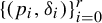 $\{(p_i,\delta _i)\}_{i=0}^r$
be the branching sequence of a zero entropy pattern around an inner point x. Then, x is bidirectional if and only if
$\{(p_i,\delta _i)\}_{i=0}^r$
be the branching sequence of a zero entropy pattern around an inner point x. Then, x is bidirectional if and only if $\delta _{r-1}\ne \delta _r$
.
$\delta _{r-1}\ne \delta _r$
.
Now, we reverse the process and consider an (abstract) branching sequence ${S=\{(p_i,\delta _i)\}_{i=0}^r}$
. Let us see that from such a sequence, we can construct a zero entropy n-periodic
${S=\{(p_i,\delta _i)\}_{i=0}^r}$
. Let us see that from such a sequence, we can construct a zero entropy n-periodic $\nu $
-flower, where
$\nu $
-flower, where $n=p_0p_1\cdots p_r$
and
$n=p_0p_1\cdots p_r$
and $\nu =\max \{\delta _i\}_{i=0}^r$
. Consider a
$\nu =\max \{\delta _i\}_{i=0}^r$
. Consider a $p_0$
-periodic trivial pattern
$p_0$
-periodic trivial pattern $\mathcal {P}_0$
and let us denote its unique discrete component by
$\mathcal {P}_0$
and let us denote its unique discrete component by $C^0_{\delta _1}=C^0_1$
(property (bs2)). Assume now that a zero entropy periodic pattern
$C^0_{\delta _1}=C^0_1$
(property (bs2)). Assume now that a zero entropy periodic pattern $\mathcal {P}_i$
of period
$\mathcal {P}_i$
of period $p_0p_1\cdots p_i$
has been defined, with
$p_0p_1\cdots p_i$
has been defined, with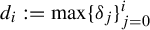 $d_i:=\max \{\delta _j\}_{j=0}^i$
discrete components labelled as
$d_i:=\max \{\delta _j\}_{j=0}^i$
discrete components labelled as $\{C^i_1,C^i_2,\ldots ,C^i_{d_i}\}$
, all adjacent to the point 0. Now, we define a new pattern
$\{C^i_1,C^i_2,\ldots ,C^i_{d_i}\}$
, all adjacent to the point 0. Now, we define a new pattern $\mathcal {P}_{i+1}$
of period
$\mathcal {P}_{i+1}$
of period $p_0p_1\cdots p_{i+1}$
by applying the following procedure. For any point j of
$p_0p_1\cdots p_{i+1}$
by applying the following procedure. For any point j of $\mathcal {P}_i$
, set
$\mathcal {P}_i$
, set $K_j:=\{j+p_i, j+2p_i,\ldots ,j+(p_{i+1}-1)p_i\}$
. Note that, by property (bs3), either
$K_j:=\{j+p_i, j+2p_i,\ldots ,j+(p_{i+1}-1)p_i\}$
. Note that, by property (bs3), either $\delta _{i+1}\le d_i$
, and in this case, we set
$\delta _{i+1}\le d_i$
, and in this case, we set $d_{i+1}:=d_i$
; or
$d_{i+1}:=d_i$
; or $\delta _{i+1}=d_i+1$
, and in this case, we set
$\delta _{i+1}=d_i+1$
, and in this case, we set $d_{i+1}:=d_i+1$
. The pattern
$d_{i+1}:=d_i+1$
. The pattern $\mathcal {P}_{i+1}$
is then defined as a
$\mathcal {P}_{i+1}$
is then defined as a $d_{i+1}$
-flower with inner point 0 and discrete components labelled as
$d_{i+1}$
-flower with inner point 0 and discrete components labelled as $\{C^{i+1}_1,C^{i+1}_2,\ldots ,C^{i+1}_{d_i+1}\}$
, in such a way that
$\{C^{i+1}_1,C^{i+1}_2,\ldots ,C^{i+1}_{d_i+1}\}$
, in such a way that $K_0\subset C^{i+1}_{\delta _{i+1}}$
and for any point
$K_0\subset C^{i+1}_{\delta _{i+1}}$
and for any point $j\ne 0$
of
$j\ne 0$
of $\mathcal {P}_i$
,
$\mathcal {P}_i$
, $K_j\subset C^{i+1}_k$
if and only if
$K_j\subset C^{i+1}_k$
if and only if $j\in C^i_k$
. By iterating r times this procedure, finally, we obtain the prescribed
$j\in C^i_k$
. By iterating r times this procedure, finally, we obtain the prescribed $\nu $
-flower
$\nu $
-flower $\mathcal {P}_r$
, with the inner point conventionally labelled as 0 by construction. Such a flower, algorithmically constructed from the branching sequence S, will be denoted by
$\mathcal {P}_r$
, with the inner point conventionally labelled as 0 by construction. Such a flower, algorithmically constructed from the branching sequence S, will be denoted by $\mathcal {F}(S)$
. To fit the intuition into the description of the algorithm, note that the combinatorial collapse of a zero entropy k-flower is either a
$\mathcal {F}(S)$
. To fit the intuition into the description of the algorithm, note that the combinatorial collapse of a zero entropy k-flower is either a $(k-1)$
-flower when a petal fully coincides with a block of the maximal structure, or a k-flower otherwise.
$(k-1)$
-flower when a petal fully coincides with a block of the maximal structure, or a k-flower otherwise.
Example 7.7. Let $S=\{(2,1),(3,2),(2,2),(2,3)\}$
. In Figure 11, we have shown the sequence of patterns leading to
$S=\{(2,1),(3,2),(2,2),(2,3)\}$
. In Figure 11, we have shown the sequence of patterns leading to $\mathcal {F}(S)$
according to the prescribed algorithm.
$\mathcal {F}(S)$
according to the prescribed algorithm.
The steps of the algorithm to generate the flower $\mathcal {F}(S)$
from the branching sequence
$\mathcal {F}(S)$
from the branching sequence $S=\{(2,1),(3,2),(2,2),(2,3)\}$
.
$S=\{(2,1),(3,2),(2,2),(2,3)\}$
.

A branching sequence $S=\{(p_i,\delta _i)\}_{i=0}^r$
will be called minimal if
$S=\{(p_i,\delta _i)\}_{i=0}^r$
will be called minimal if $\delta _{i+1}\ne \delta _i$
for all
$\delta _{i+1}\ne \delta _i$
for all $0\le i<r$
.
$0\le i<r$
.
Lemma 7.8. Let S and R be minimal branching sequences such that $\mathcal {F}(S)=\mathcal {F}(R)$
. Then,
$\mathcal {F}(S)=\mathcal {F}(R)$
. Then, $S=R$
, that is, S and R have the same length and are identical term by term.
$S=R$
, that is, S and R have the same length and are identical term by term.
Proof. Set $S=\{(p_i,\delta _i)\}_{i=0}^r$
and
$S=\{(p_i,\delta _i)\}_{i=0}^r$
and $R=\{(q_i,\kappa _i)\}_{i=0}^{t}$
. By Remark 7.4, the hypothesis that
$R=\{(q_i,\kappa _i)\}_{i=0}^{t}$
. By Remark 7.4, the hypothesis that $\mathcal {F}(S)$
and
$\mathcal {F}(S)$
and $\mathcal {F}(R)$
are the same pattern can be reworded as follows: if both flowers are labelled in such a way that the respective inner points read as 0, then the respective sets of 0-branches coincide. In particular,
$\mathcal {F}(R)$
are the same pattern can be reworded as follows: if both flowers are labelled in such a way that the respective inner points read as 0, then the respective sets of 0-branches coincide. In particular,
 $$ \begin{align} \prod_{i=0}^r p_i=\prod_{i=0}^t q_i. \end{align} $$
First, we claim that $(p_1,\delta _1)=(q_1,\kappa _1)$
. Indeed, by property (bs2),
$(p_1,\delta _1)=(q_1,\kappa _1)$
. Indeed, by property (bs2), $\delta _1=\kappa _1=1$
. Assume by way of contradiction that
$\delta _1=\kappa _1=1$
. Assume by way of contradiction that $p_1<q_1$
(the argument is symmetric when
$p_1<q_1$
(the argument is symmetric when $q_1<p_1$
). Then, from equation (7.2), it follows that
$q_1<p_1$
). Then, from equation (7.2), it follows that $r\ge 2$
. Moreover, since S is minimal,
$r\ge 2$
. Moreover, since S is minimal, $\delta _2\ne \delta _1$
. Property (bs3) yields then that
$\delta _2\ne \delta _1$
. Property (bs3) yields then that $\delta _2=2$
. So, the algorithm of construction of
$\delta _2=2$
. So, the algorithm of construction of $\mathcal {F}(S)$
and
$\mathcal {F}(S)$
and $\mathcal {F}(R)$
implies that the 0-branch indexed as 1 in
$\mathcal {F}(R)$
implies that the 0-branch indexed as 1 in $\mathcal {F}(S)$
contains the points
$\mathcal {F}(S)$
contains the points $0,1,2,\ldots ,p_1-1$
and the point
$0,1,2,\ldots ,p_1-1$
and the point $p_1$
is contained in the 0-branch indexed as 2, while the 0-branch indexed as 1 in
$p_1$
is contained in the 0-branch indexed as 2, while the 0-branch indexed as 1 in $\mathcal {F}(R)$
contains at least the points
$\mathcal {F}(R)$
contains at least the points $0,1,2,\ldots ,p_1-1,p_1$
. As a consequence,
$0,1,2,\ldots ,p_1-1,p_1$
. As a consequence, $\mathcal {F}(S)$
and
$\mathcal {F}(S)$
and $\mathcal {F}(R)$
are not the same pattern, which is a contradiction that proves the claim.
$\mathcal {F}(R)$
are not the same pattern, which is a contradiction that proves the claim.
Assume now that all terms of S and R are identical up to an index $j\ge 1$
(the previous claim states that this is true when
$j\ge 1$
(the previous claim states that this is true when $j=1$
). In this case, if S has length j, then equation (7.2) implies that R has also length j and we are done. Assume that
$j=1$
). In this case, if S has length j, then equation (7.2) implies that R has also length j and we are done. Assume that $r>j$
(the arguments and conclusions are the same if
$r>j$
(the arguments and conclusions are the same if $t>j$
). Set
$t>j$
). Set $k:=\prod _{i=0}^j p_i=\prod _{i=0}^j q_i$
. From the algorithm of construction of
$k:=\prod _{i=0}^j p_i=\prod _{i=0}^j q_i$
. From the algorithm of construction of $\mathcal {F}(S)$
and
$\mathcal {F}(S)$
and $\mathcal {F}(R)$
, it follows that all points from 0 to
$\mathcal {F}(R)$
, it follows that all points from 0 to $k-1$
are distributed identically inside the 0-branches of both flowers. The same arguments used above show then that
$k-1$
are distributed identically inside the 0-branches of both flowers. The same arguments used above show then that $t>j$
, and that if we assume
$t>j$
, and that if we assume $(p_{j+1},\delta _{j+1})\ne (q_{j+1},\kappa _{j+1})$
, we reach a contradiction since the points
$(p_{j+1},\delta _{j+1})\ne (q_{j+1},\kappa _{j+1})$
, we reach a contradiction since the points $k,k+1,k+2,\ldots ,kp_{j+1}-1$
will be distributed in different 0-branches of
$k,k+1,k+2,\ldots ,kp_{j+1}-1$
will be distributed in different 0-branches of $\mathcal {F}(S)$
and
$\mathcal {F}(S)$
and $\mathcal {F}(R)$
.
$\mathcal {F}(R)$
.
Remark 7.9. If $\mathcal {P}$
is a zero entropy flower, then the branching sequence of
$\mathcal {P}$
is a zero entropy flower, then the branching sequence of $\mathcal {P}$
around its unique inner point is minimal. Indeed, if for an index i we had two consecutive terms
$\mathcal {P}$
around its unique inner point is minimal. Indeed, if for an index i we had two consecutive terms $(p_i,\delta _i)$
,
$(p_i,\delta _i)$
, $(p_{i+1},\delta _{i+1})$
with
$(p_{i+1},\delta _{i+1})$
with $\delta _i=\delta _{i+1}$
, then, in the sequence
$\delta _i=\delta _{i+1}$
, then, in the sequence $\{\mathcal {P}_i\}_{i=0}^r$
of collapses, the trivial blocks for the pattern
$\{\mathcal {P}_i\}_{i=0}^r$
of collapses, the trivial blocks for the pattern $\mathcal {P}_i$
would not be maximal, since there would exist greater trivial blocks of cardinality
$\mathcal {P}_i$
would not be maximal, since there would exist greater trivial blocks of cardinality $p_ip_{i+1}$
. For example, let
$p_ip_{i+1}$
. For example, let $\mathcal {P}$
be the rightmost pattern shown in Figure 11 that is, in fact, the 3-flower constructed from
$\mathcal {P}$
be the rightmost pattern shown in Figure 11 that is, in fact, the 3-flower constructed from $S=\{(2,1),(3,2),(2,2),(2,3)\}$
. The sequence of collapses of
$S=\{(2,1),(3,2),(2,2),(2,3)\}$
. The sequence of collapses of $\mathcal {P}$
is not
$\mathcal {P}$
is not $\{\mathcal {P}_i\}_{i=0}^3$
but
$\{\mathcal {P}_i\}_{i=0}^3$
but $\{\mathcal {P}^{\prime }_i\}_{i=0}^2$
, with
$\{\mathcal {P}^{\prime }_i\}_{i=0}^2$
, with $\mathcal {P}^{\prime }_0=\mathcal {P}_0$
,
$\mathcal {P}^{\prime }_0=\mathcal {P}_0$
, $\mathcal {P}^{\prime }_1=\mathcal {P}_2$
and
$\mathcal {P}^{\prime }_1=\mathcal {P}_2$
and $\mathcal {P}^{\prime }_2=\mathcal {P}_3$
. The branching sequence of
$\mathcal {P}^{\prime }_2=\mathcal {P}_3$
. The branching sequence of $\mathcal {P}$
around 0 is then
$\mathcal {P}$
around 0 is then $S'=\{(2,1),(6,2),(2,3)\}$
, which is minimal.
$S'=\{(2,1),(6,2),(2,3)\}$
, which is minimal.
Let $S=\{(p_i,\delta _i)\}_{i=0}^r$
be a branching sequence. Assume that S is not minimal, that is, for some
$S=\{(p_i,\delta _i)\}_{i=0}^r$
be a branching sequence. Assume that S is not minimal, that is, for some $0\le j<r$
, we have that
$0\le j<r$
, we have that $\delta _{j+1}=\delta _j$
. Then, we can consider a reduced sequence
$\delta _{j+1}=\delta _j$
. Then, we can consider a reduced sequence $S'=\{(p^{\prime }_i,\delta ^{\prime }_i)\}_{i=0}^{r-1}$
defined as
$S'=\{(p^{\prime }_i,\delta ^{\prime }_i)\}_{i=0}^{r-1}$
defined as $(p^{\prime }_i,\delta ^{\prime }_i)=(p_i,\delta _i)$
for
$(p^{\prime }_i,\delta ^{\prime }_i)=(p_i,\delta _i)$
for $0\le i<j$
,
$0\le i<j$
, $(p^{\prime }_j,\delta ^{\prime }_j)=(p_jp_{j+1},\delta _j)$
and
$(p^{\prime }_j,\delta ^{\prime }_j)=(p_jp_{j+1},\delta _j)$
and $(p^{\prime }_i,\delta ^{\prime }_i)=(p_{i+1},\delta _{i+1})$
for
$(p^{\prime }_i,\delta ^{\prime }_i)=(p_{i+1},\delta _{i+1})$
for $j<i\le r-1$
. One can easily check that
$j<i\le r-1$
. One can easily check that $S'$
satisfies properties (bs1)–(bs3) and is thus a branching sequence. The following result states that S and
$S'$
satisfies properties (bs1)–(bs3) and is thus a branching sequence. The following result states that S and $S'$
generate the same flower. It follows immediately from the algorithm of construction of
$S'$
generate the same flower. It follows immediately from the algorithm of construction of $\mathcal {F}(S)$
.
$\mathcal {F}(S)$
.
Lemma 7.10. Let $S,S'$
be branching sequences such that
$S,S'$
be branching sequences such that $S'$
has been reduced from S. Then,
$S'$
has been reduced from S. Then, $\mathcal {F}(S')=\mathcal {F}(S)$
.
$\mathcal {F}(S')=\mathcal {F}(S)$
.
The process of reducing a non-minimal branching sequence $S=\{(p_i,\delta _i)\}_{i=0}^r$
can be iterated as many times as necessary to finally obtain what we call the sequence fully reduced from S, a minimal branching sequence
$S=\{(p_i,\delta _i)\}_{i=0}^r$
can be iterated as many times as necessary to finally obtain what we call the sequence fully reduced from S, a minimal branching sequence $\widehat {S}=\{(\widehat {p}_i,\widehat {\delta }_i)\}_{i=0}^{\widehat {r}}$
satisfying
$\widehat {S}=\{(\widehat {p}_i,\widehat {\delta }_i)\}_{i=0}^{\widehat {r}}$
satisfying $\prod _{i=0}^r p_i=\prod _{i=0}^{\widehat {r}} \widehat {p}_i$
. One can easily check that it is unique and well defined. As a direct corollary of Lemma 7.10, we get the following result.
$\prod _{i=0}^r p_i=\prod _{i=0}^{\widehat {r}} \widehat {p}_i$
. One can easily check that it is unique and well defined. As a direct corollary of Lemma 7.10, we get the following result.
Corollary 7.11. Let S be a branching sequence and let $\widehat {S}$
be the sequence fully reduced from S. Then,
$\widehat {S}$
be the sequence fully reduced from S. Then,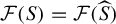 $\mathcal {F}(S)=\mathcal {F}(\widehat {S})$
.
$\mathcal {F}(S)=\mathcal {F}(\widehat {S})$
.
In this section, we have defined two procedures to generate a flower (equivalently, a set of branches). The first one uses openings to get a flower $\mathcal {F}_{x}(\mathcal {P})$
given a pattern
$\mathcal {F}_{x}(\mathcal {P})$
given a pattern $\mathcal {P}$
and a point x of
$\mathcal {P}$
and a point x of $\mathcal {P}$
, while the second one constructs a flower
$\mathcal {P}$
, while the second one constructs a flower $\mathcal {F}(S)$
given an abstract branching sequence S. The next lemma, which follows immediately from the definitions and the labelling conventions of the points and branches, states that if S is precisely the branching sequence of
$\mathcal {F}(S)$
given an abstract branching sequence S. The next lemma, which follows immediately from the definitions and the labelling conventions of the points and branches, states that if S is precisely the branching sequence of $\mathcal {P}$
around x, both flowers are the same as patterns.
$\mathcal {P}$
around x, both flowers are the same as patterns.
Lemma 7.12. Let $\mathcal {P}$
be a zero entropy pattern. Let x be a point of
$\mathcal {P}$
be a zero entropy pattern. Let x be a point of $\mathcal {P}$
and let S be the branching sequence of
$\mathcal {P}$
and let S be the branching sequence of $\mathcal {P}$
around x. Then,
$\mathcal {P}$
around x. Then, $\mathcal {F}(S)=\mathcal {F}_{x}(\mathcal {P})$
.
$\mathcal {F}(S)=\mathcal {F}_{x}(\mathcal {P})$
.
Now, we are ready to use all techniques and results of this section to get the following proposition and the subsequent corollary, which will be crucial in the proof of Theorem D.
Proposition 7.13. Let $\mathcal {P}$
be a zero entropy periodic pattern and let x be a point of
$\mathcal {P}$
be a zero entropy periodic pattern and let x be a point of $\mathcal {P}$
. Let S be the branching sequence of
$\mathcal {P}$
. Let S be the branching sequence of $\mathcal {P}$
around x and let
$\mathcal {P}$
around x and let $\widehat {S}$
be the sequence fully reduced from S. Then, the branching sequence of
$\widehat {S}$
be the sequence fully reduced from S. Then, the branching sequence of $\mathcal {F}_x(\mathcal {P})$
around x is
$\mathcal {F}_x(\mathcal {P})$
around x is $\widehat {S}$
.
$\widehat {S}$
.
Proof. By Lemma 7.12,
 $$ \begin{align} \mathcal{F}(S)=\mathcal{F}_x(\mathcal{P}). \end{align} $$
Let R be the branching sequence of $\mathcal {F}_x(\mathcal {P})$
around x. We want to see that
$\mathcal {F}_x(\mathcal {P})$
around x. We want to see that $R=\widehat {S}$
. Since
$R=\widehat {S}$
. Since $\mathcal {F}_x(\mathcal {F}_x(\mathcal {P}))=\mathcal {F}_x(\mathcal {P})$
, using again Lemma 7.12 yields
$\mathcal {F}_x(\mathcal {F}_x(\mathcal {P}))=\mathcal {F}_x(\mathcal {P})$
, using again Lemma 7.12 yields
 $$ \begin{align} \mathcal{F}(\mathcal{R})=\mathcal{F}_x(\mathcal{P}). \end{align} $$
However, by Corollary 7.11,
 $$ \begin{align} \mathcal{F}(S)=\mathcal{F}(\widehat{S}). \end{align} $$
From equations (7.3), (7.4) and (7.5), we get then that
 $$ \begin{align} \mathcal{F}(R)=\mathcal{R}(\widehat{S}). \end{align} $$
Since $\widehat {S}$
is minimal by definition of a fully reduced sequence and R is minimal by Remark 7.9, then equation (7.6) and Lemma 7.8 imply that
$\widehat {S}$
is minimal by definition of a fully reduced sequence and R is minimal by Remark 7.9, then equation (7.6) and Lemma 7.8 imply that $R=\widehat {S}$
.
$R=\widehat {S}$
.
Corollary 7.14. Let $\mathcal {P}$
and
$\mathcal {P}$
and $\mathcal {Q}$
be two zero entropy n-periodic patterns. Let x and y be inner points of
$\mathcal {Q}$
be two zero entropy n-periodic patterns. Let x and y be inner points of $\mathcal {P}$
and
$\mathcal {P}$
and $\mathcal {Q}$
, respectively. Let
$\mathcal {Q}$
, respectively. Let $\widehat {S}$
and
$\widehat {S}$
and $\widehat {R}$
be the fully reduced sequences of
$\widehat {R}$
be the fully reduced sequences of $\mathcal {P}$
and
$\mathcal {P}$
and $\mathcal {Q}$
around x and y, respectively. If
$\mathcal {Q}$
around x and y, respectively. If $\mathcal {F}_{x}(\mathcal {P})=\mathcal {F}_{y}(\mathcal {Q})$
, then
$\mathcal {F}_{x}(\mathcal {P})=\mathcal {F}_{y}(\mathcal {Q})$
, then $\widehat {S}=\widehat {R}$
, that is, both sequences have the same length and are identical term by term.
$\widehat {S}=\widehat {R}$
, that is, both sequences have the same length and are identical term by term.
8 Proof of Theorem D
Recall that the hypothesis of Theorem D is that we have an n-periodic pattern $\mathcal {P}$
with at least two inner points and at least three openings. Moreover,
$\mathcal {P}$
with at least two inner points and at least three openings. Moreover, $h(\mathcal {P})>0$
and any opening has entropy zero. Under these conditions, we have to prove that
$h(\mathcal {P})>0$
and any opening has entropy zero. Under these conditions, we have to prove that $\mathcal {P}$
is
$\mathcal {P}$
is $\pi $
-reducible for some basic path
$\pi $
-reducible for some basic path $\pi $
. The name
$\pi $
. The name $\mathcal {O}$
that we will use to denote zero entropy patterns in this section stands for opening, in the spirit of Theorem D.
$\mathcal {O}$
that we will use to denote zero entropy patterns in this section stands for opening, in the spirit of Theorem D.
The following is a simple remark about how the set of x-branches, where x is a point of a pattern $\mathcal {P}$
, can change after performing an opening of
$\mathcal {P}$
, can change after performing an opening of $\mathcal {P}$
.
$\mathcal {P}$
.
Remark 8.1. Let x be a point of a pattern $\mathcal {P}$
and let
$\mathcal {P}$
and let $\mathcal {O}$
be an opening of
$\mathcal {O}$
be an opening of $\mathcal {P}$
. If
$\mathcal {P}$
. If $\mathcal {O}$
has been obtained by joining two discrete components not adjacent at x (equivalently, the valence of x in
$\mathcal {O}$
has been obtained by joining two discrete components not adjacent at x (equivalently, the valence of x in $\mathcal {O}$
equals the valence of x in
$\mathcal {O}$
equals the valence of x in $\mathcal {P}$
), then
$\mathcal {P}$
), then $\mathcal {F}_x(\mathcal {O})=\mathcal {F}_x(\mathcal {P})$
. As an example, consider the pattern
$\mathcal {F}_x(\mathcal {O})=\mathcal {F}_x(\mathcal {P})$
. As an example, consider the pattern $\mathcal {P}$
and the opening
$\mathcal {P}$
and the opening $\mathcal {O}$
shown in Figure 5. Take
$\mathcal {O}$
shown in Figure 5. Take $x=1$
. In this case,
$x=1$
. In this case, $\mathcal {F}_x(\mathcal {O})=\mathcal {F}_x(\mathcal {P})$
is a 2-flower whose petals can be labelled as
$\mathcal {F}_x(\mathcal {O})=\mathcal {F}_x(\mathcal {P})$
is a 2-flower whose petals can be labelled as $\{0,3\}$
and
$\{0,3\}$
and $\{0,1,2,4,5,6\}$
. However, if
$\{0,1,2,4,5,6\}$
. However, if $\mathcal {O}$
has been obtained by joining two discrete components adjacent at x (equivalently, the valence of x in
$\mathcal {O}$
has been obtained by joining two discrete components adjacent at x (equivalently, the valence of x in $\mathcal {O}$
is one less than the valence of x in
$\mathcal {O}$
is one less than the valence of x in $\mathcal {P}$
), then
$\mathcal {P}$
), then $\mathcal {F}_x(\mathcal {O})$
is an opening of
$\mathcal {F}_x(\mathcal {O})$
is an opening of $\mathcal {F}_x(\mathcal {P})$
. As an example, take
$\mathcal {F}_x(\mathcal {P})$
. As an example, take $x=5$
in the previous example. Here,
$x=5$
in the previous example. Here, $\mathcal {F}_x(\mathcal {P})$
is a 3-flower whose petals can be labelled as
$\mathcal {F}_x(\mathcal {P})$
is a 3-flower whose petals can be labelled as $\{0,3,5,6\}$
,
$\{0,3,5,6\}$
, $\{0,2\}$
and
$\{0,2\}$
and $\{0,1,4\}$
, while
$\{0,1,4\}$
, while $\mathcal {F}_x(\mathcal {O})$
is a 2-flower whose petals can be labelled as
$\mathcal {F}_x(\mathcal {O})$
is a 2-flower whose petals can be labelled as $\{0,3,5,6\}$
and
$\{0,3,5,6\}$
and $\{0,1,2,4\}$
, that is, an opening of
$\{0,1,2,4\}$
, that is, an opening of $\mathcal {F}_x(\mathcal {P})$
.
$\mathcal {F}_x(\mathcal {P})$
.
Recall that the integer labels of the points of a pattern $\mathcal {P}$
are, by default, preserved when performing an opening of
$\mathcal {P}$
are, by default, preserved when performing an opening of $\mathcal {P}$
. So, in the following statement, we use the same letter x to refer indistinctly to a point of a pattern and to the corresponding point of an opening.
$\mathcal {P}$
. So, in the following statement, we use the same letter x to refer indistinctly to a point of a pattern and to the corresponding point of an opening.
Lemma 8.2. Let $\mathcal {P}$
be an n-periodic pattern with positive entropy such that any opening of
$\mathcal {P}$
be an n-periodic pattern with positive entropy such that any opening of $\mathcal {P}$
has entropy zero. Assume that
$\mathcal {P}$
has entropy zero. Assume that $\mathcal {P}$
has at least two inner points and at least three openings. Then, there exist a point x of
$\mathcal {P}$
has at least two inner points and at least three openings. Then, there exist a point x of $\mathcal {P}$
and two different openings
$\mathcal {P}$
and two different openings $\mathcal {O}$
and
$\mathcal {O}$
and $\mathcal {R}$
of
$\mathcal {R}$
of $\mathcal {P}$
such that:
$\mathcal {P}$
such that:
-
(a) x is a bidirectional inner point in
$\mathcal {O}$
; -
(b) x is an inner point in
$\mathcal {R}$
; -
(c) one of the following statements holds:
-
(c1)
$\mathcal {F}_x(\mathcal {O})=\mathcal {F}_x(\mathcal {R})$
; -
(c2)
$\mathcal {F}_x(\mathcal {O})$
is an opening of
$\mathcal {F}_x(\mathcal {R})$
.
-





Proof. To prove the result, we consider two cases.
Case 1. $\mathcal {P}$
has exactly two inner points. In this case, the hypothesis implies that at least one inner point has valence larger than 2 and that
$\mathcal {P}$
has exactly two inner points. In this case, the hypothesis implies that at least one inner point has valence larger than 2 and that $\mathcal {P}$
has at least four different openings. Let us consider for instance that
$\mathcal {P}$
has at least four different openings. Let us consider for instance that $\mathcal {P}$
has one inner
$\mathcal {P}$
has one inner $\alpha $
with valence 2 and one inner
$\alpha $
with valence 2 and one inner $\beta $
with valence 3. The proof can be trivially extended to any other case. In this situation,
$\beta $
with valence 3. The proof can be trivially extended to any other case. In this situation, $\mathcal {P}$
has four discrete components, which we label by
$\mathcal {P}$
has four discrete components, which we label by $C_0$
,
$C_0$
, $C_1$
,
$C_1$
, $C_2$
and
$C_2$
and $C_3$
. See Figure 12 for a representation of
$C_3$
. See Figure 12 for a representation of $\mathcal {P}$
and the three openings that we will use below.
$\mathcal {P}$
and the three openings that we will use below.
Three possible openings for Case 1 in the proof of Lemma 8.2.

According to the notation in Figure 12 we consider $\mathcal {O}$
to be the opening of
$\mathcal {O}$
to be the opening of $\mathcal {P}$
corresponding to the union
$\mathcal {P}$
corresponding to the union $C_0\cup C_2$
. The pattern
$C_0\cup C_2$
. The pattern $\mathcal {O}$
is a triple chain with two inner points
$\mathcal {O}$
is a triple chain with two inner points $\alpha $
and
$\alpha $
and $\beta $
. Let x be a bidirectional inner point of
$\beta $
. Let x be a bidirectional inner point of $\mathcal {O}$
that exists by Proposition 7.3. Then, statement (a) holds. Consider now a relabelling of the points of
$\mathcal {O}$
that exists by Proposition 7.3. Then, statement (a) holds. Consider now a relabelling of the points of $\mathcal {P}$
(and, as a consequence, of
$\mathcal {P}$
(and, as a consequence, of $\mathcal {O}$
) such that
$\mathcal {O}$
) such that $x=0$
. We have now two possibilities.
$x=0$
. We have now two possibilities.
If $0=\alpha $
, then we take
$0=\alpha $
, then we take $\mathcal {R}$
as the opening
$\mathcal {R}$
as the opening $\mathcal {O}'$
corresponding to the union
$\mathcal {O}'$
corresponding to the union $C_0\cup C_3$
. So, statement (b) is satisfied. Moreover, neither
$C_0\cup C_3$
. So, statement (b) is satisfied. Moreover, neither $\mathcal {O}$
nor
$\mathcal {O}$
nor $\mathcal {R}$
have been formed by joining together discrete components adjacent to 0. It follows that the valence of 0 in
$\mathcal {R}$
have been formed by joining together discrete components adjacent to 0. It follows that the valence of 0 in $\mathcal {P}$
,
$\mathcal {P}$
, $\mathcal {O}$
and
$\mathcal {O}$
and $\mathcal {R}$
is the same and statement (c1) follows from Remark 8.1.
$\mathcal {R}$
is the same and statement (c1) follows from Remark 8.1.
If $0=\beta $
, then we take
$0=\beta $
, then we take $\mathcal {R}$
as the opening
$\mathcal {R}$
as the opening $\mathcal {O}"$
corresponding to the union
$\mathcal {O}"$
corresponding to the union $C_0\cup C_1$
. So, statement (b) is satisfied. Moreover,
$C_0\cup C_1$
. So, statement (b) is satisfied. Moreover, $\mathcal {R}$
has only one inner point,
$\mathcal {R}$
has only one inner point, $\beta =0$
. In this case, the valence of
$\beta =0$
. In this case, the valence of $0$
in
$0$
in $\mathcal {R}$
equals the valence of
$\mathcal {R}$
equals the valence of $0$
in
$0$
in $\mathcal {P}$
and it is one larger than in
$\mathcal {P}$
and it is one larger than in $\mathcal {O}$
. Thus, statement (c2) follows from Remark 8.1.
$\mathcal {O}$
. Thus, statement (c2) follows from Remark 8.1.
Case 2. $\mathcal {P}$
has at least three inner points. Let
$\mathcal {P}$
has at least three inner points. Let $\mathcal {O}$
be an arbitrary opening of
$\mathcal {O}$
be an arbitrary opening of $\mathcal {P}$
. Let x be a bidirectional inner point of
$\mathcal {P}$
. Let x be a bidirectional inner point of $\mathcal {O}$
that exists by Proposition 7.3. Then, statement (a) holds. Consider now a relabelling of the points of
$\mathcal {O}$
that exists by Proposition 7.3. Then, statement (a) holds. Consider now a relabelling of the points of $\mathcal {P}$
(and, as a consequence, of
$\mathcal {P}$
(and, as a consequence, of $\mathcal {O}$
) such that
$\mathcal {O}$
) such that $x=0$
. Let
$x=0$
. Let $\alpha \ne 0$
and
$\alpha \ne 0$
and $\beta \ne 0$
be two different inner points of
$\beta \ne 0$
be two different inner points of $\mathcal {P}$
.
$\mathcal {P}$
.
If $\mathcal {O}$
has been obtained by joining two discrete components adjacent to
$\mathcal {O}$
has been obtained by joining two discrete components adjacent to $\alpha $
, then we choose
$\alpha $
, then we choose $\mathcal {R}$
as any opening obtained by joining two discrete components adjacent to
$\mathcal {R}$
as any opening obtained by joining two discrete components adjacent to $\beta $
. In this case, the valence of
$\beta $
. In this case, the valence of $0$
is the same in the three patterns
$0$
is the same in the three patterns $\mathcal {P}$
,
$\mathcal {P}$
, $\mathcal {O}$
and
$\mathcal {O}$
and $\mathcal {R}$
(see Figure 13). Thus, statement (b) holds and, by Remark 8.1, statement (c1) is also satisfied.
$\mathcal {R}$
(see Figure 13). Thus, statement (b) holds and, by Remark 8.1, statement (c1) is also satisfied.
Illustration of Case 2 (first subcase) in the proof of Lemma 8.2.

Finally, if $\mathcal {O}$
has been formed by joining two discrete components adjacent to
$\mathcal {O}$
has been formed by joining two discrete components adjacent to $0$
, then we choose
$0$
, then we choose $\mathcal {R}$
as an opening obtained by joining two discrete components adjacent to
$\mathcal {R}$
as an opening obtained by joining two discrete components adjacent to $\beta $
. In this case, the valence of
$\beta $
. In this case, the valence of $0$
in
$0$
in $\mathcal {P}$
and
$\mathcal {P}$
and $\mathcal {R}$
is the same and one larger than the valence of
$\mathcal {R}$
is the same and one larger than the valence of $0$
in
$0$
in $\mathcal {O}$
. In particular, the valence of
$\mathcal {O}$
. In particular, the valence of $0$
in
$0$
in $\mathcal {P}$
and
$\mathcal {P}$
and $\mathcal {R}$
is larger than two. Thus, statement (b) holds and, by Remark 8.1, statement (c2) is satisfied (see Figure 14).
$\mathcal {R}$
is larger than two. Thus, statement (b) holds and, by Remark 8.1, statement (c2) is satisfied (see Figure 14).
To prove Theorem D, we will use branching sequences in the two situations (c1) and (c2) given by Lemma 8.2(c). To deal with situation (c2), we need to relate the branching sequences of both a flower $\mathcal {F}$
and an opening
$\mathcal {F}$
and an opening $\mathcal {F}'$
of
$\mathcal {F}'$
of $\mathcal {F}$
.
$\mathcal {F}$
.
Illustration of Case 2 (second subcase) in the proof of Lemma 8.2.

A 16-periodic 4-flower with entropy zero.

Lemma 8.3. Let $\mathcal {F}$
be a zero entropy periodic
$\mathcal {F}$
be a zero entropy periodic $\nu $
-flower and let
$\nu $
-flower and let $R=\{(q_i,\kappa _i)\}_{i=0}^t$
be the branching sequence of
$R=\{(q_i,\kappa _i)\}_{i=0}^t$
be the branching sequence of $\mathcal {F}$
around its unique inner point x. Let
$\mathcal {F}$
around its unique inner point x. Let $\mathcal {F}'$
be an opening of
$\mathcal {F}'$
be an opening of $\mathcal {F}$
obtained by joining two discrete components corresponding to two x-branches labelled as
$\mathcal {F}$
obtained by joining two discrete components corresponding to two x-branches labelled as $j_1,j_2$
, with
$j_1,j_2$
, with $1\le j_1<j_2\le \nu $
. Set
$1\le j_1<j_2\le \nu $
. Set $R':=\{(q_i,\kappa ^{\prime }_i)\}_{i=0}^t$
, with
$R':=\{(q_i,\kappa ^{\prime }_i)\}_{i=0}^t$
, with $\kappa ^{\prime }_i$
defined as
$\kappa ^{\prime }_i$
defined as
 $$ \begin{align*} \kappa^{\prime}_i=\begin{cases} \kappa_i & \mbox{if } \kappa_i<j_2, \\ j_1 & \mbox{if } \kappa_i=j_2, \\ \kappa_i-1 & \mbox{if } \kappa_i>j_2. \end{cases} \end{align*} $$
Then, $R'$
is a branching sequence and the sequence fully reduced from
$R'$
is a branching sequence and the sequence fully reduced from $R'$
is the branching sequence of
$R'$
is the branching sequence of $\mathcal {F}'$
around x.
$\mathcal {F}'$
around x.
Proof. It is easy to check directly from the definition of $R'$
that properties (bs1)–(bs3) satisfied by R are inherited by
$R'$
that properties (bs1)–(bs3) satisfied by R are inherited by $R'$
. Thus,
$R'$
. Thus, $R'$
is a branching sequence. By checking the steps of the algorithm of construction of the flower
$R'$
is a branching sequence. By checking the steps of the algorithm of construction of the flower $\mathcal {F}(R')$
, one easily gets that
$\mathcal {F}(R')$
, one easily gets that $\mathcal {F}(R')=\mathcal {F}'$
.
$\mathcal {F}(R')=\mathcal {F}'$
.
Let $\widehat {R'}$
be the sequence fully reduced from
$\widehat {R'}$
be the sequence fully reduced from $R'$
. By Corollary 7.11,
$R'$
. By Corollary 7.11, $\mathcal {F}'=\mathcal {F}(R')=\mathcal {F}(\widehat {R'})$
. Let B be the branching sequence of
$\mathcal {F}'=\mathcal {F}(R')=\mathcal {F}(\widehat {R'})$
. Let B be the branching sequence of $\mathcal {F}'$
around its unique inner point x. We want to see that
$\mathcal {F}'$
around its unique inner point x. We want to see that $B=\widehat {R'}$
. Since
$B=\widehat {R'}$
. Since $\mathcal {F}_x(\mathcal {F}')=\mathcal {F}'$
, Lemma 7.12 yields
$\mathcal {F}_x(\mathcal {F}')=\mathcal {F}'$
, Lemma 7.12 yields $\mathcal {F}(B)=\mathcal {F}'$
. Therefore,
$\mathcal {F}(B)=\mathcal {F}'$
. Therefore, $\mathcal {F}(B)=\mathcal {F}(\widehat {R'})$
. Since
$\mathcal {F}(B)=\mathcal {F}(\widehat {R'})$
. Since $\widehat {R'}$
is minimal by definition of a fully reduced sequence and B is minimal by Remark 7.9, the previous equality and Lemma 7.8 imply
$\widehat {R'}$
is minimal by definition of a fully reduced sequence and B is minimal by Remark 7.9, the previous equality and Lemma 7.8 imply $B=\widehat {R'}$
.
$B=\widehat {R'}$
.
To illustrate Lemma 8.3, let $\mathcal {F}$
be the 4-flower shown in Figure 15. The discrete components (equivalently, the 0-branches) of
$\mathcal {F}$
be the 4-flower shown in Figure 15. The discrete components (equivalently, the 0-branches) of $\mathcal {F}$
are
$\mathcal {F}$
are $Z_1=\{0,1,3,5,7,9,11,13,15\}$
,
$Z_1=\{0,1,3,5,7,9,11,13,15\}$
, $Z_2=\{0,2,6,10,14\}$
,
$Z_2=\{0,2,6,10,14\}$
, $Z_3=\{0,4,12\}$
,
$Z_3=\{0,4,12\}$
, $Z_4=\{0,8\}$
. One can check that the branching sequence of
$Z_4=\{0,8\}$
. One can check that the branching sequence of $\mathcal {F}$
around 0 is
$\mathcal {F}$
around 0 is $R=\{(2,1),(2,2),(2,3),(2,4)\}$
. Now, let
$R=\{(2,1),(2,2),(2,3),(2,4)\}$
. Now, let $\mathcal {F}'$
be the opening obtained by joining the discrete components
$\mathcal {F}'$
be the opening obtained by joining the discrete components $Z_1$
and
$Z_1$
and $Z_3$
. The 0-branches of
$Z_3$
. The 0-branches of $\mathcal {F}'$
, indexed according to the standing convention, are then
$\mathcal {F}'$
, indexed according to the standing convention, are then $Y_1=Z_1\cup Z_3$
,
$Y_1=Z_1\cup Z_3$
, $Y_2=Z_2$
,
$Y_2=Z_2$
, $Y_3=Z_4$
. The sequence
$Y_3=Z_4$
. The sequence $R'$
defined in the statement of Lemma 8.3 is
$R'$
defined in the statement of Lemma 8.3 is $R'=\{(2,1),(2,2),(2,1),(2,3)\}$
, which is minimal. According to Lemma 8.3, it is the branching sequence of
$R'=\{(2,1),(2,2),(2,1),(2,3)\}$
, which is minimal. According to Lemma 8.3, it is the branching sequence of $\mathcal {F}'$
around 0. As another example, let
$\mathcal {F}'$
around 0. As another example, let $\mathcal {F}'$
be the opening of
$\mathcal {F}'$
be the opening of $\mathcal {F}$
obtained by joining the discrete components
$\mathcal {F}$
obtained by joining the discrete components $Z_2$
and
$Z_2$
and $Z_3$
. In this case, the 0-branches of
$Z_3$
. In this case, the 0-branches of $\mathcal {F}'$
are
$\mathcal {F}'$
are $Y_1=Z_1$
,
$Y_1=Z_1$
, $Y_2=Z_2\cup Z_3$
and
$Y_2=Z_2\cup Z_3$
and $Y_3=Z_4$
. The sequence
$Y_3=Z_4$
. The sequence $R'$
defined in the statement of Lemma 8.3 reads as
$R'$
defined in the statement of Lemma 8.3 reads as ${R'=\{(2,1),(2,2),(2,2),(2,3)\}}$
and its fully reduced sequence
${R'=\{(2,1),(2,2),(2,2),(2,3)\}}$
and its fully reduced sequence $\{(2,1),(4,2),(2,3)\}$
is the branching sequence of
$\{(2,1),(4,2),(2,3)\}$
is the branching sequence of $\mathcal {F}'$
around 0.
$\mathcal {F}'$
around 0.
Now, we are in a position to prove Theorem D.
Proof of Theorem D
Let $\mathcal {O}$
and
$\mathcal {O}$
and $\mathcal {R}$
be the two openings of
$\mathcal {R}$
be the two openings of $\mathcal {P}$
given by Lemma 8.2, let
$\mathcal {P}$
given by Lemma 8.2, let ${S=\{(p_i,\delta _i)\}_{i=0}^r}$
and
${S=\{(p_i,\delta _i)\}_{i=0}^r}$
and $R=\{(q_i,\kappa _i)\}_{i=0}^t$
be the corresponding branching sequences around x, and let
$R=\{(q_i,\kappa _i)\}_{i=0}^t$
be the corresponding branching sequences around x, and let $\widehat {S}=\{(\widehat {p}_i,\widehat {\delta }_i)\}_{i=0}^{\widehat {r}}$
and
$\widehat {S}=\{(\widehat {p}_i,\widehat {\delta }_i)\}_{i=0}^{\widehat {r}}$
and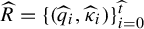 $\widehat {R}=\{(\widehat {q}_i,\widehat {\kappa }_i)\}_{i=0}^{\widehat {t}}$
be the sequences fully reduced respectively from S and R. From the definition of a reduced sequence,
$\widehat {R}=\{(\widehat {q}_i,\widehat {\kappa }_i)\}_{i=0}^{\widehat {t}}$
be the sequences fully reduced respectively from S and R. From the definition of a reduced sequence,
 $$ \begin{align} \widehat{q}_{\widehat{t}}=q_{t-j}q_{t-j+1}\cdots q_{t-1}q_{t}\quad\mbox{for some }j\ge0. \end{align} $$
However, since x is bidirectional in $\mathcal {O}$
, then, by Remark 7.6,
$\mathcal {O}$
, then, by Remark 7.6, $\delta _{r-1}\neq \delta _r$
. Therefore, using again the definition of a reduced sequence, we get
$\delta _{r-1}\neq \delta _r$
. Therefore, using again the definition of a reduced sequence, we get
 $$ \begin{align} (\widehat{p}_{\widehat{r}},\widehat{\delta}_{\widehat{r}})=(p_r,\delta_r). \end{align} $$
We claim that $q_t$
divides
$q_t$
divides $p_r$
. To prove this claim, we will consider the two cases produced by Lemma 8.2(c).
$p_r$
. To prove this claim, we will consider the two cases produced by Lemma 8.2(c).
Assume first that Lemma 8.2(c1) holds. Then, by Corollary 7.14, $\widehat {S}$
and
$\widehat {S}$
and $\widehat {R}$
are identical term by term. In particular,
$\widehat {R}$
are identical term by term. In particular, $\widehat {q}_{\widehat {t}}=\widehat {p}_{\widehat {r}}$
, which is equal to
$\widehat {q}_{\widehat {t}}=\widehat {p}_{\widehat {r}}$
, which is equal to $p_r$
by equation (8.2). Thus, equation (8.1) implies that
$p_r$
by equation (8.2). Thus, equation (8.1) implies that $q_t$
divides
$q_t$
divides $p_r$
, as claimed.
$p_r$
, as claimed.
Assume now that Lemma 8.2(c2) holds. From Proposition 7.13, we have that $\widehat {S}$
is the branching sequence of the flower
$\widehat {S}$
is the branching sequence of the flower $\mathcal {F}':=\mathcal {F}_x(\mathcal {O})$
and
$\mathcal {F}':=\mathcal {F}_x(\mathcal {O})$
and $\widehat {R}$
is the branching sequence of the flower
$\widehat {R}$
is the branching sequence of the flower $\mathcal {F}:=\mathcal {F}_x(\mathcal {R})$
. Since
$\mathcal {F}:=\mathcal {F}_x(\mathcal {R})$
. Since $\mathcal {F}'$
is an opening of
$\mathcal {F}'$
is an opening of $\mathcal {F}$
, Lemma 8.3 tells us that
$\mathcal {F}$
, Lemma 8.3 tells us that $\widehat {S}=\{(\widehat {p}_i,\widehat {\delta }_i)\}_{i=0}^{\widehat {r}}$
has been obtained from
$\widehat {S}=\{(\widehat {p}_i,\widehat {\delta }_i)\}_{i=0}^{\widehat {r}}$
has been obtained from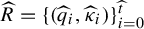 $\widehat {R}=\{(\widehat {q}_i,\widehat {\kappa }_i)\}_{i=0}^{\widehat {t}}$
in two steps. First, we consider a sequence
$\widehat {R}=\{(\widehat {q}_i,\widehat {\kappa }_i)\}_{i=0}^{\widehat {t}}$
in two steps. First, we consider a sequence $\widehat {R}'=\{(\widehat {q}_i,\widehat {\kappa }^{\prime }_i)\}_{i=0}^{\widehat {t}}$
and then fully reduce it to obtain
$\widehat {R}'=\{(\widehat {q}_i,\widehat {\kappa }^{\prime }_i)\}_{i=0}^{\widehat {t}}$
and then fully reduce it to obtain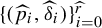 $\{(\widehat {p}_i,\widehat {\delta }_i)\}_{i=0}^{\widehat {r}}$
. Again, the definition of a reduction implies that
$\{(\widehat {p}_i,\widehat {\delta }_i)\}_{i=0}^{\widehat {r}}$
. Again, the definition of a reduction implies that
 $$ \begin{align*} \widehat{p}_{\widehat{r}}=\widehat{q}_{\widehat{t}-\ell}\widehat{q}_{\widehat{t}-\ell+1}\cdots\widehat{q}_{\widehat{t}-1}\widehat{q}_{\widehat{t}}\quad\mbox{for some }\ell\ge0. \end{align*} $$
The previous equality and equation (8.1) imply that $q_t$
divides
$q_t$
divides $p_r$
also in this case. As a consequence, the claim is proved.
$p_r$
also in this case. As a consequence, the claim is proved.
To end up, we claim that the divisibility of $p_r$
by
$p_r$
by $q_t$
implies the
$q_t$
implies the $\pi $
-reducibility of
$\pi $
-reducibility of $\mathcal {P}$
. We recall that
$\mathcal {P}$
. We recall that $p_r$
and
$p_r$
and $q_t$
are the cardinalities of the trivial blocks in the respective maximal structures of
$q_t$
are the cardinalities of the trivial blocks in the respective maximal structures of $\mathcal {O}$
and
$\mathcal {O}$
and $\mathcal {R}$
given by Proposition 6.3. Relabel if necessary the points of
$\mathcal {R}$
given by Proposition 6.3. Relabel if necessary the points of $\mathcal {P}$
in such a way that
$\mathcal {P}$
in such a way that $x=0$
. The inner point
$x=0$
. The inner point $0$
belongs to the block of
$0$
belongs to the block of $\mathcal {O}$
,
$\mathcal {O}$
,
 $$ \begin{align*} O_0=\bigg\{0,\frac{n}{p_r},\frac{2n}{p_r},\ldots,\frac{(p_r-1)n}{p_r}\bigg\}. \end{align*} $$
By Proposition 3.7, $\mathcal {O}$
is
$\mathcal {O}$
is $\pi $
-reducible for any basic path
$\pi $
-reducible for any basic path $\pi $
contained in
$\pi $
contained in $O_0$
. However, the inner point
$O_0$
. However, the inner point $0$
belongs to the block of
$0$
belongs to the block of $\mathcal {R}$
,
$\mathcal {R}$
,
 $$ \begin{align*} R_0=\bigg\{0,\frac{n}{q_t},\frac{2n}{q_t},\ldots,\frac{(q_t-1)n}{q_t}\bigg\}. \end{align*} $$
Again, $\mathcal {R}$
is
$\mathcal {R}$
is $\pi $
-reducible for any basic path
$\pi $
-reducible for any basic path $\pi $
contained in
$\pi $
contained in $R_0$
. Since
$R_0$
. Since $q_t$
divides
$q_t$
divides $p_r$
, the point
$p_r$
, the point ${n}/{q_t}$
belongs to
${n}/{q_t}$
belongs to $O_0\cap R_0$
. Take
$O_0\cap R_0$
. Take $\pi :=\{0,{n}/{q_t}\}$
. Note that
$\pi :=\{0,{n}/{q_t}\}$
. Note that $\pi $
is a basic path in
$\pi $
is a basic path in $\mathcal {P}$
,
$\mathcal {P}$
, $\mathcal {Q}$
and
$\mathcal {Q}$
and $\mathcal {R}$
. Moreover,
$\mathcal {R}$
. Moreover, $\pi $
never splits in both
$\pi $
never splits in both $\mathcal {O}$
and
$\mathcal {O}$
and $\mathcal {R}$
. Since all inner points of
$\mathcal {R}$
. Since all inner points of $\mathcal {P}$
are inner points either in
$\mathcal {P}$
are inner points either in $\mathcal {O}$
or in
$\mathcal {O}$
or in $\mathcal {R}$
, it follows that
$\mathcal {R}$
, it follows that $\pi $
never splits in
$\pi $
never splits in $\mathcal {P}$
.
$\mathcal {P}$
.
9 k-flowers
Following the sketch of the proof of Theorem A outlined in §5, we have to deal now with the special case of patterns with only one inner point and $k\ge 2$
discrete components. When
$k\ge 2$
discrete components. When $k=2$
, the following result ([Reference Alsedà, Juher and Mañosas8, Theorem 5.2]) does the job.
$k=2$
, the following result ([Reference Alsedà, Juher and Mañosas8, Theorem 5.2]) does the job.
Theorem 9.1. Let $\mathcal {P}$
be an n-periodic pattern with two discrete components. If
$\mathcal {P}$
be an n-periodic pattern with two discrete components. If $h(\mathcal {P})>0$
, then
$h(\mathcal {P})>0$
, then $h(\mathcal {P})\ge \log (\unicode{x3bb} _n)$
.
$h(\mathcal {P})\ge \log (\unicode{x3bb} _n)$
.
For $k\ge 3$
, and in the spirit of the proof by induction outlined in §5, we need to relate our pattern of period n with another pattern with period less than n and positive entropy. So, let
$k\ge 3$
, and in the spirit of the proof by induction outlined in §5, we need to relate our pattern of period n with another pattern with period less than n and positive entropy. So, let $\mathcal {P}=([T,P],[f])$
be an n-periodic pattern. A pattern
$\mathcal {P}=([T,P],[f])$
be an n-periodic pattern. A pattern $\mathcal {P}'$
will be said to be subordinated to
$\mathcal {P}'$
will be said to be subordinated to $\mathcal {P}$
if for some divisor
$\mathcal {P}$
if for some divisor $n>p>1$
of n, there is an
$n>p>1$
of n, there is an $(n/p)$
-periodic orbit
$(n/p)$
-periodic orbit $P'\subset P$
of
$P'\subset P$
of $f^p$
such that
$f^p$
such that  . Clearly, this definition is independent of the particular model $(T,P,f)$
representing
$(T,P,f)$
representing $\mathcal {P}$
.
$\mathcal {P}$
.
The following result is [Reference Alsedà, Juher and Mañosas7, Lemma 9.1]. It allows us to estimate the entropy of a pattern from the entropy of a subordinate.
Lemma 9.2. Let $\mathcal {P}$
be an n-periodic pattern. Let
$\mathcal {P}$
be an n-periodic pattern. Let $\mathcal {P}'$
be an
$\mathcal {P}'$
be an $n'$
-periodic pattern subordinated to
$n'$
-periodic pattern subordinated to $\mathcal {P}$
. If
$\mathcal {P}$
. If $h(\mathcal {P}')\ge \log (\unicode{x3bb} _{n'})$
, then
$h(\mathcal {P}')\ge \log (\unicode{x3bb} _{n'})$
, then $h(\mathcal {P})>\log (\unicode{x3bb} _n)$
.
$h(\mathcal {P})>\log (\unicode{x3bb} _n)$
.
A discrete component of a pattern will be said to be extremal if it contains only one inner point. As an example, the discrete components A, B and D are extremal for the pattern $\mathcal {P}$
shown in Figure 5.
$\mathcal {P}$
shown in Figure 5.
Let $(T,P,f)$
be a model of a periodic pattern
$(T,P,f)$
be a model of a periodic pattern $\mathcal {P}$
. Let C be a discrete component of
$\mathcal {P}$
. Let C be a discrete component of $(T,P)$
. We will say that a point
$(T,P)$
. We will say that a point $x\in C$
escapes from C if
$x\in C$
escapes from C if $f(x)$
does not belong to the connected component of
$f(x)$
does not belong to the connected component of $T\setminus \{x\}$
that intersects
$T\setminus \{x\}$
that intersects  . Any discrete component C of $(T,P)$
without points escaping from it will be called a scrambled component of
$(T,P)$
without points escaping from it will be called a scrambled component of $\mathcal {P}$
. Clearly, this notion does not depend on the particular chosen model of
$\mathcal {P}$
. Clearly, this notion does not depend on the particular chosen model of $\mathcal {P}$
. So, it makes sense to say that the pattern
$\mathcal {P}$
. So, it makes sense to say that the pattern $\mathcal {P}$
has a scrambled component. As an example, the point 7 escapes from
$\mathcal {P}$
has a scrambled component. As an example, the point 7 escapes from $\{1,7,13\}$
in the 18-periodic pattern
$\{1,7,13\}$
in the 18-periodic pattern $\mathcal {P}_2$
shown in Figure 8, while it does not escape from
$\mathcal {P}_2$
shown in Figure 8, while it does not escape from $C:=\{0,3,5,7,9,11,15,17\}$
. In fact, no point in C escapes from C. So, C is a scrambled component for
$C:=\{0,3,5,7,9,11,15,17\}$
. In fact, no point in C escapes from C. So, C is a scrambled component for $\mathcal {P}_2$
. It is easy to see that every periodic pattern has scrambled components (as in [Reference Alsedà, Juher and Mañosas7, Lemma 4.2]).
$\mathcal {P}_2$
. It is easy to see that every periodic pattern has scrambled components (as in [Reference Alsedà, Juher and Mañosas7, Lemma 4.2]).
Theorem 9.3. Let $\mathcal {P}$
be an n-periodic pattern with positive entropy and at least three discrete components. Assume that any opening of
$\mathcal {P}$
be an n-periodic pattern with positive entropy and at least three discrete components. Assume that any opening of $\mathcal {P}$
has entropy zero. If
$\mathcal {P}$
has entropy zero. If $\mathcal {P}$
has an extremal scrambled component, then
$\mathcal {P}$
has an extremal scrambled component, then $\mathcal {P}$
has subordinated patterns with positive entropy.
$\mathcal {P}$
has subordinated patterns with positive entropy.
Proof. Let $(T,P,f)$
be a model of
$(T,P,f)$
be a model of $\mathcal {P}$
and let C be the extremal scrambled component of
$\mathcal {P}$
and let C be the extremal scrambled component of $\mathcal {P}$
. Then, there is only one inner point x in C, and
$\mathcal {P}$
. Then, there is only one inner point x in C, and $f(x)\in C$
by definition of a scrambled component. Consider a sequence of openings that joins together all discrete components different from C into a single discrete component D, leading to a pattern
$f(x)\in C$
by definition of a scrambled component. Consider a sequence of openings that joins together all discrete components different from C into a single discrete component D, leading to a pattern $\mathcal {P}'$
with two discrete components, C and D. Since
$\mathcal {P}'$
with two discrete components, C and D. Since $h(\mathcal {P'})=0$
by hypothesis,
$h(\mathcal {P'})=0$
by hypothesis, $\mathcal {P'}$
has a division [Reference Alsedà, Juher and Mañosas7] with respect to C. As a consequence, there exists
$\mathcal {P'}$
has a division [Reference Alsedà, Juher and Mañosas7] with respect to C. As a consequence, there exists $p\ge 2$
, a divisor of n, such that
$p\ge 2$
, a divisor of n, such that $f^i(D)\subset C$
for
$f^i(D)\subset C$
for $1\le i<p$
and
$1\le i<p$
and $f^p(D)=D$
. In other words,
$f^p(D)=D$
. In other words, $\bigcup _{i=0}^{p-1} P_i$
is a p-block structure for
$\bigcup _{i=0}^{p-1} P_i$
is a p-block structure for $\mathcal {P}$
, where
$\mathcal {P}$
, where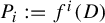 $P_i:=f^i(D)$
. Note that the blocks
$P_i:=f^i(D)$
. Note that the blocks $P_1,P_2,\ldots P_{p-1}$
are contained in C and are, thus, trivial. Consider the pattern
$P_1,P_2,\ldots P_{p-1}$
are contained in C and are, thus, trivial. Consider the pattern  . Then, $\mathcal {Q}$
is subordinated to
$\mathcal {Q}$
is subordinated to $\mathcal {P}$
. Moreover, its entropy is positive, for otherwise, the fact that all blocks but one are trivial would easily imply that
$\mathcal {P}$
. Moreover, its entropy is positive, for otherwise, the fact that all blocks but one are trivial would easily imply that $h(\mathcal {P})=0$
.
$h(\mathcal {P})=0$
.
When a pattern has only one inner point x, the discrete component containing the image of x is clearly scrambled and extremal. So, we have the next result as an immediate consequence of Theorem 9.3.
Corollary 9.4. Let $\mathcal {P}$
be a positive entropy k-flower, with
$\mathcal {P}$
be a positive entropy k-flower, with $k\ge 3$
. Assume that any opening of
$k\ge 3$
. Assume that any opening of $\mathcal {P}$
has entropy zero. Then,
$\mathcal {P}$
has entropy zero. Then, $\mathcal {P}$
has subordinated patterns with positive entropy.
$\mathcal {P}$
has subordinated patterns with positive entropy.
10 Triple chains
The final stage in the proof of Theorem A outlined in §5 leaves us with the special case of a pattern with exactly two inner points and three discrete components, a triple chain. To find lower bounds for the entropy of a triple chain $\mathcal {P}$
, it is unavoidable to count coverings in the
$\mathcal {P}$
, it is unavoidable to count coverings in the $\mathcal {P}$
-path graph (equivalently, entries in the path transition matrix). This section is devoted to this task. In our context, it is assumed that
$\mathcal {P}$
-path graph (equivalently, entries in the path transition matrix). This section is devoted to this task. In our context, it is assumed that $\mathcal {P}$
is
$\mathcal {P}$
is $\pi $
-irreducible and any of the two possible openings of
$\pi $
-irreducible and any of the two possible openings of $\mathcal {P}$
has entropy zero (property (⋆)). Note that any opening of a triple chain has two discrete components. So, to obtain a lower bound of the entropy of
$\mathcal {P}$
has entropy zero (property (⋆)). Note that any opening of a triple chain has two discrete components. So, to obtain a lower bound of the entropy of $\mathcal {P}$
, we will proceed in two steps. First, we will study the coverings in the path graph of zero entropy patterns with two discrete components. This is the aim of Lemmas 10.3 and 10.6. Finally, we will study how the previous coverings, present in the two possible openings of the triple chain
$\mathcal {P}$
, we will proceed in two steps. First, we will study the coverings in the path graph of zero entropy patterns with two discrete components. This is the aim of Lemmas 10.3 and 10.6. Finally, we will study how the previous coverings, present in the two possible openings of the triple chain $\mathcal {P}$
, imply the existence of a number of coverings in the
$\mathcal {P}$
, imply the existence of a number of coverings in the $\mathcal {P}$
-path graph (Lemma 10.8) that forces enough entropy for our purposes.
$\mathcal {P}$
-path graph (Lemma 10.8) that forces enough entropy for our purposes.
The results mentioned in the previous scheme are extremely technical. Readers are cautioned to follow the arguments using examples, as those shown in the figures.
A basic path $\pi $
for a pattern with a separated structure of trivial blocks will be said to be in-block if it is contained in a block. Otherwise, it will be said to be inter-block. As an example,
$\pi $
for a pattern with a separated structure of trivial blocks will be said to be in-block if it is contained in a block. Otherwise, it will be said to be inter-block. As an example, $\{1,13\}$
is an in-block basic path of
$\{1,13\}$
is an in-block basic path of $\mathcal {P}_2$
in Figure 8, while
$\mathcal {P}_2$
in Figure 8, while $\{0,15\}$
is inter-block. The second statement of Proposition 3.7 says that an in-block path never splits (as defined following the proof of Corollary 3.6). However, the next result states that inter-block basic paths do always split.
$\{0,15\}$
is inter-block. The second statement of Proposition 3.7 says that an in-block path never splits (as defined following the proof of Corollary 3.6). However, the next result states that inter-block basic paths do always split.
Lemma 10.1. Let $\mathcal {P}$
an n-periodic pattern with a separated structure of trivial blocks. Then, any inter-block basic path of
$\mathcal {P}$
an n-periodic pattern with a separated structure of trivial blocks. Then, any inter-block basic path of $\mathcal {P}$
splits before n iterates.
$\mathcal {P}$
splits before n iterates.
Proof. The proof strongly relies on the construction of the maximal separated structure of trivial blocks in [Reference Alsedà, Juher and Mañosas7, Proposition 9.5] and its uniqueness (see §3). The construction shows that if $\mathcal {P}$
is
$\mathcal {P}$
is $\sigma $
-reducible for a basic path
$\sigma $
-reducible for a basic path $\sigma $
, then each trivial block is obtained as the set of endpoints of a connected component of
$\sigma $
, then each trivial block is obtained as the set of endpoints of a connected component of 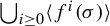 . In particular, $\sigma $
is contained in one block and is thus an in-block basic path. The uniqueness of the maximal structure of trivial blocks implies that the same is true for any basic path
$\sigma $
is contained in one block and is thus an in-block basic path. The uniqueness of the maximal structure of trivial blocks implies that the same is true for any basic path $\sigma '\ne \sigma $
such that
$\sigma '\ne \sigma $
such that $\mathcal {P}$
is
$\mathcal {P}$
is $\sigma '$
-reducible. Now, we note that if
$\sigma '$
-reducible. Now, we note that if $\pi $
does not split in n iterates, then
$\pi $
does not split in n iterates, then $\mathcal {P}$
is
$\mathcal {P}$
is $\pi $
-reducible. Then, by the previous discussion,
$\pi $
-reducible. Then, by the previous discussion, $\pi $
has to be in-block, which is a contradiction.
$\pi $
has to be in-block, which is a contradiction.
Let $\mathcal {P}$
be a non-trivial n-periodic pattern with entropy zero. By Proposition 6.3,
$\mathcal {P}$
be a non-trivial n-periodic pattern with entropy zero. By Proposition 6.3, $\mathcal {P}$
has a maximal structure of trivial blocks and the corresponding combinatorial collapse
$\mathcal {P}$
has a maximal structure of trivial blocks and the corresponding combinatorial collapse $\mathcal {C}$
has entropy zero. Let x be a point of
$\mathcal {C}$
has entropy zero. Let x be a point of $\mathcal {P}$
. The point of
$\mathcal {P}$
. The point of $\mathcal {C}$
corresponding to the collapse of the block containing x will be denoted by
$\mathcal {C}$
corresponding to the collapse of the block containing x will be denoted by $\overline {x}$
, and this will be a standing notation throughout this section. In fact, if x is contained in the block
$\overline {x}$
, and this will be a standing notation throughout this section. In fact, if x is contained in the block $P_i$
, then
$P_i$
, then $\overline {x}$
is precisely the point of
$\overline {x}$
is precisely the point of $\mathcal {C}$
labelled as i. Let
$\mathcal {C}$
labelled as i. Let $\pi =\{x,y\}$
be an inter-block basic path of
$\pi =\{x,y\}$
be an inter-block basic path of $\mathcal {P}$
. Then,
$\mathcal {P}$
. Then, $\overline {x}\ne \overline {y}$
. The binary set
$\overline {x}\ne \overline {y}$
. The binary set $\{\overline {x},\overline {y}\}$
will be denoted by
$\{\overline {x},\overline {y}\}$
will be denoted by $\overline {\pi }$
. Note that, by property (b) of Definition 6.2,
$\overline {\pi }$
. Note that, by property (b) of Definition 6.2, $\overline {\pi }$
is a basic path in
$\overline {\pi }$
is a basic path in $\mathcal {C}$
. As an example, consider the pattern
$\mathcal {C}$
. As an example, consider the pattern $\mathcal {P}_2$
shown in Figure 8. The basic paths
$\mathcal {P}_2$
shown in Figure 8. The basic paths $\pi _1=\{11,8\}$
and
$\pi _1=\{11,8\}$
and $\pi _2=\{0,7\}$
are inter-block. In this case,
$\pi _2=\{0,7\}$
are inter-block. In this case, $\overline {\pi }_1=\{5,2\}$
and
$\overline {\pi }_1=\{5,2\}$
and $\overline {\pi }_2=\{0,1\}$
are (respectively, in-block and inter-block) basic paths of the combinatorial collapse
$\overline {\pi }_2=\{0,1\}$
are (respectively, in-block and inter-block) basic paths of the combinatorial collapse $\mathcal {P}_1$
.
$\mathcal {P}_1$
.
The notation $\mathcal {O}$
for patterns of entropy zero used in the statements of this section suggests, as in §8, the term opening.
$\mathcal {O}$
for patterns of entropy zero used in the statements of this section suggests, as in §8, the term opening.
Lemma 10.2. Let $\mathcal {O}$
be a zero entropy periodic pattern and let
$\mathcal {O}$
be a zero entropy periodic pattern and let $\mathcal {C}$
be the combinatorial collapse of
$\mathcal {C}$
be the combinatorial collapse of $\mathcal {O}$
. Let
$\mathcal {O}$
. Let $\pi $
be an inter-block basic path of
$\pi $
be an inter-block basic path of $\mathcal {O}$
. If
$\mathcal {O}$
. If $\overline {\pi }$
splits in
$\overline {\pi }$
splits in $\ell $
iterates on
$\ell $
iterates on $\mathcal {C}$
, then
$\mathcal {C}$
, then $\pi $
splits in at most
$\pi $
splits in at most $\ell $
iterates on
$\ell $
iterates on $\mathcal {O}$
.
$\mathcal {O}$
.
Proof. Consider any model $(T,P,f)$
of
$(T,P,f)$
of $\mathcal {O}$
and assume that
$\mathcal {O}$
and assume that $f^i(\pi )$
is a basic path for
$f^i(\pi )$
is a basic path for $0\le i<\ell $
. From the definition of a block structure, it follows that, for all
$0\le i<\ell $
. From the definition of a block structure, it follows that, for all $0\le i<\ell $
, the basic path
$0\le i<\ell $
, the basic path $f^i(\pi )$
is inter-block in
$f^i(\pi )$
is inter-block in $\mathcal {O}$
. Set
$\mathcal {O}$
. Set $\{a,b\}:=f^\ell (\pi )$
. By hypothesis,
$\{a,b\}:=f^\ell (\pi )$
. By hypothesis, $\overline {f^i(\pi )}$
is a basic path in
$\overline {f^i(\pi )}$
is a basic path in $\mathcal {C}$
for
$\mathcal {C}$
for $0\le i<\ell $
, while
$0\le i<\ell $
, while $\overline {a}$
and
$\overline {a}$
and $\overline {b}$
are separated by at least one inner point in
$\overline {b}$
are separated by at least one inner point in $\mathcal {C}$
. We have to see that a and b are also separated in
$\mathcal {C}$
. We have to see that a and b are also separated in $\mathcal {O}$
. Assume, by way of contradiction, that there exists a discrete component D of
$\mathcal {O}$
. Assume, by way of contradiction, that there exists a discrete component D of $\mathcal {O}$
containing
$\mathcal {O}$
containing $\{a,b\}$
. In particular, the trivial blocks
$\{a,b\}$
. In particular, the trivial blocks $K_a$
and
$K_a$
and $K_b$
in
$K_b$
in $\mathcal {O}$
whose collapse gives respectively the points
$\mathcal {O}$
whose collapse gives respectively the points $\overline {a}$
and
$\overline {a}$
and $\overline {b}$
of
$\overline {b}$
of $\mathcal {C}$
satisfy
$\mathcal {C}$
satisfy $K_a\cap D\ne \emptyset $
and
$K_a\cap D\ne \emptyset $
and $K_b\cap D\ne \emptyset $
. By definition of the combinatorial collapse, this implies that there exists a single discrete component of
$K_b\cap D\ne \emptyset $
. By definition of the combinatorial collapse, this implies that there exists a single discrete component of $\mathcal {C}$
containing
$\mathcal {C}$
containing $\{\overline {a},\overline {b}\}$
, which is a contradiction.
$\{\overline {a},\overline {b}\}$
, which is a contradiction.
Given a pattern $\mathcal {P}=([T,P],[f])$
and two basic paths
$\mathcal {P}=([T,P],[f])$
and two basic paths $\pi $
and
$\pi $
and $\sigma $
of
$\sigma $
of $\mathcal {P}$
, we will say that
$\mathcal {P}$
, we will say that $\pi $
is a strict pre-image of
$\pi $
is a strict pre-image of $\sigma $
if there exists
$\sigma $
if there exists $j\ge 1$
such that
$j\ge 1$
such that $f^i(\pi )$
is a basic path for
$f^i(\pi )$
is a basic path for $0\le i\le j$
and
$0\le i\le j$
and $f^j(\pi )=\sigma $
. Note that, in this case,
$f^j(\pi )=\sigma $
. Note that, in this case, $f^i(\pi )$
are also strict pre-images of
$f^i(\pi )$
are also strict pre-images of $\sigma $
for
$\sigma $
for $1\le i<j$
.
$1\le i<j$
.
The following result computes the number of iterations necessary for an inter-block basic path to split in a zero entropy pattern with two discrete components. At this point, we recover the notation introduced in §2 and write $\{a,b\}\rightarrow \{c,d\}$
to indicate that the basic path
$\{a,b\}\rightarrow \{c,d\}$
to indicate that the basic path $\{a,b\}$
f-covers the basic path
$\{a,b\}$
f-covers the basic path $\{c,d\}$
.
$\{c,d\}$
.
Proposition 10.3. Let $\mathcal {O}=([T,P],[f])$
be a zero entropy n-periodic pattern with two discrete components and a maximal structure of trivial blocks of cardinality q. Let
$\mathcal {O}=([T,P],[f])$
be a zero entropy n-periodic pattern with two discrete components and a maximal structure of trivial blocks of cardinality q. Let $\mathcal {C}$
be the corresponding combinatorial collapse. Assume that
$\mathcal {C}$
be the corresponding combinatorial collapse. Assume that $\mathcal {O}$
is labelled in such a way that 0 is the unique inner point. Let
$\mathcal {O}$
is labelled in such a way that 0 is the unique inner point. Let $\pi $
be an inter-block basic path
$\pi $
be an inter-block basic path $\pi $
of
$\pi $
of $\mathcal {O}$
. Then:
$\mathcal {O}$
. Then:
-
(i) either splits in at most
${n}/{q}$
iterates; -
(ii) or it is a strict pre-image of a basic path
$\sigma =\{0,a+(({q-1})/{q})n\}$
with
$0<a<({n}/{q})$
. In this case,
$\overline {\sigma }$
is in-block in
$\mathcal {C}$
and
$\pi $
splits in at most
${2n}/{q}$
iterates.





If in addition $\overline {\pi }$
is in-block in
$\overline {\pi }$
is in-block in $\mathcal {C}$
, then the following statements hold.
$\mathcal {C}$
, then the following statements hold.
-
(a) If
$\pi =\{0,a\}$
with
$0<a<({n}/{q})$
, then
$\pi $
splits in
${n}/{q}-a$
iterates. -
(b) If
$\pi =\{0,a+(({q-1})/{q})n\}$
with
$0<a<({n}/{q})$
, then
$\pi $
splits in
${n}/{q}$
iterates.








Proof. Let $\{\mathcal {O}_i\}_{i=0}^s$
be the sequence of collapses of
$\{\mathcal {O}_i\}_{i=0}^s$
be the sequence of collapses of $\mathcal {O}$
according to Remark 6.4 and let
$\mathcal {O}$
according to Remark 6.4 and let $q_i$
be the cardinality of the blocks of
$q_i$
be the cardinality of the blocks of $\mathcal {O}_i$
. Since
$\mathcal {O}_i$
. Since $\mathcal {O}$
is not trivial,
$\mathcal {O}$
is not trivial, $s\ge 1$
. The proof follows in two steps. First, we prove the result for a sequence of collapses of length
$s\ge 1$
. The proof follows in two steps. First, we prove the result for a sequence of collapses of length $s=1$
. Then, we tackle the general case
$s=1$
. Then, we tackle the general case $s>1$
using the case
$s>1$
using the case $s=1$
on a particular subordinated pattern of
$s=1$
on a particular subordinated pattern of $\mathcal {O}$
.
$\mathcal {O}$
.
Assume first that $s=1$
and let
$s=1$
and let $q_0=n/q_1$
be the period of the combinatorial collapse
$q_0=n/q_1$
be the period of the combinatorial collapse $\mathcal {C}=\mathcal {O}_0$
, which is a trivial pattern. The pattern
$\mathcal {C}=\mathcal {O}_0$
, which is a trivial pattern. The pattern $\mathcal {O}=\mathcal {O}_1$
is formed by
$\mathcal {O}=\mathcal {O}_1$
is formed by $q_0=n/q_1$
trivial blocks of
$q_0=n/q_1$
trivial blocks of $q_1$
points. Let us denote by
$q_1$
points. Let us denote by $P_i$
,
$P_i$
, $i=0,\ldots ,q_0-1$
, the trivial blocks of the pattern
$i=0,\ldots ,q_0-1$
, the trivial blocks of the pattern $\mathcal {O}$
according to the standing convention in Remark 3.2. Notice that the block
$\mathcal {O}$
according to the standing convention in Remark 3.2. Notice that the block $P_0$
, formed by the multiples of
$P_0$
, formed by the multiples of $q_0$
(mod n), is one of the two discrete components of
$q_0$
(mod n), is one of the two discrete components of $\mathcal {O}$
.
$\mathcal {O}$
.
Let $\pi $
be an inter-block basic path of
$\pi $
be an inter-block basic path of $\mathcal {O}$
. Since
$\mathcal {O}$
. Since $\mathcal {C}$
is trivial,
$\mathcal {C}$
is trivial, $\overline {\pi }$
is in-block in
$\overline {\pi }$
is in-block in $\mathcal {C}$
. The labelling of
$\mathcal {C}$
. The labelling of $\mathcal {O}$
is fixed by the unique inner point. So, we can write the points in
$\mathcal {O}$
is fixed by the unique inner point. So, we can write the points in $P_i$
as
$P_i$
as $i+\ell q_0$
with
$i+\ell q_0$
with $0\leq \ell \leq q_1-1$
. The point
$0\leq \ell \leq q_1-1$
. The point $i+(q_1-1)q_0$
will be called the last point in
$i+(q_1-1)q_0$
will be called the last point in $P_i$
. The inter-block basic path
$P_i$
. The inter-block basic path $\pi $
connects a point of the block
$\pi $
connects a point of the block $P_i$
with a point of the block
$P_i$
with a point of the block $P_j$
. Along the proof, we consider that the blocks are ordered in such a way that
$P_j$
. Along the proof, we consider that the blocks are ordered in such a way that $0\leq i<j\leq q_0-1$
. We distinguish three types of inter-block basic paths of
$0\leq i<j\leq q_0-1$
. We distinguish three types of inter-block basic paths of $\mathcal {O}$
depending on the points that are connected.
$\mathcal {O}$
depending on the points that are connected.
Type I: $\pi $
connects any point of
$\pi $
connects any point of $P_i$
with one of
$P_i$
with one of $P_j$
that is not the last one,
$P_j$
that is not the last one, $0\leq i<j\leq q_0-1$
. In this situation, we can write
$0\leq i<j\leq q_0-1$
. In this situation, we can write $\pi =\{i+\ell q_0,j+rq_0\}$
with
$\pi =\{i+\ell q_0,j+rq_0\}$
with $0\leq \ell \leq q_1-1$
and
$0\leq \ell \leq q_1-1$
and $0\leq r\leq q_1-2$
.
$0\leq r\leq q_1-2$
.
Type II: $\pi $
connects a point of the block
$\pi $
connects a point of the block $P_i$
that is not the last one with the last point of
$P_i$
that is not the last one with the last point of $P_j$
,
$P_j$
, $0\leq i<j\leq q_0-1$
. In this case,
$0\leq i<j\leq q_0-1$
. In this case, $\pi =\{i+\ell q_0, j+(q_1-1)q_0\}$
with
$\pi =\{i+\ell q_0, j+(q_1-1)q_0\}$
with $0\leq \ell \leq q_1-2$
.
$0\leq \ell \leq q_1-2$
.
Type III: $\pi $
connects the last points of the blocks
$\pi $
connects the last points of the blocks $P_i$
and
$P_i$
and $P_j$
,
$P_j$
, $1\leq i<j\leq q_0-1$
. In this latter case,
$1\leq i<j\leq q_0-1$
. In this latter case, $\pi =\{i+(q_1-1)q_0,j+(q_1-1)q_0\}$
.
$\pi =\{i+(q_1-1)q_0,j+(q_1-1)q_0\}$
.
Since $\pi $
is an inter-block basic path, if
$\pi $
is an inter-block basic path, if $i=0$
for Types I and II, then
$i=0$
for Types I and II, then $\ell =0$
. That is, only the point
$\ell =0$
. That is, only the point $0\in P_0$
can be connected to a point of a different trivial block. For this reason,
$0\in P_0$
can be connected to a point of a different trivial block. For this reason, $i\geq 1$
in Type III.
$i\geq 1$
in Type III.
Notice that an inter-block basic path $\pi =\{a,b\}$
splits in k iterates if k is the smallest integer such that either
$\pi =\{a,b\}$
splits in k iterates if k is the smallest integer such that either $a+k$
or
$a+k$
or $b+k$
is a multiple of
$b+k$
is a multiple of $q_0$
different from
$q_0$
different from $0$
(mod n). Indeed, since
$0$
(mod n). Indeed, since $\pi $
is inter-block,
$\pi $
is inter-block, $a+k$
and
$a+k$
and $b+k$
cannot be both multiples of
$b+k$
cannot be both multiples of $q_0$
. Otherwise,
$q_0$
. Otherwise, $f^k(\pi )$
is a basic path joining two points of
$f^k(\pi )$
is a basic path joining two points of $P_0$
and is, therefore, in-block. Since
$P_0$
and is, therefore, in-block. Since $0$
is the only inner point and
$0$
is the only inner point and $P_0$
is a whole discrete component, the previous condition implies that
$P_0$
is a whole discrete component, the previous condition implies that $a+k$
and
$a+k$
and $b+k$
are on different discrete components. On account of the previous finding, now we compute the iterates that an inter-block basic path of each type require to split.
$b+k$
are on different discrete components. On account of the previous finding, now we compute the iterates that an inter-block basic path of each type require to split.
If $\pi $
is of Type I, then it splits in
$\pi $
is of Type I, then it splits in $q_0-j$
iterates:
$q_0-j$
iterates:
 $$ \begin{align*} \pi \rightarrow \overset{q_0-j)}{\cdots} \rightarrow \{i+q_0-j+\ell q_0,0\}\cup\{0,(r+1)q_0\}. \end{align*} $$
Indeed, since $0\leq i<j\leq q_0-1$
, then
$0\leq i<j\leq q_0-1$
, then $j+rq_0$
reaches the point
$j+rq_0$
reaches the point $(r+1)q_0$
in
$(r+1)q_0$
in $q_0-j$
iterates, whereas
$q_0-j$
iterates, whereas $i+\ell q_0$
needs
$i+\ell q_0$
needs $q_0-i>q_0-j$
iterates to reach a multiple of
$q_0-i>q_0-j$
iterates to reach a multiple of $q_0$
. Since
$q_0$
. Since $0\leq r\leq q_1-2$
, then
$0\leq r\leq q_1-2$
, then $(r+1)q_0\neq 0$
(mod n), so the splitting occurs.
$(r+1)q_0\neq 0$
(mod n), so the splitting occurs.
If $\pi $
is of Type II, then it splits in
$\pi $
is of Type II, then it splits in $q_0-i$
iterates:
$q_0-i$
iterates:
 $$ \begin{align*} \pi \rightarrow \overset{q_0-i)}{\cdots} \rightarrow \{(\ell+1)q_0,0\}\cup\{0,j-i\}. \end{align*} $$
Indeed, in this case, although $i<j$
and
$i<j$
and $j+(q_1-1)q_0$
reaches a multiple of
$j+(q_1-1)q_0$
reaches a multiple of $q_0$
in
$q_0$
in $q_0-j$
iterates, the multiple is
$q_0-j$
iterates, the multiple is $q_1q_0=n=0$
(mod n). Therefore, there is no splitting in
$q_1q_0=n=0$
(mod n). Therefore, there is no splitting in $q_0-j$
iterates. However, in
$q_0-j$
iterates. However, in $q_0-i$
iterates, the splitting occurs.
$q_0-i$
iterates, the splitting occurs.
Finally, if $\pi $
is of Type III, then it splits in
$\pi $
is of Type III, then it splits in $2q_0-j$
iterates. Indeed, in
$2q_0-j$
iterates. Indeed, in $q_0-j$
iterates:
$q_0-j$
iterates:
 $$ \begin{align*} \pi \rightarrow \overset{q_0-j)}{\cdots} \rightarrow \{i+q_0-j+(q_1-1)q_0,0\}.\end{align*} $$
The basic path $\{i+q_0-j+(q_1-1)q_0,0\}$
is of Type II with
$\{i+q_0-j+(q_1-1)q_0,0\}$
is of Type II with $i=0$
. So, it splits in
$i=0$
. So, it splits in $q_0$
iterates. Summing up,
$q_0$
iterates. Summing up, $\pi $
splits in
$\pi $
splits in $2q_0-j$
iterates.
$2q_0-j$
iterates.
The previous discussion proves the result for $s=1$
. Indeed, every inter-block basic path splits in at most
$s=1$
. Indeed, every inter-block basic path splits in at most $q_0={n}/{q_1}$
iterates with the exception of the strict pre-images of
$q_0={n}/{q_1}$
iterates with the exception of the strict pre-images of $\{0,a+(q_1-1)q_0\}$
with
$\{0,a+(q_1-1)q_0\}$
with $0<a=i+q_0-j<q_0$
, which split in
$0<a=i+q_0-j<q_0$
, which split in $2q_0-j<{2n}/{q_1}$
iterates. Moreover, the case (a) corresponds to a Type I basic path by taking
$2q_0-j<{2n}/{q_1}$
iterates. Moreover, the case (a) corresponds to a Type I basic path by taking $i=\ell =0$
,
$i=\ell =0$
, $j=a$
and
$j=a$
and $r=0$
, so
$r=0$
, so $\pi $
splits in
$\pi $
splits in $q_0-a=n/q_1-a$
iterates. Taking
$q_0-a=n/q_1-a$
iterates. Taking $i=\ell =0$
and
$i=\ell =0$
and $j=a$
on a Type II basic path,
$j=a$
on a Type II basic path, $\pi =\{0,a+(q_1-1)q_0\}$
splits in
$\pi =\{0,a+(q_1-1)q_0\}$
splits in $q_0=n/q_1$
iterates, proving statement (b). In Figure 16, we show examples of each type for
$q_0=n/q_1$
iterates, proving statement (b). In Figure 16, we show examples of each type for $n=16$
and
$n=16$
and $q_0=4$
.
$q_0=4$
.
Assume now that the sequence of collapses of $\mathcal {O}$
has length
$\mathcal {O}$
has length $s>1$
. Set
$s>1$
. Set $\mathcal {C}:=\mathcal {O}_{s-1}$
and
$\mathcal {C}:=\mathcal {O}_{s-1}$
and $\mathcal {O}:=\mathcal {O}_s$
. Moreover, each pattern
$\mathcal {O}:=\mathcal {O}_s$
. Moreover, each pattern $\mathcal {O}_i$
for
$\mathcal {O}_i$
for $1\le i\le s$
has a unique inner point, labelled as
$1\le i\le s$
has a unique inner point, labelled as $0$
according to Remark 3.3. Let
$0$
according to Remark 3.3. Let $q_0$
be the period of
$q_0$
be the period of $\mathcal {O}_0$
and, for
$\mathcal {O}_0$
and, for $1\le i\le n$
, let
$1\le i\le n$
, let $q_i$
be the cardinality of the blocks of
$q_i$
be the cardinality of the blocks of $\mathcal {O}_i$
. Then,
$\mathcal {O}_i$
. Then,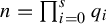 $n=\prod _{i=0}^s q_i$
. According to the notation in the statement,
$n=\prod _{i=0}^s q_i$
. According to the notation in the statement, $q_s=q$
. The pattern
$q_s=q$
. The pattern $\mathcal {O}$
has a maximal structure of
$\mathcal {O}$
has a maximal structure of $n/q$
trivial separated blocks of q points, and the pattern
$n/q$
trivial separated blocks of q points, and the pattern $\mathcal {C}$
has a maximal structure of
$\mathcal {C}$
has a maximal structure of $n/(q_{s-1}q)$
trivial blocks of cardinality
$n/(q_{s-1}q)$
trivial blocks of cardinality $q_{s-1}$
. Let us denote by
$q_{s-1}$
. Let us denote by $S_i$
and
$S_i$
and $P_i$
the blocks of the patterns
$P_i$
the blocks of the patterns $\mathcal {C}$
and
$\mathcal {C}$
and $\mathcal {O}$
, respectively. Since 0 is the unique inner point in
$\mathcal {O}$
, respectively. Since 0 is the unique inner point in $\mathcal {O}$
, from Lemma 7.3, it follows that 0 is bidirectional. Then, the trivial block
$\mathcal {O}$
, from Lemma 7.3, it follows that 0 is bidirectional. Then, the trivial block $P_0$
of
$P_0$
of $\mathcal {O}$
and the trivial block
$\mathcal {O}$
and the trivial block $S_0$
of
$S_0$
of $\mathcal {C}$
are contained in different 0-branches. See Figure 17 for an example with
$\mathcal {C}$
are contained in different 0-branches. See Figure 17 for an example with $s=2$
,
$s=2$
, $q_0=3$
,
$q_0=3$
, $q_1=4$
,
$q_1=4$
, $q=q_2=2$
,
$q=q_2=2$
, $n=24$
.
$n=24$
.
The three types of paths in Proposition 10.3.

Notation in the proof of Proposition 10.3.

Let $\pi $
be an inter-block basic path of
$\pi $
be an inter-block basic path of $\mathcal {O}$
. If
$\mathcal {O}$
. If $\overline {\pi }$
is inter-block in
$\overline {\pi }$
is inter-block in $\mathcal {C}$
, by Lemma 10.1,
$\mathcal {C}$
, by Lemma 10.1, $\overline {\pi }$
splits before
$\overline {\pi }$
splits before $n/q$
iterates. By Lemma 10.2, this property is inherited by
$n/q$
iterates. By Lemma 10.2, this property is inherited by $\pi $
, which splits in at most
$\pi $
, which splits in at most $n/q$
iterates, as desired.
$n/q$
iterates, as desired.
Let us assume now that $\pi $
is an inter-block basic path of
$\pi $
is an inter-block basic path of $\mathcal {O}$
such that
$\mathcal {O}$
such that $\overline {\pi }$
is in-block in
$\overline {\pi }$
is in-block in $\mathcal {C}$
. That is,
$\mathcal {C}$
. That is, $\overline {\pi }$
is contained in
$\overline {\pi }$
is contained in $S_{\eta }$
for some
$S_{\eta }$
for some $\eta \in \{0,\ldots ,{n}/{q_{s-1}q}-1\}$
. Note that all points in a block of
$\eta \in \{0,\ldots ,{n}/{q_{s-1}q}-1\}$
. Note that all points in a block of $\mathcal {C}$
differ by a multiple of
$\mathcal {C}$
differ by a multiple of $n/(q_{s-1}q)$
, while all points in a block of
$n/(q_{s-1}q)$
, while all points in a block of $\mathcal {O}$
differ by a multiple of
$\mathcal {O}$
differ by a multiple of $n/q$
. It follows that
$n/q$
. It follows that $\overline {\pi }$
has the form
$\overline {\pi }$
has the form
 $$ \begin{align*} \overline{\pi}=\{\overline{a},\overline{b}\}=\bigg\{\eta+i\frac{n}{q_{s-1}q},\eta+j\frac{n}{q_{s-1}q}\bigg\} \end{align*} $$
with $0\le \eta \leq {n}/{q_{s-1}q}-1$
and
$0\le \eta \leq {n}/{q_{s-1}q}-1$
and $0\le i<j\leq q_{s-1}-1$
, while
$0\le i<j\leq q_{s-1}-1$
, while $\pi $
has the form
$\pi $
has the form
 $$ \begin{align*} \pi=\{a,b\}=\bigg\{\overline{a}+\ell\frac{n}{q},\overline{b}+r\frac{n}{q}\bigg\} \end{align*} $$
with $0\le \ell ,r\leq q-1$
. For the sake of intuition, note that
$0\le \ell ,r\leq q-1$
. For the sake of intuition, note that $\eta $
labels the block
$\eta $
labels the block $S_{\eta }$
of
$S_{\eta }$
of $\mathcal {C}$
containing
$\mathcal {C}$
containing $\overline {\pi }$
, while the blocks of
$\overline {\pi }$
, while the blocks of $\mathcal {O}$
containing a and b are respectively
$\mathcal {O}$
containing a and b are respectively $P_{\overline {a}}$
and
$P_{\overline {a}}$
and $P_{\overline {b}}$
. Going back to the example shown in Figure 17, if we take
$P_{\overline {b}}$
. Going back to the example shown in Figure 17, if we take $\pi =\{16,22\}$
, then
$\pi =\{16,22\}$
, then $\overline {\pi }=\{4,10\}$
,
$\overline {\pi }=\{4,10\}$
, $\eta =1$
,
$\eta =1$
, $i=1$
,
$i=1$
, $j=3$
,
$j=3$
, $\overline {a}=4$
,
$\overline {a}=4$
, $\overline {b}=10$
,
$\overline {b}=10$
, $\ell =r=1$
.
$\ell =r=1$
.
Let us study the iterates $f^i(\pi )$
. Since 0 is the unique inner point in
$f^i(\pi )$
. Since 0 is the unique inner point in $\mathcal {O}$
, a pair
$\mathcal {O}$
, a pair $\{x,y\}$
of points of
$\{x,y\}$
of points of $\mathcal {O}$
is not a basic path if and only if 0 separates x and y. Since
$\mathcal {O}$
is not a basic path if and only if 0 separates x and y. Since $\overline {\pi }$
is in-block in
$\overline {\pi }$
is in-block in $\mathcal {C}$
, it never splits by Proposition 3.7. Moreover,
$\mathcal {C}$
, it never splits by Proposition 3.7. Moreover, $0\in P_0$
. It follows that a basic path
$0\in P_0$
. It follows that a basic path $\pi $
may split in k iterates only if
$\pi $
may split in k iterates only if $\overline {f^k(\pi )}\subset S_0$
. Let
$\overline {f^k(\pi )}\subset S_0$
. Let $\pi _0$
be the first iterate of
$\pi _0$
be the first iterate of $\pi $
such that
$\pi $
such that $\overline {\pi }_0\subset S_0$
. Then,
$\overline {\pi }_0\subset S_0$
. Then,
 $$ \begin{align*} \pi_0=\bigg\{\frac{n}{q_{s-1}q}(i+\ell q_{s-1}),\frac{n}{q_{s-1}q}(j+rq_{s-1})\bigg\} \end{align*} $$
for some $0\le i<j\leq q_{s-1}-1$
and
$0\le i<j\leq q_{s-1}-1$
and $0\le \ell ,r\leq q-1$
. Let us look at the worst-case scenario by assuming that
$0\le \ell ,r\leq q-1$
. Let us look at the worst-case scenario by assuming that $\pi _0$
is a basic path. That is to say, we have the sequence of non-splitting coverings
$\pi _0$
is a basic path. That is to say, we have the sequence of non-splitting coverings
 $$ \begin{align*} \pi \rightarrow f(\pi) \rightarrow f^2(\pi) \rightarrow \overset{{n}/{q_{s-1}q}-\eta)}{\cdots} \rightarrow \pi_0. \end{align*} $$
To bound the number of iterates required by $\pi $
to split, we study
$\pi $
to split, we study $\pi _0$
. Let us consider the subordinated pattern
$\pi _0$
. Let us consider the subordinated pattern  . Note that $\mathcal {O}'$
has two discrete components, entropy zero and a maximal structure of
$\mathcal {O}'$
has two discrete components, entropy zero and a maximal structure of $q_{s-1}$
trivial blocks given by
$q_{s-1}$
trivial blocks given by
 $$ \begin{align*} P_0\cup P_{{n}/{q_{s-1}q}}\cup\cdots\cup P_{{(q_{s-1}-1)n}/{q_{s-1}q}}. \end{align*} $$
Moreover, the corresponding combinatorial collapse $\mathcal {C}'$
is a trivial pattern of period
$\mathcal {C}'$
is a trivial pattern of period $q_{s-1}$
. In other words, the sequence of collapses of
$q_{s-1}$
. In other words, the sequence of collapses of $\mathcal {O}'$
reduces to
$\mathcal {O}'$
reduces to $\{\mathcal {C}',\mathcal {O}'\}$
, and thus we can apply the discussion about types of basic paths and coverings used in the case
$\{\mathcal {C}',\mathcal {O}'\}$
, and thus we can apply the discussion about types of basic paths and coverings used in the case $s=1$
. Let us take the labelling of
$s=1$
. Let us take the labelling of $\mathcal {O}'$
such that the only inner point reads as 0. See Figure 18 for a picture of the patterns
$\mathcal {O}'$
such that the only inner point reads as 0. See Figure 18 for a picture of the patterns $\mathcal {C}'$
and
$\mathcal {C}'$
and $\mathcal {O}'$
corresponding to the example shown in Figure 17.
$\mathcal {O}'$
corresponding to the example shown in Figure 17.
The subordinated pattern $\mathcal {O}'$
and its collapse
$\mathcal {O}'$
and its collapse $\mathcal {C}'$
for the example shown in Figure 17.
$\mathcal {C}'$
for the example shown in Figure 17.

Notice that there is a correspondence between the basic path $\pi _0$
in
$\pi _0$
in $\mathcal {O}$
and the basic path
$\mathcal {O}$
and the basic path $\{i+\ell q_{s-1},j+rq_{s-1}\}$
in
$\{i+\ell q_{s-1},j+rq_{s-1}\}$
in $\mathcal {O}'$
. Since
$\mathcal {O}'$
. Since $\pi _0$
may only split when
$\pi _0$
may only split when $\overline {\pi }_0$
returns to
$\overline {\pi }_0$
returns to $S_0$
, it suffices to study the number of iterates required by
$S_0$
, it suffices to study the number of iterates required by $\{i+\ell q_{s-1},j+rq_{s-1}\}$
to split in
$\{i+\ell q_{s-1},j+rq_{s-1}\}$
to split in $\mathcal {O}'$
and then multiply the length of the sequence of paths by
$\mathcal {O}'$
and then multiply the length of the sequence of paths by ${n}/{q_{s-1}q}$
. As it was stated in the discussion of the case
${n}/{q_{s-1}q}$
. As it was stated in the discussion of the case $s=1$
, we have three situations depending on the type of path.
$s=1$
, we have three situations depending on the type of path.
If $\{i+\ell q_{s-1},j+rq_{s-1}\}$
in
$\{i+\ell q_{s-1},j+rq_{s-1}\}$
in $\mathcal {O}'$
is of Type I, then
$\mathcal {O}'$
is of Type I, then $\pi _0$
splits in
$\pi _0$
splits in $({n}/{q_{s-1}q})(q_{s-1}-j)= ({n}/{q}) -({j}/{q_{s-1}q})n$
iterates in
$({n}/{q_{s-1}q})(q_{s-1}-j)= ({n}/{q}) -({j}/{q_{s-1}q})n$
iterates in $\mathcal {O}$
. Taking
$\mathcal {O}$
. Taking $i=\ell =r=0$
and
$i=\ell =r=0$
and $a=({j}/{q_{s-1}q})n$
, this proves statement (a).
$a=({j}/{q_{s-1}q})n$
, this proves statement (a).
If $\{i+\ell q_{s-1},j+rq_{s-1}\}$
in
$\{i+\ell q_{s-1},j+rq_{s-1}\}$
in $\mathcal {O}'$
is of Type II, then
$\mathcal {O}'$
is of Type II, then $r=q-1$
and
$r=q-1$
and $\pi _0$
splits in
$\pi _0$
splits in $({n}/{q_{s-1}q})(q_{s-1}-i)= ({n}/{q}) -({i}/{q_{s-1}q})n$
iterates in
$({n}/{q_{s-1}q})(q_{s-1}-i)= ({n}/{q}) -({i}/{q_{s-1}q})n$
iterates in $\mathcal {O}$
. Taking
$\mathcal {O}$
. Taking $i=\ell =0$
and
$i=\ell =0$
and $a=({j}/{q_{s-1}q})n$
, this proves statement (b).
$a=({j}/{q_{s-1}q})n$
, this proves statement (b).
Lastly, if $\{i+\ell q_{s-1},j+rq_{s-1}\}$
in
$\{i+\ell q_{s-1},j+rq_{s-1}\}$
in $\mathcal {O}'$
is of Type III, then
$\mathcal {O}'$
is of Type III, then $\ell =r=q-1$
and
$\ell =r=q-1$
and $\pi _0$
splits in
$\pi _0$
splits in $({n}/{q_{s-1}q})(2q_{s-1}-j)= ({2n}/{q}) -({j}/{q_{s-1}q})n$
iterates in
$({n}/{q_{s-1}q})(2q_{s-1}-j)= ({2n}/{q}) -({j}/{q_{s-1}q})n$
iterates in $\mathcal {O}$
and it is a strict pre-image of the basic path
$\mathcal {O}$
and it is a strict pre-image of the basic path $\{0,({n}/{q_{s-1}q})(i+q_{s-1}-j+(q-1)q_{s-1})\}$
.
$\{0,({n}/{q_{s-1}q})(i+q_{s-1}-j+(q-1)q_{s-1})\}$
.
The previous holds for $\pi _0$
. To bound the iterates required by
$\pi _0$
. To bound the iterates required by $\pi $
to split, we add
$\pi $
to split, we add ${n}/{q_{s-1}q}-\eta $
to the previous. So, depending on the types before, for
${n}/{q_{s-1}q}-\eta $
to the previous. So, depending on the types before, for $1\le \eta \le {n}/{q_{s-1}q}-1$
, either:
$1\le \eta \le {n}/{q_{s-1}q}-1$
, either:
-
•
$\pi $
splits in
$({n}/{q})-(({j-1})/{q_{s-1}q})n-\eta $
iterates; or -
•
$\pi $
splits in
$({n}/{q})-(({i-1})/{q_{s-1}q})n-\eta $
iterates; or -
•
$\pi $
splits in
$({2n}/{q})-(({j-1})/{q_{s-1}q})n-\eta $
iterates and it is a strict pre-image of
$$ \begin{align*} \bigg\{0,\frac{n}{q_{s-1}q}(i+q_{s-1}-j+(q-1)q_{s-1})\bigg\}. \end{align*} $$







This proves that every inter-block basic path of $\mathcal {O}$
splits after at most
$\mathcal {O}$
splits after at most $2n/q$
iterates. Moreover, the only inter-block basic paths splitting in more than
$2n/q$
iterates. Moreover, the only inter-block basic paths splitting in more than $n/q$
iterates are strict pre-images of some
$n/q$
iterates are strict pre-images of some $\{0,a+(({q-1})/{q})n\}$
, with
$\{0,a+(({q-1})/{q})n\}$
, with $0<a=({n}/{q_{s-1}q})(i+q_{s-1}-j)<{n}/{q}$
, proving the result.
$0<a=({n}/{q_{s-1}q})(i+q_{s-1}-j)<{n}/{q}$
, proving the result.
The previous result states that almost every inter-block basic path of a zero entropy pattern with two discrete components splits in at most $n/q$
iterates with the exception of those considered in statement (ii) of Proposition 10.3. The following results are concerned with the bound for the latter case. The first result states that the ‘time reverse’ of a zero entropy pattern
$n/q$
iterates with the exception of those considered in statement (ii) of Proposition 10.3. The following results are concerned with the bound for the latter case. The first result states that the ‘time reverse’ of a zero entropy pattern $\mathcal {O}$
with two discrete components coincides with
$\mathcal {O}$
with two discrete components coincides with $\mathcal {O}$
. Figure 19 shows an example that illustrates this remarkable property, which is not true for general zero entropy patterns. It is possible to prove it using sequences of collapses and Proposition 6.1, but we use a result from [Reference Alsedà, Juher and Mañosas8] to get a considerably shorter proof.
$\mathcal {O}$
. Figure 19 shows an example that illustrates this remarkable property, which is not true for general zero entropy patterns. It is possible to prove it using sequences of collapses and Proposition 6.1, but we use a result from [Reference Alsedà, Juher and Mañosas8] to get a considerably shorter proof.
A pattern $\mathcal {O}$
and its time reverse
$\mathcal {O}$
and its time reverse $\mathcal {Q}$
as defined in Lemma 10.4.
$\mathcal {Q}$
as defined in Lemma 10.4.

Lemma 10.4. Let $(T,P,f)$
be the canonical model of an n-periodic pattern
$(T,P,f)$
be the canonical model of an n-periodic pattern $\mathcal {O}$
with entropy zero and two discrete components. Let
$\mathcal {O}$
with entropy zero and two discrete components. Let $P=\{x_i\}_{i=0}^{n-1}$
be time labelled. Consider the relabelling of P given by
$P=\{x_i\}_{i=0}^{n-1}$
be time labelled. Consider the relabelling of P given by $y_i:=x_{n-i\bmod n}$
and the map
$y_i:=x_{n-i\bmod n}$
and the map  defined by $g(y_i):=y_{i+1\bmod n}$
for
$g(y_i):=y_{i+1\bmod n}$
for $0\le i<n$
. Then,
$0\le i<n$
. Then, $([T,P],[g])=\mathcal {O}$
.
$([T,P],[g])=\mathcal {O}$
.
Proof. Assume without loss of generality that $x_0$
is the unique inner point of
$x_0$
is the unique inner point of $\mathcal {O}$
. From the definitions, we get that P is an n-periodic orbit of g, time labelled as
$\mathcal {O}$
. From the definitions, we get that P is an n-periodic orbit of g, time labelled as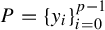 $P=\{y_i\}_{i=0}^{p-1}$
. Thus,
$P=\{y_i\}_{i=0}^{p-1}$
. Thus, $([T,P],[g])$
is an n-periodic pattern
$([T,P],[g])$
is an n-periodic pattern $\mathcal {Q}$
. By definition,
$\mathcal {Q}$
. By definition, $y_0=x_0$
, so that
$y_0=x_0$
, so that $y_0$
is the only inner point of
$y_0$
is the only inner point of $\mathcal {Q}$
. To see that
$\mathcal {Q}$
. To see that $\mathcal {O}=\mathcal {Q}$
, we have to show that both patterns have the same discrete components.
$\mathcal {O}=\mathcal {Q}$
, we have to show that both patterns have the same discrete components.
For any tree map  , an ordered set $(a,b,c)$
of three points of S is called a forward triplet of F if
$(a,b,c)$
of three points of S is called a forward triplet of F if $b\in (a,c)$
,
$b\in (a,c)$
, $f(a)=b$
,
$f(a)=b$
, $f(b)=c$
and
$f(b)=c$
and $\{a,b,c\}$
is contained in a periodic orbit of F. By [Reference Alsedà, Juher and Mañosas8, Theorem 1.1], F has positive entropy if and only if there exists
$\{a,b,c\}$
is contained in a periodic orbit of F. By [Reference Alsedà, Juher and Mañosas8, Theorem 1.1], F has positive entropy if and only if there exists $k\ge 1$
such that
$k\ge 1$
such that $F^k$
has a forward triplet. Thus, since
$F^k$
has a forward triplet. Thus, since $h(f)=h(\mathcal {O})=0$
, f cannot have forward triplets. It easily follows that both
$h(f)=h(\mathcal {O})=0$
, f cannot have forward triplets. It easily follows that both $x_i$
and
$x_i$
and $x_{n-i}$
belong to the same discrete component of
$x_{n-i}$
belong to the same discrete component of $\mathcal {O}$
for all
$\mathcal {O}$
for all $1\le i<n$
. However,
$1\le i<n$
. However, $\{x_i,x_{n-i}\}=\{y_{n-i},y_i\}$
, implying that both
$\{x_i,x_{n-i}\}=\{y_{n-i},y_i\}$
, implying that both $\mathcal {O}$
and
$\mathcal {O}$
and $\mathcal {Q}$
have exactly the same discrete components.
$\mathcal {Q}$
have exactly the same discrete components.
Lemma 10.5. The basic path $\sigma =\{0,a+(({q-1})/{q})n\}$
with
$\sigma =\{0,a+(({q-1})/{q})n\}$
with $0<a<{n}/{q}$
in statement (ii) of Proposition 10.3 has at most
$0<a<{n}/{q}$
in statement (ii) of Proposition 10.3 has at most $a-1$
strict pre-images. Moreover, a basic path
$a-1$
strict pre-images. Moreover, a basic path $\pi =\{0,y\}$
cannot be an strict pre-image of
$\pi =\{0,y\}$
cannot be an strict pre-image of $\sigma $
.
$\sigma $
.
Proof. By Lemma 10.4, the pattern $\mathcal {O}$
coincides with its time reverse. In particular, the basic path
$\mathcal {O}$
coincides with its time reverse. In particular, the basic path $\{0,a+(({q-1})/{q})n\}$
has as many pre-images as basic paths are covered by
$\{0,a+(({q-1})/{q})n\}$
has as many pre-images as basic paths are covered by $\{0,{n}/{q}-a\}$
before splitting. The basic path
$\{0,{n}/{q}-a\}$
before splitting. The basic path $\sigma $
is inter-block and
$\sigma $
is inter-block and $\overline {\sigma }$
is in-block in the corresponding combinatorial collapse
$\overline {\sigma }$
is in-block in the corresponding combinatorial collapse $\mathcal {C}$
of
$\mathcal {C}$
of $\mathcal {O}$
. Therefore, the same is true for the basic path
$\mathcal {O}$
. Therefore, the same is true for the basic path $\{0,{n}/{q}-a\}$
. Since
$\{0,{n}/{q}-a\}$
. Since $0<{n}/{q}-a<{n}/{q}$
, by Proposition 10.3(i), the basic path
$0<{n}/{q}-a<{n}/{q}$
, by Proposition 10.3(i), the basic path $\{0,{n}/{q}-a\}$
splits in
$\{0,{n}/{q}-a\}$
splits in ${n}/{q}-({n}/{q}-a)=a$
iterates. This proves the first assertion of the lemma.
${n}/{q}-({n}/{q}-a)=a$
iterates. This proves the first assertion of the lemma.
The second assertion, using the time reverse property, is equivalent to show that the basic path $\{0,n-y\}$
is not covered by
$\{0,n-y\}$
is not covered by $\{0,{n}/{q}-a\}$
before splitting. That is, before a iterates. This is clear, since neither
$\{0,{n}/{q}-a\}$
before splitting. That is, before a iterates. This is clear, since neither $0$
nor
$0$
nor ${n}/{q}-a$
map on
${n}/{q}-a$
map on $0$
before a iterates.
$0$
before a iterates.
Now we can use Lemma 10.5 together with Proposition 10.3 to find the desired coverings.
Lemma 10.6. Let $\mathcal {O}$
be a zero entropy n-periodic pattern with two discrete components and a maximal structure of trivial blocks of cardinality q. If
$\mathcal {O}$
be a zero entropy n-periodic pattern with two discrete components and a maximal structure of trivial blocks of cardinality q. If $q\geq 3$
, then any inter-block basic path of
$q\geq 3$
, then any inter-block basic path of $\mathcal {O}$
covers at least four basic paths in n iterates.
$\mathcal {O}$
covers at least four basic paths in n iterates.
Proof. Let us label $\mathcal {O}$
in such a way that
$\mathcal {O}$
in such a way that $0$
is the unique inner point and let
$0$
is the unique inner point and let $\pi $
be an inter-block basic path of
$\pi $
be an inter-block basic path of $\mathcal {O}$
. By Proposition 10.3:
$\mathcal {O}$
. By Proposition 10.3:
-
(a) either
$\pi $
splits in at most
${n}/{q}$
iterates; -
(b) or
$\pi $
is a strict pre-image of a basic path
$\{0,a+(({q-1})/{q})n\}$
with
$0<a<{n}/{q}$
which splits in
${n}/{q}$
iterates.





In the case (a), $\pi $
covers two basic paths
$\pi $
covers two basic paths $\{0,y\}$
and
$\{0,y\}$
and $\{0,z\}$
before
$\{0,z\}$
before ${n}/{q}$
iterates. Notice that both
${n}/{q}$
iterates. Notice that both $\{0,y\}$
and
$\{0,y\}$
and $\{0,z\}$
cannot be in-block basic paths of
$\{0,z\}$
cannot be in-block basic paths of $\mathcal {O}$
. Otherwise, since
$\mathcal {O}$
. Otherwise, since $0$
is inner of
$0$
is inner of $\mathcal {O}$
, and y and z are contained in different discrete components, the trivial block that contains
$\mathcal {O}$
, and y and z are contained in different discrete components, the trivial block that contains $0$
would contain points of two different discrete components, which is a contradiction. Therefore, we can assume
$0$
would contain points of two different discrete components, which is a contradiction. Therefore, we can assume $\{0,y\}$
to be an inter-block basic path of
$\{0,y\}$
to be an inter-block basic path of $\mathcal {O}$
. Moreover, by Lemma 10.5, an inter-block basic path of the form
$\mathcal {O}$
. Moreover, by Lemma 10.5, an inter-block basic path of the form $\{0,y\}$
cannot be a strict pre-image of a basic path of the form
$\{0,y\}$
cannot be a strict pre-image of a basic path of the form $\{0,a+(({q-1})/{q})n\}$
with
$\{0,a+(({q-1})/{q})n\}$
with $0<a<{n}/{q}$
. Therefore, again by Proposition 10.3,
$0<a<{n}/{q}$
. Therefore, again by Proposition 10.3, $\{0,y\}$
splits in at most
$\{0,y\}$
splits in at most ${n}/{q}$
iterates, covering two basic paths
${n}/{q}$
iterates, covering two basic paths $\{0,y_1\}$
and
$\{0,y_1\}$
and $\{0,y_2\}$
. Again, one of them is inter-block of
$\{0,y_2\}$
. Again, one of them is inter-block of $\mathcal {O}$
and splits in at most
$\mathcal {O}$
and splits in at most ${n}/{q}$
iterates. Therefore,
${n}/{q}$
iterates. Therefore, $\pi $
covers at least four basic paths in
$\pi $
covers at least four basic paths in ${3n}/{q}\leq n$
iterates. This proves the result in the case (a).
${3n}/{q}\leq n$
iterates. This proves the result in the case (a).
In the case (b), by Lemma 10.5, $\pi $
covers
$\pi $
covers $\{0,a+(({q-1})/{q})n\}$
in at most
$\{0,a+(({q-1})/{q})n\}$
in at most ${a-1}$
iterates and
${a-1}$
iterates and $\{0,a+(({q-1})/{q})n\}$
covers
$\{0,a+(({q-1})/{q})n\}$
covers $\{0,a\}$
and
$\{0,a\}$
and $\{0,{n}/{q}\}$
in
$\{0,{n}/{q}\}$
in ${n}/{q}$
iterates. By Proposition 10.3(i), the basic path
${n}/{q}$
iterates. By Proposition 10.3(i), the basic path $\{0,a\}$
splits and covers two basic paths
$\{0,a\}$
splits and covers two basic paths $\{0,u\}$
and
$\{0,u\}$
and $\{0,v\}$
in
$\{0,v\}$
in ${n}/{q}-a$
iterates and, since one must be inter-block in
${n}/{q}-a$
iterates and, since one must be inter-block in $\mathcal {O}$
, again splits in at most
$\mathcal {O}$
, again splits in at most ${n}/{q}$
iterates as shown before. Therefore,
${n}/{q}$
iterates as shown before. Therefore, $\pi $
covers at least four basic paths in
$\pi $
covers at least four basic paths in $a-1+ ({n}/{q}) + ({n}/{q}) - a + ({n}/{q}) = ({3n}/{q}) - 1 < n$
iterates, proving the result in the case (b).
$a-1+ ({n}/{q}) + ({n}/{q}) - a + ({n}/{q}) = ({3n}/{q}) - 1 < n$
iterates, proving the result in the case (b).
Remark 10.7. Let $\mathcal {P}$
be a pattern and let
$\mathcal {P}$
be a pattern and let $\mathcal {O}$
be an opening of
$\mathcal {O}$
be an opening of $\mathcal {P}$
. Let
$\mathcal {P}$
. Let $\pi $
be a basic path of
$\pi $
be a basic path of $\mathcal {P}$
. Then,
$\mathcal {P}$
. Then, $\pi $
is also a basic path of
$\pi $
is also a basic path of $\mathcal {O}$
. Moreover, if
$\mathcal {O}$
. Moreover, if $\pi $
covers k basic paths in
$\pi $
covers k basic paths in $\ell $
iterates in
$\ell $
iterates in $\mathcal {O}$
, then
$\mathcal {O}$
, then $\pi $
covers at least k basic paths in
$\pi $
covers at least k basic paths in $\ell $
iterates in
$\ell $
iterates in $\mathcal {P}$
.
$\mathcal {P}$
.
By collecting all previous results, finally, we get the desired lower bound for coverings in a triple chain.
Proposition 10.8. Let $\mathcal {P}$
be an n-periodic
$\mathcal {P}$
be an n-periodic $\pi $
-irreducible triple chain. Assume that the two possible openings
$\pi $
-irreducible triple chain. Assume that the two possible openings $\mathcal {O}_{1}$
and
$\mathcal {O}_{1}$
and $\mathcal {O}_{2}$
of
$\mathcal {O}_{2}$
of $\mathcal {P}$
have entropy zero. Then, any basic path
$\mathcal {P}$
have entropy zero. Then, any basic path $\pi $
of
$\pi $
of $\mathcal {P}$
covers at least four basic paths in n iterates.
$\mathcal {P}$
covers at least four basic paths in n iterates.
Proof. By Remark 10.7, a basic path $\pi $
of
$\pi $
of $\mathcal {P}$
is also a basic path of both
$\mathcal {P}$
is also a basic path of both $\mathcal {O}_1$
and
$\mathcal {O}_1$
and $\mathcal {O}_2$
. We claim that
$\mathcal {O}_2$
. We claim that $\pi $
is inter-block for some
$\pi $
is inter-block for some $\mathcal {O}_i$
. Indeed, if
$\mathcal {O}_i$
. Indeed, if $\pi $
is in-block in both
$\pi $
is in-block in both $\mathcal {O}_1$
and
$\mathcal {O}_1$
and $\mathcal {O}_2$
, then
$\mathcal {O}_2$
, then $\pi $
does not split through any of the two inner points of
$\pi $
does not split through any of the two inner points of $\mathcal {P}$
. Consequently,
$\mathcal {P}$
. Consequently, $\pi $
never splits in
$\pi $
never splits in $\mathcal {P}$
and so
$\mathcal {P}$
and so $\mathcal {P}$
is
$\mathcal {P}$
is $\pi $
-reducible, which is a contradiction.
$\pi $
-reducible, which is a contradiction.
The patterns $\mathcal {O}_i$
,
$\mathcal {O}_i$
, $i=1,2$
, have zero entropy. So, by Proposition 6.1, each of them has a maximal structure of trivial blocks of cardinality
$i=1,2$
, have zero entropy. So, by Proposition 6.1, each of them has a maximal structure of trivial blocks of cardinality $q_i\geq 2$
.
$q_i\geq 2$
.
Let us first prove the result when $q_i\geq 3$
. As stated before,
$q_i\geq 3$
. As stated before, $\pi $
is inter-block for some of the openings, let us say
$\pi $
is inter-block for some of the openings, let us say $\mathcal {O}_1$
without loss of generality. Since
$\mathcal {O}_1$
without loss of generality. Since $q_1\geq 3$
, by Lemma 10.6,
$q_1\geq 3$
, by Lemma 10.6, $\pi $
covers at least four basic paths in n iterates in
$\pi $
covers at least four basic paths in n iterates in $\mathcal {O}_1$
. By Remark 10.7, this property is inherited in
$\mathcal {O}_1$
. By Remark 10.7, this property is inherited in $\mathcal {P}$
, so
$\mathcal {P}$
, so $\pi $
covers at least four basic paths in n iterates in
$\pi $
covers at least four basic paths in n iterates in $\mathcal {P}$
. This proves the result in the first situation.
$\mathcal {P}$
. This proves the result in the first situation.
Now, assume that $q_1=q_2=2$
. In this case, the basic path
$q_1=q_2=2$
. In this case, the basic path $\{0,{n}/{2}\}$
is in-block in both
$\{0,{n}/{2}\}$
is in-block in both $\mathcal {O}_1$
and
$\mathcal {O}_1$
and $\mathcal {O}_2$
. By the discussion at the beginning of the proof, this produces contradiction with the
$\mathcal {O}_2$
. By the discussion at the beginning of the proof, this produces contradiction with the $\pi $
-irreducibility of
$\pi $
-irreducibility of $\mathcal {P}$
.
$\mathcal {P}$
.
We are left with the case $q_1=2$
and
$q_1=2$
and $q_2\geq 3$
. Again,
$q_2\geq 3$
. Again, $\pi $
is inter-block in
$\pi $
is inter-block in $\mathcal {O}_1$
or
$\mathcal {O}_1$
or $\mathcal {O}_2$
. If
$\mathcal {O}_2$
. If $\pi $
is inter-block in
$\pi $
is inter-block in $\mathcal {O}_2$
, the result follows as in the first case since
$\mathcal {O}_2$
, the result follows as in the first case since $q_2\geq 3$
. So, we can assume that
$q_2\geq 3$
. So, we can assume that $\pi $
is in-block in
$\pi $
is in-block in $\mathcal {O}_2$
and, as a consequence, inter-block in
$\mathcal {O}_2$
and, as a consequence, inter-block in $\mathcal {O}_1$
.
$\mathcal {O}_1$
.
Let us relabel $\mathcal {P}$
and, accordingly, the openings
$\mathcal {P}$
and, accordingly, the openings $\mathcal {O}_i$
, in such a way that the inner point of
$\mathcal {O}_i$
, in such a way that the inner point of $\mathcal {O}_1$
is
$\mathcal {O}_1$
is $0$
. We denote by j the inner point of
$0$
. We denote by j the inner point of $\mathcal {O}_2$
. The basic path
$\mathcal {O}_2$
. The basic path $\pi $
is in-block in
$\pi $
is in-block in $\mathcal {O}_2$
, so in
$\mathcal {O}_2$
, so in $\mathcal {P}$
, the first splitting is through the inner
$\mathcal {P}$
, the first splitting is through the inner $0$
. Since
$0$
. Since $\pi $
is inter-block in
$\pi $
is inter-block in $\mathcal {O}_1$
, by Proposition 10.3, one of the following situations occurs in
$\mathcal {O}_1$
, by Proposition 10.3, one of the following situations occurs in $\mathcal {O}_1$
:
$\mathcal {O}_1$
:
-
(i) either
$\pi $
splits in at most
${n}/{2}$
iterates; -
(ii) or
$\pi $
is a strict pre-image of a basic path
$\{0,a+{n}/{2}\}$
with
$0<a<{n}/{2}$
, which splits in
${n}/{2}$
iterates.





In both cases, $\pi $
covers two basic paths in
$\pi $
covers two basic paths in $\mathcal {O}_1$
after the first splitting. Since
$\mathcal {O}_1$
after the first splitting. Since $\mathcal {P}$
is a triple chain, at least one of such paths is also a basic path in
$\mathcal {P}$
is a triple chain, at least one of such paths is also a basic path in $\mathcal {P}$
. For the sake of brevity, we will focus on the worst scenario which corresponds to assuming that the two basic paths covered in
$\mathcal {P}$
. For the sake of brevity, we will focus on the worst scenario which corresponds to assuming that the two basic paths covered in $\mathcal {O}_1$
are also basic paths in
$\mathcal {O}_1$
are also basic paths in $\mathcal {P}$
. The reader may easily check that if this is not the case, then a third basic path is covered in
$\mathcal {P}$
. The reader may easily check that if this is not the case, then a third basic path is covered in $\mathcal {P}$
during the first splitting, and the upper bounds obtained below are valid for the basic path shared between
$\mathcal {P}$
during the first splitting, and the upper bounds obtained below are valid for the basic path shared between $\mathcal {O}_1$
and
$\mathcal {O}_1$
and $\mathcal {P}$
.
$\mathcal {P}$
.
Consider the case (i). Since $0$
is the inner point of
$0$
is the inner point of $\mathcal {O}_1$
, then
$\mathcal {O}_1$
, then $\pi $
covers in
$\pi $
covers in $\mathcal {O}_1$
two basic paths
$\mathcal {O}_1$
two basic paths $\{0,y\}$
and
$\{0,y\}$
and $\{0,z\}$
in at most
$\{0,z\}$
in at most ${n}/{2}$
iterates. As noticed above, we are assuming that both
${n}/{2}$
iterates. As noticed above, we are assuming that both $\{0,y\}$
and
$\{0,y\}$
and $\{0,z\}$
are basic paths in
$\{0,z\}$
are basic paths in $\mathcal {P}$
. Clearly,
$\mathcal {P}$
. Clearly, $y\neq z$
and so we can assume also
$y\neq z$
and so we can assume also $z\neq {n}/{2}$
. Consequently,
$z\neq {n}/{2}$
. Consequently, $\{0,z\}$
is an inter-block in
$\{0,z\}$
is an inter-block in $\mathcal {O}_1$
. Moreover, by Lemma 10.5,
$\mathcal {O}_1$
. Moreover, by Lemma 10.5, $\{0,z\}$
is not a strict pre-image of a basic path of the form
$\{0,z\}$
is not a strict pre-image of a basic path of the form $\{0,a+{n}/{2}\}$
. Then, by Proposition 10.3,
$\{0,a+{n}/{2}\}$
. Then, by Proposition 10.3, $\{0,z\}$
splits in at most
$\{0,z\}$
splits in at most ${n}/{2}$
iterates covering two basic paths
${n}/{2}$
iterates covering two basic paths $\{0,z_1\}$
and
$\{0,z_1\}$
and $\{0,z_2\}$
. Since
$\{0,z_2\}$
. Since $\{0,z\}$
is a basic path in
$\{0,z\}$
is a basic path in $\mathcal {P}$
, then
$\mathcal {P}$
, then $\{0,z\}$
covers at least two basic paths in
$\{0,z\}$
covers at least two basic paths in ${n}/{2}$
iterates in
${n}/{2}$
iterates in $\mathcal {P}$
. Now, we have two cases depending on the value of y. If
$\mathcal {P}$
. Now, we have two cases depending on the value of y. If $y\neq {n}/{2}$
, the same argument applies for
$y\neq {n}/{2}$
, the same argument applies for $\{0,y\}$
and, summing up,
$\{0,y\}$
and, summing up, $\pi $
covers at least four basic paths in n iterates in
$\pi $
covers at least four basic paths in n iterates in $\mathcal {P}$
, proving the result in this case. The following diagram illustrates the coverings in this first situation inside case (i).
$\mathcal {P}$
, proving the result in this case. The following diagram illustrates the coverings in this first situation inside case (i).

If $y={n}/{2}$
, then
$y={n}/{2}$
, then $\{0,{n}/{2}\}$
is in-block in
$\{0,{n}/{2}\}$
is in-block in $\mathcal {O}_1$
. Since
$\mathcal {O}_1$
. Since $\{0,{n}/{2}\}$
is a basic path in
$\{0,{n}/{2}\}$
is a basic path in $\mathcal {P}$
, it is also a basic path in
$\mathcal {P}$
, it is also a basic path in $\mathcal {O}_2$
. Moreover, it must be inter-block. By Proposition 10.3, either
$\mathcal {O}_2$
. Moreover, it must be inter-block. By Proposition 10.3, either $\{0,{n}/{2}\}$
covers two basic paths before
$\{0,{n}/{2}\}$
covers two basic paths before ${n}/{q_2}$
iterates or it is a strict pre-image of a basic path
${n}/{q_2}$
iterates or it is a strict pre-image of a basic path $\{j,j+b+{(q_2-1)n}/{q_2}\}$
, where
$\{j,j+b+{(q_2-1)n}/{q_2}\}$
, where $0<b<{n}/{q_2}$
and j is the inner point of
$0<b<{n}/{q_2}$
and j is the inner point of $\mathcal {O}_2$
. The second alternative, however, cannot be satisfied. Indeed, the time distance between the two points of an iterate of a basic path is conserved while there is no splitting. If
$\mathcal {O}_2$
. The second alternative, however, cannot be satisfied. Indeed, the time distance between the two points of an iterate of a basic path is conserved while there is no splitting. If $\{0,{n}/{2}\}$
is a strict pre-image of
$\{0,{n}/{2}\}$
is a strict pre-image of $\{j,j+b+{(q_2-1)n}/{q_2}\}$
, then the distance should be conserved, but
$\{j,j+b+{(q_2-1)n}/{q_2}\}$
, then the distance should be conserved, but $b+{(q_2-1)n}/{q_2}\geq {n}/{2}$
. Therefore,
$b+{(q_2-1)n}/{q_2}\geq {n}/{2}$
. Therefore, $\{0,{n}/{2}\}$
covers two basic paths in
$\{0,{n}/{2}\}$
covers two basic paths in $\mathcal {O}_2$
in at most
$\mathcal {O}_2$
in at most ${n}/{q_2}$
iterates. Since
${n}/{q_2}$
iterates. Since $q_2\geq 3$
then, summing up,
$q_2\geq 3$
then, summing up, $\pi $
covers at least four basic paths in n iterates in
$\pi $
covers at least four basic paths in n iterates in $\mathcal {P}$
, proving the result for the case (i). The following diagram illustrates the coverings in this second situation inside case (i).
$\mathcal {P}$
, proving the result for the case (i). The following diagram illustrates the coverings in this second situation inside case (i).

The basic paths $\{0,8\}$
and
$\{0,8\}$
and $\{3,7\}$
in Figure 20 are examples of maximal length of case (i). The basic path
$\{3,7\}$
in Figure 20 are examples of maximal length of case (i). The basic path $\{0,8\}$
splits in
$\{0,8\}$
splits in ${n}/{2}=6$
iterates and covers
${n}/{2}=6$
iterates and covers $\{0,y\}=\{0,6\}$
and
$\{0,y\}=\{0,6\}$
and $\{0,z\}=\{0,2\}$
. The path
$\{0,z\}=\{0,2\}$
. The path $\{0,6\}$
is of the form
$\{0,6\}$
is of the form $\{0,{n}/{2}\}$
, so it is in-block in
$\{0,{n}/{2}\}$
, so it is in-block in $\mathcal {O}_1$
and inter-block in
$\mathcal {O}_1$
and inter-block in $\mathcal {O}_2$
. It splits in
$\mathcal {O}_2$
. It splits in $3<{n}/{2}=6$
iterates. The path
$3<{n}/{2}=6$
iterates. The path $\{0,2\}$
is inter-block in both
$\{0,2\}$
is inter-block in both $\mathcal {O}_1$
and
$\mathcal {O}_1$
and $\mathcal {O}_2$
, and splits in
$\mathcal {O}_2$
, and splits in $2<{n}/{2}=6$
iterates. A similar phenomenon occurs for
$2<{n}/{2}=6$
iterates. A similar phenomenon occurs for $\{3,7\}$
.
$\{3,7\}$
.
An illustration of the proof of Proposition 10.8. Some loops of the $\mathcal {P}$
-path graph obtained in the proof are shown. The underlined basic paths are in-block in
$\mathcal {P}$
-path graph obtained in the proof are shown. The underlined basic paths are in-block in $\mathcal {O}_2$
.
$\mathcal {O}_2$
.

Let us now consider the case (ii). By Lemma 10.4, the basic path $\{0,a+{n}/{2}\}$
has, at most,
$\{0,a+{n}/{2}\}$
has, at most, $a-1$
strict pre-images. Thus,
$a-1$
strict pre-images. Thus, $\pi $
covers
$\pi $
covers $\{0,a+{n}/{2}\}$
in at most
$\{0,a+{n}/{2}\}$
in at most $a-1$
iterates. Since
$a-1$
iterates. Since $\pi $
is in-block in
$\pi $
is in-block in $\mathcal {O}_2$
,
$\mathcal {O}_2$
, $\{0,a+{n}/{2}\}$
must also be an in-block path of
$\{0,a+{n}/{2}\}$
must also be an in-block path of $\mathcal {O}_2$
. Hence,
$\mathcal {O}_2$
. Hence, $a+{n}/{2}=k({n}/{q_2})$
for some
$a+{n}/{2}=k({n}/{q_2})$
for some $1\le k\le q_2-1$
. Moreover,
$1\le k\le q_2-1$
. Moreover, $\{0,a+{n}/{2}\}$
splits in
$\{0,a+{n}/{2}\}$
splits in ${n}/{2}$
iterates and covers the basic paths
${n}/{2}$
iterates and covers the basic paths $\{0,a\}$
and
$\{0,a\}$
and $\{0,{n}/{2}\}$
. Recall that we are assuming that both
$\{0,{n}/{2}\}$
. Recall that we are assuming that both $\{0,a\}$
and
$\{0,a\}$
and $\{0,{n}/{2}\}$
are basic paths in
$\{0,{n}/{2}\}$
are basic paths in $\mathcal {P}$
and so in
$\mathcal {P}$
and so in $\mathcal {O}_2$
. The basic path
$\mathcal {O}_2$
. The basic path $\{0,{n}/{2}\}$
is inter-block in
$\{0,{n}/{2}\}$
is inter-block in $\mathcal {O}_2$
and, as proved in case (i), covers two basic paths before
$\mathcal {O}_2$
and, as proved in case (i), covers two basic paths before ${n}/{q_2}$
iterates. However,
${n}/{q_2}$
iterates. However, $\{0,a\}$
is inter-block for
$\{0,a\}$
is inter-block for $\mathcal {O}_1$
and, since
$\mathcal {O}_1$
and, since $a<{n}/{2}$
, it covers two basic paths in
$a<{n}/{2}$
, it covers two basic paths in ${n}/{2}-a$
iterates by Proposition 10.3(a). Summing up,
${n}/{2}-a$
iterates by Proposition 10.3(a). Summing up, $\pi $
covers two basic paths in
$\pi $
covers two basic paths in $a-1+{n}/{2}+{n}/{q_2}=(k+1){n}/{q_2}-1\leq n-1$
iterates through
$a-1+{n}/{2}+{n}/{q_2}=(k+1){n}/{q_2}-1\leq n-1$
iterates through $\{0,{n}/{2}\}$
and two basic paths in
$\{0,{n}/{2}\}$
and two basic paths in $a-1+{n}/{2}+{n}/{2}-a=n-1$
iterates through
$a-1+{n}/{2}+{n}/{2}-a=n-1$
iterates through $\{0,a\}$
, which proves that
$\{0,a\}$
, which proves that $\pi $
covers at least four basic paths in n iterates. The following diagram illustrates the coverings in case (ii).
$\pi $
covers at least four basic paths in n iterates. The following diagram illustrates the coverings in case (ii).

The basic path $\{11,7\}$
is the only one satisfying case (ii) in Figure 20. Here,
$\{11,7\}$
is the only one satisfying case (ii) in Figure 20. Here, $\{0,a+{n}/{2}\}=\{0,8\}$
with
$\{0,a+{n}/{2}\}=\{0,8\}$
with $a=2$
. Indeed,
$a=2$
. Indeed, $\{0,8\}$
has at most
$\{0,8\}$
has at most $a-1=1$
pre-images and
$a-1=1$
pre-images and $\{0,8\}$
splits exactly in
$\{0,8\}$
splits exactly in ${n}/{2}=6$
iterates covering
${n}/{2}=6$
iterates covering $\{0,a\}=\{0,2\}$
and
$\{0,a\}=\{0,2\}$
and $\{0,{n}/{2}\}=\{0,6\}$
.
$\{0,{n}/{2}\}=\{0,6\}$
.
Let $A=(a_{ij})$
be an
$A=(a_{ij})$
be an $n\times n$
non-negative matrix. Recall that
$n\times n$
non-negative matrix. Recall that $\rho (A)$
stands for the spectral radius of A. For
$\rho (A)$
stands for the spectral radius of A. For $1\leq i\leq n$
, let
$1\leq i\leq n$
, let $r_i(A)=\sum _{j=1}^n a_{ij}$
be the ith row sum of A. The following result is well known [Reference Minc27].
$r_i(A)=\sum _{j=1}^n a_{ij}$
be the ith row sum of A. The following result is well known [Reference Minc27].
Theorem 10.9. If A is a non-negative matrix, then
 $$ \begin{align*} \min_{1 \leq i \leq n} r_i(A)\leq \rho(A) \leq \max_{1 \leq i \leq n} r_i(A). \end{align*} $$
Corollary 10.10. Let $\mathcal {P}$
be an n-periodic and
$\mathcal {P}$
be an n-periodic and $\pi $
-irreducible triple chain. Assume that the two possible openings of
$\pi $
-irreducible triple chain. Assume that the two possible openings of $\mathcal {P}$
have entropy zero. Then,
$\mathcal {P}$
have entropy zero. Then, $h(\mathcal {P})>\log (\sqrt [n]{4})$
.
$h(\mathcal {P})>\log (\sqrt [n]{4})$
.
Proof. By Remark 2.2, $h(\mathcal {P})=\log \max \{\rho (M),1\}$
, where M is the path transition matrix of
$h(\mathcal {P})=\log \max \{\rho (M),1\}$
, where M is the path transition matrix of $\mathcal {P}$
. By Proposition 10.8, any basic path of
$\mathcal {P}$
. By Proposition 10.8, any basic path of $\mathcal {P}$
covers at least four basic paths in n iterates. In particular, the sum of the elements on each row of
$\mathcal {P}$
covers at least four basic paths in n iterates. In particular, the sum of the elements on each row of $M^n$
is
$M^n$
is $r_i(M^n)\geq 4$
. By Theorem 10.9,
$r_i(M^n)\geq 4$
. By Theorem 10.9, $4\leq \rho (M^n)\leq \rho (M)^n$
. As a consequence,
$4\leq \rho (M^n)\leq \rho (M)^n$
. As a consequence,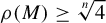 $\rho (M)\geq \sqrt [n]{4}$
and the result follows.
$\rho (M)\geq \sqrt [n]{4}$
and the result follows.
11 Proof of Theorem A
Now, we have all the necessary ingredients to deploy the proof of Theorem A as sketched in §5.
Proof of Theorem A
We prove the result by induction on the period n. For $n=3$
, there is nothing to prove, since the only pattern with positive entropy is
$n=3$
, there is nothing to prove, since the only pattern with positive entropy is $\mathcal {Q}_3$
. Let
$\mathcal {Q}_3$
. Let $\mathcal {P}$
be an n-periodic pattern and assume now that the theorem is true for any period less than n. By Theorem 4.2, we can assume that all openings of
$\mathcal {P}$
be an n-periodic pattern and assume now that the theorem is true for any period less than n. By Theorem 4.2, we can assume that all openings of $\mathcal {P}$
are zero entropy patterns.
$\mathcal {P}$
are zero entropy patterns.
If $\mathcal {P}$
is
$\mathcal {P}$
is $\pi $
-reducible for a basic path
$\pi $
-reducible for a basic path $\pi $
, then, by Proposition 3.7, it has a separated structure of
$\pi $
, then, by Proposition 3.7, it has a separated structure of $p\ge 2$
trivial blocks. The associated skeleton
$p\ge 2$
trivial blocks. The associated skeleton $\mathcal {S}$
is a p-periodic pattern and, by Corollary 3.6, its entropy is the same as
$\mathcal {S}$
is a p-periodic pattern and, by Corollary 3.6, its entropy is the same as $\mathcal {P}$
, positive. In particular,
$\mathcal {P}$
, positive. In particular, $p\ge 3$
. Since p is a strict divisor of n,
$p\ge 3$
. Since p is a strict divisor of n, $h(\mathcal {S})\ge \log (\unicode{x3bb} _p)$
by the induction hypothesis. Then,
$h(\mathcal {S})\ge \log (\unicode{x3bb} _p)$
by the induction hypothesis. Then, $h(\mathcal {P})>\log (\unicode{x3bb} _n)$
by Proposition 3.5 and we are done in this case.
$h(\mathcal {P})>\log (\unicode{x3bb} _n)$
by Proposition 3.5 and we are done in this case.
From now on, we will assume that $\mathcal {P}$
is
$\mathcal {P}$
is $\pi $
-irreducible. By Theorem D,
$\pi $
-irreducible. By Theorem D, $\mathcal {P}$
is either a k-flower or a triple chain.
$\mathcal {P}$
is either a k-flower or a triple chain.
Assume first that $\mathcal {P}$
is a k-flower. If
$\mathcal {P}$
is a k-flower. If $k=2$
, then we are done by Theorem 9.1. Otherwise, by Corollary 9.4,
$k=2$
, then we are done by Theorem 9.1. Otherwise, by Corollary 9.4, $\mathcal {P}$
has a subordinated
$\mathcal {P}$
has a subordinated $n'$
-periodic pattern
$n'$
-periodic pattern $\mathcal {P}'$
with positive entropy. Since
$\mathcal {P}'$
with positive entropy. Since $n'$
is a strict divisor of n,
$n'$
is a strict divisor of n, $h(\mathcal {P}')\ge \log (\unicode{x3bb} _{n'})$
by the induction hypothesis. Therefore,
$h(\mathcal {P}')\ge \log (\unicode{x3bb} _{n'})$
by the induction hypothesis. Therefore, $h(\mathcal {P})>\log (\unicode{x3bb} _n)$
by Lemma 9.2.
$h(\mathcal {P})>\log (\unicode{x3bb} _n)$
by Lemma 9.2.
Finally, we are left with the case that $\mathcal {P}$
is a triple chain. Since we are in the hypotheses of Corollary 10.10, then
$\mathcal {P}$
is a triple chain. Since we are in the hypotheses of Corollary 10.10, then $h(\mathcal {P})>\log (\sqrt [n]{4})$
. By Proposition 2.3(b), we are also done in this case and thus the theorem follows.
$h(\mathcal {P})>\log (\sqrt [n]{4})$
. By Proposition 2.3(b), we are also done in this case and thus the theorem follows.
12 Proof of Corollary B and Theorem C
In this section, we formally define the subfamily $\operatorname {\mathrm {Irr}}_n\subset \operatorname {\mathrm {Pos}}_n$
of all irreducible n-periodic patterns. Then, we recall some results relating reducibility and entropy, and finally prove Corollary B and Theorem C.
$\operatorname {\mathrm {Irr}}_n\subset \operatorname {\mathrm {Pos}}_n$
of all irreducible n-periodic patterns. Then, we recall some results relating reducibility and entropy, and finally prove Corollary B and Theorem C.
Let $\mathcal {P}$
be an n-periodic pattern. We say that
$\mathcal {P}$
be an n-periodic pattern. We say that $\mathcal {P}$
is reducible if it has a block structure. Otherwise,
$\mathcal {P}$
is reducible if it has a block structure. Otherwise, $\mathcal {P}$
will be said to be irreducible. From the characterization of zero entropy patterns given by Proposition 6.1, it follows that any irreducible pattern has positive entropy, so that
$\mathcal {P}$
will be said to be irreducible. From the characterization of zero entropy patterns given by Proposition 6.1, it follows that any irreducible pattern has positive entropy, so that $\operatorname {\mathrm {Irr}}_n\subset \operatorname {\mathrm {Pos}}_n$
. The next result states that
$\operatorname {\mathrm {Irr}}_n\subset \operatorname {\mathrm {Pos}}_n$
. The next result states that $\operatorname {\mathrm {Pos}}_n=\operatorname {\mathrm {Irr}}_n$
when either n is a prime or
$\operatorname {\mathrm {Pos}}_n=\operatorname {\mathrm {Irr}}_n$
when either n is a prime or $n=4$
.
$n=4$
.
Lemma 12.1. Any n-periodic pattern with positive entropy is irreducible if either n is a prime or $n=4$
.
$n=4$
.
Proof. Let $\mathcal {P}$
be an n-periodic pattern with
$\mathcal {P}$
be an n-periodic pattern with $h(\mathcal {P})>0$
. If n is a prime, then
$h(\mathcal {P})>0$
. If n is a prime, then $\mathcal {P}$
cannot be reducible since, by definition, the period of any pattern with a block structure has strict divisors. Assume that
$\mathcal {P}$
cannot be reducible since, by definition, the period of any pattern with a block structure has strict divisors. Assume that $n=4$
and that
$n=4$
and that $\mathcal {P}$
is reducible. In this case, the only possible block structure for
$\mathcal {P}$
is reducible. In this case, the only possible block structure for $\mathcal {P}$
is a separated 2-block structure of two trivial blocks. The corresponding skeleton is the trivial pattern of two points, with entropy zero. By Proposition 3.5,
$\mathcal {P}$
is a separated 2-block structure of two trivial blocks. The corresponding skeleton is the trivial pattern of two points, with entropy zero. By Proposition 3.5, $h(\mathcal {P})=0$
, which is a contradiction.
$h(\mathcal {P})=0$
, which is a contradiction.
Let us see that the patterns $\mathcal {Q}_n$
with minimum positive entropy (see Figure 2) are irreducible.
$\mathcal {Q}_n$
with minimum positive entropy (see Figure 2) are irreducible.
Lemma 12.2. Let $n\ge 3$
be a positive integer. Then, the pattern
$n\ge 3$
be a positive integer. Then, the pattern $\mathcal {Q}_n$
is irreducible.
$\mathcal {Q}_n$
is irreducible.
Proof. Let $(T,P,f)$
be a model of
$(T,P,f)$
be a model of $\mathcal {Q}_n$
and let
$\mathcal {Q}_n$
and let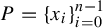 $P=\{x_i\}_{i=0}^{n-1}$
be time labelled. Recall that
$P=\{x_i\}_{i=0}^{n-1}$
be time labelled. Recall that $\{x_0,x_{n-1}\}$
is an extremal discrete component of
$\{x_0,x_{n-1}\}$
is an extremal discrete component of $\mathcal {Q}_n$
, with
$\mathcal {Q}_n$
, with $x_{n-1}$
being an endpoint. If
$x_{n-1}$
being an endpoint. If $\mathcal {Q}_n$
has a p-block structure
$\mathcal {Q}_n$
has a p-block structure $P_0\cup P_1\cup \cdots \cup P_{p-1}$
with
$P_0\cup P_1\cup \cdots \cup P_{p-1}$
with $p\ge 2$
, then the fact that
$p\ge 2$
, then the fact that  for
for $i\ne j$
implies that the block containing
$i\ne j$
implies that the block containing $x_{n-1}$
(say,
$x_{n-1}$
(say, $P_k$
) should also contain
$P_k$
) should also contain $x_0$
. Since
$x_0$
. Since $f(x_{n-1})=x_0$
, it follows that
$f(x_{n-1})=x_0$
, it follows that $f(P_k)\cap P_k\ne \emptyset $
, in contradiction with the definition of a block structure.
$f(P_k)\cap P_k\ne \emptyset $
, in contradiction with the definition of a block structure.
Now we are ready to prove Corollary B.
Let us proceed now with Theorem C that gives the minimum positive entropy when we restrict ourselves to the family of reducible n-periodic patterns. By Lemma 12.1, the problem makes sense only when n is a composite integer larger than 5. As we will see and in contrast to what happens for irreducible patterns, the minimum entropy reducible pattern is not unique.
Lemma 12.3. Let $n\ge 6$
be a composite integer and let p be the smallest proper divisor of n.
$n\ge 6$
be a composite integer and let p be the smallest proper divisor of n.
-
(a) The minimum value in the set
$\{(1/d)\log (\unicode{x3bb} _{n/d}): d\mbox { divides } n \mbox { and } d\ne 1,n\}$
is attained when
$d=p$
. -
(b) If
$n>6$
, then
$4^{1/n}>(\unicode{x3bb} _{n/p})^{1/p}$
.




Proof. Let us prove statement (a). It suffices to show that $(\unicode{x3bb} _{n/d})^{1/d}$
is minimum when
$(\unicode{x3bb} _{n/d})^{1/d}$
is minimum when $d=p$
. Since
$d=p$
. Since $\unicode{x3bb} _i>1$
for any
$\unicode{x3bb} _i>1$
for any $i\ge 3$
, this is equivalent to show that
$i\ge 3$
, this is equivalent to show that $(\unicode{x3bb} _{n/d})^{n/d}$
is minimum when
$(\unicode{x3bb} _{n/d})^{n/d}$
is minimum when $d=p$
. This claim will be true if we prove that
$d=p$
. This claim will be true if we prove that $(\unicode{x3bb} _k)^k$
is decreasing in k. By definition,
$(\unicode{x3bb} _k)^k$
is decreasing in k. By definition, $\unicode{x3bb} _i$
satisfies
$\unicode{x3bb} _i$
satisfies $(\unicode{x3bb} _i)^i-2\unicode{x3bb} _i-1=0$
. However, Proposition 2.3(a) tells us that
$(\unicode{x3bb} _i)^i-2\unicode{x3bb} _i-1=0$
. However, Proposition 2.3(a) tells us that $\unicode{x3bb} _k$
decreases with k. Putting all together yields
$\unicode{x3bb} _k$
decreases with k. Putting all together yields $(\unicode{x3bb} _k)^k=2\unicode{x3bb} _k+1>2\unicode{x3bb} _{k+1}+1=(\unicode{x3bb} _{k+1})^{k+1}$
.
$(\unicode{x3bb} _k)^k=2\unicode{x3bb} _k+1>2\unicode{x3bb} _{k+1}+1=(\unicode{x3bb} _{k+1})^{k+1}$
.
Let us prove statement (b). We have to show that $4^{1/n}>(\unicode{x3bb} _{n/p})^{1/p}$
, which is equivalent to prove that
$4^{1/n}>(\unicode{x3bb} _{n/p})^{1/p}$
, which is equivalent to prove that $4>(\unicode{x3bb} _{n/p})^{n/p}=2\unicode{x3bb} _{n/p}+1$
. This will be true if
$4>(\unicode{x3bb} _{n/p})^{n/p}=2\unicode{x3bb} _{n/p}+1$
. This will be true if $3/2>\unicode{x3bb} _{n/p}$
. Now observe that
$3/2>\unicode{x3bb} _{n/p}$
. Now observe that $n\ge 8$
and
$n\ge 8$
and $n/p\ge 4$
because
$n/p\ge 4$
because $n>6$
is composite. Since
$n>6$
is composite. Since $\unicode{x3bb} _k$
decreases with k,
$\unicode{x3bb} _k$
decreases with k, $\unicode{x3bb} _{n/p}\le \unicode{x3bb} _4\approx 1.39$
and we are done.
$\unicode{x3bb} _{n/p}\le \unicode{x3bb} _4\approx 1.39$
and we are done.
We will prove Theorem C in two steps. First, we will show that if $\mathcal {P}$
is an n-periodic and reducible pattern with positive entropy, then
$\mathcal {P}$
is an n-periodic and reducible pattern with positive entropy, then $h(\mathcal {P})\ge \log (\unicode{x3bb} _{n/p})/p$
, where p is the smallest prime factor of n. Second, we will provide examples of patterns attaining precisely this entropy.
$h(\mathcal {P})\ge \log (\unicode{x3bb} _{n/p})/p$
, where p is the smallest prime factor of n. Second, we will provide examples of patterns attaining precisely this entropy.
To find examples of reducible patterns with minimum positive entropy, we use the following construction, a generalization of the classic notion of extension for interval patterns [Reference Block16]. Let $\mathcal {R}$
be a k-periodic pattern and let
$\mathcal {R}$
be a k-periodic pattern and let $p\ge 2$
be an integer. A p-extension of
$p\ge 2$
be an integer. A p-extension of $\mathcal {R}$
is a
$\mathcal {R}$
is a $pk$
-periodic pattern
$pk$
-periodic pattern $\mathcal {P}$
such that, for any model
$\mathcal {P}$
such that, for any model $(T,P,f)$
of
$(T,P,f)$
of $\mathcal {P}$
, there is a separated p-block structure
$\mathcal {P}$
, there is a separated p-block structure $P=P_0\cup P_1\cup \cdots \cup P_{p-1}$
satisfying the following statements.
$P=P_0\cup P_1\cup \cdots \cup P_{p-1}$
satisfying the following statements.
-
(a) The associated skeleton is a trivial p-periodic pattern.
-
(b) The pattern
is
$\mathcal {R}$
. -
(c) For
$1\le i<p$
, the pattern is trivial.
 is
is 

 is trivial.
There are several possible p-extensions of a given pattern, see Figure 21 for an example. The next result states that, in any case, all the possible p-extensions have the same entropy. This fact is well known for extensions of interval patterns and other similar constructions, and the same proof applies in this setting. See for instance of [Reference Alsedà, Llibre and Misiurewicz9, Lemma 4.4.16].
Two different 3-extensions of a 5-periodic pattern $\mathcal {R}$
. In both cases, the patterns of
$\mathcal {R}$
. In both cases, the patterns of $f^3$
in each block are either trivial or
$f^3$
in each block are either trivial or $\mathcal {R}$
itself, and the skeleton is the trivial 3-periodic pattern.
$\mathcal {R}$
itself, and the skeleton is the trivial 3-periodic pattern.

Lemma 12.4. If $\mathcal {P}$
is a p-extension of a pattern
$\mathcal {P}$
is a p-extension of a pattern $\mathcal {R}$
, then
$\mathcal {R}$
, then $h(\mathcal {P})=h(\mathcal {R})/p$
.
$h(\mathcal {P})=h(\mathcal {R})/p$
.
Now, we are ready to prove Theorem C.
Proof of Theorem C
Let $\mathcal {P}$
be an n-periodic and reducible pattern with positive entropy. We claim first that
$\mathcal {P}$
be an n-periodic and reducible pattern with positive entropy. We claim first that $h(\mathcal {P})\ge \log (\unicode{x3bb} _{n/p})/p$
, where p is the smallest prime factor of n.
$h(\mathcal {P})\ge \log (\unicode{x3bb} _{n/p})/p$
, where p is the smallest prime factor of n.
Recall (Lemma 4.3) that after performing an opening on $\mathcal {P}$
, the obtained pattern is also reducible, and, by Theorem 4.2, its entropy is less or equal to
$\mathcal {P}$
, the obtained pattern is also reducible, and, by Theorem 4.2, its entropy is less or equal to $h(\mathcal {P})$
. Therefore, from now on, we can assume that
$h(\mathcal {P})$
. Therefore, from now on, we can assume that $\mathcal {P}$
satisfies the property (⋆) introduced in §5.
$\mathcal {P}$
satisfies the property (⋆) introduced in §5.
Assume that $\mathcal {P}$
is
$\mathcal {P}$
is $\pi $
-reducible for some basic path
$\pi $
-reducible for some basic path $\pi $
. By Proposition 3.7,
$\pi $
. By Proposition 3.7, $\mathcal {P}$
has a separated block structure of
$\mathcal {P}$
has a separated block structure of $k\ge 2$
trivial blocks, where k is a strict divisor of n. Moreover, if
$k\ge 2$
trivial blocks, where k is a strict divisor of n. Moreover, if $\mathcal {S}$
is the corresponding skeleton, then
$\mathcal {S}$
is the corresponding skeleton, then $h(\mathcal {S})=h(\mathcal {P})$
by Proposition 3.5. In particular, since
$h(\mathcal {S})=h(\mathcal {P})$
by Proposition 3.5. In particular, since $\mathcal {S}$
is k-periodic and
$\mathcal {S}$
is k-periodic and $h(\mathcal {P})>0$
, it follows that
$h(\mathcal {P})>0$
, it follows that $k>2$
. Now, Theorem A tells us that
$k>2$
. Now, Theorem A tells us that $h(\mathcal {S})\ge \log (\unicode{x3bb} _k)$
. If we set
$h(\mathcal {S})\ge \log (\unicode{x3bb} _k)$
. If we set $d:=n/k$
, we have that
$d:=n/k$
, we have that
 $$ \begin{align*} h(\mathcal{P})=h(\mathcal{S})\ge\log(\unicode{x3bb}_k)=\log(\unicode{x3bb}_{n/d})>\log(\unicode{x3bb}_{n/d})/d, \end{align*} $$
which, from Lemma 12.3(a), is larger than or equal to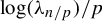 $\log (\unicode{x3bb} _{n/p})/p$
. So, the claim is proved when
$\log (\unicode{x3bb} _{n/p})/p$
. So, the claim is proved when $\mathcal {P}$
is
$\mathcal {P}$
is $\pi $
-reducible.
$\pi $
-reducible.
From now on, we assume that $\mathcal {P}$
is
$\mathcal {P}$
is $\pi $
-irreducible. Theorem D and property (⋆) imply then that
$\pi $
-irreducible. Theorem D and property (⋆) imply then that $\mathcal {P}$
is either a k-flower or a triple chain.
$\mathcal {P}$
is either a k-flower or a triple chain.
Assume first that $\mathcal {P}$
is a k-flower. Let
$\mathcal {P}$
is a k-flower. Let $(T,P,f)$
be a model of
$(T,P,f)$
be a model of $\mathcal {P}$
and let x be the only inner point. Since
$\mathcal {P}$
and let x be the only inner point. Since $\mathcal {P}$
is reducible, it has a d-block structure. Let
$\mathcal {P}$
is reducible, it has a d-block structure. Let $P_0$
be the block containing x. Note that, by the definition of a block structure and the fact that x is the unique inner point, all the remaining blocks are trivial. Consider the
$P_0$
be the block containing x. Note that, by the definition of a block structure and the fact that x is the unique inner point, all the remaining blocks are trivial. Consider the $(n/d)$
-periodic pattern
$(n/d)$
-periodic pattern  . Since $h(\mathcal {R})$
is smaller than or equal to the entropy of any map exhibiting
$h(\mathcal {R})$
is smaller than or equal to the entropy of any map exhibiting $\mathcal {R}$
and
$\mathcal {R}$
and $f^d$
exhibits
$f^d$
exhibits $\mathcal {R}$
,
$\mathcal {R}$
,
 $$ \begin{align} h(\mathcal{R})\le h(f^d)=d\cdot h(f)=d\cdot h(\mathcal{P}). \end{align} $$
Observe that if there exists some basic path $\pi \subset P_0$
of
$\pi \subset P_0$
of $\mathcal {R}$
that never splits by
$\mathcal {R}$
that never splits by $f^d$
, then
$f^d$
, then $\pi $
never splits by f, because all blocks different from
$\pi $
never splits by f, because all blocks different from $P_0$
are trivial. In this case,
$P_0$
are trivial. In this case, $\mathcal {P}$
would be
$\mathcal {P}$
would be $\pi $
-reducible, which is a contradiction. As a consequence,
$\pi $
-reducible, which is a contradiction. As a consequence, $\mathcal {R}$
is
$\mathcal {R}$
is $\pi $
-irreducible. In particular,
$\pi $
-irreducible. In particular, $h(\mathcal {R})>0$
. Thus, by Theorem A,
$h(\mathcal {R})>0$
. Thus, by Theorem A, $h(\mathcal {R})\ge \log (\unicode{x3bb} _{n/d})$
. Using equation (12.1) yields
$h(\mathcal {R})\ge \log (\unicode{x3bb} _{n/d})$
. Using equation (12.1) yields $h(\mathcal {P})\ge \log (\unicode{x3bb} _{n/d})/d$
which, from Lemma 12.3(a), is larger than or equal to
$h(\mathcal {P})\ge \log (\unicode{x3bb} _{n/d})/d$
which, from Lemma 12.3(a), is larger than or equal to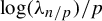 $\log (\unicode{x3bb} _{n/p})/p$
. So, the claim is proved in this case.
$\log (\unicode{x3bb} _{n/p})/p$
. So, the claim is proved in this case.
Finally, assume that $\mathcal {P}$
is a triple chain. We treat first the special case
$\mathcal {P}$
is a triple chain. We treat first the special case $n=6$
. In this case,
$n=6$
. In this case, $\mathcal {P}$
cannot have a 3-structure of blocks of two points, since
$\mathcal {P}$
cannot have a 3-structure of blocks of two points, since $\mathcal {P}$
would be
$\mathcal {P}$
would be $\pi $
-reducible. So, the only possibility is that
$\pi $
-reducible. So, the only possibility is that $\mathcal {P}$
has a 2-structure of blocks of three points. Again, if both blocks were trivial,
$\mathcal {P}$
has a 2-structure of blocks of three points. Again, if both blocks were trivial, $\mathcal {P}$
would be
$\mathcal {P}$
would be $\pi $
-reducible. So, in at least one of the two blocks,
$\pi $
-reducible. So, in at least one of the two blocks, $P_0$
, the pattern
$P_0$
, the pattern  is a non-trivial 3-periodic pattern. Such a pattern is uniquely determined and coincides with the 3-periodic Štefan cycle of the interval [Reference Štefan31], with entropy $\log (\unicode{x3bb} _3)$
. Using the same argument as in the previous paragraph, the claim follows also in the case
$\log (\unicode{x3bb} _3)$
. Using the same argument as in the previous paragraph, the claim follows also in the case $n=6$
.
$n=6$
.
Finally, if $n>6$
, since
$n>6$
, since $\mathcal {P}$
is
$\mathcal {P}$
is $\pi $
-irreducible and property (⋆) holds, then Corollary 10.10 tells us that
$\pi $
-irreducible and property (⋆) holds, then Corollary 10.10 tells us that $h(\mathcal {P})>\log (\sqrt [n]{4})$
, larger than or equal to
$h(\mathcal {P})>\log (\sqrt [n]{4})$
, larger than or equal to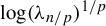 $\log (\unicode{x3bb} _{n/p})^{1/p}$
by Lemma 12.3(b). The claim, thus, holds also in this case.
$\log (\unicode{x3bb} _{n/p})^{1/p}$
by Lemma 12.3(b). The claim, thus, holds also in this case.
Once the claim that gives a lower bound for the entropy of $\mathcal {P}$
is proven, we have to give an example of a reducible n-periodic pattern having precisely this entropy. By Lemma 12.4, it is enough to consider any p-extension of
$\mathcal {P}$
is proven, we have to give an example of a reducible n-periodic pattern having precisely this entropy. By Lemma 12.4, it is enough to consider any p-extension of $\mathcal {Q}_{n/p}$
.
$\mathcal {Q}_{n/p}$
.
Acknowledgements
This work was funded by grants PID2020-118281GB-C31 and PID2023- 146424NB-I00 of Ministerio de Ciencia e Innovación, and 2021 SGR 00113 of Generalitat de Catalunya.

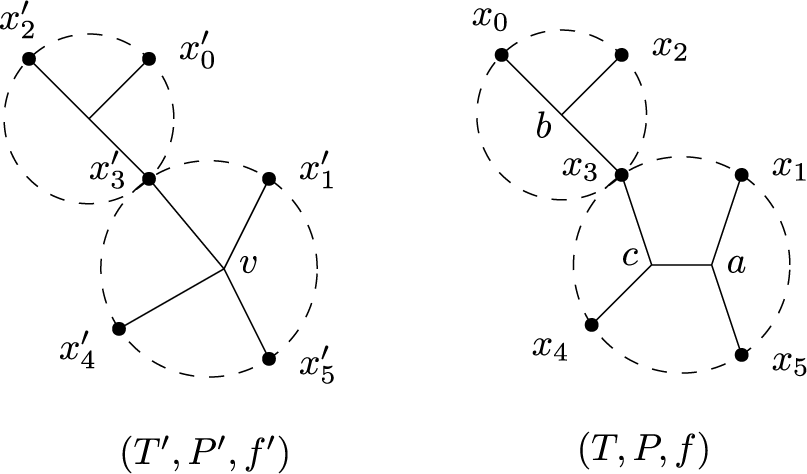


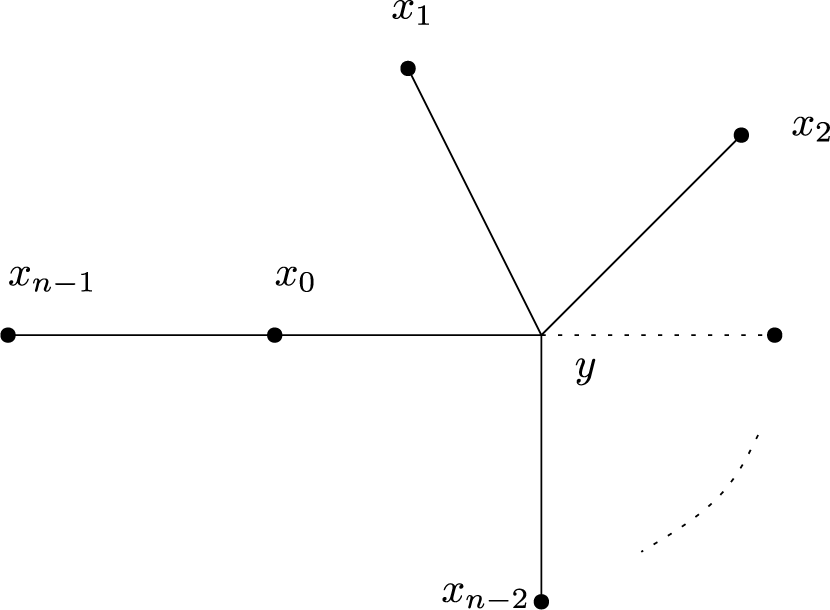


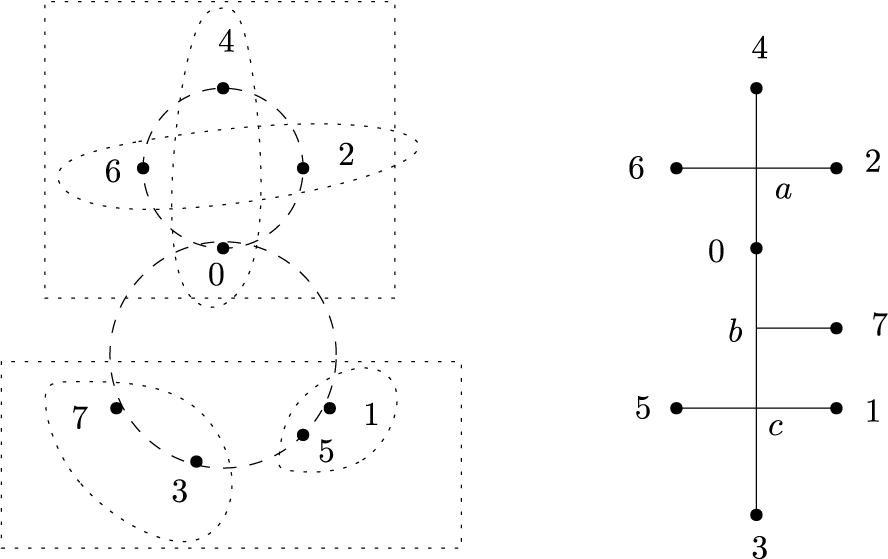





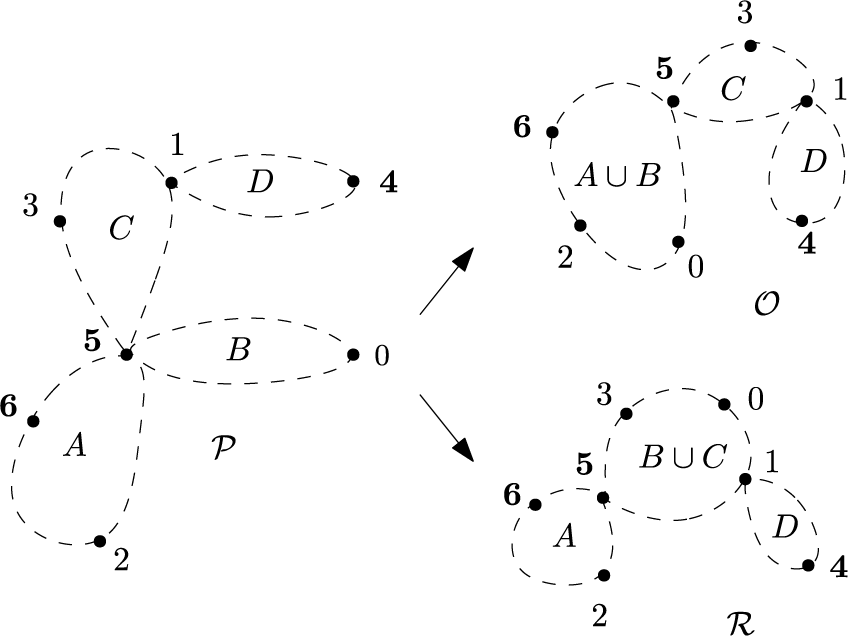

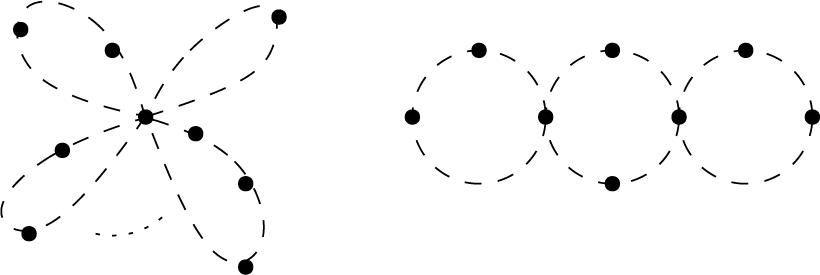
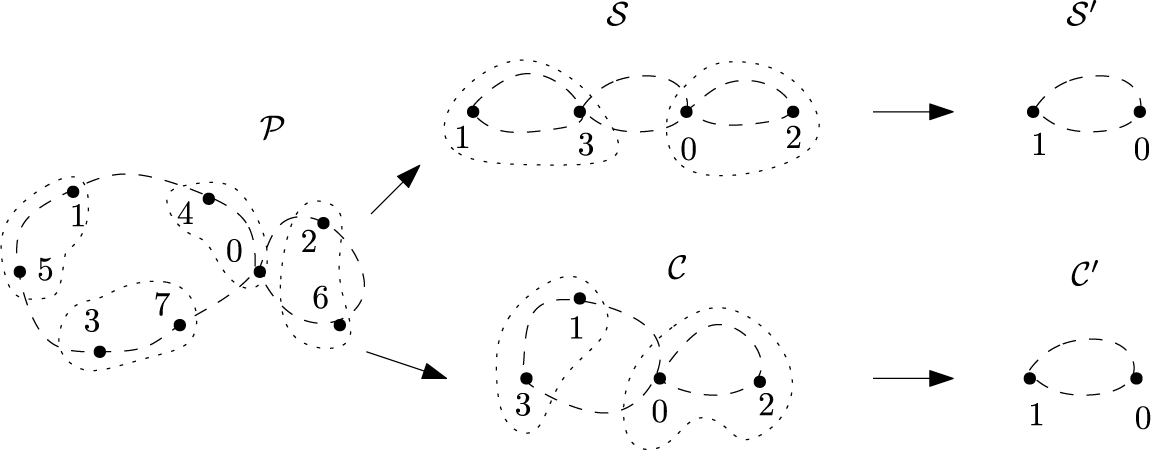
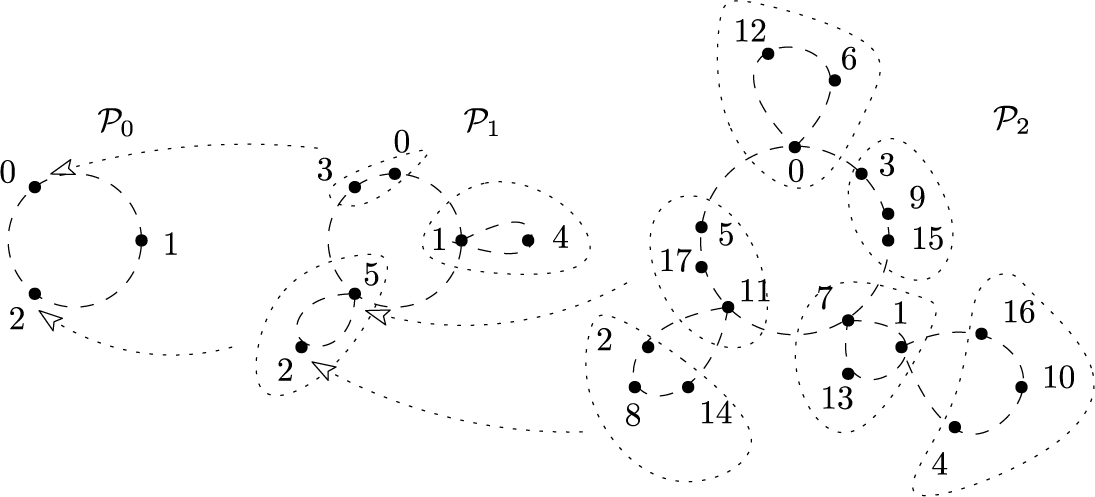

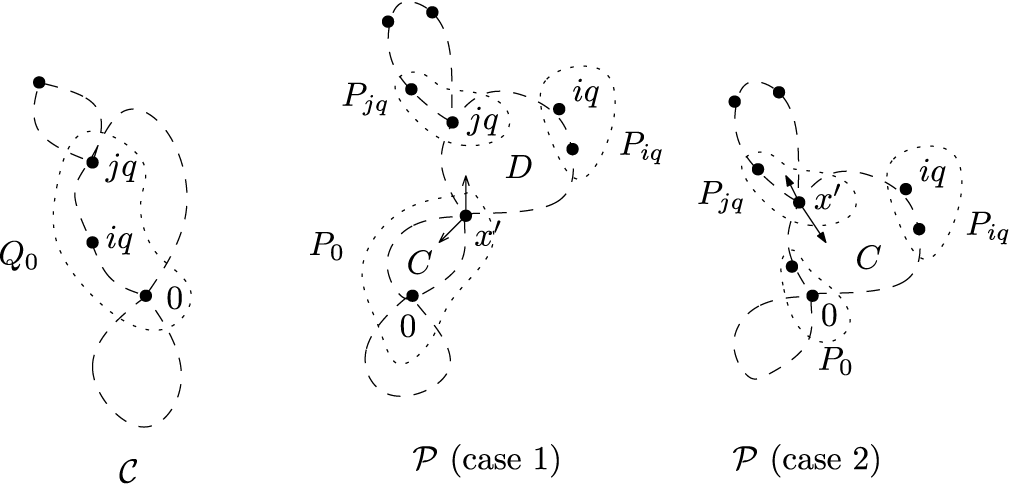


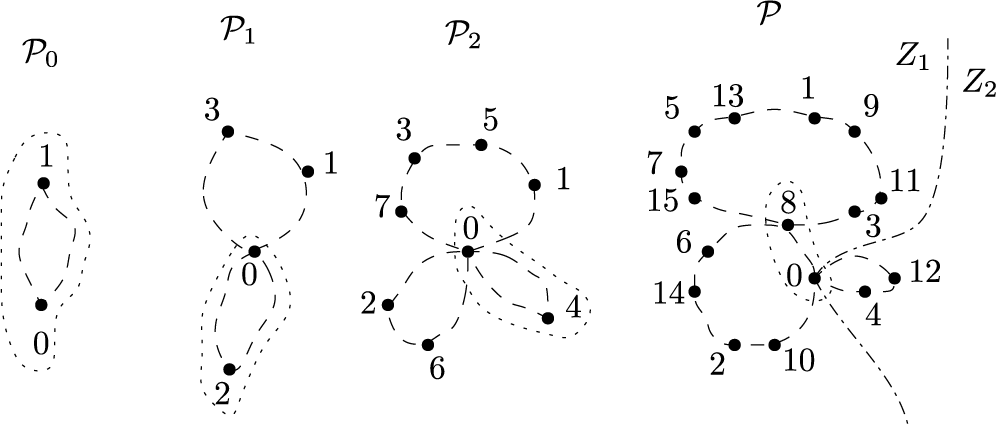


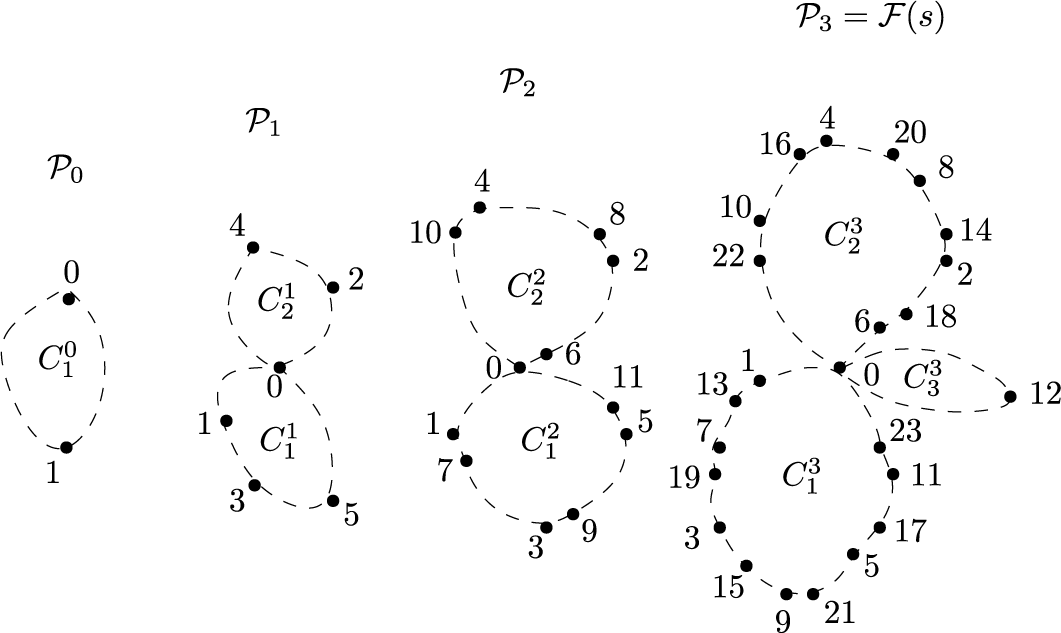


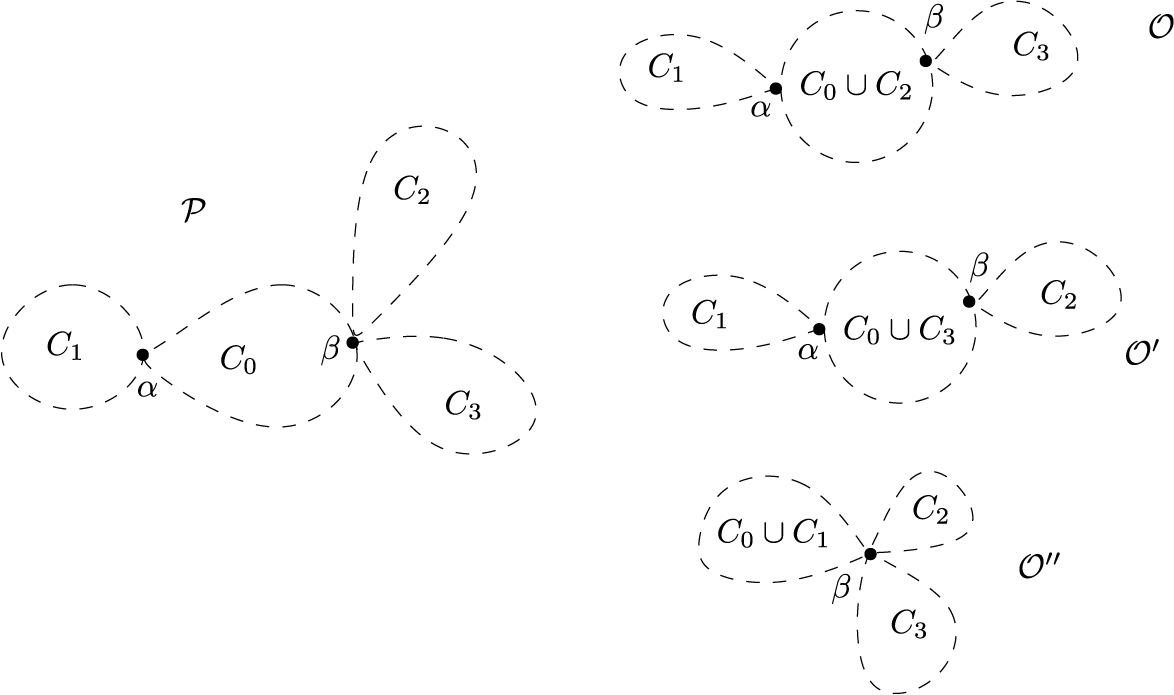
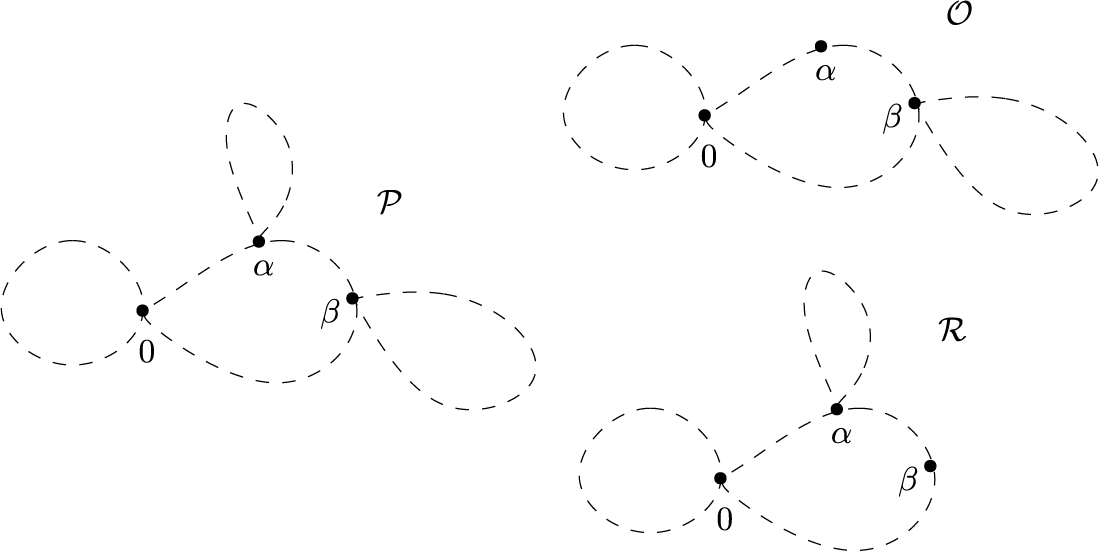
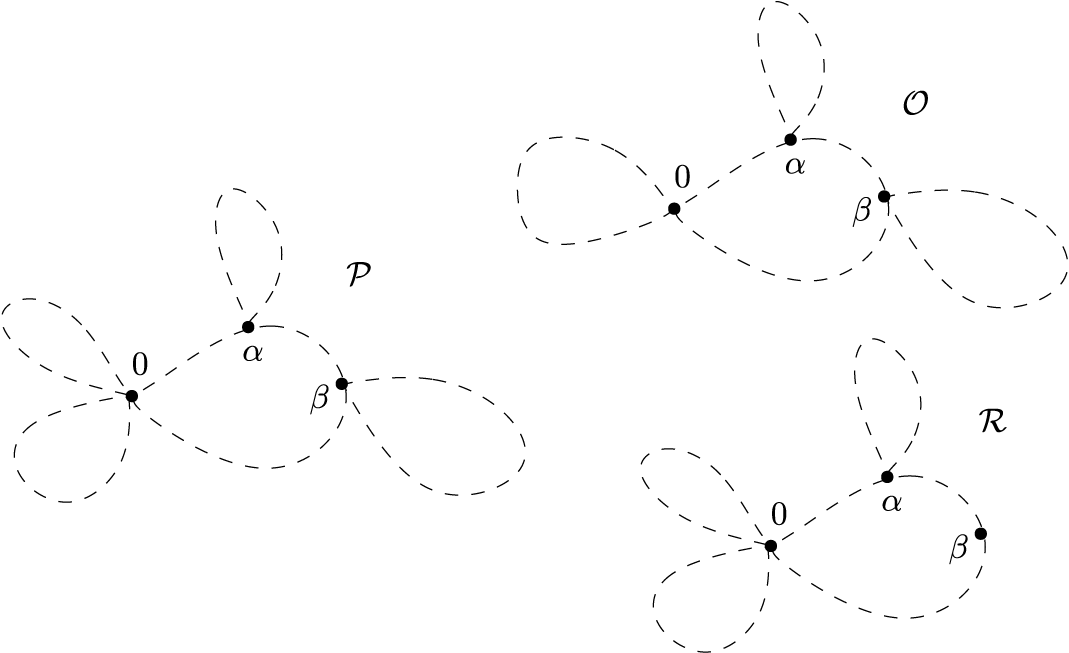
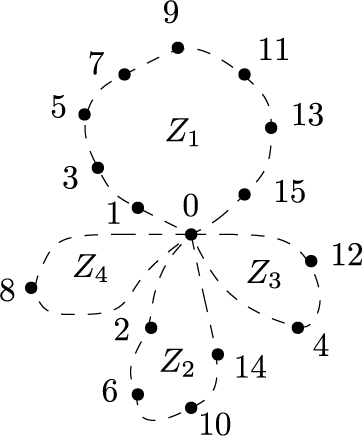
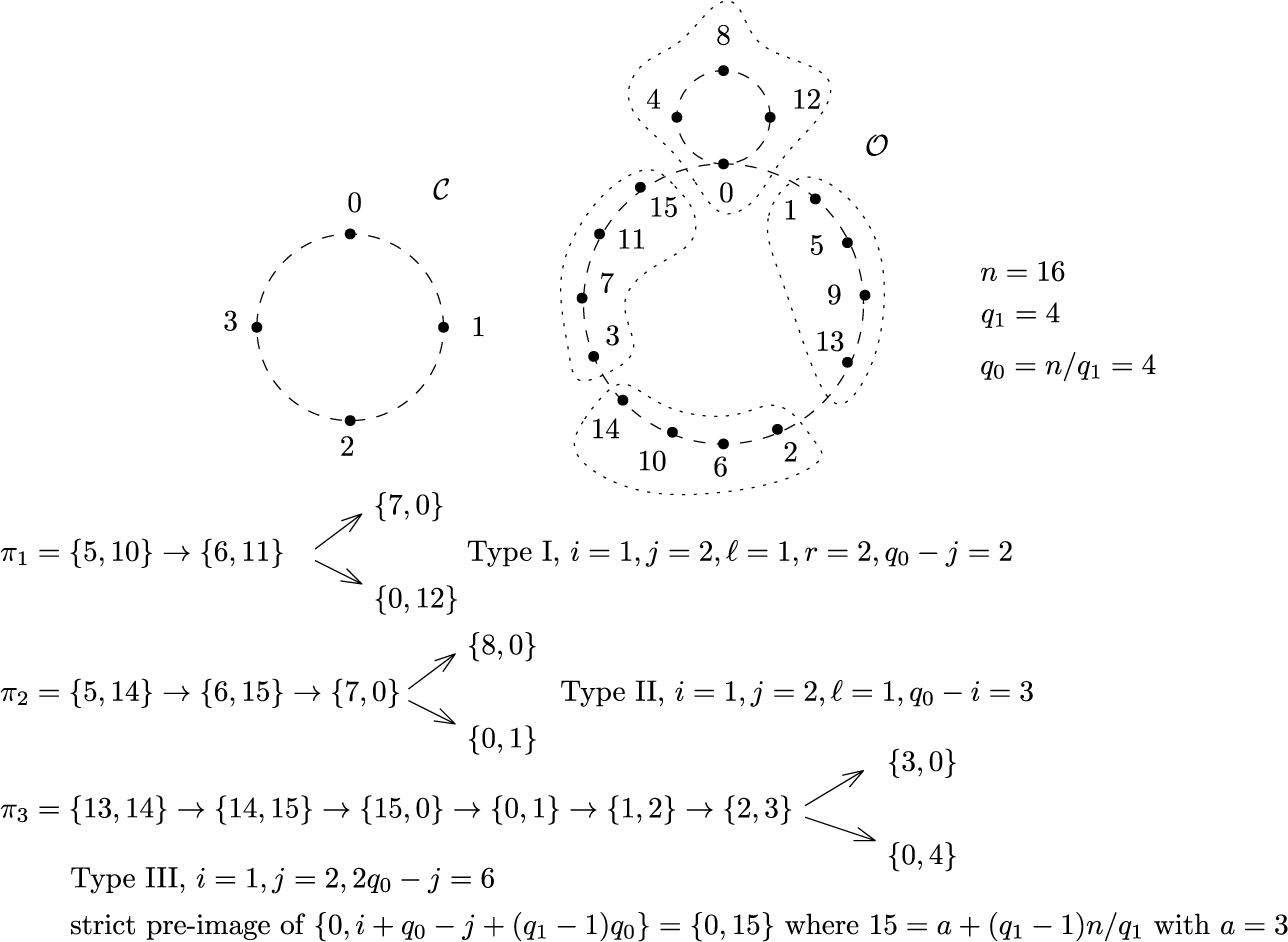
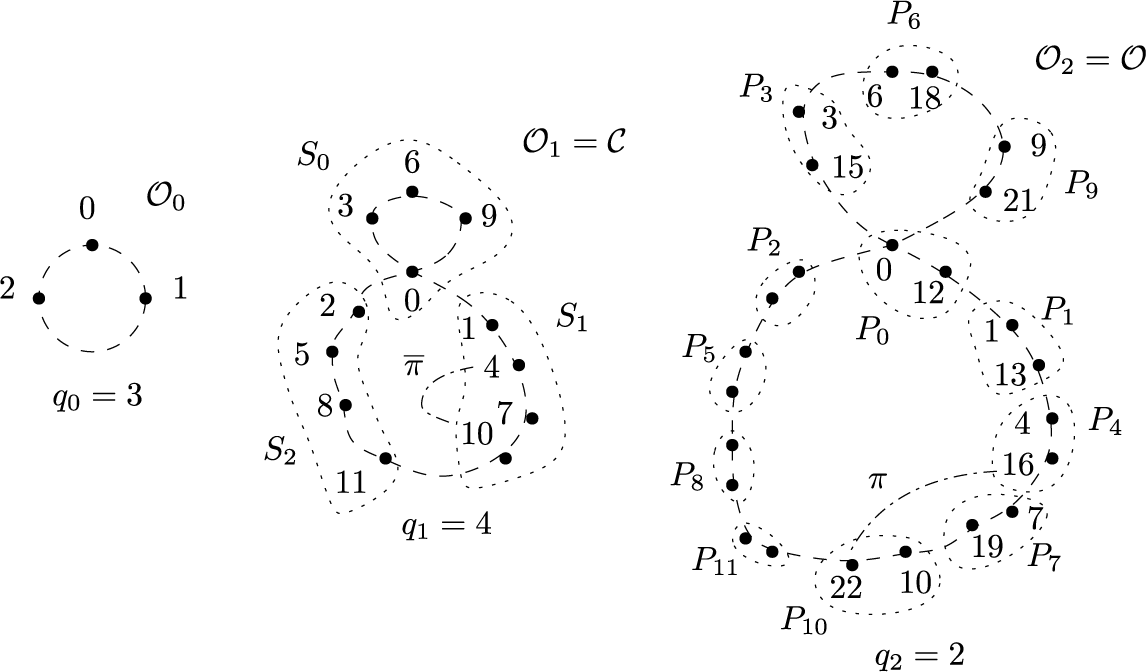
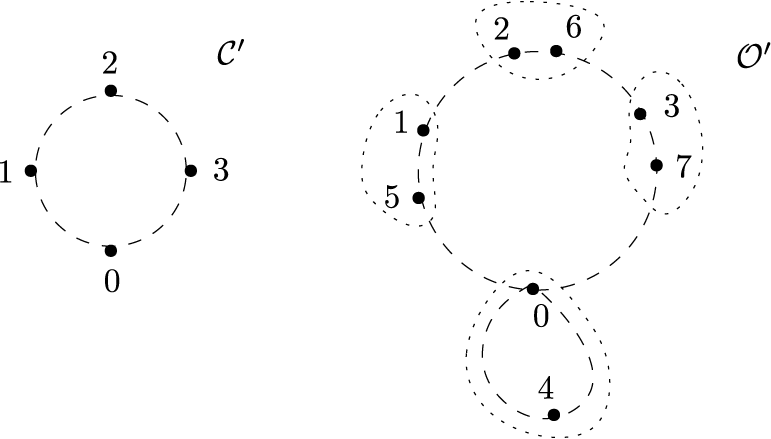


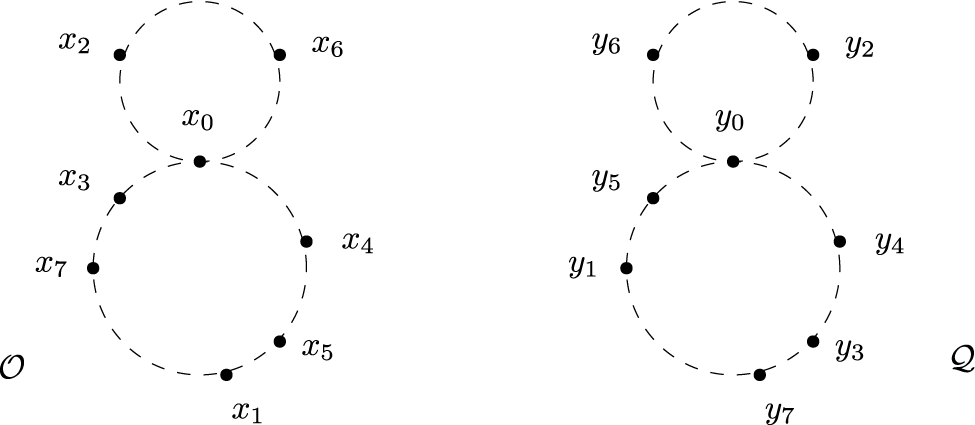


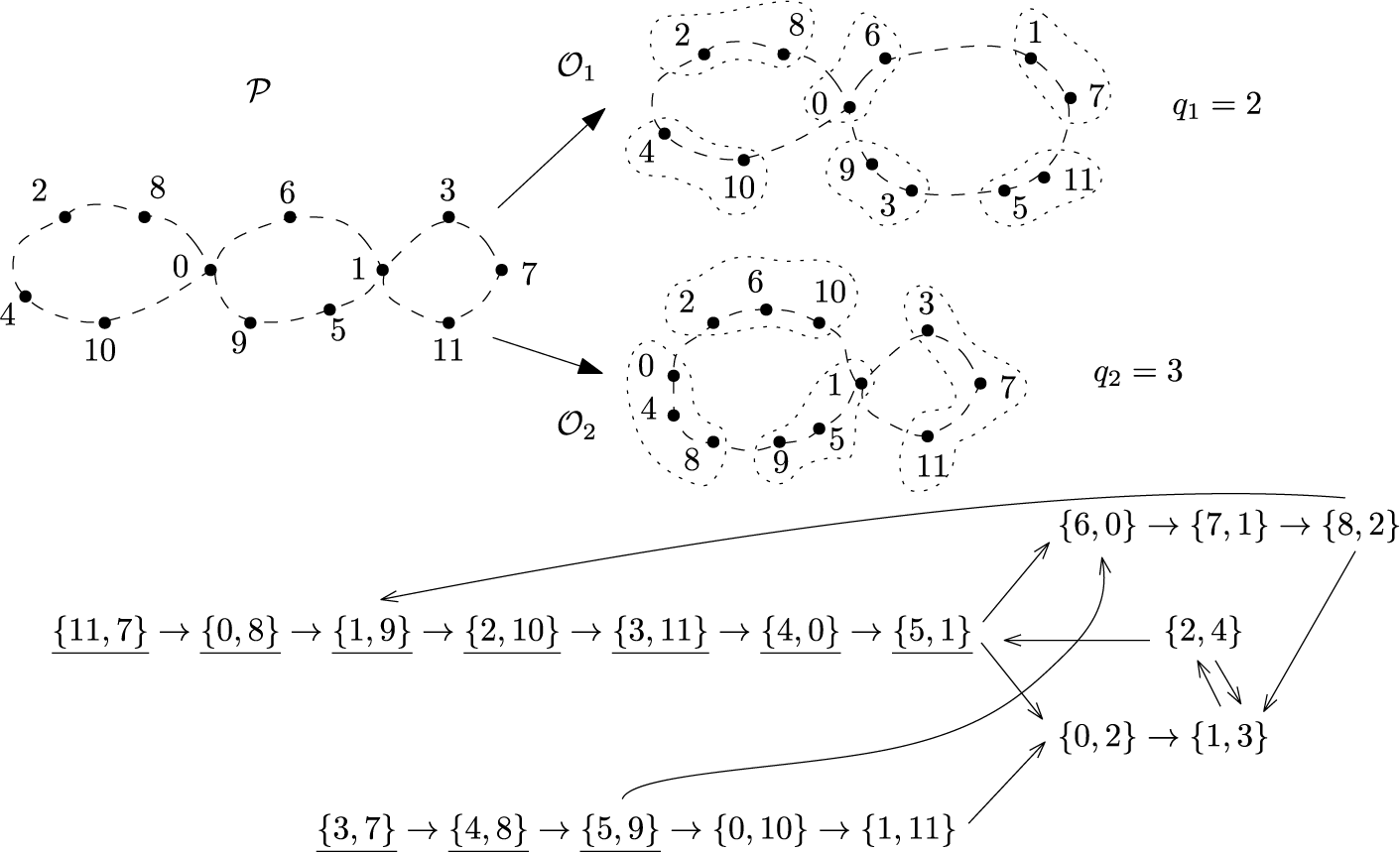


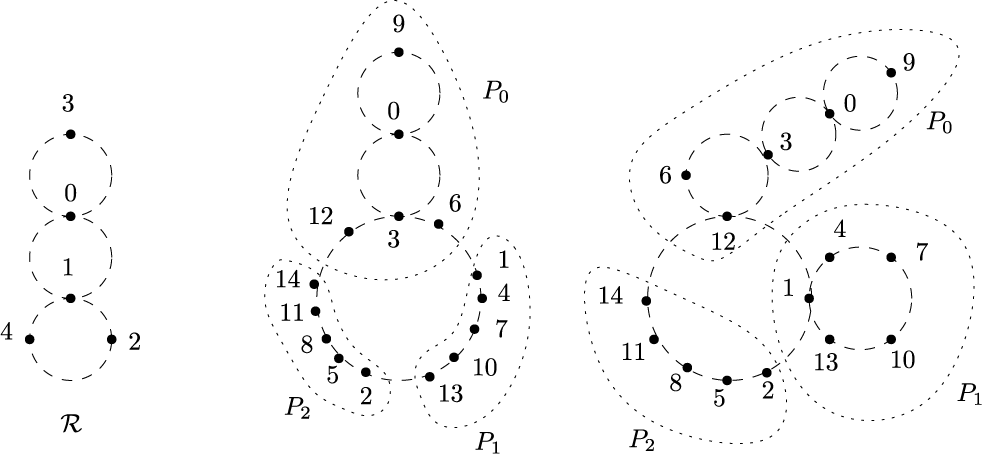


 Open access

