


In May 2009, the ‘Thursday Veggie Day’ campaign was launched in Ghent, a Flemish university town of nearly 250 000 people. The Ghent City Council adopted Thursdays as a vegetarian day for public canteens in an attempt to motivate employees in public settings to eat less meat. The campaign was launched in cooperation with the Belgian vegetarian organization EVA (Ethical Vegetarian Alternative; http://www.vegetarisme.be). For the purposes of ‘Thursday Veggie Day’, ‘vegetarian’ refers to lacto-ovo-vegetarian meals in which no meat, poultry or fish is consumed, but dairy products and eggs are allowed.
Vegetarian diets are associated with a number of health advantages including lower BMI(Reference Spencer, Appleby and Davey1), improved blood lipid levels and lower risk of IHD(Reference Craig and Mangels2), diabetes, diverticular disease(Reference Crowe, Appleby and Allen3) and some cancers(Reference Craig and Mangels2, Reference Gonzalez, Jakszyn and Pera4). Also, observations from large prospective cohorts suggest that lifestyle patterns including low meat intake are associated with increased longevity(Reference Singh, Sabate and Fraser5). Few studies have looked at the health benefits of vegetarianism in childhood; however, a vegetarian diet has been associated with higher fruit and vegetable intake among children(Reference Smith, Emmett and Newby6). Vegetarian children also tend to be leaner(Reference Sabate and Wien7), and tracking of overweight(Reference Singh, Mulder and Twisk8), obesity(Reference Starc and Strel9) and obesity-related diet behaviour(Reference Craigie, Lake and Kelly10) from childhood to adulthood has been reported, supporting the need for implementation of preventive measures during childhood.
In September 2009, the project was expanded to include all primary schools (age 6–12 years), early childhood education centres (age 3–6 years) and kindergartens (age 18 months–3 years) in Ghent. In October 2010, 93 % of meals in Ghent city schools were vegetarian on Thursdays(11). Parents who do not want their child to eat a vegetarian meal are able to order a conventional meal (although this is rare).
In order to contribute to the goal of enhanced public health, the ‘Thursday Veggie Day’ initiative in schools would need to result in children consuming food that is more nutritious than conventional meals. This relies both on the foods offered on ‘Thursday Veggie Day’ being more nutritious than conventional meals and on these foods being sufficiently acceptable to children to be eaten.
The objectives of the present study were therefore to: (i) investigate how acceptable the vegetarian meals were to children; and (ii) assess the nutritional quality of the vegetarian meals offered on ‘Thursday Veggie Day’ in two primary schools.
Methods
In cooperation with the Department of Education in the city of Ghent, two schools were contacted to participate in the study because they provided lunch for at least 100 children each school day.
All school lunches in primary schools in Ghent, including the meals for ‘Thursday Veggie Day’, are prepared and delivered as meal components by the same caterer (Deliva, Genk). All meal components are delivered as standardized portions. The sizes of these portions are formalized in an agreement between the caterer and the city of Ghent and are based on the most recent instructions of Kind & Gezin (‘Child & Family’), a Flemish governmental advisory organization for families and young children(12). The portion size for soup is set at 200 ml. All main courses are divided into the following meal components: sauces (50 g), vegetables (175 g), potatoes or other starch components (175 g), and meat or vegetarian meat analogues (such as a tofu burger; 110 g). Because no standard portion sizes are provided for desserts we used weights of common standard measures in our calculations (e.g. one apple)(13).
Evaluation of acceptability
A visual plate waste study was used to determine if the children found the vegetarian school lunches acceptable(Reference Connors and Rozell14). A tick sheet with a five-point rating scale from ‘none consumed’ to ‘all consumed’ was used to assess food leftovers of edible portions of each of the different meal components using a standardized procedure. At the time of data collection, conventional menus comprised more meal components than the vegetarian menus, leading to a higher number of plate waste observations for conventional meals. In each school, four plate waste observations were performed on four different observation days: two on a regular day and two on a ‘Thursday Veggie Day’. The observed vegetarian menus were the four consecutive menus from a 1-month menu cycle at the time of data collection. The conventional menus that were observed were selected at random from the same menu cycle as the vegetarian menus.
Before data collection, a pilot test was performed during which the investigator tested plate waste estimation accuracy by scoring the waste of twenty-four lunch trays and comparing these results with weighted plate waste. All estimations fell between 85 % and 105 % of measured weights and were therefore considered sufficiently accurate.
Data analysis was performed using the statistical software package PASW Statistics version 18·0·0 (IBM SPSS Inc., Chicago, IL, USA). Differences in visual plate waste between conventional and vegetarian menus were tested using the Mann–Whitney U rank test. Statistical significance was determined by P < 0·05.
Evaluation of nutritional quality
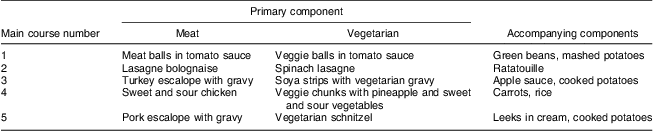
The meat and vegetarian (‘primary’) components of five consecutive vegetarian menus and five comparable conventional menus were evaluated during the winter season (Table 1). Product sheets provided by the caterer listed all ingredients for each component. This information was used to calculate the amount of energy, saturated fat and fibre provided per 100 g of prepared product using the Belgian food composition database Nubel(15) and the portion sizes described above. Only the meat and vegetarian components of the main courses were calculated because accompanying components of the conventional and vegetarian main courses were identical (e.g. both meat and veggie balls in tomato sauce were accompanied by green beans and mashed potatoes).
Conventional and vegetarian primary components of the main courses selected for nutritional evaluation
Three criteria were used for the nutritional evaluation of the primary component of the main course: (i) a maximum of 30 % of energy from fat; (ii) a maximum of one-third of fat as saturated fat; and (iii) a minimum of 1·5 g of dietary fibre per 420 kJ(16). For the present study, the maximum achievable score for each primary component was 3, which required that all three nutritional evaluation criteria were met.
Results
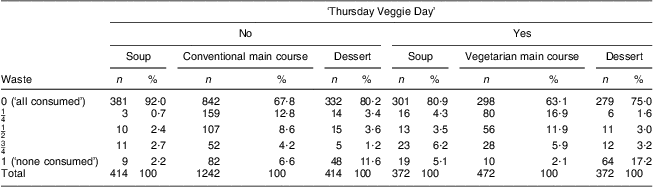
In total, 3286 observations were performed (Table 2). The small apparent difference in waste from the main course between vegetarian menus (mean rank 876) and conventional menus (mean rank 850) was not statistically significant (U = 284 232; P = 0·247). For soup and dessert, there was a significant difference in intake between ‘Thursday Veggie Day’ and regular days. Both for soup (U = 68 522; P < 0·001) and dessert (U = 72 445; P = 0·048), there was less waste on a regular day compared with a vegetarian one.
Plate waste observations during eight canteen lunches in two primary schools, Ghent, Belgium
The nutritional properties of the ten main courses are presented in Table 3. The percentage of energy from fat exceeded 30 % in three out of five of both the conventional and vegetarian components. In all meat components, the percentage of fat from saturated fat was higher than one-third. This was the case for only one of the vegetarian alternatives. All the vegetarian components provided a minimum of 1·5 g of fibre per 420 kJ compared with none of the meat components.
Nutritional properties of five conventional and five vegetarian components of ten main coursesFootnote *, Ghent, Belgium
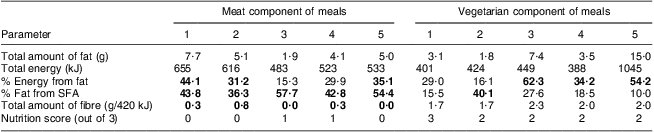
* Parameters calculated per 100 g of prepared product (except for fibre: g per 420 kJ of prepared product). Bold highlighting indicates a poor nutritional quality score.
Discussion
The present results demonstrate that vegetarian meals can be both nutritious and acceptable to a primary-school population. However, vegetarian meals are not always nutritious – three vegetarian main courses exceeded the 30 % of energy from fat criterion because of their high fat absorption during preparation (e.g. schnitzel), suggesting that care must be taken when designing vegetarian menus. One vegetarian menu (spinach lasagne) also failed the criterion of having a maximum of one-third of fat from saturated fat because of its full-fat cheese content (cheese sauce).
For the nutritional evaluation, only the meat and vegetarian alternative components of main courses were assessed. Because of the low fibre content of meat, the conventional components yielded a low score for that criterion. However, this does not necessary imply a low fibre content for the entire conventional meal. If, for instance, the accompaniments were vegetables and potatoes, then the conventional meals would provide less fibre than the meals with the vegetarian alternative, but would still be likely to provide more than 1·5 g of fibre per 420 kJ.
Overall, the findings of the study indicate that the children from the examined primary schools in Ghent find the vegetarian lunches as acceptable as the conventional menus. This suggests that vegetarian meals may be acceptable as part of the usual menu cycle on other weekdays. Certainly, there was no evidence that less of the vegetarian main course was being consumed than the conventional main course, nor was there any evidence of compensatory additional consumption of the soup or dessert courses when a vegetarian main course was offered. In fact, when vegetarian main courses were offered, significantly less soup and dessert were consumed.
No previous studies have evaluated the concept of weekly vegetarian days; however, our findings are similar to those of Lazor et al.(Reference Lazor, Chapman and Levine17), who tested the acceptance of soya products in middle-school lunches. They found that middle-school students in a large and highly diverse school district readily accepted soya alternatives over conventional menus.
Adult vegetarians, even those who continue to consume dairy products, have been shown to have a lower BMI than their meat-eating counterparts, and although the association is less clear in young children, by adolescence, vegetarians have a lower BMI(Reference Sabate and Wien7). A weekly vegetarian school lunch is unlikely, on its own, to modify risk of chronic disease; however, it may influence childhood eating behaviour over the rest of the week, and it may also influence the wider family eating behaviour if the child finds the vegetarian school lunch palatable. Via these vegetarian school lunches children can also discover new tastes, which is important in childhood populations. On the other hand, the potential of only environmental changes to improve dietary behaviour should not be overestimated. As reviewed by Van Cauwenberghe et al.(Reference Van Cauwenberghe, Maes and Spittaels18), strong evidence of positive effects on fruit and vegetable intakes was found in children only for multicomponent interventions combining education and environmental changes. Therefore, EVA has published ‘Thursday Veggie Day’ educative tools for teachers, a step-by-step plan for implementation in schools and promotional material (http://www.donderdagveggiedag.be).
Conventional school meals in Belgium, as in other Western countries, are not vegetarian. ‘Thursday Veggie Day’ is the first project to change this tradition. To be successful, not only is it important that the menus being served are nutritious, but also that the children are willing to eat them. To our knowledge, the present study is the first to investigate these issues. Another strength of the study is that the vegetarian menus were not masked. The children knew that they were eating vegetarian meals and yet there was no difference in food intake compared with menus containing meat, poultry or fish products. The menus that were analysed for their nutritional quality were supplied to all primary schools in Ghent, so the nutritional quality data are applicable to all schools. However, only two primary schools were involved in the plate waste study. The selection of the schools was based on the number of canteen lunches served, so that a large variety of individuals with different demographics would be included. Also, the schools were different in terms of geography with one being more rural in a formerly independent municipality, whereas the other is located close to the city centre. Further investigation of the acceptability of these menus to children from other schools, ages and socio-economic classes is therefore necessary. In addition, menus from the summer cycle should also be evaluated.
Conclusion
‘Thursday Veggie Day’ demonstrates that it is possible to provide nutritious vegetarian meals that are as acceptable to primary-school children as conventional meals. Nevertheless, further investigation of food composition and appreciation of these meals by children from more schools, ages and socio-economic classes is necessary, as is investigation of whether consuming a weekly vegetarian meal at school influences eating behaviour outside school and health outcomes.
Acknowledgements
Sources of funding: This research received no specific grant from any funding agency in the public, commercial or not-for-profit sectors. Conflict of interest: M.V. is an Honorary Board Member of the Belgian vegetarian organization EVA (Ethical Vegetarian Alternative). There are no other conflicts of interest to declare. Author contributions: Both W.D.K and S.V.C. contributed equally to this work. The work performed by S.V.C. was in partial fulfilment of a professional bachelor degree in nutrition and dietetics. S.V.C., M.V. and I.H. set up the study design. S.V.C performed the fieldwork. M.V. supervised the fieldwork. W.D.K. and S.V.C. analysed the data and wrote the manuscript. All authors read the manuscript and provided detailed comments to improve the manuscript. Acknowledgements: The authors would like to thank Mieke De Maeyer, dietitian at the Nutrition and Food Safety Unit, Department of Public Health, Ghent University, for performing the calculation of the nutritional content of the menus. Christel Vanden Poel and Machteld Wouters from Deliva, Genk, are also acknowledged for providing the product sheets of the menus and their assistance during the nutritional evaluation. The authors would also like to thank all the children who voluntarily participated, the school staff involved in the plate waste study and the Department of Education from Ghent for their support. S.V.C. received the Belgian Alpro Foundation BSc award 2011 for this work and ended second place in the Kellogg's award for dietetics. Some parts of this work were presented at DIETS IV conference, Amsterdam, 3–4 December 2010.



