

1. Introduction
General relativity (GR) is our best current theory of space and time; according to this theory, gravitational effects are a manifestation of the curvature of spacetime.Footnote 1 Since Lyre and Eynck (Reference Lyre and Oliver Eynck2003) and Knox (Reference Knox2011), philosophers have become increasingly attuned to the fact that there exists a so-called ‘teleparallel equivalent’ of GR (TEGR), according to which gravitational effects are a manifestation not of the curvature of spacetime but rather of its torsion, and in which (just as in Newtonian physics) gravity acts as a force.Footnote 2 Since that work, TEGR has been discussed extensively by philosophers—see, e.g., Dürr and Read (Reference Dürr and Read2024), Mulder and Read (Reference Mulder and Read2024), Read (Reference Read2023), Read and Teh (Reference Read and Teh2018), Weatherall and Meskhidze (Reference Weatherall and Meskhidze2024), and Wolf and Read (Reference Wolf and Read2023). However, what philosophers seem to have become aware of only very recently is that there is yet another possible geometric reformulation of GR, known as the ‘symmetric teleparallel equivalent’ of GR (STEGR), according to which gravitational effects are a manifestation neither of curvature nor torsion, but now of spacetime non-metricity.Footnote 3 Together, GR, TEGR, and STEGR constitute a ‘geometric trinity’ of gravitational theories (Beltrán Jiménez et al. Reference Beltrán Jiménez, Heisenberg and Koivisto2019), which all share the same empirical content.
Existing philosophy papers which explore this entire geometric trinity of gravitational theories are March et al. (Reference March, Wolf and Read2024), Weatherall (Reference Weatherall2025), and Wolf et al. (Reference Wolf, Sanchioni and Read2023b, Reference March, Wolf and Read2024). But there remains much to interrogate, especially regarding STEGR. In this article we aim to do just this, by studying in a systematic and thorough way a version of STEGR which has, as yet, received absolutely no attention from philosophers: a theory known as ‘coincident general relativity’ (henceforth CGR).
The idea behind CGR is this (to be explained in more detail below). One takes the torsion-free, flat, non-metric connection of STEGR; being torsion-free, the coefficients of this connection can be made to vanish at a certain point; being flat, this can in fact be done globally. One then introduces new physical ‘Stückelberg’ fields, which elevate this coordinate choice to a set of four new scalar fields on spacetime.Footnote 4 Thereby, one has constructed a very simple and tractable version of STEGR (because the connection itself is effectively eliminated) which nevertheless retains the empirical content of that theory (and ipso facto also of GR).Footnote 5
What we intend to do in this article is to ask (and, we hope, answer), the following questions: what conceptual features does CGR have, and is it a viable theory in light of these features? After a brief review of the geometric trinity in section 2 and of CGR in section 3, our plan for the article is this:
-
• In section 4, we consider the sense in which CGR is a ‘gauge theory of translations’ (as is sometimes claimed—see, e.g., Beltrán Jiménez and Koivisto (Reference Beltrán Jiménez and Koivisto2022)); this turns out to be a very different sense to that in which TEGR is a ‘gauge theory of translations’ (see Aldrovandi and Pereira (Reference Aldrovandi and Geraldo Pereira2013) for such a claim, which indeed has been found to be problematic by Huguet et al. (Reference Huguet, Le Delliou and Fontanini2021a,b) and Le Delliou et al. (Reference Le Delliou, Huguet and Fontanini2020); for philosophical discussion of these issues, see Dürr and Read (Reference Read2025), March et al. (Reference March, Read and Chen2025), and Weatherall (Reference Weatherall2025)).
-
• In section 5, we consider whether CGR really is theoretically equivalent (in the sense of categorical equivalence) to STEGR, giving a negative verdict (because, in a technical sense, CGR has more ‘structure’ than STEGR). In doing so, we complete a map of how different versions of the different nodes of the geometric trinity are/aren’t equivalent to each other that was begun by March et al. (Reference March, Read and Chen2025).
-
• In section 6, we consider the status of the equivalence principle in CGR, finding that this principle (which, of course, we’ll disambiguate suitably) is violated in CGR for much the same reasons that it is violated in the well-known theory of GR ‘with a preferred frame’ due to Jacobson and Mattingly (Reference Jacobson and Mattingly2001).
-
• In section 7, we consider whether CGR is ‘background independent’ in light of its Stückelberg fields; on most (but not all) of the analyses of background independence catalogued by Read (Reference Read2023), the answer is ‘no’.
Overall, then, our verdict will be somewhat negative: CGR (i) isn’t in any particularly deep sense a ‘gauge theory of translations’, (ii) has more structure than STEGR (a fortiori GR, since STEGR has more structure than GR—see Weatherall (Reference Weatherall2025)), (iii) violates the equivalence principle, and (iv) isn’t background independent. We’ll summarise these conclusions in section 8.
2. The geometric trinity
Models of GR are given by tuples $\langle M, g_{ab}, \nabla_{\text{GR}}, T^{ab} \rangle$
, where M is a differentiable manifold,
$\langle M, g_{ab}, \nabla_{\text{GR}}, T^{ab} \rangle$
, where M is a differentiable manifold, $g_{ab}$
is a Lorentzian metric field on M,
$g_{ab}$
is a Lorentzian metric field on M, $\nabla_{\text{GR}}$
is the Levi-Civita derivative operator compatible with
$\nabla_{\text{GR}}$
is the Levi-Civita derivative operator compatible with $g_{ab}$
(ipso facto torsion-free, metric, generically curved), and
$g_{ab}$
(ipso facto torsion-free, metric, generically curved), and $T^{ab}$
represents material stress-energy content. The full dynamical content of GR is expressed by the Einstein field equations, which are those equations obtained by varying the following action, the Einstein–Palatini action:
$T^{ab}$
represents material stress-energy content. The full dynamical content of GR is expressed by the Einstein field equations, which are those equations obtained by varying the following action, the Einstein–Palatini action:
 $${S_{{\rm{EP}}}} = {1 \over 2}\int {{d^4}} x\sqrt g R + {S_{{\rm{matter}}}};\qquad \delta {S_{{\rm{EP}}}} = 0\quad \Rightarrow \quad {R_{ab}} - {1 \over 2}R{g_{ab}} = k{T_{ab}}.$$
Here, $R_{ab}$
is the Ricci tensor and R is the Ricci scalar. The Ricci curvature tensor
$R_{ab}$
is the Ricci tensor and R is the Ricci scalar. The Ricci curvature tensor $R_{ab}$
is built out of the coefficients of the Levi-Civita connection, which in turn are related to the metric
$R_{ab}$
is built out of the coefficients of the Levi-Civita connection, which in turn are related to the metric $g_{ab}$
and its derivatives.
$g_{ab}$
and its derivatives.
Now for TEGR. Models of TEGR are given by tuples $\langle M, g_{ab}, \nabla_{\text{TEGR}}, T^{ab} \rangle$
, which have the same constituents as the models of GR, save that we now have the derivative operator
$\langle M, g_{ab}, \nabla_{\text{TEGR}}, T^{ab} \rangle$
, which have the same constituents as the models of GR, save that we now have the derivative operator $\nabla_{\text{TEGR}}$
, which is flat and metric but generically torsionful.Footnote
6
TEGR dynamics are given by
$\nabla_{\text{TEGR}}$
, which is flat and metric but generically torsionful.Footnote
6
TEGR dynamics are given by
 $${S_{{\rm{TEGR}}}} = - {1 \over 2}\int {{d^4}} x\sqrt g T + {S_{{\rm{matter}}}},$$
where T is the torsion scalar (in analogy with the Ricci curvature scalar R), defined as
 $$T: = - {1 \over 4}{T_{abc}}{T^{abc}} - {1 \over 2}{T_{abc}}{T^{bac}} + {T_a}{T^a},$$
where in turn $T_b := T{^{a}_{ba}}$
is the trace of the torsion tensor (Beltrán Jiménez et al. Reference Beltrán Jiménez, Heisenberg and Koivisto2019, §3).
$T_b := T{^{a}_{ba}}$
is the trace of the torsion tensor (Beltrán Jiménez et al. Reference Beltrán Jiménez, Heisenberg and Koivisto2019, §3).
Finally, models of STEGR are given by tuples $\langle M, g_{ab}, \nabla_{\text{STEGR}}, T^{ab} \rangle$
, which have the same constituents as the models of GR, save that we now have the derivative operator
$\langle M, g_{ab}, \nabla_{\text{STEGR}}, T^{ab} \rangle$
, which have the same constituents as the models of GR, save that we now have the derivative operator $\nabla_{\text{STEGR}}$
, which is flat and torsion-free but non-metric (i.e., not compatible with
$\nabla_{\text{STEGR}}$
, which is flat and torsion-free but non-metric (i.e., not compatible with $g_{ab}$
).Footnote
7
This theory is given by the action
$g_{ab}$
).Footnote
7
This theory is given by the action
 $${S_{{\rm{STEGR}}}} = - {1 \over 2}\int {{d^4}} x\sqrt g Q + {S_{{\rm{matter}}}},$$
where Q is the non-metricity scalar (again in analogy with the Ricci curvature scalar R and the torsion scalar T), defined as
 $$Q: = {1 \over 4}{Q_{abc}}{Q^{abc}} - {1 \over 2}{Q_{abc}}{Q^{bac}} - {1 \over 4}{Q_a}{Q^a} + {1 \over 2}{Q_a}{\tilde Q^a},$$
where $Q_a := Q{_{a d}^{d}}$
and
$Q_a := Q{_{a d}^{d}}$
and $\tilde{Q}_a := Q{^{d}_{d a}}$
are two independent traces of the non-metricity tensor (Beltrán Jiménez et al. Reference Beltrán Jiménez, Heisenberg and Koivisto2019, §4), itself defined as
$\tilde{Q}_a := Q{^{d}_{d a}}$
are two independent traces of the non-metricity tensor (Beltrán Jiménez et al. Reference Beltrán Jiménez, Heisenberg and Koivisto2019, §4), itself defined as $Q_{abc} := \nabla_a g_{bc}$
.
$Q_{abc} := \nabla_a g_{bc}$
.
GR, TEGR, and STEGR are all empirically equivalent in the sense of sharing the same dynamical content. This equivalence can be seen immediately when one considers that shifting between the various affine connections allows one to express the relationship between the theories’ geometric scalars asFootnote 8
 $$ - R = T + 2{\nabla _a}{T^a} = Q + {\nabla _a}({Q^a} - {\tilde Q^a}),$$
so the actions differ only by a boundary term.
3. Coincident general relativity
So much for the geometric trinity; now for coincident general relativity. Since the STEGR connection is torsion-free, its components are symmetric, and as such can be set to vanish by way of a judicious choice of coordinates $x^\mu$
—sometimes, this is referred to as the ‘coincident gauge’ (see, e.g., Beltrán Jiménez et al. (Reference Beltrán Jiménez, Heisenberg and Koivisto2019, p. 8)).Footnote
9
If one then boosts to an arbitrary coordinate system
$x^\mu$
—sometimes, this is referred to as the ‘coincident gauge’ (see, e.g., Beltrán Jiménez et al. (Reference Beltrán Jiménez, Heisenberg and Koivisto2019, p. 8)).Footnote
9
If one then boosts to an arbitrary coordinate system $\xi^\mu$
, one will find that the connection coefficients in this new coordinate system take the form
$\xi^\mu$
, one will find that the connection coefficients in this new coordinate system take the form
 $$\Gamma _{\mu \beta }^\alpha = {{\partial {x^\alpha }} \over {\partial {\xi ^\lambda }}}{\partial _\mu }{\partial _\beta }{\xi ^\lambda }.$$
(This is obvious, once one recalls the usual transformation law for connection coefficients.)
The next trick on the path to CGR is to elevate the coordinates $\xi^\mu$
to four new linearly independent physical fields
$\xi^\mu$
to four new linearly independent physical fields $\xi^a$
: so-called ‘Stückelberg fields’. In case this is unfamiliar, let’s recall some of the details of this ‘Stückelberg trick’. As stated by Ruegg and Ruiz-Altaba (Reference Ruegg and Ruiz-Altaba2004, p. 1), ‘[t]he Stueckelberg mechanism is the introduction of new fields to reveal a symmetry of a gauge-fixed theory’; or, as put by Lyakhovich (Reference Lyakhovich2021, p. 1), ‘the general idea attributed to Stueckelberg has been widely used to equivalently reformulate the original non-gauge theory in a gauge invariant way by introducing some extra fields.’ The approach is perhaps even more illuminatingly contrasted with the ‘dressing field method’ which has recently drawn the attention of philosophers (especially as contrasted with ‘traditional’ methods of gauge fixing—see in particular Berghofer and François (Reference Berghofer and François2024), François (Reference François2019), Wallace (Reference Wallace2024), and Wolf et al. (Reference Wolf, Read and Teh2023a)): François (Reference François2019, p. 5) writes, ‘One may think of the dressing field method as a reciprocal to the Stueckelberg trick: the latter aims at implementing an artificial gauge freedom, the former seeks to erase it to reveal the gauge-invariant content.’
$\xi^a$
: so-called ‘Stückelberg fields’. In case this is unfamiliar, let’s recall some of the details of this ‘Stückelberg trick’. As stated by Ruegg and Ruiz-Altaba (Reference Ruegg and Ruiz-Altaba2004, p. 1), ‘[t]he Stueckelberg mechanism is the introduction of new fields to reveal a symmetry of a gauge-fixed theory’; or, as put by Lyakhovich (Reference Lyakhovich2021, p. 1), ‘the general idea attributed to Stueckelberg has been widely used to equivalently reformulate the original non-gauge theory in a gauge invariant way by introducing some extra fields.’ The approach is perhaps even more illuminatingly contrasted with the ‘dressing field method’ which has recently drawn the attention of philosophers (especially as contrasted with ‘traditional’ methods of gauge fixing—see in particular Berghofer and François (Reference Berghofer and François2024), François (Reference François2019), Wallace (Reference Wallace2024), and Wolf et al. (Reference Wolf, Read and Teh2023a)): François (Reference François2019, p. 5) writes, ‘One may think of the dressing field method as a reciprocal to the Stueckelberg trick: the latter aims at implementing an artificial gauge freedom, the former seeks to erase it to reveal the gauge-invariant content.’
How does this move play out in the case under consideration here? The idea is simple. By fixing a gauge (read here: coordinate system) such that components of the non-metric connection vanish, one has thereby moved to a gauge-fixed—and thereby gauge-invariant (cf. Wallace (Reference Wallace2024))—formalism, in which the coordinate (read: passive diffeomorphism) symmetry has been expunged. If, however, one then wishes to restore this symmetry—perhaps in line with a desire to ensure that one’s theory be ‘generally covariant’ (more on this in section 7)—one can elevate these coordinates to physical fields, ensuring thereby that the conditions imposed having made the original coordinate choice are now encoded in those very fields, and as such remain imposed even after subsequently transforming to some new coordinate system. In the case of CGR, it will matter for our purposes later that these $\xi^a$
fields in fact count also as ‘clock fields’, which are exactly preferred coordinates elevated to the status of physical scalar fields (for a masterly study and exposition of clock fields, see Pitts (Reference Pitts2009)).Footnote
10
$\xi^a$
fields in fact count also as ‘clock fields’, which are exactly preferred coordinates elevated to the status of physical scalar fields (for a masterly study and exposition of clock fields, see Pitts (Reference Pitts2009)).Footnote
10
What results from these surgical interventions upon STEGR is a new theory, CGR, which has models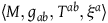 $\langle M, g_{ab}, T^{ab}, \xi^a \rangle$
. In these models one no longer has
$\langle M, g_{ab}, T^{ab}, \xi^a \rangle$
. In these models one no longer has $\nabla_{\text{STEGR}}$
because one instead has the Stückelberg fields
$\nabla_{\text{STEGR}}$
because one instead has the Stückelberg fields $\xi^a$
—and relevant objects, for example connection coefficients, non-metricities, etc., can be recast in terms of these fields.Footnote
11
When it comes to dynamics, for an explicit presentation of the action of CGR, see Beltrán Jiménez et al. (Reference Beltrán Jiménez, Heisenberg and Koivisto2019, p. 8); one of the advantages of CGR is that its action ‘only [involves] first derivatives of the metric, thus leading to a well-posed variational principle without any Gibbons–Hawking–York boundary terms.’Footnote
12
$\xi^a$
—and relevant objects, for example connection coefficients, non-metricities, etc., can be recast in terms of these fields.Footnote
11
When it comes to dynamics, for an explicit presentation of the action of CGR, see Beltrán Jiménez et al. (Reference Beltrán Jiménez, Heisenberg and Koivisto2019, p. 8); one of the advantages of CGR is that its action ‘only [involves] first derivatives of the metric, thus leading to a well-posed variational principle without any Gibbons–Hawking–York boundary terms.’Footnote
12
This presentation of CGR will suffice for our purposes in this article. What we turn to now is an appraisal of various conceptual aspects of CGR, some of which have been pointed to in the physics literature on this theory. In particular, we’ll now consider (i) whether CGR is a gauge theory of translations (section 4), (ii) whether or not CGR is equivalent to STEGR (and a fortiori whether or not it is equivalent to GR) (section 5), (iii) whether or not the equivalence principle is satisfied in the theory (section 6), and (iv) the sense in which CGR really is ‘substantively generally covariant’ or (if one prefers) ‘background independent’.
4. Gauge theories of translations
It’s sometimes claimed that CGR is a ‘gauge theory of translations’—see, e.g., Beltrán Jiménez et al. (Reference Beltrán Jiménez, Heisenberg and Koivisto2019, p. 16). This claim has to do with the fact that the components of the connection given in (7) are invariant under affine transformations of the Stückelberg fields,
 $${\xi ^\alpha } \,\mapsto \,{M^\alpha }_\beta {\xi ^\beta } + {a^\alpha }.$$
This is true—but at this stage we want to make a few points about whether it is really appropriate to aver in light of this that CGR is indeed a translational gauge theory.
Our first point is so obvious that we will mention it only briefly and then set it aside: (8) encompasses more than merely translational redundancy (encoded, of course, in the translational part $a^\alpha$
), but also redundancy in the linear part of the affine transformation. And as such, there is here not merely translational gauge freedom.
$a^\alpha$
), but also redundancy in the linear part of the affine transformation. And as such, there is here not merely translational gauge freedom.
Our second point is more interesting. TEGR is sometimes also claimed to be a ‘gauge theory of translations’ (see in particular Aldrovandi and Pereira (Reference Aldrovandi and Geraldo Pereira2013) on this claim), because (the claim goes) the theory can be understood as being built upon a principal fibre bundle which has the translation group as its structure group. In fact, it’s not obvious to us that the reasoning which proponents of TEGR deploy in order to arrive at this conclusion is coherent (Dürr and Read Reference Dürr and Read2025), and if one does desire (for whatever reason) to understand TEGR as a gauge theory of translations, then one likely has to move to understanding the theory in terms of Cartan connections rather than Ehresmann connections (see Huguet et al. (Reference Huguet, Le Delliou and Fontanini2021a,b) and Le Delliou et al. (Reference Le Delliou, Huguet and Fontanini2020), and for philosophical discussion March et al. (Reference March, Read and Chen2025) and Weatherall (Reference Weatherall2025)). But in any case, the point we want to make here is that this is evidently a very different sense of the theory being a ‘gauge theory of translations’ to that which authors seem to have in mind in the case of CGR.
Our third point is in fact a continuation of this. As Weatherall (Reference Weatherall2015) has pointed out, the term ‘gauge’ is used in many different senses in contemporary physics. One such sense has to do with ‘representational redundancy’, which is quite evidently what those working on CGR have in mind when they point to the representational redundancy encoded in (8) (setting aside, again, the fact that these are affine transformations and not merely translations!). Another sense has to do with a theory being built on the model of a Yang–Mills theory, and in particular in the framework of principal fibre bundles. This latter sense is more akin to the sense in which TEGR is a ‘gauge theory of translations’ (although even here one has to be careful, because Yang–Mills theory uses Ehresmann connections not Cartan connections—see Weatherall (Reference Weatherall2025)), but (to our knowledge) is not what those working on CGR have in mind. Perhaps one could reformulate CGR in the language of principal bundles in order to encode the gauge freedom (8), but to our knowledge this has not been done, and in any case it’s not entirely clear what the deep payoff from making this move would be.
5. Theoretical equivalence
We turn next to issues of theoretical equivalence. Before proceeding further, we’ll need to get the (by now quite standard) tools of ‘categorical equivalence’ on the table, since in this section we’ll work in that framework.
Weatherall (Reference Weatherall2016) has proposed a criterion of equivalence of physical theories, according to which two theories are equivalent just in case (i) their associated categories of models are equivalent, and (ii) the functors realising said equivalence preserve empirical content. The category of models associated with a theory is a category the objects of which are models of that theory, and the morphisms of which relate models regarded as having the ‘same structure’.
What is it for two categories to be equivalent? Two categories $\boldsymbol{A}$
and
$\boldsymbol{A}$
and $\boldsymbol{B}$
are equivalent just in case there exist functors
$\boldsymbol{B}$
are equivalent just in case there exist functors $F \,\colon \;\boldsymbol{A} \rightarrow {B}$
and
$F \,\colon \;\boldsymbol{A} \rightarrow {B}$
and $G \,\colon \;\boldsymbol{B} \rightarrow {A}$
such that
$G \,\colon \;\boldsymbol{B} \rightarrow {A}$
such that $FG \cong 1_{\boldsymbol{B}}$
, and
$FG \cong 1_{\boldsymbol{B}}$
, and $GF \cong 1_{\boldsymbol{A}}$
. Equivalently, the categorical equivalence of
$GF \cong 1_{\boldsymbol{A}}$
. Equivalently, the categorical equivalence of $\boldsymbol{A}$
and
$\boldsymbol{A}$
and $\boldsymbol{B}$
amounts to the existence of a functor relating them which is:
$\boldsymbol{B}$
amounts to the existence of a functor relating them which is:
Full: For all objects $a, b \in \boldsymbol{A}$
, the map
$a, b \in \boldsymbol{A}$
, the map $\left( f\colon \; a \rightarrow b \right) \mapsto \left( F(f) \colon \; F(a) \rightarrow F(b) \right)$
induced by F is surjective.
$\left( f\colon \; a \rightarrow b \right) \mapsto \left( F(f) \colon \; F(a) \rightarrow F(b) \right)$
induced by F is surjective.
Faithful: For all objects $a, b \in \boldsymbol{A}$
, the map
$a, b \in \boldsymbol{A}$
, the map $\left( f\colon \;a \rightarrow b \right) \mapsto \left( F(f) \colon \;F(a) \rightarrow F(b) \right)$
induced by F is injective.
$\left( f\colon \;a \rightarrow b \right) \mapsto \left( F(f) \colon \;F(a) \rightarrow F(b) \right)$
induced by F is injective.
Essentially surjective: For every object $x \in \boldsymbol{B}$
, there is some object
$x \in \boldsymbol{B}$
, there is some object $a \in \boldsymbol{A}$
and arrows
$a \in \boldsymbol{A}$
and arrows $f\colon \;F(a) \rightarrow x$
and
$f\colon \;F(a) \rightarrow x$
and $f^{-1}\colon \;x \rightarrow F(a)$
such that
$f^{-1}\colon \;x \rightarrow F(a)$
such that $f \circ f^{-1} = 1_x$
.
$f \circ f^{-1} = 1_x$
.
A functor ‘forgets structure’ just in case it is not full, ‘forgets stuff’ just in case it is not faithful, and ‘forgets properties’ just in case it is not essentially surjective.
For the geometric trinity, philosophers—in particular March et al. (Reference March, Read and Chen2025), Weatherall (Reference Weatherall2025), and Weatherall and Meskhidze (Reference Weatherall and Meskhidze2024)—have recently become interested in clarifying whether (different versions of) the different nodes of the geometric trinity are or are not categorically equivalent. The upshots, in brief, are as follows:
-
• TEGR and STEGR, when formulated as in section 2 of this article, are categorically inequivalent to GR, because they have more structure than GR (Weatherall Reference Weatherall2025; Weatherall and Meskhidze Reference Weatherall and Meskhidze2024).
-
• There are many different formulations of TEGR, but most of them turn out to be categorically equivalent to TEGR as formulated in section 2 of this article, and ipso facto categorically inequivalent to GR (because, again, they have more structure than it) (March et al. Reference March, Read and Chen2025).
-
• There is one version of TEGR due to Baez and Wise (Reference Baez and Wise2015), based upon the formalism of ‘higher gauge theory’ (see March et al. (Reference March, Read and Chen2025) for a philosophical primer), which is categorically inequivalent to GR by virtue of having less structure than it. However, there is a strong case to be made that this theory is empirically inadequate and/or predictively impotent.
In light of these points, there are good reasons to think (at least when one sets aside possible ancillary physics payoffs of using one formalism as opposed to another) that one might as well commit only to the structure of GR when confronted with the geometric trinity, because GR optimises the tradeoff between ontological parsimony and empirical adequacy. (This point has been made in various ways by March et al. (Reference March, Wolf and Read2024), Weatherall and Meskhidze (Reference Weatherall and Meskhidze2024), and Wolf et al. (Reference Wolf, Sanchioni and Read2024); we in fact endorse this conclusion.)
But in any case, a full exploration of the web of (in)equivalence relations between (different formulations of) the different nodes of the geometric trinity is not yet complete, for we have yet to fit CGR into this picture. Thankfully, it is not difficult to do so. First, we define a pair of categories STEGR and CGR. Objects of STEGR are models of STEGR as given above, and morphisms are isometries which preserve $\nabla_{\text{STEGR}}$
. Objects of CGR are models of CGR as given above, and morphisms are isometries which preserve
$\nabla_{\text{STEGR}}$
. Objects of CGR are models of CGR as given above, and morphisms are isometries which preserve $\xi^a$
. Note in particular that in CGR objects which are models of the theory that are otherwise identical but where the Stückelberg fields are related by affine transformations as per (the active equivalent of) (8) are not related by morphisms; we’ll return to this below.
$\xi^a$
. Note in particular that in CGR objects which are models of the theory that are otherwise identical but where the Stückelberg fields are related by affine transformations as per (the active equivalent of) (8) are not related by morphisms; we’ll return to this below.
Consider now the functor $F\colon \; \boldsymbol{CGR} \rightarrow \boldsymbol{STEGR}$
which maps
$F\colon \; \boldsymbol{CGR} \rightarrow \boldsymbol{STEGR}$
which maps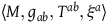 $\langle M, g_{ab}, T^{ab}, \xi^a \rangle$
to
$\langle M, g_{ab}, T^{ab}, \xi^a \rangle$
to $\langle M, g_{ab}, \nabla_{\text{STEGR}}, T^{ab} \rangle$
and takes arrows to themselves. We have the following proposition.
$\langle M, g_{ab}, \nabla_{\text{STEGR}}, T^{ab} \rangle$
and takes arrows to themselves. We have the following proposition.
Proposition 1. The functor $F\colon \; \boldsymbol{CGR} \rightarrow \boldsymbol{STEGR}$
is not full.
$F\colon \; \boldsymbol{CGR} \rightarrow \boldsymbol{STEGR}$
is not full.
Proof. Consider a model $\langle M, g_{ab}, \nabla_{\text{STEGR}}, T^{ab} \rangle$
of STEGR. Let
$\langle M, g_{ab}, \nabla_{\text{STEGR}}, T^{ab} \rangle$
of STEGR. Let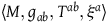 $\langle M, g_{ab}, T^{ab}, \xi^a \rangle$
and
$\langle M, g_{ab}, T^{ab}, \xi^a \rangle$
and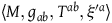 $\langle M, g_{ab}, T^{ab}, \xi'^a \rangle$
be two distinct objects of CGR corresponding to the same model of STEGR (and so related by an affine transformation of the Stückelberg fields). There’s no arrow between these models, yet they map to the same model of STEGR under F. Hence, F isn’t full.
$\langle M, g_{ab}, T^{ab}, \xi'^a \rangle$
be two distinct objects of CGR corresponding to the same model of STEGR (and so related by an affine transformation of the Stückelberg fields). There’s no arrow between these models, yet they map to the same model of STEGR under F. Hence, F isn’t full.
So, although CGR might have some physical advantages to it over STEGR as already alluded to in previous sections of this article, on Occamist grounds alone one should arguably prefer to work with STEGR over CGR.
Now, of course, one could contrive some new category, call it $\overline{\boldsymbol{CGR}}$
(in analogy with
$\overline{\boldsymbol{CGR}}$
(in analogy with $\overline{\boldsymbol{EM2}}$
for Weatherall (Reference Weatherall2015, Reference Weatherall2016) in the context of electromagnetism; see March et al. (Reference March, Read and Chen2025) for further discussion), in which one inserts morphisms by hand between otherwise identical objects in which the Stückelberg fields are related by affine transformations; then (left as an exercise for the reader) this version of CGR will in fact be categorically equivalent to STEGR. One can of course do this—but note that it would be an instance of ‘external sophistication’ in the sense of Dewar (Reference Dewar2019), and for that reason arguably metaphysically unperspicuous (what, after all, does it mean to declare isomorphic—by inserting morphisms into a category—models which are themselves not isomorphic?); for further discussion here, see March et al. (Reference March, Read and Chen2025), Martens and Read (Reference Martens and Read2020), and Read (Reference Read2025).
$\overline{\boldsymbol{EM2}}$
for Weatherall (Reference Weatherall2015, Reference Weatherall2016) in the context of electromagnetism; see March et al. (Reference March, Read and Chen2025) for further discussion), in which one inserts morphisms by hand between otherwise identical objects in which the Stückelberg fields are related by affine transformations; then (left as an exercise for the reader) this version of CGR will in fact be categorically equivalent to STEGR. One can of course do this—but note that it would be an instance of ‘external sophistication’ in the sense of Dewar (Reference Dewar2019), and for that reason arguably metaphysically unperspicuous (what, after all, does it mean to declare isomorphic—by inserting morphisms into a category—models which are themselves not isomorphic?); for further discussion here, see March et al. (Reference March, Read and Chen2025), Martens and Read (Reference Martens and Read2020), and Read (Reference Read2025).
6. The equivalence principle
The next thing to think about is the equivalence principle, where for our purposes here we mean something like ‘local physics without a preferred frame’. We’ll approach this issue obliquely, by first recalling the basic outline of a related theory developed by Jacobson and Mattingly (Reference Jacobson and Mattingly2001) in their article, ‘Gravity with a Dynamical Preferred Frame’.
The key idea behind the Jacobson–Mattingly theory is very simple. One takes GR, but introduces into its models a timelike vector field $A^a$
; thus, models of the theory overall are given by tuples
$A^a$
; thus, models of the theory overall are given by tuples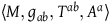 $\langle M, g_{ab}, T^{ab}, A^a \rangle$
. Insofar as this theory picks out a preferred frame at every point (the rest frame of the ‘observer’ associated with
$\langle M, g_{ab}, T^{ab}, A^a \rangle$
. Insofar as this theory picks out a preferred frame at every point (the rest frame of the ‘observer’ associated with $A^a$
at that point) there is a relatively clear sense in which this theory violates the ‘strong equivalence principle’, which states something like ‘special relativity is valid locally in general relativity’, and which in this particular case can be precisified as ‘in any model of GR, one recovers Poincaré symmetries at every point’.Footnote
13
$A^a$
at that point) there is a relatively clear sense in which this theory violates the ‘strong equivalence principle’, which states something like ‘special relativity is valid locally in general relativity’, and which in this particular case can be precisified as ‘in any model of GR, one recovers Poincaré symmetries at every point’.Footnote
13
This sense in which the Jacobson–Mattingly theory violates the equivalence principle is discussed further by Read et al. (Reference Read, Brown and Lehmkuhl2018).Footnote
14
But note that there are clear affinities between the models of the Jacobson–Mattingly theory and the models of CGR (save for the facts that (i) there is no injunction in CGR that all the Stückelberg fields $\xi^a$
be timelike at every point, and (ii) we in fact have four linearly independent fields in the case of CGR). As such, one would expect a similar analysis to go through in the case of CGR. And, ceteris paribus, one might well take the violation of (this version of the) equivalence principle to be a mark against CGR.
$\xi^a$
be timelike at every point, and (ii) we in fact have four linearly independent fields in the case of CGR). As such, one would expect a similar analysis to go through in the case of CGR. And, ceteris paribus, one might well take the violation of (this version of the) equivalence principle to be a mark against CGR.
7. Background independence
As our final point of conceptual discussion, let’s consider the issue of whether CGR is ‘substantively generally covariant’ or (what amounts to the same thing) ‘background independent’. There is a sense in which the introduction of clock fields amounts to a merely artificial restoration of general covariance. Pitts (Reference Pitts2009, p. 15), indeed, offers the following definition of substantive general covariance which runs along these lines:
A field theory is substantively generally covariant just in case it is formally generally covariant (in the sense of admitting at least arbitrary infinitesimal coordinate transformations and some finite transformations near the Lorentz group), lacks irrelevant fields (in the sense of James Anderson [Anderson Reference Anderson1967; Pitts Reference Pitts2006]), lacks nonvariational fields and lacks clock fields.
Proponents of CGR (e.g., Beltrán Jiménez et al. Reference Beltrán Jiménez, Heisenberg and Koivisto2018, Reference Beltrán Jiménez, Heisenberg and Koivisto2019; Beltrán Jiménez and Koivisto Reference Beltrán Jiménez and Koivisto2022) typically insist that introducing the Stückelberg fields in their theory have restored general covariance. However, in fact by virtue of the existence of these fields CGR is not substantively generally covariant, on Pitts’ analysis.
What of other definitions of background independence, as surveyed by Read (Reference Read2023, chapter 3)? Interestingly, definitions of background independence which preclude the existence of ‘absolute objects’, that is, objects fixed up to isomorphism in the dynamical possibilities of a theory (this being a proposal which goes back to Anderson (Reference Anderson1967), and which was later taken up by Friedman (Reference Friedman1983)—see Pitts (Reference Pitts2006) for discussion and comparison) flounder with clock fields (as Pitts (Reference Pitts2009) discusses in depth), for clock fields can vary from dynamical possibility to dynamical possibility. These issues also tar definitions of background independence in terms of what Read (Reference Read2023, chapter 3) calls ‘fixed fields’ and ‘absolute fields’ (which are, in the end, variations on the ‘no absolute objects’ definition of background independence). Note, however, that in the particular case of CGR, definitions such as the ‘no absolute objects’ injunction will still adjudicate that this theory is background dependent, due to the presence of the square root of the metric determinant, $\sqrt{-g}$
.Footnote
15
$\sqrt{-g}$
.Footnote
15
While, for example, Pooley (Reference Pooley, Lehmkuhl, Schiemann and Scholz2017) has proposed a definition of background independence in terms of variational principles—essentially, that every field in the theory (i) is subject to Hamilton’s principle and (ii) represents something ‘physical’ (the latter admittedly being a somewhat vague, or at least interpretative, matter)—which seems again to flounder with clock fields (in the sense that it can adjudicate that theories with clock fields are background independent), Read (Reference Read2023) has shown that this can be repaired by insisting that every field must be subject to Hamilton’s principle; this turns out not to be the case for clock fields, since they have trivial equations of motion (Pitts Reference Pitts2009). On this modified definition of background independence in terms of variational principles, CGR turns out to be background dependent.
Another interesting case is the definition of background independence due to Belot (Reference Belot2011), according to which (roughly—see Read (Reference Read2023, chapter 3) for a detailed recapitulation) ‘material’ degrees of freedom co-vary with ‘geometrical’ degrees of freedom in the models of the theory under consideration. In CGR, there is a case to be made that this is in fact so, since the Stückleberg fields $\xi^a$
fix the connection (essentially, of course,
$\xi^a$
fix the connection (essentially, of course, $\nabla_{\text{STEGR}}$
), which in turn is coupled to the material stress-energy content
$\nabla_{\text{STEGR}}$
), which in turn is coupled to the material stress-energy content $T^{ab}$
via the (STEGR equivalent of) Einstein’s equation. Suffice it to say, then, that the situation for CGR vis à vis its background independence is more delicate, when the latter notion in assessed on Belot’s terms.
$T^{ab}$
via the (STEGR equivalent of) Einstein’s equation. Suffice it to say, then, that the situation for CGR vis à vis its background independence is more delicate, when the latter notion in assessed on Belot’s terms.
Stepping back, then, the situation regarding the ‘substantive general covariance’ or ‘background independence’ of CGR is complicated. The theory clearly violates the proposal of Pitts (Reference Pitts2009), as we’ve seen above, due to its invocation of clock fields. The theory seems to violate ‘no absolute objects’ definitions, albeit for reasons which have nothing to do with the Stückelberg fields. With judicious tweaking, the theory violates definitions of background independence based upon variational principles. And arguably, the theory satisfies Belot’s definition of background independence.
In any case, though, the point which we want to stress here is a simple one: although proponents of CGR (e.g., Beltrán Jiménez et al. Reference Beltrán Jiménez, Heisenberg and Koivisto2018, Reference Beltrán Jiménez, Heisenberg and Koivisto2019; Beltrán Jiménez and Koivisto Reference Beltrán Jiménez and Koivisto2022) claim that the theory is generally covariant, with Pitts (Reference Pitts2009) we are of the view that the fact that this ‘general covariance’ is achieved via clock fields means that this isn’t so in a substantive sense. And in any case, we see that the situation here is actually quite complicated, given that different analyses of background independence seem to give different verdicts on CGR.
8. Close
Let’s wrap up. In this article, we’ve recalled the essential aspects of the geometric trinity, before zooming in on STEGR and the particular version of this which is CGR, which gauge-fixes the non-metric connection to vanish, and then achieves this in a ‘generally covariant’ manner via the introduction of Stückelberg fields. Various features of CGR are identified by its proponents—specifically, that the theory is a ‘gauge theory of translations’, and is generally covariant. In this article, we’ve seen that these claims are tendentious. Various merits of CGR are also sometimes adduced by its proponents—specifically, that it is a simpler/more parsimonious version of STEGR, and that it satisfies the equivalence principle. In this article, we’ve also argued that these claims are specious. All together, we think one would be right to take these points to temper one’s enthusiasm for CGR—especially when, as we’ve also pointed out above, a more ontologically parsimonious version of CGR is available in any case—namely, GR itself!
Acknowledgments
We thank Eleanor March, Brian Pitts, and Jim Weatherall for helpful comments on a previous draft. We are also grateful to the audience of our PSA symposium on the geometric trinity of gravity, and to our co-symposiasts Eleanor Knox, Eleanor March, Ruward Mulder, and Jim Weatherall, for excellent discussions.
Funding and declarations
None to report.


 Open access

