




In February 1892 the Spanish Ministerio de Fomento sent agricultural engineer Vicente Sanjuán on a mission to Italy to revive the Spanish silk industry. Sanjuán was to visit the sericulture station in Padua and several sericulture observatories, report on these institutions, and draft a plan to start a similar infrastructure in Spain.Footnote 1 His scrupulous detailing of buildings, instruments, methods, activities and labour organization reveals Sanjuán’s commitment. He was enthusiastic about what he witnessed: ‘In one word, this [Padua] is the centre from which radiates the progress that we observe today in Italian sericulture.’Footnote 2 Until the 1890s, Italy was Europe’s leading producer of raw silk and second only to China in global exports.Footnote 3 Upon his return to Spain, Sanjuán published his plan and founded the first Spanish sericulture station in Murcia in 1892.
During his travels, Sanjuán read in a local newspaper that a Russian engineer was touring Italy on a similar mission and was struck by the ‘strange coincidence’.Footnote 4 But this was no coincidence. By the early 1890s, sericulture stations had already been established in Austria–Hungary, Italy, France, Japan and the Ottoman Empire, with more soon to follow. This essay reveals the existence of an international network of sericulture stations – the ‘World Wide Silk Web’ – and argues that its influence in supporting and advancing global silk production has been largely overlooked.Footnote 5 I trace the emergence and consolidation of the sericulture station network between 1869 and 1900, drawing on correspondence, ministerial files, observatory registers, station annual reports, technical journals and manuals. This essay advances three principal interventions. Sericulture stations, I contend, must be credited with the resolution of a devastating silkworm disease (pébrine). Moreover, stations functioned as drivers of techno-entomology, favouring the exchange of knowledge and practices between Asia and Europe.Footnote 6 Finally, this network presents us with a different model of scientific organization when compared with contemporary scientific networks: it was non-imperial, polycentric and asymmetric.
Several histories of science present Louis Pasteur’s microscopic method to screen moths as the single, decisive turning point in combating pébrine, downplaying how such technology propagated, and ignoring the very existence of a network of sericulture stations.Footnote 7 I shift the focus from invention to adoption. What mattered was not a single conceptual breakthrough but international cooperation and the institutional labour that made the method workable at scale.Footnote 8 This was a ‘modernization’ mission that each country directed mainly inward, requiring investment, training and coordination. Furthermore, this essay puts Pasteur’s achievements in context, showing how several other scholars also contributed – and sometimes anticipated – key elements of his research, such as the microscopic screening of eggs and moths.
Sericulture stations qualify as techno-entomological institutions – my second point – because, by entangling entomology, technology and production, they generated what John Pickstone has called ‘knowledge commodities’.Footnote 9 Stations inextricably tied insects to instruments (silkworms to microscopes), revolutionized egg production and silkworm rearing, created a new generation of ‘rational breeders’ and women microscopists, and advanced entomology and genetics by developing silkworm strains and hybrids – new animals created in the laboratory.Footnote 10 Private investors also contributed to reshaping sericulture; however, government-funded stations were especially significant in this process as they were devoted to knowledge dissemination and were in constant contact with each other. From the very beginning, stations had three objectives: knowing, making, and disseminating.
Other insect-centred institutions also developed techno-entomology. Yet sericulture stations are the paradigmatic case of techno-entomology because, unlike other insect-centred networks, they were durable and organized. The inter-imperial network that moved insects and birds to Hawaii for livestock-pest control (including horn fly), as well as the long-running international collaborations against locust plagues, also fit this rubric.Footnote 11 Within these networks, participants transferred practices and biological material; codified procedures; and shared information, training and baits. Nonetheless, for its vastness, longevity, range of activities and production-oriented mission (including but not limited to disease control), the sericulture network offers the most comprehensive example of techno-entomological institutions of the time.
The tension between nationalism and internationalism – a key feature of late nineteenth-century science – manifested with distinctive traits in the sericulture network, setting it apart from other contemporary scientific networks for its characteristics, my third point. In the fin de siècle period examined here, scientific internationalism peaked, channelling and facilitating scientific nationalism.Footnote 12 The sericulture stations benefited from this climate. Most likely, Gorizia – the first sericulture station, founded in 1869 – followed the German model of an agricultural station. By the 1870s, Germany had over twenty such stations, which also served as a model for similar institutions in the United States and Italy.Footnote 13 Sericulture and agricultural stations shared fundamental traits, such as being directed at farmers to promote ‘internal colonization’. However, German agricultural stations were born in response to a combination of factors, such as ‘rapid economic change, a proliferation of new farmers’ organizations, and political conflict’.Footnote 14 Sericulture stations, instead, arose as a response to a common threat – not to protect humans, but to save silkworms (Bombyx mori) from a disastrous epizootic. Moreover, sericulture’s unique focus on lepidopterans (the order including butterflies and moths) and the complexity of the production chain, which ran from mulberry cultivation to weaving techniques, placed it in a relatively isolated sphere. The 1930s decline of silk as a global commodity further increased such isolation, and encouraged international cooperation.
Because power relations within the network followed the political economy of silk, regional geopolitics and scientific authority, this was a non-imperial network. In this respect, it contrasted with imperial, centralized anti-locust entomology where information flowed from periphery to centre and directives from centre to periphery.Footnote 15 Yet, within empires – such as Austria–Hungary – sericulture stations could function as imperial tools to ‘develop’ specific areas – for example, Dalmatia. Imperial dynamics were at play, but not as defining features of the network. Notably, during the period examined, despite its global pre-eminence, no dedicated sericulture station was founded in the British Empire.
Beyond being non-imperial, the network was also polycentric and asymmetric. Owing to its scientific authority, the Padua station, for example, retained prestige in the network well beyond the point in the 1890s when Italy lost its position on the silk market and Japan became the most prolific node. Unlike other networks, the sericulture network did not rely on singular personalities, differing from the colonial sleeping-sickness network, which from 1903 increasingly hinged on Paul Ehrlich’s work and connections, as well as from the anti-locust network based on Boris Uvarov and the Imperial Institute of Entomology’s authority.Footnote 16 Because sericulture is an activity dependent on local conditions – silkworms are highly sensitive to local environments and breeding cultures vary greatly – valuable knowledge and practices travelled in all directions. When mapping information flows in the network, categories such as ‘centre’ and ‘periphery’ require calibration against the silk economy.Footnote 17 Finally, the sericulture network was asymmetric: these were not relationships among equals. Because participants had different economic capacities and managerial abilities, stations could count on different resources, and their output varied accordingly.
In addition to the general climate of the period, the common threat posed by disease, and sericulture’s isolation, sericulture stations’ high degree of connectivity stemmed from the stations’ shared objectives, organization and methods. At least in its initial phase, the network’s participants also developed exceptionally close personal ties during training. Possibly for this bundle of reasons, relationships within the network developed with unparalleled solidity and durability, such that uninterrupted correspondence among some of the stations persists to this day, almost 150 years later.Footnote 18
I begin by examining the origins of sericulture stations as a response to a common threat. I challenge Pasteur’s role as sericulture saviour, showing that international scientific cooperation was already under way when he undertook his research, and that he benefited from the ongoing scientific debate. The second section focuses on the sericulture network, describing its formation and its characteristics, which set it apart from other networks. The section offers an overview of each node of the network, untangling the economic, political and scientific relationships between stations. The final section concentrates on the case of the experimental Padua station, which exemplifies how a techno-entomological station worked in practice, its impact on the labour force and sericulture, and its role in the network. While from the 1900s Japan offers the most striking example of the stations’ revolutionary potential, the Padua station had a profound impact on the birth of the network itself.
Facing pébrine through microscopes
Beside potato blight and communism, another spectre was haunting Europe in the late 1840s. A fungus-like organism, then identified as Nosema bombycis, attacked silkworms, creating havoc among thousands of farmers, workers and entrepreneurs involved in the silk business. By the mid-nineteenth century, silk was a strategic, high-value and innovative export, linking rural sericulture to industry and finance, underpinning employment and state revenues across Europe. Called pébrine (from the Occitan word pebre meaning ‘pepper’) because of the characteristic black spots visible on the insect, the silkworm disease first appeared in France in 1848. Since silkworm-rearing operations were often nested in isolated rural locations, it spread relatively slowly as it inexorably worked its way across Europe and Asia, decimating cocoon harvests by up to 80 per cent.Footnote 19
The epizootic affected the structure of silkworm egg production. As prices rose, production was outsourced in the more industrially advanced areas, shifting part of the risk onto farmers. Traditionally, silkworm egg self-production had constituted the very bedrock of a good production, but this ceased to be an option once the infection spread, forcing rearers to buy eggs (called seed) from seed merchants, who, however, could offer no guarantees of purity. Amid widespread preoccupations, farmers swapped remedies, like washing the eggs in wine, while seed merchants misleadingly touted seed from certain areas as ‘safe’. Conflicting information fed into uncertainty and fears. No one had control over the seed market, and anxiety was rampant.Footnote 20
Following the belief that Chinese seed – deemed ‘original’ – would resist disease, silkworm seed merchants travelled east in search of healthy stock, often spreading the disease as they travelled. Historian Claudio Zanier has chronicled the adventurous journeys of Italian semai (seed merchants) to China and Japan.Footnote 21 In fact, no strain was immune to pébrine, although Japanese lines proved more tolerant, both as a result of genetic factors and because traditional rearing methods practised strict hygiene. Within a few years, merchants organized the annual import of Japanese seed. Imported eggs provided Europe’s silk industry with enough cocoon to survive for several years, enabled the first comparative East–West study of rearing practices, and created a few immense fortunes.Footnote 22
According to the traditional narrative, Louis Pasteur’s introduction of microscopic screening for pébrine allowed the production of healthy eggs, contributing to the decline of Japanese egg imports.Footnote 23 Indeed, Pasteur’s methods (‘cellular’ and ‘industrial’) were extremely practical and his authority provided a crucial point of reference amid widespread confusion and uncertainty.Footnote 24 However, I argue that Pasteur’s microscopic methods resulted from a collective international effort, and that these methods would not have accomplished much without the work of sericulture stations.
Scientific research on the dominante malattia (‘dominant disease’) – an apotropaic nickname which stuck for long in Italy, Austria–Hungary and France – started immediately after the outbreak, involving a transnational pool of scientists, governments and producers.Footnote 25 The Austrian government – at the time ruling over northern Italy, where silk production was well rooted – announced a generous prize to investigate the causes of the disease.Footnote 26 In France, the Académie des sciences and the Ministry of Agriculture appointed a commission in 1858, spurred by a petition of rural landowners.Footnote 27 In Lombardy, private institutions operated from 1856, collecting studies and connecting researchers with producers.Footnote 28 Researchers directed their efforts in various directions: understand the disease origin, devise cures or preventive measures, and study alternative silk moths to replace silkworms.
The scientific debate proceeded tumultuously, and both well-known and unknown scholars proposed contrasting hypotheses.Footnote 29 The epizootic was hard to parse because of several concurrent silkworm diseases, including flacherie, and both hereditary and infectious transmission. In 1849, Félix Edouard Guérin Méneville published a description of corpuscles found in the blood of silkworms. Justus von Liebig and Hernst Hallier proposed that the disease came from a mulberry fungus.Footnote 30 Francesco Gera da Conegliano stated that the disease was simultaneously contagious and hereditary, but his paper did not enjoy much diffusion.Footnote 31 In 1856 Emilio Cornalia, in a landmark book on silkworm anatomy, asserted that infected moths’ blood was rich in ‘vibrating corpuscles’, then called ‘Cornalia corpuscles’.Footnote 32 The following year, Swiss Carl W. von Nägeli named these organisms Nosema bombycis, interpreting them as fungi.Footnote 33 Marco Osimo detected the corpuscles also in the silkworms’ eggs. In 1859, Carlo Vittadini proposed microscopical investigation to distinguish between healthy and sick seed.Footnote 34
Among the many researchers addressing the silkworm disease, in 1862 Milanese agronomist Gaetano Cantoni was the first to propose preventing pébrine by checking moths microscopically. Cantoni feared that excessive reliance on Japanese eggs would eventually lead local ‘races’ to extinction. He followed a genetic-improvement hypothesis: selecting disease-resistant individuals by screening moths to identify healthy ones. Cantoni believed that this approach would allow each breeder to produce their own disease-free seed, eliminating dependence on Japanese imports. Initially experiments yielded inconclusive results, but in 1868 he resumed them and published his method.Footnote 35 The approach Cantoni and Vittadini suggested – examining eggs and moths under the microscope – seemed impractical and expensive to many farmers, with no guarantee of conclusive results.
A few years after Cantoni’s indecisive experiments, in 1865, Louis Pasteur accepted his government’s request to investigate the silkworm disease, despite having never seen a silkworm before, by his own admission. For four consecutive springs, Pasteur relocated with his family and research team to the Gard – the region where most of France’s silkworm rearing took place – bringing ‘the laboratory to the place where the phenomena to be translated are found’, as Bruno Latour put it.Footnote 36 There, Pasteur and his équipe designed and conducted numerous experiments with silkworms, eggs, cocoons and chrysalids. He declared that his objective was to ‘make known a practical means to manufacture healthy seed’.Footnote 37 Pasteur’s, as we have seen, was not a solitary quest. During his research he himself kept well informed about novelties and regularly reported his team’s findings at various forums.Footnote 38
In the meantime, an important development in sericulture took place in Austria–Hungary. In 1869, after years of study, conferences and commissions, the Austrian government established the first sericulture station in Gorizia.Footnote 39 Professor of agriculture Friedrich J. Haberlandt was appointed director of the station, and Enrico Verson adjunct director.Footnote 40 The Gorizia sericulture station’s mission encompassed three key objectives that would become standard for all sericulture stations worldwide: conducting research and experiment on sericulture, microscopically examining silkworms submitted by farmers, and providing education and advice to breeders.Footnote 41
The establishment of the Gorizia station did not escape Pasteur’s notice. From July 1869 onward, Pasteur regularly read Sericultura Austriaca – which he referred to as the Journal de la station de Goritz – the bimonthly journal published in both German and Italian.Footnote 42 Pasteur, Haberlandt and Verson engaged in an ongoing scientific dialogue.Footnote 43 One of their main points of contention concerned the corpuscles that were agents of flacherie. In 1868, Haberlandt had published a study distinguishing between flacherie and pébrine, proposing treatments for both.Footnote 44 Haberlandt criticized Pasteur for having ‘neglected the nature of those corpuscles’, which he described as crystals, and for insufficient attention to hygiene in his rearing practices. Disagreements with Pasteur were part of a respectful debate, while Haberlandt and Verson were far more critical of Pasteur’s opponents, whom they considered ‘in perfect ignorance of the cardinals’.Footnote 45 In 1869, Pasteur moved less than thirty kilometres from Gorizia to conduct his final large-scale experiment. During his stay in Friuli, Pasteur visited the Gorizia station and completed the account of his research, published in 1870.Footnote 46
Etudes sur la maladie des vers à soie is a masterpiece – a lucid yet passionate account mostly written in the first person, constantly shifting from personal details to ‘exact observations’. Pasteur’s prose flows (almost) like a novel. He cleverly interwove elements of his personal and emotional journey, such as his initial reluctance to accept the job, his ignorance (‘I successively recognized’), and other scientists’ mistakes, and finally proposed an ultimate solution to pébrine and flacherie. Moreover, certain passages read as encouragingly simple, as a manual for farmers should: ‘Here is the very simple method to achieve it’, ‘Nothing more beautiful than …’.Footnote 47 The effectiveness of Pasteur’s rhetoric hardly needs mentioning.Footnote 48
In 1871, an Austrian commission – including Haberlandt – awarded a prize to Pasteur for developing a reliable method to protect cocoon crops from the epizootic.Footnote 49 But recognition was hardly unanimous.Footnote 50 The Italian Sericulture Association called the microscopical method ‘Cantoni–Pasteur’ and the Rivista settimanale di bachicoltura (Weekly Journal of Sericulture) hosted numerous letters contesting the primate, to which Pasteur deemed it appropriate to respond.Footnote 51 In his review of Pasteur’s book, Verson reminded readers that Haberlandt had already published work distinguishing between flacherie and pébrine, noticing that Pasteur clearly misunderstood the article.Footnote 52 In retrospect, it is hard to determine how attentively Pasteur read other scholars’ studies or how willing he was to grant proper credit to them.
Regardless of these possibly nationalistic disputes, the success of Pasteur’s method depended on its widespread adoption by breeders of different nationalities, educational backgrounds and levels of experience – all while overcoming the discouragement of years of failure and losses. As in other cases, this was a task beyond Pasteur and his team, despite their brilliance and vision.Footnote 53 Instead, governments and entrepreneurs took on the responsibility of spreading the method among silkworm farmers – many of whom were illiterate or barely literate – through sericulture stations.
The World Wide Silk Web
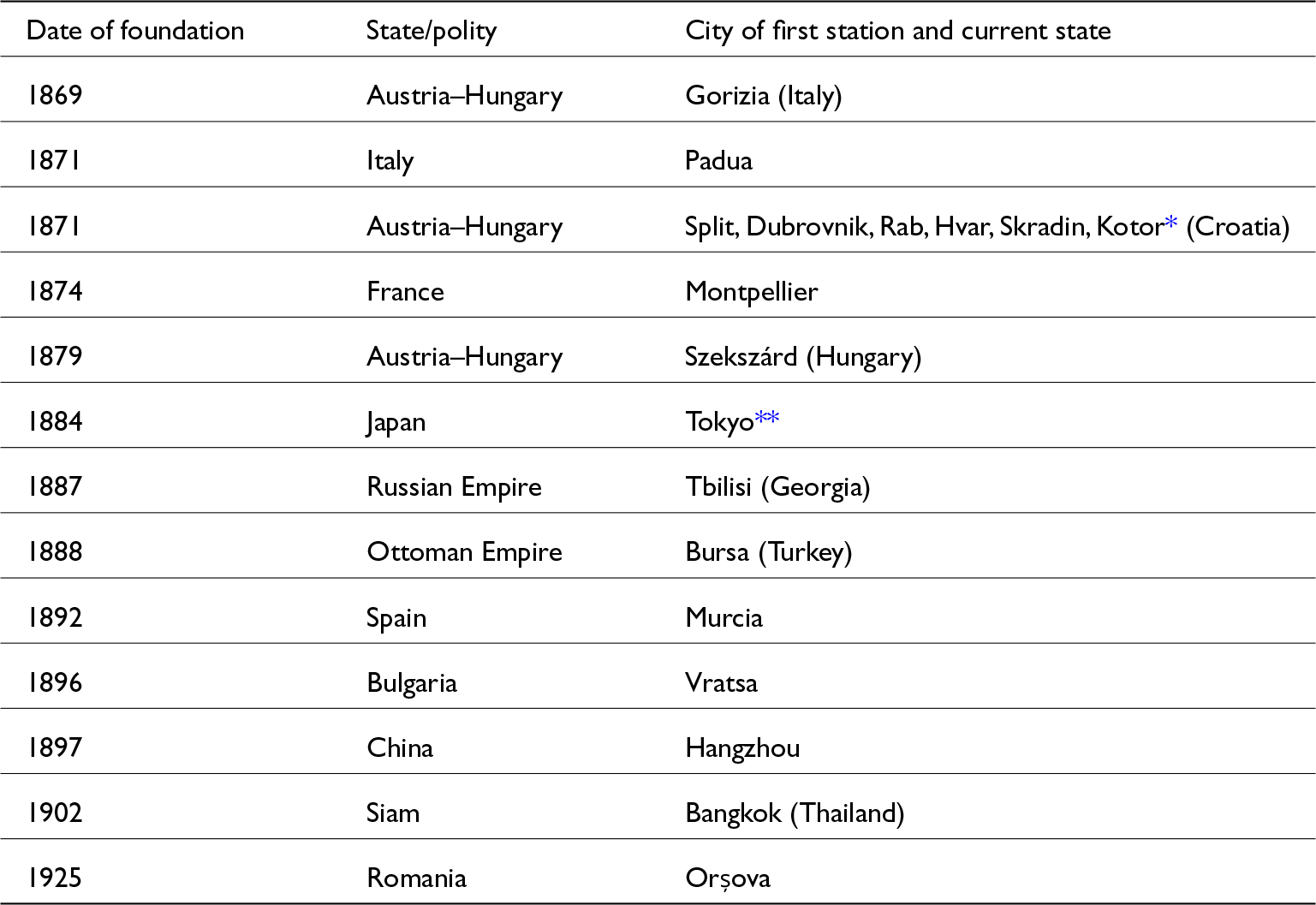
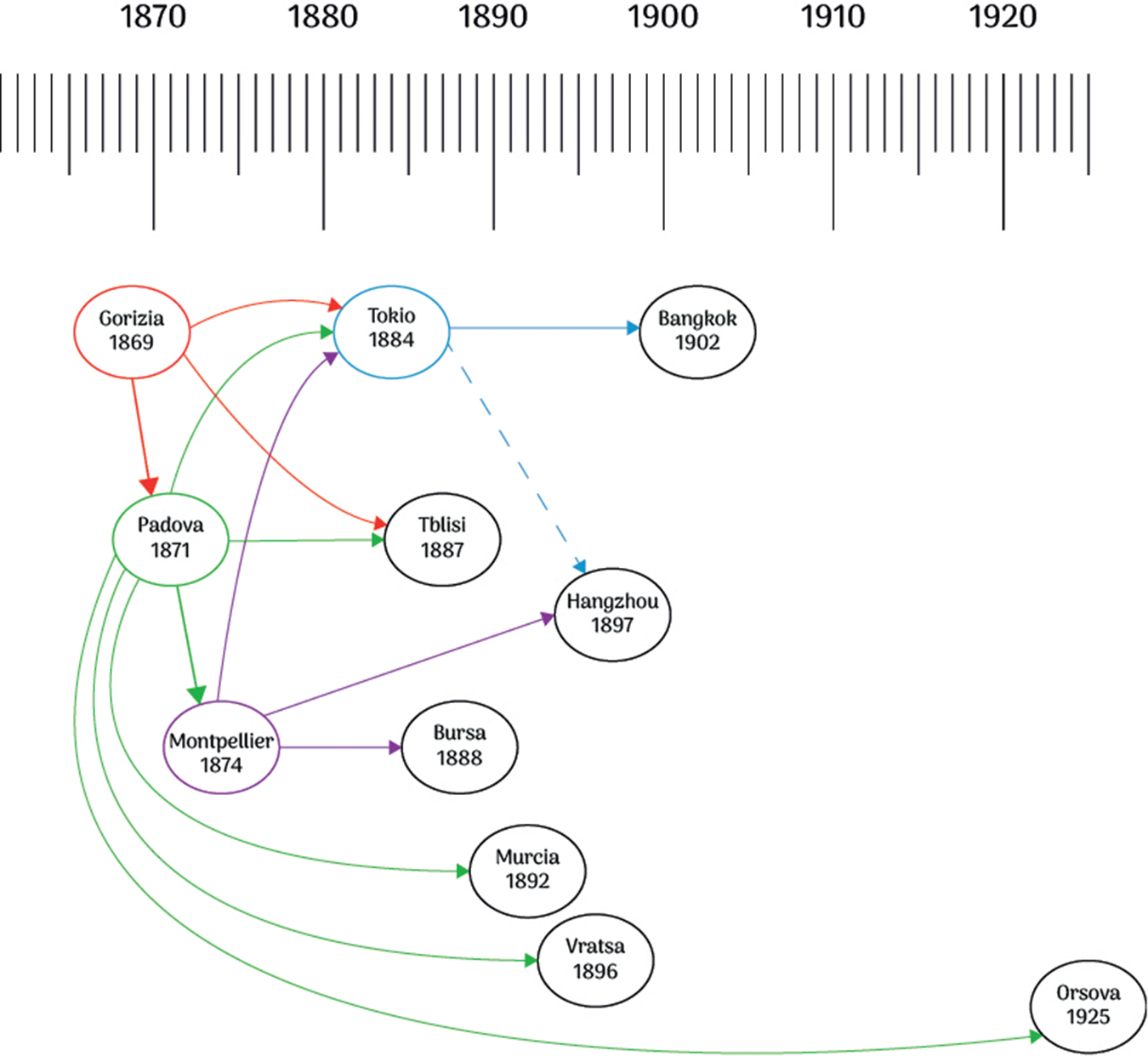
Table 1 and Figure 1 help capture at a glance the chronology and interconnection of the sericulture network by mapping the establishment of the first sericulture station in each country or polity.Footnote 54 The first three states established sericulture stations in the early 1870s. Many others followed in the 1880s and 1890s, when the global silk trade volume expanded.Footnote 55 While the full breadth of the network exceeds the scope of Figure 1, focusing on the first national stations shows that all stations derived from Gorizia’s and the year when each government formalized its policy into an institution.
First sericulture stations established by country/polity (1869–1925). In parentheses, today’s nationality.

Table 1 Long description
The table lists the year each country or polity established its first sericulture station and the city where it opened (with the city’s present-day country noted when given). The earliest entry is 1869 in Austria–Hungary at Gorizia (now in Italy). Austria–Hungary appears multiple times, including a 1871 entry naming several first-station locations (Split, Dubrovnik, Rab, Hvar, Skradin, and Kotor, now in Croatia) and a later station at Szekszárd (1879, Hungary). Other early European foundations include Italy (Padua, 1871) and France (Montpellier, 1874), followed by Spain (Murcia, 1892), Bulgaria (Vratsa, 1896), and Romania (Orșova, 1925). Asian entries begin in the 1880s and 1900s: Japan (Tokyo, 1884), China (Hangzhou, 1897), and Siam (Bangkok, 1902; now Thailand), alongside the Ottoman Empire (Bursa, 1888; now Turkey). The Russian Empire entry is Tbilisi (1887; now Georgia). Because one row lists multiple cities for a single polity and year, “first station” may reflect parallel or regionally distributed starts rather than a single site.
* Marija Gjurašić and Tea Đurović, ‘Develpment of sericulture in the Eastern Adriatic during the Austrian administration’, Athens Journal of History (2023) 9(1), pp. 9–52, 38.
** Lisa Onaga, Cocoon Cultures: The Entangled History of Biology and Silk in Japan since 1840 (Durham, NC: Duke University Press, forthcoming); for the development of Japanese stations see the section on Japan below.
Branching and interconnections between first-established sericulture stations by country/polity (Diana Mantegazza).

Figure 1 Long description
The diagram illustrates the establishment and interconnections of sericulture stations from 1869 to 1905. Key stations include Gorizia 1869, Padova 1871, Montpellier 1874, Tokyo 1886, Tbilisi 1887, Bursa 1888, Hangzhou 1897, Murcia 1892, Vratsa 1896, Bangkok 1902 and Orsova 1905. Arrows indicate connections between these stations, showing the flow of sericulture development over time. The timeline at the top marks the years from 1865 to 1905, aligning with the establishment dates of each station.
Transfer of knowledge and relationships among sericulture stations stemmed from multiple international dynamics, with success depending on specific circumstances: imperial control, geopolitical relations, economic partnerships and scientific authority. Several empires were directly involved in this network (French, Austrian, Ottoman and Russian). Ostensibly, stations in Austro-Hungarian Italy and Dalmatia, and in Russian Georgia, can be interpreted as tools of imperial control, while the sericultural relationship between Japan and Siam has been interpreted as a geopolitical alliance.Footnote 56 Italy, in contrast, used the prestige of the Padua station as leverage to strengthen economic relations with Spain, Bulgaria and Romania. Finally, the case of Montpellier and Bursa illustrates an example of a privileged economic partnership.
Alongside protectionist tariffs, establishing the Montpellier sericulture station in 1874 formed part of the French state’s attempt to revive sericulture after pébrine. Eugène Maillot, Pasteur’s former collaborator in the Gard and the station’s director, published educational material and held conferences and courses, but the station did not offer microscopy services to farmers.Footnote 57 Instead, in an 1875 publication translated by Maillot, Italian experts portrayed themselves as Pasteur’s true inheritors: ‘Only in Lombardy are there more microscopes and selectors than across the whole of France. Besides the sericulture station of Padua, dedicated to scientific research, in every region of Italy there are observatories … to spread the good methods and help the farmers.’Footnote 58 Regardless of Maillot’s efforts, the French production of raw silk and eggs never recovered after the crisis.Footnote 59 Decline stemmed from the broader transition to an industrial economy, which disfavoured labour-intensive activities like sericulture.Footnote 60 As French manufactures continued to weave silk, they progressively imported less Italian silk, instead increasing supplies from China, Japan and the ‘Levant’.Footnote 61
Market changes facilitated technological transfer from France toward China and the Ottoman Empire. The region of Bursa, south of the Sea of Marmara, had for centuries been renowned for its silk cloth manufacture. By the mid-nineteenth century, however, it had lost its market to France and Italy.Footnote 62 During the pébrine crisis, as French silk producers turned to uninfected areas, Bursa’s production of eggs, cocoon and raw silk increased, generating income for the Ottoman Düyûn-ı Umûmiyye (Public Debt Administration). But between 1850 and 1881, the infection spread in Turkey and egg merchants began importing eggs from Japan, causing Bursa’s cocoon production to fall by 80 per cent.Footnote 63 In an effort to revive production, the Ottoman administration contacted Pasteur, who referred the matter to Maillot in Montpellier.Footnote 64 In 1880, eight Ottoman students were sent to study at the Montpellier sericulture school. Among them was Kevork Torkomyan, who in 1888 founded the first sericulture school in Bursa, focusing on the production of healthy silkworm eggs and mulberry cultivation. Torkomyan, a French-educated Armenian, maintained strong ties with Montpellier, making several trips to France.Footnote 65 As global demand for raw silk nearly doubled by 1900, Bursa experienced a period of remarkable economic prosperity, while France purchased approximately 80 per cent of its total production.Footnote 66 The economic partnership with France was a decisive factor in the establishment of the Bursa station.
Like his counterpart in Bursa, the first Chinese station’s director was trained in Montpellier. China – the world’s leading producer of raw silk – had been constantly losing market share since the 1850s, due to the Taiping Rebellion, the crumbling of the Qing empire, and pébrine.Footnote 67 Despite becoming France’s first supplier of raw silk from the 1880s, anxiety for the sector was creeping in.Footnote 68 In 1890, the North China Herald informed its readers of a plan to establish ‘a central government sericultural station’ in Shanghai, which would introduce ‘M. Pasteur’s system for the eradication of disease by the selection of healthy moths’ along with new reeling machines.Footnote 69 The plan’s proponent, F. Kleinwächter – commissioner of several Chinese ports, including Jiujiang and Canton – wrote a pamphlet outlining his proposal before returning to Germany.Footnote 70 That same year, Kleinwächter possibly visited the Padua station and exchanged seed and cocoons with the Montpellier station, where he also sent a Chinese student, Jiang Shengjin, to study sericulture, along with an interpreter.Footnote 71
The first Chinese sericulture station – named Canxueguan – was founded in Hangzhou in 1897, under the regional prefect, Lin Qi. Lin drew inspiration from Kleinwächter’s proposal, as well as from Japanese publications. The school’s first teacher was Jiang. Canxueguan aimed to disseminate the cellular method, train students and experiment with new silkworm strains. From 1901 onward, several Canxueguan graduates were sent to other regions of China to establish new schools.Footnote 72 It is no surprise that Lin looked at Japanese publications, as sericulture in Japan was progressing by leaps and bounds.
The growth of Japanese stations was part of the remarkable expansion of Japan’s silk industry, itself closely tied to the trajectory of modern Japan.Footnote 73 For the first time, in 1873, the government sent a delegate, Sasaki Chōjun, to an international exhibition in Vienna. Sasaki then toured Europe and the United States, accompanying government officials (Iwakura Mission) and learning Pasteur’s method from Giovanni Bolle, then Gorizia station’s director.Footnote 74 Upon his return to Japan, Sasaki Chōjun and his son, Chūjirō, became key figures in developing new agricultural policies. The fastest-growing network of sericulture experimental stations, eventually known as the Sangyō Shikenjō, began initially with a focus on silkworm disease control in 1884. A station was established by the Japanese Ministry of Agriculture in Oji, near Tokyo, and soon was followed by other stations in Kyoto and Ueda (Nagano).Footnote 75 The Sericulture Association of Japan was founded in 1892, and by the end of the decade over three hundred experimental stations had mushroomed, both private and state-funded.Footnote 76 By the 1930s almost thirty sericulture schools operated across Japan.Footnote 77
During these years and beyond, Japanese achievements in every aspect of sericulture – from mulberry cultivation to genetic breakthroughs to advances in silk reeling – were unparalleled. This history also reflects Japan’s growing economic and geopolitical influence in Southeast Asia. In 1902, a young scholar who would become one of Japan’s foremost geneticists, Toyama Kametarō, was sent by the government to Siam as a silk expert to help establish sericulture infrastructure in the Khorat plateau, in the north-east.Footnote 78 By supporting the king of Siam in improving textile production, reducing imports and saving foreign reserves, Japan aimed to help Siam resist French and British expansion in the region.Footnote 79 According to Toyama, boosting silk production in Siam required schools, experimental stations and improved reeling methods.Footnote 80 The first Thai experimental station was founded in Bangkok in 1902, followed by one in Khorat in 1903; both were closed by 1913.Footnote 81 Unlike the commercial partnership between France and the Ottoman Empire, the connection between Japan and Siam was founded on geopolitical strategy, as a form of resistance to the expansionistic policies of Western empires.
Empires established sericulture stations to support sericulture as a valuable economic activity, such as the case of Tbilisi in the Caucasus. Sericulture in Georgia had been practised since the fifth century, and the Russian administration encouraged it. During the epizootic, Western European seed merchants sought healthy eggs in the Caucasus, creating a sudden export bubble that vanished once pébrine arrived, as had happened in Bursa. In response, in 1883 the Russian government sent biologist Nikolay Shavrov, from the Moscow Agricultural Imperial Society, to familiarize himself with Georgia’s sericulture industry. Two years later, Shavrov and zoologist Alexander A. Tikhomirov were sent to study sericulture in Europe. Shavrov paid special attention to the organization of the Padua station and Italian observatories.Footnote 82
In 1887, Shavrov became the first director of the Tbilisi station, founded with a strong focus on scientific research on silkworms, rearing techniques, mulberry cultivation and teaching microscope use.Footnote 83 The station held courses and trained twenty-five teachers, who went on to teach elementary- and secondary-school students how to rear silkworms and use microscopes.Footnote 84 By 1895, sericulture was on the rise in the Caucasus. The Italian consul reported to Rome that he saw great potential there for Italian seed merchants.Footnote 85 Russian agricultural engineers continued to travel to Europe to gain expertise. Among them was Vladimer P. Ivanov, who in 1897 embarked on a nine-month mission visiting France, Italy, Germany, Spain, Switzerland, Austria–Hungary, Serbia, Bulgaria and Turkey.Footnote 86
By discussing stations one by one, this section has shown that the sericulture network was non-imperial, polycentric and asymmetric. It was shaped by the global economy of silk and by local conditions. Stations emerged via technological transfer from older stations (Gorizia, Montpellier, Padua and Tokyo), transcending empires and single centres of scientific authority. States leveraged existing political and economic international connections, dispatching agricultural engineers and students abroad. These actors functioned as intermediaries, translating the practices they observed into new methods adapted to local needs.Footnote 87 Although the stations were guided by similar objectives and methods, their success varied widely, depending on several factors, including investments, local conditions and market demands. In Japan, a synergy of public and private investment led to an unparalleled expansion of sericulture stations. No other country invested as much, as effectively, or as consistently.Footnote 88 In the matter of a few decades, Japan became the global centre of silk production, exporting its products to Europe and the United States. Italy, in contrast, began with an advantage, but failed to capitalize on it. Nonetheless, the example of Padua exemplifies techno-entomology at work, as the next section will show.
The Padua station
Soon after the opening of the Gorizia station, sericulture experts and administrators recognized its value. In March 1870, agronomist Gaetano Cantoni wrote to the Ministry of Agriculture to advocate for the opening of an Italian sericulture station. ‘The sericulture station established in Gorizia has contributed more to sericulture in a single year than … all the trials conducted under the care of agricultural committees … we must imitate it.’Footnote 89 Others echoed this advice, and especially influential was the interest taken in this project by Luigi Luzzati, secretary of the ministry.Footnote 90 The following year, the ministry established the Padua station with the objectives of researching, teaching and inspecting eggs upon breeders’ request, for a moderate fee.Footnote 91 The staff initially comprised the director, Enrico Verson, who had already gained considerable experience in Gorizia; an assistant, Enrico Quajat; and a worker, Rinaldo Carraro.Footnote 92
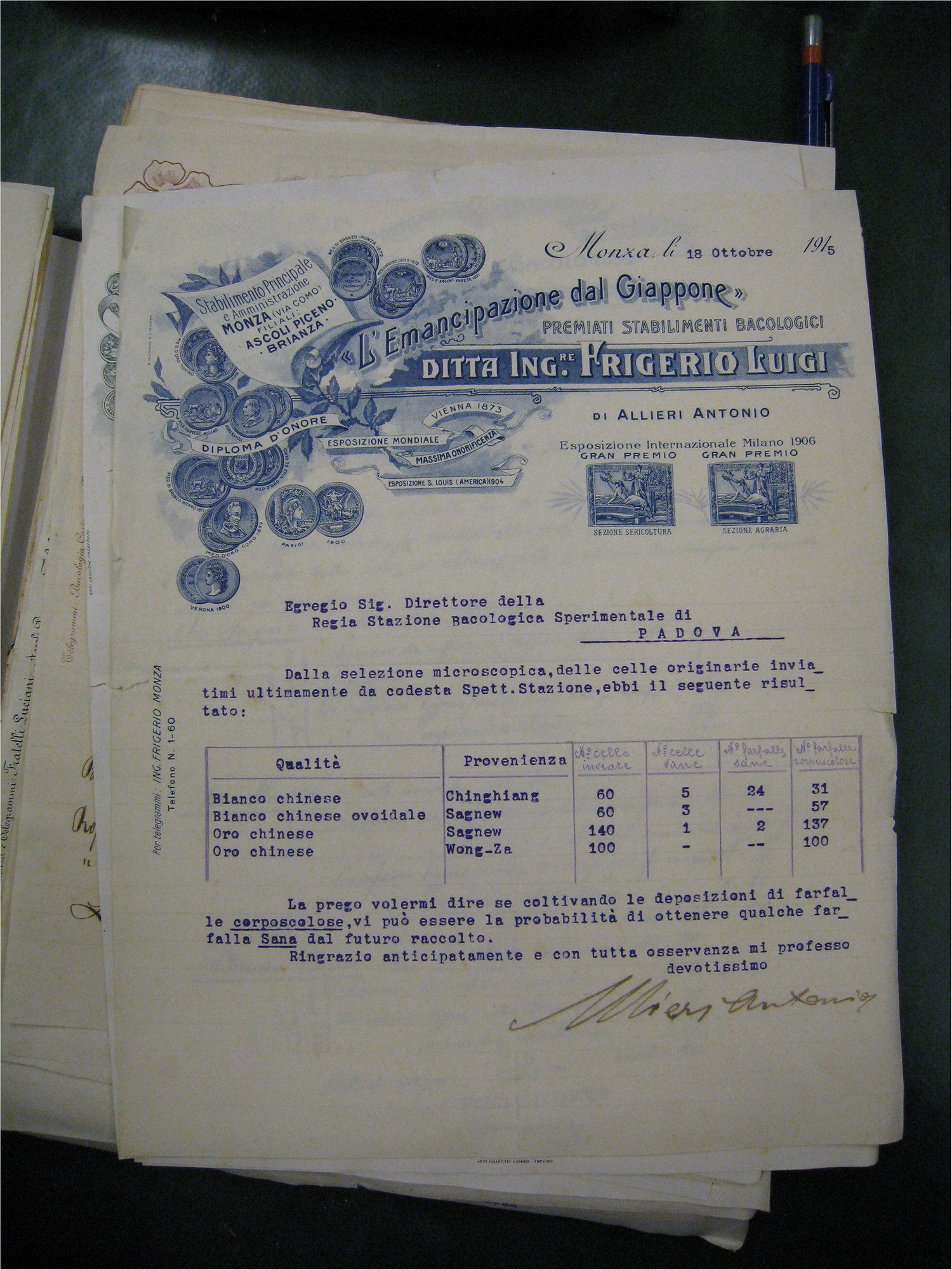
The Padua station’s dissemination activity contributed generously to overcoming the epidemic. The sharp decline in imports of Japanese egg cards attests to the substantial diffusion of the preventive method in Italy. The peak influx of Japanese egg cards occurred in the years from 1868 to 1870, with more than a million and a half imported. By 1881, they had dropped dramatically to 28,000, and in 1890 to a mere 9,000.Footnote 93 Still, in 1915, the floral letterhead of a private sericulture establishment featured the heading ‘Emancipation from Japan’, reminding readers of the painful dependence on Japanese eggs (Figure 2).Footnote 94 The primary instrument of such emancipation was the microscope. It is no wonder, then, that in the introduction to his most popular publication, Del filugello e del suo allevamento (About the Silkworm and Its Rearing), Verson dedicated seven pages to describing the microscope, including four images, and only two pages to an overview of sericulture history.Footnote 95
Letterhead of Ing. (Engineer) Luigi Frigerio’s sericulture company in 1915, displaying multiple medals and stamps commemorating awards won by the company, listing its three establishments, and featuring the inscription ‘Emancipation from Japan’. Frigerio to Verson, 15 October 1915, CREA-AA Padova, Laboratorio di Gelsibachicoltura (CPLG), 6.

Figure 2 Long description
Printed decorative letterhead in Italian, dated 'Monza, li 15 Ottobre 1915.' The header displays the bold slogan 'L'Emancipazione dal Giappone' (Emancipation from Japan) prominently at the top, flanked by circular medal and award stamp illustrations. Centered below is the company name 'Ditta Ing. Frigerio Luigi' in large decorative typography, followed by 'Di Allieri Antonio.' Award references appear around the header, including 'Premiati Stabilimenti Bacologici' and a reference to 'Esposizione Internazionale Milano 1906 — Gran Premio.' Two small rectangular stamp or seal illustrations appear to the right of the header. The formal letter body begins below, addressed: 'Egregio Sig. Direttore della Regia Stazione Bacologica Sperimentale di Padova.' The opening line of the body reads: 'Dalla selezione microscopica, delle celle originarie invia…' (text continues beyond the visible excerpt). The document is a formal business letter on printed company stationery with decorative typography and illustrated award imagery framing the header.
The station disseminated the microscopic method mainly through courses, but also via publications, exhibitions and public interventions. Between 1872 and 1900, Padua’s station awarded about seven hundred sericulture degrees.Footnote 96 The station offered two yearly courses: one for women only, described below, and a three-month spring men-only class to teach students silkworm anatomy and biology, ‘manual skills’, and how to package ‘healthy seeds with methods perfected by science’.Footnote 97 In contrast to otherwise similar courses, this class required candidates to hold a secondary-school diploma, stressing the scientific base underlying new techniques. As historian Francesco Vianello has argued, this theoretical focus both differentiated the course from those offered by farmers’ associations and helped to form scientific-minded rearers and breeders, open to innovation.Footnote 98 The final diploma qualified the student to become director of an observatory.
Ideally, observatories acted as intermediaries between the main station, farmers and breeders, creating an internal network within the country. Privately funded – with only a government starter kit of instruments – observatories offered microscopic checks of eggs.Footnote 99 By 1883, more than sixty such institutions dotted the peninsula. Since farmers sent samples outside the optimal season, inspectors worked flexibly, carrying out inspections on three life stages (egg, chrysalid and moth), favouring Pasteur’s protocols but also using others to meet local needs.Footnote 100 Soon, observatories grew controversial, as directors frequently complained of resistance and friction from ‘ignorant’ farmers. Particularly problematic was the fact that many observatories began producing seed themselves in order to raise funds, and thereby began to compete with breeders.Footnote 101
Alongside ‘rational breeders’, the station also created a new specialization through women-only courses for microscopists.Footnote 102 In the silk production chain, women were particularly numerous as workers in breeding and textile plants. They were considered especially suited for the job of selecting healthy moths, a task deemed relatively simple, requiring patience.Footnote 103 At this point, in the decades before the First World War, women were beginning to be represented in scientific agricultural roles in some countries. For example, women were increasingly employed at Japanese sericulture stations and in the Canadian Department of Agriculture, to check plant seeds.Footnote 104 This was not the case in all countries – women did not move into equivalent positions in English seed-testing stations until after the First World War – but it confirms sericulture as an innovative field.Footnote 105 Padua’s women’s class was activated in 1880: students were required to have an elementary-school diploma and previous familiarity with sericulture, and were financed with scholarships.Footnote 106 Padua also graduated six women who then became sericulture observatory directors.Footnote 107 In a few years, the number of women teaching microscopy and sericulture increased consistently in regions such as Marche, where sericulture was more developed.Footnote 108 The Padua station contributed to the very existence of these new professional figures whose qualification directly tied them to technological instruments – a significant break with the past in the domain of sericulture, especially in symbolical terms.Footnote 109
Padua’s courses attracted international attendance. Initially, international students went to Gorizia. Among these, at least two of them became directors of sericulture stations in Tbilisi (Georgia) and Szekszárd (Hungary).Footnote 110 Among those who audited Padua’s courses were egg producers and seed merchants from Bursa, Istanbul and Yokohama; public officials from Azerbaijan and the US Ministry of Agriculture; biologists like Nicolaj Gondatti, secretary of the Russian Society of Natural Sciences; and Mukerji Nitya Gopal, professor of agriculture at the Shibpur College (Bengala).Footnote 111 Moreover, between 1872 and 1913, fifty-one Romanian students took the Padua class, making Romanian sericulture a veritable branch of Padua’s.Footnote 112 The courses offered in Padua remained sought-after for decades. In 1929, when planning to train a student ‘in modern sericultural methods, including the microscopical examination of the moths, the selection of the eggs and also the cultivation of the mulberry’ on behalf of the Jamaica Agricultural Society, the London Imperial Institute sent an inquiry to Padua.Footnote 113 Courses were suspended only in the late 1930s.
These classes cemented relations among stations, as many international students remained in contact with Quajat and Verson for decades. For example, Bulgarian Hristo Yordanov (or Jordanoff) attended the sericulture class in Padua in 1889. With the arrival of pébrine, sericulture had been almost completely abandoned in Bulgaria.Footnote 114 Again on a mission in 1893, Yordanov experimented on silkworms in Padua, and visited several observatories, silkworm egg production plants and other facilities in Lyon. Once back in Bulgaria, as inspector for sericulture, he continued to turn to Padua for publications. By the end of 1894, Yordanov was discussing with Quajat the plan for the new sericulture station in Vratsa, even sending the plan and elevation for the new building. CREA’s archives in Padua preserve the original plan for the first – and still existing – building of the Bulgarian station, opened in 1896.Footnote 115
International attendance at sericulture courses created personal and institutional ties across borders and political divides. In 1933, the then Padua director, Luciano Pigorini, an early adherent of Fascism, remembered with remarkable affection Russian Dimitry Rossinsky, an ‘old friend and collaborator’. Rossinsky, the director of the Textile Institute in Soviet Moscow, had studied in Padua many decades earlier.Footnote 116 Similarly, well before the 1930s, when Italy and Bulgaria grew close again after the First World War, in 1924, Pigorini wrote to Vratsa ‘wishing to re-establish the relations we had before the war with foreign stations’. Collaboration soon restarted as Vratsa’s new director, Todor Shopov, was drafting a sericulture manual for university students.Footnote 117
Alongside courses, missions and international trips maintained the network. In 1873 the newborn Padua station organized a four-week sericulture tour of northern Italy for the Iwakura Mission. A group of ‘seven or eight’ Japanese breeders, including a French interpreter, accompanied by Sasaki Chōjun, visited numerous rearing and silk production facilities, to observe Italian methods of silk farming and reeling. The Ministry of Agriculture wrote to prefects in several cities (Udine, Treviso and Turin, among others) to make sure the Japanese guests received the best welcome. Guests visited up to ten establishments per day, and found the time to attend an opera at Milan’s ‘Alla Scala’ theatre in Count Giovanni Battista Passalacqua’s box, who later assembled a collection of Japanese objects.Footnote 118
Exchanges between stations followed different patterns. Padua’s library contains many of Gorizia and Montpellier’s publications, but few letters. Well documented are Padua’s exchanges with Tbilisi, Murcia, Vratsa, Tokyo, Szekszárd and Romania’s stations, while connections with Bursa are scarce, and exchanges with China become relevant only after 1900. Stations exchanged materials and knowledge at different levels. In 1891, for example, Shavrov, Tbilisi’s station director, sent Padua eighteen different strains of cocoons and eggs, some grown at the station in Tbilisi, some collected in the nearby regions; eleven different kinds of mulberry tree; a book, Description of Sericulture in the Caucasus; and a detailed explanation of how primary instruction about sericulture was carried out in Georgia.Footnote 119
Alongside various biological material and information, Padua received requests for its publications from both within and outside the sericulture network, including Germany, Brazil, Great Britain and the United States. The station published the Annuario della Real stazione bacologica sperimentale di Padova from 1872 to 1964 and a monthly bulletin (Bollettino mensile di bachicoltura) from 1883 to 1898. These are lively journals that mirror the techno-entomological nature of the station, including in their pages scientific, economic, technical, descriptive and social pieces. The bulletin published Verson and Quajat’s scientific papers, and hosted essays by other scholars. Notably, Aleksandr A. Tichomiroff published his paper on Bombyx mori parthenogenesis in the Padua Bollettino.Footnote 120 Not all stations adopted the same strategy. Giovanni Bolle, director of the Gorizia institution from 1880, authored more than eighty books and pamphlets for a wider audience, translated into several languages.
While most exchanges regarded Bombyx mori and mulberries, Padua station also exchanged specimens of, and information about, wild silk moths, such as Antheraea pernyi and Antheraea yamamai. Because of the threat posed by disease, research on silk-producing insects was flourishing as an alternative to silkworms, hoping to diversify production. In 1886, British businessman Thomas Wardle’s claim that Indian silk was as resistant to breakage as, or more resistant than, Italian silk unsettled the Italians and started a controversy triggering new studies on thread resistance by French economist Natalis Rondot.Footnote 121 During the years from 1891 to 1893, Quajat entertained a dense correspondence on wild silk moths and Indian wild silk (tasar) with Thomas Wardle, Eugène Maillot and Mukerji Nitya Gopal in Berhampur (or Brahmapur) in India.Footnote 122 In his book Kashmir: Its New Silk Industry, Thomas Wardle promoted the establishment of a sericultural station in India, dedicating an entire chapter to describing the Padua station and summarizing what had been a common understanding across the global sericulture community. ‘I further earnestly repeat my conviction that a Central Imperial Sericicultural Station in India, like those of Montpellier in France and Padua in Italy … would be of immense usefulness in India in preventing silkworm disease, [and] in teaching microscopic manipulation’.Footnote 123
Beginning in 1869, the sericulture stations operated as an early and enduring apparatus of techno-entomology. Through routine microscopic screening, teaching and experimentation, stations translated laboratory insights into knowledge commodities and field practices into scientific leads, yielding immediate gains in cocoon harvests. In the long term, stations achieved advances in breeding, hybridization and professionalization, including the new women’s role at the microscope.
This essay has argued that a single scientific invention mattered less than the institutionalization of technological methods and practices made to work at scale. The sericulture network should be credited with the worldwide adoption of the so-called Pasteur method – saving cocoons from pébrine, a disease which still lacks a cure – as well as with participating in the reorganization of global sericulture. As pébrine was understood as an international problem, governments and private companies favoured cooperation: missions, journals and especially sericulture courses allowed for the rapid circulation of people, practices and biological materials worldwide.
While the sericulture station was inspired by the German model of the agricultural station, the circumstance that led to the creation of sericulture stations was an epizootic disease affecting a highly remunerative economic sector, which comprised agriculture, entomology and industry. In contrast to the agricultural station, the birth of sericulture stations was not related to specific geographic or political conditions, as most countries where sericulture was significant established at least one station, with the exception of India, which was then under British rule. Given his early familiarity with sericulture stations, they might have inspired Pasteur when founding the Pasteur Institute, twenty years after the establishment of the Gorizia’s station.
This network enriches our knowledge of fin de siècle scientific networks, showing a – perhaps unique – system with peculiar characteristics and high connectivity. Cooperation stemmed from numerous factors: a common threat, shared goals and methods, the isolation of sericulture, and dense personal ties forged in courses and laboratories. However, stations varied greatly and the developments of sericulture stations in each region were primarily shaped by local, regional and national dynamics. In contrast, the international relationships among nodes followed geopolitical, economic and imperial logics. As a result, the World Wide Silk Web evolved into a polycentric and asymmetric global system. Unlike other entomological networks of the time, the sericulture network did not hinge on a single anchoring figure. Centre and periphery within the network depended upon the political economy of silk, and on scientific authority.
The World Wide Silk Web can serve as a generator to expand a multi-sited history of sericulture. The developments of sericulture stations in each region merit individual consideration, a task beyond the scope of this essay. Station building began as part of national modernization programmes or ‘internal colonization’, rather than colonial science ‘for development’. An examination of local breeding practices and their transformations might illuminate how ‘modernization’ was carried out comparatively. In each country, farmers’ attachment to traditional rearing practices created friction with the sericulture stations. However, the objective was not to eradicate local silk cultures, which formed the substrate upon which new practices were applied. Other aspects of the network can be further investigated. Though the network in its entirety was non-imperial, individual nodes certainly were political. For example, the Padua station became a colonial instrument under the Fascist regime, establishing a silk mission in the Greek colony of Rhodes in the 1920s. Furthermore, this international network challenges the purported isolation of Japan and opens to a closer investigation of multi-species interactions.Footnote 124 Finally, while many sericulture stations have been closed in the twentieth century as a result of the ever-decreasing value of silk on global markets, the history of the network after the 1930s can illuminate strategies of resilience and different approaches to declining practices. Today, sericulture stations and museums spanning from Japan and China to Italy and Spain, from Bulgaria to Georgia and Greece, are still connected to each other.
Acknowledgements
I am most grateful to Silvia Cappellozza, who generously introduced me to and guided me in the complex world of sericulture. As a historian of science, the opportunity to interact with an entomologist was a rare privilege, and I treasured it. I also thank the CREA Padua and ARACNE team for their hospitality and Diana Mantegazza for assisting me with the graphics. At DiSSGeA (University of Padua) I received the warmest welcome by Elena Canadelli, her team and Andrea Caracausi. I especially thank Francesco Vianello for his support and advice. I am also very grateful to Lisa Onaga for her thoughtful suggestions. Finally, I wish to thank the two anonymous reviewers whose careful reading and insightful comments helped me to improving this work, as well as Sarah Thompson and Amanda Rees at the BJHS. This article was written within the Aracne project funded by the European Union’s Horizon Europe research and innovation programme (Grant Agreement 101095188).

 Open access

