


Toro Muerto, located in the desert of the Majes River Valley in southern Peru, is one of the largest and most impressive rock art complexes in the Americas (Figure 1). Most of its petroglyphs were probably created between the last centuries BC and the early centuries AD, but it is evident that there was also activity at the site in the subsequent pre-Columbian period (Juszczyk et al. Reference Juszczyk, Wołoszyn and Rozwadowski2018). In colonial times—and certainly from the beginning of the eighteenth century AD—some of Toro Muerto's decorated volcanic tuff boulders were used as building material by the valley's inhabitants. A significant portion of the site was also gradually modified through conversion into cultivated fields. Consequently, by the time that its archaeological significance was discovered in the early 1950s, Toro Muerto had already undergone considerable change and partial destruction. The site was discovered by Peruvian archaeologist Eloy Linares Málaga, who made the first plan of the southern part of the site, proposed its tentative—and relatively late—chronology, and estimated the number of decorated boulders at nearly 5000 (which was, in fact, almost double the actual figure). In the following decades, the complex was visited and studied by various scholars, both from Peru and abroad (Núñez Reference Núñez Jiménez1986; van Hoek Reference van Hoek2003; Díaz Rodríguez & Rosińska Reference Díaz Rodríguez and Rosińska2008; Linares Reference Linares Málaga2014). Four years ago, a Polish-Peruvian team led by archaeologists from the Institute of Archaeology of the University of Warsaw began to explore the site in order to prepare a detailed documentation of it that would meet modern standards and as an introduction to analytical research aimed at establishing the chronology of the creation and use of the site (analysis of the iconography of the complex), recognition of its functions and ways of use (excavations at certain boulders) (Juszczyk et al. Reference Juszczyk, Wołoszyn and Rozwadowski2018).
Left) location of the Toro Muerto rock art complex; right) general view of the site (figure credit: the Toro Muerto Archaeological Research Project Archive).

Toro Muerto is an extremely rich repository of rock art. The officially protected area covers almost 50km2. Its central zone, where, according to our calculations, more than 95 per cent of the decorated rocks are located, occupies over 10km2. Although researchers have previously attempted to document the Toro Muerto petroglyphs (e.g. Pozzi-Escot Reference Pozzi-Escot, Sepúlveda, Briones and Chacama2009), they usually had the resources to record only a few hundred rocks. The documentation of the site has therefore remained incomplete and inaccurate. These inaccuracies can be observed in some of the published depictions of the petroglyphs, which are often free-hand drawings or based on oblique photographs, and are consequently heavily distorted. Furthermore, particular motifs from individual panels have often been presented separately, making it impossible to understand their relationship to other images on given panels.
The first stage of our project aimed to produce up-to-date documentation of the site, both on a macro and microscale. Due to the abundance of petroglyph-bearing boulders and their uneven distribution, this task required three field seasons to complete. More than 10km2 of the Toro Muerto area was documented through surface survey, and almost 2600 decorated rocks were registered. The location of each boulder was recorded using a total station and GPS mapping, with each petroglyph photographed and described in detail. Many petroglyph panels were traced on a transparent paper overlay, and some rocks were surveyed to create 3D models (Figure 2). During the 2018 field season, and with the generous cooperation of the National Geographic Institute of Peru, we obtained the first high-resolution aerial photographs showing the entire study area. In the same year, we also documented a new sector of the site (provisionally named sector X), which we discovered at an isolated hill located to the north. This site had almost 100 boulders decorated with unique iconography (Figure 3).
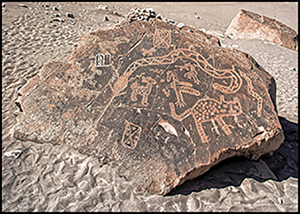
Left) Toro Muerto boulder TM 1677 exhibiting particularly rich iconography; right) modern graffiti (in the form of Tablets of Stone) is marked with a red line (figure credit: the Toro Muerto Archaeological Research Project Archive).
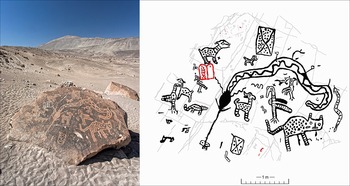
Aerial photograph of sector X (left) and TM 2498—its most spectacular boulder (right) (figure credit: the Toro Muerto Archaeological Research Project Archive).
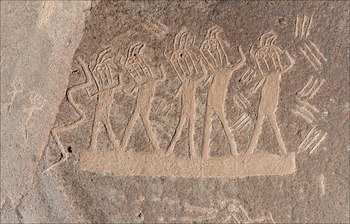
As part of the current phase of research, the Toro Muerto iconography has been analysed to consider similarities and differences in motifs, and to identify patterns and relationships between them—both on individual boulders and across the site. In terms of spatial arrangement, the boulders that have petroglyphs form an uneven strip along a south–north axis. Although many boulders are decorated, some bear no imagery, even if they are large enough and have surfaces suitable for making petroglyphs. Certain motifs can be seen in concentrations in various parts of the site, which may indicate the use of particular sectors for specific activities or rituals. These clusters include geometric designs, such as zigzags, as well as images of different kinds of birds and animals (e.g. snakes, felines or Andean camelids), and various anthropomorphic figures. The images of what appear to be people dancing, which are very characteristic of Toro Muerto and unique in Peruvian rock art, are present throughout almost the entire site, apart from the newly discovered sector X (Figure 4). A significant proportion of another type of human figure motif, depicting individuals with heads adorned with feathers, is clustered around an area that is free of boulders, creating a square or arena. It is also clear that certain motifs prevail in the eastern part of the complex, while others are found mainly on the western side.
The ‘dancer’ is one of the most common motifs in Toro Muerto iconography (TM 1646) (figure credit: the Toro Muerto Archaeological Research Project Archive).
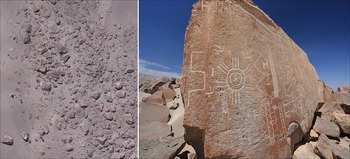
In 2018, we also undertook small-scale excavations that revealed an abundance of offerings deposited next to some of the boulders (Figure 5). The material comprised edible plants (predominantly corn but also chilli peppers and peanuts), camelid and guinea pig remains, along with small, painted stone tablets (Figure 6). The latter are typical of archaeological sites in this region, but were probably deposited several hundred years after most of the petroglyphs were produced (Faron-Bartels Reference Faron-Bartels2011). This suggests that Toro Muerto continued to be visited in the following centuries and maintained its status as an important site. This use of the site correlates with a widespread Andean tradition of wakas—sacred places that, to this day, still serve as portals through which interaction with the spirit world is possible. The organic materials are currently being dated, and we hope that this will increase our understanding of the site.
Excavating an offering of corncobs deposited adjacent to boulder TM 0252 (figure credit: the Toro Muerto Archaeological Research Project Archive).

Votive stone tablets painted with vivid colours (right) were popular offerings to deposit (left) next to boulders (figure credit: Toro Muerto Archaeological Research Project Archive).

During his research in 1965, French archaeologist Henry Reichlen documented significant quantities of surface material at Toro Muerto. This included stone tools, obsidian blades, painted tablets and pottery sherds representing different cultures. Reichlen's photographs are currently stored in the archives of the Musée de quai Branly in Paris, and can be viewed via the museum's online catalogue. Today, the surface material has almost entirely disappeared. In the 70 years since its discovery, the site has attracted tourists in increasing numbers, which may have contributed to the disappearance or destruction of the material. Furthermore, this increase in tourism has also resulted in damage to the complex: modern graffiti, for example, have appeared on some boulders, particularly in the southern area (Figure 2). Recently, local authorities, together with Peruvian archaeologists and private investors, have tried to increase public understanding of Toro Muerto and to improve the amenities at the site. They are also petitioning UNESCO to make this magnificent complex a World Heritage Site.
Acknowledgements
The first stage of our research (2015–2016) was funded by the Polish Ministry of Science and Higher Education (DI 2013008843). Toro Muerto Archaeological Research Project (begun in 2017 and due to be completed in 2021) is funded by a National Science Centre grant (UMO-2016/23/B/HS3/01882). We would like to express our gratitude to Fabian Brondi Rueda and his team from the National Geographic Institute of Peru, and to Abraham Imbertis Herrera and Lesly Tapia Rubina from Arqueomática for their commitment and excellent work. Our special thanks go to Beata Jurkiewicz, Aleksandra Lisek, Emily Ramirez and all the volunteers from Peru, Chile and Mexico who joined us during the last two field seasons.



