




On 10 December 1930, C.V. Raman took the stage in Stockholm to receive the Nobel Prize in Physics, the first Asian researcher to be awarded the prize in a scientific field, and instantly became the most internationally recognized Indian scientist.Footnote 1 Recounting the award ceremony after Indian independence, Raman claimed that he was ‘overcome by emotion when my name was called and I went up to receive the prize’, but added, ‘I was sorry to see that I was under the British flag. India was still under British rule.’Footnote 2 In that same interview with photographer and journalist T.S. Satyan, Raman recounted that he told his students at the time about his election as a fellow of the Royal Society, stating, ‘I’m not flattered by the honour done to me. This is a small achievement.’Footnote 3
This paper studies the impact of imperialism on Raman’s scientific career by looking at his engagement with scientific societies. Specifically, it focuses on the founding and organization of the Indian Academy of Sciences (IAS) by Raman within a landscape of competing Indian and international science academies. I argue that we cannot fully understand the functioning of the IAS without considering the role played by imperialism in the scientific field, and the legacy of imperialism for Raman. Raman’s experiences as a scientist in a colonized nation, especially in his interactions with the Royal Society of London, affected his perspective on the meaning and purpose of scientific institutions.
This paper aims to contribute to the current field of British imperialism and science. Recent scholarship has focused on the instrumental yet ambivalent role of the British scientific community and state institutions, such as the Royal Society, as well as debating the practices of writing that history today.Footnote 4 For the case of (British) India, a rich historiography of the development of (post)colonial science has been written, yet this chronology straitjackets itself to the periodization surrounding independence. Works by Macleod and Home categorize in great detail the work of the Royal Society in the British Empire in the long nineteenth century.Footnote 5 Others, such as Arnold and Phalkey, explore the post-independence period dominated by Nehruvian scientific organization.Footnote 6 Yet few works extend across the temporal gap of independence, meaning that little analysis has been done on the continuity of science between the late imperial period and independent India. Furthermore, the existing historiography of Indian science academies is dominated by the official narratives of the academies themselves, who avoid the historical questions posed by the legacy of imperialism.Footnote 7 By adding analysis of the Indian science academies in a (post-)imperial context, this article aims to explore more deeply the connections between imperialism and science in twentieth-century India, through the lens of scientific societies.
One exception to this lacuna is the work of Rajinder Singh, whose writings have shed new light on the first generation of professional Indian scientists, including on the life of Raman, his interactions with the Royal Society and his role in the science academies.Footnote 8 Singh’s direct work on the history of the science academies, however, is brief, and he chooses not to grapple with the reasoning behind the events.Footnote 9 To this end, he largely ignores the involvement of the Royal Society, preferring to focus on the Indian actors, thus leaving the influence of imperialism unexplored. Therefore this paper aims to provide a better insight into the imperialist underpinnings surrounding the founding of these science academies and the legacies of imperialism that shaped their functioning in a (post-)imperial context. As such, this paper analyses the career of Raman and how he navigated, and was shaped by, the imperial contexts of his time. This research sheds new light on the effects of imperialism on Indian scientific organization and institutions in this critical period.
It is worth exploring the utility of terms such as ‘imperialism’ and ‘empire’ for describing the actions of key players, as well as the historical context of these terms in India. During the 1930s, India was on the march towards independence. Gandhi’s Salt Satyagraha in 1930–1 and the widespread civil disobedience and resistance that sprang from that had opened the door to a much more assertive political movement for independence, championed by the Indian National Congress. Despite the political repression of many of the key figures such as Nehru and Gandhi during the 1942 Quit India movement, the days of British control of India were numbered. As such, the period can be broadly contextualized as one of growing Indian autonomy and imperial decline.
However, the question of what imperialism meant for the context of Indian scientific societies is still tricky to define, and the role of the Royal Society in imperialism is worth laying out. In one way, the Royal Society, and the actors involved, define their activities as unrelated to imperialism, defining imperialism as relating solely to political rule. Instead, this text argues for an expanded definition of imperialism that seeks to highlight the subtle and lingering ways in which imperial-adjacent organizations, such as the Royal Society, engaged in a form of cultural imperialism that shaped scientific communities and practices in India.
British archival materials consulted mainly come from the Royal Society and the Geological Society, comprising personal correspondence and public speeches. Materials from Indian archives were also used: the libraries of the science academies for annual reports, the Prime Ministers Museum and Library in New Delhi for personal correspondence of Indian scientists, and the Raman Research Institute for newspaper articles. These sources are more limited due to difficulties regarding access to institutions, the loss of archival material and the ongoing digitization efforts of some collections. In order to counteract this limitation, this text turns to two indirect methods of analysis for Indian academy sources: large data set analysis of academy membership and the examination of paratextual elements of academy publications. Analysis of membership lists to highlight groups, such as British scientists, hints at evidence of deeper mechanisms in action. Meanwhile, analysis of the paratexts of the journals of the academies illuminates the inner workings of publishing in the academy.
This paper is divided into four sections. The first provides a brief history of C.V. Raman and his relationship with the Royal Society, giving key background on the relations between these players during the first half of the twentieth century. The next two sections focus on the controversy surrounding the founding of the three Indian academies of sciences: the Indian Academy of Sciences (IAS), the National Institute of Sciences of India (NISI) and the National Academy of Sciences, India (NASI). The first of these sections examines how imperialism affected the initial organization of the science academies; the second analyses the actions of the academies under imperial rule. The final section examines the running of the IAS, and the impact that imperialism had on it both during and after British rule.
Doubleness and science: Raman and the Royal Society
Chandrasekhara Venkata Raman was born into a high-caste, Brahmin family in Madras and pursued a bachelor’s degree in science at Presidency College Madras. He was limited from pursuing further education in England after being judged too ill to travel by a British military officer.Footnote 10 He went to work for the Indian Financial Service but still did scientific experiments in his spare time through the Indian Association for the Cultivation of Science (IACS), an institute founded in 1876 to encourage scientific research in India. His initial success as a part-time scientist at the IACS came from the publications of this work, encouraging him to devote more time to the field of physics. Soon he began receiving students as research assistants from the University of Calcutta, and his reputation continued to grow until he took up a position as a professor in physics at the University of Calcutta in 1914.Footnote 11 During this period, he made contact with other Indian scientists, most notably his Calcutta colleague Meghnad Saha, and with international scientists as a result of his publications both in Indian journals (e.g. the Indian Journal of Physics) and in British journals (e.g. Nature).Footnote 12 Thanks to these connections, he was elected to the Royal Society on 15 May 1924.
Raman was the fourth Indian fellow in the society’s history. This was an achievement for Raman, since he had only visited Britain once, in 1921, as a representative of the University of Calcutta at a Universities Congress in Oxford.Footnote 13 Election to the Royal Society required six members of the society to vouch for a candidate before the executive committee would approve or deny the candidate based on the applicant’s merit and other circumstances, such as yearly membership limits.Footnote 14 While he made contact with several fellows at the 1921 Universities Congress, one of whom would later come to support his candidacy, the majority of his promoters came from the British Indian scientific community.Footnote 15
Following his election, Raman worked to induct a greater number of Indians into the Royal Society. Singh and Riess have shown that he supported the election of notable Indian scientist Birbal Sahni (elected 1936), as well as directly nominating others, such as K.S. Krishnan (elected 1940), who helped Raman with the experiments that won him the Nobel Prize; Homi J. Bhabha (elected 1941), the father of the Indian nuclear programme; and Subrahmanyan Chandrasekhar (elected 1944), Raman’s nephew and future Nobel Prize laureate.Footnote 16 For all of these cases, Raman relied on a composite of national and international connections. Internationally, British scientists such as Owen Richardson (for Krishnan) and Paul Dirac (for Bhabha), alongside other European scientists (e.g. Max Born), all helped Raman’s candidates. Domestically, it was a mix of scientists from the imperial scientific community, such as Lewis Leigh Fermor, and the Indian scientists he himself had helped elect earlier.Footnote 17 The singular exception is Raman’s noticeable absence in supporting the election of his former colleague Meghnad Saha. Nonetheless, this exemplifies that Raman had the connections within the British system that he could use to help other individuals become fellows of the Royal Society, and that he exclusively used this to introduce more Indian members into the society. Yet, while he actively brought more individuals into the Royal Society, it did not mean that he consistently supported the organization.
In 1943, the secretary of the Royal Society, Archibald Hill, visited India on behalf of the Royal Society to oversee a number of scientific efforts aimed at the reconstruction of India after the Second World War.Footnote 18 While there, Hill organized an induction ceremony for the Indian fellows of the Royal Society, who had not been able to travel to Britain to take part in the official ceremony in London. As such, the four non-inducted Indian fellows were invited to sign a document that stood as a replacement for the Charter Book of the Royal Society.Footnote 19 Raman encouraged the other fellows to boycott the ceremony, citing concerns that the Indian scientists were being denied the opportunity to travel to London and be inducted at Burlington House itself, a point that the Royal Society denied.Footnote 20 The result was not an entire success for either side. While Raman’s total boycott failed, with the Royal Society admitting two Indian fellows, they did not get everyone and the rejection of the ceremony, by Raman, worsened relations.
To understand this juxtaposition between Raman and the Royal Society, it is necessary to draw upon the work of Gyan Prakash and specifically the concept of ‘doubleness’. In Prakash’s own work, he uses ‘doubleness’ to highlight how different community identities, in this case colonizer and colonized, view museums and scientific categorization as both a form of imperial subjugation and an avenue of colonized autonomy simultaneously.Footnote 21 Conceptually, scientific societies fill a similar role to museums in form of scientific categorization, not that of objects, but that of people and the value of the work they produce. Therefore, the categorization of scientists through membership in scientific societies can be seen as a doubleness, of British scientists attempting to extend imperial control through categorizing the quality of scientists, and of Indian scientists attempting to forge their autonomy through converting and utilizing these institutional tools for their own benefit. To this extent, reactions to and from Raman can also be conceptualized through this concept of doubleness. To the Royal Society and the British scientists, Raman was seen through the lens of Eurocentric imperialism – a Nobel Prize laureate from a colonial nation that was increasingly more resistant to imperial rule. For Indian scientists, he was high-caste, but south Indian, and had increasingly difficult relationships with many of the high-profile Indian scientists and politicians.
Doubleness is necessary to the understanding of the Royal Society’s actions and Raman’s responses. Through examination of internal communications, the nuances of doubleness are seen in action. The ceremony, in the Royal Society’s opinion, was a bold step towards making the society fairer for scientists within the empire, following a policy of building deeper imperial connections that had been pursued since the early 1930s.Footnote 22 The ceremony was the first of its kind to occur outside Britain and, from the perspective of the Royal Society, was an attempt at building conciliation and respect between the British and Indian scientific communities. Additionally, letters between Hill and Henry Dale (president of the Royal Society) show significant anxiety over the correct way to advertise and discuss Hill’s visit to India, in order to respect the political sensibilities at the time. Due to Hill’s position as a Member of Parliament, it was decided that the trip be organized under the guise of the Royal Society. They did not want the trip to be seen as Britain trying to exert post-war control over an increasingly resistant India, but rather as a scientist’s mission to see the genuine scientific betterment of India.Footnote 23 While the actors are not conceiving their activities as being imperialist, going out of their way to pre-empt accusations of such, the act itself is still carried out in service of the project of British imperialism. For Raman and others, the event was perceived as not being on the same level as the official signing of the Charter Book in London, and thus was perceived as an insult, rather than an honour. In this case, a doubleness between the colonizer and the colonized occurs as the meanings of the public display of imperial and scientific authority are contested.
This was not the only difficulty the Royal Society faced with Raman’s conduct. In a letter to Hill in 1945, Dale states the following:
I do not know whether anyone has sent you also the enclosed newspaper report of a speech made recently by Raman. It constitutes the clearest case – indeed the only case within my memory, of a F.R.S [Fellow of the Royal Society] being guilty of one of the acts laid down in Statute 27 as a cause for ejection from the Fellowship. If Raman did not in this speech ‘by speaking, writing, or printing publicly defame the Society’, I do not think that anybody could ever be accused of doing so.
You will understand that I am not recommending that the Society should take action in the matter.Footnote 24
This letter starkly highlights that the Royal Society believed that they had legitimate cause to remove Raman and yet chose not to. Looking at their actions through an imperial lens, they did not just want to avoid the scandal of removing a Nobel Prize laureate, but of doing so to the first Asian Nobel Prize laureate. They arguably understood the political ramifications of removing the most highly decorated scientist in India from the society. The danger of removing Raman as a fellow, at a time when imperial control over India was weakening, could potentially have derailed the Royal Society’s work in organizing post-war scientific restructuring in India.
The Royal Society also extended this unusual leniency to Raman’s publications. Despite Raman’s protests, the Royal Society had concerns regarding the quality of his work and took great lengths in the peer review process of some of his articles to ensure that they had sufficient grounds for rejecting them. One article received six different peer reviewers before ultimately being rejected; more reviews than the average article at the time.Footnote 25 Despite this careful approach, the Royal Society did not avoid directly clashing with Raman either, as seen in the founding of the Indian Science Academies.
During the early 1930s, the idea of founding a national academy of science for India drew closer to reality, gaining momentum due to the difficulties faced by Indian scientists when publishing in international scientific journals after the First World War.Footnote 26 In 1930, the Academy of the United Provinces of Agra and Oudh in Allahabad was founded by Meghnad Saha.Footnote 27 Though Saha was more politically vocal than Raman, and maintained strong connections to the independence movement’s leadership, he also was more cooperative in working with British scientists. Spurred on by the success of the UP Academy of Sciences in Allahabad, preparations to found a national academy started in 1933. These preparations began with a questionnaire for the Indian scientific community about what a national academy would look like in terms of funding and organization, which was written and distributed by the Board of Editorial Co-operators of Current Science, alongside an editorial article by Raman, supporting the call for a national academy.Footnote 28 In addition, a committee of prominent scientists in Calcutta organized several meetings to discuss the new academy of science and suggested that it should be established in Calcutta.Footnote 29 In January 1934, Saha presented his presidential address on ‘The need for a national academy of science’ at the Indian Science Congress Association (ISCA). The ISCA was a scientific organization founded by two British scientists (Simonsen and Macmahon) in 1914, which organized an annual India-wide meeting of scientists in India. The general committee approved the resolution for creating a national science academy and instructed the creation of an ‘Academy Committee’, composed of several different groups of scientists.Footnote 30 In total, the committee stood at thirty-two members, a mix of mostly Indian with some British scientists, including Raman and his allies.Footnote 31 The first meeting took place in February 1934, resulting in L.L. Fermor, a key figure in the British scientific elite in India, being elected president of the committee. Fermor was also superintendent of the Geological Survey of India, president of the Asiatic Society of Bengal, and member of the Royal Society, all deeply imperial institutions that reflected the entrenchment of imperialism in the Indian scientific community.
However, after Raman – who was not in attendance at the first meeting – had received the minutes from that event, he became publicly critical of the process at the conference of the South Indian Science Association on 1 April 1934.Footnote 32 He and another scientist, Subba Rao, resigned from their positions on the committee. On 27 April 1934, Raman held a meeting to inaugurate the Indian Academy of Sciences (IAS) in Bangalore, inviting the scientific community of India to join this new national academy.Footnote 33 After months of negotiations to repair the rupture, the two sides met and agreed to a compromise in November 1934. The agreement would see the IAS remain functioning under Raman in Bangalore, while the new academy would be situated in Calcutta and named the National Institute of Sciences of India (NISI). The NISI’s role was to coordinate research efforts between various scientific organizations and societies, such as the IAS and the UP Academy of Sciences.Footnote 34
Overall, these moments of collision between Raman, his fellow Indian scientists and the Royal Society highlight the doubleness of imperialism in the scientific field in India. Raman, as a scientist from a country under colonial rule, used the Royal Society to build up his own reputation but was not strictly beholden to it. Using his unique position, he tried to stymie the Royal Society’s influence in India due to personal, professional and political misgivings. Conversely, the Royal Society’s view of Raman as a colonial scientist meant that they perceived his actions through the lens of imperialism, trying to avoid conflict due to the increasingly fragility of imperial rule in India. As such, the Royal Society arguably overstated the support that Raman actually had in the Indian scientific community, thus allowing Raman the space to create resistance to the Royal Society and by extension the imperialist influence that came with it.
The politics of equality in the Indian science academies
But what triggered Raman to split from the ISCA committee to found the IAS? While previous explanations focus on a disagreement over the meeting minutes, archival research for this paper provides a different account. In a confidential letter to Henry Dale in 1944, Fermor recounted his perspective on the events of 1934, claiming,
I discovered subsequently from personal conversation with Raman that he took this extraordinary step because he had not been selected by name by the Indian Science Congress for the Academy Committee, and forthwith nominated as the Chairman of the Committee, as the most distinguished scientist in India. Had the Indian Science Congress done this at its Bombay meeting he, Raman, would have accepted the Chairmanship, and it would have been unnecessary for him to start a rival organisation in Bangalore.Footnote 35
While this is Fermor’s own version of events, it provides a clear account of what happened.Footnote 36 Raman’s motivations appear to be focused on his perceived centrality and importance to the Indian scientific community, as well as his own desire to be the head of a national scientific academy. Yet it is also impossible to ignore the political and imperial context in all of this. Raman was the most internationally recognized scientist in India at the time and to elect someone else, a British scientist no less, to be head of the national science academy of India, at a time when nationalist sentiment was growing, was a decision underpinned by imperialist attitudes.
Raman’s public criticisms of the process also provide insight into other concerns he had. Raman protested a variety of decisions, ranging from lack of committee members from scientific support staff roles to criticisms that the society was too much like the Royal Society.Footnote 37 He also expressed concern that a ‘coterie of Calcutta scientists’ was trying to dominate the new science academy, feeding into a long-simmering regional division between northern and southern scientists.Footnote 38 Yet when Raman founded the IAS, not a single one of these critiques was addressed. The group of scientists at the heart of the academy simply changed from being centred around Calcutta to Bangalore. No other institutions or groups of individuals were involved in the consultation of what the IAS should be and even the structure of the IAS still borrowed heavily from the Royal Society.Footnote 39 He was lampooned by the north Indian press for this and the cartoon published by Amrita Bazar Patrika, a Calcutta-based newspaper, in April 1934 exemplifies this criticism (See Figure 1).Footnote 40
‘“Academy of Sciences” First Contribution! (On The Theory of Relativity)’, Amrita Bazar Patrika, 21 June 1934.
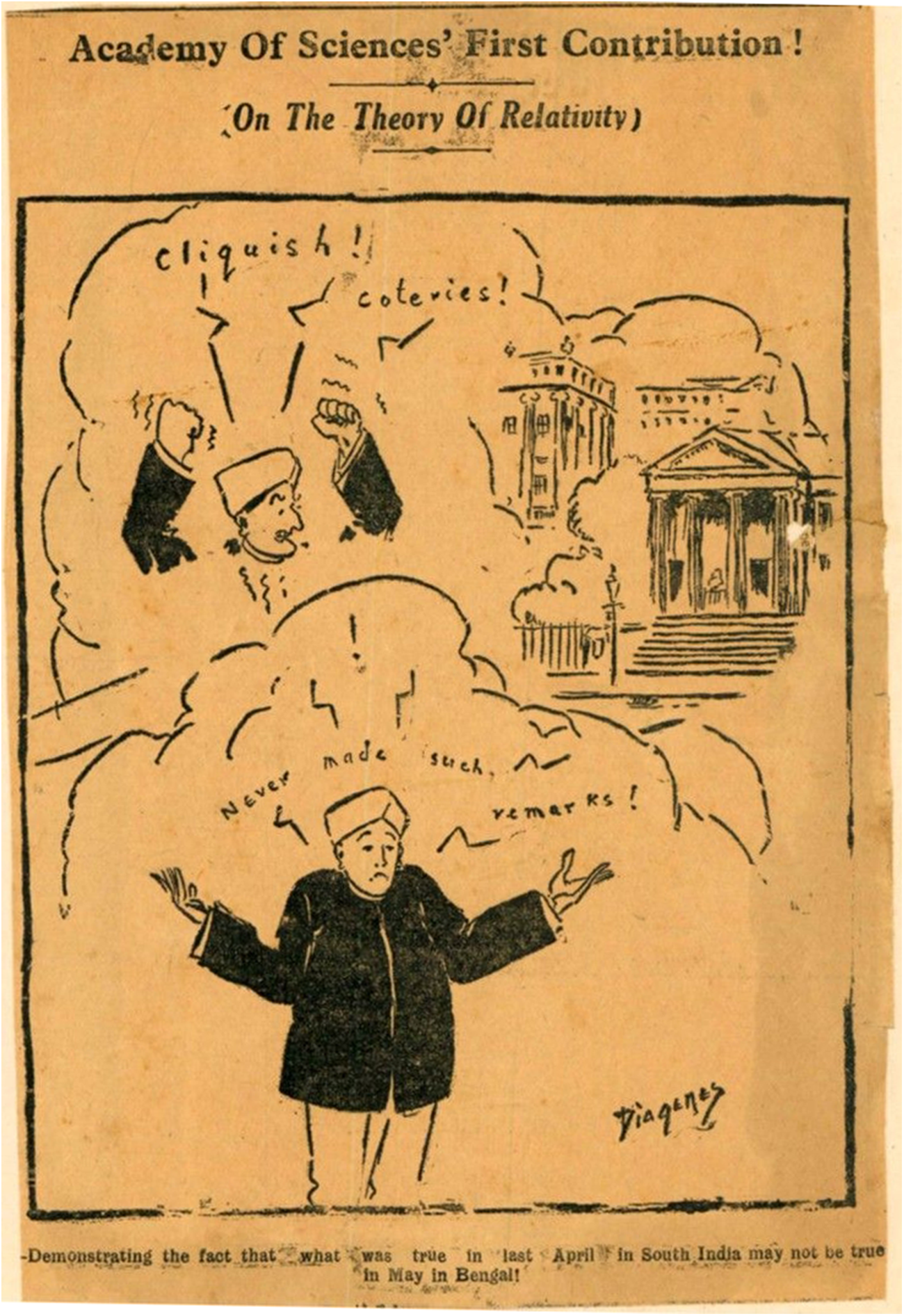
Figure 1 Long description
The cartoon shows a person with raised arms, surrounded by speech bubbles containing phrases such as 'cliquish!' and 'coteries!'. The person is positioned centrally, with buildings visible in the background. The text 'Never made such remarks!' is written near the person. The caption at the bottom reads 'Demonstrating the fact that what was true in last April in South India may not be true in May in Bengal.'.
Showing two versions of Raman, it depicts the contrast between his position on coteries and cliquishness in April 1934 with that in May of the same year. The text underneath stresses that the content of Raman’s comments was dependent on the geographical location he was referring to, thus insinuating that the relativity of his actual values was dependent on whether he was talking about northern or southern scientists.Footnote 41 While this cartoon comes from a north India newspaper, it exemplifies the fact that geographical division caused significant friction in the founding of the science academies.
The necessity of haste can explain why Raman’s own critiques did not translate into the practical structuring of the IAS, but it does also indicate that these issues were less firmly held moral stances than rather easy complaints to hide Raman’s true issue. Raman believed that he should be the one to chart the development of India’s national academy, rather than handing it over to north Indian scientists who were more willing to work with the Royal Society.
With the NISI inaugurated in January 1935, Fermor, now president of the NISI, attempted to reconcile Raman and the IAS through appeals to comradeship. In his speech to the Asiatic Society, Fermor spoke of how the formation of the IAS by ‘our Bangalore friends led to a very confused and confusing situation, which gradually became clarified when the true logic of the position became evident’.Footnote 42 The use of the term ‘Bangalore friends’ is an interesting deflection of the responsibility for the events from Raman personally, the person whom Fermor later identifies in his letter to Dale as entirely responsible for the split.Footnote 43 It also speaks once again to the geographical dimension, highlighting that Fermor, like the majority of British scientists in India at the time, was not part of the southern faction, but rather was closer to the northern faction. This holds true for the British scientists in India at large as the IAS had far fewer British scientists (eight out of sixty-seven founding fellows) when compared to the NISI (thirty out of ninety-three foundational fellows).Footnote 44
Yet while Fermor publicly evoked friendship, in private correspondence Fermor and Raman fiercely fought over the question of equality. Raman believed that the president of the IAS and that of the NISI should be made honorary members of each other’s academy in the ‘true spirit of co-operation on the part of all the scientists in India’.Footnote 45 However, Fermor argued against this on both economic grounds (as he was leaving India) and constitutional grounds, pointing out that it was Raman who had ensured that, in the statutes of the academies, Indian scientists could not be made honorary members: this position could only be offered to international scientists. Raman and Fermor attempted to negotiate on these details over the course of 1935, but failed to reach an accord.Footnote 46 Raman then informed Fermor that he had not paid his membership dues and that, according to the regulations, he was technically never a member of the institute, which breached the agreement Fermor and Raman had made in 1934.Footnote 47 Raman justified this course of action by arguing that Fermor and other scientists from the NISI had breached the agreement first by not joining the IAS, while Fermor retorted that NISI members were only required to be a member of one of the academies of sciences rather than all of them.Footnote 48 As a result, Raman declared his membership null and void.Footnote 49 Raman then, according to Fermor, began a campaign to hamstring the NISI.Footnote 50
The bureaucratic wrangling over honorary membership and honouring agreements obfuscates the deeper disagreement over equality. To Fermor and the NISI, equality meant that all senior fellows should enjoy membership of the NISI. For Raman, equality meant that the leading fellows of the academies should all be members of both the IAS and the NISI. The incompatibility of these two perspectives was partly fuelled by a practical desire for power and influence, but arguably was also informed by the imperial organizations in which this divide was taking place. The NISI was an institution born of the ISCA, an organization founded by British scientists. It was organized and initially run by Fermor, a British geologist who got the position thanks to his leadership of the Asiatic Society of Bengal, another institution with deep imperialist roots. In contrast, the IAS was an Indian-dominated endeavour, organized by Raman, India’s most prominent and internationally successful scientist. It was run mostly by Indian scientists and funded by local Indian leaders. While the imperial aspects of these divisions were never expressly stated in these discussions, and it should be noted that Indian scientists such as Saha, who were publicly anti-imperial, were also key organizers in the founding of the NISI, the structural biases of imperialism can be seen as an undercurrent of this divide.
According to Fermor, after the rupture in early 1935, ‘Raman continued to do everything he could to put his academy in a position superior to that of the remaining bodies’.Footnote 51 Raman competed aggressively for private funds with the NISI, with Fermor noting that funding applications were ‘always compromised by the appearance of a similar application from Raman’.Footnote 52 Raman’s actions were not universally supported, however, and his aggressiveness in promoting the IAS came to the detriment not only of the NISI, but also of the UP Academy of Sciences, who were frustrated with the competition for resources and lack of unity within the Indian scientific community. The UP Academy of Sciences had harboured desires to become recognized as the official academy of sciences for India, and had even voted to have their name changed to recognize this fact in 1933.Footnote 53 However, on the urging of its founder and first president, Saha, the organization agreed to let the ISCA create the newer all-Indian academy. But this united academy never came to fruition, and, in late 1935, N.R. Dhar, the third president of the UP Academy of Sciences, declared, ‘As our sacrifice has brought no unity amongst the scientists in India, we have unanimously decided to form ourselves formally into an All-India institution’.Footnote 54 By the end of 1935, there were three competing academies of science, each of whom claimed to be the national academy of sciences for India.
The race for recognition
The academies, attempting to bolster their claims of being the true national science academy, sought the support of internationally recognized scientists. Raman utilized this fact from the founding of the IAS, by ensuring that the German Nobel Prize winner Max Born was in attendance at the inaugural session of the IAS.Footnote 55 Additionally, over the course of 1935 alone, the IAS invited thirty-one honorary members, with nineteen of them soon to be or already being recipients of a Nobel Prize.Footnote 56 The content of the invitation to these individuals shows the intention behind this action. In the 1937 invitation to Henry Dale, Nobel laureate and future president of the Royal Society, Raman states, ‘The main purpose for which the Indian Academy of Sciences has been established is practically the same as that served by the great scientific societies in Great Britain and on the continent of Europe and elsewhere.’Footnote 57 In this invitation, Raman and the IAS are directly equating themselves with the national academies of sciences elsewhere and using these invitations as a tool of recognition. By getting the scientists to accept the offer, they also tacitly agree with the general content of the message.
In contrast, the NISI attempted to gain recognition through more official channels, namely through engagement with the imperial state. With the visit of A.V. Hill in 1943, the NISI passed a resolution claiming that they would
hereby request the Government of India to give formal recognition to some society representing all branches of science in India, as occupying a position relative to academic science on the one hand, and government organisations on the other, corresponding to that of the Royal Society of London or the National Academy of Sciences of Washington.Footnote 58
Meanwhile, J.C. Ghosh, the president of the NISI, personally campaigned for Hill’s support in encouraging the Indian government to recognize them officially. Initially, Hill and the Royal Society had desired to be diplomatic in their visit to India, making an effort to visit all the relevant societies for, in their words, ‘the sake of Indian susceptibilities’.Footnote 59 Even Hill’s letters of introduction to the Indian science academies were all identical, possibly in the hopes of trying to develop an equal relationship with all of them.Footnote 60 Yet with Hill, Ghosh was quickly successful at convincing him to support the NISI push for recognition. Hill was very happy to use his position, both as a member of the Royal Society and as a British government official, to support the NISI over other Indian academies of sciences. He forwarded the request from Ghosh and the NISI to Dale, now president of the Royal Society, alongside his own recommendation of support.Footnote 61 Hill’s support was not only limited to his connections to the Royal Society, however. He also gave recommendations for a NISI application for funding from the Rockefeller Foundation, which they obtained in May 1944. This support from Hill for the NISI was explicitly related to improving the position of the NISI over the other academies, with Hill handwriting a comment to Dale on the funding letter saying that the grant would ‘give the Nat. Inst a “leg-up”’.Footnote 62
The NISI used the apparatus and authority of the empire to leverage their own position and channel support within the Indian scientific community, while also avoiding direct responsibility. In the context of their own campaign for official recognition, passing the resolution in favour of a singular academy, without specifying which it should be, meant that the Indian government and the Royal Society had to make the choice themselves. As a result, the fallout from that choice would land on the British, rather than on the NISI. Indeed, after hearing that the British were close to recognizing the NISI, Raman blamed the British scientific community and the Indian government for their decision, drafting a letter of protest to the latter regarding the recognition of the NISI.Footnote 63 At the same time, the IAS organized a joint conference with the NASI, where they invited Hill, who was unable to attend.Footnote 64 Attempts at closer alignment between the Indian scientific communities of the IAS and NASI for a time had traction, but only in response to the imperial interference of the British.
From the Royal Society’s perspectives, they were acutely aware of the politics of the situation. While the Royal Society did not perceive their actions as related to empire, they also acknowledged that this perception was not shared by the Indian scientific community. Unlike Hill’s bold backing of the NISI, Dale was cautious and sought the advice of both Fermor and Simonsen before committing to continue with that support.Footnote 65 This was due to Dale’s personal lack of understanding of the Indian context, a context provided with Fermor’s response letter. Both Fermor and Simonsen agreed with the decision to support the NISI, with Fermor sharing the detailed history of the academies.Footnote 66 Yet Fermor’s letter also hinted at the political fragility of the request too. Not only did he mark his recounting of the events of 1934 as ‘confidential’ and insist that the contents be shared sparingly within the Royal Society, but he also suggested that the India Office be approached for a ‘discreet enquiry’.Footnote 67 This surreptitiousness was mirrored in Dale’s letters to the India Office, where he requested an ‘informal conversation’ about bringing up the matter of the NISI recognition.Footnote 68 The question of why they were being cautious can somewhat be explained by a meeting of the Royal Society on a related topic, the Indian Academy of Letters. In a conference on 24 July 1945, members of the Royal Society had a meeting to discuss the possibility of helping organize an Indian Academy of Letters. Dale, Hill, Fermor and Simonsen were all in attendance and, during the discussion, another member, John Clapham, brought up the concern regarding the connection between their intervention within the academic world and how that might be perceived as being linked to the empire, citing a concern about the political image of the situation.Footnote 69 It is here that Hill used the situation of the NISI to defend such intervention, arguing that there was no ‘mistrust of the British people’ but simply mistrust of the government.Footnote 70 Again, the Royal Society, while distancing themselves from engaging in what they perceived as (political) imperialism, were still engaged in work that was underpinned by culturally imperialist attitudes. Dale further defended this intervention on the ground that learned societies were deeply appreciative of British efforts, using the recent visit of six leading Indian scientists who had unanimously agreed on the necessity of British support for academic societies.Footnote 71
This visit to Britain by Indian scientists in 1944 spotlighted both the limitations of the Royal Society’s attempts to provide recognition and the society’s role in facilitating imperial activities related to the science academies. In order to boost British–Indian scientific and knowledge collaboration in the post-war period, the Royal Society had invited a delegation that included Saha and Ghosh, and had hoped to announce the award of a royal charter for the NISI.Footnote 72 This proved politically difficult, since the British government had put a blanket ban on the announcement of royal charters during the war.Footnote 73 While Dale and the others explored the possibility of getting the promise of a charter for the NISI to be delivered after the war, this was met with a definitive no from the government.Footnote 74 As the next-best option, the Royal Society organized an audience between the king and the delegation, whereby they could present the king with an ‘address’.Footnote 75 With recognition of the NISI being postponed until the end of the war, the Royal Society could do no more. Raman himself had not been included in the visit, leading to one Indian newspaper describing the visit as ‘A Hamlet without the Prince of Denmark!’Footnote 76 Raman claimed publicly that he had been asked and refused, but the internal planning documents from the Royal Society show that no one had ever brought up Raman’s name even in the initial suggestion of scientists.Footnote 77 Furthermore, inviting Raman would have undermined the alternative objective of the visit – conferring recognition on the NISI.
Yet while the Royal Society quickly forgot their role in the whole incident, Raman did not. In a report from the Royal Society delegate to the IAS in 1961, the delegate quotes Raman saying that he would not come to Britain unless he were able to stay in Buckingham Palace.Footnote 78 While the delegate dismissed the comment as a joke, it is possible that Raman still remembered the events of 1944 and the work the Royal Society did to undermine him. Raman also claimed that the other Indian fellows of the Royal Society were ‘doing unspeakable damage to science in India’, despite the fact many of them were helped into the Royal Society by Raman in the first place.Footnote 79
Altogether, this highlights the interventionist role that the Royal Society played in the early decades of the science academies of India. After 1935, the Royal Society became more actively involved in trying to support the NISI. This was partly due to the personal preferences for the NISI over Raman, mainly on the part of Hill and Fermor, but was also girded by imperialist assumptions about the location of scientific authority. The whole reason why Hill was in India in the first place was because the government of India requested his help to organize scientific development in India after the Second World War, because scientific links had been disrupted by the war effort. As such, despite the Royal Society’s rejection of explicit imperial intentions, their actions were intimately tied up in aiding the imperial control of India. The history of the science academies, especially NISI, is directly influenced by this imperial context. Raman and the IAS, conversely, found themselves sidelined because of their rejection of the Royal Society, and this affected the structure and ideology of the IAS under Raman’s leadership.
The IAS under Raman
During the contest of authority between the IAS, the NISI and the NASI over the decade between 1934 and 1944, Raman was also shaping what the IAS would become until his death in 1970. The structure and practices of the IAS were an indicator of the priorities and aims of Raman for what an Indian science academy should look like. It also highlighted how the legacy of imperialism continued to affect the scientific organization and community after independence.
Despite Raman’s public disparagement of the Royal Society, the IAS borrowed significantly from it. The journal of the IAS (Proceedings of the Indian Academy of Sciences) not only had essentially the same name as the Royal Society’s journal (Proceedings of the Royal Society) but also was divided the same way, split into Part A (physical sciences) and Part B (biological sciences), until the emergence of field-specific journals in the mid-1970s. For these journals, published papers from non-members of the academy had to be ‘communicated’ (vouched for) by a member of the society. Vouching also applied to membership applications of both regular and honorary members. All of these practices mirrored those of the Royal Society.
Yet Raman attempted to avoid the appearance of political involvement in the operation of the IAS, instead choosing to rely more on personal links to manage affairs. Raman was president from its founding until his death (1934–70). This life presidency contrasted with both the NISI and the NASI, which had rotating two-year presidencies, as well as procedural changes in the Royal Society, where the space for democratic input grew after the contested elections of 1935.Footnote 80 While Raman was elected to the presidency in 1934, and subsequently re-elected until his death, these elections seemed more coronations that exercises in democratic convention. Elections for other positions on the IAS’s executive committee did take place throughout his tenure, but the nature of election management remained opaque.Footnote 81 What is known, however, is that Raman assumed dominant control over the IAS, both administratively and financially, supporting the IAS himself and through occasional private donations.Footnote 82
The clearest example of Raman’s total control over the IAS can be seen through journal publications. The Proceedings of the Indian Academy of Sciences (Part A) had no listed editorial board during the Raman years, but an analysis of the communications of the journal articles from non-members offers an indication of the individuals who were acting as gatekeepers for the journal’s content. From the first volume in July 1934 to December 1942, around half of the 1,119 published papers in the journal were written by non-members, which needed ‘communication’ by a member prior to publication.Footnote 83 Of that group of papers (545), Raman personally communicated around 50 per cent of them himself (239 papers), far dwarfing the next-largest communicator, Sarvadaman Chowla, who communicated forty-one.Footnote 84 This high percentage of communications demonstrates the centrality of Raman to the journal, showing that he wielded significant authority as a gatekeeper of who and what was published.
Yet, while it might simply be easy to write off Raman’s actions as those of a leader who was not held effectively to account, it is worth bearing in mind the wider context of the international scientific community, as well as his own personal experiences under imperialism. To compare, the Royal Society’s own publications process was only slightly wider in scope. A study of the Royal Society’s publications and editorial practices shows that, in the 1930s, the entirety of peer review was carried out by only 30 per cent of fellows. Even then, some were concerned that papers communicated by a notable fellow were given more leniency than others.Footnote 85 On a personal level, publications were critical to Raman’s scientific career and to the building of his international reputation.Footnote 86 Even his most famous achievement, the Raman effect, was discovered by Russian scientists at roughly the same time. Raman’s speedier publication in a European scientific journal secured his legitimate priority in the discovery in the eyes of the international community, thus resulting in his Nobel Prize.Footnote 87 From Raman’s experience, scientific success hinged on publications. This both explains the frustrations he had with the Royal Society blocking his own publications, and suggests that his work on IAS publications can be seen in a more nuanced light. Raman arguably saw the Indian scientific community as requiring a publication system that did not assume that Indian science was inevitably inferior to European research. Raman and a select few others were the only ones who could be trusted to approve publications for other Indian scientists without prejudice. Thus they became the arbiters of publications within the IAS.
However, this in turn re-created the small social clique structure that had historically dominated organizations such as the Royal Society, with the result that publications, without a transparent and democratic editorial process, were still susceptible to personal bias. One example of this in the early years of the IAS was Sarvadaman Chowla. Chowla was a prominent mathematician and, until his migration to the US in 1947, a key individual in communicating papers on mathematics in the IAS. In total he communicated the second-largest number of papers during the first decade, as well as publishing numerous others.Footnote 88 However, sixteen of those papers were actually papers written by his younger brother, Inder Chowla, who only had a bachelor’s degree in mathematics at the time of the publication of his first paper.Footnote 89 Inder Chowla’s publications, communicated by his brother, kept appearing in the Proceedings of the IAS, only ceasing when his brother moved to the US. While this is not a question of intellectual rigour, and it is important to note that Inder obtained a PhD in mathematics from the University of Cambridge in 1942, it is possible that the structure of the IAS’s publication system facilitated the printing of Inder’s work.Footnote 90
This evidence suggests that Raman structured the IAS to overcome the discrimination that he, alongside other Indian scientists, faced with their work. International scientific publications, influenced by the long history of imperialism, devalued Indian work, and Raman attempted to create a space where trusted Indians could judge and value work fairly. This came at a cost, however. In rejecting the discriminatory, but more democratic, systems of the international community, Raman instead opted for a close-knit group of loyal scientists that perpetuated control amongst its own. While this group did benefit Indian scientists in the broad sense, by allowing more publications from Indian scientists, it also replicated a closed community that had little to no accountability regarding the publication decisions they were making. Ironically, many of the criticisms Raman made of the Royal Society and the NISI ended up being replicated by his own organization due to his focus on his own publication experiences.
Conclusion
Raman’s career after the founding of the IAS and independence was limited. In 1947, he created a separate research institute, called the Raman Research Institute (RRI), where he remained until he died. While NISI and NASI took government subsidies, Raman rejected state support in helping to run the IAS or the RRI.Footnote 91 Raman publicly criticized state intervention into the scientific field through the development of national laboratories, preferring to use personal or private funds.Footnote 92 As a result, he also grew isolated, rejecting Indian scientists he had previously supported, and rarely engaging with the world outside his compound.Footnote 93 While his death in 1970 was a hard blow for the IAS, they slowly transitioned to a structure which more resembled that of other academies of science. In the decade after his death, they began to accept government funding, while still decrying government influence; to change presidents every two years; and to develop a more transparent system of publications.Footnote 94
In his 2020 article, Singh calls for further research on why the three academies of science remained separate after the formal end of the British control of India, as well as why Raman remained a life-long president of the IAS.Footnote 95 This article provides a direct answer to both questions by presenting the trajectory of Raman and the IAS, and the influence imperialism played in diffracting those trajectories.
In isolation, Raman’s actions seem self-centred at best. However, incorporating the imperial lens into the analysis of the Indian scientific community transforms Raman’s apparently dictatorial grasp for power into a nuanced and complex tapestry of the doubleness of imperialism and the tensions that lay within the national and international recognition of scientists. The founding of the academies of sciences in India was directly impacted by British imperial influence, via the actions of the Royal Society, as well as by Raman. Similarities between the three organizations existed because they were conceived with the dual intention of both uniting the Indian scientific community as part of a strategy to bolster a national identity, and simultaneously being a tool of imperial influence. The result was the creation of science academies built with imperial support (the NISI), founded in rejection of imperialist influence (the IAS) or emerging as a result of the conflict between those two camps (the NASI). Undeniably, all three were influenced by the British Empire, its actors in the Royal Society, and their imperialist views on science.
With the IAS, Raman attempted to forge a mechanism that would enable other researchers to both re-create his past successes and overcome international barriers. Raman’s priorities as a scientific leader who attempted to champion his own vision for India’s scientific community through the IAS provides insight into the types of problem that were affecting the Indian scientific community at large. Raman’s centralized control of the IAS and its publication methods illuminates that, while he was successful, his attempts were still altered by his own experiences of imperialism, and in some ways ended up re-creating in the IAS elements of the imperialist structures against which he fought.
Acknowledgements
I owe many thanks to Joris Vandendriessche, Anna Cabanel, Idesbald Goddeeris, Thammy Guimarães Costa Borges, Jahnavi Phalkey, Lourens van Haaften and all the members of KU Leuven’s Cultural History since 1750 research group for their recommendations. My appreciation also extends to the editor of the BJHS and the two reviewers for their insightful comments, which improved this paper by magnitudes. My deepest thanks must be given to the helpful staff at all archives and institutions consulted for this paper. This research was funded from the European Research Council (ERC) as part of the GLOBAL ACADEMIES project (grant agreement No. 101042343).

 Open access

