




1. Introduction
The expression of emotions in a foreign language offers insights into cultural and linguistic subtleties, revealing how different groups perceive and articulate emotions like love. Such analysis highlights the social and emotive‑affective factors shaping linguistic usage. The present study examines the language of love among speakers of English as a foreign language, using an interview conducted in 2024 as a case study. Its aim is to analyse typical features of love‑motivated statements produced by non‑native English speakers. The participants were 96 bachelor’s degree students in their third or fourth semester, all native German speakers who learned English as a second language. Interviewees described situations in which they would express love (e.g., towards a partner or parents) and provided examples of how they would articulate this feeling in English. The interview allowed respondents to decide what to say and how to phrase their statements, offering insights into individual perspectives on experiences and emotions. It also prompted reflection on language use. Since the interviews took place in English as a lingua franca, the data reflect communicative strategies typical of ELF interactions, including creative or non‑standard metaphor use. Special attention is paid to metaphorical language, which dominates the dataset. The linguistic material is analysed according to Conceptual Metaphor Theory (CMT). Metaphor analysis is central in Cognitive Linguistics (Grady Reference Grady, Geeraerts and Cuyckens2007, 188). CMT dates back to Lakoff and Johnson (e.g. Lakoff and Johnson Reference Lakoff and Johnson1980, Reference Lakoff and Johnson1999), whose terminological framework (e.g. source and target domain, conceptual mapping) underpins the present study. Although CMT is influential, it has been criticised for relying on researcher intuition, neglecting irregular features and drawing on limited documentation. To address these issues, this study applies a methodological approach based on real‑language interview data on the language of love. The overall objective and research questions (RQs) are as follows:
To investigate how love is metaphorically represented and linguistically expressed by speakers of English as a foreign language, using an interview study with German L2 English learners.
RQs: Which metaphorical linguistic features are used by L2 English speakers when expressing love?
How do respondents conceptualize love metaphorically in English, and what patterns emerge?
Which cognitive, emotional‑affective, pragmatic or sociocultural factors may account for the metaphorical choices observed across contexts?
Section (1) presents existing research, Section (2) outlines the methodological approach and data, and Section (3) focuses on the empirical findings.
2. State of the art
Cognitive linguistics investigates how language is understood, produced and acquired by drawing on general cognitive abilities. It assumes that linguistic structure is inseparable from how humans perceive, categorize and reason about the world. Central to this perspective is the idea that conceptual structures shape linguistic expression and that language provides a window into the mind. Research in this tradition has offered substantial insights into how speakers encode and communicate their thoughts (e.g. Talmy Reference Talmy2000; Croft and Cruse Reference Croft and Cruse2004).
Within this broader framework, the metaphorical conceptualization of emotions has been explored extensively in both classic cross‑linguistic studies and more recent work grounded in Cognitive Metaphor Theory (CMT). A key figure in this area is Kövecses, whose analyses of anger, love and passion (e.g. Reference Kövecses1986, Reference Kövecses1990) illustrate how emotional meanings are structured and how speakers draw on culturally embedded conceptual patterns. His research shows that love, in particular, is not reducible to biological responses but emerges as a rich conceptual network linked to behaviour and bodily experience. Cross‑linguistic investigations, such as his study of the container metaphor for anger in English, Hungarian, Japanese and Chinese (Reference Kövecses and Radman1995), further demonstrate how emotional metaphors vary across languages while still reflecting shared cognitive tendencies. Later work (Reference Kövecses2000, Reference Kövecses2014) highlights the interplay between metaphor, cultural models and physiological grounding, and identifies love as one of the most metaphorically elaborated emotion concepts, drawing on domains such as unity, fire and disease (Kövecses Reference Kövecses2000, 26–27).
This research tradition builds on the foundations of CMT, developed primarily by Lakoff and Johnson (e.g. Reference Lakoff and Johnson1980, Reference Lakoff and Johnson1999; Lakoff and Turner Reference Lakoff and Turner1989), who argued that metaphor is not merely a stylistic device but a core cognitive mechanism structuring abstract thought. Complementary cross‑cultural work in anthropology, psychology and sociology (e.g. Ekman Reference Ekman1972; Mesquita and Frijda Reference Mesquita and Frijda1992; Soto et al. Reference Soto, Levenson and Ebling2005) has shown that emotional experience is shaped by cultural norms and interpretive frameworks. Karandashev (Reference Karandashev2023), for instance, demonstrates how love is embedded in socio‑cultural contexts, and how figurative language reveals the conceptual scaffolding underlying emotional understanding.
The conceptual toolkit of CMT – source and target domains, mappings and conceptual metaphors – has informed a wide range of linguistic research. It has guided cross‑linguistic metaphor studies (e.g. Kövecses Reference Kövecses1986, Reference Kövecses1990, Reference Kövecses, Handl and Schmid2011; Baldauf Reference Baldauf and Zelinsky–Wibbelt2003) as well as psycholinguistic investigations into metaphor processing (e.g. Kutas and Federmeier Reference Kutas and Federmeier2000; Gibbs and Colston Reference Gibbs and Colston2012). Methodologically, the field has evolved considerably: while early studies relied heavily on introspection and researcher‑generated examples, the past two decades have seen a marked shift toward corpus‑based, quantitatively oriented approaches (e.g. Charteris–Black Reference Charteris–Black2004; Deignan Reference Deignan2005). These corpus‑driven methods have enabled more systematic and empirically grounded analyses of metaphorical patterns, including those related to emotion concepts.
CMT‑based research on bilinguals and L2 speakers of English has also grown substantially. Studies have examined how L2 users conceptualize emotions, the extent to which L1‑based metaphorical patterns influence L2 production, and how metaphorical competence develops across languages (e.g. Boers Reference Boers2003; Pavlenko Reference Pavlenko2008; Littlemore Reference Littlemore2009). Findings suggest that bilinguals often draw flexibly on both linguistic systems, activating metaphorical patterns depending on proficiency, context and communicative goals. Some studies have incorporated elicited interview data or think‑aloud protocols to explore speakers’ explicit reasoning about emotional meaning (e.g. Pavlenko Reference Pavlenko2007; Dewaele Reference Dewaele2010), which is particularly relevant for the methodological orientation of the present study.
3. Methodology and data
The findings presented in this study are based on qualitative interviews with 96 bachelor’s degree students in their third or fourth semester at a German university. All participants were native speakers of German and learners of English as a second language, studying various humanities and social science majors (e.g., linguistics, education, cultural studies). They were between 19 and 25 years old with a balanced gender distribution. All had received at least six years of formal English instruction and were enrolled in upper‑intermediate courses (B2–C1), ensuring a comparable L2 proficiency profile for analysing metaphor use. Participants responded to three open questions designed to elicit literal and metaphorical expressions of love and reflections on factors shaping their linguistic choices (see appendix):
– Describe typical situations in which you would express love in English.
– Provide at least two examples of what you would say.
– Explain possible reasons for your choice of expressions.
In total, the interviews yielded:
– 312 literal expressions
– 1,098 metaphorical expressions
Overall, 1,098 of the 1,410 expressions (≈78%) were metaphorical, demonstrating that metaphorical language dominated the dataset. Before analysing metaphors, the study distinguishes literal vs. metaphorical examples:
Literal examples:
(1) ‘I’m very much in love with my partner.’ (Participant 14)
(2) ‘I love my parents.’ (Participant 3)
(3) ‘I’m very fond of my cat.’ (Participant 43)
(4) ‘She really likes him a lot.’ (Participant 82)
Analysis of the literal examples showed that participants relied on a small, conventionalised set of expressions, mainly to love and to be in love with. Despite their proficiency, learners used a limited repertoire of straightforward lexical items, resulting in far less variation than in metaphorical expressions.
Metaphorical examples:
(5) ‘My love for her is burning me up inside.’ (Participant 21)
(6) ‘You are my sunshine.’ (Participant 41)
Interviews were conducted between January and July 2024. Audio recordings (252 minutes) were transcribed verbatim, resulting in a 23,308‑word corpus. All participants were anonymized (Participant 1–96). Metaphors were identified using MIPVU (Steen et al. Reference Steen, Dorst, Herrmann, Kaal, Krennmayr and Pasma2010), a detailed procedure for detecting metaphorical word use based on corpus‑linguistic insights in English and Dutch. It builds on the Pragglejaz Group’s (2007) Metaphor Identification Procedure and extends it into MIPVU. Key aspects include (Steen et al. Reference Steen, Dorst, Herrmann, Kaal, Krennmayr and Pasma2010, 25–42):
– analysis of metaphors at the word level
– identification of lexical deviations from basic meanings
– emphasis on contextual interpretation
– systematic protocols ensuring consistent identification
MIPVU enables accurate, comparable results and is applicable beyond English and Dutch.
While MIPVU was applied to Part (2), responses from Parts (1) and (3) were analysed using qualitative content analysis. Contextual descriptions (Part 1) were coded inductively to identify recurring communicative situations. Metalinguistic reflections (Part 3) were coded according to cognitive, emotional‑affective, pragmatic and sociocultural factors influencing metaphor choice. This addresses critiques of CMT by grounding interpretations in participants’ explanations. The analysis draws on Kövecses’ (Reference Kövecses, Handl and Schmid2011, Reference Kövecses2015) framework, which highlights the influence of situational, discursive and cognitive contexts. As Kövecses (Reference Kövecses, Handl and Schmid2011, 26) argues, metaphor use is shaped not only by embodied experience but also by discourse type, personal history, and physical, social and cultural environments. These dimensions served as sensitizing concepts for identifying factors triggering metaphorical creativity in L2 English.
Based on the combined analyses, the study identifies:
– the most frequent metaphorical patterns used by L2 English speakers to express love,
– the communicative contexts in which these metaphors occur, and
– the contextual, cognitive and sociocultural motivations underlying individual choices.
This approach shows that metaphor production in L2 English results from a complex interplay of linguistic proficiency, cultural background, emotional experience and situational context.
4. Metaphorical language use
About 78% of the evidence from learners of English as a foreign language consists of metaphorical expressions representing the emotion concept under study. The analysis first outlines the typical situations in which the concept is realised, then examines the language use reflected in the data, and finally considers interviewees’ explanations before synthesizing the findings.
To provide an overview of the metaphorical patterns identified, Table 1 summarises the major source domains used by participants when expressing love in English. It lists each domain, its relative frequency, and a representative example from the interviews. The table focuses on broad source domains; the subsequent analysis examines each domain and its subcategories in detail. This overview serves as a structural guide to the following sections, which discuss the conceptual motivation of each domain and illustrate how L2 speakers employ these metaphors across different communicative contexts.
Overview of major metaphor domains
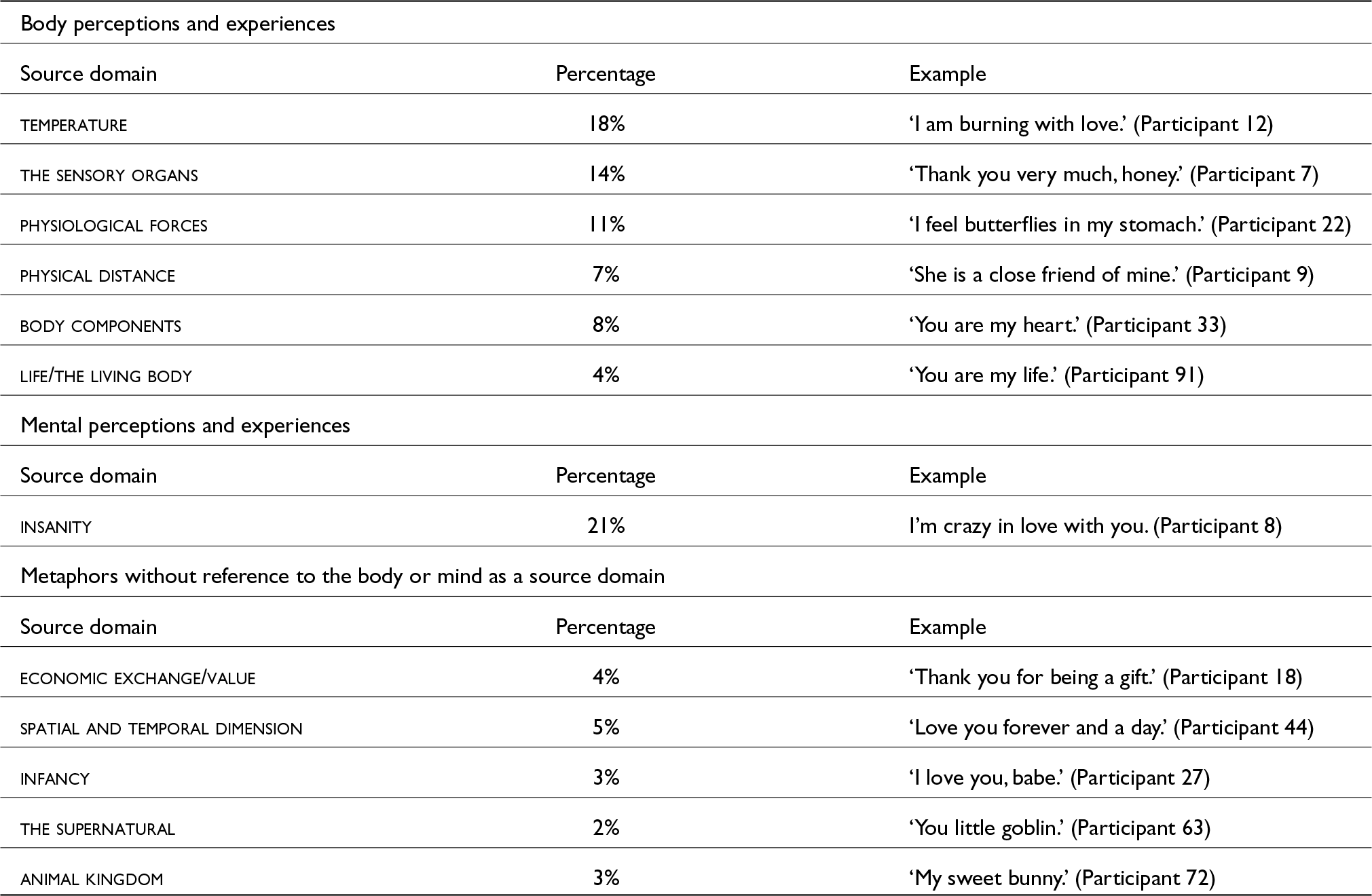
Table 1 Long description
The table summarizes metaphor source domains used in expressions of love, reporting the percentage share for each domain and giving one example quote with a participant number. In body-related domains, temperature is highest at 18 percent, followed by the sensory organs at 14 percent and physiological forces at 11 percent. Other body-related domains are body components at 8 percent, physical distance at 7 percent, and life or the living body at 4 percent. In mental perceptions, insanity is the single largest category at 21 percent. Metaphors not tied to body or mind are less frequent overall, led by spatial and temporal dimension at 5 percent and economic exchange or value at 4 percent, with infancy and animal kingdom at 3 percent each and the supernatural at 2 percent. Percentages indicate relative frequency within the dataset and may not sum to a complete total because only selected domains are listed.
The interview data reveal a number of communicative situations in which speakers naturally draw on metaphorical expressions to articulate love. Metaphors grounded in temperature typically arise in moments of heightened emotional arousal, such as romantic passion or physical attraction, where speakers describe intense feelings through heat‑related imagery. Metaphors based on taste, especially those invoking sweetness, occur predominantly in intimate interactions with a romantic partner and in affectionate exchanges with pets, particularly in private settings where speakers feel uninhibited and engage in playful or exaggerated forms of address. Metaphors drawing on vision and brightness emerge in situations where speakers express admiration or emotional uplift, often when encountering or thinking about a loved person.
Metaphors rooted in physiological forces appear in contexts involving nervous excitement or emotional agitation, such as early‑stage romantic encounters, where embodied reactions like butterflies in the stomach are used to convey emotional upheaval. Situations involving relational closeness also elicit metaphors based on spatial proximity or unity, particularly when speakers express loyalty, affection or deep interpersonal connection toward partners, close friends or family members. Additional metaphors arise in contexts where speakers highlight the perceived value or centrality of a loved person, drawing on economic exchange, temporal extension or body components to express gratitude, permanence or vulnerability.
Finally, metaphors based on the animal kingdom occur frequently in affectionate, intimate or playful interactions, especially in romantic relationships, where speakers use animal‑based terms of endearment such as bunny and kitten. These expressions often appear in private or semi‑private moments and may be reinforced by L1 patterns (e.g., German Häschen, Kätzchen) or by cultural references such as film or television. Across all these contexts, metaphor use is closely tied to embodied experience, social norms, relationship depth and communicative setting, demonstrating how speakers rely on bodily, relational and culturally mediated scenarios to structure emotional meaning.
4.1 Body perceptions and experiences
A central question in this section concerns which love metaphors known from the CMT literature also appear in the interview. Approximately 72% of all metaphors mentioned by interviewees correspond to well‑established patterns in cognitive linguistics. Many are rooted in bodily perception and experience, confirming Kövecses’s (Reference Kövecses2014, 15) view that emotional concepts are fundamentally embodied. Because emotions are often expressed physically, the body and its sensory functions naturally serve as key source domains for conceptualising love (Kövecses Reference Kövecses2014, 23).
4.1.1 Temperature
One of the most prominent metaphorical patterns in both the CMT literature and the interview data is emotion is temperature. This metaphor has been widely documented in cognitive linguistics, and the interviews clearly show that speakers continue to rely on temperature‑based imagery to conceptualise love (e.g. Kövecses Reference Kövecses2020, 77). In the present study, around 18% of all metaphorical expressions belong to this category.
4.1.1.1 Fire, heat
Within the framework of CMT, the mapping intensity is heat functions as an overarching, general metaphor that underlies more specific instantiations, including the well‑known metaphor love is fire (Kövecses Reference Kövecses2020, 8; see also Gibbs Reference Gibbs2006). In the interview, approximately 12% of all metaphors refer specifically to fire or heat. They typically highlight the intensity, passion or sexual desire associated with romantic love. These metaphors are not only theoretically established but also strongly represented in the interview data, see:
(7) My love for her is burning me up inside. (Participant 21)
(8) I am burning with love. (Participant 12)
Another recurring expression in the interviews is the colloquial phrase to have the hots for somebody, which also belongs to the love is heat metaphor family. This idiom foregrounds physical attraction, again reinforcing the embodied nature of love metaphors.
4.1.2 The sensory organs
In addition to temperature‑based metaphors, the data also reveal love metaphors grounded in the sensory organs, particularly taste and vision. Together, these account for about 14% of all metaphorical expressions. This corresponds with findings in the CMT literature, which highlight the human body and its sensory functions as a source domain for embodied emotional metaphors, including those used to conceptualise love (Kövecses Reference Kövecses2014, 23).
4.1.2.1 Taste
The collection of terms of endearment from the interview study includes several examples that illustrate the concept the object of love is appetizing food (see also Kövecses Reference Kövecses2000, 26). taste‑based metaphors make up around 6% of the data. Within this category, each example is associated with appetizing, usually sweet‑tasting food. Examples include:
(9) Thank you very much, honey. (Participant 7)
(10) You are my sweet bun. (Participant 39)
Most expressions in this category function as affectionate forms of address for a beloved partner. In addition, several examples occur in contexts where speakers address a cherished pet – typically dogs or cats – such as You are such a cutie‑pie (Participant 6). Hypocoristic diminutives grounded in the concept of sweetness further reinforce the expression of affection, as illustrated by:
(11) I love you, sweetie. (Participant 13)
While the CMT literature acknowledges taste as a relevant source domain for embodied love metaphors, it has not yet been explicitly noted that such metaphors overwhelmingly draw on sweet taste in particular. The interview data, however, show a clear preference for expressions associated with sweetness, suggesting that sweetness functions as the dominant gustatory subdomain in the conceptualisation of love.
4.1.2.2 Vision, Brightness
A common affectionate form of salutation for a loved one that appears in the various interview responses is light of one’s eye(s), which is based on vision and brightness as source domains. Metaphors of this type constitute approximately 8% of the dataset. The conceptual metaphor the object of love is a bright object, most often illustrated by implicitly comparing a loved one to sunlight, is also one of the most common expressions of endearment found in the interview study:
(12) A boy is falling in love with his classmate. The boy meets the girl in the courtyard and tells her: ‘You are the sunshine of the class.’ (Participant 50)
brightness is associated with visual perception. Its metaphorical use quite often reflects positive feelings such as love and confidence, while darkness, as an opposite term, is often associated with negative feelings such as grief, sadness and fear. love has consistently been a central theme in music, ranging from the songs of medieval minstrels to contemporary pop tunes. The well known song You Are My Sunshine, first recorded in 1940 by Jimmie Davis and Charles Mitchell (see OED), may have played a role in popularising this metaphor in English and beyond, particularly as the song has been translated into numerous languages and transmitted across generations. The OED cites a line from this song as the earliest recorded instance of the phrase.
4.1.3 Physiological forces
Kövecses (Reference Kövecses2000, 77) notes that ‘physiological forces’ constitute an important source domain for conceptualising emotions. This observation is well reflected in the interview data, which contain around 11% of metaphors belonging to this category. In the CMT literature, metaphors drawing on illness/sickness, hunger and agitation are cited as conventional ways of framing emotional experiences, including love (e.g. Kövecses Reference Kövecses2000, 45–78). The interview study confirms the presence of such patterns, with agitation‑based metaphors being particularly prominent. This metaphor is commonly realised through the idiomatic expression to have/feel butterflies in one’s stomach, which appeared several times in the collected data. The expression evokes the physical sensations associated with emotional upheaval or excitement when one is in love, as illustrated in:
(13) When you smile at me, I feel butterflies in my stomach. (Participant 22)
4.1.4 Metaphors related to an ‘outside’ perspective on the body
Metaphors that refer to an ‘outside’ perspective of the body can also be found among the interviewees’ statements. They are based on physical distance as a source area.
4.1.4.1 Physical distance
physical distance is also exemplified in the interview study, which includes examples based on the primary metaphor an emotional relation is a distance (see also Kövecses Reference Kövecses2020, 16). In the present study, such metaphors account for approximately 7% of all examples. In the cognitive metaphor literature, love is unity has been identified as one of the central and most pervasive metaphors for conceptualising romantic relationships (e.g. Kövecses Reference Kövecses2000, 27). The interview data confirm the relevance of this metaphorical pattern, as speakers frequently frame emotional bonds in terms of spatial proximity. The emotional relationships described relate primarily to affection for a beloved partner (see examples 8) or a friend (see examples 9 and 10).
(14) If someone close to me has done something nice for me I might say: ‘I could/want to kiss you right now!’ (Participant 19
(15) I will always be faithful and loyal and will stand by your side in good and bad days. (Participant 46)
(16) She is a close friend of mine; she is very near and dear to my heart. (Participant 9)
This category also includes some examples that reflect the conceptual metaphor of love as a unity of complementary parts (see also Kövecses Reference Kövecses2000, 27–28), as in:
(17) You complete me. You make my life better. I’m happy to have you in my life. (Participant 34)
Kövecses (Reference Kövecses2000, 28) points out that love is unity, including the instantiation of love is a unit of two complementary parts, has a long history and gained importance through the influential works of Plato.
4.1.5 Metaphors related to body components
The interview responses also contain a number of examples that have body components as a source area. The various examples do not reflect a correlation, but rather a perceived similarity relationship. These metaphors, which rely on perceived similarity rather than correlation, make up around 8% of the data. Respondents’ utterances include the apple of one’s eye used in reference to a loved one who is viewed as valuable. Here too, the corresponding similar equivalent in German could have triggered the use of the English expression. The German equivalent is Augenstern, literally ‘star of one’s eye’, which has the same meaning as apple of one’s eye. It is mostly found in literary and/or poetic use (see Duden Online).
The expression heart, as in ‘you are my heart’ (Participant 33), reveals a metaphorical use where heart stands for the significant other. Drawing on the idea of the heart as a vital organ expresses a deep connection of trust and vulnerability. The belief that the heart is the centre of love has a long tradition and is deeply rooted in various cultures and eras. Even in ancient times, poets associated the heart with love. For the Romans, the association of heart and love was omnipresent. The goddess Venus was considered responsible for setting hearts on fire with the help of her son Cupid. Aristotle and Plato, two important Greek philosophers, viewed the heart as the seat of intense emotions such as love and anger. Because the human heart has long been associated with feelings, its shape has become established as a symbol of romance and courtly love. Beyond its physical role as a vital organ, the heart is revered in many cultures and religions as a symbol of love and compassion. Although the idea that the heart is the centre of love is not anatomically correct (love is actually controlled in the brain), the heart remains firmly embedded in our culture as a symbol of love and emotion (see also OED).
4.1.6 Metaphors related to life, the living body
Some metaphors are based on life/liveliness as a source domain. These account for approximately 4% of the interview data. A typical example is to be somebody’s life, as in ‘You are my life’ (Participant 91), a metaphor that quite often appears in declarations of love. It emphasizes the indispensable importance that the loved one has in the speaker’s life. This statement goes far beyond simple affection and makes it clear that the person represents the heart and soul of the speaker. In a broader sense, it awakens the idea of the aliveness of one’s own body. You are my life symbolizes a deep emotional connection that goes beyond physical presence and encompasses love, trust and devotion.
4.2 Mental perceptions and experiences
The interview data also contain a number of love metaphors associated with the mind, specifically with altered or impaired mental states. These metaphors constitute around 21% of all examples. These expressions draw on insanity as a source domain, a pattern already identified in the CMT literature. Kövecses (Reference Kövecses2000, 74) notes that metaphors involving mental instability or loss of rational control represent a variation of the broader conceptual system emotions are forces, in which emotions are understood as powerful entities that can overwhelm cognitive capacities. The interview findings confirm the presence of this metaphorical pattern. A frequently occurring example is the expression to be crazy in love, which conceptualises love as a force that disrupts logical reasoning and leads to irrational or foolish behaviour. The metaphor suggests that the emotional intensity of love exceeds the boundaries of rational explanation, as illustrated in:
(18) My sweetheart, I’m so happy to be with you. I’m crazy in love with you. (Participant 8)
This example demonstrates how speakers frame love as a mental state that temporarily suspends reason, aligning closely with metaphorical patterns previously documented in cognitive linguistic research.
4.3 Metaphors without reference to the body or mind as a source domain
In the interview study examined, there are also several emotion concepts that do not reflect a correlative relationship between body and mind. Instead, they are based on a similarity relationship of different types, including economic exchange/value, spatial and temporal dimension, infancy, the supernatural and the animal kingdom. Together, these categories make up approximately 17% of the data.
4.3.1 Economic exchange, economic value
Some interviewees’ statements are grounded in economic exchange/value, or more specifically, economic compensation as a source domain. This pattern aligns with observations in the CMT literature, where Kövecses (Reference Kövecses2000, 26) identifies value‑ and exchange‑based metaphors as part of the broader system through which speakers conceptualise emotional relationships. These metaphors account for around 4% of the dataset. The following example from the interview data illustrates the conceptual metaphor the object of love is a valuable object, demonstrating that speakers draw on notions of worth, cost and compensation when expressing affection:
(19) I really miss my mother. When having a conversation with her, I feel like nothing deserves to be worried about in this life. I smile without jokes and even without reasons. My mother, thank you for being a gift. (Participant 18)
(20) A couple stands in front of the Eiffel tower. The man bows on one knee to propose and tells his girlfriend: you mean the world to me! (Participant 76)
4.3.2 Spatial and temporal dimension
Some of the metaphors used by the interviewees draw on spatial and temporal dimensions as source domains. These patterns are well documented in the CMT literature, where both space and time serve as fundamental conceptual resources for structuring abstract experiences such as love (e.g. Kövecses Reference Kövecses2000, 25–27). These constitute approximately 5% of the examples. The interview data confirm the relevance of these domains, particularly in expressions that highlight the temporal extension of love.
(21) ‘Love you forever and a day’, to which they reply: ‘I love you forever and a thousand days’. (Participant 44)
Overall, love lasts forever is a powerful metaphor that expresses the emotional depth and desire for lasting love.
To love somebody to the moon and back is a figurative expression most often used in reference to an intense and unconditional love. It occurs several times in the interview study. The metaphor contained in this saying illustrates the intensity and depth of love by using spatial dimension as a source area. The moon is often seen not only as a symbol of life and eternity but also of love (see OED). Well‑known children’s books that use the phrase, such as McBratney’s 2014 Guess How Much I Love You, may also have contributed to its spread in English.
4.3.3 Infancy
The terms baby and its colloquial form babe can metaphorically denote ‘a lover’ in casual speech, with the concept of infancy being the primary source domain. This usage directly corresponds to the conceptual metaphor the object of love is a small child, a pattern explicitly identified and discussed by Kövecses (Reference Kövecses2000, 26). For instance, phrases like ‘You are my sweet baby’ (Participant 65) and ‘I love you, babe’ (Participant 27) are frequently used by the respondents. infancy‑based metaphors make up around 3% of the data. These affectionate terms signify a deep connection and emotional intimacy, typically reserved for private use within the secure environment of a relationship to foster closeness. They are linked with positive emotions and stand in strong contrast to derogatory terms born out of animosity.
4.3.4 The supernatural
The interview study also reveals a system of metaphors linked to the so‑called Great Chain of Being (Lakoff and Turner Reference Lakoff and Turner1989), a hierarchical model that includes individuals, objects, and entities such as people, animals and physical objects. These metaphors constitute approximately 2% of the dataset. In the interview data – particularly in the conceptualisations of a loved person‑ there are several cases in which a lower‑level concept serves as the source domain for a higher‑level target concept. Among these forms of address, the interviewees use expressions based on a conceptual pattern that does not appear in the existing CMT literature: the object of love is a creature with a slightly malicious or destructive influence This metaphor is exemplified by the term goblin, which interviewees use affectionately – typically for a beloved child – while simultaneously invoking a mildly mischievous or troublesome connotation. According to the respondents, goblin is both endearing and allusive: a gently pejorative label for a child who is occasionally naughty or prone to playful pranks. Importantly, this term is not attested as a conventional pet name in English, which further underscores its creative and idiosyncratic nature.
4.3.5 Animal kingdom
the animal kingdom constitutes an important source domain in the examined data, accounting for around 3% of all metaphorical expressions. These examples align with the metaphor system known as the Great Chain of Being (Lakoff and Turner Reference Lakoff and Turner1989), in which a lower‑level concept serves as the source domain for a higher‑level target (i.e., humans are animals). In the interview study, this pattern appears primarily in terms of endearment, where speakers refer to loved ones using animal‑based expressions. This specific type of metaphorical usage – animal metaphors functioning as affectionate address terms – has received relatively little attention in linguistic research. One exception is Landmann’s (Reference Landmann2022) study, which shows that in historical data, animal terms have long served as a significant source domain for conceptualising interpersonal relationships, including romantic affection. The interview data reflect this tendency clearly. Several instances of the conceptual metaphor the object of love is an animal occur, typically involving animals perceived as cute, small or endearing by the speakers. Examples from the collected dataset include:
(22) My sweet bunny, everytime I see your face, life gets sweet as honey, and the sun seems to shine forever like it does on hot summer days. (Participant 72)
(23) I cherish you, you are my joy, my kitten. (Participant 7)
(24) In a café, before doing a daring stunt, planting a light kiss on my partner’s lips, I say, in a low tone: I love you honey bunny. (Participant 29)
The frequency of use of these metaphors could be due to the fact that the corresponding German equivalents (Häschen und Kätzchen) occur quite frequently in the respondents’ native language, particularly as a term of endearment for a female partner (see also Duden Online).
Honeybunny shows no entry in dictionaries such as OED but fairly frequently occurs in corpora of recent use such as COCA. The corpus data often contain a reference to Quentin Taratino’s film Pulp Fiction, where honey bunny was apparently first used as a term of endearment. It exemplifies conceptual blending, as described by Fauconnier and Turner in Reference Landmann2002. It is based on the assumption that lexical items forming blends have established mental spaces within the minds of speakers. Fauconnier and Turner explain that ‘mental spaces are small conceptual packets created as we think and speak, aimed at understanding actions locally.’ Conceptual blending involves merging selected information from two mental spaces into a novel, unified concept. Schmid (Reference Schmid2016, 219) notes that this new blended space not only inherits information from the input spaces but also produces what is termed emergent structure, adhering to specific cognitive rules. This emergent structure is not just a simple mix of two concepts; it carries unique implications. For instance, honey bunny is not just a fusion of honey and bunny; it acts as an original term of endearment, often used affectionately or humorously in informal contexts, adding levity to conversations or serving as a playful substitute for more solemn pet names, as in:
(25) Code Black (2016)
Well, you got lucky. You were trapped down there with the two best doctors in L.A. Let’s … let’s see how you’re doing. You’re gonna be walking in no time. You bet, honey bunny. You tell me if you can feel this, Katherine, okay? Do that again. (TV Corpus)
The interviewees offered a range of reflections on why they employ particular metaphorical expressions when talking about love, and their comments reveal how deeply linguistic choices are shaped by embodied experience, social context and cultural influence. A recurring theme in their explanations is embodiment: respondents emphasised that emotions are felt physically, which makes embodied metaphors – such as those drawing on heat, sweetness or physiological agitation – intuitive and meaningful ways of expressing affective states. Closely related to this is the role of affective motivation. Many speakers noted that they deliberately choose vivid or imaginative language in order to intensify emotional expression and to make the beloved partner feel valued, appreciated or emotionally uplifted.
Interviewees also highlighted the importance of contextual freedom. Playful, creative or exaggerated metaphors – particularly those used for pets or intimate partners – were said to occur more readily in private settings, where speakers feel unobserved and unconstrained by expectations of linguistic propriety. This connects directly to the influence of social norms: certain expressions are perceived as too intimate, personal or emotionally charged for acquaintances or colleagues and are therefore reserved for close relationships such as romantic partners, family members or very close friends.
Another factor shaping metaphor use is cross‑linguistic transfer. Several respondents pointed out that German equivalents (e.g., Schmetterlinge im Bauch, Häschen, Kätzchen, Augenstern) often trigger the use of corresponding English expressions, suggesting that metaphorical patterns are carried over from the speakers’ L1 into their L2. At the same time, media influence – particularly from social media, popular culture and widely circulated songs or film references – reinforces certain metaphorical patterns and contributes to their perceived naturalness in everyday communication.
Interviewees also referred to symbolic conventions that structure contemporary emotional expression. The heart emoji, for instance, was described as the ultimate symbol of affection in digital communication, while animal‑based terms of endearment were seen as culturally shared markers of closeness, tenderness or playfulness. Together, these explanations show that speakers’ metaphor choices are not arbitrary but emerge from a complex interplay of embodied experience, interpersonal dynamics, linguistic background and cultural discourse.
Respondents further noted that metaphors can amplify a statement by capturing the essence of an experience, whether positive or negative. Their use depends on the context, the audience and the speaker’s personality; for instance, individuals with a flair for drama may prefer more metaphorical expressions. In expressions of love, physical proximity is often used metaphorically to symbolise emotional closeness, which interviewees described as intuitively meaningful because love and affection typically involve being physically close to someone, such as embracing. Such expressions are therefore reserved for those with whom speakers share a bond – friends, partners, platonic partners or family members. The invocation of the heart in metaphors of love was also described as widespread, signifying affection in numerous ancient and contemporary languages.
Interviewees suggested that socio‑cultural evolution, attitudes and values influence how emotions are expressed. The mode of communication – whether spoken or written, such as in chats – also affects lexical choices; for example, a heart emoji may represent love in text messages. Survey responses indicated a particular dynamic in casual conversations where people exchange red hearts, which are considered the definitive sign of love. Among the array of hearts available on social media, the red heart stands out as the genuine symbol of affection. Media such as books and films were also said to play a role in disseminating metaphorical expressions and triggering their use among speakers.
When choosing terms of endearment, many individuals favour a direct and expressive approach, viewing it as an uncomplicated way to reinforce emotional closeness. In interactions with children, however, speakers often adopt a more playful and inventive twist on everyday language, creating unique terms and phrases that function as markers of familiarity and belonging, thereby distinguishing the family unit from outsiders.
Respondents also described situations in which speakers address cherished pets. They reported using pet names that may appear silly, quirky or extravagant, particularly when they are alone. Metaphorical creativity in this context can be linked to what Kövecses (Reference Kövecses2015, 100) refers to as the ‘physical environment’ – here, the absence of other interlocutors. Without an audience, speakers feel unconstrained by social expectations and are less concerned with maintaining linguistic decorum. Finally, personal experiences were identified as crucial in shaping how love is expressed. Shared memories or private jokes often inform the choice of metaphorical expressions, and speakers may deliberately use rare or unconventional terms to introduce humour or originality into their language.
5. Synthesis and conclusion
The present study examined how German learners of English metaphorically conceptualize and linguistically express love. The data show that 78% of all expressions were metaphorical, and 72% of these align with well‑established love metaphors in the CMT literature. The most frequent domains include temperature, taste and vision, physiological forces, physical distance/unity, insanity, and a set of non‑embodied domains such as economic exchange, temporal extension, infancy, supernatural entities and animal kingdom metaphors. These findings confirm that L2 speakers draw on a broad and systematic metaphorical repertoire when expressing love.
Metaphors grounded in bodily experience – heat, sweetness, brightness, agitation – dominate the data, supporting Kövecses’s argument that emotional concepts are fundamentally embodied. taste metaphors overwhelmingly rely on sweetness, a nuance not explicitly highlighted in previous CMT research. Physiological metaphors such as butterflies in the stomach confirm the relevance of agitation as a conventional love metaphor. Spatial metaphors reflect the primary conceptualization love is unity, while temporal and spatial extension metaphors (forever and a day, to the moon and back) emphasize emotional permanence. The data also reveal a creative, previously undocumented pattern: the object of love is a mischievious creature, exemplified by the affectionate use of goblin for a beloved child.
Interviewees’ reflections show that metaphor choice is shaped by a complex interplay of embodiment, affective motivation, contextual freedom, social norms, cross‑linguistic transfer, media influence and personal experience. Respondents repeatedly emphasized that emotions are felt physically, making embodied metaphors intuitive and meaningful. Many speakers deliberately choose vivid metaphors to intensify emotional expression or to uplift the beloved. Playful or exaggerated metaphors occur primarily in private settings, where speakers feel unconstrained by social expectations. Cross‑linguistic transfer from German (e.g., Schmetterlinge im Bauch, Häschen, Augenstern) frequently triggers parallel English expressions. Media, popular culture and digital communication – especially the symbolic dominance of the red heart emoji – reinforce certain metaphorical patterns. Personal experiences, shared jokes and family‑specific linguistic practices further shape metaphor use, particularly in interactions with children or pets, where creativity flourishes in the absence of external observers.
Overall, the findings replicate central CMT claims: love metaphors are predominantly embodied, grounded in sensory and physiological experience, and structured by universal conceptual mappings. At the same time, the study reveals divergences that enrich the theoretical picture, such as the strong preference for sweetness within the taste domain and the emergence of novel, idiosyncratic metaphors like goblin. These patterns highlight how L2 speakers creatively extend conventional metaphor systems while drawing on L1 resources and contemporary cultural discourse.
Interview data offer valuable insight into speakers’ metalinguistic awareness, allowing researchers to access not only metaphor use but also the motivations behind it. The semi‑structured format elicits naturally embedded examples and contextualized explanations. However, interviews may encourage more self‑aware or stylized language than spontaneous conversation, and the subjective nature of participants’ reflections limits generalizability. Despite these constraints, the method provides rich qualitative evidence that complements corpus‑based approaches.
Focusing on L2 speakers reveals that metaphor use in a foreign language is neither reduced nor simplified. Instead, L2 users draw on a hybrid system shaped by universal embodiment, L1 transfer, cultural exposure and personal experience. Their metaphorical repertoire is dynamic, context‑sensitive and often creatively expanded. This demonstrates that L2 emotional expression is not merely a reduced version of native‑speaker patterns but a complex, culturally and individually mediated process. In addition to these theoretical implications, the study also contributes to research on English as a Lingua Franca (ELF). Because the speakers use English primarily as a communicative resource rather than a target‑norm system, their metaphorical choices show how emotional meaning is negotiated across linguistic and cultural backgrounds. The data indicate that L2 users do not simply approximate native‑speaker patterns but actively adapt and expand them, drawing on L1 conceptualizations, global media and locally meaningful practices. This hybrid repertoire illustrates how ELF communication fosters flexible, emergent and creative forms of expression. In this sense, the study demonstrates that metaphor use in ELF settings is shaped by dynamic meaning‑making rather than adherence to native‑speaker conventions.
Appendix: Sample interview transcript (abridged and anonymized)
Interviewer: Thank you for taking part in the study. To begin, could you describe a situation in which you would express love in English?
Participant 32 (M, 22): Yeah, sure. I usually speak English with my girlfriend because we watch a lot of English shows together, and sometimes we just switch into English for fun. When we say goodbye after a weekend together, that’s when I often tell her how I feel.
Interviewer: Could you describe that situation a bit more?
Participant 32: When she gets on the train, I usually feel a bit emotional, so I try to say something sweet. Sometimes I text her right after she leaves.
Interviewer: And what would you say in English in such moments?
Participant 32: I often say things like ‘Love you forever and a day’. She usually answers with something like ‘I love you forever and a thousand days’. It’s kind of our thing. And sometimes I say ‘I love you to the moon and back’. I know it’s a bit cheesy, but it feels right in the moment.
Interviewer: Are there other expressions you use?
Participant 32: Yeah, sometimes I call her ‘baby’ or ‘babe’. It just feels natural in English, maybe more natural than in German. And I also use animal names, like ‘my sweet bunny’ or ‘kitten’. I don’t know why, but English has so many cute options.
Interviewer: What do you think influences your choice of these expressions?
Participant 32: I think it depends on the mood. When I’m emotional, I go for the ‘forever’ stuff — it feels like love has no time limit. The moon thing is just a strong image, like the distance shows how much I care. The baby/babe thing probably comes from movies and songs. And the animal names… maybe because in German we also say Häschen or Kätzchen, so it feels familiar.
 JULIA LANDMANN is an English linguist whose research focuses on lexical dynamics, language contact and socio‑cognitive mechanisms of linguistic change. She is Acting Professor of English Linguistics at the University of Hildesheim, following previous acting professorships at the Universities of Greifswald and Heidelberg and a lectureship at the University of Basel. She completed her Habilitation at Heidelberg in 2022 with the project The Dynamic Lexicon of English: A Socio‑cognitive Perspective, building on a PhD on French borrowings in 20th‑century English. Her work examines how lexical innovation, borrowing, phraseology and word‑formation emerge from usage, conceptualization and discourse, complemented by expertise in semantics, discourse analysis and language‑emotion interfaces.

 Open access

