

Introduction
A new Labour government was elected to the UK’s Parliament on July 4th, 2024, almost one year to the day that this paper was first drafted. Labour’s victory was record-breaking in two ways: it achieved one of the largest parliamentary majorities in living memory, but it did so on the basis of one of the smallest ever vote shares. One year on, the apparent collapse in support for the party and the Prime Minister, Keir Starmer, has also set new records (Clark and Kirk, Reference Clark and Kirk2025; Kettle, Reference Kettle2025; Streeter, Reference Streeter2025). The reasons for this are many and varied, reflecting a mix of structural pressures – years of austerity and underfunding for public services, collapsing trade as a result of Brexit, international inflationary pressures, etc. – but also deliberate policy choices that alienated much of its support. The broad coalition that swept Labour to power on such a small proportion of the vote proved to be relatively fragile. Many of its votes represented a vote against something (primarily the Conservatives, whose vote share declined from 44 per cent in 2019 to 24 per cent in 2024) rather than an enthusiastic endorsement of the Labour Party. Much of its traditional base supported it reluctantly or abandoned it altogether as a result of the party’s deliberate hostility towards the left. The febrile nature of British (and other national) politics in 2024, meanwhile, signalled that many voters wanted change to repair (at least parts of) the welfare state but support for the far right also increased (and has continued to grow since the general election).
Labour did capture the public mood in at least one respect, the title of Labour’s manifesto was one word: ‘Change’. The change that Labour’s manifesto signalled most strongly, however, concerned the Labour Party itself. Its manifesto was the culmination of several years of party and policy recalibration towards the right. Keir Starmer was the figurehead of the transformation and his image alone adorned the front cover of the manifesto. In it he pledged to transform the country as he had the party, advocating some policies that looked typically ‘Labour’ but others that did not.
This paper does not set out a detailed audit of progress against manifesto promises during Labour’s first year – others will undertake this task – rather, it scrutinises Labour’s ideas, as expressed primarily in its 2024 manifesto, for clues regarding the direction of this iteration of the party and its potential effects on the UK’s welfare state. It provides both a snapshot of a political moment and an analysis of the party’s ideological journey leading up to the election. The analysis presented here suggests that Labour’s recalibration is not simply informed by a perception of electoral necessity, but it is an attempt to embed centre-right populism into the heart of its social policies. More than responding to the political discourse of the right it appears to be embracing it. This does not consistently translate into a minimalist welfare state in the manifesto, but it appears to push social policy towards what Donoghue and Kuisma (Reference Donoghue and Kuisma2022) term ‘welfare chauvinism’ – a version of welfare that enhances provision for so-called ‘native’ populations, the elderly, and ‘deserving’ poor whilst seeking to cut it for other groups.
This paper draws on manifesto analysis techniques to promote a deeper understanding of the ideas, priorities, instincts, and direction of political parties, in this case, the UK Labour Party. It traces Labour’s evolution, as captured in party manifestos, and seeks to increase understanding of the fundamentals that are driving Labour as it muddles through (Lindblom, Reference Lindblom1959) its first twelve to eighteen months in office. Empirically, the analysis relies on two original methodological approaches. First, it provides a systematic empirical coding of Labour’s 2024 manifesto using the Comparative Manifesto Project framework and situates the results in a long-run historical comparison of Labour and Conservative programmes (1945–2024). Second, it advances a triangulated methodological strategy for manifesto analysis by combining manual coding with two forms of computer-assisted classification utilising large language models (LLMs). Taken together, these approaches reveal, not simply a shift in aggregate ideological placement, but a rebalancing within welfare discourse itself with implications for how the welfare state is legitimised and defended in contemporary British politics. This, in turn, raises important questions about the prognosis of the welfare state under the management of a party that is often considered to be its most natural supporter.
The paper proceeds as follows. First, it delves into Labour’s recent history as the party of the welfare state, tracing the party’s core values, ideology, and compromises over time. Second, it considers the immediate context of the 2024 manifesto: the fourteen years of austerity from 2010. Third, it interrogates Labour Party manifestos as historical documents that capture changing ideas, priorities, and issues over time, including how these compare to Conservative manifestos.
Labour politics and the welfare state
It is impossible to understand Labour’s current programme without some history. Founded in the early twentieth century, the Labour Party was built on a combination of socialism, trade unionism, and Christian moral reformism (Miliband, Reference Miliband, Urry and Wakeford1973) and the principles of equality, fairness, and common ownership as enshrined in Clause IV of its constitution (later heavily revised by ‘New Labour’). For most of its history, the Labour Party viewed progressive social policies as a tool for realising its founding principles through democratic socialism to achieve a more equitable society operating in defence of the working class (Miliband, Reference Miliband, Urry and Wakeford1973; Randall, Reference Randall, Callaghan, Fielding and Ludlam2003). From the outset, social policies were viewed as measures that would bring about gradual reform rather than the type of revolution witnessed elsewhere. This is made explicitly clear in one of Labour’s earliest manifestos from 1922:
Labour’s policy is to bring about a more equitable distribution of the nation’s wealth by constitutional means. This is neither Bolshevism nor Communism, but common sense and justice. This is Labour’s alternative to Reaction and Revolution’ (Labour Party, Reference Party1922).
Historically, and ideologically, Labour has been a relatively broad party on the social democratic left of British politics. Social democracy spans relatively wide divides, however, and the Labour Party has tended to deviate in terms of its level of support for different programmes within the welfare state.
Rhetorically, Labour has consistently referred to itself as the party of the welfare state. The Labour Party, under Clement Attlee, established many of the key programmes of welfare between 1945 and 1951, including the National Health Service, expanded schooling, public housing, and a comprehensive social security system in line with the Beveridge Report (Beveridge, Reference Beveridge1942). Labour has generally been more supportive of welfare expansion and universal social protections than its political rivals to the right of it – most notably the Conservative Party, which has tended to approach the welfare state with a mixture of ambivalence, scepticism, and opposition – but Labour has by no means spoken with one voice when it comes to social policies (Marwick, Reference Marwick1967; Whiteside, Reference Whiteside1996). It has, at times, been split between left and right, purists and pragmatists (Batrouni and Batrouni, Reference Batrouni and Batrouni2020), especially around debates concerning how best to ‘tame capitalism’ and/or reconcile the often competing positions of employers and employees (Gough, Reference Gough2000). Such divisions continue to be relevant to the contemporary Labour story.
It is well-rehearsed in academic accounts of post-Second-World-War history that a cross-party political consensus, underpinned by the Keynesian welfare state, shaped UK policy in the 1950s and 1960s (King, Reference King1987; Jessop, Reference Jessop, Burrows and Loader1994), although Labour embraced progressive social policies, underpinned by full employment, more enthusiastically than most of its opponents (Whiteside, Reference Whiteside1996). This strategy began to fall apart under Labour in the 1970s as it dealt with high inflationary pressures accompanied by low economic demand, which in turn led to high levels of unemployment, protracted industrial unrest, and a worsening fiscal position. The Conservative party and its supporters successfully pinned the blame for the crisis, which was in fact caused primarily by the 1973 global oil crisis, on Labour’s economic and fiscal incompetence – a reputation the party has struggled to shake ever since (Hay, Reference Hay1999; Green and Jennings, Reference Green and Jennings2012). They similarly accused the ‘bloated and inefficient’ public sector of causing the country’s economic and social decline during this period (Jessop, Reference Jessop, Burrows and Loader1994, Reference Jessop2002).
Ideologically, Labour’s response to Conservative attacks and the rise of Thatcherism from 1979 was first to swing to the left, and subsequently, to the right. The party’s 1983 manifesto – famously christened by Labour grandee Gerald Kaufman as ‘the longest suicide note in history’, promised progressive social and public policies, higher levels of redistribution, and a reinvigorated industrial policy to tackle unemployment and industrial decline. The party’s failure to win in 1983 led to the leadership election of Neil Kinnock, who proceeded to steer the party rightwards over the ensuing nine years. Under his leadership, Labour back-pedalled on core policies such as nuclear disarmament and nationalisation and embraced fiscal discipline, trade union and public sector reforms long associated with the right. Although the ideological turn stalled a little after Kinnock lost two further general elections and was succeeded by John Smith, the latter’s premature death in 1994 meant that Tony Blair was able to run with a more radical right-wing reform agenda, rebranding the party as ‘New Labour’ and promoting a new approach to public services defined, not by socialism or neoliberalism, but by a new ‘Third Way’ politics (Giddens, Reference Giddens1998). His governments (1997–2007) embraced key elements of neoliberalism, including support for: private sector delivery, fiscal constraint, targeted means-tested benefits, and welfare conditionality (Powell, Reference Powell2000). This legitimised market-oriented explanations and assumptions about poverty, growth, and state efficiency, undermining traditional Labour commitments to universalism and redistribution.
Gordon Brown, both as Chancellor and later as Prime Minister (2007–2010), remained committed to New Labour’s economic framework. However, the 2008 financial crisis exposed the vulnerabilities of this model. The Labour government responded with bank bailouts and fiscal stimulus, but the political fallout was severe. Harking back to the 1970s, the Conservatives successfully framed Labour as responsible for the crash, a charge that proved to be politically effective (Farnsworth and Irving, Reference Farnsworth, Irving, Farnsworth and Irving2015b) and went on to be the biggest party (although short of a parliamentary majority) following the 2010 general election.
Labour and the age of austerity
The 2007–2008 economic crisis and the subsequent decade of austerity (from 2010) provide an important backdrop to Labour’s 2024 manifesto. This was a period of political and social turmoil and continued economic crisis for the welfare state. Whilst Gordon Brown, as prime minister during the initial financial crisis, argued that it spelled the end for neoliberalism on the grounds that it undermined the arguments for deregulation and because it required massive state intervention to bail out the private sector, it actually spawned a new age of austerity which decisively rolled-back and reconfigured the welfare state (Farnsworth, Reference Farnsworth2021). Local expenditure and welfare entitlements took the hardest hits, and the cumulative effect was huge harms that included a worsening of inequality, the erosion of public services, and a sense of abandonment in communities that had traditionally turned to Labour during such times (Cooper and Whyte, Reference Cooper, Whyte, Cooper and Whyte2017).
For the Conservatives, this period presented opportunities to pin the blame for the crisis and the need for austerity on Labour incompetence and on the welfare state. In coalition with the Liberal Democrats they were able to instigate changes to the welfare state that the party hadn’t managed under Thatcherism (Farnsworth and Irving, Reference Farnsworth, Irving, Farnsworth, Irving, Farnsworth and Irving2015a). For Labour in opposition from 2010, this period offered the space and opportunity to seek out alternative explanations for, and solutions to, the growing challenges of the time. In some important ways the crisis boosted the relevance and position of ‘old Labour’ ideas, including stronger economic regulations, more interventionist industrial policy, and stronger social policies. In other words, it boosted the left in the party.
Ed Miliband was elected as leader of the Labour Party in 2010 on a clear left-wing ticket. His platform emphasised the need to regulate and tax powerful corporations, to redistribute incomes and wealth, and to counter the coalition’s austerity narrative. As the 2015 election neared, however, he also capitulated to the right on a number of issues, most notably on adopting a more negative stance on immigration (Diamond, Reference Diamond2021). Although Labour went on to lose the 2015 general election, Ed Miliband had succeeded in appealing to a new, younger, and more left-leaning party membership and voter, which, in turn, helped to pave the way for Jeremy Corbyn’s election as leader of the Labour Party in 2015.
Jeremy Corbyn, a long-time stalwart of the more radical left within the Labour Party, immediately set about to revive the party‘s more radical left-wing roots. His leadership offered a clear rejection of both Conservative austerity and the New Labour period. The shadow cabinet reasserted the priorities of radical, left-leaning social democracy, including public ownership, welfare state expansion, and grassroots democracy. This message appealed to younger, urban, and more politically radical voters, and it dramatically reshaped and expanded the party’s membership to over half a million, thus making Labour by far the largest political party by membership in Europe by September 2016 (Whiteley et al., Reference Whiteley, Poletti, Webb and Bale2019).
Labour’s 2017 and 2019 manifestos promised a substantial expansion of the welfare state, reversing austerity, increasing public sector funding, and framing welfare as a right rather than a reward for work (Sage, Reference Sage2019; Diamond, Reference Diamond2021). But they also deepened Labour’s divisions. A majority within the parliamentary party - more right-leaning than the membership - publicly rejected him, forcing him to seek re-election to the leadership in 2016, which he won on an even larger share of the vote amongst the membership than he achieved in 2015.
Despite this, Jeremy Corbyn and those closest to him faced growing hostility over a sustained period from the mainstream media, large sections of the parliamentary Labour Party, key Labour grandees, and, according to leaked documents, paid Party workers (Stone, Reference Stone2020). Some senior Labour figures openly campaigned against him, including Peter Mandelson, a former cabinet minister under Tony Blair, who publicly stated in 2017 that he ‘works every day to bring down Corbyn’.Footnote 1
Corbyn went on to lose the 2017 and 2019 General Elections, the latter even more decisively, and announced his resignation shortly after the 2019 election. Many within the party establishment and parliamentary party echoed Kaufman’s views above in arguing that it had lost because it had drifted too far to the left and repeated the oft-quoted refrain that British elections are only ever won from the centre, a view that is disputed (Curtice and Moller Valigarda, Reference Curtice and Moller Valigarda2024).
Keir Starmer, who went on to replace Corbyn as leader in 2019, had served in the shadow cabinet from 2015, although the relationship between the two had, at times, been strained. He had joined the attempted coup in June 2016, for instance, when nineteen members of the shadow cabinet resigned to try to force Corbyn to stand down. During his election for leader of the Labour Party, Starmer stood on a pro-Corbyn ticket that was designed to attract votes from the left of the party (see Holden, Reference Holden2025) but, upon gaining office, he subsequently abandoned the pledges he had made and sought to distance himself from left-wing policies and his predecessor, whom he eventually expelled from the party.
This very brief history of Labour highlights several recurring themes that are important to understanding Labour’s journey to 2024. First, Labour has faced constant tensions between its left and right wings and between ideology and pragmatism. The left has tended to pull the party towards more radical solutions to poverty reduction and more progressive social policies, whilst its right has argued for positively embracing private markets and greater levels of economic inequality in the name of economic growth to fund welfare programmes. Labour’s approaches to welfare have tended to oscillate between universalism and conditionality, reflecting broader ideological struggles over whether welfare should be a social right or tied to market participation. These ideological divisions and struggles within the Labour Party, not only became deeper in the 2010s, but boiled over into a highly public battle waged between the left and right of the party. The victory of the right, under the leadership of Keir Starmer, led not only to the pushing out and expulsion of many of those on the left of the party (Holden, Reference Holden2025), but a clear rejection of the ideas that had been (re)introduced over the 2010s.Footnote 2 What the historical picture also makes clear is the success of Labour‘s opponents in painting the party as economically incompetent, a reputation that the party, and all leaders, have been profoundly aware of. The 2024 manifesto emerges out of this.
What are manifestos for?
Before turning to the content of Labour‘s 2024 manifesto, it is useful to reflect on the role and function of manifestos since they form a large part of the empirical analysis undertaken for this paper. Manifestos fulfil multiple functions: they inform political debate, underpin democratic legitimacy, spell out party positions, and influence electoral outcomes (Eder et al., Reference Eder, Jenny and Mueller2016; Thackeray and Toye, Reference Thackeray and Toye2019). They articulate a party’s values, ideas, and priorities to multiple audiences – voters, members, activists, representatives, and opponents (Eder et al., Reference Eder, Jenny and Mueller2016; Harmel, Reference Harmel2018). They also define political problems, propose solutions, and project visions in ways consistent with Fischer’s (Reference Fischer2003) notion of political framing or Schmidt’s (Reference Schmidt2008) ‘discursive institutionalism’, both of which highlight the role of ideas in shaping political action. Parties matter here because they coordinate and communicate ideas that shape policy-making and legitimise policy choices. Schmidt (Reference Schmidt2008) further argues that political ideas matter to policy-making not only because of their content but because political actors advance, coordinate, and legitimise these ideas through discourse. Manifestos can be understood as one such site of political discourse: they articulate problem definitions, frame solutions, and seek to legitimise a party’s policy agenda to wider audiences.
If successful, manifestos can be a further conduit of institutional reach, contributing to the dissemination of new ideas, facilitating ‘paradigm shifts’, establishing new hegemonies in Gramscian terms, and expanding the boundaries of political possibility often described as shifting the ‘Overton window’. In this sense, manifestos do not merely describe policy but actively shape the boundaries of political contestation.
Beyond signalling values and commitments, manifestos shape the terrain of political contestation by highlighting or downplaying issues or competing over them (Green-Pedersen and Jensen, Reference Green-Pedersen and Jensen2019). They also contribute directly to defining which issues matter, to whom, and with what weight (Budge and Farlie, Reference Budge and Farlie1983; Petrocik, Reference Petrocik1996). Manifestos might remind the electorate why certain issues are important – for instance, that unemployment benefits are essential to wellbeing and poverty reduction – but their silence can marginalise or fail to defend certain issues and so reinforce existing or emerging anti-welfare policy framings. Political messaging, embedded within manifestos, matters over time: it influences what is seen as politically possible, and what is left outside the boundaries of legitimate contestation, and this matters especially for the social contract and the broader welfare state (Béland, Reference Béland2010; Green-Pedersen and Mortensen, Reference Green-Pedersen and Mortensen2010). Manifestos are thus not only reflections of existing issue competition but also active interventions in shaping public perceptions, policy agendas, and the normative underpinnings of the welfare state.
One of the most basic functions of manifestos is that they form a democratic contract with the electorate. They provide a public record against which parties can be held to account. When parties successfully deliver on manifesto promises, they reinforce political trust and legitimacy; when they fail, they risk eroding it (Bara, Reference Bara2005). This accountability role is particularly significant in Westminster systems like the UK, where the first-past-the-post electoral system has typically produced single-party governments. Unlike coalition systems, where manifestos are often diluted during post-election negotiations, British parties are expected to implement their pledges (Dale and Kavanagh, Reference Dale and Kavanagh2000). In the field of welfare politics, this role is especially important: manifesto commitments often determine whether parties aim at expansion, retrenchment, or recalibration of the welfare state (Pierson, Reference Pierson1994).
Manifestos also embody intra-party struggle and compromise. In Labour’s case, they reflect negotiation between MPs, trade unions, grassroots representatives, its National Executive Committee and its ordinary members. During campaigns, different factions within the party emphasise, defend, or criticise different elements of a manifesto. Manifestos therefore help to balance competing interests: energising activists while reassuring sceptics. They are not only outward-facing electoral documents but also mechanisms for managing internal divisions and signalling (mythical or genuine) party coalescence around core policy ideas.
During elections, manifestos become focal points of political conflict. They are attacked by opponents, scrutinised by the media, and judged by voters. Some proposals can be short-lived, not even surviving the election campaign (e.g. Theresa May’s 2017 ‘dementia tax’); others are borrowed by rival parties (e.g. UKIP’s influence on Conservative and Labour immigration policy); and still others can energise campaigns (e.g. Labour’s leaked 2017 manifesto, which galvanised support for Jeremy Corbyn and turned a projected Conservative landslide into a hung parliament).
Of course, manifestos also have their limits. They do not constitute actual electoral contracts, especially when economic shocks, institutional constraints, or political crises intervene. Many manifestos are written by parties without a hope of winning and promises are made in this light. As Hall (Reference Hall1993) notes, manifestos are crucial indicators of the paradigms within which parties operate, even when their ability to realise these ambitions is curtailed. Such qualities illuminate their ideological orientation. Thus, manifestos, the values they convey and words they use, matter.
Manifesto analysis
Having set out the political context, this section outlines the methods used to analyse manifestos.
As historical artefacts and political documents, manifestos are excellent sources for analysis. They can be analysed and coded systematically to reveal more about their role, meaning, and political significance. Manifesto coding involves breaking the text into meaningful units — often quasi-sentences — and assigning each unit to policy categories that capture the main issue or claim being made. This turns political language into structured data, allowing researchers to compare policy emphases, ideological priorities, and issue positions within and between parties, across successive elections, and between countries more consistently than impressionistic reading alone. The value of this approach is strengthened by the distinctive character of manifestos themselves. First, they are authoritative documents: a collective statement of a party’s values and policy priorities, negotiated internally and presented externally as binding (Budge and Bara, Reference Budge, Bara, Budge, Klingemann, Volkens, Bara and Tanenbaum2001). Second, they are programmatic, combining abstract principles with specific policy pledges. Third, they are comparable, as all major parties publish them at every election, allowing systematic analysis of change over time. Fourth, they are strategic, reflecting not just ideals but trade-offs, compromises, and electoral signalling. Finally, they are longitudinally rich, providing a record of how parties have adapted to crises, defeats, and ideological shifts. Importantly, research shows that manifestos are not merely rhetorical: they correlate closely with government action once in office (Thomson, Reference Thomson, Rohrschneider and Thomassen2020).
The empirical analysis here draws on all Labour and Conservative manifestos from 1945 to 2024. These provide a comparative and historical benchmark for Labour’s evolving approach to social policy in particular.
Coding procedures
The manifesto analysis presented in the paper builds and draws upon the pioneering work of Laver and Budge (Reference Laver and Budge1992) in categorising and coding manifestos. Laver and Budge argue that we can identify party ideological leanings through the systematic coding of policy pledges and sentiments expressed within manifestos. This echoes the work of those working in the broad areas of political institutionalism and the ‘politics matters’ fields. To this end, they developed a coding frame and categorisation model based on codes that tend to be ‘most strongly’ associated with the political right and those strongly associated with the political left. Their analysis is based on hundreds of manifestos spanning most democracies and most elections since 1945, and the list of codes is reproduced in Appendix 1.
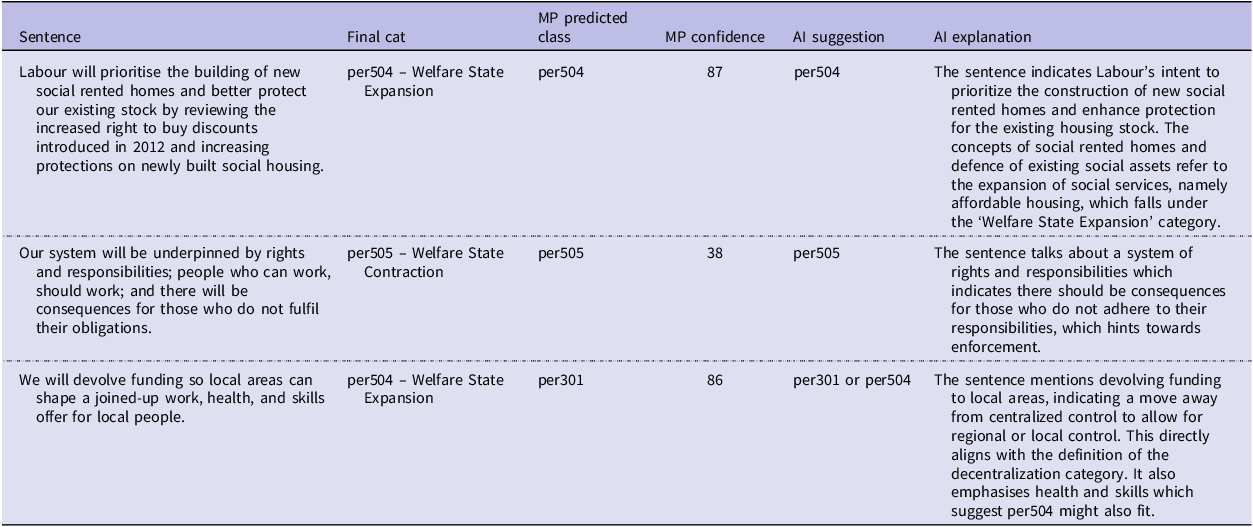
For all years up to and including 2019, I rely on coded manifesto data from the Manifesto Project (MP) database, which is based on Laver and Budge’s coding and assumptions. For 2024 (which was not included in the Manifesto Project classifications at the time of writing), I implemented a coding procedure that emulated the approach and coding frames that are employed by the Manifesto Project. I also employed novel coding techniques in three stages to analyse manifesto content (examples of which are provided in Table 1):
-
1. Automated coding with ManifestoBERTa (Burst et al., Reference Burst, Lehmann, Franzmann, Al-Gaddooa, Ivanusch, Regel, Riethmüller, Weßels and Zehnter2024), a large language, machine-learning model developed by the Manifesto Project, trained on manifesto texts. This routine assigns each sentence to a categorical code (much like manual coding does), alongside an estimated reliability probability percentage score.
-
2. Parallel autocoding with OpenAI GPT (version 4o). Using the Manifesto Project coding framework, GPT was employed to classify the same sentences as those coded through ManifestoBERTa. To emulate the approach of the Manifesto Project, OpenAI was instructed to look at sentences immediately preceding and the one immediately following the sentence for context if the sentence or part-sentence being coded was ambiguous. GPT was also asked to provide an explanation for the coding used.
-
3. Manual adjudication, where confidence/reliability scores were reported by these processes to be less than 80 per cent during stage 1, or where discrepancies arose between the two automated classifications, I manually checked and confirmed or re-coded the sentences.
Sample coding

Table 1 Long description
The table presents a comparison of political party policies and their coding classifications. It includes columns for sentences, final categories, machine-predicted classes, confidence levels, AI suggestions, and explanations. The table has three rows, each representing a different policy statement. The first row discusses Labour's focus on social rented homes and protection of existing stock, classified under Welfare State Expansion. The second row outlines a system based on rights and responsibilities, classified under Welfare State Contraction. The third row mentions devolution of funding for local services, with a note on decentralization and health and skills. The table highlights the use of automated coding techniques and manual adjudication for policy analysis.
Table 1 shows an example of a typical sentence under review. In the first row, the sentence relates to the expansion of social housing. The pledge here and in the manifesto is relatively vague, but the sentence indicates a positive sentiment towards social housing expansion, and the ManifestoBERTa (MBa) classification and OpenAI are aligned. Given this, the final categorisation was per504.Footnote 3 The second sentence suggests strong conditionality and expresses a punitive sentiment towards social protection. Although the MBa and OpenAI scores were aligned, the MP confidence score was low, which triggered manual rechecking. The final assigned code was per505. The last row in the table was categorised by MBA as per301 with a high confidence level of 86%; OpenAI suggested two alternative codes (per301 and per504). Although per301 (devolved funding) does fit to an extent, this is a stronger statement about social provision than devolved government on balance and per504 was assigned.
To increase comparability, I made two adjustments: (a) sentences containing multiple substantial claims were checked and, if required, coded more than once; (b) results were weighted by dividing the coded sentences by the total number of codes assigned to sentences, so together, these methods mirrored the Manifesto Project’s procedures.
Like all methods, manifesto coding whether undertaken by humans or machines is not an exact science. Assigning equal codes to pledges of different magnitude risks flattening their significance; broad categories (e.g. ‘social policy’) can mask divergent positions and different degrees of magnitude in sentiments. Established procedures, including clearly written principles and procedures as outlined by the Manifesto Project, mitigate some risks. The solution offered here of a hybrid triangulation method minimises the risks.
Labour Manifesto, 2024
The sections below present the following analysis: (1) left–right index scores; (2) comparative coding analysis; (3) variance analysis using principal component analysis (PCA); (4) party association with welfare state scores; and (5) an examination of party and different types of social policy.
Labour 2024 and the right-left index
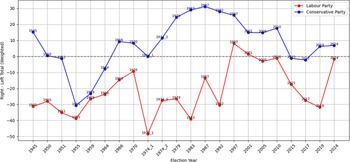
We begin with a measure of ideological ‘rightness’ and ‘leftness’ over time. Figure 1 plots the weighted r-l index scores for Conservative manifestos between 1945 and 2024. Codes for sentences that are strongly historically associated with the right (eg nationalism, welfare state contraction) are summed and subtracted from those associated with the left (welfare state expansion, industrial policy). The summed codes for each manifesto are weighted by the length of the manifesto. The result is a relatively simple proxy measure of ideological positioning: positive scores indicate a stronger association with right-wing policy codes, while lower or negative scores indicate a stronger association with left-wing policy coding.
Left-right ideological position over time (weighted per codes).

Figure 1 Long description
The line graph displays the ideological positions of the Labour Party and the Conservative Party from 1945 to 2024. The x-axis represents the election years, while the y-axis shows the right-left total weighted score. The Labour Party is represented by a red line, and the Conservative Party by a blue line. Key data points include significant shifts in ideological positions over the years, with notable peaks and troughs for both parties. The graph illustrates the dynamic nature of political ideologies over time, highlighting periods of convergence and divergence between the two parties. All values are approximated.
Looking at the results, not all results align neatly with expectations or even knowledge of policies introduced by parties when in government. For example, Labour’s 1945 manifesto is less ‘left wing’ than we might expect. This reflects the fact that it lacks policy detail especially given what the government subsequently achieved: discussion of the National Health Service (NHS), housing and pensions were compressed into a few sentences amongst vague and general statements, whereas later manifestos became longer, more detailed, more explicit, more specific and more repetitive.
Similarly surprising is that Conservative scores between 2015 and 2024 suggest leftward drift despite delivering austerity and Brexit in government. This apparent paradox can be explained by the rhetorical emphasis on protecting pensions and the NHS, the proposed expansion in industrial policy under Theresa May, and the levelling-up agenda under Boris Johnson. This does demonstrate a weakness with the r–l index: selective positivity and expansion of some areas can dampen the apparent significance of policies in other areas (such as cuts in the area of disability benefits or social care). Despite this, the index does capture broad policy differences and changing rhetoric and ideology over time.
The strength of association of party manifestos with ‘left’ or ‘right’ wing ideas and proposals shows both continuity and variability over time. This captures broad historical trends such as the sharp rightward shift of the Conservative Party from the mid-1970s, Labour’s sharp turn to the right in 1997, and the more recent leftward turn between 2015 and 2019. Labour’s 2024 manifesto shifts the party back towards New Labour (the 1997–2010 period) and strikingly captures the distancing of Starmer’s Labour from other post-2010 manifestos. On this calculation, the 2024 Labour manifesto represents a sharp recalibration, representing a turn away from leftist visions of social and public policies, as well as markets and nation-statehood. It also captures the distancing of the party from the Miliband (2015) and Corbyn years (2017 and 2019).
Beyond the r–l index: analysis by actual policy association
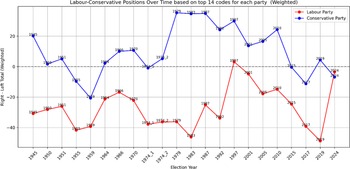
A weakness of the r–l index is that it fails to capture different national expressions of political preferences, not to mention differences in political systems. As noted above, political parties that anticipate forming coalitions with others may make different promises to those that anticipate governing alone. Some categories, such as human rights, may correlate strongly with libertarians in some nations, but would also find favour amongst many on the left. Still other issues, such as protectionism, might be strongly associated with the left historically, but at present it is the right that is pushing this set of policies in the US and beyond. To address this, I recalculated left–right scores using the fourteen allocated codes that are most strongly associated with the British Labour and Conservative parties as proxies for ‘left’ and ‘right’ ideological leanings respectively between 1945 and 2024 (see Appendix 2). The results are plotted in Figure 2.
Labour-conservative positions over time (based on top fourteen codes for each party (weighted).
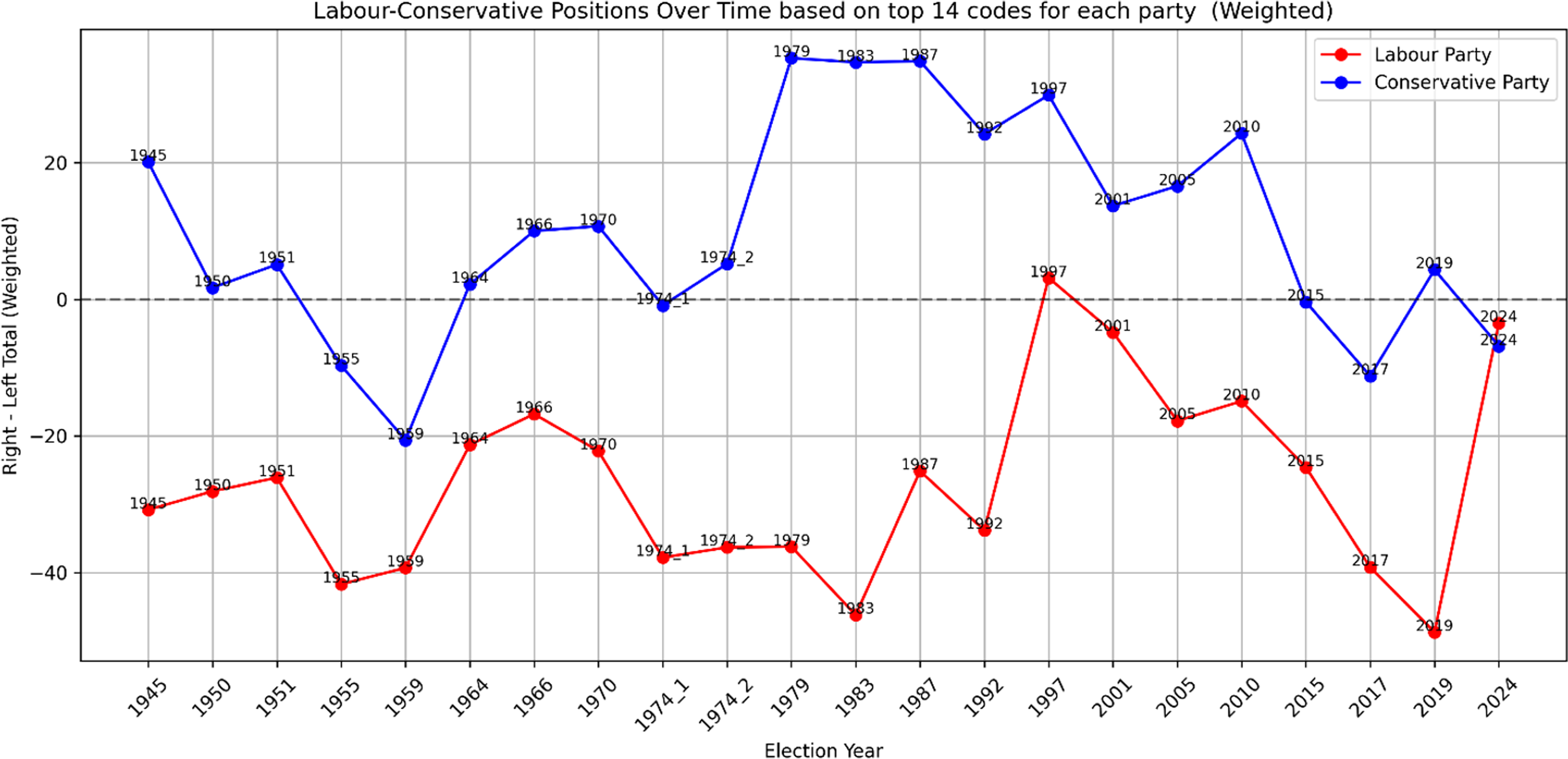
Figure 2 Long description
A line graph titled Labour-Conservative Positions Over Time based on top fourteen codes for each party (weighted). The x-axis represents election years from 1945 to 2024, while the y-axis represents the right-left total weighted values. The graph features two data lines: one for the Labour Party in red and one for the Conservative Party in blue. Key data points include notable peaks and troughs for both parties over the years. For instance, the Labour Party shows significant fluctuations, with low points around 1955, 1983, and 2019, and high points around 1964, 1997, and 2024. The Conservative Party also exhibits variations, with peaks around 1955, 1983, and 2010, and low points around 1964, 1997, and 2019. The graph illustrates the shifting political landscapes and the relative positions of the two major parties over time.
The results mirror the Comparative Manifesto Project’s (CMP) right-left index for some years, but contrast sharply after 2010. Labour’s 2017 and 2019 manifestos, often derided as radical outliers, appear as left-leaning but not exceptional when placed against the long-run average of Labour manifestos since 1945. Their emphasis on reversing austerity and expanding welfare provision was consistent with European social democracy traditions and aligned with Labour’s historic traditions.
By contrast, Labour 2024 appears to be more of an outlier. On this measure, it contains more right-associated coding than any Labour manifesto in the post-war era, and in some respects more than the Conservative manifesto of 2024. This suggests that the recalibration under Starmer was not merely a return to a ‘centre ground’ but a decisive embrace of positions historically closer to Conservative than Labour platforms.
This finding casts doubt on the suggestion that Labour’s 2017 and 2019 manifestos were ‘too radical’ to be electable, and that only a centrist repositioning could secure victory. In fact, the evidence suggests those manifestos were within Labour’s historical mainstream, whereas the 2024 manifesto departed more sharply from it.
Mapping codes and programme distances: principal component analysis
This next method employs Principal Component Analysis to explore the variance between manifestos across the full and complete set of codes used in the CMP database. This approach attempts to measure the distance between manifestos based on their coding distributions.
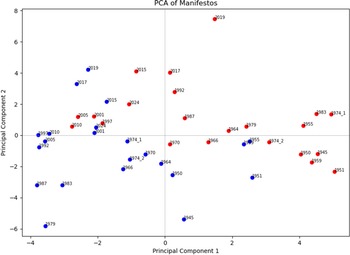
The results confirm general differences between the parties (Figure 3). Conservative manifestos cluster in the bottom left quadrant, Labour manifestos in the top right, with some overlap in the other quadrants. The New Labour manifestos of 1997–2010, however, cluster with Conservative manifestos, reflecting programmatic convergence during this period.
PCA of conservative and labour manifestos, 1945–2024.
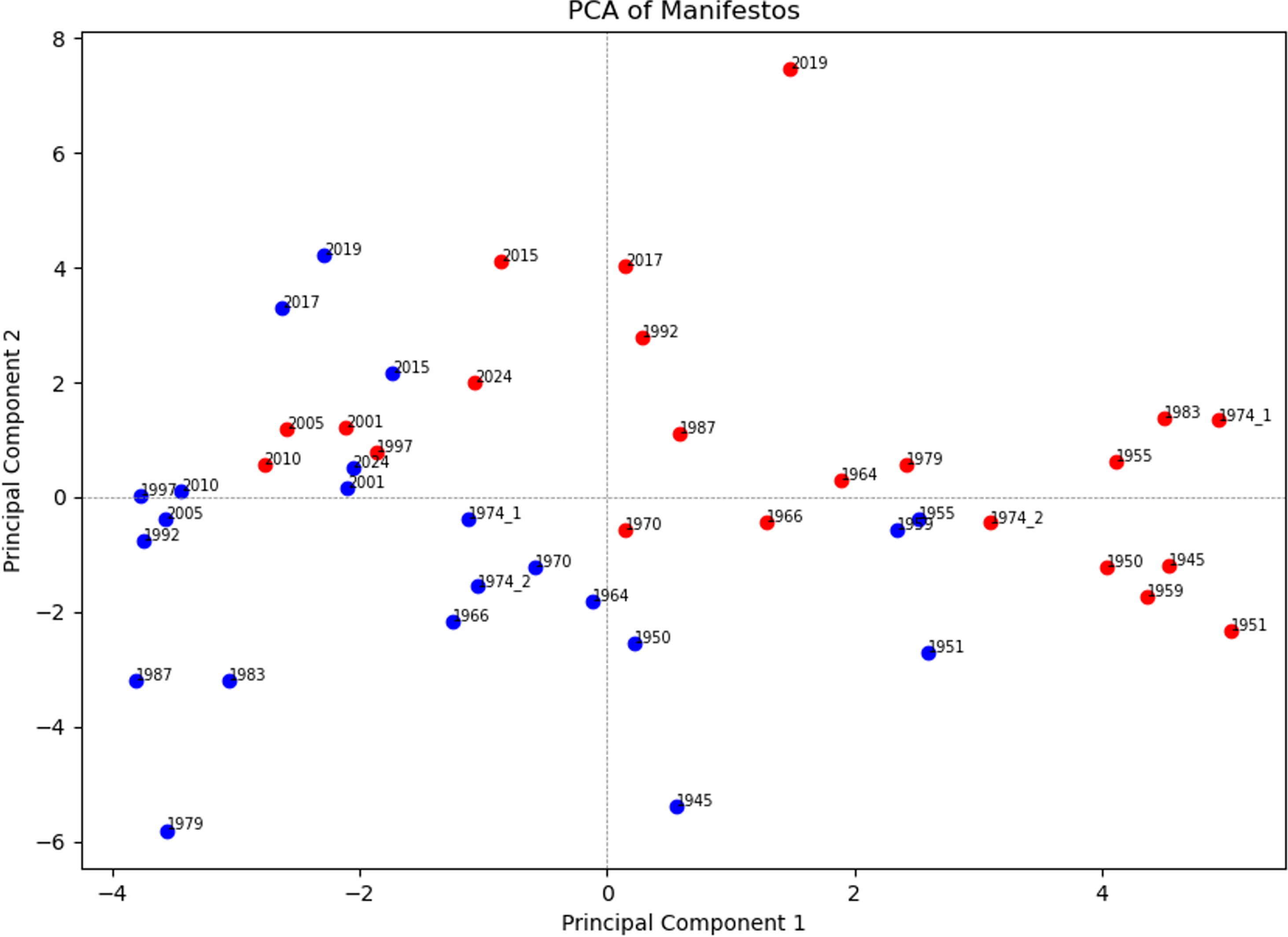
Figure 3 Long description
A scatter plot titled 'PCA of Manifestos' displays the principal component analysis of manifestos from 1945 to 2024. The x-axis represents Principal Component 1, and the y-axis represents Principal Component 2. The plot features dozens of data points, each labeled with a year. Data points are color-coded in red and blue, indicating different political parties. Notable clusters and outliers are visible, with some years distinctly separated from others. The plot shows the distribution and relationship of manifestos over time, highlighting shifts and trends in political ideologies. All values are approximated.
Labour’s 2024 manifesto is located close to the New Labour–Conservative cluster, its nearest neighbour being the Conservative manifesto of 2015. By contrast, Labour’s 2017 manifesto clusters with earlier Labour manifestos of 1992 and 2015. While 2019 appears to be an outlier on this measure, it remains located within Labour’s historical position. Labour’s 2024 manifesto, in contrast, is located closely to the New Labour period. It also visually suggests that manifestos have converged somewhat during the post-Second-World-War period. The manifestos of both parties have tended to drift closer together.
Digging deeper: support for social policies
Having examined Labour’s ideological positioning overall, we can now dig deeper into its discourse on social policy. The r-l index may capture the direction of general ideological movement, but it risks obscuring the specific welfare and education commitments that lie at the heart of Labour’s historical identity. To address this, I first analyse standard Manifesto Project codes (per504–507), before undertaking a more fine-grained recoding of welfare subcategories.
The Manifesto Project has four codes that focus on social policies:
-
• per504: indicates desire to increase or protect welfare (education, health care, social protection, and pensions) provision
-
• per505: indicates a desire to cut welfare provision
-
• per506: indicates a desire to increase or protect education (schooling and tertiary level education, including higher education) provision
-
• per507: indicates a desire to cut education provision
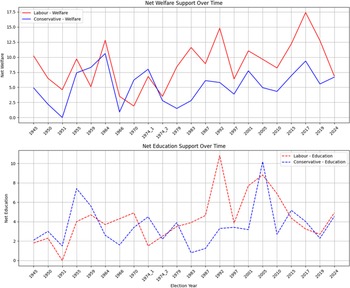
The results of these codings, including for the 2024 manifestos, are illustrated in Figure 4.
Net welfare support over time and net education support over time.
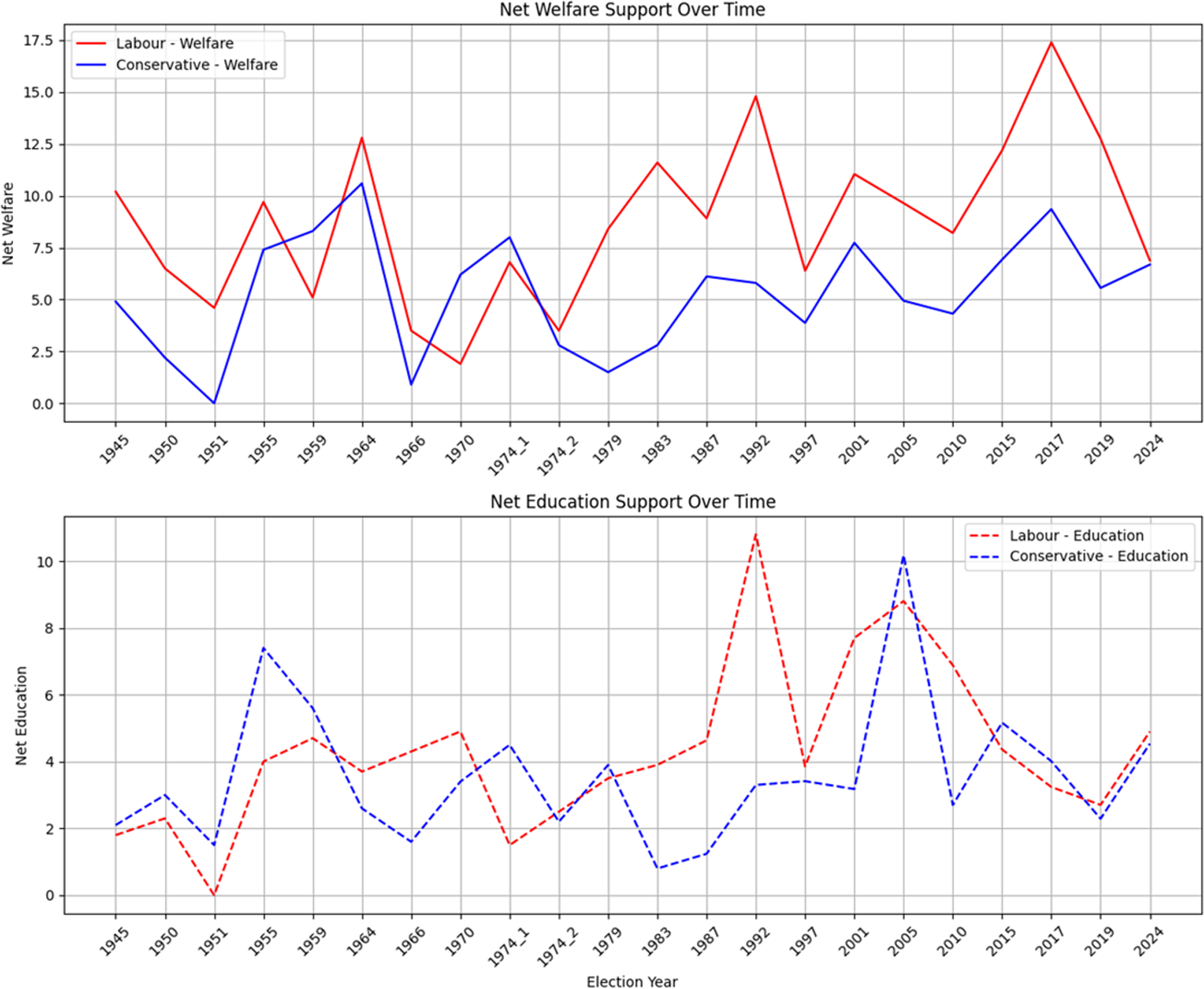
Figure 4 Long description
The image contains two line graphs. The first graph, titled 'Net Welfare Support Over Time,' shows the net welfare support for Labour and Conservative parties from 1945 to 2024. The red line represents Labour's welfare support, while the blue line represents Conservative's welfare support. The y-axis measures net welfare support, ranging from 0 to 17.5. The x-axis represents election years. The second graph, titled 'Net Education Support Over Time,' shows the net education support for Labour and Conservative parties from 1945 to 2024. The red dashed line represents Labour's education support, while the blue dashed line represents Conservative's education support. The y-axis measures net education support, ranging from 0 to 10. The x-axis represents election years. Both graphs illustrate fluctuations in support over time, with notable peaks and troughs for each party.
As expected, these figures confirm that, generally, net welfare support (positive welfare support minus negative welfare sentiment) is higher for Labour than Conservative manifestos. Moreover, the patterns appear to align broadly albeit with divergence during the Thatcher period. The so-called period of post-war consensus is evident, and the period of New Labour re-establishes policy-mirroring following Thatcherism. Although the differences between the parties become greater in the 2010s, the general policy direction remains similar until 2024, when the parties become closer. Labour scores similarly on net welfare support in 2024 to the way it did in 1997.
The pattern is more mixed when it comes to education. Here, the two parties have been generally closer throughout the post-1945 period, with a similar disruption between 1980 and 1997. The 2024 Labour manifesto appears to be more supportive of education policy than the previous two manifestos.
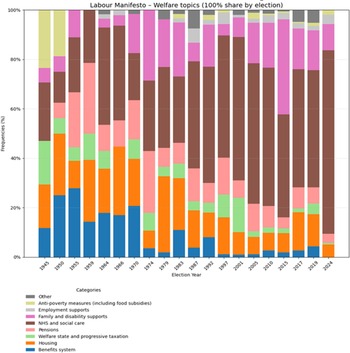
A problem of the Manifesto Project’s ‘per504’ (desire to expand welfare) code, in particular, is that it does not differentiate between different types of ‘welfare’ and different levels of support for different social policies. Support for pensions is treated the same way as support for disability benefits, housing or unemployment benefits in the coding. To capture the differences in sentiment, the manifestos were recoded utilising the coding-triangulation approach outlined above, according to whether the positive or negative sentiments expressed about the welfare state applied to anti-poverty measures, employment supports, family and disability support, pensions, housing, the benefits system, the NHS, and social care, or general welfare state measures (for details see Appendix 2). The results are presented in Figure 5. This illustrates the different emphasis placed on different forms of welfare support over time and, in particular, the falling out of favour of some key component parts. The focus on housing within manifestos diminishes over time, support for work increases, and general support for social protection, other than pensions, tends to diminish. Opinion polls consistently show that the NHS is by far the most positively weighted of the welfare state services.
Welfare topics, 1945–2024.

Figure 5 Long description
The stacked bar graph compares the frequency percentage of various welfare topics in Labour manifestos from 1945 to 2024. The x-axis represents the election years, ranging from 1945 to 2024, while the y-axis represents the frequency percentage, ranging from 0% to 100%. Each bar is divided into segments representing different categories: Other, Anti-poverty measures, Employment supports, Family and disability supports, NHS and social care, Pensions, Welfare state and progressive taxation, Housing, and Benefits system. The color scheme includes various colors for each category, with a legend at the bottom indicating what each color represents. Notable trends include the dominance of NHS and social care, Pensions, and Welfare state and progressive taxation over the years. All values are approximated.
Such support is important. Lukewarm or absent support for some areas - for instance, benefits for the unemployed, or negative portrayal of claimants - fails to build a robust defence of the welfare state, especially in the face of widespread right-wing opposition. It also risks undermining existing public support for such provision. Comparing 2024 with previous manifestos indicates that support for the welfare state is not only lower when compared with previous years, but where welfare support is positive, it tends to be overwhelmingly directed at the NHS as opposed to welfare benefits. Looking at this data, it might be possible to suggest that Labour remains a party of the NHS, but it is not the party of the welfare state.
Discussion
Labour’s 2024 manifesto was framed as a sensible, cautious, credible platform designed to reassure voters after years of economic crisis, austerity, and political volatility and instability – not least within the party itself – that Keir Starmer’s Labour could be trusted to deliver positive change. The evidence presented here suggests that it also represented a recalibration of Labour’s politics, in particular in relation to its approach to social policy and the welfare state, signalling a new rightward shift in the party’s historical, ideological contestations.
In ideological terms, Labour’s 2024 manifesto occupies a similar position to the ‘Third Way’ governments of New Labour, but is some distance from post-2010 Labour and the party’s pre-1997 manifestos. Labour‘s strategy was to try to (re)capture the political centre. But far from being the ‘aberration’ it was presented as, the radicalism of 2017 and 2019 was more consistent with Labour’s historical ideological positioning and its traditional commitments to welfare expansion and social democracy. Starmer’s foreword to the 2024 manifesto states that ‘the defining purpose of my Labour leadership has been to drag my party away from the dead end of gesture politics and return it once more to the service of working people’. He adds that ‘I have changed my party. Now I want the chance to bring that change to the country’.
Attempting to capture or recapture the political-centre in this way is not without its risks. The centre is difficult to locate, and it is fluid rather than fixed in discursive space and time (Hall, 1993). By 2024, based on opinion polling and attitudes surveys (Cavendish, Reference Cavendish2024), the centre had moved rightwards since the New Labour period. Thus, the attempt to recalibrate to the centre meant accepting Brexit, a more hostile immigration environment, tight public spending controls alongside tax freezes, limited additional funding for the NHS, and the protection of the pensions triple-lock. As already noted, the rise of the right in the UK had already hardened attitudes towards ‘undeserving’ welfare claimants and immigrants. It also risks alienating those on the traditional Labour left or left-of-centre who support more progressive social and economic policies. Where previously the Labour Party has embraced a relatively broad constituency from across the left, under Starmer it has sought to expel and distance itself from the left, many of whom previously made up its core membership and vote (Holden, Reference Holden2025).
Shunning market scepticism and environmental concerns, Labour 2024 promised prosperity delivered, not through larger public investment, but through private-sector-led growth. There were promises to expand housing construction, which would require, in some cases, removing environmental and other regulatory restrictions. Missing was a clear, ambitious, and robust strategy for dealing with poverty (Gregory and Arriaga-Garcia, Reference Gregory, Arriaga-Garcia, Köppe, Parma and Sojka2025) and a plan to reverse the cuts to benefits that had been hit hardest by Conservative austerity and had caused most harm and hardship to children and families. In contrast to the 2017 and 2019 manifestos, which emphasised greater income and wealth redistribution and the prioritisation of ‘the many not the few’, the 2024 manifesto tended to steer clear of such issues. Poverty and inequality are mentioned, but the solutions are modest. The widely opposed ‘two-child limit’, which restricts benefits to the first two children within a family, was not mentioned.
Returning to nationalism and immigration, increasingly incendiary issues by 2024, the manifesto relinquished left-wing ground to realign with the populist-right on the issue. The Labour 2024 manifesto opined that: ‘under the Conservatives, our economy has become overly dependent on workers from abroad to fill skills shortages. As a result, we have seen net migration reach record highs; more than triple the level than at the last election in 2019. The overall level must be properly controlled and managed’.
The manifesto promised tighter curbs on immigration, the end of long-term reliance on overseas workers and, on refugees and asylum seekers, a new ‘enforcement and returns policy’ to ensure ‘failed asylum seekers can swiftly be sent back’.
What the 2024 manifesto signalled is a greater willingness to embrace the populist right, rather than seek to change the terms of debate, a tendency the party has carried into its approach to governing (Brown, Reference Brown2025). Whilst the manifesto did acknowledge that ‘immigrants that have come to the UK to work make a significant contribution’ (my emphasis), in office the rhetoric has become increasingly hostile. A similar point could be made about trans rights, while the manifesto promised to modernise gender recognition policies and ‘remove indignities for trans people’, in office the government has moved in the opposite direction.
The lack of a defence of the core values and policies that underpin progressive social policies, such as those that led to the establishment of the welfare state, whether we label them left-wing or not, can be as significant as direct opposition to them. Those parts of the welfare state that are perceived as ‘less popular’ or visible – such as sickness or unemployment benefits, according to the empirical analysis above – need to be defended more vigorously than those – like the NHS – that are more popular. When parties on the left or centre-left fail to defend policies like comprehensive unemployment protections, anti-welfare parties are able to move in and reshape the policy agenda. On this issue, Labour’s 2024 manifesto not only failed to defend out-of-work benefits, but it also fed the idea of widespread welfare abuse by emphasising its intentions to tackle work-shyness amongst claimants.
Conclusion
The primary aim of this paper has been to reveal more about the present Labour Government’s approach to politics, economics and social policies, as outlined in its manifesto. It has done so by trying to ‘get under the skin’ of Labour’s 2024 manifesto; employing novel methods, including semi-automated coding techniques, to examine the party’s aims, ambitions, ideas, core concerns, and policy solutions to the challenges confronting the welfare state in a historical context. What it reveals is a recalibration of the Labour Party in 2024 and, by extension, the party’s social policies.
The 2024 manifesto is a culmination of a longer ideological struggle within Labour and the British left: a decisive move by the right within Labour to regain control of the Labour Party after a period in which the left was briefly in the ascendance. The manifesto was presented as a sensible and pragmatic plan for national and welfare state renewal that was sold as the culmination of a strategy to return Labour to its roots, when in fact, on some of the measures outlined here, it aligned the party more closely with Conservative priorities than with Labour’s own traditions. The findings presented here cast doubt on the widely circulated claim that Labour’s 2017 and 2019 manifestos were radical outliers, unrepresentative of Labour history, including when we introduce social policies into the mix.
Labour’s 2024 manifesto does show continuity with the New Labour era, and it is ideologically closer to this period than Labour’s post-war profile, not to mention the 2015-2019 period. In various ways, it aligns more with Conservative manifestos than it does with Labour ones. This pattern is visible not only in aggregate right–left indices, but also in the distribution and clustering of social policy-related codes. Substantively, the manifesto’s ‘pro-welfare’ emphasis is heavily concentrated on areas of the welfare state that tend to be more strongly supported by the Conservative Party (the NHS and pensions), while commitments on social security, poverty reduction, disability support, and housing appear comparatively thinner, more conditional, and more market-focused in tone.
In power, ‘fiscal discipline’ has brought various parts of the welfare state within the government’s sights, and its attempts to cut disability benefits and winter fuel payments – subsequently withdrawn as a result of pressure from its own backbenches – illustrate how policy-gaps within manifestos can open up the space for subsequent attacks.
The first eighteen months of the Labour Government suggest that the manifesto was more than just words. The direction of policy has, if anything, pitched further towards the political right than the manifesto suggested it would. As a marker, the manifesto set a course for greater discipline and conditionality aimed at benefit claimants and the poorest in society. Similarly, the language and approach to immigration in office has signalled a more restrictive and punitive stance that echoes or accommodates the policies and positions of the increasingly dominant far-right rather than seek to contest or reshape attitudes, perceptions, and approaches. If the manifesto drew an ideological line in the sand, it appears to have operated to curtail any leftward drift in office whilst permitting movement to the right. Yet, risks to public opinion, trust, faith in politics, and in the welfare state to meet needs are ever-growing. The risks to the Labour Party are similarly high, as it looks less and less like the natural party of the welfare state.
Supplementary material
For supplementary material accompanying this paper visit https://doi.org/10.1017/S1474746426101481


 Open access

