





Introduction
Gulls (Laridae) host a rich diversity of helminths, reflecting their varied diet and habitats (Pemberton, Reference Pemberton1963; Kennedy and Bakke, Reference Kennedy and Bakke1989). A survey of British gull species (Larus argentatus, Larus fuscus and Chroicocephalus ridibundus) revealed 36 helminth species in total (27 species in the black-headed gull, 21 in the herring gull, and 19 in the lesser black-backed gull) (Kennedy and Bakke, Reference Kennedy and Bakke1989). More recently, C. ridibundus and other European gulls (e.g., Larus michahellis and Ichthyaetus melanocephalus) were similarly reported to have high species richness (Sitko, Reference Sitko2003; Sanmartín et al., Reference Sanmartín, Cordeiro, Alvarez and Leiro2005; Santoro et al., Reference Santoro, Mattiucci, Kinsella, Aznar, Giordano, Castagna, Pellegrino and Nascetti2011). Each individual gull typically harbors only a few species at low abundances (overdispersed distribution), but the component community is broad (Kennedy and Bakke, Reference Kennedy and Bakke1989; Sanmartín et al., Reference Sanmartín, Cordeiro, Alvarez and Leiro2005).
Gulls, as opportunistic predators in both marine and freshwater ecosystems, acquire a wide range of helminths. In terms of economic or health concerns, gulls often host the fish-borne trematodes Diplostomum spathaceum and Cryptocotyle lingua. Diplostomum spathaceum encysts in the eyes of fish and causes lens cataracts, which reduce the escape response of the fish and increase their predation risk (Seppälä et al., Reference Seppälä, Karvonen and Valtonen2005, Reference Seppälä, Karvonen and Valtonen2011). This trematode was found, for example, in 65% of L. michahellis in Turkey (Poyraz et al., Reference Poyraz, Yildirimhan, Birlik, Sümer and Girisgin2022). Cryptocotyle lingua causes black spot lesions in fish skin, i.e., melanized black spots that downgrade fillets (Borges et al., Reference Borges, Skov, Bahlool, Møller, Kania, Santos and Buchmann2015; Duflot et al., Reference Duflot, Gay, Midelet, Kania and Buchmann2021, Reference Duflot, Cresson, Julien, Chartier, Bourgau, Palomba, Mattiucci, Midelet and Gaz2023). This species infected, for example, 37% of Galician L. cachinnans (Sanmartín et al., Reference Sanmartín, Cordeiro, Alvarez and Leiro2005). Gulls also host microphallids, such as Microphallus similis, which are well known for their lethal or behaviour-altering effects on their intermediate hosts. Similarly, gull echinostomes, such as Himasthla elongata and Himasthla quissetensis, have metacercariae that encyst in the tissues of cockles. Severe infestations can weaken bivalves by impairing their burrowing ability, thereby increasing their vulnerability to predation by gulls. The gull philophthalmid Parorchis acanthus (Sanmartín et al., Reference Sanmartín, Cordeiro, Alvarez and Leiro2005) is a parasitic castrator of intertidal snails and may reduce local populations of some first-intermediate hosts, especially whelks, such as Nucella lapillus (Feare, Reference Feare1970; Mouritsen and Poulin, Reference Mouritsen and Poulin2002). Gull colonies near fisheries or aquaculture can increase local parasite levels. For example, the abundance of Cardiocephaloides longicollis on fish farms was linked to gull activity (Born-Torrijos et al., Reference Born-Torrijos, Poulin, Pérez-Del-Olmo, Culurgioni, Raga and Holzer2016). Cardiocephaloides longicollis metacercariae develop in fish brains, including those of farmed Sparus aurata, where they cause altered behavior and increased predation (Born-Torrijos et al., Reference Born-Torrijos, van Beest, Merella, Garippa, Raga and Montero2023). Some avian schistosomes, including Ornithobilharzia canaliculata and Gigantobilharzia acotylea have been reported in Mediterranean gulls (Sanmartín et al., Reference Sanmartín, Cordeiro, Alvarez and Leiro2005; Santoro et al., Reference Santoro, Mattiucci, Kinsella, Aznar, Giordano, Castagna, Pellegrino and Nascetti2011) and are notorious for causing swimmer’s itch in humans upon skin contact with cercariae. Trematodes in gulls mirror the geographical distribution of their intermediate hosts. Therefore, marine trematodes (such as Microphallus, Cryptocotyle, Gymnophallus, and Himasthla) abound in gulls that feed on seacoasts, whereas freshwater trematodes (such as Diplostomum, Cotylurus and Echinostoma) appear in inland lake-feeding gulls; several species of terrestrial trematodes appear in gulls that feed on land snails or insects. In Norway, the helminth burden peaks in summer, when gulls feed heavily on invertebrates to provide for their chicks (Kennedy and Bakke, Reference Kennedy and Bakke1989), which aligns with the observation that trematode cercariae are most abundant during this time.
The ongoing inland expansion of gulls has important ecological and epidemiological implications. Gulls are highly mobile and connect marine, freshwater and human-dominated ecosystems. As their populations increasingly intermix with human-dominated landscapes and inland water bodies, gulls act as vectors for nutrients, contaminants and organisms (including parasites and pathogens) across long distances. The congregation of large numbers of inland gulls may also influence local ecosystems via predation and competition and introduce novel host–parasite interactions. For instance, gulls often harbour diverse helminth parasites and can disperse their eggs or larvae through faeces, potentially affecting parasite dynamics in inland waterfowl communities. The shift of gulls from the coast to interior areas exemplifies how an adaptable wildlife group can profoundly alter its distribution and ecology in the modern era. The expansion of gulls across Europe’s inland regions provides a critical context for understanding changes in host–parasite relationships, pathogen transmission, and the broader impacts of wildlife urbanization.
The present study examined the trematode communities of five gull species that have moved from marine coasts into the continental interior, exploiting new food resources and breeding sites. These five species were the herring gull L. argentatus, Caspian gull Larus cachinnans, common gull Larus canus, glaucous gull Larus hyperboreus and great black-backed gull Larus marinus from major pond complexes and surrounding habitats in the eastern Czech Republic. We aimed to determine how these gulls’ varied foraging strategies influence their parasite prevalence and community composition. We hypothesized that the parasite assemblages in gulls can serve as ecological indicators of their feeding habits and habitat utilization. We hypothesized that the examined gulls would stratify into three groups: those that forage extensively on fish at aquaculture ponds (which represents the near-natural landlocked environment), those primarily scavenging at landfills or other urban sites (which represent anthropogenic environments with limited diversity and abundance of potential intermediate hosts), and those that migrated from the seacoasts (which provide intermediate hosts that require brackish or salt water environments, which are therefore lacking in landlocked regions). Using comparisons with published datasets on their seacoast populations, we investigate whether several gull species that have recently moved into the continental interior have the potential to serve as vectors for previously rare trematodes of zoonotic and economic importance.
Materials and methods
Sampling and material origin
We examined gulls collected in a landlocked region of the eastern Czech Republic between 2022 and 2025, with the bulk of the material originating from the Záhlinice fishpond complex (49°19′ N, 17°29′ E) and Tovačov fishpond complex (49°25′ N, 17°17′ E). Additional carcasses were obtained from the Bartošovice area (Moravian–Silesian Region), where birds frequented the municipal waste landfill near Životice u Nového Jičína. The causes of death of the examined birds were (i) culls by fishery staff at Záhlinice during autumn and spring fish harvests; (ii) incidental mortality at Tovačov (e.g., L. canus collisions with powerlines during fog) and (iii) birds delivered from Životice u Nového Jičína municipal waste landfill (individuals who did not have fish remains in their stomach or intestines and frequently had fetid, non-fish gastric residues).
The whole dataset comprised 207 gulls with the following species breakdown: herring gull L. argentatus (n = 28), Caspian gull L. cachinnans (n = 141), common gull L. canus (n = 33), glaucous gull L. hyperboreus (n = 1), and great black-backed gull L. marinus (n = 4). The characteristics of local gull populations are provided in Supplementary Materials and methods. All the carcasses were obtained in accordance with the applicable Czech legislation; the sources included coordinated fishery damage-mitigation measures, incidental carcass findings delivered to us by local stakeholders, and untreatable wounded birds delivered to the rescue station in Bartošovice. For each bird, we recorded the date of collection, maturity (1Y = bird born in the same calendar year, and >1Y = bird born in some of the previous calendar years), and sex of the >1Y birds. For L. canus at Tovačov, approximately half of the material originated from fog-related powerline strikes.
Foraging-origin categories
We classified the birds into four ecological provenance groups:
1. Pond-foraging fish eaters: Birds culled at fishpond harvests (predominantly Záhlinice), including those observed taking market-sized carp (0.6–0.9 kg) in autumn or newly stocked K-1 carp (i.e., fish in their first production year (typically stocked after overwintering as juveniles) in Central European carp aquaculture terminology; ∼15 cm in length) in spring.
2. Landfill scavengers: Birds delivered from the Životice u Nového Jičína municipal waste landfill; there were no fish remnants present in stomachs and intestines, fetid non-fish residues and frequent absence of trematodes.
3. Migrants from coastal regions: First-year birds arriving during post-breeding movements from coastal regions. These individuals harboured species that require marine/brackish water-associated intermediate hosts to complete their life cycles.
4. Migrants from Switzerland: These birds were obtained from the Tovačov fishpond complex, where they died because of powerline collisions during a dense fog event. These birds accounted for approximately half of the L. canus individuals examined. These L. canus individuals had relatively low trematode burdens compared with those of co-occurring C. ridibundus during the same period (J. Sitko, pers. obs.). Based on the bird rings recovered, we expect these L. canus were likely migrants from Swiss wintering grounds.
The classification was performed blind to parasitological results. Because these designations rely on capture context rather than long-term diet, we assigned only individuals with clear metadata to these groups; ambiguous cases were left unclassified and excluded from among-group statistical contrasts but retained in species-level summaries.
Parasitological examination
We performed a complete helminthological autopsy of each gull. We examined subcutaneous tissues, body cavity, oesophagus, proventriculus and ventriculus, intestines, cloaca, bursa of Fabricius, liver and gall bladder, spleen, lungs, trachea/bronchi, air sacs, kidneys and reproductive organs under a stereomicroscope. We removed the trematodes immediately and fixed them in 70% ethanol. For morphological analyses, we stained the samples with borax carmine, dehydrated them through an ethanol series, cleared them in xylene and mounted them in Canada balsam.
We identified the trematodes to species using regional keys and monographs (Baruš et al., Reference Baruš, Sergeeva, Sonin and Ryzhikov1978; Vaidova, Reference Vaidova1978; Ryzhikov et al., Reference Ryzhikov, Ryšavý, Khokhlova, Tolkacheva and Kornyushin1985; Sonin, Reference Sonin1985, Reference Sonin1986), which were updated in accordance with Fauna Europaea (de Jong et al., Reference de Jong, Verbeek, Michelsen, de Place Bjørn, Los, Steeman, Baillz, Basire, Chzlarecki, Stloukal, Hagedorn, Wetyel, Glöckler, Kroupa, Korb, Hoffmann, Häuser, Kohlbecker, Müller, Güntsch and Stoev2014) and recent revisions. Representative vouchers of trematodes were deposited in the collections of the Comenius Museum (Přerov, Czech Republic); voucher numbers and raw data are provided in Table S11.
Some literature sources, such as those from the Black Sea and Caspian Sea regions (e.g., Bykhovskaya-Pavlovskaya, Reference Bykhovskaya-Pavlovskaya1962; Vaidova, Reference Vaidova1978; Sonin, Reference Sonin1986), often fail to distinguish between L. argentatus and L. cachinnans. We therefore did not use those sources for quantitative attribution to either species.
Statistical analyses of newly obtained data
We calculated infection prevalence, individual-level infection metrics, community composition, and biodiversity indices following standard approaches in parasite community ecology. Unless stated otherwise, all the statistical tests were two-tailed and evaluated at a significance level of α = 0.05. Differences in infection prevalence among host species and between transmission groups (freshwater versus marine or brackish) were analyzed using chi-square tests of independence based on presence–absence data. Associations between parasite species occurrence and host identity were likewise evaluated using chi-square tests applied to presence–absence matrices. Differences among host species were tested using Kruskal–Wallis rank-sum tests due to strong aggregation, zero inflation, and right-skewed distributions. Age-related comparisons within host species were conducted using the Mann–Whitney U-test for 2-level comparisons (1Y vs. >1Y) or the Kruskal–Wallis test when three maturity or sex classes were available. No post hoc pairwise tests were applied when the omnibus test was not significant. The aggregation of parasite richness and intensity was quantified using variance-to-mean ratios calculated separately for each host species. Differences in trematode community composition among host species and within maturity classes of a species were examined using permutational multivariate analysis of variance (PERMANOVA) based on Bray–Curtis dissimilarities calculated from abundance data. Host species or maturity class was included as a fixed factor, and statistical significance was assessed using 9999 permutations. To verify that the PERMANOVA results were not driven by unequal within-group variability, permutational tests for homogeneity of multivariate dispersion (PERMDISP) were conducted using the same distance matrices. Nonsignificant PERMDISP results were interpreted as evidence that the observed differences reflected genuine compositional variation rather than heterogeneity of dispersion. The pairwise co-occurrence of trematode taxa within individual hosts was examined by comparing observed co-occurrence frequencies with expectations under random association using binomial tests. To control for multiple testing, p-values were adjusted using the Bonferroni correction. Null-model simulations were additionally used to evaluate whether the observed combinations of trematode species within individual hosts deviated from stochastic expectations. For each host species, parasite assemblages were simulated by random draws from the observed species pool while maintaining the observed marginal frequencies of each parasite species. The observed and simulated distributions were then compared using Monte Carlo tests. Trematode community biodiversity was quantified using several abundance-weighted indices calculated from pooled abundance data, including observed species richness, Shannon diversity, Simpson dominance, Pielou’s evenness, Berger–Parker dominance and the Chao-1 richness estimator. The mean trematode species richness per host and mean infection intensity per host were also calculated. To account for pronounced among-host heterogeneity and non-independence of parasite counts, host-level bootstrap resampling was used to estimate confidence intervals (CIs) and perform univariate inference. For each bootstrap replicate (n = 1000), hosts were resampled with replacement within host species and, where applicable, within maturity classes. Trematode abundances were pooled for each replicate individually, and biodiversity indices were recalculated. Bootstrap means and 95% CIs were derived from the resulting distributions. Differences in biodiversity indices among host species and among maturity classes were evaluated using bootstrap contrasts calculated as pairwise differences between bootstrap distributions. Differences were considered statistically significant when the 95% bootstrap CI of the contrast did not overlap zero. Rare host species with very small sample sizes were excluded from inferential tests of biodiversity indices, and the results for these hosts were treated solely as descriptive.
Individual-based rarefaction analyses were performed to compare trematode richness among host species while accounting for unequal sampling effort. In these analyses, hosts were treated as sampling units (incidence-based rarefaction), and trematode taxa were accumulated sequentially as hosts were added. Rarefaction curves were calculated separately for the three most abundant host species (L. argentatus, L. cachinnans and L. canus; Fig. 1A) and for trematode taxa grouped by transmission pathway (freshwater-transmitted versus marine/brackish-transmitted; Fig. 1B). For each analysed host species, rarefaction curves were generated by randomly permuting host order 1000 times. The mean cumulative number of trematode taxa was calculated across permutations, and 95% CIs were obtained from the permutation distributions. Rarefaction analyses were also conducted separately for trematode taxa grouped by transmission pathway (freshwater vs. marine/brackish). Trematode community composition among hosts was analysed using non-metric multidimensional scaling (NMDS) based on Bray–Curtis dissimilarities calculated from raw parasite abundance data. Hosts with zero parasites were excluded from ordination analyses. NMDS solutions were obtained in two dimensions using multiple random starts to ensure convergence on a stable solution. Ordinations were visualized using points to represent individual hosts. To aid interpretation, convex hulls were drawn around groups defined by host species or host age, illustrating compositional similarity within each group. Rank–abundance curves were used to visualize dominance structure and evenness of trematode communities pooled within each host species. Relative abundance heatmaps were constructed for the most abundant trematode taxa, with values log₁₀-transformed before plotting to improve visual resolution of both dominant and subdominant taxa. All analyses were performed using Python 3.11 (NumPy, pandas, SciPy, scikit-learn, skikit-bio and Matplotlib). Rarefaction and extrapolation analyses were performed in R 4.3 using the iNEXT package.
Rarefaction and extrapolation curves of trematode taxon richness (Hill q0). (A) Incidence-based rarefaction among the three most abundant gull species, with host individuals treated as sampling units. (B) Rarefaction of freshwater-transmitted versus marine/brackish-transmitted trematodes. Shaded areas indicate 95% confidence intervals; solid lines represent interpolation (rarefaction), and dashed lines represent extrapolation.

Figure 1 Long description
The image A shows a graph with the x-axis labeled 'Number of hosts' and the y-axis labeled 'Trematode taxa richness'. It presents three curves for different gull species: Larus argentatus, Larus cachinnans and Larus canus. The curves show increasing richness with the number of hosts, with shaded areas indicating confidence intervals. The image B shows another graph with the same axes. It compares freshwater-transmitted and marine or brackish-transmitted trematode species. The curves illustrate different richness levels, with shaded areas representing confidence intervals.
Statistical analyses of previously published data
For the comparative statistical analyses, we compiled a dataset of 14 previously published studies that reported quantitative data on trematode occurrence in the gull species of interest, specifically prevalence and, where available, infection intensity, together with sample sizes. We aimed to include all major published studies meeting these criteria for the focal host species. No strict geographic restriction was applied; instead, studies were selected based on data comparability, relevance to the examined host species and the availability of extractable quantitative information. Both inland and coastal populations were included where such data were available. Studies reporting only presence or absence, without prevalence values or sample sizes, were excluded from quantitative analyses and used solely for qualitative assessments of species occurrence. Preference was given to studies with large sample sizes and well-documented datasets, including classical Eastern European works (e.g., Kurochkin and Zablotskyi, Reference Kurochkin and Zablotskyi1961; Smogorzhevskaya, Reference Smogorzhevskaya1976; Vaidova, Reference Vaidova1978) and our recent datasets (Sitko, Reference Sitko2024, Reference Sitko2025), supplemented by selected studies from other parts of Europe (e.g., Bosch et al., Reference Bosch, Torres and Figuerola2000; Sanmartín et al., Reference Sanmartín, Cordeiro, Alvarez and Leiro2005) that met the same criteria. This approach was intended to ensure comparability across studies while capturing the major available sources of quantitative information on trematode communities in the examined gull species.
For each helminth species and study, prevalence data were analysed together with the reported number of examined hosts. Differences in helminth species richness among gull species were tested using the Kruskal–Wallis test, as the richness values were not normally distributed and sample sizes varied among host species. The similarity of helminth assemblages among gull species was quantified using the Jaccard index, based on presence–absence data from quantitative studies. Variation in prevalence among studies within the same host species was evaluated using chi-square tests of independence. For each helminth species reported in two or more quantitative datasets, study identity was treated as a categorical factor, and infection status was treated as the response variable. These tests assessed whether the observed differences in prevalence exceeded those expected from binomial sampling variation. Meta-analyses of prevalence were conducted for helminth species reported in at least two quantitative studies. Prevalence proportions were transformed to the logit scale, and sampling variances were calculated under the assumption of a binomial error distribution. For studies reporting zero or complete prevalence, a continuity correction of 0.5 was applied to both infected and uninfected individuals. Random effects models were fitted using the DerSimonian–Laird estimator to quantify between-study variance. Statistical heterogeneity was assessed using Cochran’s Q statistic and summarized using the I 2 index. Differences in prevalence among gull species were tested using random-effects meta-regression models fitted separately for each helminth species, with gull species included as a categorical moderator. The overall effect of the host species was evaluated using a Wald chi-square test. Model-based pooled prevalence estimates and corresponding 95% CIs were obtained for each host species by back-transforming the predicted values from the logit scale. When data for more than 2 host species were available, pairwise comparisons were calculated on the logit scale. Age-related differences in prevalence within L. argentatus were evaluated using chi-square tests of independence for helminth species reported separately for multiple maturity classes within the same study. To account for multiple testing in the meta-regression analyses, p-values for host-species effects were adjusted using the Benjamini–Hochberg false discovery rate procedure. All analyses were performed in Python 3.11 using standard statistical formulas implemented with the NumPy, SciPy and pandas libraries. Because the compiled studies differed in geography, sampling design and taxonomic resolution, the comparative synthesis should be interpreted with appropriate caution.
Results
Differences among host species
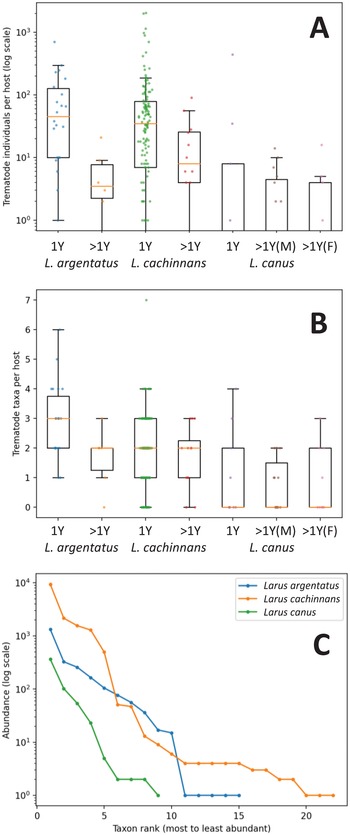
Trematode assemblages were highly aggregated across hosts, with parasite abundance dominated by a few taxa. 1Y gulls generally harboured higher parasite loads and greater trematode richness per host than >1Y gulls, with pronounced differences among host species. Trematodes were detected in 170 of 207 examined gulls, corresponding to an overall prevalence of 82.1%. The prevalence of trematodes differed strongly among host species. Larus argentatus had the highest prevalence, with 27 of 28 individuals infected, followed by L. cachinnans with 123 of 141 individuals infected and L. canus with only 15 of 33 individuals infected (Table 1). A χ2 test of independence for comparisons of infection status among host species indicated pronounced interspecific differences in infection probability (χ2 = 37.37, df = 4, p < 0.001). The infection intensities varied over several orders of magnitude (Fig. 2A), reflecting strong aggregation. 1Y hosts exhibited consistently higher parasite loads than >1Ys across all host species. >1Y L. canus hosts frequently harboured few parasites or were uninfected.
Biodiversity indices of trematode component communities by host species

Table 1 Long description
The table compares biodiversity indices of trematode communities across five host species, focusing on infection prevalence, intensity, and diversity measures. L. cachinnans has the highest number of trematode individuals and observed taxa, indicating a rich and diverse trematode community. In contrast, L. marinus and L. hyperboreus, despite having 100% infection prevalence, host fewer taxa and individuals. L. argentatus shows high infection intensity and diversity, with a notable Simpson dominance index. Equitability is highest in L. hyperboreus, suggesting a more even distribution of taxa. The Chao-1 richness estimator suggests potential for undiscovered taxa, particularly in L. argentatus and L. cachinnans. These findings highlight variations in trematode community structure across host species.
Host-level bootstrap resampling, n = 1000; mean with 95% CI unless stated otherwise.
Differences in the intensity of infection, number of trematode taxa per host, and rank–abundance distributions of trematode taxa. (A–B) Intensity of trematode infections (A) and number of trematode taxa per host (B). Boxes indicate medians and interquartile ranges; whiskers extend to 1.5 × IQR. Points represent individual hosts. (C) Rank–abundance distributions of trematode taxa pooled within each gull species (Larus argentatus, Larus cachinnans and Larus canus). Taxa are ordered from most to least abundant.

Figure 2 Long description
The image A shows a box plot illustrating trematode individuals per host (log scale) across different gull species and age groups: 1Y and greater than 1Y for Larus argentatus, Larus cachinnans and Larus canus, with additional categories for greater than 1Y male and female in L. canus. The image B shows a box plot of trematode taxa per host for the same groups. The image C shows a line graph of rank-abundance distributions for L. argentatus, L. cachinnans and L. canus, with the x-axis labeled as 'Taxon rank (most to least abundant)' and the y-axis as 'Abundance (log scale)'.
Trematode species richness per host individual also differed significantly among host species. The number of trematode taxa recorded per bird was greatest in L. argentatus, intermediate in L. cachinnans and lowest in L. canus (Table 2). A Kruskal–Wallis test revealed a highly significant effect of host species on individual parasite species richness (H = 29.07, df = 2, p = 4.9 × 10−⁷). These results confirm that differences among host species extended beyond prevalence and involved marked contrasts in community complexity. Species richness per host showed parallel patterns (Fig. 2B). 1Y L. argentatus and L. cachinnans harboured the highest numbers of trematode taxa per individual, whereas >1Ys of these two species and L. canus hosts supported fewer taxa. Differences between >1Y males and females of L. canus were minor compared with age- and species-level effects. Rank–abundance curves demonstrated strong dominance by a small number of trematode taxa in all host species (Fig. 2C). Assemblages in L. cachinnans were characterized by particularly steep rank–abundance curves, indicating extreme dominance and low evenness, whereas L. argentatus exhibited a flatter distribution, consistent with higher evenness. Larus canus communities were species-poor and dominated by a few taxa. Incidence-based rarefaction curves confirmed differences in trematode richness accumulation among host species (Fig. 1A). Larus cachinnans showed the highest cumulative richness and the slowest approach towards saturation, indicating the presence of numerous rare taxa in addition to common species. Larus argentatus exhibited a steeper initial increase in richness but reached a lower asymptote, reflecting rapid acquisition of common freshwater trematodes, albeit with reduced overall taxonomic breadth. In contrast, L. canus showed a shallow rarefaction curve with early levelling, which is consistent with low trematode richness and limited exposure to aquatic transmission pathways. The order of rarefaction-standardized richness was therefore L. cachinnans > L. argentatus > L. canus, independent of unequal sample sizes.
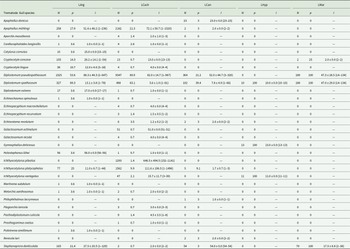
Prevalence, infection intensity and total number of trematodes recorded in the examined gull species

Table 2 Long description
The table examines the prevalence, infection intensity, and total number of trematodes in various gull species. Diplostomum pseudospathaceum has the highest prevalence in Larus cachinnans at 80.9% and a significant intensity range. Gymnophallus deliciosus is exclusively found in Larus hyperboreus with a 100% prevalence. Diplostomum spathaceum also shows high prevalence across multiple species, reaching 100% in Larus hyperboreus and Larus marinus. Most trematodes have low prevalence and intensity, often limited to one or two gull species. The data suggests specific trematodes have strong host preferences, while others are more widespread. Interpretation should consider the limited sample sizes for some species.
LArg, Larus argentatus; LCach, Larus cachinnans; LCan, Larus canus; LHyp, Larus hyperboreus; LMar, Larus marinus; N, total number of individuals; P, prevalence [%]; I, intensity (mean ± SE, range).
Total infection intensity, expressed as the number of trematode individuals per host, varied strongly among host species. The infection intensities of Larus argentatus and L. cachinnans were substantially greater than those of L. canus. A Kruskal–Wallis test demonstrated a highly significant effect of host species on infection intensity (H = 36.54, df = 2, p = 1.2 × 10−⁸), reflecting pronounced interspecific differences in parasite burden.
Age-related effects were weak or absent across all host species. Within L. argentatus, trematode species richness did not differ significantly between 1Y and >1Y hosts (Mann–Whitney U-test, U = 148, p = 0.084). No age-related differences were detected in L. cachinnans (U = 876, p = 0.81) or L. canus (U = 87, p = 0.88). Therefore, the greater absolute number of lightly infected 1Ys reflected the numerical dominance of 1Ys in the sample rather than a systematic maturity effect on parasite acquisition.
Freshwater-transmitted trematodes dominated the assemblage across all host species. The most frequently recorded taxa included (in alphabetical order) Apophallus mühlingi, Diplostomum spathaceum, Diplostomum pseudospathaceum, Ichthyocotylurus pileatus, Ichthyocotylurus platycephalus and Stephanoprora denticulata (facultatively, the first intermediate hosts are freshwater snails or euryhaline snails). Brackish and marine taxa occurred less frequently and included (in alphabetical order) Cardiocephaloides longicollis, Cryptocotyle concava, Cryptocotyle lingua, Galactosomum echinatum, Galactosomum nicolai, Gymnophallus deliciosus, Maritrema subdolum and Renicola lari (Table 2). Rarefaction differed markedly between freshwater-transmitted and marine/brackish-transmitted trematodes (Fig. 1B). Freshwater taxa accumulated rapidly and dominated overall richness across the full range of sampled hosts, with the curve continuing to rise towards the maximum sample size. In contrast, marine and brackish taxa accumulated slowly, reached low richness and displayed wide CIs at low host numbers, reflecting their sporadic occurrence. These patterns confirm that freshwater transmission pathways account for the majority of trematode diversity in inland gulls. In contrast, marine and brackish trematodes represent infrequent carry-over infections without evidence of sustained inland transmission.
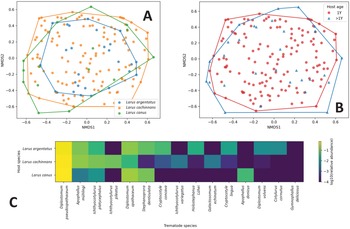
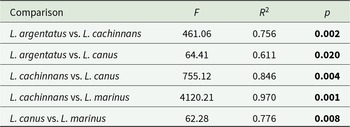
Trematode community composition differed significantly among host species. A chi-square test of independence based on presence–absence data for trematode taxa across host species revealed a strong association between parasite species occurrence and host identity (χ2 = 412.6, df = 76, p < 0.001). Larus argentatus harboured the richest and most diverse assemblage, dominated by Diplostomum spp. frequently occurring in combination with Stephanoprora denticulata or C. cornutus. Larus cachinnans showed a broadly similar assemblage but differed in terms of higher frequencies and intensities of certain Diplostomum species and in the more frequent presence of brackish and marine taxa. Larus canus exhibited a markedly simplified community characterized by sporadic occurrences of freshwater species and a high proportion of uninfected individuals. NMDS ordination based on Bray–Curtis dissimilarities revealed a clear separation of trematode communities among host species (Fig. 3A) and between 1Y and >1Y hosts (Fig. 3B). The 2-dimensional NMDS solution had a stress value of 0.299, indicating a moderate representation of multivariate dissimilarities and justifying a cautious interpretation of the ordination patterns. PERMANOVA confirmed that host species explained a large and significant proportion of variation in trematode community composition (F = 79.53, R 2 = 0.657, p = 0.001). Host maturity also had a strong and significant effect (F = 581.05, R 2 = 0.775, p = 0.001), and the species × maturity interaction was significant (F = 31.63, R 2 = 0.576, p = 0.001), indicating that age-related changes in trematode assemblages differed among host species. Pairwise PERMANOVA comparisons (Table 3) further demonstrated significant differences in trematode community composition among most host species pairs, with particularly strong separation between L. cachinnans and both L. argentatus and L. canus (R 2 ≥ 0.75; p ≤ 0.004). Heatmap visualization of the 15 most abundant trematode taxa revealed marked differences in taxon contributions among host species (Fig. 3C). Although dominant taxa were often shared among hosts, their relative abundances differed substantially. Log₁₀-transformed relative abundances showed that community dominance was driven by a subset of taxa whose importance varied among host species rather than by a single universally dominant species. Therefore, trematode community composition in examined gulls was structured primarily by host species identity, with host maturity exerting an additional, species-dependent influence, consistent with patterns observed in ordination space.
Non-metric multidimensional scaling (NMDS) and relative abundance heatmap. (A) NMDS ordination based on Bray–Curtis dissimilarities of trematode assemblages in individual gull hosts. Each point represents an individual host, coloured by host species. (B) NMDS ordination of trematode communities showing host age effects based on Bray–Curtis dissimilarities of trematode assemblages in individual hosts. (A–B) All NMDS ordinations are based on raw abundance data; hosts with zero parasites were excluded from the analysis. NMDS solutions were obtained using multiple random starts to ensure convergence. (C) Relative abundances of the 15 most abundant trematode taxa. Values are log₁₀-transformed to improve the visual resolution of dominant and subdominant taxa.

Figure 3 Long description
The image contains three sub-images. A shows an NMDS ordination based on Bray-Curtis dissimilarities of trematode assemblages in individual gull hosts, with points representing hosts and colored by species: Larus argentatus, Larus cachinnans, and Larus canus. B displays another NMDS ordination showing host age effects, with points colored by age groups: 1Y and >1Y. C is a heatmap illustrating the relative abundances of the 15 most abundant trematode taxa across different host species, with values log10 transformed for visual clarity. Host species are listed on the left, and trematode species are labeled at the bottom.
Pairwise PERMANOVA comparisons

Table 3 Long description
The table presents pairwise PERMANOVA comparisons among host species, focusing on F values, R2 values, and p-values. The comparison between L. cachinnans and L. marinus shows the highest F value of 4120.21 and an R2 of 0.970, suggesting a strong differentiation with a highly significant p-value of 0.001. In contrast, the comparison between L. canus and L. marinus has the lowest F value of 62.28 but still shows a significant difference with an R2 of 0.776 and a p-value of 0.008. All comparisons listed are statistically significant, with p-values less than 0.05, indicating meaningful differences between the species pairs. The data suggests varying degrees of differentiation among the species, with L. cachinnans consistently showing strong differentiation against other species.
Non-significant comparisons involved host species with very small sample sizes and are not shown.
Co-infections were common in L. argentatus and L. cachinnans. Multiple Diplostomum species frequently co-occurred within the same host, often in conjunction with Stephanoprora denticulata, C. cornutus or Cardiocephaloides longicollis. Pairwise co-occurrence analysis, which was based on observed versus expected frequencies under random association, indicated that several combinations of Diplostomum species occurred significantly more often than expected by chance (binomial tests, p < 0.01 after Bonferroni correction), suggesting a non-random assembly of parasite communities. Co-infections involving brackish or marine taxa were rare and never exceeded two such species within a single host individual.
Community complexity at the level of individual hosts showed limited predictability. The variance-to-mean ratios of parasite species richness and total intensity exceeded unity across host species, indicating strong aggregation. Null-model simulations based on random draws from the observed species pool revealed that the observed distribution of species combinations did not differ significantly from stochastic expectations within host species once host identity was fixed (Monte Carlo test, p > 0.1 for all host species). Therefore, beyond broad host-specific filtering, the exact composition of trematode communities at the level of individual hosts was largely shaped by stochastic exposure rather than deterministic assembly rules.
Diversity indices
Trematode community biodiversity differed among host species in terms of richness, dominance and evenness (Table 1), and both univariate and multivariate analyses statistically supported these differences. Across host species, pooled trematode assemblages ranged from depauperate communities with relatively even abundance distributions to highly diverse but strongly dominated assemblages. Multivariate analysis of trematode community composition using PERMANOVA (Bray–Curtis dissimilarity) revealed a significant effect of host species identity on overall trematode assemblage structure (pseudo-F = 6.1, p < 0.001, 9999 permutations). A test for homogeneity of multivariate dispersion (PERMDISP) indicated no significant differences in within-species dispersion (p = 0.21), confirming that the PERMANOVA results reflect true differences in community composition rather than unequal variability among host species.
Univariate comparisons of biodiversity indices were conducted using host-level bootstrap contrasts (1000 resamples) among the 3 most abundant host species (L. cachinnans, L. argentatus and L. canus). Simpson dominance (D) differed significantly among host species: trematode communities in L. cachinnans were significantly more dominated than those in L. argentatus and L. canus, as indicated by bootstrap CIs of pairwise differences that excluded zero. In contrast, Simpson dominance did not differ significantly between L. argentatus and L. canus. The patterns of evenness mirrored those of dominance. Pielou’s evenness (J) was significantly lower in L. cachinnans than in both L. argentatus and L. canus, indicating a more uneven distribution of trematode individuals among taxa in L. cachinnans. No significant difference in evenness was detected between L. argentatus and L. canus. Despite differences in dominance and evenness, Shannon diversity (H) did not differ significantly among host species, as none of the bootstrap pairwise comparisons produced CIs that excluded zero. This finding indicates that variations in richness and dominance among host species are partially balanced, resulting in broadly similar Shannon diversity values. The observed trematode richness and Chao-1 richness estimates were highest in L. cachinnans, intermediate in L. argentatus and lowest in L. canus, reflecting differences in total parasite abundance and host sample size. However, because richness metrics are strongly influenced by sampling intensity and aggregation, formal pairwise tests were not used to infer significance for richness alone.
Trematode community structure was tested for maturity (and, where possible, sex) effects within the most abundant host species. In L. cachinnans (Table S1), multivariate analysis indicated no statistically significant difference in trematode assemblage composition between 1Y and >1Ys (F + M pooled) (PERMANOVA, Bray–Curtis: F = 1.94, df = 1,139, p = 0.085), and this result was not confounded by dispersion differences (PERMDISP: F = 0.0010, df = 1,139, p = 0.985). Bootstrap contrasts of univariate diversity indices similarly revealed no evidence for age-related shifts in dominance or diversity; for example, Simpson dominance did not differ between 1Ys and >1Ys (Δ(1Y–AD) = 0.029, bootstrap 95% CI spanning zero, p = 0.856). In L. canus (Table S2), neither assemblage composition nor dispersion differed among 1Ys, >1Y females, and >1Y males (PERMANOVA: F = 0.289, df = 2,30, p = 0.99; PERMDISP: F = 0.0116, df = 2,30, p = 0.99), and bootstrap contrasts provided no support for age/sex differences in Shannon diversity, dominance or evenness. In contrast, L. argentatus (Table S3) showed a significant difference in trematode assemblage composition between 1Y and >1Y individuals (PERMANOVA: F = 1.83, df = 1,26, p = 0.044), with no evidence that this effect was driven by unequal dispersion (PERMDISP: F = 0.112, df = 1,26, p = 0.74). However, the corresponding univariate diversity indices did not show strong age-related shifts, suggesting that compositional changes between 1Ys and >1Ys may have occurred without large changes in overall diversity magnitude. The results for L. argentatus > 1Ys should be interpreted cautiously because of the limited number of available >1Ys (n = 6).
Transmission-based analyses
Trematodes transmitted through freshwater food webs overwhelmingly dominated the parasite assemblages of all the examined gull species. Among the 170 infected birds, 169 individuals carried at least 1 freshwater-transmitted trematode taxon, corresponding to a prevalence of 81.5% in the total sample (but a 99.4% prevalence among birds infected with at least 1 trematode). Trematodes transmitted through marine or brackish environments were detected in only 15 individuals, corresponding to an overall prevalence of 7.2% (8.8% when focusing only on birds infected with at least 1 trematode).
The prevalence of freshwater-transmitted trematodes differed significantly among host species. Freshwater taxa were recorded in 26 of 28 individuals of L. argentatus, 123 of 141 individuals of L. cachinnans, and 15 of 33 individuals of L. canus. A chi-square test of independence indicated a highly significant association between host species and the presence of freshwater-transmitted trematodes (χ2 = 33.46, df = 2, p < 0.001). Freshwater-transmitted parasites were therefore least frequent in L. canus.
Marine and brackish-transmitted trematodes showed markedly different distributions. These taxa occurred sporadically in L. argentatus (6 of 28 individuals infected) as well as L. cachinnans, where 6 of 141 individuals harboured 1 or more marine or brackish species. Only 1 of the 33 examined L. canus individuals was infected by a marine or brackish species. A chi-square test confirmed a significant association between host species and the occurrence of marine-transmitted trematodes (χ2 = 12.20, df = 2, p = 0.002).
The species richness of freshwater-transmitted trematodes per host individual differed significantly among host species. Larus argentatus exhibited the highest freshwater parasite richness, followed by L. cachinnans, whereas L. canus harboured few freshwater taxa per infected individual. A Kruskal–Wallis test revealed a highly significant effect of host species on freshwater-transmitted trematode richness (H = 26.50, df = 2, p < 0.001). In contrast, the richness of marine and brackish-transmitted trematodes was low across all host species. The richness differed significantly among host species (Kruskal–Wallis test, H = 12.39, df = 2, p = 0.002).
The infection intensity patterns mirrored those observed for species richness. The total counts of freshwater-transmitted trematodes per host differed strongly among host species, with the highest intensities recorded in L. argentatus and L. cachinnans and markedly lower intensities in L. canus. A Kruskal–Wallis test demonstrated a highly significant effect of host species on the intensity of infection by freshwater-transmitted trematodes (H = 36.18, df = 2, p < 0.001). Marine and brackish-transmitted trematodes occurred at low intensities, rarely exceeding a few individuals per host, and intensity differed significantly among host species (Kruskal–Wallis test, H = 12.67, df = 2, p = 0.002).
Age-related effects were weak for both transmission groups. Within each host species, neither the prevalence nor the richness of freshwater-transmitted trematodes differed significantly between 1Ys and >1Ys (chi-square tests and Mann–Whitney U-tests, all p > 0.05). Marine and brackish-transmitted trematodes were too rare in 1Ys to permit robust age-specific comparisons, and no consistent age-related pattern was detected.
Co-infections involving freshwater-transmitted trematodes were frequent, particularly in L. argentatus and L. cachinnans. Multiple freshwater species, most commonly Diplostomum spp., Stephanoprora denticulata and C. cornutus, often co-occurred within the same host individual. Pairwise co-occurrence analysis showed that combinations of freshwater-transmitted taxa occurred significantly more often than expected under random association (binomial tests, p < 0.01 after correction), indicating shared exposure pathways through freshwater prey. Co-infections involving marine or brackish-transmitted taxa were rare and almost exclusively involved a single marine species combined with freshwater taxa, suggesting that incidental acquisition rather than stable marine parasite assemblages occurred.
At the level of individual hosts, community complexity differed between transmission groups. Freshwater-transmitted trematodes showed high aggregation, with variance-to-mean ratios far exceeding unity for both species richness and intensity. Null-model simulations demonstrated that once host species identity was accounted for, the exact combinations of freshwater-transmitted species within individual hosts did not deviate significantly from stochastic expectations (Monte Carlo tests, p > 0.1). Marine- and brackish-water-transmitted trematodes exhibited low richness, low intensity and limited co-occurrence, precluding evidence of predictable community structure. Therefore, host species act as strong ecological filters for parasite transmission pathways, whereas parasite community assembly at the individual host level is largely governed by stochastic exposure within those pathways.
Discussion
Dominance of freshwater trematodes in inland gulls
The trematode communities of gulls examined in the inland eastern Czech Republic were dominated by freshwater trematodes that exploited small-bodied cyprinid fish as second intermediate hosts. Metacercariae of these taxa develop in roach (Rutilus rutilus), bream (Abramis spp.), dace (Leuciscus spp.), gudgeon (Gobio gobio) and related cyprinids that dominate Central European pond and river fish assemblages (Kruk, Reference Kruk2007; Hladík et al., Reference Hladík, Kubečka, Mrkvička, Čech, Draštík, Frouzová, Hohausová, Matěna, Matěnová, Kratochvíl, Peterka, Prchalová and Vašek2008). Carp (Cyprinus carpio) can also serve as a host, but evidence shows that it is not the principal reservoir for most of these trematodes. The frequent occurrence and often high intensities of these taxa in L. argentatus and L. cachinnans correspond to their feeding in pond systems where small cyprinids are abundant, either as bycatch during pond harvests or as natural components of stocking assemblages.
Cotylurus cornutus differs fundamentally from geographically constrained trematodes in that it is a Holarctic and locally abundant parasite of ducks throughout the Czech Republic (Rząd et al., Reference Rząd, Sitko, Dzika, Zalewski, Śmietana and Busse2020). Its life cycle is completed wherever suitable first intermediate hosts, namely lymnaeid snails (Lymnaea s.l.), occur, which explains its presence at all examined localities. Although C. cornutus is primarily associated with anatids, occasional infections have been reported from other mollusc-feeding birds, including grebes, waders and passerines. In predatory birds, such as gulls, the precise route of infection is uncertain. The widespread occurrence of C. cornutus in our material likely reflects the ubiquity of its first intermediate hosts in inland habitats rather than bird migration or the import of non-local parasites.
Apophallus spp. deserve special consideration because, although they can occur in freshwater or low-salinity systems, their transmission in the Czech Republic is geographically constrained by the distribution of their first intermediate host, the freshwater snail Lithoglyphus naticoides (Sitko et al., Reference Sitko, Faltýnková and Scholz2006). Lithoglyphus naticoides is naturally restricted to southern Moravia, and breeding populations of Apophallus are therefore absent from central Moravia and most of Bohemia. Consequently, the Apophallus spp. in gulls examined outside southern Moravia likely represent carry-over infections rather than local transmission, given the restricted distribution of its first intermediate host. Adult Apophallus trematodes are relatively long-lived in avian hosts and may persist for several months, allowing detection well into spring, including May. In gulls, particularly in >1Ys of C. ridibundus and large Larus species, Apophallus spp. are absent only briefly during early summer (June–July). As a result, Apophallus infections in inland gulls primarily reflect host movement rather than ongoing transmission within inland areas.
Brackish–marine taxa, including Gymnophallus deliciosus, Cryptocotyle concava, C. lingua, Galactosomum spp., Maritrema subdolum and Renicola lari, were restricted to a small number of birds and never established transmission cycles inland. Their occurrence indicates that some gulls carried established infections from coastal environments prior to their arrival in the study area. Importantly, although the mentioned parasites are brackish–marine taxa when assessed by the environments where they complete their life cycles, most have been reported from definitive hosts across freshwater and terrestrial contexts. For example, C. concava and C. lingua were reported from these environments by Lühe (Reference Lühe1899), Ransom (Reference Ransom1920), Stunkard (Reference Stunkard1929) and Martynenko (Reference Martynenko and Movsesyan2016).
Marine trematode species in inland gulls
The scarcity of brackish–marine trematodes in Czech gulls contrasts strongly with the rich and abundant marine trematode faunas described from gulls in the North Sea and Atlantic regions (Kennedy and Bakke, Reference Kennedy and Bakke1989; Sanmartín et al., Reference Sanmartín, Cordeiro, Alvarez and Leiro2005; Santoro et al., Reference Santoro, Mattiucci, Kinsella, Aznar, Giordano, Castagna, Pellegrino and Nascetti2011). One explanation is the different migratory origins of the birds examined. A substantial portion of the Central European gull populations moves inland from the Baltic Sea. Compared to the North Sea, the Baltic Sea is a young, low-salinity basin with a limited diversity of its mollusc fauna. The low diversity and abundance of gastropods and bivalves reduce the likelihood of developing trematodes with marine life cycles. Helminth species richness in Baltic mollusc is markedly lower than that in adjacent marine systems and declines progressively with decreasing salinity in the northern and eastern basins of the Baltic Sea (Valtonen et al., Reference Valtonen, Pulkkinen, Poulin and Julkunen2001; Ojaveer et al., Reference Ojaveer, Jaanus, MacKenzie, Martin, Olenin, Radziejewska, Telesh, Zettler and Zaiko2010; Gogina et al., Reference Gogina, Nygård, Blomqvist, Daunzs, Josefson, Kotta, Maximov, Waryocha, Yermakov, Gräwe and Zettler2016). In Bothnian Bay, for example, the less diverse and less abundant mollusc assemblage limits the range of trematodes transmissible to fish, and consequently, the component communities of fish parasites are impoverished compared with those in the North Sea (Valtonen et al., Reference Valtonen, Pulkkinen, Poulin and Julkunen2001). The overall biodiversity of the Baltic Sea macrofauna has been described as species-poor and vulnerable relative to that of the Atlantic (Ojaveer et al., Reference Ojaveer, Jaanus, MacKenzie, Martin, Olenin, Radziejewska, Telesh, Zettler and Zaiko2010). This ecological context explains why inland gulls arriving from the Baltic typically carried only a subset of marine trematodes, usually at low intensities.
Some marine/brackish taxa in the Czech gulls could have been acquired in the Baltic, particularly Cryptocotyle spp., Maritrema subdolum and possibly Gymnophallus, where hosts are present. Their lower diversity and intensities are consistent with a Baltic provenance. Conversely, Galactosomum spp. and Renicola lari are better explained by exposure of the host birds to the Mediterranean or Black Sea. In the present analysis, Apophallus spp. were treated as freshwater-associated because they can complete their life cycle in freshwater systems in Central Europe. However, Apophallus spp. occurrences outside areas with suitable first intermediate hosts should be interpreted as carryover rather than as evidence of local transmission. These distinctions support the inference about where birds acquired infections and match the known salinity-filtered biogeography of Baltic invertebrate hosts (Pearson and Prévot, Reference Pearson and Prévot1971; Lauckner, Reference Lauckner1984; Pekkarinen, Reference Pekkarinen1987; Kesting et al., Reference Kesting, Gollasch and Zander1996; Mellergaard and Lang, Reference Mellergaard and Lang1999; Rząd et al., Reference Rząd, Kavetska and Królaczyk2008; Tyutin et al., Reference Tyutin, Medyantseva, Bazarov and Tyutin2023).
Structure of parasite communities
The component communities differed among the gull species. L. argentatus carried the richest assemblage, with multiple Diplostomum species and frequent co-infections involving Stephanoprora denticulata and C. cornutus. Larus cachinnans shared many of these freshwater taxa but showed higher burdens of some Diplostomum spp. and slightly more frequent records of marine-derived trematodes, which is consistent with its broader migratory range into southern and coastal areas. Larus canus exhibited the poorest fauna, with most individuals uninfected or harbouring only a few worms, reflecting its weaker association with pond fish and more frequent reliance on alternative foods such as landfill refuse. Larus marinus, represented by only a few specimens, carried a narrow set of trematodes that were insufficient for characterizing its community structure inland.
Uninfected and lightly infected gulls formed a large proportion of the dataset. These birds likely foraged predominantly in municipal landfills rather than in fishponds, as confirmed by the fetid non-fish gastric contents of the Bartošovice specimens. Frequency of these contents was highest in L. canus (over 70%) and lower but still notable in L. argentatus and L. cachinnans (approximately 20%). Maturity effects showed no significant differences between 1Ys and > 1Ys: L. argentatus χ2 = 0.006, p = 0.94; L. cachinnans χ2 = 0.16, p = 0.69; and L. canus χ2 = 0.28, p = 0.60. Thus, the higher absolute numbers of lightly infected 1Ys reflected their predominance in the sample rather than a real age-dependent pattern.
Co-infections were common among freshwater taxa, especially between multiple Diplostomum species or combinations of Diplostomum with C. cornutus or Stephanoprora denticulata. This result reflects the overlapping life cycles of small cyprinids, which can host multiple trematode species simultaneously. In contrast, brackish–marine trematodes rarely co-occurred in the same bird and were typically accompanied by freshwater taxa, highlighting their role as incidental carry-overs from coastal environments.
Large gulls must be considered not only as recipients but also as vectors of trematodes of veterinary and zoonotic importance. Diplostomum, Posthodiplostomum cuticola and Cryptocotyle are therefore of concern to aquaculture (Heuch et al., Reference Heuch, Jansen, Hansen, Sterud, MacKenzie, Haugen and Hemmingsen2011; Lima Dos Santos and Howgate, Reference Lima Dos Santos and Howgate2011). Diplostomum spp. and P. cuticola compromise aquaculture yields by causing cataracts and systemic disease in pond fish. Cryptocotyle spp. cause black spot disease in fish (Duflot et al., Reference Duflot, Cresson, Julien, Chartier, Bourgau, Palomba, Mattiucci, Midelet and Gaz2023), and are zoonotic if undercooked fish are consumed. Metorchis and Apophallus species can infect fish-eating mammals and humans (Chai and Jung, Reference Chai and Jung2020, Reference Chai, Jung, Toledo and Fried2024). By transporting the eggs of these trematodes between coastal staging grounds and inland pond systems, gulls may contribute to the dissemination of parasites across ecosystems, although the present data do not directly quantify onward transmission. In inland regions with intensive fish farming, such as the Czech fishpond complexes, the role of gulls in maintaining and spreading these infections requires further study.
The inland dataset thus illustrates 3 ecological roles of large gulls: (i) definitive hosts of freshwater trematodes within pond systems, (ii) passive carriers of marine trematodes inland where further transmission ceases and (iii) non-participants in trematode cycles when subsisting on landfill refuse. These roles underscore the ecological plasticity of gulls and their ability to influence trematode transmission at the intersection of aquaculture, wildlife and human health.
Previously published datasets
With respect to previously published data on L. cachinnans, L. canus and L. argentatus (Table S4), the compiled datasets reveal pronounced heterogeneity in gull helminth assemblages at both the interspecific and intraspecific levels. Species richness derived from quantitative studies differed significantly among gull hosts, with L. cachinnans showing the highest richness, followed by L. canus and L. argentatus (Kruskal–Wallis test, H = 8.29, df = 2, p = 0.016). Pairwise similarity based on presence–absence data was low across all host combinations, with Jaccard indices not exceeding 0.33, indicating limited overlap of helminth faunas among gull species. These patterns suggest strong host-associated structuring of parasite communities, tempered by substantial geographic and methodological variation among studies.
The prevalence of individual helminths showed extreme variability among studies within the same host species. For common digeneans such as (in alphabetical order) Cardiocephaloides longicollis, Cryptocotyle lingua and Diplostomum spathaceum, the prevalence frequently spanned more than an order of magnitude across surveys. This heterogeneity was statistically supported by chi-square tests of independence in comparison to the study-level prevalence within host species. For example, in L. cachinnans, the prevalence of C. lingua differed significantly across studies (χ2 = 412.6, df = 5, p < 0.001), as did D. spathaceum (χ2 = 286.4, df = 5, p < 0.001). Comparable results were obtained for L. argentatus and L. canus, with multiple taxa showing highly significant between-study differences in prevalence (all χ2 tests, p < 0.001). These findings demonstrate that local ecological conditions and host demography influence infection levels, exceeding random sampling variation.
Random-effects meta-analyses of prevalence confirmed that heterogeneity was the dominant feature of the data. For most helminths included in the analyses, I 2 values exceeded 75%, indicating that between-study variance accounted for the majority of observed variation. Random-effects pooling, therefore, provided more appropriate estimates of central tendency than fixed-effects models did. Across all host species combined, pooled prevalence estimates remained broad, reflecting the high τ2 values calculated for most taxa. These results support the view that helminth prevalence in gulls is context-dependent and driven by the regional availability of intermediate hosts, seasonal exposure patterns and the maturity structure of the sampled birds.
Meta-regression analyses incorporating host species as a categorical moderator revealed significant host-associated differences in the prevalence of a subset of helminths. After accounting for random effects, the omnibus Wald test for the species moderator was significant for several taxa. For Plagiorchis laricola, host species accounted for a significant proportion of the variation in prevalence (QM = 18.7, df = 2, p < 0.001), with higher model-predicted prevalence in L. canus than in L. argentatus or L. cachinnans. Similarly, Stephanoprora denticulata had strong host effects (QM = 22.4, df = 2, p < 0.001), with the highest prevalence predicted for L. canus. In contrast, the prevalence of Gymnophallus deliciosus was significantly greater in L. argentatus and L. cachinnans than in L. canus (QM = 19.1, df = 2, p < 0.001). For these taxa, host species remained a significant predictor after correction for multiple testing using the Benjamini–Hochberg procedure.
Age-related effects were evident in L. argentatus, where studies providing age-stratified data allowed explicit testing. Chi-square tests comparing prevalence across maturity classes revealed significant differences for several taxa, including Gymnophallus deliciosus (χ2 = 48.9, df = 2, p < 0.001) and Cryptocotyle lingua (χ2 = 36.7, df = 2, p < 0.001). These results indicate a progressive accumulation of infections with age, consistent with cumulative exposure and age-related changes in dietary habits. Maturity, therefore, represented an additional source of heterogeneity that could not be fully addressed in pooled analyses lacking individual-level data.
The identification of core helminth taxa further clarified patterns of host association. Core assemblages, defined as taxa occurring in at least half of the quantitative studies per host species, differed markedly among gulls. We used these core–satellite settings to distinguish taxa that recur consistently within a host species from those recorded only sporadically across studies. Cryptocotyle lingua and Diplostomum spathaceum were core taxa in more than 1 host species, indicating broad ecological compatibility, whereas the other core taxa were host specific.
The published quantitative data corroborate that gull helminth communities are shaped chiefly by host species and ecological setting, with age-related effects being secondary and less consistent. Although prevalence varies among studies, the broader pattern is robust: the focal gull species differ in their typical helminth assemblages, and each is characterized by a recurrent core fauna (Tables S4–S10).
Limitations
A key limitation is that the ecological/foraging categorization, which underpins the comparative analyses, is based on capture context and associated metadata rather than direct longitudinal evidence of diet or habitat use. The heterogeneous sampling structure (culled birds, opportunistic carcasses, rescue centre individuals) may introduce bias in prevalence and intensity estimates. This is particularly important because the manuscript combines birds obtained from fishpond culls, incidental mortality, landfill-associated carcasses and rescue-station submissions, all of which may differ in health status, exposure history and representativeness. Additional limitations are the cross-sectional design across 2022–2025, which does not explicitly model seasonal or interannual variation in transmission, the indirect inference of foraging ecology from parasite assemblages rather than direct dietary data, the small sample sizes for some host species and the unavoidable heterogeneity among previously published datasets used for comparison, including differences in geography, sampling design and taxonomic resolution.
Conclusions
Trematode assemblages in inland gulls reveal clear differences in the transmission cycles that individual species are capable of sustaining. The most consequential finding is that gulls foraging in fishpond systems consistently support and reinforce freshwater trematode cycles, whereas birds relying on landfills or other non-aquatic food sources largely disengage from these cycles. Marine and brackish parasites are transported inland but rarely persist. Frequent co-infections involving multiple freshwater taxa indicate repeated exposure to infected small cyprinids. In contrast, the high proportion of uninfected or lightly infected birds, particularly among L. canus and individuals associated with landfills, demonstrates that shifts towards anthropogenic food sources reduce participation in aquatic parasite cycles. Therefore, gull abundance alone is a poor predictor of parasite risk. Rather, the key determinant is the strength of the link between gulls and aquatic food webs. Combined data suggest that trematode communities in gulls function as sensitive indicators of foraging ecology and habitat use.
Supplementary material
The supplementary material for this article can be found at https://doi.org/10.1017/S0031182026102133.
Acknowledgements
We thank the governmental and local authorities for providing the necessary permissions to conduct this long-term research. We also thank the landlords, fishermen and the staff of local rescue stations for providing us with carcasses of untreatable birds.
Author contributions
J.S. and P.H. conceived the study; J.S. collected the data; P.H. analysed the data and wrote the manuscript; and both authors revised the manuscript and agreed on its final version.
Financial support
The study was supported by the Ministry of Culture of the Czech Republic project DE07P04OMG007.
Competing interests
The authors declare there are no conflicts of interest.
Ethical standards
Not applicable. All the host birds were obtained dead, and, therefore, no ethics permit was required by the Czech law. The research was authorized by the Ministry of the Environment of the Czech Republic; the most recent permit was issued on 3 August 2009, under No. 11171/ENV/09-747/620/09-ZS 25. The collection of birds that originated from the Bartošovice Rescue Station was permitted by the Ministry of the Environment of the Czech Republic, permit No. 2020/630/2473, dated 13 October 2020.




 Open access

