





1. Introduction
We consider the random geometric graph (RGG) generated in a compact convex set $W\subset \mathbb{R}^d$
with
$W\subset \mathbb{R}^d$
with $d\geq 3$
and volume one. The vertices of the graph are defined by a homogeneous Poisson point process on W with intensity t. Two vertices v and w are connected by an (undirected) edge
$d\geq 3$
and volume one. The vertices of the graph are defined by a homogeneous Poisson point process on W with intensity t. Two vertices v and w are connected by an (undirected) edge $\{v,w\}$
whenever
$\{v,w\}$
whenever $\|v-w\|\leq r_t$
, where
$\|v-w\|\leq r_t$
, where $\|\cdot\|$
denotes the Euclidean norm.
$\|\cdot\|$
denotes the Euclidean norm.
To visualize this graph, we embed its vertices into $\mathbb{R}^2$
and connect each pair with a line whenever an edge exists, in which case it is likely that some lines need to cross. A straight-line drawing with few edge crossings tends to be the most aesthetically pleasing, see [Reference Purchase, Cohen, James and Brandenburg14]. The minimum number of crossings in such a drawing is called the rectilinear crossing number. Finding this number is a classical problem in graph theory where a lot is still unknown, see for example [Reference Fox, Pach and Suk7, Reference Pach and Tóth12], or the survey in [Reference Schaefer15].
$\mathbb{R}^2$
and connect each pair with a line whenever an edge exists, in which case it is likely that some lines need to cross. A straight-line drawing with few edge crossings tends to be the most aesthetically pleasing, see [Reference Purchase, Cohen, James and Brandenburg14]. The minimum number of crossings in such a drawing is called the rectilinear crossing number. Finding this number is a classical problem in graph theory where a lot is still unknown, see for example [Reference Fox, Pach and Suk7, Reference Pach and Tóth12], or the survey in [Reference Schaefer15].
We can naturally extend this problem to random graphs by studying the crossing number of a random graph or the number of crossings in a random drawing of a graph. In [Reference Pach and Tóth12, Reference Spencer and Tóth18], the expectation of the crossing number of an Erdös–Rényi random graph as well as concentration inequalities are derived, and a generalization to k-planarity is considered in [Reference Asplund, Do, Hamm, Székely, Taylor and Wang3]. An extension to weighted Erdös–Rényi random graphs is studied in [Reference Mohar and Stephen10], where the Bernoulli weight for the presence of an edge is given by independent and identically distributed random variables for each edge. [Reference Arenas-Velilla and Arizmendi1, Reference Arenas-Velilla, Arizmendi and Paguyo2] study the number of crossings of a fixed graph G whose vertices are randomly placed in convex position. They prove a central limit theorem using Stein’s method.
In this paper we study a setting introduced in [Reference Chimani, Döring, Reitzner, Bekos and Chimani4], an RGG where the graph drawing is created by projecting the vertices and edges onto a plane, as shown in Figure 1. Compared to the methods of drawing the graph used by [Reference Arenas-Velilla and Arizmendi1, Reference Arenas-Velilla, Arizmendi and Paguyo2, Reference Moon11], this method has the advantage that it preserves some of the geometric properties of the original graph. We refer to the number of edge crossings as the crossing number of the projection, or simply ‘crossing number’ when its meaning is clear from the context. By construction it serves as an upper bound for the rectilinear crossing number of the original RGG in W.
Projection of a graph in $\mathbb{R}^3$
onto a plane.
$\mathbb{R}^3$
onto a plane.
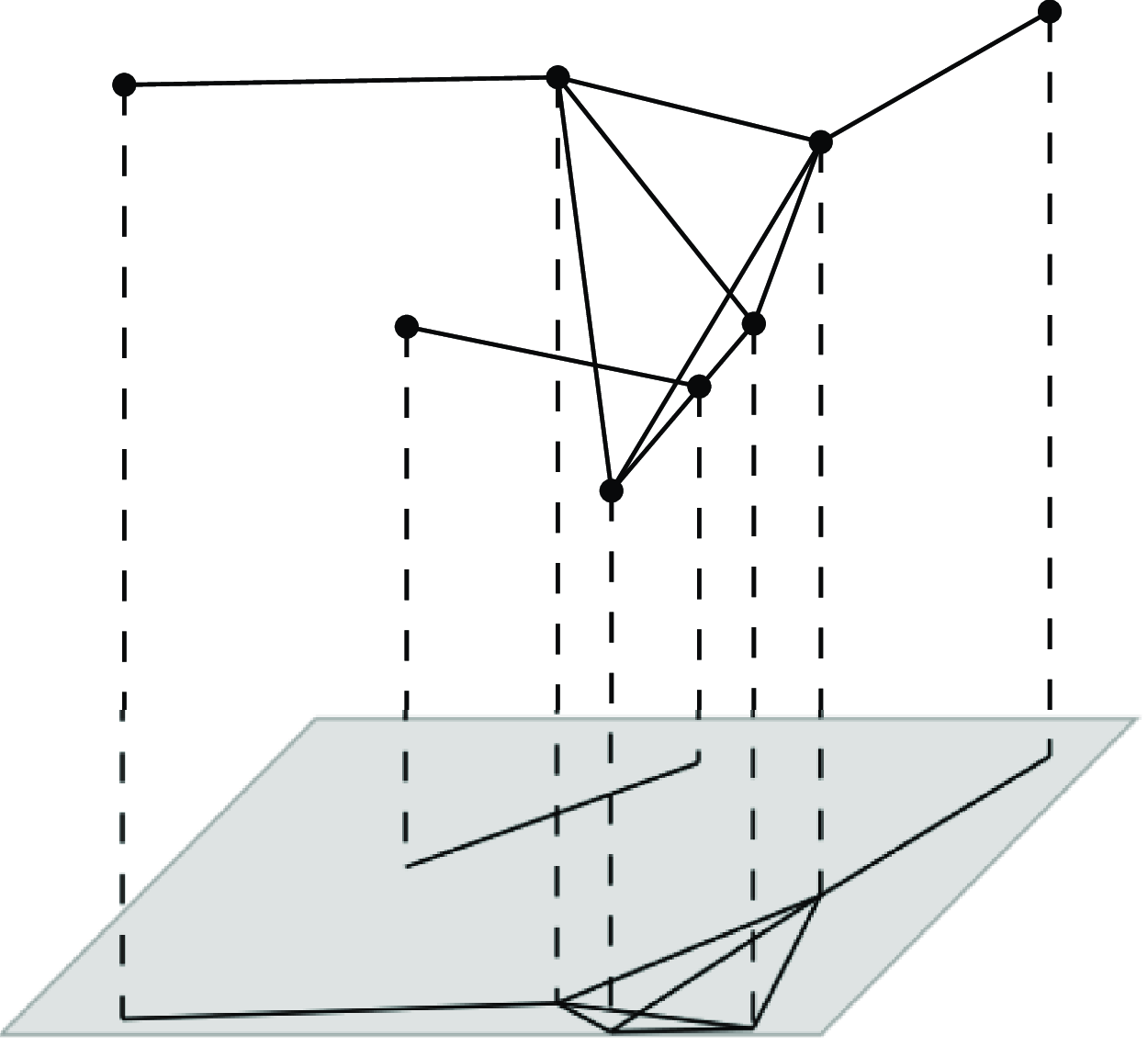
The connection between the crossing number of a projection and another quantity called stress was studied in [Reference Chimani, Döring, Reitzner, Bekos and Chimani4]. The stress is a measure of how much the distances between vertices in the original graph and vertices in its drawing differ. In the context of projected random geometric graphs, it makes sense to consider the Euclidean distance between vertices in $\mathbb{R}^d$
and in the projection so that the graph stress is low when projecting barely changes the distances between vertices. However, if two vertices that are far away in
$\mathbb{R}^d$
and in the projection so that the graph stress is low when projecting barely changes the distances between vertices. However, if two vertices that are far away in $\mathbb{R}^d$
are close to each other in the projection, the stress is high. Empirical evidence suggests that drawings with low stress also tend to have fewer crossings. This is supported by [Reference Chimani, Döring, Reitzner, Bekos and Chimani4], where it is shown that there indeed exists a positive correlation between stress and the crossing number in the model described above.
$\mathbb{R}^d$
are close to each other in the projection, the stress is high. Empirical evidence suggests that drawings with low stress also tend to have fewer crossings. This is supported by [Reference Chimani, Döring, Reitzner, Bekos and Chimani4], where it is shown that there indeed exists a positive correlation between stress and the crossing number in the model described above.
This paper extends the results from [Reference Chimani, Döring, Reitzner, Bekos and Chimani4] by proving a multivariate central limit theorem for the crossing number and stress. Additionally, we show that the point process of edge intersections converges to a Poisson point process when $r_t$
is chosen to decrease at an appropriate speed as t tends to infinity.
$r_t$
is chosen to decrease at an appropriate speed as t tends to infinity.
It is easy to see that the expected degree of a randomly chosen vertex in the random geometric graph is of order $tr_t^d$
. Based on this, we distinguish between the three regimes introduced in [Reference Penrose13]:
$tr_t^d$
. Based on this, we distinguish between the three regimes introduced in [Reference Penrose13]:
-
(i) sparse regime: $\lim_{t\to\infty}tr_t^d = 0$
implies that the expected degree tends to zero as t goes to infinity;
$\lim_{t\to\infty}tr_t^d = 0$
implies that the expected degree tends to zero as t goes to infinity; -
(ii) thermodynamic regime:
$\lim_{t\to\infty} tr_t^d = c \in (0,\infty)$
implies that the expected degree converges to some positive but finite constant; -
(iii) dense regime:
$\lim_{t\to\infty} tr_t^d = \infty$
implies that the expected degree tends to infinity.



The expected crossing number of the projection is of order $t^4r_t^{2d+2}$
(see [Reference Chimani, Döring, Reitzner, Bekos and Chimani4, Theorem 1]). For the convergence to a Poisson point process we consider a part of the sparse regime where the expected crossing number of the projection tends to a positive but finite value, which is when
$t^4r_t^{2d+2}$
(see [Reference Chimani, Döring, Reitzner, Bekos and Chimani4, Theorem 1]). For the convergence to a Poisson point process we consider a part of the sparse regime where the expected crossing number of the projection tends to a positive but finite value, which is when $t^2r_t^{d+1} \to c \in(0,\infty)$
as t tends to infinity. For the multivariate central limit theorem, we focus on the thermodynamic and the dense regime, for which the expected crossing number of the projection tends to infinity.
$t^2r_t^{d+1} \to c \in(0,\infty)$
as t tends to infinity. For the multivariate central limit theorem, we focus on the thermodynamic and the dense regime, for which the expected crossing number of the projection tends to infinity.
The study of the crossing number in random graphs is not only mathematically an interesting problem. As argued in [Reference Chimani, Döring, Reitzner, Bekos and Chimani4], the number of crossings in the projection in the sparse regime is indeed with high probability only a constant factor away from the rectilinear crossing number of the RGG. Therefore, the projection provides an algorithm for drawing a graph with low crossing number. Limit theorems with rates of convergence are decisive for determining the approximation error in this algorithm.
The structure of this paper is as follows: Section 1.1 introduces the mathematical definitions and notation. Then, the convergence to a Poisson point process and the central limit theorem are stated, which are then proved in Sections 2 and 3 respectively. The convergence to a Poisson point process is an application of a limit result for Poisson U-statistics proved using Stein’s method and the Malliavin formalism in [Reference Decreusefond, Schulte and Thäle6]. The main difficulty in Section 2 is to derive uniform bounds on the intensity measure of the point process of crossings. In Section 3, we prove good bounds on the first- and second-order difference operators to apply a multivariate limit theorem for a vector of Poisson functionals from [Reference Schulte and Yukich17].
1.1. Definitions and statements of results
Let $\lambda_n$
for
$\lambda_n$
for $n\geq 1$
denote the n-dimensional Lebesgue measure. Our observation window
$n\geq 1$
denote the n-dimensional Lebesgue measure. Our observation window $W\subset \mathbb{R}^d$
with
$W\subset \mathbb{R}^d$
with $d\geq 3$
is a convex body such that
$d\geq 3$
is a convex body such that $\lambda_d(W) = 1$
. Let
$\lambda_d(W) = 1$
. Let $\eta_t$
be a Poisson point process on W with intensity
$\eta_t$
be a Poisson point process on W with intensity $t>0$
. Then
$t>0$
. Then $\mathbb{E} \eta_t(W) = t$
since the volume of W is one. The support of
$\mathbb{E} \eta_t(W) = t$
since the volume of W is one. The support of $\eta_t$
defines the vertex set V of the random geometric graph
$\eta_t$
defines the vertex set V of the random geometric graph $G = (V,E)$
with
$G = (V,E)$
with
 \begin{equation*} E = \{\{v,w\} \colon v,w\in V \text{ and } \|v-w\|\leq r_t\}\end{equation*}
for some parameter $r_t$
going to zero as t tends to infinity. Here,
$r_t$
going to zero as t tends to infinity. Here, $\|\cdot\|$
denotes the Euclidean norm. We denote the line segment between two points
$\|\cdot\|$
denotes the Euclidean norm. We denote the line segment between two points $v,w\in\mathbb{R}^d$
by [v, w]. Note that no points exist outside of W, meaning that none of the edges cross the boundary of W. Almost surely, vertices are not projected on other vertices or edges.
$v,w\in\mathbb{R}^d$
by [v, w]. Note that no points exist outside of W, meaning that none of the edges cross the boundary of W. Almost surely, vertices are not projected on other vertices or edges.
The orthogonal projection of the graph onto a plane L is denoted by $G_L$
and is constructed by projecting all vertices onto L and connecting the vertices by an edge whenever an edge exists in G. The projection of a point v and a set
$G_L$
and is constructed by projecting all vertices onto L and connecting the vertices by an edge whenever an edge exists in G. The projection of a point v and a set $A\subset \mathbb{R}^d$
are denoted by
$A\subset \mathbb{R}^d$
are denoted by $v|_L$
and
$v|_L$
and $A|_L \, :\! = \{v|_L\colon v\in A\}$
respectively. We write
$A|_L \, :\! = \{v|_L\colon v\in A\}$
respectively. We write $W_L \, :\! = W|_L$
for the projection of W onto L to avoid cumbersome notation. The orthogonal complement of L is denoted by
$W_L \, :\! = W|_L$
for the projection of W onto L to avoid cumbersome notation. The orthogonal complement of L is denoted by $L^{\perp}$
.
$L^{\perp}$
.
Two edges $\{v_1,v_2\}$
and
$\{v_1,v_2\}$
and $\{w_1,w_2\}$
between four distinct vertices cross in the projection if
$\{w_1,w_2\}$
between four distinct vertices cross in the projection if $[v_1,v_2]|_L\cap [w_1,w_2]|_L\neq \emptyset$
. These intersections form the support of a point process
$[v_1,v_2]|_L\cap [w_1,w_2]|_L\neq \emptyset$
. These intersections form the support of a point process $\xi_t$
. Let
$\xi_t$
. Let
 \begin{equation*} S_t \, :\! = \{(v_1,v_2,w_1,w_2)\in V^4_{\neq}\colon \|v_1-v_2\|\leq r_t,\, \|w_1-w_2\|\leq r_t,\, [v_1,v_2]|_L\cap [w_1,w_2]|_L\neq \emptyset\}\end{equation*}
be the set of quadruples of distinct vertices forming two crossing edges. Then
 \begin{equation} \xi_t(A) \, :\! = \frac{1}{8} \sum_{(v_1,v_2, w_1,w_2)\in S_t}\delta_{[v_1,v_2]|_L\cap [w_1,w_2]|_L}(A) \end{equation}
counts the number of crossings in a Borel set $A\subset L$
. The pre-factor prevents the double counting of crossings. The crossing number of the projection is denoted
$A\subset L$
. The pre-factor prevents the double counting of crossings. The crossing number of the projection is denoted $\xi_t(L)$
. The intensity measure
$\xi_t(L)$
. The intensity measure $\mathbf{L}_t$
of the point process is defined as
$\mathbf{L}_t$
of the point process is defined as $\mathbf{L}_t(A) \, :\! = \mathbb{E}\xi_t(A)$
.
$\mathbf{L}_t(A) \, :\! = \mathbb{E}\xi_t(A)$
.
For all Borel sets A, the variable $\xi_t(A)$
is a U-statistic of order four, meaning that it can be written in the form
$\xi_t(A)$
is a U-statistic of order four, meaning that it can be written in the form $\xi_t(A) = \sum_{(v_1,v_2,v_3,v_4)\in V^4_{\neq}} f(v_1,v_2,v_3,v_4)$
for some symmetric function f depending on A. Here we have
$\xi_t(A) = \sum_{(v_1,v_2,v_3,v_4)\in V^4_{\neq}} f(v_1,v_2,v_3,v_4)$
for some symmetric function f depending on A. Here we have
 \begin{align*} f(v_1,v_2,v_3,v_4) & = \frac{1}{24}\big(\mathbf{1}(\|v_1-v_2\|\leq r_t,\, \|v_3-v_4\|\leq r_t,\, [v_1,v_2]|_L\cap [v_3,v_4]|_L\cap A\neq \emptyset) \\ & \quad + \mathbf{1}(\|v_1-v_3\|\leq r_t,\, \|v_2-v_4\|\leq r_t,\, [v_1,v_3]|_L\cap [v_2,v_4]|_L\cap A\neq \emptyset) \\ & \quad + \mathbf{1}(\|v_1-v_4\|\leq r_t,\, \|v_2-v_3\|\leq r_t,\, [v_1,v_4]|_L\cap [v_2,v_3]|_L\cap A\neq \emptyset)\big).\end{align*}
Since we consider three permutations of the vertices in each summand, the pre-factor from (1) is divided by three, explaining the pre-factor ${1}/{24}$
.
${1}/{24}$
.
Throughout this paper we let $B_d(x,r) \, :\! = \{y\in\mathbb{R}^d\colon \|x-y\|\leq r\}$
denote the closed ball with radius r around x, and
$B_d(x,r) \, :\! = \{y\in\mathbb{R}^d\colon \|x-y\|\leq r\}$
denote the closed ball with radius r around x, and $B_d \, :\! = B_d(0,1)$
the unit ball around the origin. The balls
$B_d \, :\! = B_d(0,1)$
the unit ball around the origin. The balls $B_2(x,r)$
and
$B_2(x,r)$
and $B_2$
are always considered to lie in the plane L. The inner parallel set of a convex set K is denoted by
$B_2$
are always considered to lie in the plane L. The inner parallel set of a convex set K is denoted by $K_{-\delta} \, :\! = \{x\colon\,(x+\delta B_d)\subset K\}$
. We write
$K_{-\delta} \, :\! = \{x\colon\,(x+\delta B_d)\subset K\}$
. We write $f(x) = \mathcal{O}(g(x))$
as
$f(x) = \mathcal{O}(g(x))$
as $x\to\infty$
if there exist
$x\to\infty$
if there exist $M>0$
and
$M>0$
and $x_0$
such that
$x_0$
such that $|f(x)| \leq Mg(x)$
for all
$|f(x)| \leq Mg(x)$
for all $x\geq x_0$
. We also write
$x\geq x_0$
. We also write $f(x) = \mathcal{O}_x(g(x))$
and omit the
$f(x) = \mathcal{O}_x(g(x))$
and omit the $x\to\infty$
.
$x\to\infty$
.
Our first result concerns the distribution of crossings in the sparse regime. We show convergence of $\xi_t$
to a Poisson point process in the Kantorovich–Rubinstein distance. The definition of this distance metric involves the total variation distance. For two finite measures
$\xi_t$
to a Poisson point process in the Kantorovich–Rubinstein distance. The definition of this distance metric involves the total variation distance. For two finite measures $\mu_1$
and
$\mu_1$
and $\mu_2$
on the Borel sets
$\mu_2$
on the Borel sets $\mathcal{B}(L)$
of L, the total variation distance is defined as
$\mathcal{B}(L)$
of L, the total variation distance is defined as
 \begin{equation*} \mathsf{d}_\textrm{TV}(\mu_1,\mu_2) \, :\! = \sup\nolimits_{A\in\mathcal{B}(L)} | \mu_1(A) - \mu_2(A) |.\end{equation*}
The Kantorovich–Rubinstein distance is then the optimal transport cost between two probability measures,
 \begin{equation*} \mathsf{d}_\textrm{KR}(\mu_1,\mu_2) = \inf_{\mathbf C\in\Sigma(\mu_1,\mu_2)}\int \mathsf{d}_\textrm{TV}(\omega_1,\omega_2)\, {\mathbf C}(\textrm{d}(\omega_1,\omega_2)),\end{equation*}
where $\Sigma(\mu_1,\mu_2)$
is the set of all couplings between
$\Sigma(\mu_1,\mu_2)$
is the set of all couplings between $\mu_1$
and
$\mu_1$
and $\mu_2$
, and we integrate over all
$\mu_2$
, and we integrate over all $\sigma$
-finite counting measures on the underlying space. For two point processes
$\sigma$
-finite counting measures on the underlying space. For two point processes $\xi_1$
and
$\xi_1$
and $\xi_2$
distributed according to
$\xi_2$
distributed according to $\mu_1$
and
$\mu_1$
and $\mu_2$
respectively, we will write
$\mu_2$
respectively, we will write $\mathsf{d}_\textrm{KR}(\xi_1,\xi_2)$
instead of
$\mathsf{d}_\textrm{KR}(\xi_1,\xi_2)$
instead of $\mathsf{d}_\textrm{KR}(\mu_1,\mu_2)$
. By [Reference Decreusefond, Schulte and Thäle6, Proposition 2.1], convergence in
$\mathsf{d}_\textrm{KR}(\mu_1,\mu_2)$
. By [Reference Decreusefond, Schulte and Thäle6, Proposition 2.1], convergence in $\mathsf{d}_\textrm{KR}$
implies convergence in distribution.
$\mathsf{d}_\textrm{KR}$
implies convergence in distribution.
The crossings in the RGG can also be studied in two dimensions without projection. In this case, the definitions above can easily be adjusted by removing all mentions of the projection onto L. The authors are not aware of results related to the distribution of these crossings and therefore include the $d=2$
case in the statement of the following theorem.
$d=2$
case in the statement of the following theorem.
Theorem 1. (Convergence to Poisson point process.) Consider the projected RGG with intensity t, dimension $d\geq 2$
, and radius
$d\geq 2$
, and radius $r_t$
such that
$r_t$
such that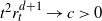 $t^2r_t^{d+1}\to c > 0$
as
$t^2r_t^{d+1}\to c > 0$
as $t\to\infty$
, and let the edge crossings form the support of the point process
$t\to\infty$
, and let the edge crossings form the support of the point process $\xi_t$
, as defined in (1). Let
$\xi_t$
, as defined in (1). Let $\zeta$
be a Poisson point process on L with intensity measure
$\zeta$
be a Poisson point process on L with intensity measure $\mathbf{M}$
defined by
$\mathbf{M}$
defined by
 \begin{equation*} \mathbf{M}(A) = \frac{1}{8} c_d c^2\int_A \lambda_{d-2}((v + L^{\perp})\cap W)^2\,\textrm{d}v \end{equation*}
for all Borel sets $A\subset L$
, where
$A\subset L$
, where $c_d = 8\pi \kappa_{d-2}^2 \mathbf{B}(3,d/2)^2$
with
$c_d = 8\pi \kappa_{d-2}^2 \mathbf{B}(3,d/2)^2$
with $\mathbf{B}$
the beta function. Then
$\mathbf{B}$
the beta function. Then
 \begin{equation*} \mathsf{d}_\textrm{KR}(\xi_t,\zeta) = \begin{cases} \mathcal{O}_t(\sqrt{r_t}) + \mathcal{O}_t(c^2 - t^4 r_t^{6}) & \text{if } d = 2, \\[3pt] \mathcal{O}_t(r_t) + \mathcal{O}_t(c^2 - t^4 r_t^{2d+2}) & \text{if } d \geq 3. \end{cases} \end{equation*}
Convergence in distribution of $\xi_t$
to
$\xi_t$
to $\zeta$
follows.
$\zeta$
follows.
The term $\mathcal{O}_t(c^2 - t^4 r_t^{2d+2})$
indicates that the rate of convergence of
$\mathcal{O}_t(c^2 - t^4 r_t^{2d+2})$
indicates that the rate of convergence of $\xi_t$
to
$\xi_t$
to $\zeta$
depends on how fast
$\zeta$
depends on how fast $t^2r_t^{d+1}$
approaches its limiting value.
$t^2r_t^{d+1}$
approaches its limiting value.
This theorem is proved in Section 2. The proof relies on [Reference Decreusefond, Schulte and Thäle6, Theorem 3.1], which roughly states that a U-statistic $\xi_t$
converges to a Poisson point process if the intensity measure converges in total variation distance and the difference between the expectation and the variance of
$\xi_t$
converges to a Poisson point process if the intensity measure converges in total variation distance and the difference between the expectation and the variance of $\xi_t(L)$
goes to zero.
$\xi_t(L)$
goes to zero.
Remark 1. A random projection plane L was also considered in [Reference Chimani, Döring, Reitzner, Bekos and Chimani4], whereas we consider a fixed plane. In the sparse regime described above, the limiting distribution of the crossing number would be a mixed Poisson distribution where the intensity is a random measure depending on the orientation of L.
The second result concerns another quantity, called stress. Let $\mathsf{d}_0$
and
$\mathsf{d}_0$
and $\mathsf{d}_L$
be two distance metrics on the vertices in a graph, then
$\mathsf{d}_L$
be two distance metrics on the vertices in a graph, then
 \begin{equation*} \textrm{stress}(G,G_L) \, :\! = \frac{1}{2}\sum_{(v_1,v_2)\in V^2_{\neq}} w(v_1,v_2) (\mathsf{d}_0(v_1,v_2) - \mathsf{d}_L(v_1,v_2))^2,\end{equation*}
where w is some weight function. We will denote the stress between two vertices by
 $$S(v_1,v_2;V) \, :\! = w(v_1,v_2) (\mathsf{d}_0(v_1,v_2) - \mathsf{d}_L(v_1,v_2))^2.$$
The V indicates that S might depend on $V\setminus\{v_1,v_2\}$
, which is the case if
$V\setminus\{v_1,v_2\}$
, which is the case if $\mathsf{d}_0$
or
$\mathsf{d}_0$
or $\mathsf{d}_L$
depends on V. Without this dependence, the stress is a U-statistic, which is the assumption made in [Reference Chimani, Döring, Reitzner, Bekos and Chimani4].
$\mathsf{d}_L$
depends on V. Without this dependence, the stress is a U-statistic, which is the assumption made in [Reference Chimani, Döring, Reitzner, Bekos and Chimani4].
A natural choice for w is
 $$w(v_1, v_2) = \frac{1}{\mathsf{d}_0(v_1,v_2)^2},$$
in which case
 \begin{equation*} \textrm{stress}(G,G_L) = \frac{1}{2}\sum_{(v_1,v_2)\in V^2_{\neq}} \bigg(1 - \frac{\mathsf{d}_L(v_1,v_2)}{\mathsf{d}_0(v_1,v_2)}\bigg)^2.\end{equation*}
For the RGG, it makes sense to let $\mathsf{d}_0$
be the Euclidean distance between points in
$\mathsf{d}_0$
be the Euclidean distance between points in $\mathbb{R}^d$
, and
$\mathbb{R}^d$
, and $\mathsf{d}_L$
the Euclidean distance in the projection. Note that in this case
$\mathsf{d}_L$
the Euclidean distance in the projection. Note that in this case $\mathsf{d}_L \leq \mathsf{d}_0$
, from which
$\mathsf{d}_L \leq \mathsf{d}_0$
, from which $S(v_1,v_2;V)\in[0,1]$
follows for all
$S(v_1,v_2;V)\in[0,1]$
follows for all $v_1,v_2\in W$
.
$v_1,v_2\in W$
.
The expectation and variance of the crossing number and stress, as well as the covariance between the two quantities, have been calculated in [Reference Chimani, Döring, Reitzner, Bekos and Chimani4] for the situation where the value of $S(v_1,v_2;V)$
only depends on the two vertices
$S(v_1,v_2;V)$
only depends on the two vertices $v_1$
and
$v_1$
and $v_2$
. An extension of their results to more general stress functions can be found in Appendix A.
$v_2$
. An extension of their results to more general stress functions can be found in Appendix A.
The known expressions for the variances and covariance can be used to transform the crossing number of the projection, $\xi_t(L)$
, and the stress to have mean zero and bounded variance. In Section 3, we use these results and [Reference Schulte and Yukich17, Theorem 1.1] to show a central limit theorem in the
$\xi_t(L)$
, and the stress to have mean zero and bounded variance. In Section 3, we use these results and [Reference Schulte and Yukich17, Theorem 1.1] to show a central limit theorem in the $\mathsf{d}_3$
distance, which is defined as follows.
$\mathsf{d}_3$
distance, which is defined as follows.
Definition 1. Let $\mathcal{H}$
be the set of functions
$\mathcal{H}$
be the set of functions $g\colon\mathbb{R}^d\to\mathbb{R}$
admitting continuous partial derivatives up to order three such that
$g\colon\mathbb{R}^d\to\mathbb{R}$
admitting continuous partial derivatives up to order three such that
 \begin{equation*} \max_{1\leq i_1 \leq i_2 \leq d}{\sup\nolimits_{x\in\mathbb{R}^d}}\bigg|\frac{\partial^2}{\partial x_{i_1}\partial x_{i_2}} g(x)\bigg|\leq 1 \quad \text{and} \quad \max_{1\leq i_1 \leq i_2 \leq i_3\leq d}\sup\nolimits_{x\in\mathbb{R}^d}\bigg| \frac{\partial^3}{\partial x_{i_1}\partial x_{i_2}\partial x_{i_3}}g(x)\bigg| \leq 1. \end{equation*}
Then, for two random variables X and Y such that $\mathbb{E}\|X\|^2<\infty$
and
$\mathbb{E}\|X\|^2<\infty$
and $\mathbb{E}\|Y\|^2<\infty$
, we define
$\mathbb{E}\|Y\|^2<\infty$
, we define
 \begin{equation*} \mathsf{d}_3(X,Y) \, :\! = \sup\nolimits_{g\in\mathcal{H}} |\mathbb{E} g(Y) - \mathbb{E} g(X)|. \end{equation*}
Theorem 2. (Central limit theorem.) Let $d\geq 3$
and consider the projected RGG in the thermodynamic regime where
$d\geq 3$
and consider the projected RGG in the thermodynamic regime where $tr_t^d\to c>0$
, or the dense regime where
$tr_t^d\to c>0$
, or the dense regime where $tr_t^d\to\infty$
as t tends to infinity. Let
$tr_t^d\to\infty$
as t tends to infinity. Let $S(v_1,v_2; V) \leq s$
almost surely for all
$S(v_1,v_2; V) \leq s$
almost surely for all $(v_1,v_2)\in V^2_{\neq}$
and define
$(v_1,v_2)\in V^2_{\neq}$
and define
 \begin{equation*} F_t = \big(F_t^{(1)}, F_t^{(2)}\big) \, :\! = \bigg(\frac{\xi_t(L)-\mathbb{E}\,\xi_t(L)}{t^{7/2}r_t^{2d+2}}, \frac{\textrm{stress}(G,G_L)-\mathbb{E}\,\textrm{stress}(G,G_L)}{t^{3/2}}\bigg). \end{equation*}
Let $\Sigma_t$
be the covariance matrix of
$\Sigma_t$
be the covariance matrix of $F_t$
. Then
$F_t$
. Then $\mathsf{d}_3(F_t, Z_{\Sigma_t}) = \mathcal{O}_t(t^{-1/2})$
, where
$\mathsf{d}_3(F_t, Z_{\Sigma_t}) = \mathcal{O}_t(t^{-1/2})$
, where $Z_{\Sigma_t}\sim \mathcal{N}(0,\Sigma_t)$
is a multivariate normal-distributed random variable with mean zero and covariance matrix
$Z_{\Sigma_t}\sim \mathcal{N}(0,\Sigma_t)$
is a multivariate normal-distributed random variable with mean zero and covariance matrix $\Sigma_t$
. Additionally, if there exists a
$\Sigma_t$
. Additionally, if there exists a $2\times 2$
matrix
$2\times 2$
matrix $\Sigma = \lim_{t\to\infty} \Sigma_t$
then
$\Sigma = \lim_{t\to\infty} \Sigma_t$
then $\mathsf{d}_3(F_t,Z_{\Sigma})\to 0$
as
$\mathsf{d}_3(F_t,Z_{\Sigma})\to 0$
as $t\to\infty$
, where
$t\to\infty$
, where $Z_\Sigma\sim\mathcal{N}(0,\Sigma)$
. This implies convergence in distribution of
$Z_\Sigma\sim\mathcal{N}(0,\Sigma)$
. This implies convergence in distribution of $F_t$
to
$F_t$
to $Z_\Sigma$
.
$Z_\Sigma$
.
Conditions on the stress such that the covariance matrix converges are derived in Appendix A. The rate of convergence to $Z_\Sigma\sim \mathcal{N}(0,\Sigma)$
depends on how fast the (co)variances converge to their limiting value, which we were not able to derive. In Appendix B, we derive
$Z_\Sigma\sim \mathcal{N}(0,\Sigma)$
depends on how fast the (co)variances converge to their limiting value, which we were not able to derive. In Appendix B, we derive $\mathsf{d}_3(F_t,Z_\Sigma) = \mathcal{O}_t(r_t)$
for a special case with
$\mathsf{d}_3(F_t,Z_\Sigma) = \mathcal{O}_t(r_t)$
for a special case with $W=[0,1]^d$
and
$W=[0,1]^d$
and $L=\mathbb{R}^2\times\{0\}^{d-2}$
, which is mostly the result of boundary effects. We expect this to be a typical rate of convergence since boundary effects are present in all models.
$L=\mathbb{R}^2\times\{0\}^{d-2}$
, which is mostly the result of boundary effects. We expect this to be a typical rate of convergence since boundary effects are present in all models.
Remark 2. (Stress as a U-statistic.) Note that if the stress is a U-statistic with $S(v_1,v_2;V) = S(v_1,v_2)<s$
(for example, if
$S(v_1,v_2;V) = S(v_1,v_2)<s$
(for example, if $\mathsf{d}_0$
and
$\mathsf{d}_0$
and $\mathsf{d}_L$
are Euclidean metrics), a univariate central limit theorem for the stress also follows immediately from [Reference Last, Penrose, Schulte and Thäle9, Theorem 3], in which case we have
$\mathsf{d}_L$
are Euclidean metrics), a univariate central limit theorem for the stress also follows immediately from [Reference Last, Penrose, Schulte and Thäle9, Theorem 3], in which case we have
 \begin{equation*} \mathsf{d}_3\bigg(\frac{\textrm{stress}(G,G_L) - \mathbb{E}\,\textrm{stress}(G,G_L)} {\sqrt{\mathbb{V}\,\textrm{stress}(G,G_L)}}, Z\bigg) = \mathcal{O}_t(t^{-1/2}), \end{equation*}
where $Z\sim\mathcal{N}(0,1)$
. By [Reference Schulte16, Corollary 4.3], this convergence also holds in the Kolmogorov distance.
$Z\sim\mathcal{N}(0,1)$
. By [Reference Schulte16, Corollary 4.3], this convergence also holds in the Kolmogorov distance.
The result in [Reference Schulte and Yukich17, Theorem 1.1] that is applied to prove the central limit theorem can also be used to show convergence in the $\mathsf{d}_2$
distance if the limiting covariance matrix is positive definite. For a
$\mathsf{d}_2$
distance if the limiting covariance matrix is positive definite. For a $2\times 2$
covariance matrix, it is enough to show that
$2\times 2$
covariance matrix, it is enough to show that
 $$\Big(\lim_{t\to\infty}\textrm{Cov}\big(F_t^{(1)},F_t^{(2)}\big)\Big)^2 < \lim_{t\to\infty}\mathbb{V}\,F_t^{(1)}\,\mathbb{V}\,F_t^{(2)}.$$
If $S(v_1,v_2; \, V) = S(v_1,v_2)<s$
, this inequality quickly follows from an application of the Cauchy–Schwarz inequality in combination with the variance and covariance expressions from [Reference Chimani, Döring and Reitzner5]. We were not able to show positive definiteness for general stress functionals.
$S(v_1,v_2; \, V) = S(v_1,v_2)<s$
, this inequality quickly follows from an application of the Cauchy–Schwarz inequality in combination with the variance and covariance expressions from [Reference Chimani, Döring and Reitzner5]. We were not able to show positive definiteness for general stress functionals.
The Slivnyak–Mecke formula (see, for example, [Reference Last and Penrose8]) is a well-known formula that is particularly useful in the proofs of both theorems. In the context of the notation used in this paper, this formula can be written as
 \begin{equation} \mathbb{E}\Bigg[\sum_{v_1,\dots,v_n\in V^n_{\neq}} f(v_1,\dots,v_n,V)\Bigg] = t^n\int_{W^n}\mathbb{E}[f(v_1,\dots,v_n,V\cup\{v_1,\dots,v_n\})]\,\textrm{d}v_1\cdots\textrm{d}v_n\end{equation}
for all measurable functions f.
This paper builds on the work done in [Reference Chimani, Döring, Reitzner, Bekos and Chimani4]. However, the proofs and derivations from [Reference Chimani, Döring, Reitzner, Bekos and Chimani4] are explained more elaborately in [Reference Chimani, Döring and Reitzner5], which is referred to when needed.
2. Convergence of crossings to a Poisson point process
In this section we prove Theorem 1 by applying [Reference Decreusefond, Schulte and Thäle6, Theorem 3.1]. In order to apply this theorem, we need to verify two things: the intensity measure needs to converge to some finite measure, and the difference between the expectation and the variance must converge to zero. We first formulate how $\xi_t$
satisfies these conditions, and then prove Theorem 1. The lemmas are then proved in Section 2.1.
$\xi_t$
satisfies these conditions, and then prove Theorem 1. The lemmas are then proved in Section 2.1.
Our first result is on the intensity measure of the crossings in L. Compared to the expected crossing number $\mathbf{L}_t(L)$
derived by [Reference Chimani, Döring, Reitzner, Bekos and Chimani4], this lemma features an improvement in the error term, here denoted by
$\mathbf{L}_t(L)$
derived by [Reference Chimani, Döring, Reitzner, Bekos and Chimani4], this lemma features an improvement in the error term, here denoted by $g_t(A)$
.
$g_t(A)$
.
Lemma 1. (Intensity measure.) There exists a term $g_t(A)$
depending on t and A such that
$g_t(A)$
depending on t and A such that
 \begin{equation*} \mathbf{L}_t(A) = \frac{1}{8} c_d t^4r_t^{2d+2}\bigg(\int_{A} \lambda_{d-2}((v + L^{\perp})\cap W)^2\,\textrm{d}v + g_t(A)\bigg) \end{equation*}
for all Borel sets $A\subset L$
, with
$A\subset L$
, with $c_d = 8\pi \kappa_{d-2}^2 \mathbf{B}(3,d/2)^2$
. The term
$c_d = 8\pi \kappa_{d-2}^2 \mathbf{B}(3,d/2)^2$
. The term $g_t$
is uniformly bounded for all A, i.e.
$g_t$
is uniformly bounded for all A, i.e. $|g_t(A)| \leq c_t = \mathcal{O}_t(r_t)$
, where
$|g_t(A)| \leq c_t = \mathcal{O}_t(r_t)$
, where $c_t$
is a constant depending on the intensity t and the choice of W and L.
$c_t$
is a constant depending on the intensity t and the choice of W and L.
The following bound follows immediately.
Corollary 1. (Total variation distance.) Let $\mathbf{M}(A) = \frac{1}{8}c_d c^2\int_A\lambda_{d-2}((v + L^{\perp})\cap W)^2\,\textrm{d}v$
be the measure defined as in Theorem 1, and
$\mathbf{M}(A) = \frac{1}{8}c_d c^2\int_A\lambda_{d-2}((v + L^{\perp})\cap W)^2\,\textrm{d}v$
be the measure defined as in Theorem 1, and $t^2r_t^{d+1}\to c$
as
$t^2r_t^{d+1}\to c$
as $t\to\infty$
. Then
$t\to\infty$
. Then
 \begin{equation*} \mathsf{d}_\textrm{TV}(\mathbf{L}_t,\mathbf{M}) = \sup\nolimits_{A\in\mathcal{B}(L)}|\mathbf{L}_t(A) - \mathbf{M}(A)| = \mathcal{O}_t(r_t) + \mathcal{O}_t\left(c^2 - t^4r_t^{2d+2}\right) \end{equation*}
goes to zero as t tends to infinity.
Lemma 2. (Convergence variance to expectation.) Let $t^2r_t^{d+1}\to c$
as
$t^2r_t^{d+1}\to c$
as $t\to\infty$
. Then
$t\to\infty$
. Then
 \begin{equation*} \mathbb{V}\,\xi_t(L) - \mathbb{E}\,\xi_t(L) = \begin{cases} \mathcal{O}_t(\sqrt{r_t}) & \text{if } d=2, \\ \mathcal{O}_t(r_t) & \text{if } d\geq 3 \end{cases} \end{equation*}
as t tends to infinity.
The proof of Theorem 1 now quickly follows.
Proof of Theorem
1. Let $\zeta$
be a Poisson point process with finite intensity measure
$\zeta$
be a Poisson point process with finite intensity measure $\mathbf{M}$
. From [Reference Decreusefond, Schulte and Thäle6, Theorem 3.1], we know that
$\mathbf{M}$
. From [Reference Decreusefond, Schulte and Thäle6, Theorem 3.1], we know that $\mathsf{d}_\textrm{KR}(\xi_t,\zeta) \leq \mathsf{d}_\textrm{TV}(\mathbf{L}_t, \mathbf{M}) + 2\big(\mathbb{E}\,\xi_t(L)^2 - \mathbb{E}\,\xi_t(L) - (\mathbb{E}\,\xi_t(L))^2\big)$
. Combining this with Corollary 1 and Lemma 2, we obtain the desired result.
$\mathsf{d}_\textrm{KR}(\xi_t,\zeta) \leq \mathsf{d}_\textrm{TV}(\mathbf{L}_t, \mathbf{M}) + 2\big(\mathbb{E}\,\xi_t(L)^2 - \mathbb{E}\,\xi_t(L) - (\mathbb{E}\,\xi_t(L))^2\big)$
. Combining this with Corollary 1 and Lemma 2, we obtain the desired result.
2.1. Proofs of the lemmas
In this section we prove Lemmas 1 and 2. Although our intensity measure looks similar to the expected crossing number derived in [Reference Chimani, Döring, Reitzner, Bekos and Chimani4], we use a different approach to derive it for any Borel set A. To count all crossings in L, it is sufficient to count any crossing resulting from four vertices in W, which was used by [Reference Chimani, Döring, Reitzner, Bekos and Chimani4] to calculate $\mathbb{E}\,\xi_t(L)$
. Since vertices projected outside A can have crossing edges inside A, we need to be more careful in the derivation.
$\mathbb{E}\,\xi_t(L)$
. Since vertices projected outside A can have crossing edges inside A, we need to be more careful in the derivation.
The Poisson point process is homogeneous in W but the projected vertices are generally not homogeneous in $W_L$
, which further complicates the proof. In the proof of the following lemma, the expected number of crossings in a sufficiently small Borel set
$W_L$
, which further complicates the proof. In the proof of the following lemma, the expected number of crossings in a sufficiently small Borel set $U\subset L$
is bounded using lower and upper bounds on the intensity of projected vertices near U.
$U\subset L$
is bounded using lower and upper bounds on the intensity of projected vertices near U.
Lemma 3. (Bounds on the intensity measure.) The intensity measure of $\xi_t$
is bounded as follows:
$\xi_t$
is bounded as follows:
 \begin{multline*} \frac{1}{8} c_d t^4r_t^{2d+2}\int_{A}\inf_{w\in B_2(v,2r_t)}\lambda_{d-2}((w + L^{\perp})\cap W_{-r_t})^2\,\textrm{d}v \\ \leq \mathbf{L}_t(A) \leq \frac{1}{8}c_d t^4r_t^{2d+2}\int_{A}\sup\nolimits_{w\in B_2(v,2r_t)} \lambda_{d-2}((w + L^{\perp})\cap W)^2\,\textrm{d}v \end{multline*}
for all Borel sets $A\subset L$
.
$A\subset L$
.
Proof. Let $A\subset L$
be a Borel set. Then
$A\subset L$
be a Borel set. Then
 \begin{align*} \mathbf{L}_t(A) & = \mathbb{E}\Bigg[\frac{1}{8}\sum_{(v_1,\ldots,v_4)\in V^4_{\neq}} \mathbf{1}\big([v_1,v_3]|_L\cap [v_2,v_4]|_L \cap A \neq \emptyset\big) \\ & \qquad\qquad\qquad\qquad \cdot \mathbf{1}\big(\|v_1-v_3\|\leq r_t,\, \|v_2-v_4\|\leq r_t\big)\Bigg] \\ & = \frac{1}{8}t^4\int_{W^4}\mathbf{1}\big([v_1,v_3]|_L\cap [v_2,v_4]|_L \cap A \neq \emptyset\big) \\ & \qquad\qquad \cdot \mathbf{1}\big(\|v_1-v_3\|\leq r_t,\, \|v_2-v_4\|\leq r_t\big)\, \textrm{d}v_1\cdots\textrm{d}v_4, \end{align*}
where the second equality follows from the Slivnyak–Mecke formula (2).
For $x\in A$
, let
$x\in A$
, let $U_x\subset B_2(x,r_t)$
be a non-empty Borel subset of L. The set A can be written as the union of such disjoint sets
$U_x\subset B_2(x,r_t)$
be a non-empty Borel subset of L. The set A can be written as the union of such disjoint sets $U_x$
. In the proofs of the lower and upper bounds that follow, we derive a bound on the intensity of crossings in a set
$U_x$
. In the proofs of the lower and upper bounds that follow, we derive a bound on the intensity of crossings in a set $U_x$
,
$U_x$
, $\mathbf{L}_t(U_x)$
. These bounds can be used to define a sequence of simple functions converging almost everywhere to the integrands from the lemma. The bounds for
$\mathbf{L}_t(U_x)$
. These bounds can be used to define a sequence of simple functions converging almost everywhere to the integrands from the lemma. The bounds for $\mathbf{L}_t(A)$
then follow from an application of the dominated convergence theorem.
$\mathbf{L}_t(A)$
then follow from an application of the dominated convergence theorem.
Lower bound. The position of a vertex on one end of an edge can be described by its position relative to the other vertex, leading to the lower bound
 \begin{align*} & \mathbf{L}_t(U_x) \\ & \geq \frac{1}{8}t^4\int_{(W_{-r_t})^2}\int_{(r_t B_d)^2} \mathbf{1}\big((v_1 + [0,w_1])|_L\cap (v_2 + [0,w_2])|_L \cap U_x \neq \emptyset\big)\, \textrm{d}w_1\,\textrm{d}w_2\,\textrm{d}v_1\,\textrm{d}v_2 \\ & =\!: \, \text{RHS}, \end{align*}
where $v_1 + [0,w_1] = [v_1, v_1 + w_1]$
is a translation of the line
$v_1 + [0,w_1] = [v_1, v_1 + w_1]$
is a translation of the line $[0,w_1]$
by
$[0,w_1]$
by $v_1$
. By restricting
$v_1$
. By restricting $v_1$
and
$v_1$
and $v_2$
to lie in the inner parallel set
$v_2$
to lie in the inner parallel set $W_{-r_t}$
, we ensure that the points
$W_{-r_t}$
, we ensure that the points $v_1 + w_1$
and
$v_1 + w_1$
and $v_2 + w_2$
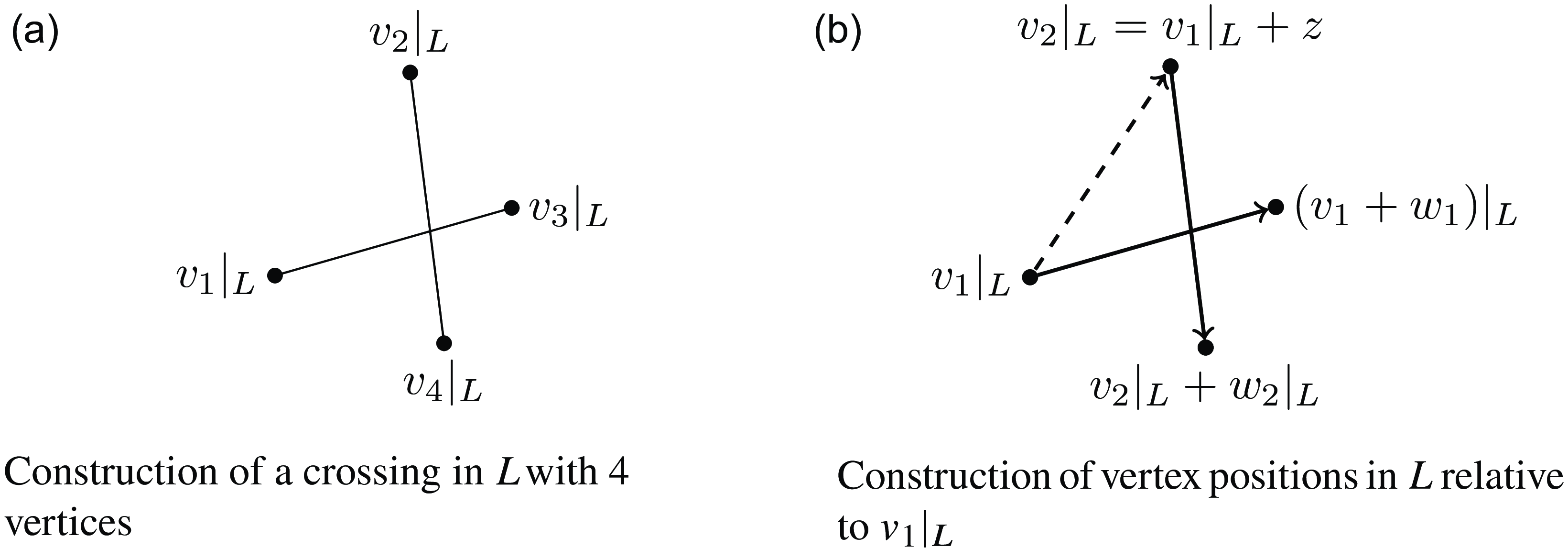
lie in W. This situation and another transformation coming up later in the proof are depicted in Figure 2.
$v_2 + w_2$
lie in W. This situation and another transformation coming up later in the proof are depicted in Figure 2.
Vertex relationships in L.
An integral over a subset of $\mathbb{R}^d$
can be split into an integral over L and one over
$\mathbb{R}^d$
can be split into an integral over L and one over $L^\perp$
. Let
$L^\perp$
. Let $\mu_{-r_t}(B) = \int_B\lambda_{d-2}((x+L^{\perp})\cap W_{-r_t})\,\textrm{d}x$
be the volume of
$\mu_{-r_t}(B) = \int_B\lambda_{d-2}((x+L^{\perp})\cap W_{-r_t})\,\textrm{d}x$
be the volume of $W_{-r_t}$
that gets projected onto a Borel set
$W_{-r_t}$
that gets projected onto a Borel set $B\subset L$
. Then, the right-hand side of the inequality above can be expressed as
$B\subset L$
. Then, the right-hand side of the inequality above can be expressed as
 \begin{multline*} \text{RHS} = \frac{1}{8}t^4\int_{W_L^2}\int_{(r_t B_d)^2} \mathbf{1}\big((v_1 + [0, w_1]|_L)\cap (v_2 + [0, w_2]|_L) \cap U_x \neq \emptyset\big) \\ \textrm{d}w_1\,\textrm{d}w_2\,\mu_{-r_t}(\textrm{d}v_2)\,\mu_{-r_t}(\textrm{d}v_1). \end{multline*}
Note that the vertices $v_1$
and
$v_1$
and $v_2$
in this last expression lie in the plane L instead of in W.
$v_2$
in this last expression lie in the plane L instead of in W.
If $(v_1 + [0, w_1]|_L)\cap (v_2 + [0, w_2]|_L) \cap U_x \neq \emptyset$
then
$(v_1 + [0, w_1]|_L)\cap (v_2 + [0, w_2]|_L) \cap U_x \neq \emptyset$
then $\|v_1 - x\| \leq 2 r_t$
and
$\|v_1 - x\| \leq 2 r_t$
and $\|v_2 - x\| \leq 2 r_t$
. That is, for the indicator function in our integral to be non-zero, the points
$\|v_2 - x\| \leq 2 r_t$
. That is, for the indicator function in our integral to be non-zero, the points $v_1$
and
$v_1$
and $v_2$
must lie in the set
$v_2$
must lie in the set $B_2(x,2 r_t )$
. We define, for all Borel sets
$B_2(x,2 r_t )$
. We define, for all Borel sets $B\subset L$
, the translation-invariant measure
$B\subset L$
, the translation-invariant measure
 \begin{equation*} \mu_-(B) \, :\! = \Big(\inf_{w\in B_2(x,2r_t)} \lambda_{d-2}((w + L^{\perp})\cap W_{-r_t})\Big)\lambda_2(B). \end{equation*}
For all $B\subset B_2(x, 2r_t)$
, we have
$B\subset B_2(x, 2r_t)$
, we have $\mu_-(B) \leq \mu_{-r_t}(B)$
, which implies
$\mu_-(B) \leq \mu_{-r_t}(B)$
, which implies
 \begin{align*} \mathbf{L}_t(U_x) \geq \text{RHS} \geq \frac{1}{8}t^4 \int_{W_L^2}\int_{(r_t B_d)^2} \mathbf{1} \big((v_1 + [0,w_1]|_L) \cap (v_2 & + [0, w_2]|_L) \cap U_x \neq \emptyset\big) \\ & \quad \textrm{d}w_1\,\textrm{d}w_2\,\mu_-(\textrm{d}v_2)\,\mu_-(\textrm{d}v_1). \end{align*}
If the indicator function is non-zero then the position of $v_2\in L$
can be described relative to
$v_2\in L$
can be described relative to $v_1\in L$
using a vector
$v_1\in L$
using a vector $z\in 2r_t B_2$
given by
$z\in 2r_t B_2$
given by $z = v_2 - v_1 $
, see Figure 2. Then,
$z = v_2 - v_1 $
, see Figure 2. Then,
 \begin{multline*} \mathbf{L}_t(U_x) \geq \frac{1}{8}t^4\int_{W_L}\int_{2r_t B_2}\int_{(r_t B_d)^2} \mathbf{1}\big((v_1 + [0,w_1]|_L)\cap ((v_1 + z) + [0,w_2]|_L) \cap U_x \neq \emptyset\big) \\ \textrm{d}w_1\textrm{d}w_2\,\mu_-(\textrm{d}z)\,\mu_-(\textrm{d}v_1). \end{multline*}
Whether or not $(v_1 + [0,w_1]|_L)$
and
$(v_1 + [0,w_1]|_L)$
and $(v_1 + z + [0,w_2]|_L)$
intersect is independent of the position of
$(v_1 + z + [0,w_2]|_L)$
intersect is independent of the position of $v_1$
. Combining this with an application of Fubini’s theorem, we can write
$v_1$
. Combining this with an application of Fubini’s theorem, we can write
 \begin{multline*} \mathbf{L}_t(U_x) \geq \frac{1}{8}t^4\int_{L}\int_{(r_t B_d)^2} \mathbf{1}\big([0,w_1]|_L\cap (z+[0,w_2]|_L)\neq \emptyset\big) \\ \int_{W_L}\mathbf{1}\big((v_1 + [0,w_1]|_L)\cap ((v_1 + z) + [0,w_2]|_L) \cap U_x \neq \emptyset\big) \\ \mu_-(\textrm{d}v_1)\,\textrm{d}w_1\,\textrm{d}w_2\,\mu_-(\textrm{d}z). \end{multline*}
Whenever $[0,w_1]|_L\cap (z+[0, w_2]|_L)\neq\emptyset$
, we obtain the following equality by the translation invariance of
$[0,w_1]|_L\cap (z+[0, w_2]|_L)\neq\emptyset$
, we obtain the following equality by the translation invariance of $\mu_-$
:
$\mu_-$
:
 \begin{multline*} \int_{W_L}\mathbf{1}\big((v_1 + [0,w_1]|_L)\cap ((v_1 + z) + [0,w_2]|_L) \cap U_x \neq \emptyset\big)\, \mu_-(\textrm{d}v_1) \\ =\mu_-(U_x) = \Big(\inf_{w\in B_2(x,2r_t)} \lambda_{d-2}((w + L^{\perp})\cap W_{-r_t})\Big)\lambda_2(U_x). \end{multline*}
That is, if the position of the crossing relative to $v_1\in L$
is fixed, then
$v_1\in L$
is fixed, then $v_1$
can lie in a set of the same size as
$v_1$
can lie in a set of the same size as $U_x$
. Note that if x is close to the boundary of
$U_x$
. Note that if x is close to the boundary of $W_L$
then
$W_L$
then $\mu_-(U_x) = 0$
. Plugging this into the expression above, we obtain
$\mu_-(U_x) = 0$
. Plugging this into the expression above, we obtain
 \begin{align*} \mathbf{L}_t(U_x) & \geq \frac{1}{8}t^4\Big(\inf_{w\in B_2(x,2r_t)} \lambda_{d-2}((w + L^{\perp})\cap W_{-r_t})\Big)\lambda_2(U_x) \\ & \quad \times \int_{2r_t B_2}\int_{(r_t B_d)^2}\mathbf{1}([0,w_1]|_L\cap (z + [0, w_2]|_L)\neq\emptyset)\, \textrm{d}w_1\,\textrm{d}w_2\,\mu_-(\textrm{d}z) \\ & = \frac{1}{8}t^4r_t^{2d+2}\Big(\inf_{w\in B_2(x,2r_t)}\lambda_{d-2}((w+L^{\perp})\cap W_{-r_t})\Big)^2\lambda_2(U_x) \\ & \quad \times \int_{2B_2}\int_{(B_d)^2}\mathbf{1}([0,w_1]|_L\cap (z+[0, w_2]|_L)\neq\emptyset)\, \textrm{d}w_1\,\textrm{d}w_2\,\textrm{d}z \\ & = \frac{1}{8}t^4r_t^{2d+2}c_d\Big(\inf_{w\in B_2(x,2r_t)}\lambda_{d-2}((w + L^{\perp})\cap W_{-r_t})\Big)^2 \lambda_2(U_x), \end{align*}
where the calculation of
 $$c_d \, :\! =\int_{2B_2}\int_{(B_d)^2}\mathbf{1}([0,w_1]|_L\cap (z+[0, w_2]|_L)\neq\emptyset)\, \textrm{d}w_1\,\textrm{d}w_2\,\textrm{d}z = 8\pi\kappa_{d-2}^2\mathbf{B}(3,{d}/{2})^2$$
is done in [Reference Chimani, Döring and Reitzner5].
Upper bound. The proof of the upper bound is similar to that of the lower bound, but for a supremum instead of an infimum. Boundary effects can be ignored since counting more edges is allowed for the upper bound. Then,
 \begin{multline*} \mathbf{L}_t(U_x) \leq \frac{1}{8}t^4\int_{W^2}\int_{(r_t B_d)^2} \mathbf{1}\big((v_1 + [0,w_1])|_L\cap (v_2 + [0,w_2])|_L \cap U_x \neq \emptyset\big) \\ \textrm{d}w_1\,\textrm{d}w_2\,\textrm{d}v_1\,\textrm{d}v_2. \end{multline*}
Defining, for all Borel sets $B\subset L$
, the measure
$B\subset L$
, the measure $\mu(B) \, :\! = \int_B\lambda_{d-2}((x+L^{\perp})\cap W)\,\textrm{d}x$
, we can transform our integrals to ones over the plane L:
$\mu(B) \, :\! = \int_B\lambda_{d-2}((x+L^{\perp})\cap W)\,\textrm{d}x$
, we can transform our integrals to ones over the plane L:
 \begin{multline*} \mathbf{L}_t(U_x) \leq \frac{1}{8}t^4\int_{W_L^2}\int_{(r_t B_d)^2} \mathbf{1}\big((v_1 + [0,w_1])|_L\cap (v_2 + [0,w_2])|_L \cap U_x \neq \emptyset\big) \\ \textrm{d}w_1\,\textrm{d}w_2\,\mu(\textrm{d}v_2)\,\mu(\textrm{d}v_1). \end{multline*}
Let $z=v_2-v_1$
be the position of
$z=v_2-v_1$
be the position of $v_2\in L$
relative to
$v_2\in L$
relative to $v_1\in L$
. Then
$v_1\in L$
. Then
 \begin{multline*} \mathbf{L}_t(U_x) \leq \frac{1}{8}t^4\int_{W_L}\int_{2r_t B_2}\int_{(r_t B_d)^2} \mathbf{1}\big((v_1 + [0,w_1])|_L\cap (v_1 + z + [0,w_2])|_L \cap U_x \neq \emptyset\big) \\ \textrm{d}w_1\,\textrm{d}w_2\,\mu(\textrm{d}z)\,\mu(\textrm{d}v_1). \end{multline*}
Let $\mu_+(B) \, :\! = \big(\sup\nolimits_{w\in B_2(x,2r_t)} \lambda_{d-2}((w + L^{\perp})\cap W)\big)\lambda_2(B)$
. For all
$\mu_+(B) \, :\! = \big(\sup\nolimits_{w\in B_2(x,2r_t)} \lambda_{d-2}((w + L^{\perp})\cap W)\big)\lambda_2(B)$
. For all $B\subset B_2(x,2r_t)$
we have
$B\subset B_2(x,2r_t)$
we have $\mu_+(B) \geq \mu(B)$
, and therefore
$\mu_+(B) \geq \mu(B)$
, and therefore
 \begin{multline*} \mathbf{L}_t(U_x) \\ \shoveleft{\leq \frac{1}{8}t^4\int_{W_L}\int_{B_2(v_1, 2r_t)}\int_{(r_t B_d)^2} \mathbf{1}\big((v_1 + [0,w_1])|_L\cap (v_1+z + [0,w_2])|_L \cap U_x \neq \emptyset\big)} \\ \shoveright{\textrm{d}w_1\,\textrm{d}w_2\,\mu_+(\textrm{d}z)\,\mu_+(\textrm{d}v_1)} \\ \shoveleft{= \frac{1}{8}t^4\int_{2r_t B_2}\int_{(r_t B_d)^2} \mathbf{1}\left([0,w_1]|_L\cap (z + [0, w_2])|_L\neq\emptyset\right)} \\ \int_{W_L}\mathbf{1}\big((v_1 + [0,w_1])|_L\cap (v_1 + z + [0,w_2])|_L \cap U_x \neq \emptyset\big) \\ \mu_+(\textrm{d}v_1)\,\textrm{d}w_1\,\textrm{d}w_2\,\mu_+(\textrm{d}z). \end{multline*}
Whenever $[0,w_1]|_L\cap (z + [0, w_2])|_L\neq\emptyset$
, the translation invariance of
$[0,w_1]|_L\cap (z + [0, w_2])|_L\neq\emptyset$
, the translation invariance of $\mu_+$
implies
$\mu_+$
implies
 \begin{multline*} \int_{W_L}\mathbf{1}\big((v_1 + [0,w_1])|_L\cap (v_1 + z + [0,w_2])|_L \cap U_x \neq \emptyset\big)\, \mu_+(\textrm{d}v_1) \\ = \mu_+(U_x) = \big(\sup\nolimits_{w\in B_2(x,2r_t)} \lambda_{d-2}((w + L^{\perp})\cap W)\big)\lambda_2(U_x). \end{multline*}
Plugging this into the expression above, we obtain
 \begin{equation*} \mathbf{L}_t(U_x) \leq \frac{1}{8}t^4r_t^{2d+2}c_d \big(\sup\nolimits_{w\in B_2(x,2r_t)}\lambda_{d-2}((w + L^{\perp})\cap W)\big)^2\lambda_2(U_x). \end{equation*}
The bound for $\mathbf{L}_t(A)$
with a Borel set
$\mathbf{L}_t(A)$
with a Borel set $A\subset L$
follows from an application of the dominated convergence theorem as described at the start of this proof.
$A\subset L$
follows from an application of the dominated convergence theorem as described at the start of this proof.
The value of $\mathbf{L}_t(A)$
can be approximated using the lower and upper bounds from Lemma 3. Using the difference between these bounds, we can determine the maximum error of this estimation.
$\mathbf{L}_t(A)$
can be approximated using the lower and upper bounds from Lemma 3. Using the difference between these bounds, we can determine the maximum error of this estimation.
Lemma 4. (Uniform error bound.) Let
 \begin{equation*} f_t(A) \, :\! = \int_{A}\sup\nolimits_{w\in B_2(v, 2r_t)}\lambda_{d-2}((w + L^{\perp})\cap W)^2 - \inf_{w\in B_2(v, 2r_t)}\lambda_{d-2}((w + L^{\perp})\cap W_{-r_t})^2\,\textrm{d}v. \end{equation*}
Then $0 \leq f_t(A) \leq f_t(L) = \mathcal{O}_t(r_t)$
for all Borel sets
$0 \leq f_t(A) \leq f_t(L) = \mathcal{O}_t(r_t)$
for all Borel sets $A\subset L$
.
$A\subset L$
.
Proof. The integrand is non-negative for all points $v\in L$
. Since
$v\in L$
. Since $A\subset L$
, it follows that
$A\subset L$
, it follows that $f_t(A)\leq f_t(L)$
.
$f_t(A)\leq f_t(L)$
.
To show the order of the upper bound, we start by bounding $\lambda_{d-2}((w + L^{\perp})\cap W_{-r_t})^2$
to get rid of the
$\lambda_{d-2}((w + L^{\perp})\cap W_{-r_t})^2$
to get rid of the $-r_t$
. Note that
$-r_t$
. Note that
 \begin{align*} \lambda_{d-2}((w + L^{\perp})\cap W_{-r_t})^2 & = \big(\lambda_{d-2}((w + L^{\perp})\cap W) - \lambda_{d-2}((w + L^{\perp})\cap (W\setminus W_{-r_t}))\big)^2 \\ & \geq \lambda_{d-2}((w + L^{\perp})\cap W)^2 \\ & \quad - 2\lambda_{d-2}((w + L^{\perp})\cap W) \cdot \lambda_{d-2}((w + L^{\perp})\cap (W\setminus W_{-r_t})). \end{align*}
For a set A, let $\partial A$
denote its boundary. Then, the volume of
$\partial A$
denote its boundary. Then, the volume of $W\setminus W_{-r_t}$
contained above w can be bounded as follows:
$W\setminus W_{-r_t}$
contained above w can be bounded as follows:
 \begin{align*} \lambda_{d-2}((w + L^{\perp})\cap (W\setminus W_{-r_t})) & \leq r_t\lambda_{d-3}(\partial((w+L^\perp)\cap W)) \\ & \leq r_t\sup\nolimits_{v\in W_L}\lambda_{d-3}(\partial((v+L^\perp)\cap W)). \end{align*}
Defining the constant
 \begin{equation*} b \, :\! = 2\big(\sup\nolimits_{v\in W_L}\lambda_{d-3}(\partial((v+L^\perp)\cap W))\big) \big(\sup\nolimits_{v\in W_L} \lambda_{d-2}((v + L^{\perp})\cap W)\big), \end{equation*}
we see that $\lambda_{d-2}((w + L^{\perp})\cap W_{-r_t})^2 \geq \lambda_{d-2}((w + L^{\perp})\cap W)^2 - br_t$
for all
$\lambda_{d-2}((w + L^{\perp})\cap W_{-r_t})^2 \geq \lambda_{d-2}((w + L^{\perp})\cap W)^2 - br_t$
for all $w\in W_L$
.
$w\in W_L$
.
For $v\in L$
, let
$v\in L$
, let
 \begin{align*} h(v) & \, :\! = \lambda_{d-2}((v + L^{\perp})\cap W)^2, \\ h_+(v) & \, :\! = \sup\nolimits_{w\in B_2(v, 2r_t)} \lambda_{d-2}((w + L^{\perp})\cap W)^2, \\ h_-(v) & \, :\! = \textstyle\inf_{w\in B_2(v, 2r_t)} \lambda_{d-2}((w + L^{\perp})\cap W)^2. \end{align*}
Note that $h_+$
is supported on a subset of L containing
$h_+$
is supported on a subset of L containing $W_L$
. Hence,
$W_L$
. Hence,
 \begin{align} f_t(L) & \leq \int_{W_L} h_+(v) - h_-(v) + br_t\,\textrm{d}v + \int_{L\setminus W_L} h_+(v)\,\textrm{d}v \nonumber \\ & = br_t\lambda_2(W_L) + \int_{L} h_+(v) - h(v)\,\textrm{d}v + \int_{L} h(v) - h_-(v)\,\textrm{d}v. \end{align}
Two-dimensional representation of a function h(v) (gray), the infimum $h_-(v)$
, and the supremum
$h_-(v)$
, and the supremum $h_+(v)$
. Solid lines indicate the domain
$h_+(v)$
. Solid lines indicate the domain $W_L$
and dashed lines the domain
$W_L$
and dashed lines the domain $L\setminus W_L$
.
$L\setminus W_L$
.
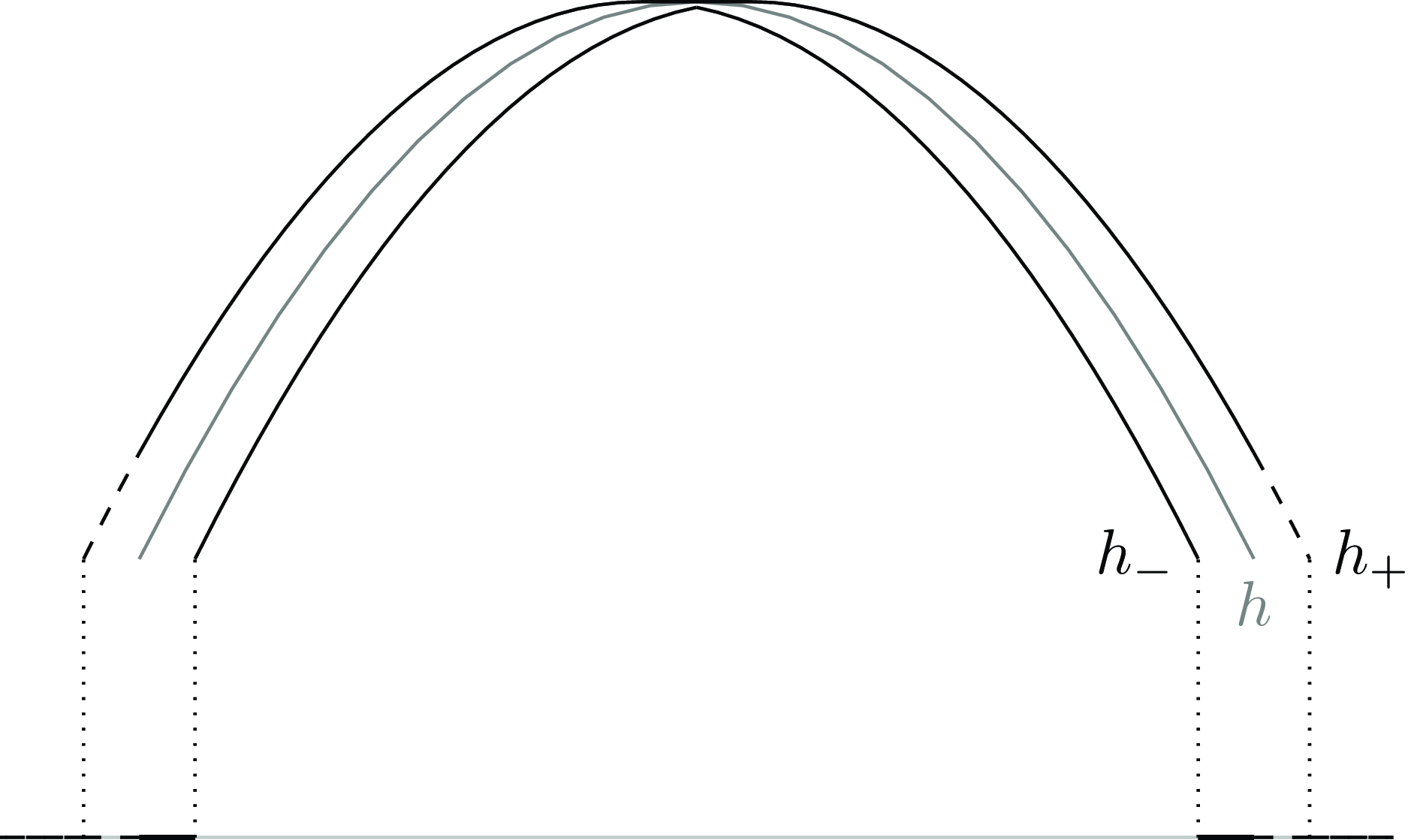
These integrals represent the differences between the volumes under the surface defined by h, $h_+$
, and
$h_+$
, and $h_-$
(see Figure 3). For
$h_-$
(see Figure 3). For $t > 0$
, let
$t > 0$
, let $C(z) = \{v\in L \colon h(v)\geq z\}$
and
$C(z) = \{v\in L \colon h(v)\geq z\}$
and $C_+(z) = \{v\in L \colon h_+(v)\geq z\}$
be the superlevel sets of h and
$C_+(z) = \{v\in L \colon h_+(v)\geq z\}$
be the superlevel sets of h and $h_+$
respectively. If
$h_+$
respectively. If $h_+(v) = z$
for some
$h_+(v) = z$
for some $v\in L$
and
$v\in L$
and $z\in\mathbb{R}$
then there must exist a point
$z\in\mathbb{R}$
then there must exist a point $w\in B_2(v, 2r_t)$
such that
$w\in B_2(v, 2r_t)$
such that $h(w) = z$
too. Combining this with
$h(w) = z$
too. Combining this with $h(v) \leq h_+(v)$
for all
$h(v) \leq h_+(v)$
for all $v\in L$
, we obtain
$v\in L$
, we obtain $C(z) \subset C_+(z) \subset C(z) \oplus B_2(v,2r_t)$
. By the convexity of W, the function
$C(z) \subset C_+(z) \subset C(z) \oplus B_2(v,2r_t)$
. By the convexity of W, the function $\lambda_{d-2}((v + L^{\perp})\cap W)^{{1}/({d-2})} = h(v)^{{1}/{2(d-2)}}$
is concave, which implies that C(z) is convex for all
$\lambda_{d-2}((v + L^{\perp})\cap W)^{{1}/({d-2})} = h(v)^{{1}/{2(d-2)}}$
is concave, which implies that C(z) is convex for all $z\in \mathbb{R}_+$
. We can therefore apply the Steiner formula to see that
$z\in \mathbb{R}_+$
. We can therefore apply the Steiner formula to see that $\lambda_2(C_+(z)\setminus C(z)) = \mathcal{O}(r_t)$
for all z. Then,
$\lambda_2(C_+(z)\setminus C(z)) = \mathcal{O}(r_t)$
for all z. Then,
 \begin{equation*} \int_{L} h_+(v) - h(v)\,\textrm{d}v = \int_0^\infty\lambda_2(C_+(z)\setminus C(z))\,\textrm{d}z = \mathcal{O}_t(r_t) \end{equation*}
is the order of the first integral in (3). Similar calculations show that $\int_L h(v) - h_-(v)\,\textrm{d}v = \mathcal{O}_t(r_t)$
too, from which we conclude that
$\int_L h(v) - h_-(v)\,\textrm{d}v = \mathcal{O}_t(r_t)$
too, from which we conclude that $f_t(L) = \mathcal{O}_t(r_t)$
.
$f_t(L) = \mathcal{O}_t(r_t)$
.
We are now ready to prove Lemma 1.
Proof of Lemma 1. Note that
 \begin{align*} \inf_{w\in B_2(v, 2r_t)} \lambda_{d-2}((w + L^{\perp})\cap W_{-r_t})^2 & \leq \lambda_{d-2}((v + L^{\perp})\cap W)^2 \\ & \leq \sup\nolimits_{w\in B_2(v, 2r_t)} \lambda_{d-2}((w + L^{\perp})\cap W)^2 \end{align*}
for all $v\in L$
. Combining this with Lemma 3, the following inequalities follow:
$v\in L$
. Combining this with Lemma 3, the following inequalities follow:
 \begin{multline*} \frac{1}{8}c_d t^4r_t^{2d+2}\bigg(\int_{A}\lambda_{d-2}((v+L^{\perp})\cap W)^2\,\textrm{d}v - f_t(A)\bigg) \\ \leq \mathbf{L}_t(A) \leq \frac{1}{8} c_d t^4r_t^{2d+2} \bigg(\int_{A} \lambda_{d-2}((v + L^{\perp})\cap W)^2\,\textrm{d}v + f_t(A)\bigg) \end{multline*}
for all Borel sets $A\subset L$
. We can therefore define
$A\subset L$
. We can therefore define $g_t$
to be the function such that
$g_t$
to be the function such that
 \begin{align*} \mathbf{L}_t(A) = \frac{1}{8} c_d t^4r_t^{2d+2} \bigg(\int_{A} \lambda_{d-2}((w + L^{\perp})\cap W)^2\,\textrm{d}v + g_t(A)\bigg). \end{align*}
Combining this with Lemma 4, $|g_t(A)| \leq f_t(A) \leq f_t(L) = \mathcal{O}_t(r_t)$
. Defining
$|g_t(A)| \leq f_t(A) \leq f_t(L) = \mathcal{O}_t(r_t)$
. Defining $c_t \, :\! = f_t(L)$
, the result follows.
$c_t \, :\! = f_t(L)$
, the result follows.
Lastly, we prove that the difference between the variance and the expectation converges to zero as t tends to infinity.
Proof of Lemma 2. For this proof, we can mostly repeat the arguments of [Reference Chimani, Döring and Reitzner5, Theorem 13], which we shorten here. Writing
 \begin{equation*} f(v_1,\dots,v_4) = \mathbf{1}([v_1,v_3]|_L\cap [v_2,v_4]|_L \neq \emptyset) \mathbf{1}(\|v_1-v_3\|\leq r_t,\, \|v_2-v_4\|\leq r_t), \end{equation*}
the variance of the crossing number is given by
 \begin{equation*} \mathbb{V}\,\xi_t(L) = \frac{1}{64}\mathbb{E} \sum_{\substack{(v_1,\dots,v_4)\in V^4_{\neq}\\(w_1,\dots,w_4)\in V^4_{\neq}\\ |\{v_1,\dots,v_4\}\cap \{w_1,\dots,w_4\}|\geq 1}} f(v_1,\dots,v_4)f(w_1,\dots,w_4). \end{equation*}
The sum over all quadruples such that $\{v_1,\dots,v_4\}=\{w_1,\dots,w_4\}$
yields the expected crossing number. The other terms are also calculated by [Reference Chimani, Döring and Reitzner5] and, by the last line of their proof, we have
$\{v_1,\dots,v_4\}=\{w_1,\dots,w_4\}$
yields the expected crossing number. The other terms are also calculated by [Reference Chimani, Döring and Reitzner5] and, by the last line of their proof, we have
 \begin{equation*} \mathbb{V}\,\xi_t(L) = \mathcal{O}_t(t^7 r_t^{4d+4}) + \mathcal{O}_t(t^6 r_t^{3d+4}) + \mathcal{O}_t(t^6 r_t^{4d+2}) + \mathcal{O}_t(t^5 r_t^{3d+2}) + \mathbb{E}\,\xi_t(L). \end{equation*}
Plugging in $t = \mathcal{O}_t(r_t^{-(d+1)/2})$
leads to
$t = \mathcal{O}_t(r_t^{-(d+1)/2})$
leads to
 \begin{equation*} \mathbb{V}\,\xi_t(L) = \mathcal{O}_t(r_t^{(d+1)/2}) + \mathcal{O}_t(r_t) + \mathcal{O}_t(r_t^{d-1}) + \mathcal{O}_t(r_t^{(d-1)/2}) + \mathbb{E}\,\xi_t(L). \end{equation*}
For $d\geq 3$
, the
$d\geq 3$
, the $\mathcal{O}_t(r_t)$
term is the largest. For
$\mathcal{O}_t(r_t)$
term is the largest. For $d=2$
, the largest term is
$d=2$
, the largest term is $\mathcal{O}_t(\sqrt{r_t})$
.
$\mathcal{O}_t(\sqrt{r_t})$
.
3. Multivariate central limit theorem
The central limit theorem concerns the thermodynamic and dense regimes, where $tr_t^d\geq c>0$
for all
$tr_t^d\geq c>0$
for all $t>0$
. In this case, we can apply the results from [Reference Chimani, Döring, Reitzner, Bekos and Chimani4] or the improvements on these results published in [Reference Chimani, Döring and Reitzner5] to scale the crossing number and stress.
$t>0$
. In this case, we can apply the results from [Reference Chimani, Döring, Reitzner, Bekos and Chimani4] or the improvements on these results published in [Reference Chimani, Döring and Reitzner5] to scale the crossing number and stress.
We assume that $S(v_1,v_2;V)\leq s$
almost surely for all
$S(v_1,v_2;V)\leq s$
almost surely for all $(v_1,v_2)\in V^2_{\neq}$
. Combining this with [Reference Chimani, Döring and Reitzner5, Theorems 13, 21, and 23] and their extensions to more general stress functionals in Appendix A, we know that
$(v_1,v_2)\in V^2_{\neq}$
. Combining this with [Reference Chimani, Döring and Reitzner5, Theorems 13, 21, and 23] and their extensions to more general stress functionals in Appendix A, we know that $\mathbb{V}\,\xi_t(L) = \mathcal{O}_t(t^7 r_t^{4d+4})$
,
$\mathbb{V}\,\xi_t(L) = \mathcal{O}_t(t^7 r_t^{4d+4})$
, $\mathbb{V}\,(\textrm{stress}(G,G_L)) = \mathcal{O}_t(t^3)$
, and
$\mathbb{V}\,(\textrm{stress}(G,G_L)) = \mathcal{O}_t(t^3)$
, and $\textrm{Cov}(\xi_t(L),\textrm{stress}(G,G_L)) = \mathcal{O}_t(t^5 r_t^{2d+2})$
. Note that
$\textrm{Cov}(\xi_t(L),\textrm{stress}(G,G_L)) = \mathcal{O}_t(t^5 r_t^{2d+2})$
. Note that $t^5r_t^{2d+2} = (t^3 t^7r_t^{4d+4})^{1/2}$
. We therefore scale the crossing number and the stress as follows:
$t^5r_t^{2d+2} = (t^3 t^7r_t^{4d+4})^{1/2}$
. We therefore scale the crossing number and the stress as follows:
 \begin{equation*} F_t^{(1)} = \frac{\xi_t(L) - \mathbb{E}\,\xi_t(L)}{t^{7/2}r_t^{2d+2}}, \qquad F_t^{(2)} = \frac{\textrm{stress}(G,G_L) - \mathbb{E}\,\textrm{stress}(G,G_L)}{t^{3/2}}.\end{equation*}
To prove the multivariate central limit theorem we apply [Reference Schulte and Yukich17, Theorem 1.1], which requires first- and second-order difference operators. For a Poisson functional $F=f(\eta)$
, where
$F=f(\eta)$
, where $\eta$
is a Poisson point process, these operators are defined as
$\eta$
is a Poisson point process, these operators are defined as
 \begin{equation*} D_x F = f(\eta + \delta_x) - f(\eta), \qquad D_{x,y}^2 F = f(\eta + \delta_x + \delta_y) - f(\eta + \delta_y) - f(\eta + \delta_x) + f(\eta).\end{equation*}
We need to find sufficiently sharp upper bounds for the following expressions from [Reference Schulte and Yukich17, Theorem 1.1]:
 \begin{align*} \gamma_1 & \, :\! = t^{3/2}\Bigg(\sum_{i,j=1}^2\int_{W^3}\big(\mathbb{E}\big(D_{x_1,x_3}^2F_t^{(i)}\big)^2 \big(D_{x_2,x_3}^2F_t^{(i)}\big)^2\big)^{1/2} \\ & \qquad\qquad\qquad\quad \times \big(\mathbb{E}\big(D_{x_1}F_t^{(j)}\big)^2\big(D_{x_2}F_t^{(j)}\big)^2\big)^{1/2}\, \textrm{d}x_1\,\textrm{d}x_2\, \textrm{d}x_3\Bigg)^{1/2}, \\ \gamma_2 & \, :\! = t^{3/2}\Bigg(\sum_{i,j=1}^2\int_{W^3}\big(\mathbb{E}\big(D_{x_1,x_3}^2 F_t^{(i)}\big)^2 \big(D_{x_2,x_3}^2 F_t^{(i)}\big)^2\big)^{1/2} \\ & \qquad\qquad\qquad\quad \times \big(\mathbb{E}\big(D_{x_1,x_3}^2 F_t^{(j)}\big)^2\big(D_{x_2,x_3}^2 F_t^{(j)}\big)^2\big)^{1/2}\, \textrm{d}x_1\,\textrm{d}x_2\,\textrm{d}x_3\Bigg)^{1/2}, \\ \gamma_3 & \, :\! = t\sum_{i=1}^2\int_W \mathbb{E}\big|D_x F_t^{(i)}\big|^3\,\textrm{d}x.\end{align*}
The Slivnyak–Mecke formula (2) is particularly useful when calculating such expectations of difference operators.
We first calculate upper bounds for these expectations of the difference operators. For the stress functional $F_t^{(2)}$
we can derive sufficiently sharp upper bounds by only considering the maximal stress.
$F_t^{(2)}$
we can derive sufficiently sharp upper bounds by only considering the maximal stress.
Lemma 5. (Bounds for stress.) If $S(v_1,v_2;V)\leq s <\infty$
almost surely for all
$S(v_1,v_2;V)\leq s <\infty$
almost surely for all $v_1$
and
$v_1$
and $v_2$
then there exist constants
$v_2$
then there exist constants $k_1$
,
$k_1$
, $k_2$
, and
$k_2$
, and $k_3$
such that, for t large enough.
$k_3$
such that, for t large enough.
 \begin{align}\sup\nolimits_{x_1,x_2\in W}\mathbb{E}\big(D_{x_1}F_t^{(2)nn}\big)^2\big(D_{x_2}F_t^{(2)}\big)^2 & \leq k_1 t^{-2},\\[-6pt]\nonumber\end{align}
 \begin{align}\sup\nolimits_{x\in W}\mathbb{E}\big|D_xF_t^{(2)}\big|^3 & \leq k_2 t^{-3/2},\\[-6pt]\nonumber\end{align}
 \begin{align}\sup\nolimits_{x_1,x_2,x_3 \in W}\mathbb{E}\big(D_{x_1,x_3}^2 F_t^{(2)n}\big)^2\big(D_{x_2,x_3}^2 F_t^{(2)}\big)^2 & \leq k_3 t^{-6}.\end{align}
Proof. For any $x\in W$
, the first-order difference operator yields
$x\in W$
, the first-order difference operator yields
 \begin{equation*} 0 \leq D_{x} F_t^{(2)n} = \sum_{v\in V}\frac{S(x,v;V)}{t^{3/2}} \leq |V|\frac{s}{{t^{3/2}}}, \end{equation*}
where s is the upper bound for $S(x,v;V)$
and
$S(x,v;V)$
and $|V|$
is the number of vertices. For a random variable
$|V|$
is the number of vertices. For a random variable $X\sim\textrm{Poi}(t)$
we have
$X\sim\textrm{Poi}(t)$
we have $\mathbb{E}\,X^n = \mathcal{O}(t^n)$
as t goes to infinity. The bounds (4) and (5) follow.
$\mathbb{E}\,X^n = \mathcal{O}(t^n)$
as t goes to infinity. The bounds (4) and (5) follow.
The second-order difference operator only depends on the two points $x_1$
and
$x_1$
and $x_2$
added to the point process, so
$x_2$
added to the point process, so
 \begin{equation*} D^2_{x_1,x_2} F_t^{(2)} = \frac{S(x_1,x_2;V)}{t^{3/2}} \leq \frac{s}{t^{3/2}}, \end{equation*}
which results in the bound (6).
The first-order difference operators for the number of crossings are of the same order as those of the stress.
Lemma 6. (Bounds for number of crossings.) Let $tr_t^d\geq c>0$
for all t. Then there exist constants
$tr_t^d\geq c>0$
for all t. Then there exist constants $k_4$
and
$k_4$
and $k_5$
such that
$k_5$
such that
 \begin{align} \sup\nolimits_{x_1,x_2\in W}\mathbb{E}\big(D_{x_1}F_t^{(1)}\big)^2\big(D_{x_2}F_t^{(1)}\big)^2 & \leq k_4 t^{-2}, \\ \sup\nolimits_{x\in W}\mathbb{E}\big|D_x F_t^{(1)}\big|^3 & \leq k_5 t^{-3/2}. \nonumber \end{align}
Proof. The first-order difference operator for the crossing number can be bounded from above as follows:
 \begin{align*} D_xF_t^{(1)} & = \frac{1}{2}t^{-7/2}r_t^{-2d-2}\sum_{v,w,y\in V^3_{\neq}} \mathbf{1}(\|x-v\|\leq r_t, \|w-y\|\leq r_t) \mathbf{1}([x,v]|_L\cap [w,y]|_L \neq\emptyset) \\ & \leq \frac{1}{2}t^{-7/2}r_t^{-2d-2}\sum_{v,w,y\in V^3_{\neq}}\mathbf{1}(\|x-v\|\leq r_t, \|w-y\|\leq r_t) \mathbf{1}(\|x|_L - w|_L\| \leq 2r_t).\end{align*}
We have
 \begin{align*} & \mathbb{E}|D_x F_t^{(1)}|^3 \\ & \leq \frac{1}{8}t^{-21/2} r_t^{-6d-6}\mathbb{E} \sum_{\substack{v_1,w_1,y_1 \in V^3_{\neq} \\ v_2,w_2,y_2 \in V^3_{\neq} \\ v_3,w_3,y_3 \in V^3_{\neq}}}\prod_{i=1}^3 \mathbf{1}(\|x-v_i\|\leq r_t, \|w_i-y_i\|\leq r_t)\mathbf{1}(\|x|_L - w_i|_L\| \leq 2r_t). \end{align*}
We can apply the Slivnyak–Mecke formula to sums over distinct vertices in a Poisson point process. Since the nine vertices in this sum are not necessarily distinct, we have to distinguish between different cases: all vertices are distinct, eight vertices are distinct and two equal, etc. An application of the Slivnyak–Mecke formula for the expectation of the sum where all points are distinct yields
 \begin{equation*} \prod_{i=1}^3\bigg(t^3\int_{W^3}\mathbf{1}\big(\|x-v_i\|\leq r_t, \|w_i-y_i\|\leq r_t\big) \mathbf{1}\big(\|x|_L - w_i|_L\| \leq 2r_t\big)\,\textrm{d}v_i\,\textrm{d}w_i\,\textrm{d}y_i\bigg). \end{equation*}
The integral over points $v_i$
such that
$v_i$
such that $\|x-v_i\|\leq r_t$
is of order
$\|x-v_i\|\leq r_t$
is of order $r_t^d$
. The point
$r_t^d$
. The point $w_i$
must be placed in a cylinder with volume of order
$w_i$
must be placed in a cylinder with volume of order $r_t^2$
. When
$r_t^2$
. When $w_i$
is fixed, the point
$w_i$
is fixed, the point $y_i$
must be placed within a distance of
$y_i$
must be placed within a distance of $r_t$
from
$r_t$
from $w_i$
so that the last integral is of order
$w_i$
so that the last integral is of order $r_t^d$
too. Each of the three integrals over
$r_t^d$
too. Each of the three integrals over $W^3$
is therefore of order
$W^3$
is therefore of order $\mathcal{O}_t(r_t^{2d + 2})$
. Together with the prefactor, the entire term is of order
$\mathcal{O}_t(r_t^{2d + 2})$
. Together with the prefactor, the entire term is of order $\mathcal{O}_t(t^{-21/2} r_t^{-6d-6} t^9 r_t^{6d+6}) = \mathcal{O}_t(t^{-3/2})$
.
$\mathcal{O}_t(t^{-21/2} r_t^{-6d-6} t^9 r_t^{6d+6}) = \mathcal{O}_t(t^{-3/2})$
.
If the triples of points have some overlap, we sum over at most eight distinct points. An example of such a term is
 \begin{align*} & \mathbb{E}\sum_{\substack{v_1,w_1,y_1,v_2,y_2,v_3,w_3,y_3 \in V^8_{\neq} \\ w_1 = w_2}}\prod_{i=1}^3 \mathbf{1}(\|x-v_i\|\leq r_t, \|w_i-y_i\|\leq r_t)\mathbf{1}(\|x|_L - w_i|_L\| \leq 2r_t) \\ & = t^8\int_{W^8}\mathbf{1}(\|x-v_1\|\leq r_t, \|w_1-y_1\|\leq r_t)\mathbf{1}(\|x|_L - w_1|_L\| \leq 2r_t)^2 \\ & \qquad\qquad \times \mathbf{1}(\|x-v_2\|\leq r_t, \|w_1-y_2\|\leq r_t) \mathbf{1}(\|x-v_3\|\leq r_t, \|w_3-y_3\|\leq r_t) \\ & \qquad\qquad \times \mathbf{1}\left(\|x|_L - w_3|_L\| \leq 2r_t\right)\, \textrm{d}v_1\,\textrm{d}w_1\,\textrm{d}y_1\,\textrm{d}v_2\,\textrm{d}y_2\,\textrm{d}v_3\, \textrm{d}w_3\,\textrm{d}y_3. \end{align*}
The order of this integral can be determined the same way as before with the nine distinct vertices and leads to a contribution of order $\mathcal{O}_t(t^{-{5/2}}r_t^{-2})$
. In general, we can see that restricting two vertices to be equal results in a loss of an integral of order
$\mathcal{O}_t(t^{-{5/2}}r_t^{-2})$
. In general, we can see that restricting two vertices to be equal results in a loss of an integral of order $\mathcal{O}_t(tr_t^2)$
or
$\mathcal{O}_t(tr_t^2)$
or $\mathcal{O}_t(tr_t^d)$
. It is then clear that the restriction that two or more vertices are the same does not increase the order of this expectation. These other terms are therefore also at most
$\mathcal{O}_t(tr_t^d)$
. It is then clear that the restriction that two or more vertices are the same does not increase the order of this expectation. These other terms are therefore also at most $\mathcal{O}_t(t^{-3/2})$
. We can conclude that
$\mathcal{O}_t(t^{-3/2})$
. We can conclude that $\mathbb{E}|D_x F_t^{(1)}|^3 = \mathcal{O}_t(t^{-3/2})$
.
$\mathbb{E}|D_x F_t^{(1)}|^3 = \mathcal{O}_t(t^{-3/2})$
.
Similar calculations with tuples of twelve points show that
 \begin{align*} \sup\nolimits_{x_1,x_2\in W}\mathbb{E}\big(D_{x_1}F_t^{(1)}\big)^2\big(D_{x_2}F_t^{(1)}\big)^2 & \leq \sup\nolimits_{x_1,x_2\in W}\mathbb{E}\big[\big(D_{x_1}F_t^{(1)}\big)^4 + \big(D_{x_2}F_t^{(1)}\big)^4\big] \\ & = 2\sup\nolimits_{x\in W}\mathbb{E}\big(D_{x}F_t^{(1)}\big)^4 = \mathcal{O}_t(t^{-2}), \end{align*}
which is what we needed to show for (7).
Lemma 7. Under the conditions stated in Theorem 2, the parameters $\gamma_1$
,
$\gamma_1$
, $\gamma_2$
, and
$\gamma_2$
, and $\gamma_3$
are of the orders
$\gamma_3$
are of the orders $\gamma_1 = \mathcal{O}_t(t^{-1/2})$
,
$\gamma_1 = \mathcal{O}_t(t^{-1/2})$
, $\gamma_2 = \mathcal{O}_t(t^{-1/2})$
, and
$\gamma_2 = \mathcal{O}_t(t^{-1/2})$
, and $\gamma_3 = \mathcal{O}_t(t^{-1/2})$
.
$\gamma_3 = \mathcal{O}_t(t^{-1/2})$
.
Proof. The order of $\gamma_3$
follows immediately from Lemmas 5 and 6. For
$\gamma_3$
follows immediately from Lemmas 5 and 6. For $\gamma_1$
we obtain, by (4) and (7),
$\gamma_1$
we obtain, by (4) and (7),
 \begin{equation*} \gamma_1 \leq (\sup\{k_1, k_4\})^{1/4}t\Bigg(\sum_{i,j=1}^2\int_{W^3} \big(\mathbb{E}\big(D_{x_1,x_3}^2 F_t^{(i)}\big)^2\big(D_{x_2,x_3}^2 F_t^{(i)}\big)^2\big)^{1/2}\, \textrm{d}x_1\,\textrm{d}x_2\,\textrm{d}x_3\Bigg)^{1/2}, \end{equation*}
which implies
 \begin{equation*} \gamma_1 \leq 2(\sup\{k_1, k_4\})^{1/4} t\bigg(k_3^{1/2}t^{-3} + \int_{W^3}\big(\mathbb{E}\big(D_{x_1,x_3}^2 F_t^{(1)}\big)^2\big(D_{x_2,x_3}^2 F_t^{(1)}\big)^2\big)^{1/2}\, \textrm{d}x_1\,\textrm{d}x_2\,\textrm{d}x_3\bigg)^{1/2} \end{equation*}
by (6) and $\lambda_d(W)=1$
.
$\lambda_d(W)=1$
.
Note that $D_{x_1,x_3}^2 F_t^{(1)}$
counts the number of crossings with both vertices
$D_{x_1,x_3}^2 F_t^{(1)}$
counts the number of crossings with both vertices $x_1$
and
$x_1$
and $x_3$
involved, which either means that
$x_3$
involved, which either means that $x_1$
and
$x_1$
and $x_3$
form a new edge and intersect an existing one or that
$x_3$
form a new edge and intersect an existing one or that $x_1$
and
$x_1$
and $x_3$
are endpoints of distinct edges which cross in their projection:
$x_3$
are endpoints of distinct edges which cross in their projection:
 \begin{align*} & D_{x_1,x_3}^2F_t^{(1)} \\ & = \frac{1}{2t^{7/2}r_t^{2d+2}}\sum_{v_1,v_3\in V^2_{\neq}}\mathbf{1}\big(\|x_1-x_3\|\leq r_t,\|v_1-v_3\|\leq r_t\big) \mathbf{1}\big([x_1,x_3]|_L\cap [v_1,v_3]|_L \neq\emptyset\big) \\ & \qquad\qquad\qquad\qquad\quad + \mathbf{1}\big(\|x_1-v_1\|\leq r_t,\|x_3-v_3\|\leq r_t\big) \mathbf{1}\big([x_1,v_1]|_L\cap [x_3,v_3]|_L \neq\emptyset\big). \\ & \leq \frac{1}{2t^{7/2}r_t^{2d+2}}\sum_{v_1,v_3\in V^2_{\neq}} \mathbf{1}\big(\|x_1-x_3\|\leq r_t,\|v_1-v_3\|\leq r_t\big) \mathbf{1}\big(\|x_1|_L - v_1|_L\|\leq 2r_t\big) \\ & \qquad\qquad\qquad\qquad\quad + \mathbf{1}\big(\|x_1-v_1\|\leq r_t,\|x_3-v_3\|\leq r_t\big) \mathbf{1}\big(\|x_1|_L - x_3|_L\|\leq 2r_t\big).\end{align*}
Multiplying four such expressions to bound $\gamma_1$
and
$\gamma_1$
and $\gamma_2$
leads to a sum of products of indicator functions in a way similar to the proof of Lemma 6, where this time the sum is over four pairs of points from V. These pairs of points may have overlap, and the products of indicators can consist of combinations of the two different products we see in the equation above. Calculating
$\gamma_2$
leads to a sum of products of indicator functions in a way similar to the proof of Lemma 6, where this time the sum is over four pairs of points from V. These pairs of points may have overlap, and the products of indicators can consist of combinations of the two different products we see in the equation above. Calculating $\gamma_1$
and
$\gamma_1$
and $\gamma_2$
therefore requires many applications of the Slivnyak–Mecke formula to all the various cases. However, we again quickly see that the highest-order terms are those where the eight-tuples over which we sum consist of distinct vertices.
$\gamma_2$
therefore requires many applications of the Slivnyak–Mecke formula to all the various cases. However, we again quickly see that the highest-order terms are those where the eight-tuples over which we sum consist of distinct vertices.
We distinguish between the two extreme cases: either $\|x_1-x_2\|\leq r_t$
and
$\|x_1-x_2\|\leq r_t$
and $\|x_1-x_3\|\leq r_t$
or
$\|x_1-x_3\|\leq r_t$
or $\|x_1-x_2\|> r_t$
and
$\|x_1-x_2\|> r_t$
and $\|x_1-x_3\|> r_t$
. If
$\|x_1-x_3\|> r_t$
. If $x_1$
and
$x_1$
and $x_3$
form an edge, each integral
$x_3$
form an edge, each integral
 $$\int_{W^2}\mathbf{1}\big(\|x_1-x_3\|\leq r_t,\|v_i-v_j\|\leq r_t\big) \mathbf{1}\big(\|x_1|_L - v_i|_L\|\leq 2r_t\big)\,\textrm{d}v_i\,\textrm{d}v_j$$
resulting from an application of the Slivnyak–Mecke formula contributes a factor of order $(t r_t^d)(tr_t^2) = t^2r_t^{d+2}$
. The factors
$(t r_t^d)(tr_t^2) = t^2r_t^{d+2}$
. The factors
 $$\int_{W^2}\mathbf{1}\big(\|x_1-v_i\|\leq r_t,\|x_3-v_j\|\leq r_t\big) \mathbf{1}\big(\|x_1|_L - x_3|_L\|\leq 2r_t\big)\,\textrm{d}v_i\,\textrm{d}v_j$$
each contribute a term of order $(tr_t^d)(tr_t^d) = t^2r_t^{2d}$
whenever
$(tr_t^d)(tr_t^d) = t^2r_t^{2d}$
whenever $\|x_1|_L - x_3|_L\|\leq 2r_t$
.
$\|x_1|_L - x_3|_L\|\leq 2r_t$
.
If $\|x_1-x_2\|\leq r_t$
and
$\|x_1-x_2\|\leq r_t$
and $\|x_1-x_3\|\leq r_t$
, the points
$\|x_1-x_3\|\leq r_t$
, the points $x_2$
and
$x_2$
and $x_3$
lie in a volume of order
$x_3$
lie in a volume of order $r_t^d$
so the integral contributes a factor of order
$r_t^d$
so the integral contributes a factor of order $r_t^{2d}$
. The expectation contributes a factor of order
$r_t^{2d}$
. The expectation contributes a factor of order
 \begin{equation*} \big(\mathbb{E}\big(D_{x_1,x_3}^2 F_t^{(1)}\big)^2\big(D_{x_2,x_3}^2 F_t^{(1)}\big)^2\big)^{1/2} = \mathcal{O}_t\bigg(\frac{(t^2r_t^{d+2})^2}{t^7r_t^{4d+4}}\bigg) = \mathcal{O}_t(t^{-3}r_t^{-2d}). \end{equation*}
If $\|x_1-x_2\|> r_t$
and
$\|x_1-x_2\|> r_t$
and $\|x_1-x_3\|> r_t$
, the points
$\|x_1-x_3\|> r_t$
, the points $x_2$
and
$x_2$
and $x_3$
must each lie in a volume of order
$x_3$
must each lie in a volume of order $r_t^2$
in order for the integrand to be non-zero. The contribution of the expectation is a factor of order
$r_t^2$
in order for the integrand to be non-zero. The contribution of the expectation is a factor of order
 \begin{equation*} \big(\mathbb{E}\big(D_{x_1,x_3}^2 F_t^{(1)}\big)^2\big(D_{x_2,x_3}^2 F_t^{(1)}\big)^2\big)^{1/2} = \mathcal{O}_t\bigg(\frac{(t^2r_t^{2d})^2}{t^7r_t^{4d+4}}\bigg) = \mathcal{O}_t(t^{-3}r_t^{-4}). \end{equation*}
Combining the above calculations, we obtain
 \begin{equation*} \int_{W^3}\big(\mathbb{E}\big(D_{x_1,x_3}^2 F_t^{(1)}\big)^2\big(D_{x_2,x_3}^2 F_t^{(1)}\big)^2\big)^{1/2}\, \textrm{d}x_1\,\textrm{d}x_2\,\textrm{d}x_3 = \mathcal{O}_t(t^{-3}). \end{equation*}
It follows that $\gamma_1 = \mathcal{O}_t(t^{-1/2})$
.
$\gamma_1 = \mathcal{O}_t(t^{-1/2})$
.
The order of $\gamma_2$
is derived similarly. The largest term, which determines the order, comes from the number of crossings:
$\gamma_2$
is derived similarly. The largest term, which determines the order, comes from the number of crossings:
 \begin{align*} & \int_{W^3}\mathbb{E}\big(D_{x_1,x_3}^2 F_t^{(1)}\big)^2\big(D_{x_2,x_3}^2 F_t^{(1)}\big)^2\, \textrm{d}x_1\,\textrm{d}x_2\,\textrm{d} x_3 = \mathcal{O}_t(t^{-4}), \\ & \int_{W^3}\mathbb{E}\big(D_{x_1,x_3}^2 F_t^{(2)}\big)^2\big(D_{x_2,x_3}^2 F_t^{(2)}\big)^2\, \textrm{d}x_1\,\textrm{d}x_2\,\textrm{d}x_3 = \mathcal{O}_t(t^{-6}), \\ & \int_{W^3}\big(\mathbb{E}\big(D_{x_1,x_3}^2 F_t^{(1)}\big)^2\big(D_{x_2,x_3}^2 F_t^{(1)}\big)^2\big)^{1/2} \\ & \qquad \times \big(\mathbb{E}\big(D_{x_1,x_3}^2 F_t^{(2)}\big)^2\big(D_{x_2,x_3}^2 F_t^{(2)}\big)^2\big)^{1/2}\, \textrm{d}x_1\,\textrm{d}x_2\,\textrm{d}x_3 = \mathcal{O}_t(t^{-5}). \end{align*}
Hence, $\gamma_2 = \mathcal{O}_t(t^{-1/2})$
.
$\gamma_2 = \mathcal{O}_t(t^{-1/2})$
.
The obtained parameters $\gamma_1$
,
$\gamma_1$
, $\gamma_2$
, and
$\gamma_2$
, and $\gamma_3$
can now be combined with [Reference Schulte and Yukich17, Theorem 1.1] to prove the following proposition and Theorem 2.
$\gamma_3$
can now be combined with [Reference Schulte and Yukich17, Theorem 1.1] to prove the following proposition and Theorem 2.
Proposition 1. Suppose that the covariance matrix $\Sigma_t$
of
$\Sigma_t$
of $F_t$
converges to
$F_t$
converges to $\Sigma = (\sigma_{ij})_{i,j\in\{1,2\}}$
. Then
$\Sigma = (\sigma_{ij})_{i,j\in\{1,2\}}$
. Then $\mathsf{d}_3(F_t,Z_\Sigma) \leq \sum_{i,j = 1}^2\big|\sigma_{ij}-\textrm{Cov}\big(F_t^{(i)},F_t^{(j)}\big)\big| + \mathcal{O}_t(t^{-1/2})$
, where
$\mathsf{d}_3(F_t,Z_\Sigma) \leq \sum_{i,j = 1}^2\big|\sigma_{ij}-\textrm{Cov}\big(F_t^{(i)},F_t^{(j)}\big)\big| + \mathcal{O}_t(t^{-1/2})$
, where $Z_{\Sigma}\sim\mathcal{N}(0,\Sigma)$
.
$Z_{\Sigma}\sim\mathcal{N}(0,\Sigma)$
.
Proof. We have $2\gamma_1 + \gamma_2 + \gamma_3 = \mathcal{O}_t(t^{-1/2})$
. The result then immediately follows from an application of [Reference Schulte and Yukich17, Theorem 1.1].
$2\gamma_1 + \gamma_2 + \gamma_3 = \mathcal{O}_t(t^{-1/2})$
. The result then immediately follows from an application of [Reference Schulte and Yukich17, Theorem 1.1].
Proof of Theorem 2. Similarly to the proof of Proposition 1, we have
 \begin{equation*} \mathsf{d}_3(F_t,Z_{\Sigma_t}) \leq \sum_{i,j = 1}^2\big|\textrm{Cov}\big(F_t^{(i)},F_t^{(j)}\big) - \textrm{Cov}\big(F_t^{(i)},F_t^{(j)}\big)| + \mathcal{O}_t(t^{-1/2}) = \mathcal{O}_t(t^{-1/2}). \end{equation*}
The convergence in distribution of $F_t$
to
$F_t$
to $\mathcal{N}(0,\Sigma)$
follows from Proposition 1. Then, since
$\mathcal{N}(0,\Sigma)$
follows from Proposition 1. Then, since $\textrm{Cov}\big(F_t^{(i)},F_t^{(j)}\big) \to \sigma_{ij}$
for
$\textrm{Cov}\big(F_t^{(i)},F_t^{(j)}\big) \to \sigma_{ij}$
for $i,j\in\{1,2\}$
, we know that the upper bound on
$i,j\in\{1,2\}$
, we know that the upper bound on $\mathsf{d}_3(F_t,Z_\Sigma)$
goes to zero, and we obtain the desired result.
$\mathsf{d}_3(F_t,Z_\Sigma)$
goes to zero, and we obtain the desired result.
Appendix A. Variance of stress and covariance
The results from [Reference Chimani, Döring, Reitzner, Bekos and Chimani4] on the stress assume that the stress is a U-statistic, i.e. that $S(v_1,v_2;V)$
is independent of
$S(v_1,v_2;V)$
is independent of $V\setminus\{v_1,v_2\}$
. The goal of this appendix is to extend the results from [Reference Chimani, Döring, Reitzner, Bekos and Chimani4] for the stress to a broader class of stress functionals, where the metrics
$V\setminus\{v_1,v_2\}$
. The goal of this appendix is to extend the results from [Reference Chimani, Döring, Reitzner, Bekos and Chimani4] for the stress to a broader class of stress functionals, where the metrics $\mathsf{d}_0$
and
$\mathsf{d}_0$
and $\mathsf{d}_L$
can also depend on the vertices of the graph. These derivations follow essentially the same steps as the proofs in [Reference Chimani, Döring, Reitzner, Bekos and Chimani4].
$\mathsf{d}_L$
can also depend on the vertices of the graph. These derivations follow essentially the same steps as the proofs in [Reference Chimani, Döring, Reitzner, Bekos and Chimani4].
Applying the Slivnyak–Mecke formula to the expectation of the stress, we obtain
 \begin{equation*} \mathbb{E} \textrm{stress}(G,G_L) = \mathbb{E} \frac{1}{2}\sum_{(v_1,v_2)\in V_{\neq}^2} S(v_1,v_2; V) = \frac{1}{2}t^2\int_{W^2}\mathbb{E}[S(v_1,v_2; V\cup\{v_1,v_2\})]\,\textrm{d}v_1\,\textrm{d}v_2.\end{equation*}
For the calculation of the variance, we follow the proof of [Reference Chimani, Döring and Reitzner5, Theorem 21] and again apply the Slivnyak–Mecke formula. Then,
 \begin{align*} \mathbb{V}\,\textrm{stress}(G,G_L) & = \mathbb{E}\sum_{(v,v_2,w_2)\in V^3_{\neq}}S(v,v_2;V)S(v,w_2;V) + \frac{1}{2}\mathbb{E}\sum_{(v_1,v_2)\in V^2_{\neq}}S(v_1,v_2;V)^2 \\ & = t^3\int_{W^3}\mathbb{E}\,S(v,v_2;V\cup\{v,v_2\})S(v,w_2;V\cup\{v,w_2\})\, \textrm{d}v_2\,\textrm{d}w_2\,\textrm{d}v \\ & \quad + \frac{1}{2}t^2\int_{W^2}\mathbb{E}\,S(v_1,v_2;V\cup\{v_1,v_2\})^2\,\textrm{d}v_1\,\textrm{d}v_2 \\ & = t^3\int_{W^3}\mathbb{E}\,S(v,v_2;V\cup\{v,v_2\})S(v,w_2;V\cup\{v,w_2\})\, \textrm{d}v_2\,\textrm{d}w_2\,\textrm{d}v + \mathcal{O}(t^2).\end{align*}
This expression is independent of whether or not we project the graph and is therefore also valid for $d=2$
.
$d=2$
.
For the covariance, we follow the proof of [Reference Chimani, Döring and Reitzner5, Theorem 23]. We then obtain
 \begin{align*} & \textrm{Cov}(\xi_t(L), \textrm{stress}(G,G_L)) \\ & = \frac{1}{2}c_dt^5r_t^{2d+2}\int_W\lambda_{d-2}((v+L^{\perp})\cap W) \int_{W}\mathbb{E}[S(v,w; V\cup \{v,w\})]\,\textrm{d}w\,\textrm{d}v\,(1+o(1)).\end{align*}
When $d=2$
, we obtain, following similar calculations,
$d=2$
, we obtain, following similar calculations,
 \begin{equation*} \textrm{Cov}(\xi_t(L),\textrm{stress}(G,G_L)) = \frac{1}{2}c_2 t^5 r_t^{6} \int_{W^2}\mathbb{E}[S(v,w; V\cup \{v,w\})]\,\textrm{d}w\,\textrm{d}v\,(1+o(1)).\end{equation*}
The vertex set V depends on the intensity t of the point process. The metrics $\mathsf{d}_0$
and
$\mathsf{d}_0$
and $\mathsf{d}_L$
and the weight function appearing in the stress functional can be chosen to depend on the intensity t too. In order for the covariance matrix in Theorem 2 to converge, the integrals in the variance and covariance above must converge.
$\mathsf{d}_L$
and the weight function appearing in the stress functional can be chosen to depend on the intensity t too. In order for the covariance matrix in Theorem 2 to converge, the integrals in the variance and covariance above must converge.
Appendix B. Central limit theorem rate of convergence for
$W = [0,1]^d$

To determine how fast $F_t$
converges to the normal distribution, we need a rate of convergence of the variance and the covariance of the crossing number and the stress. For some choices of W, these rates can be derived by making some adjustments to the derivations of the variance and covariance in [Reference Chimani, Döring and Reitzner5]. The easiest choice of W is the d-dimensional cube because of its constant height with respect to
$F_t$
converges to the normal distribution, we need a rate of convergence of the variance and the covariance of the crossing number and the stress. For some choices of W, these rates can be derived by making some adjustments to the derivations of the variance and covariance in [Reference Chimani, Döring and Reitzner5]. The easiest choice of W is the d-dimensional cube because of its constant height with respect to $\mathbb{R}^2\times\{0\}^{d-2}$
.
$\mathbb{R}^2\times\{0\}^{d-2}$
.
Proposition 2. Let $W=[0,1]^d$
and
$W=[0,1]^d$
and $L = \mathbb{R}^2 \times \{0\}^{d-2}$
, and let the stress be independent of the vertex set V of G. Define
$L = \mathbb{R}^2 \times \{0\}^{d-2}$
, and let the stress be independent of the vertex set V of G. Define $r_t$
such that
$r_t$
such that $tr_t^d=c$
for all
$tr_t^d=c$
for all $t>0$
, and let
$t>0$
, and let $\Sigma$
be defined as in Theorem 2. Then, for
$\Sigma$
be defined as in Theorem 2. Then, for $Z_{\Sigma}\sim\mathcal{N}(0,\Sigma)$
,
$Z_{\Sigma}\sim\mathcal{N}(0,\Sigma)$
, $\mathsf{d}_3(F_t,Z_{\Sigma})) = \mathcal{O}(r_t)$
as t goes to infinity.
$\mathsf{d}_3(F_t,Z_{\Sigma})) = \mathcal{O}(r_t)$
as t goes to infinity.
The improved approximations of the variance and covariance needed for the derivation of this result are given in the following two lemmas.
Lemma 8. Consider the model described in Proposition 2. The variance of the crossing number is
 \begin{equation} \mathbb{V}\,\xi_t(L) = \frac{1}{8}c^4t^3r_t^{4}\big(2c_d^2 + c_d' c^{-1}\big)(1+\mathcal{O}_t(r_t)), \end{equation}
where $c_d' = \pi \kappa_{d-2}^3 \mathbf{B}(3,d/2)^2\mathbf{B}(4,d/2)$
and
$c_d' = \pi \kappa_{d-2}^3 \mathbf{B}(3,d/2)^2\mathbf{B}(4,d/2)$
and $c_d$
is defined as in Lemma 1.
$c_d$
is defined as in Lemma 1.
Lemma 9. Consider the model described in Proposition 2. For the covariance between the crossing number and the stress,
 \begin{equation} \textrm{Cov}(\xi_t(W_L),\textrm{stress}(G,G_L)) = \frac{1}{2}c_d t^3r_t^{2}\int_W S_{W,L}^{(1)}(v)\,\textrm{d}v(1+ \mathcal{O}_t(r_t)), \end{equation}
where $S_{W,L}^{(1)}(v) \, :\! = \int_{W-v}w(0,v_2)(\mathsf{d}_0(0,v_2)-\mathsf{d}_L(0,v_2))^2\,\textrm{d}v_2$
.
$S_{W,L}^{(1)}(v) \, :\! = \int_{W-v}w(0,v_2)(\mathsf{d}_0(0,v_2)-\mathsf{d}_L(0,v_2))^2\,\textrm{d}v_2$
.
We first prove Proposition 2, after which we will prove the lemmas too.
Proof of Proposition 2. From (8), we can calculate
 \begin{equation*} \mathbb{V}\,F_t^{(1)} = \frac{\mathbb{V}\,\xi_t(W_L)}{t^7 r_t^{4d+4}} = \frac{1}{8}(2c_d^2 + c_d' c^{-1}) + \mathcal{O}_t(r_t). \end{equation*}
The variance of $F_t^{(2)}$
follows from [Reference Chimani, Döring, Reitzner, Bekos and Chimani4, Theorem 6]:
$F_t^{(2)}$
follows from [Reference Chimani, Döring, Reitzner, Bekos and Chimani4, Theorem 6]:
 \begin{equation*} \mathbb{V}\,F_t^{(2)} = \frac{\mathbb{V}\,\textrm{stress}(G,G_L)}{t^3} = \int_W S_{W,L}^{(1)}(v)^2\,\textrm{d}v + \mathcal{O}_t(t^{-1}). \end{equation*}
The rate of convergence for the covariance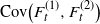 $\textrm{Cov}\big(F_t^{(1)}, F_t^{(2)}\big)$
is given by
$\textrm{Cov}\big(F_t^{(1)}, F_t^{(2)}\big)$
is given by
 \begin{equation*} \textrm{Cov}\big(F_t^{(1)},F_t^{(2)}\big) = \frac{\textrm{Cov}(\xi_t(W_L),\textrm{stress}(G,G_L))}{t^5r_t^{2d+2}} = \frac{1}{2}c_d\int_W S_{W,L}^{(1)}(v)\,\textrm{d}v + \mathcal{O}_t(r_t). \end{equation*}
It follows from Proposition 1 that $\mathsf{d}_3(F_t,Z_{\Sigma}) \leq \mathcal{O}(r_t) + \mathcal{O}(t^{-1}) + \mathcal{O}(t^{-1/2}) = \mathcal{O}(r_t)$
as t tends to infinity.
$\mathsf{d}_3(F_t,Z_{\Sigma}) \leq \mathcal{O}(r_t) + \mathcal{O}(t^{-1}) + \mathcal{O}(t^{-1/2}) = \mathcal{O}(r_t)$
as t tends to infinity.
The proofs of Lemmas 8 and 9 mostly follow the same steps as in the derivations of these quantities in [Reference Chimani, Döring and Reitzner5]. We first summarize the bounds they derived, before using them in our proofs, sticking to the notation from [Reference Chimani, Döring and Reitzner5] as much as possible.
B.1. Bounds from [Reference Chimani, Döring and Reitzner5]
For a convex body K and a two-dimensional plane in $\mathbb{R}^d$
, the following integral is defined in [Reference Chimani, Döring and Reitzner5, Lemma 8]:
$\mathbb{R}^d$
, the following integral is defined in [Reference Chimani, Döring and Reitzner5, Lemma 8]:
 \begin{equation*} J_L^{(1)}(K) \, :\! = \int_{(r_t B_d) \times K \times (r_t B_d)}\mathbf{1}([0,x]|_L \cap (y+[0,z])|_L\neq \emptyset)\, \textrm{d}z\,\textrm{d}y\,\textrm{d}x.\end{equation*}
Defining $c_d$
as in Lemma 1, the proof of [Reference Chimani, Döring and Reitzner5, Lemma 8] contains the following inequalities:
$c_d$
as in Lemma 1, the proof of [Reference Chimani, Döring and Reitzner5, Lemma 8] contains the following inequalities:
 \begin{multline*} c_dr_t^{2d+2}\mathbf{1}(2r_t B_2\subset K |_L)\inf_{u\in r_t B_d} \lambda_{d-2}((u+L^{\perp})\cap K) \\ \leq J_L^{(1)}(K) \leq c_dr_t^{2d+2}\sup\nolimits_{u\in r_t B_d} \lambda_{d-2}((u+L^{\perp})\cap K).\end{multline*}
The following integral is also defined in [Reference Chimani, Döring and Reitzner5] for points $v\in W$
:
$v\in W$
:
 \begin{equation*} I_{W,L}^{(1)}(v) \, :\! = \int_{W_3}\mathbf{1}\big([v,v_2]_L\cap[v_3,v_4]_L\neq\emptyset,\, \|v-v_2\|\leq r_t,\, \|v_3-v_4\|\leq r_t\big)\, \textrm{d}v_2\,\textrm{d}v_3\,\textrm{d}v_4.\end{equation*}
By the proof of [Reference Chimani, Döring and Reitzner5, Proposition 9], $J_L^{(1)}(W_{-r_t}-v) \leq I_{W,L}^{(1)}(v) \leq J_L^{(1)}(W-v)$
. The following integral is an analogue of
$J_L^{(1)}(W_{-r_t}-v) \leq I_{W,L}^{(1)}(v) \leq J_L^{(1)}(W-v)$
. The following integral is an analogue of $J_L^{(1)}(K)$
needed to calculate the variance of the crossing number:
$J_L^{(1)}(K)$
needed to calculate the variance of the crossing number:
 \begin{align*} J_L^{(2)}(K) \, :\! = \int_{(r_t B_d)\times K^2\times(r_t B_d)^2} & \mathbf{1}([0,x]|_L \cap (y_1+[0,z_1])|_L\neq \emptyset) \\ & \times \mathbf{1}\big([0,x]|_L \cap (y_2+[0,z_2])|_L\neq \emptyset\big)\, \textrm{d}z_1\,\textrm{d}z_2\,\textrm{d}y_1\,\textrm{d}y_2\,\textrm{d}x.\end{align*}
Defining $c_d' = \pi \kappa_{d-2}^3 \mathbf{B}(3,d/2)^2\mathbf{B}(4,d/2)$
, it is shown in the proof of [Reference Chimani, Döring and Reitzner5, Lemma 10] that
$c_d' = \pi \kappa_{d-2}^3 \mathbf{B}(3,d/2)^2\mathbf{B}(4,d/2)$
, it is shown in the proof of [Reference Chimani, Döring and Reitzner5, Lemma 10] that
 \begin{multline*} c_d'r_t^{3d+4}\mathbf{1}(2r_t B_2 \subset K|_L)\Big(\inf_{u\in r_t B_d} \lambda_{d-2}((u+L^{\perp})\cap K)\Big)^2 \\ \leq J_L^{(2)}(K) \leq c_d'r_t^{3d+4}\big(\sup\nolimits_{u\in r_t B_d} \lambda_{d-2}((u+L^{\perp})\cap K)\big)^2.\end{multline*}
Letting $v\in W$
again, the following integral is defined in [Reference Chimani, Döring and Reitzner5, Proposition 11]:
$v\in W$
again, the following integral is defined in [Reference Chimani, Döring and Reitzner5, Proposition 11]:
 \begin{align*} I_{W,L}^{(2)}(v) = \int_{W_5} & \mathbf{1}\big([v,v_2]_L\cap[v_3,v_4]_L \neq \emptyset,\, \|v-v_2\|\leq r_t,\, \|v_3-v_4\|\leq r_t\big) \\ & \times \mathbf{1}\big([v,v_2]_L\cap[w_3,w_4]_L \neq \emptyset,\, \|w_3-w_4\|\leq r_t\big)\, \textrm{d}v_2\,\textrm{d}v_3\,\textrm{d}v_4\,\textrm{d}w_3\,\textrm{d}w_4.\end{align*}
In the proof of the same proposition, it is derived that $J_L^{(2)}(W_{-r_t}-v) \leq I_{W,L}^{(2)}(v) \leq J_L^{(2)} (W-v)$
.
$J_L^{(2)}(W_{-r_t}-v) \leq I_{W,L}^{(2)}(v) \leq J_L^{(2)} (W-v)$
.
B.2. Proofs of the lemmas
Proof of Lemma 8. We closely follow the proof of [Reference Chimani, Döring and Reitzner5, Theorem 13], in which the variance is given by
 \begin{align} \mathbb{V}\,\xi_t(L) & = \frac{1}{4}t^7\int_WI_{W,L}^{(1)}(v)^2\,\textrm{d}v + \frac{1}{8}t^6\int_WI_{W,L}^{(2)}(v)\,\textrm{d}v \nonumber \\ & \quad + \mathcal{O}_t(t^6r_t^{4d+2}) + \mathcal{O}_t(t^5r_t^{3d+2}) + \mathcal{O}_t(t^4r_t^{2d+2}). \end{align}
Let $v\in W_{-3r_t}$
. Then we use the bounds prepared by [Reference Chimani, Döring and Reitzner5] to bound
$v\in W_{-3r_t}$
. Then we use the bounds prepared by [Reference Chimani, Döring and Reitzner5] to bound $I_{W,L}^{(1)}(v)$
from below:
$I_{W,L}^{(1)}(v)$
from below:
 \begin{equation*} I_{W,L}^{(1)}(v) \geq J_L^{(1)}(W_{-r_t}-v) \geq c_d r_t^{2d+2}\inf_{u\in r_t B_d}\lambda_{d-2}((u+L^{\perp})\cap (W_{-r_t}-v)) = c_d r_t^{2d+2} (1-2r_t)^{d-2}, \end{equation*}
where $(1-2r_t)^{d-2}$
is the volume of a
$(1-2r_t)^{d-2}$
is the volume of a $(d-2)$
-dimensional cube with edge length
$(d-2)$
-dimensional cube with edge length $1-2r_t$
. For
$1-2r_t$
. For $v\in W\setminus W_{-3r_t}$
, a trivial lower bound for
$v\in W\setminus W_{-3r_t}$
, a trivial lower bound for $I_{W,L}^{(1)}(v)$
is zero. A similar derivation for the upper bound yields, for all
$I_{W,L}^{(1)}(v)$
is zero. A similar derivation for the upper bound yields, for all $v\in W$
,
$v\in W$
,
 \begin{equation*} I_{W,L}^{(1)}(v) \leq J_L^{(1)}(W-v) \leq c_dr_t^{2d+2}\sup\nolimits_{u\in r_t B_d}\lambda_{d-2}((u+L^{\perp})\cap (W-v)) = c_dr_t^{2d+2}. \end{equation*}
It follows that
 \begin{align*} \frac{1}{4}t^7\int_WI_{W,L}^{(1)}(v)^2\,\textrm{d} v & = \frac{1}{4}t^7\bigg(\int_{W_{-3r_t}}I_{W,L}^{(1)}(v)^2 \,\textrm{d}v + \int_{W\setminus W_{-3r_t}}I_{W,L}^{(1)}(v)^2\,\textrm{d}v\bigg) \\ & = \frac{1}{4}t^7\big(c_d^2r_t^{4d+4}(1+\mathcal{O}_t(r_t)) + c_d^2r_t^{4d+4}\cdot \mathcal{O}_t(r_t)\big) \\ & = \frac{1}{4} t^7r_t^{4d+4}c_d^2(1+\mathcal{O}_t(r_t)). \end{align*}
For the second integral in the variance, we can also use the bounds from [Reference Chimani, Döring and Reitzner5]. Let $v\in W_{-3r_t}$
, then
$v\in W_{-3r_t}$
, then
 \begin{align*} I_{W,L}^{(2)}(v) \geq J_L^{(2)}(W_{-r_t}-v) & \geq c_d'r_t^{3d+4}\Big(\inf_{u\in r_t B_d} \lambda_{d-2}((u+L^{\perp})\cap (W_{-r_t}-v))\Big)^2 \\ & = c_d' r_t^{3d+4} (1-2r_t)^{2(d-2)}. \end{align*}
Zero is again a trivial lower bound for the case where $v\in W\setminus W_{-3r_t}$
. For the upper bound, we again let
$v\in W\setminus W_{-3r_t}$
. For the upper bound, we again let $v\in W$
and derive
$v\in W$
and derive
 \begin{equation*} I_{W,L}^{(2)}(v) \leq J_L^{(2)}(W-v) \leq c_d'r_t^{3d+4}\big(\sup\nolimits_{u\in r_t B_d} \lambda_{d-2}((u+L^{\perp})\cap (W-v))\big)^2 = c_d' r_t^{3d+4}. \end{equation*}
Then,
 \begin{align*} \frac{1}{8} t^6 \int_W I_{W,L}^{(2)}(v)\,\textrm{d}v & = \frac{1}{8} t^6 \bigg(\int_{W_{-3r_t}} I_{W,L}^{(2)}(v)\,\textrm{d}v + \int_{W\setminus W_{-3r_t}} I_{W,L}^{(2)}(v)\,\textrm{d}v\bigg) \\ & = \frac{1}{8}t^6\big(c_d'r_t^{3d+4}(1+\mathcal{O}_t(r_t)) + c_d' r_t^{3d+4} \cdot (r_t)\big) \\ & = \frac{1}{8} t^6 c_d' r_t^{3d+4}(1+\mathcal{O}_t(r_t)). \end{align*}
We can plug the expressions we obtained for the integrals into (10) to see that
 \begin{equation*} \mathbb{V}\,\xi_t(L) = \frac{1}{8} t^7 r_t^{4d+4}\big(2 c_d^2 + c_d' t^{-1}r_t^{-d}\big)(1+\mathcal{O}_t(r_t)). \end{equation*}
Setting $tr_t^d = c$
leads to (8).
$tr_t^d = c$
leads to (8).
Proof of Lemma 9. By the proof of [Reference Chimani, Döring and Reitzner5, Theorem 23], the covariance is given by
 \begin{equation*} \textrm{Cov}(\xi_t(W_L),\textrm{stress}(G,G_L)) = \frac{1}{2}t^5\int_WI_{W,L}^{(1)}(v)S_{W,L}^{(1)}(v)\,\textrm{d}v + \mathcal{O}_t(t^4r_t^{2d+2}). \end{equation*}
Using our bounds on $I_{W,L}^{(1)}$
, we can write
$I_{W,L}^{(1)}$
, we can write
 \begin{align*} \textrm{Cov}(\xi_t(W_L),\textrm{stress}(G,G_L)) & \geq \frac{1}{2}c_d t^5 r_t^{2d+2} \\ & \quad \times \int_{W}\Big(\inf_{u\in r_tB_d}\lambda_{d-2}((u+L^{\perp})\cap(W_{-r_t}-v))\Big) S_{W,L}(v)\,\textrm{d}v \\ & \geq \frac{1}{2}c_d t^5 r_t^{2d+2}(1-2r_t)^{d-2} \int_{W_{-r_t}}S_{W,L}(v)\,\textrm{d}v \end{align*}
and
 \begin{align*} \textrm{Cov}(\xi_t(W_L),\textrm{stress}(G,G_L)) & \leq \frac{1}{2}c_d t^5 r_t^{2d+2} \\ & \quad \times \int_{W} \big(\sup\nolimits_{u\in 2r_t B_d} \lambda_{d-2}((u+L^{\perp})\cap (W-v))\big) S_{W,L}(v)\,\textrm{d}v \\ & = \frac{1}{2}c_d t^5 r_t^{2d+2} \int_{W}S_{W,L}(v)\,\textrm{d}v. \end{align*}
As in the proof of Lemma 8, we can look at the difference between the upper and lower bounds and use that $S_{W,L}(v) \leq s$
for all
$S_{W,L}(v) \leq s$
for all $v\in W$
to obtain (9).
$v\in W$
to obtain (9).
Remark 3. From this proof, we can also obtain a univariate central limit theorem for the crossings: $\mathsf{d}_3\big(F_t^{(1)}, Z_{\sigma_{11}}\big) = \mathcal{O}_t(r_t)$
, where
$\mathsf{d}_3\big(F_t^{(1)}, Z_{\sigma_{11}}\big) = \mathcal{O}_t(r_t)$
, where $Z_{\sigma{11}}\sim \mathcal{N}(0,\sigma_{11})$
.
$Z_{\sigma{11}}\sim \mathcal{N}(0,\sigma_{11})$
.
B.3. Remarks on the rate of convergence
The proofs in Appendix B show how to calculate the entries of the covariance matrix when W is a cube. It might be possible to derive an order of convergence for a broader class of windows in a similar way to the proof of Lemma 4, but this is significantly more complicated.
The rate of convergence for a cube $W = [0,1]^d$
is of order
$W = [0,1]^d$
is of order $r_t$
because of boundary effects for the crossings. Because of these boundary effects, we expect the variance of the crossings and the covariance to be the dominating terms in the upper bound of
$r_t$
because of boundary effects for the crossings. Because of these boundary effects, we expect the variance of the crossings and the covariance to be the dominating terms in the upper bound of $\mathsf{d}_3(F_t, Z_\Sigma)$
for other choices of W too.
$\mathsf{d}_3(F_t, Z_\Sigma)$
for other choices of W too.
Acknowledgements
We wish to thank the referees for their thorough reading and helpful comments, which greatly improved the arguments presented in this paper.
Funding information
Funded by the Deutsche Forschungsgemeinschaft (DFG, German Research Foundation) – Project-ID 531542011.
Competing interests
There were no competing interests to declare which arose during the preparation or publication process of this article.

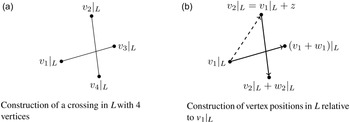
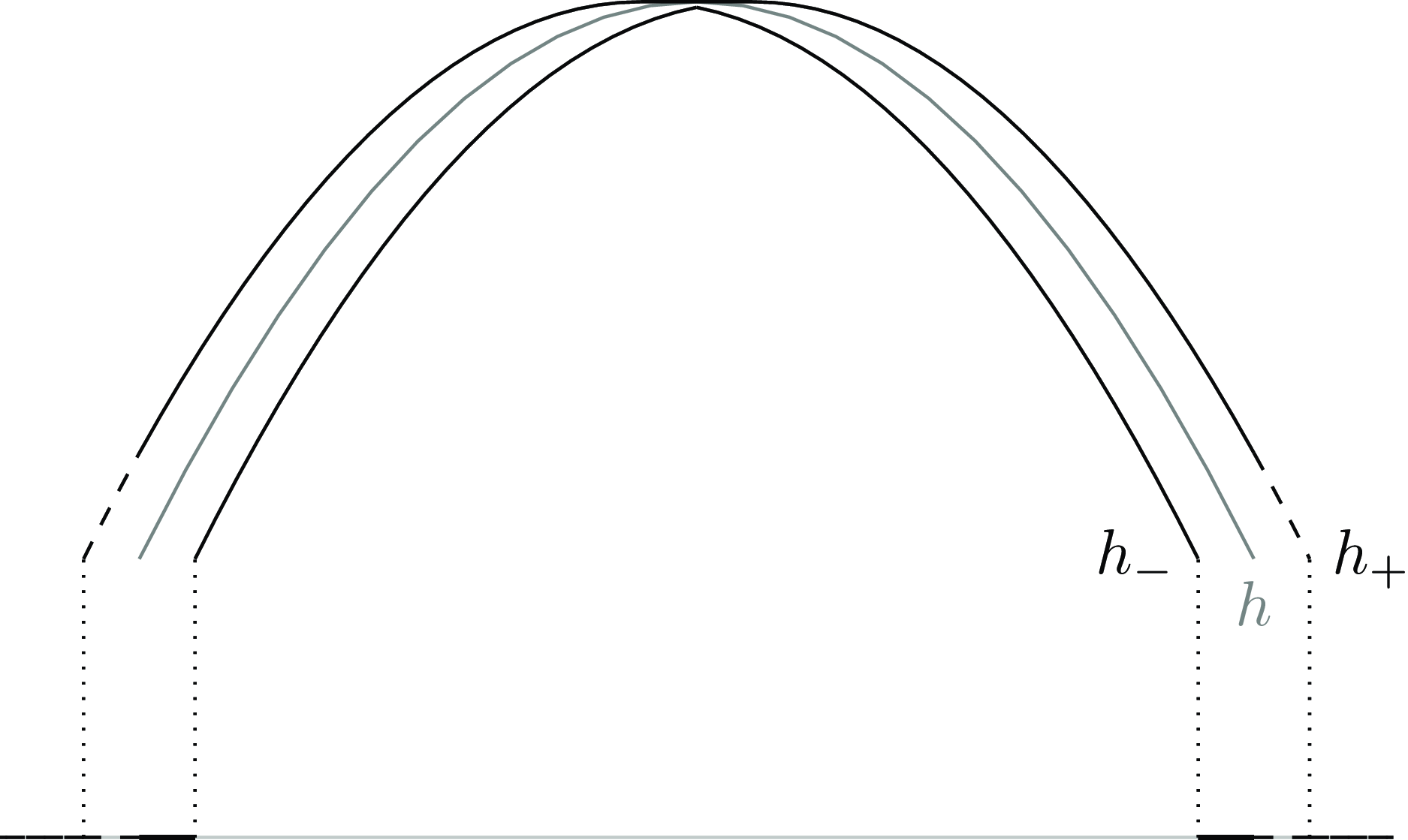


 Open access

