


CVD, including stroke and CHD, are the leading cause of morbidity and mortality in the Western world. An elevated blood cholesterol concentration is one of the principal risk factors for CHD(1). Diet plays a key role in modulating blood cholesterol concentrations. In the last decade, particular attention has been paid to the role of phytosterols, phytosterol esters, phytostanols and/or phytostanol esters; in the present paper, these are referred to by the term ‘plant sterols’. A plant sterol intake from 1 to 3 g/d can significantly reduce the LDL-cholesterol level. The intake of naturally occurring plant sterols is in general much lower than 1–3 g/d. Enriched food products must be consumed to reach an intake level of 1–3 g/d, though these enriched products are not appropriate for pregnant and breast-feeding women and children under the age of 5 years. On the other hand, an intake above 3 g/d has no additional effect(Reference Ostlund2, Reference Caswell, Denny and Lunn3). In contrast, consumption of high doses of plant sterols can reduce the carotenoid levels in blood, with β-carotene being the most important carotenoid, which is converted in the body to vitamin A(Reference Katan, Grundy and Jones4). Therefore, the European Food Safety Authority has reported that intakes of plant sterols should not exceed 3 g/d(5). So far, no data have been available about the intake of plant sterols (naturally occurring or added to novel foods) for the Belgian population, neither for the intake of β-carotene. Therefore, the Belgian PHYTOST-project (enrolled between June 2008 and May 2009) aimed at:
(1) calculating the intake of plant sterols naturally occurring in foods and, additionally, calculating and evaluating the intake of β-carotene.
(2) collecting data about the consumption of foods enriched with plant sterols and evaluating plant sterol intake via these enriched foods both for the current consumption pattern and for specific consumption scenarios.
Both objectives were together needed for a good risk assessment study. The project focused on two different subgroups of the Belgian population: pre-school children and adults. The results of the project are described in two different papers, since the methodology and the data used and collected for the two objectives of the project are very different. The results of the first objective are described in the present paper. The results of the second objective are described in Sioen et al. (published in this issue). The present paper focuses on the intake of naturally occurring plant sterols and β-carotene via the overall diet of both pre-school children and adults. Although plant sterol intakes of 1–3 g/d are needed for a significant reduction in LDL-cholesterol, recent research indicated that the consumption of naturally occurring plant sterols present in food from vegetable origin can help to reduce the LDL-cholesterol levels(Reference Ostlund2–5). The current available intake data of naturally occurring plant sterols in Europe are based on rather old food consumption data (collected between 1986 and 2000(Reference Valsta, Lemstrom and Ovaskainen6–Reference Normén, Brants and Voorrips10)), and no data are yet available for the Belgian population. The present paper presents the intake data of plant sterols based on Belgian consumption data collected in 2004, for the adult population. Moreover, to the best of our knowledge, the present paper is the first study to present the intake data of naturally occurring plant sterols among pre-school children.
Materials and methods
Food consumption data
Two different Belgian food consumption databases were used in the present project: (1) one with consumption data of pre-school children (2·5–6·5 years old) and (2) one with consumption data of adults ( ≥ 15 years old). The pre-school children database contains food consumption data collected between October 2002 and February 2003. The present project was the first in collecting the food consumption data for a representative group of pre-school children living in Flanders (the northern, Dutch-speaking part of Belgium). The database contains food consumption data of 661 pre-school children, collected using a consecutive, parentally reported 3 d estimated dietary record. More details about the methodology and the population characteristics are described by Huybrechts & De Henauw(Reference Huybrechts and De Henauw11).
The second food consumption database used was the Belgian national food consumption survey. During this survey, food consumption data were collected for a representative sample of the Belgian adult population from 15 years old onwards (minimum, median and maximum age: 15, 57 and 98 years, respectively). The food consumption data were collected during the year 2004 by means of a repeated (two times) non-consecutive 24 h recall. The 24 h recall was carried out using the EPIC-SOFT program (IARC, Lyon, France)(Reference Slimani and Valsta12). Complete data were available for 3083 adults, 1523 women and 1538 men (for twenty-two adults, the sex was unknown). The Belgian national food consumption survey was approved by the Ethical Committee of the Scientific Institute of Public Health (Brussels, Belgium). More details about the methodology and the population characteristics of the Belgian food consumption survey are described by De Vriese et al. (Reference De Vriese, De Backer and De Henauw13).
Content of naturally occurring plant sterols and β-carotene
A database containing the plant sterol and β-carotene content in all relevant food items of both food consumption databases needed to be developed, since these nutrients were not included in the Belgian food composition database. The food consumption databases contained 872 and 2511 different food items, respectively, for pre-school children and adults. The concentration database was developed on the basis of different international food composition tables as well as with data available from the scientific literature. To collect data on the content of plant sterols, the Finnish(14) (a contribution of 90·3 % to the total database) and the US(15) (a contribution of 4·4 % to the total database) food composition tables, as well as an international scientific paper (a contribution of 5·3 % to the total database) were used(Reference Normén, Ellegard and Brants16). For β-carotene, the US(15) (a contribution of 81·3 % to the total database), the Dutch(17) (a contribution of 18·4 % to the total database) and the German(18) (a contribution of 0·3 % to the total database) food composition tables were used. The order of priority of the databases was based on the completeness of the data for the different nutrients considered in the present paper.
A stepwise approach was developed to identify the plant sterol content of the consumed food items in both surveys. In the first step, all food items of pure animal origin (without addition of other ingredients) were set to zero. Next, the content for all the remaining individual food items were retrieved and entered in the database. For the composed dishes that were not found in one of the data sources, standard Belgian recipes or the information in the ingredient list on the packages were used to convert the dishes to their ingredients to calculate their plant sterol content. In cases where no data for the particular food item could be found, the content of a similar food was applied (e.g. raw instead of cooked, non-sugared instead of sugared). For both food lists, only about 8 % of the food items had a plant sterol content equal to zero, whereas for β-carotene, this was 38 % in the food list of pre-school children and 48 % in the food list of adults. The developed food composition database is available on request.
Calculations
In the database of pre-school children, it was found that twenty of the 661 children (3 %) consumed plant sterol-enriched margarines during one or more of the three survey days. In the database of the Belgian food consumption survey (adult population), it was found that 8·8 % of the adults consumed plant sterol-enriched margarines and 0·4 % of the adults consumed plant sterol-enriched yogurt drinks. As the goal was to calculate the intake and food sources of naturally occurring plant sterols, these products were excluded from the database and not replaced. The other food items consumed by these individuals remained.
All food items were categorised into ten food groups: added fats; bread and other cereal products (breakfast cereals, pasta and rice); composed dishes with meat, fish or eggs; condiments and sauces; confectionery, chocolate and other sweet products, and desserts; fruits; potatoes; soups; vegetables and legumes; other foods (beverages, dairy products, etc.). These groups were based on the publication of Klingberg et al. (Reference Klingberg, Andersson and Mulligan7), describing food sources of plant sterols in the European Investigation into Cancer and Nutrition Norfolk population.
To evaluate the intake of β-carotene, some assumptions were made because no separate recommendation exists for this nutrient. The Belgian Health Council recommends a daily intake of 400, 450, 500 and 600 μg vitamin A expressed in retinol equivalents, respectively, for children between 1 and 3 years old, children between 4 and 6 years old, adult women and adult men(19). Given that 1 μg vitamin A expressed in retinol equivalents is equal to 6 μg β-carotene(19), this means that if all vitamin A would be consumed as β-carotene – which is not the case in a common situation – then 1–3-year-old children, 4–6-year-old children, women and men would need 2400, 2700, 3000 and 3600 μg β-carotene/d, respectively.
Statistical analyses
In order to evaluate the usual intake based on the calculated intake of plant sterols and β-carotene by means of a 3 d estimated dietary record for pre-school children and a repeated 24 h recall on two non-consecutive days for adults, the technique developed by Nusser(Reference Nusser, Carriquiry and Dodd20) was applied. This is a statistical method developed at the Iowa State University that estimates the usual intake distribution of a population by accounting for intra-individual variation in nutrient intakes, while requiring relatively few days of intake per individual(Reference Nusser, Carriquiry and Dodd20). C-side software(21) was used to correct the calculated intakes for intra-individual variation. Unfortunately, this method could not be applied to the intake data of plant sterols of adults due to a very skewed distribution; therefore, these intake data are not corrected for intra-individual variation.
For both plant sterols and β-carotene, the energy-adjusted intake was calculated, leading to a ‘plant sterol density’ and ‘β-carotene density’, expressed as mg/MJ. Additionally, the percentages of plant sterols and β-carotene provided by the different food items were calculated. These percentages were calculated as population proportions, as defined by Krebs-Smith et al. (Reference Krebs-Smith, Kott and Guenther22). The population proportion is calculated by summing the amount of plant sterols/β-carotene from a certain food item for all individuals and then dividing that by the sum of plant sterols/β-carotene from all food items for all individuals.
Statistical analyses were performed using SPSS for Windows software program (version 15.0; SPSS Inc., Cary, NC, USA). Normality of continuous variables was tested using a Kolmogorov–Smirnov test (P < 0·01). To investigate correlations between two continuous variables, of which at least one was not normally distributed, Spearman's correlations were used (P < 0·01). To determine significant differences between two groups for a normal, continuous variable, an independent sample t test was used (P < 0·05). To determine significant differences between two groups for a non-normal, continuous variable, the Mann–Whitney U test was used (P < 0·05). The statistical tests were performed on the intake data before correction for intra-individual variation.
Ethical approval for this project was granted by the Ethical Committee of the Ghent University Hospital.
Results
The intake of naturally occurring plant sterols and β-carotene for Flemish pre-school children between 2·5 and 6·5 years old was calculated and found to be not normally distributed. The results in Table 1 express the ‘usual’ intake of both compounds, after adjustment with C-side. The intake of naturally occurring plant sterols was significantly different (P = 0·011) between boys (n 338) and girls (n 323); therefore, the results are shown by sex. This was not the case for the intake of β-carotene (P = 0·093). No significant correlation was found between the intake of naturally occurring plant sterols and β-carotene for pre-school children. On the other hand, the intake of plant sterols was positively correlated (r 0·138; P < 0·001) with the age of pre-school children, but this was not the case for the intake of β-carotene. The intake of both plant sterols and β-carotene was significantly correlated with energy intake (for both compounds, P < 0·001). Therefore, the energy-adjusted intakes of plant sterols and β-carotene were calculated. The mean plant sterol and β-carotene density for pre-school children was 29·8 and 334 mg/MJ, respectively. For both compounds, the energy-adjusted intakes were not significantly different between the sexes, but they were significantly correlated with each other (r 0·115; P = 0·003).
(Mean values, standard deviations and percentiles)
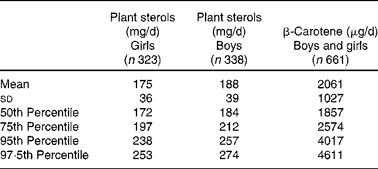
* 2·5–6·2 years old.
The intake of naturally occurring plant sterols and β-carotene for Belgian adults ( ≥ 15 years old) was calculated. As for the intakes of pre-school children, the intake data of both compounds (before accounting for intra-individual variation) were not normally distributed. Table 2 shows the intake results for Belgian adults. For β-carotene, it was possible to calculate the ‘usual’ intake using C-side (as shown in the table). In contrast, the intake data of plant sterols for adults were not corrected for intra-individual variation due to a very skewed distribution. The intake of plant sterols was significantly different between men and women (P < 0·001) and therefore shown separately. This was not the case for β-carotene (P = 0·376). A positive correlation was found between the intake of naturally occurring plant sterols and β-carotene (r 0·217; P < 0·001). On the other hand, the intake of plant sterols was negatively correlated with BMI (r − 0·084; P < 0·001) and age (r − 0·071; P < 0·001) of adults, but this was not the case for the intake of β-carotene.
(Mean values, standard deviations and percentiles)
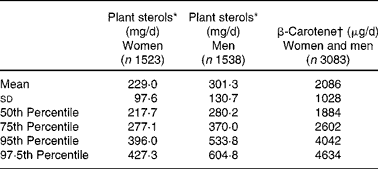
* For plant sterols, the intakes could not be corrected for intra-individual variation due to a very skewed distribution of the data.
† For β-carotene, the ‘usual’ intake is shown, after accounting for intra-individual variation with C-side.
For pre-school children, also for adults, the intake of both plant sterols and β-carotene was significantly correlated with energy intake (for both compounds, P < 0·001). Therefore, the plant sterol and β-carotene density was calculated. Both energy-adjusted intakes were not normally distributed and were significantly correlated with each other (r 0·157; P < 0·001) and were significantly different between men and women (P < 0·001). The mean plant sterol density was 30·9 and 32·5 mg/MJ, respectively, for men and women. This plant sterol density was not significantly correlated with either age or BMI. The mean β-carotene density was 262 and 347 mg/MJ, respectively, for men and women. This β-carotene density was significantly correlated with age (r 0·105; P < 0·001) but not with BMI.
In contrast with the data for pre-school children, the adult consumption database (i.e. the Belgian national food consumption survey of 2004) contains data for adults living in the Flemish as well as in the Walloon region. It was found that the plant sterol and β-carotene intake as well as the plant sterol and β-carotene density was significantly different between the two regions. Table 3 shows the results by sex and by region.
(Mean values and standard deviations)
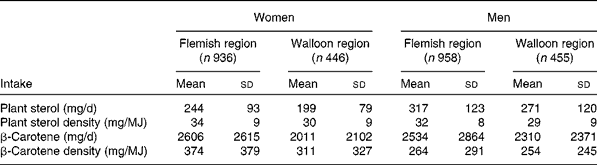
Fig. 1 illustrates the food sources of naturally occurring plant sterols for pre-school children and adults. The group of bread and other cereal products is the major contributor for both population subgroups. For adults, the second important group is added fats; for pre-school children, this is biscuits and cakes. For β-carotene, the food sources are less diverse. The groups of vegetables and legumes supply 66·7 and 58·3 % for β-carotene intake, respectively, for pre-school children and adults. Together with the group soups, these two groups provide up to three quarters of the total β-carotene intake.
Food sources of naturally occurring plant sterols for pre-school children and adults in Belgium.  , Pre-school children;
  , adults.

Discussion
The present study describes the results for the first objective of the Belgian PHYTOST-project, i.e. to calculate the intake and food sources of naturally occurring plant sterols and β-carotene for the Belgian population. Data on the intake and food sources of these compounds are not yet available for the Belgian population. The lack of plant sterol intake data could be explained by a lack of information in the commonly used food composition databases. Due to this missing information, it was decided to build up a new database based on published data about the plant sterol and β-carotene content in foods. The compilation of such a secondary database includes, however, certain limitations. First, of all, different analytical procedures to determine the plant sterol and β-carotene content can be used by different authors, which influence the results. Next, the content of plant sterols is in fact the sum of the content of different individual compounds, among others, namely sitosterols, campesterol, stigmasterol and brassicasterol. Additionally, these compounds can be present in different forms, e.g. NEFA or esterified with fatty acids(Reference Ostlund2). This complexity increases the possibility that methodological differences exist behind the plant sterol content reported in the different data sources used(Reference Normén, Ellegard and Brants16).
In the study described in the present paper, it was decided to exclude food items enriched with plant sterols since it was the goal to calculate the intake and food sources of naturally occurring plant sterols. This resulted in the exclusion of (1) plant sterol-enriched spreads of twenty of the 661 pre-school children and 271 of the 3083 adults and (2) plant sterol-enriched yogurt drinks of twelve of the 3083 adults. This exclusion of food items will result in a reduction in the overall energy intake of the considered persons; however, this is not of great relevance in the present paper. Nevertheless, it will also have a small underestimating effect on the overall intake of plant sterols since the non-enriched spread would also contribute to a limited amount to their overall intake of naturally occurring plant sterols.
Besides, it is known that consumers tend to underestimate their consumption of products such as margarine(Reference Lafay, Mennen and Basdevant23). When this was the case in the food consumption databases used in the present study, this will have an underestimating effect on the overall intake of plant sterols. On the other hand, the consumption of other foods – e.g. fruits and vegetables – is possibly overestimated. The reason for this is that subjects tend to report their intake in a socially desirable way, by eating or reporting less frequently foods considered unhealthful or fattening, such as sweets and fried foods, and more frequently socially desirable food items(Reference Johansson, Wikman and Ahren24).
Another limitation is that there were no representative consumption data available for the overall Belgian population. In the present study, two recent databases collected after 2000 were used. The first one, with data for pre-school children, is, however, limited to Flanders (the northern Dutch-speaking part of Belgium), in which about 60 % of the Belgian population lives. The second database is fully representative for Belgium but starts only from the age of 15 years old onwards. So data for consumers between 6·5 and 15 years old were lacking. In 2011, a national food consumption survey focusing on children (3–15 years old) is planned to fill this data gap. Nevertheless, it was possible to describe the results for adults separately in the Flemish and Walloon regions. These detailed results show that for both sexes, the intake and density of plant sterols and β-carotene are higher in the Flemish region compared with the Walloon region. A potential explanation for the higher plant sterol intake in the Flemish region is the higher consumption of bread and cereals (145·7 g/d in Flanders v. 114·2 g/d in the Walloon region), knowing that the group of bread and other cereal products is the major contributor to the plant sterol intake(25). The higher β-carotene intake in Flanders can be explained by the higher vegetable consumption in Flanders (145·2 g/d) compared with the Walloon region (128·0 g/d). When comparing the Flemish pre-school children with the Flemish adults, a higher plant sterol density is found for adults (32·9 mg/MJ) compared with pre-school children (29·8 mg/MJ). The opposite was found for β-carotene intake: 318 mg/MJ for the Flemish adults compared with 334 mg/MJ for the Flemish pre-school children.
Moreover, it must be reported that both the consumption databases used in the present study are collected by a different methodology. The database of pre-school children was collected by a consecutive, parentally reported 3 d estimated dietary record, whereas the database of adults was collected by means of a repeated (two times) non-consecutive 24 h recall. It is also worth noting that – as with any dietary assessment methodology – dietary records and 24 h recalls are prone to a degree of misreporting, which may have influenced the results of the present study. A 3 d estimated dietary record as well as a repeated 24 h recall does not necessarily reflect the usual intake of an individual. However, a statistical modelling method (the Nusser method) that accounts for intra-individual variability was used in order to calculate usual intakes. Unfortunately, it was impossible to correct for seasonal variations in pre-school-aged children, because our fieldwork for pre-school children was conducted only during autumn and wintertime. No data were found about potential seasonal influences on nutrient intakes in this population group in Belgium. However, from the Belgian national food consumption survey of 2004, it could be concluded that seasonal variations were only limited for nutrient intakes in our Belgian population of at least 15 years old(Reference De Vriese, De Backer and De Henauw13). These low seasonal variations in our Belgian population could be due to the widespread availability of most foods all year round.
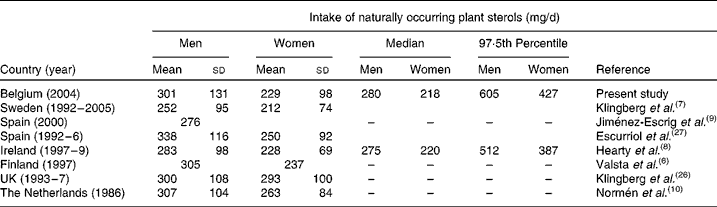
The plant sterol intake data of pre-school children could not be compared with other European intake data, since these were not available for this young population subgroup. In contrast, in Table 4, the Belgian intake data for adults are compared with the intake of naturally occurring plant sterols in other European countries(Reference Valsta, Lemstrom and Ovaskainen6–Reference Normén, Brants and Voorrips10, Reference Klingberg, Ellegard and Johansson26, Reference Escurriol, Mari-Dell'Olmo and Rohlfs27). Compared with the Belgian and Swedish results, the other available data are based on consumption data that are rather old (1986 up to 2000). Moreover, the consumption data are collected by different nutritional assessment methods. The plant sterol intake of Belgian women is very similar to those of Swedish, Irish and Finnish women, while in Spain, the UK and The Netherlands higher intakes were found. For men, the lowest intakes were found in Sweden, and the highest were in Spain. In other countries, the differences were small, with an intake about 300 mg/d. When comparing the plant sterol density, the Belgian densities are higher than the Swedish densities reported by Klinberg et al., i.e. 32·5 v. 31·6 mg/MJ and 30·9 v. 28·8 mg/MJ, respectively, for Belgian v. Swedish women and men. In the present study, it was found that the group of bread and other cereal products is the major contributor to the intake of naturally occurring plant sterols, followed by added fats. This is in accordance with the findings of other studies(Reference Valsta, Lemstrom and Ovaskainen6–Reference Hearty, Duffy and Gibney8, Reference Escurriol, Mari-Dell'Olmo and Rohlfs27).
(Mean values, standard deviations, medians and percentiles)
When evaluating the β-carotene intake using the calculated recommended values (see section ‘Materials and methods’), it seems that the Flemish pre-school children have on average an intake of β-carotene about three quarters of the recommended daily intake of total vitamin A (when converted to μg carotenoids), being 2061 μg/d as a mean value and 1857 μg/d as a median value. For the adults, a mean and median β-carotene intake of 2086 and 1884 μg/d was found, which is more than half of the recommended daily intake of vitamin A. Although it is hard to evaluate this β-carotene intake, it can be assumed that this β-carotene intake is sufficient, knowing that the diet contains other carotenoids as well as preformed vitamin A. Preformed vitamin A is retinol, which is present in foods from animal origin (main food courses are red meat, fish and dairy products). In comparison, studies conducted in Germany have shown that β-carotene accounts for up to 25–30 % of vitamin A intakes(Reference Strobel, Tinz and Biesalski28). Compared with these percentages, the contribution of β-carotene intake to the recommended daily intake of vitamin A seemed to be favourable.
Conclusion
In summary, Flemish pre-school children have a median plant sterol intake of 172 and 184 mg/d, respectively, for girls and boys. Belgian women and men have a median plant sterol intake of 218 and 280 mg/d, respectively. As expected, the intake of naturally occurring plant sterols in Belgium is low and safe compared with the recommended upper limit level of 3 g/d. Bread and other cereal products account for about 25 % to the overall contribution to the intake of naturally occurring plant sterols. For both pre-school children and adults, the median β-carotene intake lies between 1800 and 1900 μg/d, with vegetables being the most important food source.
Acknowledgements
The present study (Project RT-07/3 PHYTOST) as well as the Belgian national consumption survey 2004 were funded by the Belgian Federal Public Service of Health, Food Chain Safety and Environment. The consumption survey of the Belgian pre-school children was financed by the Belgian Nutrition Information Center. C. M., J. V. C. and S. D. H. prepared the project proposal and set up the study design. C. M. organised the fieldwork. C. M. and I. S. coordinated the fieldwork. I. S. analysed the data and wrote the project report and the manuscript. I. H. was closely involved in all steps of the consumption survey of the Belgian pre-school children and the Belgian national consumption survey. All authors read the manuscript and provided detailed comments to improve the manuscript. The authors would like to thank the dietitians of the unit Nutrition and Food Safety, Department of Public Health, Ghent University, who contributed to the project in different ways: Mia Bellemans, Mieke De Maeyer, Melissa De Neve and Anja Polet. Willem De Keyser is acknowledged for his help with the C-side analyses. C. M. is affiliated with the Department of Public Health, Ghent University, as voluntary post-doctoral researcher. He is currently working for the not-for-profit organisation International Life Science Institute – Europe Branch, located in Brussels, Belgium.



