





The search for weight-management solutions amidst an expanding global obesity pandemic is an ever-present challenge for humanity. The implications for comorbidity and economic burdens are grave without critical action to prevent this public health failure from getting any worse(Reference Lobstein, Powis and Jackson-Leach1). Significant advances are being made in the pharmaceutical treatment of obesity(Reference Melson, Ashraf and Papamargaritis2), but these are not widely available and not suitable for prevention of weight gain in most people(Reference Fallows, Ells and Anand3,4) . Pharmaceutical treatments offer hope for management of obesity as a disease to prevent comorbidity and disability, but ultimately are not a solution for the societal failure to adequately address the increasing trend for gaining excess weight early in life. Although the root causes of the growing obesity epidemic are pervasive and complex, gaining a full understanding of how socioecological factors and health behaviours interact will provide a firmer theoretical footing for preventative public health interventions. As a small but significant component of this, sleep behaviours are gaining more recognition for their influence on weight management and diet quality(Reference Chaput, McHill and Cox5), with substantial evidence showing that self-reported estimates of usual sleep duration that fall short of recommended amounts (habitual short sleep duration) is associated with approximately a 40 % increased risk of obesity(Reference Chaput, Dutil and Featherstone6,Reference Bacaro, Ballesio and Cerolini7) .
Sleep is essential for normal physical, mental and social functioning. Adults should aim to sleep for 7–9 h every night(Reference Hirshkowitz, Whiton and Albert8). Inadequate sleep increases the risk of mortality by 13 % and costs the UK economy an estimated £50 billion per year(Reference Hafner, Stepanek and Taylor9). Sleep is a keystone modifiable factor in optimising a healthy lifespan. Healthy sleep habits support adherence to other fundamental building blocks of health such as a balanced, nutritious diet and regular physical activity, yet sleep behaviours have historically been undervalued as an essential target in lifestyle interventions for weight management. Sufficient good quality sleep is crucial for mental health, repairing damage, immunological responses to infection, cognitive development, physical growth and brain function(Reference Baranwal, Yu and Siegel10).
Parameters of healthy sleep behaviour and function fall under the domains of sleep duration, sleep quality, sleep timing and sleep regularity. Sleep duration in free-living study populations can be self-reported (for example, through sleep diaries or questionnaires that ask for the time of going to sleep and waking up) or objectively measured (most commonly using wearable actigraphy devices) as time in bed, sleep duration (sleep onset until final wake onset) or actual sleep duration (the same as sleep duration but discounting periods of being awake). Sleep quality can also be evaluated using actigraphy, routinely generating scores for the following: sleep latency, the time between ‘lights out’ and ‘fell asleep’; sleep efficiency, expressed as sleep duration as a percentage of time in bed; sleep fragmentation, the number of awakenings as a proportion of sleep time; and wake after sleep onset, the duration of all wake periods between sleep onset and offset. Sleep quality is also often assessed as a global subjective score using the validated Pittsburgh Sleep Quality Index (PSQI) which ranges from 0–21 and is based on seven components including sleep quality, sleep latency, sleep duration, habitual sleep efficiency, sleep disturbances, use of sleeping medications and daytime dysfunction(Reference Buysse, Reynolds and Monk11). Finally, either by subjective or objective methods, sleep timing can be evaluated using the times of sleep onset, offset and midpoint and sleep regularity can be investigated by analysing day-to-day variability in many of the above parameters: sleep duration, awakenings, sleep onset, offset and midpoint(Reference Phillips, Clerx and O’Brien12).
Multiple parameters of good sleep function have been linked to weight management, including duration and quality of sleep and the regularity of sleep timings and durations from night-to-night or between workdays and non-workdays(Reference Patel, Hayes and Blackwell13–Reference Parsons, Moffitt and Gregory16). Importantly, the relationship between obesity and sleep function is bidirectional. Obesity may exacerbate inadequate sleep duration and sleep quality mediated through the impact of comorbidities such as obstructive sleep apnoea(Reference Kirkness, Schwartz and Schneider17), type 2 diabetes symptoms(Reference Gupta and Wang18), gastroesophageal reflux disease(Reference Tan, Wang and Wu19), musculoskeletal pain(Reference Tang, McBeth and Jordan20) and mental health problems such as depression and anxiety(Reference Araghi, Jagielski and Neira21). Accordingly, weight loss or prevention of weight gain may result in reduced daytime sleepiness(Reference Ng, Stevenson and Wong22), reduced obstructive sleep apnoea(Reference Edwards, Bristow and O’Driscoll23) and reduced sleep disturbance and sleep problems(Reference Rosas, Azar and Lv24,Reference Steinberg, Christy and Batch25) , although the evidence is mixed regarding effects on sleep duration/quality(Reference Knowlden, Ottati and McCallum26). However, evidence is accumulating that short, poor quality and/or irregular sleep precedes weight gain and therefore there is an opportunity to exploit the potential to modify sleep habits as an additional strategy in the prevention and treatment of overweight and obesity. This review presents an updated synthesis of established and emerging research on the role of optimising sleep duration, timing and quality in supporting lifestyle interventions for body weight management. The focus is specifically on nocturnal sleep in non-shift workers, with daytime sleep and napping beyond the scope of this appraisal(Reference Kecklund and Axelsson27,Reference Cai, Yang and Zhang28) .
Mechanisms for the role of sleep in body weight management
The mechanisms mediating the effect of poor sleep on increased risk of weight gain have been extensively reviewed elsewhere(Reference Chaput, McHill and Cox29–Reference St-Onge31). In summary, evidence suggests that short sleep duration leads to an increase in hedonic eating (leading to greater consumption of highly palatable energy-dense foods)(Reference Rihm, Menz and Schultz32–Reference Yang, Schnepp and Tucker34), an increase in emotional eating(Reference Zerón-Rugerio, Doblas-Faxeda and Diez-Hernández35), decreased physical activity(Reference Bromley, Booth and Kilkus36,Reference Schmid, Hallschmid and Jauch-Chara37) and dysregulation of appetite hormones(Reference Spiegel, Leproult and L’Hermite-Balériaux38–Reference Broussard, Kilkus and Delebecque40). It is also likely that irregular sleep timings or social jetlag may lead to derailment of homeostatic systems that regulate appetite and reward(Reference Meyhöfer, Chamorro and Hallschmid41–Reference Nechifor, Ciobanu and Vonica43). The discordance between sleep midpoint times across the work/non-work parts of the week known as ‘social jetlag’ is likely to disrupt normal hunger and satiety signalling due to circadian misalignment between internal biological clocks and the timing of external cues such as eating and sleeping(Reference Wittmann, Dinich and Merrow44). There is also emerging evidence that social jetlag is associated with unfavourable alterations to the gut microbiome that could be implicated in increased risk of weight gain(Reference Bermingham, Stensrud and Asnicar45).
Responsiveness to food (e.g. preference for highly palatable foods and greater responsiveness to external cues in eating) mediated the relationship between sleep disturbances and obesity in a cross-sectional analysis of data from 588 school-aged children in Spain(Reference Ramírez-Contreras, Santamaría-Orleans and Izquierdo-Pulido46). Similarly, higher disinhibition (a predisposition towards consuming excessive palatable food in response to external food cues, particularly following triggers such as emotional stress) mediated the relationship between poorer sleep quality and higher BMI in a US adult population (n 602) with a mean age of 39 years(Reference Blumfield, Bei and Zimberg47). However, a cross-sectional study in 5900 European adults (mean age 52 years) found that workplace sedentary behaviour, but not dietary behaviours such as sugar-sweetened beverages or fast-food consumption, mediated the relationship between sleep duration and obesity(Reference Timmermans, Mackenbach and Charreire48). Mediation analyses of this nature in cross-sectional studies, where lifestyle factors are putative mediators, are limited by several issues, including lack of temporality, heterogeneity in (mostly self-reported) sleep parameters and tools used for assessment, inaccuracies in assessment of lifestyle factors (e.g. dietary assessment, physical activity, sleep habits) and unaccounted for confounders. Only randomised, controlled trials can show a causal link between suboptimal sleep parameters and dysregulation of eating behaviours or physiological markers of appetite regulation, and these are limited in number.
Relationships between sleep, diet and maintaining a healthy weight in adults
Although assessments of sleep duration in population studies tend to rely on subjective tools, estimates of short sleep prevalence are consistent across high-income industrialised countries at around 34–36 %(Reference Liu, Wheaton and Chapman49,Reference Al Khatib, Dikariyanto and Bermingham50) . Observational evidence clearly points to striking associations between optimum sleep duration and maintaining a healthy body weight in both adults and children(Reference Cappuccio, Taggart and Kandala51–Reference Grimaldi, Bacaro and Natale59) but the complexities of this bidirectional relationship are not yet fully elucidated, and it is likely that there are unmeasured confounding factors limiting the acuity of theoretical frameworks.
Dietary intake and physical activity fall on the causal pathway between short sleep and weight gain. There is an abundance of observational evidence suggesting that higher energy and sugar intakes, low fibre and a lack of fruit and vegetables, as well as suboptimal micronutrient intakes, are linked to short sleep(Reference Al Khatib, Dikariyanto and Bermingham50,Reference Kant and Graubard60–Reference Jansen, Prather and Leung64) and/or irregular sleep timings(Reference Al Khatib, Dikariyanto and Bermingham50,Reference Maloney, Mengesteab and Kallas65–Reference Almoosawi, Palla and Walshe67) . Systematic reviews that have evaluated evidence for relationships between sleep (duration, quality or timing/regularity) and dietary behaviours are summarised in Table 1. Those that addressed relationships between shorter sleep duration and diet have reported mixed findings for low adherence to the Mediterranean diet(Reference Fallah, Aminianfar and Esmaillzadeh70,Reference Godos, Ferri and Lanza72) and higher dietary inflammatory index(Reference Coxon, Nishihira and Hepsomali69), but stronger evidence for associations with higher total sugar and confectionary intake, and higher soda and soft drink intake(Reference Shahdadian, Boozari and Saneei74).
Systematic reviews or meta reviews of observational studies that have investigated relationships between nocturnal sleep parameters, dietary intakes or eating behaviours published since 2019, organised by population type

BMI, body mass index; DASH, Dietary Approaches to Stop Hypertension; DII, dietary inflammatory index; F&V, fruits and vegetables; GRADE, Grading of Recommendations, Assessment, Development, and Evaluations; MA, meta-analysis; N, no; NIH, National Institutes of Health, ns, non-significant; OR, odds ratio; OW/Ob, overweight/obesity; RCT, randomised controlled trial; SFA, saturated fatty acids; SJL, social jetlag; SSB, sugar-sweetened beverages; T1, baseline timepoint; T2, second timepoint; T2D, type 2 diabetes; Y, yes.
*Systematic reviews may have also included intervention studies, but outcomes not included here.
A clearer picture emerges from systematic reviews on the Mediterranean diet and sleep quality, with greater dietary adherence being related to shorter sleep latency and higher global self-reported scores of overall sleep quality(Reference Fallah, Aminianfar and Esmaillzadeh70–Reference Godos, Ferri and Lanza72). A minority of studies found relationships between poorer sleep quality and higher dietary inflammatory index(Reference Coxon, Nishihira and Hepsomali69), and there was some evidence for negative associations between sleep quality and soft/sugar-sweetened drink consumption and positive associations between sleep quality and intakes of fruits and/or vegetables(Reference Godos, Grosso and Castellano71). In relation to sleep timing, a systematic review of 17, mostly cross-sectional, studies investigating relationships between social jetlag and diet reported moderate evidence linking social jetlag to less healthy dietary patterns, lower fruits and vegetables intakes and higher sugar-sweetened beverages intakes(Reference Arab, Karimi and Garaulet68), which presents diet as a key explanatory factor for a link between social jetlag and obesity(Reference Arab, Karimi and Garaulet84), alongside reduced physical activity(Reference Rutters, Lemmens and Adam85).
The multi-directional links between sleep, eating and physical activity behaviours, alongside psychological and socio-cultural factors, create a complex network of cause-and-effect relationships. Randomised controlled intervention studies can provide an estimate of the potential independent effect size of changes in sleep duration, timing or quality on adiposity and intermediary factors, such as dietary intake and energy expenditure. Indeed, a robust body of evidence from sleep deprivation intervention trials has demonstrated that reductions in sleep duration over short periods of time (1–14 d) increase energy intake in adults by a pooled mean of 385 kcal/d (95 % CI 252, 517, based on meta-analysis of 7 RCTs and 3 non-randomised trials, n 185 sleep-restricted and n 161 control), with no observed compensatory increase in overall energy expenditure(Reference Al Khatib, Harding and Darzi86). This positive energy balance, if it were to be maintained long-term, could eventually predispose chronically sleep-restricted individuals to weight gain. However, currently, there is a lack of evidence to suggest a long-term impact of chronic sleep-restriction on weight management due to an absence of longer-term RCTs for obvious ethical reasons. However, one RCT of chronic sleep restriction with a longer duration (5 nights/week for 8 weeks) plus energy restriction (95 % of RMR; RMR) was conducted in adults with overweight or obesity (parallel arms, n 36), reporting similar weight loss to an energy restriction-only control(Reference Wang, Sparks and Bowyer87), although the study was limited by small sample size and an imbalance between groups in body weight at baseline.
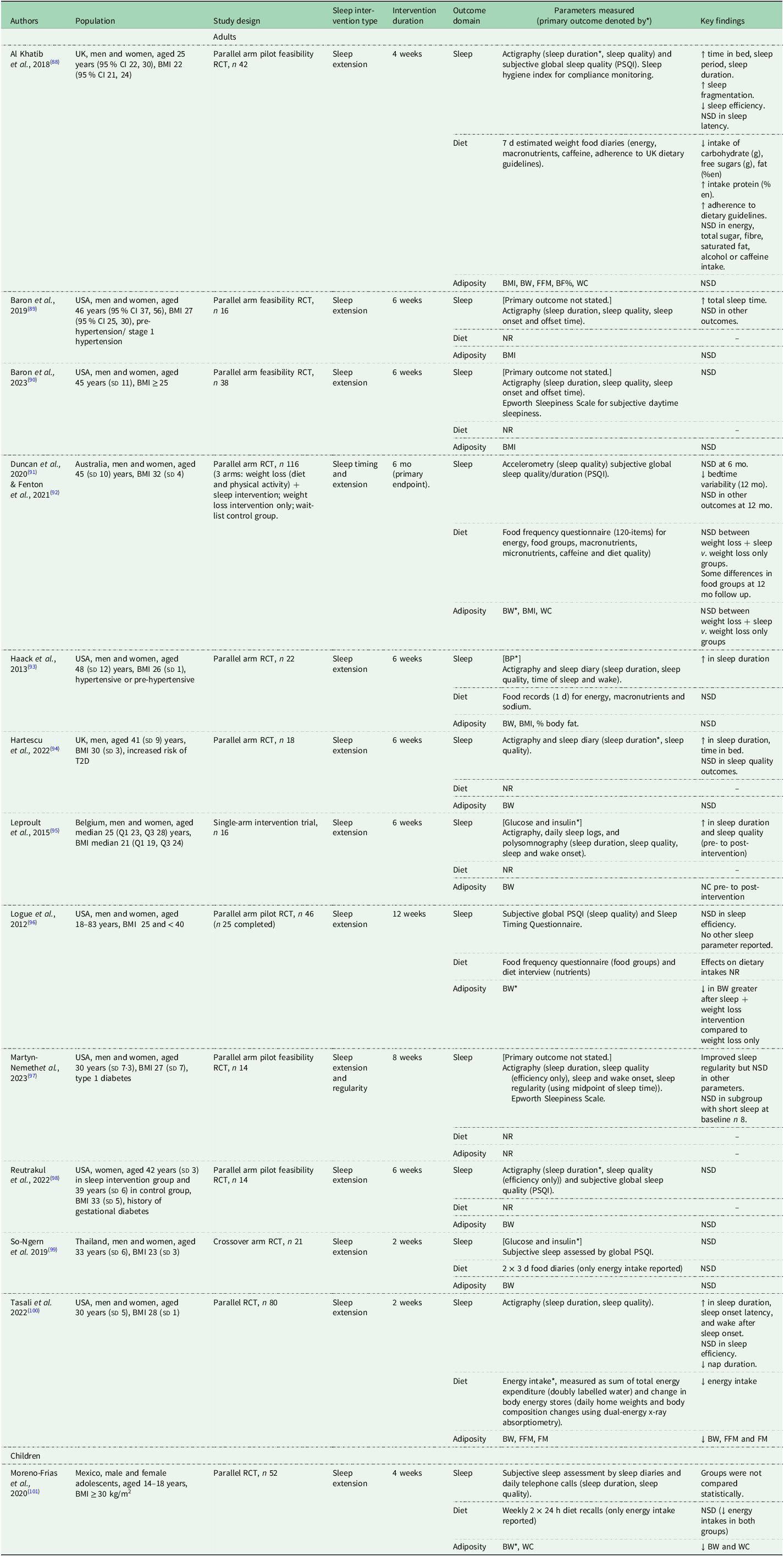
Sleep extension trials in habitual short-sleepers are important because extrapolation of sleep restriction intervention trial results (in those who normally sleep for an adequate duration) to the potential impact of sleep extension (in short-sleepers) may be an over-simplification of the physiological and psychological mechanisms involved. However, there have been fewer studies of the effects of sleep extension on weight management, diet or energy expenditure. A representative summary of diet, adiposity and cardiometabolic health outcomes from published studies in adults where an intervention was designed to extend sleep duration, or to improve sleep quality or timing/regularity (restricted here to a minimum of 2 weeks intervention), is presented in Table 2.
Intervention studies that have extended sleep duration, modified sleep timing, and/or aimed to improve sleep quality as an isolated intervention, with intervention duration ≥ 2 weeks in adult and paediatric populations

Sleep quality is an umbrella term for the following parameters: sleep efficiency, sleep onset latency, sleep fragmentation, wake after sleep onset; it can also be measured as a subjective global score by the Pittsburgh Sleep Quality Index questionnaire. Abbreviations: AEE, activity energy expenditure; BF, body fat; BW, body weight; CGM, continuous glucose monitor; %en, % energy; FFM, fat-free mass; FM, fat mass; MVPA, moderate to vigorous physical activity; NC, no change (pre- to post-intervention); ND, no significant difference; NR, not reported; PAL, physical activity level; PSQI, Pittsburgh Sleep Quality Index; SJL, social jetlag; T2D, type 2 diabetes; TEE, total energy expenditure; WC, waist circumference.
Designing a behavioural sleep extension intervention is problematic due to multiple challenges relating to designing an appropriate control treatment, blinding, potential behaviour change in the individuals allocated to the control group (who may be aware of the aim to extend sleep), burden of data collection/lifestyle change and compliance to protocol, and adherence to behaviour change counselling. Therefore, many published sleep extension intervention trials are pilot and/or feasibility studies. Sleep extension intervention trials have been conducted in both healthy and clinical populations, with outcomes including dietary intakes, adiposity, energy expenditure, cardiometabolic health markers and mental health (Table 2). Some of these have successfully extended average sleep duration(Reference Baron, Duffecy and Richardson89,Reference Haack, Serrador and Cohen93–Reference Leproult, Deliens and Gilson95,Reference Tasali, Wroblewski and Kahn100,Reference Al Khatib, Hall and Creedon102) . A pilot feasibility RCT in young, healthy-weight adults, extended sleep duration for 4 weeks, but at a cost of decreased sleep efficiency(Reference Al Khatib, Hall and Creedon102). In contrast, no negative effects on sleep quality parameters were reported by several other sleep intervention studies that have successfully extended sleep duration(Reference Baron, Duffecy and Richardson89,Reference Hartescu, Stensel and Thackray94,Reference Leproult, Deliens and Gilson95, Reference Tasali, Wroblewski and Kahn100) . Data from another pilot trial suggested that the effectiveness of a weight loss programme may be enhanced by sleep extension(Reference Logue96), but substantial participant attrition and lack of reported data on sleep duration limited the conclusions that could be drawn; very few larger, fully powered trials addressing the same question have materialised. Nonetheless, two intervention trials with mixed results are worth noting. Firstly, a RCT compared 6-month interventions comprising a weight loss programme (personalised dietary advice and physical activity goals, delivered using behaviour change techniques via in-person counselling sessions, a smartphone app, email and SMS messaging, n 41) with the same weight loss programme plus optimisation of sleep timing and sleep extension in adults with overweight or obesity (n 39)(Reference Duncan, Fenton and Brown91). There was substantial drop-out by the 6-month primary endpoint: 31 % in the enhanced sleep group and 22 % in the diet and exercise-only group. The enhanced sleep group, who received the sleep intervention via an app and a handbook targeting sleep hygiene behaviour change, reduced sleep time variability and stress management and relaxation techniques, reported reduced bedtime variability(Reference Duncan, Fenton and Brown91). However, there were no effects on the Pittsburgh Sleep Quality Index (PSQI; validated questionnaire) global score. Sleep duration forms part of the PSQI global score and was not reported separately. Furthermore, there were no associated effects on energy intake, weight loss, or HbA1C compared to a weight loss only (diet and physical activity) intervention(Reference Duncan, Fenton and Brown91). Over a much shorter intervention period (2 weeks), and without a weight loss component, a sleep extension intervention in adults with overweight (parallel arm RCT, n 80) led to reduced energy intakes (270 kcal/d, measured objectively) and body weight compared to habitual sleep(Reference Tasali, Wroblewski and Kahn100). The impact on diet quality and eating behaviours was not captured in the latter study, but collectively the evidence suggests that although short-term improvements in sleep habits may lead to reduced energy intake, the impact on body weight may be negligible over longer periods when healthy eating and physical activity advice is already being provided.
An important consideration in the design of multiple target lifestyle interventions for weight management is the risk of overwhelming participants with behaviour change goals, resulting in a failure to incorporate change into daily life and ultimately an adverse effect on weight loss. This was suggested by Marshall et al. who conducted a study evaluating the feasibility of a remotely delivered lifestyle intervention in short-sleeping (< 7 h per night on working days) university employees who had expressed an interest in losing weight (assessed for eligibility by an online questionnaire), involving sleep hygiene counselling in combination with diet and physical activity advice(Reference Marshall, Gardner and Kelly103). There were fewer participants with > 1 kg weight loss after 12 weeks of intervention in the sleep + diet + physical activity group compared with the diet + physical activity only group(Reference Marshall, Gardner and Kelly103). These findings suggest that more intervention development work is needed to optimise an acceptable, achievable programme that incorporates sleep behaviour change into standard weight-management strategies.
Relationships between sleep, diet and maintaining a healthy weight in children and adolescents
Recommended sleep durations per night for infants and children range from 14–17 h for newborns down to 8–10 h for 14–17-year-olds(Reference Hirshkowitz, Whiton and Albert8). In 2023, 38 % of 8–16 years old (total sample n 1140 recruited from the NHS Patient Register) participating in the ‘Mental Health of Children and Young People in England - Wave 4 Follow up to the 2017 Survey’ reported 3 or more nights of problems getting to sleep, waking in the night, or waking early in the previous seven days (25 % in a subsample of 810 excluding those likely to have a mental disorder)(104). Similarly, 34 % of 0–17-year-olds in a US representative 2019–2020 sample (total sample n 67 598 from a population-based nationally representative survey) had parent-reported short sleep duration(Reference Dai and Liu105). Extensive evidence exists for an association between sleep duration and adiposity in childhood. A meta-review of 24 systematic reviews of mainly observational studies investigating nocturnal sleep and adiposity parameters in children up to 18 years found that 68 % of the 443 studies reported an association between adequate sleep duration and reduced adiposity(Reference Matricciani, Paquet and Galland106), with 58 % of the 26 studies on sleep quality also finding a favourable relationship. However, evidence is less abundant and more mixed for associations between sleep variability/timing and overweight or obesity. To yield insights into directionality, Grimaldi et al. (2023) meta-analysed longitudinal studies in children and adolescents aged 10–19 years and reported that shorter sleep or lower sleep quality at baseline was associated with a 30 % increased likelihood of obesity at a later timepoint(Reference Grimaldi, Bacaro and Natale59).
As is the case for adults, there is a large body of observational evidence, mainly cross-sectional studies, but also including some cohort studies, linking short sleep with diet or eating behaviours in children and adolescents, with several systematic reviews published on this topic (Table 1). Many studies evaluated in these systematic reviews have reported that better diet quality, healthier dietary patterns, higher energy intake and/or lower intake of sugar/sugar-sweetened beverages are associated with longer sleep duration, earlier sleep timings, lower social jetlag and better sleep quality in children and adolescents(Reference Shahdadian, Boozari and Saneei74–Reference Ward, Jospe and Morrison79,Reference Zhong, Han and Li81) .
Analyses of pooled intervention trials to increase sleep duration in children and adolescents, conducted in school and home settings, have reported mixed results for adiposity and diet(Reference Liu, Figueroa and Brink107,Reference Yoong, Chai and Williams108) . Yoong and colleagues (2016) included 8 studies that had manipulated sleep duration (restriction or extension) or improved sleep quality, including multicomponent interventions, in children up to 18 years of age(Reference Yoong, Chai and Williams108). Only 2 of these studies aimed to extend sleep duration in children aged ≥ 1 year, one with a 1-week intervention compared to a sleep restriction comparator arm(Reference Hart, Carskadon and Considine109) and the other intervening over 6 months with the control arm involving provision of leaflets on child development(Reference Haines, McDonald and O’Brien110); both studies reported an increased sleep duration, with the former reporting a reduction in energy intake of 134 kcal/d(Reference Hart, Carskadon and Considine109), and both reporting a decrease in BMI. A small number of sleep intervention trials (6 months to 5 years follow-ups) in under 5-year-olds were meta-analysed by Miller et al. (2021) demonstrating an overall significant reduction in BMI compared to control(Reference Miller, Bates and Ji57). A subsequent systematic review and meta-analysis of sleep intervention trials in children aged 5–17 years of age with overweight or obesity(Reference Liu, Figueroa and Brink107) included 8 studies that measured adiposity (7 of which were multicomponent interventions). However, findings were inconclusive: heterogeneity was high across studies, only 5 reported sleep outcomes (only 2 out of 5 reported an improvement), and meta-analysis of data from 5 studies found no significant overall effect on BMI(Reference Liu, Figueroa and Brink107).
The evidence base comprising behavioural sleep or sleep plus lifestyle intervention studies with adiposity-related outcomes is small in paediatric populations, but the number that has measured the impact of improvement in sleep on dietary outcomes is even smaller. Although a handful of intervention studies including sleep within a multicomponent intervention exist, it is not possible to isolate the effect of sleep modification from these studies, as reviewed by Liu et al(Reference Liu, Figueroa and Brink107). Moreno-Frias and colleagues (2020) conducted a 4-week parallel RCT in Mexican male and female adolescents with obesity aged 14–18 years to extend sleep in addition to a weight loss programme (n 25) compared to weight loss only control group (n 27); they reported a greater decrease in BMI and waist circumference in the sleep intervention group but no differences in energy intake(Reference Moreno-Frías, Figueroa-Vega and Malacara101). However, differences in changes between groups were not presented and there were no other details on dietary outcomes reported, so firm conclusions could not be made.
In summary, although the observational evidence suggests that inadequate sleep is a key factor associated with obesity and poor diet, there is a lack of interventional evidence demonstrating that improving sleep duration or other sleep parameters in children will lead to a reduced risk of weight gain and healthier diets. Chronotype, an individual’s natural tendency to go to bed and get up in the morning either earlier or later, plays a particularly important role in how inadequate sleep impacts the risk of weight gain and obesity in adolescents, who tend to increasingly develop a later chronotype, peaking in the early twenties(Reference Roenneberg, Kuehnle and Pramstaller111). Evening chronotypes may be particularly vulnerable due to misalignment between their biological rhythms and societal demands, leading to reduced sleep duration and consequently greater risk of unhealthy eating behaviours and weight gain. Concentrating research in this area could yield new public health interventions to improve the effectiveness of current strategies to prevent child obesity.
Relationships between sleep, diet and maintaining a healthy weight during pregnancy
There are no specific guidelines for sleep duration during pregnancy. Many pregnant women experience increased sleep disruption across all trimesters, with a pooled prevalence estimate of 46 % (95 % CI 37 %, 55 %) during pregnancy, and 70 % (95 % CI 54 %, 82 %) specifically during the third trimester, as assessed by a PSQI score ≥ 5(Reference Sedov, Cameron and Madigan112). A systematic review that had investigated sleep parameters during pregnancy, gestational weight gain and eating behaviours found a low number of relevant articles (10 cross-sectional studies and one RCT, although the latter was not a sleep intervention) and reported high heterogeneity across studies, limiting conclusions that could be drawn(Reference Pauley, Moore and Mama83). Subsequently, a second systematic review of mainly observational studies, published up to 2021, reported mixed results and concurred that high levels of heterogeneity precluded any clear messages from the evidence base(Reference von Ash, Sanapo and Bublitz82). There is a shortage of evidence for the impact of sleep hygiene counselling on gestational weight gain or diet.
Conclusions on the evidence supporting inclusion of sleep behavioural interventions as a key element of successful weight management
This review has provided an updated overview of available literature on the impact of inadequate sleep duration, timing/regularity and quality in adults, children and during pregnancy on weight management and dietary factors. Although the evidence base is growing, and the links between suboptimal sleep and risk of weight gain are consistent across study types and age groups, there remains a lack of quantitative data on the likely effect size of sleep interventions on weight management. Inclusion of sleep hygiene counselling or other behavioural interventions in weight-management programmes and/or clinical guidelines for the management of obesity uses considerable resources and therefore convincing evidence is needed that this would significantly enhance the impact or durability of weight-management approaches. The use of research-grade, validated, wearable devices (e.g. MotionWatch, ActiGraph) that use accelerometry, ideally integrated with other technologies to measure changes in light or variability in heart rate for even greater accuracy, enhances the scalability and validity of research into the impact of sleep interventions on dietary and physical activity behaviours. These actigraphy devices are now integral tools for accurate assessment of changes in sleep patterns in both clinical and research settings. To date, the totality of the evidence from the few intervention studies that have investigated effects of sleep interventions on weight management is hampered by limitations such as short duration, small sample size, or low generalisability of the study sample. Full integration of sleep behaviour change into clinically-endorsed weight-management programmes would require testing an integrated diet-activity-sleep intervention in a long-term, well-powered RCT to establish superiority over standard weight-management programmes. Currently, there are insufficient data to support the inclusion of intensive sleep behaviour change counselling as a mandatory element of weight-management plans.
Financial support
None
Competing of interest
WH has received consultancy payments from Zoe Ltd.


 Open access

