


1 Introduction
The purpose of this paper is to propose and apply a relatively new way to identify and measure a distribution of consumer preferences for new products and/or extensions to existing ones. In particular, we focus on a sample of individual consumers’ optimal configurations of feature levels, subject to constraints, although one can use the approach we propose without imposing constraints. The approach we describe and discuss in this paper is called a Hypothetical Product Configurator (HPC) and we discuss it in detail later in the paper. The objective of the approach we propose is to provide as much information as possible about the likely distribution of optimal individual (or group) consumer preferences for product configurations (i.e., product feature combinations) as early as possible in the product design and development process. We view our work as a pilot test and proof of concept that one can use HPCs for this purpose and obtain useful strategic and tactical insights that could lead to enhanced design outcomes. We focus our proof of concept test on sunscreens, which are a widely used product that faces the prospect of potential near- and longer-term formulation changes due to rapid changes in the science and technology of nanoparticles. We begin the paper by discussing current and possible future changes in nanoparticle science and technology associated with sunscreens and the issues that consumers face in choosing between competing products.
In recent years development of new nanotechnologies has been accompanied by several studies examining potential hazards, risks and environmental impacts of nanomaterials. They used a variety of experimental methods (e.g., Maynard et al. Reference Maynard, Aitken, Butz, Colvin, Donaldson, Oberdorster, Philbert, Ryan, Seaton and Stone2006) to study (a) potential hazards (e.g., Balbus et al. Reference Balbus, Maynard, Colvin, Castranova, Daston, Denison, Dreher, Goering, Goldberg and Kulinowski2007; Seaton et al. Reference Seaton, Tran, Aitken and Donaldson2010; Sayes, Reed & Warheit Reference Sayes, Reed and Warheit2011), (b) appropriate exposure levels or ‘dosimetry’ (e.g., Tsuji et al. Reference Tsuji, Maynard, Howard, James, Lam, Warheit and Santamaria2006; Maynard & Aitken Reference Maynard and Aitken2007) and/or (c) the appropriateness of using existing methods to assess potential risks of engineered and adventitious products of nanotechnologies (e.g., SCENIHR 2005). In addition to cataloguing outcomes from different nanoparticle organism/environmental interactions, a variety of predictive models also were proposed, aimed at circumventing the need for numerous expensive and time consuming experiments. (e.g., Puzyn, Leszczynska & Leszczynski Reference Puzyn, Leszczynska and Leszczynski2009; Barnard Reference Barnard2009a ; Burello & Worth Reference Burello and Worth2011; Puzyn et al. Reference Puzyn, Rasulev, Gajewicz, Hu, Dasari, Michalkova, Hwang, Toropov, Leszczynska and Leszczynski2011). These studies received mixed reactions from factions in the scientific community, but were largely welcomed by broader society who often believe that knowledge about risks of nanoscale materials is insufficient to inform decisions about new and existing products.
Consumers make decisions about existing products containing nanomaterials all the time, whether they take information about risks into account or not. Thus, better information about the choices consumers are likely to make provided at early stages of product design and development can help to maximize the chance of eventual product successes and reduce the risks of public relations issues downstream. A good example of potential public relations issues involves using metal oxide nanoparticles in commercial sunscreens (e.g., Hanson, Gratton & Bardeen Reference Hanson, Gratton and Bardeen2006; Monteiro Riviere et al. Reference Monteiro Riviere, Wiench, Landsiedel, Schulte, Inman and Riviere2011), which includes titanium dioxide or zinc oxide (e.g., Tyner et al. Reference Tyner, Wokovich, Doub, Buhse, Sung, Watson and Sadrieh2009). These products recently have raised concerns because the photoactive nanoparticle surfaces produce reactive oxygen species (ROS) (e.g., Wiseman & Halliwell Reference Wiseman and Halliwell1996; Serpone, Salinaro & Emeline Reference Serpone, Salinaro and Emeline2001; Hirakawa, Yawata & Nosaka Reference Hirakawa, Yawata and Nosaka2007); there also is evidence that ROS generated by nanoparticles in sunscreens used by workers played a role in unsightly hand and finger shaped defects on pre-painted steel roofing (e.g., Barker & Branch Reference Barker and Branch2008). Although ex vivo testing indicates that nanoparticles remain on the surface of the skin and in the stratum corneum among keratinized cells (e.g., Kertesz, Szikszai & Kiss Reference Kertesz, Szikszai and Kiss2003–2004), this barrier is not impenetrable, and consumers remain concerned.
It may seem obvious that omitting nanoparticles from sunscreens would eliminate this threat, but including nanoparticles in sunscreens increases sun protection factors (SPFs) and can increase adoption of more powerful sunscreens by making them aesthetically appealing, which in turn can reduce risks of skin cancer. While one can make some predictions of ‘numerically optimal’ product configurations based on the underlying physicochemical system parameters (e.g., particle size and concentration), the product configuration that will have the greatest impact on public health is one that consumers actually want. Public participation and engagement plays an essential part in determining how serious these issues are in stakeholders’ minds and whether media portrayals and/or government position statements accurately reflect the public’s appetite for risk.
Studies and reports on societal impacts of nanotechnologies indicate that consumer decisions often are based on individual values and perceptions (e.g., Department of Industry, Innovation, Science, Research and Tertiary Education, Australian Government, 2012), so it is likely that attempts to predict the optimal sunscreen based exclusively on numerically optimizing the physicochemical properties of the nanoparticles will fail to identify socially acceptable configurations. Indeed it may be logical to assume that consumers want sunscreens that simultaneously are cheap, effective, safe and attractive; but if consumers cannot have all of these at once, how do they tradeoff these features? A recent study (Barnard Reference Barnard2010) predicted numerically optimal nanoparticle size and concentration using structure/property maps of SPF, degree of product transparency (aesthetics) and potential toxicity from ROS, but assumed all these factors were equally important (Figure 1). In reality they probably are not equally important (e.g., Australian Government Department of Industry, Innovation, Science, Research and Tertiary Education, 2012). Thus, product design and development methods and processes clearly could benefit from having access to reliable and accurate information about the likely tradeoffs and choices that consumers will make in advance.
Physically optimal region.
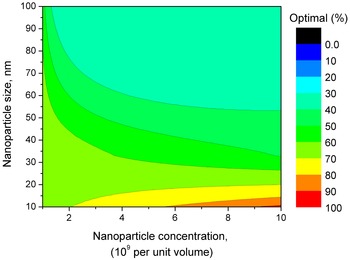
DCE preferences in optimal region.

Indeed, theory and methods are available to model and predict likely future demand and willingness to pay for new products and/or significant changes to existing products. One particular class of methods is widely used for this purpose, which are Discrete Choice Experiments (DCEs). DCEs rely on sophisticated multivariate experiments to vary product features and other potentially important aspects of choices, such as prices and messages. Each feature variant represents a product description (or ‘offering’) and the purpose of a DCE is to observe how consumer choices change as features and associated levels (values) vary. Choice data produced by DCEs allows analysts to estimate sophisticated probabilistic discrete choice models (DCMs) to predict how the probability of choosing various choice options of interest are likely to change as one varies features of one or more competing offerings (one option typically is ‘non choice’). Predictive outputs of such models can be viewed as the mean preferences of one person who provides multiple observations of choices and/or the mean preferences of a group (e.g., a sample) of people who provide one or more choice observations (Lancaster Reference Lancaster1966; McFadden Reference McFadden and Zarembka1974; Louviere & Woodworth Reference Louviere and Woodworth1983; Louviere, Hensher & Swait Reference Louviere, Hensher and Swait2000; Street & Burgess Reference Street and Burgess2007). Recent modelling innovations allow one to estimate discrete or continuous distributions of preferences using Classical or Bayesian estimation methods (see, e.g., McFadden & Train Reference McFadden and Train2000; Magidson & Vermunt Reference Magidson and Vermunt2007); and in certain cases, one also can use these new estimation methods to estimate model parameters for single individuals (see also Frischknecht et al. Reference Frischknecht, Eckert, Geweke and Louviere2014). DCMs do not predict the exact choice of a person or group; instead, they only predict the probability that various options will be chosen. DCEs and associated DCMs are widely used for new product demand forecasting, identifying attractive potential target groups, and where accurate cost data are available, estimating likely profitability.
Thus, it is fair to say that DCEs and associated DCMs currently are the ‘gold standard’ for new product demand forecasting. Consequently, we began our research to identify potentially optimal sunscreen designs (feature configurations) by designing and implementing a DCE (also called ‘Case 3 Best-Worst Scaling’: Louviere, Flynn & Marley Reference Louviere, Flynn and Marley2015) and a parallel Case 2 Best-Worst Scaling experiment (Louviere et al.
Reference Louviere, Flynn and Marley2015). As shown in Figure 2, the DCE and associated DCMs produced insufficient granularity about the distribution of preferences to allow us to reliably and accurately identify potentially desirable products in the feasible production space, despite estimating both continuous and discrete distributions of parameters to represent individual differences (McFadden & Train Reference McFadden and Train2000; Magidson & Vermunt Reference Magidson and Vermunt2007; Fiebig et al.
Reference Fiebig, Keane, Louviere and Wasi2010). Nonetheless, it is worth noting that the vast majority of DCEs and associated DCMs can and do give sufficient granularity. Unfortunately, however, for whatever reasons, this is not always the case. In our case, the reason why the DCE produced insufficient granularity is that we could not impose suitable restrictions on the feature space to enable reliable and accurate parameter estimation due to the constraints posed by the underlying physical science, as we later explain. So, we do not mean to imply that all DCEs and DCMs give insufficient granularity to estimate distributions of preferred configurations, but in our case the sample size ( $N=720$
) should have been sufficient to do so, yet we could not achieve it. As a result, we were led to try a different approach, namely a Hypothetical Product Configurator (HPC).
$N=720$
) should have been sufficient to do so, yet we could not achieve it. As a result, we were led to try a different approach, namely a Hypothetical Product Configurator (HPC).
If properly designed and implemented, HPCs allow each person to directly choose a feature level combination (here, nanoparticle size and concentration) that yields a product (here, sunscreens) that optimizes their personal preferences (here, best meets their needs and reflects risk preferences). In many cases, researchers choose to constrain DCEs by designing them to create and offer only options that actually can be produced. However, it is important to note that one of the inventors of DCEs (i.e., Louviere & Woodworth Reference Louviere and Woodworth1983) notes that in the vast majority of DCE applications, consumers have no idea what can/cannot be produced. In such cases, imposing constraints can result in serious identification and efficiency limitations in a DCE design that will impact the models that can be estimated from it (see, e.g., Louviere Reference Louviere, Hess and Daly2013). In contrast, HPCs can be constrained by physical reality, such that participants only can choose products that actually can be produced. These constraints not only do not impact the outputs of the HPCs, they actually ensure these outputs satisfy the underlying product and design constraints (here, constraints associated with physical theory). HPCs are not new; they are widely used in IT and industry, where they play roles in ‘Mass Customization’ (e.g., Dellaert & Stremersch Reference Dellaert and Stremersch2005; Franke, Schreier & Kaiser Reference Franke, Schreier and Kaiser2010).
We do not view HPCs as replacements for or competitors of DCEs; instead, we view them as highly complementary, each providing a different view of consumer preferences. So, despite the fact that in this application, they gave more detailed preference information than the DCEs we designed, this is not necessarily true in general. Thus, it is up to researchers to decide whether to use one or both and whether their different views of preferences are useful and in what ways they are useful. For example, one key advantage of DCEs has been that they allow one to forecast likely future choices in cases where product features (attributes) differ from the present (e.g., features have new values and/or new features are added). However, HPCs also can provide information about distributions of choices of such future offerings to the extent that the HPC incorporates new product features, values of such features or new values for existing features. Thus, HPCs can produce distributions of preferences for future features and/or feature levels that reflect actual physical and other constraints, such as prices and production/distribution costs. A second advantage of DCEs and DCMs has been the ability to calculate willingness to pay for new configurations, changes in feature values, etc. While we believe that this also is possible for HPCs, we do not include this extra complication in our study as it is a pilot test and proof of concept. Nonetheless, we can say that we have in fact incorporated prices directly into several prior HPCs designed and applied by members of this research team, and prices are regularly incorporated in real product configurators, such as the one on the Dell Computer website.
In the following sections we introduce, discuss and apply a HPC to descriptions of sunscreens based on combinations of three features (SPF, transparency and potential toxicity from ROS). We note that most DCE applications involve more than three features; we simplified our HPC for this proof of concept test, but it is not a limitation of HPCs in general. In reality, there can be (and likely are) many more features/attributes associated with the properties of a sunscreen preparation (McCall Reference McCall2011; Smijs & Pavel Reference Smijs and Pavel2011). Indeed, the feature ‘product transparency’ that we studied is only one physical attribute that consumers may consider (in addition to, for example, texture and/or mode of application); and there are other possible sources of the feature ‘potential toxicity’ that may be due to sources other than generation of free radicals. As previously noted, whether nanoparticles in sunscreens are toxic remains a matter of much debate and study; and surveys indicate this can be a highly emotive issue, with consumer decisions not necessarily related to or swayed by the underlying science. (e.g., Australian Government Department of Industry, Innovation, Science, Research & Tertiary Education, 2012). A recent review of the underlying science can be found in Osmond & McCall (Reference Osmond and McCall2010). As alluded to earlier, members of this research team have previously developed and applied much more complex HPCs with many more features for laptop computers, cell phones, websites and incentives to participate in surveys, to name only a few. So, we simplified the HPC in this study only for proof of concept purposes.
We now describe and discuss how we measured consumer preferences for different product configuration possibilities and linked them directly to nanoparticle sizes and concentrations that can produce these configurations. As we later discuss, the HPC is a tool to enable individual consumers to identify their preferred product based on logical, emotional and personal factors inherent in their decision processes. HPCs do not measure the impact of potential toxicity, only how people feel about it, and whether they would configure a product to avoid it if they could and/or how much of it they would accept or avoid to achieve certain levels of aesthetics (i.e., transparency). Thus, the HPC we introduce, discuss and apply is directly linked to the underlying physical theory (i.e., the materials science), which serves to directly constrain the preferences to the feasible production space.
2 Implementation and analysis methods
In principle, HPCs can be implemented with established survey methods, making their application intuitive and relatively simple. We use Barnard’s (Reference Barnard2010) results to justify the three physicochemical properties mentioned earlier (SFP, transparency and potential toxicity from ROS) as fundamental factors; and we designed and implemented an online web survey to obtain a sample of consumers’ preferred product configurations. As part of this survey, participants were asked to read three different instructions to learn how to use the sunscreen HPC and how to configure their ‘most preferred’ product. We recruited survey respondents from the Pureprofile online webpanel, a large Australian research panel that recruits and maintains approximately 600 000 households closely representative of the Australian population (we say ‘closely’ because some groups are under- or over-represented, such as rural residents, the elderly and low incomes). We screened potential participants by whether or not they had used sunscreen products in the last 12 months. The survey was conducted in October 2010, and a total of 720 people participated. Demographic profiles for age, gender and location closely matched the population statistics from the Australian Bureau of Statistics (ABS). Excluding those screened out (i.e., did not use sunscreen in the last year), the completion rate was 81%.
The survey offered (i.e., displayed) two horizontal sliders to each participant that represented, respectively, ‘Nanoparticle Size’ and ‘Number of Nanoparticles’. When participants moved the two horizontal sliders, three vertical sliders representing ‘SPF’, ‘Relative Potential Toxicity’ (assumed linearly dependent on ROS generation) and ‘Aesthetics’ changed in real time. Participants could not move the three vertical sliders directly; they changed only in response to the horizontal sliders that participants could manipulate. However, as these attributes are intrinsically linked (via nanoparticle size and concentration), all vertical sliders changed simultaneously, but not necessarily in the same direction. For example, depending on the nanoparticle size, reducing concentration reduces SPF (potentially undesirable) but can increase product transparency (potentially desirable). Participants made choices based on attributes represented by the vertical sliders, not product configurations produced by moving the horizontal sliders. A screenshot of the HPC screen is shown in Figure 3.
Screenshot of the hypothetical product configurator (HPC).

Awareness of SPF and potential toxicity have been studied in past surveys (e.g., Australian Government Department of Industry, Innovation, Science, Research & Tertiary Education, 2012). Product transparency is hard to convey to survey participants because the visual appearance of a sunscreen preparation depends on an individual’s skin tone. So, visual appearance (not theoretical degree of transparency) is what consumers ultimately assess. To allow preference differences associated with differences in skin tones we developed 10 different renderings of forearms and elbows for each of six skin types, as shown in Figure 4. Early in the survey we asked participants to choose one skin tone from the display in Figure 4 that they thought most closely matched their own. The sunscreen HPC page displayed a skin tone that matched their earlier choice. In addition, two images showed the appearance of an arm covered by sunscreen that also changed in real time to match the levels of transparency a participant chose. Because this was a proof of concept test, we did not provide participants with descriptions and/or justifications of SPF and potential toxicity because consumers rarely research the meaning of scientific terms and/or measures described on product labels, and if they do this research does not necessarily drive their choice(s).
Renderings representing sunscreen transparency and visual appearance of consumers with different skin tones (Percentages in left column represent degrees of transparency).

Survey participants could adjust the sliders as much as they wanted until they had their ideal combination, at which point they submitted their preferred nanoparticle size and concentration to be captured by the survey software. The degree of sensitivity in these outcome measures was limited only by participant dexterity. The data captured can be represented as a 3D model using a standard kernel density smoothing method applied to the collection of variable height impulses on a grid of rows and columns ( $x$
and
$x$
and $y$
coordinates of the impulse, denoting nanoparticle concentration and nanoparticle size, respectively). Kernel density smoothing is discussed in many sources, such as Silverman (Reference Silverman1981), so we do not go into detail about its use here to save space. The height, or
$y$
coordinates of the impulse, denoting nanoparticle concentration and nanoparticle size, respectively). Kernel density smoothing is discussed in many sources, such as Silverman (Reference Silverman1981), so we do not go into detail about its use here to save space. The height, or $z$
coordinate, of the impulse denotes the number of times the same configuration was chosen by the participants (Figure 5). We graph these choices on the same
$z$
coordinate, of the impulse denotes the number of times the same configuration was chosen by the participants (Figure 5). We graph these choices on the same ${<}$
size; concentration
${<}$
size; concentration ${>}$
manifold used in the physicochemical modeling (Barnard Reference Barnard2010) for the same
${>}$
manifold used in the physicochemical modeling (Barnard Reference Barnard2010) for the same ${<}$
size; concentration
${<}$
size; concentration ${>}$
range.
${>}$
range.
Raw data from the HPC (each spike represents one person’s choice).

One obvious feature in Figure 5 is the peak on the right side of the graph, indicating that the most preferred product configurations involve a high concentration of particles below ${\sim}10$
nm in size. Small particle sizes were more likely to be chosen than larger, submicron particles, in sharp contrast to many assumptions in the media. However, substantial subgroups prefer sunscreens that contain larger particles (
${\sim}10$
nm in size. Small particle sizes were more likely to be chosen than larger, submicron particles, in sharp contrast to many assumptions in the media. However, substantial subgroups prefer sunscreens that contain larger particles ( ${\sim}30$
nm to
${\sim}30$
nm to ${\sim}60$
nm), and are willing to tradeoff a lower concentration to configure a product that meets their needs.
${\sim}60$
nm), and are willing to tradeoff a lower concentration to configure a product that meets their needs.
Aside from statistical variation in choice results, nanoparticles samples rarely are monodispersed (Li et al.
Reference Li, Peng, Yi, Wang and Li2006; Dinh et al.
Reference Dinh, Nguyen, Kleitz and Do2009); so there will naturally be some polydispersivity in a sunscreen (Wokovich et al.
Reference Wokovich, Tyner, Doub, Sadrieh and Buhse2009), even when efforts are made to reduce it (Nischwitz & Goenaga Infante Reference Nischwitz and Goenaga Infante2012). In some cases the degree of sunscreen polydispersivity can be quite large (Samontha, Shiowatana & Siripinyanond Reference Samontha, Shiowatana and Siripinyanond2011). Similarly, according to Regulators (e.g., Aust Dept of Health & Aging, Therapeutic Goods Admin: Aust regulatory guidelines for OTC medicines, 2003; U.S. Food & Drug Admin, Table A1, Appendix A, EPA/600/R09/057F), there is an allowable range of values of the concentration of nanoparticles in a sunscreen. So, although consumers may want to choose a particular value, they actually could be offered any concentration in this acceptable range. Nanoparticle polydispersivity and allowable variations in concentrations provide a kernel (or cutoff) to our smoothing, with the individual choices being small overlapping areas in ${<}$
size; concentration
${<}$
size; concentration ${>}$
space.
${>}$
space.
3 HPC results
The raw data in Figure 5 clearly indicate that no one product configuration can satisfy everyone. While a few configurations are chosen by more than one person, the optimal nanoparticle size and concentration is largely an individual choice. We display the kernel density smoothing results in Figure 6 over the same ${<}$
size; concentration
${<}$
size; concentration ${>}$
range. This reveals several distinct groupings of raw data points, indicating that a number of people chose very similar configurations. In this way the sparse collection of individual choices becomes a distribution, and the collective behaviour of participants becomes as important as the individual choices themselves, indicating emergence of group behaviour (clusters of choices).
${>}$
range. This reveals several distinct groupings of raw data points, indicating that a number of people chose very similar configurations. In this way the sparse collection of individual choices becomes a distribution, and the collective behaviour of participants becomes as important as the individual choices themselves, indicating emergence of group behaviour (clusters of choices).
Preferred size and concentration of titania nanoparticles in sunscreens.

HPC results also allow one to study potential differences in size/concentration combinations for different demographic groups. For example, Figures 7(a) and 7(b) show results for male and female participants, respectively. Here, the gender differences may not be commercially important, as both display strong preferences for large concentrations of small ( ${<}10$
nm) nanoparticles. Yet, translation into commercial outcomes is not a primary motivation of all public engagement, and this high degree of fidelity may prove valuable in other applications.
${<}10$
nm) nanoparticles. Yet, translation into commercial outcomes is not a primary motivation of all public engagement, and this high degree of fidelity may prove valuable in other applications.
HPC-derived preferred size and concentration of titania nanoparticles in a sunscreen.

There also were somewhat larger differences associated with participant ages, and (to some extent) the climatic region where they lived (omitted). Figure 8(a) shows people aged 18 to 19 are more likely to prefer small nanoparticles, in either large or moderate concentrations. Figure 8(b) shows people aged 30 to 34 also prefer small nanoparticles, but tend to avoid high concentrations. Finally, Figure 8(c) shows people aged 45 to 49 prefer moderate concentrations of nanoparticles; the bimodal distribution of sizes suggests two subgroups exist in this age range with different preferences.
HPC produced preferred sizes and concentrations of titania nanoparticles in sunscreens for.

The above demographic differences suggest that one may be able to profile individuals who participate in HPC tasks using demographics or answers to other survey questions (e.g., attitudes, opinion, values, etc.). Similarly, the HPC results also suggest that one potentially can identify unobserved heterogeneity by using one or more taxonomic methods, such as cluster analysis, archetypal analysis (Cutler & Breiman Reference Cutler and Breiman1994) or Latent Class (e.g., Magidson & Vermunt Reference Magidson and Vermunt2007) applied to the individual HPC configurations, and then using the individuals’ answers to survey questions, sampling conditions or other between-subjects measures to explain differences in the resulting segments. For example, our results reveal an unusually high probability of a very low concentration of very small nanoparticles in Figures 8(a) and 8(c); it also is in Figure 6, but is more difficult to see. These peaks are not the result of group behaviour (choice clustering); instead they are directly related to many people choosing this configuration (see Figure 5). Yet, this nanoparticle size/concentration configuration makes no logical sense: the SPF is low, the product is unattractively opaque, and the relative potential toxicity is no lower than many other regions in the configuration space. We suspect that this is a subset of outlier participants, who confirmed that they use sunscreens, but did not move the horizontal sliders for reasons known only to them. We need a more extensive study to understand this behaviour, but Figure 5 shows they are a very small fraction of the sample.
Before concluding, we note again that our results are derived from an HPC. In reality, manufacturers can treat nanoparticles used in sunscreens in many ways to mitigate hazards, and in fact there are many ways to pacify toxicity and/or quench ROS. Currently, many formulations encapsulate inorganic nanoparticles to achieve acceptable cosmetic results and coat them to preserve colloidal stability. Beyond this, actual risk issues are moderated by the exposure of each individual, and while one can provide recommendations, scientists, manufacturers and/or regulators have little control over this.
4 Conclusions
We introduced and discuss a hypothetical proof of concept study and pilot test of a Hypothetical Product Configurator used to obtain data about consumers’ optimal combinations of nanoparticle sizes and concentrations. Naturally, we would require more data for a real public engagement or technology assessment study, but it is nonetheless worth noting that our HPC approach offers some advantages over simple methods like focus groups and surveys, or more advanced methods like DCEs (Louviere et al. Reference Louviere, Hensher and Swait2000; Louviere et al. Reference Louviere, Flynn and Marley2015: (1) an HPC can predict the expected behaviour of individuals or groups of individuals in particular contests, so to the extent that one can incorporate future contexts into an HPC, one can predict distributions and/or groupings of individual preferences and/or choices, and (2) a properly designed HPC will capture the fact that people have to tradeoff good and bad features of products; in our case, they had to tradeoff sunscreen transparency and SPF vs. potential toxicity to choose a compromise that best met their needs and preferences. Methods that ask people how they feel about one or more properties or features one-at-a-time inherently do not capture the fact that real products can have many features that can be (and often are) intrinsically linked. In such cases, changes in one feature can automatically change others, such that one particular feature rarely can be enhanced or reduced in isolation. In turn, this implies that understanding consumer perceptions and preferences for concentration/size combinations of nanoparticles in commercial products like sunscreens is necessarily more complex than suggested by widespread use of attitudinal surveys (e.g., Department of Industry, Innovation, Science, Research and Tertiary Education, Australian Government, 2012).
Although our proof of concept study is a modest step towards understanding and quantifying the complexity of designing and applying HPCs, our results suggest several interesting conclusions. For example, we show differences in ways that some demographic groups value transparency, SPF and potential toxicity; and some of these differences are inconsistent with what many vocal political, social and environmental groups claim. That is, taking everything into account, our sample had a surprisingly high tolerance for potential toxicity. It varies across demographics, but in general people do not seem to be as ‘anti-nano’ as some in the media suggest. Of course, we do not necessarily advocate using our results to draw conclusions about the use of nanoparticles in sunscreens, but we think that they do show that consumers do not automatically sacrifice high SPF (protects against skin cancer) and product transparency (promotes adoption, consistent with public health) to avoid possible toxicity from ROS. Indeed, our results suggest this issue is complex even in a simple research setting like our HPC; so, it is likely to provide a rich area for further research.
Barnard (Reference Barnard2009b ) noted that issues relating to potential hazards in nanoscale materials are more than just multidisciplinary problems. They are multi-field problems; hence, the final, and arguably the best, result of our proof of concept study is a demonstration that the physical and social sciences can be integrated in meaningful ways. While such collaborations have scientific and technical challenges, one nonetheless can envisage many other potential HPC applications and ways to refine and expand the data processing and analysis using expertise from different academic disciplines. Moreover, we think HPCs could be used as part of (or even a proxy for) public engagement activities to ensure statistical validity and reduce problems associated with bipolar reactions from groups that may be over-represented in voluntary public forums. They also can be used to capture public perceptions or voice of the customer-type inputs traditionally done in other ways.
Acknowledgment
We would like to thank Richard Carson for useful discussions.
Author contributions
J.J.L. and A.S.B. conceived and designed the study. J.J.L. conceived and constructed the DCM and DCE strategies. J.J.L. and A.S.B. conceived and constructed the HPC strategies. E.W. and L.Z. implemented the DCE and HPC studies and assisted in analysing the results. J.J.L. and A.S.B. prepared the manuscript with input from E.W. and L.Z.


 Open access

