



Non-alcoholic fatty liver disease (NAFLD) has become the most common chronic liver disease( Reference Neuschwander-Tetri and Caldwell 1 ). NAFLD represents excessive fat accumulation, mainly in the form of triglyceride (TG), within hepatocytes and includes a broad spectrum of liver diseases from simple steatosis progressing through non-alcoholic steatohepatitis and cirrhosis( Reference Caldwell and Crespo 2 ). Several metabolic disorders including obesity, insulin resistance, hypertension and dyslipidaemia are key pathogenic factors in the development of NAFLD( Reference Rinella 3 ).
The current World Health Organization( 4 , 5 ) guidelines based on a systematic review of epidemiological literature recommend that adults eat <2000 mg/d of sodium (Na) but at least 3510 mg/d of potassium (K) to improve health consensuses related to blood pressure (BP) and cardiovascular events. Although the association between Na intake and insulin resistance has not been as well studied as the association for BP, several evidences have suggested the potential link between Na intake and insulin sensitivity. A positive relationship between dietary Na intake and insulin resistance has been observed in animal studies( Reference Ogihara, Asano and Ando 6 , Reference Ogihara, Asano and Ando 7 ), and high Na intake has been shown to induce insulin-related adipose tissue accumulation in rats( Reference Fonseca-Alaniz, Takada and Andreotti 8 ). In human studies, there is evidence that high Na intake has an adverse effect on insulin resistance( Reference Donovan, Solomon and Seely 9 ), and that it is independently associated with an increased risk of type 2 diabetes after adjusting for risk factors including physical activity, obesity and hypertension( Reference Hu, Jousilahti and Peltonen 10 ). In addition, epidemiological studies have shown a positive association between Na intake and body size and fatness, independent of energy or sugary beverage intake( Reference Song, Cho and Lee 11 – Reference Yi, Firestone and Beasley 13 ). For K intake, some epidemiological studies found an increased risk of diabetes with low K intake( Reference Chatterjee, Colangelo and Yeh 14 , Reference Colditz, Manson and Stampfer 15 ), while others have not shown such an association( Reference Hu, Jousilahti and Peltonen 10 , Reference Chatterjee, Yeh and Shafi 16 ). K intake was inversely associated with the metabolic syndrome and insulin resistance in some observational studies( Reference Lee, Lee and Hwang 17 , Reference Chatterjee, Biggs and de Boer 18 ).
Given the evidence of links between inadequate levels of Na and K intake and metabolic disorders, it could be hypothesised that metabolic milieu in individuals who consume high Na and/ or low K levels may trigger several pathophysiological processes favouring the development of NAFLD. Thus, we evaluated the associations between dietary intake of Na, K, and Na:K ratio and prevalence of ultrasound-diagnosed NAFLD in a large population-based screening study.
Methods
Study population
The Kangbuk Samsung Health Study is a cohort study of Korean men and women who underwent comprehensive annual or biennial examinations at two Kangbuk Samsung Hospital Total Healthcare Centers in Seoul or Suwon, South Korea( Reference Kim, Yun and Jung 19 , Reference Ryu, Chang and Choi 20 ). The study population included 206 996 participants who completed a FFQ and underwent a comprehensive health check-up between March 2011 and April 2013. After participants had completed the self-administered questionnaires, clinical examinations including abdominal ultrasound were performed.
For the current analysis, we excluded a total of 106 819 participants who met exclusion criteria, which included the following: missing data on abdominal ultrasound or age (n 121); a history of liver disease or medication use for liver disease (n 22 363); the presence of positive serological markers for hepatitis B or C virus (n 7621); use of medications associated with NAFLD within the past year, such as valproate, amiodarone, methotrexate, tamoxifen or corticosteroids (n 2969)( Reference Chalasani, Younossi and Lavine 21 ); a history of malignancy (n 5379); a history of CVD (n 2119); a history of hypertension (n 19 863); a history of diabetes (n 5999); alcohol intake of ≥20 g/d for women or ≥30 g/d for men (n 33 028)( Reference Chalasani, Younossi and Lavine 21 ); ≥12 missing food items (n 38 150); missing data on rice (n 33 616); or implausible energy intakes (±3 sd of the mean log-transformed energy; n 25 270). As a result, a total of 100 177 participants were included in our study (Fig. 1). The present study was approved by the Institutional Review Board of Kangbuk Samsung Hospital. The requirement for informed consent was waived, as we used only de-identified data that were routinely collected during health screening examinations.
Flow diagram of the study participants. NAFLD, non-alcoholic fatty liver disease.

Dietary assessment
Dietary intake was assessed using a 106-item, self-administered FFQ designed to capture usual dietary intake of Koreans( Reference Ahn, Kwon and Shim 22 ). The reproducibility and validity of the FFQ were previously evaluated among 124 Korean subjects aged 40–70 years( Reference Ahn, Kwon and Shim 22 ). Participants were asked how often, on average, they had consumed each type of food or beverage over the previous 12 months. Intake of each food item was assessed in nine predefined categories of frequency, ranging from never or seldom to three or more times per day for foods and from never or seldom to five or more times per day for beverages and categories of three portion sizes. Participants were asked to report the consumption period (3, 6, 9 or 12 months) for seasonal consumption of fruits. Participants were also asked about salt intake habits with three behavioural questions( Reference Kim, Paik and Lee 23 ): Q1, ‘What do you think of your salt-eating habits’, with five responses of very salty, a little salty, modestly salty, a little bland and very bland (scored as 12, 9, 6, 3 and 0, respectively); Q2, ‘Do you add salt or soya sauce on cooked dishes?’ with four responses of always, frequently, seldom and never (12, 8, 4 and 0, respectively); Q3, ‘Do you eat pan-fried or deep-fried food with soya sauce?’ with three responses of always, sometimes and never (12, 6 and 0, respectively). We summed up all the component scores to obtain an overall salt eating habit score ranging from 0 to 36, with higher scores indicating a higher tendency for salt usage or higher consumption of high-salt foods.
Total energy and nutrient intake was calculated on the basis of the standardised food composition database( 24 ). Daily intakes of Na and K were calculated by multiplying the frequency of consumption of each food by the portion size and Na and K contents of each food and summing across all relevant food items. All nutrients were energy adjusted separately for men and women using the residual regression methods( Reference Willett, Howe and Kushi 25 ). When we used the nutrient density model by estimating nutrient intake per 4184 kJ (1000 kcal) of energy, we observed similar results (data not shown).
Ultrasound examination of the liver
Abdominal ultrasounds were performed using a 3·5-MHz transducer (Logiq 9; GE) by experienced radiologists who were unaware of the aims of the study and were blinded to the laboratory values. Images were captured in a standard manner with the health screen examinees in the supine position with the right arm raised above the head. An ultrasonographic diagnosis of fatty liver was defined as the presence of a diffuse increase in fine echoes in the liver parenchyma compared with the kidney or spleen parenchyma( Reference Mathiesen, Franzen and Aselius 26 ). High inter-observer and intra-observer reliabilities for fatty liver diagnosis were achieved in our study, with κ statistic values of 0·74 and 0·94, respectively( Reference Kim, Yun and Jung 19 ). We defined NAFLD as the presence of fatty liver on ultrasonography in the absence of elevated alcohol consumption (a threshold of <20 g/d for women and <30 g/d for men)( Reference Chalasani, Younossi and Lavine 21 ) and other causes of liver disease as stated above in the exclusion criteria.
Other variables
A standardised, self-administered questionnaire containing questions on socio-demographics, medical history, medication use, family history, physical activity, alcohol intake and smoking habits was used. Physical activity levels were assessed using the Korean-validated version of the International Physical Activity Questionnaire short form( Reference Oh, Kim and Kang 27 ). Anthropometric components (height, weight and body composition) and BP were measured by trained nurses during the health examination, which are described in detail elsewhere( Reference Chang, Kim and Yun 28 ). Blood specimens were sampled from the antecubital vein after at least 10-h of fasting, and measures of serum biochemical variables are described in detail elsewhere( Reference Chang, Kim and Yun 28 ). The Laboratory Medicine Department at Kangbuk Samsung Hospital has been accredited by the Korean Society of Laboratory Medicine and participates annually in inspections and surveys performed by the Korean Association of Quality Assurance for Clinical Laboratories and the College of American Pathologists Proficiency Testing program.
Statistical analysis
A Poisson regression model with a robust error variance was used to estimate prevalence ratios (PR) and 95 % CI( Reference Barros and Hirakata 29 – Reference Zou 31 ) for men and women separately based on the evidence of sex interaction (P for interaction<0·01 for both Na and K intake). Na and K intakes and Na:K ratio were categorised into sex-specific quintiles. We fitted two models as follows: the basic model was adjusted for age and total energy intake (quintiles), and the multivariable model was further adjusted for study centre (two categories), year of screening exam (1-year categories), education level (<community college graduate, ≥community college graduate or unknown), physical activity level (inactive, minimally active, health-enhancing physically active or unknown), smoking status (never, past, current or unknown), alcohol intake (0, <10 or ≥10 g/d), and intakes of energy-adjusted calcium (Ca), protein and fibre (quintiles). Na and K intakes were also mutually adjusted in the model because of potential reciprocal biological effects( Reference Adrogue and Madias 32 ). In additional analysis, we further adjusted for intake of total fat and carbohydrates. Tests for trends were performed using the median value in each quintile and by modelling this variable as a continuous variable in the models. Exposures of interest as quantitative continuous variables were also estimated using a 1000-mg/d increase in Na and K and a 1-unit increase in Na:K ratio.
There has been a broad range of variation in sensitivities and specificities when comparing ultrasonography and liver biopsy as a gold standard(
Reference Hernaez, Lazo and Bonekamp
33
). We conducted a series of sensitivity analyses to test the robustness of our primary results. First, we examined the associations between dietary intakes of Na and K and Na:K ratio and prevalence of NAFLD defined by ultrasound findings along with elevated ALT levels of >0·33µkat/l, which is related to NAFLD(
Reference Chalasani, Younossi and Lavine
21
). Second, we used fatty liver index (FLI), a validated surrogate marker of fatty liver, as an outcome. The FLI was calculated as
 $$(e^{{0\cdot{\rm 953}{\,\times\,}{\rm log}_{e} \left( {{\rm TG}}{\,\plus\,}0\cdot{\rm 139}{\,\times\,}{\rm BMI}{\,\plus\,}0\cdot{\rm 718}{\,\times\,}{\rm log}_{e} \left( {{\rm ggt}} \right) {\,\plus\,}0\cdot0{\rm 53}{\,\times\,}{\rm waist\, \,circumference}{\,\minus\,}{\rm 15}\cdot{\rm 745}}} )\,/<$> <$>\,({\rm 1}{\plus}e^{{0\cdot{\rm 953}{\,\,\times\,}{\rm log}_{e} \left( {{\rm TG}} \right){\,\plus\,}0\cdot{\rm 139}{\,\times\,}{\rm BMI}{\,\plus\,}0\cdot{\rm 718}{\,\times\,}{\rm log}_{e} {\rm }\left( {{\rm ggt}} \right){\,\plus\,}0\cdot0{\rm 53}{\,\times\,}{\rm waist\,\,\, circumference}{\,\minus\,}{\rm 15}\cdot{\rm 745}}} )<$> <$>{\times}{\rm 1}00$$
(
Reference Bedogni, Bellentani and Miglioli
34
) and then categorised into three groups of FLI <30, 30 to <60 and ≥60. Third, we calculated the percentage contribution of each food to the total daily Na intake and evaluated the associations of the major food sources of Na intake including kimchi (combination of four kinds – Korean traditional salted and fermented vegetable dish) and ramen (instant noodle) with the prevalence of NAFLD. Finally, we examined whether the salt eating habit score, assessed by the behavioural questionnaire, was associated with the prevalence of NAFLD.
$$(e^{{0\cdot{\rm 953}{\,\times\,}{\rm log}_{e} \left( {{\rm TG}}{\,\plus\,}0\cdot{\rm 139}{\,\times\,}{\rm BMI}{\,\plus\,}0\cdot{\rm 718}{\,\times\,}{\rm log}_{e} \left( {{\rm ggt}} \right) {\,\plus\,}0\cdot0{\rm 53}{\,\times\,}{\rm waist\, \,circumference}{\,\minus\,}{\rm 15}\cdot{\rm 745}}} )\,/<$> <$>\,({\rm 1}{\plus}e^{{0\cdot{\rm 953}{\,\,\times\,}{\rm log}_{e} \left( {{\rm TG}} \right){\,\plus\,}0\cdot{\rm 139}{\,\times\,}{\rm BMI}{\,\plus\,}0\cdot{\rm 718}{\,\times\,}{\rm log}_{e} {\rm }\left( {{\rm ggt}} \right){\,\plus\,}0\cdot0{\rm 53}{\,\times\,}{\rm waist\,\,\, circumference}{\,\minus\,}{\rm 15}\cdot{\rm 745}}} )<$> <$>{\times}{\rm 1}00$$
(
Reference Bedogni, Bellentani and Miglioli
34
) and then categorised into three groups of FLI <30, 30 to <60 and ≥60. Third, we calculated the percentage contribution of each food to the total daily Na intake and evaluated the associations of the major food sources of Na intake including kimchi (combination of four kinds – Korean traditional salted and fermented vegetable dish) and ramen (instant noodle) with the prevalence of NAFLD. Finally, we examined whether the salt eating habit score, assessed by the behavioural questionnaire, was associated with the prevalence of NAFLD.
To evaluate whether these variables mediated the association between Na intake and prevalence of NAFLD, we further adjusted for BMI, body fat percentage (BF%), systolic BP and homoeostasis model assessment of insulin resistance (HOMA-IR). We conducted subgroup analyses to determine whether the associations of Na intake with the prevalence of NAFLD were modified by age, smoking status, physical activity level, BMI or BF%( Reference Chang, Wu and Chang 35 ). The Wald’s test was used to test the significance of the interaction term. In an additional sensitivity analysis, we included a history of hypertension, rather than excluding, to the model to test whether the inclusion of this variable would attenuate the estimates of interest. All P values were two-tailed, and P<0·05 was considered to be statistically significant. We used STATA version 13.1 (StataCorp LP) for all analyses.
Results
The median age of the participants was 37·2 years (interquartile range, 32·7–42·1). The proportion of ultrasound-diagnosed NAFLD was 35·6 % for men and 9·8 % for women. The characteristics of the study participants according to energy-adjusted Na and K intakes for men and women are shown in Tables 1 and 2, respectively. Men and women consuming high levels of Na were more likely to be current smokers, to consume more alcohol, to engage in vigorous physical activity and were less likely to be educated compared with those consuming lower levels of Na. Similar patterns were observed for K intake except education level. TG levels increased with increasing levels of Na intake but not with K intake. Total cholesterol and LDL-cholesterol levels increased with increasing levels of Na and K intake among women, but these relationships were less clear among men. Men and women in the lowest quintile of Na intake tended to consume less protein, fat, Ca and dietary fibre but more carbohydrates compared with those in the highest quintile of Na intake. For dietary intake of nutrients, the similar patterns were observed for K intake.
Characteristics of the study participants by intake of energy-adjusted sodium and potassiumFootnote * in 46 596 men (Mean values and standard deviations, proportions)

HEPA, health-enhancing physical activity; BF%, body fat percentage; BP, blood pressure; HOMA-IR, homoeostasis model assessment of insulin resistance; ALT, alanine aminotransferase; AST, aspartate amniotransferase; GGT, γ-glutamyl transferase.
* Nutrients were adjusted for total energy intake using the residual method in the distribution of 46 596 men eligible for the analyses.
† Excessive alcohol intake was excluded on the basis of exclusion criteria (≥30 g/d for men or ≥20 g/d for women).
Characteristics of the study participants by intake of energy-adjusted sodium and potassium* in 53 581 women (Mean values and standard deviations, proportions)
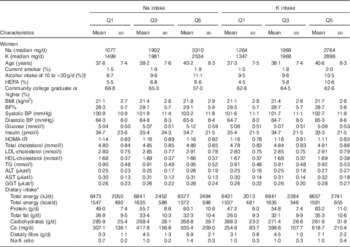
HEPA, health-enhancing physical activity; BF%, body fat percentage; BP, blood pressure; HOMA-IR, homoeostasis model assessment of insulin resistance; ALT, alanine aminotransferase; AST, aspartate amniotransferase; GGT, γ-glutamyl transferase.
* Nutrients were adjusted for total energy intake using the residual method in the distribution of 53 581 women eligible for the analyses.
† Excessive alcohol intake was excluded on the basis of exclusion criteria (≥30 g/d for men or ≥20 g/d for women).
In primary analyses, higher levels of energy-adjusted Na intake and Na:K ratio were associated with a higher prevalence of NAFLD, with a dose–response trend (Table 3). In multivariable-adjusted analyses, compared with men in the lowest quintile of Na intake and Na:K ratio, those in the highest quintile had a 25 % and a 13 % higher prevalence of NAFLD, respectively. Compared with women in the lowest quintile of Na intake and Na:K ratio, those in the highest quintile had a 32 % and a 13 % greater prevalence of NAFLD, respectively. However, we observed no inverse association between K intake and prevalence of NAFLD in either men or women but an unexpected positive association only in men. The main results remained similar after further adjustment for intake of total fat and carbohydrates in additional analysis; the multivariable-adjusted PR comparing extreme quintiles of Na, K and Na:K ratio were 1·25 (95 % CI 1·18, 1·33) in men and 1·35 (95 % CI 1·21, 1·50) in women, 1·12 (95 % CI 1·05, 1·20) in men and 1·15 (95 % CI 0·99, 1·33) in women, and 1·13 (95 % CI 1·08, 1·18) in men and 1·14 (95 % CI 1·05, 1·23) in women, respectively.
Prevalence ratios (PR)Footnote * of non-alcoholic fatty liver disease (NAFLD) by intake of energy-adjusted sodium and potassium and sodium:potassium ratioFootnote † (PR and 95 % confidence intervals)
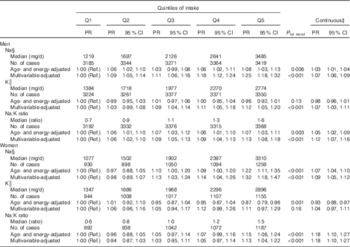
Ref. referent values.
* Estimated from a Poisson regression model with a robust error variance using a binary outcome variable (presence or absence). The multivariable-adjusted model was adjusted for age, total energy intake (quintiles), study centre (two categories), year of screening exam (1-year categories), education level (<community college, ≥community college graduate or unknown), physical activity level (inactive, minimally active, HEPA or unknown), smoking status (never, past, current or unknown), alcohol intake (0, <10 or ≥10 g/d) and intakes of energy-adjusted Ca, protein and fibre (quintiles).
† The overall interactions between sex and Na and K intakes in relation to the prevalence of NAFLD were <0·01 in the multivariate-adjusted model.
‡ Based on a 1000-mg/d increment of Na and K intake and a 1-unit increment in Na:K ratio.
§ Additionally adjusted for quintiles of energy-adjusted K intake.
║ Additionally adjusted for quintiles of energy-adjusted Na intake.
The primary findings of the association of Na intake with the prevalence of ultrasound-diagnosed NAFLD were further corroborated by the results from the several sensitivity analyses: first, the results of including elevated ALT levels of >0·33 µkat/l in the definition for diagnosing NAFLD based on ultrasound findings were consistent with the findings of the primary analysis (online Supplementary Table S1). Second, we found a positive association of FLI with Na intake but not with K intake (online Supplementary Table S2). Third, when we examined the first and the second largest food sources of Na in our data (47·5 % for kimchi and 8·0 % for ramen), we consistently found their positive associations with the prevalence of NAFLD. The multivariable-adjusted PR of NAFLD for the highest compared with the lowest tertiles of kimchi were 1·04 (95 % CI 1·00, 1·07; P trend=0·03) in men and 1·09 (95 % CI 1·02, 1·16; P trend=0·02) in women. The multivariable-adjusted PR of NAFLD for the highest compared with the lowest tertiles of ramen were 1·13 (95 % CI 1·08, 1·18; P trend<0·001) in men and 1·21 (95 % CI 1·13, 1·29; P trend<0·001) in women. Fourth, when we examined the relationship between salt eating habit score and prevalence of NAFLD, we found that men and women reporting a higher salt eating habit score had a higher prevalence of NAFLD; the multivariable-adjusted PR of NAFLD comparing the highest with the lowest quintiles of salt eating habit score were 1·21 (95 % CI 1·16, 1·26; P trend<0·001) for men and 1·22 (95 % CI 1·11, 1·33; P trend<0·001) for women. We also found that those who consumed higher levels of Na tended to have a higher salt eating habit score (P trend<0·001 for men and women). In an additional sensitivity analysis, where we included a history of hypertension in the multivariable model instead of excluding it, we found that the estimates did not change appreciably (data not shown).
When we examined whether the association between Na intake and NAFLD was mediated by metabolic parameters, we found that the association was substantially attenuated after further adjustment for BMI or BF%, whereas the association was not considerably changed after adjustment for systolic BP or HOMA-IR (Table 4). When we stratified the analysis by indicators of adiposity, we consistently found a positive association between Na intake and prevalence of NAFLD in low and high body weight participants (BMI≥23 kg/m2 or BF% ≥23 % in men and ≥35 % in women; online Supplementary Table S3).
Prevalence ratios (PR)Footnote * of non-alcoholic fatty liver disease by intake of energy-adjusted sodium after adjustment for selected intermediate variables (PR and 95 % confidence intervals)

Ref. referent values; BF%, body fat percentage; BP, blood pressure; HOMA-IR, homoeostasis model assessment of insulin resistance.
* Estimated from a Poisson regression model with a robust error variance using a binary outcome variable (presence or absence). The model was further adjusted for an individual intermediate variable in addition to the covariates used in the multivariate model in Table 3: age, total energy intake (quintiles), study centre (two categories), year of screening exam (1-year categories), education level (<community college, ≥community college graduate or unknown), physical activity level (inactive, minimally active, HEPA or unknown), smoking status (never, past, current or unknown), alcohol intake (0, <10 or ≥10 g/d) and intakes of energy-adjusted Ca, protein, fibre and K (quintiles).
† Estimates obtained with the multivariable-adjusted model as shown in Table 3.Note: some variables have missing data: BMI (0·11%), BF% (0·19%), systolic BP (0·45%) and HOMA-IR (0·98%)
Discussion
In this large sample of young and middle-aged asymptomatic men and women, we found that high Na intake was associated with a greater prevalence of ultrasound-diagnosed NAFLD after adjustment for a variety of lifestyle and dietary factors. Additional adjustment for BMI and BF% greatly attenuated the association, suggesting that adiposity partially mediates this association. A series of sensitivity analyses further support our primary findings; both major Na-containing food items and a high salt eating habit score were associated with a high NAFLD prevalence, and the results of FLI or ultrasound-diagnosed NAFLD along with serum ALT were consistent with the findings of our primary analysis. We did not observe a statistically significant inverse association between K intake and prevalence of NAFLD.
Only one study to date has evaluated the relationship between Na intake and NAFLD; however, that study did not evaluate whether K intake or Na:K ratio was associated with NAFLD and used outcomes estimated indirectly by predictive algorithms( Reference Huh, Lee and Lim 36 ). Indeed, they could not account for detailed information on physical activity level, which might be an important factor for NAFLD( Reference Ryu, Chang and Jung 37 ). They conducted a cross-sectional study of 27 433 subjects (mean age 51·5 years) from the Korea National Health and Nutrition Examination Surveys and found that high Na intake, estimated by spot analysis of 24-h urinary Na excretion, was associated with a high odds of surrogate indicators of NAFLD and advanced liver fibrosis. Consistent with this study, our findings further confirmed that Na intake was associated with ultrasound-diagnosed NAFLD and FLI.
There have been several studies suggesting that Na intake is associated with detrimental metabolic health outcomes including large body size and fatness( Reference Song, Cho and Lee 11 – Reference Yi, Firestone and Beasley 13 ), insulin resistance( Reference Donovan, Solomon and Seely 9 ), diabetes( Reference Hu, Jousilahti and Peltonen 10 ), BP( Reference He, Li and Macgregor 38 ) and CVD( Reference Strazzullo, D’Elia and Kandala 39 ). In addition to the sole effect of Na or K intake, the Na:K ratio has also been proposed as an important dietary component in the dietary guidelines( 40 , 41 ). Several epidemiological studies have found that the Na:K ratio is associated with BP( Reference Mente, O’Donnell and Rangarajan 42 ), hypertension( Reference Du, Batis and Wang 43 ), CVD events and mortality( Reference Umesawa, Iso and Date 44 – Reference Cook, Obarzanek and Cutler 47 ), with some showing relatively stronger associations with Na:K ratio than with Na or K intake, due to the biological plausibility of the possible opposite relationship between Na and K intake( Reference Adrogue and Madias 32 , Reference Du, Batis and Wang 43 , Reference Yang, Liu and Kuklina 46 , Reference Cook, Obarzanek and Cutler 47 ).
Greater K intake has been associated with lower risk of health outcomes, including all-cause and cardiovascular mortality( Reference Yang, Liu and Kuklina 46 ), CVD events( Reference D’Elia, Barba and Cappuccio 48 ) and the metabolic syndrome( Reference Lee, Lee and Hwang 17 ); however, the results regarding diabetes are inconsistent( Reference Hu, Jousilahti and Peltonen 10 , Reference Chatterjee, Colangelo and Yeh 14 – Reference Chatterjee, Yeh and Shafi 16 ). Our study showed no inverse association between K intake and prevalence of NALFD. Although the reason for the lack of an inverse association between K intake and NAFLD prevalence remains unclear, several possibilities might explain our findings. Misclassification of K intake assessed through the FFQ and the potential presence of residual or unmeasured confounding factors may be present. In addition, there is an overlap between the major sources of Na and K intake in the Korean diet. A traditional Korean diet, in general, contains relatively high amounts of Na, and vegetables are usually consumed cooked with salty seasonings. The largest contributor to total daily K intake in the Korean diet is vegetables (24·4 %), especially cabbage kimchi, which is a traditional Korean salted and fermented vegetable dish( 49 ). Similarly, in our study, the greatest contribution to total daily K intake was from cabbage kimchi (10·8 %). Therefore, it is plausible that a relatively large contribution of fermented and salted vegetable intake to daily total K intake might dilute or counteract the beneficial effect of K intake on NAFLD in our data. Finally, it is possible that there is truly no association between K intake and NAFLD.
The higher prevalence of NAFLD associated with a greater Na intake is not completely understood; however, there was a suggestion that increased adiposity could be the potential mechanism. In animal model studies, Na intake has been suggested to directly contribute to the development of obesity, given the observation that chronic salt overload induced adipocyte hypertrophy by enhancing adipocyte insulin sensitivity for glucose uptake and insulin-stimulated glucose metabolism( Reference Fonseca-Alaniz, Takada and Andreotti 8 , Reference Fonseca-Alaniz, Brito and Borges-Silva 50 ). High-Na diets have been shown to increase the production of leptin in rats( Reference Fonseca-Alaniz, Brito and Borges-Silva 50 ), which is an important indicator of adiposity( Reference Kaplan 51 ), and a high-Na diet has been associated with elevated leptin concentrations in humans( Reference Zhu, Pollock and Kotak 52 ). In previous cross-sectional studies, high Na intake was associated with body size and fatness( Reference Song, Cho and Lee 11 – Reference Yi, Firestone and Beasley 13 ), which play an important role in the pathogenesis of NAFLD( Reference Rinella 3 ). In our analysis, we found a positive association between Na intake and BMI or BF%. When we additionally adjusted for BMI or BF% in our multivariable-adjusted model, the association was considerably attenuated. Our results, together with the previous studies described above, suggested that adiposity may partially mediate the association between Na intake and NAFLD. Another possible explanation might involve abnormal metabolic components. Na intake is related to abnormal metabolic components including insulin resistance and increased BP, all of which are important factors for the development of NAFLD( Reference Rinella 3 ). In our study, however, the estimates did not appreciably change after further adjustment for systolic BP or HOMA-IR. Further investigation is needed to determine whether Na intake increases risk of NAFLD through other biological pathways or could have some direct effects.
When we stratified the analysis by indicators of adiposity, we consistently found a positive association between Na intake and prevalence of NAFLD in individuals having low or high body fat (BMI ≥23 kg/m2 or BF% ≥23 % in men and ≥35 % in women), with a slightly stronger association in those with low body fat. We speculated that it might be due to misclassification, partly explained by a tendency for under-reporting dietary intakes among obese individuals( Reference Braam, Ocke and Bueno-de-Mesquita 53 , Reference Heitmann and Lissner 54 ). We also cannot rule out the possibility that this observation could be driven by high statistical power in those with low body fat or could be reflected by chance. Additional studies are needed to elucidate this association.
In our study, we found a slightly stronger association between Na intake and NAFLD prevalence in women than in men. Although the mechanism behind this sex-related difference is unclear, several possible explanations exist. First, BP changes in response to Na intake were greater in women than in men in a large intervention study( Reference He, Gu and Chen 55 ). Second, physiological studies have suggested that oestrogen and progesterone have important effects in regulating body fluids and Na content, which are involved in BP regulation( Reference Stachenfeld 56 , Reference Reckelhoff 57 ). Third, in a previous observational study, a high prevalence of obesity associated with high Na intake was more pronounced in women than men( Reference Yi and Kansagra 12 ). These evidences may suggest a sex difference in response to Na exposure. Further research is needed to reveal the potential sex difference underlying this association.
The strengths of our study include a large sample size and the availability of a wide range of variables related to NAFLD, including comprehensive laboratory and health examination data, which were collected with extensive quality control management and standardisation. However, our study has several limitations. First, given the nature of cross-sectional data, this study cannot directly prove a causal relationship. Second, we cannot rule out the presence of residual or unmeasured confounding factors, although we carefully adjusted for various potential confounders. Third, 24-h urine collection is commonly considered the ‘gold standard’ tool for measuring Na and K intake with complete collection( Reference McLean 58 ). However, collecting 24-h urine samples was not feasible in our clinical setting because of participant burden and cost. Several issues have been raised regarding 24-h urine collection, including the low response rate and collection in representative population surveys( Reference McLean 58 ). The FFQ is designed to reflect long-term dietary intake mostly over the previous year, while a single 24-urine collection is likely to reflect a short-term period( Reference McLean 58 ), which might have some limitations when examining risk factors for the development of chronic diseases. Although the FFQ is a common method of dietary assessment in observational studies, the FFQ tends to underestimate dietary Na intake, probably due to under-reporting or difficulty in quantifying the absolute Na concentration in recipes and capturing the amount of seasoning or sauces added to food during cooking or at the table. However, in the current study, a positive association between salt eating habit score and Na intake estimated by the FFQ suggested that the FFQ enabled us to rank individuals according to Na intake levels. In addition, when we analysed foods that are major sources of Na in our data, including kimchi and ramen, which are also top contributing foods to Korean’s Na consumption( 49 ), we found a positive relationship with the prevalence of NAFLD. Fourth, liver biopsy is commonly considered the ‘gold standard’ for staging NAFLD. Operator dependency, subjective evaluation and restrictions in the ability to quantify the amount of fatty infiltration are potential limitations of the ultrasonography test( Reference Hernaez, Lazo and Bonekamp 33 ). However, a meta-analysis of thirty-four studies has suggested that ultrasonography can be an accurate and reliable imaging technique for the detection of moderate-to-severe fatty liver in clinical settings and population studies, showing a pooled sensitivity and specificity of 84·8 and 93·6 %, respectively, when compared with histology( Reference Hernaez, Lazo and Bonekamp 33 ). In addition, we found consistent associations when we examined the association with FLI, a surrogate marker of NAFLD. Finally, we excluded participants who did not have reasonable dietary information. Although the study population included in this analysis may not be a random sample of the entire population, ensuring high internal validity was one of the top priorities of our research.
In conclusion, we found that higher Na intake is associated with a greater prevalence of NAFLD, a relationship that might be partly mediated through adiposity. Our findings provide further rationale for limiting excessive Na intake and suggest the need for further studies to confirm these findings and to identify the potential underlying biological mechanisms.
Acknowledgements
This research received no specific grant from any funding agency or from commercial or not-for-profit sectors.
Study concept and design: Y. Choi, J. E. L., S. R.; acquisition of data: Y. Choi, Y. Chang, E. S., H. S., S. R.; analysis and interpretation of data: Y. Choi, J. E. L., Y. Chang, M. K. K., E. S., H. S., S. R.; drafting of the manuscript: Y. Choi, J. E. L., S. R.; critical revision of the article for important intellectual content: Y. Choi, J. E. L., Y. Chang, M. K. K., E. S., H. S., S. R.; statistical analysis: Y. Choi, S. R.; administrative, technical or material support: Y. Choi, Y. Chang, E. S., H. S., S. R.; and study supervision: J. E. L., S. R.
The authors declare that there are no conflicts of interest.
Supplementary Material
For supplementary material/s referred to in this article, please visit http://dx.doi.org/doi:10.1017/S0007114516003391



