

Introduction
Informal support for family members in need has increased globally owing to the ageing population and growing number of people suffering from a disability or a chronic disease. The number of people aged sixty years or above worldwide is expected to double by 2050 (World Health Organization, 2015). In China, this segment of the population increased from 13.3 per cent in 2010 to 18.7 per cent in 2020 (National Bureau of Statistics of China, 2021; Population Census Office under the State Council, 2012) and is estimated to reach 35.1 per cent by 2050 (United Nations, 2017). Thus, a growing number of people are expected to play a caregiving role, especially those aged sixty years or over.
Studies on older carers should be increased in China to understand their needs and required support. Although some studies examined older carers (Lu et al., Reference Lu, Liu and Lou2016; Yue et al., Reference Yue, Jia, Hu, Zhang, Bai, Wang and Yao2022), the pressures felt by this group and their needs have yet to be reported. For example, Yue et al. (Reference Yue, Jia, Hu, Zhang, Bai, Wang and Yao2022) conducted statistical analysis to investigate the stress felt by family carers of older disabled people. However, the authors did not illustrate the circumstances and problems of 68 per cent of their 274 respondents aged sixty years or over. Xue et al. (Reference Xue, Chen, Zhao, Zhao, Li and Chen2022) reported the experience of eighteen older respondents who were caring for lung cancer patients during their palliative chemotherapy. Apart from the aforementioned group of carers, the conditions of older carers looking after family members with a disability or a chronic disease should be understood to develop appropriate services for them. China is lacking a comprehensive carers’ policy; thus, a study on older carers can shed light on their caregiving capacity and the necessary actions to promote their well-being.
Culture, self-reliance and legalisation of family support
Culture is widely believed to be a key factor shaping individuals’ motivation to provide informal care and its content. After reviewing the literature on family care, Zarzycki et al. (Reference Zarzycki, Seddon, Bei, Dekel and Morrison2022) concluded that caregiving motivation is associated with cultural duties, obligations, love, and emotional attachment. Culture is also the basis of Lowe’s (Reference Lowe2018) self-reliance theory, which consists of three pillars, namely, responsibility, discipline, and confidence. Responsibility involves caring for the self and for others, and discipline concerns the setting and attainment of goals. Meanwhile, confidence is related to one’s self-worth and acceptance of cultural values and beliefs (Taneja, Reference Taneja2021). The theory is based on two assumptions, which are ‘being true to oneself’ and ‘being connected’ (Lowe, 2018). The former involves acknowledging one’s heritage and adopting the views of one’s culture, whereas the latter involves identifying and using one’s gifts, talents, social networks, and resources to benefit oneself and their family and community.
Chinese people are traditionally family-centred and self-sufficient. Such traits are influenced by Confucius teachings, which emphasise filial piety and mutual helping among family members. In traditional China, filial piety encompassed respect and care for and obedience, loyalty, and the provision of material assistance to parents (Kwok and Lee, Reference Kwok and Lee2005), which were manifested in three degrees: ‘the highest is the honouring of our parents, the second is not disgracing them, the lowest is being able to support them’ (Fung, Reference Fung and Bodde1983, p. 359). Traditionally, family support for parents was facilitated through co-residency, which meant that married children and their elderly parents lived in the same house, thereby forming a patrilocal family (Liu et al., Reference Liu, Liu, Xia, Xie and Xu2007). A person was believed to obtain self-worth by fulfilling their culturally expected caregiving duty and feel guilt and shame if they failed to fulfil their culturally mandated obligations.
Moreover, traditional China was a patriarchal society in which women were obligated to take care of their husband and the older members of the family (Chan and Chui, Reference Chan and Chui2011). Although the eldest son was expected to assume more care responsibilities than the other offspring, most of the time, his wife (the daughter-in-law) performed the actual caregiving tasks. The Bride Chapter, which is a traditional Chinese book about the proper behaviour of women, clearly states their role in the family: ‘A bride serves father-in-law, mother-in-law, and husband as serving God’ (Hok, Reference Hok1989, p. 163). Thus, daughters-in-law played a key role in fulfilling their husband’s caregiving duty to their elderly parents (Cooney and Di, Reference Cooney and Di1999). The phenomenon of women as the main carers can also be observed in Western societies, where men are the main breadwinners, and their wives are obligated to care for the family members in need. For example, in the United Kingdom, the caregiving duty of women was reported to have a negative effect on their career opportunities (Burr, Colley, Reference Burr and Colley2019).
As a result of the increasing number of older people, the Chinese government legalised traditional Chinese family values, especially filial piety. The Law of the People’s Republic of China on the Protection of the Rights and Interests of Older People describes the duties of children towards their parents (The National People’s Congress of the People’s Republic of China, 2019). Home-based care for elderly parents is the foundational principle of the law, which stipulates that family members must respect, express concern about and care for frail and elderly family members. Moreover, adult children must provide older people with financial assistance, accommodation, medical treatment, daily care, and psychological support. The duties specified by the law are not limited to adult children but also involve their spouses.
Besides support for elderly parents, Chinese laws demand mutual assistance between married couples and care and support for their children and their needs. The Civil Code of the People’s Republic of China (2020) states that ‘couples must support each other’ and ‘have equal rights to raise, educate and protect their underage children’. Moreover, the code defines one’s responsibility to help their relatives:
Grandparents who have the ability are obliged to support underage grandchildren whose parents have died or are unable to support them. Grandchildren who have the ability are obliged to support grandparents whose children have died or are unable to support them.
In short, close family members and relatives have caregiving obligations, from adult children to elderly parents, their spouse and their underage children. This type of mutual support obligation is bound by marriage or blood.
The above discussion shows that Chinese people demonstrate strong self-reliance, which is facilitated by traditional Confucius teachings on mutual support among family members and filial piety. Chinese laws have strengthened such practices further. Thus, traditional values and their legalisation are foundational to the caregiving obligations of informal carers.
However, the issue is whether family carers remain attached to traditional filial piety values and whether they have the capacity to fulfil the caregiving tasks. This study aims to address three questions based on the experiences of older Chinese carers. (a) To what extent does traditional Chinese culture shape older carers’ caregiving practices? (b) Can family support, especially that from adult children, effectively meet the needs of older carers? (c) Does the Chinese government need to provide increased support to older carers?
Research methodology
This study conducted in-depth interviews to obtain rich information on the respondents’ views and feelings, as well as to uncover the meaning of caregiving (Roller and Lavrakas, Reference Roller and Lavrakas2015). The research site was Jiangmen City, which has about four point eight million people. Purposive sampling was conducted, and the criteria for inclusion were gender (male and female), age (sixty years or older) and whether the individuals were caring for family members with a disability or a chronic disease. This study was approved by the research ethics committee of the authors’ university (Chan et al., Reference Chan, Liang, Fong and Wong2024). All the respondents were referred by the largest non-governmental organisation in Jiangmen City that provides older people with meals onsite and in their homes, as well as cultural and recreational activities. Each interview was conducted after consent was obtained from the respondent. In addition, pseudonyms and codes were used in this study to protect the identity of the interviewees.
A total of forty informal carers aged sixty years or above were interviewed from August to October 2020 (Chan et al., Reference Chan, Liang, Fong and Wong2024). The authors gathered information on the respondents’ views on several areas, such as their caregiving values and daily tasks; the impact of their caregiving duty on their physical and mental health, social life, finances and employment, and the extent of the family support that they received. All the interviews were transcribed verbatim, and thematic analysis was conducted to examine the qualitative data to address the research questions. Thematic analysis involves describing and interpreting textual data to generate meanings in the communication process (Assarroudi et al., Reference Assarroudi, Heshmati Nabavi, Armat, Ebadi and Vaismoradi2018). This analysis method can obtain rich information and easily accessible findings and thus can help inform policy development (Howitt, Reference Howitt2019).
The research team followed several steps to analyse the data (Braun and Clarke, Reference Braun and Clarke2006). Firstly, one researcher reviewed all the interview transcripts and assigned the codes. Secondly, the researcher rechecked the interview data and revised the codes. Thirdly, the researcher grouped all the codes into different main themes. Fourthly, another researcher repeated the process and made changes to the codes and themes evaluated by the first researcher. Lastly, the two researchers agreed on the main themes that were relevant to the three research questions, that is, ‘caring for your own people’ (Chinese culture), ‘caring for multiple care recipients’ (Chinese culture), ‘constraints of family support’ (the extent of family support), ‘caregiving burden’ (the government’s welfare role), and ‘self-reliance’ (Chinese culture and the government’s welfare role).
The respondents cared for family members and close relatives such as mothers, mothers-in-law, wives, husbands, adult sons/daughters, grandsons/granddaughters, and brothers and sisters (see Table 1). It should be noted that one in four older carers in this study were looking after two or more care recipients. The respondents were taking care of family members suffering from various types of illnesses such as physical disabilities, mental illness, diabetes, heart disease, hearing impairment, learning disabilities, cancers, strokes, brain damage, dementia, and kidney disease.
The main characteristics of the respondents
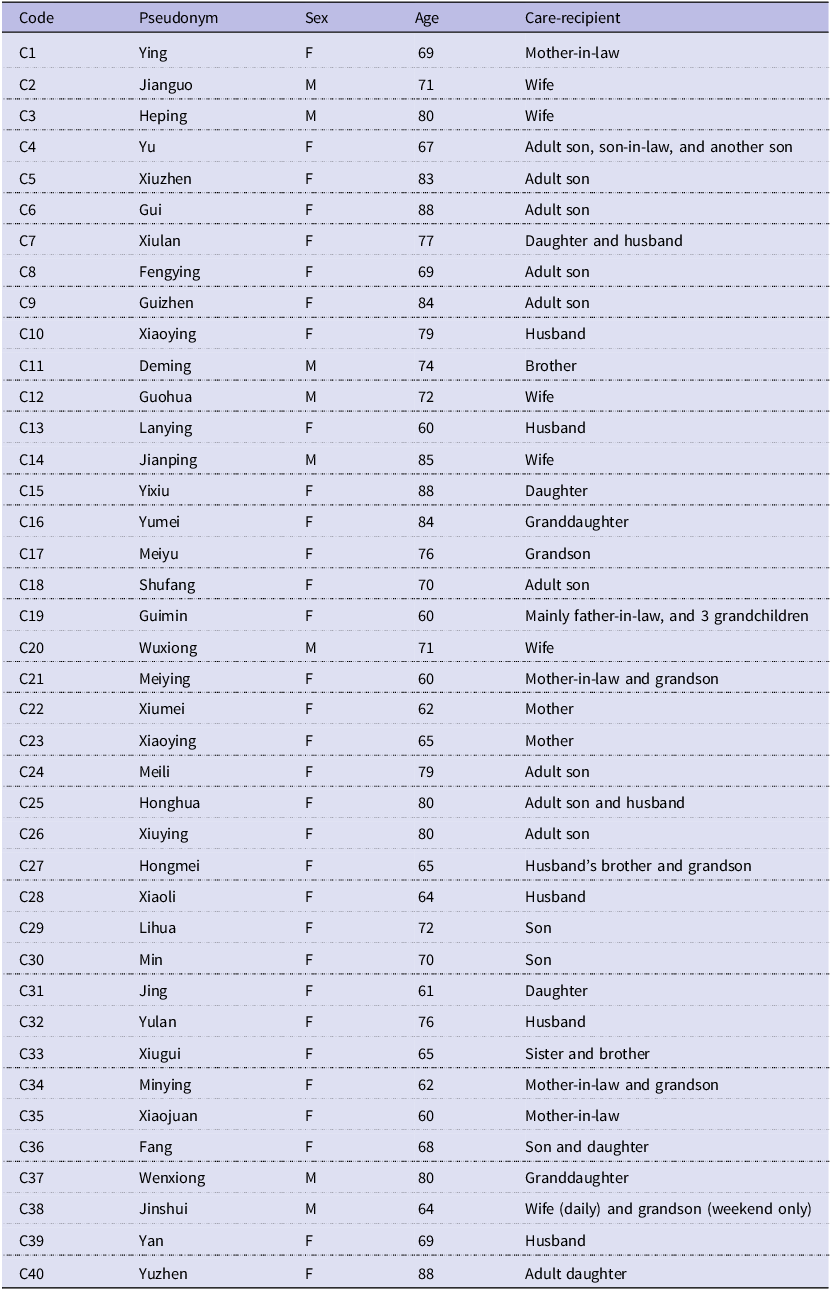
Table 1 Long description
The table presents the main characteristics of respondents who are caregivers. It includes 40 rows and 5 columns. The columns are labeled Code, Pseudonym, Sex, Age, and Care-recipient. Each row lists the code, pseudonym, sex, age, and the care-recipient of the respondent. The table provides detailed information about the respondents' relationships with their care-recipients, such as mothers, mothers-in-law, wives, husbands, adult sons/daughters, grandsons/granddaughters, and brothers and sisters. The ages of the respondents range from 60 to 88 years. The table does not summarize or interpret the data but lists the exact information provided in each row.
Source: Chan et al. (Reference Chan, Liang, Fong and Wong2024).
Key findings
This section reports the main themes obtained from the thematic analysis, as well as the pseudonyms and codes, in accordance with the research ethics.
Caring for their ‘own people’
With regard to the first research question on whether older carers engaged in traditional mutual helping practices, this study found that the respondents strongly believed that they had a duty to care for their close relatives. Jianguo (C2; taking care of his wife with multiple health problems) and Shufang (C18; supporting a physically disabled son) emphasised that their care recipient was a ‘family member’ that they would not give up caring for. Although Xiugui (C33) was tasked to look after her frail older sister and brother, she claimed that the caregiving task ‘is not hard, and she should do it’. Ying (C1; looking after her mother-in-law) quoted a Confucian text to justify her caregiving role: ‘Among all virtues, filial piety comes first’. She further emphasised that ‘taking care of my mother-in-law is my responsibility’ (C1).
As mentioned previously, married women are traditionally expected to look after their parents-in-law (Kendig and Liu, Reference Kendig, Liu, Liu and Kendig2000). When asked if her caregiving duty affected her daily life, Xiaojuan (C35) referred to her mother-in-law as her ‘own people’ and stated that she ‘has to help her even though daily life is being affected’. Thus, the respondents’ views showed that they were strongly influenced by traditional family values and perceived the practice of taking care of sick family members as an obligation.
Caring for multiple care recipients
In Chinese culture, the concept of family involves various networks and members linked by blood or marriage. In this study, the older respondents were taking care of members of their nuclear and extended families, such as their elderly parents, their children, their grandchildren, their parents-in-law, their children-in-law or their siblings-in-law. Xiugui (C33) was taking care of her older sister and older brother, and Meiying (C21) and Minying (C34) were caring for their fragile mother-in-law and grandson. Hongmei (C27) offered support to her brother-in-law, who experienced a stroke and suffered from kidney disease; her son; and her grandson. Some of the respondents were taking care of multiple care recipients and thus required suitable time arrangements and sought support from other family members on certain occasions. For example, Guimin (C19; helping to care for three grandchildren) asked her adult son to take time off from work so she could accompany her father-in-law to his medical appointment.
Some of the respondents, especially those who were young old, supported different individuals in different stages of their lives. For example, Xiugui was sixty-five years old and the primary carer for her parents and mother-in-law for several years (C33). After the death of her parents and mother-in-law, she took care of her older sister, who suffered from high blood pressure and heart disease, and her brother, who had mobility problems. Similarly, Ying (C1) supported various family members and described her experience, as follows:
I have taken care of my grandchildren since my first grandson was born. All six [of my] grandchildren are now in school, and I am too old to work. The health condition of my mother-in-law has deteriorated over the past two years, so I came home to take care of her in July last year. I do some daily tasks for her, like grocery shopping, cooking, washing clothes, house cleaning. (C1)
The older carers who cared for two or more family members struggled to perform their caregiving tasks. Honghua (C25; eighty years old) experienced considerable pressure in taking care of her two sons with brain damage and her husband, who suffered from breathing problems. She explained: ‘When I returned (home) after doing grocery shopping, I had to take care of my husband. Then, I had to check with my son’ (C25). Xiulan (C7; seventy-seven years old and taking care of her sick husband and daughter) shared that her caregiving tasks were extremely demanding:
It is very tiring to take care of both my daughter and husband. I am getting older and can’t do many things. Before my spouse fell ill, I used to pick up Lucy (my daughter) from the sheltered workshop daily, but I can only ask her to return on her own by taking public transport now. (C7)
The scope of the respondents’ caregiving was beyond their nuclear family and included extended family members. Specifically, the respondents looked after second- or third-generation family members in different stages of their lives. For some of the respondents, caregiving was a life-long journey.
Constraints of family support
Concerning the second research question, this study found that the caregiving capacity of some of the older respondents was constrained by their adult children’s financial difficulties and weak attachment to traditional values. Some of the older respondents received regular financial assistance from their adult children. For example, Ying (C1) was taking care of her mother-in-law, who suffered from multiple health problems, and received money regularly from her children for their daily expenses. Ying and her mother-in-law also received extra money from her children on special occasions, such as the Chinese New Year, birthdays, Mother’s Day, and the Mid-autumn Festival. Similarly, Shufang’s (C18) adult child gave her ¥1,000 a month for her living expenses.
By contrast, some respondents received limited assistance from their adult children. For instance, Yumei (C16; taking care of her granddaughter with a learning disability) received a small pension and was barely able to live a decent life. She said, ‘My pension is just enough for us to barely make a living. It is difficult for us to have a better meal’ (C16). In addition, she received only a small amount of money from her children during the Chinese New Year (C16). Meanwhile, Xiuzhen (C5; eighty-three years old and looking after her adult disabled son) did not receive any money from her other son.
Notably, some of the respondents’ children were unable to give them money because of financial difficulties. Xiaojuan’s (C35) son gave her only a small amount of money owing to his limited income. Jianping (C14) understood his children’s financial difficulties and was upset about this situation. Yumei (C16; eighty-four years old and caring for her granddaughter) shared her children’s financial constraints: ‘The circumstances of my other three daughters are also not good: my son has his own family, and his family condition is not very good’ (C16). Xiuying (C26), Yulan (C32), and Yuzhen (C40) also mentioned their children’s difficulties:
My daughter seldom helps me; she has her own family and a grandson to take care of… no (she doesn’t support me financially), she has a very small pension. (C26)
[My] son and daughter-in-law’s salaries are not enough for themselves. It’s not a big deal if there’s less money; we spend more when we have more and spend less when we have less. As long as we have enough to get by, that’s good. If we can save some money, we buy better-quality food. Normally, we aren’t picky with our meals; we just buy more vegetables. But, we also need to buy meat; we can’t go without it, especially since the children need to eat well for school. I also work a few hours to at least have some income. (C32)
She (the other daughter) has a daughter, and my granddaughter is a secondary school pupil. The tuition fee is ¥1,800 per term, and my daughter is unemployed. She lives hand to mouth. What can be done? If she could only manage to take care of herself, that would be sufficient. (C40)
Some respondents complained that their adult children did not follow the social norm of giving money to their elderly parents. When asked if her son gave her financial support, Xiaoying (C10) felt uncomfortable and said, ‘No, not a penny. I support myself. I don’t want to talk about this shameful thing. I will shed tears when I talk about it. Just don’t talk about it’. She (C10) was disappointed with her son’s lack of concern:
My son doesn’t care about anything. His father’s feet are painful. He didn’t even give us a phone call during the epidemic. Maybe I do not know how to raise and nurture him. No one else’s children would be like this. (C10)
This study showed that intergenerational support may depend on the nature of the parent–child relationship. Yixiu (C15; eighty-eight years old and looking after a mentally ill daughter) had a poor relationship with her children and had never received any help from them:
I feel really bad when talking about my children … one of them is still working. She didn’t tell me when she bought a house. I don’t know what has happened to her life. She doesn’t regard me as her mother. (C15)
The above findings revealed that, for some of the older carers, family support was irregular and constrained by their children’s financial hardships and poor intergenerational relationship.
Caregiving burden
Regarding the third research question on whether the Chinese government needs to support older carers more, this study found that the older carers felt tremendous pressure and required external help. Some of the older carers bore a heavy burden because of their small pension, the inadequate assistance that they received from their children, mental fatigue, and physical tiredness. Some of the old carers with little money tried to cut their expenses. For example, Yumei (C16) reduced her food expenses to save money for her granddaughter’s medical expenses:
I am encountering pressures in life, particularly in [my] finances. The monthly medical cost of Dorothy (Yumei’s granddaughter) is eighty Yen. Sometimes, I do not eat and sleep well. I have to cut expenses on food. I plant vegetables, buy some pork, and cook with soybean paste. It is just enough to fill my stomach, but I cannot buy tonic food. (C16)
Of the forty respondents, six indicated the need to reduce their food consumption to save money. Yuzhen (C40) was eighty-eight years old and had to take a part-time job to earn extra income:
The primary problem is that we simply don’t have enough money. My eldest daughter, I’m at a loss for words. She requires daily medication that amounts to a few hundred yuans each month. Additionally, I have my own medication to purchase, and on top of that, we have to pay for everyday household utilities like water, electricity, and gas. Our income is not enough. I do dishwashing at a breakfast shop at the corner of the street. They need someone to do the washing, and I wash the dishes after the customers finish breakfast at around nine to ten o’clock. I have been working at the shop for ten days. (C40)
Many of the respondents were concerned about caregiving issues and suffered from deteriorating physical health, body pains, and insomnia.
Self-reliance
This study showed that culture can shape people’s perception of self-reliance, and traditional Chinese families were self-sufficient units. However, this study found that many of the older carers regarded caregiving as a personal duty and a family affair and sought support mainly from other family members, instead of the government. Jianping (C14; eighty-five years old) said that he had never sought assistance from the government for his wife, who experienced a stroke. He emphasised that ‘It doesn’t matter, I do whatever I can do’. Similarly, Meiying (C21; caring for her mother-in-law and grandson) mentioned, ‘Our family does not want to bother others. It’s not a problem that can’t be solved. We have never asked for help from the neighbourhood committee’. Minying (C34) described caring for her mother-in-law and grandson as ‘an issue of our family’ and ‘does not need to rely on the government’. Yan (C39; sixty-nine years old and taking care of her husband and her grandchild) insisted that she could handle her caregiving tasks without any external help: ‘No need, no need for getting help. I will do what I can do and can do it by myself. I don’t rely on others. You will become lazy if you rely on others’ (C39). She refused financial assistance from the government and stated, ‘I think I will solve the problem by myself as long as I can’ (C39). Xiaojuan (C35; looking after her mother-in-law with multiple health problems) demonstrated a similar attitude. She chose to work part time to earn money, instead of asking the government for assistance: ‘I can still do a part-time job; I have not thought about obtaining public subsidies’.
Instead of asking the government for assistance, the older respondents reduced their daily expenses to alleviate their financial pressure. Wuxiong (C20) did not expect to receive any assistance from the government and social workers and was satisfied with his situation, because he did not need to worry about food. He remarked that he would cut his expenses if he encountered financial problems (C20). Minying (C34) was unable to pay for her mother-in-law’s treatment for her stroke. However, she saw this problem as an issue that needed to be addressed by the family, instead of the government: ‘We are not disabled or single people without family members. Why would the government need to help us? I have to rely on myself and [on] my mother-in-law’s children’ (C34). Similarly, Wenxiong (C37) was content with his current situation and did not expect any assistance from the government:
We need to be conscientious. The government has already cared for you, what else do you want? I do not want to make more requests. I do not need to get any help from others. I am not comfortable doing that. I am satisfied with current conditions. It is common to make different complaints. Now it is good, not bad. We will feel better if we look at things from the right perspective. (C37)
The respondents had a strong sense of self-reliance and perceived caregiving as a personal and family issue. Therefore, they were reluctant to seek external help.
Discussion
Inadequate support and need for a carers’ policy
The above findings showed that the caregiving capacity of some of the older carers was limited, they required external support because some had a small pension and received little assistance from their adult children. Some of the older carers bore the additional burden of having to care for two or more family members. The old carers felt exhausted and suffered from deteriorating health, body pains, and poor sleep. Other studies on informal carers also reported inadequate family support and urged the government to provide more assistance (Gu et al., Reference Gu, Rosenberg and Zeng2017; Luo et al., Reference Luo, Zhou, Liu and Hu2020; Yue et al., Reference Yue, Jia, Hu, Zhang, Bai, Wang and Yao2022; Zhang et al., Reference Zhang, Clarke and Rhynas2020). For example, in their study in Shandong Province, Yue et al. (Reference Yue, Jia, Hu, Zhang, Bai, Wang and Yao2022) reported that carers of older people with a disability encountered stress because of economic hardships, conflicting schedules, and insufficient caregiving abilities. Similarly, Zhang et al. (Reference Zhang, Clarke and Rhynas2020) illustrated that carers of dementia patients faced tremendous pressure owing to their limited family care capacity and inadequate public services. Gu et al. (Reference Gu, Rosenberg and Zeng2017) pointed out that traditional caregiving values have declined, and older people from low socioeconomic classes need increased support from the government and the community.
Over the past two decades, many developed countries introduced various types of assistance for informal caregivers. The UK government passed the Care Act in 2014 to promote the well-being of caregivers and prevent abuse and neglect (Care Act, 2014). The UK government (2023) also provided a weekly carers’ allowance of seventy six pounds and seventy five pence to low-income caregivers. The Canadian government offers financial support to carers of critically ill or injured individuals and allows a care leave of up to fifteen weeks, during which the caregivers may receive up to 55 per cent of their earnings (Employment and Social Development Canada, 2023). Meanwhile, the Australian government grants full-time employees an annual ten-day paid carers’ leave (The Fair Work Ombudsman, 2023), and the Japanese government gives employees up to ninety-three days of family care leave under certain circumstances and workers on nursing care leave up to two-thirds of their regular salary (Nikkei Asia, 2023).
At present, the support given by the Chinese government to informal caregivers is relatively limited. The Chinese government advocates for the ‘90-7-3’ model, which states that 90 per cent of older people are expected to be cared for in their own home, 7 per cent are to be cared for in the community, and 3 per cent are to be cared for in a residential institution (People’s Network, 2018). However, the Chinese government does not treat family caregivers as a standalone service group and has yet to implement a comprehensive national policy for carers. Policies for carers are typically subsumed under the broad category of ageing services. For example, in the ‘fourteen Five-Year Plan’, the needs of carers are presented under ageing and the elderly care service system. Although the ‘Fourteenth Five-Year Plan’ proposed a care leave system for parents and ‘respite services’ for carers (The State Council, 2021), the measures have been adopted by only a few local governments, who offer outreach and respite services for family caregivers (Consulting Team from the Hong Kong Polytechnic University, 2022). Moreover, as a result of the lack of standardised caregiver leave regulations, variations exist in the care leave schemes across different cities in China. For example, Beijing grants a ten-day paid care leave to employees with no siblings (Beijing Municipal People’s Congress Standing Committee, 2021), whereas Yunnan grants a twenty-day leave and a ten-day leave to ‘only child’ employees and employees with siblings, respectively (Xishuangbanna Prefecture Health Commission, 2022).
The caregiving capacity of carers should be improved to support the ‘90-7-3’ ageing model, encouraging older people to age in place. Thus, the Chinese government should implement a comprehensive nationwide carers’ policy to clarify the meaning of an informal carer, the scope of the main services (e.g. financial assistance, caregiving leave, respite services, and psychological support) and the duty of a local government to improve carers’ well-being. The national carers’ policy should include detailed and clear guidelines for local governments to ensure that caregivers across the country are receiving consistent and adequate support.
Carers’ empowerment and common prosperity policy
Influenced by family-oriented welfare ideologies, many of the older carers in this study regarded their caregiving burden as a personal issue and a family responsibility. Qiu et al. (Reference Qiu, Sit and Koo2017) reported that family caregivers of stroke survivors believe that taking care of sick family members is part of life and a culturally prescribed duty. They also emphasised self-sacrifice in the process of supporting sick and frail family members. However, the older carers’ strong sense of self-reliance caused them hardships and negatively affected their psychological health and material well-being. As illustrated in the previous section, some of the carers cut their expenses to save money for medical treatments or worked part-time jobs to augment their family income. However, the respondents were content with their situation and did not complain about their difficulties. The older carers’ hardships may last for many years if they do not receive any external assistance, but their strong self-reliance ideology acted as a barrier to the improvement of their long-term well-being and that of their care recipients. Qiu et al. (Reference Qiu, Sit and Koo2017) also found that their respondents tended to not seek help owing to their self-reliance ideologies.
Self-reliance ideologies can be used to reduce people’s welfare dependency on the state. Halvorsen (Reference Halvorsen2007) argued that self-reliance ideologies may be adopted to maintain people’s individualism and work ethics in a capitalist state. Informal carers must strike a balance between their welfare rights and personal duties to improve their well-being, maintain their dignity and achieve social integration (Halvorsen, Reference Halvorsen2007). Wong and Lou (Reference Wong and Lou2010, p. 519) noted that, as a capitalist state, Hong Kong’s welfare system has a contradictory task of ‘providing ontological security on the one hand and promoting self-reliance on the hand’. The Chinese government can provide older carers with benefits and welfare rights by addressing their caregiving burden. China’s recent ‘common prosperity’ strategy, which is regarded as a ‘new blueprint’ for its next developmental step (Wu, Reference Wu2022, p. 7) to promote common well-being and build a modern socialist country (South China Morning Post, (2021), is compatible with its duty to serve older carers and address their needs. Thus, by addressing the negative consequences of old carers’ self-reliance and the fundamental problem of poverty, the Chinese government can promote the idea of common economic prosperity to counter family carers’ feelings of shame and dependency when seeking external support. The well-being of family carers can be used as a key indicator to measure the success of China’s common prosperity policy.
Conclusion
The older carers of this study demonstrated strong traditional family values by including close relatives among their ‘people’ and feeling obligated to care for them. Their duty to provide mutual support led some of them to look after multiple care recipients in different stages of their lives. However, the caregiving capacity of some of the older carers was constrained by their small pensions, high medical costs, and the limited financial assistance that they received from their adult children. Faced with financial difficulties, many of the respondents exhibited self-reliance and refrained from seeking external support. Instead, they cut their household expenses and worked part-time jobs to address their financial problems. However, such coping strategies were unable to solve their problems, and the older carers felt exhausted and suffered from deteriorating physical and mental health. Thus, the Chinese government needs to introduce a comprehensive carers’ policy defining the responsibilities of the local government and providing support services to older carers to alleviate their caregiving pressure. Moreover, common prosperity can be adopted to empower family carers by giving them an opportunity to share in China’s economic achievements and access relevant public services.
For future research, quantitative studies can be conducted in different cities to examine the caregiving capacity of older carers in China. Apart from China, other Asian countries, such as South Korea, Singapore, and Japan, are deeply influenced by Confucian family ethics. Thus, comparative studies on the caregiving values of older carers and the extent of their family support may enhance our understanding of care relations and the welfare capacity of families in East Asian countries.
Acknowledgements
The authors would like to express gratitude to Lingnan University for offering a research grant (DR20B6) to study this topic. We are also grateful to the reviewers for their insightful feedback on the earlier version of this paper.
Competing interests
The authors have no competing interests to declare.

 Open access

