




On 14 May and 25 June 1959, the Royal Society held its annual conversazione to showcase noteworthy advances in British science, engineering and technology. One of the roughly two dozen exhibits was presented by Alan Durrant, a researcher at the Institute of Rural Science in Aberystwyth, entitled, ‘Transmission from parent to offspring of environmentally induced changes in flax’.Footnote 1 The exhibit catalog summarized Durrant’s demonstration that ‘[l]arge quantitative differences produced in flax by the application of different combinations of nitrogen, potassium and phosphorus persist undiminished for at least five generations’.Footnote 2 This dry and unremarkable excerpt obscured the larger import of Durrant’s claims to have fashioned a possible rapprochement between Western and ‘Eastern genetics’, the latter promulgated by the Soviet agronomist Trofim Denisovich Lysenko.Footnote 3
Durrant began his experiments six years earlier in 1953 to investigate the effects of the environment on different varieties of flax (Linum usitatissimum), including cultivated strains (cultivars) used to produce linseed oil and others specialized for linen fibre production.Footnote 4 The environmental variable that Durrant manipulated was soil nutrient content in the form of different fertilizer treatments that altered relative ratios of nitrogen (N), phosphorus (P) and potassium (K). This straightforward experiment tested so-called genotype-by-environment interactions by measuring how different flax strains (genotypes) grew in different soil compositions (environments) in a single generation of cultivation. As expected, plants grown in soils with higher nutrient content grew larger but there were differences among the strains in how well they reacted to the different environments. Durrant was surprised, however, when he grew the offspring of these plants. Seeds collected in equal proportions from five parent plants exposed to each treatment were sown either in a single common environment or in an array of soils with different nutrient content that matched the first-generation treatments.Footnote 5 In both types of experimental protocol, plants grown in favourable nutrient conditions in the first generation gave rise to larger plants in subsequent generations.Footnote 6 Conversely, plants grown in poor nutrient conditions produced seed that gave rise to smaller plants on average in the next generation, after factoring in the influence of the soil composition in the second generation. Durrant surmised that the soil environment during the first generation altered the progeny in the next generation independent of the effects of the growth conditions experienced by the offspring in its immediate environment. In other words, Durrant interpreted these data as evidence for a transmission of environmental effects through the seeds to the next generation.Footnote 7 Here I combine text-based and experimental historical analysis to argue for a reappraisal of this scientific interpretation, while offering a deeper look at the complexity of reactions to Lysenko’s hereditary theories in the West during the Cold War.
Environmental memory
Durrant’s results and conclusions were consistent with those emerging in the 1950s from other agricultural researchers in the UK and the US describing related phenomena in which parental growth conditions affected progeny. For example, Harry R. Highkin, working at the California Institute of Technology, reported that pea plants grown at constant temperatures, rather than under normally cycling day/night temperatures, grew more slowly, and that the inhibitory effects were cumulative until a point of saturation after five generations.Footnote 8 These effects decayed gradually over several generations of growth under normal conditions with a typical day/night temperature regime. The mechanisms responsible for the reversible growth inhibition that Highkin observed might have been maternal effects, stemming from different nutritional stores available to the developing seedling from the seed. Such effects could not be invoked to explain the differences between Durrant’s large and small flax derivatives (or ‘genotrophs’), as he observed that plant size was not controlled by maternal effects but by the outcome of stable inherited differences, which could be transmitted to offspring through both the male and female lineage.Footnote 9 Durrant also conducted grafting experiments that demonstrated that the new characteristics of the genotrophs were stable and therefore likely under the control of inherited factors.Footnote 10 Durrant hypothesized that the traits of the genotroph derivatives either were controlled by the contents of the nucleus (as would be expected if changes occurred in the genetic make-up of the chromosomes) or resulted from some type of unexplained imbalance between the nucleus and the cytoplasm.Footnote 11 Regardless of the specific underlying mechanism, Durrant stressed the essential point that the ‘parental treatments induced inherited changes’ and had done so reproducibly and quickly, often in a single generation.Footnote 12
The noted science journalist Maurice Goldsmith, writing in the British cultural and political magazine The Spectator, observed that Durrant’s 1959 Royal Society exhibit ‘excited a great deal of interest, because it is possible to infer from his experiments that in some way Lysenko may have been right.’Footnote 13 The connection to Lysenko was not Goldsmith’s provocative or sensationalistic leap – Durrant himself made this connection explicit at the time and continued to do so throughout the remainder of his career. Both Durrant’s flax experiments and Lysenko’s crop manipulation efforts relied on environmental treatments to create persistent changes in the characteristics of crop varieties. One of Lysenko’s most important and controversial claims was that exposure of seeds and young plants to altered temperature and moisture conditions could convert winter wheat varieties – which require overwintering in the soil to permit subsequent flowering – into spring varieties that flower without overwintering.Footnote 14 These ‘vernalization’ responses to stimulate flowering are common in plants and have been validated by many researchers, starting before Lysenko’s time and extending up to the present.Footnote 15 Over the past two decades, the molecular mechanisms responsible for the perception and memory of cold temperatures within a single plant’s lifetime have been elucidated in exquisite detail for several plant species, including wheat.Footnote 16 Lysenko’s claim, however, encompassed more than a single plant’s physiological response to temperature; he argued that the effect of the vernalization treatment could persist and be passed on to progeny, representing an example of inheritance of acquired characteristics.Footnote 17 Lysenko made related claims for environmental manipulations and procedures of other types, such as grafting, bolstering the argument that plants could integrate information from past environments and transfer that information to subsequent generations.Footnote 18 Lysenko synthesized these results into a general principle that a plant’s ‘hereditary constitution is … a concentrate of the environmental conditions assimilated … in a number of preceding generations’.Footnote 19 Such a conception was at odds with the Mendelian framework of inheritance based on ‘hard’ genetic information passed down through generations untouched by the environmental conditions experienced by the organisms carrying that information.
It is impossible to discuss Lysenko’s scientific claims, nor the reaction to them, in isolation from his enormous political and institutional impact on biology in the Soviet Union. Lysenko rose to prominence in the mid-1930s and precipitated waves of increasingly severe restructuring of agricultural and biological sciences in the Soviet Union linked with brutal and often deadly purges of prominent geneticists.Footnote 20 In the early 1950s, when Durrant began his flax experiments, Lysenko’s institutional dominance had recently been cemented in the August 1948 meeting of the Academy of Agricultural Sciences (VASKhNIL), widening the rift between Mendelian genetics in the West and Lysenko’s environmentalist concept of heredity.Footnote 21 Lysenko enjoyed some support in the West, at least for a time, among Marxist scientists and Communist Party members, such as J.D. Bernal and J.B.S. Haldane.Footnote 22 Much more common, however, was the reaction of prominent Mendelians, such as C.D. Darlington and R.A. Fisher, who denounced Lysenko as a scientific charlatan.Footnote 23 The vilification of Lysenko in the West sharpened as the Cold War began and the suppression of genetics in the Soviet Union became official policy, orchestrated by Lysenko’s machinations.Footnote 24 It was perhaps surprising, then, that in the late 1950s Durrant would actively connect his flax research to Lysenko’s widely discredited science and his attendant ruinous political campaign against genetics.Footnote 25 One possible factor in this decision may have been Durrant’s familiarity with a more nuanced view of the ‘Lysenko controversy’.Footnote 26
This exception to the typically polarized views of Lysenko in the West was put forward by the prominent British geneticist Kenneth Mather, who was Alan Durrant’s PhD mentor at the University of Birmingham. Mather urged a more open-minded consideration of some aspects of Lysenko’s attack on genetics. Writing in a 1942 letter to the journal Nature, during a time when Lysenko’s influence was accumulating but before the pivotal 1948 VASKhNIL meeting, Mather weighed Lysenko’s arguments against Mendelian genetics.Footnote 27 The short piece contained a concise history of the discipline of genetics and grappled with the admitted failure of the field to deal effectively with problems relevant to agronomic breeders. This perspective was, in part, an argument for more investment in work on the inheritance of so-called quantitative traits affected by many genes (hence polygenes), which was Mather’s specialty. It is critical to note that Mather did not dismiss Lysenko’s neo-Lamarckian breeding methods out of hand, acknowledging that if they ‘should prove sound, its basic theory must be incorporated in genetics’, but he wrote that ‘this is a matter for the future’.Footnote 28 Mather would reiterate this perspective seventeen years later during a radio broadcast interview. Commenting on the excitement surrounding Durrant’s Royal Society exhibit in 1959, Mather characterized Durrant’s flax work as ‘a result of great practical importance for agriculture if other crops behave in the same way, and one which might ultimately sift out the essence of Lysenko’s claims and weld them in their true place onto classical genetics’.Footnote 29
Pure lines and inbreeding: the problem of genetic purity
Mather, however, did push back in his 1942 letter to Nature on another key criticism that Lysenko leveled against genetics: a rejection of pure-line theory, which was first articulated in 1903 by the Danish botanist Wilhelm Johannsen.Footnote 30 In Johannsen’s terminology, a ‘pure line’ describes individuals descended from a single parent by self-fertilization.Footnote 31 This process should capture and propagate the genetic information held in that individual. If the selected plant had just one set of genetic information (that is, was homozygous at all loci along the chromosomes in a diploid parent), then sexual reproduction via self-fertilization would be equivalent to asexual cloning in which parents and offspring were genetically identical. This insight was the essence of Johannsen’s work on pure lines of the bean Phaseolus vulgaris based on his demonstration that artificial selection for seed size within these pure lines was ineffective. Selection did not change the line’s observable characteristics (phenotype) because the underlying genetic constitution (genotype) remained constant.Footnote 32
Mather explained that Lysenko rejected the pure-line theory ‘on the basis of his observation that intra-varietal variation exists in self-fertilizing cereals’, meaning that the characteristics would differ substantially among individuals of a particular strain of a cereal crop propagated via self-pollination.Footnote 33 Lysenko, expanding upon ideas originally proposed by Charles Darwin, believed that all pure lines would fail to remain uniform and that the offspring would show differences due to segregation among progeny of different adaptabilities, which were generated by micro-environmental differences experienced by the parent.Footnote 34 These adaptabilities were assumed to act akin to dominant factors that gave the parent resilience and vigor in the original environment. The distribution of these hypothetical factors parcelled out to offspring left the progeny plants with only a subset of the original complement, making them less vigorous. Mather asserted in his 1942 rebuttal of Lysenko that there was a simple Mendelian explanation for any observed non-typical progeny from a self-fertilized plant given that obtaining and maintaining a genetically homogenous line was extremely difficult. New genetic variation would constantly be introduced into a line through ongoing spontaneous mutation and, further, outcrossing (i.e. contamination) events would be difficult to prevent or exclude.Footnote 35
Mather was acutely aware of the issues surrounding the genetic homogeneity of strains. In the 1940s, he published seminal papers on selection studies using genetically ‘inbred’ lines of the fruit or vinegar fly Drosophila melanogaster.Footnote 36 Mather and his co-authors showed that even extensively inbred Drosophila lines were not genetically homogenous because new mutations constantly arise, allowing new sub-lines with altered traits to be selected.Footnote 37 One of these papers, ‘Selection of invisible mutations’, was submitted by Mather and his co-author, L.G. Wigan, to the Proceedings of the Royal Society in March of 1942, two months before Mather’s commentary on Lysenko appeared in Nature.Footnote 38 Mather subsequently published a number of related studies, including a 1954 paper co-authored with Durrant entitled ‘Heritable variation in a long inbred line of Drosophila’.Footnote 39 Durrant was, therefore, well aware of the difficulty – indeed, the near impossibility – of ruling out genetic heterogeneity in any particular variety or line. This issue was a crucial factor complicating the interpretation of Durrant’s flax genotroph research, which formed the core of his long career in Aberystwyth and for which he was recognized and awarded the degree of DSc in 1973.Footnote 40
Plastic cultivars and stable genotrophs
What began as a survey of over a dozen cultivars of flax to test their response to various fertilizer treatments became a study focused on the after-effects of those treatments using primarily one cultivar, Stormont Cirrus, supplemented with work on a second cultivar, Liral Prince.Footnote 41 In his first publication of this work in 1958, Durrant described Stormont Cirrus as ‘an inbred, self-fertilizing variety’.Footnote 42 A casual reader of this original report would take this information to mean that the Stormont Cirrus line was genetically homogenous, setting aside concerns that pre-existing genetic differences among the treated plants could be the source of the size differences that Durrant had measured and correlated with parental fertilizer treatments. As just discussed, however, Durrant was aware of the nuances of the situation.
In a 1962 publication in the journal Heredity, Durrant described in more detail the source of his Stormont Cirrus material:
Seed of the variety Stormont Cirrus was kindly supplied by the Plant Breeding Station at Stormont in Northern Ireland. In 1953 it was sown in boxes outside the greenhouse and the plants transplanted into small observation plots which had not recently received fertilisers … Flower buds were bagged on several plants and seeds from eight capsules, four from each of two plants, used for experiments which began in 1954.Footnote 43
Therefore Durrant started his experiments with a batch of donated seeds, and he selected two plants grown in 1953 as the progenitors of his subsequent experimental lines, which were derived from his various fertilizer treatments in 1954. In a retrospective written toward the end of his life and published in 2009 by his colleagues after his death, Durrant wrote in more detail about his concerns at the outset of these experiments that Stormont Cirrus might harbor residual genetic variation. Yet he largely dismissed the presence of significant genetic variation in the Stormont Cirrus line, not only because of its history as a well-known cultivar, but because ‘[s]uch large variation was not seen among the parents in 1954, nor in their grandparents in 1953’.Footnote 44 In other words, Durrant did not observe significant differences in the size or overt characteristics of the plants used to begin the experiment, reinforcing his conclusion that residual genetic variation in the Stormont Cirrus line was negligible and would not complicate his objective of measuring the long-term effects of soil nutrients.
Based on his ability to generate large and small genotroph derivatives from Stormont Cirrus, Durrant labelled the original strain Plastic, denoting the capacity to be molded or altered by the nutrient environment in the soil.Footnote 45 The various large and small genotroph lines derived from the Plastic parent, however, were stable and could not be altered by subsequent selection regimes to identify sub-lines with more extreme size traits.Footnote 46 This resistance to selection exhibited by the sub-lines was another indication to Durrant that the genotrophs did not harbor significant genetic variation and that the same was likely true for the parent.Footnote 47 By the end of his career, Durrant had propagated some of his genotroph lines for fifty generations and they retained the non-parental traits that he observed in the first-generation of nutrient-stressed progeny. This observation, Durrant admitted, ‘invites claims that they [the underlying genetic changes] are not induced changes but residual genetic differences selected by the fertilisers’.Footnote 48 But Durrant quickly rebutted this concern, writing, ‘Residual genetic variation of this kind and magnitude has not been seen nor established among the plants studied’.Footnote 49 This rebuttal, however, is challenged by the history of Stormont Cirrus and related fibre flax cultivars developed in the period between the world wars.
Linen and fibre flax breeding in the interwar period
Stormont Cirrus was released as a cultivar in 1932, after which time it was grown widely in the UK and North America before being replaced by more disease-resistant cultivars in the 1940s.Footnote 50 Stormont Cirrus is one example of several cultivars developed from intensified breeding efforts in the UK in response to the disruption in the normal supply of fibre flax seed from Russia after the revolution in 1917.Footnote 51 These efforts proceeded in the public sector in parallel with work by the linen industry consortium LIRA (the Linen Industry Research Association), which established a plant breeding station in Lambeg in Northern Ireland.Footnote 52 Stormont Cirrus, a product of the public-sector effort, and Liral Prince, a variety developed by LIRA, were examples of pure lines generated by self-fertilization of a single plant selected for its superior qualities. Stormont Cirrus, developed by the Department of Agriculture and Technical Instruction for Ireland (later by the Ministry of Agriculture for Northern Ireland, Stormont, Belfast), appears to correspond to the department’s Pure Line No. 6, which was generated from a single plant grown during the First World War from Russian seed.Footnote 53 The plant that gave rise to Liral Prince was selected toward the end of the Second World War.Footnote 54 Each line was then expanded by collecting the self-fertilized seeds from the descendants of the original plant. After passage through such a single genetic bottleneck, the line would incorporate all the genetic diversity present in the progenitor plant. Therefore these lines were only partially inbred and would be expected to continue to segregate variation for all regions of the chromosomes that were heterozygous in the selected progenitor plant. It would require many additional generations of propagation from single individuals (i.e. applying a series of genetic bottlenecks) to purify the line to the point where only a small amount of genetic variation was segregating. However, the need to produce a large number of seeds for planting was acute, and fibre flax varieties are poor seed producers, especially in the damp climates prevalent in the UK, necessitating outsourcing of seed production to other countries with more favorable climates.Footnote 55 In the end, the use of these pure lines, which passed through just a single genetic bottleneck or a limited number of them, was a compromise to balance the need to accelerate seed production with improved, and reasonably predictable, performance.
Contrasting perspectives of a breeder and a geneticist
The 1953 transfer of a batch of seeds from the Plant Breeding Station to Durrant effectively marked a reclassification of Stormont Cirrus from a plant breeder’s pure line to a geneticist’s inbred line. The latter designation projected confidence that the line was genetically pure but, as just described, Stormont Cirrus and Liral Prince were only partially inbred. Variation in similar pure lines continued to be exploited to select individuals with improved traits, leading to the development of new varieties by LIRA into the 1950s.Footnote 56 Fibre flax is grown at very high density and harvested by pulling up the base of the plant to preserve the long stems, which contain the fibre processed for linen and other fabrics. Under these conditions, variation in plant characteristics, if it existed in the line, might be of little consequence to the agriculturalist. Yet significant segregation within progeny of the Plastic parent would present a challenge to the geneticist whose experiments assume a background of genetic homogeneity.
It was clear that the large and small genotroph lines isolated by Durrant were genetically distinct and different from the progenitor Plastic line. Durrant was able to demonstrate these differences using classical genetic approaches, such as controlled crosses among different plants and observation of traits segregating in subsequent generations.Footnote 57 These experiments allowed Durrant to conclude that there were many stable, presumably genetic, differences that distinguished the genotrophs and the parent line, hence polygenic differences such as those studied by Durrant’s mentor, Mather.Footnote 58
Extensive characterization of descendants of Durrant’s genotroph lines by Christopher Cullis’s laboratory (starting at the John Innes Institute and later at Case Western University) supported Durrant’s conclusions that the lines are genetically distinct. Cullis and his colleagues published a series of scientific reports comparing Plastic and genotrophs using an array of increasingly sophisticated molecular-biology techniques, culminating in a comparison of selected genomic regions based on whole-genome sequence data.Footnote 59 One of these reports described a transposable element insertion (Linum Insertion Sequence-1 or LIS-1) that resides at a specific genomic location in many genotroph lines isolated by Durrant, but is absent in the parental Stormont Cirrus Plastic line.Footnote 60
These puzzling molecular genetic results prompted my laboratory to examine three different accessions of Stormont Cirrus available from the seed bank at the Leibniz Institute of Plant Genetics and Crop Plant Research (IPK) in Gatersleben, Germany. These accessions, which entered the stock centre at different times, ranging from 1950 to 2003, represent independent samples of the Stormont Cirrus line. We planted seeds from the supply provided by the stock centre for each of the three Stormont Cirrus accessions and characterized individual plants for the presence of the LIS-1 insertion, the genetic marker identified by Cullis and colleagues in many genotroph derivatives.
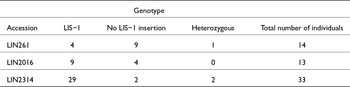
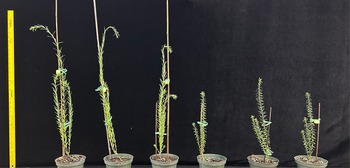
As shown in Table 1, we examined subpopulations from the accessions (between fourteen and thirty-three plants) and found a mixture of genetic types in each accession; some plants contained only the genotroph-associated genetic marker (LIS-1), while others contained the Plastic-specific alternative marker (which lacked the LIS-1 insertion). In two accessions, we identified individuals that contained both alternative genetic markers in a heterozygous state.Footnote 61 We conclude that none of the accessions is genetically pure and that the genetic marker previously identified as associated with genotroph lines pre-existed in the parental Stormont Cirrus line. Further, we observed marked morphological differences among individuals in two of the three accession subpopulations, allowing us to isolate stable sub-lines with different plant statures (see Figure 1).
Genetic testing of Stormont Cirrus individuals from three accessions.

Table 1 Long description
The table presents genetic testing results for Stormont Cirrus individuals across three accessions, focusing on the presence of the LIS−1 insertion. LIN2314 has the highest number of individuals with LIS−1 insertion at 29, compared to LIN261 with 4 and LIN2016 with 9. LIN261 has the most individuals without the LIS−1 insertion at 9, while LIN2314 has 2 and LIN2016 has 4. Heterozygous individuals are present in LIN261 and LIN2314, with 1 and 2 individuals respectively, but none in LIN2016. The total number of individuals tested varies, with LIN2314 having the largest group at 33, followed by LIN261 with 14 and LIN2016 with 13. This data highlights the genetic diversity among the accessions, particularly in the presence of the LIS−1 insertion.
Variation in plant stature among six-week-old individuals derived from the Stormont Cirrus accession LIN2314. The three individuals on the left are siblings derived from a plant exhibiting typical height, while the three individuals on the right are siblings from a parent with short stature. A yardstick is shown as a size marker on the left. Photograph by Brendan Kosztyo and Eric Richards.

Figure 1 Long description
Six plants are displayed in individual pots, arranged in a row against a dark background. The plants vary in height, with the three on the left being taller and supported by sticks, while the three on the right are shorter. A yardstick is positioned on the far left, serving as a size marker for comparison. The plants are placed in small pots filled with soil and each plant is tied to a stick for support.
Therefore, both our text- and experiment-based historical re-examinations support the conclusion that the Stormont Cirrus line contains significant genetic variation. Consequently, Stormont Cirrus is best characterized as a breeder’s pure line, as defined by Johannsen, rather than as a highly inbred line of the kind typically used by experimental geneticists. Hence it is necessary to consider the possibility that Durrant’s genotroph soil nutrient exposure protocol did not induce new variation but acted as a selection regime that filtered pre-existing variation in Stormont Cirrus.
Although Durrant reported the absence of marked phenotypic variation among individuals in his parental Stormont Cirrus line, this observation does not rule out the presence of genetic variation that was masked by dominant genes or whose effects were suppressed by environmental conditions. Durrant tried to minimize selection by collecting an equal number of seeds from the five parent plants in each of his treatment groups, but this approach cannot completely avoid a bias toward preferential recovery of genetic variants favored by a particular nutrient environment. My group’s experimental work demonstrated that both forms of a genetic marker reported to distinguish between Plastic and genotrophic derivatives were present in the progenitor Stormont Cirrus stock, including in heterozygous individuals. This discovery points to a simpler explanation for Durrant’s results. If one or both plants originally chosen by Durrant in 1953 to begin his experiments carried alternative variants at genes controlling plant size, segregation of these variants (i.e. alleles) and selection for allelic combinations that increase plant fitness in different nutrient environments could account for the recovery of genotroph lines. If the number of genes controlling plant size is small, the recovery of specific gene variant combinations would be frequent and would appear to be a reproducible consequence of nutrient treatment, as Durrant reported.
Environmental plasticity and breeding history
Our experimental findings that the Stormont Cirrus line continues to segregate genetic variation is consistent with long-standing observations that many traditional fibre flax lines are unstable when propagated via self-pollination.Footnote 62 Durrant highlighted this instability and the lack of intensive breeding as a prerequisite for crop variety to be susceptible to environmental conditioning. Durrant’s interpretation was that a variety’s ability to respond to the environment would be reduced by prolonged breeding programmes that optimized genetic factors for high yield in near-optimal conditions. By this reasoning, the genetic architecture necessary for adaptive environmental plasticity would be replaced by hardwired genetic specification of desired traits. The alternative explanation is that breeding programmes would have reduced the amount of genetic variation present in the lines and precluded selection of variants after exposure to different nutrient treatments.
One defense of Durrant’s flax work is that the tools available at the time to monitor and describe genetic variation were limited to fairly crude and time-consuming methods. Durrant was aware of the problem of genetic heterogeneity in inbred lines, so it was puzzling that he did not employ the standard approach available to him: to purify his varieties through multiple generations of single-seed descent (i.e. serial genetic bottlenecks) before beginning his experiments.Footnote 63 This approach would have required several years, however, and Durrant did not set out to initiate a long-term genetic analysis of Stormont Cirrus. Rather, he conducted a limited genotype-by-environment trial of several flax varieties, and his initial findings intrigued him enough to continue with the experiment without shoring up the genetic foundation of the study.
Flax genotrophs and environmentalist conceptions of inheritance
It is important to consider why Durrant’s genotroph work and his favoured interpretation resonated in the late 1950s and continue to garner attention up to the present. At the time Durrant first reported his flax work, an accumulating number of studies had documented examples of unexpected heredity patterns in a variety of organisms. This work included results from scientists studying cytoplasmic inheritance in microorganisms and other non-Mendelian phenomena, such as paramutation, mutable genes and controlling elements in maize.Footnote 64 Durrant’s own work on selection in Drosophila inbred lines, which he continued at Aberystwyth, argued that non-genetic factors, such as age and diet, influenced inherited traits.Footnote 65 In his publications, Durrant wove his flax results into this broader fabric of published findings, which pushed beyond the boundaries of traditional Mendelian genetics.
The enduring interest in flax genotrophs is tied, I contend, to the persistent allure of invoking a more direct role for the environment in evolution beyond simply filtering out maladapted variants. Durrant’s work led him to embrace a more expansive conception of the source of inherited biological variation that encompassed environmental and non-genetic influences. While this view paralleled that of Lysenko and his followers, these ideas have a much deeper history in evolutionary biology and genetics, and they endure as active and controversial issues to this day, often in the framework of epigenetic variation and inheritance.Footnote 66
A desire to imbue the environment with a formative role in skewing the type of variation available for selection, or to deny that possibility, continues to influence researchers’ assessment of their findings and their choices regarding research programmes. These considerations were important for Durrant, who clearly understood the danger of pursuing questions connected to environmental modification of inheritance, and to Lysenko’s science in particular. In his posthumously published retrospective, Durrant expressed his hesitancy to launch his flax work, because of
the climate of opinion, and the schism between east and west genetics, especially in the 1950s and 1960s, in the shadow of Trofim Denisovich Lysenko, a latter day Lamarckist. There was the impression, or an atmosphere, that studies on the possible inheritance of environmental effects or on some similar studies would be unacceptable. Lysenko was dismissed in 1964 from the experimental farm he directed after a commission of the Soviet Academy of Sciences judged his methods a failure.Footnote 67
Despite this initial trepidation about studying a topic that he knew to be problematic and potentially taboo, by the late 1950s Durrant had embraced the Lysenko connection in a manner that set him apart from most of his colleagues in the West. One possible reason for this choice is that Durrant’s explicit framing of his work in relation to the Lysenko controversy was effective in generating visibility in the popular press. The Lysenko angle featured prominently in Mather’s BBC interview regarding Durrant’s 1959 Royal Society conversazione exhibit.Footnote 68 The title of the article written by Maurice Goldsmith reviewing that exhibit in The Spectator was ‘Lysenko comes back’.Footnote 69 Similarly, coverage of Durrant’s exhibit in a major US paper, the Washington Post and Times Herald, ran under the title ‘British tests indicate that Lysenko may be right’.Footnote 70 Through these eye-catching distillations in the popular press, Durrant successfully promoted his work by exploiting the shock value of dancing close to a third rail in Western science. Such visibility would have benefited a young researcher establishing a novel, independent programme after training under a prominent mentor such as Mather.
Other institutional considerations were likely a factor in Durrant’s decision to position his work in relation to Lysenko’s scientific ideas. Durrant began his flax experiments when appointed as a lecturer in an agricultural science programme in Wales (Department of Agricultural Botany, University of Wales, Aberystwyth), using funds received from the Agricultural Research Council in the UK. A connection with Lysenko’s ideas might have been less objectionable among Durrant’s Department of Agricultural Botany colleagues due to the widespread appreciation within the plant biology community of the importance of Lysenko’s plant-physiological work, if not his genetic theories.Footnote 71 Durrant’s flax results enjoyed institutional support, as suggested by press coverage of the 1959 Royal Society exhibit that quoted affirmation of Durrant’s findings and their potential relevance to Lysenko’s ideas from P.T. Thomas, then the director of the Welsh Plant Breeding Station and department head at Durrant’s home institution.Footnote 72 Additionally, there was the parallel between Durrant’s choice of a practical research topic and Lysenko’s call for geneticists to develop real-world applications versus becoming distracted by esoteric problems in model organisms.
Yet such practical considerations – a play for visibility in the general press and the need to address issues of agricultural importance – should not obscure Durrant’s interest in the fundamental significance of his results and that of inherited environmental effects. It is a testament to Durrant’s conviction of the importance of such effects, and the entanglement of his work with that of Lysenko, that Durrant devoted the end of his career retrospective to a short meditation entitled ‘A comment on Lysenko’s genetics’:
A question sometimes asked is, do these results support T D Lysenko’s theories on inheritance? The short answer is no because he interpreted inheritance in all plants as a consequence of their nutrition encompassing all aspects of their environment, which led to strange claims of crop improvements, ignoring the guiding principles of present day genetics and cytology. The theories of Lysenko were rejected. This was however many years ago and there may have been some caught up in the debacle who believed they were at least partly right. Without their acknowledging and allowing for the role of chromosomes in inheritance it is not possible to construe their results, but some might have been interesting.Footnote 73
At the end of his career, the Lysenko connection was less a titillation or a play for relevance for Durrant than a source of regret for the taint that the controversy had brought to a promising area of research. Durrant’s wistful concern about missed opportunities to study important but now relegated phenomena was premature. The search for persistent environmental effects complicating traditional Mendelian inheritance continues unabated. Durrant’s work is an important case study illustrating the difficulty of demonstrating the existence of inherited environmental effects and underscoring the common problem of residual genetic variation in environmental-modification studies.
Fittingly, we can now invert the frame of reference and examine an example of Lysenko’s science in the context of Durrant’s environmental-conditioning experiments. One of Lysenko’s key results was the conversion of the winter wheat cultivar Kooperatorka to a spring wheat variety through environmental modification (including exposure to higher temperatures through serial propagation in glasshouses).Footnote 74 This result was questioned by Lysenko’s contemporaries for two reasons. The first was that many of the cereal varieties used by Lysenko were not pure lines, and thus were genetically heterogenous (and, as discussed, even pure lines do not guarantee genetic homogeneity).Footnote 75 This criticism matches Lysenko’s observations and assertions that propagation of any particular variety of a cereal crop by self-pollination inevitably leads to non-uniform trait qualities. If the varieties available to Lysenko were not truly pure lines, such trait variation would be easily explained by the segregation of allelic differences in genes controlling plant characteristics. Second, only a single treated first-generation plant survived in the Kooperatorka experiment and no controls were included.Footnote 76 Therefore it is very plausible that seed or pollen contamination, and/or segregation of variation in the parent Kooperatorka cultivar, could account for Lysenko’s findings. In both Durrant and Lysenko’s experiments, selection of genetic variants could have masqueraded as inherited environmental effects.
Context and conclusions
The methodology applied in the present study fits into the larger framework of efforts in historical reconstruction. An expanding number of studies investigating experimental practice in different scientific disciplines demonstrates the power of this approach to generate novel historical insights, to unlock important aspects of embedded tacit knowledge not accessible from text-based sources, and, in some cases, to recover scientific knowledge.Footnote 77 The historical reconstruction or reworking of Durrant’s experimental programme here is partial, focusing on the genetic material at the foundation of his experiments. A direct connection to Durrant’s experiments is possible because of the resource of agricultural germplasm banking, aided by the longevity and portability of seeds.
My group’s experimental reappraisal of Durrant’s nutrient stress experiments in flax supports a conventional selection explanation for what remains a striking experimental finding – the rapid and reproducible recovery of offspring with dramatically different morphologies after nutrient stress of parent plants. The feasibility of my working hypothesis for genotroph formation is supported by Conrad Waddington’s famous publications in the 1940s and 1950s demonstrating that selection of cryptic genetic variation present in a founder strain explained the apparent inheritance of an acquired character (i.e. crossvein-less wing patterning) in his environmentally stressed populations of Drosophila.Footnote 78 Waddington’s work notwithstanding, other experimental evidence available at mid-century, including results from flax genotrophs and manipulations such as graft hybridization, helped sustain pockets of interest in Lysenko’s ideas outside the Soviet Union.Footnote 79
Durrant’s genotroph experiments highlight the potential difficulties and altered meanings that can arise when materials (seeds) and concepts (pure-line theory) move between different domains of work. Johannsen’s operational definition of a pure line – that is, one that is derived by self-pollination of an individual plant – was used by the plant-breeding community. But breeders’ adoption of this terminology did not guarantee faithfulness to Johannsen’s central tenet that all individuals in a pure line should share a single genotype. In practice, genetic homogeneity of pure line cultivars was difficult to achieve, and the descriptor ‘pure’ needed to be understood as an approximation.Footnote 80 This situation was especially true for the fibre flax breeding efforts in the UK during the early twentieth century, where the demand for seed production led to bulking seed after a limited number of genetic bottlenecks. In the breeding and agricultural context, this deviation from Johannsen’s ideal could be tolerated, and indeed was useful, because it allowed derivative sub-lines with improved traits to be subsequently isolated from pure-line varieties. Porting this material, with a terminology and conceptual legacy denoting genetic purity, from a breeding domain back into the sphere of experimental genetics introduced more opportunities for misinterpretation.
Acknowledgements
I wish to thank a number of individuals for their help and advice, beginning with Sarah Wilmot and Leona Lynch for access to materials in the John Innes Centre archival collection. My thanks also to Keith Moore of the Royal Society for providing information from the catalogue of the 1959 conversazione exhibit, and to members of the Aberystwyth University Archives. I am grateful for the help of Archie Murchie and his colleagues at the Ministry of Agriculture, Northern Ireland, who provided suggestions and information in response to my numerous queries. James Frazer of the Irish Linen Centre & Lisburn Museum was extremely helpful in pointing me to resources regarding the practical aspects of the UK linen industry in the early twentieth century. I benefited from feedback and comments on earlier versions of the manuscript, as well as suggestions on the literature, from Rachel Christopherson, Melissa Richards, Morgan Richards, Suman Seth, Amalia Sweet, members of my laboratory, and participants in the Modern Sciences and Technology Working Group at Harvard University. My thanks to the staff of the Plant Growth Facility at the Boyce Thompson Institute, and to Brendan Kosztyo and Alex Sopilniak Mints in my laboratory. Our research on flax was funded by the Triad Foundation of Ithaca, NY; additional thanks to my collaborator and faculty colleague Andrew Nelson, who helped obtain this seed funding. Finally, I am grateful for the extremely helpful comments of the editor and two anonymous reviewers.

 Open access

