










1. Introduction and main results
The aim of this article is to investigate the algebraic notion of faithful flatness for two natural modules arising in analysis.
1.1. The notions of flatness and faithful flatness
The notion of flatness was introduced by Serre in [Reference Serre12]. Recall that a left R-module M over a ring R is flat if for every injective linear module morphism $\varphi : K\to L$
of right R-modules K and L, the map
$\varphi : K\to L$
of right R-modules K and L, the map
 $$ \begin{align*}\varphi\otimes_R M: K\otimes_R M\to L\otimes_R M \end{align*} $$
is also injective, where $\varphi \otimes _{R}M$
is the map induced by
$\varphi \otimes _{R}M$
is the map induced by $k \otimes m \mapsto \varphi ( k ) \otimes m$
. If R is a unital commutative ring, then an R-module M is flat if and only if for every linear relation,
$k \otimes m \mapsto \varphi ( k ) \otimes m$
. If R is a unital commutative ring, then an R-module M is flat if and only if for every linear relation,
 $$ \begin{align*}\textstyle \sum\limits_{i=1}^n r_im_i=0 \end{align*} $$
(where $n\in {\mathbb {N}}$
,
$n\in {\mathbb {N}}$
, $m_1,\ldots , m_n\in M,$
and
$m_1,\ldots , m_n\in M,$
and $r_1,\ldots , r_n\in R$
), there exist
$r_1,\ldots , r_n\in R$
), there exist
-
• $k\in {\mathbb {N}}$
,
$k\in {\mathbb {N}}$
, -
•
$\rho _{ij}\in R$
,
$i\in \{1,\ldots , n\}$
,
$j\in \{1,\ldots , k\}$
, and -
•
$\mu _1,\ldots , \mu _n\in M$



such that we have
-
•
$\sum \limits _{i=1}^n r_i \rho _{ij}=0$
for all
$ j\in \{1,\ldots , k\}$
, and -
•
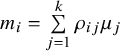
$ m_i=\textstyle \sum \limits _{j=1}^k \rho _{ij} \mu _j $
for each
$i\in \{1,\ldots ,n\}$
.



An R-module F is faithfully flat if it is flat and for every nonzero R-module M, $F \otimes _R M\neq 0$
. Equivalently, an R-module F is faithfully flat if it is flat and for every maximal ideal
$F \otimes _R M\neq 0$
. Equivalently, an R-module F is faithfully flat if it is flat and for every maximal ideal $\mathfrak {m}$
of R,
$\mathfrak {m}$
of R, $\mathfrak {m} F \neq F$
, where
$\mathfrak {m} F \neq F$
, where
 $$ \begin{align*}\mathfrak{m}F:=\{\sum\limits_{i=1}^n r_i f_i:n\in \mathbb{N}, \text{and for all }i\in \{1,\cdots,n\}, \;r_i\in \mathfrak{m} \text{ and } f_i\in F\}. \end{align*} $$
Of course $\mathfrak {m}F\subset F$
. (Throughout, we use the notation
$\mathfrak {m}F\subset F$
. (Throughout, we use the notation $A\subset B$
to mean inclusion of the set A in B, allowing A and B to be equal, and we use
$A\subset B$
to mean inclusion of the set A in B, allowing A and B to be equal, and we use $A\subsetneq B$
for strict inclusion.)
$A\subsetneq B$
for strict inclusion.)
1.2. Motivation
Besides the interest in the notion of faithful flatness of modules from the commutative algebra perspective, the faithful flatness of particular R-modules M, for some concrete Hilbert spaces M and Banach algebras R arising in control theory, play a key role in the stabilization problem for linear control systems (see Quadrat [Reference Quadrat10]). In fact, one of the results established in this article, namely, that $H^2$
is not a faithfully flat
$H^2$
is not a faithfully flat $H^\infty $
-module (see page 3), answers a question from 2005 raised in [Reference Quadrat10, Remark 1].
$H^\infty $
-module (see page 3), answers a question from 2005 raised in [Reference Quadrat10, Remark 1].
1.3. First main result
Let X be a locally compact Hausdorff topological space, and $\mu $
be a positive Radon measure on X. Let
$\mu $
be a positive Radon measure on X. Let $L^\infty (X,\mu )$
be the set of all
$L^\infty (X,\mu )$
be the set of all $f:X\to {\mathbb {C}}$
such that
$f:X\to {\mathbb {C}}$
such that
 $$ \begin{align*}\textstyle \begin{array}{rcl} \|f\|_\infty &=&{\text{ess sup}}_{x\in X} |f(x)|\\[0.1cm] &=&\inf\{ u\ge 0: |f(x)|\le u \text{ for }\mu\text{-almost all }x\in X\}. \end{array} \end{align*} $$
We identify functions in $L^\infty (X,\mu )$
that differ on any set with
$L^\infty (X,\mu )$
that differ on any set with $\mu $
-measure equal to
$\mu $
-measure equal to $0$
. With pointwise operations and the norm
$0$
. With pointwise operations and the norm $\|\cdot \|_\infty $
,
$\|\cdot \|_\infty $
, $L^\infty (X,\mu )$
is a Banach algebra. Let
$L^\infty (X,\mu )$
is a Banach algebra. Let $L^2(X,\mu )$
be the set of all
$L^2(X,\mu )$
be the set of all $f:X\to {\mathbb {C}}$
such that
$f:X\to {\mathbb {C}}$
such that
 $$ \begin{align*}\textstyle \|f\|_2^2=\int_X |f(x)|^2 d\mu(x)<\infty. \end{align*} $$
We identify functions in $L^2(X,\mu )$
that differ on any set with
$L^2(X,\mu )$
that differ on any set with $\mu $
-measure equal to
$\mu $
-measure equal to $0$
. Then,
$0$
. Then, $L^2(X,\mu )$
is a Hilbert space with pointwise operations and the norm
$L^2(X,\mu )$
is a Hilbert space with pointwise operations and the norm $\|\cdot \|_2$
(which is induced by an inner product). It is clear that with the action of
$\|\cdot \|_2$
(which is induced by an inner product). It is clear that with the action of $L^\infty (X,\mu )$
on
$L^\infty (X,\mu )$
on $L^2(X,\mu )$
given by pointwise multiplication,
$L^2(X,\mu )$
given by pointwise multiplication, $L^2(X,\mu )$
is an
$L^2(X,\mu )$
is an $L^\infty (X,\mu )$
-module. We show that
$L^\infty (X,\mu )$
-module. We show that $L^2(X,\mu )$
is a flat
$L^2(X,\mu )$
is a flat $L^\infty (X,\mu )$
-module (Proposition 2.1).
$L^\infty (X,\mu )$
-module (Proposition 2.1).
Moreover, we have the following results:
-
• If
$\mu $
is
$\sigma $
-finite, then for every finitely generated, nonzero, proper ideal
$\mathfrak {n}$
of
$L^\infty (X,\mu )$
, there holds
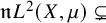
$\mathfrak {n}L^2(X,\mu )\subsetneq L^2(X,\mu )$
(Proposition 2.3). -
• If X is the union of an increasing family of Borel sets
$U_n$
,
$n\!\in \! {\mathbb {N}}$
, such that for each
$n\in {\mathbb {N}}$
,
$\overline {U_n}$
is compact and
$\mu (U_{n+1}\setminus U_n)>0$
, then
$L^2(X,\mu )$
is not a faithfully flat
$L^\infty (X,\mu )$
-module. This is an immediate consequence of Theorem 2.4.





1.4. Second main result
Let $ {\mathbb {D}}\!=\!\{z\in {\mathbb {C}}\!:\!|z|\!<\!1\}$
be the unit disc. Also, let
$ {\mathbb {D}}\!=\!\{z\in {\mathbb {C}}\!:\!|z|\!<\!1\}$
be the unit disc. Also, let ${\mathbb {T}}\!=\!\{z\in {\mathbb {C}}\!:\! |z|\!=\!1\}$
, and
${\mathbb {T}}\!=\!\{z\in {\mathbb {C}}\!:\! |z|\!=\!1\}$
, and $ \overline {{\mathbb {D}}}\!=\!{\mathbb {D}}\cup {\mathbb {T}}$
. The set of complex-valued holomorphic functions on
$ \overline {{\mathbb {D}}}\!=\!{\mathbb {D}}\cup {\mathbb {T}}$
. The set of complex-valued holomorphic functions on ${\mathbb {D}}$
is denoted by
${\mathbb {D}}$
is denoted by ${\mathcal {O}}({\mathbb {D}})$
. Let the Hardy algebra
${\mathcal {O}}({\mathbb {D}})$
. Let the Hardy algebra $H^\infty $
be the Banach algebra consisting of all bounded functions
$H^\infty $
be the Banach algebra consisting of all bounded functions $f\!\in \! {\mathcal {O}}({\mathbb {D}})$
, equipped with pointwise operations, and the supremum norm, given by
$f\!\in \! {\mathcal {O}}({\mathbb {D}})$
, equipped with pointwise operations, and the supremum norm, given by $\|f\|_\infty =\sup_{z\in {\mathbb {D}}}|f(z)|$
for
$\|f\|_\infty =\sup_{z\in {\mathbb {D}}}|f(z)|$
for $f\in H^\infty $
. If
$f\in H^\infty $
. If $f\in H^\infty $
, then the radial limits
$f\in H^\infty $
, then the radial limits
 $$ \begin{align*}\textstyle f(e^{i\theta}):=\lim\limits_{r\to 1} f(re^{i\theta}) \end{align*} $$
exist for almost all $\theta \in (-\pi ,\pi ]$
, and define a function in
$\theta \in (-\pi ,\pi ]$
, and define a function in $L^\infty ({\mathbb {T}})$
, which we have also denoted by f above. The Hardy Hilbert space
$L^\infty ({\mathbb {T}})$
, which we have also denoted by f above. The Hardy Hilbert space $H^2$
is the set of all
$H^2$
is the set of all $h\in {\mathcal {O}}({\mathbb {D}})$
such that
$h\in {\mathcal {O}}({\mathbb {D}})$
such that
 $$ \begin{align*}\textstyle \|h\|_2^2:=\sum\limits_{n=0}^\infty |h_n|^2<\infty, \;\text{ where }\; h(z)=\sum\limits_{n=0}^\infty h_n z^n \;\; (z\in {\mathbb{D}}). \end{align*} $$
Then, $H^2$
is a Hilbert space with the inner product corresponding to the norm
$H^2$
is a Hilbert space with the inner product corresponding to the norm $\|\cdot \|_2$
defined above. It can be shown that
$\|\cdot \|_2$
defined above. It can be shown that
 $$ \begin{align*}\textstyle \|h\|_2=\sup\limits_{r\in (0,1)} \big(\frac{1}{2\pi} \int_{-\pi}^{\pi} |h(re^{i\theta})|^2 \;\!d\theta\big)^{\frac{1}{2}}. \end{align*} $$
If $f\in H^2$
, then again the radial limits
$f\in H^2$
, then again the radial limits
 $$ \begin{align*}\textstyle h(e^{i\theta}):=\lim\limits_{r\to 1} h(re^{i\theta}) \end{align*} $$
exist for almost all $\theta \in (-\pi ,\pi ]$
, and now define a boundary function in
$\theta \in (-\pi ,\pi ]$
, and now define a boundary function in $L^2({\mathbb {T}})$
, which we have also denoted by h. The set of these boundary functions coincides with the set of all
$L^2({\mathbb {T}})$
, which we have also denoted by h. The set of these boundary functions coincides with the set of all $h\in L^2({\mathbb {T}})$
whose negatively indexed Fourier coefficients vanish, that is,
$h\in L^2({\mathbb {T}})$
whose negatively indexed Fourier coefficients vanish, that is, $\hat {h}_{-n}=0$
for all
$\hat {h}_{-n}=0$
for all $n\in {\mathbb {N}}$
, where
$n\in {\mathbb {N}}$
, where
 $$ \begin{align*}\textstyle \hat{h}_{m}:=\frac{1}{2\pi}\int_{-\pi}^{\pi} h(e^{i\theta})e^{-im\theta} \;\! d\theta \quad (m\in {\mathbb{Z}}). \end{align*} $$
It is clear that $H^2$
is an
$H^2$
is an $H^\infty $
-module, with the action
$H^\infty $
-module, with the action $f\cdot h$
of
$f\cdot h$
of $f\in H^\infty $
on
$f\in H^\infty $
on $h\in H^2$
given by pointwise multiplication of f and h.
$h\in H^2$
given by pointwise multiplication of f and h.
In Section 3, we show that $H^2$
is a flat, but not faithfully flat
$H^2$
is a flat, but not faithfully flat $H^\infty $
-module (Theorem 3.2). It is also observed that for any finitely generated, nonzero, closed, proper ideal
$H^\infty $
-module (Theorem 3.2). It is also observed that for any finitely generated, nonzero, closed, proper ideal $\mathfrak {n}$
of
$\mathfrak {n}$
of $H^\infty $
, we have
$H^\infty $
, we have $\mathfrak {n} H^2\subsetneq H^2$
.
$\mathfrak {n} H^2\subsetneq H^2$
.
1.5. Preliminaries
We recall some preliminaries that will be needed in both of the remaining sections.
Let A be a commutative unital complex semisimple Banach algebra. The dual space $A^*$
of A consists of all continuous linear complex-valued maps defined on A. The maximal ideal space
$A^*$
of A consists of all continuous linear complex-valued maps defined on A. The maximal ideal space $M(A)$
of A is the set of all nonzero homomorphisms
$M(A)$
of A is the set of all nonzero homomorphisms $\varphi \!:\! A \!\to \! {\mathbb {C}}$
. As
$\varphi \!:\! A \!\to \! {\mathbb {C}}$
. As $M(A)$
is a subset of
$M(A)$
is a subset of $A^*$
, it inherits the weak-
$A^*$
, it inherits the weak- $\ast $
topology of
$\ast $
topology of $A^*$
, called the Gelfand topology on
$A^*$
, called the Gelfand topology on $M(A)$
. There is a bijective correspondence between
$M(A)$
. There is a bijective correspondence between $M(A)$
and the collection of all maximal ideals of A, namely, each nonzero complex homomorphism
$M(A)$
and the collection of all maximal ideals of A, namely, each nonzero complex homomorphism $\varphi \in M(A)$
corresponds to a maximal ideal
$\varphi \in M(A)$
corresponds to a maximal ideal $\mathfrak {m}:=\ker \varphi $
of A. The topological space
$\mathfrak {m}:=\ker \varphi $
of A. The topological space $M(A)$
is a compact Hausdorff space. The set
$M(A)$
is a compact Hausdorff space. The set $M(A)$
is contained in the unit sphere of the Banach space
$M(A)$
is contained in the unit sphere of the Banach space ${\mathcal {L}}(A,{\mathbb {C}})$
of all complex-valued continuous linear maps on A with the operator norm, which is given by
${\mathcal {L}}(A,{\mathbb {C}})$
of all complex-valued continuous linear maps on A with the operator norm, which is given by $\|\varphi \|=\sup_{a\in A, \;\|a\|\le 1} |\varphi (a)|$
for all
$\|\varphi \|=\sup_{a\in A, \;\|a\|\le 1} |\varphi (a)|$
for all $\varphi \in {\mathcal {L}}(A,{\mathbb {C}})$
. Let
$\varphi \in {\mathcal {L}}(A,{\mathbb {C}})$
. Let $C(M(A))$
denote the Banach algebra of complex-valued continuous functions on
$C(M(A))$
denote the Banach algebra of complex-valued continuous functions on $M(A)$
with pointwise operations and the supremum norm. The Gelfand transform
$M(A)$
with pointwise operations and the supremum norm. The Gelfand transform $\widehat {a}\in C(M(A))$
of an element
$\widehat {a}\in C(M(A))$
of an element $a\in A$
is defined by
$a\in A$
is defined by $\widehat {a}(\varphi ):=\varphi (a)$
for all
$\widehat {a}(\varphi ):=\varphi (a)$
for all $\varphi \in M(A)$
.
$\varphi \in M(A)$
.
The following result plays a key role in the rest of the article. In particular, the sequence of growing weights $1/\sqrt {r_{n-1}}$
(see below) will be needed to construct an element of the maximal ideal
$1/\sqrt {r_{n-1}}$
(see below) will be needed to construct an element of the maximal ideal $\mathfrak {m}$
of R in our results about showing
$\mathfrak {m}$
of R in our results about showing $\mathfrak {m} M=M$
for appropriate
$\mathfrak {m} M=M$
for appropriate $\mathfrak {m}$
and R-modules M.
$\mathfrak {m}$
and R-modules M.
Proposition 1.1. Let $(a_n)_{n\in \mathbb {N}}$
be a sequence in
$(a_n)_{n\in \mathbb {N}}$
be a sequence in ${\mathbb {C}}$
not having a finite support
${\mathbb {C}}$
not having a finite support $,$
and such that
$,$
and such that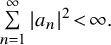 $ {\textstyle \sum \limits _{n=1}^\infty |a_n|^2\!<\!\infty. }$
DefineFootnote
1
$ {\textstyle \sum \limits _{n=1}^\infty |a_n|^2\!<\!\infty. }$
DefineFootnote
1 $ \textstyle r_n\!=\!\sum \limits _{k=n+1}^\infty |a_k|^2 (>0)$
for all
$ \textstyle r_n\!=\!\sum \limits _{k=n+1}^\infty |a_k|^2 (>0)$
for all $n\in {\mathbb {N}}\cup \{0\}$
. Then,
$n\in {\mathbb {N}}\cup \{0\}$
. Then, $\sum \limits _{n=2}^\infty |a_n|^2\frac {1}{\sqrt {r_{n-1}}}\!<\!\infty $
.
$\sum \limits _{n=2}^\infty |a_n|^2\frac {1}{\sqrt {r_{n-1}}}\!<\!\infty $
.
Proof. We have $(r_n)_{n\in {\mathbb {N}}}$
is a decreasing sequence of positive reals, and
$(r_n)_{n\in {\mathbb {N}}}$
is a decreasing sequence of positive reals, and
 $$ \begin{align*}\textstyle \begin{array}{rcl} \frac{|a_n|^2}{\sqrt{r_{n-1}}} =\frac{r_{n-1}-r_n}{\sqrt{r_{n-1}}} =\frac{(\sqrt{r_{n-1}}-\sqrt{r_n})(\sqrt{r_{n-1}}+\sqrt{r_n})}{\sqrt{r_{n-1}}} &\le& \frac{(\sqrt{r_{n-1}}-\sqrt{r_n})(\sqrt{r_{n-1}}+\sqrt{r_{n-1}})}{\sqrt{r_{n-1}}}\\ &\le& 2(\sqrt{r_{n-1}}-\sqrt{r_n}). \end{array} \end{align*} $$
Thus, the partial sums of $\sum \limits _{n=2}^\infty |a_n|^2\frac {1}{\sqrt {r_{n-1}}}$
form a Cauchy sequence:
$\sum \limits _{n=2}^\infty |a_n|^2\frac {1}{\sqrt {r_{n-1}}}$
form a Cauchy sequence:
 $$ \begin{align*}\textstyle \begin{array}{rcl} \sum\limits_{k=m+1}^n \frac{|a_k|^2}{\sqrt{r_{k-1}}} &\le & 2(\sqrt{r_{m}}\!-\!\sqrt{r_{m+1}}+\sqrt{r_{m+1}}\!-\!\sqrt{r_{m+2}}+\cdots+\sqrt{r_{n-1}}\!-\!\sqrt{r_n}) \\ &=& 2(\sqrt{r_m}-\sqrt{r_n})<2 \sqrt{r_m} <\epsilon, \end{array} \end{align*} $$
whenever $n>m>N$
, where N is such that
$n>m>N$
, where N is such that $\sum \limits _{k=N+1}^\infty |a_k|^2<\frac {\epsilon ^2}{4}$
.
$\sum \limits _{k=N+1}^\infty |a_k|^2<\frac {\epsilon ^2}{4}$
.
The organization of the article is as follows. In the next section, we prove our first set of main results (all about the $L^\infty (X,\mu )$
-module
$L^\infty (X,\mu )$
-module $L^2(X,\mu )$
), and in the last section, we establish the second set of main results (namely, that the
$L^2(X,\mu )$
), and in the last section, we establish the second set of main results (namely, that the $H^\infty $
-module
$H^\infty $
-module $H^2$
is not faithfully flat).
$H^2$
is not faithfully flat).
2. The
$L^\infty (X,\mu )$
-module
$L^2(X,\mu )$
is flat, but not faithfully flat


2.1.
$L^2(X,\mu )$
is a flat
$L^\infty (X,\mu )$
-module


Proposition 2.1. Let X be a locally compact Hausdorff topological space and $\mu $
be a positive Radon measure on X. Then,
$\mu $
be a positive Radon measure on X. Then, $L^2(X,\mu ) $
is a flat
$L^2(X,\mu ) $
is a flat $L^\infty (X,\mu )$
-module.
$L^\infty (X,\mu )$
-module.
Proof. Let $r_1 m_1+\cdots +r_nm_n=0\in L^2(X,\mu )$
for some
$r_1 m_1+\cdots +r_nm_n=0\in L^2(X,\mu )$
for some $n\in {\mathbb {N}}$
, and functions
$n\in {\mathbb {N}}$
, and functions $r_1,\ldots , r_n\in L^\infty (X,\mu ) $
and
$r_1,\ldots , r_n\in L^\infty (X,\mu ) $
and $m_1,\ldots , m_n \in L^2(X,\mu )$
. Then, there exists a subset N of X with
$m_1,\ldots , m_n \in L^2(X,\mu )$
. Then, there exists a subset N of X with $\mu (N)=0$
such that for all
$\mu (N)=0$
such that for all $x\in X\setminus N$
,
$x\in X\setminus N$
,
 $$ \begin{align*}\textstyle r_1(x)m_1(x)+ \cdots + r_n(x)m_n(x)\!=\!0, \end{align*} $$
that is, ${\mathbf {m}}(x):=(m_1(x),\ldots , m_n(x))\in {\mathbb {C}}^n$
belongs to the orthogonal complement
${\mathbf {m}}(x):=(m_1(x),\ldots , m_n(x))\in {\mathbb {C}}^n$
belongs to the orthogonal complement ${\mathbf {r}}(x)^\perp $
of
${\mathbf {r}}(x)^\perp $
of ${\mathbf {r}}(x):=(r_1(x), \ldots , r_n(x))\in {\mathbb {C}}^n$
with respect to the usual Euclidean inner product
${\mathbf {r}}(x):=(r_1(x), \ldots , r_n(x))\in {\mathbb {C}}^n$
with respect to the usual Euclidean inner product $\langle \cdot ,\cdot \rangle $
(and corresponding norm denoted by
$\langle \cdot ,\cdot \rangle $
(and corresponding norm denoted by $\|\cdot \|$
below) on
$\|\cdot \|$
below) on ${\mathbb {C}}^n$
. If
${\mathbb {C}}^n$
. If ${\mathbf {r}}(x)\!\neq \! 0$
, there exist
${\mathbf {r}}(x)\!\neq \! 0$
, there exist $n-1$
orthonormal vectors
$n-1$
orthonormal vectors ${\mathbf {e}}_1(x),\ldots , {\mathbf {e}}_{n-1}(x)$
forming a basis for
${\mathbf {e}}_1(x),\ldots , {\mathbf {e}}_{n-1}(x)$
forming a basis for ${\mathbf {r}}(x)^\perp $
, and we set
${\mathbf {r}}(x)^\perp $
, and we set ${\mathbf {e}}_n(x)\!=\!{\mathbf {0}}\!\in \! {\mathbb {C}}^n$
. If
${\mathbf {e}}_n(x)\!=\!{\mathbf {0}}\!\in \! {\mathbb {C}}^n$
. If ${\mathbf {r}}(x)\!=\!0$
, then let
${\mathbf {r}}(x)\!=\!0$
, then let $\{{\mathbf {e}}_1(x),\ldots , {\mathbf {e}}_{n}(x)\}$
be any orthonormal basis for
$\{{\mathbf {e}}_1(x),\ldots , {\mathbf {e}}_{n}(x)\}$
be any orthonormal basis for ${\mathbb {C}}^n$
. For
${\mathbb {C}}^n$
. For $x\in X\setminus N$
, define
$x\in X\setminus N$
, define $\mu _1(x),\ldots , \mu _{n}(x)$
by
$\mu _1(x),\ldots , \mu _{n}(x)$
by $\mu _j(x)=\langle {\mathbf {m}}(x), {\mathbf {e}}_j(x)\rangle $
,
$\mu _j(x)=\langle {\mathbf {m}}(x), {\mathbf {e}}_j(x)\rangle $
, $1\le j\le n$
. For
$1\le j\le n$
. For $x\in X\setminus N$
, and
$x\in X\setminus N$
, and $1\le i,j\le n$
, set
$1\le i,j\le n$
, set $\rho _{ij}(x)=\langle {\mathbf {e}}_j(x), e_i\rangle $
, where
$\rho _{ij}(x)=\langle {\mathbf {e}}_j(x), e_i\rangle $
, where $e_1,\ldots , e_n$
are the standard basis vectors for
$e_1,\ldots , e_n$
are the standard basis vectors for ${\mathbb {C}}^n$
. Then, by the Cauchy–Schwarz inequality,
${\mathbb {C}}^n$
. Then, by the Cauchy–Schwarz inequality, $|\rho _{ij}(x)|\le \|{\mathbf {e}}_j(x)\| \| e_i\|= 1$
. Thus, we have defined an element
$|\rho _{ij}(x)|\le \|{\mathbf {e}}_j(x)\| \| e_i\|= 1$
. Thus, we have defined an element $\rho _{ij}$
of
$\rho _{ij}$
of $ L^\infty (X,\mu ) $
for each
$ L^\infty (X,\mu ) $
for each $1\le i,j,\le n$
. Moreover, for all
$1\le i,j,\le n$
. Moreover, for all $x\in X\setminus N$
, we have for
$x\in X\setminus N$
, we have for $1\le j\le n$
that
$1\le j\le n$
that
 $$ \begin{align*}\textstyle \begin{array}{rcl} 0=\langle {\mathbf{r}}(x), {\mathbf{e}}_j(x)\rangle &=& \left[\begin{smallmatrix} r_1(x) &\cdots & r_n(x)\end{smallmatrix}\right] \left[\begin{smallmatrix} \langle {\mathbf{e}}_j(x),e_1\rangle \\ \vdots \\ \langle {\mathbf{e}}_j(x),e_n\rangle \end{smallmatrix}\right]\\[0.51cm] &=& r_1(x) \rho_{1j}(x)+\cdots +r_{n}(x) \rho_{nj}(x). \end{array} \end{align*} $$
Thus, in $L^\infty (X,\mu )$
, we have
$L^\infty (X,\mu )$
, we have $r_1 \rho _{1j}+\cdots +r_n\rho _{nj}=0$
,
$r_1 \rho _{1j}+\cdots +r_n\rho _{nj}=0$
, $1\le j\le n$
. Moreover,
$1\le j\le n$
. Moreover, $\mu _1,\ldots , \mu _n\in L^2(X, \mu ) $
because for
$\mu _1,\ldots , \mu _n\in L^2(X, \mu ) $
because for $1\le i\le n$
, we have
$1\le i\le n$
, we have
 $$ \begin{align*}\textstyle \begin{array}{rcl} \int_{X\setminus N} |\mu_i(x)|^2 \;d\mu(x) &=& \int_{X\setminus N} |\langle {\mathbf{m}}(x), {\mathbf{e}}_i(x)\rangle|^2 \;d\mu(x)\\[0.21cm] &\le& \int_{X\setminus N} \|{\mathbf{m}}(x)\|^2 1 \;d\mu(x)\\[0.21cm] &=& \|m_1\|_2^2+\cdots+\|m_n\|_2^2. \end{array} \end{align*} $$
Finally, for $x\in X\setminus N$
, we have
$x\in X\setminus N$
, we have
 $$ \begin{align*}\textstyle \begin{array}{rcl} \sum\limits_{i=1}^{n} m_i(x) e_i &=& {\mathbf{m}}(x) =\sum\limits_{j=1}^{n} \langle {\mathbf{m}}(x),{\mathbf{e}}_j(x)\rangle\;\! {\mathbf{e}}_j(x) = \sum\limits_{j=1}^{n} \mu_j(x) {\mathbf{e}}_j(x) \\ &=& \sum\limits_{j=1}^{n} \mu_j(x) \sum\limits_{i=1}^{n} \langle {\mathbf{e}}_j(x) , e_i\rangle e_i = \sum\limits_{i=1}^{n} \sum\limits_{j=1}^{n} \rho_{ij}(x) \mu_j(x)e_i, \end{array} \end{align*} $$
and so, we get $ \textstyle m_i =\sum \limits _{j=1}^{n} \rho _{ij} \mu _j$
in
$ \textstyle m_i =\sum \limits _{j=1}^{n} \rho _{ij} \mu _j$
in $L^2(X,\mu )$
for all
$L^2(X,\mu )$
for all $1\le i\le n$
.
$1\le i\le n$
.
2.2. The case of finitely generated maximal ideals
We claim that for any finitely generated, nonzero, proper ideal $\mathfrak {n}$
of
$\mathfrak {n}$
of $L^\infty (X,\mu )$
, we have
$L^\infty (X,\mu )$
, we have $\mathfrak {n} L^2(X,\mu )\subsetneq L^2(X,\mu )$
. To do this, we first show that
$\mathfrak {n} L^2(X,\mu )\subsetneq L^2(X,\mu )$
. To do this, we first show that $L^\infty (X,\mu )$
is a Bézout ring. Recall that a commutative ring is called Bézout if every finitely generated ideal is principal.
$L^\infty (X,\mu )$
is a Bézout ring. Recall that a commutative ring is called Bézout if every finitely generated ideal is principal.
Lemma 2.2. Every finitely generated ideal in $L^\infty (X,\mu )$
is principal
$L^\infty (X,\mu )$
is principal $,$
that is
$,$
that is $, L^\infty (X,\mu )$
is Bézout ring.
$, L^\infty (X,\mu )$
is Bézout ring.
Before we give the proof, we collect some useful observations first. For $f\in L^\infty (X,\mu )$
, let
$f\in L^\infty (X,\mu )$
, let $ |f|, \overline {f}\in L^\infty (X,\mu )$
be the functions obtained by taking pointwise complex absolute value, and pointwise complex conjugation, respectively. Then, for a representative function
$ |f|, \overline {f}\in L^\infty (X,\mu )$
be the functions obtained by taking pointwise complex absolute value, and pointwise complex conjugation, respectively. Then, for a representative function $f:X\to {\mathbb {C}}$
of an element in
$f:X\to {\mathbb {C}}$
of an element in $L^\infty (X,\mu )$
,
$L^\infty (X,\mu )$
, $f=|f|\cdot u_f$
, where
$f=|f|\cdot u_f$
, where $u_f\in L^\infty (X,\mu )$
is given by
$u_f\in L^\infty (X,\mu )$
is given by
 $$ \begin{align*}\textstyle u_f(x)=\left\{\begin{array}{cl} \frac{f(x)}{|f(x)|} & \textrm{if }\; f(x)\neq 0,\\[0.21cm] 1 & \textrm{if }\;f(x)=0. \end{array}\right. \end{align*} $$
We have $f\in L^\infty (X,\mu )$
if and only if
$f\in L^\infty (X,\mu )$
if and only if $|f|\in L^\infty (X,\mu )$
. Also,
$|f|\in L^\infty (X,\mu )$
. Also, $f\in L^\infty (X,\mu )$
if and only if
$f\in L^\infty (X,\mu )$
if and only if $\overline {f}\in L^\infty (X,\mu )$
. Also,
$\overline {f}\in L^\infty (X,\mu )$
. Also, $u_f u_{\overline {f}}={\mathbf {1}}$
(the constant function, taking value
$u_f u_{\overline {f}}={\mathbf {1}}$
(the constant function, taking value $1$
everywhere on X) and
$1$
everywhere on X) and $|f|=f \overline {u_f}$
.
$|f|=f \overline {u_f}$
.
In a commutative ring R, the ideal in R generated by $r_1,\ldots , r_n$
,
$r_1,\ldots , r_n$
, $n\in {\mathbb {N}}$
, is denoted by
$n\in {\mathbb {N}}$
, is denoted by $\langle r_1,\ldots , r_n\rangle $
.
$\langle r_1,\ldots , r_n\rangle $
.
Proof. It suffices to show that an ideal $\langle f,g\rangle $
generated by
$\langle f,g\rangle $
generated by $f,g\!\in \! L^\infty (X,\mu )$
is principal. We claim that
$f,g\!\in \! L^\infty (X,\mu )$
is principal. We claim that $\langle f,g\rangle =\langle |f|+|g|\rangle. $
Since
$\langle f,g\rangle =\langle |f|+|g|\rangle. $
Since $\overline {u_f}, \overline {u_g}\in L^\infty (X,\mu )$
, we have
$\overline {u_f}, \overline {u_g}\in L^\infty (X,\mu )$
, we have $|f|+|g|=f \overline {u_f}+g \overline {u_g}\in \langle f,g\rangle. $
Thus,
$|f|+|g|=f \overline {u_f}+g \overline {u_g}\in \langle f,g\rangle. $
Thus, $\langle |f|+|g|\rangle \subset \langle f,g\rangle $
. To show the reverse inclusion, let us define F by
$\langle |f|+|g|\rangle \subset \langle f,g\rangle $
. To show the reverse inclusion, let us define F by
 $$ \begin{align*}\textstyle F(x) =\left\{\begin{array}{cl} \frac{f(x)}{|f(x)|+|g(x)|} & \textrm{if }\; |f(x)|\!+\!|g(x)|\!\neq \!0,\\[0.21cm] 1 & \textrm{if }\; |f(x)|\!+\!|g(x)|\!=\!0, \end{array}\right. \end{align*} $$ $x\in X$
. Then,
$x\in X$
. Then, $|F(x)|\leq 1$
for all
$|F(x)|\leq 1$
for all $x\in X$
, and so
$x\in X$
, and so $F \in L^\infty (X,\mu )$
. Moreover,
$F \in L^\infty (X,\mu )$
. Moreover, $f=F \cdot (|f|+|g|)$
, and so
$f=F \cdot (|f|+|g|)$
, and so $f\in \langle |f|+|g|\rangle $
. Similarly,
$f\in \langle |f|+|g|\rangle $
. Similarly, $g\in \langle |f|+|g|\rangle $
too. Hence,
$g\in \langle |f|+|g|\rangle $
too. Hence, $\langle f,g\rangle \subset \langle |f|+|g|\rangle $
. Consequently,
$\langle f,g\rangle \subset \langle |f|+|g|\rangle $
. Consequently, $\langle f,g\rangle =\langle |f|+|g|\rangle $
.
$\langle f,g\rangle =\langle |f|+|g|\rangle $
.
If the nonzero maximal ideal $\mathfrak {m}$
of
$\mathfrak {m}$
of $L^\infty (X,\mu )$
is finitely generated, then is
$L^\infty (X,\mu )$
is finitely generated, then is $\mathfrak {m}L^2(X,\mu )\subsetneq L^2(X,\mu )$
? We claim that for any finitely generated, nonzero, proper ideal
$\mathfrak {m}L^2(X,\mu )\subsetneq L^2(X,\mu )$
? We claim that for any finitely generated, nonzero, proper ideal $\mathfrak {n}$
of
$\mathfrak {n}$
of $L^\infty (X,\mu )$
,
$L^\infty (X,\mu )$
, $\mathfrak {n} L^2(X,\mu )\subsetneq L^2(X,\mu )$
.
$\mathfrak {n} L^2(X,\mu )\subsetneq L^2(X,\mu )$
.
Proposition 2.3. If $\mu $
is a
$\mu $
is a $\sigma $
-finite positive Radon measure on a locally compact Hausdorff space
$\sigma $
-finite positive Radon measure on a locally compact Hausdorff space $X,$
then for every nonzero
$X,$
then for every nonzero $,$
finitely generated
$,$
finitely generated $,$
proper ideal
$,$
proper ideal $\mathfrak {n}$
of
$\mathfrak {n}$
of $L^\infty (X,\mu ),$
we have
$L^\infty (X,\mu ),$
we have $\mathfrak {n}L^2(X,\mu )\subsetneq L^2(X,\mu )$
.
$\mathfrak {n}L^2(X,\mu )\subsetneq L^2(X,\mu )$
.
Proof. As $L^\infty (X,\mu )$
is a Bézout ring,
$L^\infty (X,\mu )$
is a Bézout ring, $\mathfrak {n}=\langle g\rangle $
for some
$\mathfrak {n}=\langle g\rangle $
for some $g\in L^\infty (X,\mu )$
, and as
$g\in L^\infty (X,\mu )$
, and as $\mathfrak {n}$
is nonzero, so is g. Then,
$\mathfrak {n}$
is nonzero, so is g. Then,
 $$ \begin{align*}\textstyle \mathfrak{n}L^2(X,\mu)=\langle g\rangle L^2(X,\mu) =gL^\infty(X,\mu) L^2(X,\mu) = gL^2(X,\mu). \end{align*} $$
We claim that $gL^2(X,\mu )\subsetneq L^2(X,\mu )$
. Suppose on the contrary that
$gL^2(X,\mu )\subsetneq L^2(X,\mu )$
. Suppose on the contrary that $gL^2(X,\mu )=L^2(X,\mu )$
.
$gL^2(X,\mu )=L^2(X,\mu )$
.
We will first show that $gL^2(X,\mu )=L^2(X,\mu )$
implies that
$gL^2(X,\mu )=L^2(X,\mu )$
implies that $g\neq 0$
almost everywhere in X. Indeed, if
$g\neq 0$
almost everywhere in X. Indeed, if $\mu \{x\in X: g(x)=0\}>0$
, then since
$\mu \{x\in X: g(x)=0\}>0$
, then since $\mu $
is a Radon measure, there exists a compact set
$\mu $
is a Radon measure, there exists a compact set ${K\subset \{x\in X\!:\! g(x)\!=\!0\}}$
with
${K\subset \{x\in X\!:\! g(x)\!=\!0\}}$
with $0<\mu (K)<\infty $
. Let
$0<\mu (K)<\infty $
. Let $f=\mathbf {1}_K$
be the indicator function of K (i.e., pointwise equal to
$f=\mathbf {1}_K$
be the indicator function of K (i.e., pointwise equal to $1$
on K and
$1$
on K and $0$
on
$0$
on $X\setminus K$
). Then, clearly,
$X\setminus K$
). Then, clearly, $f\in L^2(X,\mu )$
, and so (thanks to our assumption that
$f\in L^2(X,\mu )$
, and so (thanks to our assumption that $gL^2(X,\mu )=L^2(X,\mu )$
), there exists an
$gL^2(X,\mu )=L^2(X,\mu )$
), there exists an $h\in L^2(X,\mu )$
such that
$h\in L^2(X,\mu )$
such that $f=gh$
. But at any point
$f=gh$
. But at any point $x\in K$
, we then get
$x\in K$
, we then get $1=\mathbf {1}_K(x)=f(x)=g(x)h(x)=0h(x)=0$
, a contradiction.
$1=\mathbf {1}_K(x)=f(x)=g(x)h(x)=0h(x)=0$
, a contradiction.
As $g(x)\neq 0$
almost everywhere in X, it follows that the multiplication map
$g(x)\neq 0$
almost everywhere in X, it follows that the multiplication map $M_g: L^2(X,\mu ) \to L^2(X,\mu )$
,
$M_g: L^2(X,\mu ) \to L^2(X,\mu )$
, $h\mapsto gh$
, is injective. But thanks to our assumption
$h\mapsto gh$
, is injective. But thanks to our assumption $gL^2(X,\mu )=L^2(X,\mu )$
, we also know that
$gL^2(X,\mu )=L^2(X,\mu )$
, we also know that $M_g$
is surjective. Thus,
$M_g$
is surjective. Thus, $M_g$
is invertible. As
$M_g$
is invertible. As $\mu $
is
$\mu $
is $\sigma $
-finite, we conclude that g is invertible as an element of
$\sigma $
-finite, we conclude that g is invertible as an element of $L^\infty (X,\mu )$
, that is,
$L^\infty (X,\mu )$
, that is, $g^{-1}\in L^\infty (X,\mu )$
(see, e.g., [Reference Halmos5, Problem 67]). But then
$g^{-1}\in L^\infty (X,\mu )$
(see, e.g., [Reference Halmos5, Problem 67]). But then $\mathfrak {n}=\langle g\rangle =L^\infty (X,\mu )$
, contradicting the properness of
$\mathfrak {n}=\langle g\rangle =L^\infty (X,\mu )$
, contradicting the properness of $\mathfrak {n}$
.
$\mathfrak {n}$
.
Ultrafilters and $M(\ell ^\infty )$
:
$M(\ell ^\infty )$
:
In order to show the non-faithfulness, we will use the maximal ideal space of $\ell ^\infty $
, which is known to be in correspondence with the set of ultrafilters on
$\ell ^\infty $
, which is known to be in correspondence with the set of ultrafilters on ${\mathbb {N}}$
. We begin by recalling some preliminaries about ultrafilters.
${\mathbb {N}}$
. We begin by recalling some preliminaries about ultrafilters.
Let $\ell ^\infty $
be the Banach algebra of all complex bounded sequences on
$\ell ^\infty $
be the Banach algebra of all complex bounded sequences on ${\mathbb {N}}=\{1,2,3,\ldots \}$
with pointwise operations and the supremum norm, which is given by
${\mathbb {N}}=\{1,2,3,\ldots \}$
with pointwise operations and the supremum norm, which is given by
 $$ \begin{align*}\textstyle \|f\|_\infty:=\sup_{n\in {\mathbb{N}}} |f(n)|\; \text{ for }\;f=(f(n))_{n\in {\mathbb{N}}} \in \ell^\infty. \end{align*} $$
Let $\ell ^2 $
be the Hilbert space of all square summable complex sequences with the inner product corresponding to the norm
$\ell ^2 $
be the Hilbert space of all square summable complex sequences with the inner product corresponding to the norm $\|\cdot \|_2$
, where
$\|\cdot \|_2$
, where
 $$ \begin{align*}\textstyle \|h\|_2^2=\sum\limits_{n=1}^\infty |h(n)|^2 \;\text{ for all }\; h=(h(n))_{n\in {\mathbb{N}}} \in \ell^2. \end{align*} $$
Then, with the action of $\ell ^\infty $
on
$\ell ^\infty $
on $\ell ^2 $
given by termwise multiplication,
$\ell ^2 $
given by termwise multiplication, $ \textstyle f\cdot h=\pmb {(}\;\!f(n)h(n){\pmb {)}}_{n\in {\mathbb {N}}}$
for
$ \textstyle f\cdot h=\pmb {(}\;\!f(n)h(n){\pmb {)}}_{n\in {\mathbb {N}}}$
for $ f\in \ell ^\infty $
,
$ f\in \ell ^\infty $
, $h\in \ell ^2$
,
$h\in \ell ^2$
, $\ell ^2 $
is an
$\ell ^2 $
is an $\ell ^\infty $
-module. As a consequence of our results in this section, it will follow that as an
$\ell ^\infty $
-module. As a consequence of our results in this section, it will follow that as an $\ell ^\infty $
-module,
$\ell ^\infty $
-module, $\ell ^2$
is flat, but not faithfully flat (see Example 2.5).
$\ell ^2$
is flat, but not faithfully flat (see Example 2.5).
For $n\in {\mathbb {N}}$
, define
$n\in {\mathbb {N}}$
, define $\varphi _n: \ell ^\infty \to {\mathbb {C}}$
by
$\varphi _n: \ell ^\infty \to {\mathbb {C}}$
by $\varphi _n(f)=f(n)$
for all
$\varphi _n(f)=f(n)$
for all $f\in \ell ^\infty $
. Point evaluations
$f\in \ell ^\infty $
. Point evaluations $\varphi _n$
,
$\varphi _n$
, $n\in {\mathbb {N}}$
, are nonzero complex homomorphisms. Thus,
$n\in {\mathbb {N}}$
, are nonzero complex homomorphisms. Thus, ${\mathbb {N}}$
can be identified with a subset of
${\mathbb {N}}$
can be identified with a subset of $M(\ell ^\infty )$
(and the topology on
$M(\ell ^\infty )$
(and the topology on ${\mathbb {N}}$
, induced from the Gelfand topology on
${\mathbb {N}}$
, induced from the Gelfand topology on $M(\ell ^\infty )$
, coincides with the usual Euclidean topology on
$M(\ell ^\infty )$
, coincides with the usual Euclidean topology on ${\mathbb {N}}$
as a subset of
${\mathbb {N}}$
as a subset of ${\mathbb {R}}$
). For each
${\mathbb {R}}$
). For each $n\in {\mathbb {N}}$
, the maximal ideal
$n\in {\mathbb {N}}$
, the maximal ideal $\mathfrak {m}_n:=\ker \varphi _n$
has the property that
$\mathfrak {m}_n:=\ker \varphi _n$
has the property that $\mathfrak {m}_n\ell ^2\subsetneq \ell ^2$
. Indeed, for example, if
$\mathfrak {m}_n\ell ^2\subsetneq \ell ^2$
. Indeed, for example, if $f\in \ell ^2$
is the sequence with
$f\in \ell ^2$
is the sequence with $1$
as the nth term, and all other terms
$1$
as the nth term, and all other terms $0$
, then
$0$
, then $f\not \in \mathfrak {m}_n\ell ^2$
(otherwise
$f\not \in \mathfrak {m}_n\ell ^2$
(otherwise $f\!=\!gh$
, for some
$f\!=\!gh$
, for some $g\!\in \! \mathfrak {m}_n$
,
$g\!\in \! \mathfrak {m}_n$
, $h\!\in \! \ell ^2$
, and so
$h\!\in \! \ell ^2$
, and so $0=\widehat {g}(\varphi _n)=g(n)$
, giving
$0=\widehat {g}(\varphi _n)=g(n)$
, giving $1=f(n)=g(n)h(n)=0h(n)=0$
, a contradiction). Despite the fact that
$1=f(n)=g(n)h(n)=0h(n)=0$
, a contradiction). Despite the fact that $\mathfrak {m}_n\ell ^2\subsetneq \ell ^2$
for each
$\mathfrak {m}_n\ell ^2\subsetneq \ell ^2$
for each $n\in {\mathbb {N}}$
, there exist many maximal ideals
$n\in {\mathbb {N}}$
, there exist many maximal ideals $\mathfrak {m}$
of
$\mathfrak {m}$
of $\ell ^\infty $
for which
$\ell ^\infty $
for which $\mathfrak {m}\ell ^2=\ell ^2$
. We recall that
$\mathfrak {m}\ell ^2=\ell ^2$
. We recall that $M(\ell ^\infty )$
can be identified with the set of all ultrafilters on
$M(\ell ^\infty )$
can be identified with the set of all ultrafilters on ${\mathbb {N}}$
as described below. We refer to the article Komjáth and Totik [Reference Komjáth and Totik7] for background on ultrafilters.
${\mathbb {N}}$
as described below. We refer to the article Komjáth and Totik [Reference Komjáth and Totik7] for background on ultrafilters.
An ultrafilter ${\mathcal {F}}$
on
${\mathcal {F}}$
on ${\mathbb {N}}$
is a collection of subsets of
${\mathbb {N}}$
is a collection of subsets of ${\mathbb {N}}$
with the properties listed below:
${\mathbb {N}}$
with the properties listed below:
-
(F1)
$\; {\mathbb {N}}\in {\mathcal {F}}$
,
$\emptyset \not \in {\mathcal {F}}$
. -
(F2) If
$A\in {\mathcal {F}}$
and
$A\subset B$
, then
$B\in {\mathcal {F}}$
. -
(F3) If
$A,B\in {\mathcal {F}}$
, then
$A\cap B\in {\mathcal {F}}$
. -
(F4)
$\; A\in {\mathcal {F}}$
if and only if
${\mathbb {N}}\setminus A \not \in {\mathcal {F}}$
.


A family of subsets of ${\mathbb {N}}$
with the properties (F1)–(F3) is called a filter on
${\mathbb {N}}$
with the properties (F1)–(F3) is called a filter on ${\mathbb {N}}$
. For a fixed
${\mathbb {N}}$
. For a fixed $n\in {\mathbb {N}}$
, the ultrafilter
$n\in {\mathbb {N}}$
, the ultrafilter
 $$ \begin{align*}{\mathcal{F}}_n=\{A\subset {\mathbb{N}}: n\in A\} \end{align*} $$
is called a principal ultrafilter on ${\mathbb {N}}$
. As
${\mathbb {N}}$
. As ${\mathbb {N}}$
is an infinite set, it can be shown (using Zorn’s lemma) that there exists a non-principal ultrafilter on
${\mathbb {N}}$
is an infinite set, it can be shown (using Zorn’s lemma) that there exists a non-principal ultrafilter on ${\mathbb {N}}$
. If
${\mathbb {N}}$
. If ${\mathcal {F}}$
is a non-principal ultrafilter on
${\mathcal {F}}$
is a non-principal ultrafilter on ${\mathbb {N}}$
, then it contains all cofinite sets in
${\mathbb {N}}$
, then it contains all cofinite sets in ${\mathbb {N}}$
(i.e., all subsets of
${\mathbb {N}}$
(i.e., all subsets of ${\mathbb {N}}$
whose complements are finite sets). For a bounded complex sequence
${\mathbb {N}}$
whose complements are finite sets). For a bounded complex sequence $(a_n)_{n\in {\mathbb {N}}}$
, a complex number L, and an ultrafilter
$(a_n)_{n\in {\mathbb {N}}}$
, a complex number L, and an ultrafilter ${\mathcal {F}}$
on
${\mathcal {F}}$
on ${\mathbb {N}}$
, we write
${\mathbb {N}}$
, we write
 $$ \begin{align*}\textstyle \lim\limits_{\mathcal{F}} a_n=L \end{align*} $$
if for every $\epsilon \!>\!0$
, the set
$\epsilon \!>\!0$
, the set $\{n\in {\mathbb {N}}: |a_n-L|<\epsilon \}$
belongs to
$\{n\in {\mathbb {N}}: |a_n-L|<\epsilon \}$
belongs to ${\mathcal {F}}$
. It is clear that if a complex sequence
${\mathcal {F}}$
. It is clear that if a complex sequence $ (a_n)_{n\in {\mathbb {N}}}$
is convergent in
$ (a_n)_{n\in {\mathbb {N}}}$
is convergent in ${\mathbb {C}}$
with limit L, then for each non-principal ultrafilter
${\mathbb {C}}$
with limit L, then for each non-principal ultrafilter ${\mathcal {F}}$
on
${\mathcal {F}}$
on ${\mathbb {N}}$
, we have
${\mathbb {N}}$
, we have
 $$ \begin{align*}\textstyle \lim\limits_{\mathcal{F}} a_n\!=\!L \end{align*} $$
as well. For $m\in {\mathbb {N}}$
, and the principal ultrafilter
$m\in {\mathbb {N}}$
, and the principal ultrafilter ${\mathcal {F}}_m$
on
${\mathcal {F}}_m$
on ${\mathbb {N}}$
, we have
${\mathbb {N}}$
, we have
 $$ \begin{align*}\textstyle \lim\limits_{{\mathcal{F}}_m}a_n =L \end{align*} $$
if and only if $a_m=L$
. The maximal ideal
$a_m=L$
. The maximal ideal $\mathfrak {m}_{\mathcal {F}}$
of
$\mathfrak {m}_{\mathcal {F}}$
of $\ell ^\infty $
corresponding to an ultrafilter
$\ell ^\infty $
corresponding to an ultrafilter ${\mathcal {F}}$
on
${\mathcal {F}}$
on ${\mathbb {N}}$
is
${\mathbb {N}}$
is
 $$ \begin{align*}\textstyle \mathfrak{m}_{\mathcal{F}}=\{f\in \ell^\infty : \lim\limits_{\mathcal{F}} f(n)=0\}. \end{align*} $$
This exhausts $M(\ell ^\infty )$
. See, for example, [Reference Gillman and Jerison4, Theorem, §2.5] (where only the real-valued case is considered, but the proof for the complex-valued case is the same, mutatis mutandis). From the above, we know that if
$M(\ell ^\infty )$
. See, for example, [Reference Gillman and Jerison4, Theorem, §2.5] (where only the real-valued case is considered, but the proof for the complex-valued case is the same, mutatis mutandis). From the above, we know that if $m\in {\mathbb {N}}$
, then
$m\in {\mathbb {N}}$
, then $\mathfrak {m}_{{\mathcal {F}}_m} \ell ^2 \subsetneq \ell ^2 $
. With these preliminaries about
$\mathfrak {m}_{{\mathcal {F}}_m} \ell ^2 \subsetneq \ell ^2 $
. With these preliminaries about $M(\ell ^\infty )$
in hand, we show the non-faithfulness of the flat
$M(\ell ^\infty )$
in hand, we show the non-faithfulness of the flat $L^\infty (X,\mu )$
-module
$L^\infty (X,\mu )$
-module $L^2(X,\mu )$
in the following section.
$L^2(X,\mu )$
in the following section.
2.3.
$L^2(X,\mu )$
is not a faithfully flat
$L^\infty (X,\mu )$
-module


Finally, we show the main result of this section. We will make a mild assumption, which will be satisfied in all the examples of our interest.
Theorem 2.4. Let X be a locally compact Hausdorff topological space $, \mu $
be a positive Radon measure on
$, \mu $
be a positive Radon measure on $X,$
such that there is a family of Borel sets
$X,$
such that there is a family of Borel sets $U_n$
of
$U_n$
of $X, n\in {\mathbb {N}},$
such that:
$X, n\in {\mathbb {N}},$
such that:
-
•
$U_1\subset U_2\subset U_3\subset \dots ,$
and
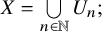
$X=\textstyle \bigcup \limits _{n\in {\mathbb {N}}} U_n;$
-
• for all
$n\!\in \! {\mathbb {N}}, \overline {U_n}$
is compact
$,$
and
$\mu (U_{n}\setminus U_{n-1})>0,$
where
$U_0:=\emptyset $
.



Let ${\mathcal {F}}$
be any non-principal ultrafilter on
${\mathcal {F}}$
be any non-principal ultrafilter on ${\mathbb {N}},$
and for each
${\mathbb {N}},$
and for each $n\in {\mathbb {N}},$
let
$n\in {\mathbb {N}},$
let $\varphi _n\in M\pmb {(}L^\infty (U_n\setminus U_{n-1}, \mu )\pmb {)}$
. Define
$\varphi _n\in M\pmb {(}L^\infty (U_n\setminus U_{n-1}, \mu )\pmb {)}$
. Define $\varphi \in M\pmb {(} L^\infty (X,\mu )\pmb {)}$
by
$\varphi \in M\pmb {(} L^\infty (X,\mu )\pmb {)}$
by
 $$ \begin{align*}\textstyle \varphi(f)=\lim\limits_{\mathcal{F}} \varphi_n(f|_{U_n\setminus U_{n-1}}) \;\text{ for all }\; f\in L^\infty(X,\mu). \end{align*} $$
If $\mathfrak {m}:=\ker \varphi ,$
then
$\mathfrak {m}:=\ker \varphi ,$
then $\mathfrak {m}L^2(X,\mu )=L^2(X,\mu )$
.
$\mathfrak {m}L^2(X,\mu )=L^2(X,\mu )$
.
Note that under the above assumptions, X is necessarily an infinite set. As each $U_n\setminus U_{n-1}$
is a Borel set, the restriction of the Radon measure
$U_n\setminus U_{n-1}$
is a Borel set, the restriction of the Radon measure $\mu $
to
$\mu $
to $U_n\setminus U_{n-1}$
is again a Radon measure (see, e.g., [Reference Folland2, Chapter 7, Example 7]). For each
$U_n\setminus U_{n-1}$
is again a Radon measure (see, e.g., [Reference Folland2, Chapter 7, Example 7]). For each $n\in {\mathbb {N}}$
,
$n\in {\mathbb {N}}$
, $L^\infty (U_n\setminus U_{n-1}, \mu )$
is a Banach algebra with pointwise operations and the (essential) supremum norm. If the complex homomorphisms
$L^\infty (U_n\setminus U_{n-1}, \mu )$
is a Banach algebra with pointwise operations and the (essential) supremum norm. If the complex homomorphisms $\varphi _n\in M\pmb {(}L^\infty (U_n\setminus U_{n-1}, \mu )\pmb {)}$
,
$\varphi _n\in M\pmb {(}L^\infty (U_n\setminus U_{n-1}, \mu )\pmb {)}$
, $n\in {\mathbb {N}}$
, then for any
$n\in {\mathbb {N}}$
, then for any $g\in L^\infty (X,\mu )$
, the complex sequence
$g\in L^\infty (X,\mu )$
, the complex sequence $\pmb {(}\varphi _n(g|_{U_n\setminus U_{n-1}}){\pmb {)}}_{n\in {\mathbb {N}}}\in \ell ^\infty $
because for all
$\pmb {(}\varphi _n(g|_{U_n\setminus U_{n-1}}){\pmb {)}}_{n\in {\mathbb {N}}}\in \ell ^\infty $
because for all $n\in {\mathbb {N}}$
,
$n\in {\mathbb {N}}$
, $ |\varphi _n(g|_{U_n\setminus U_{n-1}})| \le \|\varphi _n\|\|g|_{U_n\setminus U_{n-1}}\|_\infty \le 1\|g\|_\infty. $
Here,
$ |\varphi _n(g|_{U_n\setminus U_{n-1}})| \le \|\varphi _n\|\|g|_{U_n\setminus U_{n-1}}\|_\infty \le 1\|g\|_\infty. $
Here, $\|\varphi _n\|$
denotes the operator norm of
$\|\varphi _n\|$
denotes the operator norm of $\varphi _n:L^\infty (U_n\setminus U_{n-1}, \mu )\to {\mathbb {C}}$
which is equal to
$\varphi _n:L^\infty (U_n\setminus U_{n-1}, \mu )\to {\mathbb {C}}$
which is equal to $1$
(see, e.g., [Reference Douglas1, Proposition 2.22]). If
$1$
(see, e.g., [Reference Douglas1, Proposition 2.22]). If ${\mathcal {F}}$
is any non-principal ultrafilter on
${\mathcal {F}}$
is any non-principal ultrafilter on ${\mathbb {N}}$
and
${\mathbb {N}}$
and $\varphi _n\in M\pmb {(}L^\infty (U_n\setminus U_{n-1}, \mu )\pmb {)}$
,
$\varphi _n\in M\pmb {(}L^\infty (U_n\setminus U_{n-1}, \mu )\pmb {)}$
, $n\in {\mathbb {N}}$
, then
$n\in {\mathbb {N}}$
, then $\varphi : L^\infty (X,\mu )\to {\mathbb {C}}$
, as defined in the theorem statement above, is a continuous linear transformation, and it respects multiplication. If
$\varphi : L^\infty (X,\mu )\to {\mathbb {C}}$
, as defined in the theorem statement above, is a continuous linear transformation, and it respects multiplication. If $\mathbf {1}$
denotes the constant function on X taking value
$\mathbf {1}$
denotes the constant function on X taking value $1$
everywhere, then
$1$
everywhere, then $\varphi (\mathbf {1})=1$
. So
$\varphi (\mathbf {1})=1$
. So $\varphi \in M\pmb {(}L^\infty (X,\mu )\pmb {)}$
.
$\varphi \in M\pmb {(}L^\infty (X,\mu )\pmb {)}$
.
Proof. Let $f\in L^2(X,\mu )$
. We will construct a function
$f\in L^2(X,\mu )$
. We will construct a function $w:X\to (0,+\infty )$
such that
$w:X\to (0,+\infty )$
such that $w(x)\to +\infty $
as
$w(x)\to +\infty $
as $x\to \boldsymbol {\infty }$
, and
$x\to \boldsymbol {\infty }$
, and $fw\in \ell ^2 $
. Here,
$fw\in \ell ^2 $
. Here, $X\cup \{\boldsymbol {\infty }\}$
is the one-point/Alexandroff compactification of X. Below, by
$X\cup \{\boldsymbol {\infty }\}$
is the one-point/Alexandroff compactification of X. Below, by $f\in L^2(X,\mu )$
having a compact support, we mean that there exists a representative of f that is identically
$f\in L^2(X,\mu )$
having a compact support, we mean that there exists a representative of f that is identically $0$
outside a compact set.
$0$
outside a compact set.
-
1° If f has compact support, then we simply set
$w|_{U_1}\!=\!1$
and for
$n\ge 2$
,
$w|_{U_n\setminus U_{n-1}}=n$
. -
2° Suppose f does not have compact support. We set
$w|_{U_1}\!=\!1$
and for all
$n\ge 2$
,
$w|_{U_n\setminus U_{n-1}}=\frac {1}{\sqrt [4]{r_{n-1}}}$
, where for
$n\in {\mathbb {N}}$
, Note that
$$ \begin{align*}\textstyle r_n\!:=\!\sum\limits_{k=n+1}^\infty a_k^2, \;\text{ and }\; a_k^2\!:=\!\int_{x\in U_k\setminus U_{k-1}} |f(x)|^2 d\mu(x) \;\text{ for }\;k\in {\mathbb{N}}. \end{align*} $$
$r_n>0$
since f does not have compact support. We have
$r_n\to 0$
as
$n\to +\infty $
because
$f\in L^2(X,\mu )$
. Thus,
$w(x)\to +\infty $
as
$x\to {\boldsymbol {\infty }}$
. Moreover, using Proposition 1.1, we now show that
$fw\in L^2 (X,\mu )$
. We have
$$ \begin{align*}\begin{array}{rcl} \quad\quad&& \int_X |f(x)|^2 w(x)^2d\mu(x)\\[0.18cm] &=& \int_{U_1} |f(x)|^2d\mu(x)+ \sum\limits_{n=2}^\infty \int_{x\in U_{n}\setminus U_{n-1}} |f(x)|^2 \frac{1}{\sqrt{r_{n-1}}} d\mu(x) \quad\quad \quad (\star)\\ &\le & \|f\|_2^2 + \sum\limits_{n=2}^\infty \frac{a_n^2}{\sqrt{r_{n-1}}}<\infty. \end{array} \end{align*} $$




Define $g\in L^\infty (X,\mu )$
by
$g\in L^\infty (X,\mu )$
by
 $$ \begin{align*}\textstyle g(x)=\frac{1}{w(x)}\;\text{ for all }\;x\in X. \end{align*} $$
Then, $g(x)\to 0$
as
$g(x)\to 0$
as $x\to \boldsymbol {\infty }$
. Thus, as
$x\to \boldsymbol {\infty }$
. Thus, as $w|_{U_n\setminus U_{n-1}}$
is a constant function, taking value which we denote by
$w|_{U_n\setminus U_{n-1}}$
is a constant function, taking value which we denote by $\omega _n$
, and since by construction,
$\omega _n$
, and since by construction, $(\omega _n)_{n\in {\mathbb {N}}}$
diverges to
$(\omega _n)_{n\in {\mathbb {N}}}$
diverges to $+\infty $
as
$+\infty $
as $n\to +\infty $
, we get
$n\to +\infty $
, we get
 $$ \begin{align*}\textstyle \varphi(g)=\lim\limits_{\mathcal{F}} \varphi_n(g|_{U_n\setminus U_{n-1}})= \lim\limits_{\mathcal{F}} \frac{1}{\omega_n}=0. \end{align*} $$
So $g\in \ker \varphi =\mathfrak {m}$
. Next, define h by
$g\in \ker \varphi =\mathfrak {m}$
. Next, define h by
 $$ \begin{align*}\textstyle h(x)=\frac{f(x)}{g(x)}\;\text{ for all }\;x\in X. \end{align*} $$
By ( $\star $
) above, h belongs to
$\star $
) above, h belongs to $L^2(X,\mu )$
. So
$L^2(X,\mu )$
. So $f=gh$
, where
$f=gh$
, where $g\in \mathfrak {m}$
and
$g\in \mathfrak {m}$
and $h\in L^2(X,\mu ) $
. This completes the proof.
$h\in L^2(X,\mu ) $
. This completes the proof.
An immediate consequence of Theorem 2.4 is that, under the same assumptions on X and $\mu $
, the
$\mu $
, the $L^\infty (X,\mu )$
-module
$L^\infty (X,\mu )$
-module $L^2(X,\mu )$
is not faithfully flat.
$L^2(X,\mu )$
is not faithfully flat.
2.4. Applications/examples
The following list of examples is motivated by the consideration of signal spaces arising in control theory (see, e.g., Quadrat [Reference Quadrat10]).
Example 2.5. Let $X={\mathbb {N}}$
be endowed with the usual Euclidean topology induced from
$X={\mathbb {N}}$
be endowed with the usual Euclidean topology induced from ${\mathbb {R}}$
. Then, the compact subsets of
${\mathbb {R}}$
. Then, the compact subsets of ${\mathbb {N}}$
are finite. Let
${\mathbb {N}}$
are finite. Let $\mu $
be the counting Radon measure, defined by setting for any compact subset K of
$\mu $
be the counting Radon measure, defined by setting for any compact subset K of ${\mathbb {N}}$
,
${\mathbb {N}}$
, $\mu (K)$
to be the number of elements in K. Then,
$\mu (K)$
to be the number of elements in K. Then, $L^\infty (X,\mu )=\ell ^\infty $
and
$L^\infty (X,\mu )=\ell ^\infty $
and ${L^2(X,\mu )=\ell ^2}$
. Thus, by Proposition 2.1,
${L^2(X,\mu )=\ell ^2}$
. Thus, by Proposition 2.1, $\ell ^2$
is a flat
$\ell ^2$
is a flat $\ell ^\infty $
-module. As
$\ell ^\infty $
-module. As $\mu $
is
$\mu $
is $\sigma $
-finite, it follows from Proposition 2.3 that for every finitely generated, nonzero, proper ideal
$\sigma $
-finite, it follows from Proposition 2.3 that for every finitely generated, nonzero, proper ideal $\mathfrak {n}$
of
$\mathfrak {n}$
of $\ell ^\infty $
, we have
$\ell ^\infty $
, we have $\mathfrak {n}\ell ^2 \subsetneq \ell ^2$
. Finally, taking
$\mathfrak {n}\ell ^2 \subsetneq \ell ^2$
. Finally, taking $U_n=\{1,2,\ldots , n\}$
, we have:
$U_n=\{1,2,\ldots , n\}$
, we have:
-
•
$U_1\subset U_2\subset U_3\subset \dots $
, and
${\mathbb {N}}= \bigcup \limits _{n\in {\mathbb {N}}} U_n$
; -
• for all
$n\in {\mathbb {N}}$
,
$\overline {U_n}$
is compact, and
$\mu (U_{n}\setminus U_{n-1})=\mu \{n\}=1>0$
.


Thus, $\ell ^2$
is not a faithfully flat
$\ell ^2$
is not a faithfully flat $\ell ^\infty $
-module by Theorem 2.4.
$\ell ^\infty $
-module by Theorem 2.4.
Example 2.6. Let $X={\mathbb {R}}$
be endowed with the usual Euclidean topology, and
$X={\mathbb {R}}$
be endowed with the usual Euclidean topology, and $\mu $
be the Lebesgue measure m. Then,
$\mu $
be the Lebesgue measure m. Then, $L^2({\mathbb {R}},m)$
is a flat
$L^2({\mathbb {R}},m)$
is a flat $L^\infty ({\mathbb {R}},m)$
-module. As m is
$L^\infty ({\mathbb {R}},m)$
-module. As m is $\sigma $
-finite, it follows that for every finitely generated, nonzero, proper ideal
$\sigma $
-finite, it follows that for every finitely generated, nonzero, proper ideal $\mathfrak {n}$
of
$\mathfrak {n}$
of $L^\infty ({\mathbb {R}},m)$
,
$L^\infty ({\mathbb {R}},m)$
, $\mathfrak {n}L^2({\mathbb {R}},m) \subsetneq L^2({\mathbb {R}},m)$
. Finally, taking
$\mathfrak {n}L^2({\mathbb {R}},m) \subsetneq L^2({\mathbb {R}},m)$
. Finally, taking $U_n=(-n,n)$
, we have:
$U_n=(-n,n)$
, we have:
-
•
$U_1\subset U_2\subset U_3\subset \dots $
, and
${\mathbb {R}}= \bigcup \limits _{n\in {\mathbb {N}}} U_n$
; -
• for all
$n\in {\mathbb {N}}$
,
$\overline {U_n}=[-n,n]$
is compact, and
$\mu (U_{n}\setminus U_{n-1})>0$
.



Thus, $L^2({\mathbb {R}},m)$
is not a faithfully flat
$L^2({\mathbb {R}},m)$
is not a faithfully flat $L^2({\mathbb {R}},m)$
-module.
$L^2({\mathbb {R}},m)$
-module.
Example 2.7. Let ${\mathbb {T}}=\{z\in {\mathbb {C}}:|z|=1\}$
and
${\mathbb {T}}=\{z\in {\mathbb {C}}:|z|=1\}$
and $X={\mathbb {T}}$
be endowed with the usual Euclidean topology induced from
$X={\mathbb {T}}$
be endowed with the usual Euclidean topology induced from ${\mathbb {R}}^2$
, and
${\mathbb {R}}^2$
, and $\mu $
be the Lebesgue measure m on
$\mu $
be the Lebesgue measure m on ${\mathbb {T}}$
. Then,
${\mathbb {T}}$
. Then, $L^2({\mathbb {T}},m)$
is a flat
$L^2({\mathbb {T}},m)$
is a flat $L^\infty ({\mathbb {T}},m)$
-module. As m is
$L^\infty ({\mathbb {T}},m)$
-module. As m is $\sigma $
-finite, it follows that for every finitely generated, nonzero, proper ideal
$\sigma $
-finite, it follows that for every finitely generated, nonzero, proper ideal $\mathfrak {n}$
of
$\mathfrak {n}$
of $L^\infty ({\mathbb {T}},m)$
, we have
$L^\infty ({\mathbb {T}},m)$
, we have $\mathfrak {n}L^2({\mathbb {T}},m) \subsetneq L^2({\mathbb {T}},m)$
. Finally, taking
$\mathfrak {n}L^2({\mathbb {T}},m) \subsetneq L^2({\mathbb {T}},m)$
. Finally, taking $U_n=\{e^{i\theta }: \frac {1}{n}<|\theta |\le \pi \}\cup \{1\}$
, we have:
$U_n=\{e^{i\theta }: \frac {1}{n}<|\theta |\le \pi \}\cup \{1\}$
, we have:
-
•
$U_1\subset U_2\subset U_3\subset \dots $
, and
${\mathbb {T}}= \bigcup \limits _{n\in {\mathbb {N}}} U_n$
; -
• for all
$n\in {\mathbb {N}}$
,
$\overline {U_n}$
is compact, and
$\mu (U_{n}\setminus U_{n-1})>0$
.


Thus, $L^2({\mathbb {T}},m)$
is not a faithfully flat
$L^2({\mathbb {T}},m)$
is not a faithfully flat $L^2({\mathbb {T}},m)$
-module.
$L^2({\mathbb {T}},m)$
-module.
3.
$H^2$
is a flat, but not faithfully flat
$H^\infty $
-module


3.1.
$H^2$
is a flat
$H^\infty $
-module


The vector-valued Beurling theorem (the Lax–Halmos theorem, see, e.g., [Reference Nikolskiĭ9, Corollary 6, pp. 17–18]), characterizing shift-invariant subspaces of $H^2$
, implies that
$H^2$
, implies that $H^2$
is a flat
$H^2$
is a flat $H^\infty $
-module. This result was also shown in [Reference Quadrat10, Proposition 8] (in the half-plane setting), but we include a short proof for completeness. Below,
$H^\infty $
-module. This result was also shown in [Reference Quadrat10, Proposition 8] (in the half-plane setting), but we include a short proof for completeness. Below, $(H^2)^n$
is the Hilbert space which is the direct sum of n (
$(H^2)^n$
is the Hilbert space which is the direct sum of n ( $\in {\mathbb {N}}$
) copies of
$\in {\mathbb {N}}$
) copies of $H^2$
.
$H^2$
.
Proposition 3.1. $H^2$
is a flat
$H^2$
is a flat $H^\infty $
-module.
$H^\infty $
-module.
Proof. Let $n\in {\mathbb {N}}$
and
$n\in {\mathbb {N}}$
and $r_1,\ldots , r_n\in H^\infty $
. Consider the
$r_1,\ldots , r_n\in H^\infty $
. Consider the ${\mathbb {C}}$
-linear map
${\mathbb {C}}$
-linear map ${\mathbf {r}}:(H^2)^n\to H^2$
given by
${\mathbf {r}}:(H^2)^n\to H^2$
given by ${\mathbf {r}}(h_1,\ldots , h_n) =r_1 h_1+\cdots +r_n h_n$
for all
${\mathbf {r}}(h_1,\ldots , h_n) =r_1 h_1+\cdots +r_n h_n$
for all $ (h_1,\ldots , h_n)\in (H^2)^n$
. It is clear that
$ (h_1,\ldots , h_n)\in (H^2)^n$
. It is clear that $\ker {\mathbf {r}}$
is a shift-invariant subspace (i.e.,
$\ker {\mathbf {r}}$
is a shift-invariant subspace (i.e., $(zh_1,\ldots , zh_n)\in \ker {\mathbf {r}}$
whenever
$(zh_1,\ldots , zh_n)\in \ker {\mathbf {r}}$
whenever $(h_1,\ldots , h_n)\in \ker {\mathbf {r}}$
). By the Beurling–Lax–Halmos theorem, there exists a
$(h_1,\ldots , h_n)\in \ker {\mathbf {r}}$
). By the Beurling–Lax–Halmos theorem, there exists a $k\in {\mathbb {N}}$
and a matrix
$k\in {\mathbb {N}}$
and a matrix $[\rho _{ij}]$
of size
$[\rho _{ij}]$
of size $n\times k$
with
$n\times k$
with $H^\infty $
entries, such that
$H^\infty $
entries, such that
 $$ \begin{align*}\textstyle \ker {\mathbf{r}}=\Big\{\sum\limits_{j=1}^k \rho_{ij} \varphi_j: \varphi_1, \ldots, \varphi_k\in H^2\Big\}. \end{align*} $$
For a $j\!\in \! \{1,\ldots , k\}$
, taking
$j\!\in \! \{1,\ldots , k\}$
, taking $\varphi _{i}\!=\!\delta _{ij}$
(equal to the constant function
$\varphi _{i}\!=\!\delta _{ij}$
(equal to the constant function ${\mathbf {0}}$
if
${\mathbf {0}}$
if $i \neq j$
and the constant function
$i \neq j$
and the constant function ${\mathbf {1}}$
if
${\mathbf {1}}$
if $i\!=\!j$
),
$i\!=\!j$
), $1\!\le \! i\!\le \! k$
, we get
$1\!\le \! i\!\le \! k$
, we get $(\rho _{1j},\ldots , \rho _{nj})\!\in \! \ker {\mathbf {r}}$
. So
$(\rho _{1j},\ldots , \rho _{nj})\!\in \! \ker {\mathbf {r}}$
. So $H^2$
is a flat
$H^2$
is a flat $H^\infty $
-module.
$H^\infty $
-module.
3.2. The case of finitely generated maximal ideals
We claim that for any finitely generated, nonzero, closed, proper ideal $\mathfrak {n}$
of
$\mathfrak {n}$
of $H^\infty $
, we have
$H^\infty $
, we have $\mathfrak {n} H^2\subsetneq H^2$
. Using a result from Mortini [Reference Mortini8] (saying that any finitely generated, nonzero ideal of
$\mathfrak {n} H^2\subsetneq H^2$
. Using a result from Mortini [Reference Mortini8] (saying that any finitely generated, nonzero ideal of $H^\infty $
is closed if and only if it is a principal ideal generated by an inner function),
$H^\infty $
is closed if and only if it is a principal ideal generated by an inner function), $\mathfrak {n}=\langle g\rangle $
, where
$\mathfrak {n}=\langle g\rangle $
, where $g\in H^\infty $
is an inner function. Hence,
$g\in H^\infty $
is an inner function. Hence, $\mathfrak {n} H^2=\langle g\rangle H^2=gH^\infty H^2= gH^2 \subsetneq H^2$
. (That the last inclusion is strict: Otherwise, in particular,
$\mathfrak {n} H^2=\langle g\rangle H^2=gH^\infty H^2= gH^2 \subsetneq H^2$
. (That the last inclusion is strict: Otherwise, in particular, ${\mathbf {1}}\in H^2=gH^2$
, and so by looking at boundary values on
${\mathbf {1}}\in H^2=gH^2$
, and so by looking at boundary values on ${\mathbb {T}}$
, the pointwise complex conjugate
${\mathbb {T}}$
, the pointwise complex conjugate $\overline {g}$
of g satisfies
$\overline {g}$
of g satisfies $\overline {g}=\frac {1}{g} \in H^2$
. Thus,
$\overline {g}=\frac {1}{g} \in H^2$
. Thus, $g,\frac {1}{g}\in H^2$
, implying that the Fourier coefficients
$g,\frac {1}{g}\in H^2$
, implying that the Fourier coefficients $\hat {g}_m$
of g are zero for all
$\hat {g}_m$
of g are zero for all $m\neq 0$
, i.e.,
$m\neq 0$
, i.e., $g=\alpha $
with
$g=\alpha $
with $|\alpha |=1$
. But then
$|\alpha |=1$
. But then $\mathfrak {n}=\langle g\rangle =H^\infty $
, contradicting the properness of
$\mathfrak {n}=\langle g\rangle =H^\infty $
, contradicting the properness of $\mathfrak {n}$
.)
$\mathfrak {n}$
.)
3.3. Some background on Hardy spaces
We recall a few facts we need for the proof of the non-faithfulness of the flat $H^\infty $
-module
$H^\infty $
-module $H^2$
. Background on Hardy spaces can be found, for example, in Garnett [Reference Garnett3] and Hoffman [Reference Hoffman6].
$H^2$
. Background on Hardy spaces can be found, for example, in Garnett [Reference Garnett3] and Hoffman [Reference Hoffman6].
We recall that an inner function is a $g\in {\mathcal {O}}({\mathbb {D}})$
such that
$g\in {\mathcal {O}}({\mathbb {D}})$
such that $|g(z)|\le 1$
for all
$|g(z)|\le 1$
for all $z\in {\mathbb {D}}$
and such that
$z\in {\mathbb {D}}$
and such that $|g(e^{i\theta })|=1$
for almost all
$|g(e^{i\theta })|=1$
for almost all $\theta \in (-\pi ,\pi ]$
. An outer function is an analytic function
$\theta \in (-\pi ,\pi ]$
. An outer function is an analytic function $F\in {\mathcal {O}}({\mathbb {D}})$
having the form
$F\in {\mathcal {O}}({\mathbb {D}})$
having the form
 $$ \begin{align*}\textstyle F(z)=\alpha \exp\big( \frac{1}{2\pi} \int_{-\pi}^\pi \frac{e^{i\theta}+z}{e^{i\theta}-z} k(\theta) d\theta\big), \end{align*} $$
where $k:{\mathbb {T}}\to {\mathbb {R}}$
belongs to
$k:{\mathbb {T}}\to {\mathbb {R}}$
belongs to $L^1({\mathbb {T}})$
and
$L^1({\mathbb {T}})$
and $\alpha \in {\mathbb {T}}$
. Then,
$\alpha \in {\mathbb {T}}$
. Then, $k(\theta )=\log |F(e^{i\theta })|$
for almost all
$k(\theta )=\log |F(e^{i\theta })|$
for almost all $\theta \in (-\pi ,\pi ]$
.
$\theta \in (-\pi ,\pi ]$
.
For the results claimed below, we refer to [Reference Hoffman6, pp. 160–162]. Consider the identity function ${\mathbf {z}} \in H^\infty $
, given by
${\mathbf {z}} \in H^\infty $
, given by ${\mathbb {D}}\owns z\mapsto z$
. Then, the map
${\mathbb {D}}\owns z\mapsto z$
. Then, the map $\pi : M( H^\infty )\to {\mathbb {C}}$
,
$\pi : M( H^\infty )\to {\mathbb {C}}$
, $ \pi (\varphi )=\varphi ({\mathbf {z}})\text { for all }\varphi \in M( H^\infty ), $
is a continuous map onto the closed unit disk
$ \pi (\varphi )=\varphi ({\mathbf {z}})\text { for all }\varphi \in M( H^\infty ), $
is a continuous map onto the closed unit disk $\overline {{\mathbb {D}}}$
in
$\overline {{\mathbb {D}}}$
in ${\mathbb {C}}$
. Over the open unit disk
${\mathbb {C}}$
. Over the open unit disk ${\mathbb {D}}$
,
${\mathbb {D}}$
, $\pi $
is one-to-one, and maps
$\pi $
is one-to-one, and maps ${\mathbb {D}}$
homeomorphically onto an open subset of
${\mathbb {D}}$
homeomorphically onto an open subset of $M( H^\infty )$
, be sending
$M( H^\infty )$
, be sending $\lambda \in {\mathbb {D}}$
to
$\lambda \in {\mathbb {D}}$
to $\varphi _\lambda \in M(H^\infty )$
, where
$\varphi _\lambda \in M(H^\infty )$
, where $\varphi _\lambda $
is given by
$\varphi _\lambda $
is given by $\varphi _\lambda (f)=f(\lambda )$
for all
$\varphi _\lambda (f)=f(\lambda )$
for all $f\in H^\infty $
. The remainder of
$f\in H^\infty $
. The remainder of $M( H^\infty )$
is mapped by
$M( H^\infty )$
is mapped by $\pi $
onto the unit circle. If
$\pi $
onto the unit circle. If $|\alpha |=1$
, then
$|\alpha |=1$
, then $\pi ^{-1}\{\alpha \}$
is the fiber of
$\pi ^{-1}\{\alpha \}$
is the fiber of $M( H^\infty )$
over
$M( H^\infty )$
over $\alpha $
. If
$\alpha $
. If $g\in H^\infty $
and
$g\in H^\infty $
and $\alpha \in {\mathbb {T}}$
, then the range of
$\alpha \in {\mathbb {T}}$
, then the range of $\widehat {g}$
on the fiber
$\widehat {g}$
on the fiber $\pi ^{-1}\{\alpha \}$
is the set of all
$\pi ^{-1}\{\alpha \}$
is the set of all $\zeta \in {\mathbb {C}}$
such that there exists a sequence
$\zeta \in {\mathbb {C}}$
such that there exists a sequence $(\lambda _n)_{n\in {\mathbb {N}}}$
in
$(\lambda _n)_{n\in {\mathbb {N}}}$
in ${\mathbb {D}}$
with the properties that
${\mathbb {D}}$
with the properties that $ \lim \limits _{n\to \infty }\lambda _n=\alpha \text { and } \lim \limits _{n\to \infty } g(\lambda _n)=\zeta. $
It is clear that for each point evaluation $\varphi _\lambda $
, where
$\varphi _\lambda $
, where $\lambda \in {\mathbb {D}}$
, the corresponding maximal ideal
$\lambda \in {\mathbb {D}}$
, the corresponding maximal ideal ${\mathfrak {m}_\lambda :=\ker \varphi _\lambda }$
of
${\mathfrak {m}_\lambda :=\ker \varphi _\lambda }$
of $H^\infty $
has the property that
$H^\infty $
has the property that $\mathfrak {m}_\lambda H^2\subsetneq H^2$
(because any
$\mathfrak {m}_\lambda H^2\subsetneq H^2$
(because any $g\in \mathfrak {m}_\lambda $
has a zero at
$g\in \mathfrak {m}_\lambda $
has a zero at $\lambda $
, and so each element of
$\lambda $
, and so each element of $\mathfrak {m}_\lambda H^2$
will also have a zero at
$\mathfrak {m}_\lambda H^2$
will also have a zero at $\lambda $
, but
$\lambda $
, but ${\mathbf {1}}\in H^2$
does not vanish at
${\mathbf {1}}\in H^2$
does not vanish at $\lambda $
).
$\lambda $
).
However, $H^2$
is not faithfully flat, since we will show below that for any
$H^2$
is not faithfully flat, since we will show below that for any $\mathfrak {m}:=\ker \varphi $
, where
$\mathfrak {m}:=\ker \varphi $
, where ${\varphi \in M( H^\infty )\setminus \pi ^{-1}({\mathbb {D}})}$
, we have
${\varphi \in M( H^\infty )\setminus \pi ^{-1}({\mathbb {D}})}$
, we have $\mathfrak {m} H^2= H^2$
. More explicitly, if
$\mathfrak {m} H^2= H^2$
. More explicitly, if $\alpha \in {\mathbb {T}}$
,
$\alpha \in {\mathbb {T}}$
, $\varphi \in \pi ^{-1} \{\alpha \}$
and
$\varphi \in \pi ^{-1} \{\alpha \}$
and $\mathfrak {m}:=\ker \varphi $
, then
$\mathfrak {m}:=\ker \varphi $
, then $\mathfrak {m} H^2= H^2$
. We prove this just when
$\mathfrak {m} H^2= H^2$
. We prove this just when $\alpha =1$
, but rotational symmetry yields the result for arbitrary
$\alpha =1$
, but rotational symmetry yields the result for arbitrary $\alpha \in {\mathbb {T}}$
.
$\alpha \in {\mathbb {T}}$
.
The proof of Theorem 3.2 is based on the following email reply (paraphrased on disc instead of the half-plane) by Donald Sarason to the question (of faithfulness of the flat $H^\infty $
-module
$H^\infty $
-module $H^2$
) put to him by Alban Quadrat [Reference Quadrat and Sarason11]:
$H^2$
) put to him by Alban Quadrat [Reference Quadrat and Sarason11]:
Let $f\in H^2$
. Then,
$f\in H^2$
. Then, $f=gh$
, where
$f=gh$
, where $h\in H^2$
and
$h\in H^2$
and $g\in H^\infty $
, and
$g\in H^\infty $
, and $g(z)\to 0$
as
$g(z)\to 0$
as $z\to 1$
(so g belongs to every maximal ideal of
$z\to 1$
(so g belongs to every maximal ideal of $ H^\infty $
associated with a point in the maximal ideal space lying in the fiber above
$ H^\infty $
associated with a point in the maximal ideal space lying in the fiber above $1$
). To produce g and h take a positive function w on
$1$
). To produce g and h take a positive function w on ${\mathbb {T}}$
such that
${\mathbb {T}}$
such that $w>1$
,
$w>1$
, $wf\in L^2$
, and
$wf\in L^2$
, and $w(e^{i\theta })\hspace{-1pt} \to\hspace{-1pt} \infty $
as
$w(e^{i\theta })\hspace{-1pt} \to\hspace{-1pt} \infty $
as $\theta\hspace{-1pt} \to\hspace{-1pt} 0$
. Let g be the outer function whose modulus on
$\theta\hspace{-1pt} \to\hspace{-1pt} 0$
. Let g be the outer function whose modulus on ${\mathbb {T}}$
is
${\mathbb {T}}$
is $1/w$
, and let
$1/w$
, and let $h\hspace{-1pt}=\hspace{-1pt}f/g$
.
$h\hspace{-1pt}=\hspace{-1pt}f/g$
.
We give a complete proof by making the outline above explicit below, since the construction of such a w with the required properties is not at all trivial.
Theorem 3.2. If $\varphi \!\in \! \pi ^{-1}\{1\},$
then for the maximal ideal
$\varphi \!\in \! \pi ^{-1}\{1\},$
then for the maximal ideal $\mathfrak {m}\!=\!\ker \varphi $
of
$\mathfrak {m}\!=\!\ker \varphi $
of $ H^\infty , \mathfrak {m} H^2 \!=\! H^2$
.
$ H^\infty , \mathfrak {m} H^2 \!=\! H^2$
.
Proof. Let $f\!\in \! H^2$
be nonzero. Then, by the F. and M. Riesz theorem (see, e.g., [Reference Douglas1, Theorem 6.13]), it follows that the boundary function
$f\!\in \! H^2$
be nonzero. Then, by the F. and M. Riesz theorem (see, e.g., [Reference Douglas1, Theorem 6.13]), it follows that the boundary function $f\in L^2({\mathbb {T}})$
cannot be identically zero on any arc of
$f\in L^2({\mathbb {T}})$
cannot be identically zero on any arc of ${\mathbb {T}}$
with a positive measure. Without loss of generality, we may also assume that
${\mathbb {T}}$
with a positive measure. Without loss of generality, we may also assume that $\|f\|_2\le 1$
. Let
$\|f\|_2\le 1$
. Let $a_n>0$
be defined by
$a_n>0$
be defined by
 $$ \begin{align*}\textstyle a_n^2=\int_{\frac{1}{n+1}\le |\theta| <\frac{1}{n}} |f(e^{i\theta})|^2 d\theta \text{ for all } n\in {\mathbb{N}}. \end{align*} $$
Then, $a_n\in (0,1)$
, and also
$a_n\in (0,1)$
, and also $(a_n)_{n\in {\mathbb {N}}}\in \ell ^2$
. For
$(a_n)_{n\in {\mathbb {N}}}\in \ell ^2$
. For $n\in {\mathbb {N}}$
, set
$n\in {\mathbb {N}}$
, set
 $$ \begin{align*}\textstyle r_n=\sum\limits_{k=n+1}^\infty a_k^2. \end{align*} $$
Then, $r_n\in (0,1]$
(thanks to
$r_n\in (0,1]$
(thanks to $\|f\|_2\le 1$
and as each
$\|f\|_2\le 1$
and as each $a_n>0$
) for all
$a_n>0$
) for all $n\in {\mathbb {N}}$
. Define w as follows:
$n\in {\mathbb {N}}$
. Define w as follows:
 $$ \begin{align*}\textstyle w(e^{i\theta}) = \left\{ \begin{array}{ll} 1 & \text{if }\theta\in (-\pi,\pi]\setminus (-\frac{1}{2},\frac{1}{2}),\\[0.1cm] \min\{\frac{1}{\sqrt[4]{r_{n-1}}},n\} & \text{if } \frac{1}{n+1}\le |\theta|<\frac{1}{n}, \;n\ge 2. \end{array}\right. \end{align*} $$
We note that w is pointwise $\ge 1$
(as
$\ge 1$
(as $ \textstyle r_{n-1}\le \|f\|_2^2\le 1$
). Also, we have that
$ \textstyle r_{n-1}\le \|f\|_2^2\le 1$
). Also, we have that $w(e^{i\theta })\to +\infty $
as
$w(e^{i\theta })\to +\infty $
as $\theta \to 0$
.
$\theta \to 0$
.
We wish to construct an outer function g with modulus $\frac {1}{w}$
on
$\frac {1}{w}$
on ${\mathbb {T}}$
, that is, with
${\mathbb {T}}$
, that is, with $k:=\log |g|_{{\mathbb {T}}}|=\log \frac {1}{w}$
. So we must check that the w constructed above has the property that
$k:=\log |g|_{{\mathbb {T}}}|=\log \frac {1}{w}$
. So we must check that the w constructed above has the property that $k=\log \frac {1}{w}\in L^1({\mathbb {T}})$
. We have
$k=\log \frac {1}{w}\in L^1({\mathbb {T}})$
. We have
 $$ \begin{align*}\textstyle \begin{array}{rcl} \int_{-\pi}^\pi |\log \frac{1}{w(e^{i\theta})}| d\theta &=& \int_{\pi>|\theta|\ge \frac{1}{2}} |\log 1| d\theta + \sum\limits_{n=2}^\infty \int_{\frac{1}{n+1}\le |\theta| <\frac{1}{n}} \log w(e^{i\theta}) d\theta \\ &\le & 0+ \sum\limits_{n=2}^\infty \frac{2}{n(n+1)} \log n \le 2 \sum\limits_{n=2}^\infty \frac{\log n}{n^2}. \end{array} \end{align*} $$
But there exists an $N\in {\mathbb {N}}$
such that for all
$N\in {\mathbb {N}}$
such that for all $n>N$
,
$n>N$
, $\log n<\sqrt {n}$
because
$\log n<\sqrt {n}$
because
 $$ \begin{align*}\textstyle \lim\limits_{x\to \infty} \frac{\log x}{\sqrt{x}}=0. \end{align*} $$
For $n>N$
,
$n>N$
, $\frac {\log n}{n^2}<\frac {1}{n^{3/2}}$
. As
$\frac {\log n}{n^2}<\frac {1}{n^{3/2}}$
. As $ \sum \limits _{n=1}^\infty \frac {1}{n^{3/2}}<\infty $
, we get by comparison that
$ \sum \limits _{n=1}^\infty \frac {1}{n^{3/2}}<\infty $
, we get by comparison that
 $$ \begin{align*}\textstyle \sum\limits_{n=2}^\infty \frac{\log n}{n^2}<\infty. \end{align*} $$
So from the above, we conclude that $\log \frac {1}{w}\in L^1({\mathbb {T}})$
.
$\log \frac {1}{w}\in L^1({\mathbb {T}})$
.
Let g be the outer function with modulus $\frac {1}{w}$
on
$\frac {1}{w}$
on ${\mathbb {T}}$
, that is, with
${\mathbb {T}}$
, that is, with $k=\log \frac {1}{w}$
,
$k=\log \frac {1}{w}$
,
 $$ \begin{align*}\textstyle g(z)=\exp \big( \frac{1}{2\pi} \int_{-\pi}^\pi \frac{e^{i\theta}+z}{e^{i\theta}-z} k(\theta) \;\!d\theta\big). \end{align*} $$
Then, $g\in {\mathcal {O}}({\mathbb {D}})$
,
$g\in {\mathcal {O}}({\mathbb {D}})$
, $\frac {1}{w}\in L^\infty ({\mathbb {T}})$
, and
$\frac {1}{w}\in L^\infty ({\mathbb {T}})$
, and $g\in H^\infty $
. By the construction of w, we have
$g\in H^\infty $
. By the construction of w, we have $w(e^{i\theta })\to \infty $
as
$w(e^{i\theta })\to \infty $
as $\theta \to 0$
, that is,
$\theta \to 0$
, that is, $g(e^{i\theta })=\frac {1}{w(e^{i\theta })}\to 0$
as
$g(e^{i\theta })=\frac {1}{w(e^{i\theta })}\to 0$
as $\theta \to 0$
. By Lindelöf’s theorem (see, e.g., [Reference Garnett3, Example 7(c), pp. 88–89]), it follows that
$\theta \to 0$
. By Lindelöf’s theorem (see, e.g., [Reference Garnett3, Example 7(c), pp. 88–89]), it follows that
 $$ \begin{align*}\quad \quad \quad\quad \quad \quad\quad \quad \quad \quad \quad \quad \quad \quad \quad \quad \lim\limits_{{\mathbb{D}}\owns z\to 1} g(z)=0. \quad \quad \quad\quad \quad \quad\quad \quad \quad\quad \quad \quad \quad \quad \quad \quad (\star\star) \end{align*} $$
We claim that $g\in \mathfrak {m}$
, that is,
$g\in \mathfrak {m}$
, that is, $\varphi (g)=0$
. This follows from the fact that the range of
$\varphi (g)=0$
. This follows from the fact that the range of $\widehat {g}$
on
$\widehat {g}$
on $ \pi ^{-1}\{1\}$
is the set of all
$ \pi ^{-1}\{1\}$
is the set of all $\zeta \in {\mathbb {C}}$
such that there exists a sequence
$\zeta \in {\mathbb {C}}$
such that there exists a sequence $(\lambda _n)_{n\in {\mathbb {N}}}$
in
$(\lambda _n)_{n\in {\mathbb {N}}}$
in ${\mathbb {D}}$
satisfying
${\mathbb {D}}$
satisfying
 $$ \begin{align*}\lim\limits_{n\to \infty}\lambda_n=1 \; \text{ and } \; \lim\limits_{n\to \infty} g(\lambda_n)=\zeta. \end{align*} $$
But for each such sequence $(\lambda _n)_{n\in {\mathbb {N}}}$
in
$(\lambda _n)_{n\in {\mathbb {N}}}$
in ${\mathbb {D}}$
converging to
${\mathbb {D}}$
converging to $1$
, we have by (
$1$
, we have by ( $\star \star $
) that
$\star \star $
) that $(g(\lambda _n))_{n\in {\mathbb {N}}}$
converges to
$(g(\lambda _n))_{n\in {\mathbb {N}}}$
converges to $0$
. Hence, the range of
$0$
. Hence, the range of $\widehat {g}$
on
$\widehat {g}$
on $ \pi ^{-1}\{1\}$
is just
$ \pi ^{-1}\{1\}$
is just $\{0\}$
. In particular,
$\{0\}$
. In particular, $\widehat {g}(\varphi )=0$
, that is,
$\widehat {g}(\varphi )=0$
, that is, $\varphi (g)=0$
. Hence,
$\varphi (g)=0$
. Hence, $g\in \mathfrak {m}$
.
$g\in \mathfrak {m}$
.
As g is given by an exponential, g is never $0$
, and so
$0$
, and so $\frac {1}{g}\in {\mathcal {O}}({\mathbb {D}})$
. Define
$\frac {1}{g}\in {\mathcal {O}}({\mathbb {D}})$
. Define $h\in {\mathcal {O}}({\mathbb {D}})$
by
$h\in {\mathcal {O}}({\mathbb {D}})$
by $h=\frac {1}{g} f$
. We claim that
$h=\frac {1}{g} f$
. We claim that $h\in H^2$
by showing that
$h\in H^2$
by showing that $wf\in L^2({\mathbb {T}})$
. We have
$wf\in L^2({\mathbb {T}})$
. We have
 $$ \begin{align*}\textstyle \! \begin{array}{rcl} \int_{-\pi}^\pi \!|f(e^{i\theta})|^2 (w(e^{i\theta}))^2 d\theta &\le & \int_{\pi>|\theta|\ge \frac{1}{2}} \! |f(e^{i\theta})|^2d\theta + \sum\limits_{n=2}^\infty \int_{\frac{1}{n+1}\le |\theta| \le \frac{1}{n}}\! \frac{|f(e^{i\theta})|^2}{\sqrt{r_{n-1}}} d\theta \\ &\le& \|f\|_2^2+ \sum\limits_{n=2}^\infty \frac{a_n^2}{\sqrt{r_{n-1}}}<\infty, \end{array} \end{align*} $$
where we used Proposition 1.1 to obtain the last inequality. Thus, $f=gh$
with
$f=gh$
with $g\in \mathfrak {m}$
and
$g\in \mathfrak {m}$
and $h\in H^2$
, showing that
$h\in H^2$
, showing that $\mathfrak {m} H^2=H^2$
.
$\mathfrak {m} H^2=H^2$
.
3.4. The half plane case
In control theory, besides the Hardy spaces on the disc (corresponding to “discrete-time systems” arising from difference equations), one also encounters Hardy spaces on the right half plane ${\mathbb {C}}_+=\{s\in {\mathbb {C}}: \text {Re}\;s>0\}$
(corresponding to “continuous-time systems” arising from differential equations). We observe that the results above also hold in this case, as explained below.
${\mathbb {C}}_+=\{s\in {\mathbb {C}}: \text {Re}\;s>0\}$
(corresponding to “continuous-time systems” arising from differential equations). We observe that the results above also hold in this case, as explained below.
The Hardy Hilbert space $H^2({\mathbb {C}}_+)$
is the set of all
$H^2({\mathbb {C}}_+)$
is the set of all $F\in {\mathcal {O}}({\mathbb {C}}_+)$
with
$F\in {\mathcal {O}}({\mathbb {C}}_+)$
with
 $$ \begin{align*}\textstyle \|F\|_2^2:=\sup\limits_{x>0} \int_{-\infty}^\infty |F(x+iy)|^2\;\! dy<\infty. \end{align*} $$
Then, $H^2({\mathbb {C}}_+)$
is a Hilbert space with pointwise operations and the norm
$H^2({\mathbb {C}}_+)$
is a Hilbert space with pointwise operations and the norm $\|\cdot \|_2$
defined above (which arises from an inner product). The Hardy algebra
$\|\cdot \|_2$
defined above (which arises from an inner product). The Hardy algebra $H^\infty ({\mathbb {C}}_+)$
is the set of all
$H^\infty ({\mathbb {C}}_+)$
is the set of all $F\in {\mathcal {O}}({\mathbb {C}}_+)$
such that
$F\in {\mathcal {O}}({\mathbb {C}}_+)$
such that
 $$ \begin{align*}\textstyle \|F\|_\infty:=\sup\limits_{x>0} |F(x+iy)|<\infty. \end{align*} $$
With pointwise operations and the $\|\cdot \|_\infty $
norm,
$\|\cdot \|_\infty $
norm, $H^\infty ({\mathbb {C}}_+)$
is a Banach algebra. With the action of the ring
$H^\infty ({\mathbb {C}}_+)$
is a Banach algebra. With the action of the ring $H^\infty ({\mathbb {C}}_+)$
on
$H^\infty ({\mathbb {C}}_+)$
on $H^2({\mathbb {C}}_+)$
given by pointwise multiplication,
$H^2({\mathbb {C}}_+)$
given by pointwise multiplication, $H^2({\mathbb {C}}_+)$
is an
$H^2({\mathbb {C}}_+)$
is an $H^\infty ({\mathbb {C}}_+)$
-module. It was shown in [Reference Quadrat10, Proposition 8] that
$H^\infty ({\mathbb {C}}_+)$
-module. It was shown in [Reference Quadrat10, Proposition 8] that $H^2({\mathbb {C}}_+)$
is a flat
$H^2({\mathbb {C}}_+)$
is a flat $H^\infty ({\mathbb {C}}_+)$
-module.
$H^\infty ({\mathbb {C}}_+)$
-module.
Define $\varphi : {\mathbb {C}}_+\to {\mathbb {D}}$
by
$\varphi : {\mathbb {C}}_+\to {\mathbb {D}}$
by
 $$ \begin{align} \textstyle \varphi(s)=\frac{s-1}{s+1}\;\text{ for all }\;s\in {\mathbb{C}}_+. \end{align} $$
Then, $\varphi $
is biholomorphic, and
$\varphi $
is biholomorphic, and
 $$ \begin{align*}\textstyle \varphi^{-1}(z)=\frac{1+z}{1-z}\;\text{ for all }\;z\in {\mathbb{D}}. \end{align*} $$
It is clear that $f\in H^\infty $
if and only if
$f\in H^\infty $
if and only if $f\circ \varphi \in H^\infty ({\mathbb {C}}_+)$
. Equivalently,
$f\circ \varphi \in H^\infty ({\mathbb {C}}_+)$
. Equivalently, $F\in H^\infty ({\mathbb {C}}_+)$
if and only if
$F\in H^\infty ({\mathbb {C}}_+)$
if and only if $F\circ \varphi ^{-1} \in H^\infty $
. By [Reference Hoffman6, Theorem, p. 130],
$F\circ \varphi ^{-1} \in H^\infty $
. By [Reference Hoffman6, Theorem, p. 130], $f\in H^2$
if and only if the function
$f\in H^2$
if and only if the function
 $$ \begin{align*}\textstyle {\mathbb{C}}_+\owns s\mapsto \frac{(f\circ \varphi)(s)}{1+s} \end{align*} $$
belongs to $ H^2({\mathbb {C}}_+)$
. Equivalently,
$ H^2({\mathbb {C}}_+)$
. Equivalently, $F\in H^2({\mathbb {C}}_+)$
if and only if
$F\in H^2({\mathbb {C}}_+)$
if and only if
 $$ \begin{align*}\textstyle {\mathbb{D}}\owns z\mapsto \frac{(F\circ \varphi^{-1})(z)}{1-z} \end{align*} $$
belongs to $H^2$
.
$H^2$
.
Corollary 3.3. Let $\mathfrak {m}$
be a maximal ideal of
$\mathfrak {m}$
be a maximal ideal of $H^\infty $
as in Theorem 3.2. Define
$H^\infty $
as in Theorem 3.2. Define $\mathfrak {M}=\{g\circ \varphi : g\in \mathfrak {m}\},$
where
$\mathfrak {M}=\{g\circ \varphi : g\in \mathfrak {m}\},$
where $\varphi $
is given by (3.1). Then,
$\varphi $
is given by (3.1). Then, $\mathfrak {M}$
is a maximal ideal of
$\mathfrak {M}$
is a maximal ideal of $H^\infty ({\mathbb {C}}_+),$
and
$H^\infty ({\mathbb {C}}_+),$
and $\mathfrak {M}H^2({\mathbb {C}}_+)=H^2({\mathbb {C}}_+)$
.
$\mathfrak {M}H^2({\mathbb {C}}_+)=H^2({\mathbb {C}}_+)$
.
Proof. Let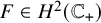 $F\in H^2({\mathbb {C}}_+)$
. Then,
$F\in H^2({\mathbb {C}}_+)$
. Then, $f\in H^2$
, where
$f\in H^2$
, where
 $$ \begin{align*}\textstyle f(z):=2 \frac{(F\circ \varphi^{-1})(z)}{1-z} \;\text{ for all }\;z\in {\mathbb{D}}. \end{align*} $$
Thus, there exist $g\in \mathfrak {m}$
and
$g\in \mathfrak {m}$
and $h\in H^2$
such that
$h\in H^2$
such that $f=gh$
. But then
$f=gh$
. But then $G:=g\circ \varphi \in \mathfrak {M}$
, and
$G:=g\circ \varphi \in \mathfrak {M}$
, and $H\in H^2({\mathbb {C}}_+)$
, where
$H\in H^2({\mathbb {C}}_+)$
, where
 $$ \begin{align*}\textstyle H(s)=\frac{(h\circ \varphi)(s)}{1+s} \;\text{ for all }\;s\in {\mathbb{C}}_+. \end{align*} $$
Also, from $f=gh$
, we get
$f=gh$
, we get $f\circ \varphi = (g\circ \varphi )(h\circ \varphi )$
, and so for all
$f\circ \varphi = (g\circ \varphi )(h\circ \varphi )$
, and so for all $s\in {\mathbb {C}}_+$
,
$s\in {\mathbb {C}}_+$
,
 $$ \begin{align*}\textstyle \frac{(f\circ \varphi)(s)}{1+s} = (g\circ \varphi)(s) \frac{(h\circ \varphi^{-1})(s)}{1+s}=G(s)H(s). \end{align*} $$
Thus, $ \textstyle G(s)H(s) \!=\! \frac {(f\circ \varphi )(s)}{1+s}\!=\! \frac {1}{1+s} f(\varphi (s))\!=\! \frac {1}{1+s}2\frac {(F\circ \varphi ^{-1})(\varphi (s))}{1-\varphi (s)}\!=\! F(s)$
.
$ \textstyle G(s)H(s) \!=\! \frac {(f\circ \varphi )(s)}{1+s}\!=\! \frac {1}{1+s} f(\varphi (s))\!=\! \frac {1}{1+s}2\frac {(F\circ \varphi ^{-1})(\varphi (s))}{1-\varphi (s)}\!=\! F(s)$
.
It can also be shown that if $\mathfrak {N}$
is any finitely generated, nonzero, closed, proper ideal of
$\mathfrak {N}$
is any finitely generated, nonzero, closed, proper ideal of $H^\infty ({\mathbb {C}}_+)$
, then
$H^\infty ({\mathbb {C}}_+)$
, then $\mathfrak {n}H^2({\mathbb {C}}_+)\subsetneq H^2({\mathbb {C}}_+)$
. Indeed, if we set
$\mathfrak {n}H^2({\mathbb {C}}_+)\subsetneq H^2({\mathbb {C}}_+)$
. Indeed, if we set $\mathfrak {n}=\{G\circ \varphi ^{-1}: G\in \mathfrak {N}\}$
, then
$\mathfrak {n}=\{G\circ \varphi ^{-1}: G\in \mathfrak {N}\}$
, then $\mathfrak {n}$
is a finitely generated, nonzero, closed, proper ideal of
$\mathfrak {n}$
is a finitely generated, nonzero, closed, proper ideal of $H^\infty $
, and so there exists an
$H^\infty $
, and so there exists an $f\in H^2 \setminus (\mathfrak {n}H^2)$
. We claim that
$f\in H^2 \setminus (\mathfrak {n}H^2)$
. We claim that $F\in H^2({\mathbb {C}}_+)$
defined by
$F\in H^2({\mathbb {C}}_+)$
defined by
 $$ \begin{align*}\textstyle F(s)=2\frac{(f\circ \varphi)(s)}{1+s}\;\text{ for all }\; s\in {\mathbb{C}}_+, \end{align*} $$
does not belong to $\mathfrak {N} H^2({\mathbb {C}}_+)$
. Otherwise, there exist elements
$\mathfrak {N} H^2({\mathbb {C}}_+)$
. Otherwise, there exist elements $G\in \mathfrak {N} $
and
$G\in \mathfrak {N} $
and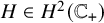 $H\in H^2({\mathbb {C}}_+)$
such that
$H\in H^2({\mathbb {C}}_+)$
such that $F=GH$
. Define
$F=GH$
. Define $h\in H^2$
by
$h\in H^2$
by
 $$ \begin{align*}\textstyle h(z)=\frac{(H\circ \varphi^{-1})(z)}{1-z}\;\text{ for all }\;z\in {\mathbb{D}}. \end{align*} $$
Thus, $F\circ \varphi ^{-1}=(G\circ \varphi ^{-1})(H\circ \varphi ^{-1})$
, and so for all
$F\circ \varphi ^{-1}=(G\circ \varphi ^{-1})(H\circ \varphi ^{-1})$
, and so for all $z\in {\mathbb {D}}$
, we have
$z\in {\mathbb {D}}$
, we have
 $$ \begin{align*}\textstyle \frac{(F\circ \varphi^{-1})(z)}{1-z}=(G\circ \varphi^{-1})(z) \frac{(H\circ \varphi^{-1})(z)}{1-z}= g(z)h(z). \end{align*} $$
Thus, $\textstyle g(z)h(z)\!=\!\frac {(F\circ \varphi ^{-1})(z)}{1-z}\!=\!\frac {1}{1-z}F(\varphi ^{-1}(z)) \!=\!\frac {1}{1-z}2\frac {(f\circ \varphi )(\varphi ^{-1}(z))}{1+\varphi ^{-1}(z)} \!=\!f(z)$
. So
$\textstyle g(z)h(z)\!=\!\frac {(F\circ \varphi ^{-1})(z)}{1-z}\!=\!\frac {1}{1-z}F(\varphi ^{-1}(z)) \!=\!\frac {1}{1-z}2\frac {(f\circ \varphi )(\varphi ^{-1}(z))}{1+\varphi ^{-1}(z)} \!=\!f(z)$
. So $f=gh\in \mathfrak {n}H^2$
, a contradiction.
$f=gh\in \mathfrak {n}H^2$
, a contradiction.
Acknowledgements
The author thanks Raymond Mortini for simplifying the argument of the strict inclusion $\mathfrak {n}H^2 \!\subsetneq \!H^2$
in Section 3.2, and Alban Quadrat for several useful comments, including raising the question of what happens when the maximal ideal
$\mathfrak {n}H^2 \!\subsetneq \!H^2$
in Section 3.2, and Alban Quadrat for several useful comments, including raising the question of what happens when the maximal ideal $\mathfrak {m}$
under consideration is finitely generated, and for sharing Donald Sarason’s email reply. Thanks are also due to the anonymous referee for useful comments.
$\mathfrak {m}$
under consideration is finitely generated, and for sharing Donald Sarason’s email reply. Thanks are also due to the anonymous referee for useful comments.


 Open access

