


The present paper is informed by a general statement: that almost all work on nutrition and public health has overestimated the significance of nutrients and of foods as such, and has underestimated or even overlooked the significance of processing. To express this rather more strongly: ‘The issue is not foods, nor nutrients, so much as processing’(Reference Monteiro1).
Authoritative reports, official and other dietary guidelines, and other documents concerned with food and health, accept or assume that processed foods and drinks are implicated in the current pandemics of obesity and chronic diseases(2, 3). The manufacture and supply of such products have expanded globally(Reference Gehlhar and Regmi4). Yet time trends in consumption are largely unknown, especially in lower-income countries. Instead, studies examining dietary change in the economically developing world (the ‘nutrition transition’) have tended to focus on shifts in consumption of energy and macronutrients, or else of basic foods or food groups like meat or cereals and cereal products(Reference Noor5–Reference Rivera, Barquera and González-Cossío9). Studies that include processed foods tend to pick only a few types of product, and do not examine ‘processed foods’ as such. This is despite the fact that ‘processed foods’ are frequently identified as a core aspect of the ‘nutrition transition’(Reference Rivera, Barquera and González-Cossío9, Reference Hawkes10).
There are at least two reasons for ignorance of time trends in the consumption of processed foods and of the significance of food processing in human health and disease. One is that few countries undertake periodic comparable population-based dietary surveys. Another is that conventional food classifications largely ignore food processing and consensus on criteria to classify foods according to food processing still does not exist.
To help address this gap, the present paper uses a new classification of foods based on the extent and purpose of the industrial processing used in their production(Reference Monteiro, Levy and Claro11). This classification is applied to data collected by comparable household budget surveys conducted across the last three decades in Brazil, with a view to assess time trends in food consumption and to explore their potential impact on the overall diet quality and health.
Methods
Data source, studied population and sampling
The data analysed in the present study are derived from three household expenditure surveys (HBS) carried out by the Instituto Brasileiro de Geografia e Estatística – IBGE (Brazilian Federal Bureau of Geography and Statistics) from March 1987 to February 1988, from October 1995 to September 1996, and from July 2002 to June 2003, in probabilistic samples representative of Brazilian households located in the eleven metropolitan areas of Brazil (Belem in the North region; Fortaleza, Recife and Salvador in the North-east region; Belo Horizonte, Rio de Janeiro and Sao Paulo in the South-east region; Curitiba and Porto Alegre in the South region; and Goiania and Brasilia in the West-centre region). According to the Census of 2000, these eleven areas contain 34 % of all Brazilian households and are home to 32 % of the total Brazilian population.
Sampling used for HBS involves the prior definition of socio-geographic strata integrated by census tracts with similar socio-economic profile and located within each metropolitan area. Subsequently, census tracts are randomly selected from within each stratum and households are randomly selected from within each tract. In order to make data collection uniform across the year's four trimesters, the interviews carried out within each stratum are spread out across the 12 months of the survey. The total number of studied households was 13 611 in 1987–8, 16 014 in 1995–6 and 13 848 in 2002–3. A detailed description of the HBS sampling strategy is available elsewhere(12).
The HBS reference period for collecting information on food purchases in each household is seven consecutive days (‘foods’ here means foods and drinks). Such a short reference period is insufficient for a reliable characterization of the food purchase pattern of individual households, so we used groups of households as our units of analysis. We created the units of analysis by cross-tabulating the sampled household according to the eleven metropolitan areas and ten family income intervals (n 110). In both cases, each unit of analysis comprises households that are homogeneous in terms of territorial domain and family income. The mean number of households surveyed in each of the 110 units was 123·7 in 1987–8 (ranging from forty-five to 351), 145·6 in 1995–6 (ranging from forty-seven to 474) and 65·7 in 2002–3 (ranging from fifteen to 228). In all cases, the sampling weight of each unit of analysis corresponded to the sum of the sampling weights of the individual households surveyed in the unit.
Data collection
HBS are designed to obtain reliable information on all sources of household income and all household expenses. Data on income and other sociodemographic variables were obtained in the three surveys by trained field workers using standardized questionnaires. Information on foods and drinks purchased by each household was obtained using the survey's collective expense notebook. In this notebook, one household member was asked to record all food purchases made by the household during seven consecutive days. During this period, the record task was daily supervised by the field worker in charge of the household.
In 1987–8, the record of food purchases was restricted to the description of the food item and the value of the expense. In this case, the quantity of each food item acquired by the household, expressed in fractions or multiples of kilograms or litres, was derived using the food item's average cost (by weight or volume) in the same week and metropolitan area (information routinely estimated by IBGE in a random sample of selling points with the purpose to monitor the cost of living in metropolitan areas). In 1995–6 and 2002–3, the record of food purchases included the actual quantity of food acquired by the household. In these cases, quantities of specific food items acquired by the households were calculated directly from the expense notebook or else, when information was missing, derived from average costs estimated from the households with valid information in the same week and metropolitan area.
Expenditure on food made by household members when eating outside the home is also collected by the HBS but not in sufficient detail to allow for estimating the type and quantity of the food. Therefore, the present study is restricted to foods available for consumption within households. Expenditure on food consumed outside the home by household members represented 24·5 % of total household food expenses in 1987–8, 25·3 % in 1995–6 and 28·2 % in 2002–3.
Food classification
The classification used in the present paper groups foodstuffs according to the extent and purpose of the industrial processing used in their production(Reference Monteiro, Levy and Claro11). Industrial food processing is defined here as all methods and techniques used by the food, drink and associated industries to turn whole fresh foods into food products. Agriculture and horticulture, especially industrial and other intensive methods of farming, can be seen as a type of processing, but these are not included here. The classification assigns foodstuffs to one of the three main groups described below.
Group 1: Unprocessed and minimally processed foods
The first group is of unprocessed and minimally processed foods. Minimal processes are mostly physical and are applied to single basic foods with the purpose of preserving them and making them more available and accessible, and often safer and more palatable. These processes include cleaning, portioning, removal of inedible fractions, grating, flaking, squeezing, bottling (in itself), drying, chilling, freezing, pasteurization, fermentation, fat reduction, vacuum and gas packing, and simple wrapping. They may be used by the primary producer, packing house, distributor or retailer, as well as by manufacturers, for eventual sale to consumers.
Group 2: Processed culinary or food industry ingredients
The second group is of substances extracted and purified from unprocessed or minimally processed foods in order to produce culinary and/or food industry ingredients. Physical and also chemical processes such as pressure, milling, refining, hydrogenation and hydrolysis, and use of enzymes and additives, are employed. These processes are different from those used to obtain minimally processed foods in that they radically change the nature of the original foods. Typically, foodstuffs in Group 2 are inedible or unpalatable by themselves, and have higher energy density and lower nutrient density compared with the whole foods from which they were extracted. They are used, at homes or restaurants, in the preparation and cooking of dishes made up of fresh or minimally processed foods (Group 1), and also in the industrial development of ultra-processed products (Group 3, see below). In modern food systems, the processing of most Group 2 foods is undertaken by agri-businesses for sale as ingredients to food manufacturers and also directly to consumers.
Group 3: Ultra-processed food products
The third group is of ultra-processed food products. These result from the processing of several foodstuffs, including ingredients from Group 2 and unprocessed or minimally processed basic foods from Group 1. Processes used in the production of Group 3 products include salting, sugaring, baking, frying, deep frying, curing, smoking, pickling, canning, and also frequently the use of preservatives and cosmetic additives, the addition of synthetic vitamins and of minerals, and sophisticated types of packaging. These industrial processes are all designed to create durable, accessible, convenient, attractive ready-to-eat or ready-to-heat products. Many of them are ‘fast’ foods or convenience foods. They are formulated to reduce microbial deterioration (‘long shelf-life’), to be transportable for long distances, to be extremely palatable (‘high organoleptic quality’) and often to be habit-forming. Typically they are designed to be consumed anywhere – in fast-food establishments, at home in place of dishes and meals prepared from scratch, while watching television, at desks or elsewhere at work, in the street, and while driving. Group 3 products can be sub-divided into (i) ready-to-eat snacks or products liable to be consumed as snacks or desserts and (ii) pre-prepared ready-to-heat products created to replace home-prepared dishes and meals. Their processing is usually undertaken by food manufacturers, or else by caterers (such as burger outlets) or food retailers (such as bakeries), for sale to consumers.
Box 1 summarizes the extent and purpose of the processes that characterize each of the three food groups, with examples.
Box 1 Food classification based on the extent and purpose of industrial processing
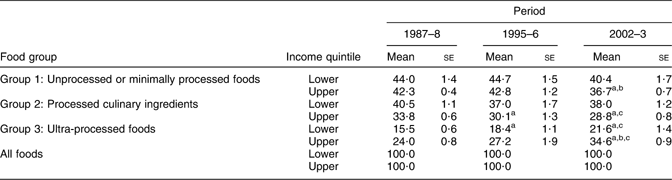
*These listings do not include alcoholic drinks. The examples given are not meant to be complete. Many others can be added, especially to Group 3, using the general principles specified in the text and as indicated in the second column.
Data analysis
In each of the three surveys, food purchase records, already excluded from non-edible fractions, were converted into energy (kcal; 1 kcal = 4·184 kJ) and nutrients using the Brazilian food composition table, version 1e(13). In the case of the few food items that are not included in this table, we used the US official food composition table, version 15(14). Alcoholic beverages are not considered in the food classification used in the present study(Reference Monteiro, Levy and Claro11) and therefore were not included here. Takeaway dishes prepared in traditional restaurants were also excluded because their description did not allow the breakdown of recipes according to the individual foods used in their preparation and cooking. In the three surveys, expenses on alcoholic drinks and takeaway dishes were recorded as amounting to less than 5 % of total household food expenditure.
After the conversion of purchased items into energy, we calculated estimates for the average daily per capita energy availability provided by food purchases made by Brazilian metropolitan households in each survey. In the next step we assigned individual food purchases to one of the three food groups defined above and to specific foods or products within each group (there are ten of these in Group 1, eight in Group 2 and ten in Group 3). Then we calculated estimates for the relative percentage contribution of each food group and subgroup to the total energy available for household consumption in each survey. The same estimates were calculated according to quintiles of the household income distribution in each survey.
Time change for each food group was tested by performing the regression of the year of the survey v. the caloric share attributed to each group.
With a view to evaluating the potential impact on the overall quality of the Brazilian diet of replacing unprocessed or minimally processed foods and processed culinary ingredients by ultra-processed food products, we have estimated dietary indicators of two ‘extreme’ food baskets: one composed only of Group 1 and Group 2 items and the other composed only of Group 3 items. In this exercise, the proportion of each individual item in the food basket was proportional to its caloric contribution in the average Brazilian metropolitan food basket in 2002–3. So, in the first case, the average basket had energy from Group 3 items replaced by energy from usual Group 1 and Group 2 items; and, in the second case, the average basket had energy from Group 1 and Group 2 items replaced by energy from usual Group 3 items.
The dietary indicators used in the comparison of the two ‘extreme’ food baskets were selected based on their association with the risk of non-communicable diseases: percentage of energy from added sugar, percentage of energy from saturated fat, grams of sodium per 4184 kJ (1000 kcal), grams of fibre per 4184 kJ (1000 kcal) and energy density (kJ/g (kcal/g))(2, 3). In the case of foods preserved in salt, such as dried beef and salted fish, we considered the amount of sodium available in the de-salted product. For the calculation of the energy density, beverages excluded, we considered the weight of each food item as usually consumed. This last was calculated, when appropriate, by multiplying the edible weight of the food item by its cooking index (the weight after cooking divided by the edible weight).
In all analyses included in the present study, we employed weighting factors to allow for the extrapolation of our results to all Brazilian metropolitan households. All analyses were carried out using the STATA statistical software package version 11 (Stata Corporation, College Station, TX, USA) and accounted for the effect of weights on the standard errors of the estimates using svy prefixed commands.
Results
The sum of all food purchases made by Brazilian metropolitan households for household consumption corresponded to an average daily per capita availability of 7531 (se 184) kJ (1880 (se 44) kcal) in 1987–8, 7037 (se 192) kJ (1682 (se 46) kcal) in 1995–6 and 6243 (se 213) kJ (1492 (se 51) kcal) in 2002–3. The drop throughout this period likely reflects increasing food consumption outside the home.
Table 1 shows the contribution to total available energy of foodstuffs classified according to the extent and purpose of their processing. The share of unprocessed or minimally processed foods (Group 1) was relatively stable in the first period (1987–8 to 1995–6) but it declined significantly in the second period (1995–6 to 2002–3), while processed culinary ingredients (Group 2) declined in the two periods. Correspondingly, the caloric share of ultra-processed food products (Group 3) increased continuously and significantly across the three surveys, the increase being most pronounced in the second period.
Relative contribution of food groups to household food availability (percentage of energy); metropolitan areas of Brazil, 1987–8, 1995–6 and 2002–3
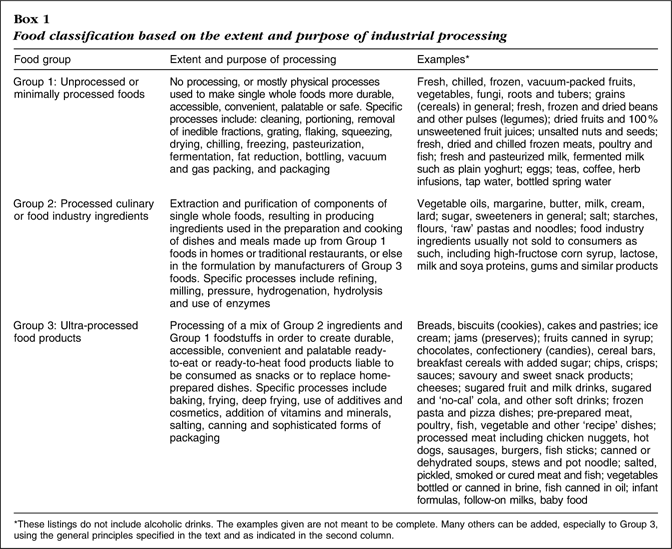
aMean value was significantly different from that of the 1987–8 survey (P < 0·05).
bMean value was significantly different from that of the 1995–6 survey (P < 0·05).
cLinear trend across the three surveys was significant (P < 0·05).
*Grains (other than rice and beans), nuts and seeds (unsalted), shellfish, coffee, tea and dried condiments.
†Corn flour, starches, others sugars and sweeteners, and coconut milk.
‡Salted and dried or oil-preserved canned fishes, canned vegetables in water-brine, instant noodle, sugared breakfast cereals, sugared milk beverages, and other sugared beverages.
The caloric share of all items belonging to Group 3 showed significant increases in the two periods. The overall increase from 1987–8 to 2002–3 was highest for biscuits (almost 100 %), cheeses (100 %), sausages (more than 100 %) and soft drinks (more than 200 %). Several items from Group 1 and Group 2 showed significant continuous declines across the three surveys. These included rice, fruits, vegetables, roots and tubers, and eggs in Group 1 and sugar, wheat flour and other processed culinary ingredients in Group 2. Milk and meat declined significantly only in the second period while vegetable oils declined significantly only in the first period. No food items in Group 1 increased from 1987–8 to 2002–3 and only pasta and animal fats did so in Group 2.
Table 2 shows time changes in the relative caloric contribution of each of the three main food groups according to households’ socio-economic position. Group 3 shows continuous increases across the three surveys among both lower- and upper-income households (from 15·5 % to 21·6 % and from 24·0 % to 34·6 %, respectively). There were corresponding reductions in the contribution of Group 1 and Group 2 foods, which were significant among upper-income households.
Relative contributions of food groups provided by food purchases in households belonging to the lower or upper income quintile (percentage of energy); metropolitan areas of Brazil, 1986–7, 1995–6 and 2002–3
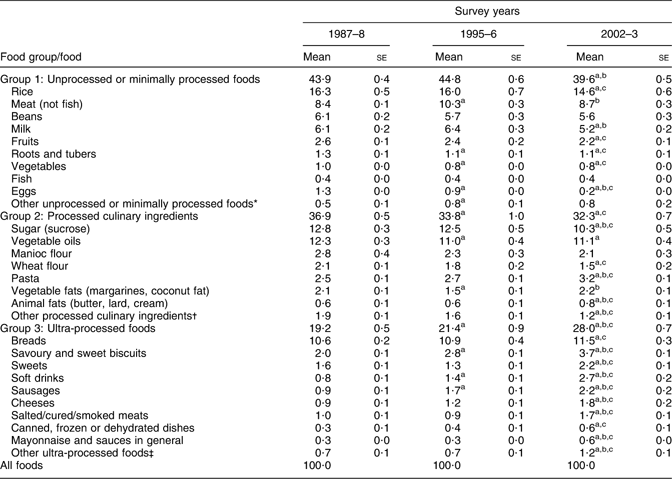
aMean value was significantly different from that of the 1987–8 survey (P < 0·05).
bMean value was significantly different from that of the 1995–6 survey (P < 0·05).
cLinear trend across the three surveys was significant (P < 0·05).
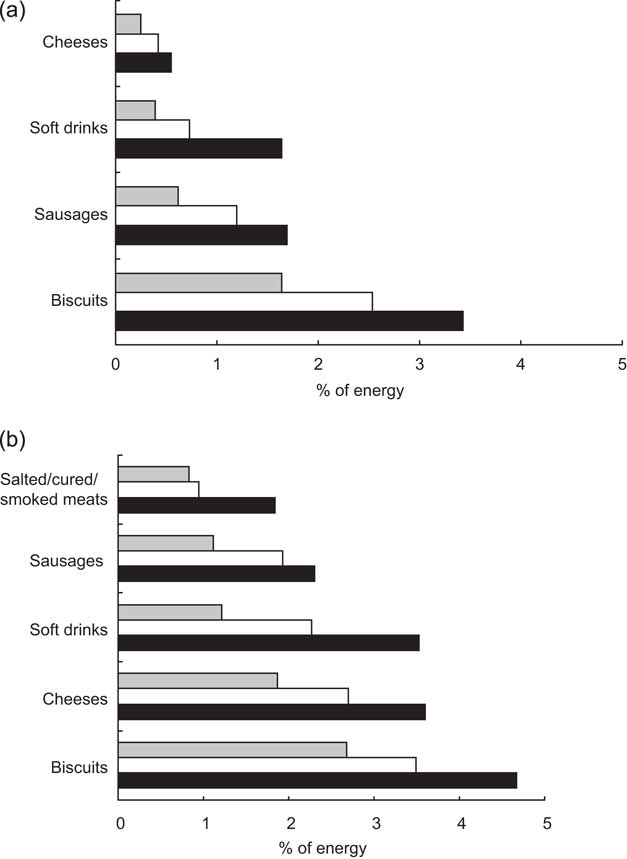
Figure 1 shows changes for the Group 3 items whose contribution to total energy purchased by lower- or upper-income households increased uniformly and significantly across the three surveys: biscuits, sausages, soft drinks and cheeses for the former and the same items plus salted/cured/smoked meats for the latter.
Time changes in the relative contribution of selected ultra-processed foods provided by food purchases (percentage of energy) in metropolitan areas of Brazil, 1986–7 ( ), 1995–6 (
 ) and 2002–3 (
 ): (a) lower-income households; (b) upper-income households
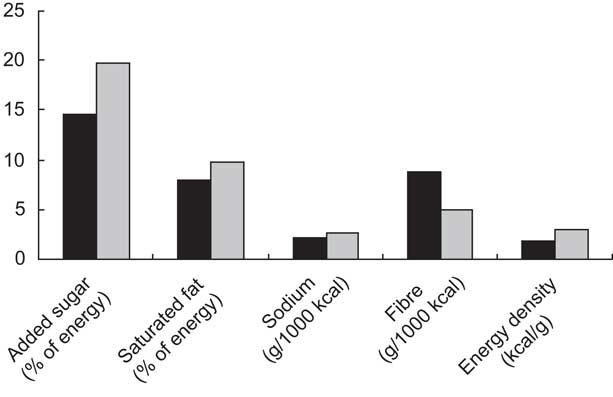
The comparison of key dietary indicators of the two ‘extreme’ food baskets – one made up only of Group 1 and 2 items, the other made up only of Group 3 items – shows systematic disadvantages for the latter (Fig. 2). The Group 3 food basket, compared with the Group 1+Group 2 food basket, has more added sugar (19·6 v. 14·6 % of total dietary energy), more saturated fat (9·8 v. 7·9 %), more sodium (2·6 v. 2·1 mg/4184 kJ (1000 kcal)), less fibre (4·9 v. 8·8 g/4184 kJ (1000 kcal)) and very much higher energy density (12·6 v. 7·5 kJ/g (3.0 v. 1.8 kcal/g), beverages excluded).
Selected comparisons between two extreme food baskets, one with a combination of usual Group 1 and Group 2 foods ( ) and other with only usual Group 3 foods (
 ), metropolitan areas of Brazil (2002–3). To convert kcal to kJ, multiply kcal by 4·184
Discussion
The application of a new food classification based on the extent and purpose of food processing, to data on food purchases collected in metropolitan areas of Brazil during the last three decades, shows that consumption of unprocessed or minimally processed foods (Group 1) and of processed culinary ingredients (Group 2) has been and is being steadily replaced by consumption of ready-to-eat or ready-to-heat ultra-processed food products (Group 3). This occurred in both lower- and upper-income groups. In the most recent survey, conducted in 2002–3, Group 3 foods represented more than one-quarter of total energy purchased by metropolitan Brazilian households, and more than one-third of that purchased by the upper income quintile.
The present study also shows that a hypothetical meal prepared only with usual Group 3 items, compared with a meal prepared only with usual Group 1 and Group 2 items, would have one-third more added sugar, nearly one-quarter more saturated fat and sodium, less than half of the fibre content and two-thirds higher energy density. The meal prepared with only Group 3 items far exceeds the upper limits recommended for added sugar intake, sodium intake and energy density, it is close to the upper limit for saturated fat intake, and it is clearly insufficient in fibre(2, 3). The meal prepared with only Group 1 and Group 2 items exceeds in a lower degree the upper limits for added sugar, sodium and energy density and it is adequate in terms of saturated fat and fibre intake(2, 3).
Limitations
The present study has limitations. It considers household food availability and not diets. It is useful inasmuch as it can reasonably be said to apply to diets. Two limitations are that wasted food and also food eaten outside the home are not taken into account.
The fact that food quantities were derived from expenses and average costs in the first survey and assessed directly in the second and third surveys makes the identified time trends more reliable in the second period (1995–6 to 2002–3) than in the first period (1987–8 to 1995–6). In any case, the increase in the share of Group 3 foods was seen in the two periods.
With the use of household food availability data, a source of error with respect to diets is that some types of food, such as vegetable oils (Group 2) discarded after deep frying, and any fresh and perishable food (Group 1), may be wasted more than others. The latter is likely to be more important. Many if not most foods consumed outside the home, such as soft drinks and sweet and also savoury snacks, are Group 3 products. Taking into account the reduction in total purchased energy per person per day seen across the three surveys, which is likely to indicate a corresponding increase in consumption outside the home, it is practically certain that the replacement of Group 1 and Group 2 foods by Group 3 food products in Brazil has been substantially higher than we have estimated.
Comparisons
Household-level studies from economically developing economies also indicate increasing consumption of selected Group 3 food products. In Mexico, consumption of sweetened soft drinks more than doubled among adolescents between 1999 and 2006, and tripled for adult women(Reference Barquera, Hernandez-Barrera and Tolentino15). An increase of Group 3 food products has also been reported in Santiago, Chile between 1988 and 1997, notably of ‘breakfast cereals’, pastries and baked goods, processed dairy products, beverages and juices, dressings and mayonnaise, and pre-cooked meals(Reference Crovetto and Uauy16).
In general, as more disposable income becomes available, the penetration of ultra-processed foods increases. Analysis of data collected by the market research organization Euromonitor shows that as national income increases, the share of retail sales of ultra-processed food products, such as ready meals and breakfast cereals, correspondingly increases, while the share of minimally processed foods, such as dried foods (mostly grains), and processed culinary ingredients, such as oils and fats, declines(Reference Gehlhar and Regmi4).
The Euromonitor data also show an explosive growth in the retail sales of ready meals and breakfast cereals, particularly in middle-income developing countries. In Brazil, between 1998 and 2003, the average annual growth rate for ready meals was 17·3 % and for cereal breakfasts was 8·9 %.
The enormous growth potential for Group 3 food products in Brazil, and other lower-income countries, becomes evident when contrasted with their contribution to the food supplies of higher-income countries. For instance, breads, cakes, pastries, confectionery, biscuits, processed meats, cheeses and soft drinks, taken together, amounted to 45·3 % of the total energy purchased by families in the UK in 2008(17), a value twice as high as the 19·1 % for the same products in 2002–3 in Brazil. This dominance of Group 3 products in the diet is even more pronounced in the USA, where the five most commonly consumed foods are all Group 3 ultra-processed food products: ‘regular’ sugary soft drinks, cakes and pastries, burgers, pizza and potato chips(Reference Block18).
It is likely that the general increase in the consumption of these ultra-processed products in Brazil will have continued, given the continuous increases of purchasing power of all income groups after 2003(Reference Neri19). This will be testable when data from the new national household budget survey, conducted in 2008–9, become available.
Human health significance
What is the significance of the increased consumption of ultra-processed food products for health? Causal relationships between consumption of Group 3 food products and health have been indicated or established only for some products.
Five systematic reviews have now concluded that there is an association between soft drink intake and increased energy intake, excess body weight and diabetes(Reference Bachman, Baranowski and Nicklas20–24). Evidence on ‘fast’ foods and snacks and obesity points the same way, but so far is less conclusive(24).
A recent comprehensive report concludes that the evidence for a causal relationship between intake of processed meat and colorectal cancer is convincing(24). This is particularly significant given the small number of studies that separate out processed meats as a category distinct from fresh meat. It is often assumed that consumption of all meat is increasing, whereas the study presented in the current paper shows that, in Brazil at least, the only meat whose consumption is rising is processed meat. Studies on meat consumption need to separate trends for fresh and for processed meat(Reference Popkin25).
It is not yet possible to estimate or predict the impact of increased consumption of ultra-processed food products, taken all together, on human health. This is because as yet there are no studies relating ultra-processed foods as a group with health outcomes. It is high time that such studies were undertaken. These need not be complex; they can simply involve re-examination of existing data. In the meantime, the known high energy density of food products in Group 3 and their negative overall nutrient profile, both confirmed by our exercise with ‘extreme’ food baskets, indicate it is safe to say that increased consumption of these ultra-processed products is increasing the risk and incidence of obesity and of other nutrition-related chronic diseases(Reference Astrup, Dyerberg and Selleck26).
Discussion on the effects of ultra-processed products on human health and the risk of disease almost always focuses on the nutrients in such products. As we have stated elsewhere(Reference Monteiro1, Reference Monteiro27), while this approach is important it is narrow, and neglects or overlooks other factors likely to be at least as important as nutrient profiles.
Many ultra-processed food products are accurately termed ‘fast’ foods or ‘convenience’ foods. Many have long or very long shelf-lives, often because they are relatively devoid of perishable nutrients, or are even practically imperishable, in contrast to all fresh foods. Ultra-processed foods are also typically sold ready-to-heat or ready-to-eat, in contrast to most fresh foods that need to be prepared and cooked. The problem is that the convenience and rapidity associated with these products favour patterns of consumption known to harm the mechanisms that regulate energy balance, which therefore leads to excess eating and obesity. Such unhealthy eating patterns include snacking instead of regular meals, eating while watching television and consuming a lot of energy in liquid form(Reference De Graaf28–Reference Mattes30). These behaviours are all provoked and amplified by aggressive advertising and marketing of branded Group 3 products, many of which are produced by transnational and other very big manufacturers and caterers.
Food and drink manufacturing, catering and allied industries concentrate their marketing investments on ‘value-added’ ultra-processed products, such as sugared breakfast cereals, burgers, sweet and savoury snacks, and soft drinks, and not on minimally processed foods; and also not on oils, flours and sugar used in homes as culinary ingredients. Heavily marketed branded products are typically made up from the cheapest oils, starches and sugars available, whose price to the manufacturers is often further reduced by government subsidies. This, and the endless opportunities to formulate ‘new’ hyper-palatable Group 3 products using sophisticated combinations of cosmetic and other additives, explain why the industry concentrates its marketing investments on these products(Reference Monteiro1).
In modern societies, food accessibility and food advertisement are the key environmental cues which trigger automatic and uncontrollable responses leading to excess eating and obesity. The idea that eating and drinking behaviours are simply a matter of conscious choice that can be educated is fundamentally wrong(Reference Cohen31).
Wider significance
Increased production and consumption of ultra-processed Group 3 products also can have negative social, cultural, environmental and other impacts. Thus, as the intensity of food processing increases, typically so also does the requirement for energy inputs, directly in the processing itself and indirectly in packaging and transportation(Reference Beauman, Cannon and Elmadfa32, Reference Roberts33). Further, the replacement of meals prepared at home by uniform branded ready-to-heat and ready-to-eat dishes, snacks and soft drinks results in the weakening of traditional food cultures, the loss of culinary diversity and the decline of family life, among very many other adverse effects(Reference Contreras Hernández and Gracia Arnáiz34).
Conclusions and recommendations
By dividing foods into categories according to the extent and purpose of processing, the present paper adds to a thin set of existing data on trends in the consumption of processed foods. It also examines how ultra-processed products are contributing to changes in eating patterns and the overall quality of the diet.
In Brazil, ready-to-eat or ready-to-heat ultra-processed foods are displacing unprocessed/minimally processed foods and processed culinary ingredients. Increased household purchase of soft drinks, confectionery and biscuits has been accompanied by a reduction in household sugar purchases. Rather than purchasing sugar as such and using it to prepare desserts in the home, household members are consuming sugar as contained in processed foods and drinks. As another example, all sorts of processed meats that can be consumed with little or no preparation are replacing fresh meat purchased for preparation in the home. There is a similar trend towards increasing purchases of bread, cakes and other ultra-processed products using wheat flour and decreased purchases of flour, whether made from wheat, corn or manioc (cassava). Thus, the food classification used here indicates not only changes in the foods people are eating, but also in the ways they are eating them. Meals, traditionally eaten in the company of the family, are likely being replaced by snacks, often if not usually eaten alone.
More work is certainly needed to assess trends in the consumption of ultra-processed food products and to understand their impact not only on human health and disease but also on and societies, economies, the environment and the biosphere. However, the known evidence points one way. Further examination of existing evidence in various countries and settings is in our view likely to amount to an adequate basis for public health action.
Meanwhile, on the precautionary principle, and in the absence of evidence to the contrary, in our opinion the prudent advice to governments and health authorities is to take the lead with other relevant actors and use all possible methods, including legislation and statutory regulation, to halt and reverse the replacement of minimally processed foods (Group 1) and processed culinary ingredients (Group 2) by ultra-processed food products (Group 3).
Acknowledgements
Sources of funding: There were no external sources of funding. Conflict of interests: There were no conflicts of interests. Authorship responsibilities: The empirical study was planned and supervised by C.A.M. and undertaken by R.B.L. and R.M.C. The initial draft of the paper was prepared by C.A.M. following extensive discussions with I.R.R.C., R.B.L., R.M.C. and G.C. Successive drafts were developed by C.A.M. and G.C., with inputs from the other co-authors. All authors have reviewed and approved the final version.



