

Globally, women earn 20% less than men (United Nations 2024). In the United States, women perform a bit better, with the average woman working full-time, year-round earning only 17.3% less than a similar man, but the wage gap there has increased in the last two years (Institute for Women’s Policy Research [IWPR] 2024). Intersectional discrimination is also a major contributing factor to the persistent gender based-wage gap in the US, as many (but not all) intersectionally marginalized women face larger wage gaps than the commonly cited average American woman. Compared to white men, Latinas earn 42.2% less, Black women earn 33.5% less, white women earn 20.4% less, and Asian American women earn 5.8% less (IWPR 2024). Between the ages of 20 and 24, women earn only 9.1% less than men, but during women’s prime child-raising years of 35 to 44 and 45 to 54, the wage gap increases to 18.9% and 20.5% less, respectively (US Women’s Bureau 2025). Similarly, mothers of children under 18 earn 26.5% less than men (IWPR 2023). Over the age of 65, women earn 22.7% less than men (US Women’s Bureau 2025). LGBTQ+ women make 21% less than men (Human Rights Campaign Foundation [HRC] 2025). Among women living with disabilities, the wage gap ranges from earning approximately 60% less than non-disabled men make for women with cognitive disabilities or difficulty living independently to approximately 40–50% for women with disabilities related to ambulation, vision, or hearing (National Partnership for Women and Families [NPWF] 2024). Together, these data suggest that 36 years after Crenshaw’s (Reference Crenshaw1989) pathbreaking work on the intersectional failures of American anti-discrimination laws, legal challenges persist, and closing the wage gap will be impossible unless they are addressed.
Building on Crenshaw’s work (1989) and responding to calls for more scholarship that centers intersectionality and relies on high-quality, large-N intersectional data (Christoffersen and Siow Reference Christofferson and Siow2025), this study provides the first large-N examination of how intersectionally marginalized women fare when they file gender-based wage discrimination cases under three American equal pay laws: The Equal Pay Act of 1963 (EPA), Title VII of the Civil Rights Act of 1964 (Title VII), and/or the Lilly Ledbetter Fair Pay Act (LLFPA) of 2009. Addressing an issue that has been central to the US women’s movement for over 60 years and building on the literatures on intersectionality, critical legal studies, and public policy, it asks whether women who file lawsuits that make intersectional claims are less likely to win and/or receive financial restitution than women who file lawsuits that only allege gender-based wage discrimination. Consequently, our study provides critical insights about the degree to which Crenshaw’s theory has impacted equal pay enforcement in the 36 years since its publication.
Relying on 1,135 equal pay cases filed in federal courts between 2000 and 2021 and building on foundational case studies of how the law fails intersectionally marginalized women (Caldwell Reference Caldwell1991; Crenshaw Reference Crenshaw1989; Smith Reference Smith1991), we begin by testing the hypothesis that women who file intersectional cases (i.e., cases that make allegations of gender-based wage discrimination and discrimination based on ability status, age, race, national origin, pregnancy, or sexual orientation) are significantly less likely to win than women who make single-axis allegations (i.e., those who only allege gender-based wage discrimination). Next, recognizing that women’s intersectional identities often include more than two interacting identities (Christofferson and Siow Reference Christofferson and Siow2025), it tests the hypothesis that women who file multiple intersectional cases (i.e., allegations of gender-based wage discrimination and discrimination based on more than 2 of the identities listed above) are also significantly less likely to win. Then, recognizing that women with different intersecting identities have different histories of oppression and legal protections (Anzaldúa Reference Anzaldúa2007; Bassel and Emejulu Reference Bassel and Emejulu2010; Christofferson and Siow Reference Christofferson and Siow2025; Collins Reference Collins2015; Murib Reference Murib2024; Strolovitch Reference Strolovitch2007), it compares 7 types of intersectional cases (gender and race, gender and nationality, gender and ability status, gender and age, gender and pregnancy, gender and sexual orientation, and multiple intersectional cases) to test the hypothesis that gender and race cases and gender and nationality cases, which can rely both rely on one law (Title VII) to make their claims are more likely to produce the same outcomes as single-axis cases than intersectional cases that require combining claims based on multiple laws.
Finally, recognizing that analyses of the intersection of gender and women’s relational statuses are rare in the literature, it tests the hypothesis that women who combine equal pay claims with allegations of pregnancy discrimination are more likely to win than women who make other intersectional claims. Though motherhood is commonly associated with disadvantages in the labor market (US Bureau of Labor Statistics 2024), we expect women who make claims based on gender and pregnancy alone (i.e., not claims based on gender, pregnancy, and another status such as race) will be more likely to win because their claims are based on one “super” gendered status which allows them to use their status as mothers to depict themselves as sympathetic or deserving of public policy benefits (Deason, Greenlee, and Langer Reference Deason, Greenlee and Langer2015; Sapiro Reference Sapiro1981; Schneider and Ingram Reference Schneider and Ingram1993).
Using qualitative coding, automated text analysis, and logit regression, our study reveals that, as expected, women who file intersectional and multiple intersectional cases are significantly less likely to win than women who make single-axis claims. Those results hold even after controlling for legal issues related to providing prima facie evidence of discrimination, countering employers’ affirmative defenses, whether the plaintiff had legal representation, whether the Equal Employment Opportunity Commission (EEOC) was involved, the court that handled the case, and the judges’ ideological preferences. Consequently, intersectional plaintiffs are only predicted to win in 17.7% of cases, and multiple intersectional plaintiffs are only predicted to win 12.1% of the time.
Focusing on specific intersections also revealed that plaintiffs who filed cases based on gender and race and gender and nationality were as likely to win as plaintiffs who filed single-axis cases. Though those results are surprising in light of foundational work on intersectionality (Caldwell Reference Caldwell1991; Crenshaw Reference Crenshaw1989; Smith Reference Smith1991), they suggest the ability to file one case under Title VII may provide some advantages as compared to women who have to file cases under the EPA, Title VII, and another law, such as the Age Discrimination in Employment Act (ADEA). Unexpectedly, women who filed cases based on gender and pregnancy were not significantly more likely to win than other plaintiffs, and they were also not the intersectional plaintiffs who were the most likely to win.
Intersectionality in the Law
In the US, three laws ban gender-based wage discrimination: the EPA, Title VII, and the LLFPA, and all three conceive of the wage gap as an individualized, one-off problem that occurs along a single axis, separate from discrimination based on other identities. The EPA requires employers to pay men and women equally for “equal work on jobs … which require equal skill, effort, and responsibility, and which are performed under similar working conditions.” It does not allow for discrimination claims based on any other identities because an amendment that would have added the words “or race” to appear everywhere “sex” appeared in the EPA was rejected as not germane, and other intersections were not considered during the EPA’s legislative debates (Harrison Reference Harrison1988). Therefore, if an intersectionally marginalized woman wants to file an equal pay case alleging discrimination based on gender and one or more of her other identities, she needs to file a case that alleges discrimination under multiple laws.
Title VII is broader, superficially allowing for some intersectional claims. It prohibits employers from discriminating against “any individual with respect to his compensation, terms, conditions, or privileges of employment because of such individual’s race, color, sex, or national origin.” Because Title VII bans discrimination based on race, color, and national origin in addition to sex, it “superficially” allows for intersectional claims, much like the United Kingdom’s Equality Law (Bassel and Emejulu Reference Bassel and Emejulu2010). However, legislative debates about Title VII revealed members of Congress conceived of those different forms of discrimination as existing on separate axes, potentially pitting intersectionally marginalized groups against each other and positioning white women’s experiences as the quintessential examples of sex discrimination (Bassel and Emejulu Reference Bassel and Emejulu2010; Crenshaw Reference Crenshaw1989; Collins Reference Collins2015). For example, Representative Martha Griffin (D-MI) argued that sex should be included in Title VII as a protected class because if sex were excluded, then Black women would receive legal protections, but white women would not (Kessler-Harris Reference Kessler-Harris2001). Moreover, the EEOC, which investigates Title VII complaints, did not release guidance stating that “Title VII prohibits discrimination not just because of one protected trait (e.g., race), but also because of the intersection of two or more protected traits (e.g., race and sex)” until 2006 and that guidance has had a limited effect (Berning O’Neill 2002; EEOC 2006 as quoted in Kotkin Reference Kotkin2009, 1450).
The original debates about Title VII also did not consider many of women’s other intersecting identities. Thus, women who want to make Title VII allegations based on gender and ability status, age, or pregnancy need to combine their Title VII claims with claims under other laws, such as the ADEA, the Americans with Disabilities Act (ADA), the Pregnancy Discrimination Act, or the Family and Medical Leave Act (FMLA). Since Bostock v. Clayton County (2020), discrimination based on sexual orientation or gender identity has been banned as a form of sex discrimination under Title VII.
The LLFPA provided a clarification in the law, allowing women to file Title VII complains within the first 180 days of any discriminatory paycheck they receive, rather than their first discriminatory paycheck. It “reversed” the Supreme Court’s decision in Ledbetter v. Goodyear Tire and Rubber Co, Inc (2007), which stated that claims had to be filed within 180 days of a discriminatory pay decision. Thus, even though the LLFPA passed in 2009 and it is the only equal pay law that has passed since 1964, it does not address intersectional wage discrimination.
Hypotheses
Since Crenshaw’s (Reference Crenshaw1989) pathbreaking work first appeared, qualitative and quantitative evidence has been mounting that suggests intersectional wage discrimination cases should be harder to win. Foundational case studies revealed that the separate axes of discrimination framework embodied in the law pose significant challenges. For example, in Degraffenreid v. General Motors (1976), a group of Black women challenged their firings as discriminatory under Title VII (Crenshaw Reference Crenshaw1989; Smith Reference Smith1991). The court analyzed the women’s sex and racial discrimination claims separately stating:
The plaintiffs allege they are suing on behalf of black women…therefore this lawsuit attempts to combine two causes of action into a new special sub-category, namely, a combination of racial and sex-based discrimination. The court notes that plaintiffs have failed to cite any decisions which have stated that black women are a special class to be protected from discrimination.
Thus, Crenshaw (Reference Crenshaw1989) noted, “Black women are protected only to the extent that their experiences coincide with either of two groups [Black men and white women]. Where their experiences are distinct, Black women can expect little protection” (143). Similarly, Crenshaw’s (Reference Crenshaw1989) analysis of Moore v. Hughes Helicopters (1983) rejected Black women’s attempts to file a class action anti-discrimination lawsuit because they did not use the narrow class of Black women to make their case. Problematically, that meant Moore was “left with such a small statistical sample that even if she had proved that there were qualified Black women [who were also discriminated against], she could not have showed discrimination under disparate impact theory” (Crenshaw Reference Crenshaw1989). Philosophically, the case also revealed the court uses white women’s experiences as the paradigmatic form of sex discrimination in Title VII cases (Crenshaw Reference Crenshaw1989). The EEOC’s intake process, which asks victims to check separate boxes for separate forms of discrimination, and the tendency for lawsuits to include separate numbered claims for each separate “type” of discrimination, only exacerbate the court’s tendency to see women’s intersecting identities as separable, rather than bound together by similar structural factors (Bassel and Emejulu Reference Bassel and Emejulu2010; Christofferson and Siow Reference Christofferson and Siow2025; Kotkin Reference Kotkin2009).
Three recent large-N analyses of anti-discrimination cases broadly (not just equal pay cases) also suggest intersectional challenges persist. Kotkin (Reference Kotkin2009) found only one plaintiff (3.8% of the sample) who pursued a race, gender, or age discrimination case in the Southern and Eastern Districts of New York between 2006 and 2007 who won a summary judgment in a case alleging multiple forms of discrimination. Kotkin (Reference Kotkin2009) attributed the stunning number of intersectional losses to the poor legal advice plaintiffs receive about multiple discrimination claims, the court’s tendency to assess claims separately, the challenges intersectional plaintiffs faced in finding the relevant comparators (i.e., those with equal skills and responsibility, working in the same establishments under the same conditions) they needed to make discrimination claims, and judges’ tendency to see intersectional claims as frivolous or desperate. Similarly, Denny (Reference Denny2009) found that only 7.5% of intersectional cases in the 8th circuit between 2008 and 2010 made it past the summary judge stage, and 92.5% of intersectional cases never made it to trial because judges ruled on intersectional claims separately, plaintiffs could not find adequate comparators, and they appeared without legal representation. Finally, Best and colleagues’ (Reference Best, Edelman, Krieger and Eliason2011) analysis of federal court decisions related to the EPA, Title VII, the ADEA, and Sections 1981 and 1983 of the US code found that plaintiffs who made intersectional claims (i.e., alleged discrimination based on more than one of the following identities: race, sex, age, or national origin), won half as often as plaintiffs who alleged only one form of discrimination.
Building on these findings, but focusing specifically on relatively recent equal pay cases, our first hypothesis states:
H 1 : Female plaintiffs who file intersectional wage discrimination cases are significantly less likely to win or receive restitution than plaintiffs who file single-axis claims.
Next, we consider plaintiffs who file cases based on gender and two or more intersecting identities. In those cases, the sex-plus doctrine, which is used in cases that combine sex discrimination claims with other discrimination claims, poses a unique challenge (Berning-O’Neill Reference Berning-O’Neill2022; Caldwell Reference Caldwell1991; Smith Reference Smith1991). Sex-plus cases are a double-edged sword for intersectional plaintiffs (Smith Reference Smith1991). On the one hand, they allow the courts to recognize intersectional claims (Smith Reference Smith1991). On the other hand, the courts limit its use to claims based on sex and only one other characteristic that is “a protected, immutable trait[s], or fundamental right[s],” typically race, national origin, or marital status (Berning-O’Neill Reference Berning-O’Neill2022, 917; Caldwell Reference Caldwell1991; Kotkin Reference Kotkin2009; Smith Reference Smith1991). Claims based on gender and 2 or more intersecting identities are unintelligible to the courts. Moreover, because the Supreme Court has not affirmed the sex-plus doctrine, it is not widely and consistently used, even in cases based on only two intersecting identities (Berning-O’Neill Reference Berning-O’Neill2022). Thus, our second hypothesis states:
H 2 : Female plaintiffs who file intersectional wage discrimination alleging discrimination based on gender and two or more other identities are less likely to win or receive financial restitution than all others.
Finally, not all intersectional equal pay cases are the same. Discrimination that occurs at different intersections results from different experiences and histories of oppression (Anzaldúa Reference Anzaldúa2007; Bassel and Emejulu Reference Bassel and Emejulu2010; Christofferson and Siow Reference Christofferson and Siow2025; Collins Reference Collins2015; Strolovitch Reference Strolovitch2007). While a full examination of those different histories and experiences is beyond the scope of this article, we provide a preliminary analysis of how women situated at different intersections fare in equal pay cases by making some assumptions about the basic process differences they face when they file cases. For example, Title VII cases prohibit wage discrimination based on gender, race, and national origin, theoretically allowing plaintiffs to allege gender-based wage discrimination and discrimination based on race or national origin using only one law. In contrast, women who allege gender-based wage discrimination along with discrimination based on ability status, age, pregnancy, or sexual orientation rely on multiple laws, including the ADEA, the ADA, the PDA, and/or the FMLA. Though Title VII cases tend to treat gender and race claims separately (Caldwell Reference Caldwell1991; Crenshaw Reference Crenshaw1989; Smith Reference Smith1991), making claims based on one law is inherently easier than making allegations under many laws. Thus, our third hypothesis states:
H3: Female plaintiffs who file wage discrimination cases based on their intersectional identities in terms of gender and race or nationality are more likely to win restitution at the same rates as single-axis plaintiffs than other intersectional plaintiffs are.
Finally, we assume that plaintiffs who allege wage discrimination based on gender and pregnancy will be more likely to win their cases than intersectionally marginalized women. Although these plaintiffs also need to file their cases under multiple laws (e.g., the EPA and/or Title VII and the PDA or FMLA), their intersection amplifies the importance of gender, rather than posing questions about how two different identities interact, making their cases more like single-axis cases. Moreover, women who only make gender and pregnancy discrimination claims (i.e., claims that are not based on gender, pregnancy, and another marginalized identity), may also be able to frame their cases in ways that allow them to appeal to women’s sympathetic or “deserving” roles as mothers or caretakers (Deason, Greenlee, and Langer Reference Deason, Greenlee and Langer2015; Sapiro Reference Sapiro1981; Schneider and Ingram Reference Schneider and Ingram1993). Thus, our last hypothesis states:
H4: Female plaintiffs who file wage discrimination cases based on their intersectional identities in terms of gender and pregnancy are more likely to win restitution than other intersectional plaintiffs.
Data and Methods
To test our hypotheses, we constructed an original dataset of 1,135 decisions in federal equal pay cases that were published between January 1, 2000 and December 31, 2021. Compiling the dataset occurred in stages. First, we searched NexisUni for decisions that included any of the following terms in the full text: “equal pay,” “pay equity,” “wage discrimination,” “the Equal Pay Act,” “Title VII of the Civil Rights Act,” “Lilly Ledbetter Act,” “Ledbetter v. Goodyear,” and “wage gap.” These terms include all three relevant laws, the Supreme Court’s decision in the 2007 Ledbetter case, and terms that are commonly used to describe the gender wage gap. We used the full-text and “or” search options to produce the most comprehensive results possible. Second, we compared our search results to media accounts of high-profile wage discrimination cases to determine whether the search had identified all the relevant cases. After discovering the NexisUni results were missing the Us women’s soccer team’s (USWNT) case, we conducted an additional search for equal pay cases on Hein Online using the same search terms from the NexisUni search. The Hein search produced additional results, which we added to the dataset.
After we collected the decisions, we read each case to determine whether it should be included in our analysis. Because we erred on the side of including as many cases as possible in our database searches, we collected some decisions that were irrelevant. For example, our initial search results included Title VII decisions in cases that alleged discrimination based on race or national origin, but not gender-based wage discrimination. Those cases were removed from the dataset. Likewise, because our theory examines how women fare when they pursue intersectional cases, we removed cases from male plaintiffs who alleged sex discrimination.
Together, NexisUni and HeinOnline (through Fastcase) include records from the US Supreme Court, all federal circuit courts, all federal district courts, and federal bankruptcy courts, giving us confidence that our searches identified a comprehensive set of equal pay decisions from the first 21 years of the twenty-first century. However, our search methods do not include every equal pay decision from this time period because we only collected published decisions, and most cases do not produce published decisions (Carlson et al. Reference Carlson, Livermore and Rockmore2020; Ringquist and Emmert Reference Ringquist and Emmert1999; Robel Reference Robel1989; Songer Reference Songer1990; Wasby Reference Wasby2001). Published decisions are not representative of all decisions because judges are more likely to publish decisions when the court hears oral arguments and legal counsel is present (Wasby Reference Wasby2001). They are also often (but not always) more likely than unpublished decisions to provide unique legal reasoning, set precedents, reverse prior decisions, be politicized, impose harsher penalties, and/or address more complex cases (Hannon Reference Hannon2001; Ringquist and Emmert Reference Ringquist and Emmert1999; Robel Reference Robel1989; Songer Reference Songer1990; Wasby Reference Wasby2001). Judges’ ideological leanings may also have an impact on publication decisions, potentially creating biases in studies that rely on published decisions (Carlson et al. Reference Carlson, Livermore and Rockmore2020; Keele et al. Reference Keele, Malmshiemer, Floyd and Zhang2009; Ringquist and Emmert Reference Ringquist and Emmert1999; Rowland and Carp Reference Rowland and Carp1996).
Despite these limitations, we relied on published decisions for theoretical and practical reasons. Practically, unpublished decisions are often unavailable or prohibitively costly to access (Keele et al. Reference Keele, Malmshiemer, Floyd and Zhang2009; Ringquist and Emmert Reference Ringquist and Emmert1999; Songer Reference Songer1990; Wasby Reference Wasby2001). Variance in the degree to which different courts publish cases and databases make unpublished decisions available also makes comprehensive, unbiased data collection difficult, if not impossible (Keele et al. Reference Keele, Malmshiemer, Floyd and Zhang2009; Ringquist and Emmert Reference Ringquist and Emmert1999; Songer Reference Songer1990; Wasby Reference Wasby2001).
Theoretically, published decisions are arguably the ones that are most important for future wage discrimination plaintiffs to consider because they have been written for larger public audiences (Robel Reference Robel1989; Wasby Reference Wasby2001). Variations in rules about when and how unpublished decisions can be cited also mean lawyers are discouraged from or cautioned against citing them (Hannon Reference Hannon2001; Reagan Reference Reagan2007; Robel Reference Robel1989). Therefore, published opinions provide the most broadly available public information that victims of wage discrimination and their lawyers can use in deciding whether and how to pursue their own equal pay cases. Published decisions may also be the only resource available to plaintiffs and lawyers who do not have frequent or insider access to the courts, and it is likely that victims of wage discrimination fall into this category as they are pursuing one-off allegations of discrimination against their employers (Robel Reference Robel1989). Moreover, since published decisions often employ unique reasoning and set precedents, they could be particularly important as the courts continue to wrestle with the unique challenges that groundbreaking intersectional cases present. Given the limitations of relying on published decisions, our results cannot and should not be generalized to the entire universe of equal pay cases. However, our analysis of published equal pay decisions over 21 years represents an important first step in understanding how intersectional plaintiffs fare in court.
Once we compiled the final set of cases for our analyses, we used a combination of hand coding and automated text analysis to code the dependent and independent variables for each case. The dependent variable for our analyses, won/restitution, is a binary variable. Cases were coded 1 when the court sided with the plaintiffs’ allegations of gender-based wage discrimination under the Equal Pay Act and/or Title VII. For example, Ryduchowski v. Port Authority (2000) was coded 1 because the Second Circuit panel rejected the Port Authority’s affirmative defense that Ryduchowski’s lowered wages were the result of a merit system, rather than gender-based wage discrimination. In cases that made multiple allegations of discrimination in addition to an equal pay claim, cases were only coded 1 when the plaintiffs won based on their EPA, Title VII, or LLFPA claims. For example, Clay v. Howard University et al (2015) considered a motion to dismiss Clay’s five discrimination allegation claims: (1) a claim for wrongful discharge in violation of public policy, (2) gender discrimination in violation of Title VII, (3) gender discrimination in violation of the D.C. Human Rights Act (DCHRA), (4) wage discrimination in violation of the EPA, and (5) claim of retaliation in violation of Title VII. This case was coded 1 because the court dismissed the DCHRA claim, but allowed all of Clay’s other allegations, including the EPA and Title VII complaints, to proceed. Only 22.4% of plaintiffs (254 cases) won or received financial restitution.
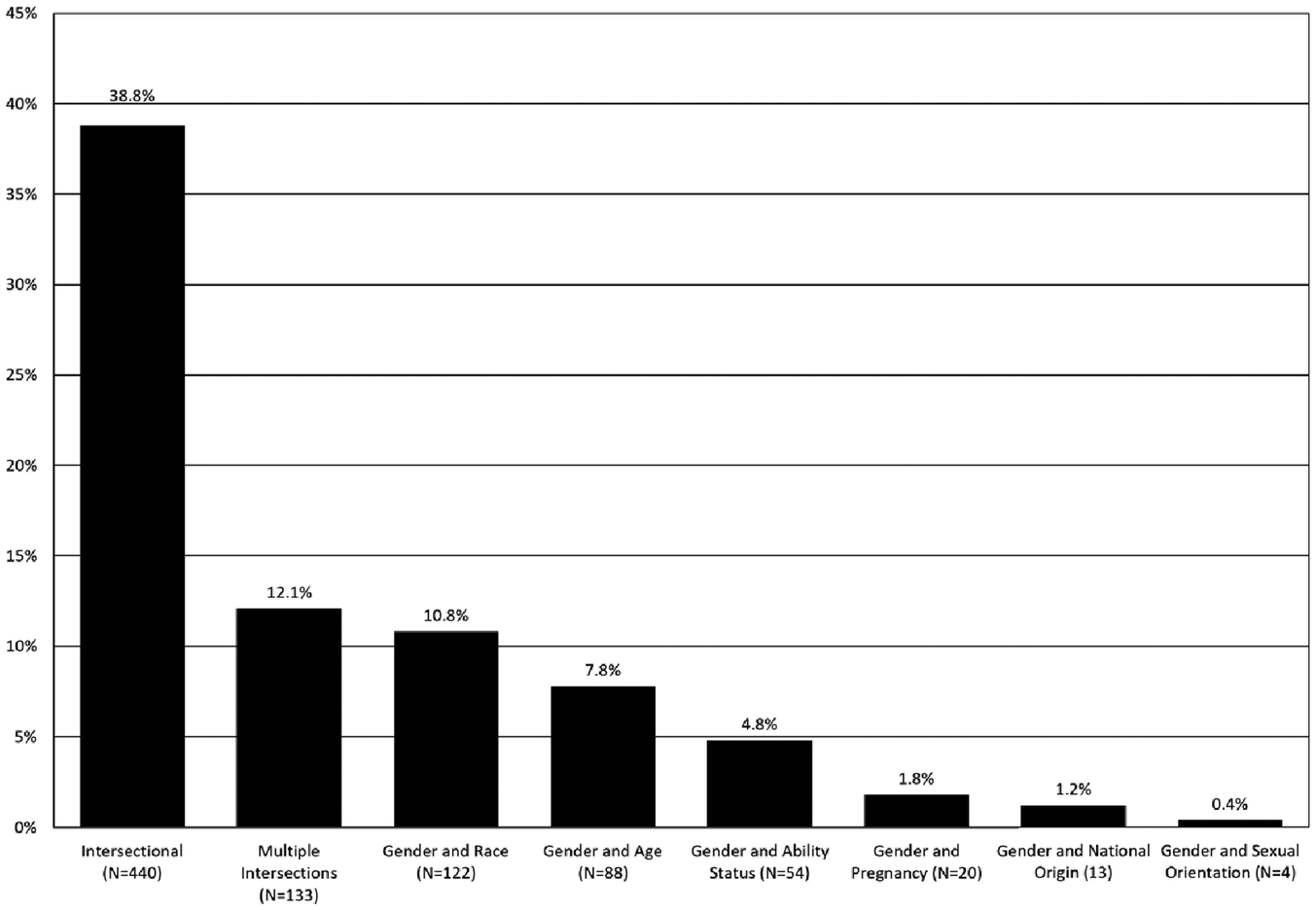
The independent variables in our analyses consider whether cases contained intersectional claims and what types of intersectional claims plaintiffs made. To test our first hypothesis, we constructed the binary variable intersectional case, which was coded 1 when decisions indicated that plaintiffs alleged gender-based wage discrimination and any number of additional discrimination claims based on another protected status (e.g., ability, age, race, national origin, pregnancy, and/or sexual orientation). The factual summaries of each case provided clear statements of what kinds of discrimination claims each plaintiff pursued. For example, Johnson v. Federal Express Corporation (2014), was coded 1 because the decision stated, “Plaintiff Cathalene Johnson (‘Johnson’) filed the above captioned action against defendant Federal Express Corporation (‘FedEx’) alleging race and sex discrimination [emphasis ours]” based on Title VII of the Civil Rights Act of 1964, the Civil Rights Act of 1991, and The Equal Pay Act. In contrast, the intersectional case was coded 0 for single-axis cases, which only made allegations based on gender discrimination. For example, Ledbetter v. Goodyear (2007) was coded 0 because it states that Ledbetter only asserted a Title VII pay discrimination claim and a claim under the Equal Pay Act of 1963. As Figure 1 demonstrates, the dataset included 440 intersectional cases.
Women’s intersectional cases by type (2000–2021).

Figure 1. Long description
The x-axis lists seven categories from left to right: Intersectional (N equals 440), Multiple Intersections (N equals 133), Gender and Race (N equals 122), Gender and Age (N equals 88), Gender and Ability Status (N equals 54), Gender and Pregnancy (N equals 20), Gender and National Origin (N equals 13), and Gender and Sexual Orientation (N equals 4). The y-axis ranges from 0 percent to 45 percent in 5 percent increments. The tallest bar on the far left is Intersectional at 38.8 percent. Next, Multiple Intersections is 12.1 percent, Gender and Race is 10.8 percent, Gender and Age is 7.8 percent, Gender and Ability Status is 4.8 percent, Gender and Pregnancy is 1.8 percent, Gender and National Origin is 1.2 percent, and Gender and Sexual Orientation is 0.4 percent. Each bar is labeled with its percentage value above. The data show a steep drop from the first to the second category, with all other categories below 13 percent.
We followed a similar procedure to construct the independent variables used to test our remaining hypotheses. The multiple intersectional case variable was coded 1 when plaintiffs alleged gender-based wage discrimination in addition to discrimination claims based on 2 or more additional protected categories, and 0 for all others. Therefore, Asojo v. Oklahoma (2012) was coded 1 because the plaintiff “alleges the University discriminated against her on the basis of her gender, race, and national origin in violation of Title VII.” The dataset includes 133 multiple intersectional cases.
Gender and ability status cases were coded 1 when plaintiffs combined a gender-based wage discrimination claim with an ability status claim, and 0 for all others. For instance, Koch v. Mack Trucks (2018) was coded 1 because the plaintiff filed a complaint alleging “gender discrimination violation of Title VII of the Civil Rights Act,” “pay discrimination in violation of the Equal Pay Act,” and “disability discrimination in violation of the Americans with Disabilities Act.” The dataset includes 54 gender and ability status cases.
Gender and age cases were coded 1 when plaintiffs made gender wage discrimination claims in addition to age-based claims. For example, Goodridge v. Siemens Energy (2013) is a gender and age case because Goodridge alleged “employment discrimination … based on her gender” and “employment discrimination … based on her age.” The dataset contains 88 gender and age cases.
Gender and race cases were coded 1 when plaintiffs made allegations of gender-based wage discrimination and discrimination based on race. For example, Shelton v. Pine Bluff/Jefferson County Library (2021) is coded 1 because Shelton “alleges that she suffered race discrimination during her nine-month employment” and “She also alleges a violation of the Equal Pay Act.” Shelton, like many of the cases in this category, was filed by a Black woman. This category also includes cases from Latinas, such as Ortiz v. City of New York, because cases were coded based on the type of discrimination alleged in the text. Ortiz alleged that “she was discriminated against because of her race and gender and that she received lower pay than similarly situated non-Hispanic colleagues.” Thus, this case was coded as a gender and race claim because the allegation referred to race, despite the fact that it referred to her Hispanic ethnicity. If cases made claims based on gender, race, and national origin; gender, race, and ethnicity; or gender, race, and color, they were coded 1 as multiple intersectional cases, rather than as gender and race cases. For example, Alvarez v. Advance Autoparts (2018) was coded as a multiple intersectional case, not a gender and race case, because the plaintiff alleged “discrimination based on gender, race, and ethnicity.” The dataset contains 122 gender and race cases.
Gender and national origin cases were coded 1 when the plaintiff combined an equal pay allegation with one based on national origin. For example, Melgoza v. Rush University Medical Center (2020) was coded 1 because Melgoza (a Mexican American woman) alleged discrimination “against her in violation of Title VII based on her gender and national origin.” Although this case featured a Latina woman, it was considered a gender and national origin case rather than a gender and race case because the allegations specifically referred to national origin, not race. This category also includes cases from Asian American women, such as Niwayama v. Texas Tech (2014), which alleged discrimination based on “gender and national origin” violation of Title VII and the Equal Pay Act. The dataset includes 13 gender and national origin cases.
Cases were coded 1 on the gender and sexual orientation variable when they alleged pay discrimination in addition to discrimination based on sexual orientation. For example, Miller et al. v. University of Minnesota (2018) received a 1 because it alleged that coaches were “non-renewed or constructively discharged on account of their sex (female) and sexual orientation (lesbian)” and they “asserted claims under the Equal Pay Act of 1963.” The dataset contains four gender and sexual orientation cases.
Lastly, Figure 1 shows the dataset contains 20 cases that make claims based on gender and pregnancy. Cases were coded 1 on the gender and pregnancy variable when they made an equal pay and pregnancy discrimination claim. For example, in McClellan v. Midwest Machining (2018) was coded 1 because McClellan alleged that she was “terminated because of her pregnancy” and that “Midwest paid male outside salespersons substantially higher commissions.”
We validated our coding scheme using English’s (Reference English2019; Reference English2020; Reference English2021a) intersectional analysis dictionary to run automated text analyses of whether each decision contained 82 terms related to women’s intersecting identities in terms of ability status, age, race, ethnicity, nationality, sexual orientation, and pregnancy. To complete this analysis, we calculated the number of references to each of those terms in the documents, highlighted them in the text in NVivo, and compared them to our hand-coded results of whether each case was intersectional and what type of intersectional case it was. For example, the automated text analysis of Shelton v. Pine Bluff (2018) discussed “Black women” and “white women,” confirming that it was correctly coded as an intersectional gender and race case. In contrast, Ledbetter v. Goodyear (2007) did not contain any of the 82 terms used to refer to women’s intersecting identities, confirming it was correctly coded as a single-axis case.
The dataset also contains control variables related to the legal challenges that women face when they file equal pay cases. Equal pay laws require plaintiffs to show that they were paid less than employees of the opposite sex who work in the same establishments and whose jobs require “equal skill, effort, and responsibility, and which are performed under similar working conditions” (EEOC 2025). Thus, the first step in winning an equal pay case is providing prima facie evidence of either disparate treatment or disparate impact. Disparate treatment claims are difficult to make because they require evidence that women were paid less because their employer had a discriminatory motive or animus (Denny Reference Denny2009; McCann Reference McCann1994). Unless women and men work in the exact same job, it can also be hard to find men who are appropriate comparators working in jobs that require the same skills, effort, responsibility, and working conditions (Denny Reference Denny2009; Kotkin Reference Kotkin2009). Pay secrecy norms and illegal pay secrecy policies add to the challenges of providing prima facie evidence of discrimination (Ledbetter Reference Ledbetter2012; Rosenfeld Reference Rosenfeld2017). Although providing evidence of disparate impact addresses the challenges associated with providing evidence of disparate treatment by showing a statistically significant difference in men’s and women’s wages, it is also challenging to obtain enough data to win (Denny Reference Denny2009; McCann Reference McCann1994).
To capture the importance prima facie evidence of disparate treatment or impact, we used automated text analysis to calculate the number of times the decision referred to “prima facie evidence,” “comparators,” “equal skill,” “equal effort,” “equal responsibility,” “the same/similar working establishments,” “same/similar working conditions,” and “the McDonnell Douglas burden shifting analysis” (which requires plaintiffs to provide prima facie evidence of discrimination. The prima facie evidence and initiation variable is the sum of the number of references to each of those terms in each decision. On average, decisions made 11.53 references to prima facie evidence and initiation (SD = 12.66), with references ranging from 0 to 115.
Under McDonnell Douglas Corp. v Green (1973), employers are allowed to mount affirmative defenses which show that men’s and women’s salary differences are due to bona fide factors other than sex, such as merit systems, seniority systems, or systems that set earnings based on workers’ quantity and quality of production. Victims of discrimination then have the opportunity to challenge their employers’ affirmative defenses, but doing so once again poses challenges related to finding a male comparator with similar merit, seniority, and/or quantities or qualities of production (Denny Reference Denny2009).
To capture the degree to which these affirmative defenses were an issue in each case, the affirmative defenses variable is the sum of the number of times each decision referred to “affirmative defenses,” “factors other than sex,” “merit system,” “seniority system,” “negotiate,” “quality of production,” “quality of production,” and “seniority system.” On average, decisions made 3.42 references to affirmative defenses (SD = 7.54), with measures on this variable ranging from 0 to 116.
Next, the Ledbetter issues variable captures legal challenges related to transparency and timely filing that were raised in the Ledbetter v. Goodyear (2007) case. It is the sum of the number of times each decision uses the following terms: “salary/wage data,” “salary/wage disclosure,” “salary/wage secrecy,” “salary/wage secrecy,” “salary/wage transparency,” “non-disclosure agreements,” “180 days,” the Ledbetter case, and the LLFPA. On average, decisions made 0.87 references to Ledbetter issues (SD = 3.92), with measures on this variable ranging from 0 to 92.
Though the prima facie evidence and initiation, affirmative defense, and Ledbetter issue variables are unlikely to capture all the nuances and complicated legal issues raised in specific cases, they provide a preliminary analysis of how intersectional plaintiffs fare after accounting for issues common to all equal pay cases. For all three variables, we expect plaintiffs will be more likely to lose when decisions make more references to these terms because more references to these terms indicate that there could be more controversy around whether there was enough prima facie evidence in the case, whether the employers’ affirmative defenses hold, and whether the plaintiff had the data they needed to file their case in a timely manner.
Pro se is the last legal challenge control, and it is coded 1 for plaintiffs who represented themselves in court and 0 for all others. We expect plaintiffs will be more likely to win when they have legal representation. Only 15.1% of plaintiffs appeared pro se.
We also control for institutional context features of each case. Because Title VII equal pay cases must be investigated by the EEOC before a federal lawsuit is filed, the binary variable EEOC involvement is coded 1 when the decisions contain references to prior EEOC involvement in the case through investigations, complaints, or right-to-sue letters. We expect that plaintiffs are more likely to lose in decisions that refer to prior EEOC involvement because they suggest that the EEOC did not rule in favor of the complainant. The EEOC had prior involvement in 55.5% of intersectional cases compared to 42.9% of single-axis cases (χ = 17.1; p ≤ 0.01).
Next, we control for which type of court heard each case by including dummy variables coded 1 for circuit court cases and 1 for Supreme Court cases, with district court cases as the reference category. We include these controls because equal pay, discrimination, and intersectionality are associated with partisan/ideological divides, and judges’ policy preferences enter into the decision-making process in different ways depending on where they sit in the judicial hierarchy. Our dataset includes 2 cases (0.18%) decided at the Supreme Court level, 115 (10.1%) at the circuit court level, 1,006 (88.6%) at the district level, and 12 (1.1%) at the Court of Federal Claims.Footnote 1 District courts have original jurisdiction, giving them the power to establish the basic facts of the case (which remain largely unchallenged during the appeals process) and set the agenda for which precedents will be used to evaluate the case later in the process (Rowland and Carp Reference Rowland and Carp1996). A single district or magistrate judge presides over cases, and though they have considerable discretion in deciding cases, district court judges are the most constrained and the least likely to rely on their own policy preferences due to their location at the bottom of the system (Boyd Reference Boyd2015; Zorn and Bowie Reference Zorn and Bowie2010).Footnote 2 Consequently, district court judges often defer to the circuit courts when circuit court judges write clear, unambiguous decisions that leave little room for discretion in how cases should be decided (Boyd Reference Boyd2015).
Circuit courts hear cases on appeal, using a panel of three judges to determine if district court decisions should be reaffirmed. In some cases, circuit courts may also hear cases “en banc,” meaning the entire court hears the case, giving the final decision more weight. As courts in the middle of the system, circuit judges make decisions with an eye to what may happen if the case is appealed to the Supreme Court, with judges considering both their own policy preferences and the preferences of the contemporary Supreme Court (Songer et al. Reference Songer, Segal and Cameron1994). Even though only a small number of circuit court decisions are appealed, rational circuit court judges consider the Supreme Court’s preferences because they know any decision could be appealed (Songer et al. Reference Songer, Segal and Cameron1994). Circuit court judges also consider the policy preferences of their panel colleagues, balancing their colleagues’ policy preferences against their own and those of the Supreme Court (Kastellec Reference Kastellec2011). Lastly, circuit court judges write decisions in anticipation of the lower courts’ responses, providing them with more detailed information about how to decide cases (Boyd Reference Boyd2015). Altogether, judges’ policy preferences are more likely to enter the process at the circuit court level than the district level, but less likely to matter than they are at the Supreme Court.
At the Supreme Court, all the sitting justices participate in hearing each case (unless they recuse themselves). The Supreme Court primarily hears cases on appeal, but unlike the other courts, it has the power to set its own agenda by granting writs of certiorari to less than 1% of the cases it is asked to hear (DOJ 2025). Supreme Court justices may use this agenda-setting power to grant cert when a case’s predicted outcome will be closer to their ideological preferences than the status quo (Black and Owens Reference Black and Owens2009). Unlike district and circuit courts, Supreme Court decisions are also guaranteed to stand as final, potentially creating the greatest opportunity for justices to insert their own policy preferences into the decision-making process (Segal and Spaeth Reference Segal and Spaeth2002; Zorn and Bowie Reference Zorn and Bowie2010).
Lastly, given the partisan and ideological of equal pay issues, evidence that ideological preferences influence judicial decision making (Segal and Spaeth Reference Segal and Spaeth2002; Songer et al. Reference Songer, Sheehan and Haire2000; Rowland and Carp Reference Rowland and Carp1996), and the potential politicization of published cases (Carlson et al. Reference Carlson, Livermore and Rockmore2020; Keele et al. Reference Keele, Malmshiemer, Floyd and Zhang2009; Ringquist and Emmert Reference Ringquist and Emmert1999: Rowland and Carp Reference Rowland and Carp1996), we control for judges’ ideologies using Bonica’s (Reference Bonica2024) Database on Ideology, Money, Politics, and Elections (DIME). DIME provides “common-space CF scores” for all individuals (including judges) and organizations that contributed to state- and federal-level candidates from 1979 to 2024. For district court cases, the judicial ideology score is the CF score for the presiding district court judge. For circuit and Supreme Court cases, the judicial ideology score is the median CF score for the judges on the circuit court panel or the Supreme Court at the time. CF scores range from −1.10 to 1.64, with a mean of 0.09 (SD = 0.73). Negative judicial ideology scores indicate a liberal ideology, while positive scores indicate a conservative one. Because legislative debates and votes on equal pay debates are split on partisan and ideological lines, with liberals arguing for stronger enforcement mechanisms and closing loopholes to close persistent wage gaps, and conservatives arguing that further legislation is not needed because further regulation would be too burdensome or existing gaps are the result of women’s choices (English et al. Reference English, Niezgoda, Richards, Hoard, Smith, Engeli and Mazur2026), we expect plaintiffs will be more likely to lose their cases as CF scores increase.
We selected this measure of judicial ideology for three reasons. First, because CF scores are based on campaign contributions (which as many as 81% of federal appeals judges have made since 2001), they are based on the judges’ own political actions (Bonica and Sen Reference Bonica and Sen2021). Thus, they may provide a better estimate of judges’ true ideological predispositions than judicial ideology scores based on the ideologies of appointing presidents or key Senators or scores based on third-party experts’ evaluations (Bonica and Sen Reference Bonica and Sen2021). Second, CF scores correlate well with other measures of ideology, such as DW-NOMINATE scores, and they are frequently cited in the literature (Bonica and Sen Reference Bonica and Sen2017). Lastly, CF scores were the only measure of judicial ideology available that includes scores for judges at all three levels of the federal court system.
After we compiled the dataset we tested our hypotheses by estimating 8 logit models that regressed the dependent variable (won/restitution) on our key independent variables (intersectional, multiple intersectional, gender and ability status, gender and age, gender and national origin, gender and race, gender and pregnancy, and gender and sexual orientation case) and our two sets of controls for legal challenges and the institutional contexts plaintiffs face. To better understand the substantive significance of the logit results, we then calculated the predicted probabilities of winning a case and/or restitution based on whether the plaintiffs filed each type of intersectional case.
Results
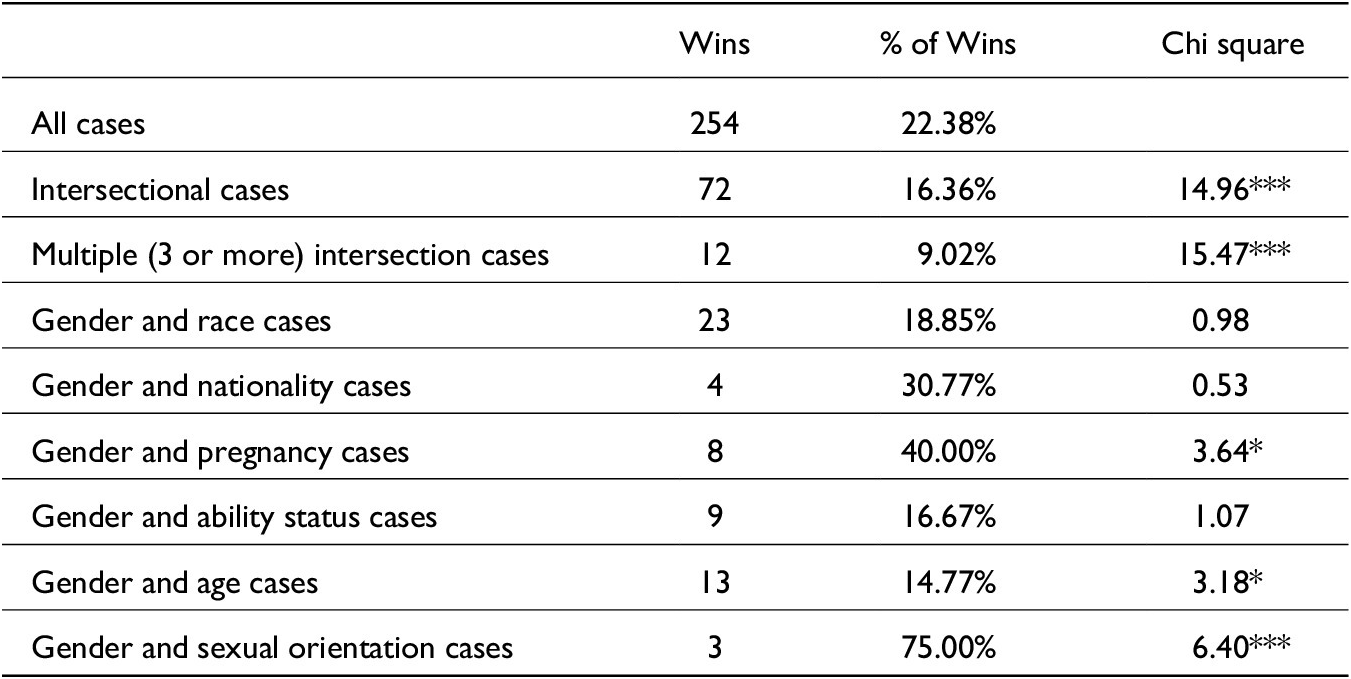
Altogether, our hypotheses suggest that intersectional cases should be more difficult to win than single-axis discrimination cases. At the bivariate level, Table 1 reveals that only 22.38% of plaintiffs in the dataset won their equal pay cases. As expected, intersectional plaintiffs (H1) and multiple intersectional plaintiffs (H2) both lose more often, winning just 16.36% and 9.02% of their cases, respectively. Intersectional plaintiffs are also significantly more likely to lose than single-axis plaintiffs (p ≤ 0.01), and multiple intersectional plaintiffs are significantly more likely to lose than all other plaintiffs (p ≤ 0.01). Gender and race plaintiffs win 18.85% of the time, and gender and nationality plaintiffs win 30.77% of the time. Moreover, their win percentages are not statistically distinct from all other plaintiffs, providing initial support for our third hypothesis. Though gender and pregnancy plaintiffs won 40.00% of their cases, their win percentages were also not statistically different from all other plaintiffs, and sex orientation plaintiffs won more often (75.00%), providing an initial rejection of our fourth hypothesis. Table 1 also reveals that plaintiffs who file cases based on gender and age are marginally (p ≤ 0.10) less likely to win than all other plaintiffs, and plaintiffs who file gender and ability cases fare as well as all other plaintiffs.
Intersectional federal equal pay cases by outcome, 2000 to 2021

Table 1. Long description
The table has four columns from left to right labeled as case type, wins, percent of wins, and chi square. The first row is All cases with 254 wins, 22.38 percent, chi square not listed. The next row is Intersectional cases with 72 wins, 16.36 percent, chi square 14.96 triple asterisk. Multiple (3 or more) intersection cases has 12 wins, 9.02 percent, chi square 15.47 triple asterisk. Gender and race cases has 23 wins, 18.85 percent, chi square 0.98. Gender and nationality cases has 4 wins, 30.77 percent, chi square 0.53. Gender and pregnancy cases has 8 wins, 40.00 percent, chi square 3.64 single asterisk. Gender and ability status cases has 9 wins, 16.67 percent, chi square 1.07. Gender and age cases has 13 wins, 14.77 percent, chi square 3.18 single asterisk. Gender and sexual orientation cases has 3 wins, 75.00 percent, chi square 6.40 triple asterisk. Asterisks indicate significance levels: triple asterisk p less than or equal to 0.01, double asterisk p less than or equal to 0.05, single asterisk p less than or equal to 0.10.
Notes: ***p ≤ 0.01, **p ≤ 0.05, *p ≤ 0.10.
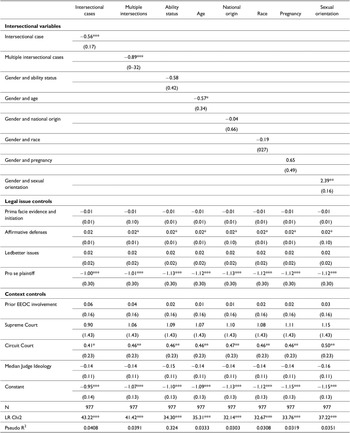
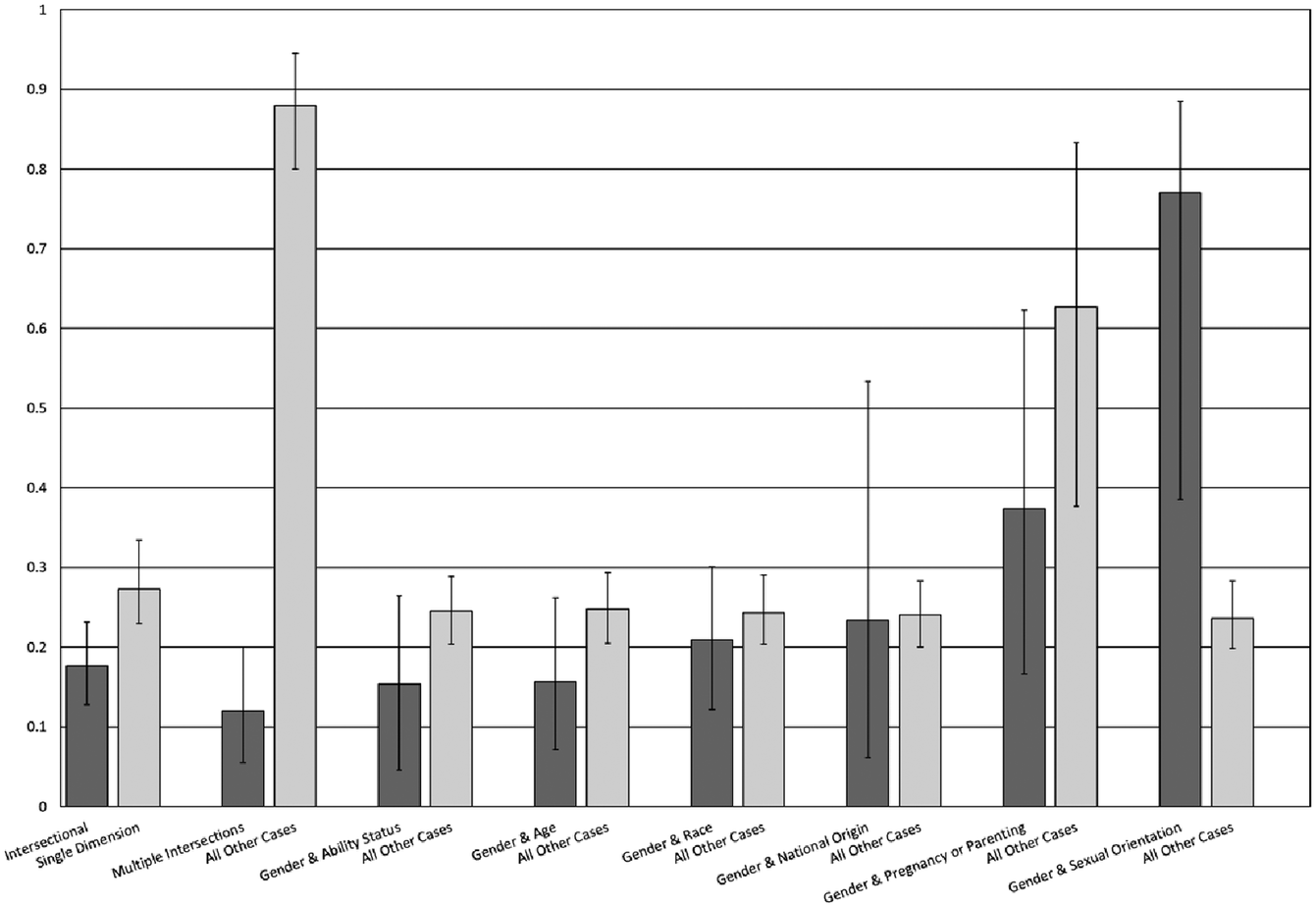
Table 2 reveals that the bivariate results held after controlling for common legal issues and contextual factors. As expected, the coefficients for intersectional and multiple intersectional cases are both negative and significant (p ≤ 0.01), indicating intersectional plaintiffs are less likely to win than single-axis plaintiffs and multiple intersectional plaintiffs are significantly less likely to win than all others. To provide substantive significance for these results, Figure 2 provides predicted probabilities of winning for all of the models, indicating that intersectional plaintiffs win 17.7% of the time and single-axis plaintiffs win 27.5% of the time, a significant difference of 9.8%.
Winning intersectional equal pay cases and/or restitution by case characteristics, legal factors, and context (2000–2021)
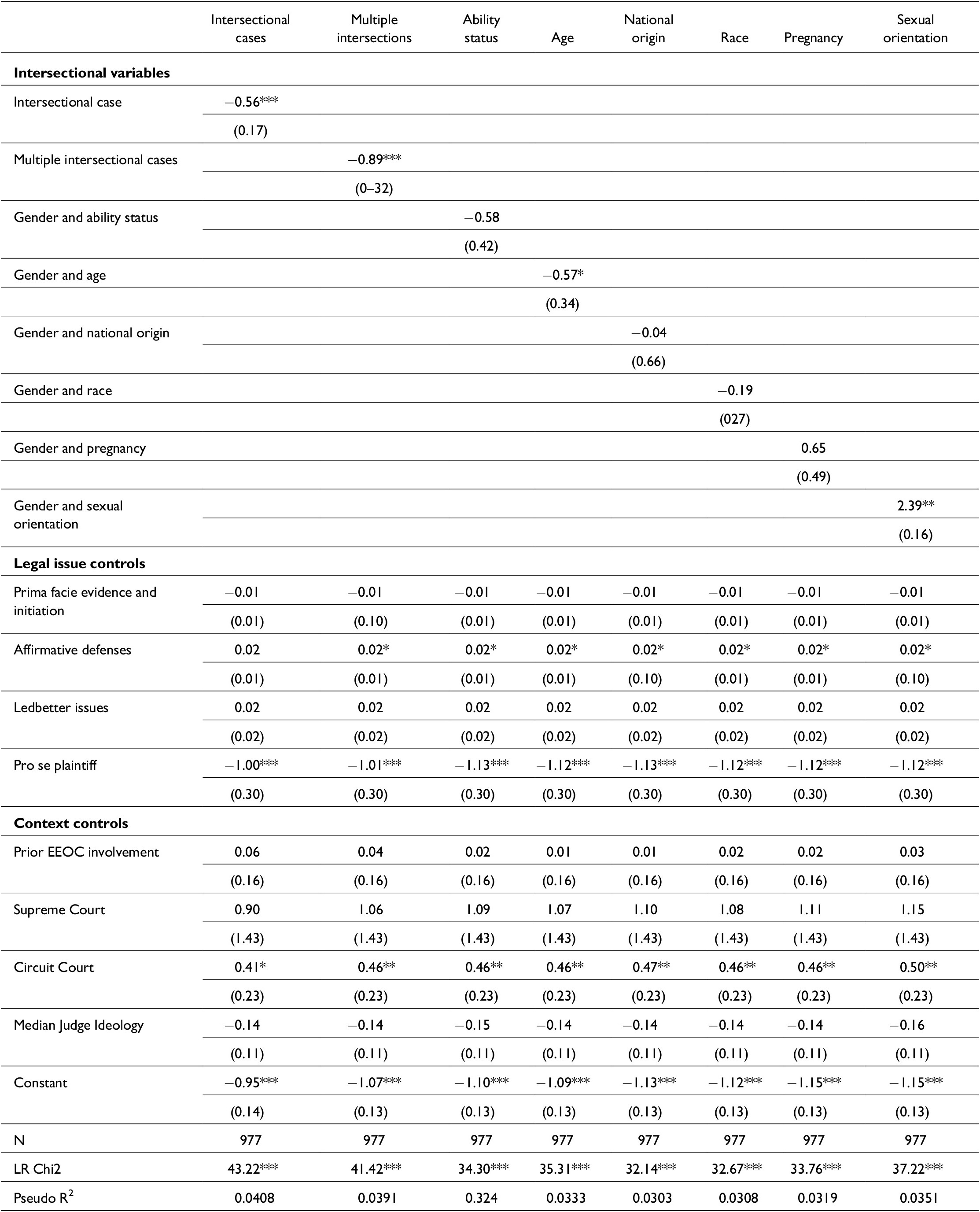
Table 2. Long description
The table presents coefficients and standard errors for winning intersectional equal pay cases or restitution from 2000 to 2021, organized by case characteristics, legal factors, and context. The columns are Intersectional, Multiple, Ability status, Age, National origin, Race, Pregnancy, and Sexual orientation. The first section, Intersectional variables, lists: Intersectional case with coefficient minus 0.56 triple asterisk and standard error 0.17; Multiple intersectional cases with coefficient minus 0.89 triple asterisk and standard error 0–32; Gender and ability status with coefficient minus 0.58 and standard error 0.42; Gender and age with coefficient minus 0.57 asterisk and standard error 0.34; Gender and national origin with coefficient minus 0.04 and standard error 0.66; Gender and race with coefficient minus 0.19 and standard error 0.27; Gender and pregnancy with coefficient 0.65 and standard error 0.49; Gender and sexual orientation with coefficient 2.39 double asterisk and standard error 0.16. The next section, Legal issue controls, includes Prima facie evidence and initiation with coefficients minus 0.01 and standard errors 0.01 to 0.10; Affirmative defenses with coefficients 0.02 or 0.02 asterisk and standard errors 0.01 to 0.10; Ledbetter issues with coefficients 0.02 and standard errors 0.02; Pro se plaintiff with coefficients minus 1.00 to minus 1.13 triple asterisk and standard errors 0.30. Context controls include Prior E E O C involvement with coefficients 0.01 to 0.06 and standard errors 0.16; Supreme Court with coefficients 0.90 to 1.15 and standard errors 1.43; Circuit Court with coefficients 0.41 asterisk to 0.50 double asterisk and standard errors 0.23; Median Judge Ideology with coefficients minus 0.14 to minus 0.16 and standard errors 0.11. The constant row shows coefficients minus 0.95 to minus 1.15 triple asterisk and standard errors 0.13 to 0.14. The sample size N is 977 for all columns. L R Chi squared values range from 32.14 triple asterisk to 43.22 triple asterisk. Pseudo R squared values range from 0.0303 to 0.0408. Notes indicate triple asterisk p less than or equal to 0.01, double asterisk p less than or equal to 0.05, single asterisk p less than or equal to 0.10.
Notes: ***p ≤ 0.01, **p ≤ 0.05, *p ≤ 0.10.
Predicted probability of winning or receiving restitution by case type, 2000 to 2021.

Figure 2. Long description
The graph presents ten pairs of vertical bars, each pair representing a case type on the x axis: Intersectional Single Dimension, Multiple Intersections, Gender and Ability Status, Gender and Age, Gender and Race, Gender and National Origin, Gender and Pregnancy or Parenting, and Gender and Sexual Orientation. For each pair, the left bar shows the predicted probability for the intersectional group, and the right bar shows all other cases. The y axis ranges from 0 to 1 in increments of 0.1. Gender and Ability Status and Gender and Sexual Orientation intersectional groups have the highest probabilities, both above 0.8, while all other intersectional groups are below 0.4. All other cases generally have lower probabilities, mostly between 0.1 and 0.3, except for the Gender and Sexual Orientation group, which is also high. Error bars indicate uncertainty for each bar. The lowest probabilities are seen in Multiple Intersections and all other cases for Intersectional Single Dimension. The graph highlights that intersectional cases involving ability status and sexual orientation have much higher predicted probabilities of winning or restitution compared to other groups.
Table 2 also confirms our hypothesis that gender and race plaintiffs and gender and nationality plaintiffs are as likely to win as other plaintiffs. The gender and race coefficients and the gender and nationality coefficients were both negative, but statistically insignificant. Examining the predicted probabilities in Table 2 shows that gender and race plaintiffs can expect to win 20.9% of the time, while all other plaintiffs win 24.3% of cases, an insignificant 3.4-point difference. Gender and nationality plaintiffs are expected to win 23.4% of the time, compared to 24.1% of all other plaintiffs, an insignificant difference of 0.7 percentage points.
Our final hypothesis suggested that plaintiffs who allege discrimination based on gender and pregnancy should be more likely to win than other intersectional plaintiffs. Our analyses rejected this hypothesis. The gender and pregnancy coefficient in Table 1 is positive, but statistically insignificant, indicating gender and pregnancy plaintiffs are as likely to win as any other plaintiffs. Moreover, the predicted probabilities in Figure 2 reveal that gender and sexual orientation plaintiffs who are predicted to win 77.1% of the time are the intersectional plaintiffs who are the most likely to win their cases. Though Figure 2 shows gender and pregnancy plaintiffs win 37.3% of the time, the confidence interval on that estimate overlaps with the confidence intervals for wins for gender and nationality plaintiffs, gender and race plaintiffs, gender and age plaintiffs, gender and ability plaintiffs, and multiple intersectional plaintiffs, indicating that they are no more likely to win than women at those other intersections.
As a whole, our results indicate that equal pay cases are hard to win in general, but they are particularly hard to win for plaintiffs who make intersectional or multiple intersectional allegations of discrimination. Intersectional challenges persist in equal pay cases, despite the long-standing centrality of equal pay as an issue and nearly 40 years of work on the intersectional failures of US anti-discrimination laws (Caldwell Reference Caldwell1991; Crenshaw Reference Crenshaw1989; Smith Reference Smith1991). Like Best et al. (Reference Best, Edelman, Krieger and Eliason2011), Denny (Reference Denny2009), and Kotkin (Reference Kotkin2009), we show that intersectional and multiple intersectional plaintiffs still fare worse in court. However, our more recent analyses demonstrate that intersectional and multiple intersectional plaintiffs face unique challenges in gendered equal pay cases, rather than anti-discrimination cases broadly. We also add to previous studies by showing that not all intersectional cases are the same and that it is important to disaggregate between different types of intersectional cases. While plaintiffs who allege discrimination based on gender and race, gender and nationality, gender and ability status, and gender and pregnancy win at similar rates as other plaintiffs, plaintiffs who allege discrimination based on gender and age lose more frequently, and gender and sexual orientation plaintiffs win more often.
Our control variables also provide important findings. Pro se plaintiffs are significantly less likely (p ≤ 0.01) to win than those with lawyers. Given those results, and Denny’s (Reference Denny2009) assertion that intersectional plaintiffs tend to lose because they appear pro se, we conducted two analyses to determine if pro se intersectional plaintiffs were more likely to lose. First, we dropped the pro se cases and reran all of the models, producing very similar results. The only differences were that the negative coefficients for judicial ideology (indicating that plaintiffs may be less likely to win when conservative judges hear cases) became marginally significant (p ≤ 0.10) in the ability status and sexual orientation models when we dropped the pro se plaintiffs from the analysis. Second, when possible, we also re-ran the models with an interaction term for the intersectionality (or a subtype of intersectionality) and pro se status, and the interaction terms were statistically insignificant in all the models. Thus, unlike Denny (Reference Denny2009), our results suggest that pro se status is not to blame for intersectional plaintiffs’ failures in court.
Lastly, while our work confirms that intersectional and multiple intersectional plaintiffs are more likely to lose, we note that some of our findings should be interpreted cautiously and/or call for additional research. The predicted probabilities in Figure 2 indicate that, of all the intersectional plaintiffs examined, multiple intersectional plaintiffs are the most likely to lose. Future research should further disaggregate that category to determine whether there is a specific number of intersections that represents a tipping point at which plaintiffs are most likely to lose and/or whether plaintiffs located at specific multiple intersections are the most likely to lose. In the near future, qualitative case studies, rather than large-N statistical analyses, will likely be the best way to conduct these analyses given the limited number of multiple intersectional cases in our dataset.
On a similar note, our findings about the equal pay cases at the intersection of gender and nationality, gender and age, gender and ability status, gender and pregnancy, and especially gender and sexual orientation should be interpreted very cautiously because there are fewer than 100 cases in each of those categories. We included these analyses in our study despite the small number of cases in those categories to provide an important, but partial, first step toward understanding how plaintiffs located at different intersections fare differently in court. Future researchers should rerun these analyses as more intersectional equal pay cases become available over time. Once again, qualitative case studies that compare and contrast how plaintiffs located at these different intersections could help flesh out and validate our preliminary results. Until such future studies are conducted, our results at the intersections above should only be used as the preliminary foundations for future hypothesis testing.
Two control variables in our models also provide important insights into what it takes to win an equal pay case. Plaintiffs are consistently more likely to win when they appear in circuit court, rather than district court. More detailed qualitative analyses of circuit court cases versus district court cases could help determine why plaintiffs fare better in district court. It could be because plaintiffs who appeal have stronger cases than those who do not, that plaintiffs fare better when they face a panel of judges rather than a single district court judge, or that plaintiffs are more likely to win when the court focuses on whether the law was applied correctly rather than evaluating the initial evidence in a case. In six models, plaintiffs are also marginally more likely (p ≤ 0.10) to win when the court’s decisions provide more references to employers’ affirmative defenses. Though the coefficients are small, in-depth qualitative coding could help better understand why this is the case and to test the hypothesis that plaintiffs do better when decisions mention affirmative defenses more because it means plaintiffs have successfully provided more evidence to counter their employers’ defenses.
Finally, future work should examine how intersectional plaintiffs fare in cases that do not produce published court opinions, such as cases that are settled out of court. As McCann (Reference McCann1994) and Best and colleagues (Reference Best, Edelman, Krieger and Eliason2011) note, it is possible that victims of wage discrimination (intersectional or not) fare better when settlements are factored in as well as court decisions. As noted above, collecting these data was not possible for this study, but small qualitative case studies based on interviews and/or archival data might provide some preliminary evidence that could be used to test that hypothesis.
Policy Implications and Conclusions
Altogether, this study provides the first large N-analysis of how plaintiffs who file intersectional equal pay cases fare in court, demonstrating that intersectional and multiple intersectional plaintiffs are significantly more likely to lose. As scholars around the globe wrestle with questions about why the global gender wage gap has failed to close despite a wide variety of different enforcement mechanisms and policy instruments used to address the issue (Engeli and Mazur Reference Engeli and Mazur2026), the US case demonstrates that equal pay lawsuits are unlikely to close both the gender wage gap and intersectional wage gaps, suggesting policymakers and researchers in US and other countries should consider whether other enforcement mechanisms, mandatory wage reporting or government negotiations with social partners might be more effective for addressing intersectional wage discrimination.
Collectively, our results suggest that one partial reason intersectional equal pay cases fail is that they require plaintiffs to make separate allegations of different kinds of discrimination under different laws and to start the process with close-ended intake procedures that ask them to simply check off different forms of discrimination (Bassel and Emejulu Reference Bassel and Emejulu2010; Christofferson and Siow Reference Christofferson and Siow2025; Kotkin Reference Kotkin2009). The obvious solution to that problem would be streamlining intersectional discrimination under one streamlined piece of legislation. However, existing models of streamlined legislation, like the UK’s Equality Law, replicate the problems of separation found in current US laws (Basell and Emejulu 2010). In the US, streamlining anti-discrimination laws is also likely a non-starter; proposed laws, such as the Paycheck Fairness Act, have been stalled in Congress for decades due to partisan gridlock and unified Republican opposition to equal pay legislation (English et al. Reference English, Niezgoda, Richards, Hoard, Smith, Engeli and Mazur2026). Given these challenges, one incremental, short-run step that the EEOC and/or the courts could take would be creating an intake process that allows complainants to provide an open-ended description of their allegations, rather than or in addition to checking boxes for separate forms of discrimination.
The courts could also provide a path to reform. As Bostock v. Clayton County (2020) showed, the courts can issue decisions that create new protected classes under existing anti-discrimination laws. However, court decisions that are not accompanied by new legislation and/or vigorous enforcement are unlikely to solve the problem (Rosenberg Reference Rosenberg2023). The Supreme Court would also have to affirm any new intersectional interpretations of equal pay laws for them to be broadly used and enforced, which is unlikely on the current conservative court.
Given obstacles in Congress and the courts, increased research and education about the issue are needed to soften up the ground for future change when the political opportunity arises (Baumgartner and Jones Reference Baumgartner and Jones2009; Kingdon Reference Kingdon2011). As the USWNT case showed, equal pay cases with the right instigators have the potential to draw policymakers’ attention to issues (English Reference English2021b). More recently, players in the WNBA, where women of color and LGBTQ+ engage in a great deal of activism, have also highlighted intersectional wage discrimination (MacKenzie Reference MacKenzie2023). Relying on high-profile athletes will not be enough, though. Traditional women’s organizations, intersectional organizations, and legal assistance organizations, which have much more legal and policy expertise, will also have to step up by providing additional research and policy guidance on intersectional wage discrimination issues and/or helping intersectional plaintiffs file and pursue high-quality cases that could help change legal precedents. All those actions will require organizations to focus more on intersectionally disadvantaged women than they usually do, despite the current hostile political environment (Basell and Emejulu 2014; Brower Reference Brower2024; Dwidar Reference Dwidar2022; English Reference English2019; 2020; 2021a; Marchetti Reference Marchetti2014; Strolovitch Reference Strolovitch2007). Ultimately, until there is the political will to make major changes to US equal pay laws, our results suggest intersectional wage gaps will persist, and the wage gap will not close.

 Open access

