





1. Introduction
Ever-increasing energy costs are a primary motivation for the continuing interest in developing techniques that reduce pressure losses in conduits. Two principal sources of loss can arise from pressure interaction with any wall topography and the friction between the fluid and the bounding wall. Mohammadi & Floryan (Reference Mohammadi and Floryan2012) summarize the pressure-loss mechanisms, and some techniques for its reduction are known. While the mechanisms underpinning friction are now well understood, knowledge of effective methods for its reduction is less well developed. Here, we examine the role that spatially distributed heating could play in limiting pressure losses.
The friction generated at the wall of a channel by a fluid flowing through it is a joint function of the fluid viscosity and the wall-normal velocity gradient. Assuming that the working fluid cannot be changed, the friction can be reduced only by modifying the near-wall velocity field, and how this might be done depends on whether the flow is laminar or turbulent. If the flow is turbulent or in danger of becoming turbulent, one might appeal to a suitable control strategy designed either to relaminarize an already turbulent flow or to delay the transition. We shall not pursue these ideas but instead focus on problems in which the flow is laminar. Given this, we further remark that flow modifications that might reduce friction can be created using either passive or active processes. There has been considerable research into active systems that rely on various actuators. Examples of studies include investigations using plasma (Inasawa, Ninomiya & Asai Reference Inasawa, Ninomiya and Asai2013), sound (Kato, Fukunishi & Kobayashi Reference Kato, Fukunishi and Kobayashi1997), piezo elements (Fukunishi & Ebina Reference Fukunishi and Ebina2001) or transpiration (Min et al. Reference Min, Kang, Speyer and Kim2006; Bewley Reference Bewley2009; Fukagata, Sugiyama & Kasagi Reference Fukagata, Sugiyama and Kasagi2009; Hoepffner & Fukagata Reference Hoepffner and Fukagata2009; Mamori, Iwamoto & Murata Reference Mamori, Iwamoto and Murata2014; Jiao & Floryan Reference Jiao and Floryan2021a,Reference Jiao and Floryanb). Unfortunately, none of these seem able to achieve net energy savings. More positively, though, it has been shown recently that a combination of transpiration and an in-plane wall motion (Floryan Reference Floryan2023) may give a better outcome.
One can view these active modulations as propulsion-assisting methods in which energy is expended on the actuation rather than increasing a classical propulsive force. Further work on force reduction arises in the emerging field of vibration-based resistance limitation and/or distributed propulsion, especially the use of small-amplitude fast waves which rely on the peristaltic effect (Floryan & Zandi Reference Floryan and Zandi2019; Floryan & Haq Reference Floryan and Haq2022; Haq & Floryan Reference Haq and Floryan2022, Reference Haq and Floryan2023; Floryan, Haq & Bassom Reference Floryan, Haq and Bassom2023a,Reference Floryan, Haq and Bassomb).
In many ways, passive processes might be preferable to active ones as they do not require any energy input. An obvious way to reduce the friction would be to modify appropriately the surface topography of the wall. A smooth surface is often thought to provide the lowest possible friction, as any modifications in surface topography would increase the wetted area. If the surface were perturbed away from being flat, an overall lessening of friction could only be achieved if the increase in the friction area was compensated for by a sufficiently large reduction in the shear. Longitudinal grooves are known to reduce drag through changes in the distribution of the bulk flow (Mohammadi & Floryan Reference Mohammadi and Floryan2013a, Reference Mohammadi and Floryan2014, Reference Mohammadi and Floryan2015; Moradi & Floryan Reference Moradi and Floryan2013). The topography of the grooves can be optimized (Mohammadi & Floryan Reference Mohammadi and Floryan2013b; Moradi & Floryan Reference Moradi and Floryan2013) with the ideal shape determined by the constraints imposed. The stability limits of such flows have been well documented (Moradi & Floryan Reference Moradi and Floryan2013, Reference Moradi and Floryan2014; Mohammadi, Moradi & Floryan Reference Mohammadi, Moradi and Floryan2015). Another class of grooves, known as riblets (Walsh Reference Walsh1983), is characterized by being of very short wavelength, but these are prone to contamination. This contamination can result in clogging and destruction if exposed to shear for extended periods. Riblets are often used in turbulent flows but are rarely chosen in laminar circumstances (Mohammadi & Floryan Reference Mohammadi and Floryan2013a).
Superhydrophobic effects (Rothstein Reference Rothstein2010) offer an alternative route for passive drag reduction. These surfaces trap gas bubbles in micropores, thereby replacing direct liquid–solid contact with gas–liquid contact, which in turn reduces the friction experienced by the liquid. This method is intrinsically limited to two-phase flows, and its effectiveness is limited by the pressure drag associated with surface irregularities (Ou, Perot & Rothstein Reference Ou, Perot and Rothstein2004; Joseph et al. Reference Joseph, Cottin-Bizonne, Benoit, Ybert, Journet, Tabeling and Bocquet2006; Truesdell et al. Reference Truesdell, Mammoli, Vorobieff, van Swol and Brinker2006; Aljallis et al. Reference Aljallis, Sarshar, Datla, Sikka, Jones and Choi2013; Park, Park & Kim Reference Park, Park and Kim2013; Srinivasan et al. Reference Srinivasan, Choi, Park, Chatre, Cohen and McKinley2013; Park, Sun & Kim Reference Park, Sun and Kim2014). Its potency can be increased in several ways: there is an advantage to be gained by suitably shaping the surface pores, enhancing the hydrophobicity through surface chemistry, increasing the surface tension, fixing the position of contact points through geometric means or controlling the contact angles (Quéré Reference Quéré2008; Reyssat, Yeomans & Quéré Reference Reyssat, Yeomans and Quéré2008; Samaha, Tafreshi & Gad-el-Hak Reference Samaha, Tafreshi and Gad-el-Hak2011, Reference Samaha, Tafreshi and Gad-El Hak2012). Caution needs to be exercised as there is the potential for shear-driven or interfacial instabilities to occur, and excess hydrostatic pressure can lead to a collapse of the gas bubbles. In this case, the liquid is directly exposed to the rough surface (Poetes et al. Reference Poetes, Holtzmann, Franze and Steiner2010; Bocquet & Lauga Reference Bocquet and Lauga2011; Zhou et al. Reference Zhou, Li, Wu, Zhou and Cai2011; Aljallis et al. Reference Aljallis, Sarshar, Datla, Sikka, Jones and Choi2013). The micropores need to be extremely small to provide stable interfaces, which, as noted earlier in the context of riblets, makes them prone to damage through clogging. If the gas is replaced with some other immiscible liquid, this prevents bubble collapse and gives rise to liquid-infused surfaces (Wong et al. Reference Wong, Kang, Tang, Smythe, Hatton, Grinthal and Aizenberg2011). An overall drag reduction is still possible despite the infusing liquid having a much higher viscosity than the gas it replaces (Solomon, Khalil & Varanasi Reference Solomon, Khalil and Varanasi2014, Reference Solomon, Khalil and Varanasi2016; Rosenberg et al. Reference Rosenberg, Van Buren, Fu and Smits2016). This technique suffers from the drawback that the pressure variations along the surface are liable to wash away the infusing liquid (Van Buren & Smits Reference Van Buren and Smits2017).
Our primary interest in this work is in using spatial heating patterns to influence the friction on the wall through the generation of convection rolls. Three effects come into play. First, the rolls reduce the direct contact between the stream and the bounding walls, reducing resistance. Moreover, density gradients drive the fluid rotation inside the rolls and provide a propulsive force that promotes fluid movement. Unfortunately, the rolls also reduce the cross-sectional area of the flow, so it is difficult to predict the net result a priori. Several studies in horizontal channels found reduced pressure losses (Hossain, Floryan & Floryan Reference Hossain, Floryan and Floryan2012; Hossain & Floryan Reference Hossain and Floryan2014, Reference Hossain and Floryan2016; Floryan & Floryan Reference Floryan and Floryan2015; Inasawa, Taneda & Floryan Reference Inasawa, Taneda and Floryan2019). When used in vertical channels, the reductions strongly depend on the Prandtl number as the flow-induced break of thermal symmetries generates a buoyancy force acting along the flow (Floryan, Wang & Bassom Reference Floryan, Wang and Bassom2023d). It is not known how flows in inclined channels may react to the patterned heating as the magnitude of the axial component of the buoyancy force changes markedly with the channel inclination angle. The addition of a groove pattern amplifies this effect if the location of the grooves is carefully chosen relative to the positions of the rolls (Abtahi & Floryan Reference Abtahi and Floryan2017a,Reference Abtahi and Floryanb, Reference Abtahi and Floryan2018; Floryan & Inasawa Reference Floryan and Inasawa2021; Inasawa, Hara & Floryan Reference Inasawa, Hara and Floryan2021). This enhancement is a demonstration of the so-called pattern interaction effect (Abtahi & Floryan Reference Abtahi and Floryan2017a,Reference Abtahi and Floryanb, Reference Abtahi and Floryan2018; Floryan & Inasawa Reference Floryan and Inasawa2021; Inasawa et al. Reference Inasawa, Hara and Floryan2021), whose magnitude has been detailed by Hossain & Floryan (Reference Hossain and Floryan2020). Spatial heating patterning has been shown to reduce the forces between plates in relative motion (Floryan, Shadman & Hossain Reference Floryan, Shadman and Hossain2018), creating propulsion (Floryan, Panday & Aman Reference Floryan, Panday and Aman2023c; Floryan et al. Reference Floryan, Wang and Bassom2023d; Floryan, Aman, & Panday Reference Floryan, Aman and Panday2024) and the ability for fluid pumping (Hossain & Floryan Reference Hossain and Floryan2023). Information about the stability limits of such flows is sparse (Hossain & Floryan Reference Hossain and Floryan2013b, Reference Hossain and Floryan2015b, Reference Hossain and Floryan2022).
Spatial heating patterning can be used to create the so-called chimney effect in non-vertical openings. This effect involves using natural convection in vertical channels to evacuate combustion gases from fireplaces (Putnam Reference Putnam1882). It is of significant interest in architectural design as it provides passive ventilation, whereby heated air flows upward and draws in cool air at the base of a structure (Linden Reference Linden1999; Wong & Heryanto Reference Wong and Heryanto2004; Mortensen et al. Reference Mortensen, Walker and Sherman2011; Nagler Reference Nagler2021). A reverse effect can also occur when relatively hot air is brought down from above into a cooler environment. Vertical openings are important in designing various fire prevention measures owing to the possibility of controlling the intensification of combustion and the spreading of fires (Song et al. Reference Song, Huang, Kuenzer, Zhu, Jiang, Pan and Zhong2020). Upright fault lines are known to be significant in the context of thermal recovery processes (Tournier, Gethon & Rabinowicz Reference Tournier, Gethon and Rabinowicz2000). More contemporary uses of the chimney effect include the passive cooling of electronic components (Naylor, Floryan & Tarasuk Reference Naylor, Floryan and Tarasuk1991; Straatman, Tarasuk & Floryan Reference Straatman, Tarasuk and Floryan1993; Straatman et al. Reference Straatman, Naylor, Tarasuk and Floryan1994; Novak & Floryan Reference Novak and Floryan1995; Shahin & Floryan Reference Shahin and Floryan1999; Andreozzi, Buonomo & Manca Reference Andreozzi, Buonomo and Manca2005) as well as in the design of passively cooled nuclear reactors (Weil Reference Weil2012). There is an obvious interest in assessing the effectiveness of the chimney effect in oblique openings.
Fundamental studies of vertical natural convection can be traced back to Zeldovich's (Reference Zeldovich1937) and Batchelor's (Reference Batchelor1954) work, involving bounding surfaces kept at a constant temperature. They were followed by an analysis of the possible transition to secondary states (Vest & Arpaci Reference Vest and Arpaci1969; Lee & Korpela Reference Lee and Korpela1983; Hall Reference Hall2012), turbulent convection (Ng et al. Reference Ng, Ooi, Lohse and Chung2015) and the effect of wall roughness (Shishkina & Wagner Reference Shishkina and Wagner2011; Toppaladoddi, Succi & Wettlaufer Reference Toppaladoddi, Succi and Wettlaufer2017). Further work has examined the modifications created by ratchet surfaces (Jiang et al. Reference Jiang, Zhu, Mathai, Yang, Verzicco, Lohse and Sun2019). Using heating patterns to promote the chimney effect has attracted recent interest (Floryan et al. Reference Floryan, Benayoun, Panday and Bassom2022a,Reference Floryan, Wang, Panday and Bassomc, Reference Floryan, Panday and Aman2023c,Reference Floryan, Wang and Bassomd; Floryan, Haq & Panday Reference Floryan, Haq and Panday2022b).
Given that these previous studies have demonstrated that reduced losses can be achieved using the chimney effect, we intend to characterize the flow response in a channel inclined to gravity and subjected to patterned heating. Such heating does not alter the mean temperature of channel walls but produces spatial modulations that may lead to the lowering of friction experienced by the fluid stream. Patterned heating is of interest as only relatively small heating levels can be sufficient to reduce significantly the pressure gradient required to maintain the desired flow rate.
The remainder of this paper is organized as follows. In § 2, we formulate the model problem that quantifies the flow response and discuss the numerical methods used later in the work. Section 3 describes the flow responses of the configuration when the applied heating is of a wavelength comparable to the width of the channel. The calculations here are restricted to when one of the walls is heated, but this is extended to account for both walls being heated; this is done in § 4. It is also noted that our problem can be analysed analytically when the applied heating is either of a long wavelength or of a short wavelength. These two limits are considered in §§ 5 and 6, respectively. We show excellent agreement between the theory and the computations in the appropriate limits, reinforcing confidence in both. The paper closes in § 7 with a summary of the main conclusions and some further remarks.
Lastly, we mention that it is well known that the quantitative details of convection are affected by the choice of the Prandtl number Pr (Hossain & Floryan Reference Hossain and Floryan2022; Floryan et al. Reference Floryan, Wang and Bassom2023d). All our calculations are conducted with Pr = 0.71, which is the value appropriate to air; consequently, should the value of Pr be altered, the finer details of the results are likely to change, but the global features are unlikely to be altered.
2. Formulation
Consider the steady, two-dimensional pressure-gradient-driven flow of a Boussinesq fluid in an isothermal channel of width 2h inclined at an angle  $\beta $ to the horizontal, as shown in figure 1. We align the x and y coordinate axes parallel and perpendicular to the slot and non-dimensionalize all lengths on the half-width h so that the sides of the channel are given by $y ={\pm} 1$. In the absence of any fluid motion, there is a hydrostatic pressure ${p_h}(x,y)$ given by the solution of
 \begin{equation}\frac{{\partial {p_h}}}{{\partial x}} ={-} \rho g\sin \beta ,\quad \frac{{\partial {p_h}}}{{\partial y}} ={-} \rho g\cos \; \beta ,\end{equation}
where g is the gravitational acceleration and  $\rho $ is the density of the fluid. When the fluid moves, the basic motion is given by velocity ${\boldsymbol{v}_0}(x,y)$ and pressure $\; {p_0}(x,y)$ fields, which are
 \begin{equation}{\boldsymbol{v}_0}(x,y) = (1 - {y^2},0),\quad {p_0}(x,y) ={-} 2x/Re,\end{equation}
where the velocity vector  ${\boldsymbol{v}_0} = ({u_0},{v_0})$ is scaled on the maximum of the $x$-velocity ${u_{max}}$ and ${p_0}$ is the pressure in excess of ${p_h}$ based on $\rho u_{max}^2$. The form of $\; {p_0}$ depends on the Reynolds number $Re \equiv {u_{max}}h/\nu $ with $\nu $ the kinematic viscosity. Given this basic flow, it is straightforward to find the associated stream function ${\varPsi _0}$, the flow rate ${Q_0}$ through the slot and the shear force (per unit length and width) ${F_{R0}}$ ( ${F_{L0}}$) acting on the fluid at the right (left) wall. These quantities are given by
 \begin{equation}{\varPsi _0} = y - \frac{{{y^3}}}{3} + \frac{2}{3},\quad {Q_0} = \frac{4}{3}\quad \textrm{and}\quad {F_{R0}} = {F_{L0}} ={-} 2/Re.\end{equation}
We next supply sinusoidal heating to both walls so that their scaled temperatures are given by
 \begin{gather}y ={-} 1:\quad {\theta _R}(x) = {\textstyle{1 \over 2}}R{a_{p,R}}\cos \alpha x,\end{gather}
 \begin{gather}y = 1:\quad {\theta _L}(x) = {\textstyle{1 \over 2}}\; R{a_{p,L}}\; \cos (\alpha x + \varOmega ),\end{gather}
where the subscripts R and L denote the right and left walls, respectively. We remark that this periodic heating is applied to the surfaces throughout the domain; moreover, this profile is of wavenumber  $\alpha $ (or wavelength $\lambda = 2{\rm \pi}/\alpha $). We also remark that the two heating patterns at the two walls are offset by a phase angle $\varOmega $. Here $\theta $ denotes the relative temperature defined by $T - {T_R} = \kappa \nu \theta /(g\varGamma {h^3})$, where T and ${T_R}$ denote the absolute and reference base temperature, respectively. Furthermore, $\kappa $ is the thermal diffusivity and $\varGamma $ is the thermal expansion coefficient, and we assume that fluid density variations follow the Boussinesq approximation. The appropriate Rayleigh numbers measure the intensity of the heating at the walls; on the right-hand side, we define $R{a_{p,R}} = g\varGamma {h^3}{\theta _{p,R}}/(\kappa \nu )\; $, where ${\theta _{p,R}}$ is the magnitude of the applied heating with an analogous definition for $\; R{a_{p,L}}$ relating to the left-hand edge of the slot. We mention in passing that it is well accepted that modelling buoyancy using the Boussinesq approach serves as an excellent paradigm for the underlying physics, especially when the temperature differences involved in the problem are relatively modest. For a discussion of the validity of this type of modelling, the interested reader is directed to the recent review by Mayeli & Sheard (Reference Mayeli and Sheard2021).
A schematic of the flow configuration in the slot defined by  $|y|\le 1$. The channel is inclined to the horizontal at an angle $\beta $ while the two walls are heated by sinusoidal thermal profiles defined by (2.4). These two profiles are offset by a phase $\varOmega $.

The continuity, Navier–Stokes and energy equations govern the system. Written in terms of the dimensionless variables, we have
 \begin{gather}u\frac{{\partial u}}{{\partial x}} + v\frac{{\partial u}}{{\partial y}} ={-} \frac{{\partial p}}{{\partial x}} + {\nabla ^2}u + P{r^{ - 1}}\theta \sin \beta ,\quad \frac{{\partial u}}{{\partial x}} + \frac{{\partial v}}{{\partial y}} = 0,\end{gather}
 \begin{gather}u\frac{{\partial v}}{{\partial x}} + v\frac{{\partial v}}{{\partial y}} ={-} \frac{{\partial p}}{{\partial y}} + {\nabla ^2}v + P{r^{ - 1}}\theta \cos \beta ,\quad u\frac{{\partial \theta }}{{\partial x}} + v\frac{{\partial \theta }}{{\partial y}} = P{r^{ - 1}}{\nabla ^2}\theta ,\end{gather}
where  $(u,v)$ are the velocity components in the (x, y) directions, respectively, scaled on ${U_v} = \nu /h$, p is the pressure associated with fluid movement scaled with $\rho U_\nu ^2$ and $\theta $ is the temperature; finally, $Pr = \nu /\kappa $ is the Prandtl number. (The generalization of the field equations to non-Boussinesq fluids may be found in the text by Tritton (Reference Tritton1977).) The range of heating parameters used in the analysis is similar to that used in experiments reported by Inasawa et al. (Reference Inasawa, Taneda and Floryan2019, Reference Inasawa, Hara and Floryan2021) and Floryan & Inasawa (Reference Floryan and Inasawa2021). A very good agreement between experimental data and theory was reported, demonstrating that the Boussinesq approximation captures a fluid response well. The required boundary conditions are
 \begin{align}u( - 1) = u( + 1) = 0,\quad v( - 1) = v( + 1) = 0,\quad \theta ( - 1) = {\theta _R}(x)\quad \textrm{and}\quad \theta ( + 1) = {\theta _L}(x).\end{align}
We decompose the flow fields according to
 \begin{gather}u(x,y) = Re\,{u_0}(y) + {u_1}(x,y),\quad v(x,y) = {v_1}(x,y),\quad \theta (x,y) = {\theta _1}(x,y),\end{gather}
 \begin{gather}p(x,y) = R{e^2}{p_0}(x) + Bx + {p_1}(x,y),\quad \psi (x,y) = Re\; {\psi _0}(y) + {\psi _1}(x,y),\end{gather}
so that if no heating were applied to the walls, we would have all quantities with subscript 1 identically zero. Our concern lies in determining whether applied heating can reduce the pressure gradient required to maintain a specified flow rate. Accordingly, we impose the mass flow rate constraint of the form
 \begin{equation}Q(x){|_{mean}} = {\left. {\left( {\int_{ - 1}^1 {u(x,y)\,\textrm{d}y} } \right)} \right|_{mean}} = \frac{4}{3}Re,\end{equation}
and seek information as to the size of the mean pressure gradient
 \begin{equation}{\left. {\frac{{\partial p}}{{\partial x}}} \right|_{mean}} ={-} 2Re + B,\end{equation}
where positive values of B signify a reduction of pressure losses.
The system (2.3)–(2.7) was solved by expressing the velocity components using a stream function  $\psi $ defined in the usual manner, i.e. $\; u = \partial \psi /\partial y$, $v ={-} \partial \psi /\partial x$, then eliminating pressure and using Fourier expansions in the x direction and Chebyshev expansions in the y direction. A description of the algorithm and the benchmarking of its accuracy are described by Hossain et al. (Reference Hossain, Floryan and Floryan2012); the reader is referred to that paper for extended details. The pressure field was normalized by bringing the mean value of its periodic component to zero while the mean Nusselt number $N{u_{av}}$ was evaluated using
 \begin{equation}N{u_{av}} ={-} {\lambda ^{ - 1}}\int_{{x_0}}^{{x_0} + \lambda } {{{\left. {\frac{{\partial \theta }}{{\partial y}}} \right|}_{y ={-} 1}}\textrm{d}\kern0.7pt x} .\end{equation}
With this definition, a positive value of  $N{u_{av}}$ means that the right wall is losing energy. The cost of moving energy within a wall to create the local cold and hot spots is difficult to assess, but it contributes to the overall energy costs. The quantity of energy that has to be moved along the wall can be determined by evaluating the horizontal heat fluxes between the hot and cold wall segments. These fluxes can be quantified in terms of heat leaving each wall per half-heating wavelength and expressed by the horizontal Nusselt number defined as
 \begin{equation}N{u_{h,R}} ={-} 2{\lambda ^{ - 1}}\int_{ - \lambda /4}^{\lambda /4} {{{\left. {\frac{{\partial \theta }}{{\partial y}}} \right|}_{y ={-} 1}}\textrm{d}\kern0.7pt x} - N{u_{av}}.\end{equation}
This is not the only possible way to estimate the energy cost. Various alternatives have been suggested in the literature; the interested reader is directed to the papers by Maxworthy (Reference Maxworthy1997), Siggers, Kerswell & Balmforth (Reference Siggers, Kerswell and Balmforth2004), Hughes & Griffiths (Reference Hughes and Griffiths2008) and Winters & Young (Reference Winters and Young2009).
We remark that the shear forces acting on the fluid at the right and left walls are given by
 \begin{equation}{F_R} ={-} {\lambda ^{ - 1}}\int_0^\lambda {{{\left. {\frac{{\partial u}}{{\partial y}}} \right|}_{y ={-} 1}}\textrm{d}\kern0.7pt x} ,\quad {F_L} = {\lambda ^{ - 1}}\int_0^\lambda {{{\left. {\frac{{\partial u}}{{\partial y}}} \right|}_{y ={+} 1}}\textrm{d}\kern0.7pt x} ,\end{equation}
and heating-induced changes of these forces are given as
 \begin{equation}\Delta {F_R} = {F_R} - R{e^2}{F_{R0}},\quad \Delta {F_L} = {F_L} - R{e^2}\; {F_{L0}},\end{equation}
with negative  $\Delta {F_R}$ and $\Delta {F_L}$ corresponding to a reduction of these forces. The total (buoyancy) body force per unit length is given by
 \begin{equation}{F_b} = {\lambda ^{ - 1}}P{r^{ - 1}}\int_{ - 1}^1 {\int_0^\lambda {\theta \,\textrm{d}\kern0.7pt x\,\textrm{d}y} } ,\end{equation}
with its x and y components given by  ${F_{bx}} = {F_b}\sin \beta $ and ${F_{by}} = {F_b}\cos \beta $, respectively.
It is noted that the above formulation is restricted to two-dimensional steady flows. There is always the possibility that the underlying structure may become time-dependent or that a secondary flow is set up. Some previous computations have addressed the question of the possibility of secondary structures in flows within horizontal channels (Hossain & Floryan Reference Hossain and Floryan2013b, Reference Hossain and Floryan2015b). Those findings suggest that no secondary flow appears unless  $\; R{a_{p,R}}$ is at least 2500. The results reported below are restricted to smaller Rayleigh numbers, so the complications that secondary structures would introduce ought not to arise.
3. Flow properties when one wall is heated
To begin our account of the effect of patterning on the pressure losses experienced along the channel, we consider the situation in which only one of the walls is heated. Within our problem, several parameters could be varied, but it is helpful to note that several inherent symmetries can be exploited to reduce the task. First, we need not be concerned about whether the flow is net upwards or downwards. If we transform  $\beta \to \beta + {\rm \pi}$ then the problem specification is unchanged if we switch the sign of $\theta $ and translate the coordinate $x \to x + ({\rm \pi}/\alpha )$. We conclude that we can restrict the inclination of the channel $\beta \in [0,{\rm \pi}]$. Furthermore, if one applies the transformations $(x,y,u,v,p,\theta ,\beta ) \mapsto (x, - y,u, - v,p,\theta ,{\rm \pi} - \beta )$ the governing equations are invariant while the boundary conditions swap over. This means that when it comes to considering the problem when only one wall is heated, we can examine the case when the patterning is applied to the right-hand wall so $R{a_{p,R}} \ne 0$ and $\; R{a_{p,L}} = 0$. We note in passing that these various symmetry properties have been confirmed by extensive numerical testing when the slot is horizontal (Hossain & Floryan Reference Hossain and Floryan2014, Reference Hossain and Floryan2015a).
The forms of the pressure losses as functions of the inclination angle  $\beta $ and pattern wavenumber $\alpha $ are illustrated in figure 2 for three values of the Reynolds number $Re = 1$, 5 and 10; the interest in these particular values will become apparent as we proceed. It is noted that a reduction in the pressure losses can be achieved when $0 \le \beta \le {\rm \pi}/2$; further, the critical inclination at which the reduction ceases to be possible is only weakly dependent on $\alpha $ when the Reynolds number is small (see figure 2a). As $Re$ is increased so the size of the parameter domain corresponding to a pressure reduction expands and does so especially at relatively long heating wavelengths; this is evident in figure 2(b,c). The heating leads to self-pumping at small $Re$ when an opposite pressure gradient must be applied to slow the fluid if the flow rate is to be maintained.
The variation of the pressure-gradient correction B as a function of heating wavenumber  $\alpha $ and slot inclination $\beta $ when only the right wall is heated with $R{a_{p,R}} = 500$. In the three cases, the Reynolds number $Re = $ (a) 1, (b) 5 and (c) 10. The grey shading denotes parameter combinations corresponding to a reduction in pressure losses (B > 0). The thick dotted, dashed-dotted and dashed lines identify those conditions for which there are 10 %, 50 % and 100 % reductions of pressure losses, respectively. The circles mark the parameter choices used in figure 3, while the vertical red lines indicate the values adopted in figure 4. Finally, the horizontal blue lines identify the flow conditions used in figure 7.

The forms of the flow and temperature fields as functions of the channel orientation  $\beta $ and at Reynolds number up to 50 are shown in figure 3. (We point out that the flow conditions assumed for the three middle rows of this figure are marked with circles in figure 2.) The flow topology arises from a competition between the uniform isothermal Poiseuille flow in the positive x direction and the natural convection driven by the applied periodic heating. Natural convection alone generates counter-rotating rolls, as illustrated in the first row of figure 3. The structure of these rolls does not change significantly as the orientation of the conduit is varied; it is seen that the fluid flows downward from cold spots and upward toward hot spots. The superposition of a small component of Poiseuille flow generates a thin stream tube that gently meanders between the rolls. As $Re$ grows, we see an enlargement of the stream tube together with a slight reduction in the intensity of the rolls adjacent to the unheated wall. Further increase in $Re$ leads to an ongoing thickening of the stream tube and the complete elimination of the upper rolls. At the point when these upper rolls completely disappear, those next to the lower (heated) wall have only undergone a relatively mild weakening, as observed in the $Re = 10$ results shown in figure 3. Nevertheless, as the Reynolds number grows further, the lower rolls continue to shrink until they are eventually destroyed. Once $Re = 50$, all that remains is a structure reminiscent of an isothermal Poiseuille flow; this is evident in the bottom row of results shown in figure 3. Finally, it is interesting to note that the qualitative forms of the flow topology seem to be largely independent of the inclination of the channel, and variations in $\beta $ only result in relatively minor changes in the global flow properties.
The flow and temperature fields for one-wall heating with  $R{a_{p,R}} = 500$ and a wavenumber $\alpha = 1$. The five rows of results correspond to $Re = 0$, 1, 5, 10 and 50, respectively. The downward black arrows show the direction of gravity force, while the red arrows indicate the direction of pressure-gradient force. The background colour illustrates the thermal field. The parameter choices used when $Re = 1,\; 5$ and 10 are marked in figure 2 by red circles, in figure 5 by green circles and in figure 7 by blue circles. In all the plots, the temperature has been normalized with its maximum ${\theta _{max}}$.

It is already well known that reducing pressure losses is possible in a horizontal channel. This phenomenon arises owing to a combination of various effects. First, reducing the direct contact between the walls and the stream lessens the frictional resistance. There is also a propulsive effect of rotation in the separation bubbles driven by horizontal density gradients. Finally, bubbles reduce the effective cross-sectional area available to the stream (Hossain et al. Reference Hossain, Floryan and Floryan2012; Floryan & Floryan Reference Floryan and Floryan2015; Hossain & Floryan Reference Hossain and Floryan2016). If the slot is inclined away from horizontal, all these effects remain operative, but now a buoyancy force acting along the channel also comes into play. The streamwise average of this additional force is zero when the channel is horizontal, but once  $\beta \ne 0$, a flow-induced break in periodic symmetry generates a streamwise component (Floryan et al. Reference Floryan, Benayoun, Panday and Bassom2022a,Reference Floryan, Wang, Panday and Bassomc, Reference Floryan, Wang and Bassom2023d), which affects the pressure loss. A significant reduction in losses is feasible when $0 < \beta < {\rm \pi}/2$ for which the buoyancy force assists in the flow direction while a large increase occurs for ${\rm \pi}/2 < \beta < {\rm \pi}$; now the buoyancy force acts against the flow direction. These cases are illustrated in figure 3. We also note in connection with figure 3 that an increase in $Re$ eliminates the separation bubbles by the stage $Re = 50$, and then the drag reduction mechanism is turned off.
The interplay between the various forces that affect the fluid motion is illustrated in figure 4. These results portray how the relative importance of the pressure gradient, the wall shear and the buoyancy forces evolve as the Reynolds number and inclination angle vary. Figure 4(a) shows the cumulative effect of the three forces. This demonstrates a reduction in the pressure gradient when  $\beta $ is relatively small; as $Re$ grows, the range of $\beta $ over which $B > 0$ diminishes. It is remarked that the pressure-gradient correction is not zero when the channel is horizontal (Floryan & Floryan Reference Floryan and Floryan2015) or vertical (Floryan et al. Reference Floryan, Wang and Bassom2023d); it is just much smaller than when the channel is inclined. The results shown in figure 4(c,d) help explain the mechanisms that underpin the heating-induced pressure-gradient reduction. Changes in the shear force on the heated wall propel fluid forward when $\beta < \sim {\rm \pi}/2$ but oppose fluid movement otherwise. Interestingly, the shear force at the isothermal surface exhibits a contrasting behaviour in as much that it resists fluid movement for $\beta < \sim {\rm \pi}/2$ but supports it otherwise. Typically, the magnitudes of the forces generated at the heated wall are larger. Further insight is gained from figure 4(b), which shows the variations in the x component of the buoyancy force. It is seen that the size of this force is significantly larger than that of the shear forces, so it dominates. It must be remembered that this force cannot affect the pressure losses when the slot is horizontal since its streamwise-averaged component is precisely zero. In practice, then, for an inclined channel, it is the buoyancy mechanism that is the principal player in determining the pressure reduction, but as $\beta \to 0$ the shear forces increasingly assume this role. We also note that all the forces associated with heating seem to decrease with $Re$, as heating-induced flow modifications gradually weaken and completely disappear once the stream becomes sufficiently strong to wash out the separation bubbles.
Flow properties as functions of the inclination angle  $\beta $ when $R{a_{p,L}} = 0$, $R{a_{p,R}} = 500$ and $\alpha = 1$ with various Reynolds numbers in the interval $Re \in [0,50]$. (a) The pressure correction $B$. (b) The x component of the buoyancy force ${F_{bx}}$. Also illustrated are the heating-induced changes in the shear forces acting on the fluid at the (c) right (heated) wall and (d) left (isothermal) wall. The flow conditions when $Re = 1,\; 5,\; 10$ are marked by the vertical red lines in figure 2.

The dependence of the pressure-gradient correction parameter B on the Reynolds number  $Re$ and the heating wavenumber $\alpha $ is considered in figure 5. These results demonstrate how a drag reduction is replaced by a drag increase as the inclination angle $\beta $ increases. As $\beta $ grows, the range of drag-reducing wavenumbers shrinks and moves toward long-wavelength modes, an effect we commented upon in our discussion of figure 2. We notice that when $\beta = 0$ or ${\rm \pi}/4$, the most effective heating wavenumber, at least as far as drag reduction is concerned, appears to be $\alpha \approx 1$. The most significant pressure reduction occurs at longer wavelengths $\alpha \approx 0.3$ for a vertical slot, but the decrease in B is also smaller. Our patterned heating no longer possesses drag-reducing properties once $\beta = 3{\rm \pi}/4$. Our results thus far demonstrate that pressure-gradient losses can be significantly mitigated and, perhaps, even eliminated if a judicious combination of parameters is made.
The pressure-gradient correction parameter B as a function of  $\alpha $ and $Re$ when $R{a_{p,L}} = 0$ and $R{a_{p,R}} = 500.$ The four plots correspond to slot inclination angles $\beta = $ (a) 0, (b) ${\rm \pi}/4$, (c) ${\rm \pi}/2$ and (d) $3{\rm \pi}/4$. The grey shading indicates those parameter combinations that lead to a reduction in the pressure loss. The thick dotted, dashed-dotted and dashed lines identify conditions leading to 10 %, 50 % and 100 % reductions in pressure losses, respectively. The green vertical lines identify the flow conditions used in figure 6, while the green circles show those in figure 3. The blue lines denote the conditions adopted in figure 7, while the brown lines and circles identify the parameter combinations used in figure 8.

Detailed information about the effects of the Reynolds number can be gleaned from the data displayed in figure 6. It is clear that the pressure-gradient correction approaches a constant, inclination-dependent limit as  $Re \to 0$, corresponding to the pure natural convection that Floryan et al. (Reference Floryan, Benayoun, Panday and Bassom2022a) considered. Our analysis here is based on the assumption of the prescribed flow rate constraint (2.8), which, in the limit $Re \to 0$ corresponds to a zero flow rate. As heating generates a net longitudinal flow, its elimination necessitates the imposition of a pressure gradient, as suggested by figure 6. The pressure-gradient correction approaches a limit that approaches zero as $Re \to \infty $ irrespective of the inclination angle. This limit is reached when $Re$ exceeds about 100, and the separation bubbles have been completely destroyed. Furthermore, the flow loses any dependence on the heating and acquires characteristics akin to an isothermal Poiseuille flow. We emphasize that obtaining a significant reduction in pressure losses for smaller Reynolds numbers is possible.
The pressure-gradient correction B as a function of the Reynolds number Re when  $R{a_{p,L}} = 0, R{a_{p,R}} = 500$ and $\alpha = 1$. Plotted are the values of B for the eight inclinations $\beta = j{\rm \pi}/8$ with $j = 0,\textrm{ }1, \ldots ,\textrm{ }7$. The flow conditions for $Re = 1,\; \textrm{ }5,\textrm{ }\; 10$ are marked using blue lines in figure 2, while the circles illustrate the flow conditions used in figure 3. The various levels of grey shading indicate parameter combinations that reduce pressure losses; the borders between the shadings depict the combinations for which 10 %, 50 % or 100 % pressure-gradient reductions are possible.

Detailed information concerning the effects of varying the heating wavenumber can be inferred from figure 7. Heating seems to have the most marked influence on the pressure losses when  $\alpha = O(1)$; naturally, the details depend on the inclination angle. The magnitude of these losses decreases in both the long- and short-heating-wavelength limits. In particular, it may be shown that $B \propto {\alpha ^2}$ as $\alpha \to 0$ while $B \propto {\alpha ^{ - 3}}$ when $\alpha \to \infty $, at least when the slot is inclined, and the details of these limits are discussed in §§ 5 and 6. Horizontal and vertical channels are somewhat special cases, as the results in figure 7 suggest. It seems that heating always reduces the pressure losses in horizontal channels irrespective of the heating wavenumber but only reduces losses in vertical channels if the wavelength is sufficiently long. There are cases of heating wavenumbers that are so effective that an opposite-signed pressure gradient must be imposed to prevent flow acceleration.
The pressure-gradient correction B when  $R{a_{p,L}} = 0$ and $R{a_{p,R}} = 500$ for the four channel inclinations $\beta = j{\rm \pi}/4$ with $j = 0,1,2,3$. Shown are the results for two Reynolds numbers: (a) $Re = 1$ and (b) $Re = 10$. The flow conditions used in this figure are shown using blue lines in figure 5. The various degrees of grey shading indicate those parameter combinations that reduce the pressure losses; the borders between the different shadings correspond to 10 %, 50 % and 100 % pressure-gradient reduction. The circles identify the conditions adopted in figure 8.

The evolution of flow structures when  $\alpha = O(1)$ has already been discussed in connection with figure 3. We observed that the structures changed slightly as the inclination angle altered. To complement these findings, in figure 8, we present evidence as to the form of the flow structures in the small- and large-wavenumber limits. There is a dramatic change in the flow topology at long wavelengths as the slot is inclined at an angle increasing from horizontal. The long-wavelength structures can be analysed, and the pertinent results are summarized in § 5. There, we point out that the limit $\beta \to 0$ is a special case, and this conclusion is supported by the flow structures displayed in the first column of rows 1 and 3 of figure 8. On the other hand, at short wavelengths, boundary layers form near the heated walls. The asymptotic solutions described in § 6 show that the details of the boundary layers differ if the channel is horizontal or vertical, but the modifications are somewhat technical so that the overall flow topology does not change significantly.
The flow and temperature fields for flows with heating intensities  $R{a_{p,L}} = 0$ and $R{a_{p,R}} = 500$. Shown are the structures that correspond to relatively long-wavelength $(\alpha = 0.1)$ and short-wavelength $(\alpha = 10)$ modes and at the two Reynolds numbers Re = 1 and Re = 10. The background colour illustrates the temperature field. The black arrows show the direction of gravity force, while the red arrows denote the direction of pressure-gradient force. The flow conditions used in these plots are marked in figures 5 and 7. In all the plots the temperature has been normalized with its maximum ${\theta _{max}}$.

One last aspect of the problem that warrants attention is the effect of the heating intensity. The change in the pressure gradient is proportional to  $Ra_{p,R}^2$ for relatively weak heating; this result is evident in the results contained in figure 9. In the opposite case of intense heating, we have evidence of saturation, and the magnitude of B does not grow indefinitely as $R{a_{p,R}}$ increases, at least in the case of small Reynolds numbers (see figure 9a). We see that the case of a vertical channel is somewhat a special case in as much that there is a transition from a reduction to a growth in the pressure losses, which occurs at $R{a_{p,R}} \approx 400$ (Floryan et al. Reference Floryan, Wang and Bassom2023d). At larger Reynolds numbers, the behaviour is rather more intricate. Now, a switch between reduced and enhanced pressure-gradient losses is possible in slots that no longer need to be vertical.
The pressure-gradient correction B for a heating wavenumber  $\alpha = 1$ and eight inclination angles $\beta = j{\rm \pi}/8$ for $j = 0,\textrm{ }1, \ldots ,\textrm{ }7$. Two Reynolds numbers are considered: (a) $Re = 1$ and (b) $Re = 10$. The different levels of shading indicate parameter combinations that reduce pressure losses, and the borders between the colours correspond to cases of 10 %, 50 % and 100 % pressure-gradient reduction.

One may inquire about the stability properties of these flows and whether a transition to secondary states might occur. Previous work on analysing flows in horizontal channels has shown that the periodic Rayleigh number must reach values in excess of 2500 for any instability to appear, irrespective of the heating wavenumber (Hossain & Floryan Reference Hossain and Floryan2013b, Reference Hossain and Floryan2015b). The results summarized in figure 9 demonstrate a saturation effect associated with an increase in heating intensity above  $R{a_{p,R}} = 2000$. The upshot is that such large intensities are of little interest in developing practical drag-reducing techniques. Strictly, one should check whether the intensity of the critical heating decreases as the inclination angle increases. However, since the channel-transverse component of the buoyancy force drives convective instabilities, and this component drops as the inclination angle grows, so the critical heating intensity is expected to increase with the inclination angle.
The above analysis raises a natural question about the energy costs of reducing pressure losses. The reduction of energy delivered through the pressure gradient (per unit length) is  $\Delta {E_{pres}} = {\textstyle{4 \over 3}}ReB$ with variations of B given in figure 2. The heat energy delivered to the system has two parts. The first one involves heat flow between the walls quantified by the average Nusselt number $N{u_{av}}$, and it represents the true energy cost. The second one represents the energy flow between the hot and cold sections of the wall. This heat flow averages out to zero over a wavelength, but there must be a cost associated with maintaining temperature variations along the wall. Some information about it is provided by evaluating heat flow leaving/entering the wall per half-wavelength, which is quantified by the horizontal Nusselt number $N{u_{h,R}}$. Variations of $N{u_{av}}$ and $N{u_{h,R}}$ for the same conditions as in figure 2 are displayed in figure 10. While $N{u_{h,R}}$ exceeds by an order of magnitude $N{u_{av}}$, as noted in Hossain & Floryan (Reference Hossain and Floryan2013a), it is not a good measure of energy cost as this heat is recovered over the next half of the heating wavelength, i.e. it averages out to zero. The actual energy cost of maintaining temperature variations along the wall is a function of the details of the construction of the heating system and cannot be determined unless the wall composition is specified and conduction within the wall is accounted for. This cost is expected to be much smaller than the heat flow over half a wavelength. The magnitude of energy fluxes can be estimated based on the data from figures 2 and 10. Consider $Re = 5$ (the middle columns in these figures) and take the middle of the drag-reducing zone, which gives $B \approx 5$. The energy saving due to the reduction of pressure losses is $\mathrm{\sim }33$, the energy cost due to the heat flow between the walls is $\mathrm{\sim }20$ and the amount of energy leaving the wall and re-entering it is $\mathrm{\sim }300$. This underlines that wall construction dominates the energy cost, but an analysis of possible wall constructions and their energy efficiencies is outside the scope of our analysis. If this energy cost can be eliminated, or at least significantly reduced, it might be possible to develop a system where energy cost of loss reduction is smaller than the energy saved by loss reduction. It should be remarked that the cost could be acceptable even if energy cost of reduction significantly exceeds the reduction itself as one may be able to use waste energy as a heating source, making the energy cost largely immaterial.
The variations of the average Nusselt number  $N{u_{av}}$ and the horizontal Nusselt number $N{u_{h,R}}$ (see (2.10)) as functions of the heating wavenumber $\alpha $ and the slot inclination angle $\beta $ when only the right wall is heated with $R{a_{p,R}} = 500$.

4. Heating applied to both sides of the channel
We now briefly discuss the situations that can arise when both sides of the slot are heated. Our observations so far suggest that changes in the friction at the heated wall are larger than at the isothermal wall, thereby reducing pressure losses. When both walls are heated, the reduction of losses is expected to be enhanced as the separation bubbles on both walls are directly driven by the heating applied at each. This additional heating introduces two further parameters into the problem: the intensity of the heating of the second surface and the phase difference  $\varOmega $ between the two patterns. An in-depth study of all possible parameter combinations would lead to an unwieldy plethora of results. To focus matters, we concentrate on understanding the role played by the phase difference when equal heating is applied to the two walls so $R{a_{p,L}} = R{a_{p,R}}$. Calculations show that the details of the pressure losses depend strongly on the phase $\varOmega $ and the channel orientation $\beta $, and some sample results are illustrated in figure 11. The value of the correction B seems to depend only weakly on the phase $\varOmega $ when the channel is horizontal. This behaviour is perhaps illusory, as there is some variation with $\varOmega $, which is largely hidden on the scale used to plot figure 11. Hossain & Floryan (Reference Hossain and Floryan2016) discuss this problem in some detail. It is recalled that the streamwise component of the mean buoyancy force is zero when the slot is horizontal, but this no longer holds once the channel is inclined. This induces much larger changes in the value of B and, as the offset $\varOmega $ is adjusted, significant swings in the magnitude of B arise and, moreover, it can change sign.
The pressure-gradient correction B as a function of  $\varOmega $ and $\beta $ when $R{a_{p,L}} = R{a_{p,R}} = 500$ and $\alpha = 1$. The three plots correspond to a Reynolds number $Re = $ (a) 1, (b) 5 and (c) 10. The shading indicates those parameter combinations that lead to a reduction in pressure losses. The thick dotted, dashed-dotted and dashed lines identify the conditions leading to 10 %, 50 % and 100 % reduction of pressure losses.

A better understanding of possible flow responses can be gained from the data displayed in figure 12. Here, we consider the quantity  ${B_{comp}} = ({B_2} - {B_1})/{B_1}$ which gives a very rough estimate of the comparison of the system performance, whether only one wall or both walls are heated. In this definition, we denote by ${B_j}$ the pressure-gradient correction observed when j walls are heated (j = 1, 2). This then naturally leads to a division of the parameter space into four regions (i)–(iv) defined by (i) ${B_1} > 0,\textrm{ }{B_2} > 0$; (ii) ${B_1} < 0,\textrm{ }{B_2} > 0$; (iii) ${B_1} < 0,\textrm{ }{B_2} < 0$; and (iv) ${B_1} > 0,\textrm{ }{B_2} < 0$. We have conditions for improved pressure corrections with two-wall heating. It seems that within (ii), there is also an advantage in using two-wall heating as it generates a positive pressure-gradient correction, while the same conditions give a negative pressure-gradient correction for one-wall heating. Overall, the advantage of the two-wall heating seems to increase with $Re$.
$Re$.
A comparison of the effectiveness of the one-wall and two-wall heating as functions of  $\varOmega $ and $\beta $ when $R{a_{p,L}} = R{a_{p,R}} = 500$ and $\alpha = 1$ for Reynolds numbers $Re = $ (a) 1, (b) 5 and (c) 10. Shown plotted is the quantity ${B_{comp}} = ({B_2} - {B_1})/{B_1}\;\textrm{in}\;\textrm{which}\;{B_j}$ denotes the pressure-gradient correction observed when j walls are heated (j = 1, 2). The parameter space is divided into four regions (i)–(iv) as defined in the text.

In the next two sections, we analytically examine the cases of long-wavelength and short-wavelength heating. This serves twin objectives: on the one hand, they provide insight into the mechanisms that underpin the flow structure; on the other hand, comparison with the numerical simulations in appropriate limits gives us additional confidence in the accuracy of the calculations.
5. Long-wavelength heating
We begin a discussion of the analytic solution for the flow by considering long-wavelength heating  $(\alpha \ll 1)$. To that end, we introduce the stretched coordinate $X = \alpha x$, which brings the governing equations and thermal boundary conditions to the following form:
 \begin{gather}\alpha [Re(1 - {y^2}) + {u_1}]{u_{1X}} + {v_1}( - 2Re\,y + {u_{1y}}) ={-} \alpha {p_{1X}} + {\alpha ^2}{u_{1XX}} + {u_{1yy}} + \frac{{{\theta _1}}}{{Pr}}\sin \beta ,\end{gather}
 \begin{gather}\alpha [Re(1 - {y^2}) + {u_1}]{v_{1X}} + {v_1}{v_{1y}} ={-} {p_{1y}} + {\alpha ^2}{v_{1XX}} + {v_{1yy}} + \frac{{{\theta _1}}}{{Pr}}\cos \beta ,\end{gather}
 \begin{gather}\alpha [Re(1 - {y^2}) + {u_1}]{\theta _{1X}} + {v_1}{\theta _{1y}} = \frac{1}{{Pr}}({\alpha ^2}{\theta _{1XX}} + {\theta _{1yy}}),\end{gather}
 \begin{gather}\alpha {u_{1X}} + {v_{1y}} = 0,\end{gather}
with the thermal boundary conditions becoming
 \begin{equation}{\theta _1}(X, - 1) = {\textstyle{1 \over 2}}R{a_{p,R}}\cos X,\quad {\theta _1}(X,1) = {\textstyle{1 \over 2}}R{a_{p,L}}\cos (X + \varOmega ).\end{equation}
Notice that we have incorporated the phase shift in the heating profiles and allowed different magnitudes of heating at the two walls. It is helpful for the subsequent calculations to define the three related quantities
 \begin{equation}{R_1} = R{a_{p,R}} + R{a_{p,L}}\cos \varOmega ,\quad {R_2} = R{a_{p,R}} - R{a_{p,L}}\cos \varOmega \quad \textrm{and}\quad {R_3} = R{a_{p,L}}\sin \varOmega .\end{equation}
We seek solutions that assume the structure
 \begin{align}({u_1},{v_1},{p_1},{\theta _1}) = {\alpha ^{ - 1}}(0,0,{\hat{P}_{ - 1}},0) + ({\hat{U}_0},0,{\hat{P}_0},{\hat{\theta }_0}) + \alpha ({\hat{U}_1},{\hat{V}_0},{\hat{P}_1},{\hat{\theta }_1}) + {\alpha ^2}({\hat{U}_2},{\hat{V}_1},{\hat{P}_2},{\hat{\theta }_2}) + \cdots ,\end{align}
where all the unknowns are functions of X and y. Given the form of the boundary conditions, we are led to the leading-order solutions
 \begin{equation}{\hat{U}_0} ={-} \frac{1}{{24Pr}}y(1 - {y^2})({R_2}\cos X + \; {R_3}\sin X)\sin \beta ,\quad {\hat{V}_0} ={-} \frac{1}{{96Pr}}{(1 - {y^2})^2}({R_3}\cos X - \; {R_2}\sin X)\sin \beta ,\end{equation}
 \begin{equation} {\hat{\theta }_0} = \; \; \frac{1}{4}\; [({R_1} - {R_2}y)\cos X - {R_3}(1 + y)\sin X]\; \quad \textrm{and}\quad {\hat{P}_{ - 1}} = \frac{1}{{4Pr}}({R_1}\sin X + \; {R_3}\cos X)\sin \beta.\nonumber\\ \end{equation}
At  $O(\alpha )$ the thermal field consists of mean and $X$-dependent parts. It may be shown that
 \begin{align}{\hat{\theta }_1}(X,y) ={-} {\textstyle{1 \over 4}}PrRe[{F_1}(y)\sin X + \; {F_2}(y)\cos X] + {\textstyle{1 \over {384}}}[{F_3}(y)\sin 2X + {F_4}(y)\cos 2X + {F_5}(y)]\sin \beta ,\end{align}
where the polynomials  ${F_1}(y)$– ${F_5}(y)$ are defined to be
 \begin{gather}{F_1}(y) = {\textstyle{1 \over {60}}}(1 - {y^2})[5({y^2} - 5){R_1} - y(3{y^2} - 7){R_2}],\end{gather}
 \begin{gather}{F_2}(y) = {\textstyle{1 \over {60}}}\; {R_3}(1 - {y^2})(3{y^3} + 5{y^2} - 7y - 25),\end{gather}
 \begin{gather}{F_3}(y) = {\textstyle{1 \over {60}}}(1 - {y^2})(3{y^4} - 2{y^2} - 17)(R_3^2 - R_2^2) - {\textstyle{1 \over {30}}}\; y(1 - {y^2})(7 - 3{y^2})(R_3^2 + {R_1}{R_2}),\end{gather}
 \begin{gather}{F_4}(y) = {\textstyle{1 \over {30}}}\; (1 - {y^2})(3{y^4} + 3{y^3} - 2{y^2} - 7y - 17){R_2}{R_3} - {\textstyle{1 \over {30}}}\; y(1 - {y^2})(3{y^2} - 7){R_1}{R_3},\end{gather}
 \begin{gather}{F_5}(y) ={-} {\textstyle{1 \over {30}}}y(1 - {y^2})(7 - 3{y^2})({R_1} + {R_2}){R_3}.\end{gather}
The remaining quantities satisfy the equations
 \begin{gather}{\hat{U}_{1yy}} - {\hat{P}_{0X}} + \frac{1}{{Pr}}{\hat{\theta }_1}\sin \beta = Re(1 - {y^2}){\hat{U}_{0X}} - 2Rey{\hat{V}_0} + {\hat{U}_0}{\hat{U}_{0X}} + {\hat{V}_0}{\hat{U}_{0y}},\end{gather}
 \begin{gather}{\hat{P}_{0y}} = \frac{1}{{Pr}}{\hat{\theta }_0}\cos \beta \quad \textrm{and}\quad {\hat{U}_{1X}} + {\hat{V}_{1y}} = 0.\end{gather}
Strictly, we only need to ascertain the parts of the solutions proportional to  $\sin X$ and $\cos X$; the nonlinear terms in (5.8a) will generate terms proportional to $\sin 2X$ and $\cos 2X$ but these do not contribute to calculating the orders that must be considered. It then follows that the relevant parts of the solution of (5.8) are
 \begin{align}
{{\hat{U}}_1}(X,y) & = \dfrac{1}{{10\;080}}Re{R_3}\left(
{{F_6} - \dfrac{{{F_7}}}{{Pr}}} \right)\cos X\sin \beta \;
+ \dfrac{1}{{10\;080}}Re\; \left( {{F_8} +
{R_2}\dfrac{{{F_7}}}{{Pr}}} \right)\sin X\sin \beta\nonumber \\ &
\quad + \dfrac{1}{{480Pr}}(1 - {y^2})[{R_3}(5{y^2} - 20y +
1)\cos X + ({R_2}(1 - 5{y^2})\nonumber \\ &
\quad + 20{R_1}y)\sin X]\cos \beta + {U_{M1}}(y) + \cdots ,\end{align}
\begin{align}
{{\hat{U}}_1}(X,y) & = \dfrac{1}{{10\;080}}Re{R_3}\left(
{{F_6} - \dfrac{{{F_7}}}{{Pr}}} \right)\cos X\sin \beta \;
+ \dfrac{1}{{10\;080}}Re\; \left( {{F_8} +
{R_2}\dfrac{{{F_7}}}{{Pr}}} \right)\sin X\sin \beta\nonumber \\ &
\quad + \dfrac{1}{{480Pr}}(1 - {y^2})[{R_3}(5{y^2} - 20y +
1)\cos X + ({R_2}(1 - 5{y^2})\nonumber \\ &
\quad + 20{R_1}y)\sin X]\cos \beta + {U_{M1}}(y) + \cdots ,\end{align}
 \begin{align}
{{\hat{V}}_1}(X,y) & = \dfrac{1}{{10\;080}}Re{R_3}\left( {{F_9} \,{-}\, \dfrac{{{F_{10}}}}{{Pr}}} \right)\sin X\sin \beta
\,{+}\, \dfrac{1}{{10\;080}}Re\left( {{F_{11}} - {R_2}\dfrac{{{F_{10}}}}{{Pr}}} \right)\cos X\sin \beta\nonumber \\ &
\quad - \dfrac{1}{{480Pr}}{(1 - {y^2})^2}[{R_3}(y + 5)\sin
X - (5{R_1} - {R_2}y)\textrm{cos }X]\cos \beta + \cdots ,
\end{align}
\begin{align}
{{\hat{V}}_1}(X,y) & = \dfrac{1}{{10\;080}}Re{R_3}\left( {{F_9} \,{-}\, \dfrac{{{F_{10}}}}{{Pr}}} \right)\sin X\sin \beta
\,{+}\, \dfrac{1}{{10\;080}}Re\left( {{F_{11}} - {R_2}\dfrac{{{F_{10}}}}{{Pr}}} \right)\cos X\sin \beta\nonumber \\ &
\quad - \dfrac{1}{{480Pr}}{(1 - {y^2})^2}[{R_3}(y + 5)\sin
X - (5{R_1} - {R_2}y)\textrm{cos }X]\cos \beta + \cdots ,
\end{align}
 \begin{align}
{{\hat{P}}_0} & = \dfrac{{17}}{{210}}Re({R_3}\sin X - \;
{R_1}\cos X)\sin \beta\nonumber \\ & \quad +
\dfrac{1}{{40Pr}}[({R_2}(1 \,{-}\, 5{y^2}) \,{+}\, 10{R_1}y)\cos X \,{-}\,
{R_3}(5{y^2} \,{+}\, 10y \,{-}\, 1)\sin X]\cos \beta \,{+}\, \cdots\!, \end{align}
\begin{align}
{{\hat{P}}_0} & = \dfrac{{17}}{{210}}Re({R_3}\sin X - \;
{R_1}\cos X)\sin \beta\nonumber \\ & \quad +
\dfrac{1}{{40Pr}}[({R_2}(1 \,{-}\, 5{y^2}) \,{+}\, 10{R_1}y)\cos X \,{-}\,
{R_3}(5{y^2} \,{+}\, 10y \,{-}\, 1)\sin X]\cos \beta \,{+}\, \cdots\!, \end{align}
in which the polynomials  ${F_6}(y)$– ${F_{11}}(y)$ are given by
 \begin{gather}{F_6}(y) = (1 - {y^2})(3{y^5} + 7{y^4} - 18{y^3} - 98{y^2} + 31y + 19),\end{gather}
 \begin{gather}{F_7}(y) = y({y^2} - 1)(5{y^4} - 16{y^2} + 19),\end{gather}
 \begin{gather}{F_8}(y) = ({y^2} - 1)[(3{y^5} - 18{y^3} + 31y){R_2} - (7{y^4} - 98{y^2} + 19){R_1}],\end{gather}
 \begin{gather}{F_9}(y) ={-} {\textstyle{1 \over 8}}{({y^2} - 1)^2}(3{y^4} + 8{y^3} - 22{y^2} - 152y + 51),\end{gather}
 \begin{gather}\; {F_{10}}(y) = {\textstyle{1 \over 8}}{({y^2} - 1)^2}(5{y^4} - 18{y^2} + 29),\end{gather}
 \begin{gather}{F_{11}}(y) ={-} {\textstyle{1 \over 8}}{({y^2} - 1)^2}[(3{y^4} - 22{y^2} + 51){R_2} - 8y({y^2} - 19){R_1}].\end{gather}
Furthermore, the mean part of the streamwise velocity  ${\hat{U}_{M1}}(y)$ is another polynomial, but this consists only of terms of odd degree, so the mass flux across the slot $- 1 \le y \le 1$ is zero.
We now move on to consideration of the  $O({\alpha ^2})$ terms. If we suppose that the pressure gradient
 \begin{equation}{p_X} = A{\alpha ^2} + \cdots ,\end{equation}
then the  $O({\alpha ^2})$ terms in the streamwise momentum and energy equations are
 \begin{align}Re(1 - {y^2}){\hat{U}_{1X}} - 2Rey{\hat{V}_1} + {\hat{U}_0}{\hat{U}_{1X}} + {\hat{U}_1}{\hat{U}_{0X}} + {\hat{V}_0}{\hat{U}_{1y}} + {\hat{V}_1}{\hat{U}_{0y}} ={-} (A + \cdots ) + {\hat{U}_{0XX}} + {\hat{U}_{2yy}} + \frac{1}{{Pr}}{\hat{\theta }_2}\sin \beta ,\end{align}
 \begin{equation}Re(1 - {y^2}){\hat{\theta }_{1X}} + {\hat{U}_0}{\hat{\theta }_{1X}} + {\hat{U}_1}{\hat{\theta }_{0X}} + {\hat{V}_0}{\hat{\theta }_{1y}} + {\hat{V}_1}{\hat{\theta }_{0y}} = \frac{1}{{Pr}}({\hat{\theta }_{0XX}} + {\hat{\theta }_{2yy}}).\end{equation}
If we denote the mean part of  ${\hat{\theta }_2}(x,y)$ by ${\hat{\theta }_{2M}}(y)$ then (5.12b) furnishes an expression for ${({\hat{\theta }_{2M}})_{yy}}$ that can be integrated twice, subject to the requirement that ${\hat{\theta }_{2M}}$ vanishes at $y ={\pm} 1$. This result is substituted into (5.12a) for the mean function ${\hat{U}_{2M}}(y)$ which can be found subject to ${\hat{U}_{2M}}({\pm} 1) = 0$; the pressure gradient is then adjusted to ensure the mean mass flux is zero. After some algebraic manipulation and simplification, we find that
 \begin{align}\begin{aligned}
A & = \dfrac{1}{{12\,600\; Pr}}({Ra_{p,R}^2 - Ra_{p,L}^2} )\sin
2\beta + \dfrac{{{{\sin }^2}\beta }}{{227\,026\,800P{r^2}}}Re\\
& \quad \times \{ (Ra_{p,L}^2 + Ra_{p,R}^2 - 2R{a_{p,L}}\; R{a_{p,R}}\cos \varOmega )(51 - 790\; Pr)\\
& \quad + [5876(Ra_{p,L}^2 + Ra_{p,R}^2) + 9620\; R{a_{p,L}}R{a_{p,R}}\cos \varOmega ]P{r^2}\} ,
\end{aligned}\end{align}
\begin{align}\begin{aligned}
A & = \dfrac{1}{{12\,600\; Pr}}({Ra_{p,R}^2 - Ra_{p,L}^2} )\sin
2\beta + \dfrac{{{{\sin }^2}\beta }}{{227\,026\,800P{r^2}}}Re\\
& \quad \times \{ (Ra_{p,L}^2 + Ra_{p,R}^2 - 2R{a_{p,L}}\; R{a_{p,R}}\cos \varOmega )(51 - 790\; Pr)\\
& \quad + [5876(Ra_{p,L}^2 + Ra_{p,R}^2) + 9620\; R{a_{p,L}}R{a_{p,R}}\cos \varOmega ]P{r^2}\} ,
\end{aligned}\end{align}
and the associated pressure gradient is  $B = A{\alpha ^2}$.
The reader may note that when heating is applied at the right wall only, the above expression simplifies to the form
 \begin{align}{\alpha ^2}\left\{ {\frac{1}{{227\,026\,800P{r^2}}}Re\,Ra_{p,R}^2(51 - 790Pr + 5876P{r^2}){{\sin }^2}\beta + \frac{1}{{12\,600\; Pr}}Ra_{p,R}^2\sin 2\beta } \right\}.\end{align}
The first term is always positive for any  $Pr$ while the second term becomes negative for $\beta \in ({\rm \pi}/2,{\rm \pi})$ and for $\beta \in (3{\rm \pi}/2,2{\rm \pi})$ with precise boundaries of these intervals being discussed later in the presentation. It is noted that a vertical $(\beta = {\rm \pi}/2)$ has the flow moving upwards. This wall begins to serve as the upper wall with a further increase of $\beta $ with the flow directed to the left. It becomes horizontal when $\beta = {\rm \pi}$, with the flow then moving to the left and the upper wall being heated. A further increase of $\beta $ results in the flow travelling downwards with the upper wall now heated. It becomes vertical at $\beta = 3{\rm \pi}/2$ with the flow now downward and the left wall heated. The channel returns to a horizontal position at $\beta = 2{\rm \pi}$, with the lower wall being heated and the flow moving to the right. Reduction of pressure losses is possible only for the channel orientation between vertical with the right wall heated and being horizontal with the upper wall heated and between being vertical with the left wall heated and horizontal with the lower wall heated. The above equation also shows that the solution for the inclined channel in the limit of $\beta \to 0$ (horizontal channel) has a different structure with $A = 0({\alpha ^4})$ (Floryan & Floryan Reference Floryan and Floryan2015) rather than $A = 0({\alpha ^2})$ for the inclined channel. Details of this transition are omitted from this discussion.
We can also comment on the Nusselt number form. If we take the expression for  ${\hat{\theta }_{2M}}$ and evaluate the derivative at $y ={-} 1$ we find that
 \begin{align}{\left.
{\frac{{\textrm{d}{{\hat{\theta }}_{2M}}}}{{\textrm{d}y}}}
\right|_{y ={-} 1}} &= \frac{1}{{45\,360}}Re(Ra_{p,R}^2 -
Ra_{p,L}^2)(1 - 10Pr)\sin \beta - \frac{1}{{12\,600}}(9Ra_{p,R}^2 + 9Ra_{p,L}^2\nonumber\\ &\quad +
17R{a_{p,L}}R{a_{p,R}}\cos \varOmega )\cos \beta
.\end{align}
\begin{align}{\left.
{\frac{{\textrm{d}{{\hat{\theta }}_{2M}}}}{{\textrm{d}y}}}
\right|_{y ={-} 1}} &= \frac{1}{{45\,360}}Re(Ra_{p,R}^2 -
Ra_{p,L}^2)(1 - 10Pr)\sin \beta - \frac{1}{{12\,600}}(9Ra_{p,R}^2 + 9Ra_{p,L}^2\nonumber\\ &\quad +
17R{a_{p,L}}R{a_{p,R}}\cos \varOmega )\cos \beta
.\end{align}
Figure 13 compares the asymptotic predictions against some numerical simulations of the complete governing system. We plot the form of  $B = A{\alpha ^2}$ as given by (5.13) and the Nusselt number $N{u_{av}}$ predicted by (5.15). The comparison shows excellent agreement between the analytical and numerical findings, at least for wavenumbers $\alpha < 0.1$.
Variations of the numerically determined ( ${B_n}$, solid black line) and the analytically determined ( ${B_a}$, dotted black line) pressure-gradient corrections, and of the numerically determined ( $N{u_{av,n}}$ solid red line) and the analytically determined ( $N{u_{av,a}}$, dotted red line) average Nusselt numbers as functions of the heating wavenumber $\alpha $ as $\alpha \to 0$ for $Re = 1$, $R{a_{p,R}} = 400$, $R{a_{p,L}} = 0$. The dashed-dotted lines identify the differences $\mathrm{\Delta }B = |{B_a} - {B_n}|$ (black line) and $\mathrm{\Delta }Nu = |N{u_{av,n}} - N{u_{av,a}}|$ (red line). These results suggest that the leading-order solutions are indeed in error by $O({\alpha ^4})$.

6. Short-wavelength heating
Here, we consider the opposite limit of short-wavelength heating. When  $\alpha $ is large, most of the interesting motion occurs near the edges of the channel, so let us consider appropriate scales so that $X = \alpha x$ and $Y = \alpha (y + 1)$ near the right-hand wall. The governing equations written in these scales become
 \begin{gather}{\alpha ^{ - 1}}[Re(2\alpha Y - {Y^2}) + {\alpha ^2}{u_1}]{u_{1X}} + {\alpha ^{ - 1}}{v_1}[2Re(\alpha - Y) + {\alpha ^2}\; {u_{1Y}}]\nonumber\\ ={-} \alpha {p_{1X}} + {\alpha ^2}({u_{1XX}} + {u_{1YY}}) + P{r^{ - 1}}{\theta _1}\sin \beta ,\end{gather}
 \begin{gather}{\alpha ^{ - 1}}[Re(2\alpha Y \,{-}\, {Y^2}) \,{+}\ {\alpha ^2}{u_1}]{v_{1X}} \,{+}\ \alpha \; {v_1}{v_{1Y}} ={-} \alpha \; {p_{1Y}} \,{+}\ {\alpha ^2}({v_{1XX}} \,{+}\ {v_{1YY}}) + P{r^{ - 1}}{\theta _1}\cos \beta ,\end{gather}
 \begin{gather}{u_{1X}} + {v_{1Y}} = 0,\end{gather}
 \begin{gather}{\alpha ^{ - 1}}[Re(2\alpha Y - {Y^2}) + {\alpha ^2}{u_1}]{\theta _{1X}} + \alpha \; {v_1}{\theta _{1Y}} = {\alpha ^2}P{r^{ - 1}}({\theta _{1XX}} + {\theta _{1YY}}),\end{gather}
where the subscript 1 refers to flow modulations caused by the heating. We solve these equations subject to periodic heating on the edges of the slot so that
 \begin{equation}{\theta _1}(X, - 1) = {\textstyle{1 \over 2}}R{a_{p,R}}\cos X,\quad \; {\theta _1}(X,1) = {\textstyle{1 \over 2}}R{a_{p,L}}\cos (X + \varOmega ).\end{equation}
When  $\alpha \; {{''}}1$ we seek solutions that assume the structure
 \begin{align}{u_1} = {\alpha ^{ -
2}}\left( {\sum\limits_0^\infty {{\alpha^{ -
j}}{{\hat{U}}_j}} } \right),\quad {v_1} = {\alpha ^{ -
2}}\left( {\sum\limits_0^\infty {{\alpha^{ -
j}}{{\hat{V}}_j}} } \right),\quad {p_1} = {\alpha ^{ -
1}}\left( {\sum\limits_0^\infty {{\alpha^{ -
j}}{{\hat{P}}_j}} } \right),\quad {\theta _1} = \left(
{\sum\limits_0^\infty {{\alpha^{ - j}}{{\hat{\varTheta
}}_j}} } \right),\end{align}
\begin{align}{u_1} = {\alpha ^{ -
2}}\left( {\sum\limits_0^\infty {{\alpha^{ -
j}}{{\hat{U}}_j}} } \right),\quad {v_1} = {\alpha ^{ -
2}}\left( {\sum\limits_0^\infty {{\alpha^{ -
j}}{{\hat{V}}_j}} } \right),\quad {p_1} = {\alpha ^{ -
1}}\left( {\sum\limits_0^\infty {{\alpha^{ -
j}}{{\hat{P}}_j}} } \right),\quad {\theta _1} = \left(
{\sum\limits_0^\infty {{\alpha^{ - j}}{{\hat{\varTheta
}}_j}} } \right),\end{align}
where all the unknowns are functions of X and Y. Leading-order terms in the thermal equation give
 \begin{equation}{\hat{\varTheta }_{0XX}} + {\hat{\varTheta }_{0YY}} = 0\quad \Rightarrow \quad {\hat{\varTheta }_0}(X,Y) = {\textstyle{1 \over 2}}R{a_{p,R}}\textrm{ exp}( - Y)\cos X,\end{equation}
to satisfy the boundary condition on  $Y = 0$ and to decay as $Y \to \infty $. Next-order equations show that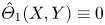 ${\hat{\varTheta }_1}(X,Y) \equiv 0$; we also have ${\hat{U}_1} = {\hat{V}_1} = {\hat{P}_1} \equiv 0$. At $O({\alpha ^{ - 2}})$ we find that
 \begin{align}2Y\,Re{\hat{\varTheta }_{0X}} = P{r^{ - 1}}({\hat{\varTheta }_{2XX}} + {\hat{\varTheta }_{2YY}})\quad \Rightarrow \quad {\hat{\varTheta }_2}(X,Y) = {\textstyle{1 \over 4}}PrReR{a_{p,R}}Y(Y + 1)exp ( - Y)\sin X,\end{align}
while the O(1) terms in the two momentum and continuity equations give
 \begin{equation}0 ={-} {\hat{P}_{0X}} + {\hat{U}_{0XX}} + {\hat{U}_{0YY}} + P{r^{ - 1}}{\hat{\varTheta }_0}\sin \beta ,\quad 0 ={-} {\hat{P}_{0Y}} + {\hat{V}_{0XX}} + {\hat{V}_{0YY}} + {\Pr ^{ - 1}}{\hat{\varTheta }_0}\cos \beta ,\quad {\hat{U}_{0X}} + {\hat{V}_{0Y}} = 0,\end{equation}
whose solution is
 \begin{gather}{\hat{U}_0} ={-} \frac{{R{a_{p,R}}\; }}{{16Pr}}Y(2 - Y)exp ( - Y)\sin (X - \beta ),\quad {\hat{V}_0} = \frac{{R{a_{p,R}}\; }}{{16Pr}}{Y^2}exp ( - Y)\cos (X - \beta ),\end{gather}
 \begin{gather}{\hat{P}_0} = \frac{{R{a_{p,R}}\; }}{{8Pr}}[(2Y + 3)\cos X\cos \beta + (2Y + 1)\sin X\sin \beta ].\end{gather}
We next move back to the energy equation at  $O({\alpha ^{ - 3}})$. We have
 \begin{equation}{\hat{U}_0}\; {\hat{\varTheta }_{0X}} + {\hat{V}_0}{\hat{\varTheta }_{0Y}} - Re\; {Y^2}{\hat{\varTheta }_{0X}} = \frac{1}{{Pr}}({\hat{\varTheta }_{3XX}} + {\hat{\varTheta }_{3YY}}),\end{equation}
which, on substituting the leading-order results, becomes
 \begin{align}{\hat{\varTheta }_{3XX}}
+ {\hat{\varTheta }_{3YY}} &= {\textstyle{1 \over
{32}}}Ra_{p,R}^2Y[(1 - Y)\cos \beta - \textrm{cos}(2X -
\beta )]\textrm{exp}({ - 2Y} )\nonumber\\&\quad + {\textstyle{1 \over
2}}PrReR{a_{p,R}}{Y^2}\textrm{exp}( - Y)\sin
X.\end{align}
\begin{align}{\hat{\varTheta }_{3XX}}
+ {\hat{\varTheta }_{3YY}} &= {\textstyle{1 \over
{32}}}Ra_{p,R}^2Y[(1 - Y)\cos \beta - \textrm{cos}(2X -
\beta )]\textrm{exp}({ - 2Y} )\nonumber\\&\quad + {\textstyle{1 \over
2}}PrReR{a_{p,R}}{Y^2}\textrm{exp}( - Y)\sin
X.\end{align}This equation admits the solution
 \begin{align}\begin{aligned}
{{\hat{\varTheta }}_3}(X,Y) & ={-} {\textstyle{1 \over
{24}}}PrReR{a_{p,R}}Y(2{Y^2} + 3Y + 3)\; exp ( - Y)\sin X\\
& \quad + {\textstyle{1 \over {512}}}Ra_{p,R}^2Y(1 + 2Y)exp
( - 2Y)\cos (2X - \beta )\\ & \quad + {\textstyle{1 \over
{256}}}Ra_{p,R}^2[1 - (1 + 2Y + 2{Y^2})exp ( - 2Y)]\cos
\beta . \end{aligned}\end{align}
\begin{align}\begin{aligned}
{{\hat{\varTheta }}_3}(X,Y) & ={-} {\textstyle{1 \over
{24}}}PrReR{a_{p,R}}Y(2{Y^2} + 3Y + 3)\; exp ( - Y)\sin X\\
& \quad + {\textstyle{1 \over {512}}}Ra_{p,R}^2Y(1 + 2Y)exp
( - 2Y)\cos (2X - \beta )\\ & \quad + {\textstyle{1 \over
{256}}}Ra_{p,R}^2[1 - (1 + 2Y + 2{Y^2})exp ( - 2Y)]\cos
\beta . \end{aligned}\end{align}
The streamwise momentum equation at  $O({\alpha ^{ - 5}})$ gives
 \begin{equation}- {Y^2}Re{\hat{U}_{0X}} + {\hat{U}_0}{\hat{U}_{0X}} - 2YRe{\hat{V}_0} + {\hat{V}_0}{\hat{U}_{0Y}} ={-} {\hat{P}_{3X}} + {\hat{U}_{3XX}} + {\hat{U}_{3YY}} + \frac{{{{\hat{\varTheta }}_5}}}{{Pr}}\sin \beta .\end{equation}
Again, we are interested in the mean parts of this equation. If we suppose that  ${\hat{P}_{3M}} = AX$ then the mean part of ${\hat{U}_3}$, call it ${\hat{U}_{3M}}(y)$, satisfies
 \begin{equation}\cdots ={-} \boldsymbol{A} + \hat{\boldsymbol{U}}_{3\boldsymbol{M}}^{\boldsymbol{^{\prime\prime}}} + \frac{1}{{\boldsymbol{Pr}}}{\hat{\boldsymbol{\varTheta }}_{3\boldsymbol{M}}}\sin \boldsymbol{\beta }.\end{equation}
We do not need to solve this explicitly, for it is sufficient to note that for large Y we have
 \begin{equation}\hat{U}_{3M}^{^{\prime\prime}} \sim \left[ {A - \frac{{Ra_{p,R}^2\; \; \; }}{{512Pr}}\sin 2\beta } \right] \Rightarrow {\hat{U}_{3M}} \sim \left[ {A - \frac{{Ra_{p,R}^2\; \; \; }}{{512Pr}}\sin 2\beta } \right]\frac{1}{2}{Y^2}.\end{equation}
We point out that all the terms on the left-hand side of (6.12) decay exponentially for large Y, so they cannot contribute to the leading-order form of the mean flow solution at large values.
This step completes the analysis of the wall layer. We see that the  $O({\alpha ^{ - 3}})$ component of ${\theta _1}$ tends to a constant as $Y \to \infty $ (see (6.10)) while the $O({\alpha ^{ - 5}})$ component ${\hat{U}_{3M}}(y)$ grows quadratically. Then, across the bulk of the slot where $y = O(1)$, we have that
 \begin{equation}{u_1} = {\alpha ^{ - 3}}\tilde{U}(y) + \cdots ,\quad {\theta _1} = {\alpha ^{ - 3}}\tilde{\varTheta }(y) + \cdots ,\quad {p_1} = {\alpha ^{ - 3}}Ax + \cdots ,\end{equation}
and these satisfy
 \begin{equation}0 ={-} A + \frac{{{\textrm{d}^2}\tilde{U}}}{{\textrm{d}{y^2}}} + \frac{1}{{Pr}}\tilde{\varTheta }\sin \beta ,\quad \frac{{{\textrm{d}^2}\tilde{\varTheta }}}{{\textrm{d}{y^2}}} = 0.\end{equation}
The form of (6.10) shows that for matching, we require
 \begin{equation}\tilde{\varTheta } \to \frac{{Ra_{p,R}^2\; }}{{256}}\cos \beta \quad \textrm{as}\;y \to - 1.\end{equation}
An exactly parallel calculation at the left wall shows that we must also demand
 \begin{equation}\tilde{\varTheta } \to - \frac{{Ra_{p,L}^2\; }}{{256}}\cos \beta \quad \textrm{as}\;y \to 1.\end{equation}
Hence,
 \begin{equation}\tilde{\varTheta }(y) = {\textstyle{1 \over {512}}}[Ra_{p,R}^2 - Ra_{p,L}^2 - (Ra_{p,L}^2 + Ra_{p,R}^2)y]\cos \beta ,\end{equation}
so that
 \begin{equation}\frac{{{\textrm{d}^2}\tilde{U}}}{{\textrm{d}{y^2}}} = A - \frac{1}{{1024\; Pr}}[Ra_{p,R}^2 - Ra_{p,L}^2 - (Ra_{p,L}^2 + Ra_{p,R}^2)y]\sin 2\beta .\end{equation}
There is no need to solve this completely – if we integrate twice and impose that  $\tilde{U}({\pm} 1)\,{=}\,0$, this requires that the constant term in the above equation disappears. Hence,
 \begin{equation}A = \frac{1}{{1024\; Pr}}(Ra_{p,R}^2 - Ra_{p,L}^2)\sin 2\beta .\end{equation}
In conclusion, we see that to maintain a constant mass flux through the channel, we need to impose a pressure-gradient correction  $B = {\alpha ^{ - 3}}A$, where A is given by (6.20). This correction does not depend on $Re$ at the leading order of approximation. If only the right wall is heated, a reduction of pressure losses can be achieved only for $\beta \in (0,{\rm \pi}/2)$ or for $\beta \in ({\rm \pi},3{\rm \pi}/2)$. The reader may note that the solution changes in the limits of $\beta \to 0$ (a horizontal channel) and $\beta \to {\rm \pi}/2$ (a vertical channel). Repeating the analysis for a horizontal channel shows that in this case $A = O({\alpha ^{ - 7}})$ (Floryan & Floryan Reference Floryan and Floryan2015) while for a vertical channel $A = O({\alpha ^{ - 5}})\; $ (Floryan et al. Reference Floryan, Wang and Bassom2023d).
To deduce the Nusselt number, we start by looking at the solution (6.12). It would be expected that the leading-order Nusselt number would be
 \begin{equation}{\alpha ^{ - 2}}{\left. {\frac{{\textrm{d}{{\hat{\varTheta }}_{3M}}}}{{\textrm{d}Y}}} \right|_{Y = 0}},\end{equation}
but it can easily be verified that this quantity actually vanishes. The next-order problem is given by
 \begin{equation}\frac{1}{{Pr}}({\hat{\varTheta }_{4XX}} + {\hat{\varTheta }_{4YY}}) = 2Y\,Re{\hat{\varTheta }_{2X}},\end{equation}
and we can determine the mean part of the solution. If this mean component is denoted as  ${\hat{\boldsymbol{\varTheta }}_{4\boldsymbol{M}}}(\boldsymbol{Y})$ then
 \begin{equation}{\hat{\varTheta }_{4M}} ={-} {\textstyle{1 \over {512}}}Y(Ra_{p,L}^2 + Ra_{p,R}^2)\cos \beta \end{equation}
by matching directly with the core-layer solution. Hence, the Nusselt number becomes
 \begin{equation}{\alpha ^{ - 3}}{\left. {\frac{{\textrm{d}{{\hat{\varTheta }}_{4M}}}}{{\textrm{d}Y}}} \right|_{Y = 0}} ={-} {\alpha ^{ - 3}}\left\{ {\frac{1}{{512}}(Ra_{p,L}^2 + Ra_{p,R}^2)\cos \beta \; } \right\}.\end{equation}
The above discussion shows that to maintain a constant mass flux through the channel exposed to the heating, we need to impose a pressure-gradient correction  $B = {\alpha ^{ - 3}}A$, where A is given by (6.20). The resulting heat flow between the walls is given by (6.24). In figure 14, we compare our asymptotic predictions with some numerical simulations; excellent agreement is observed between the two cases for $\alpha > 10$.
The form of the pressure-gradient correction B (black lines) and the average Nusselt number  $N{u_{av}}$ (red lines). Solid lines denote numerically determined values, while the dotted lines indicate the analytical values as given by (6.20) and (6.24). Calculations performed with parameter values $Re = 1$, $R{a_{p,R}} = 400$ and $R{a_{p,L}} = 0$. The dashed-dotted lines denote the differences $\mathrm{\Delta }B$ and $\mathrm{\Delta }Nu$ between the numerical and analytical predictions.

7. Discussion
An investigation has been conducted into the changes in pressure losses within an inclined channel induced by applying patterned heating to one or both boundaries. A combination of asymptotic analysis and spectrally accurate numerical tools has enabled us to probe the details of the flow and thermal structures that arise. As may have been anticipated, patterned heating leads to intricate flow and temperature field topologies, and a central pillar of these structures involves the formation of separation bubbles. These bubbles mitigate the direct contact between the stream and the side walls, thereby reducing friction experienced by the stream. Fluid rotation inside the bubbles, driven by longitudinal temperature gradients, also reduces resistance. On the other hand, the flow blockage associated with the bubbles tends to increase the flow resistance. The slightly subtle interplay of these three effects determines whether overall there is a net increase or decrease in the resistance. We have already noted that at a sufficiently large flow Reynolds number, the separation bubbles are completely washed away; the upshot is that a relatively simple temperature field remains while the drag-reducing effect has been removed.
A complex temperature field leads to the formation of a rather intricate buoyancy field. We have seen that the longitudinal component of the mean buoyancy force plays the dominant role in the flow response. Since this vanishes when the channel is horizontal, it is unsurprising that the effect of patterned heating on inclined channels is rather more than a simple modification of the previously known horizontal results. The form of the pressure loss is a function of the channel orientation and the heating wavenumber. When only one wall is heated, the reduction in the pressure gradient can be so significant that an opposite-signed gradient must be applied to prevent flow acceleration. With all other parameters held fixed, the pressure loss seemed to be small in channels oriented not too far from horizontal and increased in channels oriented closer to vertical. For fixed heating intensities, the largest pressure correction occurs at some O(1) heating wavenumber; moreover, it reduces proportional to  ${\alpha ^2}$ as $\alpha \to 0$ and to ${\alpha ^{ - 3}}$ when $\alpha \to \infty $. For relatively weak heating intensity, the size of the pressure-gradient correction is proportional to the square of the Rayleigh number, but much stronger heating leads to a saturation effect.
We reiterate that all our computations were conducted with Pr = 0.71. We claimed that the main findings are independent of the choice of Pr, and this is at least partially borne out by the asymptotic results (5.13) and (6.20) relating to the long- and short-wavelength modes. It is clear that changes in Pr would change quantitative details but have no major effect on the overall flow structure. It would only be in the cases of exceptionally large or small Prandtl numbers that more significant changes are likely to be seen.
We have also investigated the pressure reductions achieved by heating both walls. In particular, we have focused on the role played by the phase difference when the two walls are heated with the same intensities. Very significant pressure reductions can be achieved if the heating patterns are positioned optimally. Of course, our findings could be extended to account for the situation when the two walls experience different degrees of heating. A series of simulations suggest that, in this case, the various structures are reminiscent of the results described above. If one surface is heated appreciably more strongly than the other, the results seem to be qualitatively similar to the one-wall heating case described in § 3.
It is important to emphasize that we do not necessarily claim a net reduction in energy consumption. Our assertions are rather more modest; although we have shown conclusively that heating reduces pressure losses, it is not straightforward to make definitive statements regarding the implications for the overall energy budget. The cost of generating temperature patterns required to reduce flow losses is very problem-specific but is independent of the fluid mechanics. There are literally hundreds of possible ways to generate the required wall temperature distribution so it is difficult to determine the energy cost without knowing the details of wall construction. The energy losses are associated with heat transfer across the channel and conduction along the wall. This second process is likely to prove critical as it takes energy to maintain longitudinal temperature gradients along the wall. To complicate matters, waste heat is often available, so a discussion of the energy cost of flow actuation becomes somewhat moot as waste energy costs almost nothing. Clearly, there is much scope in assessing the practical implications of our suggested mechanism.
There is a limit to the available pressure gradient required to produce the desired flow rate. This limit could be dictated by technological limitations in producing such pressure differences (e.g. pump limitations) or by structural limitations, as an excessive pressure difference between channel interior and exterior may lead to structural deformations. In these cases, one may want to look at a distributed pumping mechanism, which can be created using heating patterns. In such situations, the energy cost is irrelevant, and obtaining a proper flow rate is key. A combination of heating with the existing propulsion methods can provide performance that is not otherwise available. In this context, the results summarized in Floryan (Reference Floryan2023) suggest mechanisms that lead to an expected net energy reduction.
We intend to continue exploring this problem, and should important new structures become evident, we shall report on them in due course. One also needs to verify the stability properties of the flow, as the appearance of any secondary flow would modify the predictions reported in this paper. Computations for the formation of secondary flows in horizontal channels suggest that it does not occur until the Rayleigh number exceeds 2500, a value somewhat larger than those examined in the current work. Furthermore, simple physical arguments suggest that the critical Rayleigh number required to form secondary flows should increase with the inclination angle.
Acknowledgements
We are extremely grateful to the anonymous referees whose numerous comments have led to a significantly improved paper. The authors would like to thank Mr S.A. Aman for carrying out part of the required computations.
Funding
This work has been carried out with support from NSERC of Canada.
Declaration of interests
The authors report no conflict of interest.


 Open access

