


Economic and social changes in recent years have strongly oriented food consumption habits and patterns towards convenience(Reference Buckley, Cowan and McCarthy1,Reference Stafford and Wills2) . These changes have resulted in an increased consumption of processed foods (canned vegetables, ready-to-eat foods, etc.) at the expense of fresh products prepared at home (fresh fruit and vegetables, potatoes, meat, fish, eggs, etc.)(Reference Caillavet, Darmon and Létoile3). In particular, home-prepared dishes are increasingly replaced by industrially processed dishes needing only minimal preparation before consumption. In France, such industrial dishes have increased significantly in food-at-home purchases over the last 40 years (from 0·6 to 56·6 g/10 MJ of purchase between 1973 and 2010)(Reference Caillavet, Darmon and Létoile3), while time spent cooking at home has decreased since 1985 with a large increase in the number of days where households do not cook at all(Reference Etilé and Plessz4). However, cooking remains strongly gendered, with women being much more likely than men to be engaged in everyday home food preparation. According to Etilé and Plessz, a French woman living in couple in 2010 was spending on average 56 min/d preparing meals, that is, 77 % of the time spent cooking by French couples(Reference Etilé and Plessz4). Meanwhile, home meal preparation is increasingly advocated by nutritionists and public health professionals as a way to improve health(Reference Flego, Herbert and Waters5). Poorer cooking skills have been associated with more ready-meal consumption, poorer dietary quality and overweight(Reference Hartmann, Dohle and Siegrist6–Reference Wolfson and Bleich10). Programmes designed to improve cooking skills have long targeted low-income groups(Reference Reicks, Trofholz and Stang11), since diet quality declines with socioeconomic status(Reference Darmon and Drewnowski12). However, contrary to popular belief, disadvantaged households mostly prepare their food at home, though may lack motivation and time for cooking from scratch(Reference Mclaughlin, Tarasuk and Kreiger9,Reference Adams, Goffe and Adamson13,Reference Méjean, Hassen and Gojard14) . They face economic, time and practical constraints (transportation, food storage and food preparation) that may increase reliance on cheap convenience food products(Reference Davis and You15,Reference Grant and Maxwell16) . In the French population, food-insecure individuals were found to have not only an inadequate intake of fruit, vegetables and fish but also a high intake of refined grains and sweet foods(Reference Bocquier, Vieux and Lioret17). The latter are a cheaper source of energy content, require less food preparation and are less perishable than fresh foods, and so, less likely to be wasted(Reference Darmon and Drewnowski18). However, little is known about the consumption of industrially processed dishes since national dietary surveys do not differentiate between industrially processed and home-prepared dishes. It is acknowledged that convenience and time-saving are the key motivations behind industrial-ready meal consumption, but conclusions on cost-saving motivation are conflicting(Reference Ahlgren, Gustafsson and Hall19–Reference Reed, McIlveen-Farley and Strugnell22). In France, the idea that cooking at home is a way of saving money is spread by several stakeholders such as dieticians, social workers or others. For instance, a marketing campaign is currently promoting the home preparation of fresh fruit and vegetables for budgetary reasons(23). The current study set out to assess whether buying industrially processed dishes rather than preparing similar dishes at home is cost-effective for consumers considering the purchase cost and additional costs of meal preparation, namely energy used by cooking appliances and time spent.
Methods
Selection of dishes
Dishes the most commonly consumed by the French population were identified based on the data from the French Individual and National Dietary Survey 2006–2007 (INCA2), in which a nationally representative sample of the French population reported all foods consumed over a 1-week period(Reference Lafay24). Nineteen dishes easily available from food retailers in industrially processed format were selected for the current study. Table 1 lists the nineteen selected dishes with the corresponding percentage of reported consumption from INCA2.
Nineteen selected dishes commonly consumed and percentages of adults consuming them based on the French INCA2 survey

Purchase cost
A flow diagram of the methodology used in the study is presented in Fig. 1.
Flow diagram of methodology used in the study

The cost of industrially processed dishes and the cost of ingredients used to prepare similar dishes at home were obtained from the websites of major food retailers located near the city of Montpellier (only one location to limit geographical price variations) during December 2016 (only one period to limit food price changes over time). Of the seven food retailers identified (Carrefour, Auchan, Leclerc, Leader Price, Dia, Super U and Lidl), three did not provide the required information on their websites, limiting the study to Carrefour, Auchan, Leader Price and Super U. Given the wide range of prices between low-cost foods and their brand-name equivalents(Reference Cooper and Nelson25,Reference Darmon, Caillavet and Joly26) , only retailers’ own-brand foods were selected when available; otherwise, the cheapest alternative was chosen. Screenshots of retailers’ websites were taken to keep records of food product information (packaging, description, nutritional values, price displayed). All values were expressed for four portions (4p).
Industrially processed dishes
Prices of industrially processed dishes were collected in € per unit sold and €/100 g. When industrially processed dishes were not available in packages of four portions, it was considered that consumers would buy several smaller packages to make four portions. Information on portions was obtained from package labels. When an industrially processed dish was not sold by a food retailer, a price was imputed corresponding to the mean price of the same product offered by other food retailers.
Home-prepared dishes
The INCA2 recipe table, providing the ingredient contents for 100 g of food as consumed (e.g. already peeled or cooked), was used to estimate the ingredient content of the nineteen dishes. Ingredients present in proportions <0·1 % were ignored. For each item, the cost was first calculated for 100 g as consumed by multiplying the cost of each ingredient recorded on the food retailers’ website (in €/100 g as purchased) with its proportion in the recipe. When several package sizes were available for the same ingredient, the cost of the smallest one sufficient for the recipe was selected, assuming that leftover ingredients were not wasted but kept for subsequent use. Since the ingredient content listed in the INCA2 recipe table is provided ‘as consumed’ (e.g. already peeled or cooked) while food retailers’ websites display the prices of foods as purchased, a correction coefficient was used to convert the quantity of ingredient as purchased to the quantity of ingredient as consumed (e.g. the quantity of cooked pasta is equivalent to 3 times the corresponding quantity of raw pasta). The cost of the dish was then calculated as follows:
 $${\rm{Cost}}\,{\rm{of}}\,{\rm{home{\hbox {-}}prepared{\hbox {-}}dish}}\;\left( {{\rm{in}}\,{\rm{€ }}/100\,{\rm{g}}\,{\rm{as}}\,{\rm{consumed}}} \right) = \mathop \sum \limits_{i = 1}^n Cos{t_i} \times {Q_i} \times coe{f_i}$$
where Cost i is the cost of each ingredient used in the recipe (in €/100 g as purchased), Qi is the proportion of that ingredient used in 100 g of recipe, and coef i is the correction coefficient used to convert the quantity of that ingredient as purchased to the quantity as consumed.
The dish cost was then converted into €/4p, portions being estimated by the average portion size of the corresponding industrially processed dish from the four retailers.
Energy cost
Cooking instructions (cooking methods and time) were used to compute the energy used in preparing the dish. For the industrially processed dishes, cooking instructions were taken directly from the package. For the home-prepared dishes, cooking instructions were taken from the most active online food community (marmiton.org), considering the recipe closest to that of INCA2. When several cooking methods were suggested (e.g. oven, microwave, hotplate), they were all considered in the calculation and a mean energy value was used. For the hotplate, three types were considered (induction, ceramic, gas), and again a mean value was used. The power consumption (kWh) of each cooking appliance was inferred from the most efficient power appliance available from a French retail company specialised in home appliances and consumer electronics.
The cost of energy used to prepare the dish at home was finally computed by multiplying the power consumption of each cooking appliance used in the recipe by the corresponding cooking time and energy cost in France in 2017(27).
Time cost
In economic approaches, two methods are often used to assign a value to time spent on household production: the opportunity cost estimate and the market cost estimate. The opportunity cost estimate is generally valued as the wage rate(Reference Palmer and Raftery28). The market cost estimate consists in assigning a monetary value to labour inputs directly(Reference Chadeau29). We chose the latter method to value the cost of time. This market value of time was computed based on the time needed to prepare the dish hands-on (i.e. cooking time excluded) recorded on the online food community marmiton.org. We assessed the market cost of the time spent in home productive activity as equal to the guaranteed minimum wage in France (SMIC), that is to say the salary paid to an unskilled cook. The gross rather than net SMIC was chosen, because we wanted to assign a value to the dish produced, and so the cost of time could not be considered net of taxes(Reference Chadeau29). Time spent doing grocery shopping, unpacking and storing food products was not taken into account because these activities concern both industrially processed and home-prepared meals.
Energy density of dishes
Energy-dense foods(Reference Drewnowski, Maillot and Darmon30,Reference Darmon, Darmon and Maillot31) and energy-dense diets(Reference Ledikwe, Blanck and Khan32,Reference Drewnowski, Monsivais and Maillot33) tend to be nutrient-poor. In addition, energy-dense diets induce overeating and weight gain(Reference Rolls34). We, therefore, used energy density (kcal/100 g) as an indicator of poor nutritional quality. The energy density of industrially processed dishes was obtained from package labels, and the energy density of home-prepared counterparts was estimated based on the recipes.
Statistical analyses
Differences in cost and energy density were assessed according to ‘preparation type’ (i.e. industrially processed or home-prepared) using two-way ANOVA. ‘Dish type’ (i.e. vegetable soup, couscous tabbouleh, etc.) and food retailer were used as a first set of adjustment variables. Regarding the cost of dishes, a first analysis tested differences in purchase costs. Additional costs of energy used and cost of time spent for preparing dish at home were then successively included to test differences in overall cost. All dependent variables were logarithmically transformed to improve normality. In case of a significant interaction between ‘dish type’ and ‘preparation type’ for the overall sample, simple effects tests were conducted to examine the effect of ‘preparation type’ for each dish, separately(Reference Winer35).
All analyses were performed with the SAS statistical software package (version 9.4) for Windows (SAS Institute); P < 0·05 was considered statistically significant. The research did not involve humans; therefore, no institutional review board approval was necessary.
Results
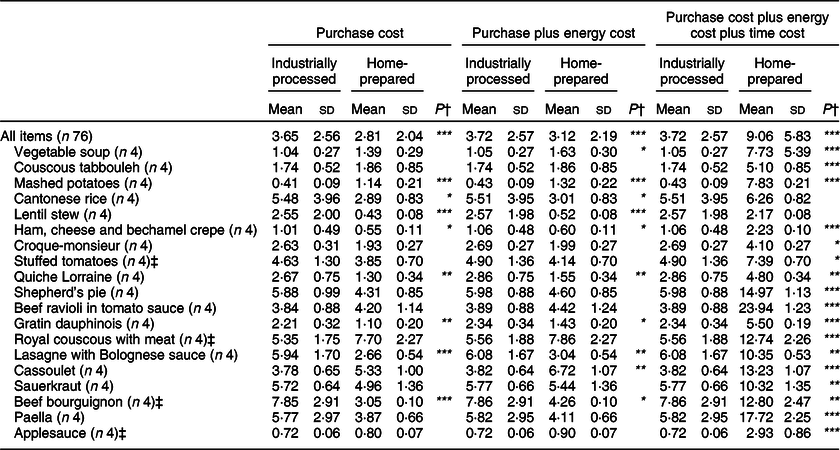
A total of seventy-six prices were obtained for industrially processed dishes (i.e. nineteen different dishes distributed by four retailers). In most cases (i.e. 86 %), the price collected was that of the retailer’s own-brand product. However, when a retailer’s own brand was not available for a given dish, we used either the price of the in-store cheapest alternative (8 % of cases) or (when the dish was not available at all on the retailer’s website) the mean price of the same dish from other food retailers (6 % of cases). For the ingredients, 344 prices were collected. All the ingredients needed to prepare the dishes at home were available on each food retailer’s website, although the retailer’s brand was not available for 12 % of them. Means and standard deviations of costs of the nineteen dishes according to ‘preparation type’ (industrially processed or home-prepared) are given in Table 2.
Mean and sd costs (in € per four portions) of nineteen prepared dishes commonly consumed in France, by ‘preparation type’ (industrially processed or home-prepared) and successive inclusion of purchase cost, energy cost and time cost
† The cost variables were logarithmically transformed to improve normality. The effect of preparation was assessed for all dishes using two-way ANOVA, and for each dish using simple effects test.
‡ The dish was not available on one retailer’s website and the corresponding price was imputed as the mean price of the same dish from other food retailers.
*P < 0·05, **P < 0·01, ***P < 0·001.
Considering only the purchase cost, industrially processed dishes were on average 0·84 €/4p more expensive than their home-prepared counterparts (3·65 (sd 2·56) v. 2·81 (sd 2·04) €/4p, respectively, P < 0.001). A significant interaction was found between ‘dish type’ and ‘preparation type’ (P < 0·001). Simple effects analyses showed that only eight of the nineteen dishes were significantly cheaper when prepared at home.
Warming up industrially processed dishes incurred a lower energy cost than cooking home-prepared dishes (mean additional cost of 0·07 € (sd 0·08) v. 0·32 € (sd 0·36), respectively). When adding the energy cost to the purchase cost, industrially processed dishes still cost on average 0·60 €/4p more than their home-prepared counterparts (3·72 (sd 2·57) v. 3·12 (sd 2·19) €/4p, respectively, P < 0.001).
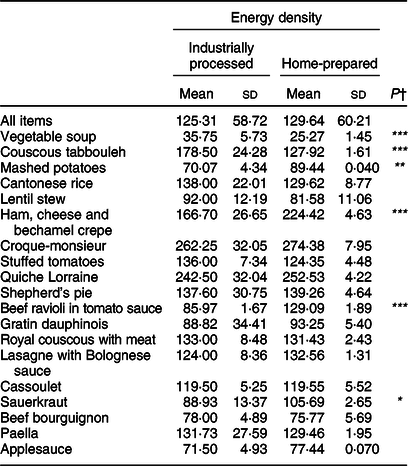
When the value of time spent preparing the dish at home was further added to the other costs, industrially processed dishes were on average 5·34 €/4p cheaper than their home-prepared counterparts (3·72 (sd 2·57) v. 9·06 (sd 5·83) €/4p, respectively, P < 0.001). Compared with the other costs, the cost of time was high and highly variable (mean 5·93 €; range 1·63 € (for lentil stew) to 19·5 € (for beef ravioli); data not shown). Simple effects analyses revealed that dishes had a significantly higher time-included cost when they were prepared at home, except for Cantonese rice and lentil stew. These last two are relatively fast and easy to prepare at home, and the associated time cost was too low to offset the relatively high purchase cost of the industrial format. Energy density of the nineteen dishes according to ‘preparation type’ is given in Table 3. Energy density was similar between industrially processed and home-prepared dishes (P = 0·103). However, a significant interaction between ‘dish type’ and ‘preparation type’ (P < 0·001) was found, meaning that the energy density differential varied widely depending on the type of dish. Simple effects analyses showed that four of the nineteen dishes had a lower energy density in their industrially processed format, while 2had a lower energy density in their home-prepared format.
Mean and sd energy density (kcal/100 g) of nineteen dishes commonly consumed in France, by preparation: industrially processed or home-prepared
† The energy density variable was logarithmically transformed to improve normality. The effect of preparation was assessed for all dishes using two-way ANOVA, and for each dish using simple effects test.
*P < 0·05, **P < 0·01, ***P < 0·001.
Discussion
To our knowledge, the current study is the first to compare the cost to consumers of buying industrially processed dishes v. preparing similar dishes at home in a European setting. Based on the data for nineteen dishes commonly consumed in France, results showed that, on average, buying ingredients to prepare these dishes at home costs less than buying industrially processed alternatives in supermarkets (Δ = –0·84 €/4p). When the cost of energy needed to warm up industrially processed dishes or to prepare and cook the dishes at home was included, home-prepared dishes remained slightly cheaper (Δ = –0·60 €/4p). However, inclusion of the value of time spent in the computation reversed this trend, making home-prepared dishes substantially more expensive than industrially processed ones (Δ = +5·34 €/4p).
Eating at home rather than out of home (especially in fast food restaurants) can help comply with dietary guidelines at no additional cost(Reference Tiwari, Aggarwal and Tang36). But, when eating at home, little is known about the cost of consuming industrially processed dishes compared with homemade dishes. Only two studies, in New Zealand and USA, have analysed cost differences across meals or dishes of varying convenience(Reference Mackay, Vandevijvere and Xie37,Reference Yang, Davis and Muth38) . The study in New Zealand found that it is less expensive to cook from scratch than buying takeaways, due to the inclusion of the cost of time spent waiting in fast-food outlets in the cost of takeaways(Reference Mackay, Vandevijvere and Xie37). However, in our study, industrially processed dishes and basic ingredients both came from supermarkets, and therefore the waiting time was considered equal and not included in the calculation. In the US study, the total cost of meals (i.e. including the cost of time) was always higher when cooking from scratch than when using more processed ingredients, even if the processed foods cost more than the basic ingredients(Reference Yang, Davis and Muth38), which is fully in line with our results.
The industrially processed dishes included in the current study are widely sold on the French market. Since food retailers can offer low selling prices through economies of scale (bulk purchase of raw materials, optimisation of processing, etc.), industrially processed dishes might have been expected to cost less than their home-prepared counterparts. However, the price of industrially processed dishes integrates many costs, including processing and retailing costs, possibly explaining that the time-exclusive cost of industrially processed dishes was slightly higher than that of home-prepared dishes. When the time cost was included, industrially processed dishes were much less costly than the counterpart, home-prepared ones. Even though we estimated the value of time based on a minimum wage, the time cost was still substantial compared with other costs, showing the importance of the time component when assessing overall costs. In the current study, the value of time was calculated based on hands-on preparation time rather than the full preparation time (hands-on + cooking time), because it was assumed that the meal preparer could engage in other activities during cooking time(Reference Mackay, Vandevijvere and Xie37,Reference Yang, Davis and Muth38) . Since cooking time was not included for home-prepared dishes, time cost was not retained either for industrially processed dishes as they needed only warming up.
Literature reviews conclude that the impact on long-term dietary behaviour or health outcomes of cooking at home is not clear, although most cross-sectional studies have found a positive relationship between cooking and dietary quality(Reference Reicks, Trofholz and Stang11,Reference Mills, White and Brown39) . Indeed, the positive association between the consumption of food prepared at home and dietary quality is generally weak(Reference Clifford Astbury, Penney and Adams40), and a healthy diet can be achieved with low amounts of food prepared at home(Reference Clifford Astbury, Penney and Adams41). In France, Méjean et al. found that a score for preparation from scratch was prospectively associated with a decreased risk of obesity over 5-year follow-up (in women only), but this relation was entirely explained by confounding factors, especially a higher intake of fruit and vegetables in women with a high score for preparation from scratch(Reference Méjean, Lampuré and Si Hassen42). In prospective cohort studies of health professionals in the USA, a lower risk of developing diabetes was found for individuals who eat meals prepared at home more frequently than those with frequent consumption of meals prepared out of home, especially fast-foods(Reference Zong, Eisenberg and Hu43). In contrast, in another US cohort of multi-ethnic/racial, middle-aged women across 14 years of follow-up, women who spent more time preparing and cleaning up meals had a greater likelihood over time of developing a metabolic syndrome(Reference Appelhans, Segawa and Janssen44). It is noticeable that this last study cannot be generalised due to the specificity of the studied population. However, the authors hypothesised that, in this population, home preparation methods could lead to unhealthy meals consumed in high portions while relatively healthy, convenient products in standard portions are increasingly available, and they concluded that ‘public health interventions should place greater emphasis on cooking healthfully, not just cooking frequently’.
It is true that when preparing food at home, individuals have the possibility to control the quality and quantity of ingredients used in the recipe and, therefore, the nutritional quality of the meal(Reference Lofthouse, Te Morenga and McLean45). However, home cooking is no guarantee of good nutritional quality and healthiness(Reference Chu, Addo and Perry46). Howard et al. found that meals proposed by TV chefs were less healthy than ready meals sold by supermarkets, and contained significantly more energy, protein, fat and saturated fat, and less fibre per portion than the ready meals, while no difference was found for sugar and salt(Reference Howard, Adams and White47). Similarly, we found no difference in energy density between industrially processed dishes and their home-prepared counterparts.
Many factors influence the decision of cooking at home and the way it is done(Reference Short48). Cooking can be perceived as a chore more than a valued occupation, but the use of ready meals can also generate negative feelings such as guilt and regret for not making a ‘proper meal’ for oneself or one’s family, especially among women who remain central figures in meal preparation(Reference Etilé and Plessz4,Reference Carrigan, Szmigin and Leek49,Reference Olsen, Sijtsema and Hall50) . In the current study, the time spent for home preparation of a four-portion dish was 36·5 min on average (data not shown), which corresponds approximately to half the time spent cooking per day and per couple in France in 2010(Reference Etilé and Plessz4). Some people cannot afford spending that time, especially single women with children and people with staggered schedules or with long commuting times(Reference Mills, White and Brown39). The preparation of meals at home has evolved considerably in recent years from cooking from scratch to more practical cooking using processed ingredients(Reference Lang and Caraher51). Hence, pre-assembled meals may offer an interesting alternative to cooking from scratch, combining the advantage of controlling the proportions of industrial ingredients (as it allows including fresh products in meal preparation) and of spending less time in the kitchen(Reference Lang and Caraher51).
The current study has limitations. Firstly, dishes included in the analysis were selected as representative of dishes commonly consumed by the French population, and so do not necessarily reflect those commonly prepared at home (e.g. beef ravioli are widely consumed in France in their industrial format, but are rarely prepared at home).
Secondly, the prices of products (industrially processed dishes and ingredients) are influenced by several variables, such as location and number of portions purchased. The choice of another location would have only slightly changed the purchase costs, because the main difference in consumption prices in France is primarily driven by the prices of rents and services, not goods, and is between Paris and the rest of the country(Reference Fesseau, Passeron and Vérone52). Regarding the number of portions, redoing the calculations, for example, two persons instead of four, would have increased the price per kilogram of both industrially processed dishes and of the ingredients to prepare them at home, but would not have changed energy cost and time cost, and thus, the general conclusion that industrially processed dishes present economic advantage when the cost of time is included would not have been affected.
Thirdly, it was considered that home-prepared dishes are made from scratch (e.g. the quiche Lorraine dough was made instead of being purchased at a store). Using pre-prepared items (e.g. industrial dough) might have yielded different results for the cost difference between industrially processed dishes and their home-prepared counterparts. Fourthly, some food items were not available on the retailers’ websites, although only food retailers providing a wide range of own-brand products were selected, resulting in some missing data. Fifthly, methodological choices made when estimating the different costs may have led to some approximation. Regarding the energy cost, the most efficient appliances available on the French market were used as the reference of power consumption. This choice might have underestimated the cost of energy consumption for preparing meals, but did not affect the findings, namely that warming up industrially processed dishes requires less energy than cooking their home-prepared counterparts. Regarding the time cost, the preparation time given on marmiton.org may not be an accurate indication for all individuals depending on their culinary skills. Also, by using the minimum wage (SMIC), the current study might have underestimated the cost of meal production at home. This conservative approach can be criticised, but there is no consensus on the most appropriate wage to use(Reference Goldschmidt-Clermont53). These methodological choices can only provide lower-bound estimates of the true costs. In addition, estimating the cost of time at market cost and not at the opportunity cost would impose the assumption of the same time cost for all. The opportunity cost would be higher for an executive and lower for an unemployed person or a person with a part-time job.
Lastly, the nutritional value of dishes was assessed using only the energy density owing to an uncertainty regarding the nutritional content of each dish. In particular, information on the content of added sugars of industrially processed dishes is not available on the nutrition label. Regarding salt, the information exists for industrially processed dishes, but it is not reliable for home-prepared dishes. In addition, we did not take into account one important difference between home-prepared meals and industrially processed dishes, which is the presence of additives, preservatives and other substances (e.g. hydrogenated oils) suspected of harming health when consumed in excess in industrially processed products(Reference Fiolet, Srour and Sellem54,Reference Srour, Fezeu and Kesse-Guyot55) . The presence of substances not commonly used in homemade preparations is one important characteristic of the definition of ‘ultra-processed’ foods(Reference Monteiro, Cannon and Lawrence56). Another characteristic of ‘ultra-processed’ products is their high energy density, recognised as the main factor explaining how the overconsumption of ‘ultra-processed’ diets actually promotes weight gain(Reference Hall, Ayuketah and Brychta57). Nevertheless, the presently studied industrially processed dishes did not share this second characteristic of ‘ultra-processed’ foods, since they had similar energy density than their homemade counterparts. When consumed appropriately, processed foods, especially when nutrient-dense, have been found to contribute to both food and nutrition security(Reference Weaver, Dwyer and Fulgoni58).
Conclusion
The current study shows that dishes commonly consumed in France are significantly but slightly cheaper when prepared at home than when purchased ready-prepared, considering the direct in-store price of the dish with or without adding the cost of the energy used to prepare it at home. Adding the time cost in home cooking implies that industrially processed dishes are of better value to the consumer. Considering the benefits of convenience foods against the high demands of everyday life, the indirect cost of food such as the value of time spent must not be ignored, especially for low-income families whose constraints of time, resources and equipment may dissuade them from buying and preparing fresh and perishable foods.
Cooking at home could have positive effects on health, for example, by encouraging the use of fresh vegetables and by facilitating better control over the use of salt and added fats. However, time and cost constraints may prevent people from preparing their own meals. Thus, ensuring the availability of convenient, affordable and nutritious industrially processed dishes could help promote healthy eating while tackling gender and social inequalities.
Acknowledgements
Acknowledgements: No specific financial support was used for this research. The authors thank Oscar Gaudin (trainee engineer), Guillaume Bruneau (dietician trainee) and Morgan Morel (dietician trainee) who participated in data acquisition and analysis. Financial support: This research received no specific grant from any funding agency, commercial or not-for-profit sectors. Conflict of interest: None. Authorship: N.D. and C.D. designed the research; M.T. analysed the data and wrote the first draft of the manuscript; all the authors interpreted the results, helped write the manuscript and made critical comments; N.D. had primary responsibility for the final content. All the authors read and approved the final manuscript. Ethics of human subject participation: The research did not involve humans; therefore, no institutional review board approval was necessary.



