Book contents
- Frontmatter
- Contents
- List of illustrations
- List of contributors
- Preface
- 1 Introduction
- 2 A single spark
- 3 Quotation songs
- 4 Mao quotations in factional battles and their afterlives
- 5 Translation and internationalism
- 6 Maoism in Tanzania
- 7 Empty symbol
- 8 The influence of Maoism in Peru
- 9 The book that bombed
- 10 Mao and the Albanians
- 11 Partisan legacies and anti-imperialist ambitions
- 12 Badge books and brand books
- 13 Principally contradiction
- 14 By the book
- 15 Conclusion
- Index
- References
4 - Mao quotations in factional battles and their afterlives
Episodes from Chongqing
Published online by Cambridge University Press: 05 June 2014
By
Edited by

Book contents
- Frontmatter
- Contents
- List of illustrations
- List of contributors
- Preface
- 1 Introduction
- 2 A single spark
- 3 Quotation songs
- 4 Mao quotations in factional battles and their afterlives
- 5 Translation and internationalism
- 6 Maoism in Tanzania
- 7 Empty symbol
- 8 The influence of Maoism in Peru
- 9 The book that bombed
- 10 Mao and the Albanians
- 11 Partisan legacies and anti-imperialist ambitions
- 12 Badge books and brand books
- 13 Principally contradiction
- 14 By the book
- 15 Conclusion
- Index
- References
Summary
Comrades throughout the Party must never forget this experience for which we have paid in blood.
War and PeaceThe rhetoric of revolution was a ubiquitous presence in the Chinese Cultural Revolution. Red Guard papers exploded with such rhetoric. Revolutionary slogans, posters, and plaques were the indispensable props of rallies, demonstrations, and mass meetings. They dotted public spaces. The Cultural Revolution would not have been what it was without its rhetoric. Yet few scholars have examined how this rhetoric may be integral to the revolutionary process. By examining the uses of the Quotations from Chairman Mao, or the Little Red Book, in the Red Guard press, this chapter shows that Mao quotations, and revolutionary rhetoric more generally, were not meaningless propaganda, but a constitutive part of the factional dynamics of the revolution. My analysis will focus on two episodes of factionalism in 1967 in the city of Chongqing, which witnessed some of the most violent battles in the Red Guard movement in the entire country. Armed with Mao quotations, Red Guards and rebels engaged in intense verbal and physical conflicts. The combatants would recite Mao quotations to give themselves strength and inspiration. The escalation of Red Guard factionalism to violence had much to do with the intensification of this rhetoric of revolutionary violence. It seemed as if Mao quotations had taken on an incantatory power. I will argue that they were the core of an entire script of the Chinese revolution. This script took on its power because by the eve of the Cultural Revolution, it had been sanctified. Like the word “revolution,” Mao quotations became holy symbols of the Chinese nation. In the end, Red Guards made a revolution by performing the sacred script of revolution.
Information
- Type
- Chapter
- Information
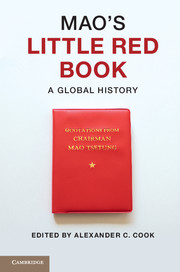
- Mao's Little Red BookA Global History, pp. 61 - 75Publisher: Cambridge University PressPrint publication year: 2014
References
, and , Revolutionary Discourse in Mao’s Republic (Cambridge, Mass.: Harvard University Press, 1998)Google Scholar
, “The Irresistible Rise and Fall of Mao,” in , ed., Shades of Mao: The Posthumous Cult of the Great Leader (Armonk: M. E. Sharpe, 1996), pp. 3–74Google Scholar
, “Decision Concerning the Great Proletarian Cultural Revolution,” Peking Review 33 (1966), pp. 6–11Google Scholar
, , and , “Students and Class Warfare: The Social Roots of the Red Guard Conflict in Guangzhou (Canton),” The China Quarterly 83 (1980), pp. 397–446CrossRefGoogle Scholar
, “Operatic Revolutions: Tradition, Memory, and Women in Model Theater,” in Acting the Right Part: Political Theater and Popular Drama in Contemporary China, 1966–1996 (Honolulu: University of Hawaii Press, 2002), pp. 73–122Google Scholar
, Zhongguo gaige kaifang shi [A history of China’s reform and opening up] (Beijing: Hongqi chubanshe, 1998)Google Scholar
, Fighting for Chairmao Mao [Wei Mao Zhuxi er zhan] (Hong Kong: Sanlian Shudian, 2010)Google Scholar
Hong wei bing zi liao: xu bian [Red Guard publications: supplement II], vol. IV (Okaton, Va.: Center for Chinese Research Materials, 1992)
, Mao’s New World: Political Culture in the Early People’s Republic (Ithaca: Cornell University Press, 2011)Google Scholar
, “That Holy Word, ‘Revolution’,” in Wasserstrom and Perry, eds., Popular Protest and Political Culture in Modern China, pp. 309–24
, The Origins of the Cultural Revolution (New York: Columbia University Press, 1997)CrossRefGoogle Scholar
, and , Mao’s Last Revolution (Cambridge, Mass.: Belknap Press of Harvard University Press, 2008)Google Scholar
, “Speech at the Anniversary of the People’s Paper,” in , ed., The Marx–Engels Reader, 2nd edn. (London: Norton, 1978 [1856]), pp. 577–78Google Scholar
, and , Proletarian Power: Shanghai in the Cultural Revolution (Boulder: Westview Press, 1997)Google Scholar
, “The Way our Generation Imagined the World,” Inter-Asia Cultural Studies 6.4 (2005), pp. 524–34CrossRefGoogle Scholar
, “‘Voices of the Mainstream': Red Songs and Revolutionary Identities in the People's Republic of China,” in and , eds., Vocal Music and Cultural Identity in Contemporary Music: Unlimited Voices in East Asia and the West (London: Routledge, 2013), pp. 225–47Google Scholar
, The Revolutionization of Chinese Youth: A Study of Chung-kuo Ch'ing-nien (Berkeley: University of California Center for Chinese Studies, 1967)Google Scholar
, Fractured Rebellion: The Beijing Red Guard Movement (Cambridge, Mass.: Harvard University Press, 2009)Google Scholar
, and , eds., Popular Protest and Political Culture in Modern China, 2nd edn. (Boulder: Westview Press, 1994)Google Scholar
“Why is Chongqing so Red?” Vista (Kan tianxia) 2 (2011), available at
, “Chongqing de ‘chang, du, jiang, chuan’ yu guojia wenhua ran shili” [Singing, reading, story-telling, and disseminating [red culture] in Chongqing and national soft power], Chongqing Social Sciences 5 (2011), pp. 93–94Google Scholar
, “That Holy Word, ‘Revolution’,” in and , eds., Popular Protest and Political Culture in Modern China, 2nd edn. (Boulder: Westview Press, 1996).Google Scholar
, “The Irresistible Rise and Fall of Mao,” in , ed., Shades of Mao: The Posthumous Cult of the Great Leader (Armonk: M. E. Sharpe, 1996), p. 7.Google Scholar
and , Mao’s Last Revolution (Cambridge, Mass.: Belknap Press of Harvard University Press, 2008).Google Scholar
, , and , “Students and Class Warfare: The Social Roots of the Red Guard Conflict in Guangzhou (Canton),” The China Quarterly 83 (1980).CrossRefGoogle Scholar
and , Proletarian Power: Shanghai in the Cultural Revolution (Boulder: Westview Press, 1997).Google Scholar
, Fractured Rebellion: The Beijing Red Guard Movement (Cambridge, Mass.: Harvard University Press, 2009).Google Scholar
and , eds., Popular Protest and Political Culture in Modern China, 2nd edn. (Boulder: Westview Press, 1994);Google Scholar
and , Revolutionary Discourse in Mao’s Republic (Cambridge, Mass.: Harvard University Press, 1998).Google Scholar
, Mao’s New World: Political Culture in the Early People’s Republic (Ithaca: Cornell University Press, 2011).Google Scholar
, Fighting for Chairmao Mao [Wei Mao Zhuxi er zhan] (Hong Kong: Sanlian Shudian, 2010), p. 197Google Scholar
, “The Way our Generation Imagined the World,” Inter-Asia Cultural Studies 6.4 (2005), p. 528.CrossRefGoogle Scholar
, The Origins of the Cultural Revolution (New York: Columbia University Press, 1997), p. 611.CrossRefGoogle Scholar
, The Revolutionization of Chinese Youth: A Study of Chung-kuo Ch'ing-nien (Berkeley: University of California Center for Chinese Studies, 1967).Google Scholar
, “Operatic Revolutions: Tradition, Memory, and Women in Model Theater,” in Acting the Right Part: Political Theater and Popular Drama in Contemporary China, 1966–1996 (Honolulu: University of Hawaii Press, 2002), p. 75.Google Scholar
, “Speech at the Anniversary of the People’s Paper,” in , ed., The Marx–Engels Reader, 2nd edn. (London: Norton, 1978 [1856]), p. 577.Google Scholar
, Zhongguo gaige kaifang shi [A history of China’s reform and opening up] (Beijing: Hongqi chubanshe, 1998), p. 320Google Scholar
, “Decision Concerning the Great Proletarian Cultural Revolution,” Peking Review 33 (1966), pp. 6–11Google Scholar
, “Chongqing de ‘chang, du, jiang, chuan’ yu guojia wenhua ruan shili” [Singing, reading, story-telling, and disseminating [red culture] in Chongqing and national soft power], Chong Social Sciences 5 (2011), p. 93.Google Scholar
, “‘Voices of the Mainstream’: Red Songs and Revolutionary Identities in the People's Republic of China,” in and , eds., Vocal Music and Cultural Identity in Contemporary Music: Unlimited Voices in East Asia and the West (London: Routledge, 2013).Google Scholar
Accessibility standard: Unknown
Why this information is here
This section outlines the accessibility features of this content - including support for screen readers, full keyboard navigation and high-contrast display options. This may not be relevant for you.Accessibility Information
Accessibility compliance for the PDF of this chapter is currently unknown
and may be updated in the future.
- 1
- Cited by