Book contents
- Frontmatter
- Contents
- List of illustrations
- List of contributors
- Preface
- 1 Introduction
- 2 A single spark
- 3 Quotation songs
- 4 Mao quotations in factional battles and their afterlives
- 5 Translation and internationalism
- 6 Maoism in Tanzania
- 7 Empty symbol
- 8 The influence of Maoism in Peru
- 9 The book that bombed
- 10 Mao and the Albanians
- 11 Partisan legacies and anti-imperialist ambitions
- 12 Badge books and brand books
- 13 Principally contradiction
- 14 By the book
- 15 Conclusion
- Index
- References
1 - Introduction
The spiritual atom bomb and its global fallout
Published online by Cambridge University Press: 05 June 2014
Edited by

Book contents
- Frontmatter
- Contents
- List of illustrations
- List of contributors
- Preface
- 1 Introduction
- 2 A single spark
- 3 Quotation songs
- 4 Mao quotations in factional battles and their afterlives
- 5 Translation and internationalism
- 6 Maoism in Tanzania
- 7 Empty symbol
- 8 The influence of Maoism in Peru
- 9 The book that bombed
- 10 Mao and the Albanians
- 11 Partisan legacies and anti-imperialist ambitions
- 12 Badge books and brand books
- 13 Principally contradiction
- 14 By the book
- 15 Conclusion
- Index
- References
Summary
Once Mao Tse-tung’s thought is grasped by the broad masses, it becomes a source of strength and a spiritual atom bomb of infinite power.
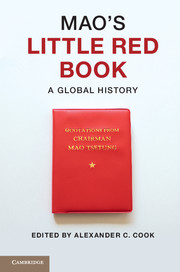
Lin Biao, foreword to the second editionThis introduction is not so much about Mao’s quotations themselves, but rather the effusive foreword that introduced Chinese and foreign readers to Quotations from Chairman Mao at the height of the Chinese Cultural Revolution. Credited to Lin Biao, Mao’s top military man and tireless promoter of the Little Red Book, it described how the written word could transform ideas into a material force for revolution. According to the foreword, the Little Red Book was a weapon of mass instruction – the intercontinental delivery system for a potentially world-shattering ideological payload: “Once Mao Tse-tung’s thought is grasped by the broad masses, it becomes a source of strength and a spiritual atom bomb of infinite power.” Lin Biao’s metaphor was an adulatory exaggeration, of course, but it should not be dismissed as only that. I will show, through an extended exegesis, that the spiritual atom bomb was in fact a coherent concept within its own Maoist intellectual context. More broadly, I will argue that the spiritual atom bomb was also a telling symptom of anxieties about the Cultural Revolution in China, about the Sino-Soviet split within the socialist world, about the larger Cold War between capitalism and socialism, and about the global confrontation with the real prospect of nuclear Armageddon. Lin Biao’s foreword to the Little Red Book arose from historical conditions specific to China in the 1960s, yet it was also a product of the global Atomic Age. In that moment of global existential crisis, when faceless technology threatened to destroy all mankind, the spiritual atom bomb was an alternate vision of the atomic that affirmed the primacy of the spiritual over the material.
Information
- Type
- Chapter
- Information
- Mao's Little Red BookA Global History, pp. 1 - 22Publisher: Cambridge University PressPrint publication year: 2014
References
, Mao’s China and the Cold War (Chapel Hill: University of North Carolina Press, 2001)Google Scholar
, “Third World Maoism,” in , ed., Critical Introduction to Mao (Cambridge: Cambridge University Press, 2010), pp. 288–312CrossRefGoogle Scholar
, “The Part Played by Labour in the Transformation of Ape to Man,”
, , , and , eds., Cold War Statesmen Confront the Bomb (Oxford: Oxford University Press, 1999)CrossRefGoogle Scholar
, “Charles De Gaulle and the Nuclear Revolution,” in Gaddis et al., eds., Cold War Statesmen Confront the Bomb, pp. 216–35
, “Nuclear Weapons and the Other in the American Imagination,” in People of the Bomb: Portraits of America’s Nuclear Complex (Minneapolis: University of Minnesota Press, 2004), pp. 21–47Google Scholar
, Dictionary of Political Thought in the People’s Republic of China (Armonk: M. E. Sharpe, 2001)Google Scholar
, Marxist Philosophy in China: From Qu Qiubai to Mao Zedong, 1923–1945 (Dordrecht: Springer, 2005)Google Scholar
, Mao Cult: Rhetoric and Ritual in China’s Cultural Revolution (Cambridge: Cambridge University Press, 2011)CrossRefGoogle Scholar
, and , China Builds the Bomb, illustrated edn. (Stanford: Stanford University Press, 1988)Google Scholar
, “Directive on the Cultural Revolution,” in China Problems Research Center, ed., Selected Works of Lin Piao, pp. 147–58
, “Dui yijiuliuliu nian quanjun gongzuo tichu de wu xiang yuanze” [Five principles addressed to the All-Army Work Conference of 1966] (November 18, 1965), in Lin Biao wenxuan [Selected works of Lin Biao] (Hong Kong: Zhong-Gang chuanmei chubanshe, 2011), pp. 412–13Google Scholar
, “Long Live the Victory of People’s War! In Commemoration of the 20th Anniversary of Victory in the Chinese People’s War of Resistance Against Japan,”
, “Look at One’s Self in the Light of Dividing One into Two,” People’s Daily, July 19, 1968; reproduced in , , and , eds., People’s China: Social Experimentation, Politics, Entry onto the World Scene, 1966–1972 (New York: Vintage, 1974), pp. 202–05Google Scholar
, “Speech at Peking Rally Commemorating the Fiftieth Anniversary of the October Revolution,” in China Problems Research Center, ed., Selected Works of Lin Piao, pp. 167–76
, and , Mao’s Last Revolution (Cambridge, Mass.: Belknap Press of Harvard University Press, 2006)Google Scholar
, “The Chinese People Cannot be Cowed by the Atom Bomb,”
, “On Contradiction,”
, “On Guerilla Warfare,”
, “Khrushchev is Having a Hard Time,” in Ministry of Foreign Affairs, Mao Zedong on Diplomacy, pp. 392–95
, “On Protracted War,”
, “South of the Mountains to North of the Seas: Excerpts from American Journalist Edgar Snow’s Interview with Mao Tse-tung,” in Selected Works of Mao Zedong, vol. IX,
, “Speeches at the Second Plenum of the Eighth Party Congress: Second Speech,”
, “Talk with American Anna Louise Strong,”
, “Talk on Questions of Philosophy,”
, “There are Two Intermediate Zones,” excerpts from talks with Kikunami Katsumi, Politburo member of the Japanese CP,” in Ministry of Foreign Affairs, Mao Zedong on Diplomacy, pp. 387–89
, Power and Protest: Global Revolution and the Rise of Détente (Cambridge, Mass.: Harvard University Press, 2003)Google Scholar
, and , The Tragedy of Lin Biao: Riding the Tiger during the Cultural Revolution, 1966–1971 (Honolulu: University of Hawaii Press, 1996)Google Scholar
, “Zhong-Mei hejie guocheng zhong de Zhongfang bianzou: Mao Zedong sange shijie lilun tichu de Beijing tanxi” [A variation on the Chinese side during Sino-American reconciliation: an analysis of the background of Mao’s Three Worlds theory], in Cuiruo de lianmeng: Lengzhan yu Zhong-Su guanxi [Fragile alliance: the Cold War and Sino-Soviet relations] (Beijing: Social Sciences Academic Press, 2010), pp. 457–81Google Scholar
, “Between ‘Paper’ and ‘Real Tigers’: Mao’s View of Nuclear Weapons,” in Gaddis et al., eds., Cold War Statesmen Confront the Bomb, pp. 194–215
, “Mao Zedong: The Marxist Lord of Misrule,” in On Practice and On Contradiction: Žižek Presents Mao (London: Verso, 2007), pp. 1–28Google Scholar
, ed., Quotations from Chairman Mao Tse-tung (New York: Frederick A. Praeger, 1967), pp. xxxi–xxxiii.Google Scholar
, “Stuart R. Schram, Nuclear Physicist and Mao Scholar, Dies at 88,” New York Times (July 21, 2012)
, Dictionary of Political Thought in the People’s Republic of China (Armonk: M. E. Sharpe, 2001), pp. 457–60.Google Scholar
and , The Tragedy of Lin Biao: Riding the Tiger during the Cultural Revolution, 1966–1971 (Honolulu: University of Hawaii Press, 1996), pp. 1–18.Google Scholar
and , Mao’s Last Revolution (Cambridge, Mass.: Belknap Press of Harvard University Press, 2006).Google Scholar
, Marxist Philosophy in China: From Qu Qiubai to Mao Zedong, 1923–1945 (Dordrecht: Springer, 2005), esp. pp. 171–95.Google Scholar
, On Practice and On Contradiction: Žižek Presents Mao (London: Verso, 2007), pp. 11, 181.Google Scholar
, “Directive on the Cultural Revolution” (September 13, 1967) in , ed., Selected Works of Lin Piao (Hong Kong: Chih Luen Press, 1970), p. 152.Google Scholar
, , and , eds., People’s China: Social Experimentation, Politics, Entry onto the World Scene, 1966–1972 (New York: Vintage, 1974), pp. 202–05.Google Scholar
, “Dui yijiuliuliu nian quanjun gongzuo tichu de wu xiang yuanze” [Five Principles Addressed to the All-Army Work Conference of 1966] (November 18, 1965), in Lin Biao wenxuan [Selected works of Lin Biao] (Hong Kong: Zhong-Gang chuanmei chubanshe, 2011), p. 413.Google Scholar
and , China Builds the Bomb, Illustrated edn. (Stanford: Stanford University Press, 1988), pp. 16–19.Google Scholar
, Mao’s China and the Cold War (Chapel Hill: University of North Carolina Press, 2001), pp. 189–90.Google Scholar
, “Between ‘Paper’ and ‘Real Tigers’: Mao’s View of Nuclear Weapons,” in , , , and , eds., Cold War Statesmen Confront the Bomb (Oxford: Oxford University Press, 1999), pp. 194–215.Google Scholar
, “Nuclear Weapons and the Other in the American Imagination,” in People of the Bomb: Portraits of America’s Nuclear Complex (Minneapolis: University of Minnesota Press, 2004), pp. 21–47.Google Scholar
, “Speech at Peking Rally Commemorating the Fiftieth Anniversary of the October Revolution” (November 7, 1967) in China Problems Research Center, ed., Selected Works of Lin Piao, p. 172
, “Zhong-Mei hejie guocheng zhong de Zhongfang bianzou: Mao Zedong sange shijie lilun tichu de Beijing tanxi” [A variation on the Chinese side during Sino-American reconciliation: An analysis of the background of Mao’s Three Worlds theory] in Cuiruo de lianmeng: Lengzhan yu Zhong-Su guanxi [Fragile alliance: the Cold War and Sino-Soviet relations] (Beijing: Social Sciences Academic Press, 2010), pp. 457–81.Google Scholar
, Power and Protest: Global Revolution and the Rise of Détente (Cambridge, Mass.: Harvard University Press, 2003), pp. 73–79.Google Scholar
, “Third World Maoism,” in , ed., Critical Introduction to Mao (Cambridge: Cambridge University Press, 2010).Google Scholar
Accessibility standard: Unknown
Why this information is here
This section outlines the accessibility features of this content - including support for screen readers, full keyboard navigation and high-contrast display options. This may not be relevant for you.Accessibility Information
Accessibility compliance for the PDF of this chapter is currently unknown
and may be updated in the future.
- 2
- Cited by