Book contents
- Frontmatter
- Contents
- List of illustrations
- List of contributors
- Preface
- 1 Introduction
- 2 A single spark
- 3 Quotation songs
- 4 Mao quotations in factional battles and their afterlives
- 5 Translation and internationalism
- 6 Maoism in Tanzania
- 7 Empty symbol
- 8 The influence of Maoism in Peru
- 9 The book that bombed
- 10 Mao and the Albanians
- 11 Partisan legacies and anti-imperialist ambitions
- 12 Badge books and brand books
- 13 Principally contradiction
- 14 By the book
- 15 Conclusion
- Index
- References
2 - A single spark
Origins and spread of the Little Red Book in China
Published online by Cambridge University Press: 05 June 2014
By
Edited by

Book contents
- Frontmatter
- Contents
- List of illustrations
- List of contributors
- Preface
- 1 Introduction
- 2 A single spark
- 3 Quotation songs
- 4 Mao quotations in factional battles and their afterlives
- 5 Translation and internationalism
- 6 Maoism in Tanzania
- 7 Empty symbol
- 8 The influence of Maoism in Peru
- 9 The book that bombed
- 10 Mao and the Albanians
- 11 Partisan legacies and anti-imperialist ambitions
- 12 Badge books and brand books
- 13 Principally contradiction
- 14 By the book
- 15 Conclusion
- Index
- References
Summary
Comrade Mao Tse-tung is the greatest Marxist-Leninist of our era. He has inherited, defended and developed Marxism-Leninism with genius, creatively and comprehensively and has brought it to a higher and completely new stage.
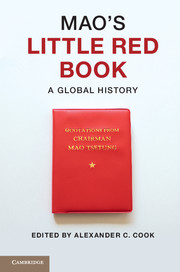
Preface to the first English editionQuotations from Chairman Mao (Mao Zhuxi Yulu), known colloquially as the “red treasure book” (hong baoshu) in Chinese, was the most prominent icon of the Cultural Revolution. It was printed just over one billion times between 1966 and 1971, and in terms of print circulation ranks second only to the Bible. In China in the late 1960s it achieved supreme importance as the ultimate guide to political action and moral behavior. Several factors explain the Little Red Book’s enormous distribution numbers and its resonance with the Chinese populace. First, the compilation was not a novel phenomenon in Chinese culture; collected sayings dating back to the Confucian Analects frequently were employed to spread the wisdom of religious or secular sages. Second, communist claims to represent the absolute truth of a scientific worldview encouraged utmost reverence for works in the Marxist–Leninist canon. The ingenious physical format of the Quotations presents a third distinctive feature. Fourth, and without doubt the most important reason, was the political environment. As the former propaganda establishment came under heavy attack for having hampered the spread of Mao Zedong Thought, the new leadership raised production numbers as proof of revolutionary loyalty. Finally, in the absence of a functioning party bureaucracy, the decontextualized quotations could be employed for highly diverse aims, and supplied skillful orators with a means of empowerment in local power struggles. This chapter traces the fascinating and contingent history of the Little Red Book in China, from its traditional predecessors and its humble origins in the General Political Department of the People’s Liberation Army (PLA) in May 1964, through the high tide of its cult status during the Cultural Revolution, and finally on to its withdrawal from circulation in February 1979.
Information
- Type
- Chapter
- Information
- Mao's Little Red BookA Global History, pp. 23 - 42Publisher: Cambridge University PressPrint publication year: 2014
References
, ed., Shades of Mao: The Posthumous Cult of the Great Leader (Armonk: M. E. Sharpe, 1996)Google Scholar
(trans.), Reflections on Things at Hand: The Neo-Confucian Anthology compiled by Chu Hsi and Lü Tsu-ch’ien (New York: Columbia University Press, 1967)Google Scholar
Da pipan ziliao xuanbian: Lu Dingyi fangeming xiuzhengzhuyi jiaoyu yanlun zhaibian [Selection of great criticism materials: extracts from Lu Dingyi’s counterrevolutionary revisionist speeches on education] (Shanghai: “Neikan” fanxiu bing, May 1967)
, Deng Xiaoping wenxuan [Selected writings of Deng Xiaoping], vol. III (Beijing: Renmin chubanshe, 1993)Google Scholar
, “‘Wenge’ shi nian Mao Zedong zhuzuo, Mao Zedong xiang chuban jishi” [Recollections about the publication of Mao Zedong’s works and Mao Zedong images during the ten years of the “Cultural Revolution”], in et al. (eds.), Zhongguo chuban shiliao (xiandai bufen), vol. III.1 (Jinan: Shandong jiaoyuchubanshe, 2001), pp. 215–36Google Scholar
, “Modes of Thinking and Modes of Discourse in the Sung: Some Thoughts on the ‘Yü-lu’ (‘Recorded Conversations’) Texts,” Journal of Asian Studies, 50.3 (August 1991), pp. 574–603CrossRefGoogle Scholar
, Mao Cult: Rhetoric and Ritual in China’s Cultural Revolution (Cambridge: Cambridge University Press, 2011)CrossRefGoogle Scholar
and , eds., Xin Zhongguo chuban wushi nian jishi [Recollections about fifty years of publishing in new China] (Beijing: Xinhua chubanshe, 1999)Google Scholar
, “Mao Zedong zai yi ci jiancha ge di gongzuo shi de zhishi” [Instructions made by Mao Zedong while observing work in various localities], in , ed., Chinese Cultural Revolution Database (Hong Kong: Chinese University Press, 2006), available at Google Scholar
, Mao zhuxi yulu, with foreword by (Beijing and Zhengzhou: Zhongguo renmin jiefangjun zong zhengzhibu, 1964 and 1966)Google Scholar
, Doing Things with Words in Chinese Politics: Five Studies (Berkeley: Institute of East Asian Studies, 1992)Google Scholar
, and , eds., Mao’s Road to Power: Revolutionary Writings 1912–1949, vol III: From the Jinggangshan to the Establishment of the Jiangxi Soviets, July 1927–December 1930 (Armonk: M. E. Sharpe, 1995)Google Scholar
, “‘Mao zhuxi yulu’ hongbian quanguo de beihou” [Behind the ‘Quotations from Chairman Mao’ that colored the whole nation in red], Dangshi bolan 3 (2009), pp. 54–58Google Scholar
, “Fengmi quanguo quanqiu, faxing 50 yu yi ce: ‘Mao zhuxi yulu’ bianfa quancheng xunzong” [Enticing all China and [the] whole world; delivering over 5 billion copies: traces of the compilation of the “Quotations from Chairman Mao”], Yanhuang chunqiu 17 (August 1993), pp. 10–24Google Scholar
, The Linji lu and the Creation of Chan Orthodoxy: The Development of Chan’s Records of Sayings Literature (Oxford: Oxford University Press, 2008)CrossRefGoogle Scholar
Yi Lin futongshuai wei guanghui bangyang wuxian zhongyu weida lingxiu Mao zhuxi [With Vice-Commander Lin as glorious example boundlessly loyal to the Great Leader Chairman Mao], vol. I (Beijing: n.p. [1970])
, ed., Zhongguo gongchandang xuanchuan gongzuo, 1957–1992 [Chinese Communist Party propaganda work, 1957–1992], vol. IV (Beijing: Xuexi chubanshe, 1996)Google Scholar
(trans.), Reflections on Things at Hand: The Neo-Confucian Anthology compiled by Chu Hsi and Lü Tsu-ch’ien (New York: Columbia University Press, 1967).Google Scholar
, “Modes of Thinking and Modes of Discourse in the Sung: Some Thoughts on the ‘Yü-lu’ (‘Recorded Conversations’) Texts,” Journal of Asian Studies 50.3 (August 1991), p. 574.CrossRefGoogle Scholar
, The Linji lu and the Creation of Chan Orthodoxy: The Development of Chan’s Records of Sayings Literature (Oxford: Oxford University Press, 2008), p. 73.CrossRefGoogle Scholar
, Deng Xiaoping wenxuan [Selected writings of Deng Xiaoping], vol. III (Beijing: Renmin chubanshe, 1993), p. 382.Google Scholar
and , eds., Mao’s Road to Power: Revolutionary Writings 1912–1949, vol III: From the Jinggangshan to the Establishment of the Jiangxi Soviets, July 1927–December 1930 (Armonk: M. E. Sharpe, 1995), p. 237.Google Scholar
, Yi Lin futongshuai wei guanghui bangyang wuxian zhongyu weida lingxiu Mao zhuxi [With Vice-Commander Lin as glorious example boundlessly loyal to the Great Leader Chairman Mao], vol. I (Beijing: n.p. [1970]), p. 42.Google Scholar
, “Fengmi quanguo quanqiu, faxing 50 yu yi ce: ‘Mao zhuxi yulu’ bianfa quancheng xunzong” [Enticing all China and [the] whole world; delivering over 5 billion copies: traces of the compilation of the “Quotations from Chairman Mao”], Yanhuang chunqiu 17 (August 1993), pp. 10–24.Google Scholar
, “Sources and Early Printing History of Chairman Mao’s ‘Quotations’,” January 10, 2004, , last accessed September 27, 2011
, Mao zhuxi yulu (Zhengzhou: Zhongguo renmin jiefangjun zongzhengzhibu, February 1966), p. 1.Google Scholar
, ed., Quotations from Chairman Mao Tse-tung, with an introductory essay and notes by (New York: Praeger, 1967), p. xv.Google Scholar
(ed.), Zhongguo gongchandang xuanchuan gongzuo, 1957–1992 [Chinese Communist Party propaganda work, 1957–1992], vol. IV (Beijing: Xuexi chubanshe, 1996), pp. 184f.Google Scholar
, “Mao Zedong zai yi ci jiancha ge di gongzuo shi de zhishi” [Instructions made by Mao Zedong while observing work in various localities] (November 1965), in , ed., Chinese Cultural Revolution Database (Hong Kong: Chinese University Press, 2006), available at .Google Scholar
, “‘Mao zhuxi yulu’ hongbian quanguo de beihou” [Behind the “Quotations from Chairman Mao” that colored the whole nation in red], Dangshi bolan 3 (2009), p. 56.Google Scholar
, Mao Cult: Rhetoric and Ritual in China’s Cultural Revolution (Cambridge: Cambridge University Press, 2011), p. 119.CrossRefGoogle Scholar
, “‘Mao zhuxi yulu’ chuban shihua” [True account of publishing the “Quotations from Chairman Mao”], Zhonghua dushu bao, July 7, 2004.
and , eds., Xin Zhongguo chuban wushi nian jishi [Recollections about fifty years of publishing in new China] (Beijing: Xinhua chubanshe, 1999), p. 101.Google Scholar
, Doing Things with Words in Chinese Politics: Five Studies (Berkeley: Institute of East Asian Studies, 1992), p. 19.Google Scholar
, “‘Wenge’ shi nian Mao Zedong zhuzuo, Mao Zedong xiang chuban jishi” [Recollections about the publication of Mao Zedong’s works and Mao Zedong images during the ten years of the ‘Cultural Revolution’], in et al. (eds.), Zhongguo chuban shiliao (xiandai bufen), vol. III.1 (Jinan: Shandong jiaoyuchubanshe, 2001), p. 235.Google Scholar
, ed., Shades of Mao: The Posthumous Cult of the Great Leader (Armonk: M. E. Sharpe, 1996), pp. 6f.Google Scholar
Accessibility standard: Unknown
Why this information is here
This section outlines the accessibility features of this content - including support for screen readers, full keyboard navigation and high-contrast display options. This may not be relevant for you.Accessibility Information
Accessibility compliance for the PDF of this chapter is currently unknown
and may be updated in the future.
- 6
- Cited by