



Rapeseed is an important oil crop widely cultivated around the world and is also the largest oil crop in China. The annual rapeseed production in China accounts for approximately 20 % of the worldwide production(Reference Hu, Hua and Yin1). The varieties of rapeseed used for oil production mainly include Brassica napus, Brassica campestris, Brassica juncea and Brassica rapa (Reference Bell2–Reference Stefański, Ahvenjärvi and Huhtanen4).
Rapeseed cake (RSC) is the by-product of rapeseeds after oil extraction(Reference Keith and Bell5). RSC has a high content of crude protein (CP) (averaging 36·3 % in DM) and metabolisable energy (averaging 13·0 MJ/kg DM)(Reference Kaldmäe, Leming and Kass6) and also contains a well-balanced composition of amino acids(Reference Xiong, Luo and Zhou7). Therefore, RSC is a good source of protein feed for livestock. However, RSC from some varieties of rapeseed contains high concentrations of glucosinolates (GLS)(Reference Abbadi and Leckband8), which act as antinutritional factors and can negatively affect the nutrient utilisation and health of livestock. Although some varieties of rapeseed with low GLS have been widely cultivated in North America, some varieties of rapeseeds containing high GLS are widely planted in China because of their high adaptability to the local conditions. A high content of GLS in the ration of pigs could induce iodine deficiency(Reference Aumaitre, Bourdon and Peiniau9) and result in liver and thyroid hypertrophy(Reference Bourdon and Aumaitre10). Ruminants are relatively more tolerant to GLS due to the pre-gastric location of microflora in the digestive system compared with monogastric animals(Reference Mandiki, Derycke and Bister11). However, high levels of GLS in the diet would adversely impact nutrient digestibility. In lambs, mustard rations containing high GLS reduced CP digestibility(Reference Tripathi, Mishra and Misra12). In lactating goats, dietary GLS in mustard reduced CP digestibility and increased milk thiocyanate (SCN)(Reference Pailan and Singhal13). In growing calves, dietary GLS in mustard decreased the digestibility of DM, organic matter and CP(Reference Tripathi, Agrawal and Sharma14). In continuous culture with the rumen fluid of cattle, rapeseed forage containing high GLS showed lower CP digestibility and bacterial N flow than annual ryegrass(Reference Dillard, Roca-Fernández and Rubano15). These results may indicate that dietary GLS or its metabolite SCN depressed nutrient digestibility in ruminants. Detoxification of GLS in RSC by microwaving, water treatment, heat treatment and solid-state fermentation(Reference Tripathi and Mishra16) can effectively eliminate the harmful effects of GLS; however, these treatments would increase the feed cost.
GLS in rapeseeds can be hydrolysed into SCN, isothiocyanate (ISCN) and goitrin by the myrosinase that exists in rapeseeds when crushed(Reference Oliviero, Verkerk and Dekker17). Only SCN was found in the ruminal digesta in cattle fed rapeseed rations containing GLS(Reference Subuh, Rowan and Lawrence18). Although the hydrolysis of GLS is known, the mechanisms of GLS that affect nutrient digestion in ruminants remain unclear. GLS or SCN is hypothesised to modulate nutrient digestion in ruminants through its impact on ruminal microbiota.
The objectives of this trial were to investigate the effects of RSC containing high GLS in the ration of steers on rumen fermentation, nutrient digestibility and ruminal microbiota and clarify the interrelationships among GLS, ruminal microbiota and nutrient digestion in steers.
Materials and methods
Ethics statement
The trial was approved by the Animal Care and Use Committee of China Agricultural University (approval number 20130611–1).
Experimental design
Eight Simmental bulls (initial body weight 219 (sd 14) kg, 10 months old) castrated 2 weeks before the trial started were used as the experimental animals. The RSC used in the trial was the rapeseed residue after the oil was extracted by hot pressing at the temperature of 120°C with the pressure of approximately 20 MPa for 20 min/50 kg rapeseed. Four levels of hot-pressed RSC, that is, 0·00, 2·65, 5·35 and 8·00 % DM, were included in the rations as the experimental treatments (Table 1). The animals and the experimental treatments were randomly assigned in a replicate 4 × 4 Latin square design. Each animal was supplied with 3·5 kg DM of total mixed ration daily, which was approximately 90 % of the ad libitum DM intake measured in a preliminary trial. The concentrations of CP and net energy of the rations were 1·2 times the maintenance requirements for the steers(Reference Feng19). Each experimental period lasted 20 d, including 15 d for adaptation and 5 d for sampling. The animals ate all the feeds offered daily, and no feeds were left during the trial.
Ingredients and nutritional composition of experimental rations (% DM)
(Percentages)

RSC, rapeseed cake; NEmf, net energy for maintenance and fattening of beef cattle; CP, crude protein; RDP, rumen degradable protein; RUP, rumen undegradable protein.
* Provided per kg DM of ration: 54 mg Zn (ZnSO4); 70 mg Fe (FeSO4); 38 mg Mn (MnSO4); 12·8 mg Cu (CuSO4); 1·2 mg iodine (KI); 0·17 mg Se (Na2SeO3); 0·6 mg Co (CoCl2); 2·31 mg vitamin A; 75 µg vitamin D3.
† NEmf was calculated according to Feng(Reference Feng19).
‡ The contents of RDP and RUP were determined according to Licitra et al.(Reference Licitra, Hernandez and Van Soest22) and the National Research Council(23).
Animal feeding and sampling
The animals were kept in individual pens. The daily ration was divided into two equal meals that were given at 07.00 and 16.00 hours. Fresh drinking water was freely available. During the sampling period, the total faeces from each animal was collected using a plastic bucket and the weight of the faeces was recorded daily. An amount of 2 % of the total faeces from each animal was sampled after homogenisation and mixed with sulphuric acid (concentration 10 %, v/v) at 20 ml/100 g fresh faecal sample to keep the pH of the samples below 3·0 and prevent N loss during storage and analysis. The ruminal fluid was taken through the oesophagus of each animal using a tube 2 h after feeding in the morning on the third day of each sampling period. To avoid saliva contamination, the first sample of rumen fluid was discharged and then a sample of about 200 ml of rumen fluid was collected from each steer. The rumen fluid was filtered through four layers of cheesecloth, and the ruminal pH was immediately measured using a portable pH meter (model 8601, AZ Instrument Corp. Ltd). The feeds were also sampled daily. The samples were stored in a freezer at –20°C until later analysis within 2 months.
Chemical analysis of feeds and faeces
The samples of feeds and faeces were freeze-dried (LGJ-12, Beijing Songyuan Huaxin Technology Development Co. Ltd) and then grinded to pass a sieve with the pore size of 1 mm for determination and analysis. The DM of feeds and faeces was determined in an oven at 105°C using the no. 934.01 AOAC method (1998)(20). The crude ash of the feeds and faeces was determined by combustion in a muffle furnace at 550°C, and the total N of feeds and faeces was analysed by the Kjeldahl method according to AOAC methods (1998)(20) no. 942.05 and 988.05, respectively. The organic matter of the feeds and faeces was calculated by DM minus crude ash. The ether extract (EE) of the feeds and faeces was analysed according to AOAC (1998)(20) method no. 920.39. The neutral-detergent fibre and acid-detergent fibre of the feeds and faeces inclusive of residual ash were analysed on an Ankom A200i Fiber Analyzer (Ankom Technology Corp.) using the methods of Van Soest et al.(Reference Van Soest, Robertson and Lewis21). The rumen degradable protein and rumen undegradable protein contents of the feeds were calculated based on Licitra et al.(Reference Licitra, Hernandez and Van Soest22) and the National Research Council(23). The extraction of GLS from RSC was conducted according to Tholen et al.(Reference Tholen, Shen and Truscott24), and the content of GLS in RSC was analysed using the method of Wathelet et al.(Reference Wathelet, Wagstaffe and Biston25) with slight modification.
Rumen fermentation parameters
The ammonia nitrogen (NH3-N) concentration of rumen fluid was determined using the colorimetric method of Broderick & Kang(Reference Broderick and Kang26). The volatile fatty acid (VFA) concentration of rumen fluid was determined via a GC (TP-2060F, Beijing Beifen-Ruili Analytical Instrument Co. Ltd) using the method described by Yang et al.(Reference Yang, Wei and Zhao27). The ruminal concentration of SCN was analysed according to China Hygiene Standard WS/T 39-1996(28). The ruminal concentration of ISCN was analysed using the method of Matthäus & Fiebig(Reference Matthäus and Fiebig29). The ruminal concentration of goitrin was analysed using the method of Thomke et al.(Reference Thomke, Pettersson and Neil30).
Real-time quantitative PCR analysis for ruminal microflora
The genomic DNA of the ruminal micro-organisms was extracted using the TIANamp Stool DNA Kit (DP328, Tiangen Biotech Co. Ltd). The primer sequences for the target species (Table 2) of ruminal microflora were synthesised by Sangon Biotech Co. Ltd. The real-time PCR was performed with TB GreenTM Premix Ex TaqTM (Tli RNaseH Plus) from Takara Biomedical Technology Co. Ltd. (no. RR420A) on a Funglyn FTC-3000 Real-time PCR System to determine the relative abundance of the target species using the protocol described by Yang et al.(Reference Yang, Wei and Zhao27). The abundance of the microbial 16S rDNA gene copy number was expressed relative to the copy number of the total rumen bacterial 16S rDNA using the following equation:
Real-time PCR primers of ruminal microbial flora

* Primer direction (F: forward; R: reverse).
 $${\rm{Relative\;abundance\;of\;target\;}}\left( {\rm{\% }} \right){\rm{\;}} = {2^{ - \left( {{\rm{Ct\;target}} - {\rm{Ct\;total\;bacteria}}} \right)}} \hskip 170pt\times 100$$
,
where Ct represents the threshold cycle.
Sequencing of rumen bacterial 16S rRNA gene
The total genomic DNA from the ruminal fluid samples for 16S rRNA gene sequencing was extracted using the CTAB/SDS method. The targets in the V3-V4 region of the bacterial 16S rRNA gene were amplified using 341F (5′-CCTAYGGGRBGCASCAG-3′) and 806 R (5′-GGACTACHVGGGTWTCTAAT-3′)(Reference Frank, Rogers and Olins36). All PCR were carried out in 30 μl reactions with 15 μl of Phusion® High-Fidelity PCR Master Mix (New England Biolabs), 0·2 μm of forward and reverse primers, and approximately 10 ng of template DNA. The PCR thermal cycling was carried out as follows: 98°C for 1 min (one cycle); 98°C for 10 s, 50°C for 30 s, and 72°C for 30 s (thirty cycles); and finally 72°C for 5 min. The amplicons were sequenced on an Ion S5TM XL platform (Thermo Fisher Scientific), and 400 bp/600 bp single-end reads were generated.
Metagenomic analysis of ruminal bacterial community
Following sequencing, raw 16S rRNA gene sequencing reads were subjected to quality filtration according to the Cutadapt (version 1.9.1)(Reference Martin37) quality-controlled process and compared with the Silva database(Reference Quast, Pruesse and Yilmaz38). The taxonomic analysis of representative operational taxonomic unit (OTU) sequences with ≥97 % similarity was analysed using UPARSE software (version 7.0.1001)(Reference Edgar39). For each representative sequence, the Silva database was used to annotate the taxonomic information based on the Mothur algorithm(Reference Quast, Pruesse and Yilmaz38). The bacterial richness values including Chao1, abundance-based coverage estimator, community diversity (Shannon and Simpson index) and sequencing depth (Good’s coverage) were calculated using QIIME (version 1.7.0)(Reference Caporaso, Kuczynski and Stombaugh40). The Phylogenetic Investigation of Communities by Reconstruction of Unobserved States was used to predict the metabolic functions of the microbial communities based on the bacterial OTU(Reference Langille, Zaneveld and Caporaso41) in combination with the Kyoto Encyclopedia of Genes and Genomes software(Reference Kanehisa and Goto42).
Statistical analysis
Statistical analysis was performed using a linear regression model with cluster robust standard errors clustered on steers in Stata (version 15, StataCorp 2017). The model for statistical analysis including fixed effects of RSC ration (x 1 = 0, 1, 2 and 3), period (x 2 = 1, 2, 3 and 4) and standard errors was adjusted for clusters of steers (n 8) for the variables. The statistical analysis results were presented as the intercept of the regression equation, regression coefficients, robust se and CI for RSC ration. The P values for regressions were also presented. The data were declared to be significant at P < 0·05 and as tendencies at 0·05 < P < 0·10. Spearman’s rank correlation tests between bacterial species at the genus level and the environmental factors including pH and the ruminal concentrations of NH3-N, total VFA and SCN were performed, and the significance was tested by corr.test in the psych package from R software (version 2.15.3, R Core Team 2013, http://www.r-project.org).
Results
Daily live weight gain
The average daily live weight gain of the four treatment groups (0·00, 2·65, 5·35 and 8·00 % of RSC in ration) was 275·0 (sd 88·6), 325·0 (sd 100·0), 318·8 (sd 116·3) and 354·8 (sd 111·8) g, respectively. Increasing the RSC levels in rations did not affect the average daily live weight gain of the four treatment groups (P > 0·05).
Ruminal fermentation parameters
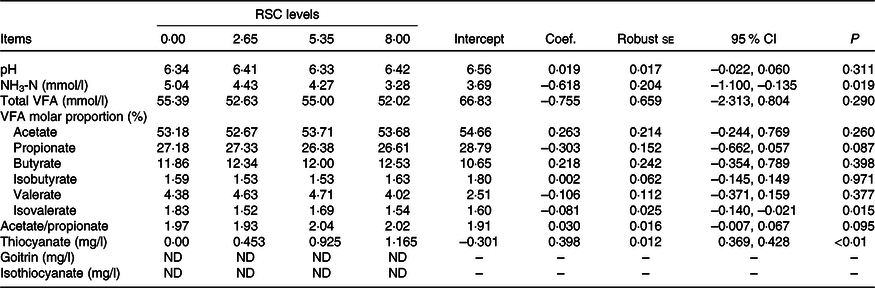
Increasing the RSC levels in rations decreased the ruminal concentration of NH3-N (P < 0·05) and the molar proportion of isovalerate (P < 0·05), but it did not affect the ruminal pH, the total VFA concentration, the molar proportions of individual VFA or the ratio of acetate:propionate (P > 0·05). Increasing the RSC levels in rations increased the ruminal concentration of SCN (P < 0·01), whereas ISCN and goitrin were undetectable (Table 3).
Effects of dietary inclusion of rapeseed cake (RSC) on rumen fermentation in steers*
(Coefficients and 95 % confidence intervals)
Coef., coefficient of regression; NH3-N, ammonia nitrogen; ND, not detected; VFA, volatile fatty acid.
* Values were least square means (n 8), cluster robust se and other parameters of cluster robust regression of RSC level.
Apparent digestibility of nutrients
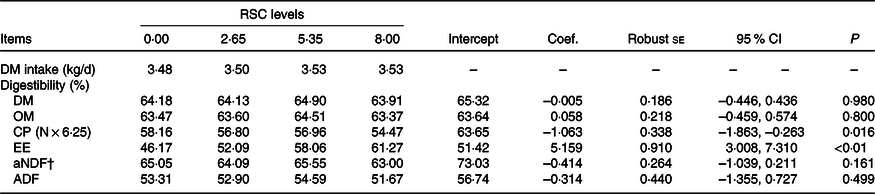
Increasing the RSC levels in rations decreased the apparent digestibility of CP (P < 0·05) and increased the apparent digestibility of EE (P < 0·01) but did not affect the apparent digestibility of DM, organic matter, neutral-detergent fibre or acid-detergent fibre (P > 0·05) (Table 4).
Effects of dietary inclusion of rapeseed cake (RSC) on apparent nutrient digestibility in steers*
(Coefficients and 95 % confidence intervals)
Coef., coefficient of regression; OM, organic matter; CP, crude protein; EE, ether extract; ADF, acid-detergent fibre.
* Values were least square means (n 8), cluster robust se and other parameters of cluster robust regression of RSC level.
† Neutral-detergent fibre (aNDF) assayed with heat-stable α-amylase and sodium sulphite, expressed as inclusive of residual ash.
Ruminal microbial flora
Increasing the RSC levels in rations tended to decrease the relative abundances of Ruminobacter amylophilus (P = 0·055) and Ruminococcus albus (P = 0·086) but did not affect the relative abundances of methanogens, protozoa, anaerobic fungi, Ruminococcus flavefaciens, Butyrivibrio fibrisolvens or Fibrobacter succinogenes (P > 0·05) (Table 5).
Effects of dietary inclusion of rapeseed cake (RSC) on ruminal microbial flora of steers (% of total bacterial 16S rDNA)*
(Coefficients and 95 % confidence intervals)

Coef., coefficient of regression.
* Values were least square means (n 8), cluster robust se and other parameters of cluster robust regression of RSC level.
Rumen bacterial diversity
A total of 2 270 387 qualified sequences were obtained from the rumen fluid samples with an average of 73 238 (sd 11 900) per sample, and 52 685 OTU with 1700 (sd 127) OTU per sample were detected based on 97 % similarity. Increasing the RSC levels in rations increased the OTU (P < 0·05) and Chao1 (P < 0·01) and abundance-based coverage estimator (P < 0·01) values, decreased Good’s coverage (P < 0·01) and did not affect the Shannon index or the Simpson index (P > 0·05). The values of Good’s coverage of the rumen fluid samples were all above 98 % (Table 6).
Effects of dietary inclusion of rapeseed cake (RSC) on the α-diversity of rumen bacterial communities of steers*
(Coefficients and 95 % confidence intervals)

Coef., coefficient of regression; OTU, operational taxonomic units; ACE, abundance-based coverage estimator.
* Values were least square means (n 8), cluster robust se and other parameters of cluster robust regression of RSC level.
Divergence of the rumen bacterial communities
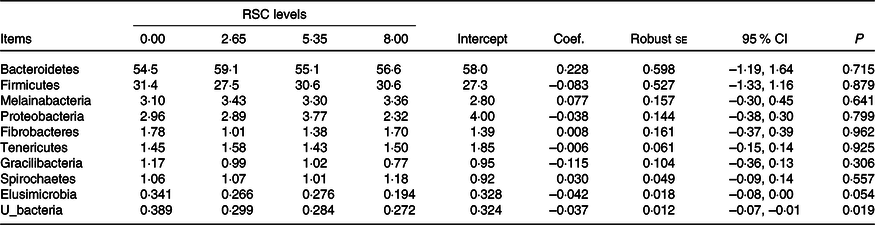
Based on the OTU obtained, a total of twenty-two phyla of bacteria were identified. The major phyla (top 10) are shown in Table 7. Increasing the RSC levels in rations decreased the relative abundances of unidentified bacteria (P < 0·05) and tended to decrease the relative abundance of Elusimicrobia (P = 0·054) but did not affect the relative abundances of any other major bacteria at the phylum level (P > 0·05).
Effects of dietary inclusion of rapeseed cake (RSC) on the relative abundance (%) of rumen bacteria of steers at phylum level (top 10)*
(Coefficients and 95 % confidence intervals)
Coef., coefficient of regression; U, unidentified.
* Values were least square means (n 8), cluster robust SE and other parameters of cluster robust regression of RSC level.
At the genus level, a total of 179 genera of bacteria were identified and the major genera (top 10) are shown in Table 8. Increasing the RSC levels in rations increased the relative abundance of Pseudobutyrivibrio (P < 0·01) but did not affect the relative abundances of any other major bacteria at the genus level (P > 0·05).
Effects of dietary inclusion of rapeseed cake (RSC) on the relative abundance (%) of rumen bacteria of steers at genus level (top 10)*
(Coefficients and 95 % confidence intervals)

Coef., coefficient of regression; U, unidentified.
* Values were least square means (n 8), cluster robust se and other parameters of cluster robust regression of RSC level.
Predicted metabolic functions of ruminal bacteria
The predicted functions of the rumen bacterial microbiota at Kyoto Encyclopedia of Genes and Genomes level 2 are shown in Table 9. Increasing the RSC levels in rations increased the function of cellular processes and signalling (P < 0·01) and tended to affect the lipid metabolism (P = 0·064), the biosynthesis of other secondary metabolites (P = 0·087) and the enzyme families (P = 0·053).
Predicted functions with linear changes at Kyoto Encyclopedia of Genes and Genomes (KEGG) level 2 of the rumen bacterial microbiota*
(Coefficients and 95 % confidence intervals)

RSC, rapeseed cake.
* Values were least square means (n 8), cluster robust se and other parameters of cluster robust regression of RSC level.
Correlations between the bacterial community and the rumen fermentation parameters
Fig. 1 indicates that the ruminal concentration of SCN was positively correlated with Desulfovibrio (P < 0·01) and negatively correlated with Candidatus_Endomicrobium and Candidatus_Saccharimonas (P < 0·05) at the genus level. The ruminal pH was negatively correlated with Candidatus_Endomicrobium and unidentified_Lachnospiraceae (P < 0·05) at the genus level. The ruminal concentration of NH3-N was correlated with the relative abundances of several rumen bacteria at the genus level including Candidatus_Endomicrobium (positive, P < 0·05), unidentified_Clostridiales (negative, P < 0·05), Anaerosporobacter (negative, P < 0·05), Acetobacter (negative, P < 0·05), Saccharofermentans (positive, P < 0·05) and Pseudobutyrivibrio (positive, P < 0·01). The ruminal concentration of total VFA was positively correlated with the relative abundances of Alloprevotella, Acetobacter and Anaeroplasma but was negatively correlated with Saccharofermentans at the genus level (P < 0·05).
Correlations between the relative abundance (%) of ruminal bacteria at the genus level and the rumen fermentation parameters. SCN, thiocyanate; NH3-N, ammonia nitrogen; VFA, total volatile fatty acids.

Discussion
GLS are typical secondary metabolites of Brassica plants and can be hydrolysed into SCN, ISCN and goitrin by myrosinase in crushed rapeseeds(Reference Oliviero, Verkerk and Dekker17). The results of the present trial indicated that increasing the RSC levels in rations increased the dietary concentration of GLS and consequently increased the ruminal concentration of SCN. However, ISCN and goitrin were undetectable in ruminal digesta. The results indicated that the main metabolite of GLS in the rumen was SCN. The results were in agreement with Subuh et al.(Reference Subuh, Rowan and Lawrence18) who reported that only SCN was found in ruminal but not in duodenal digesta in cattle fed rapeseed rations, while ITC and goitrin were undetectable in ruminal and duodenal digesta. The RSC used in the present trial was the residue of hot-pressed rapeseeds after oil extraction. The myrosinase in the rapeseeds should have been inactivated during the extraction(Reference Ludikhuyze, Ooms and Weemaes43). Bacteroides thetaiotaomicron, Peptostreptococcus spp. and Bifidobacterium spp. are reportedly able to produce enzymes with myrosinase-like activities(Reference Li, Hullar and Beresford44). Since Peptostreptococcus and Bifidobacterium are two prevalent bacteria in the rumen of heifers(Reference Oshio, Tahata and Minato45), the SCN found in the rumen digesta of the present trial should have been from the microbial hydrolysis of GLS in RSC. ISCN and goitrin can be rapidly hydrolysed by rumen microbes, while SCN was relatively unreactive in an in vitro culture of bovine ruminal fluid(Reference Majak46,Reference Geertman, Op den Camp and Jansen47) . This finding could be the reason that SCN was the metabolite of GLS rather than goitrin or ITC found in the rumen fluid in the present trial.
SCN reportedly has inhibitive effects on some species of bacteria, such as Escherichia coli, Staphylococcus aureus, etc.(Reference Shofran, Purrington and Breidt48,Reference Sá, Ferreira and Lima49) . The results of the present trial indicated that increasing GLS levels in the ration tended to decrease the relative abundances of ruminal Butyrivibrio fibrisolvens, Ruminobacter amylophilus and Ruminococcus albus. This inhibition could have resulted from the SCN hydrolysed from GLS.
The results of the present trial indicated that increasing the RSC levels in rations increased the rumen undegradable protein contents of the experimental rations and consequently decreased the ruminal concentration of NH3-N. One reason for the decreased ruminal concentration of NH3-N could be that the RSC used in the present trial was from hot-pressed rapeseeds that contained a higher content of rumen undegradable protein(Reference Deacon, De Boer and Kennelly50). Another reason could be that the SCN hydrolysed from GLS inhibited the ruminal degradation of dietary CP as reported by Dillard et al.(Reference Dillard, Roca-Fernández and Rubano15). In that report, in vitro rumen fermentation of foraged brassica containing high GLS showed a lower NH3-N concentration and CP digestibility than annual ryegrass. The results indicated that SCN, the metabolite of GLS in the present trial, should have inhibited CP degradation in the rumen and subsequently decreased CP digestibility(Reference Dillard, Roca-Fernández and Rubano15).
Ruminal NH3-N is the main N source for the growth of ruminal Ruminobacter amylophilus and Ruminococcus albus (Reference Fujimaki, Kobayashi and Wakita51,Reference Kim, Henriksen and Cann52) . Slyter et al.(Reference Slyter, Satter and Dinius53) reported that the ruminal concentration of NH3-N above 2·2 mg/100 ml in steers (live weight 183–226 kg) fed rations containing CP at 11·1–19·5 % was sufficient to allow maximum growth of rumen microbes. In the present trial, the ruminal concentrations of NH3-N ranged from 3·28 to 5·04 mmol/l (equivalent to 4·59–7·06 mg/100 ml) in steers (live weight 219 (sd 14) kg, dietary CP 12·0 % DM), which should have met the NH3-N requirement of the rumen microbes. However, the results of the present trial indicated that increasing the RSC levels in rations tended to decrease the relative abundances of the ruminal Ruminobacter amylophilus and Ruminococcus albus. This inhibition could be due to increased rumen SCN concentrations.
Increasing the RSC levels in rations in the present trial decreased the molar proportion of isovalerate in the ruminal concentration of total VFA. The results could be attributed to that the leucine content of RSC was lower than that of soyabean meal(23) and the isovalerate in the rumen exclusively originated from microbial degradation of leucine(Reference Smith and Macfarlane54). The lower dietary CP degradability and ruminal concentration of NH3-N could be other reasons for the decreased molar proportion of isovalerate.
The results of the present trial indicated that increasing the RSC levels in rations decreased CP digestibility and increased EE digestibility. One reason for the decrease in CP digestibility could be that the rumen undegradable protein in RSC as a bypass protein was not well digested in the small intestine of steers. Another reason could be that SCN could have negatively affected the digestibility of CP. The results were in agreement with Pailan & Singhal(Reference Pailan and Singhal13), who reported that dietary GLS mustard cake (Brassica juncea) reduced the CP digestibility in lactating goats, and with Tripathi et al.(Reference Tripathi, Mishra and Misra12), who reported that high GLS mustard meal reduced CP digestibility in lambs.
Increased EE digestibility could be attributed to the hot-pressed RSC, of which EE was more easily digested(Reference Patra55). The EE intake should have been increased by the addition of RSC since the EE contents of the rations were increased from 1·49 to 2·05 %, which was a considerable increase in the percentage of EE. Therefore, the increased intake of EE could have a major effect on increasing EE digestibility.
The results of the present trial showed that increasing the RSC levels in rations increased the indices of OTU, Chao1 and abundance-based coverage estimator of the rumen bacterial community. The results indicated that SCN as the metabolite of GLS could have improved the richness of the rumen bacterial community. Increasing the RSC levels in the rations did not affect the indices of Shannon and Simpson in the present trial. The results indicated that the SCN hydrolysed from GLS did not affect the diversity of the rumen bacterial community.
The results of the present trial also indicated that increasing the RSC levels in rations decreased the relative abundance of unidentified bacteria, tended to decrease the relative abundance of Elusimicrobia at the phylum level and increased the relative abundance of Pseudobutyrivibrio at the genus level. The effects should be mainly attributed to the SCN hydrolysed from GLS in RSC. In response to the altered bacterial community by GLS, the Phylogenetic Investigation of Communities by Reconstruction of Unobserved States analysis indicated that the RSC levels tended to increase the functions of the biosynthesis of other secondary metabolites, enzyme families, cellular processes and signalling, and tended to decrease the lipid metabolism. The mechanisms underlying SCN impacts on the rumen bacterial community in steers are unclear and require further investigation.
Conclusion
GLS in RSC was hydrolysed into SCN in the rumen of steers but not to ISCN or goitrin. The SCN in the digestive tract decreased the ruminal concentration of NH3-N and CP digestibility, partly affected the ruminal bacterial community and the related functions but did not affect the average daily live weight gain of steers. The effects of GLS or its metabolite SCN on rumen fermentation and CP digestibility could be attributed to the impacts of SCN on the ruminal bacterial community. Approaches to improve the CP digestibility of the RSC rations containing high GLS and the effects of dietary GLS on the carcass characteristics and the tissue composition of steers warrant future investigation.
Acknowledgements
This study was supported by National Natural Science Foundation of China (grant no. 31772626).
The authors’ contributions were as follows: G. Z. designed the research; J. G., Y. S., Y. B., K. Z. and D. K. conducted the trial, analysed the data and drafted the manuscript; G. Z. and J. G. revised the manuscript; G. Z. had primary responsibility for the manuscript and all authors approved the final manuscript.
The authors declare that there are no conflicts of interest.



