




Work done by John Edmondston … doorman and firewoman as usual.
Weekly Report Book of the Museum of the University of EdinburghFootnote 1
This paper reinterprets the Natural History Museum of the University of Edinburgh (1804–24) as a place where scientific authority was built through racialized, gendered and classed labour relations. It brings the history of science into direct conversation with histories of labour and enslavement, responding to recent calls for a more integrated, decolonial historiography.Footnote 2 Classic accounts of natural-history museums have traced their collections, taxonomies and civic ambitions, focusing on how keepers acquired, arranged and interpreted the natural world.Footnote 3 Studies of the University of Edinburgh’s museum have broadly followed this model, centring on the keeperships of John Walker (1779–1803) and Robert Jameson (1804–54), and, less often, on the work of William MacGillivray, Jameson’s assistant and secretary (1822–31).Footnote 4 Within this tradition, the museum appears as an Enlightenment institution, a civic and pedagogical project whose ordered galleries embodied the progress of enlightened modernity and laid the groundwork for the later Royal Scottish Museum (now the National Museum of Scotland).
Recent scholarship complicates this view. One strand pushes ‘from below’, recovering the hidden labour and tacit skills that sustained scientific work. Swinney and McGowan’s study of the janitor John Wilson, who taught ‘practical zoology’ while maintaining the museum, restores one such figure.Footnote 5 Yet this recovery remains confined to an exceptional individual. Far less attention has been paid to the wider, precarious workforce – the doorman, porter, cleaners, firewoman and contract specimen-preparators – whose everyday, embodied labour made collections and display possible. A second strand widens the frame, situating the museum and natural history within infrastructures of empire and enslavement.Footnote 6 Work in history, geography and science and technology studies has shown how natural knowledge travelled with and through colonial infrastructures of extraction, coercion and exchange.Footnote 7 On this rereading, the making of natural history was never innocent but rather a practice entwined with violent domination and dispossession.
This paper brings these strands together to make a fresh contribution. Building on scholarship that recovers the material and technical work underpinning scientific practice and extending it through feminist and decolonial critiques of bodily and racialized labour, it reinterprets the first two decades of the ‘new’ museum under Jameson (1804–24).Footnote 8 Rather than reinscribing the keeper’s authority, it reads the museum through its textures and tensions of everyday work: the assistant who labelled and arranged, the janitor who dusted and demonstrated, the doorman who controlled access, the women who heated and cleaned the rooms, and the contract taxidermists who turned perishable skins into durable knowledge. Among the latter was John Edmondston (aka John Edmonstone), a formerly enslaved ‘bird-stuffer’ from Demerara. Edmondston appears intermittently in the University of Edinburgh Museum records between 1822 and 1824. The spelling of his surname varies across the wider archive – as ‘Edmonstone’ or ‘Edmonston’, but the museum report books consistently record it as ‘Edmondston’, a form adopted here for archival traceability.Footnote 9 The name itself derives from the plantation family who enslaved him, a reminder that the archival traces of his work are inseparable from the imperial and slave-holding worlds that produced them. Moreover, whilst Edmondston is remembered in the heritage sector primarily as Darwin’s taxidermy tutor, this paper adopts a different approach.Footnote 10 Following Felix Driver’s caution against substituting one hero myth with another, it does not elevate Edmondston as a single protagonist but uses the traces of his work in the museum records to reveal the precarious, hierarchical and imperial character of the labour relations that made the museum function.Footnote 11
Three arguments follow. First, scientific authority at the Edinburgh museum was a product of distributed and precarious labour. The museum’s material stability, and thus credibility, depended daily acts of care – cleaning, repairing, labelling, and preserving – as much as on curatorial schemes of order. Second, that labour was profoundly stratified and unevenly valued. Women’s heating and cleaning work kept specimens stable yet remained nameless in the record; Black and colonized expertise was acknowledged as piecework yet subject to racialized evaluation. Third, attending to these workers resituates the museum within the violent imperial economies and geographies that enabled its growth. The same ledgers that list tropical birds also list human skulls from India and ‘curiosities’ from Africa; the same galleries that impressed visiting naturalists were swept by women paid in kind. To read these traces together is to recognize the museum as a node in imperial and racial capitalism rather than a monument to civic enlightenment or ‘scientific modernity’.Footnote 12
Methodologically, the paper proceeds through close reading of MacGillivray’s weekly reports and daily notebooks alongside institutional catalogues and municipal records. These sources permit a granular view of maintenance and management – who dusted which cases, when fires were lit, how infestations were treated, how contracts were negotiated – and, crucially, they reveal what MacGillivray himself called the museum’s ‘under-management’. They also open familiar episodes, such as the Dufresne acquisition and the rehousing of the collection, to re-examination from below, shifting the optic from curatorial vision to the bodily practices that enabled and sustained them. As such, the paper adopts the microhistorians’ attentiveness to the fragment and the marginal note, reading the museum’s ledgers not just for their stated purpose but also ‘against the grain’ for what they inadvertently preserve about work, value and visibility.Footnote 13 Moreover, by tracing the minute, embodied labours that sustained the museum, the paper shows how microhistory can expose the ‘big picture’ of natural history itself: a science built from the same racialized and extractive economies that moved specimens, techniques, and people across the British Empire.Footnote 14
The paper unfolds in three parts. The first section regrounds dynastic narratives of keepership by tracing how Walker’s Enlightenment project and Jameson’s reorganization depended on imperial and colonial infrastructures of collection and exchange, what the paper terms ‘contact/conflict zones’.Footnote 15 The second turns to the museum’s everyday labour, examining the choreography of cleaning, heating and guarding that kept its order intact, and the gendered and classed hierarchies that structured it. The third focuses on John Edmondston’s taxidermy work, situating his contributions within the racialized economies of evaluation that linked Edinburgh’s ‘modern’ museum to the transatlantic plantation world. The discussion of Edmondston is deliberately extended, not to recentre a single life, but because his partial archive vividly condenses the museum’s entanglements of race, labour and empire. Read together, these sections reveal how the Edinburgh museum produced scientific authority by ordering nature and people simultaneously. They also show why these relations have been so obscured: the success of the museum’s order depended on erasing the workers that kept it in place. By highlighting these labouring bodies – Black, female and working-class – this paper argues for a history of natural history that is more social, more material and more accountable, one that joins the history of science to histories of labour, enslavement and empire.
Narratives of keepership, and what they obscure
The historiography of Edinburgh’s Natural History Museum, like that of many Enlightenment and nineteenth-century scientific institutions, has been written largely from the perspective of its professors and keepers.Footnote 16 The museum inherited the disordered traditions of the cabinet but became authoritative by serving as a node where ‘knowledge in transit’ was materialized through objects moving between collectors, curators and publics.Footnote 17 The keeper thus came to embody and enact this authority through the acquisitions they pursued, the techniques they privileged, and the arrangements they imposed.Footnote 18 Apprenticeship created a dynastic pattern of keepership, with assistants often succeeding their mentors. Yet while the keeper’s authority is often cast as a stabilizing factor, privileging it risks obscuring the wider, uneven labours that made their visions materially possible and the museum function at all. Reviewing the keeperships of Walker and Jameson, and the scholarship that relates to them, offers the opportunity of examining this dynamic at work.
Walker’s keepership (1779–1803) has been subject to the most sustained attention and is usually cast as an Enlightenment project. As Charles Withers conveys, Walker sought to fashion the museum into a civic and pedagogical resource, one ‘both useful and ornamental’, aligning it with the wider intellectual ambitions of university and city alike.Footnote 19 The collection expanded through his fieldwork, purchases and networks of correspondents; its authority was thus tied to Walker’s and Edinburgh’s wider scientific cultures and connections. Yet where Withers’s account largely situates Walker’s project within local university and civic politics, Linda Andersson Burnett reframes this story by situating his keepership and museum squarely within the geopolitics and infrastructures of empire.Footnote 20 Many of Walker’s acquisitions, which included human-related artefacts, came through the Hudson’s Bay Company, their movement ‘conditioned by uneven power relations and violence’.Footnote 21 Burnett highlights the crucial role diverse intermediaries, including First Nations and Inuit actors, played in making Walker’s museum possible, showing how his collection blurred the lines between natural history, anthropology and colonial knowledge regimes. Read together, Withers and Burnett present the museum as both an institutional artefact of ‘Enlightenment Edinburgh’ and a node in the extractive networks of eighteenth-century natural history. Yet for all Walker’s ambition, the material foundations of his project were fragile. By 1799 he was already petitioning the town council for additional space, lamenting that the overcrowded museum was ‘incommodious and prejudicial to the very valuable Collection it now contains’.Footnote 22 When he died in 1803, his trustees removed much of the collection, and what remained was soon in decay. Robert Jameson, appointed in 1804, recalled that the ‘inconsiderable’ museum consisted of only a few cases which held some serpents, a small set of minerals and a handful of ethnographic items, while the birds had ‘so decayed … that I was forced very soon to throw them out’.Footnote 23 Far from inheriting a flourishing Enlightenment institution, Jameson was left with little more than a desiccated husk.
The two decades that followed saw the emergence of a dramatically different institution. Rather than continue Walker’s legacy, Jameson essentially started from scratch. He seeded the collection with his own specimens, augmented it with major donations such as Dr Thomson’s mineralogical cabinet, and, crucially, orchestrated the purchase of Louis Dufresne’s (1752–1832) celebrated ornithological collection in 1819. Jameson’s acquisition of this highly sought-after collection, which consisted of 1,305 bird specimens, was a coup for Edinburgh, as Dufresne was considered ‘the European authority on preservation’.Footnote 24 As Walker’s decaying birds attest, the major challenge facing the stability and permanence of natural-history collections was the development of effective methods for the preservation and arrangement of skins. Dufresne had worked out and published on his superior methods of what he termed ‘taxidermy’ while working as chief preparator at Muséum d’histoire naturelle, known for having ‘one of the largest and most important collections of preserved birds … in an excellent state of preservation’.Footnote 25 Dufresne’s personal cabinet not only embodied his superior techniques, but also basked in the glow of the museum’s ‘gold standard’. Its value to Edinburgh lay not just in its scale, then, but also in its cosmopolitanism. Moreover, thanks to Dufresne’s revolutionary use of arsenical soap, the specimens arrived in remarkably good condition, and their diversity made it possible to compare differences in sex and age, as well as variation in plumage.Footnote 26 In Yotam Tsal’s words, Edinburgh imported not only birds but also ‘best practices’ in preservation, taxonomy and display.Footnote 27 Moreover, Dufresne’s accompanying instructions, specifying everything from the spacing of bird mounts to the placement of pinned insects, ensured that the exacting ‘Parisian style’ could be reproduced in Edinburgh.
This transformation was architectural as well as curatorial. Stark’s Picture of Edinburgh described how the ‘paltry’ assemblage of the old museum, formerly crammed into lecture rooms, had been transfigured by Jameson’s purchases and rehoused in purpose-built suites: two great galleries ninety feet long, lit by lanterns from the roof, lined with plate-glass cases, and filled with some three thousand birds, making the collection ‘the most extensive in Great Britain, and not exceeded by many on the Continent.’Footnote 28 Beneath the gallery sat the university’s earlier holdings, while centre tables displayed shells, insects and corals, and external galleries were devoted to minerals and comparative anatomy. The museum itself had become, in Stark’s words, ‘the most superb and elegant part of the college’, a civic monument as much as a scientific one.Footnote 29 This splendour did not arrive innocently, however. Although French naturalists lacked a vast empire, Tsal argues, they cultivated a ‘competitive advantage’ through ‘expeditions, exchanges, and confiscations’, positioning Paris as a global hub in the trade of specimens and collections.Footnote 30 Dufresne had visited many parts of the world on behalf of the museum for this purpose, and thus the polish and perfection of his ‘classical and magnificent collection’ belied the extractive imperial project upon which it was founded.Footnote 31 Jameson’s ambitions for growing the collection did not stop at the Dufresne purchase either. He explicitly sought to draw on Britain’s expansive imperial ties by circulating instructions for preserving specimens to ‘residents at foreign courts and in the colonies’, to secure continued supply through colonial networks.Footnote 32
This strategy worked. The Weekly Report Book of the Museum of the University of Edinburgh for 1822 records an extraordinary range of new acquisitions made between April 1821 and June 1822, revealing the museum’s increasingly global reach under Jameson’s direction.Footnote 33 The index of donations lists ‘five boxes of insects from India’ sent by Dr Mallich; ‘skins of quadrupeds and birds’ and a ‘travelling hammock’ from Nepal; ‘curiosities from Africa’ presented by Sir Francis James Macgregor; ‘Indian rock salt’ from Professor Dunbar; and a series of ‘skulls from India’, alongside specimens from ‘New Holland’, ‘furs of the North West Company’, and a ‘dugong from Java’.Footnote 34 The donors include aristocrats, colonial officials and scientific correspondents, figures who, collectively, map the imperial geography of the collection. This list therefore renders visible the Edinburgh museum’s entanglement in what Mary Louise Pratt has described as the ‘contact zone’: the spaces of colonial encounter where ‘peoples geographically and historically separated come into contact with each other and establish ongoing relations, usually involving conditions of coercion, radical inequality, and intractable conflict’.Footnote 35 However, while the term ‘contact zone’ recognizes that colonists were not always in control of all colonial encounters and exchanges, and thus underscores Indigenous resistance and refusal, these relations were always asymmetric and often violent, which is why the updated term ‘contact/conflict zones’ is more powerful in the context of this paper.Footnote 36 Much like Walker’s before him, Jameson’s ‘new’ museum must therefore be understood as a repository not only of natural knowledge but also of the violence and dispossession on which that knowledge depended. The geographical spread of these donations, from India and Java to Africa, Australia, and North America, traces the circuits of empire that sustained the museum’s expansion. Almost every item in the list encapsulates a ‘contact/conflict zone’ of imperial science, where extraction, trade and coerced labour were translated into the raw material of collection and display. What the Weekly Report Book presents as an innocuous ‘list of additions’ is, in effect, an index of imperial entanglement, evidence that the making of natural history in early nineteenth-century Edinburgh was inseparable from the global machinery of empire and its uneven economies of collection.
Where the Weekly Report Book evidences the museum as a node in global circuits of extraction, it also gestures, obliquely, toward the labour that underpinned such exchanges. Every specimen listed in the donation register, from birds and human skulls to minerals and corals, bore traces of multiple, often unacknowledged, labours – from the work of Indigenous guides and intermediaries who gathered and shipped materials across imperial routes to that of museum attendants and preparators in Edinburgh who received, cleaned and mounted them. Their work was indispensable to the museum’s scientific and aesthetic authority, yet it has remained largely invisible within the narratives of keepership that have dominated scholarship. To attend to these material and bodily labours is to recognize that the production of natural knowledge was never only an intellectual enterprise, but also a deeply physical and unequal one. Where Burnett has focused on the intermediaries who operated before the specimens reached Scotland, the following sections will focus on the workers who cleaned, heated, guarded and prepared the specimens in Edinburgh. And as the case of John Edmondston in the final section demonstrates, even these local workers reveal the museum’s enduring entanglement with racialized and coercive labour regimes.
Maintaining the museum: the textures and tensions of everyday labour
This section responds to recent calls to bring histories of science into fuller conversation with histories of labour. It is over thirty years since Stephen Shapin wrote his influential essay ‘The invisible technician’; however, as Lissa Roberts, Seth Rockman and Alexandra Hui have argued, there is still a pressing need to confront questions that have not been adequately addressed in the history of science: ‘What and whose labor are [sic] involved [in the making of science]? And what of the lives and labor that are never legitimated as scientific?’Footnote 37 By following the traces of those who were essential to the Edinburgh museum’s functioning – its assistant, janitor, doorman, porter, firewoman and cleaners – but are largely absent from its histories, this section joins these conversations, asking how the museum’s labour regime and relations shaped the production of scientific order and authority. To shift focus toward these figures is not simply to recover lost actors, but to interrogate the hierarchies of visibility and value that underpinned both natural history and its subsequent histories.
If Jameson’s reorganization of the museum signalled the institutional modernization of natural history, its everyday running depended upon a more mundane, though no less vital, infrastructure of care. The tensions that animated this material labour are most visible in William MacGillivray’s daily and weekly report books, which record the museum’s internal workings in minute detail.Footnote 38 These notebooks, written from his position as both participant and observer, provide a rare view of the museum as a workplace, one sustained not by the disembodied ideals of science but by a web of obligations, frustrations and competing claims to authority.Footnote 39 MacGillivray, appointed as Jameson’s assistant in 1822, was the museum’s de facto curator and occupied a position of proximity to the keeper. He called upon Jameson each morning to receive instructions; assisted with distinguished visitors, including a visit from Georges Cuvier in December 1822; and supervised the arrangement, labelling and preservation of specimens.Footnote 40 Yet his notebook also records a mounting sense of frustration about what he termed the ‘under-management’ of the museum, particularly the blurred boundaries between his own duties and those of the janitor, John Wilson.Footnote 41 For example, in July 1822 he wrote,
There is a want of regularity in the under-management of the Museum, owing to the undefined nature of the offices of the Assistant and Mr Wilson, the one not wishing to meddle with the business of the other, and both being to appearance unacquainted with the extent of the others’ commission.Footnote 42
Wilson was far from being a mere caretaker. He maintained his own private collection of natural-history specimens, instructed students in preservation techniques, and passed on what Swinney and McGowan describe as ‘the tacit knowledges and practical skills that were fundamental to the assemblage and display of natural history’.Footnote 43 In many respects, Wilson embodied a kind of artisanal expertise that unsettled the emerging boundaries between intellectual and material labour in science.Footnote 44 It is perhaps no surprise, then, that MacGillivray, still establishing his own authority in the museum’s hierarchy, regarded Wilson’s proximity to both Jameson and the students as a professional threat.
Doorman John Dickie’s role further exposed the museum’s fragile chains of command. According to MacGillivray’s reports, Dickie’s duties included raising blinds, dusting glass cabinets, and ‘from 11 to 4 and sometimes half past 4 attending at the door’, which included ticket sales.Footnote 45 Yet it was often unclear who had authority to direct him:
John [Dickie] having at times instructions from two super-intendants [MacGillivray and Mr Wilson], to whom he considers himself in no way responsible, frets himself upon serving two masters, or as he esteems them two fellow servants; and expressing his disappointment that Professor Jameson does not issue his orders directly.Footnote 46
The phrase ‘two fellow servants’ is revealing. It situates all three men within a common social tier, even as they struggled to establish distinctions of rank and role. Beneath Jameson’s professorial authority, the museum was not a smoothly functioning hierarchy but a small, overworked community negotiating blurred jurisdictions and fragile boundaries of expertise. Even the cleaning of the galleries became contested terrain. In the same report MacGillivray commented, ‘The Assistant wishes to know if it be his duty to clean. John [Dickie] cannot clean to perfection, because his vision is not the most acute. Mr Wilson dusts occasionally, not regularly.’Footnote 47 The assistant’s following complaint that the storeroom was in ‘utter confusion, and the snakes are spoiling’, underscores that these tensions were not merely interpersonal; they had material consequences for the collection itself.Footnote 48 The fragile credibility of the museum was thus constantly at risk of being undone by confusion over who was responsible for what, and by the competing, yet overlapping, imperatives of intellectual order and physical upkeep.
If this male hierarchy of assistant, janitor and doorman was marked by friction and overlap, the work of other servants – the porter, firewoman and female cleaners – was rendered almost invisible. When these labourers do appear in MacGillivray’s reports they appear fleetingly, as names or descriptors beside pay records or when their conduct disturbed the practical or moral order of the museum. For example, Archie Wilson, Mr Wilson’s son and museum porter, only appears in MacGillivray’s reports when failing to meet expectations: ‘Archy in consequence of being drunk this morning had not made his appearance till about ten o’clock, the stove being lighted by one of the women between eight and nine.’Footnote 49 Such moments of censure, which appear in MacGillivray’s daily notebook and not his weekly report, also mark archival censor. Women’s work, in particular, was almost entirely effaced. Female workers are never named, referred to only as ‘the women’ or ‘Mr Wilson’s servants’, and their duties are described as peripheral, domestic or supplementary. On 1 January 1823, MacGillivray noted that the ‘firewoman’, who is never named but is regularly noted as present – ‘Firewoman as usual’ – had arrived late because she was ‘tipsey’, the delay resulting in a morning without heat.Footnote 50 This reveals the everyday intimacy and friction of the museum’s maintenance work; the space of learning and order depended upon the bodies, habits and punctuality of its least acknowledged workers. Other entries show the cumulative, routine and undervalued nature of this labour. In August 1823 MacGillivray listed the weekly schedule of ‘Mr Wilson’s servants’, recording which rooms the women had cleaned and on which days.Footnote 51 Their work was therefore essential to the museum’s presentation of cleanliness and civility, yet their employment and pay were irregular and sometimes rendered in kind – ‘given to them bread and a dram to prevent their going home to dinner’ – evidence of the precarious and gendered economies of service that sustained the museum (see Figure 1).Footnote 52 As scholars of archival absence have noted, women in and around scientific institutions tend to appear only when they disrupt expectations.Footnote 53 In MacGillivray’s reports, their presence is often only perceptible when the museum’s rhythms falter or the assistant is inconvenienced. They are what Gabriela Soto Laveaga calls ‘workers whose contributions have not been erased – they are still visible – but whose labour has been demoted in the historical narrative because of their gender, class or ethnicity’.Footnote 54 Examining the traces and absences of women’s work at the Edinburgh museum reveals that the making of natural history rested on a hierarchy of recognition in which some labours and labourers were recognized as scientific or curatorial, whilst others were consigned to the margins.
Expenses, 8 November 1823, including note on women paid in kind, Note Book of the Museum of the University of Edinburgh (Daily Report Book), National Museums Scotland, Library Archive, Archon code GB587 (hereafter NMS).

Yet keeping the museum free from dust, dirt, damp and vermin, far from being marginal, was of the utmost importance. The intellectual integrity of the collections, what Richard Burkhardt terms ‘the control of specimens’, depended on their material integrity.Footnote 55 Following Burkhardt, ‘controlling specimens’ encompassed how to collect, transport, name and preserve them, and how to defend them from decay and infestation. Although he writes of the Muséum d’histoire naturelle, the same preoccupation structured daily life in Edinburgh. Despite following Louis Dufresne’s ‘directions for preparing birds’ and admiring the superior preservation of his specimens – ‘the French birds have kept perfectly free from vermin of all kinds’ – MacGillivray’s reports return obsessively to infestation and loss.Footnote 56 Even with Dufresne’s supposedly superior specimens and methods the collection was constantly on the brink of being spoiled. In the weekly report of 23 March 1822, MacGillivray noted,
Sixty-two Birds of M. Dufresne’s collection have been marked as in some respect or degree damaged … The birds in the British Gallery are all much affected by damp, the feet and bill of many being covered with Mucor Mucedo … It is to be suspected also that there are worms in many of them.Footnote 57
The following month, 6 April 1822, he reported, ‘A great number of worms have been found by Mr Wilson in the mane and about the ears of the Zebra in the Low Room. The Panther and Leopard in the same place are similarly infected, especially the former.’Footnote 58 By 1 June 1822, the crisis had worsened: ‘The cases of the British Gallery … have again become partially covered with mucor … The small dark-coloured insects have made their appearance in considerable numbers.’Footnote 59 Such fragments reveal the precarious materiality of natural history. Even as Jameson and MacGillivray pursued ideals of taxonomic precision and Parisian refinement, the specimens themselves threatened to disintegrate.
MacGillivray’s solution was to mobilize the entire staff in cleaning campaigns. His weekly report of 8 June 1823 describes this operation in detail:
The whole of the birds have been cleaned with a feather brush, the cases rubbed with a hard brush and a towel, and the birds replaced and arranged according to Latham’s Synopsis … Bits of camphor have been placed in the corners and concealed places of all the cases.Footnote 60
But the infestation was incessant. The same report continues,
During this week the Low Room has been swarming with moths … The paws and neck of the Leopard, and the heads and feet of two of the antelopes, were the nests in which the eggs had been deposited … The Iceland Foxes are nearly destroyed and the dog below them has also suffered.Footnote 61
In a remarkable passage, MacGillivray proposed a scientific solution: ‘Should it not be proper to make a collection of the various animals which infest the specimens, with the view of divining the best way of getting rid of them?’Footnote 62 This proposal to catalogue the vermin that consumed the collection epitomizes the paradox of ‘controlling specimens’. The museum was both an instrument of order and a site of contamination, and thus exemplifies what geographers term the entanglement of ‘animal spaces’ and ‘beastly places’.Footnote 63 Within the glass cases, animals were conceptually and materially placed, ordered, named and fixed within an Enlightenment ‘order of things’.Footnote 64 Yet the museum was also a site where these taxonomic fictions continually unravelled. Moths, worms and mould refused containment, asserting their own beastly presence within the very architecture of scientific order. The assistant, janitor, doorman, firewoman and cleaners were bound together in their shared struggle against this disorder, their labour a fragile choreography of preservation that joined intellectual and bodily work. If Jameson’s ‘new museum’ projected imperial power and scientific control, its reality was one of continual contestation, where the authority of science depended upon the unacknowledged work of those striving to keep decay at bay. What emerges, then, is a vision of the museum not as a temple of order but as what Felix Driver terms as a ‘collective project of work’, a social and material enterprise sustained by the continuous, often invisible and uneven labour of keeping things in place.Footnote 65 The pursuit of scientific authority here was inseparable from the daily practices of cleaning, repairing, labelling and defending the specimens from their slow unmaking. Each worker, from assistant to firewoman, took part in the museum’s choreography of preservation, even as they were unequally recognized within it. The struggle to ‘control the specimens’ was thus also a struggle over the boundaries of knowledge and belonging, shaping who could speak for nature, who could handle it and who remained on the margins of its representation. In this sense, the museum’s dust and decay were not merely material problems but symptoms of the social and epistemic hierarchies that structured its life.
And as the museum’s index attests, these hierarchies extended well beyond the museum walls. The specimens that demanded so much care in Edinburgh had been gathered through violent networks of extraction and exchange that linked the Scottish university to colonial outposts across the British Empire. The next section turns to one figure entangled in these circuits of labour, knowledge and power: John Edmondston (aka John Edmonstone), the emancipated ‘bird-stuffer’ who taught Charles Darwin taxidermy.Footnote 66 Rather than rehearsing or amplifying Edmondston’s bit part in Darwin’s biography, the following case study repositions him within the wider economies of precarious, racialized and artisanal work that underpinned the making and the maintenance of natural history in the early nineteenth century.
Growing the collection: John Edmondston, taxidermy work and the afterlives of empire and enslavement at the museum
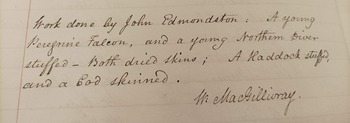
Where the previous section traced the museum’s dependence on a collective yet precarious infrastructure of care, the case of John Edmondston exposes how that collective was also transatlantic in its formation. Edmondston’s life and labour link the Edinburgh museum to the coercive geographies of empire and enslavement that made such institutions possible.Footnote 67 By examining the ‘work done by John Edmondston’ at the museum (see Figure 2), this section responds to urgent calls to bring the history of science into fuller dialogue with histories of the transatlantic slave trade.Footnote 68 Kathleen Murphy has demonstrated how the circulation of specimens through the British transatlantic slave trade – from surgeons, mariners and slave traders collecting plants, shells and skins at African and Caribbean ports, to their ultimate display in metropolitan museums – bound the production of natural knowledge to systems of captivity and coercion.Footnote 69 Edmondston’s taxidermy skills, learnt whilst enslaved in Demerara and later practised in Edinburgh, were part of this same enforced traffic in people, knowledge and labour. His craftsmanship was both a product and a residue of that world, expertise translated from plantation to museum. In this sense, Edinburgh’s ‘modern’ museum rested not just on imperial acquisition, but also on the embodied knowledge of lives that had been shaped by the violence of enslavement. His story therefore brings into view what Maria Miriti, Ariel Rawson and Becky Mansfield assert are the ‘colonial and racist underpinnings of natural history’, the ways in which scientific order, classification and pedagogy were built on structures of racial capitalism and dispossession.Footnote 70. To reckon with Edmondston’s presence in the museum is to confront these legacies.
Entry from 6 April 1822, Weekly Report Book of the Museum of the University of Edinburgh, p. 6, NMS.

Edmondston’s presence in the museum was first reconstructed by R.B. Freeman in a 1978 communication to the Royal Society, which identified him as the unnamed bird-stuffer Darwin recalled as his taxidermy tutor from his Edinburgh student days.Footnote 71 Alighting from Darwin’s statement that his tutor had ‘travelled with [Charles] Waterton’, Freeman located a likely candidate in Waterton’s 1825 book Wanderings in South America.Footnote 72 In a recollective passage Waterton claims to have taught ‘John, the black slave of my friend Mr Edmonstone, the proper way to do birds’, and that this man on ‘becoming free … got employed in the Glasgow, and then the Edinburgh museum’.Footnote 73 On this basis, Freeman concluded that ‘John’ was almost certainly Darwin’s instructor and would have likely kept the name of his enslaver even on emancipation. To corroborate the link, he examined the Edinburgh museum report books, finding two early-1820s entries recording payments to a ‘John Edmondston’ for bird and fish specimens.Footnote 74 Despite inconsistent spelling, Freeman argued that these records referred to the same man once enslaved on Charles Edmonstone’s Demerara plantation, thereby establishing the connection between Darwin’s tutor and the taxidermist who supplied specimens to the University Museum. Yet Freeman’s reconstruction, though crucial in tracing Edmondston’s historical footprint, also uncritically recycled the racialized descriptions and hierarchies of Darwin and Waterton’s writings. Indeed, the title of Freeman’s communication – ‘Darwin’s Negro Bird-Stuffer’ – reasserts the very logic of ownership and dependency that structured the archive itself. Black feminist archival theory contends that the archive of slavery ‘rests upon a founding violence’, shaping not only what is recorded but also what can be imagined about Black lives.Footnote 75 Edmondston’s transatlantic trajectory, from enslavement on a Demerara plantation to his skilled work as a taxidermist and teacher in Edinburgh, reveals a life marked by displacement, expertise and precarious freedom. Yet even as he materially contributed to the making of natural-history collections, he survives in the record only through the racialized descriptions of white elites. The aim here is not to redeem or exceptionalize him, but to situate his labour within the broader imperial economy of natural history and to show how it unsettles the hierarchies that defined it.
‘Work done by John Edmondston’ in the museum
By 1822, Edmondston was living and working in Edinburgh. The Post Office directory for that year records a ‘John Edmonston [sic], bird-stuffer’, residing at 37 Lothian Street, only a few doors from the university and the student lodgings that Charles Darwin would later occupy. According to Darwin’s correspondence, Edmondston was employed as a servant by Professor Andrew Duncan (the elder), a physician and long-standing member of the university’s medical faculty.Footnote 76 This employment likely brought him into contact with the university’s Natural History Museum, where he began supplying and preparing specimens on a contract basis. Although Adrian Desmond and James Moore suggest that Edmondston maintained his own workroom within the museum, this claim is not corroborated by William MacGillivray’s meticulous records.Footnote 77 The archival evidence indicates instead that he carried out his taxidermy from his Lothian Street lodgings, visiting the museum only to collect and deliver commissions. This distinction is significant as it positions Edmondston not as a subordinate museum employee, but as an independent craftsman making a living through scientific skill in early nineteenth-century Edinburgh.
Archival traces from MacGillivray’s weekly and daily report books reveal that Edmondston was contracted intermittently by the Edinburgh University Museum between March 1822 and January 1824. Where Freeman only reported unearthing two entries mentioning John Edmondston in his communication, there are in fact over forty and they give vital insights into his precarious employment as a contract stuffer over this two-year period. In early entries Edmondston’s work was detailed with bureaucratic precision: ‘Work done by John Edmondston: A young Peregrine Falcon, and young Northern Diver stuffed – both dried skins; A haddock stuffed, and a Cod skinned.’Footnote 78 In other weeks, Edmondston was credited with mounting an ‘Indian Kingfisher’, a ‘musk deer’, and a ‘Gnou’, specimens that had travelled from regions bound together by the imperial networks that had once enslaved him.Footnote 79 These fragments situate him not as a peripheral artisan, but as a skilled intermediary within the museum’s ongoing project of ‘controlling specimens’, that of transforming unstable organic matter from across the empire into fixed, knowable objects of science. Furthermore, the specimens Edmondston worked on arrived, and were catalogued, alongside human remains and ethnographic artefacts acquired through imperial and often violent channels. On 26 October 1822, MacGillivray noted the arrival of a ‘Case of curiosities from Sir James MacGregor to Professor Jameson’, a long list that included ‘Queen of Sectakoo’s apron, Bushman’s handkerchief, Bushman’s sack and covering for his penis, ornaments worn around the body of the bushmen made out of ostrich bone, [and] a “Caffre’s skull”.’Footnote 80 A few months later, on 18 March 1823, he recorded the arrival of ‘a box containing 14 skulls found on the banks of the river Hoogley, probably all of the Hindoo tribe, but there may be musulmen or Europeans amongst them’.Footnote 81 A week later, 25 March 1823, he added that the collection included ‘the head of a person killed in New Zealand, but from the appearance of the hair, seems to be of a different race from the New Zealanders in general’.Footnote 82 These acquisitions, alongside the specimens of birds, mammals and minerals, point to a museum where the boundaries between natural and human history were porous, and where colonized and racialized bodies were rendered into objects of scientific scrutiny and display.Footnote 83 They therefore underline natural history’s role in ‘creating and naturalizing ideas about racial hierarchy’, ideas which were used to justify not only colonial domination, but also the enslavement of peoples considered inferior.Footnote 84
Racialized hierarchies of evaluation
Where Murphy has demonstrated how the specimens that filled metropolitan museums were often themselves the material residues of slavery’s extractive geographies, figures such as John Edmondston expose how those same geographies structured the museum’s workforce.Footnote 85 MacGillivray’s notations betray the hierarchies of evaluation within which Edmondston worked. His handiwork was regularly inspected and occasionally disparaged for failing to conform to elite aesthetic or anatomical standards. In the weekly report for 30 March 1822, MacGillivray recorded:
On Friday evening John Edmondston had finished the mounting of the musk deer, and an Indian Kingfisher that had been presented in spirits. The former is over-stuffed in the body, so as to destroy the character of agility which those animals are known to possess.Footnote 86
Later that year, 7 September 1822, he noted, ‘a Gnou … has been stuffed by John Edmondston, and admitted into the Low Room. It is not perhaps done in the best style, but is nevertheless a fine specimen’.Footnote 87 Moreover, when the museum’s specimens became infested with moths, blame was directed toward ‘the Large Indian Hornbill stuffed by John Edmondston’.Footnote 88 It is difficult to ascertain whether MacGillivray’s slights were merited, as none of these specimens survive as evidence.Footnote 89 However, it is worth qualifying that despite Dufresne’s advances, taxidermy techniques were still rudimentary, whereby skins were often still being stuffed rather than fitted over accurately sculpted replacement bodies.Footnote 90 Moreover, taxidermists were often unfamiliar with the living counterparts of the skins they worked on and thus were practising what Giovanni Aloi terms ‘speculative taxidermy’.Footnote 91 While it is impossible to appraise Edmondston’s artisanry today, MacGillivray’s evaluations do echo a longer history of racialized evaluation that Edmondston was subjected to. Long before his name appeared in the Edinburgh report books, Edmondston had been subjected to a regime of judgement and comparison by Charles Waterton, who narrates their encounters through the lens of plantation paternalism in Wanderings.Footnote 92
Edmondston seems to have traded on his reputation as a one-time field companion of Waterton, then celebrated in Britain for his South American collecting exploits and his ‘original instructions for the perfect preservation of birds’.Footnote 93 However, in Wanderings, Waterton framed his former assistant within the racial hierarchies of the Demerara plantation world:
It was upon this hill in former days that I first tried to teach John, the black slave of my friend Mr [Charles] Edmonstone, the proper way to do birds. But John had poor abilities, and it required much time and patience to drive anything into him.Footnote 94
Waterton then contrasts Edmondston unfavourably with another, lighter-skinned assistant: ‘Mr Robert Edmonstone, nephew to the above gentleman, had a fine mulatto capable of learning anything … He was docile and active, and was with me all the time in the forest.’Footnote 95 Despite later protestations that he had ‘never possessed a slave in my life, or any part of a plantation’, Waterton managed several family plantations in Demerara and frequently used enslaved labourers on his expeditions.Footnote 96 His disparagement of Edmondston’s ‘abilities’ thus rehearsed the hierarchies of race and intellect that structured the white plantocracy’s self-image.Footnote 97 And as Sarah Cobham’s research has uncovered, Waterton’s motives may have been more than simply prejudicial.Footnote 98 In a lecture to the Leeds Philosophical and Literary Society in January 1824, Waterton conceded that he could not ‘fairly claim the entire credit’ for the celebrated preservation method using mercury sublimate that had made his name, admitting that ‘his friend, Mr Edmonstone … made use of exactly the same mixture for his specimens, with success and without danger’.Footnote 99 The ‘Mr Edmonstone’ in question was almost certainly Charles Edmonstone, Edmondston’s former enslaver. It is therefore entirely plausible that Edmondston had already learned, or even refined, the same technique before Waterton sought to appropriate it as his own discovery. Waterton’s published denigration of Edmondston’s skill can thus be read as an attempt to assert authorship and authority, foreclosing the possibility that the credit for an innovation in preservation might attach to an emancipated Black practitioner now working at the Edinburgh museum.
Intriguingly, MacGillivray’s reports evidence sustained connections between the museum and the plantation world from which Edmondston was transplanted. For example, on 12 April 1823 MacGillivray received a letter from the nephew of Charles Edmonstone that Waterton mentioned in Wanderings:
A letter from Mr Robert Edmonstone Demeray [sic] 25th Dec 1822 stating that he had just commenced his ornithological collection. His first collection of birds, he says, will be principally of the kinds he has not seen in English collections, ‘the little grass birds about the size of a wren’ of which he promises to send male and female, and if possible the nest eggs. He also promises, if he has an opportunity, to procure a collection of Skeletons of the different Snakes.Footnote 100
In 1817, the year Charles Edmonstone returned to Scotland with Edmondston, Robert Edmonstone’s father Archibald Edmonstone had registered ‘24 enslaved people (24M 3F) as joint proprietor in the name of Charles Edmonstone & Co.; 14 (12M 2F) people in his own name as proprietor; and 65 (41M 24F) as attorney of Charles Edmonstone’.Footnote 101 It is unclear whether the lighter-skinned pupil Waterton referred to in Wanderings would have been registered as one of these enslaved people, as he wasn’t named by Waterton and it’s also highly plausible that he was the progeny of Robert, Archibald or Charles Edmonstone. However, it is possible that this pupil was carrying out some or all the work of collecting, preserving and shipping these specimens to the Museum on Robert Edmonstone’s behalf, as Waterton claimed that he had ‘left him there to keep up this new art of preserving birds and to communicate it to others’.Footnote 102 Although this statement was clearly part of Waterton’s ‘rhetoric of self-making’ and appropriation, it demonstrates how the museum itself directly depended on coerced and enslaved labour to build its collections.Footnote 103 More broadly, this underlines how natural history and plantation slavery were not merely parallel phenomena but rather mutually reinforcing enterprises. Furthermore, Waterton’s logic of racialized evaluation did not end in Demerara; it persisted, in subtler but still perceptible form, in MacGillivray’s treatment of John Edmondston’s work.
We see this most intensely at work when Edmondston was contracted to work on the ‘Java collection’, a large consignment of skins and specimens collected by the naturalist Thomas Horsfield during his service with the Dutch East India Company.Footnote 104 Acquired by the museum in 1823, the collection, like the earlier Dufresne acquisition, signalled Edinburgh’s growing participation in imperial circuits of natural history and its ambition to rival Continental institutions. There is a striking historical resonance in the fact that Edmondston, who himself came from a former Dutch colony – Demerara was a Dutch-founded territory that transferred to British control in 1815 – was now commissioned to prepare bird skins that had travelled from another Dutch possession, Java. Bird skins and bird stuffer were thus shaped by the same colonial networks of trade, violence and forced mobility. The Java collection, in this sense, was not merely an assemblage of exotic specimens but a ‘contact/conflict zone’ where the afterlives of empire and enslavement converged in the figure of a single worker.
The Java collection
Although Mr Wilson was the museum’s main taxidermist, contract ‘stuffers’ such as John Edmondston were used when large consignments of skins were received. The Java collection was so substantial that at one point Mr Wilson, three contract stuffers and even MacGillivray himself were working on preparing its specimens. On 25 September 1823, MacGillivray recorded his first discussion with Edmondston about the new commission: ‘Spoke to John Edmondstone [sic] about stuffing for the Museum.’Footnote 105 Within a week, the Java specimens had arrived, and MacGillivray declared them ‘all excellent and beautifully preserved.’Footnote 106 Edmondston was assigned the first set of six birds at rates ranging from two shillings and sixpence to three shillings, including pedestals and the use of arsenical soap. A note at the week’s end captures both his initiative and his practical acumen: ‘John Edmondston advises getting a number of blocks and perches made and sized, to be ready as occasion may require, as they could be got cheaper in this way than a few at a time.’Footnote 107 These early entries show Edmondston acting as a skilled subcontractor who managed his own materials and even advised on the museum’s logistics, a craftsman whose technical authority was acknowledged, if fleetingly. Yet, within weeks, MacGillivray’s attention turned to new potential workers. By 18 October, George Carfrae, on the recommendation of ‘Dr Anderson’, had been taken on for a trial week, tasked with preparing twelve small birds ‘from Dr Horsfield’s collection’ at nineteen pence each.Footnote 108 MacGillivray’s notebook soon records a rhythm of comparison and judgement between the two stuffers. On 25 October MacGillivray wrote that Carfrae’s birds ‘were not in general very well done, being too flat, and the stuffing very loose – the attitudes also not very good’.Footnote 109 By 8 November, the comparisons grew more explicit: ‘They are pretty well stuffed, but not so well as Mr Wilson or John [Edmondston] would have done them.’Footnote 110 Two days later, Carfrae was dismissed: ‘Told George Carfrae that he was not to be employed any longer, as his work did not give satisfaction’.Footnote 111
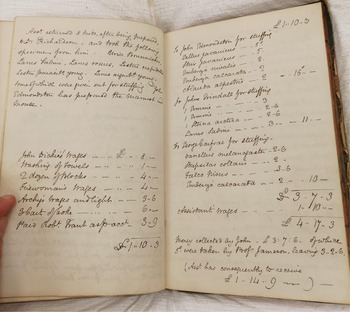
However, through November and December 1823 the ledger records a flurry of shifting commissions and evaluations (see Figure 3). Other names – Carfrae again, the janitor John Wilson, and a new ‘bird-stuffer’, John Grindall – appear in alternating entries, each subjected to the same language of appraisal. On 6 December, MacGillivray noted that ‘Grindall brought Herring Gull and two Golden Plovers … all very well done’, while John Edmondston’s work drew new scrutiny: ‘He says he will not prepare the Marmot for less than 5s and asks for £1 1s for the Fox.’Footnote 112 Edmondston was also repeatedly disparaged for his slow pace: ‘Went to John Edmondston’s. Birds not ready’; ‘he has 7 by him unprepared.’Footnote 113 By January 1824, this process of evaluation and comparison had hardened:
John Grindall has prepared the specimen of Roe Deer … He would seem to have taken John Edmondston’s Moschus moschiferus in the Low Room for a model; like it the present specimen is absurdly overstuffed … It were difficult to say which is best. George Carfrae, however, is very docile, and would make a good stuffer with practice.Footnote 114
Entry for expenses, 20 December 1823, showing pay of the three contract stuffers. Note Book of the Museum of the University of Edinburgh (Daily Report Book), NMS.

In this last sentence the museum’s social logic is laid bare, as technical judgement slips into moral judgement. ‘Docility’ becomes the measure of worth, and assumptions about obedience, skill and improvement underwrite MacGillivray’s evaluations. By 13 March 1824, MacGillivray’s final verdict closes the episode: ‘Comparing the work of the present stuffers [George Carfrae and John Grindall] with that of John Edmondston, upon the same sort of skins – it appears to be much superior in general.’Footnote 115 Thereafter, John Edmondston’s name vanishes from the museum’s record books and George Carfrae, the stuffer prized for his docility rather than skill, becomes the museum’s taxidermist of choice and assistant to Mr Wilson.Footnote 116
The Java collection’s processing exposes the ways in which scientific authority was produced through systems of comparison, discipline and substitution among its artisans.Footnote 117 The comparative judgements that ordered specimens were mirrored in the evaluation of the workers who prepared them. Skill was measured not only by aesthetic or anatomical accuracy, but also by behavioural conformity; ‘good work’ and ‘good conduct’ were collapsed into a single moral economy of discipline and docility. Within this regime, Edmondston’s independent negotiation of prices, his slower pace and his capacity to advise rather than merely obey were reframed as deficiencies. The episode of the Java collection also condenses the geography of racialized labour underpinning natural history. A collection gathered in the Dutch Empire was processed in Edinburgh by a man who had lived enslaved in a Dutch colony, his craftsmanship judged against white assistants whose docility was prized above experience. In the museum’s routines of delegation, inspection and dismissal, the control of specimens and the control of workers were intimately linked. Both were subject to the same epistemic order, one that aligned refinement with whiteness, obedience with ability, and invisibility with the smooth functioning of scientific authority. Reframing MacGillivray’s evaluations today exposes the museum not as a neutral site of preservation but as an instrument through which both natural and human lives were ordered, exploited and, at times, erased. Edmondston’s craft transformed embodied knowledge born in captivity into the intellectual capital of metropolitan science. In this sense, the birds he prepared for the Java collection were part of a longer continuum of extraction: the conversion of colonial violence into scientific value, and of enslaved experience into the material foundations of natural history.
Presence, autonomy and an alternative cartography
Yet other fragments in MacGillivray’s record tell a different story of Edmondston’s place, contribution and standing. On Monday 28 April 1823, MacGillivray recorded, ‘Went along with Archy to Mr Edmondston’s lodgings, for some minerals.’Footnote 118 This entry demonstrates that Edmondston maintained his own small natural-history collection and private trade from his lodgings at 37 Lothian Street. Far from being a menial assistant, he was an independent tradesman operating at the intersection of Edinburgh’s commercial and academic economies of natural history. The Post Office directories corroborate this trajectory of independence and advancement. Between 1823 and 1838, they show a steady move from the Southside to the heart of Edinburgh’s New Town:
1823–5: ‘Edmonston, John, bird-stuffer, 37 Lothian Street’,
1825–6: ‘Edmonston, John, bird-stuffer, 51 Lothian Street’,
1826–7: ‘Edmonstone, John, bird-stuffer, 29 Princes Street’,
1827–33: ‘Edmonstone, John, bird-stuffer, 6 South St David Street’,
1833–8: ‘Edmonston, John, bird-stuffer, 66 Princes Street’.Footnote 119
This movement from the university’s working-class fringe to the city’s most prestigious commercial thoroughfares charts professional success. His ‘slowness’ in fulfilling museum commissions likely reflected not negligence but over-demand. Edmondston was building a clientele that included university students and more wealthy collectors and patrons. This is precisely why Caroline Bressey argues that
the experiences of the black presence should be of interest to all historians of labour, not because they are exceptional, but because their presence, which may only amount to a small but critical fracture, prompts us to change our core understandings of the histories of working people in Britain.Footnote 120
Edmondston’s work exemplifies this critical fracture in the historical record, unsettling assumptions about who could belong within the making of natural knowledge. In this respect, he also embodies what Ian Duffield identified as a distinctive feature of the early nineteenth-century African diaspora in Britain, namely the emergence of literate, skilled workers who demonstrated ‘considerable enterprise in acquiring literacy and establishing themselves in skilled occupations’.Footnote 121 Edinburgh, like London, hosted a small but significant population of free Black and mixed-heritage men who made their living through skilled trades, including barbers, seafarers and, in John’s case, a taxidermist supplying one of Britain’s leading scientific institutions.Footnote 122 Within the museum’s collective labour regime, however, Edmondston remained precariously situated. His expertise was valued but never fully recognized; his presence necessary yet uneasily acknowledged. He shared the museum’s cramped ecosystem with firewomen, cleaners and other contract stuffers whose work of maintenance and preservation was likewise essential yet undervalued. Together they sustained the museum as a ‘collective project of work’, one that bound intellectual aspiration to manual, gendered and racialized labour.Footnote 123 However, although their labour was foundational to the museum’s project of work it was structurally effaced, upholding ‘problematic assumptions in the history of science about who can perform certain labors’.Footnote 124 Laveaga’s concept of disposability helps make sense of this erasure. The institutional logic that sustains museums often frames certain labour as expendable, unremarkable or beneath notice, and minoritized cleaners and contractors’ contributions are among those still easily dismissed. Attending to these labours and labourers thus begins the project of writing decolonial labour histories of science and its institutions.
Towards decolonial labour histories of science
Taken together, the three parts of this paper recast the University of Edinburgh’s Natural History Museum as a site where scientific authority was made materially, socially and unevenly. Reading across Jameson’s rebuilding of the museum, the Dufresne acquisition and the 1821–3 inflow of specimens, in and against the grain of MacGillivray’s weekly and daily report books, this paper has shown that the institution’s intellectual authority rested on a dense yet overlooked infrastructure of maintenance, craft and care. The assistant, janitor, doorman, porter, firewoman, cleaners and contracted preparators sustained the museum’s material life and, with it, its claims to scientific authority. Far from being an Enlightenment or modern institution ordered and refined by keepers alone, the museum was a workplace whose routines of cleaning, heating, guarding, mounting and labelling were inseparable from the production of knowledge. This reading also repositions the museum squarely within colonial ‘contact/conflict zones’, imperial networks through which birds from Java, skulls from India and the skills of an emancipated Black practitioner were translated into metropolitan capital. The museum’s splendour, architecturally and taxonomically, was built atop extractive imperial circuits and through the lives and afterlives of enslavement.
Three contributions follow. First, to the historiography of keepership, the article demonstrates that narratives centred on Walker and Jameson obscure the distributed and precarious labour regime that made their projects viable. Viewed from its workers rather than keepers, the museum appears as less a monument to order than a site of constant contestation, repression and repair. The labour of the janitor, doorman, cleaners and firewoman was routine, precarious and yet indispensable. MacGillivray’s reports record this choreography of dusting, heating and guarding against damp and decay, revealing how ‘controlling specimens’ meant controlling the material and human conditions of care. This was profoundly gendered and stratified work, with women’s labour maintaining the cleanliness and civility on which the museum’s intellectual authority depended, yet their contribution was rendered almost invisible in the record. By highlighting this labour, and the import of integrating the history of science with histories of labour, the paper exposes that what counted as scientific at the museum always relied on work that was never legitimated as such.
Second, the case of John Edmondston (aka Edmonstone) brought both the museum’s and natural history’s entanglements of race and labour into sharper focus.Footnote 125 A formerly enslaved man from Demerara, trained in taxidermy not by Charles Waterton, as claimed, but more likely by Charles Edmonstone, Edmondston emerges not as a footnote in Darwin’s biography but as a skilled independent artisan working at the intersection of university, city and empire. MacGillivray’s report books preserve his presence in the idiom of piecework – ‘Work done by John Edmondston’ – and in the idiom of scrutiny: a gnu ‘not done in the best style’, a musk deer ‘absurdly overstuffed’.Footnote 126 These judgements expose the racialized hierarchies embedded in the museum’s internal order, where aesthetic and moral evaluation blurred and skill was measured against obedience. The episode of the Java collection crystallized this dynamic. When Edmondston’s work was weighed against that of white counterparts, the museum rehearsed the same grammars of discipline and comparison that structured plantation labour regimes far beyond its walls. At the same time, the Post Office directories plot an alternative cartography from Lothian Street to Princes Street, a movement that testifies to Edmondston’s success in a wider market of students, collectors and patrons. Responding to Mythri Jegathesan’s call for an ‘ethical (re)historicization of race, labour, and migration in imperialist capital production’, Edmondston’s presence in the museum demonstrates that natural history was not built solely through the circulation of specimens but through the embodied expertise of those displaced by slavery and empire.Footnote 127 The same routes that moved enslaved people and colonial goods also moved specimens and techniques; the same logics that fixed non-European lives in taxonomies fixed their labour outside the credits of science. The Edinburgh museum can therefore no longer be viewed as a neutral space of display and learning. It was a material manifestation of imperial and racial capitalism, where the boundaries between natural and human life were drawn through acts of extraction, display and evaluation. To rehistoricize it ethically is to restore to view the labouring bodies – Black, female and working-class – who made its intellectual ambitions possible, and to recognize that the museum’s own archives of order are also archives of inequality and erasure.
Third, and finally, methodologically the paper demonstrates how microhistory can serve as a decolonial practice. By reading institutional records both in and against the grain, it renders visible the racialized and gendered labour that sustained scientific modernity.Footnote 128 The museum’s ‘modernity’ was not a rupture with Enlightenment but a reconfiguration of its colonial infrastructures; a shift in techniques and standards, not a break from the imperial economy that delivered both human remains and hummingbirds to the same ledger. And when we attend to the textures of everyday work – the mould, the camphor, the feather brush, the stove – we see how fragile scientific order always was, and how deeply it depended on those excluded from authorship. The Edinburgh case thus offers a practical historiographical prompt, one that resonates with the University of Edinburgh’s ongoing Review of Race and History.Footnote 129 To write institutional histories that do not reproduce the museum’s hierarchies and erasures is to treat a cleaning note as evidence of skill, a pricing dispute as a record of racialized evaluation, a donation list as a map of imperial extraction. Doing so relocates the intellectual achievements of keepers and naturalists within the social, material and often violent relations that made those achievements possible. This reframing challenges curator-centred narratives not by replacing one hero with another but by exposing the museum as a collective, hierarchical and precarious workplace embedded in global economies of coercion and care. Museums and institutions are still embedded in these uneven economies of work and attribution. To challenge this means writing curatorial credit lines that acknowledge preparation and care, catalogue metadata that record labour as well as provenance, interpretation that names coercive routes of acquisition, and teaching that treats collection management and maintenance as knowledge making. The Edinburgh museum therefore offers not only a history of empire and science but a model for how universities might confront the colonial pasts embedded in their own institutional foundations through reparative acts of rereading and renarrating.Footnote 130
Acknowledgements
This research was supported by a University of Bristol Research Fellowship Award. The author is grateful to Andy McDougall, library assistant at the National Museum of Scotland, for facilitating access to the weekly and daily report books of the University of Edinburgh Museum. Special thanks to Jenny Crane, Joe Gerlach, Franklin Ginn and Vickie Zhang for reading and commenting on drafts of this paper. Thanks also to Joe Day, Nye Merrill-Glover and John Morgan for their council on eighteenth and nineteenth-century naming and spelling practices. Finally, sincere thanks to the anonymous reviewers and the BJHS editor, Professor Amanda Rees, for their insightful feedback and suggestions, which greatly strengthened this paper.


 Open access

