





1. Introduction
The present paper revisits the impact of different cognitive factors at play in argument structure variation and possible changes in such variation over time. It thereby further contributes to the extant body of cognitive, usage-based research on syntactic alternations and historical variationist studies. More specifically, the paper zooms into the choice between nominal (1–3a) and prepositional patterns (1–3b) in the English conative alternation (Levin, Reference Levin1993; Perek, Reference Perek, Glynn and Robinson2014, Reference Perek2015; Perek & Lemmens, Reference Perek and Lemmens2010).



The emergence of this alternation, similar to other cases of systematic NP-PP variation like the dative or genitive alternation, is commonly set in early Middle English (ME) and can be assumed to reflect a general increase in the frequency of PP-expressions as part of the typological shift of English from more synthetic to more analytic (Baugh & Cable, Reference Baugh and Cable2002; Fennell, Reference Fennell2001; Szmrecsanyi, Reference Szmrecsanyi, Nevalainen and Traugott2012). However, the precise historical development of the conative alternation and the factors impacting the choice between the patterns have to date been much less explored and even less so based on quantitative data. The focus of this paper is then on providing an empirical analysis of the conative alternation and the factors driving it, by investigating its development from ME to Late Modern English (LME), meaning from 1150 to ca. 1900.
Taking a usage-based linguistics approach to the diachrony of the alternation, the main question to be addressed in the paper is the relative importance of (i) variables relating to processing difficulty compared to (ii) lexical-semantic effects regarding the verb lemmas involved and (iii) verb frequency, as well as diachronic shifts in the impact of these factors. That is, communicative efficiency may play a role in the conative alternation in that the more explicit PP-patterns should be preferred in more complex contexts demanding more processing effort, e.g. when there are long dependencies between a verb and its object or when there is ambiguity between subject and object (e.g. Rohdenburg, Reference Rohdenburg1996; Levshina, Reference Levshina2018, Reference Levshina2021a). By contrast to such higher-order predictors, research on alternation phenomena has also suggested that choices are often strongly lexically conditioned (e.g. Stefanowitsch & Gries, Reference Stefanowitsch and Gries2003), with specific lexical items being biased towards one or the other variant. This often points to semantic differences between the constructions (e.g. Guerrero-Medina, Reference Guerrero-Medina, de Mendoza Ibáñez, Oyón and Pérez-Sobrino2017; Perek, Reference Perek, Glynn and Robinson2014, Reference Perek2015; Perek & Lemmens, Reference Perek and Lemmens2010). A further factor, namely lexical frequency, may be viewed as straddling both types: assuming that less frequently occurring elements are harder to retrieve from memory and therefore present more complex, difficult environments (e.g. Bloem, Reference Bloem2021), infrequent verbs may then be assumed to be biased towards PP-use. In general, following a usage-based approach to language, frequency in actual language use (as reflected in corpora) is presumed to impact cognitive representations and linguistic choices. The present paper tests the role of these factors in combination with each other in the diachrony of English, postulating that PPs – as the innovative variant – serve as a complexity-reducing tool, especially relevant at a time of systemic upheaval when the morphological case was disappearing. At the same time, lexical biases may change over time, indicating changes in constructional semantics.
The data for this study come from the Penn-Helsinki Parsed Corpora of Historical English (PPCME2, Kroch et al., Reference Kroch, Taylor and Santorini2000; PPCEME, Kroch et al., Reference Kroch, Santorini and Delfs2004; PPCMBE2, Kroch et al., Reference Kroch, Santorini and Diertani2016) and are analysed by means of three different methods. On the one hand, I use collostructional analyses (Stefanowitsch, Reference Stefanowitsch, Hoffmann and Trousdale2013; Stefanowitsch & Gries, Reference Stefanowitsch and Gries2003), typically employed to investigate lexical effects; on the other hand, I run a mixed-effects logistic regression which can readily reveal the impact of high-level predictors like complexity features, but is not as well equipped to handle lexical factors. To combine both in a unified approach, the study then follows Sevenants et al. (Reference Sevenants, Van de Velde and Speelman2024) in using elastic net regression, ‘a new methodology which is able to process predictors of various nature on an equal footing’ (p. 4). This comparison is expected to yield more robust insights into what drives this alternation in the history of English.
The paper is structured as follows: Section 2 is about background information. It first introduces the conative alternation in more detail, commenting on its use in present day English (PDE; Section 2.1) as well as its history (Section 2.2). Section 2.3 provides the motivation for the different explanatory accounts on the choice of nominal vs prepositional variant. Section 3 gives the data and methods of the study, while the main results are shown in Section 4. In Section 5, the implications of the results are discussed, and Section 6 concludes the paper.
2. Factors at play in the English conative alternation
2.1. The conative alternation in PDE
2.1.1. Main differences between the variants of the alternation
The conative alternation, with Levin (Reference Levin1993, p. 42), ‘is a transitivity alternation in which the object of the verb in the transitive variant turns up in the intransitive conative variant as the object of the preposition in a prepositional phrase headed by the preposition at.’ In other words, the members of this alternation are a transitive (nominal) pattern on the one hand (4–10a) and a prepositional variant with a post-verbal at-PP, or occasionally an on-PP, on the other hand (4–10b). The latter is also sometimes termed a type of ‘antipassive’ variant of the former (e.g. Guerrero-Medina, Reference Guerrero-Medina and Guerrero-Medina2011). As listed in Levin (Reference Levin1993, pp. 42–43), verbs used in the alternation include verbs of contact by impact such as hitting (4), but also verbs of poking (5), spraying/loading (6), pushing (7), pulling (8), cutting (9) and certain verbs of ingesting (10).







Most basically, both constructions are said to express a sense of contact and motion (Levin, Reference Levin1993, pp. 42–43). The main semantic differences between the constructions supposedly lie in the success or telicity of the action involved: while the transitive NP-construction is typically telic, meaning that it is associated with a sense of completion of the intended result, the intransitive, prepositional pattern is usually atelic, expressing an ‘“attempted” action without specifying whether the action was actually carried out’ (Huddleston & Pullum, Reference Huddleston and Pullum2002, p. 298; Levin, Reference Levin1993, p. 42; Pinker, Reference Pinker1989, p. 104; further Beavers, Reference Beavers2010, Reference Beavers2011; Broccias, Reference Broccias, Andronis, Ball, Elston and Neuvel2001, Reference Broccias2003; Guerrero-Medina, Reference Guerrero-Medina, de Mendoza Ibáñez, Oyón and Pérez-Sobrino2017; Perek, Reference Perek, Glynn and Robinson2014, Reference Perek2015; Perek & Lemmens, Reference Perek and Lemmens2010; Sosa Acevedo, Reference Sosa-Acevedo2009; van der Leek, Reference Van der Leek, Dobrin, Singer and McNair1996). That is, poking the snake implies succeeding in touching the animal (11a), but the outcome is left open or can be unsuccessful with the PP-construction (11b).Footnote 1

The contrast between the constructions is furthermore often also framed in terms of the degree of affectedness of the theme – by comparison with the NP-pattern, the theme participant of the conative PP-pattern is not necessarily impacted by the action (Beavers, Reference Beavers2010, p. 829; Riemer, Reference Riemer2012, p. 354). In addition to ‘missed contact’, ‘lack of completion’ and ‘lack of affectedness’, Perek (Reference Perek2015, pp. 90–94), following Broccias (Reference Broccias, Andronis, Ball, Elston and Neuvel2001, Reference Broccias2003) and others, lists ‘repetition’ under the distinct semantic properties of the PP-construction: the transitive NP-construction usually expresses a punctual, single event with a clear delimitation, whereas the PP-construction often implies a repeated action, with the number of repetitions not specified (Perek, Reference Perek2015, p. 92; also Broccias, Reference Broccias, Andronis, Ball, Elston and Neuvel2001; Guerrero-Medina, Reference Guerrero-Medina and Guerrero-Medina2011). This is illustrated in the sentence pair in (12a–b). Finally, the patterns differ in terms of volitionality or intentionality of the agent, which is not necessarily given with the PP-construction. The adverbial modifier in (13a–b) and the greater acceptability of inanimate agents in the prepositional but not the nominal pattern (14a–b) support this (Perek, Reference Perek2015, pp. 93–94; also Broccias, Reference Broccias, Andronis, Ball, Elston and Neuvel2001; Dixon, Reference Dixon1991; Guerrero-Medina, Reference Guerrero-Medina and Guerrero-Medina2011; van der Leek, Reference Van der Leek, Dobrin, Singer and McNair1996). In general, the prepositional pattern seems to background the theme and place a greater focus on the agent (Perek, Reference Perek2015, p. 94; also Guerrero-Medina, Reference Guerrero-Medina, de Mendoza Ibáñez, Oyón and Pérez-Sobrino2017).



The key semantic differences between the constructions are repeated in Table 1 and can be summarised as follows: the NP-construction denotes a successful effect on a theme, whereas the meaning of the PP-pattern is best described as ‘X directs action at Y’ (Goldberg, Reference Goldberg1995, p. 63) or ‘the subject is trying to affect the oblique object but may or may not be succeeding’ (Pinker, Reference Pinker1989, p. 104).
Main semantic differences between the NP- and the PP-pattern in PDE

2.1.2. Semantics of the conative PP-pattern
Having said this, a number of studies have challenged the assumption of a more general, unified, central meaning of the prepositional construction as ‘directed action’. Instead, they have stressed stark semantic differences between different verb classes and have posited several sub-types of conative PP-patterns (Beavers, Reference Beavers2010, Reference Beavers2011; Broccias, Reference Broccias, Andronis, Ball, Elston and Neuvel2001, Reference Broccias2003; Guerrero-Medina, Reference Guerrero-Medina, de Mendoza Ibáñez, Oyón and Pérez-Sobrino2017; Perek, Reference Perek, Glynn and Robinson2014, Reference Perek2015; Perek & Lemmens, Reference Perek and Lemmens2010).
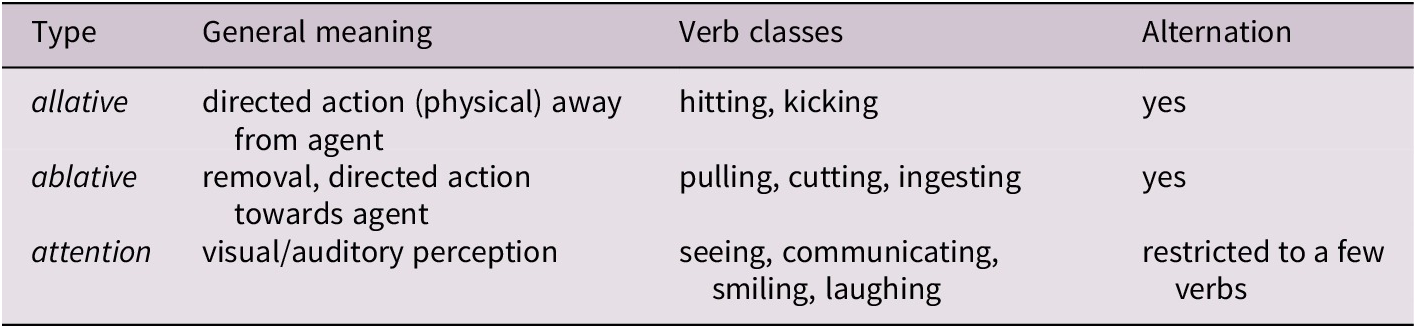
The main distinction that has been put forward in previous literature here is that between ‘allatives’ on the one hand and ‘ablatives’ on the other hand (terminology introduced in Broccias, Reference Broccias, Andronis, Ball, Elston and Neuvel2001). The former corresponds more directly to the basic sense of ‘direction at’, containing impact verbs which entail contact and motion, such as hitting or kicking, and being described ‘in purely locative terms as involving translational motion towards a target with which contact is not necessarily made’ (Perek, Reference Perek, Glynn and Robinson2014, p. 64). Guerrero-Medina (Reference Guerrero-Medina, de Mendoza Ibáñez, Oyón and Pérez-Sobrino2017, p. 351) adds that while there may not be any observable physical change of state of the theme with allatives, the agent typically carries out some sort of characteristic movement. The ablative pattern, on the other hand, is instantiated by verbs of ingestion and verbs of pulling or cutting. Here, contact and a change of state of the theme are implied, but the intended result is not necessarily fully achieved; furthermore, repetition is foregrounded in these cases (Beavers, Reference Beavers2010, p. 829; Perek, Reference Perek, Glynn and Robinson2014, p. 64). For example, from eat at the cake, we can infer that only some (or indeed very little) of the food was consumed and thus affected. Likewise, to cut at the rope does not specify the extent of affectedness, but contact between the cutter and their knife and the rope is clearly implicated.Footnote 2 Perek and Lemmens (Reference Perek and Lemmens2010) and more explicitly Guerrero-Medina (Reference Guerrero-Medina, de Mendoza Ibáñez, Oyón and Pérez-Sobrino2017) then furthermore add a third category of ‘attention’. This group includes verbs of visual perception (e.g. glance, stare, peek) or communication verbs/verbs of auditory perception (e.g. shout, curse, growl) and smiling/laughing verbs (Guerrero-Medina, Reference Guerrero-Medina, de Mendoza Ibáñez, Oyón and Pérez-Sobrino2017, p. 351). Neither contact nor an intended result and affected participant is necessarily present in these cases. Importantly, although some verbs allow paraphrasing (15), alternation with NP-patterns is not felicitous with many verbs in this group (16–17). The main differences between the types are summarised in Table 2.



Three-way distinction of conative PP-types and main features
Even though this three-way categorisation has also been criticised as generalising too broadly over striking verb-class-dependent semantic features (cf. Perek, Reference Perek, Glynn and Robinson2014, Reference Perek2015), previous work seems to largely agree that the PP-construction expresses a range of distinct sub-senses, connected through involving some form of (more concrete or more metaphorical) motion, but differing in precise semantics as well as their ability to take part in the conative alternation. Despite the substantial body of research on the PP-pattern, however, little corpus-based research in fact exists on the relevance of lexical and semantic aspects for the alternation and possible other factors guiding it have not yet been explored at all. The present paper then addresses this gap. Before outlining the paper’s main assumptions in more detail, the following section briefly comments on what is known about the history of the conative alternation.
2.2. The conative alternation in the history of English
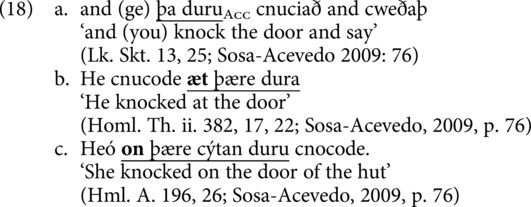
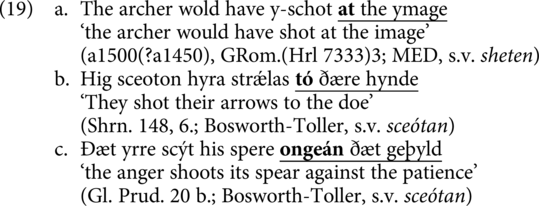
The history of the conative alternation in English is surprisingly little researched, with only some information found in Visser (Reference Visser1963, pp. 387–402), Sosa-Acevedo (Reference Sosa-Acevedo2009) and Esteban-Segura and Salles-Bernal (Reference Esteban-Segura and Salles-Bernal2017). What these sources suggest is that the alternation existed to some extent in Old English (OE) already and mainly involved senses relating to impact by motion. This is illustrated by the examples in (18), where a knocking event is instantiated by a transitive nominal pattern with a case-marked NP-theme (‘door’) in (18a), while in (18b), the theme is marked by the preposition at and (18c) involves on (examples taken from Sosa-Acevedo, Reference Sosa-Acevedo2009, p. 76). A cursory look at specific verbs in the online Bosworth-Toller Dictionary of Old English (Bosworth-Toller; Bosworth & Toller, Reference Bosworth, Toller, Sean and Tichy2014) and the online Middle English Dictionary (MED; University of Michigan Regents, 2013) further indicates that a variety of PP-constructions, including at and on, but also e.g. to or against were used with verbs of impact such as hitting or shooting in OE and ME (19a–c).Footnote 3
While the alternation thus appears to have had its precursors in the OE period already, the pattern presumably became increasingly restricted to at (as well as on) over time. Sosa-Acevedo (Reference Sosa-Acevedo2009, pp. 75–78) furthermore argues that among the different prepositional patterns in OE, only on-constructions constituted conatives proper in that they denoted a lack of contact, completion and affectedness; by contrast, at-PPs are taken to express reached locations and actual contact (Sosa-Acevedo, Reference Sosa-Acevedo2009, pp. 75–78). This may point towards some change in the semantics of at and at-constructions, potentially also reflected in an increasing openness of the subject slot to allow non-intentional and inanimate agents (Estaban-Segura & Salles-Bernal, Reference Esteban-Segura and Salles-Bernal2017). However, more extensive empirical data on the history of the alternation is clearly lacking to date.
The present study then aims to take a first step towards closing this gap. Drawing on evidence from other NP-PP alternations, I tentatively assume that the main changes and the emergence of the conative alternation in its present form should be located in early ME – a time when prepositional patterns in general came to be used more frequently, likely related to the loss of case marking around the same time, and a broad move away from synthetic means to more analytic patterns (Baugh & Cable, Reference Baugh and Cable2002; Fennell, Reference Fennell2001; Szmrecsanyi, Reference Szmrecsanyi, Nevalainen and Traugott2012). I therefore investigate data from this period onwards. The main focus is on the factors driving the alternation in earlier times; the precise features taken into account here are laid out in the following section.
2.3. Factors predicting the conative alternation
As mentioned, the present study aims to investigate the effects of two main groups of factors potentially at play in the conative alternation: (i) variables reflecting communicative and cognitive efficiency, specifically processing complexity, and (ii) lexical preferences, potentially reflecting semantic differences. A further factor, (iii) verb frequency, is taken to reflect both types.
2.3.1. Cognitive complexity
The first account builds on explorations of communicative efficiency affecting linguistic choices (e.g. Levshina, Reference Levshina2022). Among other things, processing complexity, meaning the cognitive costs incurred by producing or comprehending an utterance, is here taken to play a role in language use: for example, as formulated in Rohdenburg’s (Reference Rohdenburg1996) ‘complexity principle’, ‘[i]n case of more or less explicit grammatical options, the more explicit one(s) will tend to be favoured in cognitively more complex environments’ (Rohdenburg, Reference Rohdenburg1996, p. 151; also Rohdenburg, Reference Rohdenburg, Cuyckens and Radden2002, Reference Rohdenburg2020). Applying this principle to specific test cases necessitates definitions of (a) what constitutes more and less explicit grammatical (or lexico-grammatical) variants and (b) what constitutes cognitively more complex environments (Klavan & Schützler, Reference Klavan and Schützler2023, pp. 302–304). Regarding the former, Rohdenburg (Reference Rohdenburg1996, pp. 151–152; 2020, p. 771) points out that ‘the more explicit variant is generally represented by the bulkier element or construction,’ with the less explicit option typically involving less morphosyntactic material. This can be illustrated by e.g. less explicit/transparent NP-patterns vs more explicit PP-patterns in the case of the English dative alternation (Rohdenburg, Reference Rohdenburg1996, Reference Rohdenburg, Cuyckens and Radden2002), in the case of the home /at home-variation (Levshina, Reference Levshina2018) or in transitive alternations like search (for) (Pijpops et al., Reference Pijpops, Speelman, Grondelaers and Van de Velde2018). Other examples include morphological options, such as (less explicit) synthetic comparative adjectives vs (more explicit) analytic comparatives (Mondorf, Reference Mondorf2009) or also (less explicit) nominal case contrasted with (more explicit) postpositions (Klavan & Schützler, Reference Klavan and Schützler2023). Similarly, ‘complexity’ as a variable has been dealt with in a large range of ways, usually referring to environments requiring increased processing costs or higher working memory. For instance, Rohdenburg (Reference Rohdenburg2020, p. 771) includes greater clause length or greater morphosyntactic complexity of involved noun phrase complements/objects in his list, but also mentions factors such as passive voice, subordination and negation (which could be subsumed under ‘markedness’ features; cf. Klavan & Schützler, Reference Klavan and Schützler2023, p. 302). In addition, measures of predictability are often taken into account, with e.g. lower frequency of the lexical items included supposedly correlating with weaker entrenchment, lower accessibility, and therefore greater complexity, or low association strength between elements involved likewise indicating less predictability and thus increasing processing effort (e.g. Linzen & Jaeger, Reference Linzen and Jaeger2014). While many of these studies confirm the effect of complexity on the choice of variant (e.g. Levshina, Reference Levshina2018; Pijpops et al., Reference Pijpops, Speelman, Grondelaers and Van de Velde2018), other work demonstrates that complexity effects may ‘not generalise sufficiently to other languages to warrant the status of a “principle”’ (Klavan & Schützler, Reference Klavan and Schützler2023, p. 325). In the present paper, I test the assumptions made by the complexity principle on the conative alternation, assuming that the prepositional variant as the more explicit option should be more likely in more complex environments, such as with longer dependents, greater distance between verbs and their dependents, but also with more infrequent verbs. Since complexity effects are taken to be quasi-universal, I expect these variables to be rather stable in their impact; nevertheless, processing costs may be even higher in times of accelerated systemic change, and complexity effects may therefore become temporarily stronger compared to others.
A further aspect connected to cognitive complexity is the assumption that the use of prepositional marking may aid disambiguation between participants in a clause. This is driven by cross-linguistic research into phenomena of coding asymmetries and specifically the well-documented phenomenon of differential object marking (DOM): in languages such as Spanish, Maltese or Hebrew, prepositional marking is only used with a subset of transitive direct objects. This distribution is not random, but clearly guided by certain semantic-pragmatic features of the arguments (Levshina, Reference Levshina2021a, p. 1; Reference Levshina2021b; also Aissen, Reference Aissen2003; de Hoop & de Swart, Reference Hoop and de Swart2008; Fedzechkina et al., Reference Fedzechkina, Jaeger and Newport2012; Haspelmath, Reference Haspelmath2021a, Reference Haspelmath2021b; Iemmolo, Reference Iemmolo2010, Reference Iemmolo2013; Tal et al., Reference Tal, Smith, Culbertson, Grossman and Arnon2022; Witzlack-Makarevich & Seržant, Reference Witzlack-Makarevich, Seržant, Seržant and Witzlack-Makarevich2018). For instance, Spanish and Maltese DOM appears to be driven by animacy, with animate objects expressed by PPs opposed to inanimate NP-objects (21), while definiteness is the main determinant in Hebrew (Tal et al., Reference Tal, Smith, Culbertson, Grossman and Arnon2022, p. 3; further Haspelmath, Reference Haspelmath2021a, Reference Haspelmath2021b; Iemmolo, Reference Iemmolo2013).

The emergence and maintenance of DOM phenomena is typically linked to ambiguity avoidance mechanisms, more precisely to prepositional marking serving the function of disambiguating between subjects and objects in cases of overlap. This builds on observed hierarchies of semantic/grammatical roles, as subjects are prototypically animate and definite, among other properties. In the absence of other morphosyntactic cues such as word order, correctly distinguishing between subjects and likewise animate and definite objects would then be problematic. In such instances, ambiguity can be resolved by prepositional marking, presenting an efficient, selective strategy of argument disambiguation (Fedzechkina et al., Reference Fedzechkina, Jaeger and Newport2012, Reference Fedzechkina, Newport and Jaeger2017; Fedzechkina & Jaeger, Reference Fedzechkina and Jaeger2020; Levshina, Reference Levshina2022). Specifically relating to English, this argument has been applied to the history of the dative alternation in Zehentner (Reference Zehentner2022), arguing that the prepositional variant rose in ME as a response to increased ambiguity between subjects and indirect objects (recipients) due to the loss of case marking (Allen, Reference Allen1995). Building on this, we would expect the impact of these features to be strongest in ME (namely at a time of systemic change), with a potential decrease in relevance in later periods.
Ambiguity-related variables are here linked to complexity drawing on e.g. Tal et al. (Reference Tal, Smith, Culbertson, Grossman and Arnon2022, p. 5), who characterise DOM as a case of ‘predictability-based marking where languages mark less expected forms with more linguistic material’ (cf. also Haspelmath, Reference Haspelmath2019, Reference Haspelmath2021a, Reference Haspelmath2021b; Levshina, Reference Levshina2021a, Reference Levshina2021b). In this view, ambiguous, atypical contexts present cognitively costly environments, whose processing is facilitated by, for instance, the use of prepositional patterns.
2.3.2. Lexical factors
Besides the set of variables to do with complexity, previous work on PDE suggests that lexical factors – in this case, verb lemma – are also of relevance to the conative alternation (Perek, Reference Perek, Glynn and Robinson2014, Reference Perek2015). This is supported by research on a range of other alternation phenomena demonstrating strong lexical biases in the choice of variant (Heller et al., Reference Heller, Szmrecsanyi and Grafmiller2017; Röthlisberger et al., Reference Röthlisberger, Grafmiller and Szmrecsanyi2017; Stefanowitsch & Gries, Reference Stefanowitsch and Gries2003; also e.g. Pijpops et al., Reference Pijpops, Speelman, Grondelaers and Van de Velde2021, Reference Pijpops, Speelman and van den Bosch2022; Sevenants et al., Reference Sevenants, Van de Velde and Speelman2024). Verb-specific effects may then also reflect semantic differences between the constructions, possibly connected to the distinction between allative, ablative and attention senses introduced above or more generally reflecting the spatial origins of the prepositions involved in the PP-pattern (Broccias, Reference Broccias, Andronis, Ball, Elston and Neuvel2001, Reference Broccias2003; Guerrero-Medina, Reference Guerrero-Medina, de Mendoza Ibáñez, Oyón and Pérez-Sobrino2017; Perek, Reference Perek, Glynn and Robinson2014, Reference Perek2015; Perek & Lemmens, Reference Perek and Lemmens2010).
2.3.3. Lexical frequency
Finally, I add verb frequency as a factor combining lexical effects and processing complexity: as mentioned before, frequency plays a prominent part in usage-based approaches, positing that actual language use and in particular ‘frequency or repetition of experiences has an impact on cognitive representations’ (Bybee, Reference Bybee2007, p. 18; also Bybee & Hopper, Reference Bybee and Hopper2001; Divjak, Reference Divjak2019; Schmid, Reference Schmid2020). Most importantly for the present study, there is evidence that high-frequency words are activated and processed more easily, making them less complex environments than low-frequency words (cf. e.g. Bloem et al., Reference Bloem, Versloot and Weerman2017; Gibson, Reference Gibson1998; Röthlisberger, Reference Röthlisberger, Seoane and Biber2021). Following the hypotheses on complexity affecting syntactic choices laid out above, we can then assume verbs with a higher overall (corpus) frequency to tend towards NP-use, while PP-marking should be preferred with less frequent verbs, which present cognitively more demanding contexts.Footnote 4
In sum, the hypotheses to be tested in this study are as follows:
-
(i) the conative alternation is motivated by properties relating to complexity and ambiguity avoidance, treated under the umbrella of communicative efficiency,
-
(ii) the conative alternation is driven by lexical choices (verb lemma),
-
(iii) the conative alternation reflects the impact of lexical (verb) frequency, and
-
(iv) changes in the relative importance of these variables have to do with more general systemic shifts in the history of the English language.
The next section presents the data and methodology used to investigate these assumptions.
3. Data and methods
3.1. Data extraction and annotation
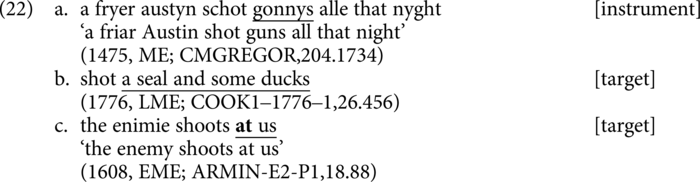
This paper uses data from three corpora of historical English: the Penn-Helsinki Parsed Corpus of Middle English (PPCME2; Kroch et al., Reference Kroch, Taylor and Santorini2000), which contains texts from 1150 to 1500 and has a size of approximately 1.2 million words; the Penn-Helsinki Parsed Corpus of Early Modern English (PPCEME; Kroch et al., Reference Kroch, Santorini and Delfs2004), which covers the timeframe of 1500 to 1700 and is about 1.8 million words large; and the Penn-Helsinki Parsed Corpus of Late Modern British English (PPCMBE2; Kroch et al., Reference Kroch, Santorini and Diertani2016), which goes from 1700 to 1914 and includes roughly 2.8 million words. For the study, I extracted all PPs and NPs which are annotated as standing in a ‘sister-relation’ to lexical verbs (excluding do, be, have and modals) in the three corpora, which yielded a total of about 406,000 combinations of verb+PP or verb+NP. In a first step, this was narrowed down to a subset of at-PPs on the one hand and NPs on the other hand. This means that other potentially interesting patterns such as collocations with on or against are not part of the study, and we can consequently not draw any conclusions on these further options for variation (as suggested by e.g. Sosa Acevedo’s Reference Sosa-Acevedo2009 discussion on- vs at-patterns in OE). In a second step, the two sets were compared and only instances of verbs attested in both samples were retained. Next, the resulting list was manually pruned to exclude irrelevant tokens, using Levin’s (Reference Levin1993) list of conative alternation verbs and their equivalents in earlier English provided in the BASICS toolkit (Percillier, Reference Percillier2016, Reference Percillier, Frank, Ivanovic, Mambrini, Passarotti and Sporleder2018) as a point of reference. For example, instances of at expressing time (21) and instances where NP- and PP-argument denote clearly different participants (e.g. instrument in 22a vs targets in 22b-c) were removed, and all instances of phrasal verbs (shoot so. down) and clauses with additional PP-arguments (shoot so. in the head) were discarded as non-alternating (Lee, Reference Lee2003, pp. 171–173). In order to nevertheless keep as many instances as possible, no frequency thresholds were imposed, meaning that any verb occurring at least once in both constructions across the corpora was included. This may evidently impact results and also requires a caveat regarding the question whether all instances in fact qualify as alternating contexts (Pijpops, Reference Pijpops2020). Likewise, I did not remove ditransitive clauses, that is, clauses with an additional (direct) NP-object besides the (indirect) alternating NP/at-PP (23), which could be debated.

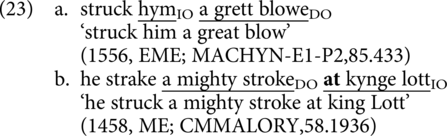
The remaining final dataset contains 3,605 instances; in addition to basic meta-information and details on clause (a), these tokens were then each annotated for the groups of variables in (b–e), reflecting the issues presented above.
-
(a) Basic information
-
- text-ID
-
- period: Middle English (‘ME’), Early Modern English (‘EME’), Late Modern English (‘LME’)
-
- clause type: ‘transitive’ (V-NP/PP) vs ‘ditransitive’ (V-NP-NP/PP)
-
(b) Features pertaining to cognitive complexity
-
- length of the theme: log-transformed (base 10) length of the NP/PP-constituent, measured in words (not counting the preposition for PPs)
-
- distance between the verb and the theme: log-transformed, centred and scaled length of the number of words intervening between verb and NP/PP-argument
-
(c) Features relating to ambiguity avoidance
-
- animacy: ‘animate’ (including humans and animals) vs ‘inanimate’ themes (objects and concepts, but also institutions and body parts)
-
- definiteness: ‘definite’ (including pronouns and NPs with definite articles and determiners, as well as possessives) vs ‘indefinite’ themes (indefinite pronouns, unmarked NPs and NPs containing indefinite articles and pronouns)
-
(d) Lexical features: 47 distinct verb lemmasFootnote 5
-
(e) Verb lemma frequency
Regarding points (d) and (e), note that extracting lemma information and lemma frequencies from the corpora used here is difficult since no fully lemmatized versions of the corpora exist to date, and spelling variation is rampant, especially in earlier texts. For the PPCME2 (ME), I therefore employed the lemmatiser that is part of the BASICS toolkit (Percillier, Reference Percillier2016, Reference Percillier, Frank, Ivanovic, Mambrini, Passarotti and Sporleder2018). This tool – currently restricted to verbs – makes use of the MED, which lists all attested word forms for particular lemmas; verb forms in a specific corpus are then automatically matched with the appropriate lemma based on these correspondences and the lemma information is directly appended to the forms in the corpus. As detailed in Trips and Percillier (Reference Trips and Percillier2020, p. 7172), evaluation has shown that the lemmatiser has a precision and recall of 94.85% and 98.92%, respectively, as well as an accuracy score of 94%. In the current study, verb lemma assignment was manually checked again for the instances included in the dataset. For the PPCEME (EME) and PPCMBE (LME), I first VARDed the data to normalise spelling variation. VARD (Variable Detector; VARD 2; Baron & Rayson, Reference Baron and Rayson2008) is a Java-based tool which was specifically designed to deal with orthographic variation in EME texts. It can be used to automatically identify non-standard spellings in a text and to determine the most likely candidates for replacing them (cf. also Archer et al., Reference Archer, Kytö, Baron and Rayson2015). Since VARD is an interactive tool that, among other features, allows users to customise the balance between precision and recall to their liking (and for each word form individually), no one accuracy score for the tool can be provided. Once VARDed, I then used the lemmatising function of the R package ‘textstem’ (Rinker, Reference Rinker2022). For all corpora, the lemmatised versions were finally used to annotate the verbs in the extracted instances regarding lemma, as well as to derive (base 10 log-transformed) lemma frequencies in the respective periods.
3.2. Statistical analysis
As Sevenants et al. (Reference Sevenants, Van de Velde and Speelman2024, p. 2) observe, alternation research has tended to focus either on lexical effects or on ‘high-level, general predictors stemming from actual language use.’ These foci are also reflected in different methodological approaches. In studies mainly interested in lexical preferences, collostructional analyses, which ‘gauge[] associational strength between constructions and the lexical elements filling certain slots in these constructions,’ have become a standard tool (Schmid & Küchenhoff, Reference Schmid and Küchenhoff2013, p. 532; also Gries, Reference Gries2019; Gries & Stefanowitsch, Reference Gries and Stefanowitsch2004; Stefanowitsch, Reference Stefanowitsch, Hoffmann and Trousdale2013; Stefanowitsch & Gries, Reference Stefanowitsch and Gries2003, Stefanowitsch & Flach, Reference Stefanowitsch, Flach, Pastor and Colson2020). The impact of high-level variables, by contrast, is typically investigated by means of logistic regression analyses, with lexical biases often included as random factors in mixed-effects models, for lack of better options (Gelman & Hill, Reference Gelman and Hill2006; Levshina, Reference Levshina2015; Winter, Reference Winter2019; see Van de Velde & Pijpops, Reference Van de Velde and Pijpops2021 specifically for a discussion of lexical factors as random effects). However, neither of these methods is able to capture the full complexity of phenomena by providing a full and sound model of variation, and a unified analysis is clearly desirable. Such an approach is provided in Sevenants et al. (Reference Sevenants, Van de Velde and Speelman2024), ‘demonstrat[ing] elastic net regression, a new methodology which is able to process predictors of various nature on an equal footing’ (p. 4). As discussed in detail in their study, this method is superior to others in allowing to combine high-level predictors and lexical effects in one model and circumventing the inherent problem of being forced to ‘highlight[] only part of the phenomena under scrutiny’ (Sevenants et al., Reference Sevenants, Van de Velde and Speelman2024, p. 2). The method, which combines ‘lasso regression’ and ‘ridge regression’, is furthermore useful in avoiding overfitting, in that it ‘adds a penalisation factor to the maximum likelihood procedure used to compute the model parameters’ (Sevenants et al., Reference Sevenants, Van de Velde and Speelman2024, p. 4) and thereby effectively shrinks model coefficients. In addition, it is able to deal with high-level categorical predictors such as lexical items used in a particular slot by means of cross-validation and, since coefficients can also be shrunk to zero, can essentially ‘carry out variable selection within the regression analysis itself’ by disabling irrelevant predictors from the start (Sevenants et al., Reference Sevenants, Van de Velde and Speelman2024, p. 4). Last, the model is more robust to multicollinearity than traditional methods (see Sevenants et al., Reference Sevenants, Van de Velde and Speelman2024, pp. 4–7, for an overview of the components and specific features of the model).
In the present study, I then use all three methods, namely collostructional analysis, logistic regression and elastic net regression, with the aim of comparing and contrasting the respective results and in order to showcase the benefits of elastic net regression analysis, only very recently introduced to studies of linguistic variation. To conduct the analyses and for visualisation, I used R (version 4.4.2, R Core Team, 2024), specifically the packages ‘ggplot2’ (Wickham, Reference Wickham2016), and ‘collostructions’ (Flach, Reference Flach2021), as well as ‘lme4’ (Bates et al., Reference Bates, Mächler, Bolker and Walker2015), ‘visreg’ (Breheny & Burchett, Reference Breheny and Burchett2017) and ‘JGmermod’ (Grafmiller, Reference Grafmiller2019). For the elastic net regression, I used ‘ElasticToolsR’, a library by Sevenants (Reference Sevenants2023) based on ‘glmnet’ (Friedman et al., Reference Friedman, Tibshirani and Hastie2010). The results are given in the following section.
4. Results
4.1. Data distribution
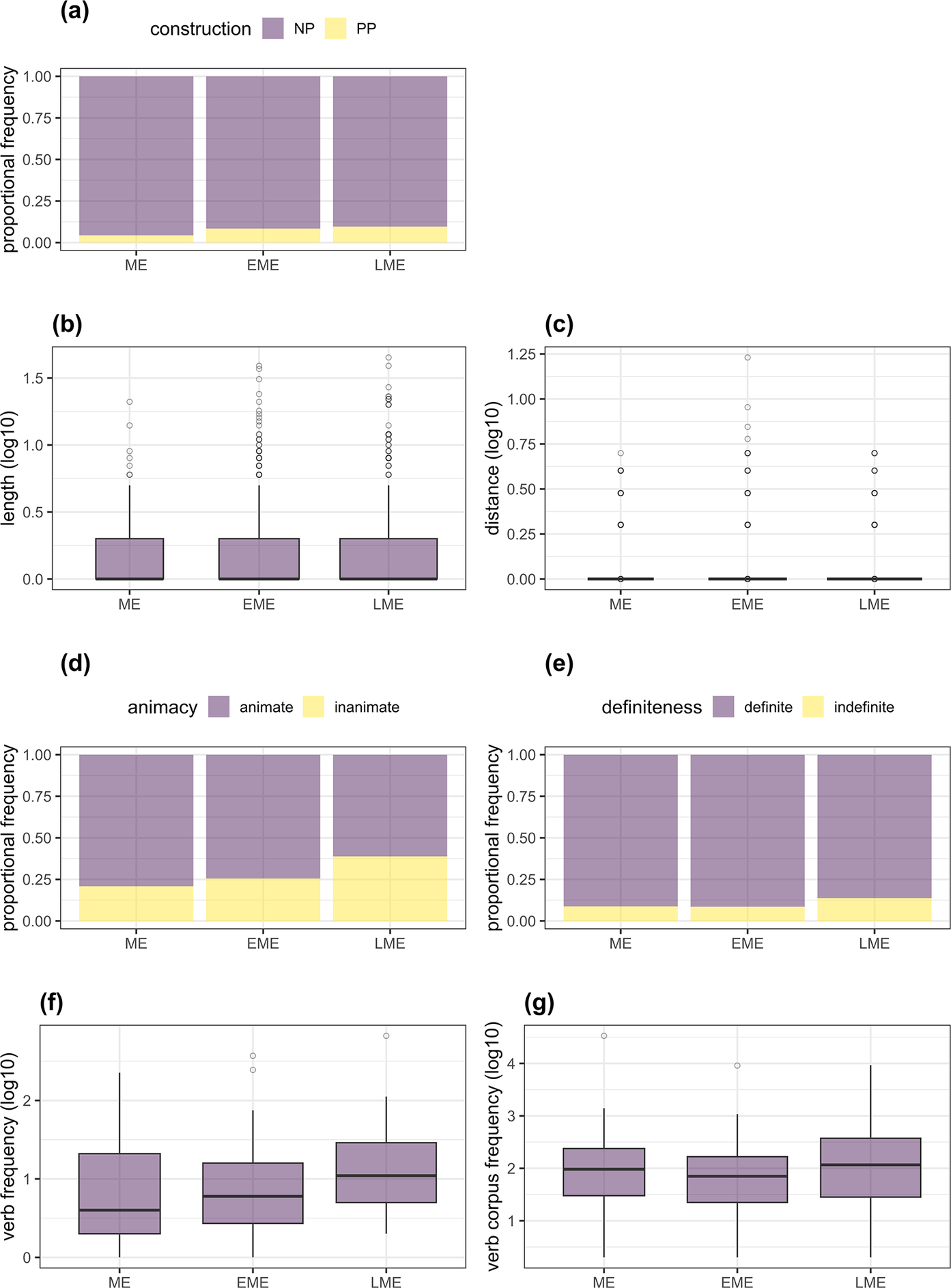
Starting with a brief glance at the distribution of the variables in the dataset, Figure 1(a) first shows that between the two constructional variants, the PP-pattern is strikingly under-represented (taking up around 8% of all instances in total), meaning that the alternation is highly imbalanced. The small increase over time in the proportions accounted for by the at-variant (from approximately 4% in ME to roughly 10% in LME) is in line with the hypothesis that the conative (PP-)construction only really gained ground from ME onwards. However, this rise is rather subtle, and the conative alternation thereby stands in stark contrast to other cases like the dative alternation, where the PP-pattern temporarily even surpasses the NP-pattern in frequency during ME (McFadden, Reference McFadden and Lightfoot2002; Zehentner, Reference Zehentner2019). Parts (b) and (c) of Figure 1 indicate that the lengths of the theme arguments (namely the NP-object or NP-complement within the PP) and the distances between verb and theme, respectively, are generally very short, with mean lengths of 1.71 words, mean distances of 1.12 and medians of 1 word for both. While mean lengths very slightly increase between periods (ME: 1.42 words vs EME: 1.79 and LME: 1.8), mean distances decrease (if only marginally; ME: 1.18 words vs EME: 1.14 and LME: 1.07), with medians at 1 word throughout. With regard to animacy (d), we find that over two-thirds (70%) of all theme referents in total are animate, compared to less than one-third of inanimates – this discrepancy is higher in the earliest period (roughly 80/20) and lower in the latest period (roughly 60/40). For definiteness (e), there is a stable distribution of about 90% of instances including a definite theme throughout time. The frequency distribution of the 47 verb lemmas within the dataset is shown in (f): here, we find that the mean frequency of verb lemmas across the entire dataset is 76.7, with a median of 18; in the individual periods, mean verb lemma frequencies and medians are 27.8/4 for ME, 25.8/6 for EME and 37.9/11 for LME. The figure also indicates that there are strong outliers: specifically, the lemma ask is greatly overrepresented in the entire dataset (accounting for 1,215 tokens and thus almost 35% of instances overall), with the verbs next in frequency considerably lagging behind (beseech: 390/11%, touch: 209/6%, draw: 186/5%, smite: 152/4%). By contrast, there are two verbs (kick and spurn), which only occur once in each construction and accordingly only twice in the dataset. In terms of diachronic change, slight shifts can be seen, in particular a decrease in the frequency of the verb say and the gradual disappearance of e.g. beseech and smite, in contrast to growing frequencies of e.g. ask and shoot. Last, panel (g) shows verb lemma frequency in the whole corpora. Again, the distribution is clearly skewed here: while the mean corpus frequency of verb lemmas is about 652.5, the median is at 87. In ME, this is even more striking than in the later periods (mean/median ME: 1,390/96 vs EME: 352/70.5 and LME: 467/118). The main outlier in all periods is the verb say, which has a raw frequency of over 50,000 across all corpora (ME: over 33,000; EME and LME: over 9,000). The least frequent verbs in terms of corpus frequency include flout, spurn, cheap, tickle and lash (fewer than 25 in total).
Proportions and distributions of categorical and continuous variables in the dataset. (a) proportions of constructional variants, (b) distribution of theme lengths in words (log10 scale), (c) distribution of verb-theme distances in words (log10 scale), (d) proportions of animate vs inanimate theme referents, (e) proportions of definite vs indefinite themes, (f) distribution of verb lemma frequency within the dataset (log10 scale), and (g) distribution of corpus-wide verb lemma frequency (log10 scale).
4.2. Collostructional analysis
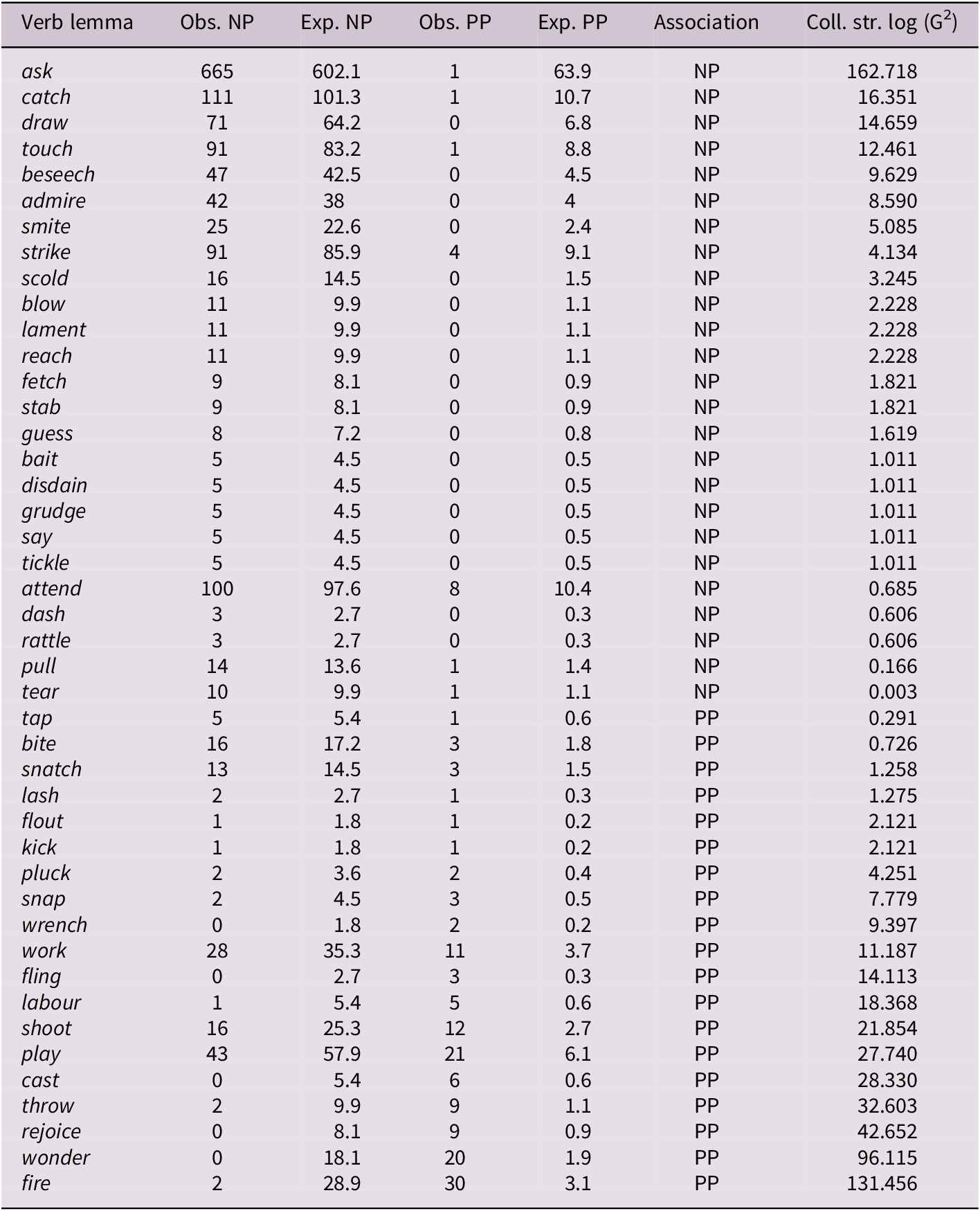
In order to determine which verbs, verb classes, and more abstract verb categories most strongly tend towards one or the other constructional variant and whether any shifts over time can be discerned, I then take a first exploratory look at lexical and semantic biases in the alternation by means of distinctive collostructional analysis (cf. Perek, Reference Perek, Glynn and Robinson2014, Reference Perek2015; Perek & Lemmens, Reference Perek and Lemmens2010 for collostructional analyses of the PDE conative PP-construction). To this end, separate analyses were conducted for the three periods, shown in Figure 2 as well as Tables A1–A3 in the Appendix.
Verb lemma associations with either NP-patterns (purple) or PP-patterns (yellow) as indicated by collostructional analyses for ME (top), EME (mid), and LME (bottom). Collocation strength is given on the x-axis, with the vertical dashed line marking the significance threshold conventionally used in collostructional analysis.
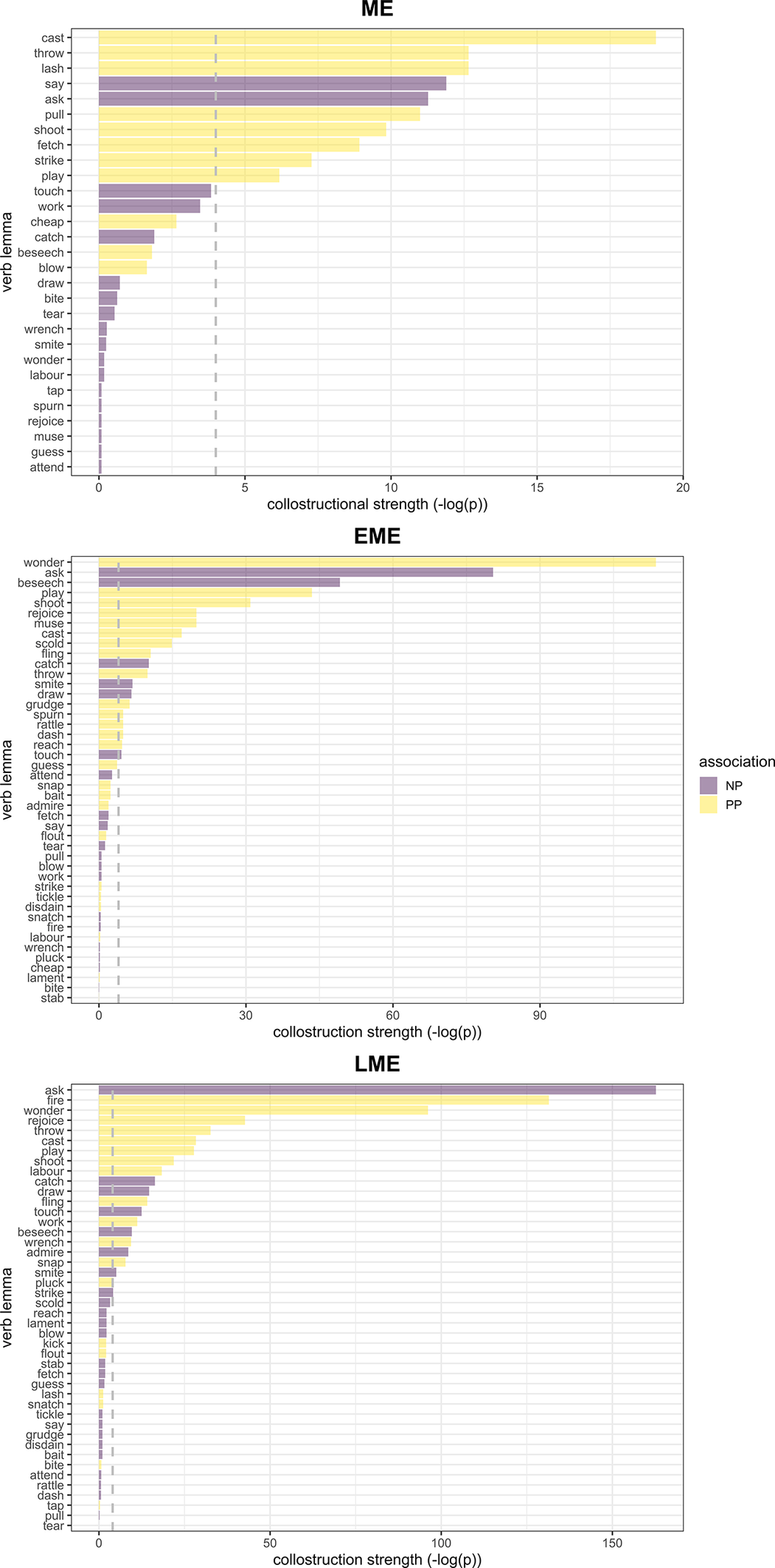
What can be seen in the figure is that the verbs most strongly associated with the NP-construction in all periods are verbs of communication (expressing ‘attention’ senses): ask is among the highest-ranked verbs for NP-expression in all periods, and beseech moves from higher PP-use to NP-preference over time. The communication verb say loses attraction to the NP-pattern from ME onwards; however, it should be noted here that the verb greatly drops in frequency in the alternation in general (a change that is likely connected to the by-now largely ungrammatical use of say in the double object construction, as in *say me one thing; cf. e.g. Colleman & De Clerck, Reference Colleman and De Clerck2011). Apart from communication verbs, the NP-pattern is rather stably used with the verbs catch, draw and touch as well as smite in later texts; while the first two of these express more ablative senses, the latter have an allative meaning. By comparison, the PP-construction appears as consistently biased towards allatives, in particular verbs of ballistic motion that denote throwing and shooting events (e.g. cast, throw and shoot) – this preference seems to become even more pronounced over time (e.g. with new verbs like fire and fling being added to the group of PP-associated verbs). In addition, verbs to do with engaging with work tasks or games (e.g. work, labour or play) become more strongly drawn to the PP-pattern in later periods; the same goes for verbs to do with emotional reactions to external stimuli such as rejoice or wonder.
4.3. Mixed-effects logistic regression modelling
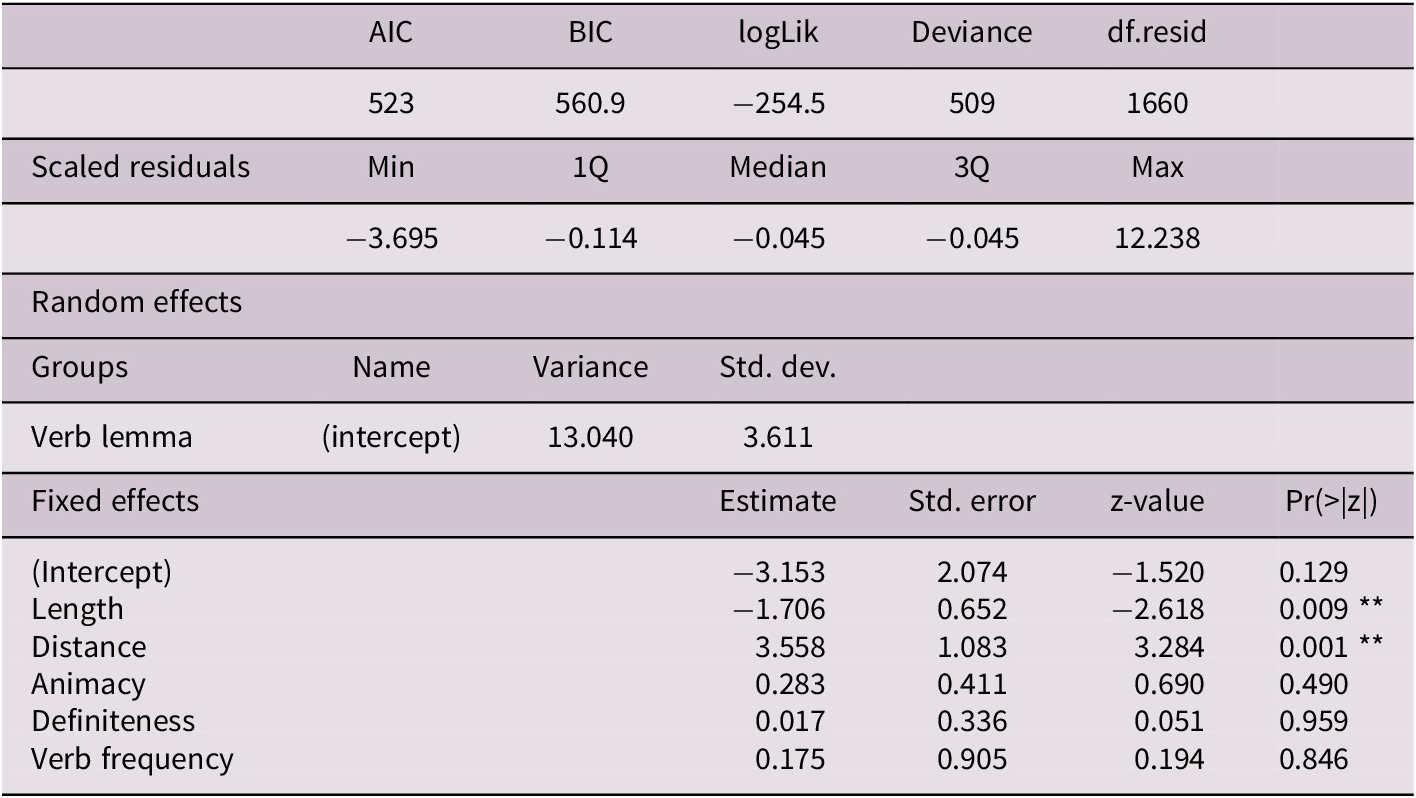
In the next step, the interplay between the high-level predictors, specifically between the complexity- or ambiguity-related factors, is tested by means of mixed-effects logistic regression modelling (Gelman & Hill, Reference Gelman and Hill2006; Levshina, Reference Levshina2015; Winter, Reference Winter2019). For the sake of comparability with the other approaches, three separate models are run here for the respective periods (but note that a single model with ‘period’ as an interaction term for the other predictors yields the same results). In the models presented below, the dependent variable is construction (NP vs PP), while complexity (length and distance), ambiguity features (animacy and definiteness), as well as verb lemma frequency, are used as fixed effects. Verb lemma is included as a random effect due to the high number of levels leading to convergence issues when included as a fixed effect (cf. Van de Velde & Pijpops, Reference Van de Velde and Pijpops2021). Insignificant predictors were not discarded from the model and no model comparison or selection was conducted (cf. Klavan & Schützler, Reference Klavan and Schützler2023; Tizón-Couto & Lorenz, Reference Tizón-Couto and Lorenz2021).
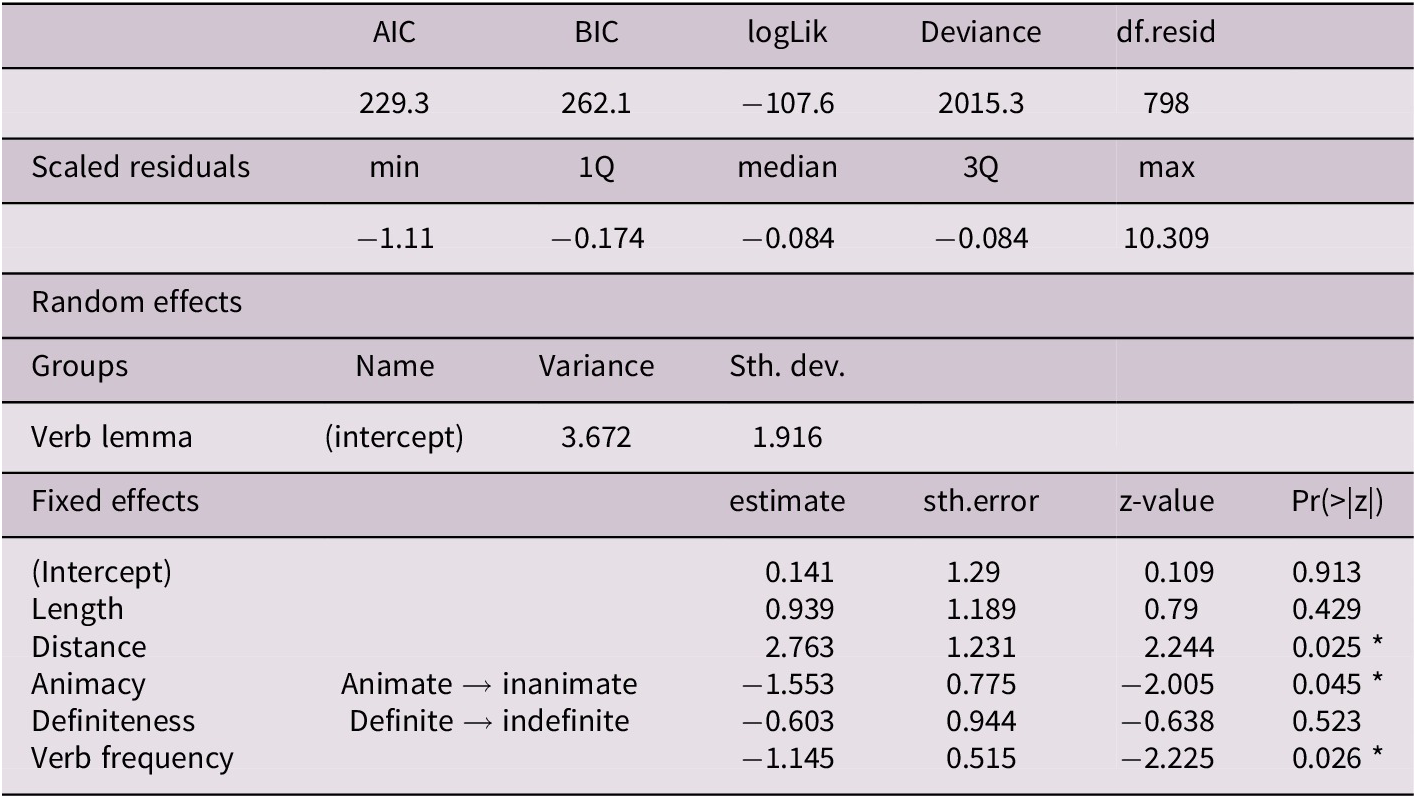
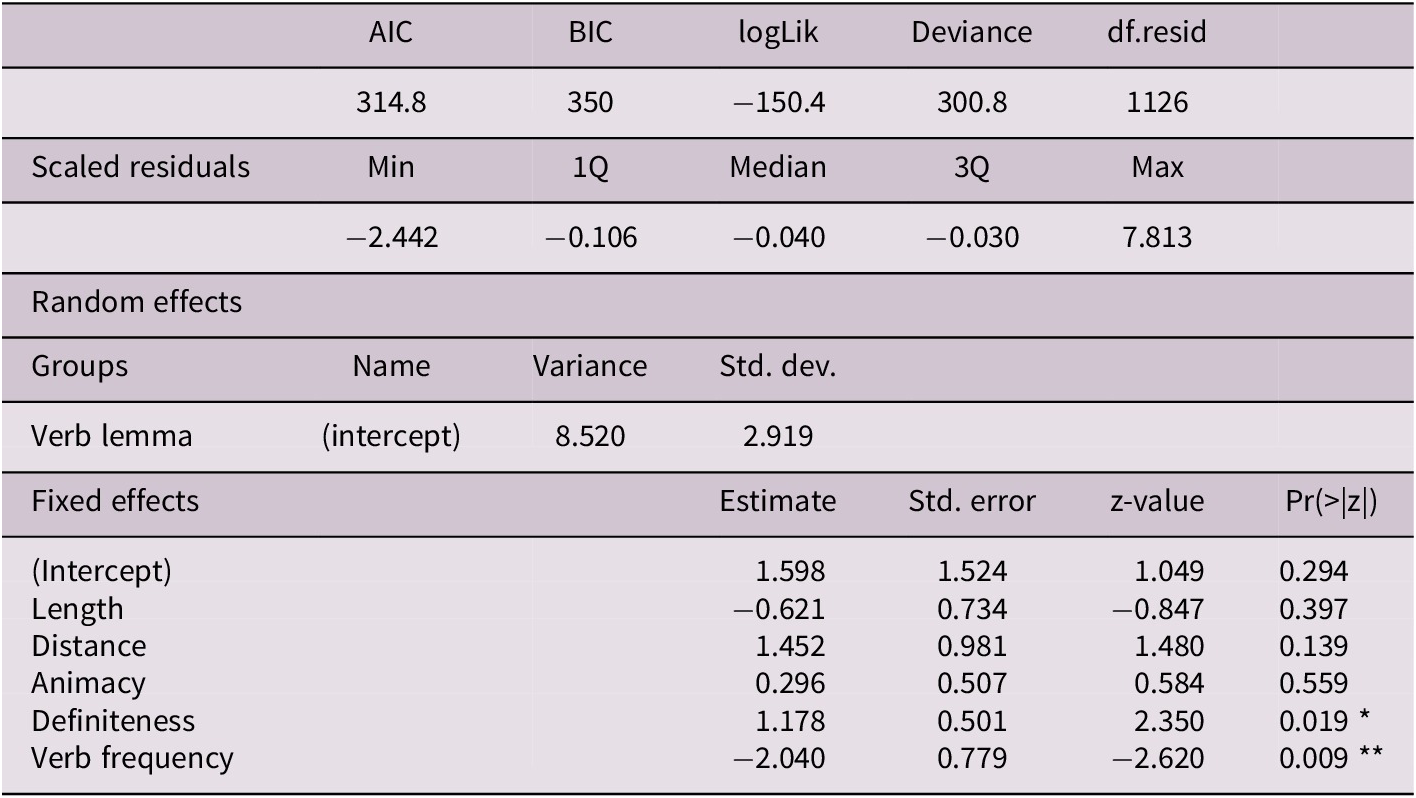
The results of the regressions are given in Figure 3 as well as Tables A4–A6 in the Appendix. As can be seen, in ME, greater distance is linked to greater odds for PP-use, while higher corpus frequency of a verb lemma correlates with higher NP-use, as does inanimacy of the theme in this period. The effects of all other predictors are non-significant in the ME model. Effects also seem to shift over time – while e.g. verb frequency still significantly and positively impacts NP-choice in EME, this is absent in the LME model. Distance between verb and theme does not significantly influence the alternation in EME, but re-emerges as a significant predictor in LME, with greater distances again triggering higher PP-use. A further change is the disappearance of animacy as a relevant factor after ME, whereas length only comes into play in the latest period, with NP-patterns being preferred with longer themes in LME. Finally, the probability of PP-patterns is higher with indefinite themes in EME, but not in the other periods.
Output of mixed-effects logistic regression models for NP- vs PP-choice in Middle English (left), Early Modern English (centre), and Late Modern English (right), showing the effects of (a) theme length in words (log10 scale), (b) distance between verb and theme in words (log10 scale), (c) theme animacy, (d) theme definiteness, and (e) corpus frequency of the verb lemmas (log10 scale). Significant effects are indicated by asterisks in the plots, following standard conventions (*p<0.05, **p<0.01, ***p<0.001).
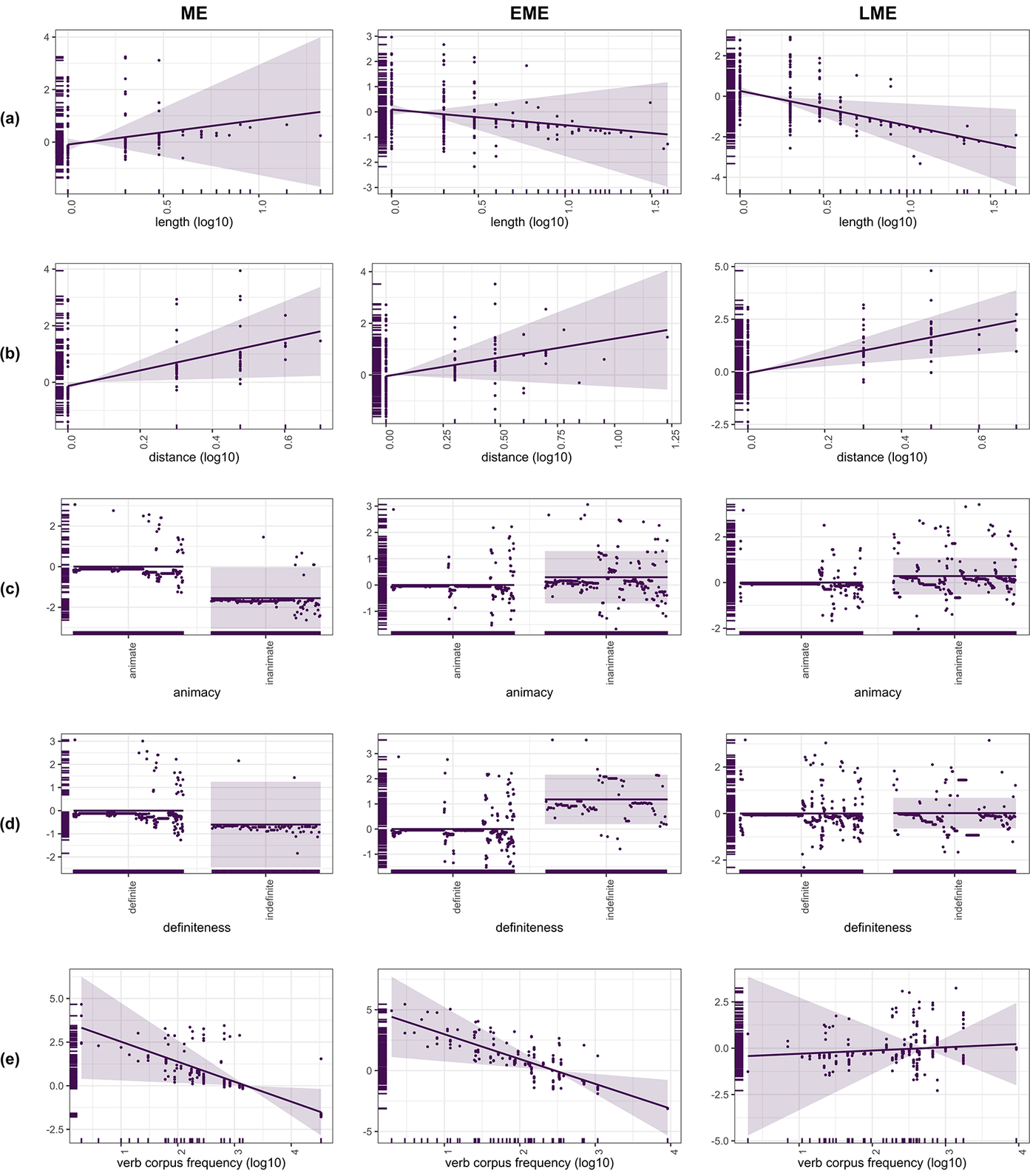
While some of these results are nicely in line with the expectations posited above, others do not fit predictions too well. In addition, although model fits (ME: C = 0.919; Somer’s Dxy = 0.838; EME: C = 0.982; Dxy = 0.964; LME: C = 0.969, Dxy = 0.937) and accuracies (ME: 96.65%; EME: 96.47%; LME: 94.9%) are high, importantly, variances of the random effects are also very high in all models (ME: variance = 3.672, std.dev = 1.916; EME: variance = 8.52, std.dev = 2.919; LME: variance = 13.04, std.dev = 3.611). This suggests that verb lemma has a strong influence throughout time and that the results here neither present the full picture nor are entirely reliable and robust. A method that is able to incorporate both high-level predictors as well as lexical effects in a balanced and unified way should therefore clearly be preferred: such a technique is, as already outlined above and as demonstrated in Sevenants et al. (Reference Sevenants, Van de Velde and Speelman2024), provided by elastic net regression. The outcome of applying this method to the present data is presented in the following section.
4.4. Elastic net regression modelling
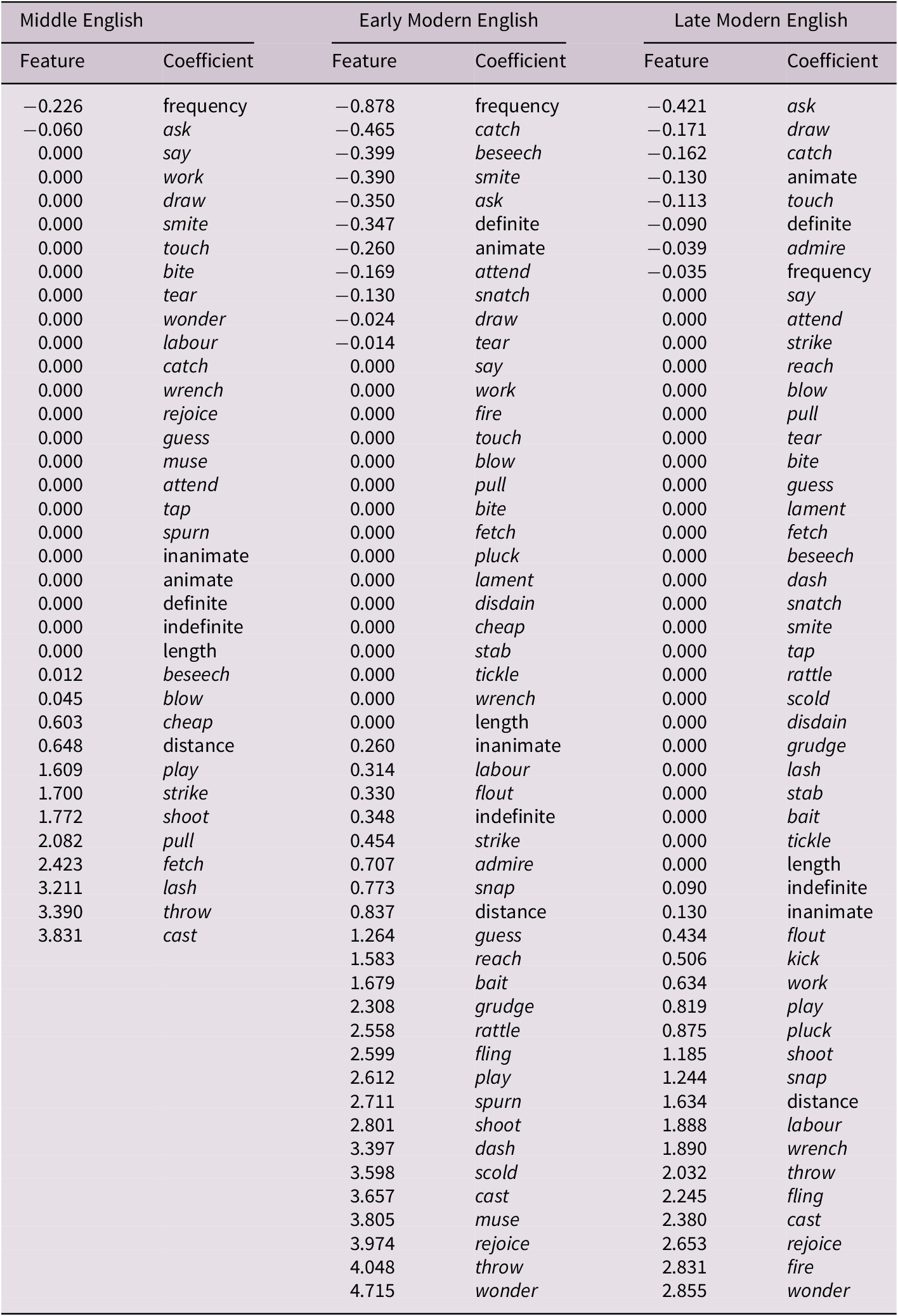
The set-up for the elastic net regressions more or less mirrors the logistic regression presented in the preceding section: separate models are again run for different periods, each including the predictors of theme length, verb-theme distance, theme animacy and theme definiteness, as well as verb lemma frequency. Different from the logistic regression, however, verb lemma is also included here as a main predictor, rather than as a random effect. Figure 4 (as well as Table A7 in the Appendix) presents the results of the three-period models with features (feature levels) and their coefficients: coefficients indicate whether a particular feature has an effect and which direction this effect has; for categorical factors, coefficients are given for each individual type or feature level (e.g. separate coefficients for the different verb lemmas). The best performance for the models is at alpha = 0.2 for ME and EME (among others) and alpha = 0.1 for LME, as automatically determined by ElasticToolsR (cf. Sevenants et al., Reference Sevenants, Van de Velde and Speelman2024 for a detailed discussion of the specific components of elastic net regression).Footnote 6
Output of elastic net regression models for NP- vs PP-choice in Middle English (top), Early Modern English (mid) and Late Modern English (bottom); features and feature levels associated with NP-use are in purple, those associated with PP-use in yellow, and removed (non-significant) features in green. The x-axis shows the coefficients of the features (negative values indicate NP-preference, positive values signal PP-bias).

Starting with lexical effects, it is then first noticeable that NP-expression is again strongly tied to verbs expressing communication or verbalising; specifically, the verb ask is the only verb prone to NP-use in ME and also features as one of the most tightly associated verbs to NP-patterns in the later periods, alongside beseech in EME. However, in later texts, further verbs not connected to communication or perception are likely to appear with nominal themes as well, including the ablative verbs catch, snatch and draw, in addition to touch and the allative smite. By contrast, PP-expression is associated with more verb lemmas throughout time, and coefficients are generally higher. Among the verbs which are most inclined towards PP-use in ME are allative verbs of ballistic motion such as shooting and throwing (including cast, throw, shoot and strike) or hitting (lash) but also ablative verbs like fetch or pull, as well as the verb play. These preferences seem to be stable over time, with further allative verbs like fling, fire or kick being added to the group of PP-prone verbs in EME and LME. Interestingly, later texts also show verbs expressing feelings or attitude like wonder, muse, rejoice, admire or grudge as closely associated with PP-expression.
With respect to higher-level predictors, the elastic net regression on the one hand indicates that higher verb lemma frequency increases the odds of NP-patterns being chosen throughout time (even if less strongly so in LME). On the other hand, the PP-construction is more likely when there is a greater distance between verb and theme. By contrast, length does not play a role in any period, and animacy (as well as definiteness) shows a surprising effect: while this factor is not retained in the ME model and thus does not seem to significantly impact the alternation, it is present in EME and LME, even if relatively weakly so. Specifically, animate (and definite) themes are more closely linked to NP-expression in the later periods, while inanimates (and indefinites) are more often used in PP-patterns (e.g. kick the dog/ ask the woman [a question] vs kick at a ball/ ask [a question] at a book).
In terms of comparison with the methods presented in Section 4.2, the lexical effects seen here largely overlap with the results of the collostructional analyses, with the highest ranking verbs for each pattern also emerging as relevant in the elastic net regression and indications for some shifts in verb and verb class associations over time. Likewise, it is encouraging that most of the factors found to be significantly impacting the choice in the logistic regression model, such as distance as well as verb frequency, persist when verb lemma is taken into account as a main predictor within the same model. Nevertheless, there are some differences with respect to the latter, in particular the absence of an animacy (and definiteness) effect in the earliest period compared to an effect, and especially one in the opposite direction, in later periods. In addition, length is not retained in any of the period models, while the logistic regression for LME showed it as significant.
In sum, the findings of the elastic net regression confirm a strong predominance of lexical effects in guiding the conative alternation. Nevertheless, complexity is also found to play a role. In the following sections, I briefly discuss the theoretical and methodological implications of these results (Section 5) and point out some limitations of the study as well as directions for further research (Section 6).
5. Discussion
5.1. Complexity effects
The results of the models presented in Section 4, in particular those of the elastic net regression, largely provide support for the hypotheses laid out above, while also opening up room for further questions. That is, the findings (i) confirm a general impact of processing complexity, in that contexts that require less cognitive effort, meaning instances with shorter verb-theme dependencies, are drawn towards NP-patterns. By contrast, greater distance between verb and argument in the clause (caused by intervening material like e.g. adverbs), representing a cognitively more complex context, triggers the use of the more explicit grammatical option, namely the PP-pattern (Klavan & Schützler, Reference Klavan and Schützler2023; Levshina, Reference Levshina2018; Pijpops et al., Reference Pijpops, Speelman, Grondelaers and Van de Velde2018; Rohdenburg, Reference Rohdenburg1996, Reference Rohdenburg2020). Hypothesis (iii) on verb frequency as a factor can, as mentioned above, also be subsumed under complexity effects – high-frequency verbs are more predictable and thus present a cognitively less demanding environment, leading to higher uses of nominal patterns, whereas PP-marking facilitates processing in more complex environments with low-frequency verbs (e.g. Bloem, Reference Bloem2021).
At the same time, theme length does not seem to play a role in the conative alternation: despite constituting a more complex environment, it can be argued that in conative constructions, the theme is typically in clause-late position anyway and that heaviness of the constituent is thus less relevant in this case than in e.g. the dative alternation (Bresnan et al., Reference Bresnan, Cueni, Nikitina, Baayen, Bouma, Kraemer and Zwarts2007). Furthermore, animacy and definiteness show mixed effects: NP-patterns tend towards animate/definite themes, while inanimates/indefinites are more prone to prepositional patterns, which goes against the assumption of ambiguation avoidance as a factor in this choice in a process similar to that motivating DOM in other languages (Haspelmath, Reference Haspelmath2021a, Reference Haspelmath2021b; Iemmolo, Reference Iemmolo2013). Importantly, this effect is not found in the earliest period, but only present in later texts, indicating change over time (hypothesis iv). That is, there is no evidence supporting the idea that PP-marking was preferred with animate/definite themes in order to reduce the cognitive costs of potential ambiguity between the protoyypically animate/definite subject and a likewise animate/definite object, and no evidence that such an effect was particularly strong in ME, when the increasing loss of case marking would have amplified the demand for a different strategy of argument disambiguation. The conative alternation thus seems to differ from other alternations in the history of English, where prepositional patterns saw a striking increase in the course of ME especially in ambiguous contexts, only to drop in frequency again once the system had ‘recovered’ by fixing word order and thereby making another disambiguation cue quasi-categorical (cf. also Zehentner, Reference Zehentner2022).
5.2. Lexical effects
In addition to confirming some impact of processing complexity, the results clearly support hypothesis (ii) on lexical biases and semantic differences between the constructions. The strong predilection of shooting and throwing verbs for PP-use throughout time can be related to the basics semantics of such verbs as well as the spatial origins of the preposition, directly instantiating the PP-construction’s presumed dominant meaning of ‘X directs action at Y’ (Goldberg, Reference Goldberg1995). Still, in later periods the PP-pattern is also tightly associated with more abstract notions of emoting such as wonder or rejoice, in which cases NP-uses are in fact rare or obsolete today (OED, s.v. wonder, rejoice). This may be taken as a sign of the preposition grammaticalising further and the entire PP-construction expanding in semantics over time, coming to cover more metaphorical senses (Sato, Reference Sato2009) or can be viewed as indicating the emergence of new, semantically different (sub-)patterns (Perek, Reference Perek, Glynn and Robinson2014, Reference Perek2015; Traugott & Trousdale, Reference Traugott and Trousdale2013).
By comparison, the main verbs that emerge as strongly associated with the NP-pattern in the analysis are verbs like ask or beseech; that is, communication verbs emerge as clearly biased towards NP-expression rather than PP-marking. However, verbs from other classes such as catch and draw (both denoting an ablative sense of motion in the direction of the agent) as well as allative smite (motion away from the agent and towards a theme) also come to select for NP-use in later times, which may suggest some shifts in constructional semantics here as well. We could tentatively interpret this as constructional alignment – with alternating patterns becoming more similar to each other (De Smet et al., Reference De Smet, D’hoedt, Fonteyn and Goethem2018). Still, the associations shown for the NP-pattern, together with the fact that there are more verb lemmas with a strong preference for the PP-variant throughout time, may also reflect a constructional frequency effect (Bloem, Reference Bloem2021, p. 138; Sevenants et al., Reference Sevenants, Van de Velde and Speelman2024): regular NP-objects are generally more frequent than PP-complements, which makes it harder for verbs to ‘stand out’ in nominal patterns. The prepositional conative is thus more lexically specific compared to the ‘default’ nominal transitive, and the changes in lexical preference seen with the PP-pattern are more conspicuous. This is also in line with PP-uses of some included verbs being more specialised than corresponding NP-patterns, cf. e.g. the combination play + at-PP now being linked specifically to participating in games as well as pretending as a game (as opposed to the rather diverse meaning of play + NP (OED, s.v. play).
The lexical differences between the PP- and NP-patterns highlighted here may also provide an explanation for the animacy/definiteness biases in the analysis as discussed above: rather than reflecting an impact of ambiguity (and accordingly complexity), the animacy/definiteness effects seen in EME and LME may be strongly linked to the preferred argument structure patterns of NP-biased verbs. For example, the communication verb ask is frequently used in ditransitive constructions of the type ask them a question, where the alternating object in fact expresses an addressee instead of a transitive theme. While such addressees can still vary between NP- and PP-marking in PDE, the former is by far the preferred option today (Zehentner, Reference Zehentner2019). The general predominance of animate (definite) objects in NP-patterns is then likely a consequence of addressees in communication events prototypically being animate and discourse-given, while both goals and targets of ballistic motion (as in shooting at a car) as well as stimuli of emotions (as in rejoice at the flowers) are often inanimate and new. In order to get a clearer picture of the conative alternation, it may therefore be necessary to restrict further investigations to transitive tokens only and to view variation between nominal ditransitives and two-place at-patterns as a sub-type of or phenomenon similar to the English dative alternation (Levin, Reference Levin1993).
Despite these differences, it should also be pointed out that a considerable proportion of verbs do not show any predilection for either of the variants; this may indicate that subtler contextual, verb-independent notions (e.g. success or failure of the action or degree of affectedness of the participant), not captured by the variables included in this study, are likely at play in this alternation as well. This is, of course, not surprising, but directly corresponds to the observations abundantly made in previous research on conatives (e.g. Beavers, Reference Beavers2010, Reference Beavers2011; Broccias, Reference Broccias, Andronis, Ball, Elston and Neuvel2001, Reference Broccias2003; Guerrero-Medina, Reference Guerrero-Medina, de Mendoza Ibáñez, Oyón and Pérez-Sobrino2017; Levin, Reference Levin1993; Perek, Reference Perek, Glynn and Robinson2014, Reference Perek2015; Perek & Lemmens, Reference Perek and Lemmens2010). Nevertheless, it also again confirms that the English conative alternation and its history differ considerably from other well-researched alternations such as the dative alternation, where high-level predictors like complexity and information structure have been shown to be equally influential as lexical and semantic factors, if not more so (e.g. Bresnan et al., Reference Bresnan, Cueni, Nikitina, Baayen, Bouma, Kraemer and Zwarts2007). A final caveat concerns verb frequency within the dataset: the fact that no frequency threshold was imposed in this study means that some verb lemmas with a low frequency in the dataset may not show significant attraction to either pattern merely due to insufficient data – although two low-frequency items (lash, muse) are retained in the present results, it cannot safely be inferred from these results whether other infrequent items really have no preference for either of the constructions.
5.3. Methodological implications
On a final methodological note, the output of the elastic net regressions presented in this study to a large extent overlaps with results gained from more standard methods such as collostructional analysis and mixed-effects logistic regression modelling, which is overall reassuring. Nevertheless, the elastic net regression models have also revealed important differences, especially compared to the logistic regression. Most strikingly, the animacy/definiteness effects shown in the latter – which would have confirmed one of the hypotheses posed in this paper – disappeared in the elastic net regression. The comparison has thus had a significant effect on the conclusions drawn about the history of the conative alternation, showcasing the benefits of being able to assess lexical effects and those of high-level predictors in a single model (Sevenants et al., Reference Sevenants, Van de Velde and Speelman2024) and to thereby obtain more refined and robust results. The combination of both lexical effects and higher-level predictors in one model – and evidence for both of these affecting syntactic variation – also has more general theoretical implications, in that it provides support for accounts arguing against a syntax-lexicon dichotomy, such as construction grammar (e.g. Goldberg, Reference Goldberg1995).
6. Conclusions
This paper has investigated the impact of different cognitive factors which are involved in a particular case of argument structure variation between a nominal pattern and a prepositional construction with at, namely the English conative alternation observable with verbs of impact such as hitting. More precisely, the study has zoomed in on the history of the alternation from ME to LME, using data from the standard corpora of historical English. Tracking the development of the alternation over time, the study has investigated different factors impacting the choice of prepositional over nominal patterns. On the one hand, these include variables grounded in Rohdenburg’s complexity principle (Reference Rohdenburg1996), which suggests that the more explicit option (in this case the PP-pattern) should be used in more complex, cognitively demanding environments, such as in instances with longer constituents or low-frequency verbs, or in potentially ambiguous contexts. On the other hand, the paper has assessed the role of lexical biases, in particular verb-related preferences. In order to explore the relative impact of these two groups of factors, the more standard methods of collostructional analysis and mixed-effects logistic regression modelling have been compared to a new model demonstrated in Sevenants et al. (Reference Sevenants, Van de Velde and Speelman2024), namely elastic net regression. The latter is particularly beneficial as it allows, among other things, to combine both lexical effects and high-level predictors such as argument length in a single, unified model.
Ultimately, the elastic net regression model has confirmed the important role of lexical effects throughout time and has suggested that the PP-pattern in particular may have lexically and semantically expanded over time. At the same time, results also show an impact of complexity, specifically of distance and verb frequency. Other effects are more mixed: in particular, ambiguity seems to have the opposite impact than what was expected. Overall, it thus seems that the conative alternation in general may be more lexically driven than other alternations like the English dative alternation. The influence of semantic-pragmatic factors likely at play in the alternation (such as success or failure of the action) as well as their historical development, however, remains unexplored.
Further limitations of the study and points for future investigations include the exclusion of additional potentially alternating patterns (with prepositions other than at). For example, PP-instances verbs of ingestion or the prototypical impact verbs hit and knock may be attested with different prepositions. On the other hand, the study has been more inclusive than others, mostly due to including ditransitive patterns in addition to transitive clauses. As additional objects in the clause also provide more options for order variation, which may, in turn, impact the factors at play and the direction of their influence, this factor needs to be revisited in more detail. Likewise, the paper has been very (potentially too) broad regarding the verbs included (also covering e.g. admire or rejoice, not typically counted as part of the conative alternation). In general, manual decisions on the interchangeability of the patterns are always subjective to some extent (especially when dealing with historical data), which may evidently skew results.
Funding statement
This study was funded by the Swiss National Science Foundation (Grant nr. 175987; Prepositions in English Argument Structure across Time and Space).
Data availability statement
The data and code for the present study can be accessed via OSF: https://osf.io/uzvtd/?view_only=adc1af91de6f49c4a2fbb335cb506d70.
Appendix
Distinctive collexeme analysis of verb lemmas, verb classes, and verb categories associated with NP vs PP patterns in Middle English
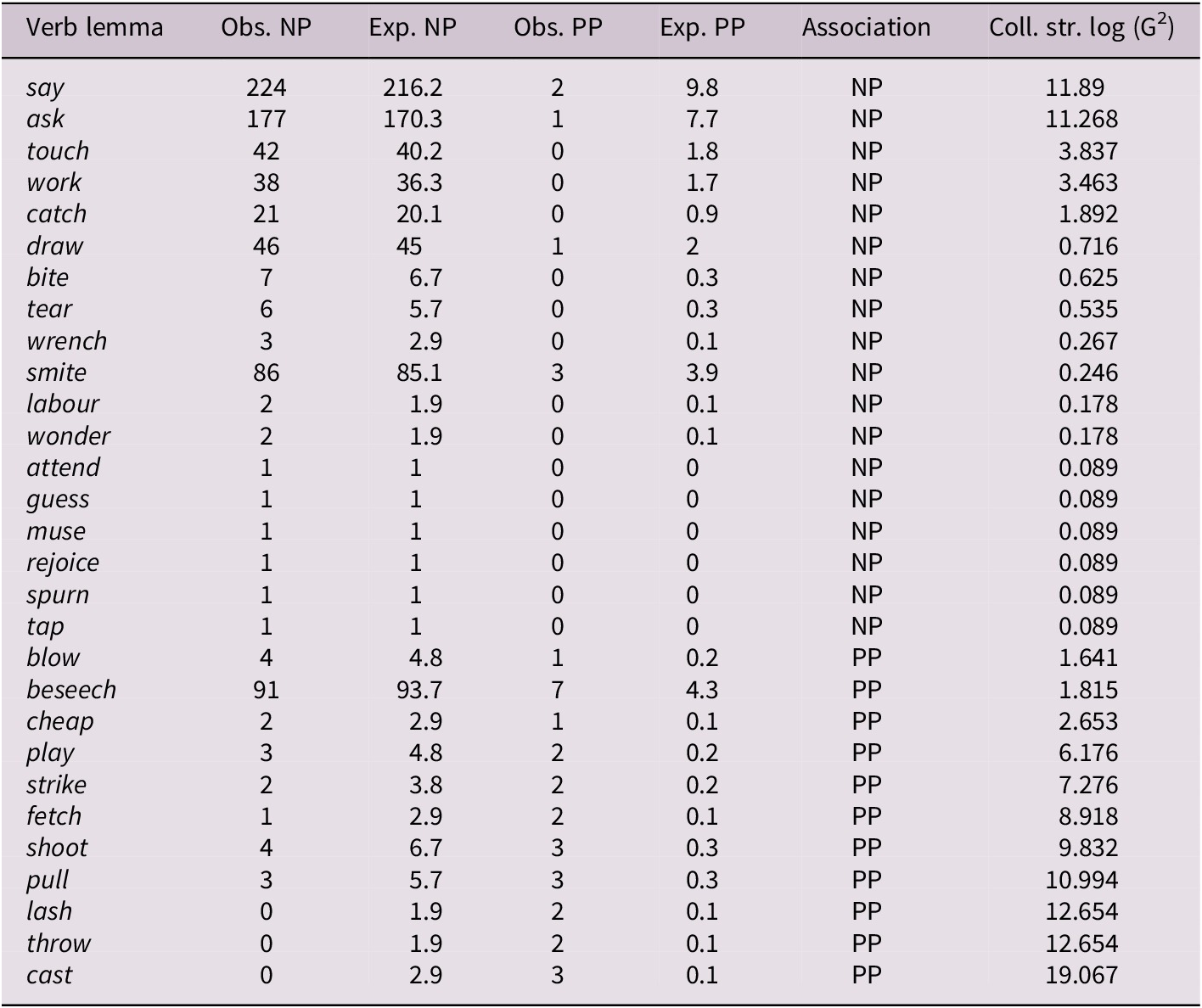
Distinctive collexeme analysis of verb lemmas, verb classes, and verb categories associated with NP vs PP patterns in Early Modern English

Distinctive collexeme analysis of verb lemmas, verb classes, and verb categories associated with NP vs PP patterns in Late Modern English
Output of a mixed-effects logistic regression model for NP/PP-choice in Middle English
Output of a mixed-effects logistic regression model for NP/PP-choice in Early Modern English
Output of a mixed-effects logistic regression model for NP/PP-choice in Late Modern English
Output of an elastic net regression model for NP vs PP-choice (features and coefficients) in Middle English, Early Modern English, and Late Modern English


 Open access

