




Introduction
Following the material turn in social sciences, the idea that human–object interactions are multidirectional and shape social processes across time and space is widely agreed upon across disciplines. One of the well-established analytical tools for tracking these webs of interactions and synthesizing them in unifying accounts is object biography. Since its original inception, on the disciplinary crossroads of social anthropology and ethnography, object biography – besides finding numerous applications in archaeology itself – has been widely theorized about and informed in accordance to the contributions of new materialist and post-humanist thinking (e.g. Kopytoff Reference Kopytoff and Appadurai1986; Gosden and Marshall Reference Gosden and Marshall1999; Fontijn Reference Fontijn2002; Meskell Reference Meskell2004; Joy Reference Joy2009; see also Bauer Reference Bauer2019 for an overview). Current approaches, best illustrated by the concept of object itineraries (Hahn and Weiss Reference Hahn and Weiss2013; Joyce and Gillespie Reference Joyce and Gillespie2015; see also Antczak and Beaudry Reference Antczak and Beaudry2019), engage in a discourse that favours matters of agency, movement and relationality, and adopt an updated ontological point of view that attempts to overcome some of the often-noted weaknesses of the biographical metaphor, especially the latter’s linearity and tendencies of anthropomorphizing material artefacts.
Object biographies and itineraries offer the potential to function as a means of intersection or intermediary links between material analyses and the public sphere. Object biographical perspectives encompass current understandings of materiality and illustrate the multi-layered diachronic relationships of dependence between things and people. At the same time, they place emphasis on the present entanglements of material culture elements, in relation to current socio-political or heritage frameworks. Moreover, the inherent narrative structure of the concept, the tangible physical attributes of the objects themselves and the familiarity of both biography and itinerary as metaphors render them relevant to a variety of museum practices and exhibition settings and encourage their incorporation in projects seeking public engagement (e.g. Hill Reference Hill2012). Their compatibility with such strategies does not by default determine their social reach and impact, however, and the present paper aims to explore how the creative merging of object biography and art can traverse the disciplinary confines of academic work and connect diverse audiences with the materiality of the past and present.
The capacity of archaeology to inspire a wide range of artistic forms and expressions is highlighted by a growing scholarly discussion (e.g. Renfrew Reference Renfrew2003; Bailey Reference Bailey, Russell and Cochrane2014, Reference Bailey2017; Russell and Cochrane Reference Russell and Cochrane2014). Creative arts and their applications in archaeology have been approached as experimental formats for communicating archaeological context and interpretations, as paths for obtaining innovative or alternative readings of archaeological data, or offering complementary perspectives to quantitative and qualitative results. The implementation of art in the public sphere has the potential to serve educational purposes but to also tread new ground, by stimulating public awareness for very real and relevant issues that transcend the limits of archaeological time.
What our paper aims to demonstrate is the pertinence of object biographical perspectives in this cross-disciplinary field. We introduce the concept of Creative Object Biography and, as such, explore the intersection of object biographical approaches and creative art, drawing attention to the opportunities offered by this integrative junction. Creative Object Biography developed out the Finds Stories project, a project that examines a variety of case studies of inter- and intra-Balkan mobility, from antiquity to the present, exploring their material and biological parameters and correlates from a biographical perspective. The case study that is presented here is drawn from modern pastoral transhumance, as practiced by the Vlach populations of northern Greece. The creative object biographies that function as the starting point for the proposed creative merge are three short films conceived and executed by the artist Zoe Katsilerou. The short films were inspired from the materiality of Vlach pastoralism, combining and re-interpreting the multiple diachronic entanglements of three everyday utilitarian objects. The creator incorporated and re-imagined the itineraries of the objects, from construction to their multiple phases of use, dis-use, and re-use, composing three visually, narratively and aesthetically distinct artistic works.
In order to contextualize Creative Object Biography in the ever-progressing discourse on object biography and materiality, we briefly summarize recent theoretical advances that constitute our frame of reference. We subsequently address how this experimental concept fits within the broader dialogue between archaeology and the wide spectrum of artistic expression and we outline the opportunities it offers for creating new pathways in human–object interactions, for constructing alternative imageries and narratives about materiality and the diversity of the human experience. We then turn to our case study, the Vlach pastoral transhumance, the objects and respective itineraries that provided the material basis for this venture, and then the creative products themselves. Our intention is ultimately not to coin a new term but rather to inspire further applications of this creative merge.
Studying human–object interaction. Biographies, itineraries, entanglement, and beyond
To use biographical terminology aptly, the birth of object biography can be placed in 1986, when The social life of things was published by A. Appadurai, containing I. Kopytoff’s (Reference Appadurai and Appadurai1986) contribution that would become one of the most influential publications in material culture studies. The idea that things, much as persons do, acquire their own social lives, from the moment they are manufactured to the moment they are discarded, represented a fresh interest of social sciences in material culture (see also Strathern Reference Strathern1988). Even in archaeological research, the rise of processualism set a trajectory – particularly in Anglo-Saxon scholarship –away from the individual artefact in itself (for a recent overview of this paradigm shift, see e.g. Hicks Reference Hicks, Hicks and Beaudry2010). Of course archaeology developed other methodologies for analysing the life-histories of artefacts that in some respects intersect with the biographical approach, most characteristic among them being the chaîne opératoire (Leroi-Gourhan Reference Leroi-Gourhan1964; see also Dobres Reference Dobres, Dobres and Hoffman1999), and the use-life and use-wear analyses (e.g. Keeley Reference Keeley1974; Grace Reference Grace1996). Object biography, nevertheless, became the first analytical tool to consider the full cycle of manufacture and circulation of objects, and identified the relationships developing between objects and humans as an integral part of the conversation.
Its compatibility with post-processual thinking resulted in its profound and lasting impact on archaeology, especially after its applicability in archaeological contexts was crystallized in the World archaeology issue ‘The Cultural Biography of Objects’ (Gosden and Marschall Reference Gosden and Marshall1999; see also Tilley Reference Tilley1996). Over the past three decades, theoretical discussions on materiality have focused increasingly on matters of agency, and the capacity of objects to actively, in association with human as well as non-human agents, affect the world around them (see among others Gell Reference Gell1998; Latour Reference Latour2005; Knappett and Malafouris Reference Knappett and Malafouris2008; Robb Reference Robb2010). Under the influence of new materialist thinking (Barad 2003; Reference Barad2007; Bennett 2005; Reference Bennett2010), the interconnectedness of objects and people, and the complexity of the webs their relations display, has restructured the discourse. Within this updated ontological framework, entanglement theory has emphasized the multidirectional relationships of dependence and dependency between things and people, or amongst things themselves (Hodder 2011; 2012; Reference Hodder2014), and scholars have conceptualized the relational connections between objects and humans as ‘meshworks’, with tangled pathways and knots, capturing their fluid and dynamic character (Ingold Reference Ingold2007a; Reference Ingold2011; Knappett Reference Knappett2011).
Object biographical approaches have accordingly been informed by the above shifts in the theoretical discourse on materiality. This is best illustrated by the analytical concept of object itineraries, which developed from two different but relevant starting points by Hahn and Weiss (Reference Hahn and Weiss2013) and Joyce and Gillespie (Reference Joyce and Gillespie2015; also Joyce Reference Joyce, Feigenbaum and Reist2012) in the course of the past decade. Object itineraries came to complement and amend aspects of the biographical metaphor that have long been criticized as inadequate on ontological grounds. These included the anthropocentric basis of biography as a whole, the misleading impression that objects have finite lives, with clearly defined beginnings and endings, and the fact that, similar to the biographies of people, object biographies are linear and descriptive, accumulating more and more elements with the passage of time. With regards to the latter, one could object that the most efficient way to present a person’s biography is not cumulative but selective in any case. More significantly, the efficiency of any metaphor lies exactly on its power to transcend literal language, and as such the widely criticized perceived finality of object biographical perspectives is a weakness that could have been overcome by nuanced analysis, without necessitating the re-formulation of the metaphorical terminology (see also commentary in Fontijn Reference Fontijn, Hahn and Weiss2013). That being said, the strength and fundamental contribution of object itinerary, as both a metaphorical device and a methodology, lies in its updated focus on movement (cf. Ingold Reference Ingold2007b), which is not conceived as linear and unidirectional.
Object itineraries moved beyond biographical conceptualizations of objects as static, and considered mobility not only literally, across physical space, but most importantly figuratively, as the meanings and entanglements of the objects transform with the passage of time and the social contexts they inhabit. This mobility is not conceived of as necessarily linear, and the model allows for its existence side by side with periods of rest or object inactivity. The itineraries offer the flexibility of focusing on specific segments of the routes across the webs of interactions and relationships, but also view these routes as open-ended, without pre-determined ending points. As such, the present entanglements of the objects, which in object biographical accounts would have been delegated to the objects’ afterlife, are not viewed as disconnected from those that formed in archaeological time. Current political, cultural or academic frameworks impact in direct and indirect ways how their past meanings are reconstructed and understood in the present (Hamilakis Reference Hamilakis1999).
From entanglement (Hodder Reference Hodder2012) to assemblage (Harris Reference Harris2014; Jervis Reference Jervis2019), and from correspondence (Ingold 2015; Reference Ingold2017) to the recently introduced ‘assemblage of practice approach’ (Antczak and Beaudry Reference Antczak and Beaudry2019), there is an abundance of different theories that focus on human–object interactions. All these theories individually or in synergy offer new insights into how humans interact with the material word, but the overarching discourse links them back where our approach began: whether object itinerary has a future that goes beyond re-discussing and expanding the object biographical discourse. The core of the issue here is that, if post-humanist approaches and all theorizations on materiality can address the same concerns as object itineraries, then what is the next step forward for the latter? Have object biography and its methodological successor outlived their usefulness? What is their current analytical value, and how can they be employed besides as captivating methodological exercises?
The Finds Stories project and the concept of creative object biography
The position the present paper adopts is a positive one. Both object biography and itinerary present the opportunity to zoom in on individual artefacts and deliver in-depth accounts that explore the complexities of agency or relationality, can tether discussions on personhood or identity, and offer nuanced bottom-up approaches to social and cultural phenomena. Exploring how objects themselves are in a constant state of becoming – deeply interconnected with the lives of humans and past and present social/political/economic realities – demonstrates how people and things cannot be fully understood unless examined in conjunction with each other, one affecting the other and transforming together as relationships change and shift. Post-humanist archaeological thinking can offer the theoretical and methodological grounds to accomplish very similar goals (Harris and Crellin Reference Harris, Crellin, Astor-Aguilera and Harvey2018; Crellin and Harris Reference Crellin and Harris2021), but individualized object itineraries have a more targeted character.
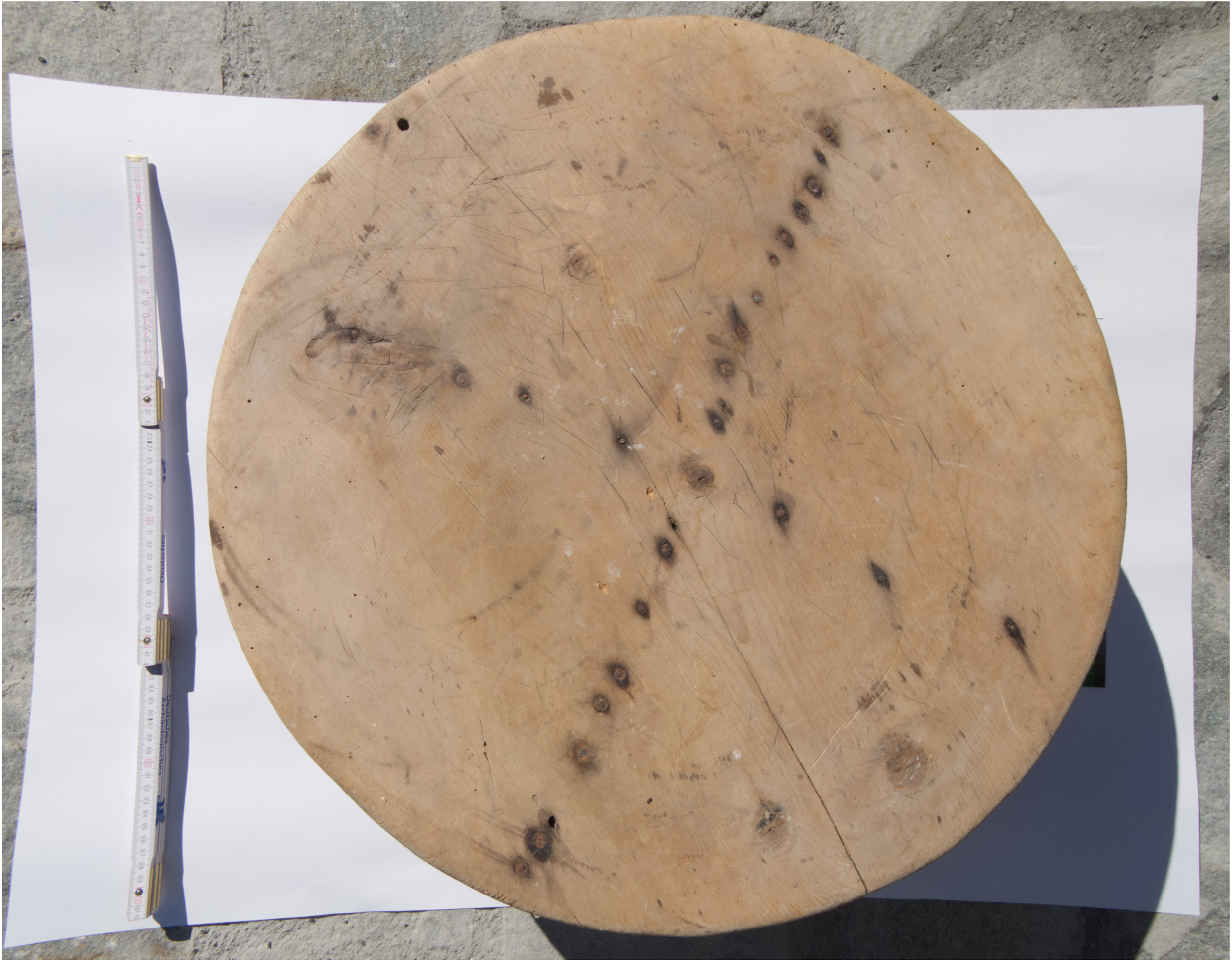
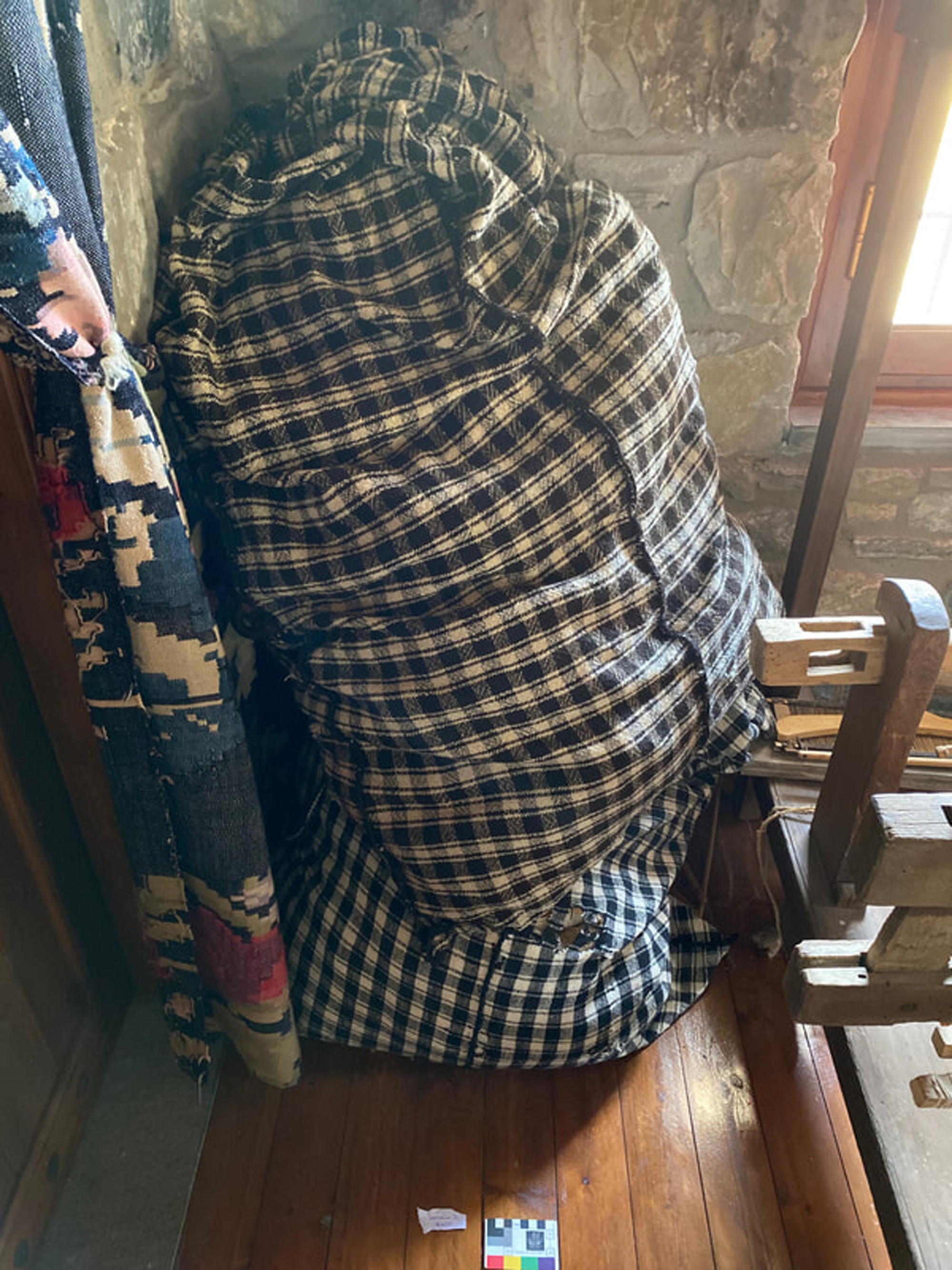
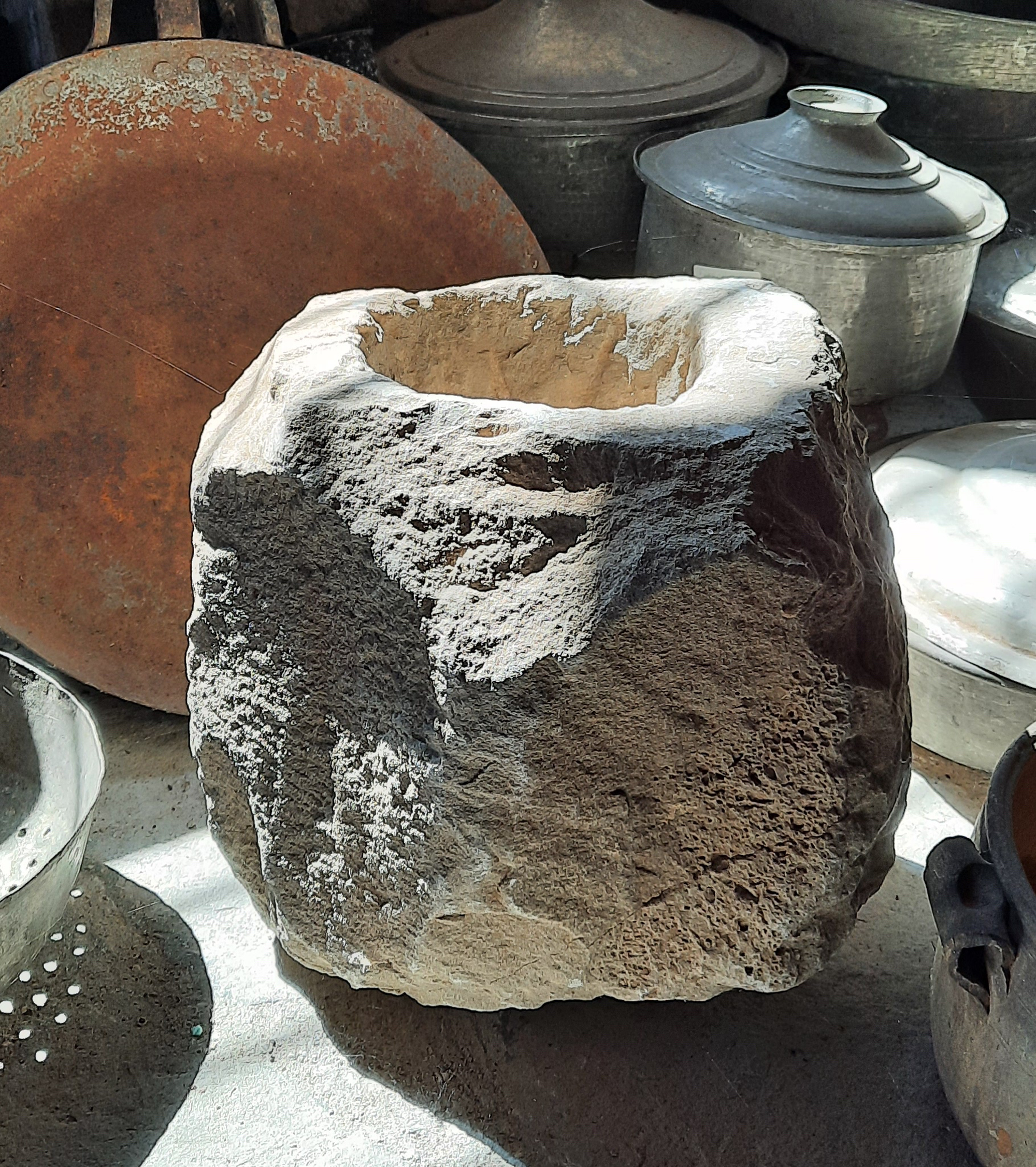
As a telling example we can look at the three objects that will be used in the following section our case study (Figs. 1–3): a low wooden table, a pair of woollen transportation sacks and a stone mortar, traditionally called sofras, haragia and doubeki, respectively, among the Vlach populations of northern Greece, where the Finds Stories project documented them. Finds Stories was an Erasmus+ Key Action 2 project with the aim to discuss mobility through biographical accounts of people and objects. Finds Stories had six case studies corresponding to different types of mobility and different periods of human activity in the Balkans. Three of the case studies are from present-day Croatia, and three are from Greece. The Croatian case studies range from Rača Cave on the island of Lastovo to the town of Sisak and the plains of Baranja. The case studies cover a period from the Late Neolithic to Late Antiquity and provide evidence for long- and short-term mobilities. The Greek case studies range from the Ionian Island of Kythera to the moving pastorals of Samarina and the contemporary sports mobilities on display at the YMCA Basketball Museum in Thessaloniki (for more about Finds Stories, see Trimmis et al. Reference Trimmis, Drnić, Brkić Drnić, Drnić, Trimmis and Brkić Drnić2023a). Regarding the objects that referred to the Samarina groups and are also the focal point of this paper, all objects can be typologically traced many centuries back, and have a wide distribution across the Balkans that were the point of interest of Finds Stories. None of the types is exclusively associated with populations practicing seasonal pastoral transhumance, but they are all characteristic of the materiality of the northern Greek Vlach communities. While the emergence of Vlach transhumant pastoralism did not depend upon the existence of any of these classes of artefacts, their entanglement is undeniable, and their meanings can only be understood in relational terms within specific spatial and temporal circumstances. The meaning of the individual objects similarly changes in association with the individuals that used and still use them, the social settings of their circulation and an ever-changing assemblage of other elements of material culture. The shifts in their meaning are inseparably tied to changes in what transhumant pastoralism is, within a specific historical and geographical horizon. Understanding the latter is not possible without situating the people who practice it within the broad meshwork of relational connections, within which the three objects are also integrated.
A sofras table, part of an ethnogrpahic collection recorded in Samarina, 2022.

Haragia, part of the Eleni Kazakou collection, in the typical black and white pattern of Samarina.

Toubeki, part of an ethnographic collection, recorded in Samarina, 2022.

A post-humanist approach on the materiality of Vlach communities as a whole, would demonstrate how material artefacts, transhumant pastoralism and the people behind it are in an ever-progressing state of becoming, similarly to a thorough analysis of the itinerary of the three everyday objects in question, albeit from a different scope and on a different scale. The strength of object itinerary, from the position we support in this paper, lies in the power of the metaphor to convey meaning in an easily approachable and very direct manner, and this is a potential that can be realized at its fullest and in the most impactful manner within the public sphere. Object itineraries allow the exploration of the materiality of the past, and the multitude of its entanglements, in the present. At the same time, they draw attention to contemporary issues through the lens of the past. The narrative aspect that is embedded in the concept of an itinerary, and the easily approachable nature of the metaphor, increase the reach of object itineraries as vehicles for engaging diverse audiences, not as passive recipients of academic knowledge but rather as active participants in the webs of relationships that feed into these narratives. They can convey nuanced insights into wider and complicated phenomena, stimulating the imaginary and fostering the subjective but personal connection of individuals with tangible elements of the past. The current object biographical discourse, though, opens two additional areas of discussion. The first has to do with the fact that object biographical accounts are usually produced by a researcher or a team of people who are specialists on the topic and apply a specific methodological approach. Hence the produced account may capture different meanings and relational connections an object can have during its ‘lifetime’ or ‘journey’ depending on whether the output is outlined as a biography or an itinerary. The second area of discussion is on the consumption of the account itself. As mentioned in the introduction of this paper, object biographies/itineraries are utilized in heritage education and community engagement as mediums to communicate stories based on tangible assets. However, the biography/itinerary that is usually shared is the output of a certain group of disciplinary specialists that might occasionally be distant from the audience.
These were core points in the methodological planning and execution of the Finds Stories project, and guided the conceptualization of the Creative Object Biography. Finds Stories explores the multiple impacts of mobilities in an ‘epistemic’ way. In the discourse of Finds Stories, ‘epistemic’ means summing up the knowledge we have about an event to define the possibility that such an event can be reproduced in the future, and likewise the communication needs of such a possibility (Trimmis et al. Reference Trimmis, Drnić, Brkić Drnić, Drnić, Trimmis and Brkić Drnić2023a, 9). We see epistemic as a way to reflect transdisciplinary approaches, but also as a way to encapsulate existing knowledge that is not related to science, such as knowledge that comes from the people who migrate and creative interpretations of the migration experience. Finds Stories, then, is about creating an epistemic methodological framework to explore the impact of different mobilities. To achieve this, Finds Stories brought together applications from biological anthropology (studying the physical effects on moving people), material culture studies (studying the interaction between objects and people during mobility), landscape anthropology (the impact on the environment), archaeological practise (as a methodological toolbox) and creative art (as a third research paradigm – art as a metanarrative). You can see Trimmis et al. (Reference Trimmis, Drnić, Brkić Drnić, Drnić, Trimmis and Brkić Drnić2023a) for an introduction to the Finds Stories theoretical framework and all case studies in Drnić et al. (Reference Drnić, Trimmis and Brkić Drnić2023) volume for examples of how this was applied in the project.
The experimental concept of creative object biography, as grown from Finds Stories, introduces the idea that the involvement of the artist in the process of creating and communicating object itineraries profoundly reshapes and enhances the interaction with materiality for specialists and non-specialists alike. The use of the itinerary of an artefact as an inspiration for art at a first level results in another knot in the meshwork of relations the object is dynamically entangled in. Depending on the form of the artistic work, artists can develop their own connections with the objects’ materiality, and the creative process itself is a field in which performative and material relations are formed (see discussions in Jones and Cochrane Reference Jones and Cochrane2018). As highlighted by the collaborating artists contributing to the Finds Stories project, the objects presented new possibilities in relation to the shapes, shadows, lines, curves, speed, density and intention of the drawn elements, movements or sounds. Through a creative interpretation of their qualities and textures, objects could propose new forms, imagine new narratives and suggest new lives both to the creative contributors and to themselves. The creative process shapes new routes for an object to traverse as a non-human agent, by giving a fresh, imaginative and artistic shape to some of the past and present segments of its itinerary in the degree they affect the creator. As such, creative art emerges as a medium that facilitates a connection with emotion and the senses, providing a completely different field for experiencing and contextualizing materiality. Creative art brings to the table a diverse pool of methods, media and narrative tools for engaging with the objects, embracing subjectivity and promoting non-traditional and non-formal ways of experiencing and understanding the complexity of the objects’ multiple entanglements. Nevertheless, the need for treating an object biography/itinerary, and to that extent a creative object biography, as a research case study, rather than a mere theme for creating any sort of artwork, should not be underestimated. Therefore, it would seem rather useful and relevant for a creative practitioner/artist to possess a clear understanding of the structure, meaning and purpose of an object itinerary, and the archaeological theory underpinning it, so as to generate meaningful outcomes. This can be achieved either through relevant formal education on the part of the artist, or through close collaboration between the two disciplinary agents.
This approach, situated on the intersection of contemporary art and archaeology, is not on its own a new idea. Professionals active in public archaeology and museology have long been concerned with communicating archaeological information to non-specialists through multiple resources and rendering it relevant to the public (e.g. Hill Reference Hill2012). Within the academic field, the collaboration between archaeologists and artists is represented by a consistently growing body of scholarship focusing on pushing the discipline beyond its traditional boundaries. It is also associated with the current orientation of post-humanist studies in archaeology towards bringing attention to emotional and sensorial parameters (Harris and Sørensen Reference Harris and Sørensen2010; Hamilakis 2013; Reference Hamilakis2017), and is tied to perspectives viewing archaeological research as a cultural product situated in the present (Shanks and McGuire Reference Shanks and McGuire1996; Hamilakis Reference Hamilakis1999). A substantial number of projects have initiated collaborations with contemporary artists (see papers in Renfrew, Brodie and Hills Reference Renfrew, Brodie and Hills2004, esp. Callery Reference Callery, Renfrew, Gosden and DeMarrais2004). Renfrew’s Figuring it out. The parallel visions of artists and archaeologists (Reference Renfrew2003) was certainly one of the key publications that contributed to the building of momentum of this interdisciplinary merging, adding to studies defining and exploring the premise of art/archaeology (Bailey 2014; Reference Bailey2017; see also Ingold Reference Ingold2013). The range of employed media formats extends from creative writing and storytelling – shown to offer complementary perspectives to archaeological narratives (Praetzellis Reference Praetzellis1998; Joyce Reference Joyce2002), photography (Shanks Reference Shanks and Molyneaux1997) and two- or three-dimensional art (Hansen Reference Hansen2008; Bailey et al. Reference Bailey, Navarro and Moreira2020) – to performance and drama, which have been experimentally employed in alternative ways of presenting or understanding the past in archaeological practice and teaching (Pearson and Shanks Reference Pearson and Shanks2001; Shanks Reference Shanks2004; Trimmis and Kalogirou Reference Trimmis and Kalogirou2018). Performative research has in fact been described as the ‘third research paradigm’, capable of producing meaning and new conceptualizations of the past (Seitz Reference Seitz, Even and Schewe2016; for applications in archaeology see Trimmis and Kalogirou Reference Trimmis and Kalogirou2018).
Within this framework, the concept of creative object biography proposed here marks one more step in the direction of seeking alternative ways of explaining and engaging the past – a past that on its own does not exist but is instead an interpretation of physical remains, taking place within the cultural context of the present. Creative Object Biography aims to move the discourse beyond the academic limitations of composing ‘objective’ narratives about the past, relying on factual syntheses of archaeological data and the articulation of pieces of evidence into meaningful accounts. It aims to overcome the authoritarian voice of scientific language and the restraints imposed by readable text on how the narratives of individual object itineraries can be presented and consumed by the wider public. In line with other current approaches, creative object biography concentrates on involving contemporary art not in terms of aesthetics but as creative way of exploring and communicating alternative narratives and modes of presentation that can stimulate a multi-sensory critical engagement with objects, phenomena and ideas, as they are conceptualized in the present. It experiments with a different method of connecting with the materiality of the past, without focusing on getting a specific explanatory construct across.
Through the work of the creative artists, the object itineraries, as re-constructed by the material culture specialists, are revisited and integrated in new narratives. The segments of these itineraries that resonate with or affect the creative contributor more are ‘disarticulated and repurposed’ (Bailey Reference Bailey2017), utilized to produce new imageries. Through them authority is transferred to the viewer to form their own understanding of the many meanings of things and the people they were entangled with. The evocative and immersive character of creative art has the capacity to elicit different responses from the spectators, to initiate new, individualized and personal experiences of the past entanglements of the objects. It opens up the negotiation of their meanings, allowing the viewers to form sensorial connections with the objects – both the original artefact that provided the inspiration and the produced artistic work. Audiences can, thus, partake in the itineraries of the objects in ways that are variously enriched by their own memories, feelings and backgrounds. Creative object biography, as a work of the present, acts as a political, and cultural comment, and the process opens the discourse to diverse audiences (cf. discussion in González-Ruibal Reference González-Ruibal2008 on the archaeology of the contemporary past). It functions as a vehicle for multiplying the impact of discussions on materiality, by rendering them relevant to current social issues, and promotes inclusivity, by encompassing marginalized voices and groups.
A case study from the Greek pastoral transhumant communities
One of the studied cases of inter- and intra-Balkan mobility that Finds Stories focused on was that of the transhumant communities of Greek western Macedonia and Thessaly, with an emphasis on how seasonal mobility impacts the groups moving from the lowlands to the mountains. This impact was assessed through a combination of people and object biographical accounts. During the campaigns of 2021 and 2022, the Finds Stories team recorded more than 110 objects from the transhumance groups related with the Vlach communities of Samarina area in the Grevena region and composed their itineraries. The material documentation was supported by the local community, which contributed through open-ended questionnaires and accompanying oral testimonies. The three aforementioned objects – a sofras (low table), a pair of haragia (woollen sacks), and a doubeki (stone mortar) – were the subject of creative object biographies. The creative outcomes varied from interpretations of the object functions and their entanglement with humans and the natural environment to works that embraced free subconscious associations, related to past events in the artist’ s life, family memories and historical events. All three creative biographies are blurring the line between the seemingly insignificant manifestations of the everyday and that of history, contemporary archaeology and ethnography.
A quick look at the historical and socio-economic parameters of Vlach pastoralism is a first step in contextualizing the three objects under examination. The Vlach communities of Samarina and more broadly the Aromanian Vlach communities of modern Greek Macedonia and Thessaly form part of a large and heterogeneous group of peoples geographically spread across the Balkans (Winnifrith Reference Winnifrith1987). With the risk of oversimplifying a multidimensional phenomenon, diachronically shared cultural elements of the Vlach populations include the spoken Eastern Romance language of Latin descent, the adherence to pastoralism as an economic strategy and way of life, and the Orthodox Christian denomination. Their history across the Balkans chronologically transcends the Byzantine and Ottoman empires (Nitsiakos Reference Nitsiakos1985, 13–30), but scholarship is to a great degree divided by the fragmentation imposed by modern political borders. While a detailed analysis on the topic lies outside the scope of this paper, it is significant to note that modern Vlach history is fraught with controversies and biases resulting from the way Vlach identity was intertwined with the emergence of nation-state political agendas in the Balkans during the decline of the Ottoman empire and long-standing majority-focused identity politics, promoting assimilation into a homogeneous national cultural narrative within the different nation-states.
For centuries, the Vlachs of northern Greece, including the communities of Samarina that our three objects originate from, practiced long-distance seasonal transhumance (for an ethnographic overview, see Koukoudis Reference Koukoudis2003). Vlach pastoralism peaked in the Ottoman empire, especially between the 16th and the 18th centuries, when the modern-day Vlach villages were formed. Some of them, owing to their strategic military and economic position, emerged as prominent regional centres, and Vlach involvement in long-distance inland trade networks flourished, benefitting from the difficulty of the Ottoman economy to adapt to the penetration of capitalism (Nitsiakos Reference Nitsiakos1985, 27–28). While a small portion of the Vlach communities emerged from sedentary mixed-farming components (see e.g. Dasoulas Reference Dasoulas2019 for the Vlachs of Metsovo), livestock breeding diachronically constituted the backbone of the majority of Vlach economies and transhumance was instrumental in defining Vlach group identity. It must be noted, though, that treating the Vlach-speaking populations of northern Greece as an ethnic minority is a sensitive and politically charged matter, due to the integral role of Vlach initiative in the Greek revolution of independence in the 19th century and the conflation of Greek nationality and ethnicity in the modern Greek historical and political discourse (Karakasidou Reference Karakasidou1993; Nitsiakos Reference Nitsiakos and Dimadis2007). The combination of these two factors has resulted in the dominant self-identification of the Vlachs of northern Greece as a segment of Hellenism with distinct cultural heritage, rather than an ethnic minority, unlike other Vlach-speaking populations in the Balkans (Tanner Reference Tanner2004, 201–216).
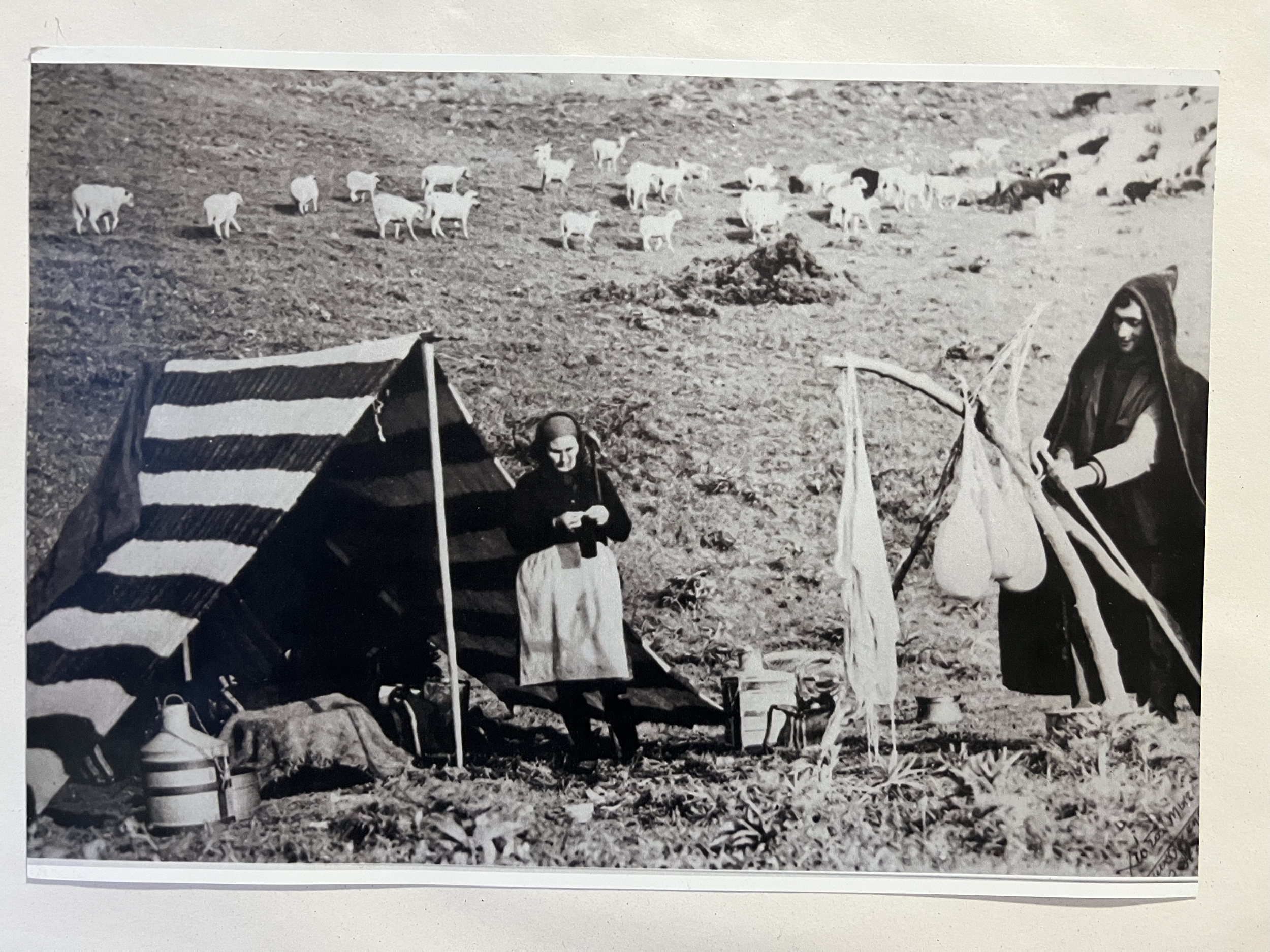
The Vlach communities of Samarina traditionally moved along with their flocks from highland summer residences in the mountainous area of Grevena to low-land winter pastures and villages (himadia) in the Thessalian plain during winter (Wace and Thompson Reference Wace and Thompson1914; Sivignon Reference Sivignon1968; Trimmis et al. Reference Trimmis, Perdikopoulou, Marini, Fernée, Drnić, Trimmis and Brkić Drnić2023b). The journey (diava or strata) towards the plains started in late September or early October, and the move back to the uplands took place in late spring, during the month of May. In the course of the journey, the shepherds, flocks, and accompanying family members followed a predetermined route and made stops in specific localities frequented for generations (konakia; Fig. 4). During this laborious process of descending to the plains and returning to the mountains, families carried their entire households, on foot and on animals. With the increasing accessibility to motorized transportation, trucks started assisting to the transfer of household possessions and family members for the entirety of the journey or part of it. The use of vehicles for the transportation of animals, on the other hand, is a practice that was introduced later on. With the increasing urbanization, the modernization of production, state intervention, and changing economic strategies, as well as climate change, the way transhumance is practiced by the Vlachs of Samarina has undergone significant changes. Since the third quarter of the 20th century, the Vlach communities have been extensively sedentarized, and the pastoral cycle, for those continuing to practice seasonal transhumance, has shifted, making the actual period of migration much shorter. Still, the return to the mountainous village of origin continues to be deemed crucial for maintaining group membership and reaffirming the shared heritage as transhumant pastoralists (Chang Reference Chang1993, 695–697).
Vlachs of Samarina at a konaki during the annual movement. Sofras is visible at the entrance of the tent ('tsantila') covered by a cloth. From Nikos Sioumkas collection.

The sofras, the haragia and the doubeki. Three interwoven itineraries
Before embarking on the Creative Object Biography, the itineraries of the three objects that function as the case study for this paper were reconstructed and composed in textual form. The itineraries were closely pursued by combining previous ethnographic research on Greek transhumant pastoralist life and tradition, material recording of the objects themselves and oral accounts given by their current owner (all three objects are property of the same individual), who kept them as part of a small private collection of Vlach traditional items. The itineraries were synthesized into 800–1000 word accounts, and were shared with the collaborating creative artist, alongside photographic and 3D documentation of the objects, and the audio recordings of the interviews. The itineraries of the three objects are presented here in a succinct manner for the sake of brevity (about itineraries of these objects, see also Trimmis et al. Reference Trimmis, Perdikopoulou, Marini, Fernée, Drnić, Trimmis and Brkić Drnić2023b).
Although the chronology of manufacture of the objects is imprecise, the manufacture of the sofras (low table) and the harágia (woollen sacks) can be narrowed down to the 1920s–1930s. Things are mdsdore unclear about the doubeki (mortar), as stone tools can have long cycles of use, and its manufacture could trace much earlier. All objects were handcrafted by locally sourced materials: the wood and stone for the table and mortar, respectively, would have been selected on the grounds of their strength and durability, while the procurement and processing of the wool for the sacks were embedded in an economic process (textile making) that constituted a pillar of Vlach village economies (Wace and Thompson Reference Wace and Thompson1914, 78–84, 119–120). The diachronic persistence of the objects in Vlach household assemblages can be best understood by approaching the utilitarian role they played in transhumant mobility strategies down to the previous century, their ties to perceptions of gender in the family and community setting, and by addressing the entanglement of transhumant material practices with the shaping of Vlach identities.
The sofras (plural: sofrades) as a type goes back to Ottoman tradition, and while in other sociocultural contexts its functions where spiritual as well as utilitarian (see Soileau Reference Soileau2012 for the sedentary Bektashi Muslim communities in the Balkans), the easily transportable nature of this table type in general rendered it an essential part of the moveable household items that accompanied the Vlach families during the period of winter transhumance and returned to their summer settlement of origin in the mountains. Its limited height, generally below 40 cm, further eliminated any need for additional seating arrangements that would require the transportation of more furniture. It constituted the main dining table during the seasonal move and provided a food preparation surface. Family members and kinsmen gathered around it for the evening meal in the tent, once the animals were herded into the folds for the night. The object was interconnected with constructing, negotiating, or retaining family and kinship dynamics, which held a prominent position within the Vlach community. It contributed to shaping the physical space where such dynamics could develop and be performed, by serving as a material focus for these social interactions to the degree that they intersected with food consumption.
Similarly to the sofras, the haragia were inseparably tied to the cycles of seasonal migration of the Vlach communities. They were used for transporting moveable goods along the diava, a function that at the same time created a tangible connection between the objects and the performance of the collective pastoralist identity. This connection was consciously appreciated by the community, as the haragia of each Vlach village bore distinct colour combinations (white and black for the Samarina Vlachs), providing physical signals of belonging. As wool-working and weaving were exclusively undertaken by women in the Vlach communities, the manufacture of the haragia was also entangled with perceptions of womanhood and the social capital of women, who were directly involved in the production of specialized goods that were important for the community’s economy as a whole (on textiles and gender see e.g. Brumfiel Reference Brumfiel2006; Øye Reference Øye2016) This is something emphasized by the owner of the haragia in the Finds Stories inventory, who talked with pride about her grandmother’s skill in the manufacture of the objects.
The third of the objects discussed here – the doubeki – was not part of the moveable gear involved in the seasonal transhumance, and instead was in use only in the periods of settlement. The mortar, made from an irregular block of limestone, was used for pounding grains with the use of elongated mallet-shaped tools. Mortars like this were placed outdoors, and for stability purposes were sunken in the soil. As glimpsed from the owner’s interview, poorer households did not own such mortars, and had to share mortars belonging to relatives or neighbours, showing that to a degree they functioned as status indicators. Much like the haragia, the doubeki was entangled with the gendered division of labour, as the processing of cereals among the Vlachs was predominantly a female task (for non-industrial societies see also Murdock and Provost Reference Murdock and Provost1973; Alonso Reference Alonso2019, 4320–4321). The performative nature of the use of the mortar, provided opportunities for social interaction and for the communication of female identities and family dynamics. It was also connected to shared cultural values around food consumption within the Vlach community (see e.g. Sutton Reference Sutton2001; Twiss Reference Twiss and Twiss2007).
All three objects went through long cycles of use, visible in signs of wear, repair or maintenance on their surfaces. They were passed down through members of the same family over three generations, reaching their current owner after they all went through phases of disuse. According to oral testimonies, including the items’ owner, these classes of artefacts continue to evoke aspects of the transhumant pastoralist ideology even after the movement from summer to winter pastures had been modernized, or access to industrially processed cereals became the rule. On weddings, for example, sofrades are often placed in the main reception room of the house, bearing food and wine, commemorating or symbolically propagating the shared transhumant background heritage. However, in the most recent part of their itineraries all three of the individual objects were removed from the household setting and became part of their owner’s private folk collection. Their utilitarian character along with their links to family relations have been replaced by a focus on their capacity to function as imagery of a past and cultural heritage that the owner bears an attachment to. They are maintained in good condition and are primarily appreciated for their quality as exhibition pieces. As part of this private collection, they are engaged with by a number of visitors. In lack of accompanying museological planning, though, the full range of implications of the objects’ entanglements are not easily accessible to a wider visiting audience that may connect with them at different levels, depending on their background, sense of self-identification or level of education.
The creative object biographies of the three objects
The above outlined itineraries, reconstructed from material, historical, anthropological and ethnoarchaeological sources, were shared with the collaborating creative artist, Zoe Katsilerou, a UK-based choreographer, performer and musician as part of the Finds Stories project. It was used as inspiration for three short films incorporating screen dance, music, narrations and acting, and polyphonic vocals. The creator was able to use the primary data and research material freely, drawing from the aspects of the objects’ itineraries and the practices and relationships they were and are embedded in, in ways that resonated with their creative work. Throughout the creative process the contributor stayed in communication and collaboration with the material culture specialists of the project, visited Samarina during fieldwork and was introduced to the analytical concept and methodological parameters of object itinerary, but was not expected to adhere to any research-dictated explanatory construct.
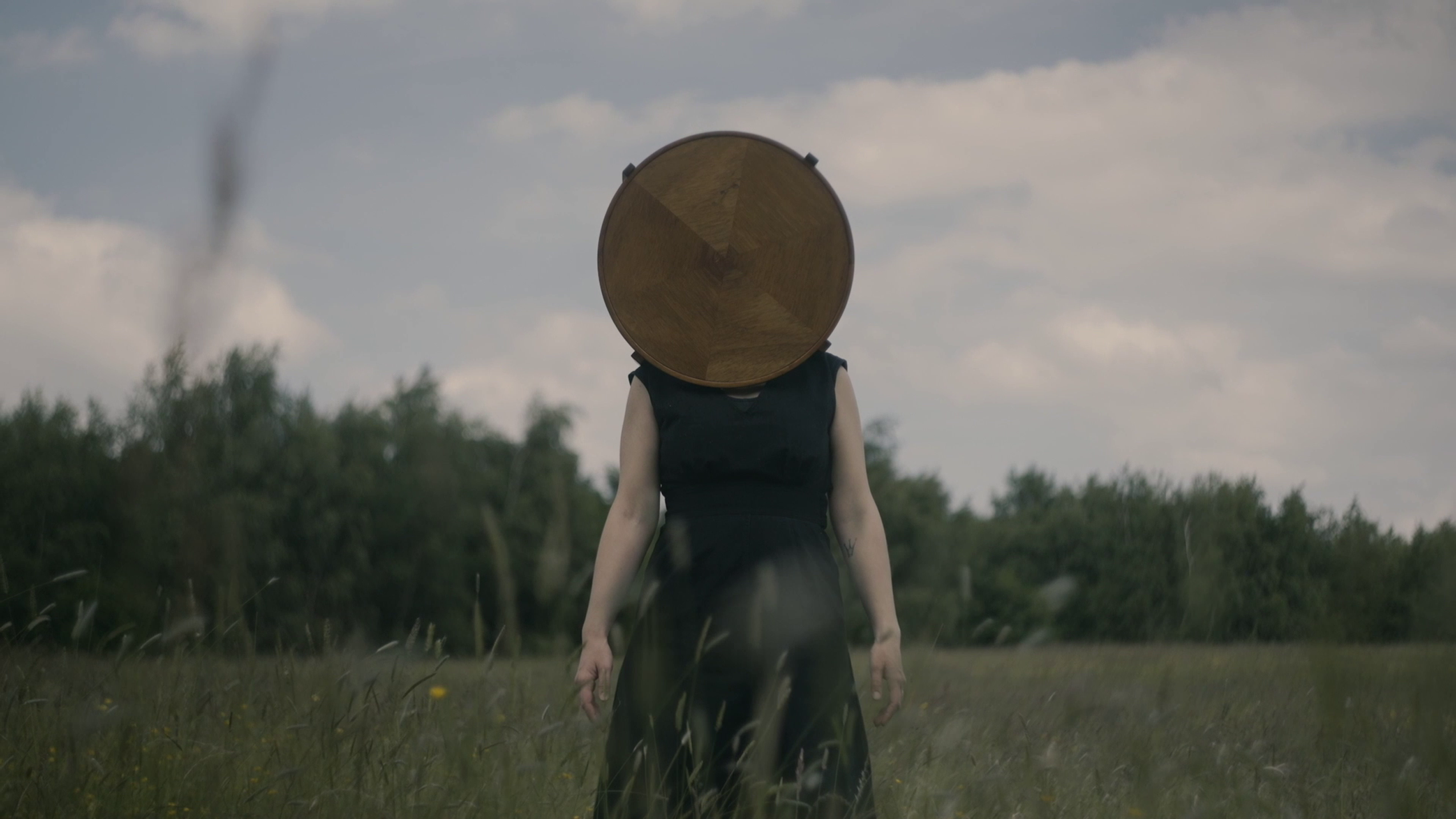
In creating the film inspired by the sofras, the artist drew inspiration from and attention to the contrast between the constant movement of the Vlach population and the stability offered by something like a table (Fig. 1). The filming was conducted in outdoor settings, and it involved experimentation with movements such as walking, rolling and climbing trees; everyday movements that would have been prevalent within these communities, whilst maintaining a sense of grounding offered by an object such as a table. The dance is intended to reflect on all these notions, and echoes the sensitivities of spending time outdoors, moving through nature, listening, smelling, touching and feeling (Fig. 5). The sound world of this film includes the call of the Cretzschmar bird, or Skourovlahos. Building on the call of this bird, we hear a polyphonic melody reminiscent of the messy polyphonic melodies sung by Vlach populations of the Pindus mountains (Kahl Reference Kahl, Ahmedaja and Haid2008). Gently sitting in relationship to a 7/8 tempo played on the traditional Greek instrument daouli (a double-headed suspended cylindrical drum played with mallets) by percussionist Eilon Morris, with loose melodic movements, the vocals aim to maintain a sense of communal, outdoor singing, directly responding to the environment (bird song) and the landscape.
A still from the SOFRAS film. The table is now indicate the identity of the people they carrying it. Concept and performance by Z. Katsilerou.

The ending of the film aims to draw attention to the fragility of these populations in terms of maintaining their cultural heritage and language, and the gradual withering of the Vlach transhumant pastoralist lifestyle over time, as also reflected in the present itinerary of the object that inspired the artistic work. SOFRAS is a screen dance project exploring motion, stability, harmony and dissonance light and darkness in relationship to the natural environment and a round wooden structure. It thus incorporates and re-interprets elements of the itinerary of the sofras, associated with the cultural performance of the object within the context of the Vlach pastoral transhumance and its entanglement with social practices and group identities within the communities, and also considers its itinerary in the present, at a time of shifting lifestyles and socioeconomic realities.
The HARAGIA film, inspired by the haragia sacs, draws the viewer’s attention onto the context and everyday circumstances of the women that made them and reflects on the artists personal experiences of being a woman and becoming a mother. In this work, the artist reflects on the significance of women’s labour and the impact patriarchy has had on their position in western, modern society. Through her personal experience of being a working mother, most of the time without childcare, she used everyday experiences, such as being interviewed for a job, to highlight differences in perception around raising a baby, mothers’ invisible labour (breastfeeding, rocking a baby to sleep) and working expectations between men and women. In HARAGIA the artist uses fragments of one interview that Finds Stories team did with a Vlach woman in Samarina, Eleni Kazakou, to create a fictional dialogue between a Vlach woman and a male interviewee whose intonation suggests an advantageous position. In the Vlach society males are the dominant part, while the women are traditionally focused on household duties and childcare. However, their struggles to manage a household on the move every year very often are unnoticed by the anthropological research that is focused on the pastorals and the herds. The head scarf and gloves in the video are created by a fabric with almost identical a pattern to the haragia sacks. Wearing them so close and tight to her skin, they represent the intensity of female labour in the Vlach community and the inescapable nature of their everyday activities. Sitting in between a humorous old Greek movie and a corporate interview, HARAGIA, subtly reflects on the contrasts between the ways women are often expected to present themselves, and the maternal, interpersonal, generational and historical realities they carry. Equally, the video showcased the difficulties that women had to overcome while being on the diava managing their children and being responsible for the household.
DOUBEKI is a celebration of the multiplicity of Vlach women who, from a very young age, dedicate their lives to nourishing their families. The object that inspired this work is a stone mortar used for pounding grain called doubeki. Using a doubeki and its movement qualities as a starting point, the artist tries to imagine her grandmother’s life from its beginning. The artist’s grandmother Nitsa was a Vlach from the mountains of Trikala. She spoke Vlachika as her mother tongue and learnt Greek at school that she attended for two years. Following these two years of basic education, Nitsa spent her days supporting her family with the preparation of food. Through layering meditative sequences of movement and sounds, the artists try to imagine her at a young age learning the everyday demands of her family life; at an adult age, dreaming of her future; and at an older age reflectively continuing with the manual labour. The grandmother’s imagined biography draws from the object’s literal biography as an object that is stable but women that worked with it growing around and in relation to the object. The collective dance at the end shows the importance of the doubeki for the community. Women may have used it, but the whole family are benefitted by the food that is being produced through the doubeki.
SOFRAS is available to be viewed at (https://vimeo.com/user117115987). HARAGIA can be viewed at (https://vimeo.com/manage/videos/892231390), and DOUBEKI can be viewed at https://www.youtube.com/watch?v=b6YnBs2CUXg).
Conclusion
All three creative biographies on the objects under study highlighted the different readings that the itinerary of an object can offer, both for the role of the object for a societal group and for the people that are engaging with the object during its cycle of circulation and use. Creative biographies achieve that third paradigm for archaeological and anthropological research that have been highlighted by Trimmis and Kalogirou (Reference Trimmis and Kalogirou2018), where creative arts are not just useful for the delivery of qualitative and quantitative research to wider audiences but can also complement established approaches with performative analysis. The Finds Stories team quantitively recorded the object and qualitatively combined the ethnographic interviews with material culture analysis to address the materiality of the object. But it was Zoe Katsilerou’s creative biographies who brought the objects into their actual context, presenting and bodily analysing elements of object entanglement that research methodological parameters did not encompass, such as the relationship between the table and the traditional music of the area under study, or the complex relationships that women build with the material culture of the domestic context, as in the case of the haragia and the doubeki.
Ethnographic data as well as the examination of the objects themselves outline the importance of them as a utilitarian object for a group practicing pastoral transhumance, that is moving through demanding terrains and is in need of a small and versatile surface for food preparation and consumption, such as the sofras table; sacks to move their equipment; and permanent food preparation objects at the place of seasonal residence, such as the doubeki. The equally significant involvement of these objects in social practice, with their importance as heirlooms for the current owner or as a point for family congregation permeates the presented itinerary. What a biographical or itinerary approach falls short of communicating is the full depth of the objects’ relationships. It misses the mountains and the rivers that objects have crossed, the bodies that sat or lay next to sofras or carried the haragia, the pleasure of the sofras at the end of a demanding day, the stories that people shared around this table and even the homework that the children had to complete on it. Similarly, non-creative/performative research paradigms are difficult to associate with non-tangible assets of a context that are equally deeply entangled with the objects’ lifecycle. These for example can be sensorially or kinaesthetically perceived assets that connected with an object (e.g. music, sounds, language, taste, smells, perceptions, ways of handling the object). Therefore, it is methodologically useful to treat a creative object biography as a research base study for an object’s lifecycle, rather than a distinct and disconnected artwork. Anecdotally, we showed the SOFRAS and DOUBEKI films to members of the Vlach community of Samarina side by side with the written object biographical accounts, and the locals regarded the films as biographical accounts that corresponded better to their memories, with their music, landscapes, kinesiology and movement close to their practices. Equally, they understood the written accounts as recordings of the objects but not as ‘biographies’ of them – meaning the interaction that objects had with the people.
Creative object biography, as introduced and defined in the present paper, can function as a tool for restructuring or creating afresh individual or collective interactions with past objects, values and experiences. With the contribution of creative art, it is possible to convey alternative stories and accounts on diachronic matters, including and by no means limited to migration, war, (post)colonialism, technological or climate change. In a poignant way art thus functions as an interdisciplinary mediator for contextualizing the itineraries of objects, and through them not only aspects of material culture but also the societies, events, landscapes and the people that shaped them, over wide social, political and geographical horizons in the long term, by generating a personal and individualized connections to the objects themselves.
Creative object biography exponentially expands the scope of how materiality can be conceptualized and engaged with, by utilizing creative visual metaphors, multi-sensory interactions and storytelling in novel ways. Creative art, in its many forms and facets, is not treated as a tool deployed to pursue quantifiable research targets and to test interpretational hypotheses, nor as a vehicle for conveying bounded research results faster or more efficiently to wider audiences. While there is nothing wrong with either, the experimental angle proposed here introduces art as an outlet towards a less conventional or formal engagement with objects and the complexities of their entanglements, one that embraces subjectivity and creates space for deliberation and new understandings of objects and their social contexts, pushing beyond academic narratives and the restrains of archaeological reconstructions.
Acknowledgments
Authors would like to thank all the people of Samarina, Greece, who supported the study and, especially, Ioannis Lygouras, Lakis and Sofia Avellas, and Ioannis Anthoulis.
Funding statement
Finds Stories was funded by the EU Erasmus+ Key Action 2 scheme (grant number 2020-1-UK01-KA201-079065).
Author contribution
Konstantinos P. Trimmis: Conceptualization, Investigation, funding acquisition, writing – original draft and supervision as the Finds Stories PI. Christina Marini: Investigation and writing – original draft. Zoe Katsilerou: Investigation, visualizations and writing – original draft. Maria Marinou: Investigation and writing – original draft. Konstanza Kapsali, Kristina Brkić-Drnić, Melina Perdikopoulou, Valentina Soumintoub: Investigation. Eleftheria Theodoroudi, Ivan Drnić, Lita Tzortzopoulou-Gregory: Investigation and resources. Christianne Fernée: Investigation and project administration. Konstantina Kalogirou: Funding acquisition, resources and project administration.

 Open access

